



Abstract
This article investigates spontaneous volunteering during the social crisis referred to as the “European 2015 refugee crisis.” The situation was politically controversial and the vacuum in humanitarian aid was filled by civil society, including large numbers of spontaneous volunteers (SVs). Based on empirical research, we analyzed the responses and the experiences of SVs working under the auspices of civil society organizations and derived management implications. The findings show that the environment of spontaneous volunteering in social crises differs from that in natural disaster situations. SVs partly substitute official response systems and this results in a high degree of self-organization. Thus, “structured self-organization,” that is finding a suitable complementary relationship between self-organization and coordination, is crucial for the efficiency of SVs’ work, and their satisfaction, well-being, and commitment. Structured self-organization requires (a) fluid structures that enable autonomy, (b) orienting framework conditions, and (c) resources for care and coordination.
Keywords
Introduction
The main goals of this study are to analyze the experiences of spontaneous volunteering under the auspices of civil society organizations (CSOs) in a social crisis and to deduce implications for the management of spontaneous volunteers (SVs). Spontaneous volunteering is a form of volunteering in which volunteers arrive at a scene of sudden needs, caused by a crisis, in an unplanned, spontaneous, and ad hoc mode.
In 2015, Europe was confronted with high numbers of refugees. In this situation, which was widely framed as a “European 2015 refugee crisis” (Greussing & Boomgaarden, 2017), public authorities were overburdened. The resulting humanitarian vacuum was largely filled by civil society, including large numbers of SVs.
More than one million persons arrived in the last two quarters of the year 2015 in Europe by the Mediterranean Sea (https://data2.unhcr.org/en/situations/mediterranean). Between September 5 and mid-December 2015, 600,000 so-called “transit” refugees passed through Austria, a country with 8.6 million inhabitants (Simsa, 2017, p. 80). Depending on the decisions of the governments in neighboring countries, people arrived often unanticipated, and often in large groups. Public authorities were hardly able or willing to cope with the situation (Simsa, 2017). As in other European countries, there was a surge in civil society activities by traditional CSOs, new self-organized groups, and by individuals, filling the gap between the perceived need and the official response of governmental organizations (Stallings & Quarantelli, 1985). Accordingly, volunteering increased significantly. Many CSOs had to deal with large numbers of SVs who joined impulsively because of newscasts or social media requests for help.
In general, the literature shows that individualistic forms of volunteering are becoming more important, and organizational attachments are weakening (Cnaan & Handy, 2005; Dunn, Chambers, & Hyde, 2015; Hustinx, 2005, 2010b; Macduff, 2005). New forms of self-organized volunteering are gaining importance. These phenomena—captured as “a transition from ‘traditional,’ ‘classical’ and ‘old’ to ‘modern’ or ‘new’” forms of volunteering (Hustinx & Lammertyn, 2003, p. 167)—have been studied widely. Volunteering is thus becoming more reflexive (Hustinx & Lammertyn, 2003), individualistic (Eckstein, 2001), and focused on specific projects or times (Hustinx, 2010a; Meijs & Hoogstad, 2001). As a consequence, volunteer management has to deal with more episodic volunteering (Cnaan & Handy, 2005; Dunn et al., 2015; Kirsch, Hume, & Jalandoni, 2000; Macduff, 2005; McCurley & Ellis, 2003), reduced volunteer availability, higher turnover rates, and higher costs (Hyde, Dunn, Bax, & Chambers, 2016).
Spontaneous volunteering, in contrast, has not yet been intensively studied and most literature does not refer to social crises. Most research regarding SV refers to natural disasters (Harris, Shaw, Scully, Smith, & Hieke, 2017). The purpose of this article is to fill this gap in knowledge. We argue that spontaneous volunteering during social crises poses specific challenges to volunteers and CSOs.
The article is organized as follows: Based on a literature review on spontaneous volunteering, the goals and the research design and the findings are presented. It then proceeds to discuss challenges of spontaneous volunteering in social crises and the implications for the management, and ends with conclusions and limitations.
Literature Review: Spontaneous Volunteering
Spontaneous volunteering is an impulsive and unplanned type of volunteering. It occurs as a response to suddenly rising needs in crises and disaster situations, characterized by turbulent environments and often short-term increases in the number of volunteers (Harris et al., 2017; Whittaker, McLennan, & Handmer, 2015). SVs usually have no previous affiliations with CSOs (Cottrell, 2010; Drabek & McEntire, 2003; Kulik, Arnon, & Dolev, 2016) and are therefore also referred to as “convergent,” “walk-in,” “emergent,” or “unaffiliated” volunteers (Harris et al., 2017). Most authors include both formal activities in CSOs and informal activities on an individual basis (Harris et al., 2017; Lavine & Thompson, 2004; Whittaker et al., 2015). Shaskolsky (1967) identifies different types of formal and informal volunteers in disaster situations. He calls SVs working with organizations, as “spontaneous organisation volunteers” and differentiates four subgroups: those who (a) help a regular disaster organization; (b) formally create an ad hoc organization for dealing with the circumstances of the specific disaster; (c) use their pre-existing non-disaster organization for disaster work; or (d) carry out disaster-related tasks within a loose, informal network. (Whittaker et al., 2015, p. 361)
Research on volunteer management tends to focus on the motivations, satisfaction, commitment, and retention of volunteers (e.g., Barnes & Sharpe, 2009; Cnaan & Cascio, 1998; Cuskelly, Taylor, Hoye, & Darcy, 2006; Garner & Garner, 2011; Hyde et al., 2016; Kulik et al., 2016; Locke, Ellis, & Smith, 2003; van Schie, Güntert, Oostlander, & Wehner, 2015). Yet these challenges are not the main concern in the case of spontaneous volunteering, and not all of the suggested management process steps are applicable (Whittaker et al., 2015). Spontaneous volunteering is difficult to anticipate (Clary & Snyder, 1991; Snyder & Omoto, 2008), and therefore, it blurs the boundaries between the well-established concepts of volunteering. Lassiter, Khademi, and Taaffe (2015) conclude that it “appears as though there is not a study that considers volunteer management with uncertain task demands in a dynamic setting” (p. 99).
The existing models of volunteer management, classified by Brudney and Meijs (2014) into universalistic and more conditional approaches, do not cover the topic of managing SVs sufficiently. Some of the conditional management models (e.g., Meijs & Hoogstad, 2001) implicate how to deal with short-term episodic volunteers, or how to manage “serendipitous volunteer programs,” which often are more coordinated than managed (Macduff, Netting, & O’Connor, 2009, p. 413) and require participative decision making and collaboratively designed volunteer duties (Brudney & Meijs, 2014). Other authors like Barnes and Sharpe (2009) also suggest a more collaborative management approach that emphasizes informality, flexibility, and autonomy of volunteers to foster volunteering and citizen engagement. Nevertheless, none of these models provide explicit guidance for the management of SVs and its challenges.
Moreover, existing empirical research on SVs refers to natural disaster situations such as earthquakes and floods (Britton, 1991; Harris et al., 2017; Kim & Jung, 2016; Kulik et al., 2016; Lassiter et al., 2015; Twigg & Mosel, 2017) or on “ . . . technological hazards in politically stable countries” (Twigg & Mosel, 2017, p. 454). These disasters usually have a “low point” where “the worst that is going to happen has already occurred” (Baum, Fleming, & Davidson, 1983). Furthermore, in contrast to dissensus types of crisis with contrasting views of their nature and adequate means to resolve them (Stallings, 1973), in natural disasters, usually there is societal and political consensus to help, which becomes apparent in the “agreement on the meaning of the situation, the norms and values that are appropriate, and priorities that should be followed” (Quarantelli & Dynes, 1977, p. 23). Although, official response systems, consisting of established procedures and organizational networks (Stallings & Quarantelli, 1985; Waugh & Streib, 2006), cannot meet all needs (Harris et al., 2017), they usually assume the main responsibility for coping with the situation.
In such situations, the crucial challenges for the management of SVs are matching “their desired tasks or skill levels, to best help the affected population” (Lassiter et al., 2015) and retaining the SVs. Harris et al. (2017) investigated SV in flood episodes and argue that this management is characterized by an inherent involvement/exclusion paradox, which refers to “helpers wanting to be involved, juxtaposed with pressures for managers to exclude them” (p. 354). Spontaneous volunteering thus not only adds resources in times of need but also implies risks to the volunteers, to the clients, or to the disaster organizations (Fernandez, Barbera, & van Dorp, 2006). Nonetheless, sending SVs away is difficult; it might decrease future community resilience or increase independent actions by uncoordinated volunteers. Other authors also have argued that official response systems often are wary about SVs’ involvement. SVs may cause insecurity, as their qualifications and motives are unknown, and they might be an obstacle to effective disaster response (Barsky, Trainor, Torres, & Aguirre, 2007; Britton, 1991). They rarely have specialized training or relevant expertise (Drabek & McEntire, 2003). Hence, Harris et al. (2017) name the following main challenges for volunteer managers during natural disasters: communicating with SVs, maintaining links with SVs, prioritizing the tasks of SVs, incorporating SVs, keeping SVs motivated during standby, and finally the risks to SVs as well as the costs for insurance, equipment, and reputational risk. They suggest “five principles for involving SVs. 1. Anticipate convergence of SVs . . . 2. Avoid thinking that the only choices are to exclude or to incorporate SVs into the official response . . . 3. Be aware of the possible need for ‘surge capacity’ which cannot be met by ORs . . . 4. Consider community characteristics . . . 5. Manage SV expectations” (p. 367).
Even though these findings are helpful for SV management in social crises to some extent, social crises differ in various dimensions from natural disaster situations, such as trajectory, political context, response, and the role of SVs (see Table 1). Therefore, it remains open if these findings are fully applicable in other contexts.
Characteristics of Natural Disasters and Social Crises.

Source. Baum, Fleming, and Davidson (1983); Quarantelli (1988); Quarantelli and Dynes (1977); Stallings and Quarantelli (1985); Waugh and Streib (2006); own data.
Note. SV = spontaneous volunteer; CSO = civil society organization.
Goals of the Study
The study explores spontaneous volunteering in times of social crisis. Some SVs had been called by CSO, others come independently, and some worked with and under the auspices of a CSO. For our analysis, we focus on spontaneous organization volunteers (Shaskolsky, 1967), namely SVs who volunteered under the auspices of CSOs. Based on the identified research gap, we address the following questions:
What were the responses of SVs working under the auspices of CSOs during the refugee crisis?
How did SVs experience this form of volunteering?
This article contributes to an understanding of volunteering in a threefold way:
First, by empirically examining the specific and hitherto underresearched instances of spontaneous volunteering during social crises, it contributes to an understanding of the conceptual breadth of volunteering, and our findings complement the empirical picture. Second, the article contributes to an understanding of spontaneous volunteering under the auspices of CSOs during a social crisis by exploring crucial topics and challenges for SVs and their management. Third, we deduce implications for the management of spontaneous volunteering. We show how management can respond to the challenges of spontaneous volunteering during a social crisis.
Data and Method
This study is based on a research project 2 about the contribution of civil society during the refugee crisis in Austria (Simsa et al., 2016). The project examined different actors’ perceptions of civil society’s work. The authors conducted 57 interviews with formal and informal SVs, regular volunteers, volunteer coordinators, paid staff, CSO managers, representatives of public authorities, and refugees. Observation field notes and social media communication complemented the material.
For the present article, we concentrated on a sample of 42 problem-centered interviews (Witzel & Reiter, 2012) with SVs and managers, and three interviews with representatives of public authorities. Table 2 shows the characteristics of our sample.
Sample Description.
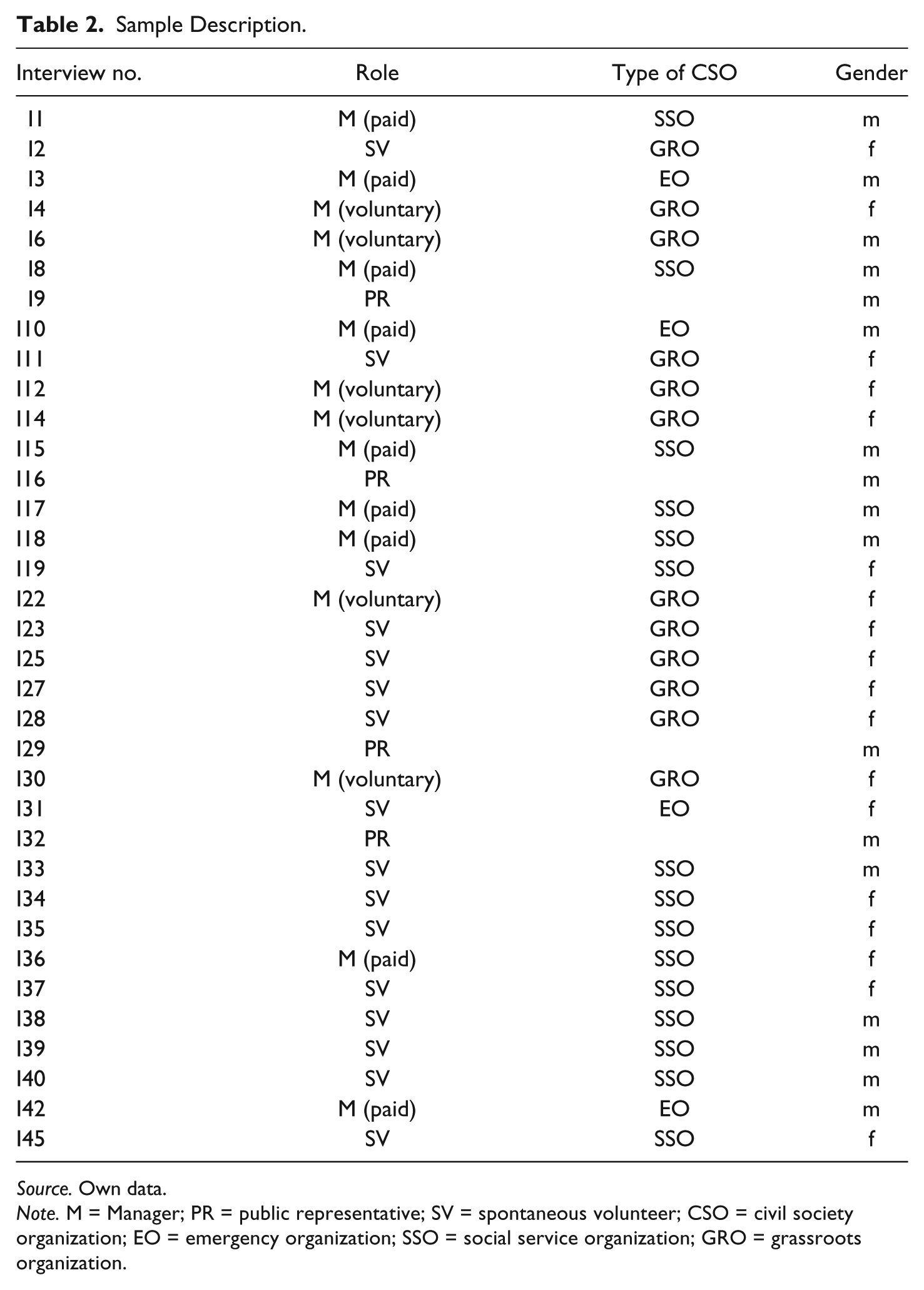
Source. Own data.
Note. M = Manager; PR = public representative; SV = spontaneous volunteer; CSO = civil society organization; EO = emergency organization; SSO = social service organization; GRO = grassroots organization.
We included those CSOs in our sample that were the most strongly represented at the sites. These are two emergency organizations (EO), four social service organizations (SSO), and nine grassroots organizations (GRO). The latter form a heterogeneous group of participatory and informal organizations, which were established in the crisis. Examples are two well-known initiatives. One provided refugees with initial assistance at the central train station in Vienna; the other ran an emergency shelter for 800 persons in a sport stadium. Both were self-organized and worked without public funding.
The face-to-face interviews lasted 30 to 90 min. Some of them were conducted on site, some in coffee shops near the train stations, and some in interviewees’ offices.
Our semistructured schedule was geared to the study of Harris et al. (2017) and addressed topics of the role of SVs, tasks, motivation, conditions, cooperation, decision making, organizational structure, and coordination of volunteers. As we used a theme-oriented schedule, we also followed topics raised by interviewees. The interviews were fully transcribed and coded with MAXQDA.
For text analysis, we combined an inductive approach and a deductive approach (Boyatzis, 1998; Crabtree & Miller, 1999; Fereday & Muir-Cochrane, 2006). We coded the data to prestructure it, using deductive codes which were the steps in the volunteer management process, identified by Studer and von Schnurbein (2013). Within each management step, we coded “challenges and problems” and “solutions.” Next, the coding process involved recognizing relevant themes (Sandberg, 2005). A theme is “something important about the data in relation to the research question, and represents some level of patterned response” (Braun & Clarke, 2006, p. 82). We concentrated on “coordination: self-organization” as the main theme within and across the initial deductive codes. For quality assurance, we communicatively validated the themes and at the same time our translations at face-to-face research meetings.
Findings
Social Crises and the Substitutive Role of Spontaneous Volunteering
In contrast to the usual dynamic of natural disasters, there were ongoing peaks and changes in this social crisis depending on the decisions of the diverse governments, with this situation lasting for several months. As one person expressed it, “We were prepared for a sprint and then it turned to a marathon” (SV, conversation during a participant observation). Furthermore, it was a dissensus type of crisis. The government in Austria straddled between following the increasing hostility toward foreigners, fueled by popular right-wing parties (Simsa, 2017, p. 79), and following the “welcome culture” of civil society.
The politically controversial nature of the crisis led to the reluctance of government to act and thus to a vacuum of authority. Therefore, official response systems were not applied from the beginning. The chaotic situation was very unusual for crises in the country. Respondents often criticized the lacking coordination and information from government bodies: “You can’t imagine how often we threw food away. They told us that buses with 350 people would be coming, so we cooked, and then the buses didn’t come because they had been redirected” (I10/M/EO). Even the responsibilities of the authorities were unclear, “ . . . there was no officer-in-charge . . .” (I31/SV/EO). The existing official response systems are moreover not designed to respond to a crisis of this scope and duration. Consequently, many CSOs were overburdened and they needed large numbers of SVs. The well-established command-and-control-structures for natural disasters were not suitable: “The structure [of the CSO] is already quite good but installing an old structure in a situation which was so new, did not work” (I31/SV/EO).
In natural disasters, SVs mainly complement governmental and civil society actors. In the social crisis investigated, due to the insufficient official response, the role of SVs was crucial: In many situations, SVs substituted for governmental and civil society actors. SVs were often the first responders at the scenes, and worked before CSOs or government bodies took over. When working under the auspices of CSOs, their numbers were greater than those of CSO members.
Responses of SVs Working Under the Auspices of CSO
As indicated in Table 3, we describe the characteristics of spontaneous volunteering in this case along with the key categories of volunteering derived from the literature.
A Systematic Categorization of Spontaneous Volunteering in Austria During the European 2015 Refugee Crisis.
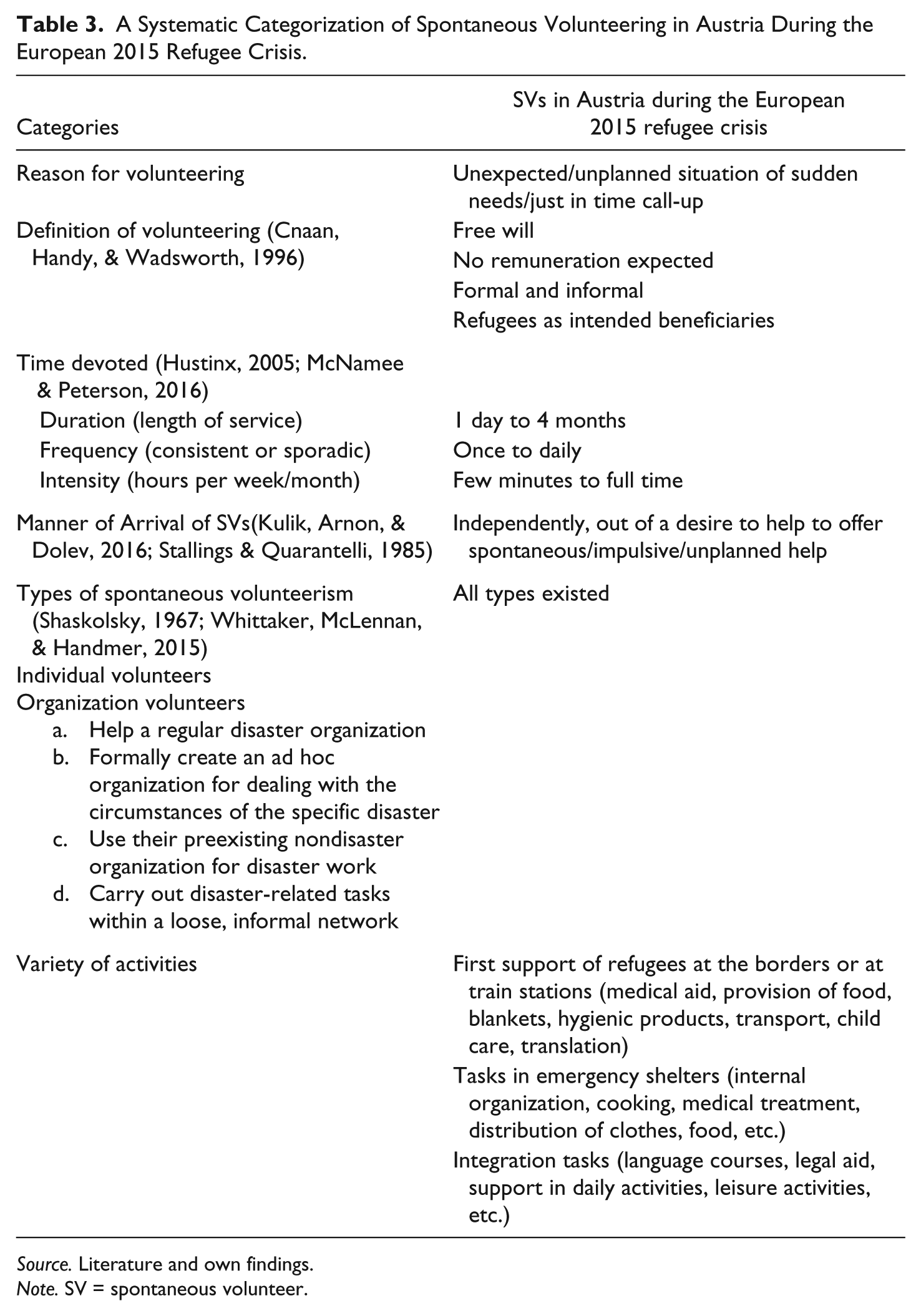
Source. Literature and own findings.
Note. SV = spontaneous volunteer.
SVs became active because they wanted to help in an unexpected situation of sudden need. Many had been refugees themselves, and many wanted to give back to society. The ongoing vacuum of authority had a mobilizing effect on the civil society. Many expressed discontent with the way the government was acting as the main reason for volunteering: “You can’t trust the state any longer, you know, people are not cared about. They are not accommodated” (I33/SV/SSO).
SV was thus also a form of political expression; thousands of SVs welcoming refugees visibly were a powerful equivalent for demonstrations for the rights of refugees: I can’t remember of any situation like this before; that citizens, with their individual social action, that they did some real concrete, basic work, like helping, supporting, welcoming, supplying water, food, clothes, and interpretation, that this was transformed or related to political protest. (I15/M/SSO)
The time devoted to volunteering ranged from single and very short incidents to full-time equivalents of weeks or months. “I do less now, but it still is a kind of full-time job. But it is not what it used to be before, now I can sometimes meet friends again.” (I27/SV/GRO). Regarding the manner of arrival, SVs either came on their own or were recruited via public calls by CSO: Then we opened transit shelters . . . One for 900 people and one for 2,500 . . ., it had to be done within two days. . . . we went there, with equipment, beds and so on to prepare everything. We had only six employees there . . . so we started a call on Facebook, we did that for the first time ever. And the first evening, 480 people were there. (I10/M/EO)
Although all four types of SV (see Table 3) were represented in the situation investigated, this paper focuses on SVs working under the auspices of a CSO.
Especially at the beginning, SVs accomplished significant tasks. They were manifold and ranged from unskilled to highly professional work. They included first support of refugees at the borders or at train stations, offering medical aid, provision of food, blankets, hygienic products, transport, child care, or interpreter’s services. A second group of tasks related to the organization of emergency shelters built in soccer stadiums or other available buildings, in which many refugees stayed for weeks or months. Most of these shelters were run by CSOs, but SVs took over significant tasks like the internal organization, cooking, medical treatment, or the distribution of clothes, food, or information. A third group of tasks was related to the integration of those refugees who stayed in the country, such as language courses, legal aid, support in daily activities, leisure activities, and so on.
Experiences of SVs
This section analyzes the experience of SVs. Apart from general experiences, remarkably many statements referred to the form of coordination.
Fulfillment
Most SVs liked their activities. They described how they felt good about being able to help—by enriching encounters with refugees, by experiences of cooperation in culturally heterogeneous groups, by being part of a movement—and they mostly were content with their tasks. Opportunities for self-organization were often referred to as rewarding; most SVs appreciated responsibilities, leadership roles, and the empowerment through enlarged tasks, going along with the need to self-organize: “My feeling was that . . . a lot of coordination [tasks] were left to us. However, it worked out. We obviously had people who did that very well” (I40/SV/SSO). “ . . . they don’t want to have a boss, they don’t want to be led in a classical way” (I28/SV/GRO).
SVs with very different backgrounds reported positive experiences with self-organization. For example, a volunteer with previous experience in a very command-and-control–oriented CSO stated: “This self-organized story was very positive, because we could develop and design everything . . ., and there was a feeling of community” (I31/SV/EO). Others related, “I realized that I really liked . . . to find structure in the chaos” (I11/SV/SSO); “It was great that we could develop everything” (I31/SV/EO). Also some managers enjoyed the fluidity and the improvization: “Our depot was an old bowling alley . . ., the owner just put wooden panels, all done in the last second, this was really great” (I14/M/GRO).
Emotional and physical strains
Many volunteers faced high emotional and physical strains, due to long working hours, and the seemingly endless and urgent tasks with the refugees. Interviewees reported cases of SVs breaking down physically, dreaming of traumatic situations, or taking medication to withstand the situation: Some burned out. There were some extreme cases who slept in the emergency shelter, on camp beds beside refugees, got up after two or three hours, continuing work for another 16 hours. That was so crazy . . . this self-sacrifice. This is dangerous. (I40/SV/SSO)
SVs with specific training, for example, in emergency or psychosocial work, managed to cope better with the challenges, but volunteers without this background often faced serious problems: There was a volunteer . . . He broke down, drowned in tears because he could not stand it. I understand that—felt the same sometimes and thought: “So, I turn around and go. If I watch for three more minutes, I break down myself.” (I29/PR)
A manager said, “With students, we often had this situation: They worked 14 to 16 hours per day until sometimes they were like in burnout and retreated completely” (I33/SV/SSO).
Another problem causing frustration was the oversupply of SV at many sites: “Nobody is being sent away. In the afternoon, there were not only two people sorting clothes, but at least six, standing in each other’s way” (I2/SV/GRO). Usually, CSOs did not send people away; sometimes this was done by SVs: “A problem was that at midday there were too many volunteers. It was a maxim not to send anybody away. But we did it nevertheless . . . ” (I37/SV/SSO).
The contested environment caused mixed feelings. Many SVs expressed the necessity to help more than initially planned due to discontent with the government: “It is hardly possible to abandon the people—the refugees and the volunteers—more than this government has done” (I14/M/GRO). Also, as large parts of the population became more negative toward refugees and thus also toward volunteers, this caused additional stress for volunteers, ranging from neighbors changing the side of the street, when meeting a volunteer, to more violent assaults: “Those seeking help were attacked by radicalized groups, who also attacked the helpers” (I31/SV/EO).
In this situation, care activities like sending people home after a certain number of hours, supervision or other forms of emotional support were reported as very important but also as lacking. In most CSO, care activities for SVs started only after some weeks. Thus, support activities were done in self-organized forms, for instance, by therapists doing supervision as SVs, or by SVs encouraging others to go home and relax. SVs were often left alone in situations of too much responsibility: “I think you should not give so much responsibility to volunteers. You believe that all depends on you. . . . I would have wished that someone had realized that” (I40/SV/SSO).
Structured Self-Organization: Self-Organization Enabled by Sufficient Coordination
The need to self-organize
At the beginning of the crisis, partly due to the sheer number of SVs in relation to CSO staff and partly due to the nature of the crisis, CSOs were not capable of establishing structures and managing SVs. CSOs had limited possibilities to coordinate SVs and thus left many tasks to self-organization: “When people arrived at the scene, we had no other chance than to tell them to organize somehow” (I10/M/EO).
SVs registered on Internet schedules, organized shifts, assessed the needs of the following days, and supervised other SVs: I came to the emergency center to help for some hours. It was run by [CSO] but there was nobody there to tell people what to do. I realized quickly that we had to do this on our own. After some hours, I took leadership and told other people where and how they can work. (I34/SV/SSO)
The planning, recruiting of new SVs, and coordination were done to a large extent and self-organized by SVs in all involved CSOs: For me, it feels like that the paid staff had little to do with the set-up of the whole system of volunteering at the [site]. Maybe I am wrong, but I had the feeling that everything was self-organized. Which had good and bad effects. (I40/SV/SSO)
Ambivalences
Most SVs were ambivalent about the need for self-organization. On one hand, almost all SVs named positive effects such as empowerment, the good feeling of coping, and getting in close contact with other SVs. On the other hand, inefficiencies caused overload and frustration: “Generally, there are a lot of inefficiencies. I have a business background and it hurts to see how things are organized here, how things are done in parallel . . . In part, this is extremely unprofessional” (I28/SV/GRO). Inefficiencies were observed throughout the whole period such as the oversupply of food or SVs dumping new clothes at places where existing piles had just been sorted, and so on. Due to unclear structures regarding areas of responsibility and the lack of management, processes were unclear or often changed, which was demotivating for SVs: “You had established your system and suddenly all was changed again. This sapped much energy . . . Finally, I thought that it was too tiresome, to start every day in a new way” (I33/SV/SSO).
The ambivalence of freedom versus coordination was expressed by many SVs: “Everybody has another system of arranging donations . . . It is tiresome to find a common denominator . . . in the end, a lot is managed by the helpers, but this makes things much more interesting.” (I39/SV/SSO). Also, the responsibility going along with self-organization was experienced ambivalently: I would have liked more presence of coordinators. On the one hand, I liked that they gave me so much responsibility. On the other hand . . ., on the third day, they gave me a jacket and told me to distribute food to 700 people, and that I should decide to whom I should give it . . ., this was a really heavy task. (I40/SV/SSO)
SVs described self-organized processes—established deliberately or out of necessity—as motivating, but lacking orientation, responsibility structures, and management also led to a decreasing willingness to contribute.
The need for coordination
To a large degree, SVs wanted and enjoyed self-organization, if it was accompanied by sufficient coordination. “We wanted to do it ourselves, but constant and regular support would have been helpful” (I40/SV/SSO).
SVs named the need for stable elements. They were often meant in a very basic, minimum sense, like having regular morning meetings or other routines, having stable contact persons, and a basic set of rules, responsibilities, or clear roles. “To keep volunteers longer, it is necessary that tasks are clear. That they know when they come to the site that they are really needed there” (I1/M/SSO). Responsibilities might be leadership roles (a person coordinating all tasks related to the kitchen), or smaller roles (a person takes care of all blankets). Clear procedures also ranged from very basic things (when you come to the warehouse, you always are greeted and informed) to more elaborate systems of quasi-hierarchical procedural organizations. Dealing with an oversupply of SVs by coordinating the mobilization strategies and organizing daily shifts was a further necessary and welcome management task: “It would have been better if they would have said more often ‘Hey, you can go home, there is not much work to do’” (I37/SV/SSO). SVs did not care whether these management tasks were done by managers of CSOs or by other SVs. Nevertheless, it was a meticulous task for CSOs to determine the adequate level of management.
Conflicts arose when CSOs offered too little or too much, or when their coordination was too volatile. When self-organized structures already had been established, SVs felt offended by coordinators who “interfered” in their procedures: . . . you came as a volunteer, and everyday there was another coordinator [paid staff] from [CSO] who had to orient himself everyday new. Then somebody else came and changed the processes and there were real tensions . . . Yes, you had your system, and suddenly, everything started from scratch again. (I33/SV/SSO)
Structured self-organization
Generally, self-organized processes usually worked well, when clear goals, responsibilities, and basic structures had been established: At the beginning it was really cool, like a game, . . . but it was also really heavy. Later, at the station, there always was a coordinator with us. This was good and important, we always had a contact person. (I40/SV/SSO)
Evidently, both elements of coordination and self-organization were necessary. We suggest to call this structured self-organization, which means to give space to self-organized processes but enable their efficiency by basic structures, clear (although often very short time) goals, and organization.
Not surprisingly, different types of organizations were coping differently with the challenge to find the right balance of coordination and self-organization. GRO, with their culture based on self-organization and autonomy, were more light-handed in dealing with ambiguity and uncertainty, they adapted faster and with fewer conflicts. Established SSO showed diverse patterns, and EO encountered the most difficulties regarding the self-organization of SVs. Initially, they perceived self-organizing as necessary and helpful, but as soon as possible they reestablished hierarchical structures and formally designed procedures, leaving little space for autonomous decisions of SVs. They clearly perceived self-organizing as burdensome, as impeding efficiency, and only appreciated it if there were no other means of coordination.
Hierarchical organizations gave more room to self-organization; they implemented less formal procedures and moved partly toward less hierarchical decision-making structures. Formerly, strict rules—for example, concerning the qualifications required for certain executive positions—were suspended, and autonomous zones were established. GRO developed clearer rules, responsibilities, and hierarchies. They designated coordinators, restricted the decision-making competencies of SVs, and defined processes more clearly.
Discussion
In this section, we will contrast the challenges of SV in natural disasters with those in social crises, and discuss implications for the theory and the management of SVs (see Table 4).
Implications for the Management of Spontaneous Volunteering in Social Crises.

Note. SV = spontaneous volunteer.
Challenges of Spontaneous Volunteering in Social Crises
The involvement/exclusion of SVs, which is a crucial topic in natural disasters (Harris et al., 2017), was different in the situation we investigated. Although large numbers of SVs often impeded efficiency, it was not possible to exclude SVs. Furthermore, the situation was not risky for volunteers, and SVs were appreciated because of the political dimension. In this situation of almost complete inclusion of SVs, the establishment of sufficient care gained importance. SVs faced specific, often subtle, vulnerabilities due to the potential overload in the long-lasting situation and due to political contestation. Thus, our concept of structured self-organization with a focus on care is in line with what Leonard, Onyx, and Hayward-Brown (2004) call a “nurturing style” of volunteer coordination, with a focus on volunteers’ needs, on contact and support, and with a balance of “encouragement of independence with the offering of direction” (p. 213).
The substitutive role of SVs implied and required high degrees of self-organization. In the situation investigated, communication, maintaining links with SVs, prioritizing tasks, and the inclusion and motivation of SVs, which are named as challenges in natural disasters (Harris et al., 2017), were mainly done self-organized by SVs. SVs also had high expectations regarding autonomy and participation, and they rejected hierarchy. Equally, CSOs relied heavily on self-organization, which often proved better adapted to unplanned and turbulent situations. This finding corresponds with other findings that identify a main advantage of SVs in that they are less “constrained by pre-established rules, strategies and technologies that may inhibit effective local response” (Fernandez et al., 2006; Whittaker et al., 2015, p. 362). Thus, the crucial challenge is finding the right relation between self-organization and coordination. These results are in line with Harrald (2006) who discusses the relation of discipline and agility with respect to management in crisis situations. He argues that discipline (structure, doctrine, process) is needed to ensure the quick and efficient supply of services, and agility (creativity, improvization, adaptability) is important to enable communication and adaptability. In addition, our findings correspond with Brudney and Meijs’s (2014) conditions of serendipitous volunteer programs, which need both a high degree of flexibility and regulation.
Implications for the Management of SVs in Social Crises
In the dynamic situation, in which CSOs had to constantly adapt to changing conditions, the core functions of volunteer management like selection, orientation, job design, training, and evaluation (Brudney & Meijs, 2009) were not applicable. During the crisis, almost all organizations changed their structures at least temporarily toward structured self-organization. On a continuum between self-organization and coordination, they seemed to move a few steps closer to the middle, thus seeking a new relation of self-organizing and formal coordination by establishing framework conditions for autonomous activities.
While effective management of SVs in social crises must meet all the requirements for natural disasters (Harris et al., 2017), our findings regarding the importance of self-organization contain the following additional implications:
Create space for new organizational structures and procedures
Effective self-organization of SVs requires flexibility of CSOs and the establishment of open and fluid structures that ensure and enable autonomy and encourage self-organization of activities. These results concur with some disaster research, which no longer views command-and-control-models as effective, but suggests “loosening rather than tightening up the command structure” (Quarantelli, 1988, p. 381; Whittaker et al., 2015) and which values the autonomy of decision making over the centralization of authority (Dynes, 1994).
Establish orienting framework conditions for the self-organizing of SVs
Nevertheless, self-organization requires a minimum of orientation and structure. Increasing the efficiency of SV’s work calls for a minimum of stable coordination, for example, a few persons working in shifts, assessing and ensuring stable processes, passing on information, acting as coordinators for SVs, and other means of guidance. To avoid inefficiencies, and thus also frustration of SVs, processes should focus on specific tasks. Thus, our findings are in line with Cnaan and Handy (2005), who advise to “view the task as the center point” (p. 34).
The establishment of zones of stability can contribute to reducing the emotional and physical strain on SVs, for example, by ensuring rituals, rules, and processes that provide orientation even if these zones of stability appear to be small.
Provide resources for care and coordination
To reduce the strain on SVs, CSOs should provide sufficient resources for active care, for example, for giving feedback, establishing supervision, keeping an eye on stress and problems, and talking about it. In line with other authors who call for planning ahead for the appearance of SVs (Harris et al., 2017; Whittaker et al., 2015), we recommend pro-active capacity building for SV coordinators in times of noncrisis.
Conclusion and Limitations
The purpose of this study was to explore spontaneous volunteering during the European refugee crisis in the autumn of 2015. The study gives insights into spontaneous volunteering in chaotic situations in which there are no official response systems in place, with an overload of CSOs and political contestation. Nevertheless, it is limited in time and scope. It covers a short period of time and focused only on those SVs who worked under the auspices of CSOs. The complex interplay of different civil society actors in refugee work as well as civil society’s long-term impact on refugees, the volunteers, and on society deserves further research.
We argue that due to the partly supplementary role of SVs and their large numbers in social crises, a high degree of self-organization is necessary. SVs want, and also need, open and fluid structures that ensure and enable autonomy, and CSOs depend on their self-organization. To prevent inefficiencies and the overburdening of SVs, it is necessary to have orienting conditions such as clear rules, tasks, and responsibilities. Thus, for CSOs, spontaneous volunteering requires a constant balancing act between self-organization and coordination.
Footnotes
Acknowledgements
We thank the anonymous reviewers of Nonprofit and Voluntary Sector Quarterly for their comments and suggestions. We would particulary like to thank Jeff Brudney for his assistance and guidance through the publication process.
Declaration of Conflicting Interests
The author(s) declared no potential conflicts of interest with respect to the research, authorship, and/or publication of this article.
Funding
The author(s) received no financial support for the research, authorship, and/or publication of this article.