



Abstract
The digital divide persists; a quarter of the U.S. population is unconnected, left without Internet access at home. Yet volunteer recruitment is increasingly moving online to reach a broader audience. Despite widespread use, little is known about whether the lack of digital access has repercussions on connections offline in the community. We examine the influence of access on volunteering across four critical aspects—structure, time devoted, level of professionalization, and pathways to volunteering. We find home Internet access has an independent influence on volunteering even after controlling for socioeconomic status. Those with access are more likely to volunteer, formally and informally, and are more likely to become volunteers because they were asked. However, digitally unconnected volunteers devote more time. Nonprofit organizations and government agencies should be strategic and inclusive in their volunteer recruitment efforts to ensure they recruit qualified and dedicated volunteers rather than rely solely on digital recruitment strategies.
In recent decades, the Internet has evolved from tedious dial-up to regularly used high-speed connections, both at home and on the go. However, research remains divided on the influence the Internet has on civic engagement. Some argue it isolates people (Putnam, 2000), whereas others link online engagement to engaging with others offline (Eimhjellen, 2014). The uneven availability (and hence the impact) of household Internet access further complicates the subject as gaps between those with digital access and those left unconnected persist. This study examines whether the Internet helps connect people in person in addition to online and whether those without access are unconnected not only from the Internet but also from volunteering.
In 2013, nearly 84% of U.S. households owned a computer and about 74% reported having access to and using the Internet at home (File & Ryan, 2014). While this shows tremendous growth, compared with only half of the population reporting even using the Internet in 2000 (Perrin & Duggan, 205), about one quarter of all households are still left without digital access. Research suggests digital divide, the gap between those with Internet access and those without, exists along established social cleavages (Castells, 2001; van Dijk, 2005, 2012; Wessels, 2013). Perrin and Duggan (2015) find that digital gaps persist, especially for older individuals, those with less education, lower incomes, in rural areas, and in certain racial and ethnic groups. Although many segments of the population are nearly fully connected, and much recent literature on civic engagement has treated the digital divide as a problem from the past, certain groups remain unconnected and unable to use modern technology to connect with others in the community.
This issue is particularly salient for nonprofits, as organizations increasingly lean on digital technology to improve their services. For volunteer recruitment, the Internet can reach a wide population quickly and at a relatively low cost to the organization. However, as the digital divide isolates certain people from online communication, does the lack of digital access at home discourage volunteering among the unconnected?
To address this question, we examine how digital access influences volunteering across four aspects—structure, time devoted, level of professionalization, and pathways to volunteering. Using linked data from the 2013 Computer and Internet Use Supplement and the 2013 Volunteer Supplement of the Current Population Survey, we examine how household Internet access influences formal and informal volunteering, time spent on formal volunteering, how individuals become volunteers, and service in leadership positions.
Findings contribute to research and practice in several ways. First, we examine volunteering across diverse aspects to paint a more complete picture of the differences in voluntary behavior between those with household Internet access and those left unconnected. Research can use this broader conception of volunteering to highlight the similarities and differences in voluntary behavior across individuals and contexts. Second, in support of the dominant status theory and resource-based approach, we find individuals with household Internet access are more likely to volunteer, both formally and informally, and are more likely to become volunteers because they received invitations to do so. In this study, we operationalize formal volunteering as voluntary work done through or for an organization, whereas informal volunteering corresponds to working with others to fix a problem or improve a condition in the community or elsewhere. Household Internet access is a resource for connecting with others and organizations, but is not an indicator for time or dedication. While less likely to receive requests to volunteer, those who are digitally unconnected spend more time volunteering. Third, nonprofit organizations and government agencies can use these findings to diversify their volunteer recruitment strategies. Although the web may seem like a quick and easy way to reach a broad audience, digital recruitment strategies may exclude about a quarter of the U.S. population. Volunteer recruitment efforts should use a wide range of strategies to ensure they are inclusive of the community to obtain the most qualified and dedicated volunteers.
Persistence of the Digital Divide
The digital divide—the gap between those with access to information and communication technology (ICT) and those without—started to receive widespread attention as an emergent issue in the 1990s. In 1995, the National Telecommunications and Information Association (NTIA) initiated a research series titled Falling Through the Net. The first report in this series highlighted the issue of the digital divide by focusing on the “haves” in the suburbs and the “have-nots” concentrated in rural areas and central cities. In subsequent years, the series noted that Internet access disparities widened between upper and lower incomes; furthermore, while computer ownership increased among all racial groups, Blacks and Hispanics lagged behind Whites in Internet access (NTIA, 1998, 1999). When the series concluded in 2000, the fourth and final report stated, “Now that a large number of Americans regularly use the Internet to conduct daily activities, people who lack access to these tools are at a growing disadvantage” (NTIA, 2000, p. xv).
Many factors influence Internet access. Much like the first Falling Through the Net report in 1995, location continues to matter, where people in the suburbs are more likely to have Internet access than those in rural areas and inner cities (Mossberger, Tolbert, & McNeal, 2008). In addition, children, marriage, and some occupations—professional and managerial—increase the likelihood of home Internet access (Mossberger et al., 2008; Norris, 2001). Not surprisingly, age and generation influence Internet access, with younger individuals being the most connected (Mossberger et al., 2008; Mossberger, Tolbert, & Stansbury, 2003; Norris, 2001; Panagopoulos, 2013).
Gaps persist between the poor and the wealthy, as well as the less educated and the highly educated (Mossberger et al., 2008; Mossberger et al., 2003; Norris, 2001; Panagopoulos, 2013), with no closing of the divide for education and income in the United States in recent years (Witte, Kiss, & Lynn, 2013). Racial inequalities also continue, even among the less educated and the poor (Mossberger et al., 2008). Blacks and Hispanics are less likely to have Internet access than Whites (Mossberger et al., 2008; Mossberger et al., 2003; Panagopoulos, 2013). The racial, income, and education divides cause concern by contributing to existing sources of inequality (Castells, 2001). As Wessels (2013) states, Digital Technology is a key resource for people in a networked society because it provides information and resources, and access to online public spheres. However, the use of digital services coalesces around social divisions, and in situations with low resources, which adds a fundamental cleavage to existing inequalities. (p. 26)
In this sense, digital access serves as a trend amplifier, reinforcing social trends already present in society (van Dijk, 2005, 2012). This raises cause for concern, especially “as the advantages of inclusion are growing, the disadvantages associated with exclusion may be growing at an even faster rate” (Witte et al., 2013, p. 69).
Volunteer Recruitment
Technological advances are one way nonprofits can address increased demands with fewer resources. Technology provides ways for nonprofits to reshape ways of organizing and delivering services (Burt & Taylor, 2000, 2003), to increase accountability (Saxton & Guo, 2011), and to recruit volunteers (Dighe, 2012; Finn, 1999; Hawthorne, 1997; Pynes, 2013). Nonprofits’ use of ICT evolves as technology advances. In examining volunteer management, Harrison, Murray, and Macgregor (2004) find that “the more ICT related changes an organization experiences the more ICT is used” (p. 13). Similarly, Mele (2008) illustrates the evolution of ICT within one organization beginning with telephones used for mentoring to online recruitment, online training, and even online volunteering. In examining early adoptions of online volunteer recruitment, Finn (1999) found a majority of organizations (58.4%) reported getting volunteers through their website. Now organizations can utilize not only their websites but also social media and websites specializing in matching volunteers with opportunities, such as catchafire.org, volunteermatch.org, idealist.org, and others. Organizations also increasingly turn to online or virtual volunteering (Murray & Harrison, 2005) to conduct an array of activities from maintaining websites to providing technical assistance (Cravens, 2000). Scholars have examined the benefits and challenges of managing virtual volunteers (Cravens, 2006; Dhebar & Stokes, 2008), but the use of the Internet for volunteer recruitment, management, and even volunteering is on the rise.
Even leaving aside the implications of the digital divide for a moment, the recruitment of volunteers tends to exclude particular groups. Certain individuals are more likely to volunteer, largely because they are asked. D. H. Smith (1994) dubs this the “dominant status model.” Some social background characteristics, such as education and occupation, give individuals “more prestige and respect in current American society” (Smith, 1994, p. 247). This prestige and status in turn influences formal volunteering. As Lemon, Palisi, and Jacobson (1972) argue, “there is a direct relationship between the status positions on major social dimensions and participation” (p. 40). As an alternative explanation for why certain groups volunteer more, Musick and Wilson (2008) take a resource-based approach arguing that only those with the necessary skills will think to volunteer or be asked. Resources, such as education, income, and occupation, serve as “ability signals” for volunteer recruiters (Musick & Wilson, 2008). From these perspectives, individuals from social backgrounds of dominant status in society and those with resources are more likely to engage in formal volunteering.
Both the dominant status and resource-based perspectives lead to inequities in who people ask to volunteer. Most people never receive invitations to volunteer, yet being asked is the single most important reason people become engaged in formal volunteering (Piatak, 2016). From the resource-based perspective, “organizations looking to hire volunteers are likely to seek people who they believe will be the most productive and the least troublesome to manage and motivate” (Musick & Wilson, 2008, p. 112). However, this can lead to sweeping generalizations based on existing social characteristics and divisions. Based on interviews with volunteer recruiters, Dean (2016) finds recruiters target middle-class students based on assumptions about disadvantaged groups. Disadvantaged students may benefit the most from volunteering—to develop skills, to make friends, or to enhance their self-esteem—yet may not know such opportunities exist. Volunteers can obtain a wide array of personal benefits from their volunteer work (Benenson & Stagg, 2016; Hustinx, Cnaan, & Handy, 2010), but people who have the most to gain from volunteering to enhance their resources are excluded from personal asks. In this sense, volunteer recruitment not only perpetuates dominant status but also increases the status of resource-rich individuals.
In addition to the “ability signals” of certain groups, social ties influence volunteer recruitment. Members of different social groups may not interact, where “prosocial behavior is not socially encouraged, but is often a question of noblesse oblige” (Luria, Cnaan, & Boehm, 2015, p. 1046). Verba, Schlozman, and Brady (1995) describe not only the lack of asks but also difficulties in finding ways to participate: . . . contrary to what seems like a blitz of entreaties for political involvement ranging from the mass-market phone appeals for political donations to requests from neighbors for help in dealing with some community issue, many people never receive requests to get involved. Moreover, inclusion in a recruitment network is not a random process but is highly structured by several characteristics that are also related to activity. Furthermore, to seek is not necessarily to find. A substantial share of requests are denied, especially if they come from strangers. (p. 134)
People are more likely to volunteer when they know the person asking (Bekkers, 2010). Similarly, people recruit those they know to volunteer. Hence, recruiters faced with target numbers and a lack of resources will pull from readily available pools, failing to put in the effort to recruit more diverse volunteers (Dean, 2016), thereby further excluding already marginalized groups.
The process of recruiting volunteers is by no means perfectly inclusive. In many cases, volunteer recruitment tends to draw from dominant status groups, whereas lower status groups are excluded. These status distinctions also manifest themselves in the digital divide. Therefore, we ask, with the growth of the Internet and its potential as a means to recruit volunteers from a wider population (Dighe, 2012), does the lack of digital access at home further exacerbate the exclusion of those who remain unconnected when it comes to volunteering?
Hypotheses
To address the various ways the digital divide affects volunteering, this study examines volunteering across four aspects of volunteering: structure, time devoted, level of professionalization, and pathways to volunteering. First, we assess the differential impact of the digital divide on formal versus informal volunteering to provide insight on the digital divide’s impact on various structures of volunteering. Second, we examine time devoted to formal volunteering as a measure of volunteer dedication. Third, we examine the level of professionalization of the volunteer activity. Finally, we examine how volunteers first became involved. In considering each of these aspects, we aim to not only address the important analytical distinctions between different structures of volunteering (following Cnaan, Handy, & Wadsworth, 1996) but also get a better sense of the inclusiveness of the volunteer recruitment and potential barriers to volunteering.
Despite the growing use of the Internet, research is divided about its effects on offline social life. In examining the influence of digital access on political participation using the American National Elections Study, connected individuals have higher levels of civic engagement (Panagopoulos, 2013). In addition, home Internet access and other forms of digital connectedness are a resource and may contribute to one’s status in society. Individuals with more dominant status categories are more likely to volunteer (Lemon et al., 1972). In line with the resource-based perspective and the dominant status model, we see the Internet as a resource and hypothesize the following:
Although most volunteer research focuses on formal volunteering (voluntary activities done through or for a formal organization), recent research has focused on alternative structures of volunteering. Although there is no uniform definition of informal volunteering (see, for example, Cnaan et al., 1996; Gazley & Brudney, 2014; Musick & Wilson, 2008), scholars generally agree that the primary distinction from formal volunteering is that informal volunteering takes place outside of the organizational context. Informal volunteering may be people-oriented or task-oriented (Finkelstein & Brannick, 2007) and ranges from informal helping, providing assistance to any nonrelative (Lee & Brudney, 2012; Wang, Mook, & Handey, 2017) to informally working with others to accomplish a task (Finkelstein & Brannick, 2007; Piatak, 2015). We follow previous research that uses a task-oriented measure of working with neighbors to serve the community (Piatak, 2015, 2016; Shandra, 2017) to capture one element of informal volunteering and separate informal volunteering activities from more formal activities.
One key argument for making the distinction between informal and formal volunteering is that factors influencing the likelihood of informal volunteering may differ from the (more well-established) determinants of formal volunteering in key ways. For example, education has a positive influence on formal volunteering, but not on informal community work (Snyder & Omoto, 1992). Similarly, minorities have lower rates of formal volunteering (Sundeen, 1992; Wilson & Musick, 1997), but Blacks are more likely to volunteer informally in their communities (Piatak, 2015; Williams, 2004). In short, scholars suggest that informal volunteering is a means to engage underprivileged populations (Piatak, 2015; Taniguchi, 2012; Williams, 2004, 2008) outside the confines of formal organizations. As such, we hypothesize the following:
Contrary to correlates of formal volunteering that reflect the dominant status and resource-based perspectives, certain groups that are less likely to formally volunteer often devote more time to formal volunteering. For example, scholars find employment to positively influence volunteering (Musick & Wilson, 2008; Smith, 1994; Sundeen, Garcia, & Raskoff, 2009; Taniguchi, 2006; Wilson, 2000, 2012; Wilson & Musick, 1997), but unemployed volunteers devote more time to volunteering (Kinsbergen, Tolsma, & Ruiter, 2013; Piatak, 2016; van Ingen & Dekker, 2011). Similarly, women and White Americans are more likely to volunteer formally (Musick & Wilson, 2008; Wilson & Musick, 1997), but men and Black Americans devote more time to volunteering (Piatak, 2016). Perhaps unconnected individuals are dedicated volunteers once they become involved.
Moreover, digital access and reliance on technology may also have a direct impact on volunteering time. Some scholars have proposed that advances in communication technologies together with increasing Internet access have altered the rhythms of communication in modern society, effecting an erosion of the traditional work/home boundary (Deal, 2015; Major & Germano, 2006; Middleton, 2007; Park, Fritz, & Jex, 2011). Other recent research has been skeptical of these claims, positing that there is little evidence of any measurable decrease in leisure time (Aguiar & Hurst, 2007; Bittman, Brown, & Wajcman, 2009; Wajcman, Bittman, & Brown, 2008). Nonetheless, many Americans report feeling “time squeezed” or “harried” by modern life (Wajcman, 2014). It is therefore plausible that as digital access exacerbates the perceived squeeze on users’ leisure time, digital users may shift their priorities, devoting less time to activities relegated to post-business hours—including “serious leisure” activities like volunteering (Stebbins, 1996). Furthermore, there is some evidence that individuals who rely on the Internet and digital devices for entertainment may be less inclined to spend time on other leisure activities, including volunteering (Wallsten, 2013). Consequently, we hypothesize the following:
Individuals with resources, dominant status, and social ties—employed, educated, and the like—are more likely to volunteer, largely because they are more likely to be asked (Dean, 2016; Lemon et al., 1972; Musick & Wilson, 2008; Smith, 1994). Previous research suggests that Internet access may be another resource that contributes positively to receiving requests to volunteer, even controlling for other socioeconomic indicators. As a mode of communication, the Internet is a useful tool for nonprofits to recruit volunteers (Dighe, 2012). The Internet allows for quick communication of a message from the organization out to a potentially disparate audience. It follows that individuals with regular Internet access may be more visible to nonprofits using online systems to advertise volunteer opportunities than those lacking such access.
In addition to invitations to volunteer received from nonprofits, individuals with Internet access may also be more likely to receive peer invitations, such as from friends, family, or acquaintances. Previous research has shown Internet-based communication to be particularly adept at the maintenance of loose networks and bridging ties (Boase & Wellman, 2006; Brandtzaeg, 2012; Hampton, Goulet, Marlow, & Rainie, 2012). These same loose networks can be sources of information about volunteering activities, and research has shown that those with diverse bridging ties are more likely to be civically active, especially in volunteer activities (Forbes & Zampelli, 2014; Paik & Navarre-Jackson, 2011). In short, we believe that those with regular access to the Internet are more likely to receive requests to volunteer, either from nonprofit organizations or from their peer networks. Thus, we hypothesize the following:
Digital access may also influence the type of organizations and activities volunteers participate. Nonprofits historically target volunteer board members with dominant status—those who can bring clout and resources to the organization. This closes opportunities to others and perpetuates individuals’ dominant status, where people tend to serve on boards because of family tradition, duty, or for prestige (Covelli, 1985). While research on board diversity is evolving and has found links to performance (Gazley, Chang, & Bingham, 2010), board diversity continues to be an issue (Bradshaw & Fredette, 2013; Brown, 2002). As those with home Internet access may be easier to reach and have more social ties, we hypothesize the following:
Data and Method
Data Sources
The data used for this analysis were collected from the Current Population Survey (CPS). The CPS, conducted by the U.S. Census Bureau for the Bureau of Labor Statistics, is the source of the official government statistics on employment and unemployment. Each month, for over 50 years, the CPS collects data from about 100,000 adults in about 56,000 households across the United States. The CPS sample of households is scientifically selected based on area of residence to represent the nation as a whole. The data are weighted to account for the sample design, response to the baseline labor force survey, and responses to the supplemental survey, which collects data on a different workforce-related topic each month. The CPS weights are adjusted periodically so that the totals match population benchmarks at the state and national level.
The analysis uses data from two CPS surveys: the July 2013 survey and the associated Computer and Internet Supplement (U.S. Census of Bureau, U.S. Department of Commerce, 2013a), and the September 2013 survey, which also includes the Volunteer Supplement (U.S. Census of Bureau, U.S. Department of Commerce, 2013b). The CPS Computer and Internet Supplement has been one of the Census Bureau’s primary sources of data on computer and Internet use for over 30 years. Each CPS sample consists of eight groups of roughly equal size; our analytic sample contains data from two of these groups or about 25% of a typical CPS sample. We formed the analytic data set by merging the July and September CPS data sets on household ID, which is consistent throughout the household’s CPS obligation; the person’s line number on the household roster, which should also be consistent over time; and the respondent’s sex and age (which should change by 1 year or less). Replacement households are excluded from the analysis if they were members of the CPS sample in September but not in July. Our data-merging strategy is one of several alternatives (Madrian & Lefgren, 2000), but strikes a reasonable balance between avoiding false-positive and false-negative matches. 1
Independent Variables
The July 2013 supplement, which was sponsored by NTIA, contained standard questions about computer use and Internet use for the household as well as for individual respondents. Internet connectivity, the key independent variable in all our models, is a simplified version of the eight-category “connectivity continuum” of variations in computer and Internet access (File, 2013; see Figure 1). Internet connectivity is coded as “1” when the respondent lives in a household that has Internet access and “0” when the respondent’s household does not have access to the Internet—even if they use the Internet at work or elsewhere outside the home.
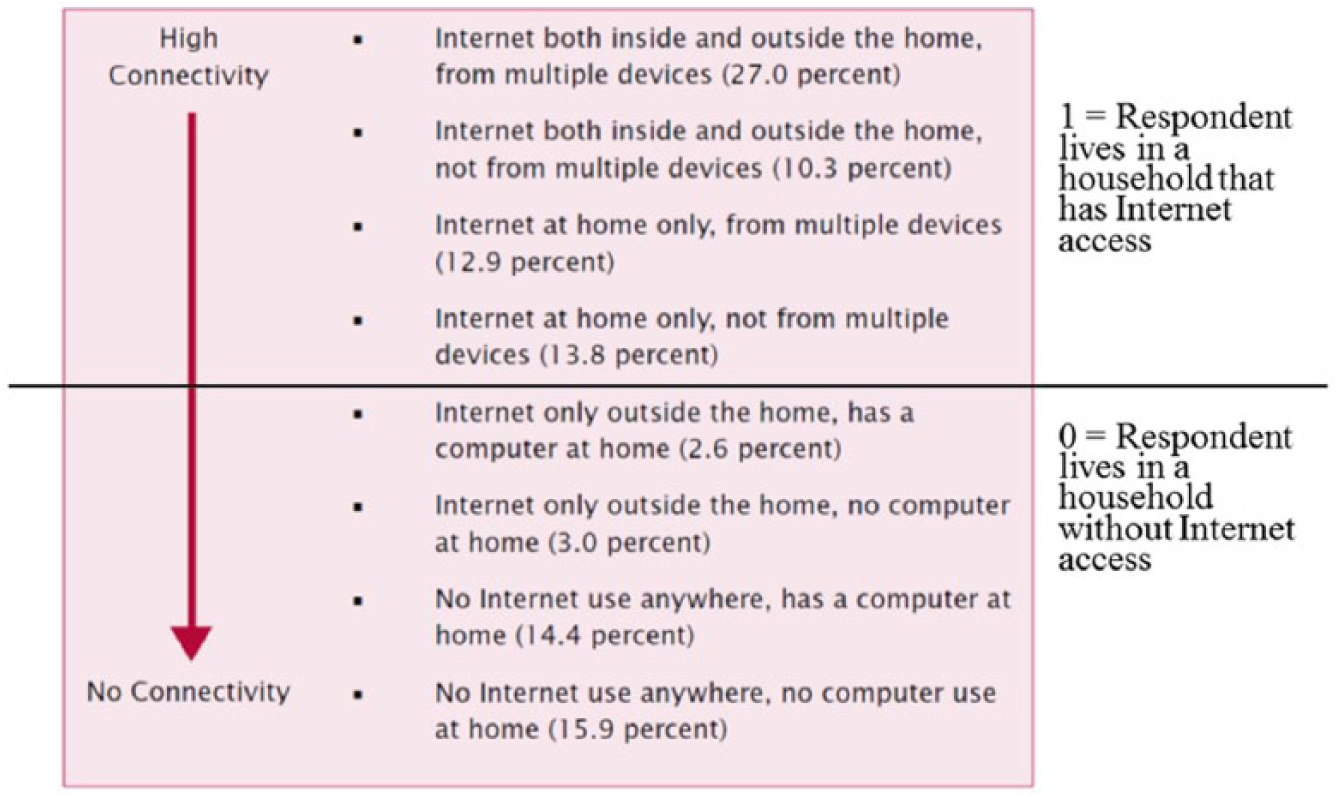
Census connectivity index and internet access.
All the multivariate models we estimate use the same group of independent variables, which serve as controls for Internet connectivity, the independent variable of theoretical interest. Piatak (2016) serves as source material for many of our theoretical expectations, but in most cases the independent variables are coded exactly as they are in the annual Bureau of Labor Statistics (BLS) brief Volunteering in the United States (BLS, U.S. Department of Labor, 2014). The descriptive statistics are shown in Table 1, and descriptions of each variable follow.
Descriptive Statistics.

Gender
The consensus from previous research is that women tend to volunteer more (Musick & Wilson, 2008; Wilson & Musick, 1997) and devote more time to volunteering than men (Taniguchi, 2006). In our models, men (the comparison group) are coded “0” and women are coded “1.”
Race
The BLS brief shows that African Americans and Asians have lower formal volunteering rates that adults who identify only as White. The observed differences in formal volunteer rates have been attributed to human capital theory (Wilson, 2000) and the dominant status model (Lemon et al., 1972; D. H. Smith, 1994). However, some studies indicate that race is not associated with volunteering when taking other factors into account (Taniguchi, 2012) and that racial and ethnic minorities may have higher informal volunteer rates than White-only adults (Piatak, 2015; Williams, 2004). White-only adults serve as the comparison group in our models, whereas the other racial groups—African Americans, Asians, Native Hawaiians/Pacific Islanders, Native American/Indians, and those who identify with more than one racial category—each receive their own 0-1 indicator variables.
Ethnicity
The differences between self-identified Latinos and non-Latinos are similar to the racial differences discussed above. Latinos are coded as “1” in all models (making non-Latinos the comparison group).
Educational attainment
Adults with lower levels of education tend to volunteer less (Gesthuizen & Scheepers, 2012; D. H. Smith, 1994; Wilson, 2000, 2012). As in the BLS brief, educational attainment is measured using four indicator variables: less than a high school diploma (the reference category); high school diploma or the equivalent, but no college; some college attendance and/or an associate degree; and a bachelor’s degree and/or advanced professional degree.
Family income
Along with education, income is another important component of socioeconomic status. Socioeconomic status can appear to remove barriers to participation, as in the case of homeownership (Rotolo, Wilson, & Dietz, 2015). However, income is included in empirical models of volunteering less frequently than education, in part because the CPS does not ask respondents about their personal income. Our models include the CPS measure of family income (where a household may contain multiple families) because of the importance of controlling for the ability to pay for Internet access in the household. We divide household income into four categories—less than US$35,000 (the reference category), between US$35,000 and US$50,000, between US$50,000 and US$75,000, and US$75,000 and over—and use indicator variables to denote each category.
Parenthood
Parents are more likely to volunteer if they live with their own children (Musick & Wilson, 2008). Following the BLS convention, we include an indicator that codes respondents as “1” if they live with one or more of their own 18-and-under children, and “0” otherwise.
Marital status
Married adults tend to volunteer more often than those who have never been married or those who are no longer married (Musick & Wilson, 2008). In our models, “single and never married” is the reference category, and we add two indicator variables for marital status, coded the same way as in the BLS brief: married with spouse present and “other,” which includes those who have been divorced or widowed.
Labor force status
The well-established relationship between volunteer rates and employment status can mask important variation (Piatak, 2016). In our models, we designate full-time employed adults as our reference category and include indicator variables for those who are employed part-time, unemployed, and not in the labor force.
Region and household location
Volunteering patterns may vary across communities because of local variations in the nonprofit sector and social, economic, and demographic population differences (Piatak, 2016). The Census Bureau (File, 2014) also shows that Internet access varies considerably across states and regions within the United States. In addition, the digital divide disproportionately affects those in central cities and rural areas (Mossberger et al., 2008), and scholars have examined whether there is a rural–urban divide in voluntary association participation (Hooghe & Botterman, 2012). To control for these differences, we include both regional indicator variables for the Midwest, South, and West Census regions with the East as the reference category and household location indicators for urban (central city), suburban (the rest of the metropolitan area), and rural with not identified (households outside metro areas that are not rural) as the reference group.
Age
Finally, in each of our models, we include categorical variables for seven age groups: ages 16-19, 20-24, 25-34, 35-44, 45-54, 55-64, and 65-74. Adults aged 75 and over serve as the reference group.
Dependent Variables
The September 2013 CPS Volunteer Supplement was the data source for the dependent variables used to test our hypotheses. For H1a, we use the measure of formal volunteering used in official publications like Volunteering in the United States (BLS, U.S. Department of Labor, 2014): Volunteers are defined as individuals who performed unpaid volunteer activities through or for an organization. To test H1b, about informal volunteering, we use a question that was added to the Volunteer Supplement in 2006 that measures whether an individual worked with others in the neighborhood to fix a problem or improve something. Both formal and informal volunteering are indicator variables taking on a “1” if the respondent volunteered and a “0” otherwise. Because of the likelihood that unmeasured factors may influence people to volunteer formally and/or informally, given the opportunity, we estimate a bivariate probit model that tests H1a and H1b simultaneously. The bivariate probit results include an estimate of rho, the correlation between the disturbance terms in the equations for formal and informal volunteering. A positive value of rho indicates that unmeasured factors that influence both types of participation are positively correlated.
We examine voluntary behavior among volunteers to test H2, H3, and H4. Individuals who reported that they volunteered formally over the past year are asked additional questions about time devoted, how they became involved, and the activities they performed. For H2, the dependent variable is the total number of hours that the respondent reported serving at all the organizations where she or he volunteered in the past year. H3, examining how volunteers first became involved, and H4, examining primary activities performed when volunteering, are based on information that is specific to the respondent’s main organization (the one where the respondent served the most hours).
For the dependent variable for H3, respondents who volunteered are coded as “1” if they reported that they joined up with their main organization because someone asked them to, and “0” otherwise. For the dependent variable for H4, respondents who reported that their main volunteer activity was to “provide professional or management assistance including serving on a board or committee” are coded as “1”; all other volunteers are coded as “0.” Table 2 contains a list of our hypotheses and the corresponding survey questions from which the dependent variables were drawn.
Hypotheses and Measures for Dependent Variables.

Method
Tables 3 through 5 contain the results. For all hypotheses except H2, we estimate probit models because the dependent variable is binary. The marginal effects of the independent variable in our bivariate and univariate probit models—which can be found in the dy/dx columns in each table—represent the difference in probability between respondents in a given category and respondents in the reference category, holding all the other variables constant at their means. For H2, our dependent variable is a continuous count variable (number of hours served). Following Piatak (2016), we estimate a negative binomial model to test H2. Unlike the Poisson model, another common choice for count data, the negative binomial accounts for the positive contagion observed for hours volunteered: Adults who have already donated a substantial amount of time to volunteer service are significantly more likely to serve an additional hour, compared with those who have volunteered little time. Although Table 5 contains estimates from a different statistical model, the marginal effects are constructed similarly: The dy/dx values represent the difference in hours served between respondents in a given category and respondents in the reference category, holding all the other variables constant at their means.
Bivariate Probit Regression Results for Formal Volunteering (H1a) & Informal Volunteering (H1b).

Note. Rho (ρ), the correlation in the disturbance terms in the two equations, is significant and positive (ρ =.476, p < .001).
p < .05. **p < .01. ***p < .001.
Results
As shown in Table 3, people with Internet access are about 10 percentage points more likely to volunteer than those without home Internet access, holding all other variables constant at their means. We find support for H1a that people with Internet access are more likely to volunteer, in line with dominant status theory and the resource-based perspective. The control variables follow formal volunteering trends found in prior research, where women volunteer more than men, Black Americans volunteer less than White Americans, Latinos volunteer less than non-Latinos, married individuals volunteer more than those who were never married, those with children volunteer more than those without, and part-time employees volunteer more than those who work full-time. In addition, volunteer rates increase with education and income.
The effect of Internet access is much smaller for informal volunteering: People with Internet access at home may be about 2 percentage points more likely to volunteer informally, compared with those without Internet access at home (see Table 3). However, as the marginal effect estimates show, the result may be slightly negative, which would suggest that access to the Internet may be resource for formal volunteering but not for informal volunteering, as H1b states. The estimate of rho is positive, indicating that unmeasured characteristics that influence both informal and formal volunteering are positively correlated. The bivariate probit results also permit us to look at the marginal impacts of connectedness on volunteering formally and/or informally. These results (which are not included in the tables) suggest that connectedness has the greatest effect on getting involved in volunteering at all: People with Internet access at home are between 7 and 11 percentage points more likely to volunteer formally and/or informally. Internet access has a smaller, but still large, effect on the probability of being involved with an organization but not around the neighborhood (between 5 and 8 percentage points). It has a much smaller effect (1-2 percentage points) on informal volunteering, but only for formal volunteers. For people who are not also volunteering with an organization, Internet access has no effect on the likelihood of working with others to fix or improve something in the neighborhood.
The results in Table 3 show that demographic and socioeconomic characteristics are associated with informal and formal volunteering in different ways. For instance, males are more likely to volunteer informally than females, younger individuals are less likely to informally volunteer, and older individuals are more likely to informally volunteer, all else being equal. However, some determinants of informal volunteering are similar to formal volunteering as informal volunteering increases with education and income, although only people with the highest income category are significantly more likely to informally volunteer than the lowest category. In addition, those with children and those working part-time are more likely to volunteer informally.
Table 4 shows the negative binomial regression results for the total hours volunteers dedicated to all organizations. Digitally connected volunteers devote about 34 fewer hours than volunteers without home Internet access. In support of H2, volunteers without access may be more dedicated. Interestingly, the sociodemographic variables also reveal different relationships for likelihood of volunteering and the time devoted. While White Americans are more likely to volunteer than Black Americans, Black volunteers devote about 38 more hours and American Indians or Alaskan Natives devote about 91 more hours. Volunteers not in the labor force and older volunteers tend to devote more time.
Negative Binomial Regression Results for Formal Volunteer Hours, All Organizations (H2).
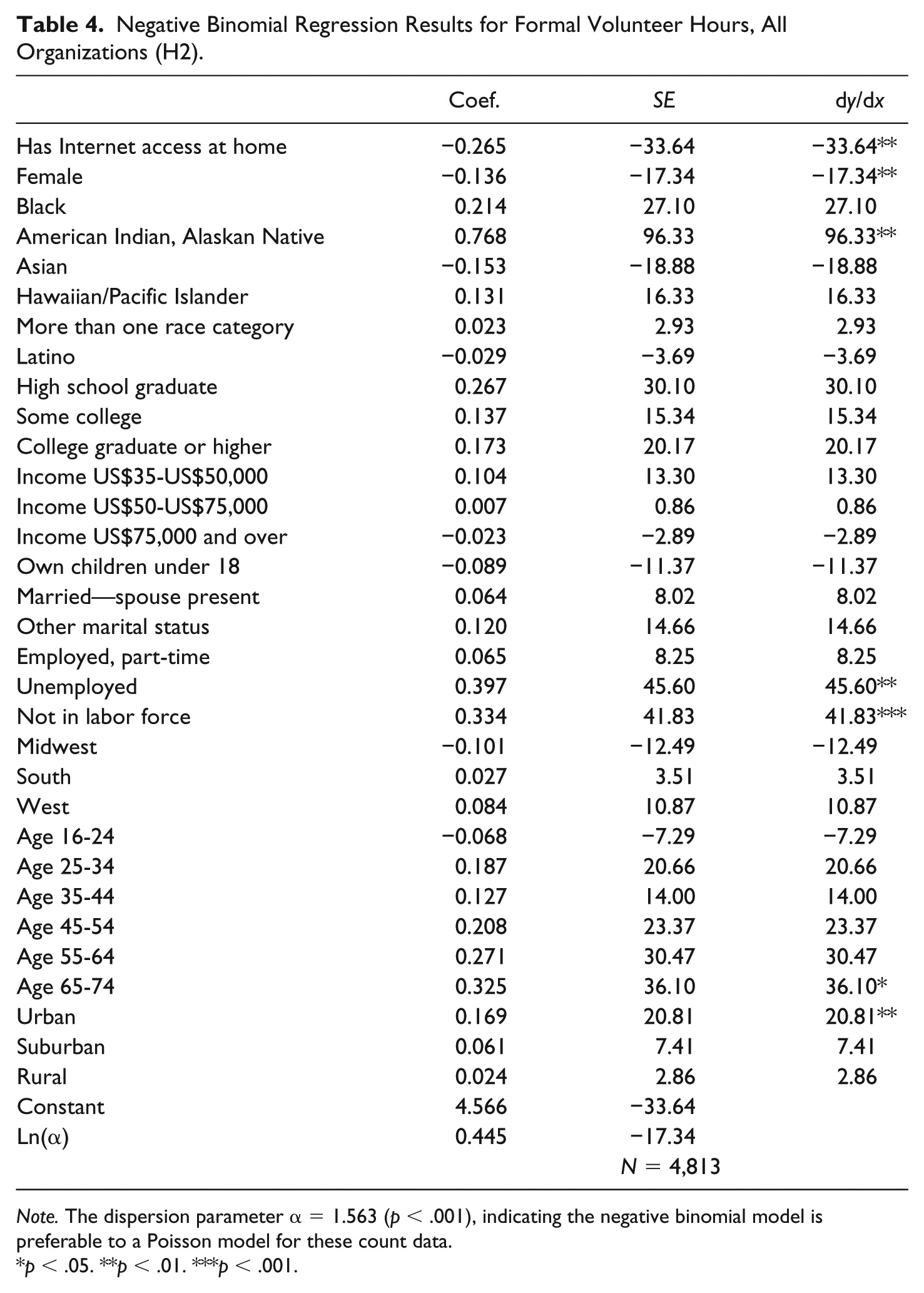
Note. The dispersion parameter α = 1.563 (p < .001), indicating the negative binomial model is preferable to a Poisson model for these count data.
p < .05. **p < .01. ***p < .001.
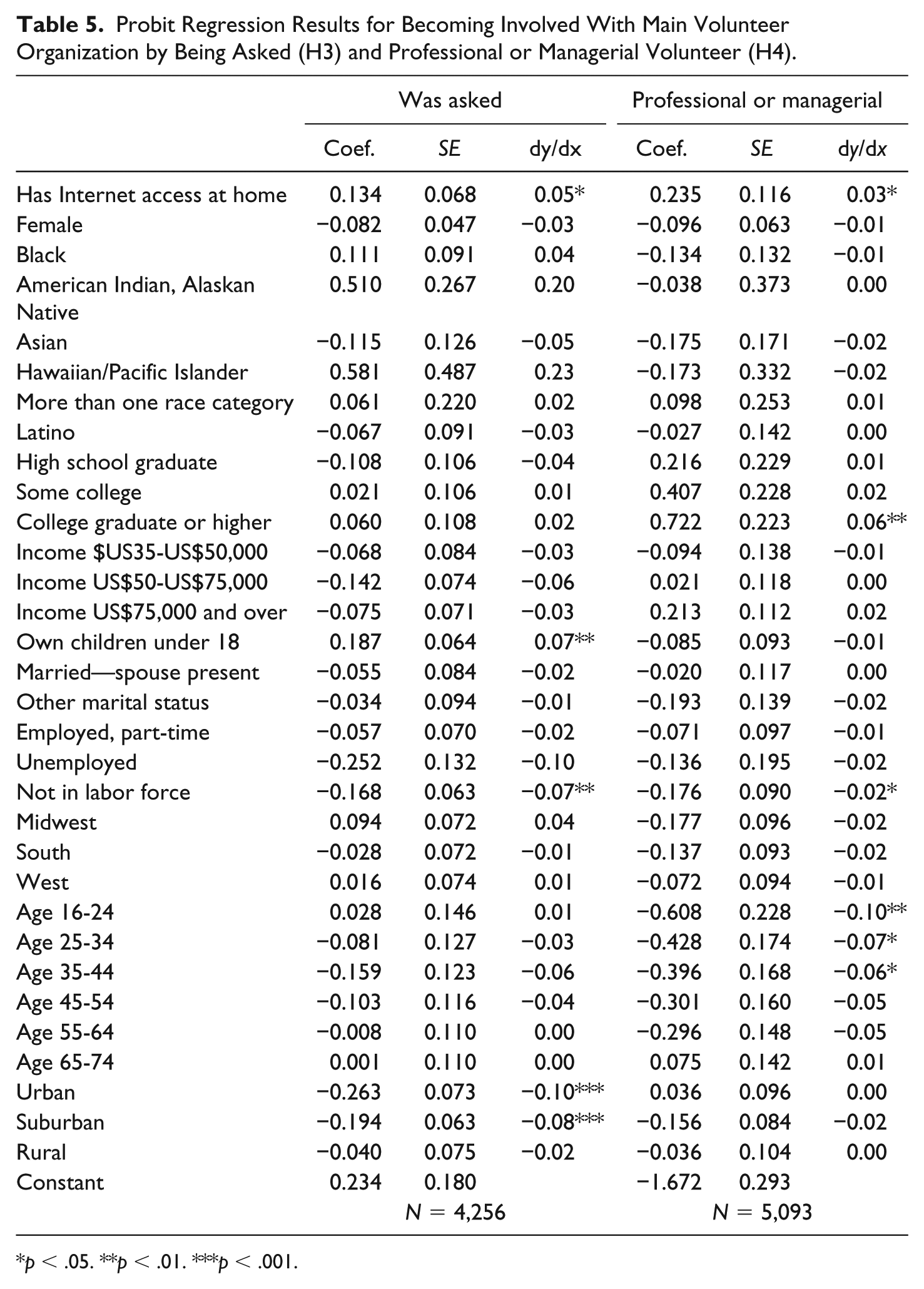
Table 5 shows support for H3: Volunteers with Internet access at home may be about 5 percentage points more likely to become involved by being asked to volunteer, compared with other ways of becoming acquainted with one’s main volunteer organization. Interestingly, people with children are more likely to receive invitations to volunteer, whereas those who are not in the labor force are less likely to receive such invitations.
Probit Regression Results for Becoming Involved With Main Volunteer Organization by Being Asked (H3) and Professional or Managerial Volunteer (H4).
p < .05. **p < .01. ***p < .001.
Meanwhile, Table 5 shows support for H4: Volunteers with Internet access at home are more likely to serve in a leadership position with their main organizations. This result is not an artifact of socioeconomic status, as the model controls for age, educational attainment, and household income. The direct, independent effect of income is not statistically significant, but age and education do have significant effects: Volunteers with at least a college degree are more likely to serve in leadership positions and younger volunteers are less likely.
Discussion and Implications
While Internet access and use are growing, the uneven distribution of household access leaves certain individuals behind. In line with dominant status theory and the resource-based approach to volunteering, we find individuals with home Internet access are more likely to volunteer, both formally and informally, which may be due to their greater propensity to receive invitations to volunteer. Meanwhile, volunteers without household Internet access devote more time to volunteering. Although socioeconomic status helps account for the digital divide and influences volunteering, we find home Internet access has an independent influence on volunteer propensity and volunteer behavior even after we control for socioeconomic status. Nonprofit organizations and government agencies may find the Internet to be an appealing volunteer recruitment tool to reach a relatively broad audience at a minimal cost, but such efforts exclude certain segments of the population, which may include some of the more dedicated volunteers.
Across the four aspects of volunteering—the structure, time devoted, level of professionalization, and pathways to volunteering—we find support for the dominant status theory (Lemon et al., 1972; Smith, 1994) and resource-based perspective (Musick & Wilson, 2008), except for time devoted to volunteering. We find those with home Internet access are more likely to volunteer, both formally and informally, serve in leadership positions, and receive invitations to volunteer. However, time devoted to volunteering shows that status and resources do not correlate with time. Volunteers without home Internet access devote more time to volunteering. While the unconnected are less likely to receive invitations to volunteer, they are dedicated volunteers who devote a greater amount of time to volunteering. In addition, while some have been uncertain about the influence of Internet access on leisure time, our findings suggest that technology may squeeze out free time previously allocated for volunteering.
Examinations of volunteering across these critical aspects help to paint a more complete picture about the influence of digital exclusion on individuals, both their likelihood of volunteering and their patterns of volunteering. Many have called for examinations of informal volunteering in addition to formal volunteering (e.g., Cnaan et al., 1996; Musick & Wilson, 2008), but few have examined both (for exceptions, see Lee & Brudney, 2012; Piatak, 2015, 2016; Wang et al., 2017). Definitions of informal volunteering vary, but researchers agree it involves voluntary activities outside the confines of a formal organization. Estimating a bivariate probit similar to our own, Lee and Brudney (2012) also find formal and informal volunteering are positively interrelated. However, Lee and Brudney (2012) focus on a people-oriented measure of informal volunteering (ρ = .844, p < .028), and we focus on a task-oriented measure of informal volunteering (ρ = .476, p < .001). As the rho captures the correlation between the unmeasured preferences for doing both types of volunteer work, one would expect a higher rho when using a people-oriented definition of informal volunteering as it may be linked to social ties. Future research should explore the diversity and complexity of volunteering by examining voluntary behavior across critical dimensions and aspects, like the structure, time devoted, level of professionalization, and pathways to volunteering.
With the growth of the Internet, there is much debate about the influence on society. As the digital divide further separates the “haves” and “have-nots,” digital access is an additional measure of social class, responding to demands for more holistic measures and examining multiple dimensions of social class in studying volunteering (Tang, 2008). We find digital access influences volunteering independently from traditional measures of social class such as income and education. Scholars may want to examine additional dimensions of social class, such as digital access, in future work.
The digital divide is itself a multidimensional concept. Norris (2001) identifies three key dimensions: the global divide or divergence across societies, the social divide or gap between rich and poor in each nation, and the democratic divide or differences between those who do and do not use “digital resources to engage, mobilize, and participate in public life” (Norris, 2001, p. 4). We focus on the social divide, the digital divide that exists between those with Internet access at their fingertips at home and those without Internet access at home, who face larger barriers to connecting online. Future research on volunteering and other forms of prosocial and political participation should examine the other dimensions of the digital divide. For example, how does the digital access gap in the United States compare with other countries and how does this influence participation in the community? For the democratic divide, how does active participation online influence engagement offline?
As with most research, this study is not without its limitations. We combine two supplements of the CPS, which gives us a large and diverse data set that enables us to control for many measurable factors, but our data do not allow us to control for factors such as religiosity, social network size, or prosocial attitudes. 2 We are also limited by the fact that certain questions, such as how volunteers first became involved in volunteering, are only asked of those who volunteer. Ideally, we would like information on whether the entire sample was asked to volunteer, but we operationalize H4 by examining differences in routes to engagement among volunteers. Future research should examine this issue more broadly. Finally, we measure one aspect of informal volunteering—a task-oriented measure of working with others to improve one’s community, but there are many other aspects of informal volunteering. Research is needed to differentiate informal volunteering from formal volunteering and informal helping behaviors. This study compares a specific aspect of informal volunteering to a broad definition of formal volunteering, where future work examining the determinants of volunteers for similar formal and informal activities would be helpful. Does the nature of the task or the nature of the environment influence who volunteers and in which setting?
Inequity in Volunteer Recruitment
This study responds to calls to examine volunteer recruitment (Bushouse & Sowa, 2012), but finds volunteer recruitment may not always be an inclusive process. Hustinx et al. (2010) express concerns with the social equity of volunteering as volunteering can further power imbalances in society. Our study finds support for dominant status theory and the resource-based perspective, where individuals with greater status in society and more resources—like home Internet access—are more likely to volunteer and are more likely to become involved by receiving personal invitations to volunteer.
Whether due to “ability signals,” resources, or status symbols, the lack of diversity in volunteer recruitment efforts should be alarming to a sector that exists to help others. As Ott and Dicke (2015) describe, Throughout the history of the United States, individual citizens have recognized a need or a problem, attracted others who share their concern, and build a voluntary constituency committed to ameliorating the need or solving or eliminating the problem. This has been true even of issues, or the people associated with them, considered socially undesirable. (p. 3)
Yet volunteer research focuses on those with resources and dominant status (e.g., Musick & Wilson, 2008; Smith, 1994). Only recently have studies begun to question the influence on recruitment efforts (Dean, 2016), future generations (Gesthuizen & Scheepers, 2012), and social equity (Hustinx et al., 2010). In our study, we set forth to answer whether the lack of digital access further exacerbates the exclusion of those who remain unconnected when it comes to volunteering. We find evidence that it does. Those without digital access are less likely to volunteer and less likely to receive requests to volunteer, even though unconnected volunteers devote more time.
Role of Nonprofit Organizations in Bridging Rather Than Deepening the Digital Divide
The Internet is a potential means to recruit volunteers from a larger population (Dighe, 2012), but relying on online connections isolates certain segments of the population. Scholars have called upon nonprofits to do their part to help bridge this divide (Te’eni & Young, 2003). Nonprofits can bridge the divide in volunteer recruitment efforts by using more inclusive recruitment strategies that reach those who are digitally unconnected, too. Organizations seek competent and productive volunteers so must compete for the time and talents of potential volunteers (Brudney, 2016). Like employee recruitment (Brudney, 2010), the strategies chosen to recruit volunteers have their own strengths and weaknesses. Nonprofits should use a mix of strategies to ensure they reach all qualified potential volunteers.
Social media is becoming a common recruitment tool in addition to the more traditional means, such as word-of-mouth referrals, newspaper advertisements, radio and television spots, community presentations, and tapping the networks of clients (Pynes, 2013). However, recruitment strategies focusing on reaching the local community need not focus on digital efforts. For example, Snook and Olsen (2006) recommend fire departments recruit volunteer fire fighters by speaking to local civic groups, placing ads in the local newspaper, and gaining media attention. The Center for Substance Abuse Treatment (2005) offers strategies, such as contacting the local volunteer center; making personal appearances at schools, senior centers, career fairs, and other community events; and sending mass or personal mailings. Nonprofits should be strategic in their recruitment efforts to ensure they are being inclusive of the communities they serve and getting the most qualified and dedicated volunteers.
Footnotes
Acknowledgements
We would like to thank Jeff Brudney for his careful editorship and our anonymous reviewers for their thoughtful comments.
Declaration of Conflicting Interests
The author(s) declared no potential conflicts of interest with respect to the research, authorship, and/or publication of this article.
Funding
The author(s) received no financial support for the research, authorship, and/or publication of this article.
