



Abstract
Nonprofit organizations are often claimed to be schools of democracy: “that produce citizens able and ready to participate in society” (as stated by Dodge and Ospina in Nonprofits as “schools of democracy”: A comparative case study of two environmental organizations, 2016, page 479). This claim is predicated the external role nonprofits play in producing democracy, particularly by engendering civic action. In contrast, this article promotes nonprofits’ internal organizing processes to produce democracy within nonprofits themselves. Drawing on the workplace democracy literature, we explore three main justifications for workplace democracy: consequentialist, deontological, and virtue ethics. Rather than viewing workplace democracy as an extrinsic good—based solely on consequences external to the organization—we argue that it should be considered an intrinsic good, valuable in and of itself. We, therefore, argue for a broadened imaginary for how nonprofits are managed, that include the internal organizational processes and widening of the social mission of nonprofit organization for greater democracy and freedom, based on good work.
Keywords
Introduction
Sentiments and ideas renew themselves, the heart is enlarged, and the human spirit is developed only by the reciprocal action of men upon one another. I have shown that this action is almost nonexistent in a democratic country. It is therefore necessary to create it artificially there. And this is what associations alone can do. (de Tocqueville, 2000 [1835-1840], p. 491, cited in Van der Meer & van Ingen, 2009, p. 284)
In Democracy in America de Tocqueville (1840/2018) noted, with great surprise, the natural instinct for Americans to come together and form associations, to solve common problems or meet collective needs. He described how they “hold fêtes, found seminaries, build inns, construct churches, distribute books, dispatch missionaries to the antipodes. . . . if they wish to highlight a truth or develop an opinion by the encouragement of a great example, they form an association” (p. 58). Furthermore, he claimed “Political associations [in today’s terms advocacy nonprofits and voluntary associations] may therefore be considered as large free schools, where all the members of the community go to learn the general theory of association” (1840/2018, p. 63). In the act of coming together, by working and listening to each other, de Tocqueville (1840/2018) argued, individuals, through these associations, are “no longer isolated men, but a power one sees from afar, whose actions serve as an example; a power that speaks, and to which one listens” (p. 59).
De Tocqueville’s positive descriptions of these political associations as free schools of association have inspired a so-called “neo-Tocquevillian” approach (see Dodge & Ospina, 2016; Van der Meer & van Ingen, 2009; van Ingen & van der Meer, 2016 for a review). This neo-Tocquevillian approach presents participation in voluntary associations (and as Dodge and Ospina, 2016, argue “by extension nonprofits” [p. 479]) as an intrinsic good, where participants develop skills to be fully engaged democratic citizens (Ayala, 2000; Lichterman, 2005), thus creating a participatory society, such as the Dutch “doe-democratie” (do-democracy; Dekker, 2019). As Quintelier (2013) states, “A lot of positive attitudes to democracy have been attributed to people who are active in voluntary associations” (p. 174).
Yet, as we will explore below, this romantic vision of nonprofits as schools of democracy is challenged by empiricist evidence (Van der Meer & van Ingen, 2009), which suggests nonprofits often do not achieve the desired effect of socializing members into democratic participation. It is also challenged by theoretical claims (including those drawing on neo-institutional theory), that nonprofits are increasingly directed toward alternative goals of efficiency and effectiveness in line with managerialism (see, for instance, Shirinashihama’s, 2018, argument that managerialism benefits nonprofits through tight budgetary control). Consequently, nonprofits are under pressure not to focus on being schools of democracy but rather managerialist ends, particularly hitting funding targets (Dart, 2004; King, 2017; Sanders, 2015), thus self-regulating themselves which compels them to adapt to certain (managerial) norms and values (for a discussion, see AbouAssi & Bies, 2018). This raises the question, which we focus on in this article: What is the case for workplace democracy within nonprofits when they are under pressure to follow managerialist objectives?
While there is considerable discussion about the role nonprofits place in achieving democracy, there is little discussion in the literature around nonprofits capacity for workplace democracy. We provide a novel contribution through turning to the ethics literature to examine and assess three justifications for workplace democracy within nonprofits: consequentialist, deontological, and virtue ethics. While, based on our previous work, we accept that we have an a priori inclination toward a deontological justification of workplace democracy (see Griffin, Learmonth, & Elliott, 2015; King & Land, 2018), it is this kind of justification which has tended to be overlooked within the literature because of the focus on the consequences or outcomes of nonprofit organizations’ (NPOs) activity. Ultimately, however, we find value in all three forms of justification and believe that they can reinforce each other in making the case for workplace democracy. We present them herein to argue that NPOs could be what we call “prefigurative schools of democracy,” where workplace democracy is appreciated for its intrinsic value rather than just its extrinsic capacity to deliver services (managerialism) or have socializing outcomes on citizens (as neo-Tocquevillian schools of democracy). In combining these diverse literatures, we create original insights for theorists and managers working in this area that have direct relevance for practice in the area of nonprofits. Our contention is that in doing so we provide a firmer theoretical grounding for nonprofits’ internal organizational practices to be considered the starting point to be considered schools of democracy and offer practitioners, including trustees, employees, and members, stronger ethical support to introduce more democratic workplace practices within their organization.
Are Nonprofits Schools of Democracy?
As stated above, the neo-Tocquevillian approach presents a romantic view of voluntary associations and nonprofits as schools of democracy. 1 This depiction is predicated on the belief that nonprofits (and particularly voluntary associations) are intrinsically schools of democracy. This is based on the assumptions that by coming together, the effects of participation “socialise [participants] into larger political involvement” (Van der Meer & van Ingen, 2009, p. 282). As Kim and Kim (2018) argue, “Nonprofits need democracy to explore and address social issues, often through civic participation and policy changes; however, democracy also depends on nonprofits to educate citizens about societal needs and find the best ways to address them” (p. 704).
By participating in such organizations, the claim is that citizens are introduced to politics on a small scale (Van Deth, 2003), where they learn to deliberate with their fellow citizens (particularly dissimilar others) and thus become engaged with their communities (Putnam, 2000). It is argued that the effects of participation are increased levels of trust, generosity, and status (Van der Meer & van Ingen, 2009); all of which are capacities participants can transfer into other spheres of society such as increased political leadership ambitions (LeRoux & Langer, 2018).
This “neo-Tocquevillian line of reasoning” (Van der Meer & van Ingen, 2009, p. 284) suggests nonprofits “produce citizens able and ready to participate in society” (Dodge & Ospina, 2016, p. 479). This is based on a consequentialist ethical justification that the extrinsic effect of participation is translated into political action external to the nonprofit. For instance, Van der Meer and Van Ingen (2009) claim, “participants in voluntary associations are more likely to be politically active as they have obtained the skills, the network and the mind-set to be so” (p. 282). They go on to state that they “consider this positive, causal relationship between civic participation and political action, through socialisation, to be the core of the ‘neo-Tocquevillian’ theory. Positive, small-scale experiences in associations enable people to socialise into larger political involvement” (p. 282). The neo-Tocquevillian approach, therefore, claims voluntary associations and nonprofits to be schools of democracy based on their capacity to create change in the political behavior of the participant and with this create democratic accountability.
Yet this romantic depiction is questionable. First this neo-Tocquevillian socialization thesis has been challenged by empiricist examinations of the efficacy of nonprofits to act as schools of democracy, by assessing the socializing impact nonprofits have on their participants (LeRoux & Langer, 2018; Quintelier, 2013). The evidence of this socializing impact is mixed (see van Ingen & van der Meer, 2016, for a review). Rather than being schools of democracy, nonprofits are often criticized for being pools of democracy due to self-selection effects (van Ingen & van der Meer, 2016), or even creating undemocratic outcomes (Van Deth, 2010). One such example may be that rather than facilitating democracy, the social capital, bonding, and interconnections that Putnam (2000) championed may in fact occur between actors who oppose democratic values. Therefore, the claim that nonprofits are schools of democracy is vulnerable to consequentialist arguments that they might not produce the outcomes neo-Tocquevillians assume.
Second questions are raised regarding how the institutional environment shapes NPOs’ practices. The “neo-Tocquevillian approach,” Dodge and Ospina (2016) argue, “uncritically assumes that civic activism is inherent to nonprofit work” (p. 480). However, such civic activism is increasingly marginalized within NPOs (J. C. Alexander, 2006). For instance, in the United Kingdom Barings Report claims an overreliance on state funding, and the anti-lobbying legislation restricts nonprofits’ capacity for activism (Singleton, 2015). Indeed, Skocpol (2013) argues, these associations were never the self-governing entities of the neo-Tocquevillian’s romantic depictions. Instead, “civic voluntarism was thoroughly intertwined with government activities and popular politics. Mass-mobilizing U.S. wars and inclusive public social programs . . . ” (Skocpol, 2013, p. 23).
Third, and related to the above, there is pressure on nonprofits to follow managerialism (Shirinashihama, 2018) rather than focusing on producing democratically inclined citizens. As Skocpol (2013) states, within America (and arguably worldwide) there has been a “transition from membership activities to professionally managed institutions and advocacy groups” (p. 128). By managerialism we mean a form of organization in which managerial forms of logic have come to dominate and shape the actions of individuals and groups in society. Indeed, it is managerialism, rather than neo-Tocquevillian schools of democracy, that arguably is the dominant logic shaping nonprofit activity (Coule, 2015; Dart, 2004; King, 2017; Sanders, 2015). NPOs increasingly have to win contracts and justify themselves through a logic of efficiency and competency, creating isomorphic pressure for nonprofits to be run in ways that emphasize efficiency and outward accountability (Carmel & Harlock, 2008), achieving targets and hitting milestones with measurable outcomes (Dart, 2004; King, 2017; Maier, Meyer, & Steinbereithner, 2016; Meyer, Buber, & Aghamanoukjan, 2013). These changes place more emphasis on upward accountability toward donors and outward accountability toward partner organizations, at the expense of downward accountability to beneficiaries and inward accountability to workers and volunteers (Ostrower & Stone, 2015).
Although this discourse of managerialism (and related business-like practices) are presented as ideologically neutral (it is about “what works”; Alvesson & Willmott, 1996), they too have an implicit set of ideological assumptions (and inherent ethical positions) they rarely articulate. Managerialism is justified through an implied instrumentalist-consequentialist position, based on a narrow means–end rationality, in which nonprofit activity is solely judged on the efficient use of public funds. They also invoke virtue claims, by privileging efficiency for the taxpayer, as a natural and unquestioned social good (J. A. Alexander & Weiner, 1998) above other ends. Like the neo-Tocquevillian schools of democracy perspective, this is an extrinsic value for the delivery of public services (see Table 1).
Managerialism, Neo-Tocquevillian, and Prefigurative Ethical Justifications.
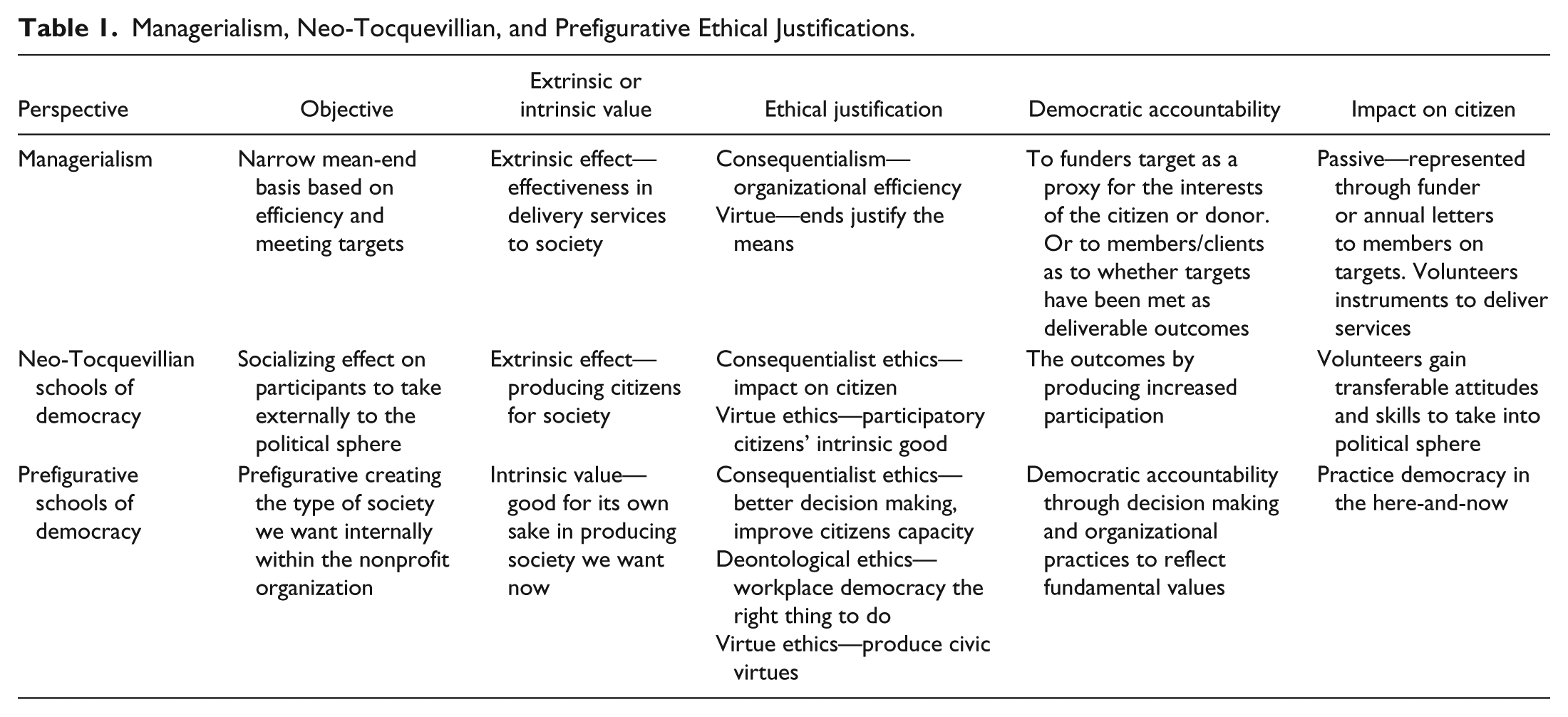
However, as critical scholars, we find these assumptions problematic. First, they assume an instrumentalist-consequentialist position, that is, that managerialism and business-like practices are the most efficient and effective way of organizing NPOs—a view which the workplace democracy literature questions. Second, they assume an economic logic of efficiency and productivity as unquestionable virtues which should be the overriding aim of nonprofit activity—again a view workplace democracy literature challenges. We now examine the ethical justifications for workplace democracy within nonprofits, which sees workplace democracy for its intrinsic value that can prefigure (produce in the here and now) the type of society nonprofits often say they want to produce (Land & King, 2014; Reedy, King, & Coupland, 2016).
Justifications for Workplace Democracy
The concept of workplace democracy is a contested one, encompassing factors including ownership, decision making, governance, and representational structures (see, for instance, Cathcart, 2013; Dahl, 1985; Yeoman, 2014 for a discussion). In this article, we define workplace democracy broadly as encompassing features such as collective decision making, equity, and autonomy over and within the workplace (see S. Parker & Parker, 2017 for a discussion) to produce good work. Numerous forms of governance structures can be captured by the definition ranging from worker cooperatives, where workers have a stake within an organization and make decisions for mutual benefits (Craig & Pencavel, 1992), to sociocratic organizations—in which equal employees use a consent based form of governance to participate and make decisions in the organization (Buck & Villines, 2007). Importantly, for us, it goes beyond representative workplace democracy—in which a manager might be delegated responsibility to lead, with staff forfeiting equity and autonomy in the aim of efficiency. While this might include egalitarian horizontal organizational structures, our broad definition of workplace democracy can also include forms where leaders exist but are elected or selected on a fixed-term basis with the possibility of removal (Griffin et al., 2015). With this in mind, we now consider how this type of internal governance might be justified within NPOs, by considering three dominant forms of ethical justification: consequentialism, deontology, and virtue ethics.
Consequentialist Justifications
Consequentialism suggests that the rightness or wrongness of an act should be judged solely on outcomes (Bentham, 1996). This is the basis for the justifications of managerialism. NPOs are judged, and therefore deemed legitimate, primarily based on their efficiency in hitting targets. However, this instrumentalist-consequentialist argument is overly narrow, overlooking the wider consequences of how NPOs are organized, specifically the consequences on paid staff, volunteers, and the external impacts on society. Furthermore, champions of workplace democracy argue managerialism may also contain inefficiencies and negative outcomes.
It has been well-documented that hierarchical organizational forms can have significant costs (Blaug, 2009) and the benefits have been overrated (Kastelle, 2013). Critical accounts of such organizations suggest that hierarchy enables and promotes oppressive and controlling practices by management (Alvesson & Willmott, 1996). Practical accounts of exploitation through hierarchy in the world of business (Korten, 2015), public sector (Pollitt, 1993), and even in academia (M. Parker, 2014) are commonplace. Managers dominate their employees by exerting their control through strict disciplinary procedures and often ruthlessly pursuing increased efficiency and performance, invariably measured purely in economic terms (Deetz, 1992). Evidence shows that hierarchical organizations can perpetuate existing inequalities (particularly around gender, see Acker, 1990) and have corresponding problems with motivating staff to provide discretionary effort. In following these organizational forms, scholars argue many NPOs operate in a manner largely indistinguishable from their for-profit and public sector counterparts (Carnochan, Samples, Myers, & Austin, 2014; Coule, 2015; Dart, 2004; King, 2017; King & Learmonth, 2015; Maier & Meyer, 2011; Maier et al., 2016; Sanders, 2015). The evidence suggests that even on consequentialist grounds they may be misguided in doing so as employees who engage in collective decision making tend to show more affective commitment, leading to lower long-term costs for the organization (Weber, Unterrainer, & Schmid, 2009). Furthermore, hierarchical and bureaucratic structures can place multiple barriers which can slow decision making. For instance, Jose Andres’s (2018) account of working in disaster relief in Puerto Rico describes how some of the large nonprofits were paralyzed by the disaster, unable to spend the money they had or distribute food and water already purchased because of the bureaucracy and hierarchical decision-making structures.
Moreover as nonprofits use volunteers, managerialist approaches may be counterproductive. Volunteers, by their very nature, cannot be motivated by financial incentive, but rather by enthusiasm to their cause (Kreutzer & Jäger, 2011), which is unlikely to be achieved through narrow, instrumental goals around efficiency and productivity (Howlett & Rochester, 2007). Consequentialist arguments can thus be used to promote a more positive vision of workplace democracy, including that it increases volunteers’ motivation through greater participation and engagement in decision making, thus fostering organizational commitment (Harrison & Freeman, 2004) and participation (Collins, 1997). Workplace democracy has also been praised for empowering workers and improving job satisfaction (Black & Gregersen, 1997), increasing employees’ health, reducing anxiety and stress-related illnesses (Foley & Polanyi, 2006), contributing to “psycho-social well-being” (Knudsen, Busck, & Lind, 2011; Sashkin, 1984), improving strategic decision making and firm performance (Carmeli, Sheaffer, & Yitzack Halevi, 2009), stimulating creativity and innovation (Sarin & McDermott, 2003), and having societal benefits such as increasing democratic consciousness and increasing political efficacy (cf. Greenberg, 2008; McCelland & Burnham, 1976; Pateman, 1970). All of these potential benefits of more participation in organizations provide strong consequentialist grounds from which to justify workplace democracy.
Second, consequentialist arguments can be utilized to justify the use of more democratic and participatory forms of organizing beyond economic (and managerialist) justifications. Utilitarianism, perhaps the most well-known consequentialist ethical position, suggests in considering the rightness or wrongness of an action we should be aiming for the happiness of the greatest number. In this vein, John Stuart Mill (1871/1965) argued (contra Marx) that workplace democracy would contribute to the “healing of the standing feud between capital and labour; the transformation of human life, from a conflict of classes struggling for opposite interests, to a friendly rivalry in the pursuit of the common good [the greatest happiness] for all” (p. 792). In this sense, workplace democracy is seen as a key mechanism for developing the democratic character of individuals that they can then implement in the wider democratic sphere. Thus, Mill suggested that there “is a ‘developmental’ case to be made for giving people the vote as a means of perfecting their skills, even if it makes no practical difference (in the short term) to political outcomes” (Goodin, 1996, p. 842). Such an argument is core to Putman’s argument for the need to renew civil society to create more social-bonding and connection between people (Putnam, 2000).
However, the utilitarian defense of workplace democracy is weak in the same way that many other consequentialist accounts are. For example, if more people could be made “happy” through the utilization of strict hierarchical and dominant management systems in NPOs, it would, on utilitarian grounds, justify abandoning workplace democracy altogether. Indeed, workplace democracy might ironically produce its own democratic deficit. As Blühdorn (2013) argues, democratic organizing can be time-consuming which might even reduce the levels of participation by stakeholders. Similarly, in their attempt to bring about workplace democracy to a small nonprofit King and Land (2018) argue the organizations’ staff, and some volunteers and trustees, . . . collectively and democratically, came to the conclusion that working democratically demanded significant levels of responsibility, commitment, time and energy. . . . For people working part-time [or volunteering] in a charity, it was too much. Their choice can be seen as a sensible reaction to the possibilities of intensifying work. (p. 1547)
Consequentialism alone therefore does not fully provide a basis for workplace democracy. We now turn to the deontological justifications which are less concerned with consequences and more concerned with the intrinsic rightness or wrongness of workplace democracy.
Deontological Justifications
It is common for people to propose workplace democracy using deontological or rule-based arguments. For these individuals, increasing democracy within the workplace is the right thing to do regardless of the outcomes. Clearly better outcomes are preferred (and predicted), but this is not the justification they primarily employ. Instead, influenced by Kantian and enlightenment ideals, proponents suggest we are bound by duty to act toward others as we would want them to act toward us (to universalize our justifications) and thus should treat people as ends rather than means (Kant, 1785). In this sense, workers and volunteers should not be considered merely as cogs in a machine to increase efficiency but as human beings with reasons for their desires and motives to be autonomous. Dahl (1985) utilizes a neo-Kantian justification of workplace democracy when he argues “if democracy is justified in governing the state it must also be justified in governing economic enterprises” (p. 111). Similarly, Cohen (1989, p. 26) using a Rawlsian and rather more radical argument for “worker-managed firms” states that a “commitment to socialism follows naturally from a commitment to democracy, where a democracy is understood to be an association that realizes the ideal of free deliberation among equal citizens.” For Dahl and Cohen, therefore, workplace democracy is the right way of organizing as it is a subsystem of political democracy which is the just and fair way of collectively making decisions in society (see also Habermasian inspired versions of workplace democracy such as Fryer, 2012).
In this sense, NPOs might be concerned with democracy not merely as a necessary instrumental means to (use volunteers to) increase efficiency but as intrinsically valuable in itself because it is the right thing to do, central to their mission as an organization. For instance, if an organization is committed to human rights, or equal opportunities, it would be hypocritical and undermining if their own workplace practices contravened such ambitions (for a discussion, see Land & King, 2014).
However, such deontological arguments (may) unfold differently within NPOs. An essential basis for Dahl’s (1985) and Malleson’s (2013, p. 605) argument is that “most workers [in for-profit organizations] are compelled [through economic necessity] to join hierarchical workplaces within which they are structurally unequal.” Thus, due to this necessity of work, workplaces should be democratic, and treat people fairly as equals, because although they have the option for exit (see Hirschman, 1970) they still need to work and therefore have limited options, simply moving from one undemocratic organization to another. While within NPOs this argument might similarly be applicable for paid employees, it becomes more nuanced for volunteers. By their nature, volunteers do not have the same economic necessity to stay within the organization and therefore, in principle at least, their capacity for exit is significantly enhanced vis-à-vis the paid employee. If they do not like the way that they are treated, they can leave. In this sense it could be argued the need for workplace democracy is not as strong for volunteers. However, such an approach does not take into account the social-bonds that are created through the volunteering experience that may reduce the desire to leave (Howlett & Rochester, 2007).
There are various criticisms of deontology as an ethical position which when applied to the justification of democracy within NPOs can have just as much force. For instance, what happens if the use of workplace democracy (despite being ethically correct in deontological terms) could do great harm? Perhaps the manager of a democratic nonprofit committed to feeding malnourished developing-world children is faced with a situation where acting autocratically would likely fulfill their mission and save more lives, whereas through deontological grounds, it could be argued the manager’s moral duty is consulting other organizational member. We, therefore, have competing duties: the duty to consult other equal members democratically on important decisions and a duty to save as many lives as we can. Kant (1785) claimed that “a conflict of duties is inconceivable”; there will always be a duty which we are clearly more obligated to follow. However, in a situation where children’s lives are (potentially?) at risk, and our (definite) commitment to democratic organizing is also at risk, it is perhaps not such a simple choice. This points toward a final potential issue with the deontological justification, where the manager of the NPO exaggerates or omits information to make certain duties more primary than others, that is, “I had to bypass the democratic process, we had a moral duty to those children.” It is at this point that our commitment to justifying workplace democracy through deontological means is potentially tested a step too far. It may even lead to a slip back into consequentialism as we debate outcomes based upon actions rather than moral duties.
Furthermore, even proponents of workplace democracy such as Malleson questions if its wholesale adoption is appropriate in all NPOs. For instance, he argues, “[w]e would not want . . . the school curriculum decided unilaterally by the school staff, since this would be undemocratic from the perspective of the larger community” (Malleson, 2014, p. 44). NPOs therefore do not have responsibility simply to their workforce or volunteers but the wider community they serve. Workplace democracy therefore would be one of a number of competing values that NPOs operate by and should not necessarily be considered an overriding one. In situations like this, many theorists have suggested what people require to justify moral action is a given end to work toward (that may guide our evaluation of duties and consequences) and a set of virtues that might guide us in this process. We now turn to virtue ethics justifications of workplace democracy in an effort to consider how arguments focusing on moral character within the internal procedures of an organizations might also effect NPOs.
Virtue Ethics Justifications
Virtue ethics has a long-standing tradition rooted in both Greek (Aristotelian) and Chinese (Confucian) philosophy. It is one of the three core strands of ethical justification. Whereas consequentialists focus on outcomes of actions and deontologists concentrate on duties or rules, the virtue ethics approach concentrates on the virtuosity of actions in a given circumstance. It is important at this point to stress that this does not mean that the virtue ethicist is unconcerned with consequences or rules (any more than the deontologist is completely unconcerned with consequences or the consequentialist totally unconcerned with duty), merely that the virtue is the guiding principle of action. Virtues will be important to the deontologist for abiding by duty and they will be important for the consequentialist in achieving good outcomes. However, for proponents of virtue ethics they will not be subservient to other core concepts, they are the dominant and most important aspect of ethical decision making. Applied in an organizational context, virtue ethics might lead us to consider on a case-by-case basis, how the behavior within a specific nonprofit reflects on moral character and moves us toward the central virtues of, for example, benevolence and charity.
NPOs organized democratically can be justified as collectively they contribute toward sustaining key virtues. Weber and colleagues, for instance, argue that civic virtues like “mutual aid, prosocial perspective-taking, solidarity, humanitarian values, and cosmopolitan activities are vital for the maintenance of a democratic society” (p. 1144) and that democratically structured organizations can help produce such cohesion. This argument can be traced back to Aristotle, for whom participation was considered a key component of the “good life” and achieving human flourishing (eudaimonia). Virtue ethics also draws on the Greek notions of arête (excellence) and phronesis (practical or moral wisdom), emphasizing the potential for individuals to develop their moral character over time. For instance, Gutmann and Thompson (2002) develop a form of deliberative democracy from these Aristotelian foundations to defend virtues such as reciprocity, in which “citizens owe one another justifications for the mutually binding laws and public policies they collectively enact” (p. 156).
While virtues like reciprocity and mutual respect might contribute to internal democracy within NPOs, these schemes have also been criticized in an organizational context (Moorman, 1991). For instance, MacIntyre (1984), the preeminent defender of Aristotelian virtue ethics, has also stressed how extremely skeptical he is of managers being able to actively (and ethically) employ virtues to control positive outcomes in a business setting. From this perspective, even participatory schemes that appear virtuous will often be no more than instrumentalist management initiatives that are intended to secure a compliant workforce rather than nurturing a critically reflexive group of workers ready to challenge the status quo. In addition, nonprofits that overtly encourage virtues such as mutual respect toward a collective good (a telos of the organization) might end up leaving less space for active critique within the organization. This need not be fatal for the virtue ethics defense of workplace democracy but suggests we need to pay close attention to the kinds of virtues we are supporting and perhaps even the ultimate telos or outcome we are intending to achieve through adherence to certain virtues. Furthermore, adhering to virtues by themselves may not be enough to maintain our commitment to democratic values or outcomes.
Nevertheless, one of the strongest aspects of virtue ethics is that it might help NPOs maintain standards when tempted to abandon them due to other competing objectives. For instance, Age UK was claimed to have received £6 million in referral payments from energy supplier E.ON, particular, by marketing a 2-year fixed-price tariff costing £1,049 a year as “great value,” even though it was said to cost £245 more annually than E.ON’s cheapest deal (Brignall, 2016). It may be important therefore in this mode of justification of workplace democracy to take seriously the need for a connection of ends and means and the grounds on which we decide to connect the two. It may ultimately be the case that all three modes of justification offer something to workers when considering how they might defend the continued use (or adoption) of democratic forms within their NPOs.
Discussion: The Case for Prefigurative Workplace Democracy
Under stable conditions, people may unthinkingly follow and reproduce a particular logic’s activities; alternative ways of organizing are often unfathomable. (Chen, Lune, & Queen, 2013, p. 859)
By adopting practices of workplace democracy, NPOs have the potentiality to be what we call prefigurative schools of democracy. Prefiguration is drawn from anarchism and heavily utilized within the alter-globalization movement (Maeckelbergh, 2009, 2011). It is the politics of immanence, in which desired outcomes are created in the here-and-now rather than projected into the future (Reedy et al., 2016). It seeks to combine the ends (democracy) with the means (democratic practices) which focus on the intrinsic value of democratic practices as good for their own sake. Participants seek to embody within its values, social relations, ways of living, and organizational practices of democracy and participation (Maeckelbergh, 2009, 2011), such as those captured in more spontaneous forms of organizing (Simsa, Rameder, Aghamanoukjan, & Totter, 2018).
This approach challenges managerialist instrumentalist-consequentialism by stressing the importance of the processes through which these outcomes are achieved (in particularly on the impact that it has on participants) and their separation of the means and ends which managerialism by solely focusing on outcomes encourages. It also radicalizes the neo-Tocquevillian schools of democracy by looking beyond NPOs producing extrinsic socializing impacts on participants that they use in political sphere (Quintelier, 2013; Van der Meer & van Ingen, 2009). Rather than focusing solely on consequentialist benefits of NPOs, it takes seriously the intrinsic benefits that can arise through the internal working practices through which NPOs organize themselves. Nonprofits should embed practices of Good Work within how they operate as well as doing good for society. Using our three ethical justifications, we argue that NPOs as schools for democracy are significantly enhanced if NPOs operate using workplace democracy. We will address these areas in turn.
Employing democratic working practices can develop the capacity of citizens working within them. It can develop critical thinking skills through democratic workplace practices such as participating in collective decision making (Pincione & Tesón, 2006). As the critiques of managerialism have illustrated (Dart, 2004), this narrow instrumentalist-consequentialism can have implications on the democratic growth of volunteers, because it constrains voice and participation (Baines, Cunningham, & Fraser, 2011). The approach can often render volunteers (and workers) as passive or subservient and thus lacking self-determination (Alvesson & Willmott, 1996), which can have significant material consequences (e.g., see Andres, 2018). NPOs adopting internally democratic working practices on a day-to-day basis can act as prefigurative schools of democracy and enable citizens to learn new ways of being and doing that enhance their capacities as active citizens (Felicetti, 2018). For instance, following the Habermasian model of deliberative democracy it should, some authors argue, be guided by a “‘self-organizing community of free and equal citizens’ coordinating their common affairs through common reason” (Felicetti, 2018, p. 4) thus providing opportunities for all to be involved in collective self-determination. Models such as Participatory Budgeting or consensus-based decision making offer us models of practices through which citizens participate collectively, and through these develop their capacities to work collectively and self-sufficiently (Land & King, 2014).
As prefigurative schools of democracy NPOs could offer opportunities for the realization of democratic ideas such as individual autonomy, voice, freedom, and participation in decision making, not solely for its extrinsic impact on socialization into wider political involvement (Van der Meer & van Ingen, 2009). This, in turn, can enable participants to grow in their personal and social capacities, learning, experiencing and modeling ways of working that then could filter into wider society. As Carole Pateman has argued, the opportunity to experience participatory democracy in their everyday lives (for instance, through active involvement in democratically run NPOs) could strengthen belief in a wider democratic project (Pateman, 1970). As new social movements also argue, such practices are developmental and prefigurative, in that they create “space in civic life for ideas and actions that exist nowhere else, encouraging people to envision how the world can be transformed into something better” (Blee, 2012, p. 134). Applied more directly to NPOs, Howlett and Rochester (2007) suggested that this “volunteer way of doing things” might be characterized by basic democratic structures and nonmanagerial logics in which integration is more important than efficiency. It is thus through the practices of volunteering, of participating in collective decision making and self-determination, citizens could begin to develop new ways of being in the here-and-now.
However, workplace democracy is no panacea. As Kleinman (1996) illustrates, despite the espoused ambition to operate democratically some NPOs may in fact simply reproduce the existing social patterns and power differentials: I learned that in a society permeated by inequalities, we can’t get rid of the patterns of domination and subordination we participate in unless we continually examine our contradictions. And we find these contradictions by tracing out the political implications of our moral identities. Without such self-examination we may think of ourselves as progressive, but fail to build a better alternative. (Kleinman, 1996, p. 140)
Prefigurative workplace democracy therefore cannot rely on consequentialist ethics alone as democratic work practices could be dismissed if they do not produce the intended effects. Deontological ethics therefore could also be employed to argue that a commitment to workplace democracy is a good for its own sake and virtue ethics that workplace democracy is important for nonprofits to connect the means (organizational practices) to the ends (the social purposes they are seeking to achieve). For organizations that have commitments to producing more equal societies can be strengthened through the introduction of workplace democracy. Even when workplace democracy might produce unintended undemocratic outcomes (Blühdorn, 2013) such as those revealed by Freeman’s (1972) classic “Tyranny of Structurelessness” thesis, this does not necessarily mean the end of workplace democracy, rather an opening for self-reflection, self-criticism, and flexibility to work through the challenges it creates (Maeckelbergh, 2009).
In recent times, NPOs have been judged through the discourse of managerialism which assesses NPO activity through narrow instrumentalist-consequentialist framework of their ability to efficiently hit targets (Dart, 2004; Sanders, 2015). However, even within this reductionist reading of the purpose of nonprofits the workplace democracy literature highlights there are many reasons to suggest that internal workplace democracy might help provide more suitable and effective services. One of the central principles of democratic organizing, increased participation in decision making throughout the whole organization (Malleson, 2013), also has benefits for organizations that often rely on the goodwill of volunteers. It does so by providing opportunities for increased commitment and voice, therefore supporting the development of the organization. Drawing on virtue ethics justifications we can argue that contra managerialism, the implementation of virtuous management could (despite MacIntyre’s concerns) lead to a democratic form of internal organizing that connects participation to the service needs of the community. That is, by reimagining workplace democracy through adherence to virtues like reciprocity and mutual respect, we can begin to build and understand relationships with our fellow volunteers in NPOs and work together much more harmoniously toward collective organizational goals (Putnam, 2000). This, in turn, could provide a much stronger foundation for providing services to the wider community that the NPO is attempting to assist.
Workplace democracy—backed by these three broad areas of justification—could therefore be used as a way to construct a new imaginary of what nonprofits and wider society could potentially look like (Smith, 2012). Rather than considering nonprofits through the narrow viewpoint of efficiency, means–end calculation of managerialism, their internal mode of operating could be considered integral to their social mission. Drawing from ideas within new social movements, the organizing practices through which nonprofits operate could, we argue, be considered as prefigurative, reflexive of the types of societal changes that nonprofits seek to bring about (see, for instance, Maeckelbergh, 2009; Reedy et al., 2016). Furthermore, by increasing internal forms of democracy NPOs can be more accountable and representative of their members’ needs and interests, therefore increasing their capacity for advocacy and offering genuine freedom of association. While this deontological claim represents a strong ideal for how NPOs might want to organize, some may still question their effectiveness. Given that internal democracy may be one, but not the only, ambition for NPOs, the effectiveness of internal democratic practices needs to be reconciled against other interests (in particular, servicing the communities for which the organization was originally founded). Yet other more recent organizational forms such as Sociocracy suggest they can create democratic and participatory practices as well as more effective forms of decision making (Buck & Endenburg, 2012; Rau & Koch-Gonzalez, 2018). Further research is required to investigate into whether this new form of organizing lives up to the claims its proponents make.
Conclusion: Toward a Democratic Imaginary
This article contributes to the schools of democracy literature by broadening the repertoire of ethical justifications for workplace democracy within NPOs. It does this by introducing deontological and virtue ethics justifications for workplace democracy to complement and extend consequentialist ethical positions (on which both managerialism and the neo-Tocquevillian perspective rely) and through this strengthen the arguments of NPOs as schools of democracy. These ethical positions challenge managerialism’s instrumentalist-consequentialist position which judges nonprofits solely as mechanisms for the delivery of effective and efficient services. Instead, it argues nonprofits could produce broader and more sustainable effects on society by seeking to create democracy within nonprofits for its own sake. It also deepens and extends the neo-Tocquevillian perspective of nonprofits as schools of democracy beyond their socializing-consequentialist impact on the political activity of participants (Quintelier, 2013; van Ingen & van der Meer, 2016). For us this neo-Tocquevillian position is always vulnerable to empirical assessment that this socializing-effect does not work and therefore should be dropped.
Thus by arguing that workplace democracy is in-and-of-itself of intrinsic value, valuable for its own sake, we are arguing that workplace democracy should not be judged solely on consequentialist external outcomes but deontologically as the right thing to do and based on virtues including reciprocity for its intrinsic value. The article, thus, is an attempt to extend our imaginary of what nonprofits could be rather than what they are, offering what, Milbourne and Murray (2017) argue, is a democratic imaginary (also see Smith, 2012). In such an imaginary, NPOs might seek to reconfigure their social mission, beyond conventional managerialist concerns about efficiency in service provision, to the wider responsibility they have as schools of democracy.
We recognize that such a call is contested. Our aim, through these insights, is not to prescribe but to stimulate debate that is relevant within our field and beyond. In this sense, our call also raises questions for practitioners and activists regarding how they might organize and policy implications regarding what roles funders and others have to create a wider eco-system which could extend and deepen our understanding of nonprofits as schools for democracy based on Good Work. Future research therefore could consider the difficulties and paradoxes faced while trying to internally organize in a democratic fashion—the dilemmas faced by managers in trying to be effective while also being ethically sound. In doing so we might show that while democracy within NPOs can be fraught with tensions and difficulties, these can be addressed without them being considered failed experiments. It might also build on accounts of alternative forms of organizing examining how such principles could be translated from new social movements into NPOs, particularly given the different legal context of funding requirements. Finally, it might also seek to recover the memory of, and learn lessons from, the many experiments that have occurred within NPOs and new social movements, particularly from the 1960s and 1970s. In doing so, we hope research can keep alive and support the idea that another way is possible.
Footnotes
Acknowledgements
We would like to thank the reviewers and editor of the journal for their constructive comments and helping us develop the ideas in this article. We are grateful for the ESRC (Economic and Social Research Council) for the grant, “Democratic Renewal in Civil Society Organizations” ES/N009096/1, which inspired this article. We are also grateful for the organizers and participants of the European Group for Organizational Studies (EGOS), 2017 Sub-theme 18 “Civil Society Organizations: The Site of Legitimizing the Common Good”; the 2017 Critical Management Studies stream “Civil Society Organizations: Democratic Alternatives in action”; and Jennifer Dodge, Tracey Coule, and Alistair Mutch for commenting on early drafts of this paper.
Declaration of Conflicting Interests
The author(s) declared no potential conflicts of interest with respect to the research, authorship, and/or publication of this article.
Funding
The author(s) received no financial support for the research, authorship, and/or publication of this article.