



Abstract
Nonprofit organizations (NPOs) increasingly implement socially responsible programs to address their responsibilities toward society. Although collaborations are a valuable means to tackle complex social issues, NPOs also similarly collaborate with other NPOs for delivering socially responsible programs. However, the motivations driving NPOs to collaborate with likeminded organizations for socially responsible programs remain unclear. Using a single embedded in-depth case study research design, our purpose is to examine the formation of collaborations among sport federations and sport clubs for socially responsible programs. Reflecting the interplay between resource-based view and institutional perspectives, our findings intrinsically indicate that partners demonstrate similarity in their motivations to collaborate due to their organizational fit, but with some key differences in the complementary resources they seek. Organizational legitimacy and resource exchange needs for socially responsible programs are driving the collaboration rather than organizational survival needs. The potential to create social value makes this nonprofit collaboration form unique.
Keywords
Introduction
Nonprofit organizations (NPOs) increasingly embrace the term corporate social responsibility (CSR) to address their social responsibilities toward society (Lin-Hi, Hörisch, & Blumberg, 2015). A recent study shows an increasing trend in adoption rates for nonprofits of communication and reporting schemes that express social responsibility, such as the Global Compact or the Global Reporting Initiatives Guidelines (Pope, Bromley, Lim, & Meyer, 2018). This upward frequency underpins a small but growing body of research examining this phenomenon in the nonprofit context (Acar, Aupperle, & Lowy, 2001; Lin-Hi et al., 2015; Pope et al., 2018; Robertson, Eime, & Westerbeek, 2018). These studies purport that it is valuable to discuss the social responsibility of all contemporary organizations not only in the for-profit, but also in the nonprofit sector. The social nature of NPOs’ activities should not automatically imply social responsibility given their recent irresponsible behaviors such as fraud, corruption, or environmental damages (Lin-Hi et al., 2015; Robertson et al., 2018).
NPOs engage in socially responsible programs to play a role beyond service delivery for their members. These practices often extend beyond their core purpose. In the business context, CSR implementation regularly involves collaboration between profit and nonprofit (Austin & Seitanidi, 2012a). Similarly, NPOs collaborate with other NPOs for delivering socially responsible programs.
More specifically, extant literature has only examined NPOs as the vehicle for businesses to implement their social responsibility agenda (Austin, 2000). NPOs enacting these practices themselves rather than acting as the recipients of socially responsible programs (Kourula & Laasonen, 2010; Omar, Leach, & March, 2014) have not received much attention and are still in need of empirical examination (Lin-Hi et al., 2015; Pope et al., 2018). Although various studies exist regarding why business collaborate with NPOs (Austin & Seitanidi, 2012a; Seitanidi, Koufopoulos, & Palmer, 2010) as well as why NPOs collaborate with business (Herlin, 2015; Omar et al., 2014), we know little about motivations for collaboration between NPOs for social responsibility.
This study examines nonprofit collaboration, which concerns different NPOs striving to address problems—such as education, health, and social cohesion (Gazley & Guo, 2015)—through joint effort, resources, and decision making and share ownership of the final product or service (Guo & Acar, 2005). Although nonprofit collaboration has grown significantly in recent years (Gazley & Guo, 2015), the scholarship in this field overlooks collaboration among NPOs in the delivery of socially responsible programs. To date, we lack understanding of what drives NPOs to collaborate with likeminded organizations for the implementation of socially responsible programs. A better understanding of the motivations driving NPOs to collaborate for programs that can have an impact on society is a current managerial and research gap. As such, empirical insights can help us bring to the fore the mutual social value such collaborations can offer.
Drawing on the nonprofit sport sector, the purpose of this study is to examine the motivations behind the formation of collaborations among sport federations and sport clubs for socially responsible programs. We study motives for engaging in collaborations to deliver socially responsible programs from the most common theories used to explain nonprofit collaboration, namely, resources-based view and institutional theory. Our research is predicated on the following question: What motivates NPOs to collaborate with other NPOs to implement socially responsible programs?
The contribution of this study is twofold. First, it offers a fresh perspective in nonprofit collaboration scholarship by exploring collaborations formation for nonmission-related activities among NPOs (i.e., mission that extend beyond their primary social purpose). Second, the study expands knowledge related to NPOs and social responsibility by broadening the role of NPOs in achieving socially responsible objectives, beyond their generally admitted activist, consultant, or partner roles (Kourula & Laasonen, 2010). At the same time, it enlarges the possible forms of collaboration for the delivery of CSR, beyond the widespread cross-sectoral social collaborations (Peloza & Falkenberg, 2009). By paying more attention to the spread of this social responsibility movement in the nonprofit domain from the motivations for nonprofit collaboration formation, scholars and practitioners can gain a better understanding of the nature of this phenomenon.
Theoretical Background and Literature Review
Social Responsibility in the Nonprofit Sector
The applicability of the concept of CSR beyond traditional business has been debated as CSR extends to other organizational forms such as small and medium enterprises (e.g., Amaeshi et al., 2016), public organizations (e.g., Dentchev, Eiselein, & Kayaert, 2018), and NPOs (e.g., Pope et al., 2018). As such, scholarly activity now includes various organizational settings despite the “corporate” limitation in the terminology used. Indeed, this general evolution of CSR has been captured by Bondy, Moon, and Matten (2012) with the notion of institution, used to describe that CSR has become a taken-for-granted concept spread outside the classical business spheres.
In light of traditional business, CSR is broadly defined as “companies taking responsibility for their impact on society” (Commission of the European Communities, 2011). This study draws on the large notion of social responsibility, which encompasses the voluntary engagement for society (“doing good”) and the prevention of irresponsible behavior (“avoiding bad”; for example, Carroll, 1991; Lin-Hi et al., 2015). As such, this article builds on the small, but growing body of research on social responsibility in the nonprofit domain (Lin-Hi et al., 2015; Pope et al., 2018). When referring to this phenomenon, scholars have referred to CSR (e.g., Lin-Hi et al., 2015), nonprofit responsibility (e.g., Pope et al., 2018) or sustainability (e.g., Fifka, Kühn, Adaui, & Stiglbauer, 2016).
These studies contend that the social nature and character of NPOs could mislead us into considering an NPO as being intrinsically socially responsible (Lin-Hi et al., 2015). Driven by their organizational purpose, the role of NPOs is to provide a “social good” or service. NPOs are oriented toward social needs, influenced by public issues and changing public expectations (Selsky & Parker, 2010). As noted by Lin-Hi et al. (2015) “since NPOs engage themselves for the well-being of stakeholders and society as a whole by pursuing their social mission, CSR in terms of ‘doing good’ is closely related to their core business” (p. 1963). Consequently, one could consider that these NPOs are automatically seen as being socially responsible. However, NPO’s socially responsible behaviors should not be taken for granted given recent examples of irresponsible behaviors in the nonprofit sector (Lin-Hi et al., 2015). Moreover, the assumption that NPOs are socially responsible per se cannot be generalized to all NPOs. In the case of NPOs delivering services to a small audience, such as sport organizations, considering the idea that NPOs are socially responsible is not valid because they only provide social good to their members and, therefore, contribute to the well-being of their members only.
Carroll (1991) contend that the economic and legal responsibilities are “required” primary social responsibility, whereas the ethical responsibilities are “expected,” and the discretionary responsibilities are “desired” secondary social responsibilities. Congruent with this distinction, NPOs have the potential to exert positive social change (Aguilera, Rupp, Williams, & Ganapathi, 2007) by embracing socially responsible programs into their agenda through, but also far and beyond, their primary social purpose. Social responsibility is more than doing good to society by building on organization’s core mission as it may also extend beyond organizations’ social purpose and existing institutional norms. Socially responsible programs are projects that neither necessarily nor explicitly derived from their mission statement. Beyond providing basic social services, NPOs secondary responsibilities can also consist in looking beyond their own interests and contribute to the needs of the community and society. In other words, although NPOs are social in nature and already contribute to the well-being of society, they can do more for society, beyond delivering social goods to their members. That is, they participate in the society carrying out activities in several environments through collaboration and interaction with various stakeholder groups (Acar et al., 2001; Lin-Hi et al., 2015; Misener & Doherty, 2012; Robertson et al., 2018). For instance, Misener and Doherty (2012) found, contrary to the traditional notion that NPOs are the recipients of donations, examples that illustrated their desire to serve the community beyond providing basic sport services for members. They reported that clubs collaborated with other local NPOs to develop civic engagement among its athletes.
As CSR is sensitive to institutional context, core social mission and organizational characteristics (Athanasopoulou & Selsky, 2015), we contend the need for differentiated research and distinctive approach to nonprofit social responsibility. Interestingly, Selsky and Parker (2010) noted, Organizations in every sector are confronted by and must respond to social challenges. Yet, long established sectoral differences have traditionally led organizations to frame social challenges in different ways and to address them with different ends in mind. (p. 21)
Thus, in line with Selsky and Parker (2010), we posit that the mature presence of NPOs in CSR-related process as well as the reported socially responsible NPOs behavior may call for an examination of the related collaborative means chosen to deliver social responsibility. Moreover, Austin and Seitanidi (2012a) argued that “NPOs have embraced collaboration with business as an important mode for the generation of value required for successfully meeting their missions” (p. 9). Consequently, insights in the motivations for nonprofit collaboration for socially responsible programs are necessary to understand how such intrasectoral collaboration can create value.
Nonprofit Collaboration Formation
A rich and diverse body of research has focused on nonprofit collaboration that spans from within-sector (i.e., among organizations from the nonprofit sector) to multisector partnerships (i.e., between organizations from two or more sectors; Gazley & Guo, 2015). This study delimits itself in collaboration among NPOs. Therefore, we invariably utilize nonprofit collaboration when examining within-sector collaboration.
In the nonprofit collaboration literature, most studies investigating within-sector collaboration have looked at the types of collaboration (Foster & Meinhard, 2002; Guo & Acar, 2005; Proulx, Hager, & Klein, 2014), the formation (AbouAssi, Makhlouf, & Whalen, 2016; Snavely & Tracy, 2002; Sowa, 2009), the process (Tsasis, 2009; Walters & Anagnostopoulos, 2012) and the impact (Arya & Lin, 2007; Chen & Graddy, 2010), and termination (Hu, Guo, & Bies, 2016). In the sport literature, special attention was paid on sport federations and sport clubs collaborative capacity (Doherty, Misener, & Cuskelly, 2014) to deliver various sport services (Sotiriadou, Brouwers, De Bosscher, & Cuskelly, 2017; Vos & Scheerder, 2014).
Collaboration formation informs the decision by organizations to collaborate (Selsky & Parker, 2005). Initial conditions, antecedents, preconditions, and motivations are frequent areas in the collaboration formation literature (Austin & Seitanidi, 2012b). The formation is described as an important precondition to collaboration (Bryson, Crosby, & Stone, 2015). Most efforts in the nonprofit collaboration literature relate to the motivations to form collaboration for services delivery (i.e., programmatic needs in line with organizational goals including social and elite sport services; Chen & Graddy, 2010; Snavely & Tracy, 2002; Sotiriadou et al., 2017; Sowa, 2009), the factors associated with collaboration forms (Guo & Acar, 2005; Proulx et al., 2014), the antecedents and capacity (AbouAssi et al., 2016; Foster & Meinhard, 2002), and the partners selection (Atouba & Shumate, 2015).
For instance, Sowa (2009) suggested two motivation levels: motivations associated with the service delivered and the organization. Guo and Acar (2005) examined the factors that drive the implementation of formalized nonprofit collaboration—with age, size, budget, linkages with other nonprofits, and industry influencing the formalization. Atouba and Shumate (2015) examined the factors that affect the structure and configurations of collaborations—why NPOs collaborate with particular partners. The crux of their work is that homophily—similarity in terms of attributes, geography and institutional—matters in nonprofit collaboration.
Motives for Nonprofit Collaboration for Socially Responsible Programs
Empirical insights from nonprofit collaboration literature might not necessarily help us understand the motives for engaging in discretionary-based socially responsible initiatives. NPOs seem to be driven by resource motives in the case of cross-sectoral collaborations (Omar et al., 2014). Collaborations provide access to additional resources, to learn skills, to professionalize, and eventually strengthen legitimacy (Austin, 2000; Herlin, 2015). However, what drives NPOs to collaborate to deliver socially responsible programs and what can they benefit from collaborating for nonmission-related actions with likeminded partners remain unknown. Other motives might be at play, and traditional theories and existing studies on nonprofit collaboration (Austin, 2000; Sowa, 2009) seem to be unable to explain or do not fully apply to this collaboration form. Potential differences in benefits for the NPOs pose critical new research questions that have not been adequately addressed.
Bryson et al. (2015) as well as Gazley and Guo (2015) note that insufficient attention has been paid to the characteristics of forms of nonprofit collaborations. Earlier studies (Sotiriadou et al., 2017; Sowa, 2009) suggest that the motivations for nonprofit collaboration could be influenced by the nature of the service delivered. Accordingly, the motivations to collaborate for socially responsible programs could differ from other collaboration forms because the creation of positive social change (Aguilera et al., 2007) underpins these collaborations. Collaborations represent an important vehicle to implement socially responsible programs, as they have the ability to cocreate value for both partners (Austin & Seitanidi, 2012a). Yet, whether this value cocreation also applies to within sector collaborations remains unexplored.
Multiple perspectives (such as institutional theory, stakeholder theory, resource dependence theory, transaction cost theory, or network theory to name but a few) have been employed to theoretically underpin the study of collaboration (e.g., Barringer & Harrison, 2000; Guo & Acar, 2005). Responding to warnings that collaborations cannot be explained by a single theoretical approach (Barringer & Harrison, 2000; Oliver, 1990), the present study is also fundamentally guided by principles found in institutional (Oliver, 1990) and resource-based view perspectives (Barney, 1991). The interplay between institutional and resource lenses has already been acknowledged in collaboration studies with multiple perspectives (Barringer & Harrison, 2000) and is particularly relevant in the CSR context (Aguilera et al., 2007). Resource-based view and institutional theory have been often used as theoretical frameworks to examine nonprofit organizational motivations.
Institutional Forces and Legitimacy
Institutional theory suggests that the environment pressures organizations to conform to prevailing rules, requirements, and social norms (DiMaggio & Powell, 1983). These pressures stimulate organizations to pursue activities that may eventually increase their legitimacy and cause them to appear compliant with their environment (Barringer & Harrison, 2000; Oliver, 1990).
Coercive, mimetic, and normative pressures can explain why organizations are driven similarly (DiMaggio & Powell, 1983). Coercive pressure stems from pressures on the organizations by other organizations on which the former depends. For instance, NPOs collaborate to meet legal requirements and mandates such as new reporting standards from higher authorities (Guo & Acar, 2005). Mimetic isomorphism is the process in which organizations copy other organizations’ legitimate behavior. Consistently, NPOs may collaborate for socially responsible programs by mimicking successful organizations that have established best practices such as collaboration and/or social responsibility (Barringer & Harrison, 2000). For instance, nonprofit collaboration is increasingly popular in the nonprofit sector to deliver its core purpose, such as in the case of early care services (Sowa, 2009). Normative isomorphism refers to professional networks and industry standards that contribute to spreading ideas, models, and normative rules. For instance, the ISO and GRI guidelines are important forces facing NPOs and seem to be contributing to the increasing adoption of socially responsible programs (Pope et al., 2018). Such standards are actively promoted as one of the preferred ways to meet social needs.
Institutional theory is valuable in explaining why NPOs collaborate for socially responsible programs because it captures the related external social context (Athanasopoulou & Selsky, 2015). NPOs are pressured to form collaboration for socially responsible programs because the number of NPOs engaged in collaboration has increased and may, therefore, become an institutionalized practice in the nonprofit sector (Proulx et al., 2014). Institutional forces have also been used in nonprofit collaboration studies to examine why NPOs collaborate for legitimacy purposes (Guo & Acar, 2005; Sotiriadou et al., 2017; Sowa, 2009). These studies have particularly depicted normative and coercive pressures acting as driving forces for NPOs (Chen & Graddy, 2010; Guo & Acar, 2005; Snavely & Tracy, 2002; Sowa, 2009).
Moreover, collaborations have become particularly commonplace and legitimate means in the realm of CSR (Herlin, 2015). Studies found that it allows a win-win scenario for both partners, simultaneously ensuring CSR and allowing NPOs to increase their capacity in the fight against global problems.
Furthermore, institutional forces are encouraging NPOs to adopt socially responsible behavior. Robertson et al. (2018) indeed showed that community sport organizations face increasing pressures from stakeholders to devote resources to socially responsible programs. Societal expectations also apply to NPOs because of their significant scale and aggregate social achievements (Austin, 2000) as well as sports negative impact (i.e., environmental negative externalities and irresponsible behavior should be compensated by socially responsible programs).
Organizational compliance eventually ensures organizational survival, acceptance, and legitimacy (Oliver, 1990). A central premise of institutional theory is indeed legitimacy, defined as “a generalized perception or assumption that the actions of an entity are socially desirable, proper or appropriate within some socially constructed system of norms, value, beliefs and definitions” (Suchman, 1995, p. 574). Accordingly, Sotiriadou et al. (2017) suggested that when collaborating with clubs for elite sport services, sport federations primarily seek legitimacy, understood as enhanced reputation as a center of expertise and a leading role in the implementation of this service. Sowa (2009) further observed that NPOs are more likely to collaborate to seek legitimacy when funders place a high value on collaboration. In that study, she also put forward that forces also drive NPOs to collaborate in a shared response to problems that cannot be dealt with at the individual organizational level. Although institutional forces have been useful in explaining the external social context for social responsibility programs collaboration, this theoretical lens alone may be incomplete in offering a more rounded perspective in what motivates likeminded NPOs to collaborate for such programs.
Resource-Based View Theory
The resource-based view theory adds to our examination by bringing to the fore the importance of sharing resources as well as to accessing unavailable resources needed to achieve these programs. This lens is used because collaboration for socially responsible programs is a strategic option, but not necessarily the core purpose of a sport’s reason for existence. NPOs typically are resource constrained (Sowa, 2009; Wicker & Breuer, 2013) and, therefore, need to acquire additional resources to implement socially responsible programming. These resources could include, for example, human resources, financial, technological, infrastructure, and channels to attract participants to these programs (AbouAssi et al., 2016). Viewed through the lens of the resource-based view (Barney, 1991), this need for resource exchange can explain why collaborations occur in relation to socially responsible programing in NPOs. Partners are seeking to acquire the complementary resources possessed by each other. In particular, NPOs constantly seek to diversify their source of funding and to leverage their capacity to become sustainable and effective in achieving their goals and programmatic needs (Arya & Lin, 2007; Chen & Graddy, 2010; Gazley & Brudney, 2007; Omar et al., 2014; Sotiriadou et al., 2017). NPOs hold unique capacity, expertise of which human capital (AbouAssi et al., 2016) and specific expertise (Chen & Graddy, 2010; Omar et al., 2014) are particularly salient.
In this respect, the resource-based view theory brings an important nuance to the study by providing understanding of why these organizations collaborate beyond the need to become less dependent on their environment. The theoretical interplay between the institutional and resources-based view will allow us to discern the motivational forces behind collaboration for socially responsible programs. On one hand, there may be pressures at play, yet on the other hand, value cocreation can occur when the needed resources are used jointly. Overall, the theoretical interplay is fundamental, as collaborating may improve NPOs’ image, which in turn may attract new or additional resources. As noted by Herlin (2015), “In the case of NPOs, resource acquisition and mission attainment depend on organizational legitimacy because legitimate organizations are perceived as ‘more meaningful, more predictable and more trustworthy’ (Schuman, 1995, p. 575)” (p. 4). Engaging in collaboration for socially responsible programs could allow an NPO to improve its reputation or image and impress other members in its network such as resource-granting agencies, external stakeholders, or the general public (Herlin, 2015). Ultimately, legitimacy might open the doors to other collaboration that may ensure new resources and expertise (Barringer & Harrison, 2000; Herlin, 2015; Selsky & Parker, 2005).
Method
The study adopts an interpretative and embedded single-case study design (Yin, 2013), which has often been used in previous studies on collaboration (Austin, 2000). Single case studies are appropriate because they enable theory testing, provide alternative explanations, and contribute to refine existing theory through replication (Gerring, 2004; Yin, 2013). This study does not support that its findings are generalizable across all NPOs. However, it uncovers conceptual and empirical patterns of nonprofit collaboration that may be transferable to other settings with similar context and characteristics. The unit of analysis is the within-sector collaboration between sport federations and sport clubs for socially responsible programs.
Research Setting
This research was conducted among national (Association Royale Belge de Hockey—ARBH) and regional (Ligue Francophone de Hockey—LFH) sports federations and sports clubs operating in the French-speaking part of Belgium. Sports federations are sport-governing bodies that organize sports activities and competitions for their members (Winand, Rihoux, Robinson, & Zintz, 2013). ARBH is responsible for the representation of the sports discipline in international sports structures, the national teams, the organization of international and national competition, and the coordination of regional structures. LFH is in charge of defining the strategic goals, the regulation, the promotion and organization of regional and local competitions, sports activities and elite sports policy for their members. At the local level, a dense network of nonprofit sports clubs is responsible for the provision of grassroots sports (Vos & Scheerder, 2014).
Sports federations and sports clubs are nonprofit, service membership organizations (Doherty et al., 2014). Specific characteristics of NPOs in general are found in these particular NPOs (Winand, Zintz, Bayle, & Robinson, 2010). First, their strategic objectives are mostly intangible, and hence, difficult to measure. Second, they are required to meet their stakeholders’ needs and expectations. Third, they are financially constrained, especially due to the annual funding received from public authorities, member fees, and the infrastructure costs. Fourth, their internal functioning is often unclear due to the complex human resource balance between paid staff and volunteers (Wicker & Breuer, 2013; Winand et al., 2010). Fifth, they have a small-scale decentralization and flat organizational hierarchy. Sixth, they are moving to a more business-like and professionalization logic (Maier, Meyer, & Steinbereithner, 2014).
The case study focused on joint socially responsible programs developed by hockey federations and hockey clubs. In this respect, the study’s context suggests a dyadic collaboration among these NPOs. The focus was on two socially responsible initiatives, which go beyond their narrow sport mandates. First, Hockey Together (HT), jointly operated with several sport clubs and spread across the country with the support of the federations, aims to integrate persons with a disability through hockey. Second, Stick to Fair Play (STFP), designed by the federations and delivered with the clubs, aims to promote fair play values for hockey in Belgium through awareness campaigns. These initiatives should be considered as discretionary socially responsible as they draw on and extend beyond these NPOs core mandate and legal norms. Consistent with Guo and Acar (2005), these two initiatives are joint programs. Table 1 offers a description of both initiatives.
Contextual Background of the Case Study.

Note. HT = Hockey Together; STFP = Stick to fair play; LFH = Ligue Francophone de Hockey; VHL = Vlaamse Hockey Liga; ARBH = Association Royale Belge de Hockey; NPO = nonprofit organizations.
Data Collection
Two data collection techniques were employed in this study, namely, semistructured interviews and organizational documents. Collecting evidence from multiple sources offers different dimensions of the same phenomenon and facilitates triangulation (Yin, 2013).
Semistructured interviews
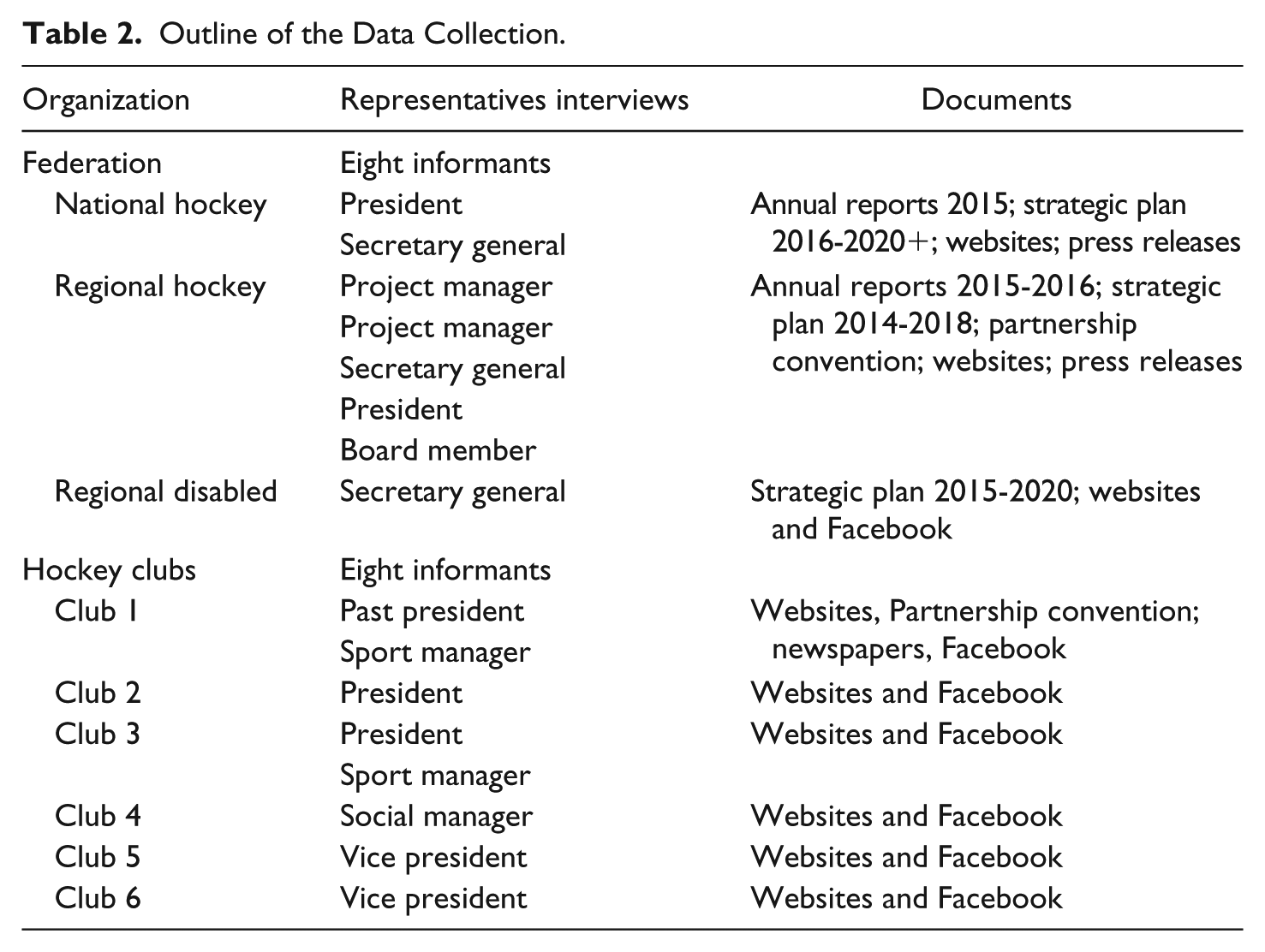
In total, 16 interviews were conducted from May 2016 to March 2017 with key individuals involved in the design and management of the initiatives in the national and regional federations and six clubs (Table 2). We purposefully selected key actors and “boundary spanners” who were considered as important informants as they possessed specialist knowledge of the socially responsible program. Employing a “key informant technique” and following the principles of theoretical saturation—denoting that no new features emerge from the data in the analysis process (Strauss & Corbin, 1998)—we selected and interviewed individuals actively and directly involved in the programs.
Outline of the Data Collection.
We questioned informants to reflect on their social responsibility vision, their personal experiences, and their specific role regarding the socially responsible initiatives. Participants were encouraged to discuss retrospectively the objectives and the process to deliver the initiatives through collaboration. Furthermore, interviews explored the informants’ perceptions (and their organizations’) motivations for engaging in socially responsible programs through collaboration, the influence of key partners on the collaborative setting, the nature of the relationship with their partners, the evolution patterns, and the challenges of working together with other NPOs.
Organizational documents
Secondary sources provided valuable background information about the NPOs in question, their strategic orientation, and a decision and action timeline of the initiatives. All this documentary material—such as annual reports, strategy notes, brochures, press releases, and presentations to key hockey stakeholders—was either available on NPOs’ official websites or was provided by the participants during interviews. In total, 52 documents provided information on the context within which socially responsible programs were implemented.
Data Analysis
In line with Miles and Huberman’s (1994) framework, we iteratively analyzed data using both deductive and inductive reasoning. Initially, a number of themes originated from a review of the literature on collaboration in general (Oliver, 1990), nonprofit collaboration (Guo & Acar, 2005; Sowa, 2009), and sports management in particular (Babiak, 2007; Sotiriadou et al., 2017). Consistent with the research question, the themes included motives related to resources (stability), efficiency, reciprocity, institutional (legitimacy, necessity).
First, the lead author read the transcripts several times. Analytical memos as well as temporal bracketing were processed to identify the major characteristics (Guo & Acar, 2005) and phases of the collaboration process. Following this, refinement of themes and development of alternate themes took place. Once all interviews and document passages were coded according to themes, they were carefully reviewed and then further scrutinized for relationships and linkages. Analysis of the data was facilitated with Nvivo 11 software. To ensure consistency and credibility in the analysis process, the coding protocol and the interpretation of the data were discussed between all authors.
Findings and Discussion
This study examines nonprofit collaboration between sport federations and sport clubs implementing socially responsible programs. We present our findings building on the perspective of those directly engaged in the collaboration. As a starting point for exploring collaboration among NPOs for socially responsible programs, two complementary theoretical frameworks were used for this study. The interplay between these lenses unveils the uniqueness of this collaboration form.
This study displayed two major motivations. Both federations and clubs pointed to resource exchange and organizational legitimacy as primary motivations. Our case shows that each partner reported common and diverse motives to collaborate to deliver socially responsible programs, as suggested by previous studies on collaboration formation (e.g., Gazley & Brudney, 2007; Sotiriadou et al., 2017; Sowa, 2009). The convergence between nonprofit partners’ motivations underpins the relationship and eventually contrasts with the divergence between partners found in cross-sectoral collaboration (i.e., strategic vs. altruistic goals; Seitanidi et al., 2010) or in nonprofit collaboration (Sotiriadou et al., 2017).
As resource-based view theory suggests, organizations are not self-sufficient, and revenues are affecting the need for collaboration (Arya & Lin, 2007). The importance of resource in this particular case is not surprising, as NPOs operate in a complex environment characterized by resource scarcity (Wicker & Breuer, 2013). In fact, hockey partners are evolving in an unstable political environment that nudges them to work together to attain alternate supplies of resources. The following data extract illustrates the resource instability: Budgetary speaking, sport is a poor sibling, so we do not have many resources and we are not going to develop them [these collaborative projects]. Sponsorship is reaching its limits, political subsidies are what they are, so we cannot hope to multiply by ten our financial income so we need to deal with our shoestring means available, with what we have but (. . . ) we also try to use exchanges and contacts. (Federation 5)
Contrary to the resource dependence perspective often mobilized to examine NPO collaboration for service delivery (Gazley & Brudney, 2007; Sotiriadou et al., 2017; Sowa, 2009), NPOs do not collaborate for socially responsible programs to exert power and control over organizations with scarce resources (Barringer & Harrison, 2000). As Sowa (2009) noted, NPOs first seek their basic programmatic needs before seeking to implement complementary projects. In this case, collaboration is not a matter of organizational survival needs.
Rather, partners are motivated by the increase of complementary resources to develop the joint socially responsible initiatives. Our results show that organizations primarily seek to secure the survival of these initiatives that highly rest on the complementary resources provided by partners. This means that in this context, NPOs mainly collaborate for the survival of the initiative, rather than for their basic organization survival needs. As illustrated by these extracts, resource exchange was central for the both partners: “LFH wished to accompany closely clubs in the creation and development of their section” (LFH organizational document). As explained by a club member, expanding the initiative with the federation’s resources was central.
Our goal since the beginning is that the project is open to all partners, so I don’t ask more that the league joins. So the more people work on it, the more I am glad in this collaboration. We can hardly develop something on the national level without the federation support. (Club 3)
The desire to pursue common goals stimulated NPOs to put their respective competencies at the disposal of each other to converge toward the development of socially responsible programs. The literature often identifies reciprocity (Oliver, 1990) as a determinant to engage in such collaborations. As such, this clubs-federation synergy was mutually expected to benefit both entities.
The federation wanted to support the HT project and help to expand it and encourage other clubs to open HT (. . . ) But we are conscious that it is a two way street: thanks to it we will have a visibility (. . . ) it can open doors for opportunities and give the envy to clubs to be part of the project. It always works in both directions. (Club 6)
A federation member also exemplifies his mutually beneficial position, “we work closely with the clubs and they come also to us with projects” (Federation 1). This reciprocity allowed NPOs to pool their competencies to converge toward the fulfillment of a common objective: the development of the socially responsible initiatives to generate social progress.
For instance, in the case of HT, clubs initially developed the idea, served as the implementation platform through their infrastructure, human resources (sport practitioners and volunteers), situated knowledge, geographical coverage, and local connections with other organizations and beneficiaries. The federation shared its political (acting as a lobby seeking subsidies and visibility for the hockey community), human (professional staff), technical (Expertise and competences), communication (information sharing), network, and financial resources as well as its legitimacy.
The collaboration can facilitate information sharing, mobilize complementary resources and acquire expertise. For instance, as explained by a federation member on a web page, the resources exchanges: “It is the initiation, making primary contacts, the access to the community and sharing experiences. I think each section is different but what is important is sharing between you” (Webinar LFH, 03.26.2018). Statements like this illustrate that informal resources such as learning, knowledge, and diffusion of good practices were important in the eyes of the partners.
Moreover, NPOs reported that they seek to acquire new resources from other partners as well as enhancing existing collaboration between clubs and federations and new collaboration ties to reinforce the initiative. This network of resources and lobbying capacity is illustrated here: “we work closely with the clubs and they come also to us with projects. To help them, we seek subsidies from the minister” (Federation 1). As outlined in Table 1, the collaborations for HT and STFP have in turn attracted additional supplies of resources from public and private partners as well as new partners partaking in the initiatives.
Surprisingly, these findings showed that rather than building on asymmetrical interdependencies inherited from the sports structure in which sport federations, as governing bodies, are traditionally occupying a hierarchical position over clubs (Babiak, 2007; Sotiriadou et al., 2017), partners have altered this likely domination and competitive state (Sowa, 2009; Wicker & Breuer, 2013) into a collaboration position. The lack of asymmetry is illustrated in this quote: “We are not aware of everything that happens within the clubs but our goal is to have as much information as possible. Not for control purposes” (Federation 2).
The absence of asymmetrical motivation is an interesting insight to understand the formation of nonprofit collaboration, because this is not systematically the case, as reported in other nonprofit studies (Sotiriadou et al., 2017). This reciprocity can eventually be explained by the significant organizational mission and identity fit between these NPOs and previous interdependence experience (Atouba & Shumate, 2015; Seitanidi et al., 2010; Walters & Anagnostopoulos, 2012).
To some extent, these findings concur with Atouba and Shumate (2015) who found that homophily (i.e., NPOs being more likely to collaborate when they have the same status) influences the selection of nonprofit collaboration. In this case, these NPOs have similar cultural and organizational characteristics that explain this complementary fit. These NPOs’ common mission is indeed influential for this fit.
Developing hockey is one of our main goals as a federation. It is in the ARBH’s strategic plan. One of the elements is to increase the number of sport participants. So why not people with a disability because none of this existed yet. (Federation 1)
The results also showed that sharing similar values is essential in this reciprocal relationship. As one federation member highlighted, “There are regularly projects which are always very well welcomed because they correspond to our values. For instance, with HT (. . . ), we absolutely want that it expands in the entire hockey field” (Federation 2).
Ultimately, the resource perspective does not sufficiently provide a complete understanding of the NPOs’ motivations to collaborate. The desire to appear legitimate in the institutional environment to eventually acquire additional resources to do good for society has been also evoked. The institutional perspective provides a more complementary understanding of what motivates NPOs. Our findings showed that organizations sought collaboration to enhance their legitimacy to enhance their organizational positioning by showing their capacity to have the right practices in place (Herlin, 2015; Sowa, 2009) and demonstrate their capacity to create social value as in cross-sectoral social collaborations (Austin & Seitanidi, 2010a).
Institutional pressures played a role in encouraging partners to increase their legitimacy to appear “appropriate” in relation to their stakeholders’ expectations and prevailing norms in their environment (DiMaggio & Powell, 1983; Oliver, 1990). Collaboration is indeed considered as a leading means to tackle various social issues (Austin, 2000; Gazley & Guo, 2015), while addressing social responsibility is a major strategic organizational concern (Seitanidi et al., 2010) for NPOs given its taken-for-granted institution nature (Bondy et al., 2012; Pope et al., 2018).
Compared to the literature, our findings interestingly show that while previous studies depicted mimetic isomorphism influencing NPOs to collaborate (Guo & Acar, 2005; Oliver, 1990; Sotiriadou et al., 2017; Sowa, 2009), organizations were not motivated by meeting explicit institutional mandates or complying with collaborative requirements from funding partners. Rather, collaborations were self-initiated in the context of the initiatives examined.
Eventually, NPOs’ collaborative behaviors are guided by the need to achieve organizational legitimacy. In particular, all partners have shown that legitimacy played a role in the collaboration, contrary to previous findings (e.g., Sotiriadou et al., 2017), which only identified such determinant in one of the partners (the federation). Moreover, cross-sectoral studies only identified legitimacy motivations with the business sector (Seitanidi et al., 2010). Although NPOs typically possess strong legitimacy attributes (Herlin, 2015; Omar et al., 2014; Sowa, 2009), they strive for improved internal legitimacy (i.e., by their internal stakeholders: the member-clubs, the staff, and the volunteers) and external (i.e., by the external stakeholders: sponsors, public authorities, sport organizations) reputation. For instance, LFH illustrated this drive to enhance their image as a leading organization due to their short life span.
It is important for us to get known. That is, externally, that all our stakeholders know “we are now the league,” toward the Adeps [i.e., public sport administration], and all the subsidiary authorities, toward the French community, all local actors. (. . .) and internally, towards our clubs (. . . ) Now, there are two leagues but the ARBH is still the national umbrella agency. We exist as a new entity. (Federation 3)
Interestingly, several clubs were also driven by the opportunity to make their members pride of their club.
So this club, if you are proud of what it does, notably, because it empowers people with disability through sport, if you are proud of that, of the colors of your club, you will run faster. (Club 4)
Using collaborative socially responsible initiatives, NPOs, therefore, seek to strengthen their image and their strategic position within their organizational field. Eventually, the results showed that organizations expressed their legitimacy motivation in different ways, namely, to demonstrate their capacity to conform to their stakeholders’ expectations and institutional norms, to solve social problems, and to act as a relevant actor of societal change building on the intrinsic nature of the NPOs (Lin-Hi et al., 2015; Pope et al., 2018; Seitanidi et al., 2010). Consistent with legitimacy theory (Suchman, 1995), these findings support that legitimacy can be both strategic/utilitarian and altruistic (Seitanidi et al., 2010; Selsky & Parker, 2005).
Consequently, findings intrinsically indicate that partners demonstrate similarity in their motivations to collaborate due to their organizational fit, but with some key differences in the complementary resources they seek. Overall, the socially responsible program is driving the collaboration. Viewed as a desirable behavior and a valuable means to address social problems, the analysis finds that collaboration is a strategic response to legitimacy and resource needs for the socially responsible programs. The potential to create social value makes this nonprofit collaboration form unique. Partners are motivated by the aim to create social value that leads to positive social change. This is the catalyst to these collaborations.
Eventually, the study makes two contributions. First, this work generates original insights into the formation of nonprofit collaboration. Although a growing body of research has focused on the motivations of collaborations among NPOs for specific service delivery (Sowa, 2009), this article contributes to this emergent field by examining motivations to engage in nonprofit collaboration for social responsibility programs. This study contributes to the nonprofit collaboration literature by providing an understanding of how motivations for nonprofit collaboration for socially responsible programs differ from other nonprofit collaboration forms depending on the nature of the issue addressed. This study shows that there are differences in nonprofit collaboration formation depending on the purpose and on the nature of the issue addressed in the collaboration. Social responsibility programs lead to differences because of the social value creation aim.
The findings originally point that NPOs do not compete for resource although there is a general competition for resources in the general NPO context (Wicker & Breuer, 2013). Elements of resource-based view and institutional forces provide explanatory power for studying the singularity of the formation of collaboration for socially responsible programs. Prior research found reducing the need to compete for resource and funding uncertainties, cost savings, and a desire to expand services beyond the capacity of partners to be important drivers of the motivation to collaborate (Chen & Gaddy, 2010; Guo & Acar, 2005; Sowa, 2009), whereas we have noted the nonprofit interest in using collaboration as a strategic response to resource complementarity and social value creation. Overall, the theoretical interplay is fundamental, as collaborating may improve NPOs’ reputation, which in turn may attract new or additional grant funding. Organizations also seek new partners to build future relationships to enhance and mature existing collaborations. Essentially, these findings extend existing work demonstrating that both theories are equally important and complementary driving forces of collaboration by NPOs (Arya & Lin, 2007; Barringer & Harrison, 2000). This study contributes to this growing body of research and knowledge by applying two theoretical perspectives, which complementarily, offer a more rounded approach on the motivations to engage in social responsibility collaborations.
Second, this article contributes to a better understanding of the applicability of social responsibility in the nonprofit domain by examining NPOs collaborative motivations to implement such programs (Lin-Hi et al., 2015; Pope et al., 2018). These programs are often considered practices that extend beyond their core purpose. In this study, NPOs are collaborating with likeminded organizations rather than serving either as recipients or vehicles of socially responsible programs of business (Kourula & Laasonen, 2010); a stream of research that has predominantly attracted scholarly attention in the nonprofit literature. The traditional perspective of NPOs as mere passive providers of CSR should be abandoned. NPOs should rather be regarded as capable proactive implementers of socially responsible practices. As such, there is some consensus that businesses are not responsible for addressing all social issues (Amaeshi et al., 2016). That is, although the word “corporate” has typically been associated with large business organizations, CSR is now being embraced by organizations of all types and sizes, including nonprofit sport organizations. Moreover, this study shows that beyond cross-sectoral collaboration, other collaborative forms exist to implement CSR programs. Within sector collaboration can offer valuable benefits for organizations willing to implement their social responsibilities with likeminded organizations. As such, this study extends the roles of collaboration for the implementation of CSR by considering that profit organizations are not the only organizations capable of developing collaborations to implement socially responsible programs.
Conclusions and Future Research
The purpose of this article was to examine a particular form of collaboration within the nonprofit landscape. In this study, we have indicated key motivations for the formation of collaborations among NPOs for socially responsible programs. As such, three unique features of this collaboration can be highlighted. First, NPOs’ motivations stemmed from the potential to create social value from the social responsibility programs implemented through collaboration. As such, this nonprofit collaboration form is unique because socially responsible programs are the catalyst of the collaboration. Second, reflecting the interplay between resource-based view and institutional perspectives, organizational legitimacy and resource exchange needs for socially responsible programs are driving the collaboration rather than organizational survival needs.
Third, the partners demonstrate similarity in their motivations to collaborate due to their organizational fit, but with some key differences in the complementary resources they seek. This suggests that a high degree of organizational characteristics and motivations fit among partners might increase chances to deliver social good at this stage prior to the collaboration implementation. In the case of sport, the network of partners is relatively dense and the degree fit is important.
The findings from this study are limited in their generalization to similar institutional contexts where implicit forms of social responsibility prevails and to similar organizational contexts where voluntary membership organizations are based on a federated structure. Yet, this study may be beneficial for managers willing to work in collaboration for socially responsible programs. Collaboration requires the understanding of the partners’ motivation to collaborate. Motivations are preconditions of collaboration formation and many managers tend to miss this important part (Austin, 2000). Beforehand, managers should detect common characteristics and (seek) compatible motivations to inform the decision to partner or not to partner. Managers can strategically oversee collaboration when they know partners’ motivations. Hence, this should minimize the risk of threats to the implementation of the collaboration and eventually increasing the potential outcomes of the collaboration. Furthermore, as collaboration requires various sources, an effective manager should define the resources they need, detect potential resources to exchange, and eventually create new resource flows through collaboration.
However, the study is also subject to some limitations. First, the sports context limits the findings’ universality. Second, the study is based on a data set collected in a relatively short period. Third, adopting a single level of analysis limits the findings. These limitations could be addressed through future investigation.
First, we encourage future studies to expand knowledge on social responsibility and NPOs by examining whether and how NPOs from different industry outside sports collaborate in the delivery of socially responsible programs. Second, as this study has examined the static motivations of collaboration, a step forward could be opting for a longitudinal perspective to capture the evolution of the nonprofit collaboration process (especially within all the chronological stages of collaboration, formation, management, and outcomes; Selsky & Parker, 2005); thereby, integrating the nonprofit collaboration challenges, resistance, and termination. Third, delving into individual or network-level factors, such research could pave the way for a better understanding of how they intersect, addressing issues such as leadership and organizational learning.
Footnotes
Declaration of Conflicting Interests
The author(s) declared no potential conflicts of interest with respect to the research, authorship, and/or publication of this article.
Funding
The author(s) received no financial support for the research, authorship, and/or publication of this article.
