




Abstract
We examine how donors influence nonprofit long-term product innovation by estimating a fixed-effects model using longitudinal data on a sample of nonprofit organizations. Innovation requires multiyear funding, but some donations to nonprofit organizations are a transient source of funding. Consistently, we find that when nonprofit organizations increasingly rely on donations from external private sources of funding, long-term innovation declines. However, as the nonprofit organization generates revenue from more predictable relational customers, concern associated with transient donations is attenuated. Moreover, in contrast to dependence on external donations deterring innovation, when a nonprofit grows their donor network, it increasingly emphasizes the long-term innovative interests of donors. The donor network offers social capital that provides managers with confidence and access to new information necessary to pursue innovation.
Introduction
Investment in longer term innovation is challenging because managers need confidence to pursue innovation that has uncertain future value, new sources of knowledge to fuel innovation, and multiyear funding to financially support the development of innovation, all while meeting near-term goals. Nonprofits are becoming increasingly innovative as they face financial and competitive pressure (Bakhshi & Throsby, 2010; Gras & Mendoza-Abarca, 2014; Morris, Coombes, Schindehutte, & Allen, 2007). However, innovation is particularly challenging for managers in nonprofit organizations because they are funded from a variety of sources with different interests (Chang & Tuckman, 1994; Krawczyk, Wooddell, & Dias, 2017). These stakeholders often have varied temporal expectations and interests when they financially engage with an organization (Connelly, Tihanyi, Certo, & Hitt, 2010). The temporal nature of funding (i.e., reliability of funding year to year) and temporal interests of the funders (i.e., desiring funds be put to use on future innovative projects vs. current programs and services) vary across nonprofit stakeholder groups. Given the longer term commitment required for product and service innovation (Souza, Bayus, & Wagner, 2004), we examine the role that these temporal tensions have on long-term product innovation.
Donors are a particularly relevant group to examine the impact of temporal tensions on long-term innovation because donations are a transient source of revenue, but, at the same time, the direct ties donors make to the organization create a network supportive of the innovative process. Because donations are a transient source of funding (Duquette, 2017), we argue that when nonprofits rely too heavily on external donors for contributed funding, they will engage in less long-term investment. However, donors want the nonprofit to continuously enhance the future quality of its products and services (Hansmann, 1981). As a collective, a growing donor network generates social capital that reduces the uncertainty often associated with innovation (Lee, Song, & Yang, 2016; Phelps, Heidl, & Wadhwa, 2012) and provides access to a pool of knowledge resources with insights into future needs (Galaskiewicz, Bielefeld, & Dowell, 2006; Ozer & Zhang, 2015; Phelps et al., 2012). Thus, as the donor network grows, the more confident nonprofit has quick access to knowledge resources to fuel longer term innovation.
To examine this paradoxical influence of donors—hindering the financing of innovation while also contributing to the development of innovation—we consider the contextual influence of earned revenues. In particular, relational customers, such as members or subscribers, provide a stable stream of earned revenue because these customers are committed to the organization over a period of time (Voss, Sirdeshmukh, & Voss, 2008), which we find attenuates concerns managers have with more transient donor funding. However, relational customers also have static product expectations and managers tend to tailor products to these product expectations so they can avoid putting this stable stream of revenue at risk (Voss & Voss, 2013). Our findings reveal that nonprofit managers appear to be able to balance the long-term aspirations of donors and the near-term expectations of relational customers, consistent with work that found nonprofit managers are skilled at managing conflict in the decision-making process (Schwenk, 1990).
We contribute to literature on nonprofit organizations and long-term thinking in organizations by demonstrating that the pressure many organizations face to choose between investments with different time horizons (Graham, Harvey, & Rajgopal, 2005; Marginson & McAulay, 2008; Reilly, Souder, & Ranucci, 2016) extends to nonprofit organizations. To survive, nonprofit organizations are looking at more innovative, yet more temporally uncertain revenue sources (Dees, 1998; Gras & Mendoza-Abarca, 2014), which make this temporal tension increasingly relevant to nonprofit managers. Managers of nonprofit organizations are challenged to decide how to allocate resources toward the long-term sustainability of the nonprofit versus activities that can meet nearer term social needs.
Finally, consistent with calls for a more nuanced understanding into the nature of innovation in nonprofit organizations (Morris et al., 2007), we add nuance to our understanding of donors to nonprofit organizations. By modeling the within-organization effects of both the nonprofit’s dependence on external donations and the size of their donor network, we reveal different effects that donors have on long-term product innovation. Our work suggests that while nonprofit managers may be reluctant to rely on uncertain donations to fund innovation, a broader donor network offers social capital necessary for innovation.
Theory and Hypotheses
Long-Term Product Innovation in Nonprofit Organizations
Innovation among nonprofit organizations is on the rise as nonprofit organizations have become more entrepreneurial in the face of financial stress and increased competition (Gras & Mendoza-Abarca, 2014; Hager, 2001; Morris et al., 2007). Scholars agree that innovation is one of the key factors for a nonprofit organization’s survival as funders and policymakers increasingly call on nonprofit organizations to be more innovative (Choi, 2014; Dees, 1998). However, innovation in nonprofits is not clearly defined because there are various ways that these organizations can be innovative (Bakhshi & Throsby, 2010). Moreover, Voss and Voss (2013) find complexity in how nonprofit organizations manage innovation as they also try to refine their existing offerings and processes. This tension between investment in exploring future innovations versus investment in exploiting current offerings and processes hints at a temporal tension common across organizations (March, 1991), but is likely acute in nonprofit organizations that are under increasing financial constraints (Morris et al., 2007).
Innovation scholarship identifies several factors that lead innovation to be characterized by a longer term time horizon in terms of both a longer time span associated with innovation-related decision-making and a longer term temporal orientation or preference of stakeholders in the innovative process. Product and service innovation are investments that take place over longer term horizons (Souza et al., 2004). Specifically, investment in innovation requires multiyear financial slack (H. Kim, Kim, & Lee, 2008; Nohria & Gulati, 1996), suggesting that longer term funding is necessary to support innovation. Beyond funding, innovation requires the development and implementation of ideas (Edmondson, 2003) and there is scholarship that argues a longer term orientation is necessary to generate innovative ideas that will be valued in the future (Lumpkin, Brigham, & Moss, 2010).
Work on long-term investment in organizations reveals that managers often make temporal trade-offs (Reilly et al., 2016), forgoing investment in longer term projects to allocate resources to projects with shorter term returns (Marginson & McAulay, 2008) or holding resources in reserve to smooth future performance outcomes (Graham et al., 2005). However, this tendency to underinvest in projects with a longer horizon varies across organizations. There is evidence that this general short-term interest among financial stakeholders of for-profit organizations can vary with stakeholders espousing a variety of horizon preferences (Tihanyi, Johnson, Hoskisson, & Hitt, 2003). Similarly, nonprofit managers make decisions consistent with the relationships they hold with external stakeholders (Voss, Cable, & Voss, 2000), and nonprofit organizations have a wide variety of financial stakeholders (Chang & Tuckman, 1994). Thus, just as for-profit organizations have a range of temporal preferences among their capital suppliers (Connelly et al., 2010), we should expect variance in the temporal preferences of nonprofit stakeholders and potential conflicts among these preferences. We focus on the role that these temporal attributes and preferences play in nonprofit innovation.
Donor Influence on Long-Term Product Innovation
With multiple stakeholder groups, managers of nonprofit organizations are making decisions on how to allocate resources which may not maximize the mission of the nonprofit organization (Fama & Jensen, 1983a). This problem has long been examined in for-profit organizations with managers diversifying into multiple lines of business to reduce business risk and by extension their own employment risk (Amihud & Lev, 1981). Similarly, managers in nonprofit organizations also manage risk by seeking a diverse portfolio of revenue streams (Carroll & Stater, 2008; Chang & Tuckman, 1994) even if that means they will need to compromise the mission of the nonprofit to satisfy conflicting demands among this diverse portfolio of funding sources (Foster & Bradach, 2005; Froelich, 1999).
Revenue diversity is common in operating nonprofit organizations, which finance their operations through a mix of contributed revenue (e.g., government funding, Board of Director donations, donations from external individuals, corporations, foundations) and earned revenue (e.g., commercial activity such as ticket sales, concession sales, subscriptions) (Krawczyk et al., 2017). This mix of contributed and earned revenue is largely characteristic of the sector in which the nonprofit operates (Hansmann, 1980), and less is understood about the diversity of financial stakeholders within these two broad revenue categories. In particular, we focus first on contributed revenues because nonprofits with contributed revenue consider these contributions foundational to the operating mission of nonprofit organizations (Bennett, Iossa, & Legrenzi, 2010; Foster & Bradach, 2005), suggesting it is a critical consideration as managers make investment decisions.
Among the sources of contributed revenue, external private donations are considered the most uncertain and volatile (Duquette, 2017). Hansmann (1988) describes two circumstances that inform our understanding of these donations to nonprofit organizations as uncertain and often transient. First, there is asymmetric information between the organization and those donating funds to the organization because these donors have little information to evaluate the quality of the social services being rendered. Second, the donors do not take on ownership because the cost to monitor managers under conditions of asymmetric information would exceed the benefit the donors get from the organization. Given these conditions, external donor commitment is highly uncertain and unreliable compared with other sources of contributed revenue. For example, donations from board members do not meet these same conditions because board members monitor managers and have more information than external donors (Fama & Jensen, 1983b). Moreover, their donations are often tied to their board membership, making board donations more reliable. Government grants also have few transient characteristics as the amount and duration are often known in advance and typically awarded for a particular purpose.
Moreover, research suggests nonprofits that depend on transient donors to generate contributed revenue may not use those funds for innovative projects. Long-term innovation requires stable, multiyear funding; therefore, organizations that rely on transient sources of capital tend to be more short-term oriented (Bushee, 1998; Connelly et al., 2010). Indeed, evidence reveals that when nonprofit organizations receive more donations, they are more likely to smooth revenues in future years rather than commit those resources to risky multiyear projects (Duquette, 2017). Thus, increased reliance on private donations decreases the likelihood that nonprofits will develop longer term projects. Although strong and active governance could counteract this effect by monitoring for mission-oriented, entrepreneurial behavior in nonprofits (Coombes, Morris, Allen, & Webb, 2011; Fama & Jensen, 1983b), nonprofit donors do not have strong incentives to engage in governance (Core, Guay, & Verdi, 2006; Hansmann, 1988).
Innovative new products require a longer term financial commitment, but external private donations are a highly variable source of contributed revenue over time. Thus, we expect a nonprofit organization that increasingly depends on external donations to reduce long-term product innovation as managers become concerned with maintaining those donations and use the donations to smooth revenue in future years.
While private donations to the nonprofit may be variable and short term, the motivation behind the donation suggests that donors have an interest in the organization’s longer term ability to deliver social value. Donors engage with the nonprofit even though they can’t fully quantify the return on their donation, demonstrating intrinsic commitment to the nonprofit (Sargeant & Woodliffe, 2007) and engagement in the future direction of the organization (AbouAssi, 2013). Donors want to see their donations used toward the general mission of nonprofit (Fama & Jensen, 1983a) and they make voluntary contributions to the nonprofit to improve the future quality of its services (Hansmann, 1981).
Donors support their general interest in the nonprofit having future innovative impact as a collective network. The structure of an organization’s network, including the number of network ties, represents social capital that helps managers act more efficiently and provides opportunity for creativity and learning (Nahapiet & Ghoshal, 1998). A growing network is associated with attention on the nonprofit (Guo & Saxton, 2018) and signals trust in the organization (Nahapiet & Ghoshal, 1998). Moreover, a larger network signals a higher status for the organization and reduces performance uncertainty associated with investment in the innovation (Phelps et al., 2012). Beyond offering positive signals to management, a broader private donor network can provide increased future financial stability because more funding sources create a network for nonprofits to access new funding going forward (Arya & Lin, 2007). Indeed, within nonprofit organizations networks do positively influence future resource acquisition (Eng, Liu, & Sekhon, 2012; Saxton & Wang, 2014). Taking these arguments together, we expect that as the donor network grows, attention, trust, status, and perceptions of future financial stability generate social capital that reduces managerial uncertainty associated with investing in innovation with a longer horizon, giving managers confidence to make longer term commitments. This logic is consistent with work that has found networks made up of external stakeholders offer positive feedback to pursue innovation (Lee et al., 2016).
Furthermore, while social capital in network ties encourage innovation by giving managers security to make more uncertain commitments, the network can additionally help the organization build intellectual capital that further encourages innovation (Nahapiet & Ghoshal, 1998). Innovations that take a longer time to develop require learning from new sources of knowledge (Alexander & Van Knippenberg, 2014). Network ties generate knowledge resources that positively impact product innovation (Rao & Drazin, 2002) as direct ties outside of the organization create channels for new and diverse information to quickly flow into the organization (Phelps et al., 2012) and help the organization anticipate future needs and interests (Ozer & Zhang, 2015). Consistently, nonprofit organizations build quality services over time by learning about the range of needs and values among their stakeholders and integrating their varied interests into the work of the nonprofit (Schwenk, 1990; Voss et al., 2000). Research on nonprofit networks has found a variety of network touchpoints (Arya & Lin, 2007) and external community networks (Marquis, Davis, & Glynn, 2013) help nonprofits thrive as these external knowledge resources are an important element for innovation within nonprofit organizations (Kanter & Summers, 1987). In particular, donor interests add to the diversity of knowledge necessary to generate new ideas in nonprofit organizations (Dover & Lawrence, 2012) and social capital among individual donors is important to nonprofits as they work to understand the needs of their varied constituency (Galaskiewicz et al., 2006). As innovation is about knowing and meeting stakeholder needs (Bhoovaraghavan, Vasudevan, & Chandran, 1996), exposure to a broader donor network should help the nonprofit learn more about their donors’ evolving interests.
Beyond the knowledge benefits of passive exposure to a broader external network, the external network may be taking on an increasingly active role in sharing their knowledge and interests with the nonprofit. External stakeholders are increasingly vocal and involved in the activity of nonprofit organizations (Guo & Saxton, 2010; Hardina, 2006). Donors, in particular, are a generally engaged stakeholder group who want to have a hand in shaping and co-creating the products and services that the nonprofit offers (Sargeant & Lee, 2004; Vallaster & von Wallpach, 2018) and have been found to actively voice how they would like their donations to be used (AbouAssi, 2013; Surysekar, Turner, & Wheatley, 2014).
Even though their donations may stimulate short-term behaviors among managers concerned about stability, external donors make donations to nonprofits because they have an interest in the nonprofit delivering future social value. As a group, a growing donor network offers social capital that lowers uncertainty typically associated with innovation, motivating nonprofit organizations to develop innovative new products and services. Moreover, a broader network of donors contributes knowledge resources to the ongoing learning process that is so critical to innovation.
The Moderating Impact of Relational Revenue
To this point we have argued that external donors are a unique source of contributed revenue, having a seemingly paradoxical influence on long-term product innovation in nonprofit organizations. Dependence on external donations decreases managerial investment in long-term innovation, although this network of donors encourages innovative development. To further understand this paradox, we now consider earned revenues within nonprofit organizations. In particular, we examine dependency on relational customers for earned revenue. Like donors these stakeholders are external to the organization, but unlike donors, they choose to maintain a sustained commercial relationship with the nonprofit organization as members or subscribers (Voss et al., 2000). This sustained relationship differentiates this stream of revenue from other earned sources of revenue, which are transactional (e.g., ticket sales, concession sales).
Relational customers of nonprofit organizations are appealing because they are committed to the organization, generating a predictable stream of earned revenue. However, they are also customers with homogeneous product expectations (Voss et al., 2008), placing near-term pressure on nonprofit organizations to deliver similar popular products and services that initially attracted them (Christensen & Bower, 1996). Generally, nonprofit organizations must be customer-oriented to maintain fiscal viability (Holbrook & Zirlin, 1985) and pressure from commercial interests can lead to attention being diverted away from mission-oriented innovative activity (Foster & Bradach, 2005; Toole & Czarnitzki, 2010). Specifically, nonprofit organizations that have more earned revenue from relational customers tailor their services to those groups (Voss & Voss, 2013), ultimately engaging in less product innovation because such innovation is considered risky and threatens to compromise stable relationships with these reliable stakeholders (Voss et al., 2008).
Relational customers have seemingly contradictory temporal impacts in both providing a stable source of revenue that is necessary to fund long-term innovation, and, at the same time, preferring current services and products, which suggests a preference to trade-off investment in long-term innovation to fund nearer term services. We expect these opposing effects to cloud the direct effect that earned revenue from relational customers has on investment in long-term product innovation. However, dependence on this revenue stream offers further insight into how managers interpret donor effects when they are making decisions about longer term product innovation. Specifically, the stability of relational revenue should alleviate some of the managerial concerns about the volatility of donations. Thus, as a nonprofit becomes increasingly dependent on relational revenue as a reliable source for earned revenue, managers are less concerned about their dependence on transient donations, tempering the negative effect of donation dependency on long-term product innovation.
At the same time, strong dependency on relational revenue could lead managers to discount the long-term interests and social capital of their donor network as they attend to relational customer interests. Attention is a scarce resource and, therefore, decision makers are selective about where they focus their attention (Ocasio, 1997). Organizations tend to try to avoid uncertainty (Cyert & March, 1963), particularly organizations that are survival focused (March & Shapira, 1987). Given the survival struggles nonprofits face (Gras & Mendoza-Abarca, 2014; Hager, 2001), we expect nonprofit decision makers to focus their attention on coalitions that contribute most significantly to uncertainty avoidance. With the stronger certainty associated with relational customers compared with donors, we expect managers to prioritize relational customer interests over donor interests. As discussed, these relational customer interests are nearer term, implying a preference for managers to trade-off longer term investment to provide nearer term products and services. Thus, we expect a nonprofit that relies heavily on relational customers for earned revenue to discount donor network social capital when considering long-term innovative projects.
Method
Data and Sample
Our hypotheses are relevant to operating nonprofits that rely on both earned and contributed revenue; thus, we identify a nonprofit sector with both of these revenue sources. We test our hypotheses using a sample of nonprofit professional theaters from 2003 to 2013 because the creative industry must constantly balance artistic aspirations with commercial realities to achieve ongoing success (Hansmann, 1981). Nonprofit professional theaters are involved in product innovation when they premiere new productions because the theater is involved in the development process (i.e., develop a new script, hire actors). In contrast, presenting theaters do not get involved in the new production process, but rather book shows produced by other theaters (Voss, Montoya-Weiss, & Voss, 2006).
We are specifically interested in long-term innovation, a construct that can vary in horizon in most industries. However, one type of premiere in nonprofit professional theaters, world premieres, consistently takes around 2 years to produce (Voss et al., 2006), offering a context to measure long-term innovation. Although the data set covers 11 years, the 2-year lead time that is necessary to capture innovation reduces the maximum amount of observations per theater to nine. Furthermore, we drop theaters with fewer than four observations, resulting in an average of five observations per theater so we are able to capture longitudinal effects.
We collect data on these theaters from the DataArt’s Cultural Data Profile (CDP), a standardized online form that nonprofit arts and cultural organizations nationwide use to submit information of their annual financial and programmatic activities. Researchers have found this a reliable source of audited financial data following generally accepted accounting principles (GAAP) and nonfinancial data on programming and operations (M. Kim & Charles, 2016). As we are looking at professional theaters and these theaters are designated as professional because they release new productions, we drop theaters that have never had any type of premiere over the time period of the sample. Finally, after removing observations that did not report financial data or are missing data on our variables of interest, our final panel includes 1,247 theater-year observations across 247 unique theaters in United States.
Model Specification
Scholars have noted significant unobserved heterogeneity among nonprofit organizations (Hager, 2001; M. Kim & Charles, 2016). To control for this heterogeneity, we use a fixed-effects panel regression model to test our hypotheses. Moreover, a fixed-effects model is consistent with our theoretical reasoning. For example, we argue that increasing a nonprofits’ donor network over the prior year brings new social and knowledge capital to a nonprofit and this argument supports a within-firm effect. The Hausman test supports the fixed-effects specification, rejecting the null hypothesis that the fixed and random effects coefficients are the same (χ² = 18.15, p = .01).
Measures
Dependent variable
Consistent with prior work (Voss et al., 2006), long-term product innovation is a ratio of the number of world premieres to the number of self-produced productions. A world premiere is an original theater piece performed for the first time anywhere in the world. Any self-produced production can be considered innovative activity within a theater, but a world premiere is a distinct case of a self-produced production that requires the longest time frame of all types of premieres to develop, which is consistent with our emphasis on longer term innovation. We observe innovation at t + 2 because a world premiere takes approximately 2 years to develop (Voss et al., 2006).
Predictor and moderating variables
Nonprofits report two broad categories of revenue—contributed revenue and earned revenue. Prior work has examined differences between how organizations are predominantly financed (e.g., Fischer, Wilsker, & Young, 2011), but our work instead examines differences within these categories over time within organizations. Therefore, our fixed-effects model assumes that the proportion of earned and contributed revenue is a relatively stable economic characteristic of the type of nonprofit, which is consistent with economic models of nonprofit organizations (Hansmann, 1980). Moreover, our theoretical arguments compare temporal horizons within each category requiring measurement within the category and ensuring independence across constructs. Specifically, donation dependency represents the proportion of the nonprofit’s contributed revenue that comes from external private donations including individuals, corporations, and foundations. To develop our measurement for relational revenue dependency, we use revenues from subscriber and membership fees, which is consistent with Voss and colleagues (2008). Therefore, we calculate relational revenue dependency as the percentage of earned revenue generated by subscriber and membership fees. Finally, donor network quantifies the size or centrality of the donor network using the number of direct ties (Phelps et al., 2012). We measure this variable as the number of individual donors in thousands.
Control variables
To control for the effects of other funding for long-term innovation, we include the theater’s financial slack and debt ratio in the model. There is evidence that slack influences innovation in organizations (H. Kim et al., 2008; Nohria & Gulati, 1996). Therefore, consistent with Voss and colleagues (2008), we include a control for financial slack, calculated as cash divided by total expenses. We also include the debt ratio as a control variable to capture the use of debt to generate funding for innovation and the impact that debtholders have on investment decisions (Desyllas & Hughes, 2010). We calculate the debt ratio as total debt divided by total assets.
Variable descriptive statistics and pairwise correlations are summarized in Table 1. We recognize the high correlation between relational revenue dependency and the size of the donor network as individual donors may also be paying subscribers or members. Other work has also found a correlation between donor and commercial activity but treat the related constructs separately to isolate a distinctive part of these groups’ engagement with the nonprofit (Morris et al., 2007). Similarly, we argue that the way these stakeholders engage with the nonprofit is reflective of their temporal interests. These temporal interests are not necessarily dichotomous (i.e., short or long term), there is room for multitemporality of these interests (Le, Breton-Miller, & Miller, 2011). Thus, including both variables is theoretically reasonable as long as they do not affect the reliability of the coefficient estimates in the model. To test for the impact of collinearity in the model, we calculate and report the variable inflation factor (VIF) for all variables in Table 1. VIFs indicate the model is reliable as there is minimal variation in the coefficients of the variables.
Descriptive Statistics and Pairwise Correlations (N = 1,247).

Note. Pairwise correlation significance levels in italics. VIF = variable inflation factor.
Results
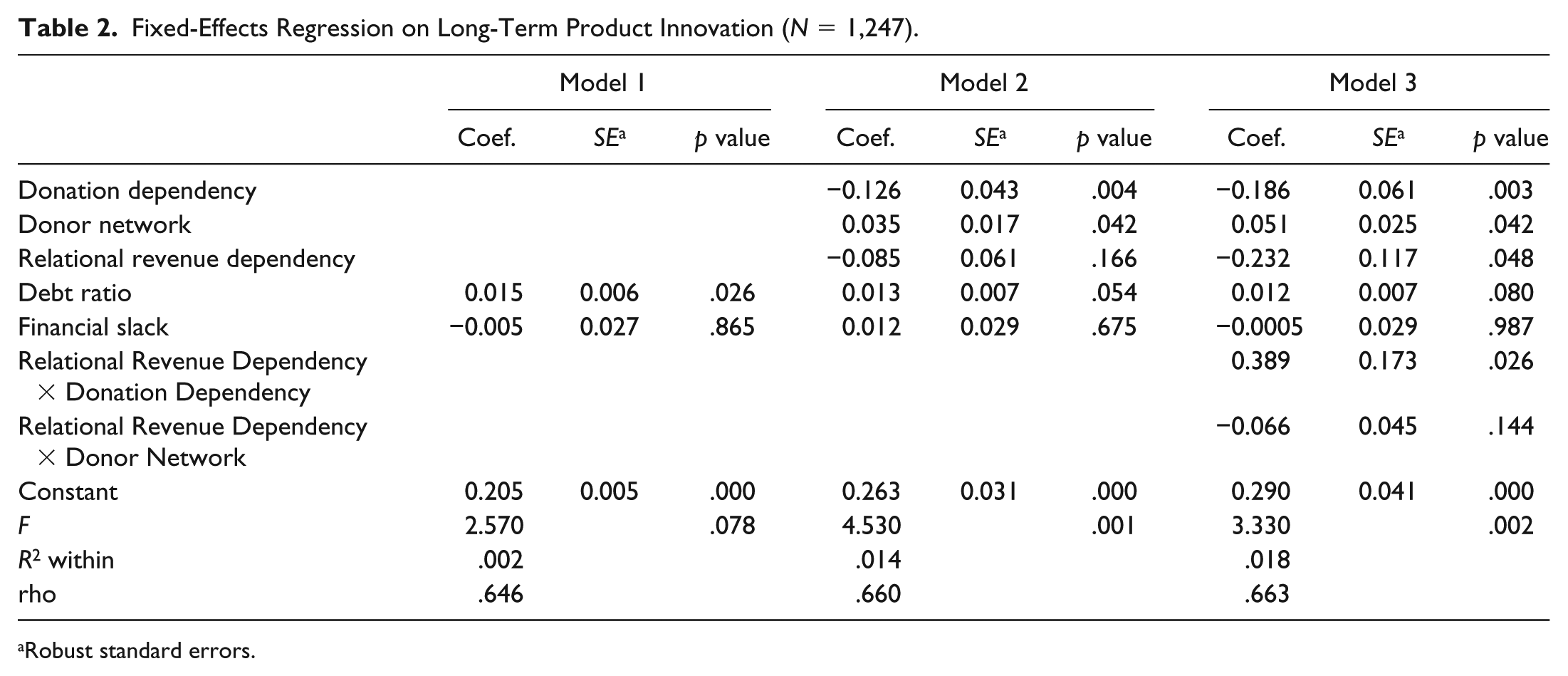
Table 2 presents the fixed-effects panel regression results using a model building approach where we report coefficient estimates on all variables, model fit statistics, and model interclass correlations (rho). In addition, we report model R2 within because this estimate is a useful statistic for fixed-effects models, describing the amount of within firm variance explained by the model. Model 1 represents the base model, including only control variables. Model fit for this baseline model is modest (F = 2.57, p = .08). Model 2 includes the direct effects of the predictor and moderating variables, significantly improving model fit (F = 4.53, p = .001). Model 3 adds in the interaction terms, weakening model fit, but still indicating strong model fit overall (F = 3.33, p = .002). Moreover, Model 3 explains the most within-firm variance (R2 within = .018) and the intraclass correlation (rho) suggests that 66% of the variance in product innovation is due to firm-level effects, supporting the fixed-effects specification. Going forward, we will report the hypotheses test results using Model 3 results.
Fixed-Effects Regression on Long-Term Product Innovation (N = 1,247).
Robust standard errors.
We argue that when nonprofits increasingly rely on external donations for contributed revenues, they are likely to decrease investment in innovation because innovation happens over a multiyear period, but donations are an unreliable source of funding from year to year. Consistent with Hypothesis 1, the direct effect of donation dependency on long-term innovation is negative and statistically significant (β = −0.19, p = .00). Within this sample, these results reveal that as a nonprofit professional theater increasingly depends on contributions from external private donors, their productions 2 years later will feature fewer world premieres.
Furthermore, we hypothesized that regardless of the funding donors provide, as more donors create direct ties with the nonprofit organization, this donor network generates social capital to fuel future innovative projects. The results indicate support for this theory. As the nonprofit develops more network ties with donors in year t, nonprofit professional theaters focus more of their productions on world premieres 2 years later (β = 0.5, p = .04).
The results confirm our theory that dependency on donations is a drag on long-term innovation, whereas the size of the donor network stimulates long-term innovation. To learn more about this seemingly paradoxical impact of donors on long-term innovation, we examined these separate donor-related effects within the context of the nonprofit’s dependence on relational revenues. We argued that relational customers provide stable earned revenue that could be used to fund future innovative programs and services, but these same customers have static, short-term interests that run counter to long-term innovative activities. Although we did not hypothesize a direct effect for relational revenue due to these contradictory expectations, results reveal that dependence on relational revenue does have a statistically significant direct negative effect on long-term innovation (β = −2.32, p = .05). Despite this direct effect, increased dependency on relational revenues does alleviate some of the concerns nonprofit mangers have when they also depend on external donors for contributed revenues. Supporting Hypothesis 3, the coefficient on the interaction between relational revenue dependency and donation dependency is positive and statistically significant (β = 0.39, p = .026).
Figure 1 illustrates this relationship when relational revenue dependency is at zero (no subscriber and membership revenue), at the mean (17% of earned revenues generated by subscriber and membership fees), and double the mean (34% of commercial revenues generated by subscriber and membership fees). The graph reveals the direct negative effect of donation dependency on long-term product innovation with all three lines downward sloping. However, the negative relationship between donation dependency and long-term innovation is attenuated at higher levels of relational revenue dependency. When the theater has no relational revenue, their innovation productivity varies significantly from 30% world premieres when the nonprofit has little dependence on donations to as little as 15% world premieres when the nonprofit is heavily dependent on donations. However, when theaters are highly dependent on relational revenue they produce world premieres at a relatively stable rate of 19% to 22%. This suggests nonprofits that are dependent on reliable relational customers see little change in their commitment to innovation, and their level of innovation is stable regardless of dependency on more transient donations.
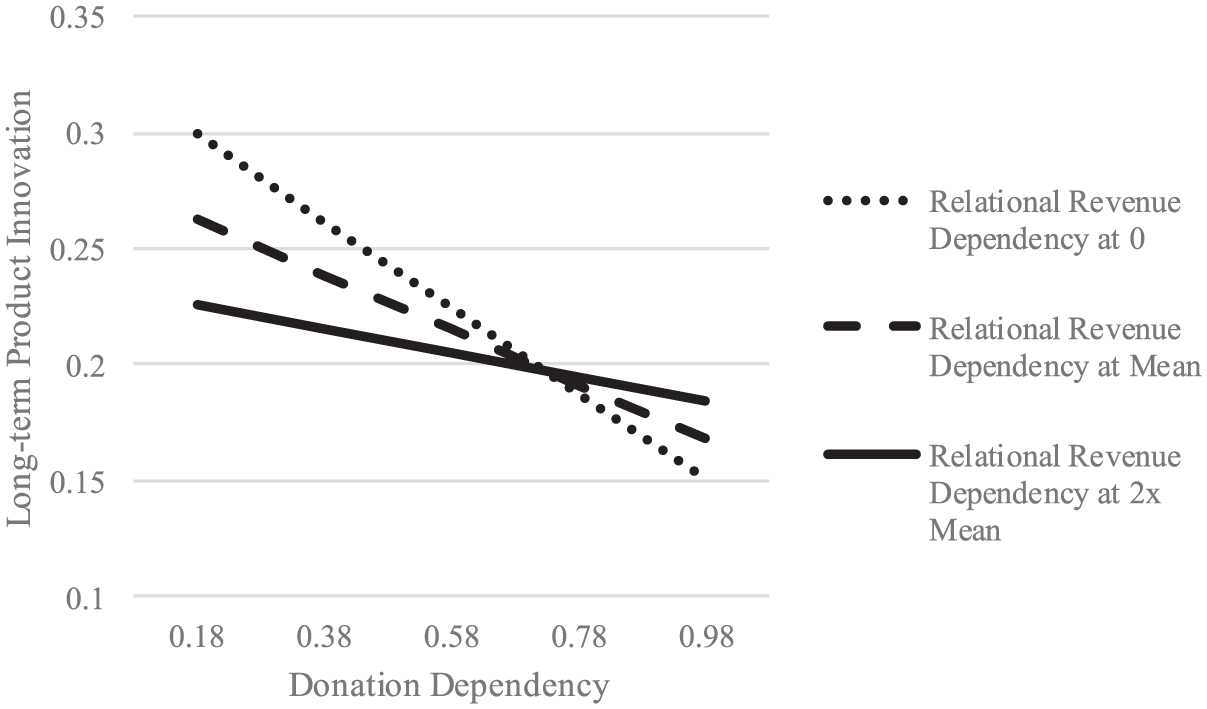
Effect of donation dependency on long-term product innovation across different levels of relational revenue dependency.
Hypothesis 4 predicted that relational revenue dependency would moderate the positive relationship between donor network size and long-term product innovation such that managerial attention would be directed away from the donor network and toward relational customers’ near-term static interests. Although the coefficient on this interaction is negative as hypothesized, it is not statistically significant. Thus, Hypothesis 4 is not supported (β = −0.07, p = .144), suggesting managers in nonprofits are skilled at handling competing interests among stakeholder groups. We consider the implications of this finding in our discussion.
Discussion
Current public policy debate about when funds should be expended for public welfare (Duquette, 2017) highlights the relevance of work with a temporal emphasis. Nonprofits must meet public needs today and tomorrow, suggesting a multitemporal approach within nonprofits is important. Indeed, work on multitemporality suggests value is created by allocating resources across the temporal continuum (Le et al., 2011). Assuming that nonprofit innovations create the social good consistent with their organization’s mission, we should be looking for nonprofits not only to spend on programming today but also to invest in future innovations. However, investing in long-term innovation is challenging for financially constrained nonprofits which have some stakeholders looking to see social benefits today. Our work is positioned at the apex of this temporal trade-off as we examine the multitemporal impact that stakeholders have on innovation. In particular, our study examines the nuanced impact donors have on long-term innovation in nonprofit organizations. Our results indicate that when nonprofits increasingly depend on donations, they engage in less innovation because they cannot rely on these donations to supply the stable, multiyear funding necessary to innovate. However, as their donor network grows, the nonprofit’s social capital helps create valued innovation. Moreover, as a nonprofit draws on more stable sources of earned revenue, concerns about volatile donations attenuate. Thus, despite concerns expressed about the negative impact of earned revenues on mission-oriented decision-making in nonprofits (Foster & Bradach, 2005), there appears to be a benefit to stable sources of earned revenue.
We expected dependency on relational revenues from customers who place near-term demands on the nonprofit, to draw attention away from donors and their long-term aspirations for the nonprofit; however, we did not find support for this hypothesis. This null result lends support to work that suggests nonprofit managers are skilled at handling competing demands on their attention. For example, Schwenk (1990) found nonprofit managers are more skilled than for-profit managers at handling conflict in the decision-making process. Given the variety of funding sources for nonprofits, engaging and balancing stakeholder interests is likely an acquired skill for nonprofit managers.
Isolating the contradictory effects of donors on product innovation within nonprofit organizations makes an important contribution to the literature. Morris and colleagues (2007) call for a more nuanced view of the nature of innovation activity in nonprofit organizations. Our work addresses this call by examining the nuanced impact that temporal attributes and donor preferences have on innovation. Although donors are primarily viewed through the lens of their financial contributions, as a collective, these external stakeholders are a network resource offering important social and intellectual capital (Nahapiet & Ghoshal, 1998) necessary to fully develop new ideas and implement innovation in all types of organizations (Dover & Lawrence, 2012; Galaskiewicz et al., 2006; Phelps et al., 2012). Models that examine between-organization effects are not likely to detect the nuanced effects of within-organization social capital on the innovative process because of unobserved heterogeneity in the innovative process across nonprofit organizations. We model donor effects within nonprofit organizations over time to isolate the unique, yet contradictory, effects that donors have on long-term product innovation.
Ours findings also offer practical suggestions to managers in nonprofit professional performing arts organizations. Specifically, the positive impact of a growing donor network supports donor acquisition and retention strategies. Moreover, when managers of performing arts, organizations find themselves heavily dependent on donations, our results support strategies to convert transactional customers (i.e., single ticket buyer) to relational customers (i.e., subscribers).
Limitations and Directions for Future Research
Our study also includes limitations. We test our sample within a specific subsector of nonprofit organizations, so we can control for sector-specific effects and have a consistent measure of long-term innovation. Although nonprofit professional theaters do have some unique characteristics because their products and services target a wealthier audience (Hansmann, 1981), we do not believe this changes the impact of the constructs presented in the study. We expect our results can generalize to other types of operating nonprofits with a mix of contributed and earned revenue. However, our sample is based on nonprofit funding structures found in the United States and may not generalize to nonprofit organizations that cannot access earned revenues or experience significant government governance.
We know that when nonprofits actively engage their external donors, they are generally more successful (Ivy, Larty, & Jack, 2015). In this study, we examine within organization effects and measure the size of the donor network, reasonably assuming that the intensity with which the nonprofit engages these donors is relatively constant within each organization. However, future research could examine between-firm effects by capturing how intensely nonprofits engage with their donors. We expect these engagement efforts will have a moderating effect on the relationship between the size of the donor network and innovation.
Finally, we recognize that donors are not a group with homogeneous interests, as the existence of restricted donations suggests (Surysekar et al., 2014). Although donors are generally a less reliable source of revenue than relational customers, some donors make repeat donations and other donors make large donations offering them more influence over decision-making. We cannot isolate these donor characteristics in our data, but future research could examine the concentration of repeat and large donors within the network, adding further nuance to our understanding of donor influence over innovation. Finally, a limitation in our research is our inability to identify individuals who engage with the nonprofit as both donors and members. Future research could examine the complex temporal interests of this group. Do their long-term aspirations for the nonprofit as donors dominate their near-term customer-centric interests or vice versa? Alternatively, do their multitemporal interests allow managers to strike the desired balance, investing in near-term and long-term social good?
Conclusion
Innovation is a growing area of interest among nonprofit organizations. We consider the temporal attributes and preferences of donors and relational customers to develop a nuanced understanding of nonprofit long-term innovation. Our results provide support for our theory that donors have a paradoxical effect on innovation as dependence on unreliable donations discourages innovation, whereas a growing donor network positively contributes to innovation. Moreover, stable revenue from relational customers alleviates temporal concerns associated with dependency on external donations. These findings highlight temporal tensions within nonprofit organizations as they pursue innovation.
Footnotes
Acknowledgements
We would like to acknowledge the helpful comments on prior iterations of this work from our colleagues at the University of Hartford and seminar participants at the Academy of Management. We would also like to thank Editor-in-Chief Chao Guo and the two anonymous reviewers for their helpful and constructive feedback during the review process.
Declaration of Conflicting Interests
The author(s) declared no potential conflicts of interest with respect to the research, authorship, and/or publication of this article.
Funding
The author(s) received no financial support for the research, authorship, and/or publication of this article.