




Abstract
Nonprofit revenue sources have significant consequences for how we understand the sector, its power, and sources of accountability. Earned income is an important element of the nonprofit revenue mix. And while commercialism among nonprofits has received some attention, there has been relatively little research seeking to understand the types of earned income that nonprofits are using and the non-commercial, mission-enhancing objectives that these activities potentially serve. This research note addresses that gap through an analysis of one type of earned income: retail operations. The note begins by situating retail within the wider literature on nonprofit revenue, and then introduces the concept of a nonprofit retail operation (NRO). It then introduces a typology of NRO formats, distinguished by the objectives that they serve. Next, it provides descriptive cross-national data on NROs using a dataset of 22 leading international non-governmental organizations in 12 countries. Finally, it discusses areas for future NRO research.
Introduction
Nonprofit studies research has devoted significant attention to understanding the changing landscape of the nonprofit sector, as well as its causes and implications (Eikenberry & Kluver, 2004; Kamat, 2004; Smith & Lipsky, 1993; Weisbrod, 1998). In particular, the question of nonprofit revenue composition has significant consequences for how we understand the sector, its power, and its sources of accountability (Fischer, Wilsker, & Young, 2011; Hug & Jäger, 2014). Of the three main nonprofit revenue source categories – government, philanthropy, and earned income – government and philanthropic funding have received the most research attention. However, earned income is an important element of the nonprofit revenue mix internationally (Salamon & Sokolowski, 2004). And while commercialism among nonprofits has received some attention (James, 1983; Schiff & Weisbrod, 1991; Weisbrod, 1998), there has been relatively little research seeking to understand the types of earned income that nonprofits are using and the non-commercial, mission-enhancing, objectives that these revenue-raising activities potentially serve.
This research note moves toward addressing that gap through an analysis of one type of earned income: retail operations, which are sometimes called “charity shops”. It begins by situating retail within the wider literature on nonprofit revenue, then introduces nonprofit retail operations (NROs). An NRO consists of a nonprofit organization’s use of retail – the sale of goods to the ultimate consumer – in its activities. The note then introduces a typology of five NRO types, distinguished based on how the NRO connects to internal- and external-regarding nonprofit objectives. Next, the article provides descriptive cross-national data on NROs, using a dataset of 22 leading international non-governmental organizations (INGOs) in 12 countries. The data from this sample are used to suggest future directions for NRO research.
Literature Review
The Relevance of Revenue Mix
Nonprofit studies research has often focused attention on nonprofit funding sources. The intuition underpinning this work is an assumption that to comprehend nonprofits and their role in society, it is necessary to begin by understanding how they obtain resources (Eckerd & Moulton, 2012; Fischer et al., 2011; Weisbrod, 1998) – which in turn should tell us more about the logic underpinning their actions as well as to whom they are accountable (Hug & Jäger, 2014; Knutsen, 2012; Mohan & Breeze, 2016). Nonprofit revenue mixes differ around the world, but in general the top revenue sources are some combination of government funding, philanthropic funding, and earned income. Earned income is revenue generated from the sale of goods, services rendered, or work performed. In other words, it refers to “the sale of products, services, processes, expertise and intellectual property for monetary return” (Imagine Canada, 2013, p. 1). For the purposes of this article, government contracts for nonprofit service provision are considered as a government funding source, rather than earned income – although the author acknowledges that this is a point of debate. “Trading activities” (Charity Commission for England and Wales, 2016), “social enterprise” (Herranz, Council, & McKay, 2011; McBrearty, 2007), and “fee-based” revenue (Salamon & Sokolowski, 2004) are alternate ways to describe earned income generation by nonprofits. Salamon and colleagues (2004) found that nonprofit sectors in 34 countries on average relied on “fees” for 42% of their revenue, more than either government (26%) or philanthropic support (31%). Despite the importance of earned income for the nonprofit revenue mix, government and philanthropic funding have received the most research attention.
Certainly, there has been some research on the use of earned income as a nonprofit revenue source. Much of this research ties into debates about the hybridization of nonprofits (Aoyama & Parthasarathy, 2016; Billis, 2010; Ebrahim, Battilana, & Mair, 2014), the pressures and rationale underpinning nonprofit commercialization (Schiff & Weisbrod, 1991; James, 1983, 1998; Dart, 2004; Guo, 2006), and the trade-offs attendant in adopting market approaches within the third sector (Eikenberry, 2009; Hughes & Luksetich, 2004; Thompson & Williams, 2014; Weisbrod, 1998). These questions have been connected to concerns around nonprofit effectiveness and mission drift (Ebrahim et al., 2014). Reliance on earned income can also influence rules of access, for instance, the decision to charge a fee for arts and cultural programs (Kim, Pandey, & Pandey, 2017). Conversely, a nonprofit’s mission can influence the extent to which it uses earned income as a revenue source (Young, Wilsker, & Grinsfelder, 2010).
However, research on earned income largely treats trading activities as a single unit, rather than disaggregating it into its variants. There is an amazing variety of earned income activities, some of which include membership fees; user, program fees; admission, performance fees; conferences and symposia; event or presentation services; rental fees; sale of goods; tuition, training materials; food, food services; newsletters, magazines; advertising sales; information products; and consulting services (Lasby, 2013). Given the range of earned income activities, there would seem to be significant space for research on how these different forms are used and their implications. While the general commercialization of nonprofits is an important trend of which to keep account, we might expect earned income activities to affect nonprofit structure, activities, and accountability differently. When a nonprofit decides to buy property and rent it out as a revenue-raising activity, it likely encounters different challenges than when it raises revenue through recreational program user-fees or, again, by putting on an annual conference. This article focuses on one type of earned income and its use by nonprofits: retail.
NROs
NROs consist of situations in which nonprofit organizations use retail – the sale of goods to the ultimate consumer (Merriam-Webster, n.d.) – in their activities. Notably, this definition excludes the sale of “gifts” to beneficiaries: for instance, Plan International’s Gifts of Hope, in which donors can buy a goat or food basket for beneficiaries. In this case, the individual consuming the good is not purchasing the good; as such, this author conceptualizes gift-buying as fundraising rather than retail. This definition also excludes nonprofit labels that are added to private goods sold by for-profit companies, such as the Rainforest Alliance label or the application of the WE Charity logo by corporate partners. There are many different types of nonprofit retail – not least of which are thrift shops, online branded t-shirt sales, museum gift stores, and church souvenir sales (Ford & Mottner, 2003; Mottner & Ford, 2005).
The limited research on NROs has focused mainly on “charity shops”, which is a term used in the United Kingdom to refer to a nonprofit-run retail space, staffed primarily by volunteers, that sells donated used goods. Alternative English-language terms include the Australian “opportunity shops” as well as “thrift stores”, the typical descriptor in North America. 1 Charity shops have been a fixture of the nonprofit sector at least since the establishment of Salvation Army salvage shops in the late 19th century (Horne, 1998). Salvation Army salvage shops were initially conceived as a way to provide employment for the “submerged” in the collection, renovation, and sale of secondhand goods (Horne & Maddrell, 2002). While these beginnings are important, charity shops are essentially a post-1945 phenomenon (Horne, 1998; Livingstone, 2011). Charity shops expanded in the United Kingdom alongside, and as a result of, the era of consumer disposables in the 1960s, and especially since the 1980s (Horne, 1998; Horne & Maddrell, 2002; Parsons, 2004). Beginning in the 1980s, charity shops became more professional and commercial (Broadbridge & Parsons, 2003). Horne (1998) attributed this to a realization by charities of the revenue-raising potential of retail operations. Charities also began to “upscale” their retail operations through marketing targeted at making secondhand consumption fashionable, as well as the introduction of new and repurposed goods into charity shop inventories (Parsons, 2004). Today, charity shops constitute a sizable nonprofit revenue source, generating £270 million annually in the United Kingdom (Harrison-Evans, 2016).
The literature is primarily concerned with nonprofit retail as a cultural phenomenon (e.g., Podkalicka & Meese, 2012), an alternate consumption practice (e.g., Gregson, Crewe, & Brooks, 2002; Williams, 2002), an outlet for disposing of items with emotional meaning (Lovatt, 2015), or a source of volunteerism and employment (Harrison-Evans, 2016; Jones & Reynolds, 2019; Parsons & Broadbridge, 2006). This article responds to two gaps in the existing literature on nonprofit retail. First, the literature has yet to substantially explore cross-national differences in nonprofit retail. Geographically, much existing work is focused on the use of nonprofit retail in the United Kingdom. As well, single or small-n case studies pervade as a methodological approach (e.g., Li, 2017; Podkalicka & Meese, 2012). The author was unable to find any studies comparing the cross-national use of nonprofit retail. Second, nonprofit retail is moving beyond the thrift shop. Perhaps the most significant change underlying this is the rise of online retail. Consistent with trends in mainstream retail, online nonprofit retail is growing. For instance, eight of the top 10 British nonprofit retailers have online shops. 2 In addition to online shops selling products at a set price, there are now a number of charity auction websites, like shopgoodwill.com, that provide venues for consumers to bid on donated items. The literature has seldom explored how the Internet economy is transforming nonprofit retail alongside the disruptions occurring in for-profit retail. To stimulate further research on nonprofit retail internationally, this article introduces 10 objectives which nonprofit retail potentially serves. It then proposes a typology of five NRO models linking these objectives to retail formats. Finally, it provides data on the cross-national use of NROs.
Typology of NRO Formats
This section introduces a typology of five NRO models to further our understanding of the different purposes of nonprofit retail, as well as resulting differences in NRO formats. To do so, it begins by identifying 10 objectives that retail may potentially serve for a nonprofit. It then connects these objectives to five NRO formats that are currently in use. The nonprofit objectives were developed through a combination of inductive and deductive methods (identifying objectives in the literature reviewed above and theorizing other possibilities given the nature of the sector) while the NRO formats were conceptualized inductively (through the author’s analysis of nonprofit retail examples).
NROs offer an interesting type of earned income activity because of the non-revenue purposes that they can serve. Indeed, when the British Red Cross identified their charity shops as an area with potential for increased revenue output in their 1992-1996 five-year plan (British Red Cross Society, 1991), this caused a reaction from regional Branches: “some Branches do not want their shops to become too commercial as they understand this to be contrary to the voluntary ethos of the Society” (British Red Cross Finance Committee, 1991, p. 2). Whatever the Branches understood the purpose of their shops to be, revenue-raising was not evidently the primary objective for some.
The presence of non-commercial purposes has been a feature of NROs since the development of the first thrift shops. As discussed above, the earliest Salvation Army shops were aimed at providing alternate employment as well as affordable goods to needy individuals. These are far from the only non-revenue objectives that NROs can serve. There are at least 10 different objectives that nonprofit retail can advance, as outlined in Table 1.
NRO Objectives.

Note. NRO = nonprofit retail operation.
Formats understanding the extent to which NROs today are a primarily commercial endeavor requires studying nonprofit retail in terms of these objectives and their relative importance. Some objectives are readily observable in the format of an NRO, while others require more detailed analysis of an NRO and interview evidence. The NRO formats presented in this article represent readily observable differences in the type of retail undertaken by nonprofits, as connected to the objectives identified above. It is quite likely that other NRO formats exist. Furthermore, the dividing lines between NRO formats are not always clear-cut; hybrid and boundary cases exist. A nonprofit’s retail activities might well encompass more than one NRO format. Indeed, in the dataset for this article, as many as three NRO formats were used by a single nonprofit organization.
There are at least five NRO formats in evidence today, each of which implies an emphasis on different NRO objectives. The first three NRO formats feature an external-regarding objective – that is, an objective that is intended to benefit those outside of the organization – while the final two formats focus on internal-regarding objectives. External-regarding objectives could be considered as favored outputs in James’ (1983) framework. Table 2 introduces the five NRO formats and their connections to NRO objectives.
NRO Formats.

Note. NRO = nonprofit retail operation.
The first NRO format is a familiar one: the thrift shop. An NRO with this format sells secondhand donated items such as books, clothing, and household items. There are other objectives that might be included in this format, but that are neither necessary nor sufficient to the thrift shop model. For instance, thrift shops are often volunteer-run or employ individuals that meet means-linked criteria. However, this is not necessarily the case. 3 A second NRO format is social consumption-promoting retail, in which an NRO is geared toward the sale of items that meet environmental, social, or governance (ESG) criteria, such as Fairtrade labeled goods. Third, an NRO may facilitate the sale of mission-linked goods. Mission-linked goods are those products which by their nature advance the nonprofit’s mission. For instance, a disaster relief nonprofit might sell first aid kits or emergency preparedness kits, while an advocacy organization might sell books about their topic of interest. The final two NRO formats focus on internal-regarding objectives. One of these is brand-promoting retail, in which the NRO sells branded items, such as apparel featuring the nonprofit logo. Finally, it is possible for an NRO to be established solely for the purpose of generating revenue. This NRO format is labeled general retail, as it approximates for-profit retailing.
Research Design and Limitations
The U.K.-centric nature of research on “charity shops” to date suggests a need to understand the scope of nonprofit retail internationally. This article introduces data on the use of nonprofit retail by a sample of nonprofits in 12 countries: Australia, Canada, France, Germany, Hungary, Ireland, Italy, Japan, the Netherlands, Sweden, the United Kingdom, and the United States. The purpose of this study is to introduce data that, in combination with the concepts introduced above, can suggest future areas for research on the use of nonprofit retail internationally. Comparing nonprofit sectors internationally poses problems, as the vast majority of nonprofit organizations are localized, while legal and reporting regimes vary widely. To circumvent this challenge, the data gathered here compare a set of the same nonprofit movements cross-nationally. Specifically, the dataset draws on a list of leading INGOs developed by Stroup and Wong (2017). For the 12 case countries, the researcher identified national affiliates (NAs): organizations that represent the INGO movement in that particular country.
This Stroup and Wong (2017) dataset is an optimal starting point because it provides a minimally biased basis for selecting nonprofits in a cross-national study. Comparing nonprofit sectors cross-nationally is difficult because of the differences in legal regimes that exist, as well as the primarily local nature of nonprofits. Most countries do not have nonprofit registers from which a random sample can be drawn. Therefore, the approach taken in this study is to identify a sample of international nonprofits with a presence in numerous countries. The Stroup and Wong (2017) list identifies the most influential INGOs, by their measurement. These are international movements, yet each has affiliated national organizations that advance the mission within their domestic context. As such, the Stroup and Wong (2017) list provides a plausible starting point for identifying relatively comparable organizations across countries.
Of course, it is possible that internationally linked nonprofits differ systematically in their use of NROs from nonprofits which are domestic in nature. For instance, we might expect the NAs here to be larger than the median nonprofit in any of the case countries, and this might conceivably make it more likely that they undertake nonprofit retail. This is a limitation of the study, which in future could be explored through country-specific studies. Unfortunately, the paucity of NRO data leaves us without hypotheses from which to estimate the extent to which differences in the characteristics of the NAs might affect the findings. While perhaps not representative of the nonprofits in each nation’s nonprofit sector, the NAs are comparable across countries, as they occupy a substantially similar role with respect to their corresponding INGO. Moreover, as the local manifestations of some of the most influential nonprofit movements worldwide, the NRO activities of the sample included here indicate a meaningful subset of NRO activity, even if it is not representative of all NRO behavior.
As to country selection, this author used the eight countries in Salamon and Anheier’s (1998) study, with Australia, Canada, Ireland, and the Netherlands added. Using the countries in Salamon and Anheier’s (1998) study ensures that country selection encompasses the breadth of nonprofit sector regimes identified in social origins theory: liberal, statist, corporatist, and social democratic. Australia, Canada, Ireland, and the Netherlands have been added to gain a sense for the possible contours of variation, as these are understudied countries in nonprofit research with good data availability.
INGOs were included in this dataset only if there were three or more NAs among the 12 case countries, resulting in a dataset of 193 NAs corresponding to 22 INGOs. Once the set of NAs was identified, a web search was conducted to identify whether the NA had an NRO or not, as well as NRO characteristics. The representation of each country in the dataset is not equal, as there are NAs for more INGOs in some countries than others. The United States is the country most represented, with NAs for 21 out of 22 possible INGOs. It thus reflects 11% of NAs. On the other extreme, Hungary only had six NAs, and thus represents 3% of NAs.
Once the set of 193 NAs was identified, a web search was conducted to identify whether the NA had an NRO or not, as well as NRO characteristics – whether retail was online-only, in-store-only, or included both physical and online retail, as well as the number of physical stores if available. A qualitative assessment of the NRO format(s) used by the NA was also included, as a binary variable for each of the five NRO formats. It was assumed that the existence of an NRO would be marked by a presence on the organization(s)’ website(s), as these were generally large organizations with a web presence and an interest in promoting their retail operations online. However, it is possible that this assumption is false in some cases, and therefore the dataset may undercount the use of nonprofit retail.
Findings
NRO Use
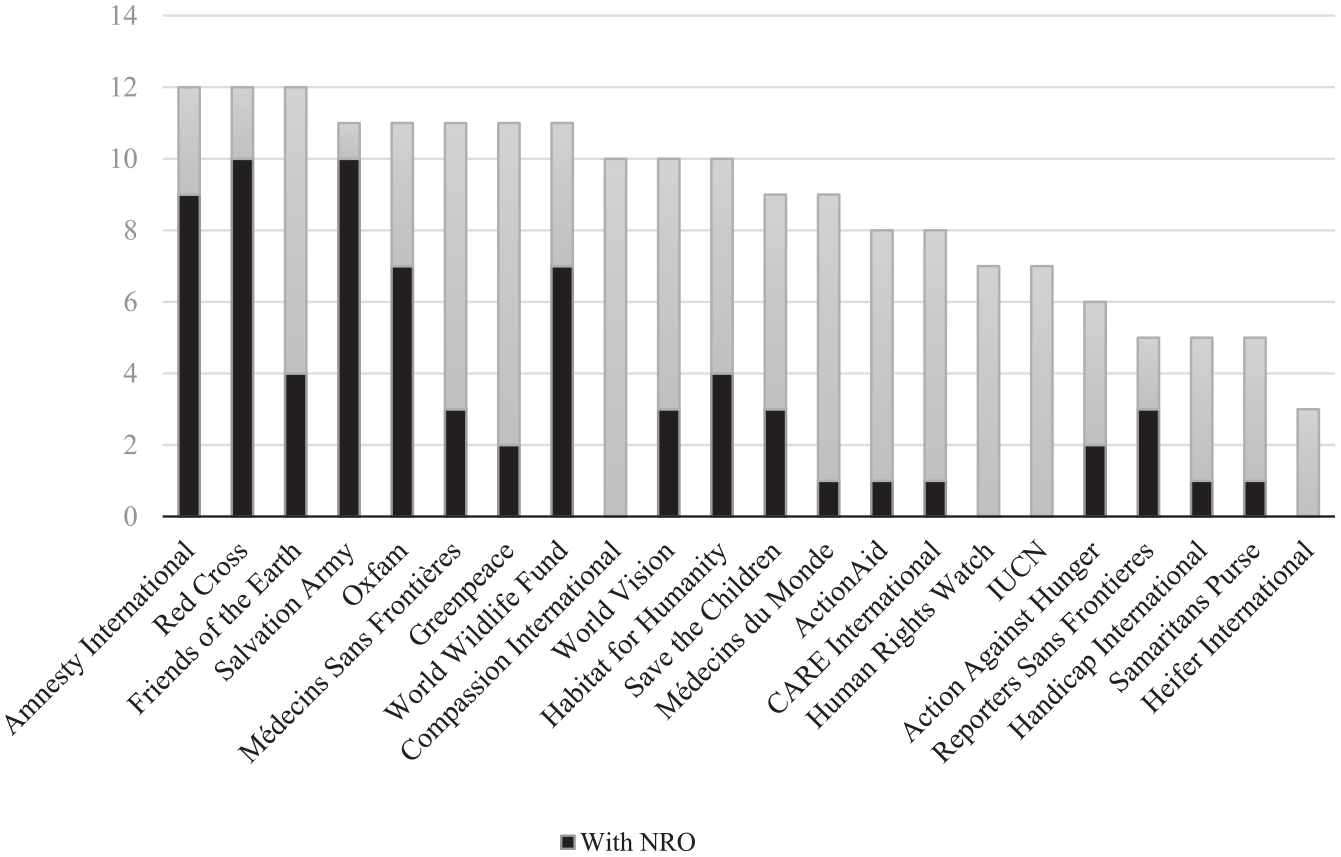
Roughly one third of included NAs use nonprofit retail: overall, the mean percentage of NAs with NROs is 37%. As the chart below shows (Figure 1), there is considerable variation in the extent to which the leading INGOs use nonprofit retail.
NAs with/without NROs, by INGO.
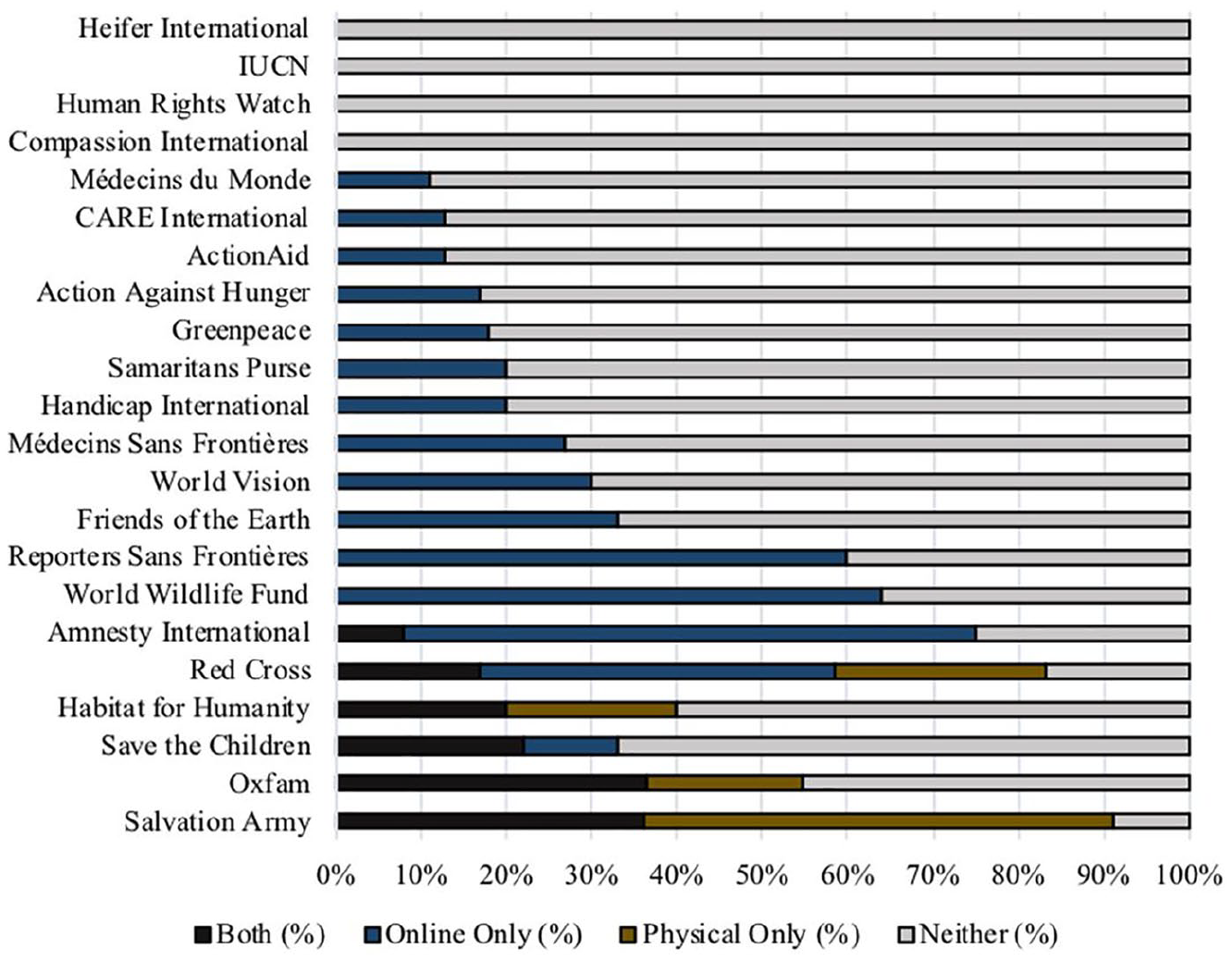
The INGO with the highest percentage of NAs using nonprofit retail was the Salvation Army (91%), where every NA excepting the Republic of Ireland Salvation Army had an NRO. For the Red Cross (83%), Amnesty International (75%), Oxfam (64%), World Wildlife Fund (64%), and Reporters sans Frontières (60%), more than half of NAs had NROs. At the other end of the spectrum, in no cases did the NAs of Heifer International, IUCN, Human Rights Watch, and Compassion International have NROs. These descriptive statistics suggest that organization type is a variable of potential interest for studying NRO use. However, this would appear not to be a straightforward matter of subject. The data offer examples of human rights INGOs at each end of the spectrum (Reporters sans Frontières and Amnesty International compared with Human Rights Watch), as is the case for religious, development, disaster relief, and environmental INGOs.
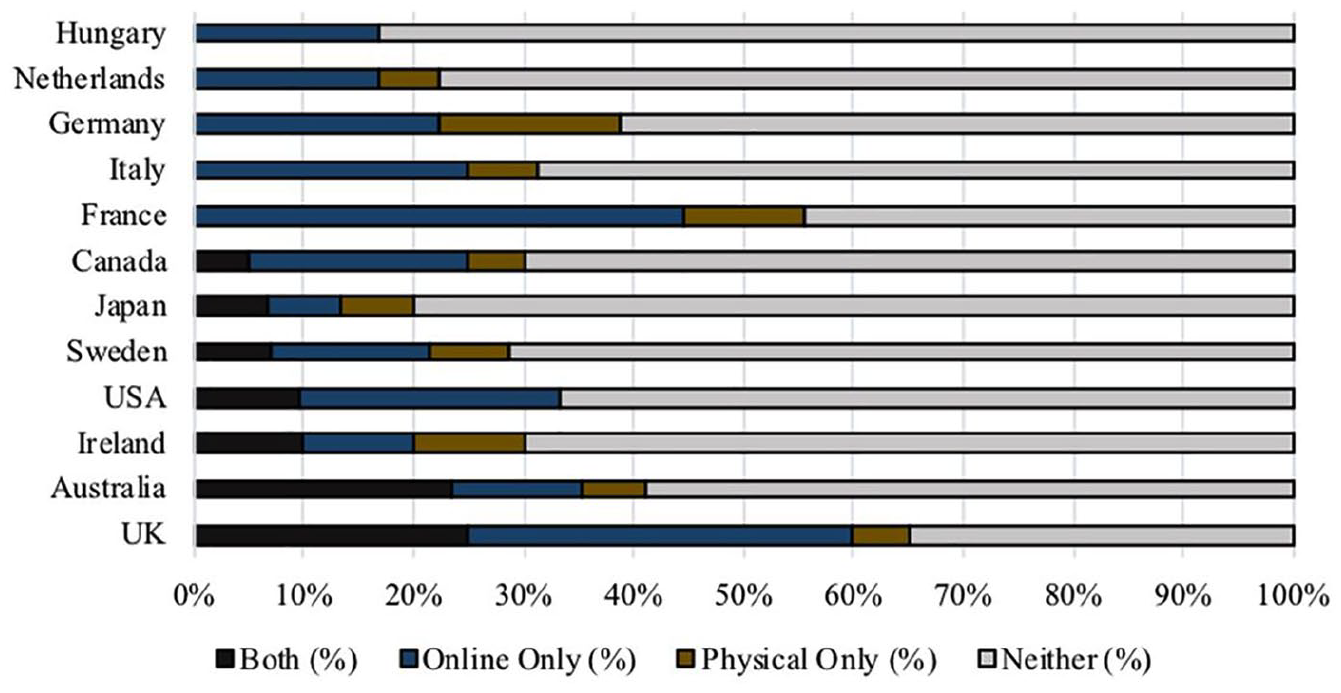
Cross-nationally, NRO use varied considerably (Figure 2). The highest percentage of NAs with NROs occurred in the United Kingdom (70%), while the lower bound was just 16% in Hungary. Bearing in mind the considerable limitations here, the data suggest that future research might fruitfully examine how NRO use interacts with the civil society “regimes” identified in social origins theory (Salamon & Anheier, 1998). In that theory, countries are categorized according to the overall scale of the nonprofit sector, as well as the nonprofit sector’s revenue mix (specifically, reliance on government funding as compared with philanthropic and earned income sources). The resulting framework – consisting of liberal, statist, corporatist, and social democratic regimes – complements to a large degree the three welfare state regimes from comparative political economy research (Esping-Anderson, 1990). Drawing on social origins theory, we might expect variation between civil society regimes. In particular, one could conceivably expect “liberal” regimes (the United Kingdom, the United States, Australia, and Canada) to exhibit the highest prevalence of nonprofit retail. While the limitations of this study are considerable, the data imply that cross-national nonprofit retail use may not correspond to these regimes, at least not in a straightforward manner. This is suggested by the relatively high proportion of NROs used by France (56%) and Germany (39%), two corporatist civil society regimes.

NAs with/without NROs, by country.
NRO Form
The simplest distinction in NRO form concerns the use of online retail versus physical shops. Overall, 30% of NAs (57) had online retail operations, while only 15% (28) had physical stores and just 8% (15) had both online and physical stores. The chart below (Figure 3) provides data on the percentage of NAs that had online retail, physical shops, or both kinds of nonprofit retail, arranged by INGO. As it shows, just six of the 22 leading INGOs have NAs which operate physical stores: the Salvation Army (10), Oxfam (6), the Red Cross (5), Habitat for Humanity (4), Save the Children (2), and Amnesty International (1). In contrast, 18 of the 22 leading INGOs have NAs which operate online retail.
NRO usage by INGO, percentage of NAs.
The chart below (Figure 4) – which outlines the percentage of NAs with online retail, physical shops, or both online and physical retailing – shows that this pattern prevailed cross-nationally as well. While there was variation in the usage of online versus physical retail cross-nationally, online retail was more prevalent than physical shops in all cases. The relative prevalence of online retail suggests that the thrift shop, the archetypical secondhand charity shop as identified in the extant literature, may not be the dominant form of nonprofit retail today.
NRO usage by country, percentage of NAs.
NRO Typology
For the NAs included in this study, brand-promoting retail (36) was the most common type of NRO, while social consumption-promoting retail (6) and general retail (5) were least common. Table 3 provides a summary of the NRO formats by frequency of use. 4
Nonprofit Retail Operation Format, Frequency of Usage.

Discussion
There is considerable potential for future research on nonprofit retail. Although there were insufficient observations in this dataset to allow for inferential statistical analysis, the contours of variation suggest several areas of inquiry. First, although nonprofit retail was most prevalent for sample organizations in the United Kingdom, NROs were not a U.K.-specific phenomenon. While the data here are limited by using a small grouping of influential nonprofits, the method of comparing the same INGO movements as manifested in their NAs allows us some analytical purchase on cross-national NRO use. To that end, the data also suggest that social origins theory regime type may be a fruitful basis for cross-national comparison. In particular, the higher rates of NRO use in two corporatist civil society regimes (Germany and France), as compared with two liberal regimes (Canada and the United States), are discordant with expectations that might be drawn from social origins theory – as social origins theory defines liberal regimes on the basis of their relatively greater reliance on earned income and philanthropic funding sources. Further cross-national research is necessary to, first, validate or invalidate the representativeness of this data and, second, to explore this phenomenon more fully. Other explanatory variables, such as the prevalence of environmental movements and geographical proximity to the United Kingdom, should be explored.
Next, there are potentially interesting areas for research of within-country NRO use. Some of the INGOs in this study had no NAs using retail, while for others retail was commonplace. The variation suggests that mission type is a variable of potential interest for studying NRO use. But it may be a more complicated matter than issue area, as there was variation within issue-area categories.
Finally, the conceptual contribution of this article provides an entry point for analyzing models of nonprofit retail beyond the thrift shop – something which is especially important in light of the prevalence of online retail among the sample nonprofits. The article abductively identified 10 objectives that nonprofit retail could potentially serve. While revenue generation was an identified objective, other non-commercial objectives – such as volunteerism, reuse, alternate employment, and beneficiary engagement – are potentially important as well. Interpreting trends in nonprofit retail today requires understanding the mix of commercial and non-commercial objectives at play in each particular NRO. As a starting point for analysis of this sort, the article introduced a typology of five NRO formats – the thrift shop, social consumption-promoting retail, the sale of mission-linked goods, brand-promoting retail, and general retail – and discussed their connection to the identified objectives. This typology could fruitfully be extended in future research. One avenue might entail the use of survey methods to obtain data pairing information on NRO formats with self-reported data on the purposes of nonprofit retail. A study of this nature could explore whether there are systematic associations between the format of an NRO and how nonprofit organizations think about retail.
Conclusion
Earned income merits more study than it has to date received as a component of the nonprofit revenue mix. In particular, nonprofit retail is of interest given the non-revenue purposes that it can serve, which in some cases can be of equal or greater importance to the nonprofit using an NRO. The U.K.-centric nature of research on nonprofit retail, as well as the emphasis on thrift store models, has placed boundaries on the utility of research for understanding how NROs fit into the missions and strategies of today’s nonprofits. The data in this article provide an initial, albeit limited, basis for understanding the scope of nonprofit retail internationally. Major INGO movements are using nonprofit retail – more than a third (37%) of NAs covered in this study had NROs – although there is variation both cross-nationally and by INGO. Online retail was twice as prevalent as physical retail, suggesting a need to move beyond the thrift shop in future studies of nonprofit retail. To this end, this article introduced a typology of five NRO formats which differ in their objectives. Applied to the data, the typology showed that although the thrift shop is a common NRO format, it was not the most common in the sample studied: more NAs employed brand-promoting retail, such as selling apparel with the organization’s logo.
Footnotes
Acknowledgements
This research would not have been possible without the support that the Lupina Foundation and the University of Toronto Innovation Policy Lab have provided throughout my doctoral studies. I thank participants of the 2018 Association for Nonprofit and Social Economy Research Annual Conference for providing comments on an earlier version of the paper. Thank you as well to Dr. Susan Phillips for her thoughtful editorial advice. Finally, I would like to thank the three anonymous reviewers for providing helpful and constructive feedback.
Declaration of Conflicting Interests
The author(s) declared no potential conflicts of interest with respect to the research, authorship, and/or publication of this article.
Funding
The author(s) received no financial support for the research, authorship, and/or publication of this article.
