



Abstract
By integrating literature on governance processes with literature on network integration, we investigate the governance of mandated lead-organization public–nonprofit service networks. We argue that the relationship between the governing public actor and the participating nonprofit organizations as well as the governance processes involved are dependent upon the level of integration that is established in the network in terms of the centrality of the leading public agency and the density among the nonprofit actors. We formulate four propositions and distinguish archetypes of governance that guide further research and practice.
Introduction
Governments are increasingly relying on service delivery networks with nonprofit organizations to address complex social problems or “wicked issues” in ways that cannot be achieved by one organization alone (Isett et al., 2011; Provan & Lemaire, 2012). We focus on mandated lead-organization public–nonprofit service networks that aim to deliver publicly funded social services to vulnerable target groups such as children, frail elderly, people in poverty, and people with mental health problems (Graddy & Chen, 2006; Johnston & Romzek, 2008; Raeymaeckers et al., 2017; Span et al., 2012; Vermeiren et al., 2019). These networks are a unique type of service delivery networks due to their lead-organization structure and mandated nature. First, they have a lead-organization structure because they are established and funded by a public agency affiliated to the government (Provan & Kenis, 2008; Raeymaeckers et al., 2017; Span et al., 2012; Vermeiren et al., 2019). Second, they are “mandated or contracted,” as opposed to “self-initiated” by the nonprofit members themselves, meaning that complex publicly funded services are delivered through government contracting with nonprofit organizations (Johnston & Romzek, 2008; Provan & Kenis, 2008; Van Slyke, 2007). The leading public agency negotiates with interested nonprofit organizations, defines the terms of their contracts, sets a common network goal, and attempts to integrate their expertise and efforts to provide a wide array of (integrated and jointly produced) social welfare services that meet the requirements of the local target groups (Johnston & Romzek, 2008; Span et al., 2012).
In contrast to other types of service delivery networks, the leading public agency is responsible for the network’s governance, which can be defined as “the design and use of a structure and processes that enable actors to direct, coordinate, and allocate resources for the collaboration as a whole and to account for its activities” (Vangen et al., 2015, p. 1244). However, the participating nonprofit organizations in the network are not immune to self-interest (Provan & Kenis, 2008; Provan & Lemaire, 2012). An important governance challenge involves the extent to which organizations work together to achieve the common network goal. To steer the network toward the realization of this goal, a crucial task for the leading public agency is to carefully design and use governance processes, which refer to “ways of communicating, sharing responsibility and taking decisions” (Vangen et al., 2015, p. 1250). Yet, literature on this topic is quite limited (Stone et al., 2010; Vangen et al., 2015). The aim of this article is to bridge this research gap by providing new insights into the use of governance processes in public–nonprofit service networks. More precisely, we frame governance processes within organization theories (agency, stewardship, and managerial hegemony theories) and apply insights from social network analysis to depict how these processes are embedded in and influenced by the level of network integration. Moreover, by limiting our analysis to mandated lead-organization public–nonprofit service networks, we (a) emphasize the critical importance of narrowly differentiating and distinguishing between different types of service delivery networks to understand the peculiarities of their governance, and (b) avoid misconceptions such as the interchangeable use of service networks and policy networks in current research while these terms are actually quite different from each other with regard to their rationale, governance, and outcomes (Dal Molin & Masella, 2016; Isett et al., 2011; Lecy et al., 2014).
Governance of Public–Nonprofit Service Networks
In mandated lead-organization public–nonprofit service networks, a leading public agency and participating nonprofit organizations work together to provide publicly funded services to vulnerable target groups in their community (Span et al., 2012). As a result, these networks often consist of a very diverse set of nonprofit organizations that aim to reach a variety of objectives. For example, a network aimed at fighting child poverty typically includes nonprofit organizations focusing on health care delivery, education, parenting support, and poverty in general (Raeymaeckers et al., 2017). Generally, there is a discrepancy between the common network goal determined by the leading public agency and the objectives of the participating nonprofit organizations. While the public agency is focused on the attainment of the common network goal, the nonprofit members may have other objectives besides this goal. Consequently, they may try to gain control in the network to maximize their own individual interests. The more that one of the nonprofit organizations achieves this ambition of control, the less efficient the network will be in realizing the common goal. Public–nonprofit service networks may fail when each participating nonprofit organization tries to maximize its own individual interests instead of the common network goal (Park & Ungson, 2001; Provan & Kenis, 2008; Vangen & Huxham, 2012). However, when the nonprofit organizations do not obtain sufficient benefits from participating in the network, they can decide to leave the network, which may also cause network failure (Park & Ungson, 2001). A crucial challenge for the leading public agency is therefore to find a balance between, on one hand, integrating the efforts of these organizations to achieve a common goal, and on the other hand, allowing them to remain differentiated so that they can obtain advantages from their network membership.
To resolve the aforementioned tension, the leading public agency can resort to a wide range of governance processes that can take many shapes and forms. For example, these processes determine how (a) members meet and communicate, (b) resources are mobilized, (c) collective decision-making occurs, and (d) activities of members are coordinated (Stone et al., 2010; Vangen et al., 2015). We add to this literature by applying organizational theories (e.g., agency theory and stewardship theory) to frame governance processes between the leading public agency and the participating nonprofit organizations in public–nonprofit service networks. In addition, we argue that the use of governance processes in this relationship is dependent upon the level of network integration, which refers to the configuration of (contractual and noncontractual) ties among network actors in terms of the centrality of the leading public agency and the density among the participating nonprofit organizations (e.g., Lemieux-Charles et al., 2005; Provan & Milward, 1995). We formulate four propositions regarding this relationship and the use of governance processes. As such, four archetypes of governance are distinguished that can guide further research and practice.
So far only a few authors have investigated the governance of public–nonprofit networks or collaborations (Cornforth et al., 2015; Stone et al., 2010, 2014; Vangen et al., 2015; Vermeiren et al., 2019). Stone et al. (2010, 2014) developed a conceptual model by focusing on interactions between various network governance elements. We build on their model to understand the design and use of governance processes in public–nonprofit service networks. In more detail, we argue that these processes are (a) shaped by the lead-organization structure of the network, with the public agency as network leader (Provan & Kenis, 2008; Span et al., 2012), (b) subjected to the tension between network and organization governance (Park & Ungson, 2001; Provan & Kenis, 2008), and (c) influenced by the level of network integration (Provan & Milward, 1995; Yi, 2018). We show that governance processes between the leading public agency and the participating nonprofit organizations are embedded in and influenced by a complex web of ties among network actors. Similar to the link between governance structure and governance processes as described by Stone et al. (2010, 2014), we acknowledge that the causal relationship between network integration and governance processes may go both ways. However, following Yi (2018), we focus on the effects of network integration on network governance. We argue that depending on the network’s level of integration (i.e., the density among the nonprofit actors and the level of centrality of the public actor), different types of relationships between the leading public agency and the participating nonprofit organizations (e.g., principal–agent or principal–steward relationships) will more likely occur, resulting in the use of different governance processes to resolve the tension between network and organization governance.
Governance Processes: Agency Theory, Stewardship Theory, and Managerial Hegemony
Agency theory and stewardship theory have been applied to investigate governance and accountability in the public and nonprofit sectors (e.g., Van Puyvelde et al., 2012, 2016; Van Slyke, 2007). Consider a single nonprofit organization where the board of directors is the body with the main responsibility for ensuring that governance functions are carried out. Although there are no owners in the sense of shareholders, there are important stakeholder groups who can affect or are affected by the achievement of the organization’s objectives (R. E. Freeman, 1984). Often the relationship with a particular stakeholder group of the nonprofit organization is hierarchical in nature (Van Puyvelde et al., 2012). One party (the principal) expects another party (the agent/steward) to perform some service on its behalf, and delegates some decision-making authority to this party (Jensen & Meckling, 1976). For example, the relationship between the board (principal) and management (agent/steward) in nonprofit organizations has been investigated by integrating both perspectives (e.g., Bernstein et al., 2016; Van Puyvelde et al., 2016). Similarly, literature on nonprofit organizations’ relationships with external stakeholders, such as the government–nonprofit contracting relationship (e.g., Marvel & Marvel, 2009; Van Slyke, 2007), has considered both agency and stewardship theories. We apply these theories to the relationship between the leading public agency and the participating nonprofit organizations in public–nonprofit service networks. In this case, the public agency assumes the role of principal, and the participating nonprofit organizations act as agents or stewards. Table 1 gives an overview of the basic tenets of both theories.
Agency Theory and Stewardship Theory.

Source. Based on Van Slyke (2007) and Marvel and Marvel (2009).
In short, agency theory assumes that the principal and the agent have different interests, and that asymmetric information combined with the agent’s opportunistic nature makes it difficult or expensive for the principal to observe the agent’s behavior (Eisenhardt, 1989). Stewardship theory, in contrast, posits that the principal and the steward share interests. Stewards want to do a good job and will act in the principal’s best interests (Davis et al., 1997). While agency theory emphasizes the use of control-oriented processes such as monitoring and incentives to eliminate opportunistic behavior and to ensure goal alignment, stewardship theory stresses the importance of empowerment-oriented processes such as responsibility, autonomy, engagement, involvement, and shared culture and norms (Davis et al., 1997; Van Slyke, 2007). Both theories have been applied to study nonprofit governance (Coule, 2015; Van Puyvelde et al., 2012). We posit that agency and stewardship theory are also useful for studying the governance of public–nonprofit service networks. In this case, the public agency (principal) is the actor with the main responsibility for ensuring the network’s governance. Among others, it will contract locally embedded nonprofit organizations (agents/stewards) to provide services to people in the community on its behalf, thereby delegating some decision-making authority to these organizations.
Empirical literature on governance processes in public–nonprofit collaborations and networks can be related to both principal–agent and principal–steward models (Van Slyke, 2007). On one hand, consistent with principal–agent models, strong leadership of the public agency can be very useful in networks where consensus-oriented decisions are extremely difficult to make due to the diversity among network actors (Provan & Kenis, 2008; Raeymaeckers et al., 2017; Span et al., 2012; Vangen et al., 2015). For example, Provan and Kenis (2008) point out that in a lead-organization network, the leading agency is able to contribute to a very efficient decision-making process because it has the mandate and the full authority to make decisions in the network, even without the full support of the network members. Indeed, governance processes aimed at excluding a subset or all network partners can be used to enforce decisions throughout the network (Vangen et al., 2015). On the other hand, in line with principal–steward models, inclusiveness in network decision-making and building trust relationships are considered to be important governance processes (Bryson et al., 2006; Provan & Kenis, 2008; Stone et al., 2010; Vangen et al., 2015; Vermeiren et al., 2019). The public agency trusts the participating nonprofit organizations to make decisions conform to the network’s objectives. Following this view, network decision-making power is shared between the public agency and the nonprofit members (Raeymaeckers et al., 2017; Span et al., 2012), and the existence of trust between them depends on the extent of collaborative decision-making as well as the level of information sharing, inclusiveness, and good intentions (Bryson et al., 2006; Vangen & Huxham, 2003). Moreover, both the network’s internal legitimacy and the commitment of network partners are also dependent on the extent to which network partners are allowed to influence and be involved in the network’s decision-making processes (Bryson et al., 2006; Vangen et al., 2015).
Both agency and stewardship theories have their usefulness in the context of public–nonprofit service networks, as they provide an answer to the competing logics behind the use of governance processes in these networks (Vangen et al., 2015). To this end, we strongly believe that an integration of both theories yields fruitful insights into the relationship between the leading public agency and the participating nonprofit organizations in public–nonprofit service networks. However, an alternative perspective that may also shed light on this relationship is the theory of managerial hegemony. On one hand, similar to applications of agency and stewardship theory, the board–manager relationship is central in this theory. On the other hand, in contrast to these theories, where the board is in control and has the power to implement governance processes to protect shareholders’ or donors’ interests, managerial hegemony theory assumes that the power of the board is limited and control is ceded to the managers of the organization (Chen et al., 2009; Kosnik, 1987). According to this view, the board is a legal fiction: it is formally but not genuinely the governing body of the organization (Huse, 2007). Otherwise stated, although the board has formal governing authority over managers, in reality, it is dominated by them. As a consequence, managers will make strategic decisions, and these decisions will fit their own objectives. The board will be little more than a compliant “rubber stamp” that ratifies the management’s decisions and gives legitimacy to their actions (Cornforth, 2003; Hung, 1998; Van Puyvelde, 2016). We argue that a similar reasoning may also apply to the relationship between the leading public agency and the participating nonprofit organizations in public–nonprofit service networks. Instead of conforming to the aforementioned principal–agent or principal–steward models, the relationship between the public agency and the nonprofit members may actually be dominated by the latter.
As already stated, to meet the complex demands of vulnerable target groups, the leading public agency relies upon the expertise and skills of nonprofit members (Raeymaeckers et al., 2017; Span et al., 2012). Without their support, the network is unable to provide the necessary customized or tailor-made services to its target groups. The public agency, therefore, needs to balance the benefits of including nonprofit members in network decision-making processes with the costs of consulting them and reaching consensus, and the corresponding loss in decision-making efficiency (Provan & Kenis, 2008; Vangen et al., 2015; Vermeiren et al., 2019). In some cases, this balance may shift toward a very open mode of governance (Vangen & Huxham, 2003), where nonprofit members obtain power in network decision-making at the expense of the authority of the leading public agency. However, in contrast to the principal–steward model where decision-making power is shared between both parties, striving to maximize the inclusion of nonprofit members’ inputs can lead to a situation where the network’s decision-making power mainly lies in their hands with little or no intervention by the public agency (Raeymaeckers et al., 2017; Span et al., 2012). As a result, nonprofit members will dominate the relationship with the public agency and make network decisions that fit their own objectives. The public agency, in contrast, will act as their subordinate and facilitate their needs and wishes. For example, Span et al. (2012) show that in service delivery networks officially governed by a public agency, the latter may effectively adopt a facilitating role, with only limited or no decision-making power, as a way to incorporate all the necessary expertise of nonprofit members in providing customized services. In addition, studies illustrate that due to their power in network decision-making, nonprofit members may hire or appoint a network coordinator that considers their concerns above the directions of the leading public agency and supports them in the formulation of the network’s vision and the execution of projects (Raeymaeckers et al., 2017; Vermeiren et al., 2019). In other words, a form of member hegemony arises where the public agency is formally but not genuinely the governing body of the network. Analogous to managerial hegemony theory, a member hegemony perspective may therefore also have its merits in framing governance processes in public–nonprofit service networks.
From Fragmentation to Network Integration
Network integration plays an important role in public–nonprofit service networks. The leading public agency attempts to integrate the expertise and efforts of diverse nonprofit organizations to provide services to vulnerable target groups (Raeymaeckers & Kenis, 2016). This challenge can be compared with the tension between differentiation and integration in complex organizations as put forward by Lawrence and Lorsch (1967). They observed a relationship between the extent of differentiation and integration of organizational subsystems (e.g., sales, research, and production) and the complex requirements of the environment of the organization. Being concerned with the question of how the structure of an organization affects its effectiveness, they argued that to be effective, an organization should integrate its subsystems in a manner that corresponds to both its internal and external differentiation. In other words, the more differentiated an organization is, the more integrated its parts must be to perform effectively. Hence, for organizations confronted with a complex environment, high levels of both differentiation and integration are indispensable to be effective.
A similar reasoning applies to public–nonprofit service networks. On one hand, differentiation among the nonprofit actors is needed to provide an answer to the complex problems the network is confronted with. On the other hand, integration of the expertise and efforts of differentiated nonprofit organizations is necessary to attain the common goal (Provan & Kenis, 2008; Raeymaeckers & Kenis, 2016). However, when the public agency is unable to integrate the differentiated set of nonprofit actors, fragmentation occurs and the network will most likely fall apart in several isolated actors that try to deal with the “wicked issues” themselves separately, without any connection or ties between each other. In line with theories of fragmented governance (e.g., Zürn & Faude, 2013), a highly complex and fragmented governance landscape arises, where it is very difficult to install governance processes and to establish coordination among network actors. For example, this situation is observed in cases of global or international environmental issues, such as climate change challenges (e.g., Abbott, 2012; Hjerpe & Nasiritousi, 2015), shark conservation strategies (e.g., Techera & Klein, 2011), and the governance of international rivers (e.g., Zawahri & Mitchell, 2011). Similarly, a situation of fragmented governance may also occur in public–nonprofit service networks.
Several authors have used social network analysis to investigate network integration (e.g., Lemieux-Charles et al., 2005; Provan & Milward, 1995; Raeymaeckers & Kenis, 2016). This technique focuses on social actors’ positions in the network, the relationships among them, and the patterns and implications of these relationships (Wasserman & Faust, 1994). The relationships or ties refer to contractual agreements as well as noncontractual voluntary exchange ties, such as information or knowledge exchange between network members, client referrals from one organization to another without the presence of a contract, and the demonstration of competency, good intentions, and follow-through to partner organizations when treating the same clients (e.g., Provan & Milward, 1995; Raeymaeckers & Kenis, 2016). Besides formal contractual ties, informal noncontractual ties also influence network governance (West et al., 2015), for example, by increasing (or decreasing) the reputation of the public agency (Isett & Provan, 2005) or by inducing trust between network participants (Bryson et al., 2006; Isett & Provan, 2005), which in turn may contribute to the success and effectiveness of the network (Provan & Kenis, 2008; Stone et al., 2010; Vangen & Huxham, 2003). Hence, when analyzing governance processes in public–nonprofit service networks, we take into account that the public agency and the nonprofit organizations are embedded in and influenced by a complex web of contractual and voluntary exchange ties (cf. West et al., 2015).
Social network analysis measures such as density and centrality have been used to assess the integration of service networks (e.g., Lemieux-Charles et al., 2005; Provan & Milward, 1995; Raeymaeckers & Kenis, 2016). A similar approach can be used for public–nonprofit service networks. First, density refers to the level of ties among the participating nonprofit organizations. The main idea is that a network with a high density is associated with socially integrative effects. Similarly, in case of public–nonprofit service networks, a higher density implies more connections among the nonprofit actors. We argue that this measure can be used to assess the level of social integration in terms of cooperation and consensus among the nonprofit organizations. The higher the level of density, the more these organizations share the same norms and values. Second, centrality refers to the leading public actor’s position in the network relative to the nonprofit actors. A central actor is commonly considered as a very powerful actor with a lot of influence in the network (Borgatti, 2005). Burt (2004) states that this actor connects different parts of the network. It obtains power because it offers/receives unique resources to/from other network actors. In the literature, several measures of centrality are available, the most common being betweenness, closeness, and degree centrality (Borgatti, 2005; Knoke & Yang, 2008; Wasserman & Faust, 1994). Given that we focus on the extent to which the leading public actor is able to directly influence the participating nonprofit actors to strive for the common network goal, we believe that degree centrality is the most appropriate measure for our analysis. This measure focuses on the direct influence of the leading public actor by counting the number of ties that directly emanate from it (Borgatti, 2005). We conclude that network integration of contractual and voluntary exchange ties in public–nonprofit service networks can be established by a very dense network where all the nonprofit actors are connected and/or by a network where the leading public agency has a high level of centrality.
Propositions
We formulate four propositions to explain the relationship between network integration and governance processes in public–nonprofit service networks. As explained above, the main building blocks of our propositions are the centrality of the leading public agency (degree centrality) and the density among the participating nonprofit organizations.
High Centrality of the Leading Public Agency and High Density Among the Nonprofit Actors
Consider a public–nonprofit service network where the leading public agency has a high level of centrality and the density among the nonprofit actors is high. Due to its high centrality, the public agency can resist stakeholder pressures, control the flow of information, and influence the formation of members’ expectations (Rowley, 1997). As a result, the leading public agency has a lot of influence in the network and is able to steer the network toward the common goal. Furthermore, given the high density among the nonprofit actors, there are a lot of interorganizational linkages, which facilitates not only the communication and information exchanges among these actors but also the diffusion of norms and values across the network (Oliver, 1990; Rowley, 1997). Indeed, as Coleman (1988) argues, high levels of social control in dense networks can lead to situations where network members are enforced by their participating counterparts to accept the norms in the network. Considering the above effects, there will be more implicit coordination and collectivization in the network. These observations are closely related to the tenets of stewardship theory (Davis et al., 1997). Stewards place greater value on collective goals than on individual goals, and make decisions that they perceive to be in the best interest of the principal. The relationship between the principal and the steward is built upon collaboration and trust. We argue that similar to the case of government–nonprofit contracting relationships, governance processes to ensure goal alignment in public–nonprofit service networks will focus on empowerment, and include cooperation, responsibility, informal discussions, and shared culture and norms (Marvel & Marvel, 2009; Van Slyke, 2007).
High Centrality of the Leading Public Agency and Low Density Among the Nonprofit Actors
Consider a public–nonprofit service network where the leading public agency also has a high level of centrality in the network, but the density among the nonprofit actors is low. Similar to the first case, the leading public agency acts as principal and steers the network toward its common goal due to its high centrality. However, given the low density among the nonprofit actors, communication and information exchanges between them may be limited. Moreover, because of the lack of connections among the nonprofit actors, the formation of shared norms and the flow of resources are also hindered (Rowley, 1997). As a result, a participating nonprofit organization can become somewhat isolated and independent from other network actors, which has two important consequences. A first one is that the nonprofit organization may experience fewer benefits from participating in the network (e.g., limited resources or a decreased access to crucial information), which may reduce its willingness to pursue the common network goal. A second consequence is that due to its more isolated position, the nonprofit organization may have more discretion over its actions. Because its activities are not easily discernible by other network actors, the nonprofit organization has the ability to conceal its behavior to a certain extent and to pursue its own goals without experiencing pressure from other network actors. To respond to these challenges, the public agency relies on its high centrality, which is a source of influence and power in the network. More specifically, to resolve issues related to member discretion and reduced willingness to pursue the common network goal, the public agency focuses on controlling the nonprofit organizations, which is in line with the tenets of agency theory (Eisenhardt, 1989). For example, similar to the government–nonprofit contracting relationship, the leading public agency can use incentives and monitoring practices to foster goal alignment and bridge information asymmetry (Marvel & Marvel, 2009; Van Slyke, 2007).
Low Centrality of the Leading Public Agency and High Density Among the Nonprofit Actors
Consider a public–nonprofit service network where the density among participating nonprofit organizations is high but the leading public agency has a low level of centrality in the network. In this case, the leading public agency is in a vulnerable position. First, due to its low centrality, it is limited in its abilities to control the flow of information and to influence nonprofit actors toward the attainment of the common goal. Second, because the nonprofit actors form a dense group, they can efficiently communicate with each other, without the public agency acting as gatekeeper of this information exchange process, and obtain a lot of influence and power in the network (cf. Rowley, 1997). Third, the public agency may attempt to use its leading mandate to improve its position in the network. Among others, it may try to exclude noncompliant nonprofit organizations from the network, acquire new connections by providing funding to new members, and activate existing connections by renewing contractual agreements (Gulati & Srivastava, 2014). However, adopting these strategies in a network where the nonprofit actors are highly connected is very difficult. On one hand, the public agency needs the skills and expertise of nonprofit actors to tackle wicked issues. Without their help and support, the network may fail. On the other hand, the nonprofit actors form a dense group. They share similar norms and values, and exchange several resources. As a result, they have a lot of power in the network and can resist or hinder the public agency’s decisions, thereby limiting its decision-making power.
This situation corresponds to the theory of member hegemony outlined before, where nonprofit members dominate the relationship with the public agency. Because the leading public agency has a low level of centrality and is situated on the periphery of the network, it lacks insights into how the nonprofit actors are connected, and which contributions and expertise they bring to the network. As a result, it will be limited in its abilities to gain influence in the network and to make sure that the common network goal can be obtained. In other words, there is a shift in power from the leading public agency to the participating nonprofit organizations. The public agency is formally but not genuinely the governing body of the network. It is unable to make decisions and implement governance processes that are most suitable to steer the network toward the attainment of the common goal. A collective of nonprofit organizations with shared values and norms will formulate the network goals and make the strategic network decisions, whereas the leading public agency will have to ratify their decisions, fulfill their needs and wishes, comply with their expectations, and accept the established norms in the network. In sum, we suggest that in networks where the leading public agency only has a low level of centrality and the density among the nonprofit actors is high, a form of member hegemony will more likely be present.
Low Centrality of the Leading Public Agency and Low Density Among the Nonprofit Actors
In a public–nonprofit service network with a low level of integration, fragmentation appears among the network actors, which is detrimental for both the leading public agency and the participating nonprofit organizations. The leading public agency has almost no influence in the network, and similar to the situation of member hegemony, it is too weak and lacks the necessary insights to steer the nonprofit actors toward the fulfillment of the common goal. However, in contrast to the situation of member hegemony, the participating nonprofit organizations are also limited in their ability to formulate collective network goals and make important network decisions. They will obtain only minimal benefits from being a network member (e.g., limited resource attainment). In this case, a form of fragmented governance occurs. Nonprofit organizations are simultaneously but separately addressing the same or similar “wicked issues” in their community, and the public agency is limited in its ability to steer the coordination between them. As a result, the participating nonprofit organizations may try to renegotiate the terms of their contract. However, if this option fails, they may decide to end the contract and to leave the network if possible.
This network situation is comparable with the notion of fragmented governance in global or international environmental issues such as climate change challenges where there is a complex and highly fragmented governance landscape (Abbott, 2012; Hjerpe & Nasiritousi, 2015; Zürn & Faude, 2013). Among others, (a) establishing coordination processes is difficult, (b) key issues are not treated as integral units, (c) gaps or overlaps in efforts arise, (d) gains from cooperation are minimized, (e) organizations can pursue their own interests, (f) conflicts or competition between organizations may occur, and (g) organizations may raise questions and have different opinions about the legitimacy and effectiveness of governance arrangements (Bäckstrand, 2008; Hjerpe & Nasiritousi, 2015; Zürn & Faude, 2013). Similar fragmentation issues may also occur in local public–nonprofit service networks with a low level of integration (e.g., Park & Ungson, 2001). Consequently, to improve the governance of these networks, the leading public agency needs to gradually develop and initiate governance processes that simultaneously reflect the differentiation of nonprofit organizations in the network as well as establish sufficient coordination between them. Only in this way governance processes can be implemented with sufficient legitimacy to be accepted by the whole network. For example, the public agency may hire a coordinator or establish steering committees or working groups that can assist in building consensus on the common network goal and establish collaborative ties between network members (Raeymaeckers et al., 2017; Vermeiren et al., 2019). Alternatively, the public agency may try to initiate and/or facilitate mergers between participating nonprofit organizations (Benton & Austin, 2010), thereby improving its position in the network.
Summary and Discussion
We posit that the relationship between the leading public agency and the participating nonprofit organizations and the resulting governance processes are dependent upon the level of integration that is established in the network. More precisely, depending on the density among the nonprofit actors and the level of centrality of the public agency in the network, four governance archetypes can be distinguished (see Figure 1). The higher the centrality of the leading public agency, the higher its influence in the network and the more it is able to steer the network toward the direction that it wants. When the high centrality of this actor is combined with a low density among the nonprofit actors, principal–agent relationships between the public agency and the nonprofit organizations will more likely occur. In this case, governance processes will focus on controlling the participating nonprofit organizations and monitoring their performance. For example, by implementing monitoring practices such as committees, performance reviews, and progress reports, the public agency can obtain information about the nonprofit organizations’ behavior and performance. As such, it is able to use rewards (e.g., extension or renewal of the contract) and sanctions (e.g., temporary suspension from public service delivery) to steer the organizations’ behavior and to ensure their alignment with the common network goal. However, when the density among the nonprofit actors increases, their influence will rise, which will increase their impact on the network decision-making process. In these networks, the high level of connections among nonprofit actors will result in a network that will more likely balance around principal–steward relationships between the leading public agency and the participating nonprofit organizations. Governance processes implemented by the public agency will be directed at empowering nonprofit organizations to make strategic decisions in the network’s best interest. Among others, by (a) delegating responsibilities for certain tasks and activities, (b) organizing workshops, seminars, and informal meetings, and (c) providing technical assistance to improve organizational service delivery, the public agency tries to engage nonprofit organizations to become involved in the network’s planning, decision-making, and evaluation.
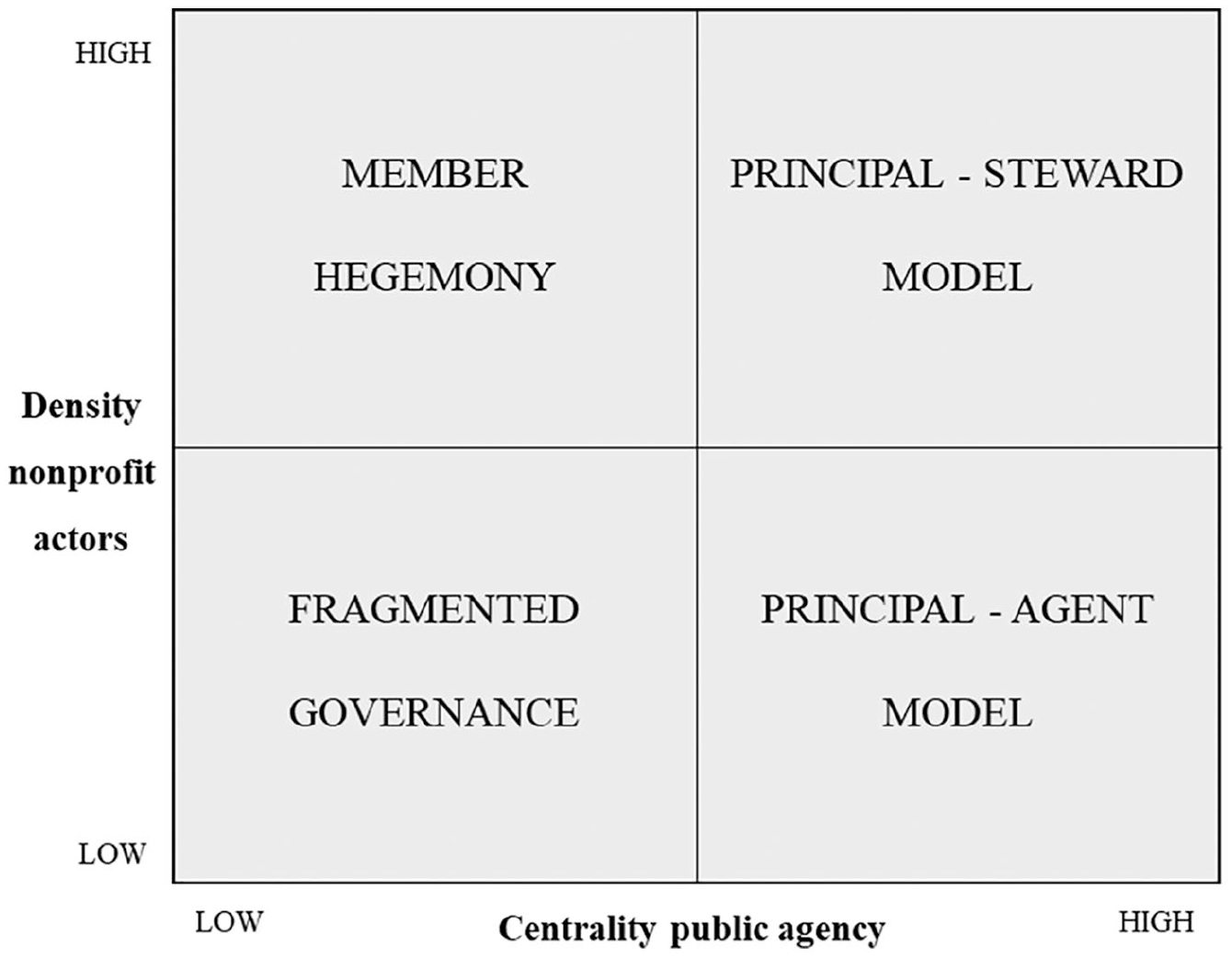
Governance archetypes in lead-organization public–nonprofit service networks.
When the network is characterized by a low centrality of the leading public agency and a high density of connections among the participating nonprofit organizations, a situation of member hegemony will more likely occur. The leading public actor is limited or constrained—by the combined efforts of the nonprofit actors—in its abilities to obtain a high centrality in the network. As a result, it will act as a subordinate of the well-organized members. As it is no longer capable of steering the network and implementing governance processes as it sees fit, traditional principal–agent or principal–steward models are not applicable, thereby illustrating the need for other perspectives such as member hegemony. Finally, in a network with a low level of integration, a situation of fragmented governance will more likely occur. Similar to the situation of member hegemony, the leading public agency is limited in its ability to steer the network’s governance. However, due to the fragmentation in the network, the nonprofit actors are also limited in their ability to make important network decisions. As a result, the nonprofit actors will be simultaneously but separately addressing the same or similar “wicked issues” in their community, with only limited coordination between them.
Future studies can empirically test our propositions on how the relationships between the leading public agency and the participating nonprofit organizations are dependent upon the level of network integration. One particularly interesting issue that can be further explored concerns the “constrained agency” of the public actor. How will this actor improve its centrality in case of either member hegemony (Proposition 3) or fragmented governance (Proposition 4)? Following the framework of “constrained agency” (Gulati & Srivastava, 2014), we suggest that the leading public agency may improve its position by forming coalitions with other network actors, thereby increasing the extent to which it can exert influence in the network. However, such efforts may be constrained because of the public agency’s lack of insight into the overall network structure and other actors blocking or resisting the increase of influence of the public agency in the network. A lead organization occupying a position on the periphery of the network must obtain and use the right resources to gain influence and power so that the network is able to provide quality services to vulnerable target groups (Gulati & Srivastava, 2014; Provan & Kenis, 2008). Further studies can focus on identifying the resources, skills, and capacities needed for leading public agencies to effectively improve their position in situations of member hegemony and fragmented networks.
Second, although we acknowledge that one needs to be very careful in applying implications from research on service delivery networks to other network types (Dal Molin & Masella, 2016; Isett et al., 2011; Lecy et al., 2014), we do believe that our propositions may also be relevant in other contexts. For example, we suggest that when the density among the nonprofit actors is high, their influence in the public–nonprofit service network increases. This could also be the case for policy networks where participation in decision-making and actor involvement is very important (Dal Molin & Masella, 2016). Network actors that have many ties among each other may exercise a larger influence on the decision-making processes of the policy network than actors who are less connected. Similarly, our propositions may also be tested in service networks governed by nonprofit organizations where the role of the government is mainly limited to the provision of funding (Milward, 2014). In this case, the centrality of the leading nonprofit actor constitutes an important research topic. Future research may focus on how responsibilities such as controlling, providing support, and making decisions are divided between the nonprofit governing actor and the public funder of the network, and on how this distinction influences the design and use of governance processes.
Third, we focused on the centrality of the leading public agency in the public–nonprofit service network. However, an important distinction can be made between point centrality and graph centrality (L. C. Freeman, 1979). Centrality or point centrality refers to the location of a point in the network, for example, one individual actor’s position in the network. Centralization or graph centrality, in contrast, involves the application of the concept of centrality to the overall structure of the whole network. Given that we are especially interested in the role of the public agency as the lead organization of the network and its direct relationships with differentiated nonprofits actors, we strongly believe that centrality is the most appropriate measure. More specifically, the higher the centrality of the lead organization, the more influence this actor can exercise in the network. Of course, a focus on centralization may also have its merits, as graphs, for example, may be more centralized around one particular or a group of nonprofit actors than the leading public actor (e.g., Provan & Milward, 1995). In addition, centrality can be assessed by using several measures such as degree, betweenness, and closeness. Each of these measures reflects different kinds of influence and power. We opted for the degree measure of centrality because we are interested in the extent to which the leading public actor is able to directly influence the participating nonprofit actors toward the attainment of the common goal. However, other measures of centrality can also be explored. Following Borgatti (2005), we recommend future studies to carefully assess which centrality and centralization measures could and should be used to analyze governance processes in public–nonprofit networks, while also taking into account the goal and the context of the study.
Fourth, an important issue that must be resolved in further studies is the causality between network governance and network integration. This article focused on the relationship between the leading public agency and the participating nonprofit organizations when a certain configuration of integration among these actors already existed. However, similar to the link between governance structure and governance processes in public–nonprofit networks as described by Stone et al. (2010, 2014), we acknowledge that the relationship may also go in the opposite direction. Future research should therefore consider how the leading public agency may be capable of adopting and using governance processes to (a) steer network integration, (b) increase its central position in the network, and (c) enhance its influence in the network once a central position has been reached (Isett et al., 2011).
Fifth, future research may also test our propositions in contexts where leading public agencies create quasi-markets where nonprofit organizations have to compete for government service contracts with a mix of public, nonprofit, and for-profit competitors (Eikenberry & Kluver, 2004). In this case, an increasing level of competition among nonprofit organizations may result in less collaboration and informational exchange. In line with our second proposition, we expect such markets to be characterized by a high level of centrality of the regulating public agency and a low level of density among the nonprofit actors. However, nonprofit organizations may also join efforts and compile resources when competing for funding in highly competitive markets, which may result in the creation of alliances and dense networks (Kim, 2015). An interesting research avenue is to investigate this tension empirically.
Finally, future research should also focus on the effectiveness of public–nonprofit service networks. We state that when public or nonprofit actors aim to deal with complex problems, the network has to fulfill very complicated tasks based upon “customized” or tailor-made solutions (Span et al., 2012). This means that the expertise and specific knowledge of the variety of partners must be integrated into the actions of the network. We therefore argue that highly integrated networks (i.e., high centrality of the public actor and high density among the nonprofit actors), where principal–steward relationships exist between the leading public agency and the participating nonprofit organizations, will benefit the most from the expertise among network actors due to the focus on cooperation and collaboration. In these networks, nonprofit organizations will be the most inclined to share their expertise with the leading public agency. As such, the network’s ability to fulfill highly complex tasks will increase, which will have a positive influence on its effectiveness. Future research may want to test this idea empirically while also taking into account critical contingencies that may positively or negatively affect the effectiveness of lead-organization networks, such as trust, the number of participants, and the need for network-level competencies (Provan & Kenis, 2008). For example, a crucial factor in these types of networks is the level of trust the leading actor receives from the network participants. When trust is high, the lead organization is allowed to make decisions on complex problems even without the presence of a high level of network consensus (Raeymaeckers et al., 2017; Span et al., 2012). We therefore recommend future studies to control for the level of trust between the participating actors and the leading agency when testing our propositions on the relationship between network integration and governance processes.
Footnotes
Acknowledgements
We would like to thank Marc Jegers and the three anonymous referees for their useful comments.
Authors’ Note
An earlier version of this article was presented at the 13th International Conference of the International Society for Third-Sector Research (ISTR) in Amsterdam, the Netherlands, July 10–13, 2018.
Declaration of Conflicting Interests
The author(s) declared no potential conflicts of interest with respect to the research, authorship, and/or publication of this article.
Funding
The author(s) received no financial support for the research, authorship, and/or publication of this article.
