



Abstract
A decade after key theoretical developments in strategic human resource management (SHRM) in nonprofit organizations (NPOs), we still lack a comprehensive understanding of the disparate strands of empirical evidence. Furthermore, this growing field requires integration and synthesis of new themes and conceptual developments. Therefore, we conducted a systematic review of SHRM studies in NPOs published between 2008 and 2017. Our review of 74 articles synthesizes a fragmented body of research and maps out the relationships into a more integrated whole. By mapping the research landscape, we provide insights into the tensions NPOs face between external pressures and values, highlighting the underexplored role of managerial discretion in shaping NPOs’ differing responses. Our review expands the resource orientation to include a social capital dimension and identifies new empirical manifestations of human resource management (HRM) types. We offer avenues for research on content, process, outcomes of SHRM, and discuss how the interplay across key themes can inform the development of the field.
Keywords
Introduction
Research on strategic human resource management (SHRM) in nonprofit organizations (NPOs) is growing in importance, especially as these organizations seek to balance multiple, often competing demands in their operating environments (Guo et al., 2011; Ridder, Baluch, & Piening, 2012; Walk et al., 2014). Organizations in the nonprofit sector are founded to address a range of issues and needs, such as social, health, cultural, education, and advocacy; it is thus of importance that human resource management (HRM) contributes adequately to these goals. SHRM is understood “as the pattern of planned human resource deployments and activities intended to enable an organization to achieve its goals” (Wright & McMahan, 1992, p. 298). Scholarship on SHRM is home to both the contingency perspective in which HR systems are shaped by different contextual factors, particularly the organizational strategy, and a configurational approach that focuses on the internal consistency of bundles of HR practices and their congruence with organizational goals as central to achieving performance (Delery & Doty, 1996; Lepak & Snell, 1999).
Turning to the field of SHRM in NPOs, there are only a few key theoretical approaches. Ridder and McCandless (2010) introduced a model of HR architectures in NPOs that draws on the building blocks of the strategic and resource-based approaches in the SHRM literature. Subsequently, Akingbola (2013a, 2013c) emphasized the contextual factors that drive HR practices in NPOs. Although these conceptual approaches highlight the contingencies, HR architectures, and their proposed relationships to outcomes, our understanding of SHRM in the nonprofit field remains limited in three respects:
These approaches have been used as a theoretical background for interpreting empirical findings (e.g., Kelliher & Parry, 2011; Kellner et al., 2017; Walk et al., 2014), yet we lack a comprehensive understanding of the disparate strands of empirical evidence drawing on these conceptual approaches.
Although further studies have identified new insights that are not addressed in these approaches (e.g., Valeau, 2015), the field requires integration and synthesis of these new themes and developments.
SHRM in NPO scholarship is characterized by a plethora of studies that remain fragmented due to heterogeneity in their approaches, methods, and findings.
As such, we do not have a clear picture about the recent theoretical developments and empirical insights with regard to SHRM in NPOs. A decade after the main conceptual approaches (Akingbola, 2013a, 2013c; Ridder, Baluch, & Piening, 2012; Ridder & McCandless, 2010), the time is ripe to take stock of key themes and reflect on the directions in which this nascent and growing area of research might move.
To achieve these aims, this study provides a comprehensive systematic review of recent SHRM studies in NPOs published between 2008 and 2017. Following Denyer and Tranfield’s (2009) five-step approach to systematic review and employing a structured content analysis, we draw on the aforementioned conceptual approaches to distinguish between research focusing on the content, process, and outcomes of SHRM. Our review identifies key themes that shed light on these three areas of inquiry (content, process, and outcomes) and points to new developments that have garnered less conceptual or empirical attention in the literature.
Our study makes several contributions to the field of SHRM in NPOs. First, our systematic review of the literature synthesizes a fragmented body of research and maps out the relationships into a more integrated whole. Second, mapping the research landscape provides insights into the tensions NPOs face between external pressures and values, highlighting in particular the underexplored role of managerial discretion in shaping NPOs’ differing responses. We also expand the resource orientation to include the dimension of social capital and identify new empirical manifestations of HRM types. Third, alongside our avenues for future research on content, process, and outcomes of SHRM, the interplay across key themes can inform and stimulate the development of this nascent field.
Conceptual Foundations of SHRM in NPOs
If we look to the field of SHRM in NPOs, there are only a few key theoretical approaches. Ridder and McCandless (2010) introduce a model of HR architectures in NPOs that is based on the overarching notion of human resource (HR) systems architecture (Arthur & Boyles, 2007; Lepak & Snell, 2002). This model distinguishes between two dimensions that shape HRM in NPOs: strategic and HR orientations. In the strategic orientation, SHRM contributes to an organization’s outcomes through achieving a vertical fit (alignment between the organization’s HR and overarching strategy) and a horizontal fit (coherence between HR practices or bundles of practices; Wright & Snell, 1998). According to this strategic perspective, a nonprofit’s values, mission, and the expectations, needs, and goals of its internal and external stakeholders (e.g., the board, competitors, and funders) drive the strategic orientation (Ridder & McCandless, 2010; Ridder, Piening, & Baluch, 2012).
The HR orientation, grounded in the resource-based view (RBV), understands an organization’s internal resources, specifically the organization’s HR capital pool as a source of sustained competitive advantage if this human capital is utilized through organization-specific HR practices (Barney & Wright, 1998; Wright et al., 2001). The specific characteristics of intrinsically and highly motivated nonprofit employees alongside their needs are considered the basis of HR practices and shape the HR orientation (Ridder, Baluch, & Piening, 2012). Together, these strategic and HR orientations are proposed to reflect a broad variety of characteristics and account for the variety of reasons for which organizations adopt and implement HR practices; thus, Ridder and McCandless (2010) argue these dimensions range along a continuum from a low to high value. Juxtaposing these nonmutually exclusive dimensions results in a typology of four HR architectures: administrative, strategic, motivational, and values-based HRM.
Ridder and McCandless’s (2010) model of HR architectures was developed further to shed light on the synergies arising from interrelated HR practices within a HR architecture (Ridder & Baluch, 2017; Ridder, Baluch, & Piening, 2012). In line with the HR systems structure, each of the types is expected to have different HR principles, programs, practices and employees’ perceptions thereof, leading to different effects. This model seeks to account for differences in the contribution of HRM to employee-related and performance outcomes. It has witnessed growing influence in the nonprofit literature, being examined in a variety of empirical studies and contexts (e.g., Kellner et al., 2017; Valeau, 2015; Walk et al., 2014).
In contrast, Akingbola (2013a, 2013c) seeks to conceptualize the organizational goals and characteristics stemming from contextual factors that drive HR practices in NPOs. Drawing on the RBV and resource dependency theory, Akingbola (2013c) examines the determinants of strategic nonprofit HRM that reflect the complex interactions and processes that characterize the environment in which NPOs operate. In this approach, the specific environment of nonprofits sets unique and institutional variables for strategy formulation. The complexity of the social mission entails operating in an institutional environment driven by social and cultural phenomena. This requires consideration of social needs, funders, government, clients, regulations, and an investigation into unique interactions and processes. The specific environment in which nonprofits operate provides—in this view—institutional resources and capabilities (e.g., volunteer participation, quality of employees). Therefore, research in nonprofit HRM has “. . . to pay detailed attention to social and institutional contingent variables” (Akingbola, 2013c, p. 235).
Akingbola (2013a) distinguishes between different models of nonprofit HRM, arbitrary, administrative, values-based, strategic, and mutual HRM, emphasizing that these models of HRM vary in terms of the contextual drivers. This conceptual approach captures a wide range of assumptions about the relationships between contextual factors, nonprofit strategy and strategic nonprofit HRM principles, system-level and organizational characteristics, HR practices, managerial competencies and behaviors, alongside the skills and attitudes of nonprofit employees.
Comparing the two approaches, one strand focuses on the HR systems structure and interrelated practices that make up the HR architecture of NPOs (Ridder & McCandless, 2010), while the other devotes attention to the contingencies of HRM in NPOs (Akingbola, 2013a, 2013c). Albeit from different angles, both approaches conceptualize about what shapes the design of HRM and HR architectures.
Drawing broadly on these aforementioned conceptual approaches, our review has three aims: First, our aim is to systematically take stock of the field and investigate what factors drive the content of SHRM. This focus on the “what” of HRM acknowledges the nuances of SHRM in NPOs by considering a broad spectrum of external and internal influences that shape the orientation and configuration of HRM. Our review systematically analyzes the fragmented body of research and maps the role of tensions and managerial discretion in shaping differing responses and orientations when configuring HR practices, bundles, and systems.
The second aim of our article is to identify key themes around the process of SHRM. Regarding the implementation of HR architectures, Ridder, Baluch, and Piening (2012) conceptualize this as the employees’ appraisal of HR practices, such as the quality of implementation, usage, and fairness of HR programs. Akingbola (2013c, p. 235) offers a model “. . . to identify strategically relevant factors for strategic HRM planning and implementation” in future research. Conceptually and empirically, there is an opportunity to review and synthesize studies on implementation processes (the “how” of HRM strategies, architectures, and practices), including employees’ perceptions of and reactions to HRM.
Our third aim is to integrate insights from research on SHRM outcomes in the nonprofit realm. Drawing on evidence from for-profit studies which shows that employee attitudes and behaviors are central to understanding the relationship between HR practices and organizational-level outcomes, Ridder, Baluch, and Piening (2012) propose that the relationship between organizational performance and the HR architectures is mediated by HR outcomes. Similarly, Akingbola (2013c) conceptualizes “nonprofit performance” as a linear result of employees’ skills and attitudes. While SHRM scholars in the for-profit realm have begun to provide insights on the mechanisms underlying the relationship between specific HRM systems or bundles of HR practices and outcome measures (Kehoe & Wright, 2013; Messersmith et al., 2011; Nishii et al., 2008), it is time to bring together and evaluate the fragmented HRM scholarship in NPOs which focuses on isolated single HR practices and their effects.
Method
To address these aims, we conducted a comprehensive systematic review in five stages (Denyer & Tranfield, 2009; Tranfield et al., 2003). First, we selected our bibliographic database and journals using the Web of Science and excluded those not on the 2017 Harzing’s Journal Quality list to capture all of the high-quality nonprofit and public management, general management, and HRM journals in the field. Our search strategy set the search period between 2008 and 2017 to account for all recent developments in the field since a prior review of the literature (Ridder & McCandless, 2010). In a second step, we conducted a keyword search of articles using a combination of relevant SHRM search strings, such as nonprofit/not-for-profit/third sector/voluntary sector* AND *HR, HRM, HR practice, HR bundle, human capital, social capital, HR, RBV. Third, we compiled an initial sample of 180 selected abstracts. Fourth, each author read these abstracts and applied the exclusion criteria (e.g., non-HRM topics; public or private organizational settings; special issue introductions), reducing our data set to 77 articles. In a final stage, both authors read the full text of each publication, resulting in further reduction of outliers and a final data set of 74 articles.
The articles in our data set reveal that this body of research is growing incrementally, as evidenced by the increasing trend in the publication of studies on SHRM in NPOs from 2008 to 2017. As shown in Figure 1, there is a rise in publications from 2009 to 2015, yet with the highest number of articles published in 1 year amounting only to 12, the field is still very much in its infancy.

Trend in publications on SHRM research in NPOs (2008–2017).
In terms of the range of journals in which this work is being published (see Table 1), the highest number of articles features in Voluntas, followed by the International Journal of Human Resource Management, Nonprofit and Voluntary Sector Quarterly (NVSQ), and thereafter Nonprofit Management and Leadership (NPML). These publication outlets suggest that most of the research appears in nonprofit journals rather than the mainstream HRM publications that featured much less frequently in our review.
SHRM Research in NPOs Data Set.

Note. SHRM = strategic human resource management; NPO = nonprofit organization.
Coding and Analysis
As outlined above, the categories of content, process, and outcomes are derived from our comparison of the main conceptual HRM approaches in the nonprofit literature. Content studies refer to the HR practices, bundles, systems, and architectures as well as the influences that shape the configuration of HRM. Although there are only a few conceptual approaches advancing the nonprofit literature which highlight the contingencies, strategic and resource orientations (Akingbola, 2013a, 2013c; Ridder & Baluch, 2017; Ridder, Baluch, & Piening, 2012; Ridder & McCandless, 2010), the for-profit evidence in the realm of HRM points to the importance of configurations of mutually reinforcing HR practices (B. E. Becker & Huselid, 2006; Lepak & Snell, 1999). The SHRM literature understands HR architectures as the overall internally consistent and coherent HR system structure of an organization through which HR practices are synergistic in effect (Arthur & Boyles, 2007). Seeking to take stock of the conceptual and empirical advances in the configuration of HRM in NPOs, we examined the content studies in our data set using a list of prespecified codes (e.g., “single HR practice, bundle or systems unrelated to strategy”; “strategic orientation”; “resource orientation”; “administrative,” “strategic,” “motivational,” and “values-based HRM”). During the course of analysis, we also identified codes that emerged directly from the data (e.g., “external pressures,” “mission and values,” “the role of management,” “relationship to processes,” “relationship to outcomes”).
Process studies address the implementation of HRM and employees’ perceptions and reactions. Still left underexplored are the processes through which HRM is implemented and influences performance, an issue which is similarly debated in for-profit scholarship. We draw on seminal work by Bowen and Ostroff (2004) which questions the assumption that HRM contributes directly to organizational goals, thus neglecting the relationships between HRM practices, implementation processes, perceptions, and reactions of employees (Khilji & Wang, 2006; Nishii et al., 2008; Ridder, Baluch, & Piening, 2012). We therefore coded for these “implementation processes,” and “employee perceptions and reactions” toward HRM implementation, adding the emergent codes “HRM in change processes” and “generating and transferring knowledge” during the course of data analysis.
Outcome studies focus on the effects of HR practices, bundles, or HR systems. Following Helmig et al. (2014), understanding performance effects is key for the success or failure of NPOs, but the accomplishment of social objectives remains underexplored. Although numerous studies investigate the relationship between single HR practices and outcomes in the nonprofit area, these studies are disjointed, preventing an integrated picture about employees’ attitudinal and behavioral outcomes, alongside organizational and financial performance outcomes of HRM systems or practices. Our coding therefore distinguishes between “HR outcomes,” “financial performance,” and “organizational performance” outcomes.
Through independent first-level coding, each author first coded all of the abstracts along the three main categories (content, process, outcomes). With a percentage agreement in intercoder ratings of 85% between the two authors, we resolved the remaining differences in coding through discussions and, where necessary, by cycling back to the full text of the studies. In independent second-level coding of the full text, both authors coded each content, process, and outcome study using a coding sheet with the aforementioned pre-specified codes. At the same time, we remained open for further codes that emerged during the analysis (e.g., “external pressures”; “HRM in change processes”), adding these to the coding sheet. Thereafter, we compared the occurrences of the prespecified codes in an iterative process, returning to the full text with the agreed-upon emergent codes and further discussion of the occurrences of the second-level coding. A full list of the codes can be seen in Table 2, alongside the occurrences of these in the 74 articles in our data set. Several articles are labeled with multiple codes, and a few studies fall into multiple categories of content, process, and outcomes.
Prespecified and Emergent Codes in the Data Analysis.
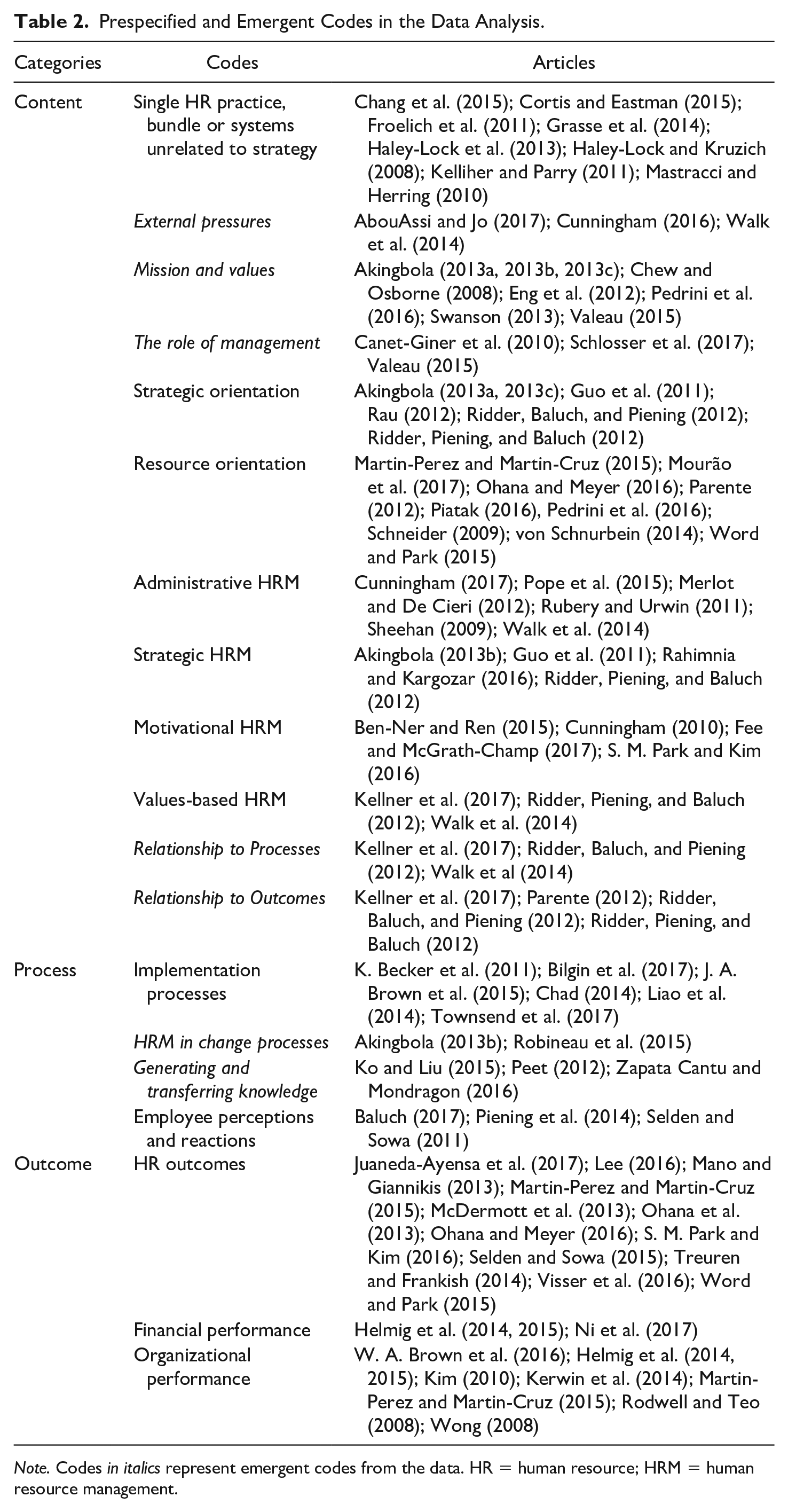
Note. Codes in italics represent emergent codes from the data. HR = human resource; HRM = human resource management.
We employed structured content analysis techniques to inductively surface themes from the data. By conducting within-theme and cross-theme comparisons for the content, process, and outcome studies (Duriau et al., 2007; Krippendorff, 2013), we moved from the initial codes to patterns in the data to key themes. This process entailed bundling the studies into groups across these first-order codes to identify patterns or second-order categories (Gioia et al., 2013). Through an inductive and iterative process of cycling back and forth between the studies and the emerging higher-level categories, we aggregated from these patterns into key themes in the content studies, such as “tensions, managerial discretion and variety in responses,” “social capital,” and “hybrid” HRM. We repeated this procedure of inductively surfacing key themes for the process studies (e.g., “expectations”) and outcome studies, such as multidimensional views of performance. Finally, we used these themes to map the research landscape which captures the observed relationships between these different themes identified in our systematic review.
From our systematic review, we can glean the trends in the emphasis and direction of SHRM research in the nonprofit field, as depicted in Figure 2. When dividing the data set into content, process and outcome studies, we see that the 41 content articles remain the dominant and constant focus of the research. In contrast, studies on outcomes are fewer (20 total) and fluctuate over time, although these do make up the largest proportion of studies in 2016. Process articles remain scarce over the 10-year time period (13 total) with no more than three publications per year.

Trends in the focus of SHRM research in NPOs.
Findings
Iterating between the emergent key themes and the studies in our systematic review, we map the research landscape of SHRM in NPOs. Figure 3 highlights these themes and demonstrates the relationships we observed between these patterns. In the following, we present these new insights.

Mapping the research landscape of SHRM in NPOs.
Managerial Discretion: Between External Pressures and Unique Values
Our review revealed new emergent themes of tensions, managerial discretion, and variety in responses that center on the role of managers in shaping and accounting for differences in organizational approaches. First, the review confirms an ongoing tension between external pressures and unique values. External pressures stem from various sources that are mutually reinforcing. Demands for efficiency and rationalization are shown to be on the rise (Cunningham, 2016), while stakeholders decrease financial support and introduce cost-cutting regulations (AbouAssi & Jo, 2017). Policy changes and changes in labor supply as well as competition among NPOs amplify these cost-cutting requirements (Walk et al., 2014). These pressures identified in the review have consequences for the hiring of qualified personnel and the quality of work.
External pressures confront NPOs at the heart of their unique values, goals, and mission. Mostly founded for goals other than commercial purposes, the nonprofit mission and values drive the organization’s development (Pedrini et al., 2016; Valeau, 2015). Even if NPOs decide to engage partly in commercial objectives, the mission is fundamental and central in the selection of commercial interests and/or business partners (Eng et al., 2012). Most of the scholarship in the review proceeds from the assumption that—as a result of the unique values, goals, and mission in NPOs—nonprofit strategy is distinctive and gives NPOs a competitive advantage (Akingbola, 2013b, 2013c; Chew & Osborne, 2008). This assumption is echoed in studies adopting a social capital perspective, such as Swanson’s (2013) framework on strategically managing social capital for institutional benefit that suggests that NPOs incorporate engagement as a core value into the organization’s mission, strategic plans, goals, and policies.
Second, tensions between mission and professionalization lead to different responses. Even if NPOs start with clear intent, mission, and goals and adjust their management processes to these initial aims, NPOs face a contradiction between their mission and the need to become more professional (business-like) as the environment changes. Valeau (2015), for example, found out that despite exposure to the same forces across NPOs, decider’s preferences, visions, and projects lead to differences in approaches, leaving a cultural “imprint” that remains as the organization undergoes professionalization leading to “. . . a form of indetermination opening the door to more managerial discretion” (Valeau, 2015, p. 1908). In this respect, our review demonstrates managerial discretion in NPOs. Managers in NPOs act as intrapreneuers (Canet-Giner et al., 2010), and redefine themselves as leaders in an organization with a social mission, leading to substantial variety in responses (Fee & McGrath-Champ, 2017; Schlosser et al., 2017).
Strategic Orientation
Stemming from the prior themes of tensions between external pressures and nonprofit values, our review demonstrates that an NPO’s strategic orientation is driven by different contexts and organizational goals, leading to different usage of HR practices. Akingbola (2013c), for example, highlights the ongoing influence of organizational and contextual factors in his conceptual work. Guo et al.’s (2011) survey examines the prevalence and the organizational and contextual factors associated with the adoption of these strategic practices. Incorporating these contingencies into research on labor unions as a subset of NPOs, Rau (2012) identifies external factors and internal organizational characteristics as determinants of HR best practices. Our review suggests that conceptual work remains preoccupied with the distinctiveness of nonprofit strategy and identifying the determinants of a strategic approach to HRM.
Resource Orientation
The resource orientation builds on the strong alignment of values and mission with the unique needs and expectations of nonprofit employees. Studies reveal that resource-oriented NPOs start from the intrinsic motivation of their human capital that is closely aligned with the mission of the organization (Parente, 2012; Piatak, 2016; Word & Park, 2015), and that “a well-established and defined culture of intrinsic rewards matters in selecting, hiring, and retaining highly qualified employees in nonprofits” (Word & Park, 2015, p. 105). Employee involvement and commitment are high and, for example, not undermined by lower salaries compared with the for-profit sector (Martin-Perez & Martin-Cruz, 2015; Ohana & Meyer, 2016; Parente, 2012).
In addition to the aforementioned specificities in human capital, our review reveals that the resource orientation encompasses social capital. This concept is well established in organization theory and comprises the role of relationships as a source of social action (Coleman, 1990; Kwon & Adler, 2014). These relationships can be distinguished into structural (e.g., network ties), cognitive (e.g., shared language and narratives), and relational (e.g., trust and norms) dimensions (Nahapiet & Goshal, 1998). Our review identifies social capital as a resource that enables NPOs to develop durable, trust-based networks to fulfill their mission as well as to acquire resources and engage in collaborative strategies (Pedrini et al., 2016; Schneider, 2009). If the members of the NPO are in sync with the shared vision, it is likely that these members have close ties, sharing the norms and values that can contribute to the vision of the NPO. These emerging networks provide a trustful pool of contacts (Mourão et al., 2017). As a result, social capital management “. . . might find the value configurations helpful for understanding social capital as a resource of their organization” (von Schnurbein, 2014, p. 371).
Configurations of HRM
Resulting from the influence of the strategic and resource orientations, our review identifies empirical patterns of HR configurations. Against the background of contingency approaches to SHRM in NPOs (Akingbola, 2013c) and previously identified HR architectures (Ridder & McCandless, 2010), there is confirmation of empirical manifestations of HRM types (administrative and employee-oriented HRM) and new types emerge as well (hybrid).
Administrative HRM Dominates the Scene
Our review identifies a large group of studies dealing with single HR practices and their effects (Chang et al., 2015; Cortis & Eastman, 2015; Froelich et al., 2011; Grasse et al., 2014; Haley-Lock et al., 2013; Haley-Lock & Kruzich, 2008; Kelliher & Parry, 2011; Mastracci & Herring, 2010). These studies confirm the overall diagnosis that the HR function in NPOs is more or less ad hoc and reactive. These practices represent a bureaucratic approach to HRM and a short-term response to external changes, reflecting the imbalance of strategic and noncore HR functions (Pope et al., 2015; Sheehan, 2009; Walk et al., 2014). Organizational capacity remains underdeveloped due to insufficient skilled and experienced staff (Merlot & De Cieri, 2012).
Administrative HRM has consequences for employees as well. Our review identified an abundance of studies that evidence hard HRM. This term represents a tendency in which employment protections in NPOs are undermined, for example, by reducing wages and training, and extending working time. Rubery and Urwin’s (2011) work on the impact of outsourcing on employment relationships in social care organizations reveals how employment and income security suffered and the complete flexibility of the workforce regarding working time and tasks was required. Employees face limited career mobility, minimal training, and few rewards for higher skills and experience. Additional evidence of hard HRM with its focus on reducing cost and becoming more efficient suggests that employees face greater insecurity through zero-hour contracts and fragmented working time. Government policies of austerity and personalisation of social services result in weakened terms and conditions of employment (Cunningham, 2017).
Employee-Oriented HRM: More Rhetoric Than Reality
Only a few empirical studies in our review reflect the resource orientation through the usage of employee-oriented practices that emphasize the alignment of mission with the needs of the employees and target their intrinsic motivation (Ben-Ner & Ren, 2015; Cunningham, 2010; Fee & McGrath-Champ, 2017; S. M. Park & Kim, 2016). In accordance with the social capital literature, Ben-Ner and Ren (2015) identified that NPOs use specific recruiting strategies that draw on social networks to hire new employees who favor the mission of the NPO. Our review corroborates this with training and development being important for employees’ value congruence (S. M. Park & Kim, 2016). An example of a strong resource orientation in HRM is demonstrated by Fee and McGrath-Champ (2017) who reveal that international NPOs use a broad range of HR practices relating to people services, information services, and communication services to ensure the safety and security of their expatriates. These competencies are embedded in a philosophy described as personal responsibility for employees.
Hybridization to Balance Conflicting Demands
Our review surfaces an emerging research strand that identifies how NPOs are balancing contradictory demands through the configuration of their HRM. Contrary to the outlined conceptual approaches, the empirical patterns in our review did not overwhelmingly correspond to the ideal type of values-based HRM, nor does the strategic emphasis map neatly onto HRM being driven solely by strategic goals (Akingbola, 2013b; Guo et al., 2011; Rahimnia & Kargozar, 2016). Although there is some evidence that a clear translation of values into strategic goals results in balancing the mission with strategic requirements for employee investments, Ridder, Piening, and Baluch’s (2012) case study overwhelmingly suggests that as part of a sector-wide shift toward a more strategic emphasis, a third way of configuring HRM is taking shape. This proactive approach entails dealing with external constraints and a strong financial orientation toward performance. Instead of financial pressures undermining the role of HRM and employment conditions (see Cunningham, 2016, 2017; Rubery & Urwin, 2011), HRM forms an integral part of the organizational strategy. At the same time, NPOs remain attentive to their internal principles in managing their HR (Ridder, Piening, & Baluch, 2012). Further studies point to the challenges to values-based HRM posed by the external environment’s influence. Walk et al. (2014) not only demonstrate the difficulties of achieving a fit with religious values for higher-level managers given the changing workforce, but their case study also highlights the organizations’ struggle to afford to pay employees to realize Christian values.
Balancing contradictory demands is furthermore evident in Kellner et al.’s (2017) investigation of how two separate and potentially conflicting HRM systems—values-based and high performance—can coexist in an NPO. A modified high-performance work system (HPWS), consisting of strategic HR planning, recruitment, performance management, and learning and development, leads to improvement in employee engagement and well-being through being tempered by a strong relationship to a values-orientation. This balancing is found to mitigate potentially conflicting elements of a strategic high-performance approach to HRM and complements the organization’s religious values. Despite the NPO’s objective to generate surplus funds and improve performance, delivering on mission remains paramount: “mission and margin are dance partners, and you have to remember that it is the mission that is the lead” (Kellner et al., 2017, p. 1957).
Our review therefore points to a further emergent theme as balancing contradicting demands leads to the co-existence of HRM types in an NPO. Illustrating the simultaneous use of hard and soft HRM in an NPO, Cunningham’s (2017) work points to cost reductions and a focus on efficiency through hard HRM policies. At the same time, where HR takes on a strategic role and introduces soft HRM policies, recruitment aligns with customer preferences, and employees are engaged in service provision. In line with a pluralist view of employment relations, HRM not only forges strategic functions that are business-facing, but also seeks to balance competing interests of the organization, its employees, and customers. These aforementioned studies suggest that not only is the hybridization of types a means to achieve these contradictory demands, but also manifests itself through different variations of HRM co-existing in an NPO.
Processes: Scarcity of Research on Implementation and Employees’ Perceptions
Implementation processes are not very well researched in the field of SHRM in NPOs. At the strategic level, our review demonstrates that leadership matters—whether considering processes of change in general or implementation processes specifically—there is a focus on the responsibility of top management (Bilgin et al., 2017). Townsend et al.’s (2017) analysis of the implementation of flexible work arrangements, for example, shows that leadership style is important for balancing tensions between employee values and market values. Key to steering change processes is having a high priority on the management agenda (Liao et al., 2014), support of senior management (K. Becker et al., 2011), and capability of top executives (Townsend et al., 2017). Especially when NPOs move from a traditional charity orientation to a market orientation (business-like), the role of specialist managers in directing change retains its importance (Chad, 2014). Knowledge management seems to be a silver bullet for adapting to external pressures and organizing change processes. Activities such as the external acquisition, internal creation and flow of knowledge between generations, and tacit knowledge sharing are identified (Ko & Liu, 2015; Peet, 2012; Zapata Cantu & Mondragon, 2016). HRM is also seen as having a supportive function in coping with change by aligning the organization with the external environment (Akingbola, 2013b; Robineau et al., 2015).
Research on the operational level is fragmented, and unsurprisingly, the usual barriers emerge such as the scarcity in implementation resources. Liao et al.’s (2014) study of the implementation of quality management programs reveals that the success of the implementation was hampered by a lack of adequate training and skills in the management group, and an absence of an organization-wide shared understanding of the logic of quality initiatives, and adequate metrics to measure performance. In contrast, where groups have an abundance of resources, J. A. Brown et al.’s (2015) work on organizational change in NPOs points to how powerful employees use their bargaining power to effect structural changes. At the same time, the bargaining power of these employees forced management to benefit this group by providing additional income and privileges and to focus more on retention management.
Compared with the for-profit realm, our review indicates very few studies address the variation in employees’ perceptions of and responses to HR practices. In the scarce research, the theme of a gap in implementation emerges. Selden and Sowa (2011), for example, find that differences between the espoused policy and practice in implementing performance management and appraisal arise as evaluation and feedback is shifted in favor of urgent tasks and firefighting. Additional research examines these differences with regard to the linkages between intended HR practices, their implementation, and employee perceptions. Piening et al. (2014) find that there must be agreement among decision makers about HRM intentions as well as effectiveness in leveraging resources to develop adequate HR structures, systems, and processes to avoid an implementation gap. Implemented HR practices are perceived differently by employees based on their expectations with employees not being very demanding in NPOs that pursue a modest approach to HRM. Similarly, Baluch’s (2017) work on variations in the perception of HR practices reveals an overall positive perception of rudimentary HR practices, reflecting low levels of employees’ expectations. Given low instrumentality, validity, and contradictory HRM signals, employees have varied experiences and do not form a shared sense of the kinds of behaviors that are expected and rewarded in the organization.
Fragmentation in Outcomes
A key topic in research on HR outcomes is the importance of HR practices in supporting commitment and intrinsic motivation by providing strong bonds between employees and the organization’s mission, values, and goals (Juaneda-Ayensa et al., 2017; Parente, 2012; S. M. Park & Kim, 2016; Word & Park, 2015). The antecedents of organizational commitment include perceptions of psychological contract fulfillment, procedural justice (participation in decision-making), fairness of rewards, alongside the dominant role of intrinsic rewards (Martin-Perez & Martin-Cruz, 2015; McDermott et al., 2013; Ohana et al., 2013; Ohana & Meyer, 2016).
In terms of employee satisfaction, factors such as pride in the organization, ethical standards, trust within the organization, and job autonomy are identified as having an impact on job satisfaction and work–life balance satisfaction (Lee, 2016; Visser et al., 2016). Employees who perceive their HR practices and organizations positively are less likely to leave or intend to leave the organization; even in times of crises, employees increase their loyalty, involvement, and attachment to nonprofit goals (Mano & Giannikis, 2013; Selden & Sowa, 2015). Similarly, the strengths of their attachment with clients or customers dampen the adverse effects of pay dissatisfaction on intention to leave (Treuren & Frankish, 2014).
Research emphasizing organizational performance outcomes reveals a fragmented picture of effects. Studies on the SHRM–organizational performance link provide evidence that bundles of strategic HR practices positively impact perceived market and organizational performance (Kim, 2010; Rodwell & Teo, 2008). Yet, this research also shows mixed effects, that is, a negative impact of merit pay systems on subjective organizational performance (Kim, 2010) and positive effects of intrinsic– rather than extrinsic– rewards on knowledge transfer in NPOs (Martin-Perez & Martin-Cruz, 2015). Research addressing the role of HRM in NPO survival or failure suggests the salience of HRM for maintaining staff satisfaction and meeting users’ needs and that the number of volunteers, staff motivation, and management team diversity contribute to NPO success (Helmig et al., 2014; Wong, 2008). Qualitative research on organizational capacity affords further nuance, suggesting that human capital, financial capital, and social capital support organizational performance (W. A. Brown et al., 2016).
Research on nonprofit values adopting a multidimensional view of performance suggests mixed results. Contrary to expectation, a nonprofit value prioritization does not constitute a competitive advantage and lead to better organizational performance, although some implemented nonprofit values enhance quality outcomes and overall success (Helmig et al., 2015). In addition, management by values mediates the effect of ethical-social organizational values on the developmental performance of NPOs (Kerwin et al., 2014). Although there is some evidence of a multidimensional understanding of performance, most studies in our review examine single HR practices and link these to one-dimensional outcomes.
Finally, our review identifies only a few studies on HRM and financial performance outcomes, revealing a relationship between professionalization in HRM and fundraising efficiency (Ni et al., 2017) and a positive impact of several implemented nonprofit values on financial performance success (Helmig et al., 2015). This paucity of studies diverges from a review of performance outcomes in the nonprofit literature which reveals a dominance of research on financial performance and HRM as a determinant of success (Helmig et al., 2014).
Discussion
Existing conceptual approaches to SHRM in NPOs emphasize contingency factors (Akingbola, 2013c) and configurations of HRM (Ridder, Baluch, & Piening, 2012). Based on these conceptual foundations, we systematically investigated the content, process, and outcomes of SHRM in NPOs in our data set of 74 articles. Thus far, our review extends the antecedents of SHRM with regard to tensions, managerial discretion, and variety in responses and it identifies new empirical manifestations in HR configurations. Furthermore, we unearth the underexplored aspects of processes in the implementation of HR practices and disentangle effects into HR, organizational, and financial performance outcomes. At the same time as synthesizing and mapping these key themes and new developments in the literature, our review aims to reflect on the directions for future scholarship in this nascent field.
Avenues for Future Research: Content
With regard to content, we identify both further clarity and development within this realm. From the contingency perspective, Akingbola (2013c) proposes the specific influence of the context. Our review reveals several patterns detailing the ongoing external pressures that NPOs are facing. This is an important step as SHRM is concerned with the changing circumstances under which NPOs conduct their tasks. Our review underscores as well that these changes are often in conflict with the values and mission of NPOs. Finally, it shows that NPOs do not react similarly to the changing context, but display a substantial variety of responses to these tensions (e.g., Canet-Giner et al., 2010; Schlosser et al., 2017; Valeau, 2015).
However, the evidence base remains thin, and the influence of managerial discretion has not garnered much empirical attention in relation to differences in organizational approaches to HRM. Our first direction for the future research landscape, therefore, is (a) to investigate into managerial discretion in shaping the HRM response to external pressures of NPOs.
Stemming from the prior themes of external pressures and unique values, our review confirms that the organization’s strategic orientation is driven by different contexts and organizational goals, leading to different usage of HR practices. At the same time, a new theme emerges that inspires further exploration of the resource orientation. Beyond highlighting the human capital dimension of the resource orientation (i.e., intrinsic motivation of employees), a new wave of studies reveals the authentic role of social capital as a driver of the mission and the cooperation of the members of the NPO (e.g., Mourão et al., 2017; Schneider, 2009). Although a primary focus in for-profit organizations (Donate et al., 2016), the social capital dimension remains a gap in the nonprofit SHRM literature. Therefore, a fruitful direction for future research is (b) to examine the role of structural, cognitive, and relational networks as a natural driver of the resource orientation in NPOs.
Our findings regarding the configurations of HRM reveal that literature on administrative HRM is saturated with studies that identify the struggles, barriers, and deficiencies of HRM in NPOs, and that it is unnecessary to confront NPOs continuously with normative-laden demands to improve their HRM if the underlying conditions remain constrained. Surprisingly, our review reveals that employee-oriented HRM remains a cool spot that is underdeveloped in the literature. Although we know a lot about the human capital dimension, especially with regard to intrinsic motivation, only a few studies investigate into the transfer of a resource orientation into HR practices (e.g., Fee & McGrath-Champ, 2017). Therefore, we encourage future nonprofit research (c) to focus on the configuration of employee-oriented HRM.
Our review suggests an increasing interest in strategic HRM and at the same time reveals variations of this HRM type that are fragmented in response to the complexity of the environment. These findings confirm that the increase of managerial discretion leads to a logic of different strategic responses. Our review yields new evidence for the differentiation of strategic HRM and co-existence of different HRM configurations in an NPO (Cunningham, 2017; Kellner et al., 2017), the latter of which likely leads to different groups of employees in NPOs being treated differently (Lepak & Snell, 1999). Depending on the strategic importance of these groups, NPOs may offer different terms and conditions to their core permanent versus temporary fixed-contract employees.
In addition, a small array of rich case studies provides in-depth insights into different empirical manifestations of hybridization across HRM types as a means of balancing conflicting demands (Ridder, Piening, & Baluch, 2012; Walk et al., 2014). Further research is needed to better understand the new HR configurations emerging in response to these challenges. Therefore, it seems fruitful for future SHRM scholarship (d) to explore new (hybrid) configurations of HRM in NPOs.
Iterating our findings with the above outlined conceptual and empirical SHRM literature, these insights strengthen arguments regarding strategic responses to tensions between external pressures and values, alongside an employee-oriented focus. Bearing potential to inform wider SHRM scholarship, our findings echo recent calls for a better understanding of the move to a multistakeholder perspective in SHRM (Beer et al., 2015).
Avenues for Future Research: Processes
While content research is more developed, processes remain heavily underresearched. The scant literature focuses on the role of the top management and scarcity of resources in implementation processes. Our review reveals the underexplored role of knowledge management and human resource development (HRD) in implementation processes (Ko & Liu, 2015; Peet, 2012; Zapata Cantu & Mondragon, 2016). Given the increasing body of research examining NPOs in the HRD literature that has developed distinctively from nonprofit HRM literature (Egan, 2017; S. Park et al., 2018; Wang, 2019), future research that brings insights from the two bodies of work together is necessary to intensify the investigation into the role of HRD in implementation processes.
Furthermore, there are very few studies dealing with the variation in employees’ perceptions of and responses to HR practices. A more comprehensive exploration of this topic is needed, especially in light of the identified role of expectations from our review (e.g., Baluch, 2017; Piening et al., 2014). Until we know more about how and why employees perceive HRM, reasoning about the effects of HR practices remains speculative (Nishii et al., 2008). Of particular interest are the differences in employees’ perceptions and reactions in relation to HRM configurations. Building on for-profit SHRM research (Bowen & Ostroff, 2004; Khilji & Wang, 2006), our assumption is that different types will lead to variations in perceptions and responses.
Therefore, future research would benefit from studies that seek (e) to explore the role of knowledge management and HRD in implementation processes and examine the perceptions and reactions of employees toward HRM configurations.
Avenues for Future Research: Outcomes
Finally, the majority of the SHRM research in NPOs is still focused on outcomes of HR practices, especially on commitment and intrinsic motivation. These employee-related outcomes are linked to pride, trust, discretion, loyalty, and attachment to nonprofit goals, which potentially outweigh the negative effects of lower pay or difficult conditions of labor (e.g., Lee, 2016; Visser et al., 2016). In contrast, it is difficult to find clear evidence about organizational and financial performance outcomes. Fragmented research suggests that single practices are linked to mixed effects. A holistic view of HRM configurations and of their linkage to a range of performance outcomes that acknowledges the multidimensionality of performance in NPOs (Helmig et al., 2014) still remains underdeveloped in the literature. Therefore, another direction for the future research landscape is (f) to examine the effects of HRM types and bundles.
Avenues for Future Research: Interplay Across Content, Process, and Outcomes
Viewing the above future research avenues regarding content, process, and outcomes of SHRM in conjunction, we also argue that the body of nonprofit SHRM scholarship would benefit from the richness of exploring the relationships between the aforementioned key themes. Most research in our review addresses the content, process, or outcomes of SHRM in NPOs; only a few studies overlapped in one or more of these categories. We therefore encourage nonprofit researchers (g) to focus on the interplay across content, process, and outcomes in future studies.
With regard to Arrow 1 (Figure 3) in our landscape, further research would provide a better understanding of how and why external pressures and unique values, goals, and mission lead to a variety of responses. The variety of responses is exemplified in Valeau’s (2015) study and is likely linked to the organization’s life cycle. Additional research is needed that explores the translation of these responses into the strategic and/or resource orientations of the NPO.
Second, the interplay of strategic and/or resource orientations is of interest (Arrow 2a and 2b; Figure 3) for better understanding the configuration of HRM in NPOs. Walk et al. (2014), for example, considered such interplay by advocating for better alignment between HR practices and HR bundles that reflect the organizational strategy and are used to achieve the organizational mission. Based on our literature review, we identified administrative, employee-oriented, and hybrid HRM, but we expect greater variety if further research concentrates on the interplay of the orientations.
Additional rich insights can be gained from a holistic view of HR systems and configurations in conjunction with the implementation of HRM and employees’ perceptions thereof (Arrow 3; Figure 3). Combining a content and processual approach is, for example, seen in Kellner et al.’s (2017) study of implementing values-based HPWS. This holistic view examines how values shape HR practices and how these practices are communicated and perceived by employees, providing a better understanding of employees’ responses when HR systems are adapted to the differences in strategic orientation.
In a similar vein, linkages between HR systems, employee outcomes, and performance outcomes are worthy of further investigation (Arrow 4; Figure 3). In our review, work by Ridder, Piening, and Baluch (2012) provides initial qualitative evidence of differences in strategic outcome goals and HR outcome goals across HRM types. Overall, we anticipate that pursuing these overarching directions on the interplay across content, process, and outcomes will inform and stimulate the development of the field.
Our systematic review of SHRM in NPOs is not without limitations. The keywords, journals, and timeframe of our search strategy are inevitably restricted by the inclusion and exclusion criteria. For example, we purposefully did not include articles pertaining to civil society as we view this as an area of research with a distinctive lens. Similarly, as scholarship on SHRM focuses mainly on paid employees, we excluded the vast body of nonprofit literature on volunteer management. By conducting our search in published journal articles, we are unable to include research developments in book chapters, monographs, unpublished theses, and gray literature. As a result of these parameters, our review does not claim to capture an exhaustive data set of studies on SHRM in NPOs. Furthermore, other related areas of literature to SHRM remain outside our search. These bodies include relevant work on the organizational life cycle, organizational change, and nonprofit governance, particularly the role of the board of directors in shaping strategy, resources, and the configurations of HRM, which are likely to be useful for informing future SHRM scholarship in NPOs.
Footnotes
Acknowledgements
The authors thank the Editor and three anonymous reviewers for their helpful feedback. The authors would also like to acknowledge the research assistance provided by Lyuba Kudriavtseva.
Declaration of Conflicting Interests
The author(s) declared no potential conflicts of interest with respect to the research, authorship, and/or publication of this article.
Funding
The author(s) received no financial support for the research, authorship, and/or publication of this article.
