



Abstract
Drawing on data from Zhejiang Province, this study explores China’s collaborative response to COVID-19 in which business associations played a critical role. Consistent with existing literature on cross-sector collaboration and nonprofit contributions in extreme events, the preliminary findings of this study carry significant implications for future research to advance new knowledge. Specifically, two important next steps of future research that hold considerable promise—examining the overwhelming impact of the institutional environment on collaboration and accounting for the complex mechanisms in which multiple components of collaboration create outcomes through a configurational approach—emerged from this study. In addition, the practical implications of these findings are highlighted.
Introduction
The rapidly sweeping COVID-19 pandemic has been the most impactful challenge for human societies in decades. At the time of writing this article, the pandemic has infected more than 25 million people worldwide and killed nearly 1 million. In coping with this darkest of crises, though its initial handling of the outbreak was widely blamed, China managed to contain the further spread of the virus in a short amount of time. The hallmarks of China’s efforts are mass testing, contact tracing, and, in particular, the most comprehensive and strictest lockdowns. A deeper look at these aggressive measures, however, reveals an underlying all-out war against COVID-19. All segments of Chinese society, from governments, businesses, and nonprofits down to every single individual, have participated in collaborative initiatives to limit the transmission of the virus. How was China able to build and sustain such a large-scale network against the epidemic? What role did Chinese nonprofits play in these collaborative responses? What new knowledge can be built on the preliminary findings, and what are their implications for future research?
This study aims to answer these questions by focusing on the role of business associations in the collaborative response of Zhejiang Province, China, to COVID-19. From the partial to the whole, it seeks to shed light on the working mechanisms underlying the effectiveness of China’s collaborative approach toward the epidemic.
Analytical Framework
Collaboration has long been recognized as vital for an effective response to extreme events, but the literature also indicates that this is not easy. Many models have been developed to understand how cross-sector collaboration works. Each identifies key components of collaboration and postulates how they interact with one another to produce outcomes. Bryson et al. (2006), for example, attended to the four causal dimensions of collaboration—initial conditions, process, structure and governance, and contingencies—that lead to the fifth dimension, outcomes. Around the mid-2000s, Thomson and Perry (2006), Ansell and Gash (2008), and others also published important frameworks that identified similar components of collaboration (Bryson et al., 2015). More recently, Emerson et al. (2012) built an integrative model of collaboration that encompasses a larger system context, a collaborative governance regime, and the dynamics of such a regime that generate actions toward outcomes. Most notably, this model pulls out the broad system context—the political and institutional environment—from the initial conditions and treats it as a critical surrounding component in which collaboration is embedded.
Indeed, institutional theory and empirical studies have long stressed the significant influence of the institutional environment on collaboration (Galaskiewicz, 1985; Guo & Acar, 2005). In China, the political and institutional setting, which some scholars theorized to be a corporatist regime (Unger & Chan, 1995), leaves imprints on all aspects of cross-sector relationships (Zhang & Guo, 2020a). Within this corporatist structure, the state authorizes a limited number of associations (usually only one) in each social or industrial sector to aggregate and represent the interest of constituencies, through which important social forces are therefore co-opted into institutionalized political processes (Schmitter, 1974, 2019). As important corporate groups representing a sectoral constituency of private enterprises, business associations are cross-boundary “bridges” between government and business that often cooperate as partners (Mansbridge, 2019; Unger, 1996). As a result, the frequent and structured exchanges among business associations, governments, and enterprises foster their mutual trust, interdependence, and goal congruence. In dealing with extreme events, the existing relational network and the linking role of business associations can therefore be easily translated into cross-sector collaborations to address common challenges.
Incorporating major theoretical frameworks and empirical findings (e.g., Simo & Bies, 2007) during 2006–2015, Bryson et al. (2015) revised their 2006 model of cross-sector collaboration. Their updated framework also singles out the institutional environment as an independent component, known as general conditions, and highlights the dynamic interaction between processes and structures as an additional separate dimension: leadership and governance. This study, therefore, applies and adapts this most comprehensive model to examine both Zhejiang’s collaborative response to COVID-19 and the role of business associations. As shown in Figure 1, this framework contains six components. First, the system context, depicted by dotted lines that form a surrounding context, relates to the institutional environment that influences all aspects of collaborative efforts. Second, initial conditions comprise preexisting relationships among principal collaborators. Third, processes cover a series of actions in trust-building and conflict management through which unified commitment and shared motivation are formed. Fourth, structures embrace the organization of collaborations to deal with various tasks. Fifth, leadership and governance, sitting at the intersection of processes and structures, coordinate collaborative efforts, which are the drivers of effective collaboration in Emerson et al.’s (2012) model. Sixth is the outcome.
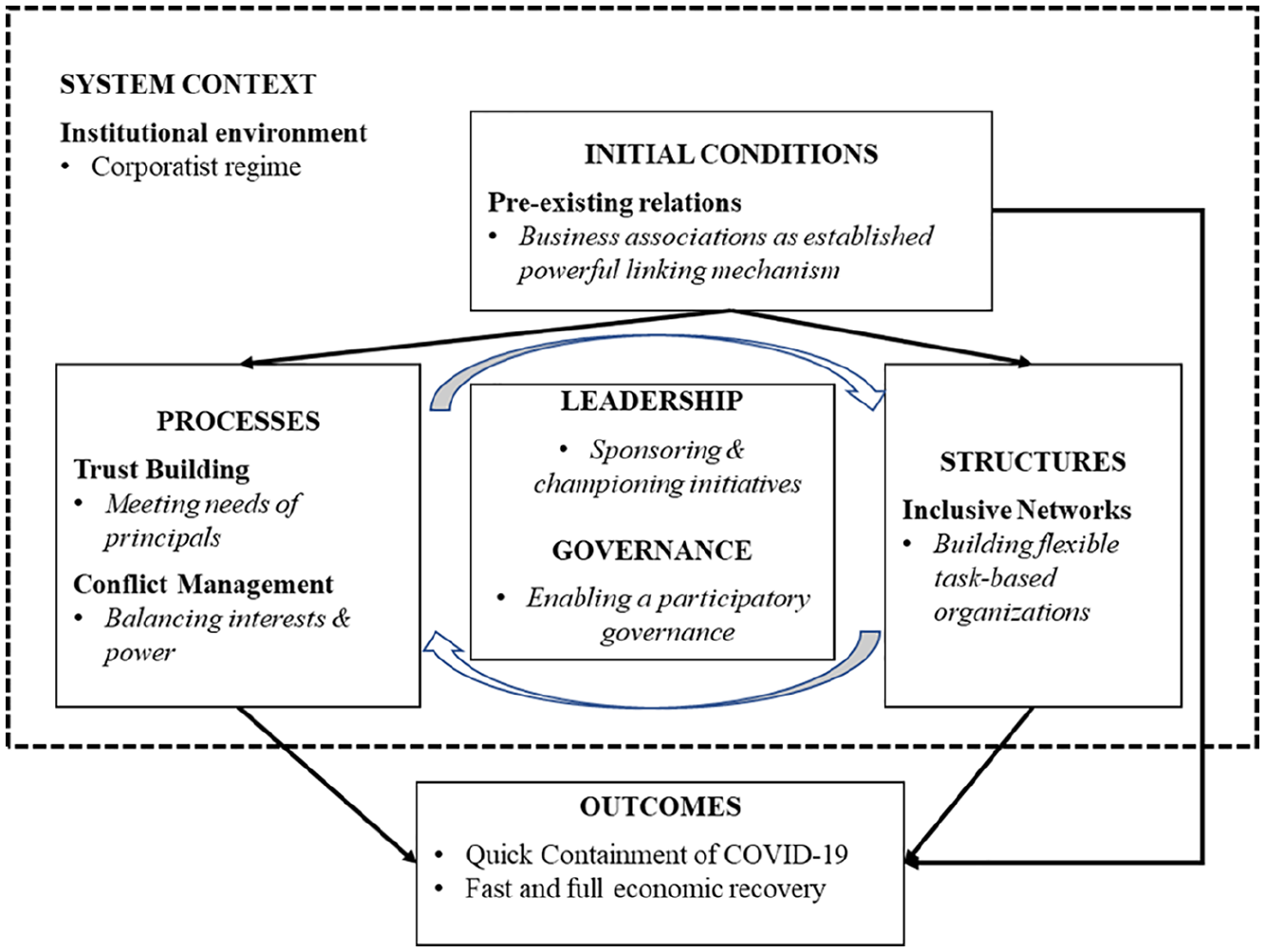
A framework for Zhejiang’s collaborative response to COVID-19.
Method and Data
The Case of Zhejiang
In China, Zhejiang Province produced one of the best records in not only COVID-19 containment (Cheng et al., 2020) but also economic recovery. Measured by return-to-work rates, for example, Zhejiang was a towering figure among all provinces in terms of restarting its economy, despite being hardest hit by the virus.
Meanwhile, Zhejiang leads China in the private economy that emerged as a result of China’s massive economic and social transitions since the late 1970s. It is against this backdrop that the Chinese nonprofit sector burgeoned. The Chinese government engaged with corporatism to rebuild the system of interest representation and to reshape the changing state–society relations (Froissart, 2019; Hsu & Hasmath, 2013; Zhang & Guo, 2020a). In its most basic form, corporatism seeks to organize society into associations that represent sectoral constituencies to cooperate with governments to achieve common goals (Hasmath, 2020). As important corporatist agents, a large number of business associations were thus established to serve as intermediaries between the state and the newly emerged private business sector (Kennedy, 2005; Unger, 2008). The thriving private economy of Zhejiang makes it top China with the most dynamic business associations, numbering 4,058 in 2019. Representing the interests of private enterprises, these business associations get channeled into policymaking and sometimes even implement state policy on the government’s behalf (Yu et al., 2007). Therefore, Zhejiang offers an exemplary case for looking into the role of business associations during China’s collaborative response to COVID-19 through the lens of corporatism in corporatist China, although some research explains the other side of the story via a framework of civil society (Hu & Sidel, 2020).
Data
From February 18 to June 11, 2020, the authors and their colleagues at Zhejiang University conducted 112 semi-structured interviews, each lasting 30 to 60 min, with three city leaders, 28 agency heads, 43 business association executives, 20 workers, and 18 community residents in the three cities of Wenzhou, Ningbo, and Huzhou, as well as in the four counties/districts of Yongjia, Rui’An, Yinzhou, and Wuxing, all in Zhejiang Province.
A hybrid approach of deductive and inductive coding and theme development was implemented to analyze the interview transcripts. First, based on the analytical framework, a code manual template was developed a priori with eight coding themes: institutional environment, preexisting relationships, trust-building, conflict management, networks, leadership, governance, and outcome. Second, segments of text were classified in line with their relevance to each of the eight themes and sorted accordingly. Then, inductive codes were assigned to these sorted segments and subsequently clustered into categories under each prior theme. Therefore, theory-driven themes and data-driven codes are integrated in the data analysis.
Findings
The preliminary findings confirm that, as the analytical framework suggests, the dynamic interactions of multiple components—in which the business associations played a crucial role—contributed to the effective collaboration that controlled COVID-19.
System Context
Setting collaboration in motion within the institutional environment of a corporatist regime
After the coronavirus outbreak, the Chinese government adopted a whole-of-society approach with a “joint prevention and control mechanism” to tackle the crisis. A Leading Small Group for Work to Counter the New Coronavirus Infection Pneumonia Epidemic was formed in late January across all hierarchical levels and chaired by respective government leaders to coordinate the all-out collaborations. Correspondingly, on February 11, the Zhejiang Provincial Department of Civil Affairs, the regulatory authority of the nonprofit sector, called for the participation of all business associations to link together with their sector constituencies—the private enterprises—in the broad network combating COVID-19. The corporatist regime was thus gearing up to rally the strengths of all societal sectors. Hasmath (2020) suggested that the unique strength of the corporatist system is its capability, guided and spurred by the government, to organize society into associations that work together to achieve harmonious results, especially amid perceived threat. Indeed, as illustrated by Zhejiang’s experiences, this corporatist regime, as a system context, created collaboration formation and set the direction for collaborative dynamics and actions. In the interviews, almost all respondents attributed the quick containment of the coronavirus to this all-embracing collaboration and, even more so, to this system context. For example, the party boss of Wenzhou, a coastal city with a population of more than 9 million, commented retrospectively that the key was that our [collaboration] work came from a system. It was not fragmented. [The positive outcomes] resulted from the extensive participation of the population at large. Many enterprises and individuals extended support to the joint prevention and control measures . . . It is particularly worth pointing out that business associations made significant contributions.
Initial Conditions
Leveraging linking mechanisms in preexisting relations to convene diverse partners for collaboration
Business associations serve as “transmission belts” in the corporatist system (Hasmath, 2020; Unger & Chan, 1995), providing a two-way network between the government and the constituencies of private enterprises: by top-down transmission, mobilization of enterprises on behalf of the government’s collective goal; and by bottom-up transmission, articulation of enterprises’ needs and concerns.
Such preexisting relational networks with boundary-spanning business associations that serve as a strong linking mechanism facilitate and sustain the assembly of various participants in the collaborative battle. In Ningbo, a subprovincial city of Zhejiang, for instance, 19 representative business associations attended a city-wide overall coordination conference on February 24. On the next day, in a top-down fashion, all business associations in Ningbo put forward initiatives to their respective constituencies, urging them to participate more actively in these joint efforts through donations and quick production resumption or by shifting to manufacturing medical supplies. One day later, Ningbo Furniture Business Association alone (Ningbo has more than 200 business associations) received donations of RMB187,510 from its members, which were subsequently given to support hospitals, infected low-income families, and communities in quarantine.
Acting from the bottom-up, business associations actively articulated and advocated the interests of constituencies to the policymaking process. For instance, the food industry was one of the worst-hit by COVID-19. As such, Huzhou Catering and Cuisine Association lobbied the Bureau of Commerce and the Administration for Market Regulation to offer greater and more precise policy support, such as by designating member enterprises as special catering suppliers. The government responded accordingly. The president of the association thus commented that “[the successful advocacy] not only accelerated the recovery of the catering business but also the return to normal of social and economic life.”
Such initial conditions, therefore, helped elicit open and inclusive communications, a diversity of perspectives and resources, and the representation of different interests throughout the collaboration, forming a “principled engagement” (Emerson et al., 2012), which as analyzed below reinforces effective collaborative processes and structures that further build needed capacity for joint action.
Processes
Facilitating collaborative processes through trust-building and conflict management
Bryson et al. (2015) have indicated that trust is the essence of collaboration. Trust-building is thus a core aspect of iterative collaborative processes, which relies on establishing a good understanding of common goals and the needs of each party. Indeed, through meeting each partner’s needs, business associations continuously built trust and shared motivation among stakeholders. For example, the possibility for capital chain rupture is a major concern of businesses when resuming production which is critical to the collaborative fight. In response to this problem, Rui’an Federation of Industry and Commerce started partnerships with local banks and served as a credit intermediary for enterprises to receive financing support. Its head commented that “our federation has secured low-interest loans of RMB 102.5 million for our membership enterprises. Their financing needs for production resumption have thus been satisfied to the greatest extent possible.” This enhanced trust in turn fostered mutual understanding and strong commitments among all collaborating parties.
Furthermore, business associations were also actively involved in managing emerging conflicts. As mentioned, it is necessary for manufacturing firms to quickly resume production. But it relies on the early return of migrant workers into communities whose residents were reluctant to accept them due to the risk of possible imported infections. To minimize this potential conflict, business associations linked member enterprises to form partnerships with communities: Enterprises supported communities with additional funding, prevention materials, and volunteers to enhance the “closed-off management” of residential zones. Meanwhile, all partners worked together to ensure a safe and healthy reintegration of workers into communities.
Structures
Constructing inclusive structures with flexible task-based networks
Bryson et al. (2015, p. 653) found that collaborative structures are “often quite adaptive and changeable” and that “being structurally ambidextrous on an as-needed basis” is important. Zhejiang’s experiences echoed these observations. Taken together, China’s collaborative response to COVID-19 was heavily top-down, in which governments were chief decision-makers, coordinators, and controllers. This hierarchical structure, however, left significant autonomy to all participants to self-organize collaborations, providing room for business associations to construct various flexible networks based on different tasks or needs.
For instance, as smoothly operating supply chains is a prerequisite for production resumption, business associations linked suppliers, logistics operators, distributors, and government agencies to a supply chain consortium. “Business associations worked as a sponsor to convene the transportation, storage, distribution and customs clearance of raw materials and finished products for member enterprises [to resume production],” said the president of Wenzhou Automobile and Motorcycle Industry Association.
Furthermore, business associations also initiated and connected transportation companies, member enterprises, and governments at origins and destinations to a network to offer exclusive transportation services, such as charted buses, to ensure the safe return of migrant workers. In Yinzhou District, for example, these networks arranged tailored commuting services for more than 2,000 workers, benefiting over 70 enterprises.
Most of these collaborative structures were truly ambidextrous. Networks did not replace but overlaid or co-existed with hierarchies. Moreover, structures tended to be adaptive, inclusive, and open—particularistic structures always emerged around different tasks with different relevant members. Hence, one Yinzhou government agency head commented that “we welcome and encourage such inclusive network structures, as they complement the hierarchical government with flexibility.”
Leadership and Governance
Championing collaborative initiatives and enabling participatory governance
At the intersection of processes and structures that constitute the core of collaborative dynamics (Emerson et al., 2012), leadership and governance are the drivers of the dynamics to generate collaborative action. In Zhejiang, business associations contributed their leadership via their ongoing sponsorship and championship of not only the formation of collaboration but also, more importantly, the maintenance of collaboration. Almost all business associations engaged in sponsoring various collaborative parties. In Yinzhou, for instance, more than 80 business associations spent close to RMB1 million to support frontline volunteers with meals, water, and personal protective equipment. They also sponsored a network comprised of governments, hospitals, and communities to transport suspected patients. In Zhili Town of Huzhou, business associations purchased prevention materials worth RMB600,000 to support communities in isolation. In addition, business associations vigorously managed collaborative tensions through championship that Bryson et al. (2015) defined as the balancing of the strain surrounding unity and diversity in collaboration. The president of Wenzhou Foreign Trade Clothing Business Association commented, It is not economical to produce masks now due to the high cost of machinery and raw materials. But now as the whole country is fighting against the epidemic, businesses cannot just focus on their profit. When government and society need masks, our enterprises must shift production to manufacture masks.
As a result, more than 10 clothing enterprises joined the “Wenzhou Alliance of Clothing Enterprises Shifting Production to Manufacturing Face Masks,” reaching a monthly production capacity of 20 million.
The governance of collaborations entails the use of processes and structures to enable stakeholders to engage in collective activities (Bryson et al., 2015). The findings above already demonstrate participatory governance fostered by inclusive processes and inclusive structures. It is thus unnecessary to elaborate on this again here.
In sum, working together with processes and structures, the leadership and governance offered by business associations boosted the needed capacity for sustained collaborative action and strengthened the resilience of communities as a whole.
Discussion and Conclusion
This study confirms and extends the existing literature on cross-sector collaboration and the role of nonprofit organizations during extreme events. More importantly, its preliminary findings have significant implications for future research to advance new knowledge.
First, the results of this study suggest that, though many components affect cross-sector collaboration, the system context or the institutional environment seems to be an overwhelmingly dominant force that molds all aspects of collaboration as well as what role nonprofits can play. Specifically, in the Zhejiang case, the factors that make the collaborative response to COVID-19 work—the initial conditions with pre-established networks, business associations as linking mechanisms, collaborative dynamics with inclusive processes and structures, and so on—have all been shaped by the corporatist regime. On the contrary, “none of the frameworks delves very deeply into the effects of the broader technical and institutional environment on collaboration” (Bryson et al., 2015, p. 650). In particular, the findings suggest that those frameworks by Bryson et al. and others may need further adaptations when applied to an authoritarian system context. Consequently, a theoretical understanding and related empirical examinations of the overall significance of the institutional environment are in short supply. The next step for research emerges from this finding: It can further model the impact of institutional environment on all dimensions of collaboration. It can examine the relative importance of the institutional environment versus other components in collaboration, or it can take the form of comparative studies of the effects of different system contexts in which collaborations are embedded.
Second, our preliminary findings also suggest that the outcome of collaboration stems from the complex interactions of multiple interdependent components. As Simo and Bies (2007) pointed out, however, existing literature has failed to address the collaboration outcome issue. Although recent studies have started filling this gap (e.g., Nolte & Boenigk, 2011), they have nonetheless failed to account for the complex causation between collaboration components and outcomes—it is the interactions of multiple components or the combinatory effect of multiple components that generate outcomes, as this study has demonstrated. Bryson et al. recognized the call for future research “to view collaborations as complicated dynamic systems. Within these systems, a better understanding is needed of . . . the interactions between managerial actions, processes and structures over time” (Bryson et al., 2015, p. 650). Lacking any corresponding theory and method, however, little progress has been made in this suggested research direction. Given the multidimensional nature of collaboration, another next step for research has emerged: the application of a configurational approach (Ragin, 1987) to study collaboration, suggesting that collaboration is best understood as constellations of interconnected components whose outcomes result from the synergistic effect of these elements combined. This configurational approach with Qualitative Comparative Analysis (QCA) has been increasingly applied to examine complex causality in the field of nonprofit studies (Zhang & Guo, 2020b). Hence, the time is ripe to advance the understanding of collaboration and its outcomes through this fresh theoretical perspective and this novel methodology using a configurational approach.
Moreover, based on the significant practical implications of these findings, we offer the following recommendations for nonprofit and public leaders to more effectively combat this disease.
The Design and Implementation of a Collaborative Response to COVID-19 Must Be Rooted in the Institutional Environment
The secret behind the efficacy of Zhejiang’s collaborative approach toward the coronavirus is that the strengths of the corporatist system were brought into full play. An important lesson nonprofit and public leaders can draw from this, therefore, is that the collaborative response must be tailored carefully to the local institutional context. It is essential to have a thorough grasp of institutional advantages before designing and implementing effective collaborative measures to contain the virus.
Nonprofit Organizations Must Develop a Boundary-Spanning Capability
The contributions that Zhejiang’s business associations made were fundamentally derived from their established competency as a linking mechanism or a cross-boundary “bridge” connecting a wide variety of cross-sector stakeholders in the collective fight against COVID-19. Thus, this highlights the strategic importance of developing boundary-spanning capabilities for nonprofit organizations when pursuing effective collaboration to control the pandemic.
Footnotes
Acknowledgements
The authors thank anonymous reviewers and interviewees of Zhejiang province for guiding us to our best work.
Declaration of Conflicting Interests
The author(s) declared no potential conflicts of interest with respect to the research, authorship, and/or publication of this article.
Funding
The author(s) disclosed receipt of the following financial support for the research, authorship, and/or publication of this article: This work was supported by the Zhejiang Provincial Natural Science Foundation of China under Grant No. LR20G030002, National Social Science Foundation of China (18ZDA116), the Planning Project of Zhejiang Provincial Philosophy and Social Sciences (19YSXK02ZD-3), and the Key Project of Humanities and Social Sciences in Ministry of Education of China (No. 18JZD056).
