



Abstract
Third-sector organizations (TSOs) in Europe have been confronted with profound changes to their regulatory and societal environments. By applying the concepts of “organizational paradoxes” and “governance,” we analyze how TSOs have adjusted their governance as a response to these environmental challenges. Based on organizational case studies in France, Germany, and the Netherlands, we argue that TSOs have found multiple ways to address tensions at the organizational level, for example, by mobilizing and combining resources, re-arranging their organizational governance and by adopting new legal forms. These changes have resulted in hybridization and increased organizational complexity that might translate into the emergence of new paradoxes at the organizational level. Therefore, dealing with paradoxes constitutes an ongoing process for TSOs that goes beyond incremental adjustments.
Introduction
In recent years, third-sector organizations (TSOs) have been confronted with an increasingly competitive and resource-constrained environment. How have they managed to survive and flourish in these circumstances without jeopardizing or losing those characteristics that are distinct for the third sector? TSOs have often been viewed as bringing an added value by enhancing efficiency in social service delivery, strengthening social cohesion, and fostering innovation in addressing public issues (Anheier et al., 2019). No less important is their democratic function for modern societies which is realized through enabling civic participation and representing citizens’ rights (Bode & Brandsen, 2014). This democratic function is also reflected in the organization’s governance, which—ideally—allows for inclusive decision-making and the participation of members in governance processes, for example, through the one person–one vote principle in both classical membership and social economy organizations. The European Commission’s Social Business Initiative in 2011 emphasized participation and internal democracy as key features of the third sector.
This article focuses on changes to the governance of TSOs as strategies for coping with environmental pressures. Empirically, we draw upon the findings of five organizational case studies in France, Germany, and the Netherlands, which were performed in the course of a larger European research project (Enjolras et al., 2018). The goal of the case studies is to analyze organizational changes in response to current developments, and to identify commonalities and differences in the ways TSOs have addressed organizational paradoxes triggered by environmental changes. In line with the neo-institutional tradition of organization theory (Scott, 2014), we expected incremental adjustments and changes to modes of governance in congruence with the organizations’ traditions, and contexts. However, in response to environmental pressures, TSOs have also changed more substantially, revising their governance thoroughly and thereby even departing from the traditional nonprofit legal form.
In this article, we will use a broad definition of TSOs as “organizations (formal or informal), private, self-governed, non-compulsory, and totally or significantly limited from distributing any surplus they earn to investors, members, or others” (Salamon & Sokolowski, 2016). This understanding does thus not only include nonprofit organizations but also mutual societies, cooperatives, and social enterprises in cases where they totally or significantly limit profit distribution into the concept of TSOs (Salamon & Sokolowski, 2016).
Furthermore, we will link our analysis to the discussion on profound organizational changes due to complex environmental demands in organization and management theory. Specifically, we refer to the theoretical approaches of organizational paradoxes (Eisenhardt, 2000; Smith & Lewis, 2011) and governance (Cornforth, 2012; Wolf & Mair, 2019) to develop a conceptual framework. We apply this framework on the cases of five TSOs, which exemplify typical pathways of organizational governance changes as a response to environmental pressures.
The article is organized as follows: we first lay out the theoretical background regarding organizational paradoxes and governance. With this background explained, we present our methodology and then discuss the results of our analysis of five organizational case studies. For each case, we address the key challenges with which the organization has been confronted—challenges mainly coming from environmental pressures, whose responses have generated or exacerbated existing paradoxes, leading to a change in organizational governance. We characterize the new modes of governance in terms of stakeholder diversity representation, power distribution, degree of professionalization, and participative practices and presence of arenas of negotiation. Against this background, we discuss commonalities and identify differences and specificities of organizational developments of TSOs. In our concluding remarks, we summarize our findings and make suggestions for further research.
Understanding Organizational Paradoxes and Governance Responses
Analyzing responses to changing environments, often with a special focus on government–third sector relations, has developed into a prominent strand of third-sector research (Salamon & Anheier, 1998; Smith & Lipsky, 1993). In the 1980s, alongside the integration of TSOs in public service provision, a key focus was the impact of bureaucratic procedures on TSOs, which were perceived to be moving away from their voluntary distinctiveness and getting closer to government entities, thus becoming bureaucratic organizations (Horch, 1995). Since the 1990s, with the rise of neoliberalism and the introduction of New Public Management (NPM), the impact of marketization on TSOs has become crucial for third-sector research (Eikenberry & Kluver, 2004). With regard to their transformed relationships with the state, TSOs were described as “nonprofits for hire” (Smith & Lipsky, 1993). Regarding organizational procedures, the topic of how and to what extent TSOs have managerialized and thus became more business-like is now a well-covered research topic area (Maier et al., 2016).
More recently, however, and linked to the growing research on social enterprises, “hybridity” as an organizational characteristic of TSOs, was discussed intensively (Skelcher & Smith, 2015). Hybrids are considered as organizations that span institutional boundaries (Brandsen & Karré, 2011; Pache & Santos, 2012), combining features from public/for-profit/nonprofit organizations and are thus influenced by different and even contradictory institutional logics. Instead of studying organizational change in the sense of mimicking either government entities or business corporations, third-sector research has increasingly focused on the question of how to maintain equilibrium and uphold the hybrid nature of TSOs (Zimmer et al., 2018). In this article, we consider the TSOs under scrutiny as hybrids; they pursue multiple social goals, involve multiple stakeholders, and mobilize a mix of resources. Thus, they combine characteristics of different ideal types of organizations. Following Doherty et al. (2014), we make the assumption that their hybrid nature is both a challenge and an opportunity to cope with institutional pressures and find innovate organizational forms (p. 427). To understand these challenges, literature on organizational tensions and paradoxes is helpful.
The Paradox Approach
The paradox approach provides us with a deeper understanding of crucial tensions in organizations and where they are located within the organization (Cameron & Quinn, 1988). An organizational paradox can be defined as “the simultaneous existence of two inconsistent states, such as that between innovation and efficiency, collaboration and competition, or new and old” (Eisenhardt, 2000, p. 73). Paradoxes are “contradictory yet interrelated elements that exist simultaneously and persist over time” (Smith & Lewis, 2011, p. 382). This definition includes two aspects of paradoxes: underlying tensions and responses that address these tensions simultaneously. Based on Smith and Lewis (2011), we distinguish between four main types of organizational paradoxes:
Belonging paradoxes concern tensions regarding identity and mission; they occur when different values or a different sense of belonging are present in an organization.
Performing paradoxes arise when there are various stakeholders who pursue different goals and expect different types of output.
Organizing paradoxes emerge from tensions with regard to productive methods, work organization, and managerial options, for instance the choice between control and flexibility or between collaboration and competition.
Learning paradoxes concern knowledge dimensions within the organization, such as tensions between old and new, innovation and stability, and incremental and radical innovation.
There has been lively debate among organizational scholars on how organizations cope with conflicting demands to remain sustainable over time and how they manage to reach equilibrium despite the persistence of paradoxes (Ismail & Johnson, 2019; Lewis, 2000; Poole & Van de Ven, 1989). “As organizational environments become more global, dynamic, and competitive” (Smith & Lewis, 2011, p. 381), tensions within the organizations increase. The paradox approach offers a framework for understanding how complex organizations deal with contradictory demands and organizational tensions. Following Cameron and Quinn (1988), cited by Lewis (2000), “by exploring paradox, researchers might move beyond oversimplified and polarized notions to recognize the complexity, diversity, and ambiguity of organizational life” (p. 760). Considering tensions as paradoxes therefore involves searching for solutions that are not the result of a choice between alternatives but that address both sides of the paradox simultaneously and over time, in a dynamic perspective. Moreover, as Lewis (2000) stated, managing paradoxes means “capturing its enlightening potential” (p. 763). Hence, paradoxes are not only considered as challenges but also as opportunities for organizational creativity and change. From this perspective, Poole and Van de Ven (1989, pp. 566–567) distinguish between three types of strategies that organizations use to manage paradoxes:
Acceptance in the sense that organizations accept the organizational tensions and live with them without changing their governance structures;
Separation in terms of spatial separation, when tasks are separated between different units or levels of the organizations, or temporal separation, when tensions are dealt with separately over time;
Synthesis in the sense that organizations introduce new perspectives to resolve the paradoxes.
These strategies are ideal types that can be combined over time. When separating organizational tasks, TSOs can, for example, either establish separate units within a single organization (segmentation) or create new, affiliated organizations (segregation) (Skelcher & Smith, 2015). For Smith and Lewis (2011) however, acceptance is a different strategy from separation and synthesis, which are resolution strategies as they seek to solve the tensions.
The Governance Approach
Many paradoxes require strategic decisions and changes at the governance level. We refer to governance as an encompassing concept of steering or governing activities and as a theoretical approach that has gained momentum in the social sciences (Cornforth, 2012; Wolf & Mair, 2019).
Our understanding of governance thus goes beyond the notion of governance in organizational theory, which limits governance to the role, function, and composition of boards, that is, control mechanisms or compliance. As Cornforth (2012) suggests, approaches that center on boards are overly narrow and do not take into account the growing complexity of the governance systems that TSOs have adopted. In the broader understanding, governance thus refers to all strategic decisions, including how to manage organizational paradoxes, smoothen organizational tensions, and adopt mechanisms to avoid or mitigate mission drift (Cornforth, 2014). It is an “organizational compass” and a proactive approach (Wolf & Mair, 2019, p. 537) that keeps organizations on track. Governance is a relevant level of analysis for understanding paradoxes because “it brings together controlling partners and core stakeholders’ beneficiaries” (Mason & Doherty, 2016, p. 454).
This broader conceptualization of governance first entails the structuration of the organization, as it is revealed in its charter and sometimes linked to its legal form, including participative practices or spaces of negotiation (Battilana et al., 2015, pp. 1676–1678) outside the board. These authors have shown that organizations can overcome internal tensions by investing in spaces of negotiation, which can perform an important coordinative function, acting as catalysts for processes of proactive governance and as regulation meetings among diverse stakeholders’ groups within organizations. When characterizing the governance of the organization, we refer to the following criteria: (a) the internal representation of stakeholders, given the trend toward having more diverse stakeholders in governance bodies and boards, as a way to take into account the diversity of stakeholders’ interests in line with the stakeholder model of governance (Brown, 2005; Cornforth, 2004); (b) the distribution of power among members, in particular in the case of multiple stakeholders, to see how the different constituent interests are represented and how each constituent is empowered to take part to strategic decisions, in line with the democratic model of governance (Cornforth, 2004; Gasley et al., 2010); (c) the degree of professionalization at the managerial and the shop floor level, as an estimate of the capacity of the governance structure to deal with complex problems, mobilize expertise and technical competences and to have a strategic leadership, in line with the resource dependence theory (Brown, 2005; Cornforth, 2004); and (d) the participation and existence of arenas of negotiation as a way to assess internal democracy, create common understanding and shared responsibilities and regulate tensions among stakeholders (Battilana et al., 2015). Evolutions in these four dimensions can lead to substantive changes in the governance, such as a revision of the organization’s legal form, hiring professionalized managers or opening ownership and decision-making power to multiple stakeholders.
Toward an Analytical Framework on Organizational Paradoxes in TSOs
We proceed in three steps. First, we assume that environmental challenges faced by TSOs have created or exacerbated organizational paradoxes. Paradoxes are thus triggered and/or intensified by external pressures that create contradictory and conflicting demands on the governance of the organization. The second step is the identification of the nature of these paradoxes that require an organizational response in terms of proactive governance. We assume that belonging and performing paradoxes are the most salient in the context of TSOs. Each organization carries a certain organizational legacy, this varies significantly depending on the original type of the relevant organization, whether it is a classical voluntary membership association, a social movement organization, a social service providing organization, an organization, active in the area of culture or leisure, a cooperative, a quango, or a social enterprise. For the third step, we analyze changes in both governance and organizational structures to respond to these paradoxes. We try to identify the distribution of power within the organization and among organizational stakeholders. We assume that managing paradoxes is related to moving away from the governance of traditional TSOs that—at least in a European context—used to be primarily based on volunteer input on the management and shop-floor level as well as on voluntary contributions instead of earned income. We therefore analyze whether and to what extent the TSO has developed into a more hierarchical and more business-like organization in terms of resources, recruitment of personnel for leadership positions and decision-making.
In sum, our roadmap for the analysis of TSOs encompasses the following steps:
Outlining how the organization responds to environmental changes with the aim of safeguarding its resource base in terms of financing, human resources, and access to markets in a penurious context.
Identifying and characterizing the paradoxes, with which the organization must cope, which may be generated or strengthened by the solutions they adopted.
Specifying how the organization manages to live with its paradoxes (what its response is) and thus reaching a new equilibrium with a focus on the changes implemented at the governance level.
Context, Case Selection, and Research Design
The organizational case studies were conducted in the framework of a larger research project which studied the size, scope, and scale of the third sector in Europe, its current impact, and the barriers that hinder it from fully contributing to the continent’s welfare (Enjolras et al., 2018). Within the project, we identified environmental changes to third-sector development through a mixed-methods approach, consisting of an online survey, qualitative interviews with TSO representatives and with a sample of 40 organizational case studies (Zimmer et al., 2018). From these results, we have identified typical pathways of third-sector organizational development in Europe (Zimmer et al., 2018, p. 23).
In this article, we focus on organizational responses, based on an in-depth analysis of five organizational case studies which highlight governance changes as the result of environmental pressures. For this analysis, we selected the following organizations: (a) Gängeviertel is a cultural organization that emerged of a social movement to preserve the urban district “the Gängeviertel” in the German city of Hamburg; (b) Humanitas is a Dutch association that organizes voluntary projects in the social sector; (c) Un goût d’illusion is a French cultural cooperative aimed at supporting cultural and artistic projects in Montpellier; (d) Turn- und Sportgemeinschaft Bergedorf – TSG Bergedorf is a sports club and social service provider in Hamburg; and (e) La Varappe is a work organization social enterprise (WISE) in the French city of Aubagne. Table 1 provides an overview of the key organizational characteristics.
Organizational Case Studies.

We selected the five TSOs according to the following criteria. First, the organizations represent TSOs that succeeded in managing their internal paradoxes, at least temporarily, as they remained active in their field of operation. Second, with culture, social services, and sports, they represent crucial spheres of TSO activity that have undergone profound changes in recent decade in terms of funding, volunteer input, and competition from for-profit organizations in Europe (Enjolras et al., 2018). Third, the selected TSOs operate in France, Germany, and the Netherlands, which as policy environments for TSOs are broadly similar (Salamon & Anheier, 1998). By keeping this aspect rather homogeneous, we could focus on organizational differences. Fourth, they represent different organizational traditions and organizational types, including membership organizations (Humanitas and TSG Bergedorf), a social movement organization with strong roots in the local community (Gängeviertel), and social enterprises (Un goût d’illusion and La Varappe).
While the selected organizations show very different organizational features, they faced similar environmental conditions: prior to the introduction of NPM instruments, a neo-corporatist arrangement between the government and the third sector was a characteristic feature. TSOs enjoyed a privileged position, particularly in the area of social service provision and (to a smaller extent) in sports, arts, and culture. The organizations were largely protected from for-profit competition and could count on both secured public funding and infrastructural support from the government. As outlined in detail elsewhere (Bode & Brandsen, 2014; Enjolras et al., 2018), the position held by TSOs in the welfare arrangement of these countries has changed. Due to changes made to government welfare and fiscal policies, TSOs in France, Germany, and the Netherlands are currently confronted with a more demanding and competitive environment, with resource-constraints and financial risks (Enjolras et al., 2018, pp. 125–160; Pape et al., 2020).
In collecting the data, we followed a mixed-methods approach. We checked the so-called gray literature issued by the organizations, such as newsletters, websites, and anniversary publications. Interviews with major stakeholders of the organizations constituted a further key component. On average, we conducted three to four interviews per case study with key stakeholders of each TSO, in particular with the public representative (either the president or the CEO), the head of the administrative unit (usually the secretary), and at least one staff member, volunteer, or member of the organization. Our questions referred to the history, mission, departmental structure, leadership, finances, cooperation, and with a special eye on organizational changes on the evolution of the governance. The goal of the interviews was to obtain in-depth knowledge of the underlying mechanism of organizational governance change. Specifically, we first investigated how and to what extent environmental changes challenged the organization economically in terms of financing or human resources; second, we tried to identify the organizational impact of these challenges in terms of tensions and paradoxes. Third, we analyzed how the organization managed to safeguard its resources through innovative and proactive governance.
Findings
By applying the analytical framework to our five cases (as presented in Table 1), we identify the key paradoxes and the governance of the TSOs in terms of structure, stakeholders’ diversity representation, distribution of power, degree of professionalization, and participative practice and arenas of negotiation. We focus on the questions of whether and how these organizations have applied the strategies of acceptance, separation, and synthesis a strategic response to organizational paradoxes (Poole & Van de Ven, 1989).
Organizational Challenges and Responses
Dealing with environment pressures, the investigated organizations drew on their specific organizational strengths and combined available resources. At the financial level, facing cuts in public subsidies, increased competition and searching for economic viability, they have mobilized new resources (e.g., fees for services, crowdfunding, private loans and investment funds), have reached out to new markets or new alliances (e.g., by developing additional activities, merging or creating new businesses) and/or have tried to overcome regulatory obstacles related to the limitations of the nonprofit legal form to attract capital and involve multiple stakeholders in their ownership structure. Performance evaluation requirements have also led to deep organizational changes, in particular in terms of board composition and professionalization of managers, paid staff or volunteers. As a result, paradoxes have been generated or exacerbated, challenging the organizational governance. To address them, some organizations have tended either to set up different units within the organization or to establish new affiliated organizations. By doing so, all TSOs in our sample managed to remain active in their area of activity while experimenting important changes to their organization and to their governance in particular. Organizational challenges and response strategies and combinations are presented in Table 2.
Key Organizational Challenges and Responses.

Note. TSO = third-sector organization.
Originally, “Gängeviertel” was the name of a deteriorated neighborhood where housing stock was earmarked for demolition and new investments. Artists and social activists squatted houses and founded a voluntary organization—“Gängeviertel”—to prevent the demolition of the city quarter. With the support of the local government, “Gängeviertel” renovated the compound of 12 buildings and turned it into a cultural center with a broad array of artistic workshops and galleries. Today, Gängeviertel constitutes a successful outcome of a local protest movement against gentrification. Its key components are a public–private partnership between Hamburg’s local government as the owner of the property and Gängeviertel as a grassroots initiative that developed into a complex TSO combining a business entity in charge of organizing festivals and other cultural events, a co-op that is responsible for the real estate “Gängeviertel” providing housing and studios for artists, and a voluntary association responsible for the overall strategy of the TSO. Alongside its development from a social movement to the hybrid Gängeviertel, the TSO managed to cope with very different environmental pressures by adjusting its organizational governance and simultaneously safeguarding its community orientation (see Table 1).
As a social service TSO, Humanitas faced changes in the regulation of government subsidies and growing competition in the social welfare sector. To stand out from other organizations, Humanitas decided to focus on working with volunteers (in contrast to TSOs with employed staff members) and invest in the quality of voluntary work by developing professional training, coordination, and support structures. The local and regional branches of the TSO are supported by a national secretariat with employed staff members which oversees the professional management of the organization. The development of voluntary effort as key characteristic allowed Humanitas to expand its program activities to develop its profile as voluntary organization in the social sector. However, the focus on voluntary work also gave rise to a set of organizational paradoxes that arose from the demands of its members, volunteers, and clients and the official standards in social service delivery that required professionalized quality standards. Despite these challenges, Humanitas has experienced positive development and steady participant growth. Its success was possible through the introduction of a two-tier governance system, which combines the traditional features of a voluntary association with professionalized management and routinized infrastructural support.
The cultural organization Un goût d’illusion was confronted with the necessity to obtain new resources, diversify its funding, and develop its activities on a larger scale. Today, they function as a hybrid production office, bringing together support services for autonomous artists, a training center, and a large production office. Beside the association, they decided to create a collective interest cooperative (SCIC) with the commercial legal form of a limited liability company. They consider this the best way to meet organizational challenges and to foster multistakeholder involvement. By contrast with a classical cooperative form, the SCIC legal form requires the constitution of at least three colleges representing three types of stakeholders (in this case, a college of founders and paid workers, one of co-producers of services and one of users, activity fields and territories, composed by local public authorities, users, representatives from research and engineering). This collegial representation is one way to express the collective interest of this type of cooperative, against the mutual interest of other types of cooperatives because it includes an explicit social utility objective, for which public representatives, inhabitants, volunteers, or local stakeholders can become members (and not only workers or users).
The sports organization TSG Bergedorf offers another example of organizational changes. Faced with growing individualization and changing volunteer patterns, the traditional sports club professionalized its personnel structure, merged with other local sports clubs, and invested in sports infrastructure and new health and social services. The club outsourced its central administration, for example, financial accounting, the dunning system and the membership administration to a for-profit limited liability company. In 2009, the by-laws were changed, and TSG Bergedorf professionalized its governance structure, which now consists of the membership organization, a number of auxiliary services (e.g., child care and fitness studio) and the central administration which deals with the accountability procedures in the social service sector. These changes enabled the sports club to deal with the increased complexity emerging from increased business involvement and to accelerate decision-making procedures against the backdrop of rapidly changing market conditions where membership associations with slow coordination processes are clearly disadvantaged vis-à-vis their faster commercial competitors.
La Varappe faced reduced public subsidies and increasing competition from the private sector, particularly in the field of waste management and renewable energy. As a response, the organization decided to choose a commercial legal form to avoid restrictions by the not-for-profit requirement, attract private capital and to scale up its operations by setting up subsidiaries. But the organization adopted specific by-laws to restrict the redistribution of profits to associates and avoid mission drift. In particular, the founding nonprofit association, today called La Varappe Développement, part of the holding and member of the board of directors, owns 40% of the shares. This association has therefore a blocking minority for all the decisions, as guarantor of the social mission. A charter stating the values of the organization needs also to be signed by all the associates of the group. The new legal form is a means of maintaining the social mission of work integration while surviving in a competitive environment.
These TSOs thus created new resources or combined existing resources in new ways. La Varappe attracted private investment funds and developed innovative ideas for activities. By combining a production office for the performing arts with support services for artistic projects, Un goût d’illusion managed to overcome the challenges that it faced due to its small size. As a classical sports club, TSG Bergedorf broadened the services offered to its members by setting up fitness and trend sports activities and merging with other sports clubs. The organization responded to increased bureaucratic requirements by outsourcing its administration to a club-owned liability company.
The different resources combined can be both material and immaterial. Humanitas, for instance, developed its unique selling point as a voluntary organization in the social services, thus focusing on voluntary effort as one of the organization’s main resources. The social movement organization Gängeviertel strengthened its link with the community by offering an inclusive space for activists and artists and by creating new businesses (e.g., artists’ workshops, studios, and gastronomy) that generate income and provide community space.
The five TSOs in our sample have implemented organizational responses to their environmental pressures that led them to develop new activities or access to new markets, mobilize a larger mix of resources, both financial and human, with deep implications for their governance framework, concerning the stakeholders involved, the organization’s size, structure and, in some cases, their legal form. These changes have generated or exacerbated organizational paradoxes.
Organizational Paradoxes
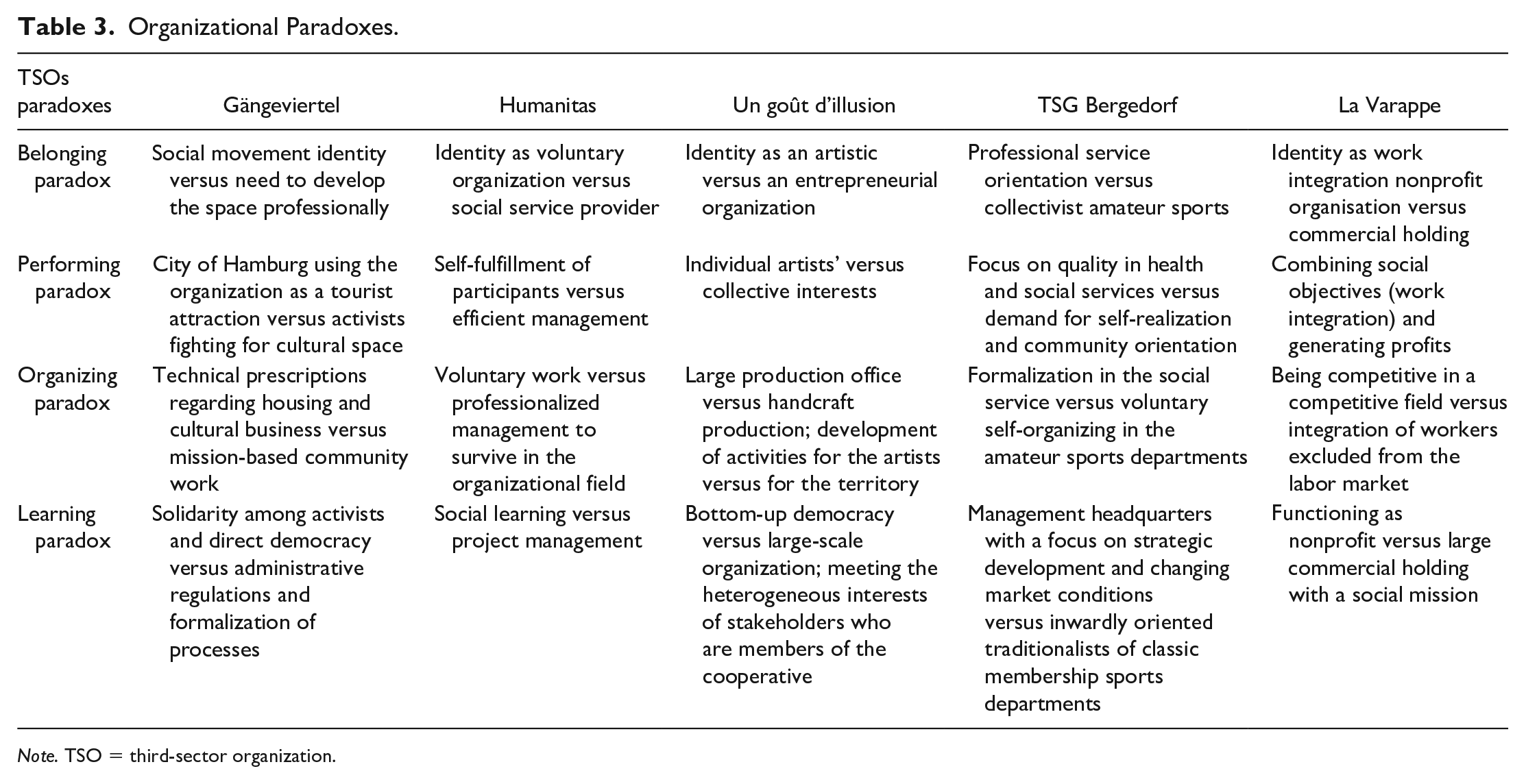
Because of their transformations, TSOs face various organizational paradoxes that evolve at the level of organizational identity, performance, internal organization, and learning. Most of the observed paradoxes (see Table 3) overlap.
Organizational Paradoxes.
Note. TSO = third-sector organization.
The majority of TSOs have faced paradoxes concerning (directly or indirectly) the belonging dimension, revealing tensions related to their identity and to their mission stemming from competing values. The identity of most organizations is now composed by opposite poles or conflicting dimensions that generate belonging paradoxes. TSG Bergedorf, for instance, is both a professional service provider and a collectivist amateur sports club, which needed to respond to the rise of individualized clients’ demands and to the aim of serving their community. These belonging paradoxes, in turn, create paradoxes on performance and internal organization. TSG Bergedorf has to meet very different quality standards with regard to self-fulfillment of certain clients and community participation of other beneficiaries. La Varappe unites the identities of a work integration nonprofit organization and a commercial holding, with different performance criteria. Humanitas must consider the requirements of efficient project management and the interests of its volunteers and members, who are geared more toward project activities than management and accountability. Gängeviertel, in turn, must reconcile the interests of the Hamburg city administration and those of the activists and artists who established the social movement. Un goût d’illusion is subject to similar tensions: it must both take into account the individual artists and serve the interests of diverse stakeholders who are part of the cooperative organization. Many TSOs must reconcile bottom-up decision-making in a traditional membership with the need for efficient organization.
These belonging and performance paradoxes are intensified by the involvement of more diverse stakeholders such as members, clients, volunteers, public agencies, donors, and paid workers, who pursue their own objectives, values, and performance criteria. Furthermore, tensions arose from the choice to diversify activities. TSG Bergedorf, for instance, has developed social services, although it was originally active in the field of sports. These social services require formalization and professionalization, while sports activities need community participation and self-realization. Other TSOs have re-organized their work, have professionalized, and managed different types of human resources. Humanitas, for example, professionalized the training, coordination, and supervision of its volunteers. Belonging paradoxes also generated organizing paradoxes. For Humanitas, organizing paradoxes emerged from the need to both focus on voluntary work and professionalize its management. Gängeviertel also had to deal with organizing paradoxes when reconciling institutional prescriptions regarding housing with artistic and cultural business and community work expectations. Learning paradoxes arose as well. Un goût d’illusion had to develop administrative, managerial, and strategic expertise, while members were mainly small, voluntary artistic and cultural organizations or independent artists. TSG Bergedorf had to combine management headquarters with strategic expertise and membership club sports with traditional and community-oriented profiles and competences.
These paradoxes challenge the level of governance, as the “compass” of the organization, where tensions can be addressed, and strategic choices made to manage these paradoxes.
Organizational Governance Responses
TSOs have developed various responses to environmental pressures and paradoxes at the governance level. None of the investigated cases, has chosen to restrict themselves to a coping or acceptance strategy. They have all chosen more fundamental resolution strategies, going beyond the incremental, which is evident from the substantial changes in their governance structure which the organizations decided to implement. Changing the structure of governance comes with great effort and expense, which is why organizations usually try to avoid it, but in these cases, a more radical approach was seen as a more sustainable solution in the long run. This type of strategy could in practice be divided into two main categories.
First, some TSOs have opted for the spatial separation of the paradoxical dimensions. In our sample, spatial separation involved creating different organizational parts within a single legal entity. Gängeviertel decided to create different legal entities under one roof: a nonprofit organization for community work and a cooperative for housing. In TSG Bergedorf, members are organized in self-governed and financially autonomous departments represented by delegates at the assembly of delegates, which is the central governance body. Humanitas adopted a dual governance structure (for the membership organization and for the professional one) but with a mechanism to safeguard its mission because the membership council remains the main decision-making body.
Second, other organizations decided to pursue synthesis at the governance level. Un goût d’illusion, initially a nonprofit organization, decided to create a collective interest cooperative as a way to integrate a diversity of stakeholders within a single cooperative. The founding association is a member (associate) of the cooperative. La Varappe, formerly also a nonprofit organization, was transformed into a holding company with a commercial legal form, in which the historical association has a large number of shares with a blocking minority power, restrictive by-laws for profit redistribution and a chart signed by all associates that act as safeguards to the social mission.
To preserve organizational unity and coherence in spite of paradoxes and particularly in the case of separation strategies, the investigated TSOs invested in identity building. They communicated their mission to members, volunteers, and other stakeholders, for example, in training seminars or through events. This can be regarded as an attempt of blending of their different organizational identity dimensions.
Changes in the governance structures have implications on the four dimensions of governance. First, multistakeholder organizations like La Varappe must guarantee the internal representation of stakeholders, who are more diverse than in classical nonprofit organizations. All five organizations adhere to a general assembly or council as a central decision-making body, which in principle unites all members or shareholders. Some TSOs adopted specific representation systems. At TSG Bergedorf, for instance, there is a youth department represented by juvenile members at the assembly of delegates. Second, they need to shape the distribution of responsibilities and power within the organization, taking into account different stakeholders, such as members and volunteers, employees, clients, donors, funders, and partners. Un goût d’illusion, for instance, distributed voting power among three stakeholders: the college of founders and paid workers (50% of the votes), the college of co-producers of services (25%), the college of users, activity fields and territories—including local public authorities, users, representatives from research and engineering (25%). Third, the TSOs need to safeguard a sufficient level of efficiency of internal decision-making processes, which can be at odds with the idea of inclusive and participatory governance. Humanitas, for instance, supports the structure by a professional secretariat and associated managerial structures. Fourth, TSOs need to provide organizational spaces for negotiation, such as working groups, meetings and committees, in addition to statutory governance bodies, that allow for the broad participation of their members and/or supporters. For instance, at Un goût d’illusion, there is classically a general assembly and a board of directors constituted by the paid executives of the cooperative. Nevertheless, they created a new strategic council to increase the mobilization of associates and paid workers. Before each general assembly, they organize a seminar and some working groups on different issues for the cooperative.
However, and as a consequence of more complex governance structures, decision-making has become more hierarchical or professionalized and some decoupling solutions have been adopted. Because of the need to professionalize management structures, organizations have indeed had to follow certain procedures. As in Humanitas and TSG Bergedorf professionalization and bureaucratization have thus been accompanied by the limitation of the democratic dimension, as decision-making is formalized and volunteers are “managed from above.”
Changes with regard to the scale of the TSOs may also explain the shift from direct to representative democracy, decision-making decoupling, which result in reducing opportunities in terms of extensive participative processes. At TSG Bergedorf, for instance, departments elect an assembly of delegates, which subsequently elects an advisory board, which in turn appoints the managing board. Opportunities for democratic decision-making only exist in small sections of the organizations, such as autonomous groups and basic units. Democratic life is limited to small areas at the grassroots level.
Our results highlight that overcoming paradoxes is extremely complex and not without risk for the identity and specificities of TSOs. Deep changes in their governance structure were the sphere where tensions were addressed, discussed, and hopefully solved in the sense that TSOs were able to find a new equilibrium to live in a more complex and uncertain environment.
Discussion
Our analysis shows that environmental pressures have pushed TSOs toward important organizational changes in core dimensions of the organizations with crucial consequences at the governance level that create new paradoxes or tensions.
The investigated TSOs were originally nonprofit organizations, with different relations to stakeholders and support structures. Membership organizations such as TSG Bergedorf, Un goût d’illusion, and Humanitas focus on their members as their main stakeholders. Movement organizations such as Gängeviertel focus on a broader community. The service-oriented social enterprise La Varappe focuses on workers in need of integration and on local authorities as their main stakeholders. These organizations have different resources at hand for addressing organizational paradoxes. Membership organizations rely on the support of their members, volunteers, supporters, and associates, movement organizations rely on their supporting community, and social enterprises rely on clients (at La Varappe, their clients are mainly public authorities through public markets).
Organizational Paradoxes at the Core of the Organizations
Despite their heterogeneity, these TSOs have experimented paradoxes that concern the constitutive elements of their organization and go beyond the division between social and entrepreneurial organizations, which literature usually refers to (Mason & Doherty, 2016). A more complex analytical framework is needed. In addition, our results highlight the emergence of multiple paradoxes (belonging, performance, organizational, and learning ones) related to different elements of the organization in question. As Smith and Lewis (2011) point out, “paradoxical tensions may be nested” (p. 384). Our analysis clearly shows that the organizational paradoxes are interdependent and cannot easily be resolved. The introduction of professionalized governance structures has inevitably led to a decrease of internal participation opportunities. The voluntary organization Humanitas has succeeded in making its volunteering programs more appealing to members by introducing professional support structures, including training, placement, and supervision. The new emphasis on the quality of voluntary work has also diminished the interest in members in participating in internal decision-making processes, as they increasingly see themselves as organization’s clients rather than its owners. Similarly, the introduction of new service functions in the sports organization TSG Bergedorf has at the same time broadened the range the services offered and decreased the attractiveness of the sports club as an association the participation of members beyond paid services.
Complex Governance Structures as Fabric of Paradoxical Solutions and Tensions on Internal Democracy
Because of organizational responses to environmental changes, third-sector governance structures have become more complex. All investigated organizations found ways to deal with the paradoxes, either by spatial separation (paradoxical aspects were “allocated” to different parts of the organization) or by synthesis at the governance level. Both approaches led to more complex forms of governance, either in the form of separate suborganizations or by integrating diverse stakeholders through the blending of organizational identities. Our cases confirm the distinction introduced by Smith and Lewis in 2011 between acceptance in the sense of tension identification and separation or synthesis, as tension resolution strategies. It seems to us, and this is one of our contributions, that acceptance can be considered as a necessary condition for the introduction of tension resolution strategies.
Such changes can, however, in turn create new tensions at the governance level. With greater organizational professionalization and bureaucratization, the democratic function of TSOs as “schools for democracy” risks being relegated to the past. The governance structure itself is a level of negotiation among different stakeholders’ representatives. In addition to statutory bodies, to safeguard their unity and identity as organizations, TSOs have created new spaces for negotiation, for example, by establishing discussion and working groups for members, volunteers, and other stakeholders. The TSOs have also focused on identity building and have emphasized the communication of core values among those who support the organization. While tensions on internal democracy are present, our empirical evidence also shows that TSOs are inventing and experimenting with new forms of democracy, thus in some sense acting as “manufacturers of democracy.”
Conclusion
The article examined how TSOs in Europe adapted to profound changes in their regulatory and societal environments, specifically in relation to governance structures. The question how nonprofits interact with their regulatory environment is a classic issue in third-sector literature. However, whereas early literature tended to stress national differences, since then it has been recognized that, in spite of different national histories and regulatory environments, all TSOs have been facing similar pressures, due to common underlying social trends and isomorphic tendencies among national policies (Pape et al., 2020).
We found that, in the cases we studied, environmental changes accelerated the movement from traditional member-based organizations toward larger ones, with more complex governance structures, involving multiple stakeholders. These have adopted new combinations of resources (e.g., by entering new markets) and/or new legal forms, generating internal paradoxes especially with regard to internal democracy. Overcoming such paradoxes is becoming increasingly complex, reflecting less stable and more complex environments. These findings underline the importance of studying the nature of hybrid organizations and their governance systematically and comparatively, moving beyond isolated case studies. The cross-national research presented in this article has brought together a number of in-depth cases, showing up common trends in the governance of TSOs that might otherwise been seen as only the idiosyncratic characteristics of particular organizations. Nonetheless, these have still only been small numbers, so a larger follow-up study will be necessary to test the validity of the findings across larger populations of organizations.
If the findings do indeed hold up more widely, what would they imply? First of all, they would suggest that third-sector/nonprofit research, especially in Europe, should shift away from its traditional concern with national variations. The relative lack of comparative research, combined with conceptualizations that drew heavily on regime theory, may have overemphasized the distinctiveness of path-dependent, national trajectories. While these undoubtedly remain important, it must be observed that TSOs in different countries have to a significant extent responded similarly to environmental pressures. Insofar as there were differences, these were related more to types of organization and their local environment than to elements of the national context. Extending that line of reasoning would mean that variations between countries would (become) less relevant than differences between types of organizations. In other words, we would move away from an analysis of TSOs as reflecting developments in national third sectors, to a cross-national comparative analysis of TSOs in which the national regulatory context is one, but not necessarily the most important variable. An important ambition for future research is to explore this on a wider scale. It is undoubtedly a contentious issue, in a field of research that, especially in Europe, tends to treasure national traditions and narratives of the third sector.
A second potential implication of the findings is that the paradoxes must not be regarded as a transitional phenomenon, but as a more permanent feature of TSOs. They go beyond the traditional tension between social mission and economic efficiency. Solving them requires more than a simple choice between acceptance, separation, and synthesis. Of course, all organizations to some extent face internal tensions of one sort or another, because they harbor inherent contradictory logics. The classic bureaucracy, with its tension between rule-based and hierarchical coordination, is a case in point. What makes such tensions show up as paradoxes in the current analysis is that they represent a deviation from the traditional ideal type of a TSO. Rather than a temporary state of confusion, this may represent the “new normal”—a point made in some early studies on hybrid TSOs (e.g., Brandsen et al., 2005). An indicator that might be the case is that the organizations in our sample have managed to deal with the paradoxes successfully, in the sense that they have managed to achieve new equilibria in dealing with the dynamic and complex environment they are facing. However, their identity will be less stable and more ambiguous (comp. Heckert et al., 2020), although it will not necessarily be experienced as such by those who implement new governance structures (Beaton, 2021).
To end on a positive note: our work highlights that TSOs have not lost their innovative capacity to deal with new social challenges, even when facing resource-constrained environments, heavy administrative burdens, and higher performance requirements. The new economic crisis unfolding now, at the time of writing, will again test that capacity.
Footnotes
Author’s Note
The authors would like to thank the collaborators of the Third-Sector Impact project, the participants of the panel on Governance at the 6th EMES International Research Conference on Social Enterprise 2017 and two anonymous referees of this journal for valuable comments and suggestions.
Declaration of Conflicting Interests
The author(s) declared no potential conflicts of interest with respect to the research, authorship, and/or publication of this article.
Funding
The author(s) disclosed receipt of the following financial support for the research, authorship, and/or publication of this article: This study received funding from the European Union’s Seventh Framework Program (FP7) for research, technological development, and demonstration under grant agreement no. 613034. Patrick Hoemke and Christina Rentzsch provided support in the data collection for this article.
