




Abstract
The mission of a job affects the type of worker attracted to an organization but may also provide incentives to an existing workforce. We conducted a natural field experiment with 246 short-term workers. We randomly allocated some of these workers to either a prosocial or a commercial job. Our data suggest that the mission of a job has a performance-enhancing motivational impact on particular individuals only, those with a prosocial attitude. However, the mission is very important if it has been actively selected. Those workers who have chosen to contribute to a social cause outperform the ones randomly assigned to the same job by about half a standard deviation. This effect seems to be a universal phenomenon that is not driven by information about the alternative job, the choice itself, or a particular subgroup.
Introduction
A wide range of empirical literature has found many differences in organizational characteristics, jobs, and workers between the private and the nonprofit sector (see, e.g., De Cooman et al., 2011; Winter & Thaler, 2016). One difference is that employees of nonprofit organizations (NPOs) are said to care about the social mission of their job (Weisbrod, 1998). Handy and Katz (1998) suggest that lower wages (see, e.g., Borzaga & Tortia, 2006) are used by nonprofits as a screening device to attract intrinsically motivated individuals who are willing to forego some money in exchange for the opportunity to provide goods or services with positive social externalities.
Goal theory of motivation (Locke & Latham, 1990) suggests that employees are more motivated to perform a task if they feel that it will result in important outcomes. Starting from this point, this article studies the conditions under which a prosocial mission can incentivize an existing workforce. With observational data, it is difficult to isolate potential influencing factors on performance due to worker self-selection and measurement difficulties, so we used a natural field experiment (Harrison & List, 2004). In partnership with a local advertising agency, we hired 246 temporary workers, paid them a fixed wage, and measured their performance in doing the simple, homogeneous task of placing solicitation letters—either for businesses or for prosocial organizations—into envelopes and getting them ready to mail. The jobs differed only in the purpose of the letters (prosocial cause vs. for-profit goal) and the allocation method of the jobs (self-selection vs. exogenous allocation).
The broad question of whether a prosocial mission has a positive performance effect can be divided into two narrower questions. First, there is the question of whether a prosocial mission in itself has a positive effect. We investigate it by randomly sorting workers into a mission-oriented and a commercial job. Second, there is the question of whether actively choosing a mission-oriented job has a performance-enhancing effect. Hence, we let a group of workers consciously make the choice to work toward a social mission, and we compared them with workers whom we randomly assigned to the prosocial mission. By offering equal pay, we ensured that almost all workers would prefer the mission over the commercial purpose, so that the sorting effects would be negligible.
Our data suggest that the scope for performance increases through the exogenous provision of a mission is limited. If it exists at all, the pure mission effect is only observable for workers who privately engage in volunteering activities; we gathered this information as a proxy for individuals’ prosociality. We do find, however, a positive and highly significant performance effect caused by the conscious decision to work for a good cause. This performance increase equals about half a standard deviation, and unlike before, it is not driven by a particular subgroup. Further control treatments rule out the possibility that information about the alternative job or the choice itself caused the effect.
We consider our investigation as relevant, since hitherto there is a lack of evidence on the performance effects of prosocial missions from controlled settings. By conducting a field experiment in partnership with profit and NPOs, we are able to rigorously test this fundamental relationship. Moreover, we contribute to the general understanding of the interplay between mission and performance by studying the specific impact of deliberation about a prosocial mission, which we show is more powerful than deliberation and choice in general.
Related Literature and Hypotheses
The suggestion that individuals perform better when working for a social cause than when purely motivated by profit is based on the psychological framework of the goal theory of motivation (Locke & Latham, 1990), which posits that efforts increase with performance goals if employees believe that these will result in important outcomes. Wright (2007) applies this framework to public service motivation and finds that they are more motivated to perform their task if they feel that it is important and achievable. Similarly, the organizational mission influences work motivation by increasing the importance employees place on their work, which can even facilitate innovation (McDonald, 2007). Wright’s analysis is restricted to public employees; applying this theory to our research question, one might argue that a social cause could be perceived as more important than increasing sales and, hence, cause higher performance.
The empirical literature on the relationship between an organization’s mission and workers’ performance can be divided into two strands. The first strand highlights the importance of a mission match. Carpenter and Gong (2016) conducted a real-effort laboratory experiment in which subjects were randomly allocated to two organizations whose missions were diametrically opposed. The performance of mission-matched subjects was more than 70% higher than the performance of mismatched individuals. A similar design was implemented by Smith (2016), who argues that meaningfulness serves as an intervening mechanism; this argument is connected to a recent strand of literature that analyzes the impact of perceived meaning of work on performance (see, e.g., Chadi et al., 2017; Kosfeld et al., 2017). Other experimental studies refrain from explicitly creating matches and mismatches, but they vary the match quality and compare subjects’ performance to a control group in which no mission is present at all. Except for Cassar (2019), most of these studies confirm that there is a positive relationship between mission match and exerted or stated effort (e.g., Gerhards, 2015; Koppel & Regner, 2014; Resh et al., 2017).
The second strand of empirical literature focuses on the impact of social incentives on individuals’ performance, independent of how much the mission is appreciated. By comparing groups of subjects whose efforts either generate donations to a charity or do not, a significant difference in performance can be observed (Kajackaite & Sliwka, 2017), but these effects are often confined to particular settings such as using low stakes (Charness et al., 2016) or subgroups such as low productivity individuals or females (Tonin & Vlassopoulos, 2010, 2015). The experimental designs of these studies are well suited for answering the question of whether additionally pursuing a prosocial mission—for example, in terms of corporate social responsibility activities—enhances workers’ motivation. However, the findings are only incompletely transferable to our question of whether nonprofit workers exert higher efforts than for-profit workers. Note that pursuing a commercial goal can be perceived to be meaningful, too. Then, if the mission effect is mediated by the perceived meaningfulness of work as Smith (2016) suggests, no mission effect might be found. The following empirical and experimental evidence supports this suggestion.
First, findings from the British Household Panel Survey indicate that the likelihood of doing unpaid overtime remains stable if individuals switch from the nonprofit to the for-profit sector (Gregg et al., 2011). Second, the experimental design by Fehrler and Kosfeld (2014) is close to that of the investigations mentioned above, but their control group differs in that subjects’ chosen effort also generates money for a randomly selected student from the university. Compared to this control group, the authors do not find a positive effect of generating donations to a charity, even though subjects were allowed to choose the charity to which donations shall be made. Finally, Banuri et al. (2018) experimentally demonstrate a difference between task-based and mission-based motivation. They show that mission-based motivation enhances performance only if there is no task motivation.
By randomly allocating workers to different solicitation letters—prosocial mission versus commercial advertisements—, we can cleanly identify a pure mission effect on workers’ exerted efforts if it exists. Based on the empirical evidence, we derive the following hypotheses:
Hypothesis 1a: There is no pure mission effect for the overall sample.
Hypothesis 1b: There is a pure mission effect for individuals who regularly volunteer.
Hypothesis 1b suggests that volunteering individuals may be a subgroup of people who exert higher efforts if they are involved with a prosocial mission since prosociality has been shown to be an important factor in mission-oriented settings (see, e.g., Non et al., 2019; Smith, 2016). Second, Weiss and Piderit (1999) find that employees perceive organizational goals to be personally meaningful if the organization’s mission is congruent with their values. One might assume that volunteers are especially likely to value the work of the sender of the mission-oriented letter, an agency that organizes volunteers to do social work in the community. Drawing again on goal theory, the perceived meaningfulness of the organizational goal is likely to translate into observable performance effects.
In reality, jobs are usually not randomly assigned. Even if people do not have a real choice—that is, when the job market is very tight—, accepting a job always involves some commitment. By drawing on cognitive dissonance theory, choosing a mission-oriented job may lead to behavioral changes. As Festinger (1957, p. 2) argues, even though people strive for internal psychological consistency by acting in alignment with their values, “for one reason or another, attempts to achieve consistency may fail.” As a consequence, a feeling of discomfort can arise. However, dissonance caused by a decision—such as taking a job supporting a social cause when one is not committed to that cause—can be reduced by persuading oneself that the chosen alternative is more attractive and/or the rejected alternative is less attractive. Izuma et al. (2010) provide evidence that individuals indeed change their preferences to match their prior decision, using both self-reported preferences and their neural representations. In our setting, the dissonance-reducing activity is the act of putting extra effort into the chosen job because it is not unpleasant or because the social goal is even more desirable than originally thought (see Harmon-Jones et al., 2009). This suggestion is in line with the finding that self-persuasion interventions have a positive effect on job performance; Bellé (2013) reached that conclusion at the end of a study in which nurses had to describe how a specific project could improve the lives of their patients.
Investigating the possible interaction effect between a social mission and the choice of it also follows a recent strand of literature that stresses the importance of self-reflection to behavioral changes. Actively deciding between different jobs might induce workers to reflect on the characteristics of these jobs. In doing so, workers could form a subjective value for the prosocial job (Stutzer et al., 2011), above and beyond a pure mission effect. Relatedly, Krupka and Weber (2009) provide experimental data that individuals’ prosocial behavior increases when their attention is drawn to social norms.
By allowing workers to deliberately sort themselves into a mission-oriented job while we keep the composition of our workforce nearly unchanged due to equal pay, we can investigate the possible existence of what we can call the “active mission choice effect”—a potentially important factor that has been neglected in the mission-based motivation literature so far. Based on the theories and findings we have discussed above, we derive the following hypotheses:
Hypothesis 2a: There is an active mission choice effect for the overall sample.
Hypothesis 2b: The active mission choice effect is greater than the pure mission effect for non-volunteering individuals only.
The latter hypothesis should be true if the active mission choice effect can be explained by the cognitive dissonance theory. In that case, choosing the mission-oriented job does not create any cognitive dissonance for prosocial individuals, so the active choice should not play any role for these individuals. The less socially minded people, however, are in a state of cognitive dissonance and can be expected to put extra effort into the chosen job to avoid discomfort. As a consequence, the effect caused by deliberation in a setting that involves a prosocial mission is likely to be different from the effect caused by the task choice itself. Given that the positive performance effects of task choice usually work via goal commitment (which is a function of the probability that individuals can demonstrate high ability; see, e.g., Nicholls, 1984), choosing between two different commercial advertisements while conducting exactly the same activity should not be related to proving high ability and, hence, should not result in a statistically significant difference in performance.
Study Design
We partnered with a local advertising agency to investigate the impact of a prosocial mission and the conscious choice to contribute to a social cause. Various upcoming mailing campaigns for different nonprofit and for-profit organizations allowed us to conduct a natural field experiment (Harrison & List, 2004) to observe temporary staff in a controlled but natural working environment without the workers being aware of the experimental conduct. King et al. (2013) argue that organizational scholars can derive meaningful conclusions from this methodological approach if the attributes that characterize high-quality field experiments (i.e., random assignment of subjects, a natural setting, and the manipulation of behavioral variables) are present. Participants in natural settings outside the constraints of the laboratory or a survey who are unaware that they are involved in a study can be expected to perform actions that are less filtered by social desirability―which might be an issue especially for nonprofit research. Although field experiments have rarely been the method of choice for scholars publishing in nonprofit journals (Mason, 2013), 1 they have yielded important conclusions for this area, such as about the impact of social information on volunteering (Moseley et al., 2018).
For this study, we attracted the attention of prospective workers using small advertisements on bulletin boards in supermarkets, public libraries, university campuses, and the like, as well as on regional online platforms. Advertisements informed potential workers about the type of job (clerical), the pay, and the contact details. We noted that it was a joint project between our university and local companies and organizations but gave no information regarding the project’s purpose. Interested individuals applied in person during office hours. Some of them brought résumés, while others filled in a short form to provide their contact details, nationality, and age. We briefly informed them about the mailing campaigns, asked them about potential working times, and, if they had brought no résumé, we asked them a few questions about their experience in similar jobs, as is usual in job interviews. Given that we intended to use volunteering as a proxy for prosocial preferences, we asked whether they had engaged in volunteering activities, and, if so, for how long. We used a binary coding system, counting every individual who had volunteered for at least 6 months as a volunteer. 2
Afterward, we offered all applicants an immediate opportunity to earn 5 euros for 30 minutes of work. The task consisted of putting letters in envelopes, stamping the envelopes on the front and back, and binding the letters together in stacks of 10 with a rubber band. As the task was the same for all applicants, and as these letters differed from the subsequent treatment letters only in their neutral content—they promoted services for fans of a local sports club—, we used the number of processed letters as a performance indicator.
Of the 267 people who applied for the job and processed the sports information letters, 246 showed up for the allocated work shift. For the 2-hour shift, each received a fixed payment of 20 euros. Upon arrival, a research assistant welcomed the workers and gave them brief standardized instructions for the task at hand. To rule out peer effects, each worker was allocated a different meeting time so that the instructor briefed only one worker at a time. Furthermore, employees worked alone in single offices without any coworkers or supervisors around. All offices were identically equipped with a desk, two office chairs, and about 400 letters and envelopes. 3 Workers were also told that they could take breaks whenever necessary. Given these particular circumstances, workers were likely to feel responsible for managing their own workload. In addition, workers were told in advance that this job was a unique opportunity to earn money with this employer to rule out any career concerns.
After the application and before running the experiment, workers were randomly allocated into one out of five treatment groups:
Treatment Groups Overview.

To investigate whether there is a pure mission effect, we compare the groups
Since the decision about which option to choose is connected to the information about the different choices, any possible differences in performance might be driven by both the decision and the information. Therefore, we implemented a further control group,
We thoroughly followed the standard rules for natural field experiments (Harrison & List, 2004), including the strict requirement that we not deceive the workers: their efforts were commercially useful, in terms of processed letters that workers were paid for. Hence, unlike experiments in psychology where deception is the rule rather than the exception, we did not provide a debriefing. Furthermore, the temporary workers were treated according to the rules of German labor law and the intervention was very mild, so that no harm was to be expected; no worker reported any inconvenience. We conducted the experiment in a medium-sized German city in late 2014. All five treatments were rolled out simultaneously, which was possible because of our mild intervention and the naturalness of the situation since different workers might also work on different projects.
Empirical Analysis
The average age of the 246 workers was 24.70 years. 69.5% were female and 11.4% were foreign nationals. About 34.6% had volunteered in the past for at least 6 months, which is consistent with the data from the German Survey on Volunteering (Hagen & Vogel, 2012). We find no statistically significant differences in workers’ initial performance, their age, and volunteering activities between treatments (based on randomization inference with 1,000 random permutations). However, treatment
Looking at workers’ performance, we find that workers processing letters for a for-profit purpose (i.e., treatment
Result 1: We do not observe a pure mission effect when comparing a mission-oriented and a for-profit job. If an economically significant impact exists at all, it can be reported only for regularly engaged volunteers. These findings support both Hypothesis 1a and Hypothesis 1b.
We now turn to the potential “active mission choice effect.” In the treatment
Regression Analysis for the Pure Mission Effect.

Note. Dependent variable is the total number of enveloped letters during the 2-hour shift. The table reports OLS coefficient estimates (robust standard errors in parentheses). Only workers from the treatments
p < .1. ***p < .01.
Since not all of the workers allocated to the treatment
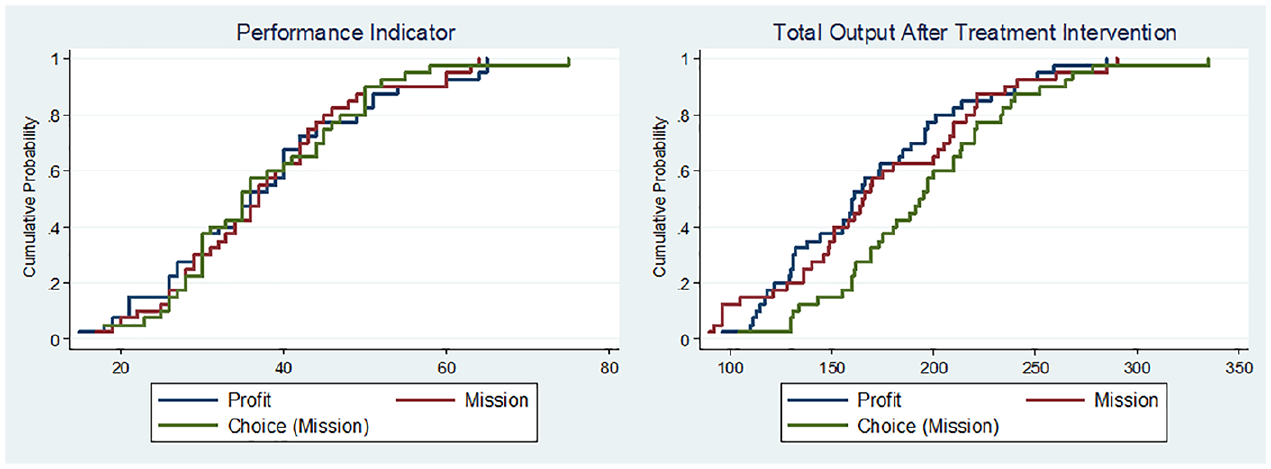
Cumulative distribution functions of workers’ performance.
Given the somewhat higher share of volunteers compared to the groups
The Active Mission Choice Effect—Testing for Heterogeneity.

Note. Dependent variable is the total number of enveloped letters during the 2-hour shift. The table reports OLS coefficient estimates (robust standard in parentheses). Only workers from the treatments
**p < .05. ***p < .01.
Taken together, our data suggest that the observed effect is not due to self-selection of workers who would perform well anyway but that workers exert higher efforts if they deliberately decided upon doing something good, which supports Hypothesis 2a. Since deciding in favor of the commercial advertisement can be interpreted as noncompliance from a statistical point of view, we finally apply a two-stage least squares estimation (2SLS) to estimate the complier average causal effect (CACE), as proposed by Gerber and Green (2012), which is the consistent estimate of the ATE among the particular subset of individuals who have chosen the prosocial job. In the first-stage regression, none of the controls is significant, and the treatment is estimated to raise workers’ output by 25.62 letters (p = .000) compared to the exogenous allocation of the for-profit letter. This is only minimally smaller than the raw difference of 27.22 letters, confirming our previous suggestion that the treatment effect equals about half a standard deviation. The results remain nearly identical when using treatment
To scrutinize the suggestion that a feasible channel of the active mission choice effect is a result of individuals’ avoidance of cognitive dissonances, we again split the sample according to workers’ volunteering activities. We find no performance difference between volunteers and nonvolunteers in the group
Result 2: In contrast to an exogenously provided mission, the active choice to do good sizably increases the work performance of the whole group. Given that only nonvolunteers are sensitive to this specific treatment, our data suggest that the avoidance of cognitive dissonances is a likely behavioral driver.
To rule out the possibility that the previously identified effect is driven by information about the different options or the mere right to choose—which are two inevitable aspects of self-selection—we analyze the work performance in the control treatments,
Finally, being aware of the existence of the for-profit letters in the treatment
Treatment Effects Overview.

Note. Dependent variable is the total number of enveloped letters during the 2-hour shift. Additional controls include workers’ age, gender, nationality, initial performance, and whether they have been volunteering before. In Specification (2), two observations are lost due to missings as regards their birthdate. The table reports OLS coefficient estimates (robust standard in parentheses). Comparing the point estimates for
p < .05. ***p < .01.
Discussion
In an ideal world, employees have a clear idea of their preferred mission and the organizations they would like to work for. They search until they find the perfect job, with prosocial individuals reliably sorting themselves into mission-oriented jobs and NPOs. Actually, it is not uncommon that people have less precise ideas about their preferences. To put it positively, they are open to new experiences and can imagine working for either a prosocial or a profit-oriented organization. Sometimes, they need to find a job quickly, and they take the first-best they can get, so that chance determines where they go.
The existing literature cannot adequately answer the question of whether a job’s prosocial mission per se has a positive impact on workers’ willingness to exert effort compared to a profit goal. Our study seeks to fill this gap by providing clean, causal evidence obtained from a natural field experiment. We find that employees allocated to the prosocial mission work as hard as those working toward a profit goal. Only when looking at a very specific subgroup, namely people who already do unpaid volunteer work during their leisure time, is a pure mission effect observable. This coincides with the assumption that a prosocial mission is more important for these people than for the average population. Note, however, that we aimed to isolate the mission effect from any other influencing factors. Consequently, the mission of the job was communicated in a very neutral way, without highlighting its value for society, but in ordinary work situations, organizations could draw on active leadership communication to inspire individuals to work harder for their social cause (Jensen et al., 2018). Especially where the working environments are monotonous, Antonakis et al. (2019) have shown that charismatic leadership has a significant impact on workers’ performance.
Besides exogenously allocating them into treatment groups, we allowed some employees in different treatment conditions to opt for their preferred job because self-selection is an inherent part of the real labor market. The innovation here is that workers could choose between a normal commercial job and doing good for society without an earnings loss. Thereby, we were able to generate a particularly interesting group for research: a workforce that deliberately chose a job with a prosocial mission without the usually biased workforce characteristics due to selection. We find that there is no additional performance effect of the active choice for the subgroup of volunteer workers who already performed very well under the exogenous allocation of the prosocial mission. We do, however, observe a statistically significant performance increase for nonvolunteers who actively decide in favor of the social cause, which suggests that the avoidance of cognitive dissonance is a likely behavioral driver.
While previous research emphasizes the importance of a perfect mission match, and therefore suggests that NPO managers should pay particular attention to perfect screening and selection, our results suggest an overestimation of a perfect mission match, given that we observe a positive performance effect once individuals decide to work for such a social cause regardless of their preferences. The occurrence of this active mission choice effect seems to be good news for society as a whole but also for human resource management. It confirms that human resource managers in NPOs are indeed well advised to pursue the strategy of having a values-laden orientation, as shown by Ridder and McCandless (2010). It is, however, important that NPOs are aware of this resource and communicate the mission accordingly also outside the organization so that potential workers can actively decide to contribute to a good cause.
This finding is interesting and novel, but it should be followed by further investigations involving larger numbers of workers. While the statistical power of our investigations is completely sufficient regarding this “active mission choice effect” (0.738), the subgroup analyses that specifically study the behavior of workers classified as prosocial would benefit from larger samples in terms of confidence in these novel scientific contributions.
Even though we intentionally designed our experiment in such a way that we can rule out any influences from external rewards, a future study could analyze to what extent the perceived fairness of a fixed wage influences the established findings. Given the present setting of a one-time job without any specific requirements applicants had to fulfill, the hourly wage can be perceived as rather generous. In contrast, agents employed at nonprofit organizations usually receive significantly lower salaries than do employees working for profit-oriented companies. If the positive performance effect of actively choosing to do good was tied to perceiving the paid wage as fair, it would be interesting for employers to think about wage increases, at least moderate ones, ending up in a beneficial situation for both employee and employer. The evidence provided by Brown and Yoshioka (2003), showing that dissatisfaction with pay tended to override employees’ attitudes toward the mission which is otherwise positively associated with their intentions to remain within the organization, emphasizes the need to investigate the role of pay.
Given that the active mission choice effect seems to be driven by people who work harder to strive for internal psychological consistency, future research should also aim at investigating the long-run consequences of such behavior. On one hand, individuals’ desire to avoid cognitive dissonance might fatigue them so that they become more likely to reduce their effort or even quit the job. On the other hand, however, such avoidance behavior might not be necessary in the long run for at least two reasons. First, Stutzer et al. (2011) indicate that attributing value to a particular prosocial activity may require introspection, but many people seem to refrain from doing so. If they start working for a prosocial cause, organizational socialization might make it necessary to introspect and altruistic preferences could adapt. Second, some individuals might not consider certain social activities as particularly important because they might not have the necessary information to assess their importance. They could even have prejudices toward potential clients or coworkers. According to Allport’s contact hypothesis (also known as intergroup contact theory), contact with an unfamiliar outgroup improves knowledge, increases empathy, and reduces fears, ultimately breaking down prejudices (see, e.g., the meta-analysis by Pettigrew & Tropp, 2006). As a consequence, accepting a mission-oriented job could (positively) change individuals’ perceptions by getting in contact with the matter. Using both lines of reasoning, one might argue that avoiding cognitive dissonances might not be necessary in the long run.
In that we conducted a highly controlled field experiment, causal inference can be made and internal validity is high. Compared to laboratory studies, our research design provides high external validity, too, because we observed real workers while they were performing a genuine task. An experimental approach not only provides particularly reliable and valid evidence but is also very rare in the field of intrinsic motivation research (see Cerasoli et al., 2014)―even though already Grant (2008) proposed that future research should experimentally manipulate prosocial and intrinsic motivations to provide more conclusive evidence on this topic. This ongoing paucity of experimental studies is problematic in that Cerasoli et al. (2014) also show that experimental studies find weaker associations between intrinsic motivation and performance than correlational designs, a result that we can confirm with our data.
We acknowledge that our particular setting, in which short-term workers conduct a single monotonous, routine task, may raise the question of the generalizability of the results. At this point, two counterarguments are warranted. First, we test general theories, which should be valid (or invalid, as the case may be) in this setting, as they are elsewhere. Second, this setting is not just any setting, but one that is often found in reality. We are not examining a convenience sample, but exactly those who have applied for temporary employment. In other words, precisely those employees who are many organizations and companies have to rely on from time to time to reduce high workloads, and who are often difficult to motivate to do their best due to the short duration of the employment and the modest pay.
Still, further research should show whether our results are transferable to full-time employees. Usually, full-time employees have a varying set of tasks with which they might not directly contribute to the organizational mission. Hence, it would be interesting to know whether the performance effects observed here are limited to tasks that are directly related to the prosocial cause; whether such tasks can have a positive spillover on unrelated tasks in the event that both are present; and whether the organizational mission might be enough for employees who are barely in touch with the mission, such as those working in an organization’s administration taking care of its financial performance. Given that Knapp et al. (2017) do not find that task significance has a major impact on nonprofit employees’ job satisfaction and turnover intention, our findings are likely to carry over to other settings, but further research in this context would contribute to a deeper understanding of how a prosocial mission influences individual behavior at work.
Footnotes
Appendix
Descriptive Statistics by Treatment Group.

| Random allocation into: | ||||||
|---|---|---|---|---|---|---|
| Initial performance | 37.30 | 37.55 | 37.61 | 38.01 | 37.70 | 34.57 |
| Performance during 2-hour shift | 168.53 | 172.83 | 191.91 | 168.34 | 176.3 | — |
| Socio-demographics: | ||||||
| Female | 0.650 | 0.675 | 0.630 | 0.788 | 0.650 | 0.619 |
| Age | 25.70 | 24.25 | 24.22 | 24.79 | 24.34 | 25.56 |
| Foreign | 0.175 | 0.175 | 0.152 | 0.051 | 0.075 | 0.059 |
| Regular volunteers | 0.350 | 0.350 | 0.391 | 0.313 | 0.350 | 0.381 |
| Self-selection into: | ||||
|---|---|---|---|---|
| Initial performance | 37.63 | 37.5 | 38.42 | 37.64 |
| Performance during 2-hour shift | 195.75 | 166.33 | 167.87 | 168.83 |
| Socio-demographics: | ||||
| Female | 0.625 | 0.667 | 0.684 | 0.881 |
| Age | 24.25 | 24.00 | 25.30 | 24.34 |
| Foreign | 0.150 | 0.167 | 0.054 | 0.048 |
| Regular volunteers | 0.425 | 0.167 | 0.342 | 0.286 |
Declaration of Conflicting Interests
The author(s) declared no potential conflicts of interest with respect to the research, authorship, and/or publication of this article.
Funding
The author(s) received no financial support for the research, authorship, and/or publication of this article.
