




Abstract
Despite the plethora of research on environmental participatory processes, the forms of nongovernmental organization (NGO) involvement in these processes, and the influence of their involvement on participation outcomes, are still under-conceptualized. This article aims to develop a conceptual typology for NGO roles in environmental participatory processes and to suggest how these roles might be associated with participation outcomes. Following a review of public participation literature and NGO capacities, we present four prototypes of NGO roles along two axes: orientation axis and nature of involvement axis. The prototypes include Entrepreneur, Service-Provider, Enabler, and Partner. We then offer an empirical illustration of the typology using eight case studies across the globe and discuss how the four NGO roles might be associated with outcomes of participatory processes. The framework acknowledges the complex, sometimes limited, contribution of NGOs to participatory processes and suggests practical implications.
Keywords
Introduction
Incorporation of public participation (PP) in policy processes is widely practiced today in various fields, among them environmental governance. Yet the outcomes are oftentimes flawed or disappointing because of barriers to, or failures of, the participatory process (Irvin & Stansbury, 2004). The involvement of nongovernmental organizations (NGOs) as intermediaries between citizens and the government has been suggested as a possible avenue to address some of the barriers to, and failures of the PP process (Berkes, 2009; Carmin, 2003; Chaskin & Greenberg, 2015; Fisher et al., 2012). NGOs have the capacity to serve various roles in participatory processes and, as we will argue, generate different effects on the PP outcome. Despite rich literature on PP and participatory governance, discussion on the contribution of NGOs has been mostly descriptive (e.g., O’Neill, 2019), and lacking conceptual clarity or a critical perspective on NGO roles and influence (Dodge & Ospina, 2016).
In this article, we aim to fill this gap by examining NGOs in environmental participatory processes. We suggest a typology of NGO roles in participatory processes and demonstrate the merit of this typology by aligning it with PP outcomes. We pose the following questions: (a) What roles do NGOs play in (environmental) participatory processes? (b) How can we conceptualize these roles? and (c) How might the different NGO roles be associated with participation outcomes? Surprisingly, the nonprofit literature scarcely addresses these questions.
While the empirical focus below is on the environmental context, our conceptual analysis should be applicable to other fields for two main reasons: first, because PP principles are not confined to a specific policy field (Bryson et al., 2013; Rowe & Frewer, 2000), and second because environmental issues are often intertwined with other social problems such as inequality, economic growth, or urban planning (Beard & Sarmiento, 2014).
An analysis of NGO involvement in PP is important for both theoretical and practical reasons. Theoretically, although evaluation of PP is a persistent goal in scholarly work (Chess & Purcell, 1999; Irvin & Stansbury, 2004; Koontz & Thomas, 2006), research has focused mostly on the PP process rather than its policy outcomes (Coglianese, 2002). We suggest that our NGO role typology may help to conceptualize the link between NGO involvement in decision-making and expected participation outcomes. From a practical perspective, such typology may be useful to actors involved in designing PP processes by outlining both common expectations and the potential contribution of NGOs.
Next, we define participatory governance and participatory outcomes and review the literature on NGO capacities and their involvement in participatory processes. We then suggest a conceptual typology of four NGO role prototypes and illustrate its utility using eight case studies in diverse settings around the world. These cases are based on existing literatures and the unit of analysis in each case is the participatory process, allowing us to position the NGO within specific PP, along choices that determine its role in the process. We conclude by offering exploratory testable propositions of the association between NGO roles and PP outcomes.
Background: Governance, NGOs, and Public Participation
The transition in public policy from government to governance is well documented (Kooiman, 2003; Levi-Faur, 2012). Governance refers to a policymaking framework characterized by nonhierarchical, polycentric, and participatory structures of power sharing, where the role and inclusion of multiple nonstate actors in the policy process are central (Beer et al., 2012; Chhotray & Stoker, 2009; Phillips, 2012). Governance includes complex arenas of power sharing with “institutions and processes, both formal and informal, which provide for the interaction of the state with a range of other agents or stakeholders affected by the activities of government” (Mitlin, 2004, p. 3), thus highlighting the importance of multiplicity of actors, including NGOs.
Public Participation and Participatory Processes
PP is a common practice within the governance framework (Kochskämper et al., 2016; Wesselink et al., 2011). In it, “public concerns, needs and values are incorporated into governmental and corporate decision-making” (Creighton, 2005, p. 7). One approach views PP as a top-down process wherein a government entity seeks citizen input into public policy matters (Reed, 2008). A government’s motivation to adopt such practice is increased trust, legitimacy and credibility of its decisions (Rowe & Frewer, 2000) and lessened opposition to controversial decisions. PP is also viewed as an embodiment of norms of representation and fairness in decision-making processes in democratic societies (Su, 2018; Wesselink et al., 2011) and supplements mainstream knowledge with local knowledge, improving the effectiveness of particularly risky decisions (Berkes et al., 2000).
A counter-approach views PP as a bottom-up government–citizen relation in the form of civic engagement, emphasizing the importance of the citizens in policymaking processes (Dodge & Ospina, 2016; Fisher et al., 2012). In an analysis of more than100 studies of PP, Rowe and Frewer (2005) argue that the term “civic engagement” better captures the connections between the public, NGOs, and decision-makers in participatory processes. In both bottom-up and top-down approaches to PP, involved actors oftentimes include a tripartite of a government entity, a citizenry, and an organized civic actor such as NGOs, community-based organizations, or university-based centers (Clark et al., 2005).
Evaluating Outcomes of Participatory Processes
Evaluation of the effects of PP on policy outcomes has been limited and difficult to assess (Chess & Purcell, 1999; Gaventa & Barrett, 2010; Koontz & Thomas, 2006). While most PP evaluation efforts concentrated on the participatory process (e.g., consensus building) or the kind of PP outputs (e.g., an agreement reached), only a few studies examined the extent that the participatory process has affected actual policy decisions (i.e., indicators of policy outcomes; Benson et al., 2014; Koontz & Thomas, 2006).
One group of outcome indicators used in the evaluation literature was stakeholders’ perceptions of the impacts of PP on environmental quality (Booth & Halseth, 2011; Bryer, 2009; Conrad et al., 2011). However, Coglianese (2002) cautioned against using these indicators in evaluating environmental participatory processes because stakeholders’ satisfaction “does not necessarily equate with good public policy” and “excludes those who do not participate.” Instead, he suggested focusing on measures such as effectiveness and equity of resulting policy decisions. Our discussion on PP outcomes builds on this argument, including a discussion of the connection between an NGO’s role and community outcomes such as community trust and community agreement (Chess, 2000; Postigo, 2011), and policy outcomes such as policy change and policy implementation (Benson et al., 2014; Kochskämper et al., 2016; Leach et al., 2002).
NGO Roles and Capacities in Participatory Processes
Two types of barriers to PP have been identified: Community characteristics hinder meaningful participation, such as residents’ socioeconomic status, the heterogeneity of the community, or the level of citizen trust in government (Booth & Halseth, 2011; Rowe & Frewer, 2005), and government bureaucracy that cannot or will not accommodate meaningful participation (Bryer, 2009; Yang & Callahan, 2007). These barriers have encouraged intermediaries, especially NGOs, to enter the space between formal government and informal citizen structures in various roles and capacities (Carmin, 2003; Chaskin & Greenberg, 2015; Fischer, 2006; Head, 2007).
The conceptualization of NGOs as actors in the governance literature is underway (Seyfang & Smith, 2007). Chaskin and Greenberg (2015) argued that nonprofits play a central role in governing by “contributing directly to public decision-making and action as part of the governing process” (p. 248). The literature has identified several roles that NGOs can adopt in participatory processes; however, insufficient attention has been given to conceptualizing their roles and capacities, and how they influence PP outcomes. NGOs were viewed, for example, as intermediaries of grassroots innovations by offering deliberation, representation, and resource allocation at the participation process (Chaskin & Greenberg, 2015), or by coordinating and aggregating knowledge from local projects, establishing an institutional infrastructure for innovation, and brokering partnerships with actors outside the community (Hargreaves et al., 2013). In the context of sustainability transition, Frantzeskaki and colleagues (2016) suggest three NGO roles, according to their leadership position: drivers of sustainability transition, safeguards of grassroots social needs, and disconnected innovators that remain “below the radar” to avoid government or funder cooptation. In global environmental politics, O’Neill (2019) has labeled NGOs as architects of governance solutions, agitators for environmental action, and entrepreneurs of new initiatives. However, these typologies did not place NGOs within the PP process as community actors.
We offer a deductive conceptualization of NGO roles, which is later illustrated using several case examples. We argue that NGO involvement contributes three capacities to the PP process: (a) a capacity to represent, (b) an expert/professional capacity, and (c) a capacity to access various decision-making arenas. First, NGOs can represent a community or a group, a capacity that enables them to claim both legitimacy and representative validation (Guo & Musso, 2007; Kissane & Gingerich, 2004). In this capacity, environmental NGOs (ENGOs) empower muted community voices, and act as authentic representatives of community and environmental interests, by offering professional expertise or a track record of entrepreneurial activism (Anguelovski, 2014; Dodge & Ospina, 2016; Einsiedel, 2008; Læssøe, 2007), for example, in transboundary ecoregions (Klinke, 2012) and climate governance (O’Neill, 2019).
Second, NGOs can help engage the public using professional knowledge and expertise. When a local authority, for example, outsources a participatory process, NGOs may carry out the task by serving as PP professionals (Bherer et al., 2017). NGO experts can coordinate the process, increase trust and conflict resolution among stakeholders, and facilitate the diffusion of alternative knowledge (knowledge produced by the community) into the participatory process (Beebeejaun et al., 2015; Berkes, 2009; Cohen-Blankshtain et al., 2013).
Third, NGOs have the capacity to access various decision-making arenas, whether on a local, national, or global scale. Hence, they offer a “logistical shortcut” (Mosley, 2016) as the first go-to actors in top-down participatory processes, and their presence on the ground is “useful” from a government perspective (Klinke, 2012; Powell & Colin, 2009). The local tacit knowledge, sociocultural resources, and grassroots competencies of NGOs are essential to the incorporation of PP in the policy process (Greenspan, 2014; Postigo, 2011; Tukahirwa et al., 2010). It is, therefore, easier for decision-makers to work with organizational actors in the implementation of participatory processes.
From Capacities to NGO Role Prototypes: A Framework
NGO capacities are linked to our conceptualization of NGO roles owing to two assumptions. First, the above capacities are not mutually exclusive, hence NGOs may hold more than one capacity. Second, these capacities entrust NGOs with implicit or explicit agency and power in the PP process (Cohen & Arato, 1994; McCambridge, 2004). In accordance, these capacities are translated into various NGO roles that shape PP because the magnitude of each capacity held by an NGO varies. This variation in magnitude of capacities shapes two dilemmas, or paradoxical dimensions, of NGOs: Who are the NGOs oriented toward and accountable for, and the degree of involvement of NGOs in the PP process. These dilemmas can be examined along two axes that represent choices NGOs can make in specific PP cases based on their activated capacities. Choices along these two axes establish, in turn, a framework of four prototypical roles of the NGOs in PP. The two axes and the four roles are described below.
The orientation axis refers to the extent to which NGOs are aligned with or oriented toward community or government in the PP process. Whether an NGO constructs its representation claim (Saward, 2006) from the public or from the government affects its orientation and is likely to affect its role in PP (Ron & Cohen-Blankshtain, 2011; Warleigh, 2000). NGOs may have a bottom-up community orientation, claiming their legitimacy on the basis of community support, or they may have a more institutional top-down government orientation, receiving their legitimacy from government entrustment in exchange for their professional capacities and sociocultural resources. Thus, the orientation axis rests on the central paradox of an NGO’s capacity to represent: Are NGOs accountable to and oriented toward the public or government and funders (Morag-Levine, 2003)?
The nature of involvement axis reflects a second paradox: To what extent are NGOs involved in the participatory process as “passive custodians” or “active advocates” (Stenling & Sam, 2019)? On one hand, informed by the civic engagement tradition, NGOs initiate participatory processes (Carmin, 2003; Fischer, 2006) and can be regarded as proactive advocates of policy-oriented participatory processes (Grønbjerg & Prakash, 2017; Suárez & Hwang, 2008). NGOs will be more proactive advocates when greater “participatory constituent practices,” such as communication with constituents and constituent involvement in strategic decision-making, are involved (Guo & Saxton, 2010; Hur & Bollinger, 2015). In other cases, NGOs are reactive agents, joining an existing PP process to help institutionalize government or community initiatives (Hargreaves et al., 2013). For example, Buffardi et al. (2017) compared advocacy strategies of reactive NGOs that work to stop or modify existing policies versus proactive NGOs that enhance new policy. The latter types were found to use more expertise and less media campaigns. In other words, the proactive/reactive involvement axis reflects the stake an NGO has in initiating PP in the policy process or responding to an existing process.
Four Prototypes of NGO Roles in PP
Built along the two axes, four prototypes of NGO roles in participatory processes emerge: entrepreneurs, service providers, partners, and enablers (see Figure 1). In what follows, these prototypical roles are first characterized and then illustrated using eight case studies of environmental PP initiatives involving government, NGOs, and community actors.

NGO role prototypes in participatory processes: A framework.
Entrepreneur (proactive involvement and government-oriented)
In the entrepreneur prototype, NGOs initiate or lead participatory processes oriented toward policy change. The NGOs have professional capacities that establish their legitimacy to proactively represent either a marginalized issue or a neglected community in the policy process. NGOs that initiate participatory processes or build the infrastructure for more effective institutionalized PP use their entrepreneurial energy and professional capacity. They are likely to employ paid professional staff, use advocacy tools and lobbying strategies, be embedded in social or professional networks along with decision-makers, and hold advantageous organizational social capital (Greenspan, 2014; Suárez & Hwang, 2008). These entrepreneurial assets entrust NGOs with the capacity to access policy arenas and engage with decision-makers. In this sense, the first role of NGOs in participatory processes has similarities to the advocacy model of NGOs. Criticisms of this role prototype casts doubt on the extent to which NGOs’ entrepreneurial work genuinely engages the public, especially marginalized stakeholders, in the participatory process, and questions their use of expertise as a source of legitimacy in claiming community representativeness (Booth & Halseth, 2011; Hendriks, 2009; Mosley, 2016; Parkins & Sinclair, 2014).
Two examples of this role prototype are discussed below: An advocacy NGO that initiated and implemented a participatory master plan for an ethnic minority neighborhood in Jerusalem (Israel), and a Jordanian NGO that led a deliberative process of bridging the gaps between local herder communities and state-level regulators. Despite the different settings, both examples demonstrate the entrepreneurial role of NGOs in suppressed communities that are not commonly engaged in PP.
Service provider (reactive involvement and government-oriented)
In this role prototype, NGOs work closely with the government to implement formal PP programs at the community level. Service-providing NGOs serve as subcontractors of the bureaucracy, soliciting public input into government-led PP initiatives. As service providers, they offer unique professional capacity and expert skills to understand community complexities—skills that are lacking in government agencies and are needed for implementing mandatory PP programs, for example, digital platforms for PP or collaborative and culturally sensitive planning methods and a range of participatory mechanisms (Rowe & Frewer, 2005; Takahashi et al., 2015). On the contrary, in their role as service-providers, NGOs risk becoming agents of cooptation by the government (Najam, 2000). This role prototype is illustrated below with two examples: In the United States, an NGO with expertise in building emergency plans in coastal areas led government to hire the organization to lead PP for emergency planning, and in New Zeeland, an NGO was recruited to facilitate a culturally sensitive PP process with local indigenous communities.
Enabler (proactive involvement and community-oriented)
Enablers are NGOs that act within the community to empower residents in the participatory process, prioritizing community influence over policy change. These NGOs often initiate the participatory process in the name of the community within which they operate but ensure that this initiative is accomplished with full collaboration and leadership of the community. Such NGOs support the community participatory process financially, organizationally, politically, or professionally. The involved NGO can offer knowledge brokering, organizing tools, and capacity building. Their position between the state, the market, and citizens enables them to contribute to participatory processes as process enablers or “bridging organizations” (Berkes, 2009). On the community/government axis, enablers lean toward the community side, meaning that while they are positioned between community and government, they prioritize strengthening local community voices. This role prototype is prominent in the United States, where community development corporations (CDCs) and grassroots organizing increasingly address environmental issues (Fisher et al., 2012). Our examples of the role of the enabler are indeed American. One presents a CDC that partnered with a professional NGO to facilitate a grassroots democratic model of community gardens, providing fresh food and educational programs on urban agriculture. The other is an alliance of four local NGOs steering a community-led process to plan a watershed recovery that takes into account community needs.
Partner (reactive involvement and community-oriented)
Partners are NGOs that join communities in support of bottom-up environmental efforts. Partnering NGOs orient themselves with the community, and help to facilitate, or even join, political grassroots mobilization in light of government (or corporate) pressure and un-consulted decisions. The legitimacy of these NGOs stems from the capacity of being part of, rather than representing, the community. The NGOs join the participatory process and aim to enhance or promote rather than initiate it. In this type of involvement, professional knowledge is secondary to local knowledge: The former is employed only to the extent that it helps to reinforce the latter, fitting it for reproduction as a scientific or political statement. The partnering NGOs are part and parcel of the bottom-up movement for change, which may even place them at odds with government representatives. In that sense, the partners are in line with the role of social movement organizations (SMOs; Zald & McCarthy, 1987). They act close to the community, encourage collective action, recruit supporters, and seek legitimacy from below. The partner role is illustrated below using the examples of a British NGO that promotes behavioral change through community building and local tailored initiatives, and an academic research lab that partnered with Pygmy tribes in Congo to design a technological tool (App) for mapping important trees for conservation and alert against illegal logging.
Empirical Illustrations
Method
The case descriptions address “best practice” stories of contemporary environmental PP initiatives (see Appendix for case summaries). We rely on academic literature and secondary sources only. The cases were chosen as part of a comparative study conducted by the authors on behalf of a large, interdisciplinary ENGO. The study provided an analytical framework for the organization’s internal strategic process using examples perceived as “best practice.” We used broad criteria for case selection. First, chosen cases were well documented in the literature. Second, NGOs were central in the initiative. We deliberately chose to define the term NGO as broadly as possible to a diverse spectrum of roles. Third, case specificities varied depending on the scale of NGO involvement (national/local), the type of engaged community (urban/rural), the environmental issue at stake, and the nature of the participatory process (bottom-up/top-down). Finally, chosen cases had demonstrable outcomes. Our unit of analysis was the PP process and we sought to understand the role(s) of the NGO according to its agency and capacities.
We initially compiled a dataset comprising 19 PP cases that varied in geographical location, governance structures, engaged audiences, and type of outputs. The case selection intentionally did not include the global scale and international NGOs (e.g., O’Neill, 2019) due to the localized, community-based nature of PP. Additional screening excluded cases where NGOs did not play a central role. This resulted in a final sample of eight case studies. We then proceeded with a detailed analysis of the collected secondary materials by identifying actions of NGOs and their policy contributions in each case. In some cases, informants were contacted to provide additional data on the participatory process. For each case, we describe the relevant context of the initiative, the involved actors and the role(s) of NGOs in detail.
Some limitations to this methodological approach apply. First, the selected cases rely largely on our prior knowledge and the availability of existing sources, thus possibly missing useful examples. Second, while secondary source analysis was useful for comparability and brevity, our distance from the original subject matter of each case must be taken into consideration. We did not attempt to reach generalizable or replicable results, but rather to illustrate the applicability of our conceptual framework and the analytical versatility of role prototypes.
Entrepreneur prototype
One example showcasing the entrepreneurial and professional roles of NGOs in PP is found in the NGO Bimkom and the Kaminker Project in Isawiyah (Jerusalem). Isawiyah is a sizable Palestinian neighborhood in the northern part of Jerusalem, whose Arab residents are granted by the municipal planning authorities’ very limited opportunities for community development and building permits. The residents also suffer from insufficient municipal services, such as waste collection and public amenities. 1 The NGO Bimkom (Hebrew for “instead of”) initiated participatory processes in support of the local neighborhood aiming at preparing an alternative land-use plan for the neighborhood (Cohen-Blankshtain et al., 2013).
The purpose of the process was to create a plan that was both supported by the community and followed the formal zoning requirements, so that it had the potential to be approved by the municipal planning authorities. The community-oriented participatory process included numerous public meetings and the opening of a designated neighborhood storefront where residents could suggest revisions to the proposed plan. This process resulted in plan modifications following vocal objections from local residents who viewed the initial plan as unfair. An important empowerment phase of the community-oriented process saw local residents claim responsibility for the land-use plan. This initiative involved the formation of a committee of 23 residents, representing the extended families in the neighborhood. This committee authorized three residents to establish a local formal committee that would submit the plan to the planning authorities on behalf of all residents (Ron & Cohen-Blankshtain, 2011).
The novelty of this case is twofold: first, it illustrates the role of an external professional NGO in initiating PP to produce a formal outcome—a land-use plan—in a nonconfrontational collaboration with the authorities; second, it features a grassroots approach to advocacy by a Palestinian community, which is a rare mode of action among minority groups in the Israeli planning landscape.
A second example of an NGO in an entrepreneurial role is the case of the Royal Society for the Conservation of Nature (RSCN), a publicly funded NGO in Jordan. RSCN manages the Dana Biosphere Reserve, a 300km2 area in southwestern Jordan that suffers from desertification-related effects, land degradation, and loss of vegetation (Reynolds et al., 2007). The designation of the Dana area as a biosphere reserve placed restrictions on grazing in it, to the dismay of herd owners from the surrounding Bedouin communities (Schneider & Burnett, 2000).
To bridge the gap between top-down environmental regulation and local economic needs, RSCN collaborated with the Sustainable Management of Marginal Drylands (SUMAMAD), a UNESCO-led project that funds and educationally supports scientists and reserve managers in dryland reserves worldwide. The collaboration was aimed at creating meaningful engagement with the local communities and producing both environmental and social benefits (Adeel & Safriel, 2008). The outcomes of this collaboration were a sustainable grazing plan, along with the establishment of a livestock-owner cooperative to manage the plan (UNESCO, 2014). In the process, RSCN addressed local economic needs by sponsoring the rehabilitation of water sources. The NGO took into consideration the potential conflict over turf between herding tribes by setting a long-term grazing plan that gave each Bedouin tribe a temporal slot for grazing. It also included training programs that allowed herd owners to self-govern the plan by relying on local knowledge and successful external models. The professional capacity of RSCN was used not only to empower community members but also to train reserve staff tasked with monitoring the grazing plan.
These two cases illustrate how external professional NGO experts initiate a project and seek to collaborate with local stakeholders in a participatory process. In both cases, there is clear entrepreneurial orientation toward policymaking, focusing on institutional policy change and building of infrastructure for continued PP. While acting as advocacy actors, external to decision-making circles, the work of NGOs is oriented toward the policy arena.
Service provider prototype
Two cases of NGOs employing innovative tools on behalf of the government illustrate the service provider prototype. One is a climate-adaptation tool from the United States, and the other is a biowaste management plan from New Zealand.
In the American case, PP was administered by a nonprofit research institute promoting readiness to adapt to climate change. The Vulnerability, Consequences, and Adaptation Planning Scenarios (VCAPS) program was developed by the NGO as a deliberative planning tool for coastal communities facing climate-related risks, such as tropical storms and ocean acidification. The VCAPS program brings community stakeholders together to share their local knowledge and practice while providing them with technology (a graphic modeling device) and scientific know-how to help them develop hazard-mitigation plans that are required by some state laws (Kettle et al., 2014). Besides its primary outcome—a written plan—the collaborative learning process has an indirect outcome: increased engagement of key stakeholders in the community. When a hazard mitigation plan was drafted, it had already gained the commitment of the actors crucial for its implementation. The role of the NGO was critical in coordinating this process on behalf of the government who funded it.
In another case, in the municipal district of Kaikōura, New Zealand, a publicly funded NGO, the Centre for Integrated Biowaste Research (CIBR), collaborated with the community to introduce a biowaste management plan. Regulations in New Zealand require that waste management plans include PP components, especially in indigenous Maori communities, which retain the right to self-govern their environmental issues. Biowaste is a particularly contested issue, as Maori tradition demands separation between body contaminants and food sources.
The mission of CIBR was to replace the previously used “tokenist” consultation methods with more participatory “social learning” tools wherein a group of actors collaboratively experience a mutual nonhierarchical learning process (Reed et al., 2010). Community members were trained to understand environmental and economic analyses (such as life cycle assessments), suggest their policy alternatives and vote on proposed alternatives (Goven et al., 2012; McDevitt et al., 2013). This localized process helped inform more culturally minded participatory processes throughout the entire country.
The case of CIBR illustrates several NGO capacities in PP: an independent professional broker that helped frame the process as technical rather than political; an intermediary facilitator between resident and government; and a translator of government policy and scientific language into a local, cultural context. Nevertheless, CIBR neither initiated the process nor did it act as a community advocate, hence it fits the role of the service provider.
These cases show that the service provider prototype offers access to the community and performs collaborative processes required by law or by necessity, with the goal of implementing government policy. On the contrary, service-providing NGOs are neither embedded-in nor committed to the community in the long term, nor do they serve as community advocates.
Enabler prototype
In Boston and New York City, two hotbeds of community organizing in the United States, NGOs have taken on the role of enablers, advancing the promotion of environmental justice through PP. In Boston, the Dudley Street Neighborhood Initiative (DSNI) was founded in 1984 in Roxbury, one of Boston’s low-income neighborhoods, following a local community action against illegal dumping in the area. DSNI is a CDC whose mission is “to empower Dudley residents to organize, plan for, create and control a vibrant, diverse and high-quality neighborhood in collaboration with community partners” (https://www.dsni.org/about-us). DSNI was granted the responsibility over vacant lots in an area known as the Dudley Triangle (Medoff & Sklar, 1994) and addressed multiple needs of the community while maintaining a commitment to community leadership and self-governance (McCambridge, 2004).
In 2004, DSNI obtained an unused lot in a court ruling. Following community consultation, it decided to use the lot to address the limited access to fresh food in the neighborhood (Anguelovski, 2015). DSNI teamed with The Food Project, an NGO dedicated to urban agriculture, to open a community greenhouse that grows and sells fresh produce, supports community gardens in the area, and serves as an educational center on urban agriculture, healthy eating, and traditional cooking. Dudley Greenhouse is run in collaboration with the community, its goals were set in consultation with the public and regular program planning is also discussed with community members. Residents serve on its advisory committee and manage the enterprise. The grassroots democratic model, defined by Anguelovski (2015) as a “bottom-to-bottom network,” pooled local resources and directed them toward environmental issues that the community deemed pressing. The outcome of the NGO’s financial and organizational support was both a tangible service and an underlying infrastructure of community leadership.
Another example of the enabler role is the Bronx River Alliance, from the South Bronx neighborhood of New York City. Formed in 2001, the alliance is a coalition of 72 local grassroots organizations, which is dedicated to the restoration of the heavily polluted Bronx River (Byron, 2004). In 2004, the alliance received a grant from New York State to steer redevelopment efforts in a community-led approach (Steil & Connolly, 2009) and to promote routine educational, outreach, and recreation activities in public spaces along the river, using an environmental stewardship approach. The four founding organizations of the alliance are prominent grassroot NGOs that were formed by members of the community and thus hold a strong representational legitimacy when advocating for policy change (Rosan, 2012). 2 The alliance collaborates with community partners, yet organizationally, remains at arms-length from the partner organizations. This approach allows the alliance to affect policymaking by alternating between advocacy and cooperation with state and federal agencies (Steil & Connolly, 2009).
In their role as enablers, NGOs advance the representation of communities in policy processes by developing community leadership and organizational governance. The grassroots affiliation does not prevent enablers from performing the professional capacities required for participation.
Partner prototype
One example of an NGO in a partner role prototype is the Transition Towns Network (TTN), a global movement of ecological towns and communities that, in the face of climate change, is dedicated to the transition from a carbon-based economy to alternative energies and low consumption (Seyfang & Haxeltine, 2012). Formed in 2006 in the British town of Totnes, TTN is a decentralized movement operating in more than 50 countries. The movement’s theory of change assumes that widespread cultural change is fostered by a feeling of personal betterment within one’s local community. Correspondingly, transition communities focus on community events and local initiatives and on strengthening interpersonal connections.
New localities that express interest in the goals of the network can join the network after being trained by the international organization, using online resources and instructional materials (Smith, 2011). The process of creating a new transition community follows some basic steps that are designed to produce locally fitting outcomes while remaining true to the values of the movement. Two common practices in most TTN locations include permaculture and the use of a local currency system. In terms of political activity, TTN has officially distanced itself from political advocacy, “presenting an apparently consensual view of the reality of the transitions to occur and the good sense of their proposed response” (Seyfang & Haxeltine, 2012, p. 386).
A second example of the partner prototype is the Extreme Citizen Science Lab (ExCiteS), an interdisciplinary research group based on University College London. ExCiteS has supported data gathering among nonliterate hunter-gatherer communities of Pygmy tribes in Congo using the participatory tools of Citizen Science. Citizen Science is a partnering of scientists with community volunteers to collect scientific data, including designing projects, collecting and analyzing data and communicating findings (West & Pateman, 2016). As Citizen Science is about empowering communities, it should stimulate co-creation and inclusion, rather than only seek contribution.
Faced with the invasive activity of international logging corporations, the Pygmy tribes experienced immense pressures and cultural disparities with global corporations, even when the latter adhered to social responsibility and ecological standards (Lewis, 2012). ExCiteS was invited to develop a mobile mapping platform that digitized local tribe knowledge, such as culturally important trees for conservation and illegal logging sites, to inform the logging companies (Lewis, 2012). The result was software/platform named Sapelli, which was developed in a participatory process. For example, its nonverbal interface was tested in multiple tribes and smartphones were fitted with heat-converting power chargers (Stevens et al., 2014). The software was later used to engage with nonliterate communities in other settings, such as Namibia and Brazil. Without the help of ExCiteS, the indigenous communities might not have been able to relay their demands to the logging companies. Thus, the partnership promoted both meaningful citizenship and sustainable resource consumption without governmental involvement.
These two cases adhere to a similar logic: an NGO partners with a local community or with citizen-led initiatives, despite being committed to a limited aspect of the participatory process. There is a deliberative process of community mobilization and building community competency, which may or may not lead to a trajectory of advocacy initiation or wider policy change. NGOs in these cases resemble other social movement organizations, which are formal organizations that align their goals with those of a social movement (or a community) and attempt to implement those goals (Zald & McCarthy, 1987).
Linking NGO Role Prototypes and PP Outcomes: Discussion
The goal of this article was twofold: (a) to generate a more systematic examination of NGO roles in PP and (b) using case illustrations, to suggest how the NGO roles might be associated with PP outcomes. Before addressing the second goal, it is important to clarify that while the role framework is analytical and theoretical, generalizations regarding the links between NGO roles and PP outcomes are based on the empirical case illustrations and hence observational and exploratory. Therefore, these tentative generalizations should be taken with caution and should be further tested in future research.
Linking NGO role prototypes and PP outcomes, we argue that each role prototype will influence PP outcomes differently, as summarized in Table 1 and Figure 1. Entrepreneurial NGOs will institutionalize citizen participation in PP initiatives by bolstering community presence around the table and underrepresented voices. Service-provider NGOs bring their professional expertise and capacities to the community. Processes that involve service-providing NGOs usually take place to fulfill a statutory obligation for PP. Therefore, they are primarily tasked with assisting the government in devising and implementing concrete plans with community voice and approval. But, as the cases of VCAPS and CIBR illustrate, the process can also produce new participatory methods or tools.
NGO Role Prototypes and Public Participation Outcomes.

Note. NGO = nongovernmental organizations; PP = public participation.
Partner NGOs that are aligned with the community will assist in building community competency and community behavioral change using their representation capacity and some professional capacities. The political partners can create demand and infrastructure for participatory processes, and subsequently expose the community to opportunities, introduce values and initiate local learning, as in the case of TTN and ExCites. However, innovative PP methods or approaches are not a necessary outcome of this role. Finally, enabler NGOs will work toward empowered participation (Fung, 2015) and subject position (Dodge & Ospina, 2016), that is, citizen capacity and leadership building within the community.
Further linking NGO roles and PP outcomes, we identify emergent outcomes and processes that align with the position of NGOs on the two role axes. First, the nature of NGO involvement axis (vertical axis) relates to the enduring outcomes of PP. Thus, our first proposition is that proactive NGOs, which initiate participatory processes (two upper quadrants in Figure 1), will be more likely to influence and institutionalize PP processes. Proactive NGO involvement means that they have initiated or accompanied the PP initiative and are presumably more committed to it. Hence, they will be more directed toward policy implications and are more likely to assist in institutionalizing and embedding PP into the wider policy domain.
Conversely, the impact of reactive NGO involvement on PP outcomes will depend on the commitment of other stakeholders, be it community or policymakers, to institutionalization. Thus, our second proposition is that reactive NGOs, which perform participatory processes (two lower quadrants in Figure 1), will be more likely to produce an expanded toolkit for PP, without necessary implementation in policy. Because reactive NGOs see a narrower policy picture, they are less likely to convince the government to adopt participatory processes with a greater community role.
Second, the orientation axis (horizontal axis) is reflected in the process of PP. Participatory processes with government-oriented NGOs lack community capacity and local legitimacy/representation. To form an unmediated connection to the community, a local organization must be engaged with or established as part of the participatory process. Thus, our third proposition is a process proposition, claiming that government-oriented NGOs will seek to collaborate with local partners or establish a community partner to accomplish their goals. On the contrary, community-oriented NGOs will likely try to compensate for their lack of government access by collaborating with government-oriented partners, by working to establish a new government-oriented organization, or by supplementing their community activity with institutional funding and advocacy efforts. Accordingly, our fourth proposition is a process proposition, where community-oriented NGOs will seek to
Conclusion and Study Implications
NGOs are important mediating actors in participatory initiatives. They have a lot to offer the public and government, be it varied roles, entrepreneurial energy, professional knowledge, or coordination of PP processes as facilitators or consultants. On one hand, they can promote awareness among decision-makers of the benefits of democratizing the participatory process (Bäckstrand, 2003). On the other hand, they can mobilize the community to become more active in policy decisions (Anguelovski, 2015).
Theoretically, this article contributes to limited research in both the nonprofit (Chaskin & Greenberg, 2015; Mosley, 2016) and the public policy literatures (Benson et al., 2014; Chess & Purcell, 1999; Gaventa & Barrett, 2010; Koontz & Thomas, 2006), by examining NGO roles in participatory processes and their influence on PP outcomes. Our article also adds to a line of research on nonprofit functions (DiMaggio & Anheier, 1990; Frumkin, 2002; Steinberg, 1993) by suggesting comprehensive roles of NGOs in a unique area of PP.
In particular, the growing spheres and policy arenas in which PP is adopted (Fung, 2015) are manifested with increasing participation tools and technologies at different scales and levels, highlighting the various roles NGOs may take in such processes. Ranging from local community meetings and participatory budgets (Su, 2018) to web-based consultation platforms, up to national citizen assemblies, as we have seen budding recently in France, Ireland, and other locations (Devaney et al., 2020), 3 NGOs may choose different involvement paths, either by efforts to initiate (proactive) or to join (reactive) participatory processes, and targeting community or policy change.
Theory and practice are tightly intertwined. Therefore, alongside theoretical conceptualization, the article has practical implications. First, our conceptualization creates choices that need to be addressed by NGO staff when they select (implicitly or explicitly) their organization’s role in every PP process. As the role that is taken by an NGO is case-specific, and is dependent, in each case, on the taken position along the two axes, one practical implication is that NGOs can move along the axes and adopt different roles in different cases. This is to suggest that NGOs are dynamic in their roles, and they can choose to change roles according to situations. Or in other words, NGOs involved in PP processes manifest their agency and capacities differently when involved in multiple processes.
Second, while our theoretical framework focused on the environmental participatory process, it nevertheless has echoes of, and implications for, other fields institutionalizing participatory projects, such as urban governance (Beard & Sarmiento, 2014; Chaskin & Greenberg, 2015; Kissane & Gingerich, 2004; Mosley & Grogan, 2013), health and social services (De Freitas & Martin, 2015; Park, 2020), and even tourism (Marzuki et al., 2012). Therefore, our study implications can be viewed more broadly albeit with caution until further empirical research is undertaken.
Finally, we offer an important yet overlooked potential relationship between the NGO role in the participatory process and its anticipated outcome. While the role prototypes were theoretically driven, the relationship of these roles with PP outcomes is based on empirical case studies. Therefore, the proposed relationships should be seen as tentative generalizations. Yet these proposed relationships between roles and policy outcomes may assist NGOs seeking to get involved in the policy process how to navigating along the typology axes, given their outcome preferences.
One noteworthy proposition with practical implications is the collaboration proposition, which suggests that NGO practitioners, depending on their organization’s orientation, should be aware of the importance of collaborating with other citizen and government actors to advance participatory initiatives (Berkes, 2009; Bryer, 2009; Koontz & Thomas, 2006). They fit within the idea of a network of actors in promoting both citizen- or government-led initiatives (Connelly et al., 2020).
In sum, we offered in this article a conceptual framework for understanding the roles of NGOs in participatory processes and proposed how variation in these roles might be associated with PP outcomes. NGOs may adopt different roles and engage in participatory processes differently to affect PP outcomes. Past research evaluating the effectiveness of PP on policy choices has distinguished between outcome and process influences. Here we suggest that the evaluation of PP should consider the role of the NGO involved in the process. Four distinct relationships of NGO roles to the participation process and outcome are highlighted, supporting the claim (suggested, for example, by Innes & Booher, 2015) that policy process and policy outcomes are closely linked phenomena bridged by the action of stakeholders, among them NGOs.
Footnotes
Appendix
Case Summaries.
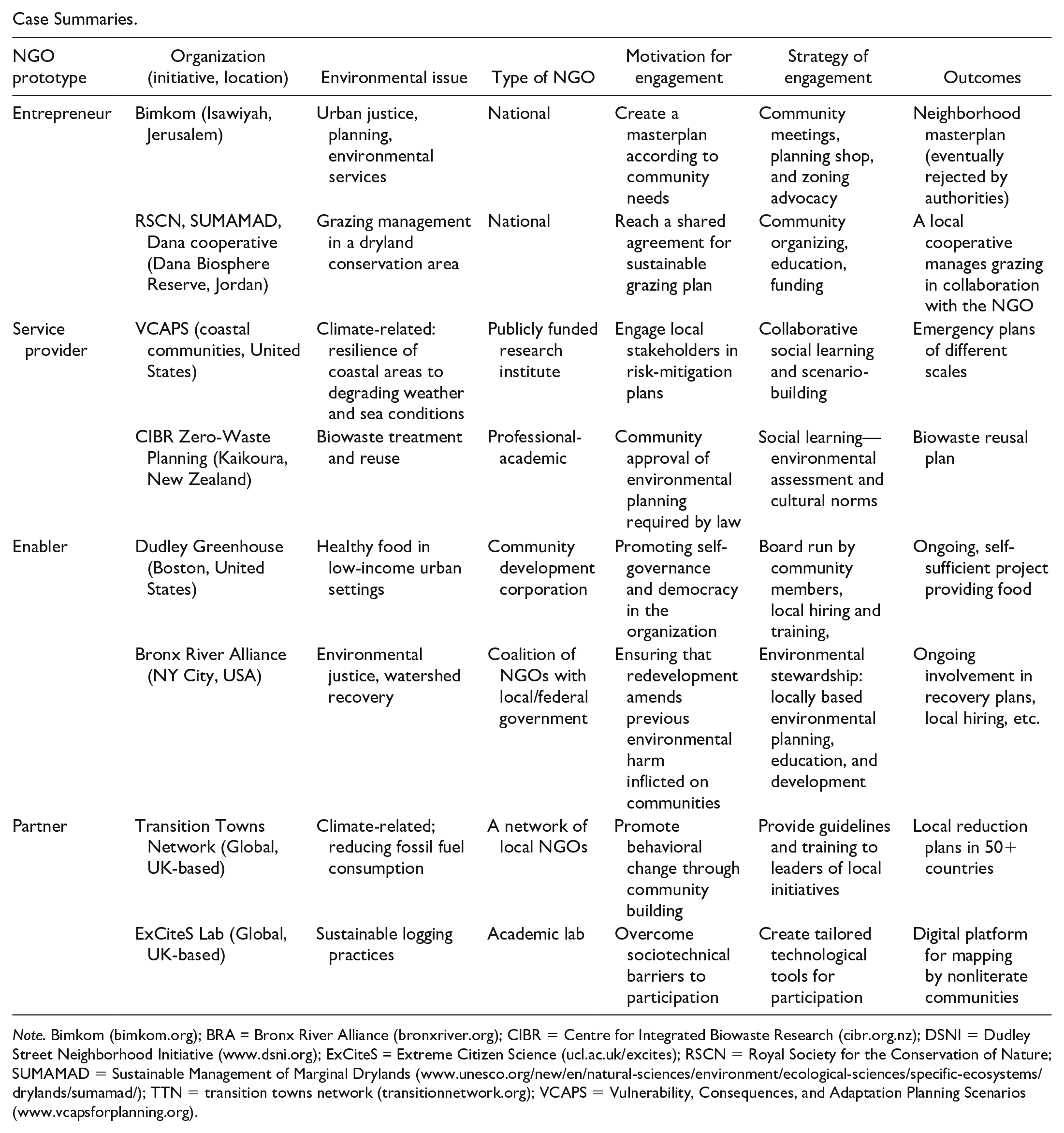
| NGO prototype | Organization (initiative, location) | Environmental issue | Type of NGO | Motivation for engagement | Strategy of engagement | Outcomes |
|---|---|---|---|---|---|---|
| Entrepreneur | Bimkom (Isawiyah, Jerusalem) | Urban justice, planning, environmental services | National | Create a masterplan according to community needs | Community meetings, planning shop, and zoning advocacy | Neighborhood masterplan (eventually rejected by authorities) |
| RSCN, SUMAMAD, Dana cooperative (Dana Biosphere Reserve, Jordan) | Grazing management in a dryland conservation area | National | Reach a shared agreement for sustainable grazing plan | Community organizing, education, funding | A local cooperative manages grazing in collaboration with the NGO | |
| Service provider | VCAPS (coastal communities, United States) | Climate-related: resilience of coastal areas to degrading weather and sea conditions | Publicly funded research institute | Engage local stakeholders in risk-mitigation plans | Collaborative social learning and scenario-building | Emergency plans of different scales |
| CIBR Zero-Waste Planning (Kaikoura, New Zealand) | Biowaste treatment and reuse | Professional-academic | Community approval of environmental planning required by law | Social learning—environmental assessment and cultural norms | Biowaste reusal plan | |
| Enabler | Dudley Greenhouse (Boston, United States) | Healthy food in low-income urban settings | Community development corporation | Promoting self-governance and democracy in the organization | Board run by community members, local hiring and training, | Ongoing, self-sufficient project providing food |
| Bronx River Alliance (NY City, USA) | Environmental justice, watershed recovery | Coalition of NGOs with local/federal government | Ensuring that redevelopment amends previous environmental harm inflicted on communities | Environmental stewardship: locally based environmental planning, education, and development | Ongoing involvement in recovery plans, local hiring, etc. | |
| Partner | Transition Towns Network (Global, UK-based) | Climate-related; reducing fossil fuel consumption | A network of local NGOs | Promote behavioral change through community building | Provide guidelines and training to leaders of local initiatives | Local reduction plans in 50+ countries |
| ExCiteS Lab (Global, UK-based) | Sustainable logging practices | Academic lab | Overcome sociotechnical barriers to participation | Create tailored technological tools for participation | Digital platform for mapping by nonliterate communities |
Note. Bimkom (bimkom.org); BRA = Bronx River Alliance (bronxriver.org); CIBR = Centre for Integrated Biowaste Research (cibr.org.nz); DSNI = Dudley Street Neighborhood Initiative (www.dsni.org); ExCiteS = Extreme Citizen Science (ucl.ac.uk/excites); RSCN = Royal Society for the Conservation of Nature; SUMAMAD = Sustainable Management of Marginal Drylands (www.unesco.org/new/en/natural-sciences/environment/ecological-sciences/specific-ecosystems/drylands/sumamad/); TTN = transition towns network (transitionnetwork.org); VCAPS = Vulnerability, Consequences, and Adaptation Planning Scenarios (www.vcapsforplanning.org).
Acknowledgements
The authors would like to thank Eran Feitelson and Hagit Naali-Josep for their contribution to early phases of this project. The Society for Protection of Nature in Israel (SPNI) sponsored the workshop on public participation where the seeds of this article budded. We received valuable comments on an earlier version from participants in the Innovation in Climate Governance (INOGOV) workshop (Bordeaux, 2017). Finally, we thank three anonymous reviewers and NVSQ’s area editor Michael Meyer for their vital advice and useful comments.
Declaration of Conflicting Interests
The author(s) declared no potential conflicts of interest with respect to the research, authorship, and/or publication of this article.
Funding
The author(s) received no financial support for the research, authorship, and/or publication of this article.
