



Abstract
The nature of the relationship between the time people spend on paid work and volunteering remains debated in the social sciences. Time constraint theory suggests a negative relationship because people can allocate only as much time to volunteering as their work responsibilities permit. However, social integration theory suggests a more complex inverse U-shaped relationship because paid work not only limits people’s free time but also plays a key role in their social integration. Departing from these competing theories, this study uses two-wave panel data from Denmark to examine the relationship between hours of paid work and volunteering. In support of time constraint theory, the results suggest that hours of paid work have a significant negative effect on the total number of hours that people spend volunteering, not mainly because paid work hours affect people’s propensity to volunteer but because they affect the number of hours that volunteers contribute.
Keywords
The nature of the relationship between the time people spend on paid work and the time they spend volunteering remains debated in social sciences. Two competing theories dominate the literature. Time constraint theory suggests a negative relationship because people can only allocate as much time to volunteering as their work responsibilities permit (Freeman, 1997; Robinson et al., 2016). However, social integration theory emphasizes that paid work not only limits people’s free time but also plays a key role in their social integration. On these grounds, social integration theory suggests a more complex inverse U-shaped relationship because people who work part-time can, unlike the unemployed, enjoy the social integration benefits of labor market participation but without experiencing the time constraints that full-time workers do (Musick & Wilson, 2008; Rotolo & Wilson, 2007).
The debate between the two competing theories has yet to be settled by sufficiently persuasive empirical evidence. With two strong exceptions (Rotolo & Wilson, 2007; Wiertz & Lim, 2019), the previous evidence comprises studies that use cross-sectional or pooled cross-sectional data. The estimates from these studies are most likely uninformative about the causal effect of hours of paid work on volunteering because they cannot address the bias that arises as people’s current participation in volunteering is related to past participation in volunteering. Compelling evidence thus suggests that people who have volunteered in the past are much more likely to volunteer in the present, irrespective of other factors, such as current workload, either because people form a habit of volunteering or because unobserved individual characteristics are associated with both past and present volunteer participation (Dawson et al., 2019; Janoski et al., 1998; Smith & Wang, 2016; Wilson, 2000). An example of such an individual characteristic that might confound the relationship between hours of paid work and volunteering is the ability to cope with time pressure, which psychologists have found to vary greatly between individuals (Szollos, 2009).
Another drawback of existing research is that many studies examine only the relationship between hours of paid work and a binary variable that indicates whether the individual has participated in volunteering but not for how many hours. In fact, the study by Rotolo and Wilson (2007) appears to be the only existing sociological study that has examined the relationship between the time people spend on paid work and the time they spend volunteering, using panel data. The study by Rotolo and Wilson (2007) produced surprisingly strong evidence against time constraint theory based on a panel of American women. Among the employed women, the study counterintuitively found that those who worked overtime (more than 40 hr per week) were more likely to volunteer and volunteered more hours than those who worked a standard work week (Rotolo and Wilson, 2007). In his highly influential review of the literature on volunteerism, Wilson (2012) also states more generally that “. . . among full-time workers, volunteer hours increase as paid work hours increase” (p. 188). Findings such as these have made it commonplace in sociology to assert “. . . that the relationship between the time spent on paid work and volunteer work does not always reflect the trade-offs implied in a zero-sum game” (Marshall & Taniguchi, 2012, p. 215). However, as the failure to control for important possible confounders most likely leads to upward biased estimates of the effect of hours of paid work on volunteering, sociologists’ inclination to reject time constraint theory rests on a fragile empirical foundation. This methodological pitfall was recognized by Rotolo and Wilson (2007), who speculated that their counterintuitive findings might have been due to the fact that flexible working arrangements were not controlled for.
In this study, I contribute to the literature by providing new evidence on the effect of hours of paid work on volunteering. To address the shortcomings of previous research, I draw on two-wave panel data from the Danish Volunteer Survey that includes information about the availability of flexible working arrangements. An additional attractive feature of these data is that they have been enriched with information from Danish administrative registers that allows me to construct highly reliable socioeconomic control variables, including educational level, annual earnings, and occupational prestige.
Hours of Paid Work and Volunteering: Evidence to Date
This section reviews previous sociological evidence on the relationship between hours of paid work and volunteering. The review shows that previous evidence is almost exclusively based on data from the United States. Moreover, the results from previous research seem to depend on the data, measures, and methods that have been used in the particular studies. Table 1 summarizes the review of the evidence to date.
Summary of Previous Evidence on the Relationship Hours of Paid Work and Volunteering.
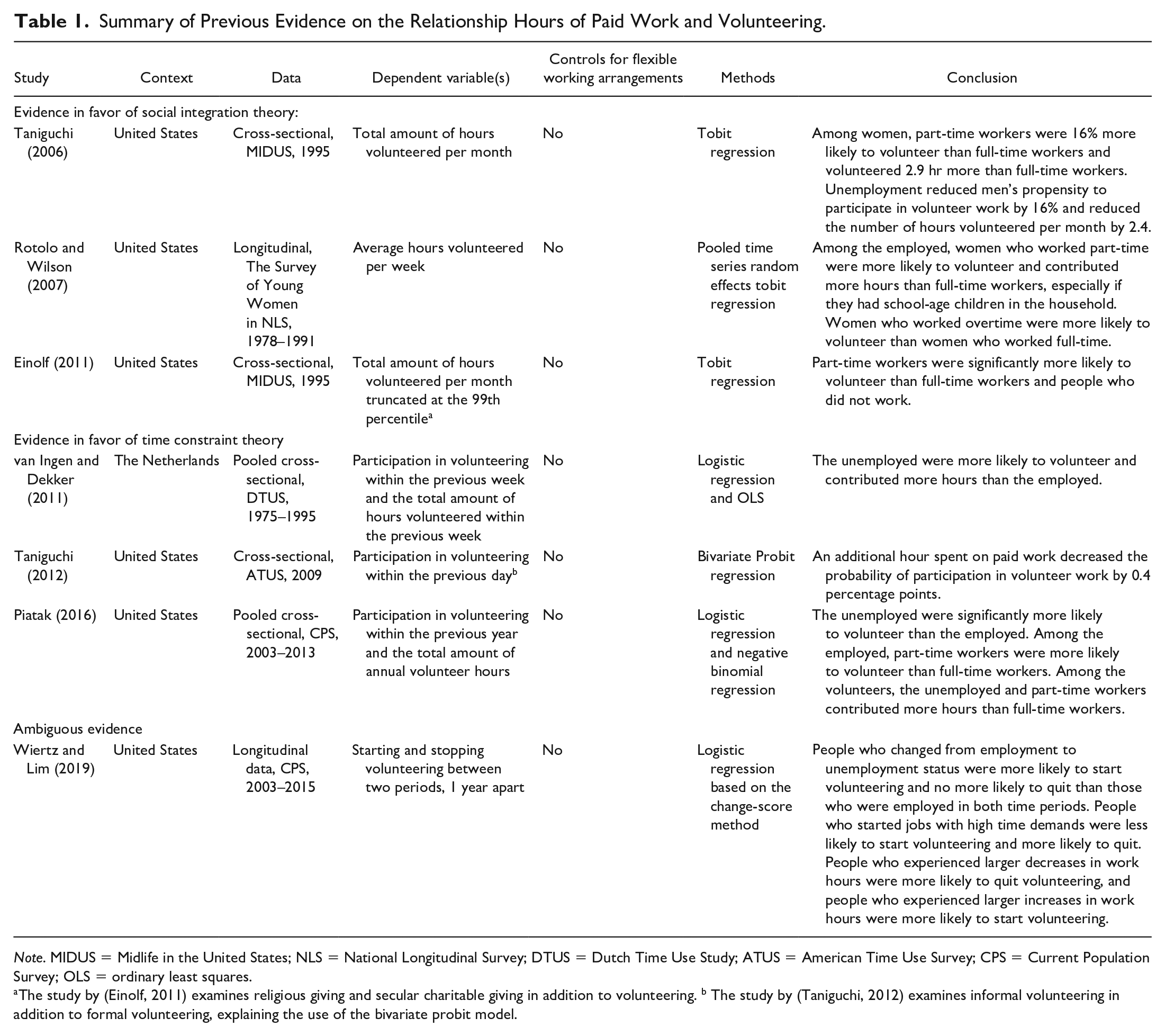
Note. MIDUS = Midlife in the United States; NLS = National Longitudinal Survey; DTUS = Dutch Time Use Study; ATUS = American Time Use Survey; CPS = Current Population Survey; OLS = ordinary least squares.
The study by (Einolf, 2011) examines religious giving and secular charitable giving in addition to volunteering. b The study by (Taniguchi, 2012) examines informal volunteering in addition to formal volunteering, explaining the use of the bivariate probit model.
Evidence in Favor of Social Integration Theory
Evidence in favor of social integration theory mostly comprises earlier studies conducted in the 2000s, which were based on tobit regression. Tobit regression relies on the strong assumption that the same factors affect participation in volunteering and time use in the same direction and with the same magnitude (Forbes & Zampelli, 2011). With the exception of Rotolo and Wilson (2007), these studies drew on cross-sectional data. In the following, I discuss the data, methods, and results of the particular studies in greater detail.
Taniguchi (2006) drew on data from the Midlife in the United States (MIDUS) survey and used a tobit model to examine the links between employment, family characteristics, and volunteer work for men and women. The results indicate that, among women, part-time workers were 16% more likely to volunteer than full-time workers and volunteered 2.9 hr more hours per month. However, for men, the study found no significant differences in volunteering efforts between part-time, full-time, or overtime workers. The study found that unemployment reduces men’s propensity to participate in volunteer work by 16% and reduces the number of hours volunteered per month by 2.4 hr. In another cross-sectional study, Einolf (2011) also drew on data from the MIDUS survey and used a tobit model to examine gender differences, including employment characteristics, in the correlates of volunteering. The study found that part-time workers volunteered significantly more than both the unemployed and full-time workers. The study also found that the differences were more pronounced for men than for women.
The only sociological study that has provided evidence in favor of social integration theory with panel data is that of Rotolo and Wilson (2007), who drew on three waves of survey data collected for the same individuals in 1978, 1988, and 1991 from “the Survey of Young Women” in “the National Longitudinal Survey of Labor Market Experience” (NLS). Unfortunately, the study did not utilize the panel component of the data to address unobserved individual heterogeneity because it was argued that the 10-year gap between the first two data collections was too long to do so. Instead, Rotolo and Wilson (2007) used a random effects tobit model that, in addition to the usual tobit regression assumptions, relies on the strong assumption that unobserved individual characteristics are uncorrelated with hours of paid work and volunteering. The study found that homemakers were the most likely to volunteer. However, among the employed, the study found that women who worked part-time were most likely to volunteer. The study also counterintuitively found that women who worked overtime were more likely to volunteer and contributed more hours than women who worked full-time, providing particularly strong evidence against time constraint theory.
Evidence in Favor of Time Constraint Theory
The evidence in favor of time constraint theory comprises more recent studies conducted in the 2010s based on hurdle or two-part models that use separate models for participation and time use. Unfortunately, all these studies drew on cross-sectional or pooled cross-sectional data.
Taniguchi (2012) drew on cross-sectional data from the 2009 American Time Use Survey (ATUS) and a bivariate probit model to examine the determinants of formal and informal volunteering. The study found that an additional hour spent on paid work decreases the probability of participation in formal volunteer work by 0.4 percentage points. In a pooled cross-sectional study, van Ingen and Dekker (2011) drew on five waves of pooled cross-sectional survey data from the Dutch Time Use Study (DTUS) in the 1975 to 2005 period and used logistic regression to predict volunteer participation and ordinary least squares (OLS) to predict volunteer hours. The study found that the unemployed were more likely to volunteer and contributed more hours than the employed. Another pooled cross-sectional study by Piatak (2016) drew on a large pooled cross-sectional data set of monthly data from the period 2003 to 2013 obtained from the Current Population Survey (CPS). Using logistic regression to predict participation and a negative binomial regression to predict volunteers’ contributions of time, the study found that, before any control variables were added, the unemployed were significantly less likely to volunteer compared with the employed. However, when various factors were controlled for in the multivariate analysis, the unemployed were significantly more likely to volunteer than the employed. However, among the employed workers, the study found that part-time workers were more likely to volunteer than full-time workers. Finally, the study found that among the volunteers, the unemployed and part-time workers contributed more hours than full-time workers, with the unemployed contributing the most time.
Ambiguous Evidence
A very recent panel study is Wiertz and Lim (2019), who drew on the CPS in the 2002 to 2015 period to construct a large panel data set. Unfortunately, the study examined only the relationship between employment states and a binary variable that indicates whether or not the individual volunteers but not for how many hours. However, the study used the change-score method in which the difference in volunteer status between two time periods is regressed on the explanatory variables to address unobserved heterogeneity between individuals. The study, however, obtained ambiguous results regarding the merits of the social integration and time constraint theories. Supporting time constraint theory, the study found that people who changed from employment to unemployment status were more likely to start volunteering and not more likely to quit than those who were employed in both time periods. Moreover, the study found that starting jobs with high time demands makes individuals less likely to start volunteering and more likely to quit. However, the study also found that larger decreases in work hours were associated with a higher propensity to quit volunteering. Curiously, it also found that larger increases in work hours were associated with a higher propensity to start volunteering.
The Role of the Availability of Flexible Working Arrangements
One possible explanation for the counterintuitive results that have been obtained in previous studies is that people who work long paid work schedules are more likely to enjoy flexible working arrangements than people who work shorter schedules (Golden, 2001). This could explain why it has been observed that large increases in paid work hours positively affect the decision to start to volunteer (Wiertz & Lim, 2019) and that volunteers who work overtime contribute more hours than volunteers who work full-time (Rotolo & Wilson, 2007).
The term “flexible working arrangements” refers to a number of different work characteristics. However, broadly, it refers to spatial flexibility, that is, flexibility in where to work, and temporal flexibility, that is, flexibility in when to work (Rau & Hyland, 2002). Empirical research suggests that the availability of flexible working arrangements is becoming increasingly common across workplaces in Europe (Anttila et al., 2015).
Despite the fact that the availability of flexible working arrangements is a likely confounder of the relationship between hours of paid work and volunteering, none of the previous studies control for it. However, a few studies have examined the direct effect of flexible working arrangements on volunteering. Freeman (1997) drew on the 1989 CPS and the Independent Sector’s Gallup Survey of Giving and Volunteering and found that people in the United States who enjoyed flexible working arrangements were more likely to participate in volunteering than people who did not. However, another study by Gomez and Gunderson (2003), who drew on the 9th cycle of the Canadian General Social Survey (GSS), found that only some components of flexible working arrangements affected the likelihood of participation in volunteering. For example, the study found that the ability to work from home significantly increased the probability of volunteer participation, whereas the availability of flextime did not. Unfortunately, none of these studies addressed the relationship between flexible working arrangements and the amount of time spent volunteering. However, a study based on the MIDUS survey found that people with a high degree of job autonomy (measured by, inter alia, whether the individual controls his or her own work hours) contributed more hours to volunteer work than people without job autonomy (Marshall & Taniguchi, 2012).
The Danish Context
Religious organizations have historically been vital in the provision of social welfare. However, in Denmark, the development of “the Scandinavian welfare model” characterized by a large tax-financed public sector, generous transfers, and a high degree of economic redistribution means that there is less need for religious organizations to provide help for socially marginalized people because this role is assumed by the state. Consequently, a much smaller proportion of volunteers in Denmark are active in religious organizations and in secular social service organizations than in countries characterized by a more liberal welfare regime such as the United States. Instead, the majority of volunteers in Denmark (and the other Scandinavian countries) is active within culture, sports, and leisure organizations (Qvist et al., 2019). These contextual differences suggest that previous evidence that mostly derive from the United States regarding the relationship between work hours and volunteering might not readily transfer to the Danish case.
Data, Measures, and Analytical Strategy
Data
This study draws on the Danish Volunteer Survey, which comprises two-wave panel data of the Danish population aged 16 to 85 years (Fridberg & Henriksen, 2014). Both waves of data collection were carried out through telephone interviews and included personal follow-up interviews with respondents who could not be reached by telephone. One attractive feature of the Danish Volunteer Survey is that it is possible to merge the data with Danish register data at the individual level. This made it possible to construct important socioeconomic covariates, including educational level, annual earnings, and occupational prestige, from highly precise and reliable register data information. This merger is possible because each citizen in Denmark is required to hold a unique personal identification number in the Danish Civil Registration System (Pedersen, 2011). After ethical approval of the research project from the Danish Data Protection Agency and Statistics Denmark, anonymized personal identification numbers were used to merge the survey information with relevant information from the administrative registers, which Statistics Denmark makes available for researchers through remote access servers.
The first wave of survey data was collected as a simple random sample of the Danish population and contains 3,134 respondents, with an exceptionally high response rate of 75%. However, the panel component suffered some attrition. Of the 3,134 initially surveyed individuals, 1,981 (64%) agreed to participate again in the second round of data collection in 2012 (Hermansen, 2018). For the analysis, I restricted the sample to include only people who were aged 24 to 65 years in 2012 because these respondents were of working age and were old enough to participate in the first round of data collection. This age restriction reduces the sample from 1,981 individuals to 1,586 individuals. After additionally removing individuals missing data for any of the variables included in the analysis, I ultimately obtain an analysis sample of 1,578 individuals, of whom 1,166 were active in the paid labor market in 2012.
To investigate the causes of attrition in the analysis sample, I computed a variable that was defined as 1 if the respondent remained in the panel in both waves and 0 otherwise. I then used this variable as an outcome variable in a logistic regression (see Online Table A1). The logistic regression revealed that the likelihood of remaining in the panel was significantly higher for the higher educated, women, older adults, and people who volunteered in 2004. To examine potential bias caused by this selective attrition, I used logistic regression to calculate each individual’s probability of remaining in the sample. These estimated probabilities were then used to form inverse probability weights. Inverse probability weights can be used to address attrition bias because they assign a higher weight to the outcome of an individual with a lower probability of remaining in the panel and conversely assign a lower weight to the outcome of an individual with a higher probability of remaining in the panel. The estimates presented in the article are from unweighted models that produce more efficient estimates than weighted models (Winship & Radbill, 1994). The parameter estimates of the effect of hours of paid work on volunteering are quite similar across the weighted and unweighted models (for weighted results, see Online Tables A2 and A3).
Outcome Variables: Yearly and Monthly Hours of Volunteering
The study uses two dependent variables: yearly and monthly hours of volunteering. In the survey, the respondent was first asked to indicate whether he or she had volunteered within 14 different areas during the past year. The areas correspond to the International Classification of Nonprofit Organizations (Salamon & Anheier, 1992) and are as follows: culture, sports, hobby, education, health, social services, environment, housing and community, unions and work organizations, advice and legal assistance, political parties, international organizations, religion, and other. If the individual indicated having volunteered within a particular area during the past year, he or she was asked to indicate for how many hours. The outcome variable, yearly volunteering, was then constructed as the sum of the number of volunteer hours that the individual reported having contributed within each of the 14 areas during the past year. Subsequently, the respondent was asked to indicate whether he or she had also volunteered within the same 14 different areas during the past month. If the individual indicated having volunteered within a particular area during the past month, he or she was asked to indicate for how many hours. The outcome variable, monthly volunteering, was then constructed as the sum of the number of volunteer hours that the individual reported having contributed within each of the 14 areas during the past month.
I examine both yearly and monthly hours of volunteering because both measures have advantages and disadvantages. An advantage of yearly volunteer hours is that volunteering is usually measured during the past year, allowing direct comparison with findings from previous studies. However, an important disadvantage of using yearly volunteering is that people might shift jobs and workloads during such a relatively long period. Consequently, I also examine monthly volunteer hours, and job and workload shifts are less likely within this short period.
A small number of respondents reported having participated in volunteering during the past year or month but not for how many hours. For these respondents (18 yearly volunteers and five monthly volunteers), I imputed a predicted number of volunteer hours based on a negative binomial regression model.
Explanatory Variable: Hours of Paid Work
The variable weekly work hours is based on information from the survey data that captures weekly work hours with a top coding at 80 hr per week. In the analysis of the whole sample, hours of paid work is set to zero for people who are out of the labor force, unemployed, or enrolled in education.
Control Variables
“Educational level” is measured based on information from administrative registers. It is measured as highest completed education in five levels: (a) primary school, (b) vocational training, (c) short-cycle tertiary, (d) medium-cycle tertiary, and (e) long-cycle tertiary.
“Self-rated health” is an ordinal scale variable based on the survey question, “How is your health in general?” with answers ranging on a 5-point scale ranging from 1 (very bad) to 5 (very good).
“Social networks” is an ordinal scale variable based on survey questions that measures the respondent’s frequency of contact with each of the following groups: “family and relatives,” “neighbors and others in the local community,” “friends and acquaintances outside of the local community,” “former colleagues,” “present colleagues,” and “others” with answer categories that range from no contact to every day.
“Religiosity” is an ordinal scale variable based on the survey question, “How important is religion in your life?” with answers that range among four categories from not important at all to very important.
“Children in the household” is based on information from the survey and is a categorical variable with four categories based on the survey data. The four categories include (a) no children, (b) preschool children (aged 0–5 years), (c) schoolchildren (aged 6–16 years), and (d) both types of children.
“Gender and age” is based on register data information. Age is included with a squared term because the relationship between age and volunteering is usually found to be inversely U-shaped (van Ingen, 2008).
“Volunteer in 2004” is an indicator equal to 1 if the individual indicated having volunteered within at least one of the 14 different areas during the past year in the first wave of data collection and 0 otherwise.
“Annual earnings” is measured in tens of thousands of Danish kroner (DKK) based on information from administrative registers.
“Flexible working arrangements” is based on survey data information and is used in the employed-only sample. It is measured by a categorical variable that captures the degree of spatial and temporal flexibility that the respondents report characterizes their current job: (a) regular work hours, (b) flexible work hours, (c) flexible work hours with the ability to work from home, and (d) flexible work hours with the ability to work from home and full autonomy in deciding when to work.
“Occupational prestige” is created based on register data information about the individual’s occupation coded according to the sub-major groups in the International Standard Classification of Occupations from 2008 (ISCO-08) and is used in the employed-only sample. I used the sub-major groups in the ISCO to compute the Standard International Occupational Prestige Scale (SIOPS; Ganzeboom and Treiman, 1996, 2010).
“Volunteer area indicator variables” are included because there are large differences in levels of hours of volunteering across areas of volunteering. The differences in levels of hours of volunteering are probably related to unobserved contextual differences between the areas of volunteering; for example, in some areas, it is more common to also be a member of the organization for which one volunteers than in other areas and members typically assume more time-consuming roles and tasks within organizations (Qvist et al., 2018).
Table 2 presents descriptive statistics for all variables included in the analysis.
Descriptive Statistics.
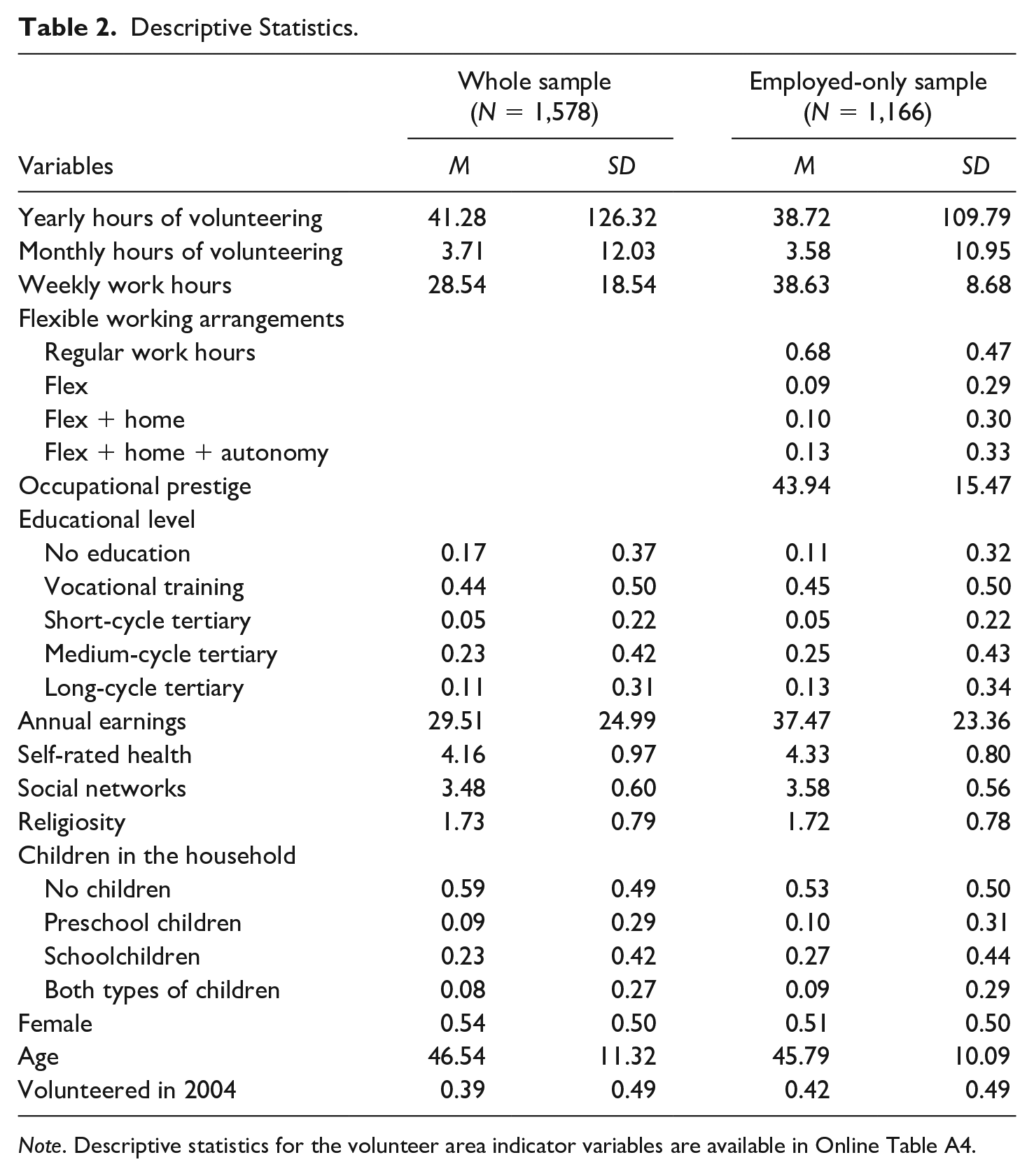
Note. Descriptive statistics for the volunteer area indicator variables are available in Online Table A4.
Analytical Strategy
The outcome variables, yearly and monthly hours of volunteering, are count variables because they can only take nonnegative integer values. Moreover, they are characterized by the presence of many zero values because a large proportion of the population contribute 0 hr of volunteering (62.6% and 73.1% for yearly and monthly hours of volunteering, respectively). Furthermore, the positive observations of hours of volunteering are skewed to the right because the majority of volunteers contributes relatively few hours, whereas a small minority of volunteers contribute relatively many hours.
To address the presence of many zeroes and skewness, I used a hurdle model, which is the count data analog of a two-part model (Wooldridge, 2010, p. 691). In the first part, a logistic regression was used to predict whether the individual had contributed more than 0 hr during the past year and month. In the second part, a negative binomial regression model was used to predict yearly and monthly hours of volunteering among those who had volunteered during the past year and month, respectively. A negative binomial regression model is a generalized linear model, with the logarithm as the link function and a negative binomial distribution function. The negative binomial distribution was used because hours of volunteering is a count outcome that is overdispersed with respect to a Poisson distribution that assumes the variance is equal to the mean. The Stata command “twopm” was used to compute predicted values of total volunteer hours and average marginal effects across both parts of the hurdle model (Belotti et al., 2015).
The hurdle model is justified by assuming that individuals engage in a two-step sequential decision process. First, they decide whether to volunteer and subsequently for how many hours. Thus, unlike the tobit model that relies on a single equation, the two-equation hurdle model does not assume that the explanatory variables affect participation and time used in the same direction and with the same magnitude because the participation and the amount decision are modeled separately (Forbes & Zampelli, 2011; Qvist, 2015).
A key identification assumption of the hurdle model is that the error terms of the participation and amount equations are uncorrelated. If the error terms are correlated, it indicates that one or more omitted variables affect both the participation and the amount decision. To examine the possible presence of such correlation, I have used Heckman sample selection models, which allow for correlation between the error terms (see Online Tables A5 and A6). Unlike the hurdle model, the Heckman sample selection model requires an exclusion restriction (i.e., a variable that appears in the selection equation but not in the amount equation) to provide credible estimates. I therefore excluded the social network variable from the amount equation because social network ties possibly only affects the participation decision but not the amount decision as it solely affects the chances of being asked to join. The Heckman sample selection models provide no evidence of correlation between the error terms. This supports the use of the simpler hurdle model that assumes uncorrelated errors. However, it should be noted that the Heckman sample selection models are based on the untestable assumption that the assumption behind the exclusion restriction is valid.
To exploit the nature of the panel data, I use the regressor variable approach in which the outcome variable measured at a previous time point is controlled for along with the other control variables (Allison, 1990; Taris, 2000). This approach addresses bias that arises because people’s current participation in volunteering is related to their participation in the past, either because volunteer participation in the past has a causal effect on present volunteer participation through habit formation (Janoski et al., 1998) or because participation in both time periods is caused by time-stable unobserved individual characteristics, such as the ability to cope with time pressure. A highly informative recent study suggests that both mechanisms are important explanations for the persistence in people’s propensity to volunteer over time (Dawson et al., 2019). In cases where there are grounds to assume that current observations of the outcome are, at least in part, due to a causal effect of past observations of the outcome, the regressor variable approach to panel data analysis is more appropriate than change-score methods (Allison, 1990; Morgan & Winship, 2015).
In the analysis, I present two sets of results for both yearly and monthly hours of volunteering: one set of results for the whole sample and one set of results for the employed-only sample. The reason for this is twofold. First, we should only expect to find an inverse U-shaped relationship based on social integration theory if the whole sample, including those who work 0 hr of paid work, is included. Second, some control variables, occupational prestige and the availability of flexible working arrangements, are relevant only in the employed-only sample.
Results
To test whether the relationship between hours of paid work and volunteering is negative, as predicted by time constraint theory, or inverse U-shaped, as predicted by social integration theory, I carried out two sets of analyses. First, I estimated the hurdle model with quadratic terms for weekly work hours. However, the quadratic terms were found to be nonsignificant in all the models, providing no evidence of an inverse U-shaped relationship (see Online Tables A7 and A8). Second, as an additional check, I estimated the hurdle model with hours of paid work coded into six grouped categories: (a) enrolled in education, (b) out of the labor force, (c) unemployed, (d) working part-time (1–30 hr), (e) working full-time, (30–40 hr), and (f) working overtime (40–80 hr). The results from these models suggested that none of the grouped categories of hours of paid work had a significant effect on the likelihood of having volunteered during the past year or month. Among the yearly volunteers, the results suggested that the unemployed spend significantly more hours on their voluntary activities than volunteers who work full-time or overtime in their paid jobs. Among monthly volunteers, it was also found that unemployed volunteers spend more hours on their voluntary activities than those who work overtime (see Online Tables A9 and A10). In sum, neither the analysis that includes quadratics nor the analysis that includes hours of paid work in six groups provide any evidence of an inverse U-shaped relationship between hours of paid work and volunteering.
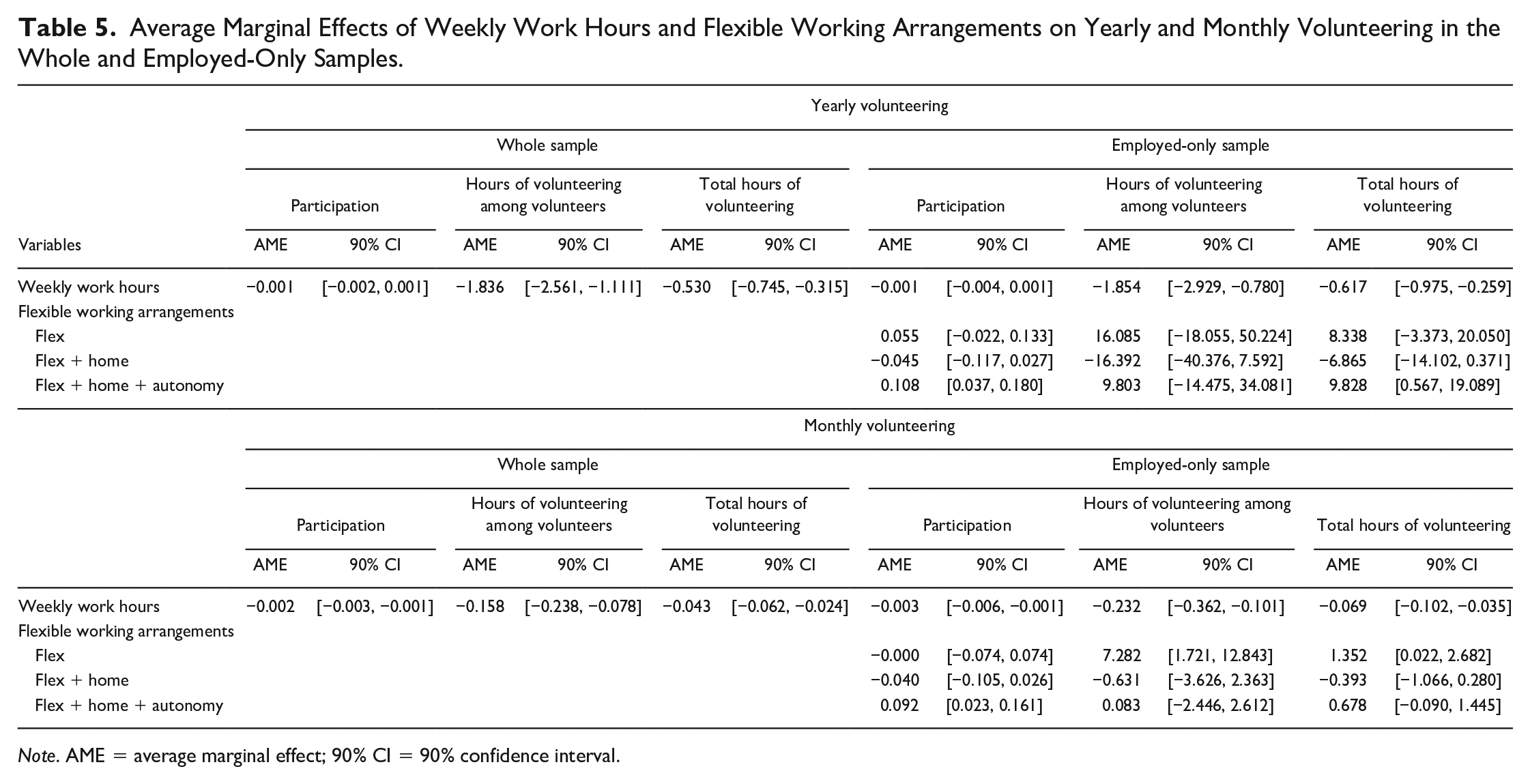
Tables 3 and 4 therefore present the results of the hurdle models that predict yearly and monthly hours of volunteering in the whole and the employed-only samples, using a linear term for weekly work hours along with the control variables. Table 5 presents the average marginal effect (AME) of weekly work hours and the availability of flexible working arrangements on the probability of participation, hours of volunteering among volunteers, and total hours of volunteering in the whole sample and the employed-only sample based on the regressions in Tables 3 and 4.
Hurdle Model Predicting Yearly Hours of Volunteering in the Whole and Employed-Only Samples.
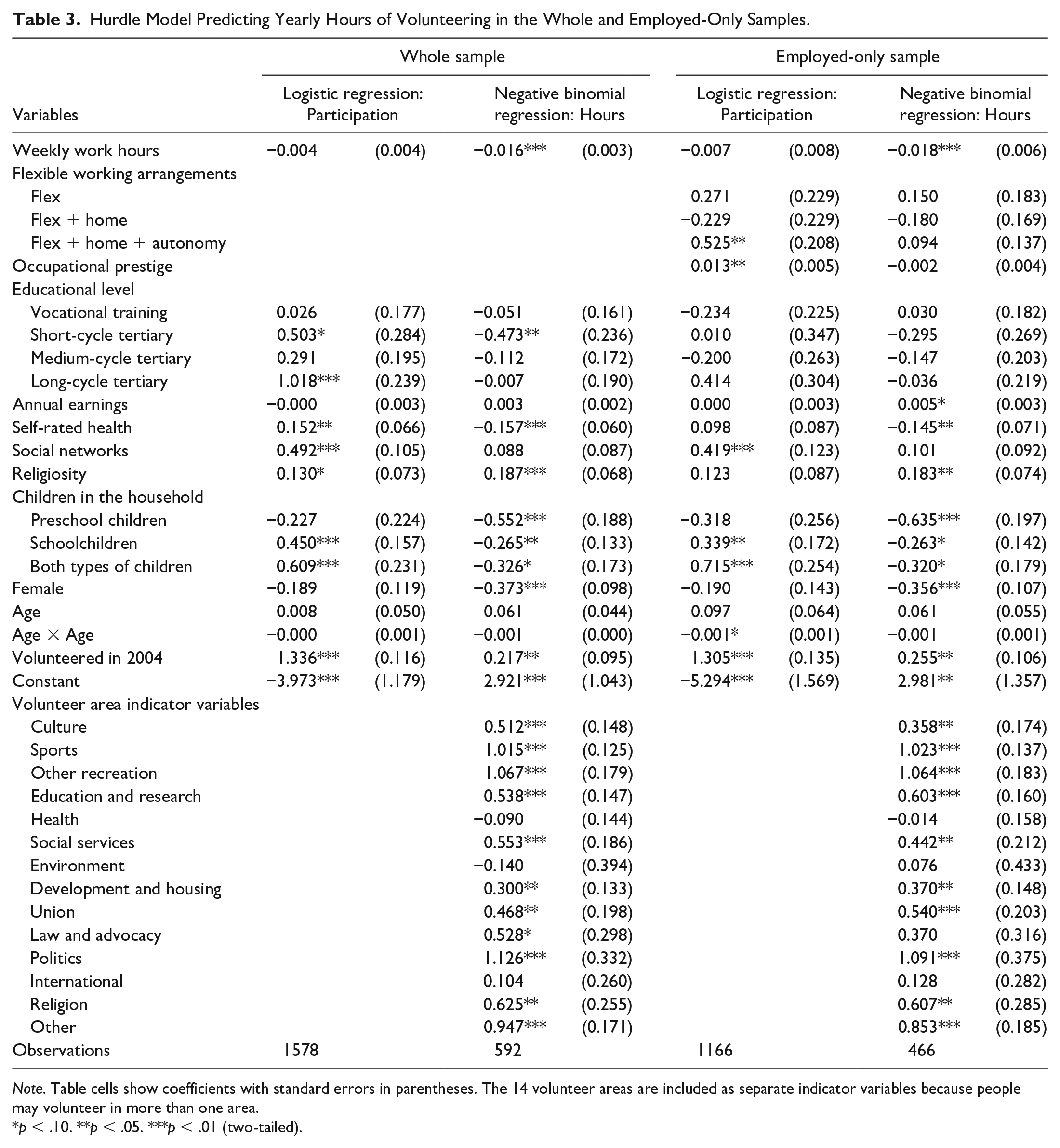
Note. Table cells show coefficients with standard errors in parentheses. The 14 volunteer areas are included as separate indicator variables because people may volunteer in more than one area.
p < .10. **p < .05. ***p < .01 (two-tailed).
Hurdle Model Predicting Monthly Hours of Volunteering in the Whole and Employed-Only Samples.
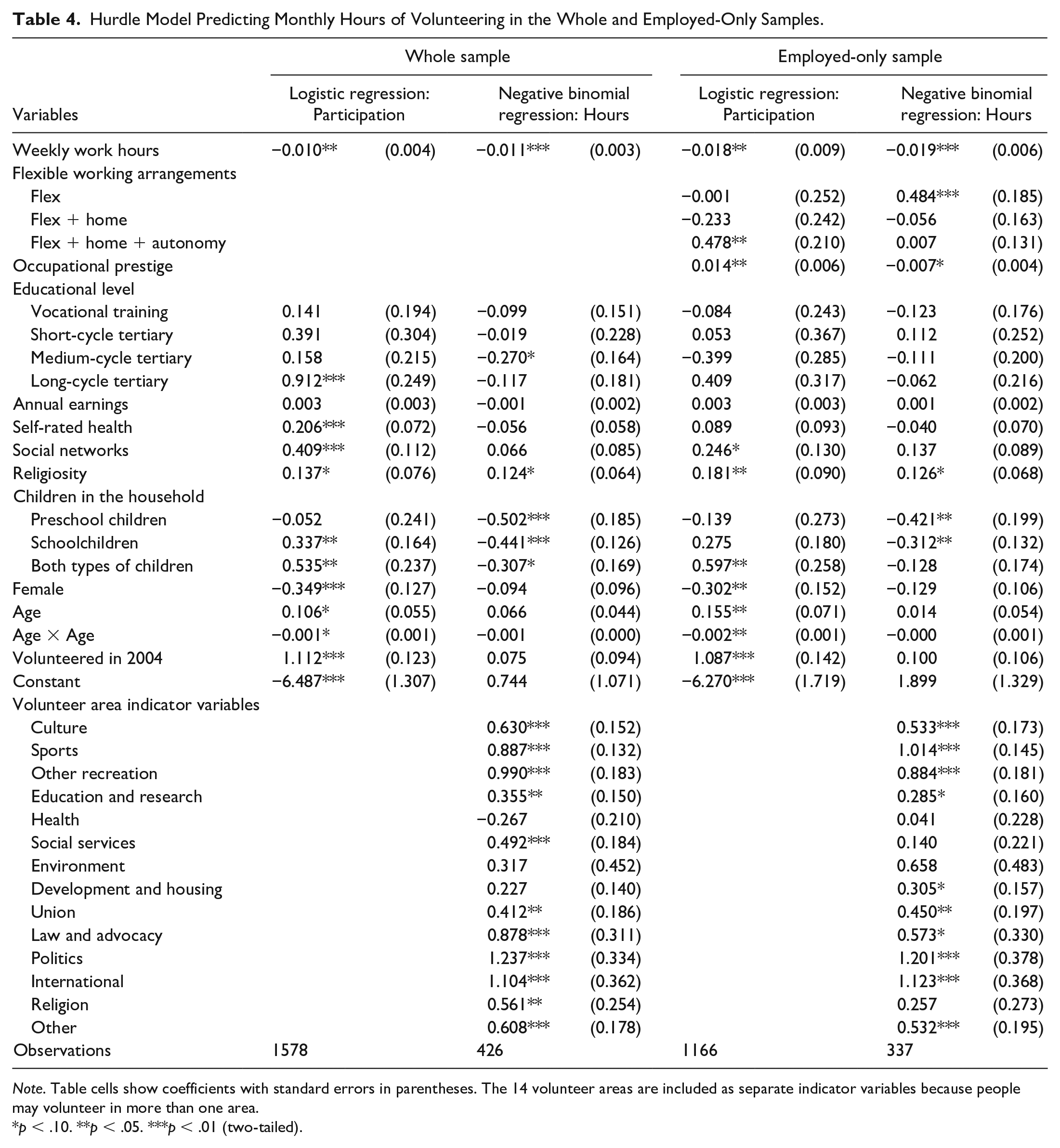
Note. Table cells show coefficients with standard errors in parentheses. The 14 volunteer areas are included as separate indicator variables because people may volunteer in more than one area.
p < .10. **p < .05. ***p < .01 (two-tailed).
Average Marginal Effects of Weekly Work Hours and Flexible Working Arrangements on Yearly and Monthly Volunteering in the Whole and Employed-Only Samples.
Note. AME = average marginal effect; 90% CI = 90% confidence interval.
First, we inspect the AME of weekly work hours on total hours of volunteering during the past year and month. Considering volunteering during the past year, the AMEs suggest that one additional weekly work hour decreases total hours of volunteering by approximately 0.530 hr (≈32 min) in the whole sample (90% confidence interval [CI] = [−0.745, −0.315]) and by 0.617 hr (≈37 min; 90% CI = [−0.975, −0.259]) in the employed-only sample in which flexible working arrangements and occupational prestige are controlled for. Considering volunteer hours during the past month, the AMEs suggest that an additional weekly work hour decreases total hours of volunteering by approximately 0.043 hr (≈3 min) in the whole sample (90% CI = [−0.062, −0.024]) and by 0.069 hr (≈4 min; 90% CI = [−0.102, −0.035]) in the employed-only sample. In sum, the results support the time constraint, irrespective of whether we consider hours of volunteering during a longer period (the past year) or a shorter period (the past month) and irrespective of whether we consider the whole sample or the employed-only sample.
Inspecting the AMEs of weekly work hours on the probability of participation and on hours of volunteering among the volunteers, we learn that the negative effect of weekly work hours on total hours of volunteering is mainly due to its negative effect on the number of hours that the volunteers contribute. In fact, the estimated AMEs provide no evidence that weekly work hours affect the likelihood of having volunteered during the past year in either the whole or the employed-only sample. However, weekly work hours do appear to have a modest negative effect on the likelihood of having volunteered during the past month. Thus, the AME suggests that an additional weekly hour of paid work decreases the likelihood of having volunteered during the past month by approximately 0.2 percentage points (90% CI = [−0.003, −0.001] and 0.3 percentage points (90% CI = [−0.006, −0.001]) in the whole and employed-only samples, respectively. However, the upper bounds of the CIs lie extremely close to zero, indicating that the magnitude of the negative effect might be practically zero.
Among those who have volunteered during the past year, the AMEs suggest that an additional hour of paid work decreases volunteering by 1.836 hr (≈1 hr and 50 min; 90% CI = [−2.561, −1.111]) and by 1.854 hr (≈1 hr and 51 min; 90% CI = [−2.929, −0.780]) in the whole and employed-only samples, respectively. Among those who also volunteered during the past month, the AMEs suggest that an additional hour of paid work decreases hours of volunteering by 0.158 hr (≈9 min; 90% CI = [−0.238, −0.078]) and by 0.232 hr (≈14 min; 90% CI = [−0.362, −0.101]) in the whole and employed-only samples, respectively.
The estimates of the effect of weekly work hours on volunteer hours in the above is surrounded by a relatively large degree of uncertainty. This is evident from the relatively wide 90% CIs that surrounds the AMEs. However, the CIs actually disguise the fact that the degree of uncertainty is smallest around the mean number of paid work hours (≈39 hr in the employed-only sample) and greater in both tails of the distribution of paid work hours. The largest degree of uncertainty is found in the lower tail of the distribution, where people work only a small amount of paid work hours. To further aid in the intuitive interpretation of the effect of weekly work hours on hours of volunteering, Figure 1 plots the total predicted yearly and monthly volunteer hours by weekly work hours in the whole and employed-only samples with 90% CIs. The figure naturally corroborates that the average effect of weekly work hours on the yearly and monthly volunteer hours is negative; however, the figure gives a better impression of the large degree of uncertainty that surrounds the estimated effects.

The total predicted yearly and monthly hours of volunteering by weekly work hours in the whole and employed-only samples with 90% confidence intervals.
Finally, we also inspect the AMEs of flexible working arrangements on total hours of volunteering during the past year and month in the employed-only sample. Considering volunteering during the past year, the AMEs suggest that, compared with regular work hours, the highest degree of flexible working arrangements, including the opportunity to work from home and full autonomy in deciding when to work, increases total hours of volunteering by 9.828 hr (≈9 hr and 50 min; 90% CI = [0.567, 19.089]). Considering volunteering during the past month, the point estimate is also positive but barely misses significance. Inspecting the AMEs of the highest degree of flexible working arrangements on the probability of participation and on hours of volunteering among the volunteers, we learn that the positive effect of flexible working arrangements on total hours of volunteering is mainly due to its positive effect probability of participation. Accordingly, having the highest degree of flexible working arrangements increases the likelihood of having volunteered during the past year and month by 10.8 percentage points (90% CI = [0.037, 0.180]) and by 9.2 percentage points (90% CI = [0.023, 0.161]), respectively. However, considering volunteering during the past month, the AMEs actually suggest that flexible working arrangements without the opportunity to work from home and autonomy in when to work increases total volunteer hours by 1.352 hr (≈1 hr and 21 min) [90% CI = [0.022, 2.682]) because it positively affects the number of hours that the volunteers contribute.
Possible Heterogeneity in the Effects and Robustness Checks
To test whether the estimated effects of hours of paid work on the yearly and monthly hours of volunteering are heterogeneous with respect to gender, I tried to include interaction terms. However, these models provided no evidence that the effects of weekly hours of paid work on yearly and monthly hours of volunteering are heterogeneous with respect to gender (see Online Tables A11 and A12). I also tried to include interaction terms between weekly hours of paid work and children in the household. These models provided no evidence that the effects of hours of paid work on yearly and monthly volunteer hours are heterogeneous with respect to having children in the household (see Online Tables A13 and A14). However, the results of these additional analyses should be interpreted with some caution because substantial effect heterogeneity would need to be present for the interaction terms to be significant because of the limited sample sizes.
Finally, to test whether hours of paid work might have a positive effect on hours of volunteering among the volunteers who work full-time, I created a linear spline of work hours with a knot at 37 hr according to the regular work week in Denmark. Diametrically opposed to what is suggested in Wilson (2012), the results indicate that among the volunteers who work full-time or more, an additional hour of paid work per week has a significant negative effect on yearly and monthly volunteer hours in the employed-only sample (see Online Table A15).
Discussion and Conclusion
Departing from time constraint theory and social integration theory, this study set out to examine the relationship between hours of paid work and volunteering, using two-wave panel data enriched with information from administrative registers from Denmark. In support of time constraint theory, the results from a hurdle model suggest that hours of paid work have a significant negative effect on the total number of hours that people spend volunteering, not mainly because paid work hours affect people’s propensity to volunteer but also because they affect the number of hours that volunteers contribute. These results run counter to the social integration theory that is dominant in sociology (Musick & Wilson, 2008; Rotolo & Wilson, 2007; Wilson, 2012). Instead, the results support the time constraint theory that emphasizes that people can allocate as much time to volunteering as their work responsibilities permit (Freeman, 1997; Robinson et al., 2016).
One critical issue that warrants attention is whether the negative effect of work hours on volunteering generalizes to other contexts such as the United States. One concern that challenges the external validity of my findings is that the composition of the voluntary sectors differs widely between Denmark and the United States. In particular, a much smaller proportion of volunteers in Denmark are active within religious organizations and secular social service organizations than in the United States and levels of volunteer hours differ markedly between the areas. However, by the inclusion of volunteer area indicator variables in my models, I control for variation in levels of volunteering across areas, which should aid the external validity of the findings. Moreover, it is noteworthy that the study by Piatak (2016), which used a similar empirical approach as mine with a large sample from the United States, found largely similar results as presented in this article.
My findings also shed light on how having flexible working arrangements affects volunteering, which appears to be more complicated than previously thought. Compared with those who work regular hours, workers who have the highest degree of flexible working arrangements including the ability to work from home and autonomy increase total hours of volunteering, at least when considering volunteering during the past year. The positive effect of flexible working arrangements on total hours of volunteering is mainly due to its positive effect probability of participation. However, the results regarding the role of flexible working arrangements are somewhat ambiguous. Considering volunteering during the past month, it was found that it is not the highest degree of flexible working arrangements that increases total volunteer hours but flexible working hours without the opportunity to work from home and autonomy in deciding when to work. One possible interpretation of this result is that the consequences of flexible working arrangements are two-edged; flexible working arrangements not only provide workers with flexibility but probably also lead to work intensification because workers who are offered flexible working arrangement are inclined to increase their working efforts to return benefits to their employer (Kelliher & Anderson, 2010).
The present study represents one of the most methodologically rigorous examinations of the relationship between the time people spend on paid work and volunteering to date, but some limitations remain. First, the measures of hours of volunteering are based not on time-diary information but on a so-called stylized survey question. This weakness should not be taken lightly, as evidence suggests that time diaries measure hours of volunteering more accurately than stylized surveys (Robinson et al., 2016). However, based on the assumption that the measurement error is unrelated to hours of paid work and the control variables, the measurement error in hours of volunteering should have limited impact on the multivariate results (see Kan & Pudney, 2008, p. 125). Second, my analysis relies on the assumption that unobserved individual characteristics, such as the ability to cope with time pressure, are time-stable and that participation in volunteering remains a good proxy variable for such unobserved individual characteristics. This is a nontrivial assumption, especially given the 8-year time span between the two data collections. Unfortunately, it was not possible to investigate the robustness of the results with fixed effects regression analysis because important variables such as the availability of flexible working arrangements were only collected in 2012. I therefore encourage further research on the relationship between work hours and volunteering with more ideal panel data. Third, the panel suffered some attrition between the waves of data collection. However, parameter estimates of regressions that have been weighted by the inverse probability of remaining in the panel provide substantively similar results as the unweighted regressions that are presented in the analysis. Moreover, attrition that is related to participation in volunteering should also be minimized by including past participation in volunteering as a control variable (Graham, 2009). Fourth, it was unfortunately not possible to separate people’s actual work hours from their preferred work hours. This is unfortunate because a growing number of people unwillingly work less than full-time because of a precarious position in the labor market (Kalleberg, 2009), and the effect of unwillingly working less than full-time on volunteering might be very different from the effect of doing so out of choice.
Despite these methodological shortcomings, the results contribute to important debates about the extent to which long paid work hours prevent people from engaging in volunteering. At the national level, the results imply that policies introduced to decrease the standard workweek would, all else equal, most likely lead to increases in the total amount of time people spend on volunteering, mainly because those who already volunteer will contribute more hours. This is important knowledge because recent evidence from Denmark (Qvist et al., 2018, 2019) and the United States (Andersen et al., 2006) suggests that the amount of time that people spend volunteering has declined in recent decades. Moreover, at the organizational level, the results imply that recruitment efforts could fruitfully target people who are out of the labor force, unemployed, or work only part-time because people with time on their hands contribute larger amounts of their time once they become involved in volunteering (Piatak, 2016).
Supplemental Material
sj-pdf-1-nvs-10.1177_0899764021991668 – Supplemental material for Hours of Paid Work and Volunteering: Evidence From Danish Panel Data
Supplemental material, sj-pdf-1-nvs-10.1177_0899764021991668 for Hours of Paid Work and Volunteering: Evidence From Danish Panel Data by Hans-Peter Y. Qvist in Nonprofit and Voluntary Sector Quarterly
Footnotes
Acknowledgements
The author would like to thank Lars Skov Henriksen, Lesley Hustinx, Karl-Henrik Sivesind, Henrik Lolle, Jeevitha Y. Qvist, conference participants, and the editor and three anonymous referees of Nonprofit and Voluntary Sector Quarterly for helpful comments.
Author’s Note
Previous versions of this article were presented at the 29th Nordic Sociological Association conference, the Danish Sociological conference 2018, the 13th International Society for Third-Sector Research International Conference, and the 8th European Research Network on Philanthropy International Conference.
Declaration of Conflicting Interests
The author(s) declared no potential conflicts of interest with respect to the research, authorship, and/or publication of this article.
Funding
The author(s) received no financial support for the research, authorship, and/or publication of this article.

Supplemental Material
Supplemental material for this article is available online.
Author Biography
References
Supplementary Material
Please find the following supplemental material available below.
For Open Access articles published under a Creative Commons License, all supplemental material carries the same license as the article it is associated with.
For non-Open Access articles published, all supplemental material carries a non-exclusive license, and permission requests for re-use of supplemental material or any part of supplemental material shall be sent directly to the copyright owner as specified in the copyright notice associated with the article.
