



Abstract
Scholars have long been interested in nonprofits, religious congregations, and their collaborative activity. This research builds upon past large-scale studies of congregations to suggest a nuanced understanding of how clergy approach congregational partnerships and make decisions about collaborating with community organizations. Using qualitative data from a geographically bounded sample of 30 Protestant congregations and grounded theory methodology, we suggest that clergy view their congregations as serving a different purpose from nonprofit partners and navigate numerous tensions inherent in congregational life in their pursuit of collaborative activity. We introduce a new typology of congregational collaboration that posits collaboration as a strategy for providing material and spiritual resources, in and outside of their congregations.
Introduction
Given the long-standing influence of religious congregations in America, researchers have demonstrated an interest in the circumstances under which congregations partner and the scope of services that they provide. Although congregational partnerships are commonplace, “the extent and nature of those partnerships is largely unexplored territory” (Ammerman, 2005, p. 160). Most research focuses on the provision of social services and internal congregational characteristics rather than congregational relationships (Fulton, 2016). Moreover, existing research often overlooks the nuances inherent in decisions regarding the purpose and process of collaboration.
This study builds upon prior research to provide a deeper understanding of how congregations collaborate. This article makes several contributions to the study of nonprofit organizations. First, we unite two literatures that are relevant to each other but rarely integrated—congregational involvement in social services and nonprofit collaboration—to better understand congregations’ collaborative activity. Specifically, we rely upon theoretical constructs common in nonprofit literature (e.g., collaboration, resource exchange, and diverse stakeholders) and apply these to congregational relationships. In doing so, we move beyond the notion of congregations as providers and instead elaborate on their role as community partners. Second, we focus on clergy perspectives regarding interorganizational collaboration. Although prior research suggests that clergy characteristics are relevant to collaboration (Fulton, 2016) and that clergy are both organizational and community leaders (Harris, 1998), research tends to focus on perspectives of nonprofit leaders as opposed to congregational leaders (Polson, 2008). Third, our grounded theory approach reveals the tensions experienced through collaboration. To this end, we develop a typology of congregational collaboration that describes partnerships in terms of material and spiritual resources inside and outside of religious communities. These tensions are further depicted in the need for both top-down and bottom-up support of congregations’ involvement in collaborative efforts, and clergy’s perceived dual role as gatekeepers of church mission and resources and champions for community involvement.
Although we expect that these findings are relevant to those interested in religious congregations, we suggest that this research has implications for nonprofit researchers for two reasons. The first is that religious congregations frequently partner with others. In the United States, religious congregations are one of the largest nonprofit subsectors (Grammich et al., 2012) and an important conduit for nonprofit volunteers and donors (Ammerman, 2005; Bartkowski & Regis, 2003; Luria et al., 2017; Schnable, 2016). Outside of the United States, especially in post-secular environments, religious congregations may have fewer members but continue to collaborate with other organizations and sectors (Gärde, 2020). The second reason is an ongoing question about the role of congregations in alleviating social problems. Despite repeated assertions that congregations cannot provide more social services than they already do (Chaves, 2004; Wuthnow, 2009), there are continued calls for religious congregations to play an active role in combating complex social problems such as poverty (Scott & Cnaan, 2018). Collectively, this research suggests that religious congregations play an important role in the broader nonprofit landscape.
Literature Review
Despite claims that “social science research has neglected the world of religion and religious-based services for almost a century” (McGrew & Cnaan, 2006, p. 3), there are extensively researched areas (e.g., the role of congregations, the rise of faith-based organizations). Congregational provision of social services is frequently researched, but this research typically lacks a connection to the broader body of work on nonprofit collaboration, including a broader understanding of how and why congregations partner with other agencies in response to social problems. We review the related literature, referencing sensitizing concepts from resource dependency and stakeholder perspectives to better understand the complexity of religious congregations and the demands they face.
Congregations, Social Services, and Partnerships
Although congregations serve varied purposes, they are primarily religious in nature. Ammerman (2005) defines congregations as “fundamentally religious organizations,” despite a perception of congregations as “deliverers of social services, builders of social capital, mobilizers of political constituencies, or even producers of culture” (p. 23). These expectations suggest that congregations are a unique context for study; indeed, churches are “unique” organizations in that they are both flexible and organized and emphasize both worship and activity (McPhee & Corman, 1995).
Several book-length studies have focused on American congregations, including congregational partnerships (Ammerman, 2005) and involvement in providing social services (Chaves, 2004). Previous texts have elaborated on policies, such as Charitable Choice, that gave rise to congregational partnerships with government or nonprofit agencies (Bartkowski & Regis, 2003). Consequently, we know a great deal about the services congregations provide.
Congregations host or partner with other organizations to provide programs pertaining to food, housing, education, domestic violence, substance abuse, tutoring, youth mentoring, and employment (Chaves & Tsitsos, 2001; Clerkin & Grønbjerg, 2007). Congregations assist in response to ongoing needs as well as emergency situations (Bartkowski & Regis, 2003), and are especially valued for the ability to provide small groups of volunteers for meeting basic needs in food, health, clothing, and housing (Chaves & Eagle, 2016).
In addition to the type of services provided, previous research has focused on the characteristics of congregations likely to provide such services or partner with other agencies. Chaves (2004) suggested that congregations are about as likely to partner with a religious nonprofit as they are a secular one. His research also referred to the role of denominations in collaboration, suggesting that conservative and evangelical congregations are less likely to perform social services, and less likely to collaborate with others. Mainline congregations containing more college graduates were more likely to collaborate, and African American congregations are more likely to partner with secular organizations (Chaves, 2004). Clerkin and Grønbjerg’s (2007) study of congregations, faith-based organizations, and secular nonprofits indicated that congregations were more likely to be involved in informal networks that involve cooperation or coordination with other agencies, but less involved in formal collaboration involving legal, fiscal, administrative, or programmatic exchanges compared with faith-based and secular nonprofits.
Chaves (2004) suggests that in addition to providing social services, congregations may partner with other congregations or with external agencies. Indeed, American congregations are instrumental in providing volunteers and gifts to nonprofit organizations (Chaves & Eagle, 2016; Luria et al., 2017; Schnable, 2016). Congregational support of these organizations can take different forms depending on religious tradition, as well as whether the program exists within the congregation or outside of it (Schneider, 2013).
Partnerships may not always be religious in nature. Just as faith-based organizations vary in their religiosity (see Bielefeld & Suhs Cleveland, 2013), congregational provision of social services or partnerships with other agencies may or may not contain religious elements. Although congregations may partner out of theological or denominational interests, they also arise out of a geographic interest (Schneider, 2013), such as a desire to serve the local community. This is reminiscent of resource dependency theory (Pfeffer & Salancik, 1978), which suggests that organizations exist within a shared, turbulent environment and depend on one another for resources. This framework is frequently applied to studies of nonprofit collaboration (Gazley & Guo, 2020), and prior research has indicated that, despite an assumption that smaller organizations may be more in need of resources and thus more likely to partner, larger organizations with more resources are more likely to engage in formal partnerships (Guo & Acar, 2005). Studies of congregations have indicated similar findings with respect to resources and environment; congregations more likely to provide social services are typically larger, have larger budgets, and are located in poorer neighborhoods with greater needs (Chaves & Tsitsos, 2001).
That said, congregations also have religious obligations, and previous researchers have noted tensions between serving the broader community and operating as a religious community. Harris (1998) notes that congregations may face expectations similar to nonprofits in that they are expected to provide welfare, but congregations are also responsible for meeting spiritual needs. It is perhaps because of the religious nature of congregations that they are typically left out of broader conversations on nonprofit collaboration.
Congregations and Nonprofit Collaboration
A variety of nonprofit and cross-sector collaboration definitions exist. Definitions typically emphasize concepts such as sharing information or resources and combining efforts to own a shared product or service (Guo & Acar, 2005), or “achieve jointly an outcome that could not be achieved” by independent organizations (Bryson et al., 2006, p. 44). Researchers note that collaboration among churches and faith-based organizations alongside nonprofits and government agencies in response to social problems is common (Koschmann, 2013); however, most definitions of collaboration do not reference congregations. For example, Bryson et al. (2006) describe cross-sector collaboration as including “government, business, nonprofits and philanthropies, communities, and/or the public as a whole” but neglect any mention of faith communities. Although there is a large, cross-disciplinary body of research on nonprofit collaboration (see Gazley & Guo’s, 2020, review), congregations rarely factor into this conversation. Studies of faith-based organizations in collaboration are slightly more common, but researchers suggest that faith communities are not well understood (Kearns et al., 2005).
This omission goes both ways. Just as research on nonprofit collaboration rarely includes congregations, research on congregations and social services rarely draw from the rich, cross-disciplinary literature on collaboration. Specifically, studies of congregations and their partners typically do not utilize typographies or frameworks developed for nonprofit collaboration.
Typologies typically describe interorganizational relationships in terms of activity (Snavely & Tracy, 2000), and, more commonly, the extent to which the organizations are integrated (Austin & Seitanidi, 2012; Keast et al., 2007). Similarly, Polson (2008) focuses on boundaries and interdependencies in his study of congregation–agency partnerships, though this typology does not refer to frameworks developed within nonprofit collaboration literature. However, questions of boundaries and interdependency, though relevant, may not capture the nuances of the partnerships in which congregations engage.
Within nonprofit collaboration research, Gazley and Guo (2020) claim that the conditions that lead to collaboration are extensively researched, whereas the collaboration process is explored to a lesser extent. The same could be said of congregational participation in collaboration. Research provides a vital overview of congregational demographics (Chaves, 2004) and circumstances that might lead them to partner with social service agencies or other nonprofits (Bartkowski & Regis, 2003). More recently, Fulton (2016) suggested that previous research typically emphasizes the internal characteristics of congregations engaging in social services, but not necessarily the relationships themselves. Further understanding of partner selection process is relevant, as both academic research and texts for clergy suggest that churches are pressured to partner with other agencies. Clerkin and Grønbjerg (2007) note that congregations that provide human services pressure to collaborate just as nonprofits do, and books intended for clergy encourage congregational collaboration (Bruno & Dirks, 2014).
Previous work also suggests that clergy plays a pivotal role in facilitating collaboration and leading social service efforts (Fulton, 2016). Given clergy’s unique organizational roles—which differ from other social service providers, such as nonprofit directors—their relationship to their congregations may prove significant in understanding congregational collaboration.
The Role of Clergy and Congregations
Clergy play a distinctively significant role in American society. Smidt (2016) suggests that this is due to their strategic position (described in terms of the number of churchgoers), the moral and voluntary nature of the organizations they represent, the nature of their authority, and the resources and opportunities they possess to shape dialogue and civic involvement. While these factors position clergy to wield a significant amount of influence in American life, their roles are complicated by the varied tasks they perform. For example, Harris (1998) notes multiple clergy functions: religious celebration, preaching or prophecy, education, pastoral care, community leadership, public representation, administration, and managerial leadership. There are different expectations for how they fulfill these roles, and ambiguities exist within the congregation. This suggests that the distinction between clergy and the congregation may vary across denominations, across churches, or with respect to issues within the church.
Although clergy are typically considered the formal leaders of congregations, informal leaders typically develop as a result of their involvement in congregational activity (McPhee & Corman, 1995) and may be enabled by the denomination. This can result in tensions for clergy, who lead congregations while trying to empower them (Harris, 1998). Tensions are typically described as resulting from competing or contradicting demands that may not be resolved even as they prompt an organizational response (see Mease, 2019). For example, Bartkowski and Regis (2003) suggest that clergy experience ownership tensions in that they have leadership responsibilities but also depend on members to ensure congregational survival.
The clergy-congregation discussion is reminiscent of the stakeholder perspective. Stakeholders are defined as “any group or individual who can affect or is affected by achievement of the organization’s objectives” (Freeman, 1984, p. 25). Although Freeman’s description has been criticized for being too broad (see Mitchell et al., 1997), it seems apt to describe a religious congregation with clergy and lay leaders, member and nonmember attendees, and community members who participate in congregational social services without any other congregational affiliation. Mitchell et al. (1997) note that Pfeffer and Salancik (1978) suggest that organizations comprised multiple interests and subject to the influence of those that have access to resources or organizational leaders. Given the significant role of clergy and their relationship to these varied stakeholders (Smidt, 2016) in complex environments, they may be uniquely positioned to comment on how congregations engage with other organizations.
Thus far, we have examined prior research on congregations providing social services, nonprofit collaboration, and the unique role of clergy in light of the assertion that collaboration research tends to have implications for varied organizations and individuals. We suggested that previous typologies do not capture the nuances of congregational collaboration. Having explored the relevance of these literatures to one another as well as prior claims that specifics of congregational partnerships are underexplored in the broader context of nonprofit collaboration literature, we pose the following question:
Method
Participants and Procedure
We practiced theoretical sampling, in which the researcher is guided by a general subject and seeks similarities and differences for the purposes of discovering categories and building interrelationships into a theory (Charmaz, 2006; Glaser & Strauss, 1967). To that end, we chose a geographically bounded sample of 63 churches from within a five-mile radius in DuPage County, an area outside of Chicago where the congregational landscape “mirror[s] the nation as a whole” (Ammerman, 2005, p. 15). We chose a geographically bounded sample because it offered similarities in perceived opportunities for collaboration. However, this choice also provided diversity with respect to denomination, congregational size, and leadership structure. A geographic sample also lends itself to a resource dependency lens given its emphasis on organizational environment. Because the clergy perspective is underexplored in nonprofit literature, we opted to cast a wide net with respect to their collaborative activity as opposed to being limited to either nonprofits or congregations; this is similar to Clerkin and Grønbjerg’s (2007) decision to explore collaboration in the context of congregations, faith-based nonprofits, and secular nonprofits.
After obtaining a local directory of DuPage County churches, we verified the existence of churches through the presence of a physical location and a website. Churches missing either of these things were excluded from our sample. Of the 63 churches we contacted, 31 individuals participated (49.2% response rate) over two rounds of data collection (November 2016 and March–September 2017). Although we did not intend to have a Protestant-only sample, no Catholic or Orthodox leaders responded to our inquiry. Previous researchers suggest that the American Protestant legacy prompted close ties between Protestant congregations and faith-based organizations (Bielefeld & Suhs Cleveland, 2013). Moreover, the Protestant sample is perhaps unsurprising given that this community has been previously described as having large numbers of Protestant congregations (Miller, 2017) and evangelical organizations (Miller, 2013). The participation of evangelical clergy also provides an interesting research context given somewhat conflicting findings about their collaboration. Evangelicalism results in network closure and mistrust (Marshall & Olson, 2018) and evangelical congregations are less likely to collaborate (Chaves, 2004), but evangelicals play a significant role in mobilizing nonprofit and parachurch organizations (Scheitle & McCarthy, 2018).
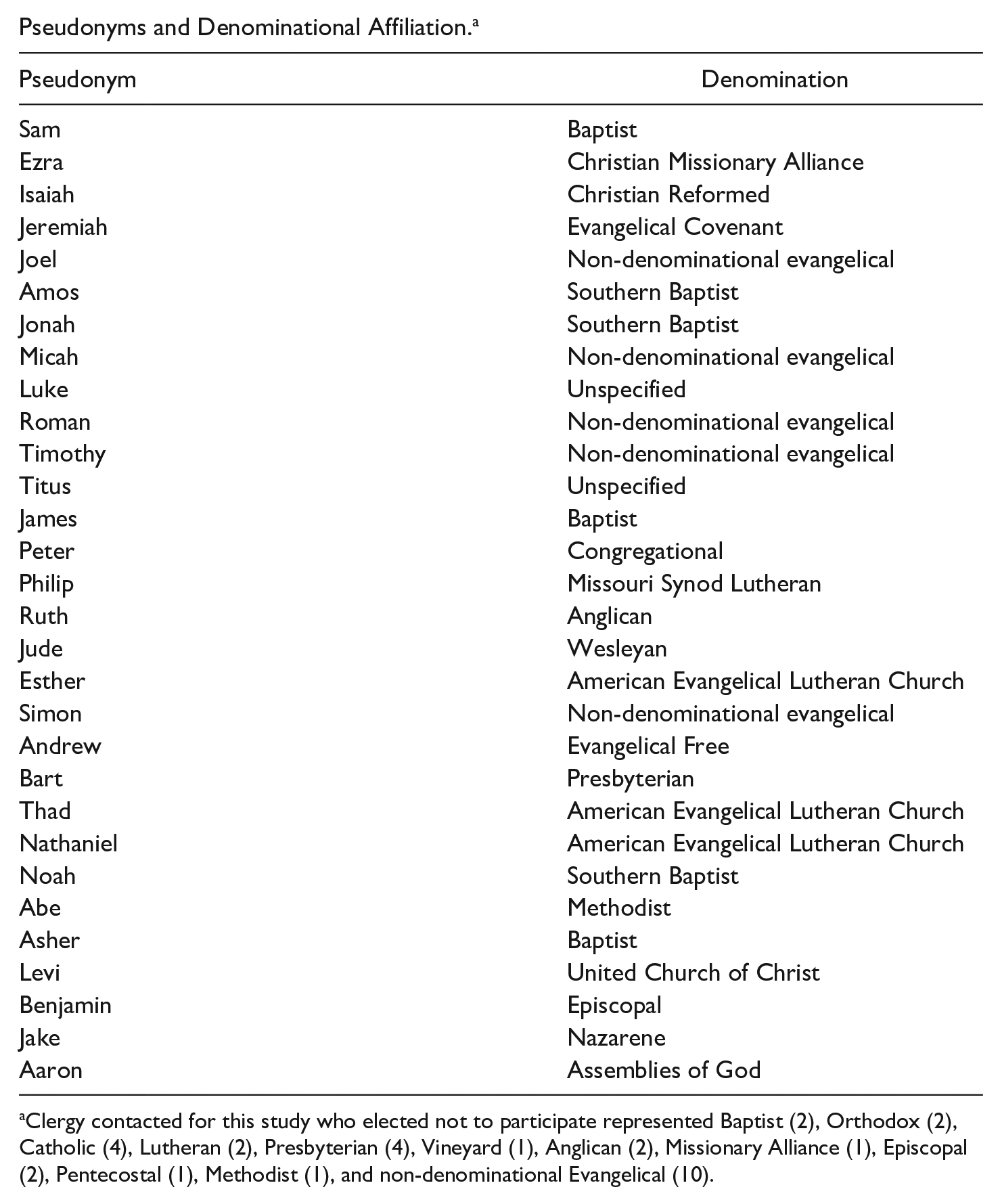
Ultimately, 31 leaders representing 30 congregations participated (one church had two pastors participate in the interview). Individuals were overwhelmingly White and male, which is typical of Protestant clergy (Smidt, 2016). We had few non-White participants (N = 1) and female participants (N = 2) represented in our sample. We interviewed 26 senior pastors, and five clergy responsible for specialty areas relevant to this study (e.g., outreach pastors). The majority were middle-career professionals with 15 to 20 years of experience in ministry. Prior research suggested that clergy education levels are positively associated with congregational partnerships or social service provision (Chaves & Tsitsos, 2001; Fulton, 2016). Within our sample, 26 interviewees had master’s degrees, five held double master’s, two had post-graduate certifications (e.g., counseling), and 10 completed doctorates. Participants represented congregations that varied with respect to size: the smallest congregation represented had approximately 25 weekly attendees and the largest congregation hosted thousands of people across multiple weekend services. All participants were assigned pseudonyms (see Appendix A).
Because extensive reviews exist of congregational demographics, denomination, and likelihood of collaboration (see Chaves, 2004; Fulton, 2016), we chose to focus on clergy description of partnerships. Therefore, we did not collect detailed information on the clergy or congregation’s denominational, doctrinal, or political affiliations (see Appendix B) while acknowledging that these may influence collaboration activity. That said, numerous participants referenced their own political views or their congregations’ stance on social issues, suggesting that the churches represented in this sample fell along the political spectrum. In total, 15 different denominations were represented (see Appendix A).
In grounded theory, Glaser and Strauss (1967) caution that researchers do not know at the onset how many people will participate. Instead, researchers collect data until reaching saturation, and, having looked for opportunities to improve the diversity of data, no longer find data to develop categories. We continued to collect data, following up with congregations of different sizes or underrepresented denominations to stretch the diversity of our participants, and ceased data collection when we had begun to hear similar responses from new participants.
The grounded theory approach suggests starting with a concept rather than an existing framework. Guided by the concepts of organizational fields and collaborative exchange (Pfeffer & Salancik, 1978) and stakeholders (Freeman, 1984), we devised questions that drew upon collaboration and congregational literature, but no single definition of collaboration. Questions were semi-structured; we asked follow-up questions to further elaborate how or why collaborative activity unfolded (Appendix B). Interviews were transcribed verbatim and sent back to participants with an opportunity to correct or clarify their remarks.
We followed Glaser and Strauss’ (1967) recommendations for the early stages of coding. This included coding incidents into as many categories as possible to compare with one another, creating memos and discussing them with one another, and engaging in reduction and generalizing codes with the goals of simplifying variables and developing the applicability of theory to a wide range of situations. This process of reduction through coding is described by Charmaz (2006) in categories of focused coding (to categorize initial codes), axial coding (to make relationships around the axis of a category), and theoretical coding to develop theoretical families. After creating 65 codes in open coding, these codes were systematically reviewed and reduced during subsequent rounds, revealing central and subcategories of tensions inherent in congregational collaborations. All four rounds of coding were completed using Atlas.ti.
Results and Discussion
Interviews reveal expressions of distinct, spiritually motivated organizations with limited resources that expect to respond—and are expected to respond—to unlimited needs. The data suggested a single, overarching theme: in making decisions about congregations in collaboration, clergy navigate a number of tensions inherent in congregational life. These included both praxis and conceptual tensions (Mease, 2019). Praxis tensions are those identified by the participants themselves and were evident when participants discussed, for example, the competing needs of the church. Clergy viewed the church primarily as a gathering place for the religious education and spiritual edification of its members and attendees. However, they also grappled with what they described as spiritual mandates and external expectations to serve the broader community. Conceptual tensions emerged through further analysis of the interview data set as whole (Mease, 2019). Specifically, in making decisions about collaboration, clergy described collaboration as a strategy for serving their congregations versus serving a broader community, collaboration as a strategy for meeting material versus spiritual needs, the roles of clergy versus lay leadership in collaboration, and seeing churches as gatekeepers of resources and doctrine versus full community partners. Findings echo tensions described in previous literature (Harris, 1998), but they also suggest a new typology for congregational involvement in collaboration. We further explore these tensions and introduce the typology below.
Collaboration as a Strategy for Serving Congregation Versus Broader Community
The congregational leaders in our sample emphasized a variety of community concerns that require their attention. These included addiction/recovery; immigration; food insecurity; homelessness; income inequality; human trafficking; lesbian, gay, bisexual, transgender, and queer (LGBTQ) affirmation; anti-abortion initiatives; racial reconciliation; and rehabilitation for ex-offenders. These issues prompted collaboration in many forms.
When asked to describe their collaborative activity, interviewees often elaborated on resources they had to offer. Churches provided meeting space for other congregations or for groups not affiliated with the church, such as Boy Scouts or Alcoholics Anonymous; many hosted schools or community gardens. Beyond space, other congregational resources included financial donations as well as coordinating of volunteers for nonprofits. These findings resonate with those in previous literature in terms of congregational resources (Ammerman, 2005; Bartkowski & Regis, 2003; Chaves & Eagle, 2016).
Clergy also referred to other collaborative activity underexplored or absent from previous research: namely, collaboration to support the needs of their congregations as opposed to the broader community. Prior research had led us to think that congregations would pursue collaboration in response to a social problem, as suggested in our interview protocol. However, in response to questions about congregational motivations and partners, clergy also acknowledged collaborative efforts that sustained staff through the difficulties of working in ministry. Thad (July 6, 2017) mentioned his involvement in two groups for pastors, one for Lutheran leaders and one open to any local clergy. Benjamin (August 30, 2017) described “intra-church collaboration” as “a part of the Episcopal church’s legacy and interest.” Whereas Benjamin and Thad described fellowship groups that were open to clergy within their denomination or within their city, Simon (May 2, 2017) described a smaller group of pastors who were personal friends that met twice a month and included time reserved for personal support and prayer.
In addition to the emotional or spiritual support gleaned from other clergy, some acknowledged that they relied upon collaboration for the church to exist, as a resource dependency perspective might suggest. Thad said that by collaborating with other churches, “ideally [we] would be supporting each other . . . when [churches] get really small, it just becomes a survivor thing.” He described specific strategies, such as sharing administrative staff across congregations to help defray costs. Benjamin suggested collaboration as a strategy to keep smaller churches from closing, whereas Abe (August 17, 2017), another pastor who led a small church, described collaboration as a means of providing extra enrichment opportunities to his congregation. This quarter-time pastor described his church as a “Sunday-only church,” and said that their partnership with another church in their denomination gave his two dozen or so parishioners another place to go for study or social groups during the week. These distinctions hint at the nuances of using collaboration to provide both material and spiritual resources in their community.
Collaboration as a Strategy for Providing Material Versus Spiritual Resources
Although stakeholders may have various stakes in an organization (Freeman, 1984), clergy appeared to classify these into two categories: material and spiritual. Clergy talked extensively about collaboration as a means of meeting needs for shelter, clothing, or food, similar to how previous studies have suggested congregational involvement in social services (Chaves, 2004). However, they also talked about collaboration as a means for spiritual engagement. One pastor, Jeremiah (November 17, 2016), drew the distinction among their support of missionaries, characterizing some relationships as strictly financial support whereas the church provided “pastoral and spiritual care” for other partners. Interviewees described collaborating for the purpose of evangelism. Simon, who met twice a month with a small group of pastors, suggested that some of those meetings were dedicated to sharing information on how they might pursue evangelism. Jake (August 30, 2017) was more direct about the spiritual motivation for collaboration, suggesting that by “making the difference in the lives of the people affected . . . we get to share Christ.”
The descriptions of the collaborative types and motivations also differ from the ways that researchers have typically described nonprofit collaboration involving congregations. Previous literature on congregation–agency partnerships focused primarily on questions of boundaries and interdependencies (Polson, 2008). The extent to which organizations are integrated is a common feature of typologies involving nonprofit and cross-sector collaboration (Austin & Seitanidi, 2012; Keast et al., 2007). However, participants in this study appeared unconcerned with organizational boundaries because they perceived churches as inherently different from other organizations. Clergy acknowledged that the church had a distinct role and was not intended to operate exactly as a nonprofit would, nor should the congregation lose its unique purpose. Leaders repeatedly stressed that church was not intended to meet every need through social services, saying that a church’s “primary calling” was a place of “gathering” (Joel, August 29, 2017) and that “the church doesn’t need to be everything” (Titus, November 17, 2016).
Interview data that clergy conceptualized of collaborative activity differently from the collaboration typologies typically discussed in nonprofit literature. Clergy drew distinctions between whether they were offering material or spiritual resources through the partnership, and implied that collaboration benefits members inside their faith community—for example, the denomination, pastoral team, or congregation—as well as external stakeholders. Figure 1 depicts a typology of congregational collaboration according to who is being served and resources are provided. Although there may be some blurring of the categories as indicated in the figure (e.g., a church-sponsored sports camp may offer soccer instruction and also include some religious education; a food pantry may benefit the congregation and the extended community), this typology suggests ways in which congregational collaboration may differ from nonprofit collaboration.
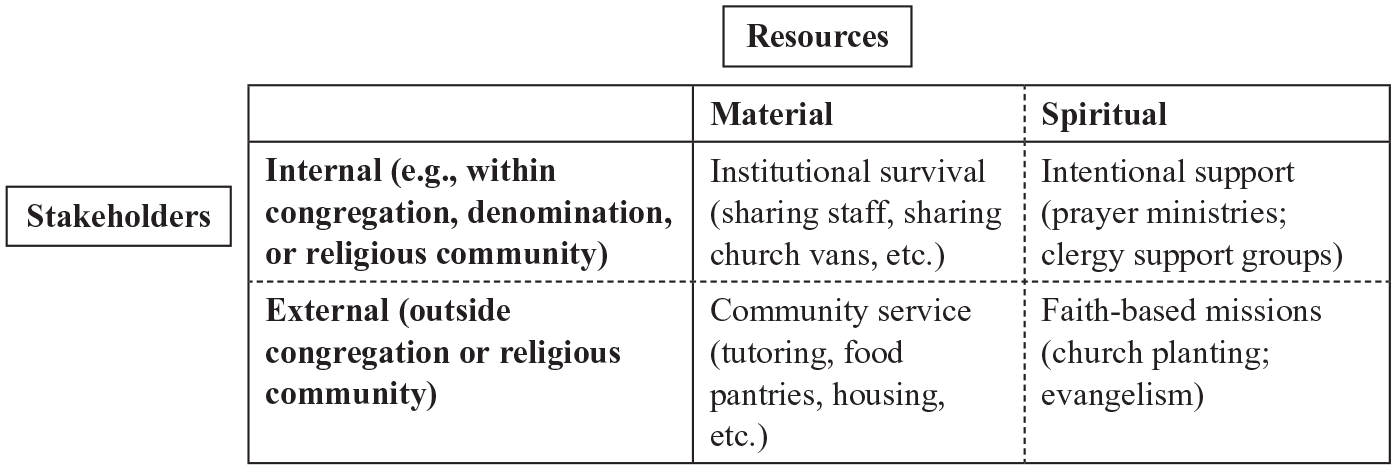
A Collaboration Typology for Congregations and Community.
This typology represents a departure from previous collaboration typologies in that it focuses on the nature of these needs as opposed to organizational integration. It also differs from prior typologies that distinguish among beneficiaries. Within service-oriented nonprofits, collaboration is typically intended to benefit those outside the organization. The typology does hint at competing congregational interests, as suggested by Harris’ (1998) assertion that congregations were often expected to provide services for the community as well as meet the spiritual needs of congregants. These tensions—between internal and external stakeholders, or between material and spiritual resources—are evident in congregations’ collaborative activity and in how clergy view their roles in collaboration, as explored in the next section.
Clergy Versus Congregational Leadership
In speaking about their own roles, interviewees discussed the challenges inherent in their roles as leaders of the church. Collaborative efforts depended on both top-down and bottom-up involvement. That is, clergy’s implied or official endorsement was valuable, but collaboration demand congregational involvement. As leaders, interviewees acknowledged that they played a significant role in collaborative activity, but without exception noted that partnerships were only sustained with the support of their congregations. James (June 21, 2017) said this was typical: Ministries have gotten started the way that they do in most congregations: there’s an individual or two who had a passion for those particular areas, and so they had ideas to get some things started, encouraged others to come along, and became a full-fledged ministry.
Abe said that without congregational interest to sustain partnerships, “there’s not going to really be any collaboration.” Many acknowledged that church leaders were consumed with the business of running the church and depended on the involvement of informal leaders from the congregation to carry out the partnership.
In some cases, denominational guidelines or church protocol encouraged the involvement of lay leaders in supporting partnerships. For example, Peter (June 16, 2017) pointed out that members of his congregational church led the way when it came to determining issues and partners for the church: [Partnerships have] to come from the bottom up. I can sort of set a general direction and encourage direction and a vision, but the specifics really have to come from the church.
Benjamin described a similar grassroots approach as “the nature of Episcopal churches.” In his role as rector, he typically was “looped in just to kind of give it my affirmation,” but he acknowledged individuals or committees typically drive support for community partnerships.
Other churches did not necessarily have doctrinal or denominational guidelines for partners, but their process seemed designed to give congregations input or ownership in partnership decisions. Noah (June 13, 2017) described a board comprised of elders and deacons that represent the demographics of the church. Noah said his role was to “cast the vision,” but that the board had the final say in terms of partnerships and financial support for those partnerships. Others further emphasized the spiritual nature vision-casting, describing leaders in prayer and in conversation as they sensed a calling to take up a particular issue or concern or equipped congregants to engage further (Jake).
Pastors seemed acutely aware of the influence they had on their congregations and a desire for members of their congregations to lead the way by collaborating with outside organizations. Aaron (September 11, 2017) described his “philosophy” for his congregation to pursue partnerships as they felt led, suggesting, “I don’t want people to become a cog in my wheel, I want them to become a cog in God’s wheel.” Joel echoed Jake’s desire to support members of his congregation to form their own relationships with ministries or agencies outside of church leadership: I also think as a pastor, it’s quite important not to try to be an expert on everything . . . I think my job would be to teach and encourage from God’s word, and to equip that person for their ministry. I don’t think I’m the minister and everything else has to funnel through me.
In empowering congregational members to seek out partnerships, leaders are perhaps free to focus on other responsibilities, namely, stewarding the resources and mission of the church. Interviewees repeatedly described their decisions to collaborate as rooted in a motivation for their church to serve others as an expression of their beliefs. Leaders repeatedly stressed the need to “serve” (Simon) or “advance” God’s work (Andrew, April 26, 2017), or to be God’s “hands and feet in the world” (Aaron). In their words, collaboration provides “a very profound witness” (Joel) or opportunities for church members to enact their “mandate . . . to strive for justice and peace in the world” (Benjamin). Leaders repeatedly stressed that collaboration offered a vehicle for churches to extend outside of their physical space as opposed to what Noah referred to as “an isolated suburban castle,” or a “cocoon,” or what James described as “just a church sitting here.” However, church leaders balanced the need for outward collaboration with what they perceived as a need to protect the church’s mission.
Gatekeeper Versus Full Community Partner
As previously mentioned, interviewees suggested that the church had a distinct role not to be confused with social service nonprofits. However, they uniformly acknowledged that the church did have a mandate to the community. Collaboration was often a response to that mandate because it allowed churches to join ongoing efforts within existing organizations: I think the main reason we want to collaborate rather than owning something on our own is because we recognize there’s an expertise needed that we don’t have. And we need that expertise in order to do what God’s asked us to do. (Titus)
Joining existing efforts enabled clergy to stay focused on the church mission and be protective of church resources. Although it might be assumed that congregations collaborated to exchange resources (Pfeffer & Salancik, 1978), interviewees repeatedly cautioned against exhausting church resources through partnership. This included warnings against spreading themselves or their congregations too thin. Jude (March 30, 2017) suggested that church leaders “have a tendency, in their eagerness, to maybe overextend themselves and their church in the process.” Nathaniel (July 10, 2017) expressed similar concerns: “When you’re really focused outward some of the inward stuff starts to fail . . . Doing that collaboration sometimes draws time that you can spend in your own organization. We’ve seen that balance be thrown off one way or another.” While some talked about this in terms of personal strain, others stressed the dangers of overextending resources. For example, Noah repeated a cautionary tale of a local church that began loaning their space to different organizations while not tending to their own congregation’s needs: [Their congregation] actually dwindled, and it got to the point where they just signed over the building . . . They just shut down the home church . . . They lost themselves in their collaborations. I took that lesson to heart because [while] what they did . . . was admirable, they lost track of their own mission.
Leaders who self-identified on the more conservative end of the spectrum tended to emphasize the church’s spiritual role, which resonates with previous literature (Chaves, 2004). However, participants overwhelmingly affirmed collaboration, regardless of their stated denomination or political orientation. Inherent in their support for collaboration, however, is a need to be seen as partners. As part of their perceived roles as gatekeepers, interviewees warned against churches being seen merely as resources for funds or labor. This is commonplace, as suggested by the quotes below: I’ve found other organizations to be kind of obnoxious in this sort of come in and ask for things without giving anything in return and sort of assume a certain amount of allegiance as though we owe them something almost, you know? (Peter) You do fall into situations at times where people will cold call or send mailers saying “Hey, partner with us,” but really, it’s “Send us your money.” (Aaron)
Instead, they advocated for partners who would see churches as “equal partners” (Aaron) and collaboration as “beneficial for both groups” (Noah). Several pastors, for example, Roman (November 15, 2016) and Joel, focused on the roots or origins of the word, describing their church’s partnerships with others in terms of “co-labor.” Joel further argued for a sense of the church as “partners” by pointing out that the church should collaborate with others as well as “be collaborated with . . . Otherwise it’s just a kind of code for trying to get something out of other people.” Numerous interviewees said that true collaboration enabled them to use multiple resources as well as learn something from the partnership, as described by Timothy (July 6, 2017): [Collaborative partners have] to align with us missionally, as well as be interested in our resources, all of our resources, our financial and our people resources . . . It needs to be a partnership that we can also learn from, so it isn’t really just a one-sided conversation. It is almost always an opportunity for us to learn as well.
When it came to social issues, doctrine and denomination posed less of a threat to clergy than the idea of unequal partnerships. For example, Philip (April 13, 2017) noted that they “wouldn’t celebrate [religious sacraments] with a group of people who don’t believe the same thing that we do” but “pair with anybody who we can work with” on social issues.
Clergy featured in this study saw the church as a gathering place for the religious education and spiritual edification of its members and attendees, with the added responsibility of serving a broader community. These tensions did not indicate confusion about the role of the church; rather, these are expressions of distinct, spiritually motivated organizations with limited resources that expect to respond—and are expected to respond—to unlimited needs. These findings echo prior research on the varied roles that congregations play (Ammerman, 2005; Harris, 1998). However, this study extends prior research by identifying and illustrating tensions as experienced by clergy as they try to determine what it means to be an organizational partner. The question of how congregations navigate these tensions shapes not just the congregation itself but the broader community.
Conclusion
In this article, we have sought to build upon previous research by exploring the nature of congregational involvement in collaboration. Our findings indicated that clergy see churches as places of worship and fellowship distinct from other nonprofit organizations but with a mandate for community service. Concepts relevant to nonprofits—such as resource dependence and varied stakeholders—prove relevant to congregational collaboration, as congregations seek collaboration to share their own expertise and access resources and typically depend on the involvement of both clergy and congregational stakeholders. Interviews revealed tensions in collaboration and suggest a typology of congregational involvement in collaborative activity.
There are several limitations of this study that suggest further directions for research. Although this research included different denominations, our sample only included Protestant congregations and a rather homogeneous sample with respect to race and gender. In addition to congregational and clergy diversity, further research may seek to explore partnerships outside of a Christian tradition, as well as congregations outside of the United States. These congregations may experience other tensions not identified here or experience these tensions to varying degrees. In addition, while relying on a geographical sample offers several benefits to the study of collaboration, this approach limits generalizability. This study also reflects a nonrespondent bias and leadership bias; further research should include congregation and community members. While we focused on congregations as distinct organizations engaged in partnerships, other research might explore congregations as part of coalitions or in hybrid forms, as hybrid models are associated with tensions (Gärde, 2020). Finally, as the goal of this study was to build theory, we relied upon qualitative data obtained through interviews. Future research may apply other methodologies to further develop or explore these concepts.
This article affirms what others have suggested as the significance of congregations within the nonprofit landscape and adds nuance to prior discussion of congregational involvement in social services. Previous scholars concluded that there is no “untapped reservoir” of resources for social services (Chaves, 2004, pp. 20–21). This research would suggest that is true, but that it is true in part because clergy do not necessarily see social services as the sole responsibility of congregations. Expectations to engage in social services may exist in tension with a congregation’s responsibilities as a religious organization.
This research also suggests that congregations are involved in diverse collaborative endeavors, serving varied audiences for varied purposes. One implication of this is that perhaps the attention paid to churches as providers of social services has been limiting. Scholars, congregational leaders, and nonprofit leaders might instead move beyond the “provider” language typically used and instead utilize a lens of “partnership” to explore congregations within a broader context of nonprofit or cross-sector collaboration. Such distinctions are particularly relevant because, although research would suggest that congregations are not likely to provide more social services (Chaves, 2004; Wuthnow, 2009), there are continued calls for congregations of all faiths to further engage in responding to social problems (Scott & Cnaan, 2018), and religious congregations are typically a conduit for nonprofit volunteers and donations (Ammerman, 2005; Bartkowski & Regis, 2003; Luria et al., 2017; Schnable, 2016). A partner lens may also shed further light on forms of congregational collaboration—for congregational survival or to meet spiritual needs—that are not traditionally addressed in nonprofit collaboration research.
Finally, within this broader context of collaboration, we suggest prior typologies may not capture congregational motivations for collaboration or the audiences served through partnership. Instead, we suggest that the tension typology introduced here offers insights for congregational involvement in community. Tensions are unlikely to be entirely resolved, suggesting that clergy are likely to feel the pull between serving internal and external stakeholders, for example, or prioritizing the needs of their congregants as opposed to the broader community. But tensions also represent points at which leaders make choices with significant organizational implications (Mease, 2019) by favoring one side of the tension over another, or seeking to meet both needs. Given the role of congregations within the United States, we would suggest that clergy responses to these tensions have implications not just for the congregation but also for the broader landscape of nonprofit organizations and, ultimately, the communities in which they reside.
Footnotes
Appendix A
Pseudonyms and Denominational Affiliation. a
| Pseudonym | Denomination |
|---|---|
| Sam | Baptist |
| Ezra | Christian Missionary Alliance |
| Isaiah | Christian Reformed |
| Jeremiah | Evangelical Covenant |
| Joel | Non-denominational evangelical |
| Amos | Southern Baptist |
| Jonah | Southern Baptist |
| Micah | Non-denominational evangelical |
| Luke | Unspecified |
| Roman | Non-denominational evangelical |
| Timothy | Non-denominational evangelical |
| Titus | Unspecified |
| James | Baptist |
| Peter | Congregational |
| Philip | Missouri Synod Lutheran |
| Ruth | Anglican |
| Jude | Wesleyan |
| Esther | American Evangelical Lutheran Church |
| Simon | Non-denominational evangelical |
| Andrew | Evangelical Free |
| Bart | Presbyterian |
| Thad | American Evangelical Lutheran Church |
| Nathaniel | American Evangelical Lutheran Church |
| Noah | Southern Baptist |
| Abe | Methodist |
| Asher | Baptist |
| Levi | United Church of Christ |
| Benjamin | Episcopal |
| Jake | Nazarene |
| Aaron | Assemblies of God |
Clergy contacted for this study who elected not to participate represented Baptist (2), Orthodox (2), Catholic (4), Lutheran (2), Presbyterian (4), Vineyard (1), Anglican (2), Missionary Alliance (1), Episcopal (2), Pentecostal (1), Methodist (1), and non-denominational Evangelical (10).
Appendix B
Declaration of Conflicting Interests
The author(s) declared no potential conflicts of interest with respect to the research, authorship, and/or publication of this article.
Funding
The author(s) received no financial support for the research, authorship, and/or publication of this article.
