



Abstract
Nonprofit organizations (NPOs) becoming business-like is a contested issue. Some understand the adoption of business-like practices by NPOs as a case of adopting rational myths through institutional isomorphism and thus potentially dangerous for NPOs’ ability to fulfill their unique societal roles. Others are more optimistic, arguing that technical rationality is possible in the adoption of business-like practices, and that such practices can therefore support NPOs in fulfilling a wide range of societal roles. Drawing on survey data of NPOs in Flanders, we examine the relationship between the extent to which NPOs use business-like practices, and the extent to which they engage in various societal roles. We find that business-like practices are weakly related to NPOs’ societal roles. All roles are positively related to nonprofit managerialism and unrelated to NPOs’ reliance on commercial funding. Our results suggest that a certain optimism regarding the rational use of business-like approaches is justified.
Introduction
For the past decade, nonprofit organizations (NPOs) adopting practices from for-profit businesses have been a major topic in nonprofit management studies. This phenomenon has been referred to as marketization (e.g., Eikenberry & Kluver, 2004), rationalization (Hwang & Powell, 2009), managerialization (e.g., Shirinashihama, 2019), hybridization toward the market domain (Suykens et al., 2019a), and NPOs being business-like (Dart, 2004a; Maier et al., 2016). In this study, we use the concept of “business-like” to refer to NPOs becoming more similar to businesses by adopting practices ideal-typically associated with the market.
The observation that many NPOs have become more business-like has generated a critical debate. Eikenberry and Kluver (2004) have warned that the introduction of business-like practices can deter NPOs from fulfilling their societal roles. Some studies show that business-like approaches encourage NPOs to focus on service delivery, and less so on encouraging people to participate in political processes (Baines et al., 2014; Keevers et al., 2012). In a similar vein, Backman and Smith (2000) theorize that contributions to social capital may be eroded by participants becoming self-interested consumers. In recent years, however, an increasing number of well-designed quantitative studies have identified a positive impact of NPOs using business-like approaches, for example, strengthening financial stability (Horvath et al., 2018; Shirinashihama, 2019) and improving the perceived organizational performance (Hersberger-Langloh et al., 2020; Suykens et al., 2021).
Yet, in many aspects, the theorized effects of NPOs being business-like on NPOs’ societal roles lack comprehensive large-N empirical testing. Such studies are necessary to promote an evidence-based debate. Considering the many findings from qualitative studies that point to possible negative consequences (e.g., Baines et al., 2011; Kreutzer & Jager, 2011), it is important to understand whether these findings are typical for the whole sector. Our study contributes to this debate by asking: How are NPOs’ business-like practices related to their engagement in various societal roles?
We base our research on a survey of NPOs in Flanders (N = 496), the northern region of Belgium. We conduct linear regression analyses to test whether commercial revenue and managerial practices influence the extent to which NPOs engage in service delivery, political advocacy, community building, and civic engagement efforts. Flanders, a typical neo-corporatist welfare regime, constitutes a salient research context to address this issue. It has a large nonprofit sector that has historically been intertwined with the public sector. In comparison to the Anglo-Saxon context, New Public Management reforms were only moderately implemented in Flanders, leading to a less pronounced shift from collaboration to competition in nonprofit-public interactions (Pauly et al., 2020), and a less pervasive introduction of business-like practices in Flemish NPOs (Suykens, De Rynck, et al., 2020).
Our study contributes to nonprofit management research and practice in three ways. First, we apply a two-dimensional framework for analyzing NPOs being business-like: commercialism and managerialism. Second, we provide an evidence-based overview of how business-like practices might be beneficial or detrimental to the fulfillment of particular societal roles. Third, we provide a first inspection to what extent the findings of previous, often qualitative, studies hold beyond their substantial and institutional boundary. Doing so, we analyze a large-N sample in a continental European institutional environment, thereby contributing to a more empirically grounded debate about the effects of NPOs being business-like. In the remainder, we clarify the key concepts used, spell out possible causal mechanisms, formulate hypotheses, and discuss our research design. We then present our research findings. We conclude by discussing the implications for nonprofit management research and practice.
Being Business-Like and NPOs’ Societal Roles
NPOs being business-like can refer to a wide range of practices (Dart, 2004a; Maier et al., 2016; Suykens et al., 2019a). Major aspects of being business-like include applying corporate management practices such as business management tools (Hvenmark, 2016) and various forms of performance measurement (see, for example, Hwang & Powell, 2009, p. 289), and generating commercial revenue through selling products and services (Suykens et al., 2019b; Suykens, George, et al., 2020). Although the former can be couched under the “nonprofit managerialism” umbrella, the latter can be referred to as “nonprofit commercialism” (Maier et al., 2016). Both are part of being business-like as a coherent culturally shared template for organizing that, depending on theoretical background, may be conceptualized as an institutional logic (Knutsen, 2012) or a discourse (Eikenberry, 2009).
Influential studies conclude that becoming more business-like threatens NPOs’ contributions to society (e.g., Dart, 2004a; Eikenberry & Kluver, 2004; Maier et al., 2016) by making NPOs concentrate on services that generate a financial surplus, or engage in cherry-picking clients, and by making them reduce costs that do not contribute to these services. Management tools and managerialist understandings of performance focus on efficiency and effectiveness in ways that can conflict with pursuing the common good (Hwang & Powell, 2009).
The societal contributions of nonprofits can be conceptualized as their societal roles. Synthesizing from previous work (e.g., Frumkin, 2009; Ivanova & Neumayr, 2017; Moulton & Eckerd, 2012), we distinguish between the following roles:
(1) Service delivery is about delivering intangible or tangible goods that are used by beneficiaries. These outputs may be private goods (such as a counseling talk), club goods (such as a library), or public goods (such as a marked hiking trail).
(2) Political advocacy aims at influencing public policy. NPOs often give a voice to minorities and particularistic interests when performing advocacy.
(3) Community building refers to activities that build trust and reciprocity between people and foster inclusion into communities and society.
(4) Civic engagement is about empowering people to participate in politics and stand up for their interests. NPOs may promote civic engagement through programs specifically for that purpose (e.g., voter education campaigns), or by functioning as “schools of democracy” that use democratic procedures for decision-making, thus nurturing habits and skills of self-rule.
How Being Business-Like Affects NPOs’ Societal Roles
Previous studies have often brushed over the causal mechanisms how becoming business-like might affect NPOs’ societal roles (e.g., Backman & Smith, 2000; Eikenberry & Kluver, 2004). Looking at studies that more specifically spell out causal transmission mechanisms, we can identify three effects how becoming more business-like may change societal roles: through an interpretation frame effect, through a commercial revenue effect, or through a production effect.
First, the interpretation frame effect is central to institutional theory; it is inspired by studies focusing on the micro-foundations of institutions (e.g., Beaton et al., 2020; Horvath et al., 2018). This effect occurs as individual decision-makers in organizations perceive and interpret signals from the organization and its environment, make sense of these signals against the backdrop of their culturally shared knowledge and, using their individual agentic capabilities, make decisions about maintaining or changing the practices or the goals of their organization (Powell & Colyvas, 2008). Applied to the problem of business-like practices possibly causing a shift of nonprofits’ societal roles, this means that in tandem with business-like practices, nonprofit leaders may also be internalizing the values that undergird business enterprises. They adopt business practices as a means to achieve their mission, but as business values become shared in an organization, they become part of its enduring character. If nonprofit leaders do not take intentional action, business-like means become taken for granted and divorced from their ends, and the organization experiences goal displacement (Beaton et al., 2020, p. 26f.).
Second, the commercial revenue effect has primarily been dealt with in literature from an economic perspective (e.g., Enjolras, 2002; Wilsker & Young, 2010). It occurs due to the nature of the produced goods. The commercial potential of goods is determined by the possibility to exclude them from free use, and by the extent to which these goods can generate market demand (Enjolras, 2002). The majority of services provided by nonprofits are not pure public goods, but club goods or private goods with positive externalities, thus contributing to public goods (e.g., social security). Providing private goods has the highest commercial potential (Suykens, George, et al., 2020). There is less commercial potential in community building, advocacy, or civic engagement; these roles are typically about providing club goods or contribute to public goods. Nonprofits can generate commercial revenue from mission-based core programs (e.g., a symphony orchestra selling admission tickets for its concerts), from activities that use the same technologies or target the same audience like mission-based core programs (e.g., a symphony orchestra recording behind-the scenes podcasts for fans), or from activities external to the mission (e.g., a symphony orchestra offering a valet service, see Levine Daniel & Kim, 2018).
Third, the production effect has been illuminated by analyses of how community building and civic engagement are achieved in nonprofits (e.g., Backman & Smith, 2000; Eikenberry & Kluver, 2004). These societal roles are often fulfilled as planned or unplanned by-products of nonprofits’ other activities. For example, a bowling league may produce strong ties of trust among members in the course of providing a sports service (Putnam, 2000); a social movement organization may increase the civic skills of activists as they advocate for a cause (Skocpol, 2013). Managerialist methods of organizing give little place to democratic participation (Eikenberry, 2009), and commercial activities tend to have few positive side effects in terms of community-building (Backman & Smith, 2000). Therefore, we may expect business-like methods to produce less community and civic engagement.
Considering these potentially problematic effects, it seems puzzling why nonprofits would choose to become business-like. In response to this puzzle, many scholars identify institutional isomorphism as the main driver of the diffusion of business-like practices in the nonprofit domain (e.g., Hersberger-Langloh et al., 2020; Hwang & Powell, 2009). This theoretical perspective argues that business-like practices spread because (a) the government demands so (i.e., coercive isomorphism), (b) NPOs copy them from other organizations that they consider as successful (i.e., mimetic isomorphism), or (c) they are instilled through formal education and professional networks (i.e., normative isomorphism; DiMaggio & Powell, 1983). In all of these scenarios, it is essentially the global spread of neoliberalism and its “pervasive faith in the market and business-based approaches and solutions” (Eikenberry, 2009, p. 584) that are viewed as the main institutional force behind the becoming business-like of NPOs. In such a climate, NPOs that present themselves as business-like can gain a legitimacy advantage over more “traditional” NPOs in the eyes of resource holders (see, for example, Andersson & Self, 2015; Dart, 2004b; Dey & Teasdale, 2016; Willems et al., 2017).
With all the spotlights on institutional isomorphism, it has become neglected that isomorphism is not only caused by institutional pressures, and business-like management is not only “myth and ceremony” (Meyer & Rowan, 1977). Isomorphism can also be the result of rational considerations and practical proof of more efficient approaches. DiMaggio and Powell (1983, p. 149) distinguish institutional from “competitive isomorphism.” For NPOs adopting business-like practices, institutional isomorphism implies that they adopt these practices for mimetic, coercive, or normative reasons. “Pure” institutional isomorphism is likely to result in negative implications for NPOs’ fulfillment of societal roles, if business-like rationality is not appropriate for the kind of work that they are doing (e.g., forcing social work into a procrustean bed of client prioritization while cutting down on advocacy, neglecting community participation in housing projects for the sake of efficiency). In such cases, business-like NPOs would tend to myopically foster service delivery while neglecting community building, advocacy, and civic engagement, because in line with the interpretation frame effect and the production effect, processes of producing goods and services and also political advocacy fit more neatly with managerial methods and tools that have been developed for business than other societal roles.
In contrast, if competitive isomorphism were a major driver behind NPOs using business-like approaches, this would mean that business-like practices enhance NPOs’ positions in a broad competitive field (not just vying for commercial revenue but also for donations, public funding, volunteers, etc.). In this scenario, a broad range of stakeholders is likely to assess NPOs positively because they perceive them as better equipped to make societal contributions (e.g., Andersson & Self, 2015; Carré et al., 2021). It is competitive isomorphism that the large body of literature on NPOs from a management and economics perspective has in mind when arguing that a proper application of management techniques will enhance goal attainment in all areas, and that an increase in commercial revenue will boost NPOs’ capacity also in their non-market roles. It is also competitive isomorphism that micro-level institutional theorists imply when they make the qualification that by taking intentional action, nonprofit leaders can avoid letting managerial methods lead to goal displacement (Beaton et al., 2020, p. 26f.).
In the following subsections, we further review the literature about business-like practices’ effects on nonprofit organization’s roles, and deduct hypotheses for empirical testing.
Service Delivery
Resonating with the commercial revenue effect, fulfilling a service role typically has higher commercialization potential than fulfilling other societal roles (Enjolras, 2002; Fischer et al., 2011; Suykens et al., 2020; Wilsker & Young, 2010). Descriptive analyses of large-N studies point in this direction. Suykens et al. (2020, p. 1472), for instance, observe that “those [NPOs] relying considerably on commercial income tended to generate this through mission-related activities” that in essence aim to fulfill the needs of the target population. In a similar vein, nonprofit service providers appear to be among the most commercialized segments of the nonprofit sphere in the United Kingdom (McKay et al., 2015), the United States (Kerlin & Pollak, 2011), and the Czech Republic (Vaceková et al., 2017). Based on this, we expect that:
Typical managerialist practices are quite amenable to service provision. Several qualitative studies have examined the consequences of NPOs adopting systems of tight managerial control and performance management in response to the demands of public funders (Baines et al., 2014; Irvine et al., 2009; Keevers et al., 2012). In line with the interpretation frame effect and the production effect mentioned above, these studies find that after making these changes, NPOs begin to prioritize service delivery in a narrow sense over more community-engaged, social justice-directed activities to fulfill other societal roles. We therefore hypothesize:
Community Building
Concerning the effect of commercial activities on the community-building role of NPOs, Backman and Smith (2000), and Eikenberry and Kluver (2004) theorize an adverse production effect. The argument is that “commercialization has the potential to change the nature of the ties between key stakeholder groups and nonprofits, moving them from the goodwill ties traditionally posited for transactions in the charitable realm to arms-length exchanges that characterize market transactions” (Backman & Smith, 2000, p. 363). Some empirical support for this argument has been provided (Galaskiewicz et al., 2006). Furthermore, raising participation fees inherently goes hand in hand with the risk of excluding those who cannot afford.
It should be noted, though, that several studies have painted a more nuanced picture, suggesting that community building can occur as a byproduct of commercial activity if the nonprofit engages in a community-oriented form of commercialism (Bertotti et al., 2012; Teasdale, 2010; Tello-Rozas, 2016). There have also been quantitative studies, specifically in the field of sports, that do not find a negative effect of commercialization on community building (Enjolras, 2002; Kumar et al., 2019). These may be atypical cases however, and so, in line with the commercial revenue effect, we hypothesize that:
Concerning the implications of business-like management practices for community building, contradictory arguments have been put forward. In line with the interpretation frame effect, it has been argued that managerialist practices entail a unilateral focus on efficiency and thus harm social capital building (Backman & Smith, 2000). The contrary argument is that “the intelligent adoption of business practices could make many nonprofit organizations even more effective in creating social capital” (Dees & Anderson, 2017, p. 23). For example, marketing techniques may enable nonprofits to reach new target groups; diversity management instruments may make nonprofits more inclusive. Substantial empirical support for either of these arguments is missing. At the same time, there is evidence that the community-building effects of NPOs have little or nothing to do with NPOs’ internal structures (e.g., Lindberg & Farkas, 2016; Sivesind et al., 2013).
Overall, the practices typically subsumed under managerialism (and which we have measured empirically in this study) are more about increasing efficiency than about promoting participation. An adverse interpretation frame effect of managerialism on community building, therefore, seems likely. We hence formulate the following hypothesis:
Political Advocacy
NPOs typically do not generate commercial revenue directly from advocacy. If we assume that nonprofit managers prefer engaging in commercial activities that directly support their mission (Levine Daniel & Kim, 2018), we can conclude in line with the commercial revenue effect that commercial activities will lead to a reduction of advocacy efforts. However, a meta-analysis by Lu (2018b) finds no overall significant effect of commercialism on advocacy, as there is support for both positive and negative relations. Commercial revenues may increase the autonomy of nonprofits, thus supporting advocacy by reducing dependency on other funders (Lu, 2018b, p. 189S [sic]). Recently, Zhang and Guo (2021) revealed specific configurations that enable nonprofits to continue active political advocacy despite commercialization (Zhang & Guo, 2021). They also argue that the financial autonomy gained by commercial revenues alone does not translate into efforts in political advocacy. Rich resources play no role in the causal pathways, and in specific configurations, political advocacy is endangered (Zhang & Guo, 2021, 938).
Research on the impact of other funding sources shows positive relations to advocacy for government funding and individual donations (Lu, 2018a; Silverman & Patterson, 2011). These findings harmonize with the commercial revenue effect theorized above, therefore we formulate the hypothesis:
Concerning nonprofit managerialism, previous research suggests a complex relationship with NPOs’ political advocacy. By operating more like businesses, NPOs seem not to cut back on advocacy, but rather to shift toward more professionalized advocacy forms (i.e., hire professional staff to engage in advocacy) and non-confrontational advocacy (e.g., Skocpol, 2013; Tatarchevskiy, 2011). This is consistent with King’s (2017) analysis of how becoming professionalized as a nonprofit leader shapes identity as a political activist. For community foundations, Suárez et al. (2018) show that managerial professionalization is positively related to engagement in advocacy. These findings make sense against the backdrop of an interpretation frame effect of managerialism, as ideas such as stakeholder communication, lobbying, and public relations are part of the conventional managerialist set of ideas. Management tools for performance measurement are quite amenable to managing advocacy activities (e.g., formulating SMART advocacy goals, benchmarking advocacy success). We hence hypothesize that managerialism tends to be positively associated with fulfilling an advocacy role,
Civic Engagement
It has been argued that commercially funded NPOs fulfill less of a civic engagement role, because, in terms of the production process, civic engagement is not necessary for commercial activities (Eikenberry & Kluver, 2004, p. 137). Speaking in terms of interpretation frames, engaging in commercial activities may entail a strongly marketized perspective that downright contradicts civic engagement (Eikenberry, 2009). Kim (2017) documents a negative relationship between commercial revenue and the civic engagement role in a quantitative study of nonprofit arts organizations. We hence hypothesize based on the production effect as well as the interpretation frame effect:
Business-like practices are clearly a different set of organizational practices than those typical of civic engagement (Knutsen, 2012; Maier & Meyer, 2011): top-down management for the former, bottom-up participation and self-management for the latter. Although managerialist and democratic practices can be combined in an organization, and management practices may include stakeholder participation, in practice there often seems to be an interpretation frame effect in which organizations favor one set of practices over the other. Qualitative studies are fairly unanimous in finding that managerialist practices undermine participation and organizational democracy (e.g., Eizenberg, 2012; Hvenmark, 2013; Kreutzer & Jager, 2011; Skocpol, 2013) and weaken the role of NPOs as facilitators of civic engagement. For example, Baines et al. (2011) find that the standardization of operational processes leads to reduced opportunities for employee participation in decision-making processes. The main reason for this tendency appears to be that mainstream management methods prioritize efficiency and effectiveness, which may conflict with more participatory methods in terms of time requirements and diversity of perspectives. Mainstream management methods hardly include any element of civic engagement. Therefore, we hypothesize:
Method
Sampling and Data Collection
We examine NPOs in Flanders, the northern region of Belgium. We started data collection with a systematic mapping, as there is no comprehensive database listing all Flemish NPOs. We screened government’s and umbrella associations’ databases. We limited our focus to NPOs that are active at the Flemish level in the domains of human wellbeing, social economy, or socio-cultural activities. Human wellbeing nonprofits include care initiatives targeting minors, people with disabilities, and other underprivileged groups. The social economy domain consists of work integration social enterprises. Here, mission and market overlap because the programs for fulfilling prosocial goals are market-based by nature. The socio-cultural includes professional associations, patient associations, social movement organizations, political organizations, socio-cultural associations, youth associations, ethnic-cultural associations, and faith-based associations. The sample of included nonprofits is diverse, including pure service providers, pure advocacy organizations, pure community builders, but mostly organizations engaging in a mix of societal roles.
To take account of the population’s diversity, we extracted a disproportionate sample stratified by the three domains mentioned above (N = 747). We invited these NPOs to participate in the study. We designed a two-wave survey aimed at the NPOs’ directors. Starting in September 2017, we sent introductory letters to the NPOs. The first wave was a personal interview. Respondents then had the choice to complete the second wave in a personal interview, by mail, or online. The first wave included questions on societal roles, commercial revenue, management tools, and performance measurement. The second wave included questions about the composition of the board and the size of the organization. We sent several reminders and received 496 responses to the first wave and 403 responses to the second wave by June 2018. This corresponds to response rates of 66.4% and 53.9%. A chi-square test confirmed that respondents reflected the composition of our sampling frame.
Measures
For measuring the dependent variables in this study, that is, the extent to which NPOs fulfill various societal roles, we constructed indices. We mainly followed the nonprofit role indices developed by Moulton and Eckerd (2012). However, pre-tests with nonprofit directors showed that some items suggested by Moulton and Eckerd did not fit the Flemish context or the diversity of the NPOs. Therefore, we slightly adapted the indices (see Online Appendix). We measured all items with a 5-point Likert-type scale, ranging from not at all to a lot. Based on principal components analyses, we calculated factor scores for “community building” (Cronbach’s α = .744), “civic engagement” (.775), “political advocacy” (.808), and “service delivery” (.812).
The independent variables cover two dimensions of NPOs being business-like: commercialism (i.e., business-like funding), and managerialism (i.e., the use of typical management tools and performance measurement). We operationalized commercialism as the proportion of revenue resulting from the profitable sale of products and services relative to the organization’s total revenue. To ensure a common understanding, we provided respondents with our definition of commercial revenue, supported by examples indicating what does (e.g., service fees) and does not (e.g., membership fees) count as commercial revenue. We operationalized managerialism with two variables: use of management tools, and performance measurement. Regarding the use of management tools, we asked respondents to indicate on a 5-point Likert-type scale (from not present to often used) to what extent they use the following management tools: SWOT analysis, SMART goals, lean management, benchmarking, pay for performance, quality management (e.g., ISO), and key performance indicators (e.g., based on a balanced scorecard). This selection of management tools was based on previous studies on nonprofit managerialism (e.g., Hvenmark, 2013) and consultation with nonprofit directors. Regarding performance measurement, we asked respondents to indicate on a 4-point Likert-type scale (from not measured to often measured) to what extent their organization measures the following aspects of nonprofit performance: (a) openness toward beneficiaries, (b) efficient spending, (c) mission fulfillment, (d) meeting expectations of beneficiaries, (e) service quality, and (f) making programs known to stakeholders. We provided respondents with explanations for each management tool and each performance measurement dimension to ensure common understanding. From these items, we constructed one index for “management tool use” (Cronbach’s α = .809) and one for “performance measurement” (.834) by calculating the sum scores. Interestingly, these two aspects of managerialism could not be combined into one index (principal components analyses identified two distinct indices), yet each aspect contributes to the explanatory power of our regression models. We hence included the aspects as two distinct indices. We provide the items for both aspects of managerialism in the Online Appendix.
We add four control variables for which previous research and theory suggest that they influence which societal roles NPOs fulfill: The organization’s field of activity (International Classificatin of Non-Profit Organizations), its age (due to imprinting), size (more paid staff making service delivery more likely), and reliance on non-commercial funding (a higher proportion of public funding making service delivery more likely, a higher proportion of philanthropic funding making community building more likely).
Statistical Analysis
As our dependent variables are composite indexes, they can be considered continuous, thereby making linear regression an appropriate statistical technique to test our hypotheses. We tested whether the assumptions underlying multiple linear regression are met, finding no issues concerning (a) model specification (Ramsey-Reset tests insignificant), (b) normality (standardized predictor values and residuals show a normal distribution when plotted), or (c) autocorrelation of unstandardized residuals (Durbin–Watson test 1, 5 < d < 2, 5). For three models (civic engagement, advocacy, service), the assumption of homoscedasticity was initially not met (significant White’s tests), but resolved by recalculating our models using the HC3 estimator in the HCREG macro of Hayes and Cai (2007). Our models were not affected by multicollinearity (Variance Inflation Factor < 10) or influential outliers (Cook’s distance <1).
Because we collected our data through the same method, we took measures to limit the risk of common method bias (CMB). Ex ante, we subjected the dependent and independent variables to proximal separation by means of buffer items, and variated the scale properties. We mostly used factual independent variables. Ex post, we controlled for CMB with the Harman one-factor test. We imputed the dependent and independent variables into an unrotated factor analysis limited to one factor. Because this score did not exceed the 50% mark, we can conclude that CMB is not likely an issue. Finally, because business-like behavior can be a sensitive topic in a nonprofit setting, social desirability bias might be at play. We limited social desirability bias by not using the term “business-like” throughout the survey, separating the questions about business-like manifestations in space (i.e., buffer items), and formulating our questions in a fact-based manner.
Findings
Descriptive analysis shows that the NPOs at hand focus most on service delivery, followed by community building, advocacy, and civic engagement (see Table 1). In this section, we present the results of the linear regression analyses (see Table 2).
Means, Standard Deviations, and Correlations.
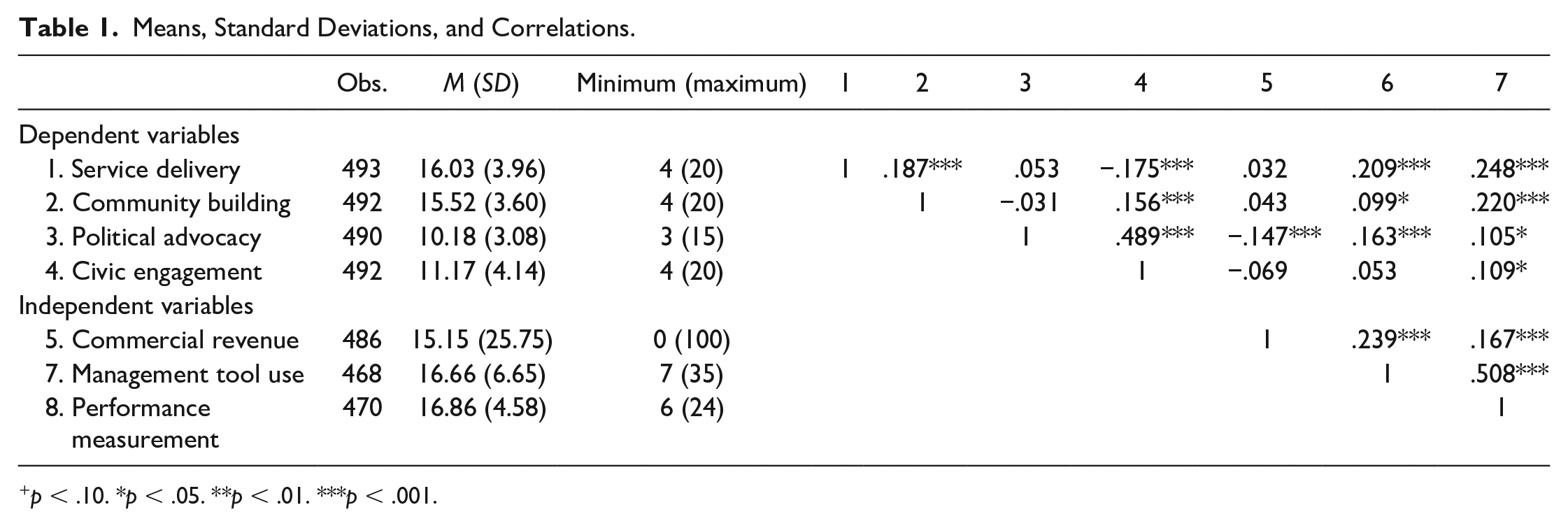
p < .10. *p < .05. **p < .01. ***p < .001.
Linear Regression Results.
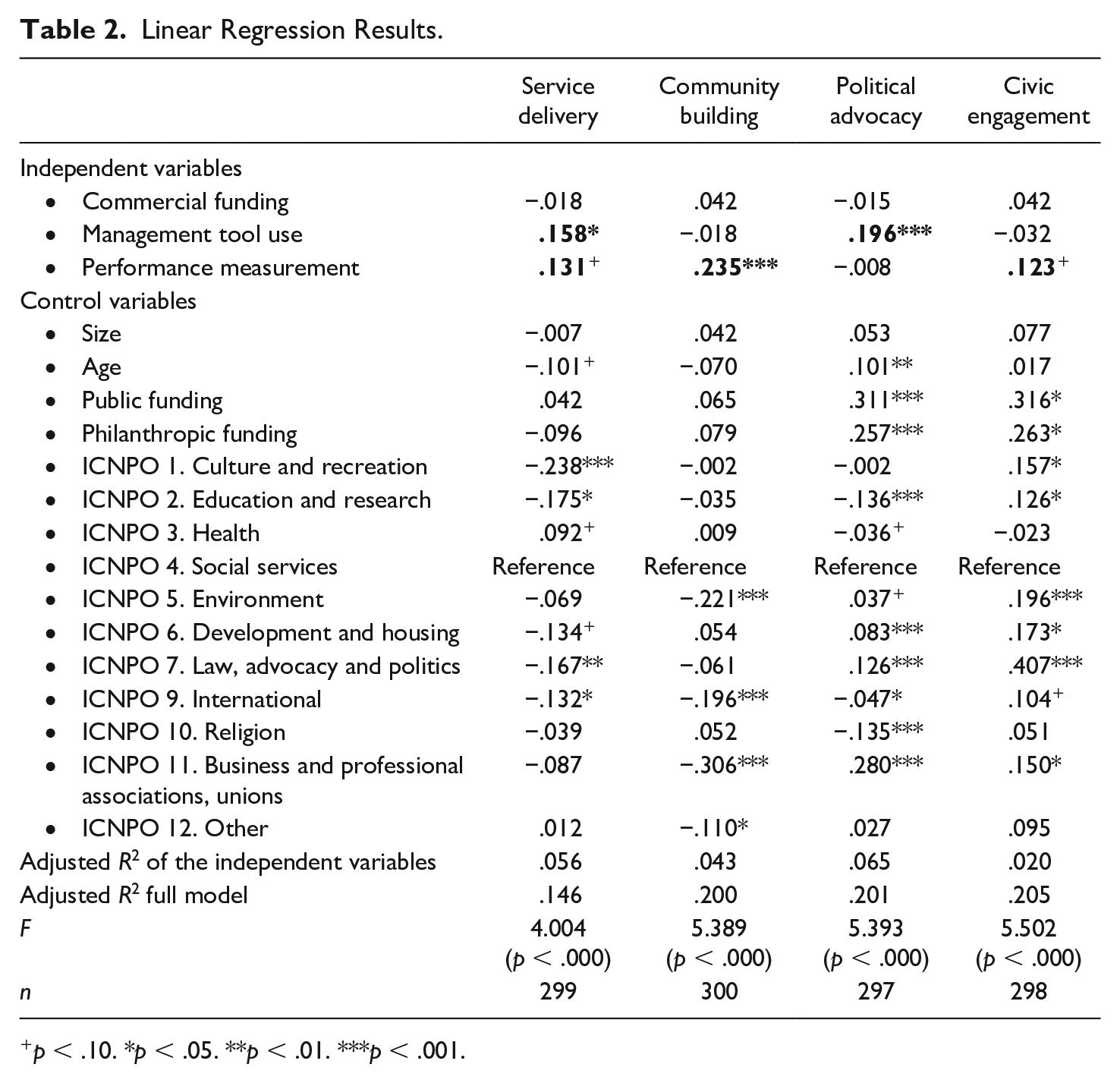
p < .10. *p < .05. **p < .01. ***p < .001.
First, our model explains 14.6% of the variance of how much NPOs provide services. Here, being business-like accounts for 5.6% of the variance. Contrary to our theoretical expectation, commercial funding is unrelated to service delivery (reject H1a). In line with our expectations, managerial practice, operationalized as management tool use and performance measurement, is positively related to service (accept H1b). Looking at the control variables, NPOs in the social services and health fields engage most strongly in service delivery. In contrast, organizational size and dependency on public or philanthropic funding are unrelated to the extent to which NPOs engage in service delivery. Finally, but remarkably, younger NPOs engage more in service delivery than their older counterparts.
Second, our model explains 20.0% of the variance in how much NPOs engage in community-building. Looking at independent variables, being business-like only accounts for 4.3% of the variance in the extent to which NPOs fulfill a community-building role. Contrary to our hypotheses, we find no significant relationship between community building and commercial funding or management tool use, and even a positive relationship between community building and performance measurement (reject H2a and H2b). Looking at control variables, we find that compared with NPOs providing social services, NPOs that focus on environmental or international issues, represent the interests of a particular profession, or are included in the “other category” engage significantly less in community-building. Finally, organizational size, age, and dependency on public or philanthropic funding are not significant predictors of the extent to which NPOs engage in community building.
Third, our model explains 20.1% of the variance of how much NPOs engage in political advocacy. Being business-like accounts for 6.5% of the variance. We find no significant relationship between advocacy and nonprofit commercialism (reject H3a). H3b about a positive relationship between managerialism and advocacy is partly confirmed, as we find a significant positive relationship with management tool use, but not with performance measurement. Looking at control variables for field of activity, we find that NPOs that focus on environmental issues, development and housing, law, advocacy and politics, or professions and work-related issues engage more in advocacy than NPOs from the social services field. In contrast, NPOs in the fields of religion, education or health, and NPOs that are organized internationally engage less in advocacy than NPOs from the social services field. The extent to which NPOs rely on public or philanthropic funding is positively associated with nonprofit advocacy efforts. Finally, whereas organizational size is not a significant predictor, we find that organizational age is positively associated with the extent to which NPOs assume an advocacy role.
And fourth and finally, our model explains 20.5 % of the variance of how much NPOs promote civic engagement. However, looking at independent variables, being business-like only accounts for 2.0% of the variance explained. Similar to community building, hypotheses about a negative relationship between NPOs being business-like and promoting civic engagement are not confirmed. There is no significant relationship between fulfilling a civic engagement role and commercial funding or management tool use, and a border significant positive relationship with performance measurement (reject H4a and H4b). When considering the control variables, we find that NPOs from the social services and health fields are less preoccupied with engaging people in the public debate than NPOs in other fields. Public and philanthropic funding is positively associated with fulfilling a civic engagement role. Organizational size and age add no explanatory value to the model. Table 3 summarizes findings across all models in comparison to the hypotheses.
Overview of Findings.

Note. n.s. = no significant relationship.
Discussion and Conclusion
Although NPOs adopting business-like practices generate a critical debate (see, for example, Eikenberry & Kluver, 2004; Maier et al., 2016; Suykens et al., 2019), there have been few quantitative studies examining its effects on nonprofit role uptake. Furthermore, theorizing on the effects of business-like practices on societal roles has rarely gone beyond institutional isomorphism and critical theory and has not detailed out concrete effects. Inspired by institutional and economic theories, we have therefore conceptualized three distinct potential effects of business-like practices on societal role uptake: the interpretation frame effect, the commercial revenue effect, and the production effect. Based on regression analyses of data collected from Flemish NPOs (N = 496), we find that business practice use only holds limited explanatory power regarding the extent to which NPOs engage in different societal roles.
We observed two distinct patterns. First, managerial practices appear to be positively related to all societal roles, although for some roles this positive relationship is limited to either managerial tool use or performance measurement. Corroborating previous research (cf. Baines et al., 2014; Irvine et al., 2009; Keevers et al., 2012; Suarez et al., 2018), we find support for a positive interpretation frame effect of managerialism leading to greater emphasis on the service delivery and advocacy role. However, we do not find support for a negative interpretation frame effect of managerialism detracting from community building or civic engagement. To the contrary, the performance measurement aspect associated with managerialism seems to emphasize community building and civic engagement. Presumably, this is owed to the fact that some prior qualitative studies documenting adverse effects of nonprofit managerialism (e.g., Baines et al., 2011; Hall, 1990; Kreutzer & Jager, 2011) may have focused on cases sporting extremely high levels of managerial practice, or on instances of mismanagement which also occur in for-profit businesses. We by no means want to denigrate the explanatory value of such case studies, but the range of their findings is arguably different from quantitative studies. Essentially, our findings suggest that warnings about managerialism endangering the nonprofit domain—likely underpinned by extreme cases—might be somewhat overdrawn for the majority of nonprofits, as competitive isomorphism, in addition to institutional isomorphism, is likely at play.
Second, commercial revenue appears to be unrelated to nonprofit role uptake. Accordingly, we cannot confirm any commercial revenue effects, in the sense of commercialized NPOs putting more emphasis on service delivery at the cost of other, less marketable, societal roles. This may indicate that, despite having a broader base to commercialize (Suykens et al., 2019), commercialization is by no means the prerogative of nonprofit service providers. All types of NPOs can generate commercial income via the sale of mission-unrelated items like candy, plants, t-shirts, flags and so forth, which subsequently can be used to cross-subsidize both service and non-service roles (cf. Guo, 2006; Toepler, 2006).
Needless to say, our findings should be interpreted with the study’s limitations in mind. First, we need to consider the particularities of the institutional context. We conducted our study in Flanders, which is a typical neo-corporatist welfare regime (Pauly et al., 2020). Here, business-like practices are less diffused in the nonprofit domain compared with Anglo-Saxon countries (Suykens et al., 2020) which have been the context of the most influential studies on NPOs becoming more business-like (e.g., Backman & Smith, 2000; Dart, 2004a; Eikenberry, 2009; Eikenberry & Kluver, 2004). Our findings may reflect the absolute level to which business-like practices are diffused in a particular nonprofit domain. Consequently, the relationship between the degree of being business-like and the emphasis on societal roles may correspond with an inverted U-shaped curve. By adopting business-like practices to a moderate extent, many Flemish NPOs might be entering the Goldilocks zone by reaping the benefits while staying clear of the pitfalls. A more intensive introduction of business-like practices may cause a “too much of a good thing” effect, justifying the influential warning by Eikenberry and Kluver (2004). Hence, differences across institutional contexts basically disallow a black-or-white positioning on the notion that NPOs becoming more business-like is a wrong-headed idea from the outset. We encourage future research to pursue this argument further by systematically comparing societal role uptake of NPOs in institutional settings characterized by a limited, moderate and extensive business practice diffusion.
In addition to the institutional context, we want to underline that our findings are bound by (a) our focus on business-like practices materializing within NPOs and (b) our measurement of nonprofit role uptake. Although commercialism and managerialism are widely considered as key manifestations of NPOs becoming more business-like (Maier et al., 2016), many harmful effects identified by previous studies should more accurately be attributed to changes in NPOs’ political and economic environment (e.g., marketization of public procurement) rather than to changes in NPOs’ internal structures (see, for example, Considine et al., 2014; Gallet, 2016). Hence, future research can complement this study by examining to what extent dynamics such as resource competition for public service contracting and performance-based accountability demands by resource holders induces NPOs to rebalance their contributions to society.
In a similar vein, our measurement of societal role uptake is necessarily lopsided, though we did our best to cover a broad spectrum of roles. Specifically, we measured the quantitative increase/decrease in organizational focus on different societal roles, thereby neglecting “how,” that is, by which specific practices, and perhaps more importantly, “how effectively” NPOs fulfill a particular role. For instance, although we find support for an interpretation frame effect of management tools strengthening the focus on service delivery, we cannot verify whether these services are offered within the esprit of the prosocial mission, or alternatively, increasingly corroded by exclusion mechanisms (e.g., Hustinx & De Waele, 2015), or driven by a one-size-fits all approach (e.g., Dart, 2004; Gallet, 2016). Typically, these qualitative shifts in nonprofit role uptake take center stage in qualitative studies. Experimental survey designs might be a promising way to analyze such mechanisms quantitatively. By providing nonprofit executives with fictitious scenarios that contain varying information on business practice use, research can tease out its impact on nonprofit role uptake by subsequently questioning executives on decisions they would take regarding the fictitious NPO’s contributions to society.
Finally, we should note that our study draws on single respondent survey data. Although common in the nonprofit management field, we cannot rule out that the surveyed nonprofit directors have an overly positive view of their organizations’ fulfillment of societal roles. Different stakeholders may have different perceptions regarding the extent to which NPOs (a) engage in business-like practices and/or (b) fulfill various roles (Carré et al., 2021). Future studies could overcome these limitations by adopting a multi-informant research design that combines qualitative and quantitative data about the extent and mode of role fulfillment (Enticott et al., 2009; Mele & Belardinelli, 2019).
Despite these caveats, the take-home argument of our study lies in the observation that both facets of managerialism—managerial tools and performance measurement—are positively related with societal roles. Performance measurement in particular positively links with service delivery, community building, and civic engagement. Managerial tools link positively with service delivery and advocacy. Overall, this supports the assumption that reflected and educated management of nonprofits does strengthen their contributions to society. Commercial funding, however, has neither positive nor negative effects on these contributions. From this, we derive the following implications for nonprofit research and practice.
For nonprofit research, our study paints a first broad-brush picture of the large-N relationship between business practice use and nonprofit role uptake, and offers a concise research agenda on how future research can uncover more fine-grained insights. For nonprofit practice, the observation that managerial practice is weakly, yet positively associated with nonprofit role uptake tentatively suggests that it is likely to contribute to goal fulfillment. Hence, for practitioners, our findings can be understood as an encouragement to use the tools that business management has to offer, but cautiously and with utmost care about the organization’s mission and values. Practitioners should use their judgment to consider the use of business-like or alternative methods, and they should be wary of adopting business practices in excess. As Paracelsus has suggested, the dose makes the medicine.
Supplemental Material
sj-docx-1-nvs-10.1177_08997640221106979 – Supplemental material for Business-Like and Still Serving Society? Investigating the Relationship Between NPOs Being Business-Like and Their Societal Roles
Supplemental material, sj-docx-1-nvs-10.1177_08997640221106979 for Business-Like and Still Serving Society? Investigating the Relationship Between NPOs Being Business-Like and Their Societal Roles by Ben Suykens, Florentine Maier, Michael Meyer and Bram Verschuere in Nonprofit and Voluntary Sector Quarterly
Footnotes
Declaration of Conflicting Interests
The author(s) declared no potential conflicts of interest with respect to the research, authorship, and/or publication of this article.
Funding
The author(s) disclosed receipt of the following financial support for the research, authorship,and/or publication of this article: This research was supported by the Agency for Innovation andEntrepreneurship (VLAIO) research grant 150025.
Supplemental Material
Supplemental material for this article is available online.

Author Biographies
References
Supplementary Material
Please find the following supplemental material available below.
For Open Access articles published under a Creative Commons License, all supplemental material carries the same license as the article it is associated with.
For non-Open Access articles published, all supplemental material carries a non-exclusive license, and permission requests for re-use of supplemental material or any part of supplemental material shall be sent directly to the copyright owner as specified in the copyright notice associated with the article.
