



Abstract
South Korea has experienced a rapid increase in the emergence of social enterprises that aim to address various social problems. However, little is known about the conditions that can affect the emergence of social enterprises at the regional level. This study examined the regional factors that influence the establishment of social enterprises using a panel dataset of observations on 17 metropolitan cities and provinces in South Korea from 2012 to 2019. The appearance of social enterprises in regional entrepreneurial ecosystems was found to be associated with the market, government, networks, financial resources, and human capital. We also found that the determinants of their emergence within South Korea’s social enterprise ecosystem vary based on their level of development and purpose. Based on the results, we suggested several policy implications and suggestions.
Introduction
Social enterprises facilitate the alleviation of various societal problems through innovative entrepreneurial approaches. Recent research in the area has sought to explain the uneven distribution of social enterprises by focusing on the factors that either facilitate or hamper their development. At the national level, different institutional contexts—including economic, social, and legal systems—and characteristics of the third sector have been examined in detail (European Commission, 2014; Hazenberg et al., 2016; Hoogendoorn, 2016; Stephan et al., 2015). Studies that focus on individual aspects have sought to characterize the idiosyncratic beliefs of and opportunities available to individual social entrepreneurs (Christopoulos & Vogl, 2015; Yitshaki & Kropp, 2016). In addition, numerous studies have simultaneously explored individual and country-specific characteristics by employing a multilevel approach (Coskun et al., 2019; Monroe-White et al., 2015).
However, there is a lack of research on the influence of regional factors on social enterprises. Although several studies show geographical disparities in the activities of social entrepreneurs (Buckingham et al., 2012; Muñoz, 2010), they do not offer sufficient knowledge about how the regional environment affects them. Given that the main objective of a social enterprise is to address social problems, which do not exist in a vacuum, the regional environment is an appropriate context for the exploration of the emergence and the role of social enterprises. In addition, the region as a unit provides numerous advantages, such as rich data that enables an exploratory research design and comparative explanations under similar social mechanisms within relatively homogeneous environments.
Only recently have studies begun to acknowledge the regional environment’s effect on social enterprises through the entrepreneurial ecosystem (Roundy, 2017; Surie, 2017). An entrepreneurial ecosystem refers to a set of supportive environments that foster innovative business—incorporating cultural, social, and material attributes that are difficult to imitate or reproduce (Spigel & Harrison, 2018). An important aspect of regional entrepreneurial ecosystems is that each region is defined by particular characteristics and employs varying approaches through which social enterprises interact with their environments (Shwetzer et al., 2019). Furthermore, making the entrepreneurial ecosystem conducive for social entrepreneurship is critical for the emergence and growth of social enterprises (Muñoz, 2010).
Against this backdrop, this study adopts the entrepreneurial ecosystem approach to explore regional determinants that lead to the emergence of social enterprises in South Korea. Previous studies have indicated that legal forms and local contexts play important roles in fostering social enterprises (Pratono & Sutanti, 2016). Thus, we also examined whether the aforementioned determinants differed depending on the types and purposes of the social enterprises based on the Social Enterprise Promotion Act (SEPA). For these purposes, we utilized an unbalanced panel dataset of 17 metropolitan cities and provinces from 2012 to 2019 that captured the dynamics of social enterprise development and subsequently attempted to illuminate the regional factors that determine the emergence of social enterprises.
Social Enterprises in South Korea and the Social Entrepreneurial Ecosystem
Development and Distinctive Features of Social Enterprises in South Korea
Before we introduce the features and types of social enterprises in South Korea, it is important to define concepts, such as social entrepreneur, social entrepreneurship, and social enterprise, due to the illusive nature of these terms. Generally, a social enterprise is distinct from social entrepreneurs and social entrepreneurship, as it is not necessarily engaged with others (Brouard & Larivet, 2010). A social enterprise is a form of social business/social venture run by individuals and social entrepreneurs who are willing to delegate some decisions to professional managers (Saebi et al., 2019). However, social entrepreneurship is seen as the process through which social entrepreneurs create social enterprises—concentrating motivation, leadership, and innovative activity at the individual level (Defourny & Nyssens, 2008; Luke & Chu, 2013). We will focus here on social enterprises as organizations that aim to address social problems.
The emergence and development of social enterprises vary based on historical and social contexts, social structures, and institutional environments. For example, revenue-generating activities are emphasized in the American context, whereas social enterprises in Europe are generally of the nonprofit or cooperative variety (Defourny & Nyssens, 2010; Kerlin, 2006). Although there is no simple explanation regarding how social enterprises are related to their specific environment, the development of civil society, including its relationships with the government and the market, is important to social enterprises (Salamon & Anheier, 1998). Particularly, a key question is whether social enterprises will be able to maintain their distinct features against the isomorphic pressure wielded simultaneously by the state and the market (Defourny & Kim, 2011; DiMaggio & Powell, 1983).
In South Korea, strong state power has played a key role in the emergence and development of social enterprises. This differs from the European and North American context, where social enterprises have been more influenced by the voluntary initiatives of civil society rather than the state (Defourny & Kim, 2011; Kerlin, 2006). Social enterprises in South Korea were seen as a public policy tool, as the nation intended to utilize social enterprises to influence the economy and civil society (Bidet & Eum, 2011; Jeong, 2017). Subsequently, there exists considerable concern about the dominant role of the state in the development of social enterprises in South Korea, where civil society is emerging but not advanced enough (Defourny & Kim, 2011; Jang, 2017).
However, this strong state power of South Korea mitigated the trend toward market reliance, which reduced the need for social enterprises to seek economic profits at the expense of their social mission (Defourny et al., 2021; Defourny & Kim, 2011). Moreover, there have been considerable changes in the relationship between the government and civil society recently in South Korea. These changes include the expansion of the nonprofit sector, the surge of social welfare service organizations, and the emergence of the cooperative sector (Jang, 2017). Thus, it can be argued that South Korea’s social economy has transitioned from being dominated by the state into a mixture of top-down and bottom-up approaches where the role of civil society has increased (Bidet & Eum, 2011; Defourny & Kim, 2011; Jang, 2017).
Against the overview of the development of social enterprises in South Korea, we introduce various kinds of social enterprises in the country. Although numerous diverse types of social enterprises can be operational within a country (Bidet et al., 2018; Defourny & Kim, 2011), we examine social enterprises in South Korea based on the types of establishments stipulated in the legal frameworks, which were developed from Borzaga and Defourny’s (2001) historical identification of major fields of social enterprises.
As shown in Table 1, there are two types of social enterprises in South Korea—certified social enterprises and preliminary social enterprises. Certified social enterprises are considered formal social enterprises that are eligible for various financial and business supports as well as tax exemptions. Following the types of establishments stipulated in the SEPA and its relevant enforcement decree, certified social enterprises can be classified into five subtypes based on their objectives—job creation, social service provision, mixed (job creation and social service provision), local community contribution, and miscellaneous. The number of certified social enterprises has dramatically increased from 55 in 2007 to 2,704 in 2020. Approximately 66% of these certified social enterprises were job-creation-oriented. The large proportion of job creation social enterprises reflect the prevalence of governmental policies that utilized social enterprises to address unemployment in the aftermath of the 1997 economic crisis (Bidet & Eum, 2011).
Different Types of Social Enterprises in South Korea.
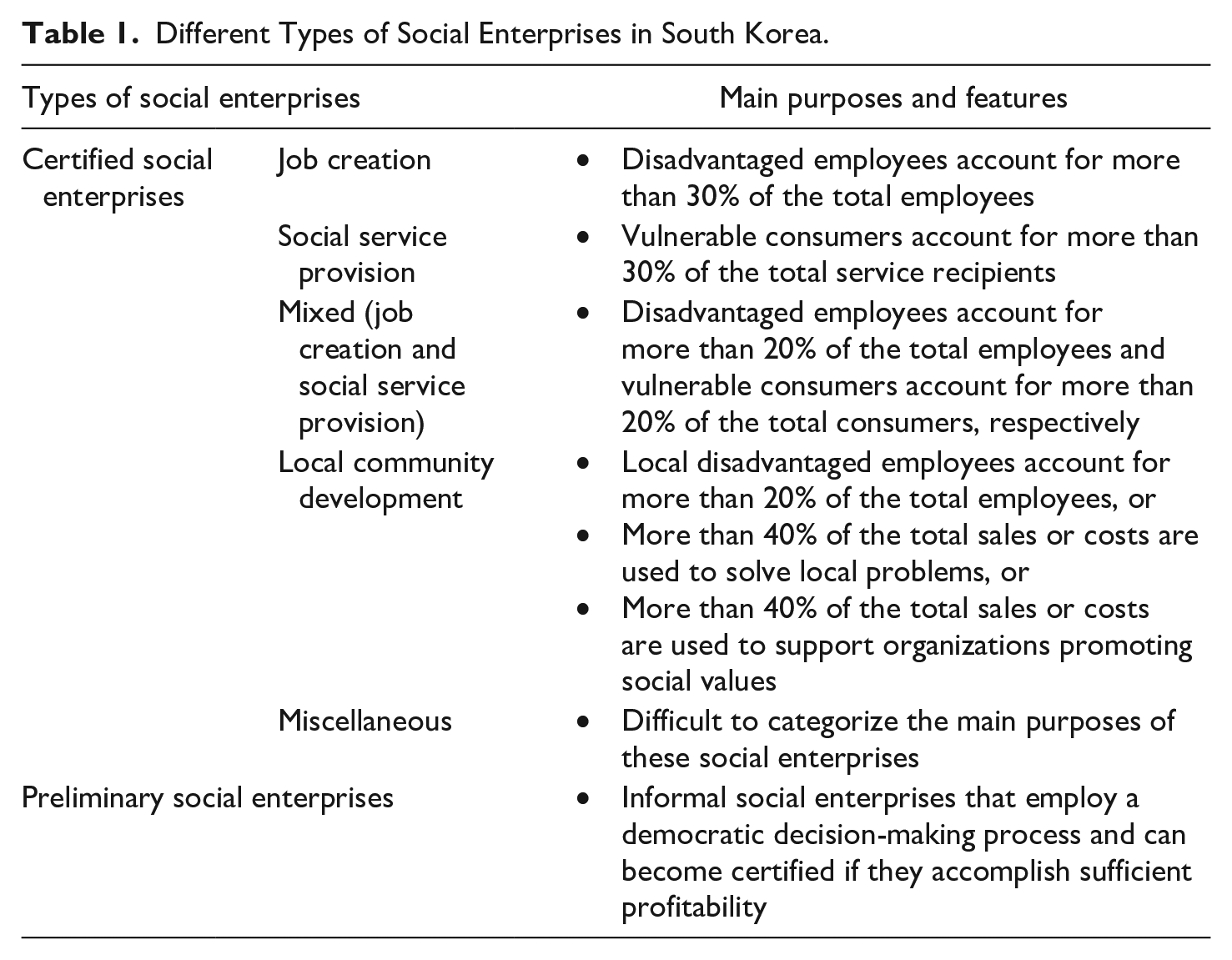
Turning to the other type of social enterprises, preliminary ones are organizations that can become certified social enterprises once they achieve sufficient profitability to be sustainable. In addition, they practice a democratic decision-making process with interested parties. Preliminary certification—awarded by regional governors or ministers of the government—has also rapidly developed since it was introduced. There were 791 preliminary social enterprises in 2011; this number increased to 1,789 as of 2020. This public scheme attracts nascent entrepreneurs through financial and business support from governments, but the amount and scope of such support are limited in comparison to the resources available for certified social enterprises. As of 2020, approximately 67% of the certified social enterprises were originally preliminary social enterprises. This reflects that preliminary social enterprises strive to receive certification.
Entrepreneurial Ecosystems of Social Enterprises
We examine the regional factors that foster social enterprises based on entrepreneurial ecosystems, which provide insight into specific regional environments. Entrepreneurial ecosystems can be defined as combinations of social, political, economic, and cultural elements within a region that support the development and growth of innovative start-ups, where different actors interact and cooperate to facilitate the cumulative co-production of new knowledge (Brown & Mason, 2017; Spigel, 2017). It has been suggested that entrepreneurial ecosystems are primarily managed by entrepreneurs rather than the state, and the importance of entrepreneurial resources, such as knowledge regarding how to start and grow a business, has been emphasized (Spigel & Harrison, 2018).
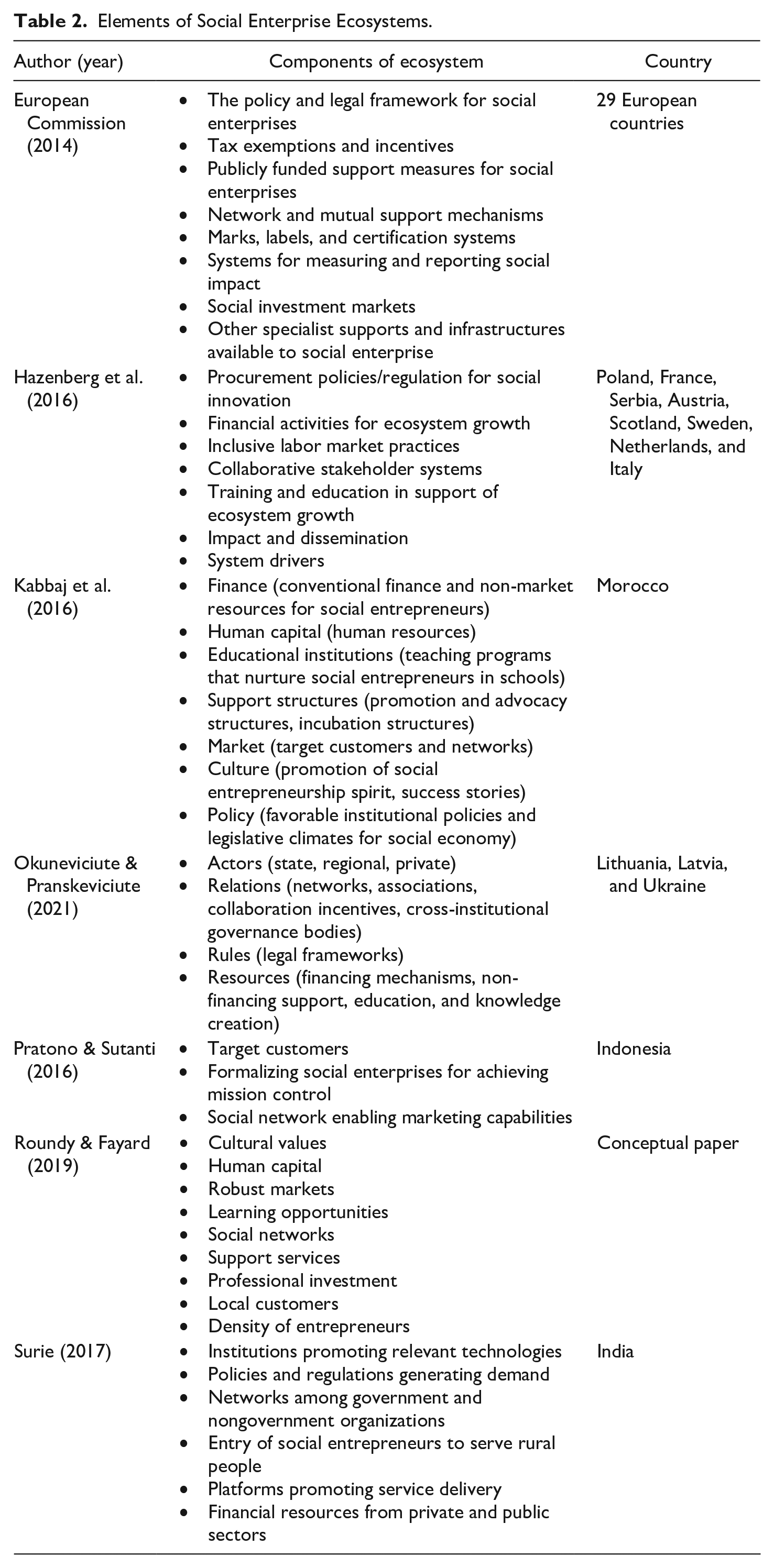
Although social enterprises share various features with conventional enterprises, entrepreneurial ecosystems of social enterprises have several characteristics that are particularly important for social enterprises in comparison to for-profit institutions (Roundy, 2017). As shown in Table 2, various elements of social enterprise ecosystems have been presented as important factors regarding the development of social enterprises over the last decade. In this study, the factors we focus on are market, government, network, and other resources (financial resources, human capital, and research and development), as they were frequently discussed in prior studies.
Elements of Social Enterprise Ecosystems.
First, market demands in the entrepreneurial ecosystem constitute a critical element because social enterprises need to be competitive and self-sustainable to generate social value for their customers (Zhang & Swanson, 2014). The aggregate market demand is usually gauged by the size and disposable income and of the population (Audretsch & Belitski, 2017). However, unlike for-profit start-ups, social enterprises tend to start businesses to satisfy social needs that are not sufficiently addressed by markets or the public sector. Thus, vulnerable people, including the poor and socially disadvantaged groups, are regarded as proxy customers of social enterprises, which can be affected by the number of vulnerable people in the region who have social needs (Westley & Antadze, 2010). In fact, several empirical studies have indicated that social entrepreneurs initiate their businesses to address the social needs that have not been met by the market (Apostolopoulos et al., 2019; Ferguson, 2007).
Second, prior studies have shown that the government-led redistribution of economic wealth through tax and welfare spending can affect the activities of social enterprises (Estrin et al., 2016; Stephan et al., 2015). A scarcity of available social services leads to the emergence of social enterprises, implying that social enterprises emerge to fulfill the unsatisfied social needs that result from limited government expenditure. On the contrary, a high level of government expenditure on welfare may hinder their entry into social sector markets, even though the negative impact will be lower for social enterprises in comparison to commercial ones (Estrin et al., 2016; Salamon & Anheier, 1998). Ferri and Urbano (2011) found that public spending negatively affected the absolute level of social entrepreneurship. Although Hoogendoorn (2016) found that government expenditure was positively associated with the proportion of social entrepreneurial entry among the total number of start-ups, it is presumed to be the result of its stronger negative effect on commercial start-ups and the subsequent decrease in the total number of start-ups. Thus, we posit a negative association between social enterprises and the related resources of governments, as social entrepreneurs recognize the business opportunities created by a lack of public services.
Third, the social enterprise ecosystem is shaped by their networks with other firms, as the entrepreneurial ecosystem perspective posits that networks are central (Kabbaj et al., 2016; Okuneviciute & Pranskeviciute, 2021; Pratono & Sutanti, 2016; Roundy & Fayard, 2019; Zhang & Swanson, 2014). Networks, entrepreneurial resources, and know-how of start-ups are central to a sustainable competitive advantage of entrepreneurial ecosystem (Spigel & Harrison, 2018). Moreover, the benefits of a network do not necessarily accrue to firms in the same market due to the greater importance of knowledge about the entrepreneurial process, such as opportunity identification and business planning, in comparison to industry-specific knowledge and resources within an ecosystem (Aldrich & Yang, 2014; Spigel & Harrison, 2018). Thus, a sufficient supply of entrepreneurs and experienced employees in early-stage ventures can aid social entrepreneurs owing to the knowledge possessed by such individuals, even they come from other industry (Roundy & Fayard, 2019). Furthermore, previous studies have highlighted that inter-firm cooperation within the same industry is most often observed in entrepreneurial ecosystems as they focus on value creation and compete for attention but not revenues (Bogers et al., 2019; Hannah & Eisenhardt, 2018; Ranganathan et al., 2018). Thus, we assume that the regions with a higher number of start-ups and those with a higher number of firms in the same market have more social enterprises.
Finally, resources, such as access to financial resources, human capital, and research and development (R&D), play pivotal roles in the emergence and growth of social enterprises (Choi et al., 2020; Perrini & Vurro, 2006; Roundy, 2017). In particular, subsidies from the government serve as important financial resources that enable social enterprises to establish and sustain themselves by avoiding purely market-oriented risks, especially in societies where welfare services are underserved (Perrini & Vurro, 2006). Furthermore, the provision of direct government subsidies can significantly influence the establishment of social enterprises in South Korea as the SEPA requires local governments to provide subsidies to social enterprises, especially in their early stages (Choi et al., 2020). Human capital is a significant factor for social entrepreneurs, as relevant knowledge and experience enable nascent entrepreneurs to recognize new opportunities through the observation of social problems and devise innovative solutions to these problems (Estrin et al., 2016; Kong, 2019; Roundy, 2017). R&D investment can facilitate innovation and entrepreneurial activities as it allows social entrepreneurs to provide innovative goods and services that are useful to vulnerable people and can have a social impact (Fabrizio & Tsolmon, 2014; Westley & Antadze, 2010).
Research Method
Data Collection
For the analysis, we selected 17 metropolitan cities and provinces in South Korea that have their own local autonomy within the regional boundary (http://nationalatlas.ngii.go.kr/pages/page_1266.php). We used metropolitan cities and provinces as a unit of analysis because numerous variables that can reflect social enterprise ecosystems are only available at that level. Furthermore, it is worth noting that metropolitan cities and provinces have the same constitutional power, which is relevant when comparing the effect of local governments on social enterprises across regions.
Concerning the time scope of the study, we built the panel dataset starting from 2012 because we required access to information on subsidies for preliminary and certified social enterprises. We obtained unbalanced panel data that consisted of 131 observations instead of 136 because no data was available for Sejong Metropolitan City during the 2012–2016 period. We built the panel dataset until the year 2019, which was the most recent data on regional environments available at the time.
Our data were mainly collected from two sources. All independent and control variables were collected from Statistics Korea, which is considered a reliable source as it provides government-approved data for public use (http://kostat.go.kr/). The information on different types of social enterprises and subsidies for the social enterprises in each metropolitan city and province was obtained from the Korea Social Enterprise Promotion Agency (KSEPA), which manages and evaluates the activities of social enterprises in the country (http://www.socialenterprise.or.kr).
Variables
We employed four dependent variables to reflect the distinct types and purposes of certified social enterprises. The first dependent variable was the sum of preliminary social enterprises approved by ministers and certified social enterprises. Using this variable enabled the examination of the effects of determining factors on social enterprises in the country overall. We set the second dependent variable as preliminary social enterprises. For the third and fourth dependent variables, we categorized the certified social enterprises into two groups: job creation social enterprises and social enterprises with the other purposes. We counted the number of new social enterprises and did not include incumbent social enterprises. All dependent variables were standardized by 10,000 people to reflect the population size.
Based on previous studies on social enterprise ecosystems, we measured various independent variables, including market, government, network, financial resources, human capital, and R&D. We measured the market for social enterprises using the percentage of vulnerable groups, which included people aged over 65, people with disabilities, and recipients of basic livelihood security, as target customers and potential employees of social enterprises. The government welfare budget was measured by calculating the percentage of local government expenditure on social welfare. We employed two variables to measure the characteristics of networks. Networks with start-ups were measured by the number of new firms divided by 1,000 labor force, and networks with firms in the same industry were measured by the percentage of social welfare (SW) and health firms among the incumbent firms. We gauged the financial resources of social enterprises by calculating the amount of subsidies they received from the central government taking a natural log. We calculated human capital as the percentage of the labor force that had a university degree or above. Subsequently, we added R&D investments divided by 1,000 labor force with a natural log.
We also controlled for the regional economic conditions using unemployment rates because most of the nation’s social enterprises were established to address the unemployment problem (Defourny & Kim, 2011; Lee, 2015). Table 3 describes the measurements and data sources of the variables.
Description of Variables and Data Sources.

Note. SE = social enterprises; KSEPA = Korea Social Enterprise Promotion Agency.
Analytical Method
We first estimated the effects of the entrepreneurial ecosystem on social enterprises by using the pooled OLS analysis with the following Equation 1:

Here,
After performing Joint F-tests, Breusch–Pagan tests, and Hausman tests, we find that the fixed effects (FE) model rather than pooled OLS or random effects (RE) model is the best estimation method in all cases. As shown in Equation 2, our FE model incorporates unobservable region-specific effects, controlling for the time-invariant region.

where
Results
The descriptive statistics and correlation matrix among variables are reported in Table 4. As shown, certified social enterprises comprised almost two-thirds of the examined social enterprises. In addition, most certified social enterprises focused on creating jobs for vulnerable people. Job creation social enterprises comprised about 69.8% of the certified social enterprises during the research period. Looking at the correlation matrix among the variables, all types of social enterprises were positively and significantly correlated. We disregarded multicollinearity problems as the value of the variance inflation factor (VIF) was 3.43. For the current study’s purposes, we analyzed Equation 2 with four different dependent variables. These variables were all social enterprises, preliminary social enterprises, job creation certified social enterprises, and other certified social enterprises.
Descriptive Statistics and Correlation Matrix (N = 131).
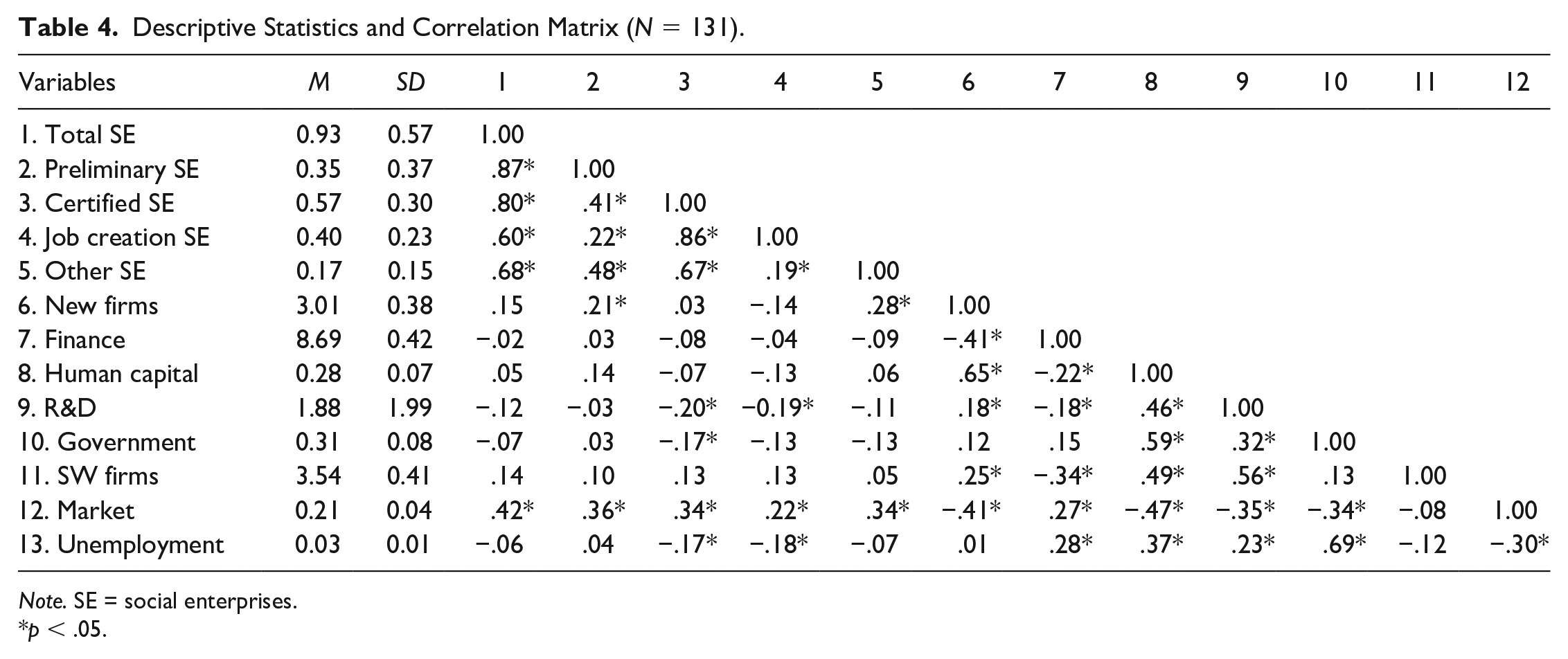
Note. SE = social enterprises.
p < .05.
Estimation Results.
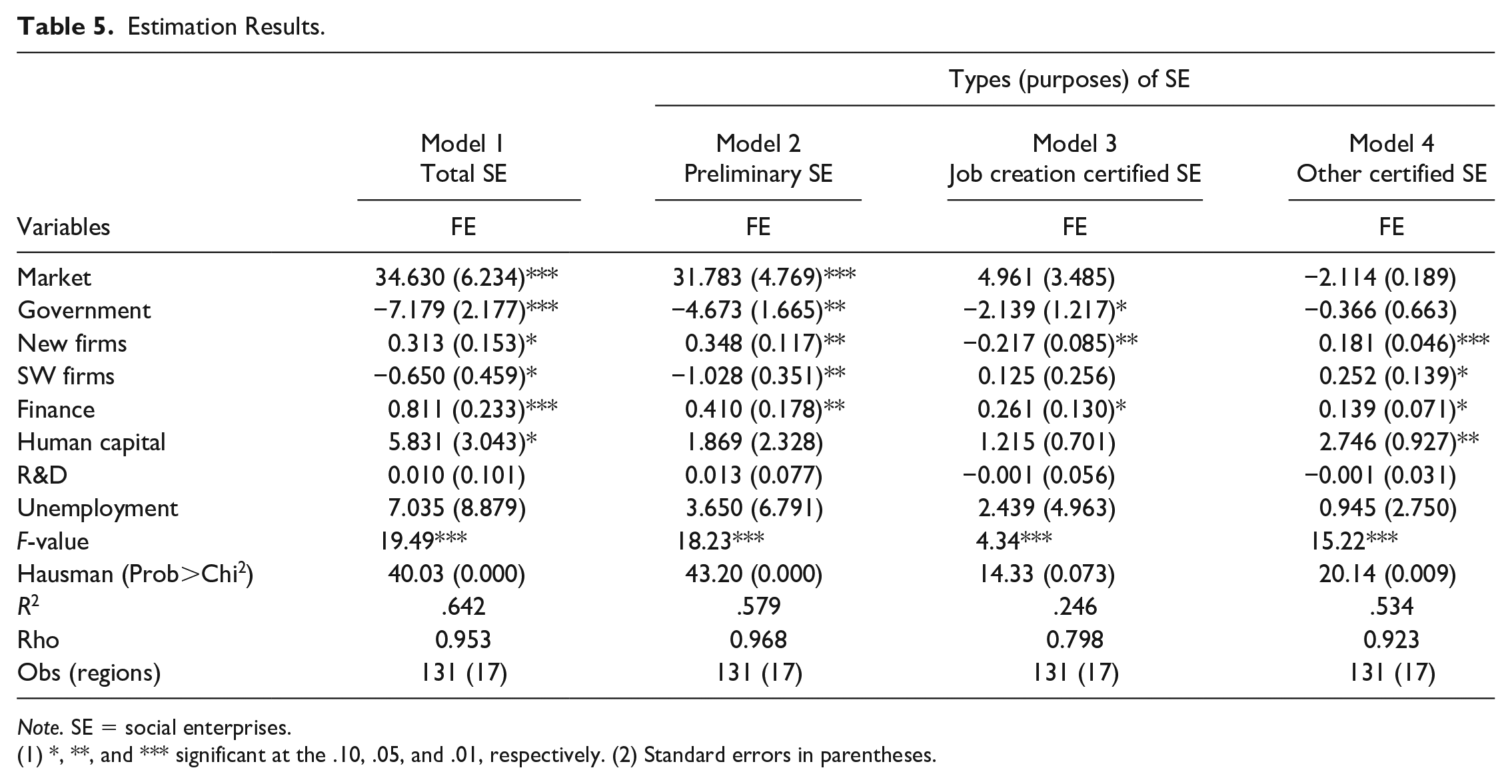
Note. SE = social enterprises.
(1) *, **, and *** significant at the .10, .05, and .01, respectively. (2) Standard errors in parentheses.
For the first research question of the current study, we mainly interpreted the results of Model 1, pertaining to all the examined social enterprises. In Model 1, H1 was supported as we found that the percentage of vulnerable people was positively related to new social enterprise creation with a statistical significance of 0.01. H2 was also supported as the percentage of government expenditure on social welfare showed negative estimates, indicating that regions with smaller budgets dedicated to the welfare sectors were predicted to have more social enterprise creation.
Concerning networks, the number of overall social enterprises starting their businesses in regions was positively related to new firm formation. However, the emergence of social enterprises was negatively correlated with the number of social welfare firms. Thus, H3a was supported but H3b was not. In other words, social enterprises prefer regions with more start-ups and regions with fewer social welfare and health firms. We will discuss this result in detail in the next section alongside other results related to preliminary and certified social enterprises. Among the other regional resources, financial resources are statistically and positively associated with the emergence of social enterprises. The estimate of human capital represents that social enterprises were positively associated with human capital. However, R&D was not found to have any statistically significant association with new social enterprises. Thus, H4a and H4b were supported but H4c was not. It can thus be interpreted that nascent social entrepreneurs rarely tend to utilize science-based approaches.
In addition, unemployment was not associated with social enterprises. A reason why unemployment had no correlation may reside in the original data. Several vulnerable groups, such as people over 65 years of age, were not reflected in our data regarding unemployment as they are not considered to be a part of the labor force according to official statistics. A more detailed examination is required to understand the specific reasons.
Turning to the second research question, we analyzed the differences in the determinants based on the varied types and purposes of social enterprises. We specifically compare the estimates of Model 2 for preliminary social enterprises, Model 3 for job creation social enterprises, and Model 4 for the other certified social enterprises with varied social purposes. The most conspicuous differences between them can be found in terms of markets, networks, and human capital.
With regard to the market, the number of nascent preliminary social enterprises was statistically significantly and positively related to the number of vulnerable people and negatively related to the welfare budget of local government in Model 2. However, the job creation social enterprises in Model 3 and the other certified social enterprises in Model 4 did not show any statistically significant association with vulnerable people. It appeared that preliminary social enterprises—not certified as formal social enterprises primarily due to their low profitability—were more likely to respond to regional demands for the vulnerable that were not sufficiently addressed by the market and the local government.
When it comes to networks, Model 2 presented similar results to Model 1. Specifically, in Model 2, the number of preliminary social enterprises was positively associated with the number of new firms, while it was negatively associated with that of social welfare and health firms. On the contrary, in Model 3, the number of job creation social enterprises was negatively associated with the number of start-ups. In Model 4, the number of other certified social enterprises was positively associated with both the number of new firms and that of social welfare and health firms. This indicates that these kinds of social enterprises benefit from their relational assets with start-ups and firms in the same industry.
While human capital was not associated with the number of the preliminary social enterprises in Model 2, it was observed that human capital can play a role in the establishment of other certified social enterprises in Model 4. Presumably, professional knowledge and experience are required to facilitate certification from governments and make their business sustainable and profitable, especially in the case of innovative social enterprises.
Discussion
Although the need for studying the regional factors that influence the activities of social enterprises is increasing (Muñoz, 2010), we still have limited knowledge about the entrepreneurial ecosystem’s influence on social enterprises. Using the entrepreneurial ecosystem perspective, the present study attempted to examine the regional factors that affect the geographical distribution of new social enterprises in South Korea, using a regional-level longitudinal dataset that covered the whole country for the period ranging from 2012 to 2019. Furthermore, we showed that the effects of specific entrepreneurial ecosystem elements differed depending on the types and purposes of the social enterprises that constituted them.
The empirical results of the current study revealed that social enterprises are likely to emerge to satisfy the needs of the socially vulnerable (Apostolopoulos et al., 2019; Ferguson, 2007), which suggests that social enterprises endeavor to create social value or satisfy needs that the government failed to address (Hoogendoorn, 2016; Salamon & Anheier, 1998). In particular, preliminary social enterprises, not certified due to their low profitability, were found to be more responsive than certified ones to the needs of vulnerable people living in regions where the local governments had limited welfare budgets.
Based on these empirical results, we suggest the following policy implications at the country and regional/local level in the context of South Korea. First, at the country level, we suggest that more diverse social economy entities should be included in the system, rather than maintaining the current strict certification system. Our results showed that preliminary social enterprises are more likely to respond to regional demands for vulnerable residents than certified social enterprises. The results hint at the possibility that other various social economy entities that are as embryonic and informal as preliminary social enterprises may respond better to the social needs that are not met by the welfare system. Thus, we believe that it is important to create an institutional context that facilitates the growth of bottom-up initiatives from civil society and accommodates within the system other social economy entitles, such as cooperatives and community enterprises. Introducing a registration system or redesigning the present system to enable the emergence of more social enterprises can be considered as an alternative, as the existing government’s certification system is too strict in terms of its legal requirements and sanctions, unlike the United States’ B Corporation certification (Choi et al., 2020; Kim, 2009; Kim et al., 2018; Moon, 2012).
In addition, we suggest that nation-wide networks for the development of social enterprises should be reinforced. Our results showed that social enterprises tend to appear in regions where social welfare firms are not densely located. The result implies that social enterprises regard other service providers as competitors, rather than potential cooperation partners. Accordingly, to shape an ideal ecosystem of innovative and cooperative networks in South Korea, more effective nation-wide platforms that aim to foster partnerships between social enterprises and others are required. The online and offline platforms can provide necessary information and services for the matching between social economy entities and various other actors, such as firms, religious organizations, donors, and volunteers. In addition, the government’s role should change from that of a direct supporter to that of an indirect one, creating cooperative networks and joining the social enterprise ecosystem as a participant alongside Korea Social Economy Solidarity Conference, Korea Health Welfare Social Cooperative Federation, Korea Cooperatives, Korea Social Value and Solidarity Foundation, and so on.
Finally, at the regional/local level, more specialized support systems and the expertise of the intermediaries are required. Our results suggest that social enterprises’ networks vary based on their level of development and purpose. Preliminary social enterprises tend to emerge in regions with more start-ups regardless of industry. The result can be interpreted that social enterprises require networks with start-ups in their embryonic stage, and they benefit from networks with other firms in the same industry in their more developed stage. Nevertheless, job creation social enterprises are more likely to emerge in regions with fewer new firms than other regions, presumably indicating that entrepreneurial knowledge and relations with start-ups are not as essential to those social enterprises as to others. Thus, specialized expertise of regional and local level intermediaries is required to cater to the differing needs of diverse social enterprises. Specifically, better targeted support is required for training and capacity-building programs for those intermediaries, in addition to differentiated and tailored programs for aspiring social entrepreneurs in local and regional academic institutions (Lee, 2018; Ma, 2011).
Conclusion
Our results indicated that South Korean social enterprises emerged as an attempt to satisfy social needs that the market and government failed to address. The results also revealed that the determinants of the emergence of social enterprise in South Korea vary based on their level of development and purpose. Social enterprises in South Korea have been led primarily by the government. However, South Korean social enterprises were not captured in state welfare policy as the government allowed them to grow as deliverers of social services (Jeong, 2017). Furthermore, unlike many Western European countries, they were not narrowly connected to specific policies as the government used social enterprises as a broader policy tool and encouraged the development of various types of social enterprises. In this vein, although Salamon (2010) categorized South Korea as a statist civil society, the South Korean social enterprise model can be called “strategic diverse” (Jeong, 2017; Kerlin, 2017, p. 71).
Our results supported the model, indicating that social enterprises in South Korea tend to emerge when government failure or market failure occurs while preserving the differences in their motives of starting their businesses, which is corroborated by the differing influence of regional factors based on their level of development and purpose. Especially, networks and entrepreneurial resources of start-ups were important for social enterprises, although there was an absence of close cooperation among firms in the same industry. To support the development of social enterprises and other civil society institutions while retaining their diversity against the homogenizing pressure from competition (DiMaggio & Powell, 1983; Mair, 2020), the creation of cooperative networks within the social enterprise ecosystem and the joint creation of social value needs to be facilitated.
Despite the implications and contributions of the current study, it has certain limitations. As we utilized and analyzed data from South Korea, the results are not directly applicable to other countries with different institutional contexts and socioeconomic conditions. We suggest that the determining factors of the emergence of social enterprises should be compared with other countries with similar frameworks. In addition, it is desirable to include more social economy entities and more variables that reflect the distinct characteristics of social enterprises in regional milieus, such as the amount of charitable donations and the number of voluntary organizations. Finally, although we conducted a quantitative study, a qualitative approach to social enterprises in idiosyncratic regional environments should be simultaneously considered. Additional research on the subject is required to tackle these shortcomings.
Footnotes
Authors’ Note
We extend our sincere appreciation to the anonymous reviewers for their insightful comments and suggestions in the review process.
Declaration of Conflicting Interests
The author(s) declared no potential conflicts of interest with respect to the research, authorship, and/or publication of this article.
Funding
The author(s) received no financial support for the research, authorship, and/or publication of this article.
