



Abstract
Social media is an important tool for nonprofit public policy advocacy. To help nonprofits effectively utilize social media in advocacy efforts, this study proposes a measurement framework of social media social capital based on social networks. Specifically, in this study, we examine the relationships between social media capital and symbolic, political capital on social media. We study how a group of nonprofits utilizes Twitter to advocate for the Green New Deal and their interaction with politicians, activists, and publics on social media during the 2019 presidential primaries. Our analysis shows that different dimensions of social media capital significantly influence nonprofits’ social media-based symbolic capital and political capital.
Many nonprofit organizations engage in public policy advocacy for a variety of reasons, such as giving voice to constituencies, representing diverse views, promoting economic, social, and environmental justice, facilitating civil interactions, and strengthening civil society and democracy (Brady et al., 2015; Greenspan, 2014; Guo & Saxton, 2020; Shier & Handy, 2015). In recent years, as the population of social media users continues to grow, research has documented how nonprofits utilize social media for insider and outsider advocacy strategies (Guo & Saxton, 2014), resource mobilization (Saxton & Wang, 2014), and civil rights advocacy and activism (Brady et al., 2015). Most scholars tend to agree that nonprofits’ social media use could facilitate policy advocacy (Guidry et al., 2014).
Meanwhile, scholars have also recognized that adopting social media alone is insufficient to achieve desired outcomes in the crowded, social-mediated public sphere (Guo & Saxton, 2018). With millions of users and even bots speaking up on social media, it is crucial for nonprofits to understand which type of resources social media could provide and how organizations’ social media efforts can be translated into such resources to advance their strategic goals. As noted by Te’Eni and Young (2003), a proper use of communication technologies would allow nonprofits to function as trusted intermediaries and help people cope with complex information on social media.
We draw upon recent research that conceptualizes social media capital as a relational construct (Saxton & Guo, 2020), and propose a systematic measurement framework to understand the relationships between social media capital and other forms of capital that can be acquired through social media-based advocacy. Specifically, we draw from Saxton and Guo’s (2020) conceptualization of social media capital as “the stock of social media-based social resources an organization has generated via its day-to-day social media efforts” (p. 4). Extending the argument that social media capital precedes other forms of capital (Saxton & Guo, 2020) as well as Bourdieu’s (1986) work on different forms of capital, we identify political capital and symbolic capital as the two most relevant types of capital that social media capital can help increase in the context of policy advocacy. To test our hypotheses, we examine 136 nonprofits’ social media capital and its relationship with political and symbolic capital. Data regarding these nonprofits’ social media behaviors were obtained from a large Twitter dataset covering 6-month public debates on the Green New Deal (GND) in the United States during the 2019 presidential primaries.
Our study makes several contributions. This study provides a theoretical framework that conceptualizes social media capital and its relationship with political and symbolic capital. Our conceptualization of social media capital differentiates the ego- versus whole-network aspect of an organization’s social media positions. These two network aspects have considerable differences in terms of their structural properties, and the acquisition of each relies on different communication strategies. Methodologically, our study combines ego- and whole-networks into the research design. This holistic approach allows researchers to simultaneously examine networks from the vantage point of individual organizations and overall networks, providing a multi-angle assessment of organizations’ social media capital. Practically, this framework provides actionable implications that could guide nonprofits’ strategic planning and evaluation of social media-based advocacy.
Nonprofit Public Policy Advocacy on Social Media
Since policy advocacy traditionally requires advocacy skills and connections with government officials or policy-makers, research suggests that many nonprofits are either unwilling or unable to engage in effective advocacy (Almog-Bar & Schmid, 2014). Given the resource barriers, social media platforms, with their decentralized structure and relatively cost-effective access, offer important opportunities for nonprofits to engage in and expand advocacy efforts (Guo & Saxton, 2014). While scholars generally recognize the values of social media for nonprofits’ advocacy, many also warn that the adoption alone is inadequate to produce desired outcomes (Saffer et al., 2019). Social media platforms are a crowded space, which means nonprofits need to compete with other actors and narratives for public attention. In addition, a vaguely planned social media campaign without reasonable goals can be counterproductive or ineffective.
One critical concept for conceptualizing the value of social media use is social capital. According to Putnam (2000), social capital refers to “features of social life-networks, norms, and trust that enable participants to act together more effectively to pursue shared objectives” (p. 34). Research has shown that for organizations, a wealth of social capital is associated with higher rates of competitive advantages, lower rates of employee turnover and higher chances for organizations to survive environmental turmoil (Mostafa & Bottomley, 2020).
Moreover, there is a growing body of research investigating the connection between social media use and social capital, and the general findings suggest that social media use contributes to the creation of social capital (Gil de Zúñiga et al., 2012). Nevertheless, despite the ever-increasing number of studies on social media and social capital (Arnaboldi et al., 2013; Guo & Saxton, 2014, 2018, 2020) little consensus exists regarding what is unique about social capital on social media. Furthermore, questions remain regarding what measures serve as empirical indicators of social media-related social capital. More importantly, what demonstrates the impact of social media-related social capital? Currently, most measures of social media-related social capital tend to be mere replication of offline social capital instruments. As noted by Williams (2006), “existing approaches to studying social capital online have been stymied by importing measurements from older, functionally different media” (p. 610).
To address these issues, we draw upon Saxton and Guo’s (2020) work on social media capital to further theorize the uniqueness of social media capital. In addition, our study extends previous research by differentiating individual actors’ social media capital based on their ego and whole communication networks on Twitter. The next section discusses the conceptualization and measurement in detail.
Toward a Measurement Model of Social Media Capital
To properly understand social media capital, we need to closely examine the communication structure of social media. Saxton and Guo (2020) observed that social media are fundamentally networked. Many activities that occur on social media are mediated by some form of friendship or followership networks. Which messages one can view and respond to could be (to a varying degree, based on specific platforms) shaped by the social networks that the person is embedded in. Based on this observation, Saxton and Guo (2020) coined the concept of social media capital as a type of resource that organizations can accrue and/or mobilize through the use of social media. They further argue that social media capital is the most essential and immediate resource that organizations can acquire online.
In comparison to offline social capital, Saxton and Guo (2020) argue that social media capital has several unique characteristics: it is (a) observable in real-time, (b) not normally distributed (as opposed to following the normal distribution), and (c) acquired through communicative activities. Specifically, observable refers to the idea that social media capital can be studied through digital trace data, and researchers no longer need to rely exclusively on surveys or other secondary data (Putnam, 2000). Non-normal distribution highlights the fact that the distribution of social media users’ social media capital may represent a power-law distribution, where a very small percentage of actors are clustered at the top of the distribution with far more social capital than most other social media users. Therefore, different organizations accrue varying levels of social media capital. Acquired through communicative activities means social media capital could be built through sending messages and forming formal or informal communicative connections. Moreover, Saxton and Guo (2020) posit that social media capital can be converted to other forms of capital, such as cultural, financial, human, intellectual, or reputational capital, which provide valuable insights into identifying empirical indicators showing the influence of social media capital.
In sum, social media capital is key to accruing benefits from social media use (Saxton & Guo, 2020). Given such a resource is heavily embedded in networks, we posit that the specialized field of social network analysis could help shed further light on how this resource can be acquired. Accordingly, we leverage social network analysis to develop new network-based measures of social media capital. Namely, in the social media context, studies have noted that organizations not only directly interact with other users and influence them (ego-networks), but they could also indirectly influence others who are connected with their immediate contacts but may or may not have direct connections with them (whole networks). We argue that such direct and indirect engagement overlaps substantially with the notions of “ego” and “whole” networks in the social network literature (for a review, see Borgatti et al., 2009). As separate streams of research, previous research tends to focus either on the ego-network or the whole-network. As we further argue below, the artificial separation of ego- versus whole-networks violates the actual conditions in the social-mediated context. Ego and whole networks are integrated components of social media capital. As such, extending Saxton and Guo’s (2020) work, we first differentiate two types of social media capital and then propose a measurement model to operationalize the nuanced dimensions.
Measurement Model of Social Media Capital
Previous research has proposed network measures for social media capital. Xu and Saxton (2019), for instance, propose to measure an organization’s social media capital based on its network size, network position, tie strength, and embedded resources. On social media, organizations could reach out to and influence the public either through direct or indirect engagement (see Figure 1). For example, on Twitter, direct engagement refers to the contacts with whom organizations directly tweet, retweet, or mention. Research found factors, such as the length of social media posts, the number of posts a nonprofit has, and the proportion of advertising over total budget are strong predictors of nonprofits’ stakeholder engagement on social media (Carboni & Maxwell, 2015). But organizations could potentially reach and influence more publics through indirect engagement (González-Bailón et al., 2013). Using Twitter as an example, when an organization’s follower retweets its message, this message could reach this follower’s network, whom the organization’s messages may not otherwise reach. Social media capital based on organizations’ direct and indirect engagement could have different characteristics and offer organizations different values.
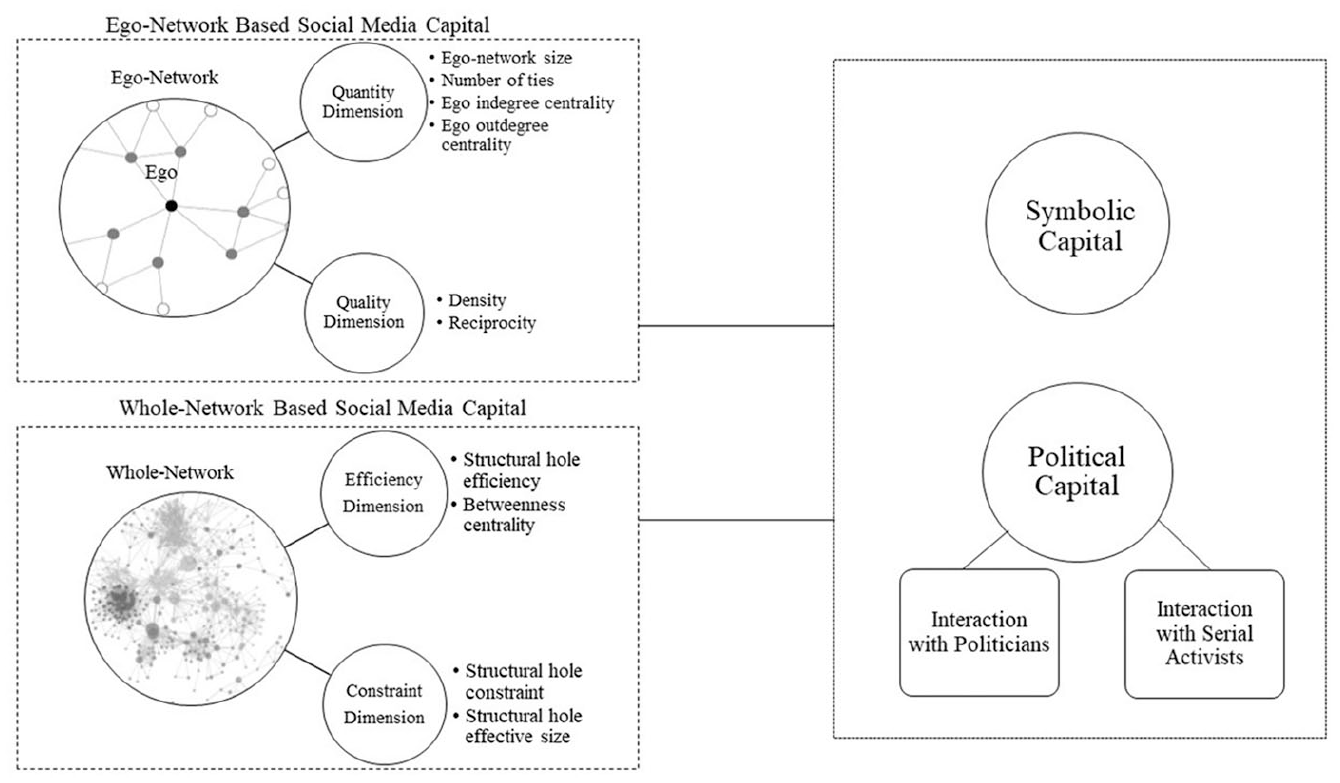
The measurement model of social media capital.
Our proposed measurements of social media capital differentiate resources that can be obtained from nonprofits’ ego communication network, which we refer to as ego–network-based social media capital, and resources that reside in nonprofits’ whole network, which we refer to as whole–network-based social media capital. Differentiating these dimensions is important because each dimension may differently influence the acquisition of other forms of capital. We elaborate on the ego- and whole-network social media capital below.
Ego-network-based social media capital
An ego-network refers to all the direct connections that an actor has and the ties among those direct contacts (Wasserman & Faust, 1994). An examination of the ego-networks can reveal the micro or immediate social environment that influences an actor or can be directly influenced by the actor (Burt, 2001). In the network literature, ego-networks are considered an important form of social support networks (Wasserman & Faust, 1994). While early definitions of social support networks emphasize the emotional dimension of social support, recent work has shifted the focus to the interactive communication processes among individuals and organizations (Arnaboldi et al., 2013; Saffer et al., 2019). In the context of social media-mediated communication, ego-networks could be a direct outcome of organizations’ direct and long-term interactions with followers and friends.
Not all ego-networks offer the same level of social media capital. The literature suggests that two dimensions are important in quantifying the difference. The first dimension is the quantity aspect, which includes the size of the network, as well as how densely connected one’s ego-network is (Xu & Saxton, 2019). The associated network measures are ego-network size, ego-network tie counts, and ego-network density. The quantity aspect helps to assess how much social media capital is available at an organization’s disposal. The second dimension is the quality aspect, which refers to the frequency and intensity of interactions that take place in an ego-network. The quality aspect may better predict how reliable one’s ego-network can provide support or resources. For example, Arnaboldi et al. (2013) modeled over 20 variables to assess the quality of social media ego-network ties and found that variables, such as the frequency of contacts and frequency of reciprocal ties, can predict tie quality. Therefore, we propose that the ego-network-based social capital measures may fall under the two dimensions: quantity and quality dimensions.
Whole-network-based social media capital
Whole-network refers to all the actors that fit certain criteria and all the connections among them, both directly or indirectly (Wasserman & Faust, 1994). A whole-network encompasses many ego-networks. In the case of a Twitter-based discussion network on a social issue, the whole-network can include anyone who tweets or retweets about the issue identified through keywords or hashtags. In the whole-network, not all users are directly connected with an organization. But when the organization is strategically positioned to connect with influential actors, even indirect or weak connections may generate considerable value (González-Bailón et al., 2013). It is interesting to note that the type of strategies that build a strong ego-network may not lead to desirable outcomes in a whole- network. After all, organizations have limited resources to directly engage the entire spectrum of the public. For organizations, the potential of a whole-network mainly resides in the values generated through connecting with heterogeneous others (Putnam, 2000).
Burt’s (2000) structural holes measure is widely used for measuring diversity-based social capital. According to Burt (2000), there are two dimensions to consider. One aspect is efficiency, which refers to non-redundancy in an organization’s immediate neighborhood in the whole-network. Burt recommends using structural efficiency to capture the degree to which one’s contacts overlap with each other. In addition, other scholars have used betweenness centrality to measure the degree to which a node is located on the shortest path (geodesic) to reach every other node in a network (Wasserman & Faust, 1994). The other aspect is dependency, which refers to the degree to which one depends on a handful of others to gain access to diverse connections. In this case, Burt (2000) recommends constraint as the measure for dependency, which examines the degree to which others can impose a constraint on a focal actor. Adopting these two dimensions, we propose that whole-network-based social media capital has the following two dimensions: efficiency and dependency dimensions.
So far, we have discussed the dimensions and measures for social media capital. As noted by Saxton and Guo (2020), social media capital may be linked to other forms of capital that could benefit nonprofits. In the context of policy advocacy, we examine how social media capital can predict the following two types of capital (i.e., symbolic capital and political capital) that are critical for policy advocacy.
Bourdieu’s Capital Theory and Resource Mobilization in Policy Advocacy
Resource mobilization theory suggests that resources, such as human capital, funding, organizational skills, and societal level opportunity structure are all necessary conditions for civil society actors to engage in civil interactions, movements, and advocacy (Louis et al., 2020; McCarthy & Zald, 1977). As McCarthy and Zald (1977) contend, the success of nonprofit policy advocacy may depend on “the variety of resources that must be mobilized, the linkage of social movements to other groups, the dependence of movement upon external support for success, and the tactics used by authorities to control or incorporate movements.” (p. 1213).
To understand different forms of resources, French sociologist Pierre Bourdieu’s work provides valuable insights. Bourdieu (1986) noted that different types of capital exist in cultural, political, business, educational, and policy advocacy fields. Capital in a specific field could manifest itself as language patterns, ethnicities, or the use of symbols. In different fields, actors’ possession of certain forms of capital tends to be accumulative, meaning that some actors may have a greater amount of capital than others. Within a field, the unequal distribution of capital can provide the basis for power relations, such as dominance and subordination. Finally, Bourdieu notes that various forms of capital are exchangeable, meaning one type of capital can be converted to another. Greenspan (2014) argues that these attributes of capital, such as relationality, accumulation, and exchangeability make them critical for nonprofit advocacy.
Since the values of capitals are field-specific, certain forms of capital would be particularly important for public policy on social media (Bourdieu, 1986). The growing use of social media implies a changing repertoire of resources necessary for effective nonprofit advocacy. Conventional resources, such as money or organizational members—though still relevant—are less able to capture the range of resources needed for social media-based policy advocacy (George & Leidner, 2019). Rather, for nonprofits to achieve policy influence, they need to acquire symbolic influence or build connections with important players in the public policy domain (Almog-Bar & Schmid, 2014). This points to two forms of capital that are specific to the field of public advocacy on social media: symbolic capital and political capital.
Symbolic capital
According to Bourdieu (2000), capital acts as symbolic capital once it is perceived as a positive sign and it makes the owner of such capital “visible, admired and invited” (p.69). Symbolic capital is important for both nonprofits’ insider and outsider policy advocacy. Research finds that government agencies and politicians are more likely to engage with reputable nonprofits (Balassiano & Chandler, 2010). Nonprofits that appear to be leaders in their issue areas are more likely to be favored in terms of building same-sector and cross-sector alliance relationships (Atouba & Shumate, 2015). Such connections could be beneficial for insider advocacy as they directly appeal to decision-makers (Shier & Handy, 2015). In addition, nonprofits with more symbolic capital are more likely to achieve greater influence in outsider advocacy campaigns through indirect public pressure on decision-makers to demand social change (Brady et al., 2015). Symbolic capital is a valuable resource in the process of political struggles and policy-making (Stone, 2002). Previous studies suggest that users’ network positions could influence their visibility levels (Saffer et al., 2019), we hypothesize
Political capital
Political capital refers to the resources that an actor can use to influence the process of policy formation and achieve outcomes that serve the actor’s interests (Birner & Wittmer, 2003). Previous studies have measured political capital based on an organization’s affiliation with politicians or organizational participation in political activities (Zhou, 2009). Almog-Bar and Schmid (2014) highlight that for nonprofits to engage in insider policy advocacy, they need to have connections with politicians.
In the context of a specific policy advocacy campaign, politician-initiated tweets could indicate the degree to which: (a) politicians are aware of these nonprofits or their messages and (b) politicians are willing to openly engage with these nonprofits. Since there are often many nonprofits working on a public policy issues, which nonprofits politicians pick and initiate interactions with may be influenced by these nonprofits’ social media capital (Saxton & Guo, 2020). Therefore, we propose a positive relationship between nonprofits’ social media capital and their political capital with politicians on social media, which we call formal political capital:
In addition, recent research has shown that political advocacy on social media also requires organizations to engage with influencers who are specific to the political issue area (González-Bailón et al., 2013). These influencers are not necessarily politicians or institutionalized decision-makers. But they are highly engaged individuals or groups who could play significant roles in political mobilization. A line of recent research identifies these political activists as serial activists (Bastos & Mercea, 2016; Mercea et al., 2018). Serial activists are not career politicians. They are defined by their heavy social media usage and sustained commitment to contentious politics (Bastos & Mercea, 2016). Serial activists are highly influential on social media to set public discussion agenda, especially in their respective political and policy areas. Studies found that serial activists generally have extensive networks with other political actors, could powerfully mobilize participation on social media and have a sustained impact on social media-mediated political discourse (Mercea et al., 2018). Given these characteristics of serial activists, we examine if nonprofits’ social media capital could be converted into the form of political capital as indicated by the connections with serial activists, which we call informal political capital:
Method
Case Description
As the condition of climate change continues to worsen worldwide, many nonprofits have taken actions to advocate for more aggressive policies to mitigate the impact of climate change. The GND represents one of the most ambitious policy proposals in the recent history of the United States (Irfan, 2019). On January 10, 2019, a letter signed by 626 nonprofit organizations in support of the GND was sent to all members of Congress (Cama, 2019). Later in May 2019, over 90 house representatives and senators endorsed the GND. In August 2019, Sen. Bernie Sanders was the first of the 2020 Democratic presidential contenders to support the GND. By September 2019, most front runners of the 2020 Democratic candidates have embraced the GND or adopted their versions of the ambitious climate policy plans. The topic was featured prominently in multiple presidential debates in the second half of 2019 and emerged as a prominent policy advocacy issue (Irfan, 2019).
Data and Sampling
To identify nonprofits that advocated for the GND on Twitter, the following steps were taken. First, we collected tweets between July 2019 and December 2019 during the six democratic presidential debates, 1 using trending hashtags related to GND, including #greennewdeal, #Road2GND, and #ClimateStrikeME. This step produced a total of 2,110,822 tweets. 2 Second, we identified a list of 626 nonprofits that signed the letter and 105 politicians that openly endorsed the GND and were active on Twitter. We further narrowed down the list to keep nonprofits and politicians that had tweeted about the GND during the selected period. After this step, we identified 134 nonprofits that signed the letter and used Twitter to advocate for GND. To identify serial activists, we first divided the tweets by each month and then identified 355 users whose tweets consistently appeared in all 6 months as committed serial activists.
The subsequent analysis was based on these 134 nonprofits’ Twitter profiles, ego- and whole-network metrics, as well as their tweeting activities. Each nonprofit’s ego-network was constructed by including any user accounts that had “mention” and/or “retweet” relationships with the focal organization. That is, organizations that retweeted or mentioned the focal organization, as well as those retweeted or mentioned by the focal organization. The corpus used to construct ego-networks was the full GND Twitter corpus (N = 2,110,822), but each ego-network was a subset of the whole-network. We constructed 134 ego-networks and calculated social media capital measures based on each ego-network.
Meanwhile, the whole-network was constructed similarly based on the “mention” and/or “retweet” relationships among all users identified from the entire corpus of tweets. Overall, we constructed a whole-network with 229,212 unique users connected by 464,674 ties (network density: .000009). We calculated whole-network-based social media capital for every user and extracted the values for the 134 nonprofits for further analysis.
Measures
Ego-network-based social capital measures
Network measures listed in this section examines ego-networks based on each nonprofit.
Nonprofit ego-network size
The size of each ego-network was indicated by the total number of unique actors in the network. The size ranged between 2 and 8,646 (M = 96.17, SD = 760.56). Nonprofit ego-network edge count. For each ego-network, edge count was calculated based on the total number of network ties in the network, ranging between 0 and 17,879 (M = 170.90, SD = 1,545.25).
Nonprofit ego-network density
The density of each ego-network was calculated as the proportion of possible network ties that were actualized in the existing network. A denser network is more tightly connected than a loosely connected one. The density ranged between 0 and 1 (M = .30, SD = .33).
Nonprofit ego-network reciprocity
Network reciprocity was measured as the ratio of reciprocal ties in each ego-network. A reciprocal tie means that between a pair of communicating Twitter users, both users initiated and received the “mention” and/or “retweet” relationships. The level of reciprocity ranged between 0 and .33 (M = .01, SD = .04).
Nonprofit ego-network indegree centrality
A focal nonprofit’s indegree centrality was measured by the number of unique users that mentioned and/or retweeted this organization. A high indegree centrality suggests that a nonprofit is frequently mentioned or retweeted by other Twitter users. The ego-network indegree centrality ranged between 0 and 17,576 (M = 160.22, SD = 1,519.19).
Nonprofit ego-network outdegree centrality
A nonprofit’s ego-network outdegree centrality was measured as the number of unique Twitter users that the focal nonprofit mentioned and/or retweeted. A high outdegree centrality suggests that a nonprofit actively retweets or mentions other Twitter users. The ego-network outdegree centrality ranged between 0 and 247 (M = 9.81, SD = 25.57).
The number of reciprocal ties in nonprofit ego-network
The number of reciprocal ties was calculated as the total number of mutually mentioning/retweeting dyads involving the focal nonprofit in its ego-network. This variable ranged between 0 and 56 (M = .94, SD = 5.12).
Whole-network-based social capital measures
This section presents network measures that are based on all accounts, including nonprofits and other types of actors who participated in this issue discourse.
Whole-network structural holes 3 : constraint
The constraint aspect of structural holes measures the extent to which resources are concentrated within a single cluster or a single individual in the network. As Burt (1992) contended, opportunities and resources are constrained to the extent that if an actor i invested a significant portion of resources to another actor q, but q has invested in a relationship with another contact j that i also tries to reach. The current article adopted Burt’s (1992) measure of structural holes constraint using the following equation:

where i represents the focal nonprofit actor, q and j are two contacts of i, pij is the proportional strength of i’s relationship with j, piq is the proportional strength of i’s relationship with q, and pqj is the proportional strength of q’s relationship with j. The constraint measure was reverse-coded (for the original measure, a higher constraint value means that an actor is more vulnerable to constraints imposed by others. After reverse-coding the original constraint measure, a higher value indicates that an actor is less vulnerable to constraints imposed by others. Reverse-coding was done by adding a negative sign in front of constraint values) to reflect the degree to which the focal nonprofit served the brokerage role in the network (M = .64, SD = .33).
Whole-network structural holes: Effective size
As another structural hole measure, effective size is the sum of a node’s non-redundant contacts and was calculated using the following equation (Burt, 1992): q-mjq, where q represents the number of alters and mjq represents t he average number of ties that each alter has to other alters within the network. The effective size of all 134 nonprofits ranged between 0 and 10,048.46 (M = 110.05, SD = 890.70).
Whole-network structural holes: Efficiency
The structural holes efficiency measure was calculated by using effective size divided by the number of alters in a nonprofit’s ego-network, which ranged between 0 and 1 (M = 0.92, SD = 0.14)
Whole-network closeness centrality
Closeness centrality indicated the distance that it takes for an actor to reach every other actor in the network. Each nonprofit’s closeness centrality was calculated among the whole-network (M = .0000004677, SD = .000000190).
Whole-network betweenness centrality
Finally, each nonprofit’s betweenness centrality in the whole-network was calculated. Betweenness centrality indicated the proportion of shortest paths between all other pairs of nodes in the network that pass through the focal node. Betweenness centrality ranged between 0 and 2.47 for all sampled nonprofits (M = .02, SD = .22).
Dependent variables
In this study, we operationalize symbolic capital with two measures that indicate a nonprofit’s visibility on social media. The number of times a nonprofit is mentioned or retweeted by the public assesses visibility and impact in terms of an account’s ability to be recognized by the general public and shape public discussion and issue agenda. The number of times a nonprofit is mentioned or retweeted by media could indicate the degree to which a nonprofit is recognized by cultural authorities, such as media (Bourdieu, 2000). In Bourdieu’s (1986) original work, he has used recognition by cultural icons and mainstream media as evidence of symbolic capital. In the context of social media, we operationalize media as a wide range of content providers including traditional media and social media influencers, such as bloggers, podcast hosts, and so on.
Symbolic capital with media
The first indicator of symbolic capital was the number of times that the focal non-governmental organization (NGO) got retweeted/mentioned by a media account. We identified media accounts from the full GND Twitter network (N = 2,110,822). We took the following steps to identify media users, which included both media organizations and individuals who self-identified as affiliated with a media organization. The following types of media were included: (a) mainstream, legacy media that had established offline presence, such as magazines, TV networks, radios, and newspapers; and (b) grassroots and alternative media that may only have an online presence, including Indymedia, news aggregators, and podcasts. To identify media accounts from the whole-network, the authors first used a set of keywords, such as “media,” “reporter,” “daily,” and “times” to search all users’ Twitter biographic information, yielding a total of 7,129 accounts that included at least one of the keywords in their bios. The authors then manually reviewed these accounts’ biographic information, identifying a final list of 2,838 media accounts. The symbolic capital with media was then calculated by the number of times a focal NGO got retweeted/mentioned by one of the 2,838 media accounts (M = 1.69, SD = 17.46).
Symbolic capital with online publics
In addition, as any accounts on Twitter were able to increase the visibility of a focal NGO through retweet or mention activities, we computed the number of times that the focal NGO got retweeted and/or mentioned by any users identified from the GND Twitter network (N = 2,110,822) as another indicator of symbolic capital (M = 138.78, SD = 1,407.34).
In this study, we operationalize political capital as nonprofits’ communication ties with politicians on social media. Politicians here include prominent politicians (senators & congressmen/congresswomen) who officially endorsed the nonprofits’ policy proposal and politicians who tweeted using relevant hashtags. More specifically, we use the tweets initiated by politicians as indicators of nonprofits’ political capital for two reasons. First, since nonprofits can mention politicians for any reason in their tweets, nonprofits-initiated communication may not properly indicate their influence on politicians. Second, on the contrary, because tweets are publicly visible, politicians’ mentioning or retweeting of certain nonprofits could cause their followers to speculate on their policy positions. Such engagement could attract public attention to these nonprofits and their causes, potentially benefiting these organizations. Such benefits thus indicate a level of social media-based political capital.
Political capital with politicians
The affiliation with politicians was assessed by the number of times that the focal nonprofit got mentioned/retweeted by a politician (M = .01, SD = .17) on Twitter. We identified politicians accounts from the full GND Twitter network (N = 2,110,822).
Political capital with serial activists
The connection with serial activists was similarly assessed by the number of times that the focal nonprofit got mentioned/retweeted by serial activists (M = 28.33, SD = 310.03), operationalized as Twitter accounts that persistently tweeted about GND at multiple time points (M = .31, SD = .86). We identified serial activist accounts from the full GND Twitter network (N = 2,110,822).
Control variables
Tweeting frequency
The number of original tweets from each nonprofit during the selected period was calculated, which ranged between 1 and 18,644 (M = 193.09, SD = 1611.95).
Time on Twitter
To control for each nonprofit’s prior Twitter use experience, time on Twitter was calculated by subtracting the year at which the nonprofit created its Twitter account from the year of 2019, and the variable ranged from 0 to 12 years (M = 7.17, SD = 3.30).
Nonprofit tenure
The founding year of each nonprofit was identified from each nonprofit’s official websites, and organizational tenure was calculated by subtracting its founding year from 2019, which ranged from 1 to 118 (M = 15.95, SD = 19.47).
Nonprofit revenue
The annual revenue of each nonprofit as of 2019 was obtained from the internal revenue service (IRS) tax documents whenever they were available (M = US$2,076,893, SD = US$7,041,676).
Nonprofits’ issue identity
We coded nonprofits’ issue identities into one of five types: environmental organizations (N = 76, 56.7%), religious organizations (N = 3, 2.2%), political organizations (nonprofits affiliated with political parties) (N = 7, 5.2%), advocacy organizations and social welfare organizations (N = 32, 23.9%), and service provider organizations (N = 15, 11.2%). The coding was done in two steps. First, we read all nonprofits’ Twitter bio descriptions. Second, based on their bios, we identified the above five mutually exclusive categories. The intercoder reliability is .82 (Cohen’s kappa). In comparison to categories, such as national taxonomy of exempt entities (NTEE), our categories better reflected the specific nonprofits involved in the case.
Analysis Strategy
The first part of the analysis revolved around establishing and validating new scales that operationalized ego-network- and whole-network-based social capital. To do that, exploratory factor analysis (EFA) was conducted, followed by confirmatory factor analysis (CFA). The Hypotheses H1 to H3 were tested by running a series of regression models. Specifically, the validated constructs of whole-network-based social media capital (including both efficiency and dependency dimensions) and ego-network-based social capital (including both quality and quantity dimensions), and several control variables were included in the three models that, respectively, predicted the level of symbolic capital (H1), political capital with politicians (H2), and political capital with serial activists (H3).
Results
EFA and CFA of Ego-Network- and Whole-Network-Based Social Capital
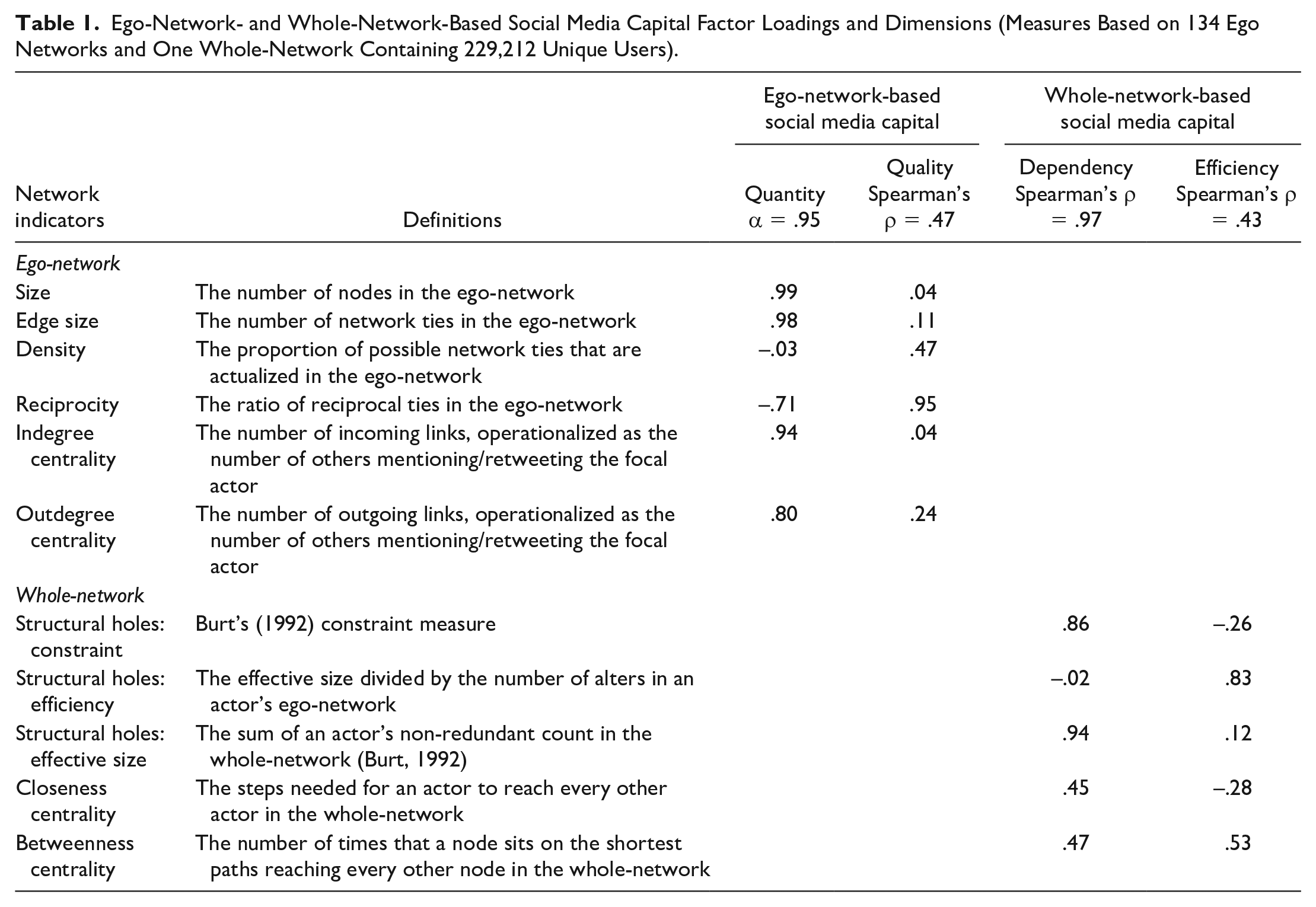
To establish the measurement scales for ego-network-based social media capital, EFA was first run on the six items that tapped into each of the nonprofit’s ego-network characteristics. EFA identified two components, where (a) ego-network size, edge count, indegree centrality, and outdegree centrality were clustered under the first component, (b) whereas ego-network density and reciprocity made up the second component. To further test how well the identified factors loaded, CFA was conducted among items that fell under each component, identifying two sub-scales: the quantity scale that consisted of four items—network size, edge count, indegree centrality, and outdegree centrality (Cronbach’s α = .95); and a quality scale consisting of network density and reciprocity (Spearman’s rho = .47).
The same procedures were applied to explore the underlying structure among the five items associated with whole-network-based social media capital. EFA identified the following two components consisting of four items: (a) structural holes constraint and structural holes effective size; (b) the structural hole efficiency and betweenness centrality. CFA further suggested that the first component reached a high level of reliability (Spearman’s rho = .97), whereas the reliability of the second component was fair (Spearman’s rho = .43). Table 1 listed all items included in the above EFA and CFA procedures, as well as the respective factor loadings for the sub-scales developed.
Ego-Network- and Whole-Network-Based Social Media Capital Factor Loadings and Dimensions (Measures Based on 134 Ego Networks and One Whole-Network Containing 229,212 Unique Users).
Hypotheses Testing
Hypotheses 1 through 3 posited the extent to which ego-network- and whole-network-based social media capital were associated with other forms of capital, specifically, symbolic capital (H1) and political capital (H2 and H3). After inspecting the distribution of main variables and transforming them through log normalization, four linear regression models were run to test H1 through H3. An inspection of the bivariate correlation matrix of all variables revealed no substantial correlations among the predictors, and the variance inflation factor (VIF) statistics for all the variables were within the range from 1.85 to 4.31, which were within an acceptable range of 10 (Hair et al., 2006), indicating no multicollinearity issue for all the models. Table 2 presented the model configurations and coefficients obtained from the four regression models.
Multiple Regression Models Predicting the Level of Symbolic Capital and Political Capital for GND Movement NGOs.
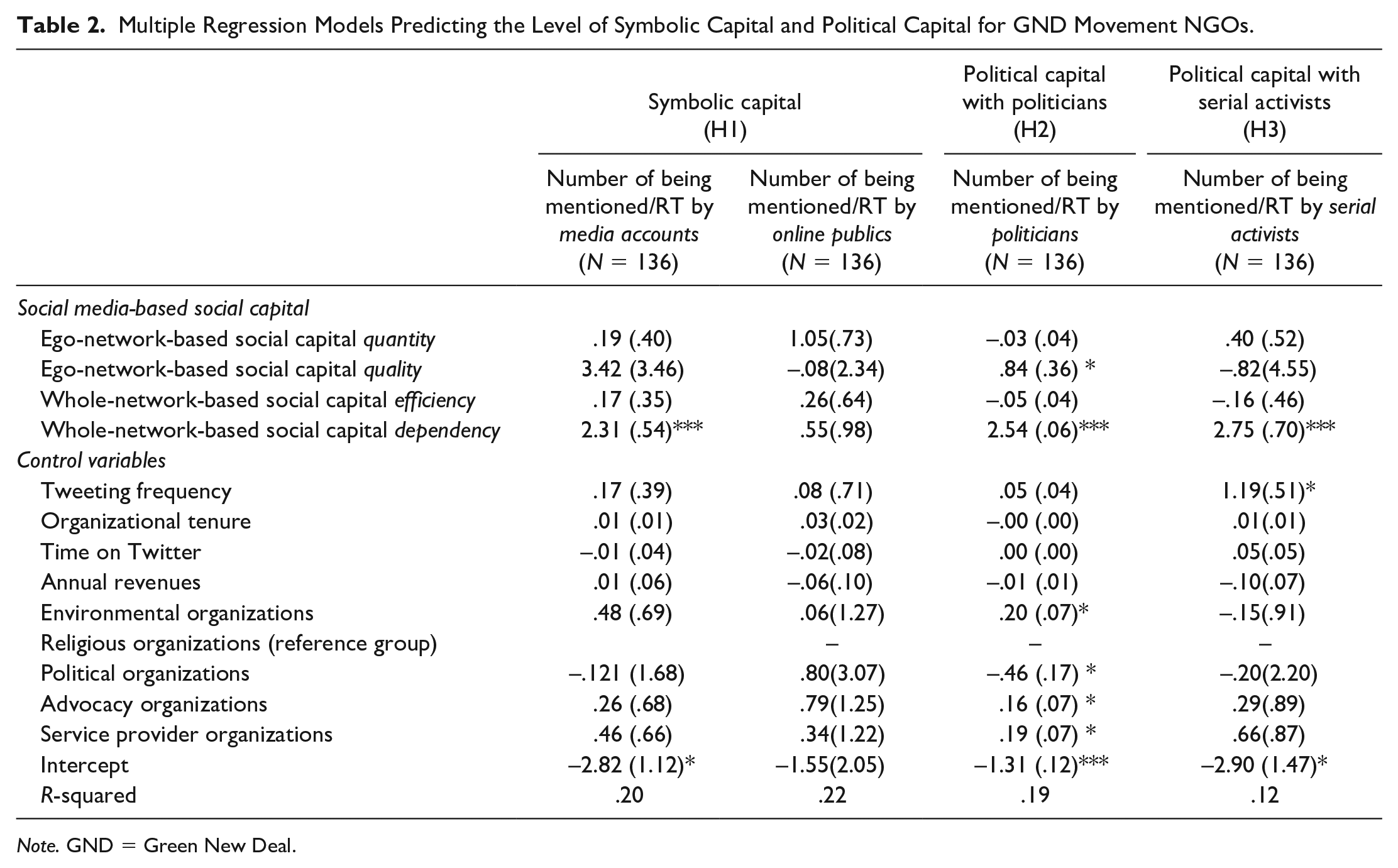
Note. GND = Green New Deal.
H1 hypothesized that whole-network-based social media capital (H1a) and ego-network-based capital (H1b) would significantly predict nonprofits’ symbolic social capital with media and online publics, and this set of hypotheses was only partially supported. The results showed that the dependency aspect of whole-network-based social capital (b = 2.31, p < .001) significantly predicted the number of times that a nonprofit was mentioned/retweeted by media.
H2 tested the relationship between social media capital and a nonprofit’s interaction with politicians on Twitter, which was conceptualized as one dimension of political capital. This set of hypotheses also received mixed support. The dependency dimension of whole-network-based social capital turned out as a significant predictor for the number of times that the nonprofit got mentioned/retweeted by a politician (b = 2.54, p < .001). Moreover, the quality dimension of ego-network-based social capital significantly predicted the frequency of being mentioned/retweeted by politicians (b = .84, p < .05).
Finally, H3 assessed the role of social media capital in nonprofits’ interactions with serial activists. The dependency dimension of whole-network-based social capital, again, emerged as a significant predictor (b = 2.75, p < .001) of being retweeted or mentioned by serial activists.
Discussion
Our analysis reveals that the quantity of nonprofits’ ego-network-based social media capital is influenced by nonprofits’ directly interaction with contacts and structural location in their ego-networks. Moreover, the quality of nonprofits’ ego-network-based social media capital is influenced by the interaction patterns and connectedness of members from such ego-networks. Our analysis also shows that nonprofits’ whole-network-based social media capital are shaped by structural hole features. In addition, our analysis confirms that both ego-network- and whole-network-based social media capital shape nonprofits’ symbolic and political capital in important but different ways. This study makes three important contributions to advancing our understanding of nonprofit policy advocacy on social media. First, the study proposes and tests a measurement framework to measure nonprofits’ social media capital based on their communication networks on social media. Second, the study examines the associations between social media capital and symbolic and political capitals with modifications that reflect the characteristics of the social media context. Third, this study bridges the gap between the ego- and whole-network approaches and provides a holistic framework to assess multiple aspects of nonprofits’ social network positions. Overall, our framework offers a network-based perspective to understand nonprofits’ social media capital and provides a guideline for their strategic policy advocacy on social media. In the sections below, these contributions are further discussed.
The Measurement Framework for Social Media Capital
In this study, we propose a measurement framework of social media capital based on nonprofits’ communication network characteristics. Our analysis largely confirms the proposed model, with small revisions. The ego-network-based social media capital has quantity and quality dimensions. For the quantity dimension, measures, such as ego-network size and the number of ties in each ego-network, and a nonprofit’s indegree and outdegree centrality in its respective ego-network load significantly under this factor. These indicators suggest that a nonprofit would enjoy a high quantity of ego-network-based social media capital when one or both of the following conditions are met: (a) a nonprofit directly interacts with many contacts and (b) the nonprofit is centrally located in the ego-network and active in engaging with its direct contacts. To boost the quantity dimension of ego-network-based social capital, a nonprofit could proactively initiate communication or respond more to its direct communication contacts. It can also maintain its central network position by offering relevant resources (e.g., information) to its direct contacts. This is consistent with Xu and Saxton’s (2019) finding that stakeholder engagement on social media is beneficial for nonprofits. Importantly, nonprofits should develop long-term strategies to routinely engage with their direct contacts and make sure they maintain frequent interactions.
For the quality dimension, measures, such as ego-network density and reciprocity load under this factor, suggesting that a nonprofit would have high-quality ego-network-based social media capital when: (a) members from this ego-network mutually engage with one another or (b) members from this ego-network are densely connected among themselves. Together, these measures identify important network structural features for measuring a nonprofit’s ego-network-based social media capital and suggest which tactics to use if a nonprofit plans to strengthen its ego-network-based social media capital. To reap the benefit of high-quality ego-network-based social media capital, nonprofits need to use tactics that not only bring others to their immediate circle but also encourage interaction among their community. For example, it could encourage conversations among direct contacts, such as suggesting discussion topics or activities that foster ongoing participation and interaction. In our data, we observed some nonprofits, such as Sunrise.org frequently use trending hashtags, such as #climateactionnow #strongertogether while initiated conversations that calls on other nonprofits to influence their political representatives. For future practice, nonprofits should recognize the importance of strong alliances with other nonprofits, and develop strategies that strengthen such communities.
Our whole-network-based social media capital assesses potential resources that reside in the whole communication network including 229,212 users. For this measure, our factor analysis identifies the dependency dimension and efficiency dimension. We find that factors, such as structural hole constraint (reverse-coded) and effective size (the higher the effective size, the more each nonprofit is disconnected from other primary contacts), indicate the degree to which a nonprofit’s communication connections would depend on a handful of contacts. To increase such whole-network-based social media capital, nonprofits could diversify their reliance on a few important actors by targeting and reaching out to a wider range of key actors and dedicating resources to sustain interactions over time.
Moreover, a nonprofit’s connections are more efficient in terms of reaching out to diverse others when the nonprofit is: (a) connecting with more non-redundant contacts and (b) enjoying high betweenness centrality in the whole-network (meaning the nonprofit often serves as the “bridge” to connect disconnected sub-communities). These whole-network-based social media capital measures identify important opportunities in nonprofits’ overall network environment. To achieve a high level of whole-network-based social media capital along the efficiency dimension, nonprofits could intentionally identify and reach out to relevant users who are underrepresented in their previous networks and continue such efforts over time.
Many nonprofits may not have the resources to simultaneously build all kinds of social media capital. Our further analysis helps to reveal which types of social media capital would best contribute to online symbolic and political capital. Nonprofits could plan their campaigns accordingly and choose tactics that can directly advance specific goals.
Social Media Capital and Symbolic Capital
Previous research suggests that symbolic capital is critical for nonprofits (Atouba & Shumate, 2015; Balassiano & Chandler, 2010). To obtain symbolic capital on social media, our analysis shows that different dimensions of whole-network-based social media capital affect nonprofits’ symbolic capital differently. Here, we focus on two forms of symbolic capital that indicate the degree to which a nonprofit is visible among the public: the number of times a nonprofit is retweeted or mentioned by media, and the number of times it gets retweeted or mentioned by online public. Our analysis shows that the dependency aspect of whole-network-based social media capital can help increase a nonprofit’s chance of being noticed by media. Media exposure could greatly enhance the visibility of nonprofits and their advocacy agenda (Guidry et al., 2014). Therefore, diversified connections in a whole-network could substantially benefit nonprofits. Nonprofits should monitor online discussions that are relevant to their policy interest, and regularly reach out to previously unconnected influencers to decrease their dependency on a few actors.
Social Media Capital and Political Capital
In the study, we measure nonprofits’ political capital with politicians through the number of times politicians mention or retweet nonprofits. Our analysis shows that the dependency dimension of nonprofits’ whole-network-based social media capital significantly drives the likelihood of being mentioned or retweeted by politicians. Alternatively, for nonprofits to receive engagement from politicians, they need to have high-quality ego-network-based social media capital. In other words, politicians are likely to reach out to nonprofits that are well supported in their ego-network or those that could effectively reach a large number of diverse publics.
We also introduce the concept of serial activists to account for grassroots social media influencers who are exceptionally active in a given public policy domain. We discover that nonprofits with less constrained whole-network social media capital are more likely to be mentioned or retweeted by serial activists. To receive communication engagement from these activists, nonprofits also need to cultivate whole-network positions with diverse connections.
While it may be under a nonprofit’s control to proactively engage with politicians and serial activists, to attract politicians and serial activists’ engagement is often a more challenging task. Our analysis shows that if a nonprofit’s goal is to capture the attention of politicians and serial activists, they may want to strengthen the quality of their ego-network-based social media capital or reduce the constraint level in the whole-network with some of the strategies discussed earlier. Collectively, these findings suggest that ego-network- and whole-network-based social media capital function differently. The integrated approach as proposed in this study helps nonprofits to assess multiple and unique aspects of their network positions and holistically identify challenges and opportunities that reside in both direct and indirect connections.
Limitations and Future Direction
There are several limitations in the current study that point to directions for future research. First, the study focuses on the context of public policy advocacy and thus only explores how nonprofits’ social media capital is associated with symbolic capital and political capital in this specific domain. For future studies interested in examining how social media capital may affect other aspects of nonprofit operations on social media, they may broaden the scope of the current measurement framework to include other social-mediated capital and examine questions, such as how social media capital affects the outcome of online fundraising or online volunteer recruitment. Second, this study looks at a public debate that is still ongoing. With a timely issue like this, it limits our ability to assess how well the symbolic and political capital can bring in actual policy changes. Future studies may compare multiple public policies and see how well nonprofits’ symbolic capital and political capital on social media could influence actual legislative outcomes.
Conclusion
Our study examines how a group of nonprofits use Twitter to advocate for GND during the 2019 presidential campaign. As GND rise to national prominence and a moderate version of this proposal has taken the center stage in Biden administration’s political agenda, this study reveals lessons that can be learned to guide other nonprofits’ future advocacy efforts. Our analysis showed that these 134 nonprofits’ social-mediated interactions with their immediate contacts and other indirectly connected Twitter users position them in different network positions. Such network positions significantly influence their opportunity to obtain symbolic and political capital. Nonprofit studies have well-documented the important value of social media for nonprofits’ operation. Our study reflects an important attempt to advance research on nonprofits’ social-mediated advocacy and provides nuanced conceptualization and measures that capture a range of aspects of nonprofits’ network positions. In addition, our empirical findings suggest that social-mediated capital could be valuable assets that further influence nonprofits’ ability to acquire other forms of capital that are crucial for advocacy. In addition, our framework offers practical guidance for nonprofits to plan and evaluate their social media advocacy campaigns, and it may further assist nonprofits to better harness the resources on social media in policy advocacy.
Footnotes
Declaration of Conflicting Interests
The author(s) declared no potential conflicts of interest with respect to the research, authorship, and/or publication of this article.
Funding
The author(s) received no financial support for the research, authorship, and/or publication of this article.
