



Abstract
This study aims to explore the effect of social media use on fundraising by nonprofit organizations (NPOs). To do so, we analyze the accounts of 83 Spanish nongovernmental development organizations on Facebook, Twitter, YouTube, and Instagram over a 5-week period. Our results show that social media can be a useful tool for NPO fundraising. Specifically, although mere presence on social media has no effect on the donations raised by the organization, the size of the NPO’s network (followers), its social media activity (posts), content (posts explicitly requesting donations), and follower engagement do influence fundraising. This study helps to highlight the usefulness of social media as a fundraising tool and to show the differences among platforms, format, and content of posts. In particular, NPOs who intend to increase fundraising should actively participate in social media—especially Twitter and YouTube—not overuse stories and increase posts that solicit donations.
Introduction
Nonprofit organizations (NPOs) depend on donations from either government agencies or private donors to cover their funding needs vis-à-vis carrying out their activities. Funds from private sources have become increasingly relevant –especially since the 2008 financial crisis and the drastic reduction in public funding received by these organizations (Garcia-Rodriguez & Romero-Merino, 2018). To raise these private funds, NPOs traditionally provide information about their activities and foster dialogue with their donors by using channels such as annual reports or websites. However, the growing popularity of social media (e.g., Facebook and Twitter have reached over two billion active users worldwide [Statista, 2021)) makes it a more suitable means of fostering relationships between NPOs and their funders (Nah & Saxton, 2013). Social media platforms—which are diverse in target audience and post format—allow NPOs to reach a wide audience and facilitate communication and interaction with both current as well as potential donors of time and money.
Given this trend in social media’s role in the nonprofit sector, researchers have paid special attention to them (Guo & Saxton, 2012; Lovejoy & Saxton, 2012; Svensson et al., 2015; Young, 2017). However, very few authors have thus far explored what impact the use of these social media platforms has on the donations obtained by NPOs. Specifically, previous literature on this topic has focused either on the effect of network size (Lee, 2021; Lee & Shon, 2023; Saxton & Wang, 2014) or on the influence of NPOs’ social media activity and follower engagement (Bhati & McDonnell, 2020; Harris et al., 2023; Tian et al., 2021). With the exception of Lee and Shon (2023), to the best of our knowledge, previous studies base their research on a single platform (mainly Facebook), without considering possible cross-platform differences. Moreover, although content affects follower engagement on social media (Carboni & Maxwell, 2015; Guo & Saxton, 2018), its influence on donations has yet to be studied. Although posts asking for donations made by social media users (peer-to-peer solicitation) do seem to promote fundraising (Castillo et al., 2014), this effect has not been analyzed when it is the NPO itself that requests the funds. Finally, there is a gap in the literature on the effect that different post formats might have on the donations received by organizations.
Following this line, the main goal of this study is to further current understanding of social media’s potential as a fundraising tool and how their use promotes donations. For this purpose, we address all the aforementioned shortcomings found in previous literature. The study analyzes the posts published by 83 Spanish nongovernmental development organizations (NGDOs) on the four most widely used platforms (Facebook, Twitter, YouTube, and Instagram (IAB Spain, 2021)) over a 5-week period. Specifically, 17,295 posts were examined. Our findings show that mere presence on social media does not influence the volume of donations received. However, the number of followers, the level of activity, content specifically designed for fundraising and higher follower engagement do favor the amount of funds raised by the organization. When analyzing each social media platform, we also find differences in their impact on fundraising.
This study makes several contributions. First, it looks at how NPOs’ use of social media translates into fundraising by simultaneously studying four social media platforms and their effect on the total amount of donations received by the NPO. Since social media platforms have different characteristics and different target audiences, their impact on donations and their suitability as fundraising tools may vary. In addition, we include post-content analysis by examining the effect of posts in which the NPO explicitly asks supporters for donations. Finally, we analyze post format, introducing an analysis of story posts and the differences between their influence on donations and the impact of feed posts.
This article is structured as follows. First, we review the literature on NPO use of social media and their role in fundraising. We then propose the hypotheses. Next, we describe the sample, model, and variables. Following, we describe the variables and provide the findings of the analyses. Finally, we present the main conclusions, implications, and limitations of the study.
Social Media and Fundraising in the Nonprofit Sector
Social Media in the Nonprofit Sector
The introduction of social media has revolutionized the way we communicate with each other, and the nonprofit sector has embraced the use of these technologies (Young, 2017) to help them carry out their mission (Harris et al., 2023). The innovative features of social media compared with other media traditionally used by NPOs make them particularly attractive and useful (Lovejoy & Saxton, 2012). First, social media are low-cost, so many organizations can have access (Lovejoy & Saxton, 2012). Second, social media allow organizations to reach a very wide audience drawing attention to an NPO and its causes (Lovejoy & Saxton, 2012; Nah & Saxton, 2013; Saxton & Wang, 2014). Third, social media are interactive in nature, and provide more fluid and dynamic communication with their stakeholders than other traditional media (Auger, 2014; Young, 2017), therefore favoring information exchange (Alonso-Cañadas et al., 2019) and dialogue with other users (Lovejoy et al., 2012). These characteristics have led NPOs to adopt social media with the main purpose of sharing information and creating dialogue with stakeholders (Benito-Esteban et al., 2019; Lovejoy & Saxton, 2012).
Over the last two decades, a new purpose has been added as NPOs have turned social media into a fundraising tool (Nah & Saxton, 2013; Saxton & Wang, 2014). Some studies have found a positive relationship between the use of social media and an increase in the volume of donation received by NPOs (Bhati & McDonnell, 2020; Harris et al., 2023; Lee, 2021; Lee & Shon, 2023; Saxton & Wang, 2014; Tian et al., 2021). The theoretical arguments used by authors to justify this relationship stem mainly from three different theories: signaling theory (Guo & Saxton, 2018; Harris et al., 2023), stakeholder theory (Alonso-Cañadas et al., 2019; Guo & Saxton, 2012; Saxton & Wang, 2014), and legitimacy theory (Lee, 2021; Svensson et al., 2015).
First, signaling theory plays a particularly key role in the nonprofit sector due to the large information asymmetries that characterize its activities. In this context, stakeholder inability to monitor how funds are managed may result in a reduced willingness to contribute to such entities (Connelly et al., 2011). NPOs have traditionally sent out signals, i.e., shared information, through three channels: annual reports, word of mouth, and fundraising campaigns (Haski-Leventhal & Foot, 2016). Recently, social media have gained prominence as NPO’s signaling tools, since they enable NPOs to send signals more dynamically (Guo & Saxton, 2018), with more diverse content (Guo & Saxton, 2018; Harris et al., 2023), and by fostering dialogue with stakeholders (Guo & Saxton, 2012; Lovejoy et al., 2012) –specially with donors.
Second, according to the stakeholder theory, social media offer a relatively cheap and simple way to interact with and engage different stakeholders (Guo & Saxton, 2012; Lovejoy & Saxton, 2012). Given their interactive nature, they allow receiving suggestions and having conversations with stakeholders (Lovejoy et al., 2012), thus engaging stakeholders more effectively than websites (Auger, 2014). Social media increase stakeholder commitment to the NPO (Nah & Saxton, 2013; Saxton & Wang, 2014) and positively affect the satisfaction of stakeholders (Alonso-Cañadas et al., 2019; Kim et al., 2014), including that of donors, who will be more willing to provide funding (Saxton & Wang, 2014).
Finally, arguments from legitimacy theory are also relevant to explain certain NPO behaviors. NPOs—whose primary mission is to pursue a social or general interest—rely heavily on donors’ and general public’s trust to survive and to develop their activities (Saxton et al., 2012). In this context, social media are taking a leading role as a legitimization mechanism for NPOs, becoming part of their communication strategies aimed at gaining legitimacy in an environment of increasing competition for resources (Svensson et al., 2015). Social media allow the NPO to disseminate information about itself and its activities and to maintain a dialogue with stakeholders in an effort to demonstrate that it meets society’s expectations and deserves to be labeled as legitimate (Young, 2017). Ultimately, the NPO’s legitimization will enable it to access financial resources (donations) that will ensure its continuity.
Social Media as Determinants of Donations
Each of the three theories described above employs different arguments to explain the usefulness of social media in the nonprofit sector. Yet, they all lead to understanding social media as a useful communication tool that provides signals to interested actors, to keep in touch with stakeholders and, ultimately, to legitimize the organization. A positive relationship is therefore to be expected between the use of social media and the donations raised.
Research on the link between the use of social media and the amount of donations received by NPOs has been gaining importance. A review of the existing literature on this topic can be found in Table 1. This table shows how most studies focus on exploring how network size, NPO activity in social media and follower engagement might impact donations. In particular, some studies have examined the effect of the broad scope provided by these technologies in studying what impact social media network size (measured by the number of followers or likes on the platform) has on donations (Bhati & McDonnell, 2020; Lee, 2021; Lee & Shon, 2023; Saxton & Wang, 2014). In this case—except for Lee and Shon (2023)—all other papers focus on a single platform, namely, Facebook. Meanwhile, some other authors have studied the influence of NPOs’ social media activities and follower reactions (likes, comments, and shares) on donations (Bhati & McDonnell, 2020; Harris et al., 2023; Tian et al., 2021). All these studies also consider a single social media platform (in this case Facebook or Weibo). Finally, one differentiating element does emerge in the study by Harris et al. (2023), who analyzes whether the mere fact of being present on different social media platforms affects the donations received by the NPO.
Studies on Determinants of Donations Related to the Use of Social Media.

Note. We conducted a systematic literature review to search for those papers that study the relationship between the use of social media and donations in NPOs. We searched the Web of Science and Scopus databases and included only peer-reviewed articles. We found 468 papers (224 in Web of Science and 244 in Scopus). After cleaning duplicates, the sample was reduced to 317. Using title and abstract analysis, a total of 40 papers proceeded to the next step. Finally, full-text assessment led to only six empirical studies that analyzed the relationship from the organizational perspective. NPO = nonprofit organization.
Based on the review of the research in Table 1, we propose specific hypotheses for each of the dimensions already mentioned: presence, network size (followers), activity (posts), and follower engagement. Our approach, however, adopts a broader view of social media use, as we incorporate the influence of post content which—to the best of our knowledge—has not previously been addressed. When analyzing the impact of NPO activity on social media use, we also delve deeper than previous studies by highlighting the importance of post format (i.e., stories vs. feeds).
Presence on Social Media
Social media offer a great opportunity for organizations as a new means and channel for communication and transparency (Dixon & Keyes, 2013; Harris et al., 2023), as they allow NPOs to reach new groups of potential donors who are often younger than the usual donors (Harris et al., 2023; Saxton & Wang, 2014). Following signaling theory, social media can become a signaling tool and decrease existing information asymmetries between the organization and its stakeholders (Guo & Saxton, 2018; Harris et al., 2023). In fact, being present on social media is in itself a signal, showing that donors deserve the organization’s attention and that they are appreciated (Harris et al., 2023). Likewise, according to legitimacy theory, social media can be used to convince society that organizations deserve social support and recognition and, therefore, legitimization (Auger, 2014). From the stakeholders’ theory perspective, social media achieve greater user engagement than other media traditionally employed by NPOs (Saxton & Wang, 2014), such that adopting social media can increase stakeholder satisfaction and involvement. In line with previous literature (Harris et al., 2023) we thus propose the following hypothesis:
Hypothesis 1 (H1): The presence of NPOs on social media positively influences the volume of donations received by the organization.
Network Size
The dynamism of social media allows interested people to follow an organization by configuring themselves as followers or friends—depending on the platform—and by establishing a relationship between follower and organization (Harris et al., 2023). These relationships created on social media are more informal and personal (Guo & Saxton, 2018) and seem particularly suited to attract resources, either in terms of time or money (Saxton & Wang, 2014). In this context of increased interactivity—and given the possibility of engaging in conversation with the organization—stakeholders feel more involved and satisfied (stakeholder theory) (Alonso-Cañadas et al., 2019; Saxton & Waters, 2014). According to signaling theory, following an organization on social media is considered a reaction or feedback to the organization’s presence on the corresponding platform (Saxton & Waters, 2014), and as an expression that the signal sent is being accepted. Likewise, following an organization on social media can be a form of social acceptance of the entity, i.e., a way of legitimizing it (legitimacy theory) (Lee, 2021). Moreover, the greater the number of followers an NPO has on social media, the larger its audience will be, which can lead to an increase in donations (Bhati & McDonnell, 2020; Lee, 2021; Lee & Shon, 2023; Saxton & Wang, 2014). Based on the above, we propose the following hypothesis:
Hypothesis 2 (H2): The network size of an NPO positively influences the volume of donations received by the organization.
Activity on Social Media
Effective use of social media requires the publication of valuable content and the continuous updating of messages (Svensson et al., 2015). If NPOs post very sporadically, their messages may get lost among the rest of the social media posts, and thereby fail to reach the intended audience (Lovejoy & Saxton, 2012). Social media activity includes both permanent posts (feeds) and ephemeral posts (stories). Whereas in previous literature only feed posts were included as an activity, stories can give a sense of greater authenticity and closeness, creating an urgency to check for updates and attracting greater attention from followers (Alibakhshi & Srivastava, 2022).
Following signaling theory, the entity’s signaling effort can be measured by the number of messages or posts an organization creates (Guo & Saxton, 2018; Harris et al., 2023). Furthermore, from the perspective of the legitimacy theory, the more an organization communicates and posts, the more well-known and recognized it will be and the more attention it will receive from stakeholders—specifically donors (Bhati & McDonnell, 2020). Social media can thus be a vehicle to legitimize an organization by providing evidence of its legitimacy through messaging. Finally, according to the stakeholder theory, organizations should create content for their followers on social media that is able to meet their expectations (Alonso-Cañadas et al., 2019), improve the attitude of stakeholders toward the organization (Tian et al., 2021) and create more personal relationships, thereby making them feel part of the organization (Saxton & Wang, 2014; Tian et al., 2021; Young, 2017). We thus propose the following hypothesis:
Hypothesis 3 (H3): The social media activity of NPOs positively influences the volume of donations they obtain.
Post Content
In addition to being used for dissemination and communication, social media can also be used directly for fundraising campaigns (Bhati & McDonnell, 2020). Post content affects follower engagement on social media and can also trigger different effects on donors’ attitudes (Alonso-Cañadas et al., 2019; Carboni & Maxwell, 2015; Guo & Saxton, 2018). Therefore, some NPOs publish posts that more or less explicitly solicit donations (either within a specific fundraising campaign or as regular donations). These posts can be categorized as fundraising posts (Lovejoy & Saxton, 2012) and are designed expressly for followers to contribute funds to the organization, such that the greater the use of these posts, the greater the volume of donations obtained by the NPO is expected to be. We therefore propose the following hypothesis:
Hypothesis 4 (H4): The number of fundraising posts positively influences the donations obtained by the organization.
Follower Engagement
Social media offer multiple opportunities to engage the target audience by allowing them to comment on messages posted by the organization publicly through likes, comments and shares (Alonso-Cañadas et al., 2019; Saxton & Waters, 2014). In this line, the greater the volume of responses, the more effective the post is felt to be (Guo & Saxton, 2018), the more likely it is to engage stakeholders and, therefore, the greater the volume of donations it can raise (signaling theory) (Harris et al., 2023). Likewise, following the legitimacy theory, the level of responses acts as a sign of organization’s reputation and builds trust and credibility, providing the NPO with social acceptance and legitimacy (Harris et al., 2023; Lee, 2021). From the perspective of stakeholder theory, reactions to posts show follower engagement with the NPO and their interaction with it. A high level of interactions and responses tells donors that an organization has a liking for building relationships and high interaction with its stakeholders, which can ultimately lead to increased donations (Bhati & McDonnell, 2020; Harris et al., 2023; Lee, 2021; Tian et al., 2021). We thus propose the following hypothesis:
Hypothesis 5 (H5): Follower engagement with NPO posts on social media positively influences donations obtained by the organization.
Data and Methods
The sample used in this study consisted of the NPOs of a particular industry of the nonprofit sector that works on development cooperation, and which are known as NGDOs. Specifically, we analyzed the 83 NGDOs that were members of the Spanish NGDO Platform (CONGDE). CONGDE is the most important national platform of social organizations and regional networks dedicated to international cooperation, education for global citizenship and humanitarian action. Partner NGDOs are required to comply with the CONGDE Statutes and Code of Conduct, and to provide documentation on their functioning to the CONGDE, such as accounting documents or activity reports, upon request. It, therefore, collects comprehensive information about its members, some of which is not available on the organizations’ own websites. All the NPOs in the sample were present in at least one of the four platforms considered in this study: Facebook, Twitter, YouTube, and Instagram.
Due to the difficulty involved in retrieving the information needed—particularly the content of posts and story posts that are ephemeral—we used 5 weeks for our analysis. Specifically, the study period spanned from November 4 to December 8, 2019—both inclusive, thereby covering 5 weeks. This sample length is the common duration of studies that analyze post content, where the period of time covered ranges from 2 weeks to 2 months (e.g., Carboni & Maxwell, 2015; Lovejoy & Saxton, 2012; Nah & Saxton, 2013; Saxton & Waters, 2014). These studies consider that analyzing 1 month’s posts provides insights into how NPOs use social media in general. Hence, in this study, we consider that the NPO’s performance on social media platforms (in terms of activity, content or engagement achieved) over these 5 weeks can be applicable to the rest of the year. In order to ensure that the sample analyzed mirrors the NPO’s regular activity on social media, it is necessary to choose weeks that could be called “typical,” which means that they do not include key dates (e.g., Christmas). For this purpose, we examined dates (November and early December) that are similar to those used in previous studies (Lovejoy & Saxton, 2012; Nah & Saxton, 2013).
The total number of posts analyzed came to 17,295: 2,214 on Instagram (1,234 stories and 980 feed posts), 2,500 on Facebook (156 stories and 2,344 feed posts), 12,288 on Twitter, and 293 on YouTube. Given that the sample included posts with an ephemeral nature (stories) that disappeared after 24 hr, control was carried out daily.
With respect to the organizational variables of the NGDOs, these data were obtained from the organizations’ websites, their annual reports for 2018 and 2019, and the CONGDE 2019 report.
Model and Variables
The model used to perform the analysis is as follows:

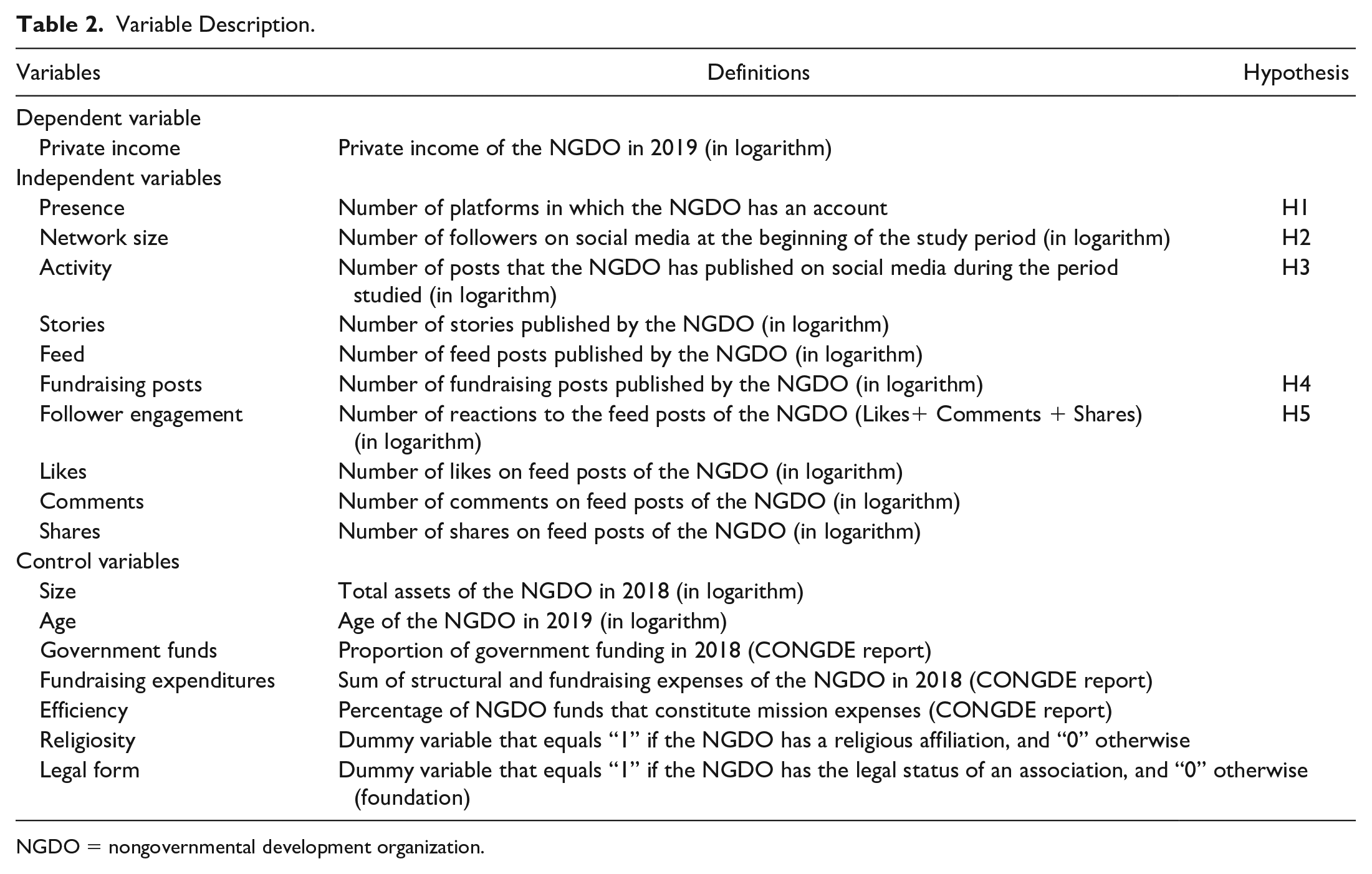
The variables used in the study are defined in Table 2. As shown in this table, the dependent variable (Private income) refers to the private funds received by each of the organizations in 2019. Specifically, it includes regular contributions, one-time contributions, income from private organizations, services provided, products sold and other private income received by the NPOs in 2019.
Variable Description.
NGDO = nongovernmental development organization.
With regard to the independent variables, social media is alternatively defined as the variables constructed to analyze what effect social media presence (H1), network size (H2), number of posts (H3), posts promoting donations (H4), and followers’ reactions (H5) have on private income. First, social media presence (Presence) is measured through the total number of social media platforms (Instagram, Facebook, Twitter, and YouTube) in which the NGDO has an account. We use this measure since all organizations have accounts on at least one platform. Second, network size (Network size) is defined by the sum of the followers the organization has in each of its social media accounts at the time the study began. Third, the activity that organizations maintain on social media (Activity) is analyzed through the number of posts—both feed posts (which are permanent) and stories (which are ephemeral)—that the NGDO publishes in any platform during the study period. Fourth, post content is measured by the number of posts made by the NGDO to express donation requests to followers (Fundraising posts). Finally, the fifth variable related to social media is follower engagement (Follower engagement). In order to build this variable, we adapted previous measures (e.g. Alonso-Cañadas et al., 2019; Carboni & Maxwell, 2015) to the specificities of each platform. Follower engagement is thus measured by the number of reactions that followers make by liking, commenting, or sharing the post. In Instagram and YouTube sharing is not public, thus only likes and comments are included. This variable just applies to feed posts since reactions to stories are not public.
Furthermore, a series of control variables used in the literature on the determinants of donations are included in the analysis: organizational size (e.g., Marcuello & Salas, 2001), age (e.g., Okten & Weisbrod, 2000), government funds (e.g., Andres-Alonso et al., 2020), fundraising costs (e.g., Weisbrod & Dominguez, 1986), efficiency (e.g., Okten & Weisbrod, 2000), religiosity (e.g., Marcuello & Salas, 2001), and legal form (e.g., Andres-Alonso et al., 2020). Consistent with previous research (Harris et al., 2023), the control variables correspond to the year prior to the study (2018; except in the case of age, legal form, and religiosity which, with exceptions, cannot be modified), while the independent and dependent variables are measured in 2019 due to the immediacy that characterizes these technologies. In other words, whereas in the case of other traditional methods of communication, a period of time is required for donors to receive the information and to react to it, the information on social media is up-to-date and is always available for stakeholders, thereby triggering a more immediate donor reaction (Harris et al., 2023).
Data Analysis
To test the hypotheses, we perform an ordinary least squares regression with robust standard errors. In line with previous studies (Harris et al., 2023), we perform separate regressions for the different independent variables that constitute the hypotheses, due to the high correlation among them. To check for multicollinearity problems, we calculate the variance inflation factor (VIF). We also check for the absence of heteroscedasticity by performing the Breusch-Pagan test and the White test. We use hierarchical regression to estimate the models such that in the first model (Column [1] of Table 4) we only include the control variables, and in the following ones, we include the independent variables.
Results
Descriptive Statistics
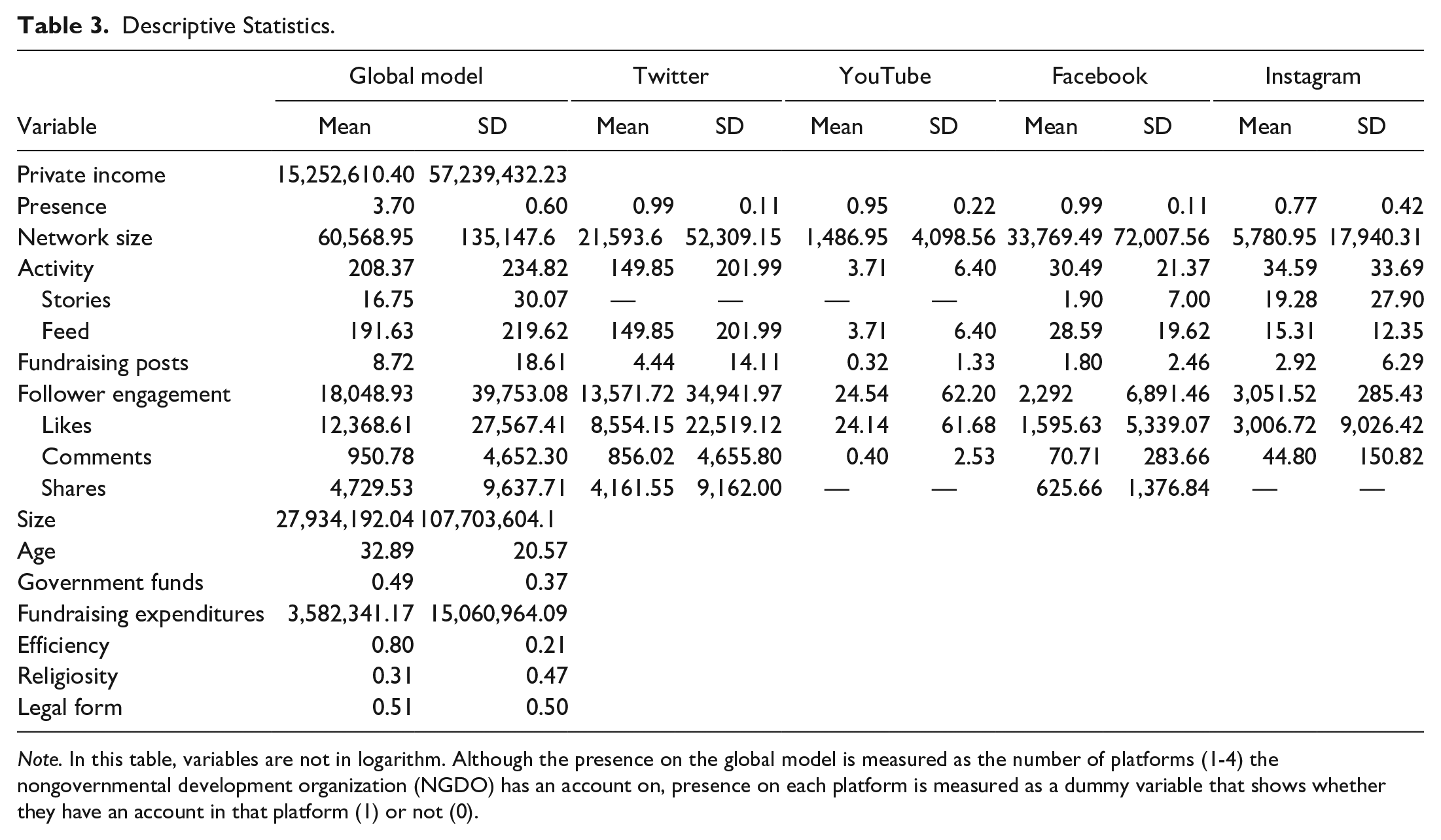
Table 3 presents the descriptive statistics for the variables in the models. Also, to have a clearer understanding on how the variables are distributed, the values for skewness and kurtosis of the independent variables are included in Table A1 in the Appendix. As shown, NGDOs have an average of 15 million euros in private income (Private income), although there is a wide dispersion between organizations.
Descriptive Statistics.
Note. In this table, variables are not in logarithm. Although the presence on the global model is measured as the number of platforms (1-4) the nongovernmental development organization (NGDO) has an account on, presence on each platform is measured as a dummy variable that shows whether they have an account in that platform (1) or not (0).
We also see that the average value of NGDOs’ assets (Size) is approximately 28 million euros, and they were founded on average 33 years ago (Age). On average, 49% of their funding comes from the government (Government funds). Moreover, they spend 3.5 million euros on fundraising and structural expenses (Fundraising expenditures), with 80% of total expenses being mission expenses (Efficiency). Moreover, 31% of the organizations are linked to religious beliefs (Religiosity) and 51% are foundations (Legal form).
With regard to the use of social media (Presence on Social Media), Table 3 shows that there is a high participation of NGDOs on social media since all of them are present on at least one platform and, on average, are present on three or four of the four platforms analyzed (3.70). This result is similar to that obtained by Harris et al. (2023) for 427 U.S. NPOs, which are present on four platforms on average.
To gain a better understanding of the use of social media and the differences in adoption and use among platforms, we disaggregated data by the social media platforms used in the study. According to these data, the most commonly adopted platforms are Facebook (99%) and Twitter (99%), followed by YouTube (95%), and, to a lesser extent, Instagram (77%). This trend in which Facebook and Twitter are the most popular platforms is consistent with previous studies (Guo & Saxton, 2012; Harris et al., 2023; Kim et al., 2014; Young, 2017), although the present study showed higher values in the adoption of all platforms. This may be because Facebook, YouTube, and Twitter were created before 2006, while Instagram was not developed until 2010, making the former more well-known and their use more consolidated in society.
The average number of followers (Network size) in all the social media platforms is over 60,000. In this case, as Table 3 shows, the platform with the highest number of followers is Facebook, followed by Twitter, Instagram, and YouTube.
On average, NGDOs publish 208 posts (about six posts per day; Activity), mainly in feed format (192 posts). Publication of stories is much smaller (less than 17 stories), and almost half of the sample (38 NGDOs) did not use this format. In this regard, it should be noted that at the time of the study, stories could only be used on Instagram and Facebook. The platform in which NGDOs are most active is Twitter—with an average of 150 posts—while Instagram and Facebook show similar values (an average of 35 and 30 posts, respectively). Finally, the platform with less NGDO activity is YouTube with an average of only four posts over the entire study period. The video-based content of this platform might explain the lower posting frequency since videos are more elaborate than text and photos and their creation requires more resources (Moran et al., 2020). There are also differences between the platforms regarding post format. On Facebook, stories (Stories) are hardly used, with only two posts of this type on average, while stories on Instagram (19 on average) are more used than feed posts (15 on average). Their earlier appearance on Instagram might explain this result, with their use being more consolidated on this platform.
NGDOs hardly publish fundraising posts (Fundraising posts). On average, they make nine posts of this type, with 36 organizations not including this type of content on their social media, added to which there are slight differences depending on the platform. Moreover, NGDOs received an average of 18,000 reactions to their posts (Follower engagement). Likes are the most commonly used reaction by NGDO followers, with an average of 12,000 likes compared with 951 comments and almost 5,000 shares. These differences might be due to the different involvement and time required for each reaction. For all the platforms, likes are the most widely used reaction followed by post sharing (except on Instagram or YouTube, where it does not appear publicly), with the least used being comments. These reactions to NGDO posts are also more numerous on Twitter, followed by Instagram, Facebook, and YouTube.
It can thus be seen that the most widely adopted social media platforms by NGDOs and those with the highest number of followers are Facebook and Twitter. Moreover, Twitter is the most frequently used and the one that generates the most reactions from followers, while Instagram surpasses Facebook in both use and follower engagement. Finally, although most organizations have YouTube accounts, they are not frequently used, nor do they generate a large volume of followers or follower feedback.
Findings
Having described the variables, we now present the results obtained by testing the proposed hypotheses. To better understand the significance of the different dimensions studied in each of the platforms, we have used the standardized beta coefficients, since they can be easily compared (Siegel & Wagner, 2022). Table 4 shows there are no multicollinearity problems in the calculations (the VIF does not exceed a value of 2), and the model is globally significant.
Effect of Social Media on Private Income.

Note. Standardized beta coefficients and standard errors in parentheses. VIF = variance inflation factor.
p < .1. **p < .05. ***p < .01.
Results first show that—contrary to expectations—presence on social media has no effect on the volume of donations received by an NGDO; thus, hypothesis H1 is rejected (Column [2] of Table 4). Social media presence might not represent a competitive advantage over other organizations since it is widespread and common in society. However, the number of followers on NGDO social media accounts (Network size) does have a positive effect on the private funds raised by the organizations, as proposed in hypothesis H2 and in line with the findings of Saxton and Wang (2014) in their study on Facebook, and Lee and Shon (2023) in their study into Facebook and Twitter. In fact, based on the standardized beta coefficients, this is the variable related to social media that has the most influence on donations (β = 0.363).
Regarding activity on social media, we find that the number of posts the NGDO publishes positively affects donations (β = 0.147), as proposed in hypothesis H3, and in line with the results obtained by Bhati and McDonnell (2020), Harris et al. (2023), and Tian et al. (2021). Furthermore, our results confirm both H4 and H5 because posts expressly designed to solicit funds also trigger a higher volume of private income (β = 0.146; (H4) and, in line with previous studies (Harris et al., 2023), the more reactions NGDOs have to their posts, the more private funds the organization receives (β = 0.169; H5). Therefore, although mere social media presence has no significant influence on the private funds obtained by NGDOs, its use and the factors derived from it do promote fundraising.
With regard to the control variables, larger and more mature organizations receive more private donations, since size and age imply greater visibility, and thus greater accessibility to private funds (Andres-Alonso et al., 2020; Marcuello & Salas, 2001; Weisbrod & Dominguez, 1986). In contrast, government funds have a negative effect on donations. This result—together with the non-significance of the remaining control variables (fundraising expenses, efficiency, religiosity, and legal form)—is in line with the findings obtained by Andres-Alonso et al. (2020) for a panel of Spanish NGDOs.
Given the structural differences between social media platforms, they offer different communication experiences and may have different effects on followers (Lee, 2022). We, therefore, performed an analysis for each platform, with the results showing that not all platforms have the same effect on NGDOs’ donations (see Tables 5–8). To test whether the coefficients are significantly different across social media platforms, we used a Wald test (see Appendix Table A2). We found significant differences for most of the independent variables (i.e., platform presence, network size, activity, and follower engagement), except for the number of fundraising posts (which is statistically significant only on Instagram and Twitter).
Effect of Twitter on Private Income.

Note. Standardized beta coefficients and standard errors in parentheses. VIF = variance inflation factor.
p < .1. **p < .05. ***p < .01.
Effect of YouTube on Private Income.

Note. Standardized beta coefficients and standard errors in parentheses. VIF = variance inflation factor.
p < .1. **p < .05. ***p < .01.
Effect of Facebook on Private Income.

Note. Standardized beta coefficients and standard errors in parentheses. VIF = variance inflation factor.
p < .1. **p < .05. ***p <.01.
Effect of Instagram on Private Income.

Note. Standardized beta coefficients and standard errors in parentheses. VIF = variance inflation factor.
p <.1. **p < .05. ***p < .01.
Among all the social media platforms, Twitter and YouTube seem to be the two most effective in fundraising. On one hand, we highlight the importance of Twitter in attracting financial contributions since all the variables analyzed—except for presence—have a significant and positive influence on the volume of donations (see Table 5). Based on these results, it seems Twitter’s very wide reach, the dynamism of its use and the virality of its posts make it an excellent fundraising tool (Haro-de-Rosario et al., 2018). However, YouTube also proves to be a platform with substantial fundraising power, since although there are fewer dimensions which are statistically significant (according to values in Table 6 neither the presence nor the number of fundraising posts published are significant), standardized beta coefficients show that the influence of the other dimensions (i.e., network size, activity and follower engagement) is considerably stronger than on the other platforms (see Table 6). Specifically, both the number of posts (activity) and the number of follower reactions (engagement) are almost twice as influential (β = 0.237 and β = 0.248 respectively) as the same variables on Twitter (β = 0.127 and β = 0.133, respectively). This could be due to the fact that this platform is mainly used by NPOs to inform about their mission and programs and that video format allows to strengthen the relationship with stakeholders (Waters & Jones, 2011).
In the case of Facebook, its effect on NPO fundraising seems to come through its followers, either via the number of followers or the number of their reactions to NGDO posts (see Table 7). On Facebook, organizations try to increase their followers’ involvement through posts that meet their expectations, generating connections with them in an environment of greater closeness and familiarity (Haro-de-Rosario, 2018; Lee, 2022). The fact that Facebook users are more relationship-seeking may explain why neither the number of posts nor posts that request funds affect donations.
Finally, on Instagram, donors only react to the content of the post (see Table 8), probably because its main target audience is younger people who are not major funders (Salomon, 2013). However, although this platform has little effect on NGDOs’ current fundraising, it might influence medium-term fundraising or promote other aspects such as volunteer recruitment or awareness-raising.
Additional Analyses
In addition to the analyses described above, we performed a more comprehensive study by disaggregating the independent variables according to the type of posts made by the NGDO (stories and feed posts) as well as the different types of reactions from followers (likes, comments, and shares).
Differences Between Types of Post
In relation to the two types of post formats—as shown in Table A3 in the Appendix—while the positive effect of the general variable of activity on donations (H3) is maintained in feed posts, stories are seen to have no significant effect. This may be due to the ephemeral nature of these posts which—as they are only visible for a certain time—may end up not being seen by donors.
Differences Among Types of Follower Reaction
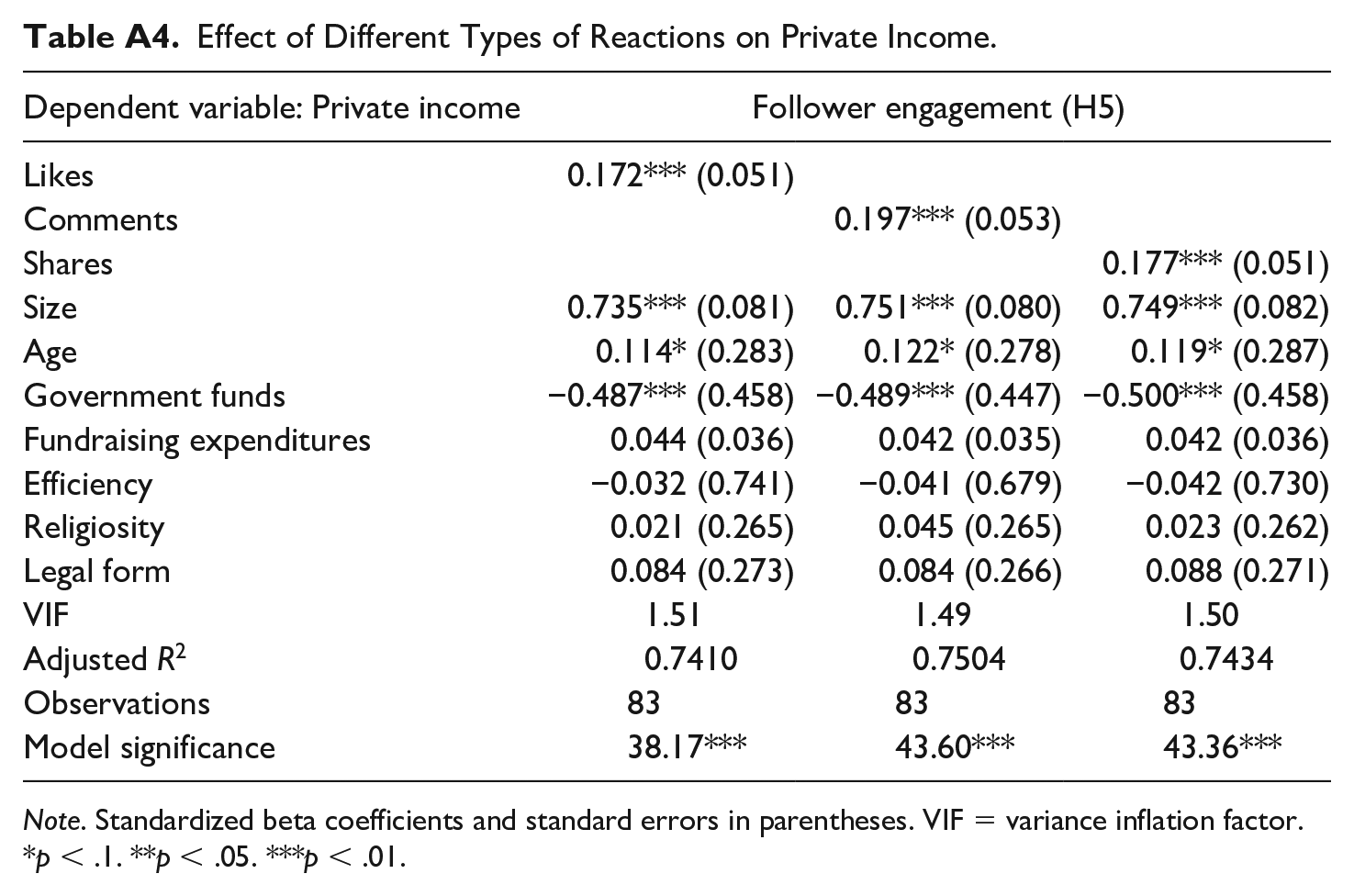
As Table A4 in the Appendix shows, likes, comments, and shares all have a positive effect on donations, as does the general variable of follower engagement (H5). Although these are three different forms of reaction, and therefore reflect different degrees of follower engagement, we find no difference in the effect they have on the volume of private funds raised by the organization.
Conclusion
This research analyzes the potential of social media as a fundraising tool for NPOs. To do so, we analyze the use of four social media platforms by 83 organizations belonging to CONGDE in 2019 for a 5-week period. All of them were present on at least one platform: specifically, 99% had an account on Facebook, 99% on Twitter, 95% on YouTube, and 77% on Instagram.
Results show, first, that the mere presence on social media has no effect on the volume of donations but, the greater the number of followers and the activity on social media, the more private funds the NPO obtains. The latter result, however, only holds for feed posts (permanent), while stories (ephemeral) have no effect on donations. Furthermore, fundraising posts (those explicitly asking for donations), although not frequently used, do attract donations. Concerning followers’ reactions to the organization’s posts (regardless of whether they are likes, comments or shares), we find that they also have a positive influence on donations. Finally, we note that the results are not consistent for all social media platforms and that, in fact, Twitter and YouTube emerge as particularly effective tools for fundraising while Instagram only seems to be helpful when explicitly used to publish fundraising posts.
Our study has several theoretical and practical implications. First, in response to the main objective of the study, we show that—following the theoretical arguments proposed by signaling theory, stakeholder theory and legitimacy theory—NGDO use of social media is an effective means of fundraising. Social media might therefore prove to be an important tool for NGDOs since it offers a more cost-effective means than other traditional forms of fundraising. In addition, we evidence significant differences in fundraising capacity between platforms. These differences could be explained by the characteristics of the platforms, or by their target audience. Specifically, we find that the most effective platforms are Twitter and YouTube. As Phua et al. (2017) point out, Twitter users report the highest bridging social capital since reaching new people makes them feel part of a broader community, while Instagram users have less interaction, and Facebook users only connect with people they know in real life. Regarding YouTube, despite its lesser use, it provides a more authentic and relationship-building experience (Waters & Jones, 2011). Following these arguments, the most suitable theoretical framework could be stakeholder theory, giving that platforms’ ability to engage followers seems to be essential for fundraising effectiveness.
Second, this study supports the idea that the degree to which an organization uses social media is not the only important aspect of its use. In fact, it is rather how NPOs use these platforms and what they post that seem to influence donor attitudes the most. Specifically, the content of posts improves fundraising when followers are asked for donations. We also provide evidence on the differences that arise depending on the post format and confirm that feeds have a greater impact on fundraising than stories, probably due to the latter’s ephemeral nature. This finding adds robustness to previous studies which focused specifically on feeds.
This study also makes notable practical contributions by providing NPO managers who want to use social media as a fundraising tool with guidelines on how to use them more efficiently. According to our findings, organizations should not simply create a social media account, but should actively participate therein; they should not overuse stories and should publish more fundraising posts, an aspect which is not currently widely used. They should also recognize the differences between platforms and, we would recommend them to focus especially on Twitter and YouTube (given their fundraising effectiveness).
Our study presents some limitations that may guide future lines of research. First, it focuses on a particular sector of entities (NGDOs). By its nature, the development aid sector may have followers who are highly involved in social demands and who can be especially dynamic in platforms. It would therefore be interesting to find out whether these results are transferable to NPOs working in other fields. Second, given the difficulty involved in analyzing post content, our analysis of activity, follower engagement, and the content analysis itself covers only 5 weeks. This is a common—or even longer—sample than that used by other authors for similar studies (e.g., Carboni & Maxwell, 2015; Lovejoy & Saxton, 2012), since it is considered a long enough period to ensure an adequate number of status updates (Nah & Saxton, 2013), assuming that the organization’s behavior over that period can be extrapolated to the rest of the year. However, it would be advisable to obtain this type of information for the whole year, as there may be some divergence in organizations’ behavior during periods that are usually more active in attracting resources, such as Christmas or times of crisis. Furthermore, although November does not include any significant dates, results could be affected by seasonality issues that would be avoided with a whole-year analysis. Also, given the size of the sample, there could be a potential risk for Type II error. Finally, it would be important to differentiate between posts with visual content (including photographs or videos) or mere text, as well as to separate positive and negative comments when analyzing follower engagement, since they could affect donations differently.
In addition to future lines of research derived from the described limitations, other avenues for future research could also be proposed. Due to the influence that the number of followers has on donations, it could be interesting to study which variables determine follower engagement. Along the same lines, surveys conducted among social media users about their behavior or interviews with NPO managers about their use of social media could be interesting. All of these options for future research show that the analysis of social media use as a means of fundraising for NPOs is underexplored due to its relative novelty, but it has become a topic of both academic and practical relevance.
Footnotes
Appendix
Effect of Different Types of Reactions on Private Income.
| Dependent variable: Private income | Follower engagement (H5) | ||
|---|---|---|---|
| Likes | 0.172*** (0.051) | ||
| Comments | 0.197*** (0.053) | ||
| Shares | 0.177*** (0.051) | ||
| Size | 0.735*** (0.081) | 0.751*** (0.080) | 0.749*** (0.082) |
| Age | 0.114* (0.283) | 0.122* (0.278) | 0.119* (0.287) |
| Government funds | −0.487*** (0.458) | −0.489*** (0.447) | −0.500*** (0.458) |
| Fundraising expenditures | 0.044 (0.036) | 0.042 (0.035) | 0.042 (0.036) |
| Efficiency | −0.032 (0.741) | −0.041 (0.679) | −0.042 (0.730) |
| Religiosity | 0.021 (0.265) | 0.045 (0.265) | 0.023 (0.262) |
| Legal form | 0.084 (0.273) | 0.084 (0.266) | 0.088 (0.271) |
| VIF | 1.51 | 1.49 | 1.50 |
| Adjusted R2 | 0.7410 | 0.7504 | 0.7434 |
| Observations | 83 | 83 | 83 |
| Model significance | 38.17*** | 43.60*** | 43.36*** |
Note. Standardized beta coefficients and standard errors in parentheses. VIF = variance inflation factor.
p < .1. **p < .05. ***p < .01.
Acknowledgements
The authors gratefully acknowledge the helpful suggestions received from the two anonymous reviewers and the Editors, Chao Guo and Joanne Carman, who have so kindly assisted them in the development of the paper, and the comments received from the participants at the ACEDE Conference and WJI Workshop, held in Barcelona and Calatayud respectively.
Declaration of Conflicting Interests
The author(s) declared no potential conflicts of interest with respect to the research, authorship, and/or publication of this article.
Funding
The author(s) disclosed receipt of the following financial support for the research, authorship, and/or publication of this article: This study was supported by the Spanish Ministry of Science and Innovation (Grant PID2022-139777NB-I00), the UAM - Comunidad de Madrid Research Project for Young Researchers (SI3-PJI-2021-00276) and it benefited from financial aid for the pre-doctoral research personnel in training from the Junta de Castilla y León, co-financed by the European Social Fund Plus (ESF+).
