



Abstract
COVID-19 has been regarded as environmental disruption that catalyzed a multitude of organizational changes in nonprofit organizations. This study centers on the nonprofit workers’ experience of change. Specifically, this study investigates to what extent and how negative appraisals in the midst of the pandemic are related to intentions to leave the organization about a year after the start of the pandemic, at a point in time when the initial shock had settled into a sense of the “new normal.” Findings indicate that harm but not threat appraisals predict psychological contract violation and that psychological contract violation is related to behavioral resistance to change as well as intentions to leave. Unexpectedly, neither threat appraisal nor resistance to change was related to turnover intentions. We discuss contributions to theory, research, and practice.
Keywords
Introduction
The nonprofit sector experienced tremendous events in the past few years with organizational functioning impacted by the COVID-19 pandemic alongside other economic and public policy changes. Whereas the latter allow organizations to prepare themselves, COVID-19 can be seen as environmental disruption that did not allow for preparation (Kim et al., 2022). Environmental disruptions, though can tremendously impact organizational functioning, requiring organizations to implement changes rather swiftly. For instance, when COVID-19 first hit, nonprofits altered how they delivered services while also adapting where and how employees worked (Kuenzi et al., 2021).
During the COVID-19 pandemic, nonprofits were confronted with staggering staff fluctuation, mostly due to layoffs and furloughs alongside voluntary departures. Employment in nonprofit organizations fell by 13.7% during the early phases of the pandemic (Karol & Mayo, 2023). Recovery has been fast, indicating that nonprofit sector jobs, on average, were back to pre-pandemic (2017) levels by October 2022 (Nonprofit Employment Data Project, 2023). Turnover, both voluntary and involuntary, presents an ongoing challenge for organizations since it is costly and time-intensive to replace employees who have left (Shaw et al., 1998). Turnover is especially challenging in the context of organizational change, as resources may already be spread thin by maintaining daily operations while simultaneously implementing changes.
The day-to-day implementation of organizational change falls into the responsibility of employees, making them an important asset to organizational functioning (Oreg et al., 2011). While change implementation is specific to the change content, it may entail realignment of tasks, alterations of work procedures or schedules, and working in new structures or team constellations. As such, organizational change comes along with disruptions in routines. Given the tremendous impact of COVID-19 on how work in the nonprofit sector is done (Kuenzi et al., 2021), employees “have struggled to keep up, to balance their passion with the stress, trauma, and exhaustion brought on by the changes the pandemic has wrought” (Rendon, 2021), which led to increased voluntary turnover rates following Great Resignation trends in other sectors (Casselmann, 2021; King, 2022). To understand how nonprofit workers received the organizational changes spurred on by COVID-19, this paper focuses on one of the primary predictors of voluntary turnover (Podsakoff et al., 2007; Zimmerman & Darnold, 2009): employee intentions to leave their organization.
Organizational change research has sought to understand why people leave their employers, examining the problem from two disjointed angles. One research stream has drawn on appraisal theory. Individuals who experience change engage in the process of evaluating those changes and how they impact them (Oreg et al., 2018), as well as reflecting on the relationship with their employing organizations (Lopez & Fuiks, 2021). This evaluation process is conceptualized as cognitive appraisal (Folkman et al., 1986; Lazarus, 1991) and entails answering the question: “Am I likely to benefit or to be harmed now or in the future by this event?” Changes can be perceived as threatening (i.e., harm has not been done but is expected) or as harmful (i.e., some damage has already occurred) (Rafferty & Restubog, 2017). Previous research indicates that those negative (harm and threat) appraisals may lead to violations of the psychological contract (Rafferty & Restubog, 2017), which refers to an individual’s beliefs about mutual obligations in the context of the relationship between them and their employer. If the psychological contract is violated, employees tend to develop thoughts of leaving the organization (Rousseau, 1995), which may result in them actually leaving (Fugate et al., 2011, 2012).
A second research stream to understand turnover intentions focuses on employee resistance to change. Employees who resist a certain change initiative may try to prevent that change from happening or protest against it. Resistance to change is the most often studied reaction to organizational change (Oreg, 2006) and reliably predicts both intentions to leave and actual turnover (Oreg et al., 2011). We propose to combine these two disjointed research streams and suggest that resistance to change can further help explain the underlying mechanism of how change appraisals lead to turnover intentions. Therefore, this study asks the following research question: Are psychological contract violations and resistance to change underlying mechanisms that link employees’ cognitive change appraisals to their intentions to leave the organization?
This study contributes to the literature in the following ways. First, even though resistance to change is one of the most often studied individual-level reactions to change (Oreg et al., 2011) with a solid understanding of predictors as well as outcomes of resistance, organizational change research has only recently emphasized the emotional processes that may influence how individuals react to change and how emotions impact resistance (Oreg et al., 2018). This study investigates the relationship between psychological contract violation as an emotional state and resistance to change. In doing so, this work adds a potential new mechanism for understanding how negative appraisals are linked to turnover intentions. Further, a recent literature review on organizational change in the nonprofit context indicated that findings from outside the nonprofit context are not universally transferable to nonprofits (Walk et al., 2023). As such, we test previously established relationships in the nonprofit context, especially the links between negative appraisals, psychological contract violations, and intentions to leave (Rafferty & Restubog, 2017). Moreover, previous work on appraisals and the relationship to intentions to leave has focused on employees in individual organizations in the public and private sectors (Biggane et al., 2017; Fugate et al., 2012; Rafferty & Restubog, 2017). This study focuses on individuals with similar educational backgrounds working in a diverse set of organizations, which allows us to hold education constant while studying change across organizations. Finally, COVID-19 may not be the typical organizational change, that tends to be planned (Cawsey & Deszca, 2007) but rather an environmental disruption, necessitating swift organizational changes without time for adequate preparation or planning (Kim et al., 2022). Whereas there is sufficient research on the pandemic’s impact on operations and finances, this article contributes to the emerging research centering nonprofit workers and their experience (Kuenzi et al., 2021, 2023).
Literature
Cognitive appraisal is the process through which individuals evaluate the significance of events for their well-being (Folkman et al., 1986; Lazarus, 1982). Appraisals capture the cognitive processing of an individual in the context in which they operate (Biggane et al., 2017). Specifically, individuals assess the importance of a particular event and determine it to be irrelevant, benign-positive, or stressful (Folkman et al., 1986; Lazarus, 1982). In the latter case, two specific stress appraisals can be differentiated: harm or threat. Threat appraisals capture anticipated impacts of the event, whereas harm appraisals capture impacts of the event that have already occurred (Peacock & Wong, 1990). This distinction of whether or not actual harm has occurred is important since a situation that is appraised as threatening allows individuals to cope and potentially to mitigate negative impacts. In situations where harm has already been inflicted, there is no opportunity for mitigation (Lazarus & Folkman, 1984). Yet, both the anticipation of a loss (threat) as well as the loss itself (harm) may have similar consequences for the individual (Lazarus & Folkman, 1984).
Oreg and colleagues (2018) posited that “change events trigger emotional episodes by evoking affective processes intertwined with cognitive appraisals that affect change recipients’ behavioral responses to the change events” (p. 67). In simple terms, change events are perceived by employees, and these perceptions will dictate how an employee responds to a change event. Appraisals have mostly been studied as antecedents and mediators and are associated with various outcomes, such as emotions (Conte et al., 2023), psychological contract violation (Rafferty & Restubog, 2017), support and commitment to change (Fugate & Soenen, 2018), as well as work withdrawal, such as absenteeism, intentions to quit, and voluntary turnover (Biggane et al., 2017; Fugate et al., 2012; Rafferty & Restubog, 2017).
In this paper, we utilize a framework (see Figure 1) that combines this prior literature and investigates the mechanisms that connect these change appraisals to intentions to leave. As illustrated, we treat harm and threat appraisals as antecedents that are catalyzed in the context of COVID-19-induced organizational change. Specifically, we propose that harm but not threat appraisals will lead to psychological contract violation, which will then be associated with resistance to change. Finally, these factors—threat appraisal, psychological contract violations, and resistance to change—directly relate to intentions to leave.
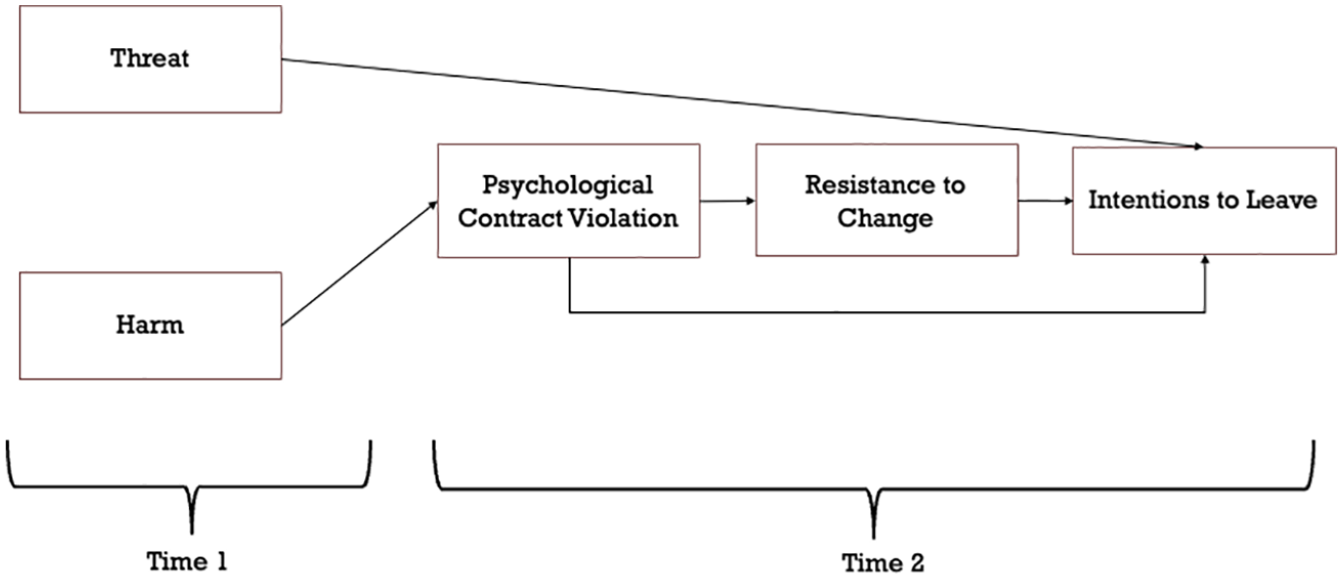
Theoretical Framework.
Appraisals and Psychological Contract Violations
Organizational changes can modify the beliefs and perceptions that employees have about their employment relationship (Morrison & Robinson, 1997). A psychological contract encapsulates the beliefs that capture the perceived reciprocal obligations between employees and their employing organizations and develops based on perceived promises (catalyzed through written documents, discussions, and organizational practices) and may or may not be shared by the organization (Morrison & Robinson, 1997). In cases when employees perceive that their employer has not met this psychological contract, such as in situations of major organizational change, a violation of this contract occurs (Robinson & Wolfe Morrison, 2000).
Sustaining the psychological contract is particularly meaningful in the nonprofit context since there is not only the self-interested traditional psychological contract but oftentimes an ideological psychological contract as well (Sanderson, 2021), suggesting that an employee is commited to the mission of the nonprofit. This ideological psychological contract tends to be a part of a multidimensional psychological contract entailing an “employee belief that the organization is obligated to demonstrate a credible commitment to and investment in a valued cause” (Thompson & Bunderson, 2003, p. 574) and pertaining to “employees who commit to an organization in exchange for being able to serve a social cause/mission” (Cunningham, 2010, p. 701).
Employees may evaluate the personal impact of major organizational changes, which can pose threats (e.g., impending changes to work tasks, job status, fear of layoffs, furloughs, pay/benefit cuts) as well as harm if changes have already been actualized. Following this cognitive evaluation, employees may then display an emotional response and consider whether or not the employer has violated their psychological contract. 1 Some scholars have indeed linked appraisal theory to the psychological contract (Rafferty & Restubog, 2017; Vander Elst et al., 2016). For instance, Rafferty and Restubog (2017), who investigated organizational change in a manufacturing organization, posit that both threat and harm appraisals are predictive of psychological contract violations. This study was the first to include multiple components of cognitive appraisal to provide a fuller picture of employees’ cognitive appraisals and their impact on psychological contract violations. Their findings, however, indicate that only harm, but not threat appraisal, is significantly related to violations, which indicates that threat alone may not impact the individual’s psychological contract. Rafferty and Restubog (2017) reason that “it is the experience of loss that generates negative emotions rather than the anticipation of future losses” (p. 542).
In light of the emotional reactions to the changes the nonprofit workers were exposed to in the context of COVID-19, alongside other evidence as discussed above, we hypothesize:
Psychological Contract Violation and Resistance to Change
Psychological contract violations, depending on their severity, can lead to detrimental individual and organizational outcomes such as a reduction of contributions to the organization (Arshad & Sparrow, 2010; Turnley & Feldman, 2000), decreased commitment (Arshad & Sparrow, 2010; Tomprou et al., 2012), reduced trust and job satisfaction (Tomprou et al., 2012), and increased turnover intentions (Arshad & Sparrow, 2010; Robinson & Rousseau, 1994; Turnley & Feldman, 2000). In extreme cases, employees may also seek revenge or engage in workplace deviance (Bordia et al., 2008; Restubog et al., 2015).
Research has highlighted the importance of the psychological contract, specifically the avoidance and mitigation of psychological contract violations in the context of major organizational change (e.g., merger and acquisitions), to ensure the successful implementation of change (Bellou, 2007; Shield et al., 2002). Specifically, Shield and colleagues suggested that “in managing change, psychological contracts should be deliberately, carefully and extensively preserved” (Shield et al., 2002, p. 361).
Previous research on the stability of psychological contracts is mixed, with some suggesting that a baseline contract is developed in an employee’s early tenure in a position and evolves into a relatively stable mental model (Rousseau, 1995, 1998, 2001). Others suggest that psychological contracts are more flexible and subject to changes over time (Rousseau, 1998, 2001). In the context of the COVID-19 pandemic, emerging research points to tremendous impacts on employees’ psychological contracts (Lopez & Fuiks, 2021), implying that workplace casualties spurred on by the pandemic were both tangible changes as well as intangible perceptions. Likewise, while not described explicitly as the psychological contract, in their study of the impact of COVID-19 on nonprofit workers, Kuenzi et al. (2023) noted a common theme of questioning current careers as a result of the pandemic, leading to a recalibration or re-negotiation of the prominence of work in their lives.
Theoretical work posits that emotional episodes may lead to behavioral responses to change events (Oreg et al., 2018; Smollan, 2006). As such, employees may follow-up with action (i.e., resistance) after the emotional response (i.e., psychological contract violation). Change recipients tend to resist to organizational change in cases when they are opposed to the change and do not support it. Behavioral resistance to change may entail the intention to behave as well as actual behavior (Oreg, 2006).
Whereas resistance to change is one of the most often studied reactions to organizational change (Oreg et al., 2011), research has not substantially tested the relationship between psychological contract violations and resistance to change. 2 However, theoretical work generally supports this relationship (Burnes, 2015; Folger & Skarlicki, 1999). Specifically, Burnes (2015) suggests that individuals may resist change if they feel their psychological contract has been violated. Similarly, “if the individuals can see why the contract needs to be changed and if this leads to a new psychological contract which aligns the demands on them, they are unlikely to resist the changes” (Burnes, 2015, p. 107). Similarly, Folger and Skarlicki (1999) argue that “resisting organizational change is one response to a psychological contract violation” (p. 40).
Nonprofit workers tend to have an ideological psychological contract alongside a traditional psychological contract (Sanderson, 2021). We reason that their commitment to their organization’s mission may be contingent upon an alignment of their motivations and their perception of security within the context of their workplace and, thus, any change to that workplace may be perceived as a personal affront, leading them to resist said changes. We therefore hypothesize:
Predictors of Intentions to Leave
Intentions to leave capture an employee’s desire to exit the employing organization and is a very strong predictor for actual turnover (Podsakoff et al., 2007; Zimmerman & Darnold, 2009). When employees leave, they take with them vital knowledge about their work and work processes (Shaw et al., 1998). This is especially challenging in the U.S. context, where employment-at-will “allows either the employer or the employee to terminate their employment relationship at any time for virtually any reason or for no reason at all” (Radin & Werhane, 2003, p. 113). In essence, employees can leave within a few workdays oftentimes preventing a structured handover from happening. Retention is therefore a continuous management challenge as good employees tend to find other employment easily. Retention becomes especially crucial during times of organizational change since the success of change depends on the employees who are responsible for change implementation (Oreg et al., 2011). As displayed in Figure 1, we hypothesize that threat appraisals, psychological contract violations, and resistance to change are all predictors of intentions to leave.
Threat Appraisal
The main argument linking threat appraisals to employee intentions to leave the organization is that employees “are expected to avoid or mitigate threats at work, including the job itself and these motivations often manifest in intentions and actual behavior” (Fugate et al., 2012, p. 898). As such, those who experience change as more threatening may be more likely to display withdrawal behaviors in the form of thinking about leaving (Podsakoff et al., 2007). Previous appraisal research has found mixed empirical evidence for this relationship. Whereas Rafferty and Restubog (2017) did not find significant relationships between treat appraisals and intentions to leave, other scholars did. For instance, Fugate and colleagues (2012), studying organizational restructuring in a public services organization, identified a positive relationship between threat appraisal and intentions to leave as well as absenteeism, two forms of withdrawal behavior. Similarly, Biggane and colleagues (2017), studying acquisitions in the airline industry, identify a positive relationship between threat appraisals and intentions to leave. Finally, sampling from organizations that have undergone changes in the context of the COVID-19 pandemic, a recent study indicates a positive correlation between threat appraisal and turnover intentions (Yue & Walden, 2022). While not specifically building on appraisal theory, a meta-analysis on the relationship between hindrance stressors—stressors that individuals “appraise as potentially constraining their personal development and work-related accomplishment” (Podsakoff et al., 2007, p. 438)—and turnover intentions also supported a positive relationship (Podsakoff et al., 2007).
While there are no research studies supporting this relationship in the nonprofit context, there is emerging anecdotal evidence from changes spurred on during the COVID-19 pandemic. For instance, West (2022) identifies that “staff are leaving due to the fear that the organization is not resilient enough to survive or disappointment in the organization’s poor response to COVID-19” (p. 46), indicating that it is a potential threat occurring in the future that catalyzes their behavior. With the protracted nature of the pandemic and the general workforce instability experienced during the “Great Resignation,” we hypothesize.
Psychological Contract Violation
Psychological contract violations and intention to leave the employing organization are generally positively correlated, meaning employees who feel their employer has violated the psychological contract are more likely to think about leaving the organization (Dulac et al., 2008; Salin & Notelaers, 2017; Stoner & Gallagher, 2010; Suazo, 2009; Turnley & Feldman, 2000). This holds true among a wide variety of employees such as managers in private and public institutions (Turnley & Feldman, 2000), customer-service employees for a Fortune 500 company (Suazo, 2009), a cross-section of the general U.S. working population (Stoner & Gallagher, 2010), and internationally such as in the context of Belgian organizations (Dulac et al., 2008) or among business professionals in Finland (Salin & Notelaers, 2017).
Most of the previously existing relationships were examined in the public or private sector context. There is also some empirical evidence in the nonprofit context supporting the psychological contract violation—intentions to leave relationship. In a qualitative study among employees in three Scottish voluntary organizations, Cunningham (2010) shows that individuals may choose to quit if violations of any aspect of their psychological contract occur.
Concerning the specific situation of COVID-19, there is anecdotal evidence that suggests that nonprofit employees experienced impacts on their psychological contracts following the onset of the COVID-19 pandemic and associated organizational changes. For instance, a Chronicle of Philanthropy article reports on a female nonprofit employee in the area of youth-services who experienced changes in work tasks (i.e., cleaning when lockdowns hit) followed by furloughs (Rendon, 2021). These changes resulted in her indicating that “It really did make me feel that my service had not been valued. The way they handled everything; it made me want to take a long break from the nonprofit world” (Rendon, 2021).
Based on the empirical evidence in the public and private sector, the qualitative evidence in the nonprofit context, and additional anecdotal evidence in the COVID-19 context, we hypothesize:
Resistance to Change
Resistance to change can result in “particularly negative recipient attitudes and behaviors and lower well-being” (Oreg et al., 2018, p. 70). Aside from negative impacts on the individual, resistance to change can also lead to detrimental organizational outcomes. Most prominently, since the early studies at the Harwood Manufacturing Corporation conducted by Coch and French (1948), resistance to change has been associated with intentions to leave and actual turnover. Scholars over the years have solidified our understanding and, generally, resistance to change is positively associated with intentions to leave (Oreg et al., 2011). For instance, Oreg (2006) hypothesized and confirmed a positive relationship between behavioral resistance to change and intentions to leave among employees of an organization in the defense industry that had recently undergone a merger.
Reactions to change, such as resistance, have not been extensively studied in the nonprofit context (Walk et al., 2023). However, the nature of the changes brought on by the pandemic and impact on nonprofit workers, researchers highlight the importance of studying how nonprofit workers react to changes in their organizations (Kuenzi et al., 2021). We therefore hypothesize:
Methods
Data and Sample
The sample was drawn from alumni of nonprofit graduate degree programs (i.e., nonprofit management and philanthropic studies) at two time points (October 2020 and April/May 2021). Through the choice of their graduate degree, these alumni have demonstrated selection into and initial commitment to the nonprofit sector (Kuenzi et al., 2020). Those graduates are not only committed to serving in the sector but, as a result of this training, qualified with the competencies and skills needed for management roles (Mesch, 2010; Tierney, 2006).
The sample was collected through seven universities offering nonprofit graduate degrees across different locations (Midwest [3], Southwest (2), Northwest (1), Mid-Atlantic (1)) and with different affiliations (NACC [2], NASPAA (1), both (4)). In total, 1,567 alumni were invited to participate, of which 234 emails were bounced back (mostly university-affiliated email addresses that no longer worked), and 420 responses were returned (32% response rate). To further increase the response rate, we provided individuals with a $5 coffee gift card; all invited alumni received two follow-up emails after the initial invitation to participate at each of the T1 and T2 data collection points. All T1 respondents were asked if they were willing to be contacted again. In total, 248 individuals from T1 provided their consent (59.05%) of which 117 participated (47.18%) in the follow-up survey. 3
Participants are predominantly female (78.6%), white (82.9%) with an average age of 34.5 (range: 23-65). About 19% of respondents had children, and 74.5% worked in the nonprofit sector (see Table 1). This sample is generally comparable to other study samples focusing on nonprofit workers (Kuenzi et al., 2020; McGinnis Johnson & Ng, 2016; Suarez, 2010; Tschirhart et al., 2008).
Descriptive Statistics and Bivariate Correlations.
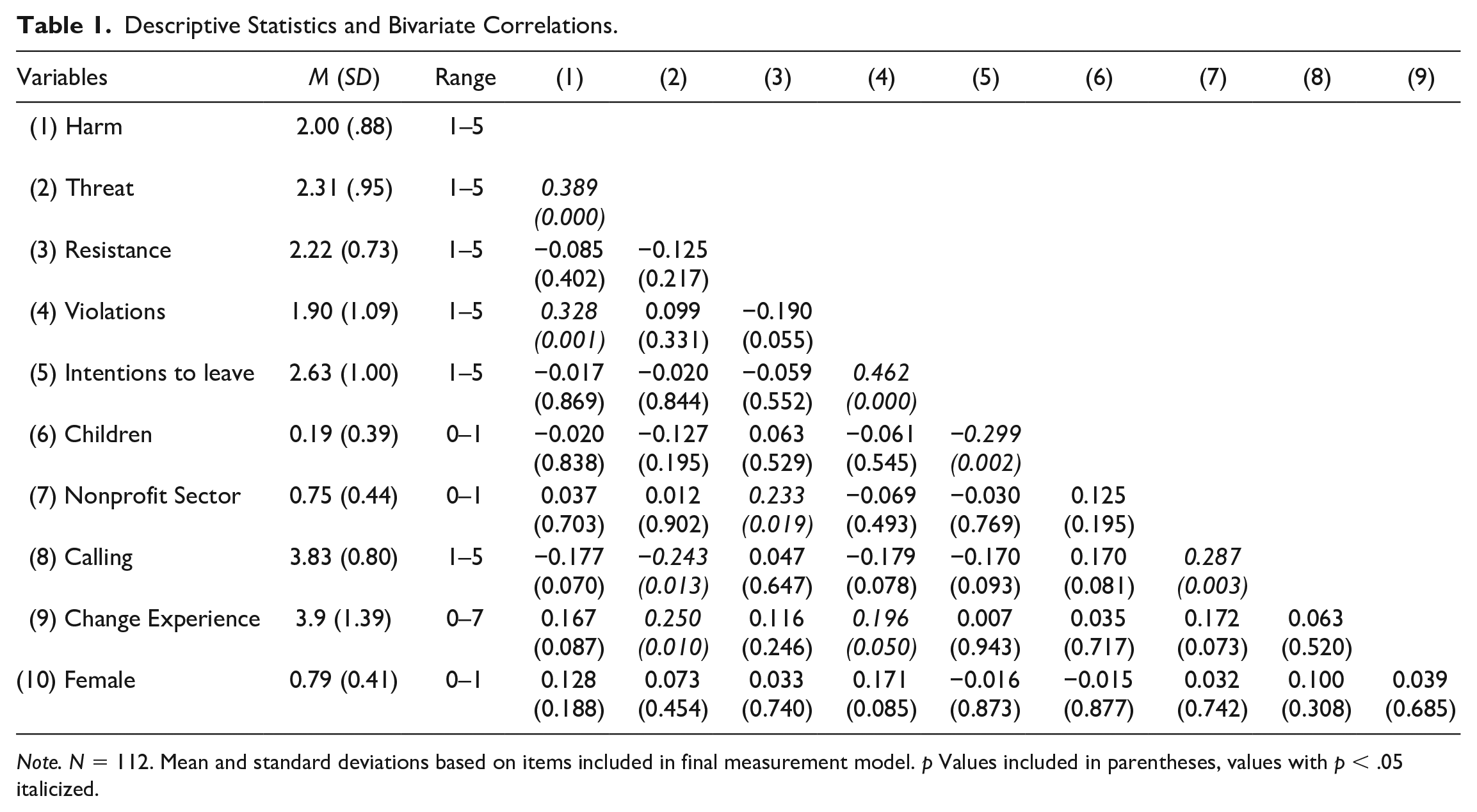
Note. N = 112. Mean and standard deviations based on items included in final measurement model. p Values included in parentheses, values with p < .05 italicized.
Variables
Intentions to Stay: We measured intentions to stay with four items taken from Landau and Hammer (1986) at T2. One example item is: “I plan to continue to work for this organization in the future.” One item was reverse-scored before analysis. Items were rated from 5—strongly agree to 1—strongly disagree.
Resistance to Change: Resistance to change was captured using the behavioral attitudes to change subscale developed by Oreg (2006) at T2. This scale consists of five items and items are rated from 5—strongly agree to 1—strongly disagree (e.g., “I looked for ways to prevent COVID-related changes from taking place”). Three items were re-coded to capture negative reactions to change.
Psychological Contract Violation was operationalized using four items (Robinson & Wolfe Morrison, 2000) at T2. Items are rated from 5—strongly agree to 1—strongly disagree (e.g., “I feel a great deal of anger toward my organization”).
Negative Appraisals: Threat appraisal consisted of eight items (Fugate et al., 2008). We adapted two items: The items “relationship with supervisors and coworkers” and “pay and benefits” were split into two given the double-barrel wording. Participants were asked, “Due to the changes, to what extent do you feel that each of the following is threatened—a possibility that it will get worse in the future?” Respondents indicated their perceived threat along a continuum from 1 (not at all threatened) to 5 (threatened to a great extent). Harm appraisal was captured by asking “As a result of the changes as described above, to what extent do you feel that the following aspects of your work life were harmed—got worse than they were?” followed by four descriptors (relationship with your supervisor, ability to perform your job, relationships with coworkers, desirability of your job; Fugate et al., 2008). Response options ranged from 1 = not at all harmed to 5 = harmed to a great extent.
Control Variables
We considered several potentially relevant control variables including gender, children, work sector, experience with change, and calling orientation. We considered relationships between the predictor variables of interest (threat and harm appraisals, psychological contract violations, and behavioral resistance to change) as well as the outcome variable (turnover intentions) and potential control variables. Following suggestions for parsimonious use of control variables (Bernerth & Aguinis, 2016), we did not include control variables unless we identified strong theoretical and empirical evidence as well as significant bivariate correlations (p < .05) between the control and the other study variables. All control variables were collected at T1.
Gender: There is evidence of a statistically significant relationship between gender and harm as well as threat appraisals. Specifically, being male is negatively related to both appraisal forms (Rafferty & Restubog, 2017). There is some evidence of a statistically significant positive relationship between being male and turnover intentions (Rafferty & Restubog, 2017); however, other studies in the context of organizational change do not find such a relationship (Spreitzer & Mishra, 2002). Being male is negatively related to the degree of psychological contract violation (Turnley & Feldman, 2000) in some studies, but gender is unrelated to psychological contract violation in others (Stoner & Gallagher, 2010). Gender was assessed by asking respondents, “what is your gender?” with response options 1 = male, 2 = female, 3 = other. Twenty-four respondents indicated “male,” and one respondent indicated “other,” we therefore recoded this variable to a binary variable female = 1, other = 0.
Children: Prior research did not find significant relationships between having children and turnover (Spreitzer & Mishra, 2002) as well as readiness to change (C. E. Cunningham et al., 2002). Still, given the impact of the COVID-19 pandemic on parents due to stay-at-home orders or school closures, which coincided with the T1 data collection period, we control for whether or not respondents had children. There is extensive research on how having children during COVID-19 impacted working families and resulted in negative outcomes such as burnout, reduced well-being, and increased anxiety or depression (Calarco et al., 2020; Kerr, Fanning, et al., 2021; Kerr, Rasmussen, et al., 2021). Children were assessed by asking respondents, “How many children (under 18) live with you or are dependent on your income for support?” Answers were re-coded into 1 = yes or 0 = no.
Experience of organizational change: The extent to which employees are directly impacted by change may be related to how they appraise a situation (Biggane et al., 2017) and the violation of their psychological contract (Tomprou et al., 2012). Further, employee reactions may be more intense, if they are exposed to multiple changes at the same time (Bartunek et al., 2006). We aimed, therefore, to capture the total number of changes that respondents were exposed to in the context of their work and closely followed suggestions by Tomprou and colleagues (2012) to construct our variable. Our data set contains two sets of COVID-19-related organizational changes that we sought to combine. The first variable consists of four responses to the question: Since March 2020 has anything of the following happened to you? (Furloughed, pay cut, benefits cut, work from home more, 1 = yes, 0 = no). Eight percent had been furloughed, 10% reported a pay cut, 12% reported cuts in benefits, and 84% indicated that they work from home more. The second variable consists of five responses to the question, “Have your work responsibilities changed in any of the following ways due to the COVID-19 pandemic?” (e.g., My weekly work hours have . . ., the number of tasks as part of my job . . ., and the impact of my work on the lives of others . . .). We converted the responses of the second set of questions initially rated on a three-point scale (increased, decreased, stayed the same) to reflect change (1 = yes) vs. no change (0 = no) by combining the increased and decreased responses into “yes” and keeping stayed the same as “no.” Forty-one percent reported changes in weekly work hours, 65% indicated changes in the number of tasks in their work, 61% reported changes in the impact of their work on the lives of others, 76% indicated changes to the degree of which the job allows for flexible scheduling, and 43% reported that the degree of direct and clear communication had changed. This conversion of responses enabled us to combine this set of questions with the first set (response options yes/no). Like Tomprou et al. (2012), we then summed across all responses to capture more vs less experience with organizational change.
Work sector: Although the sample consists of graduates with a nonprofit degree, not everyone with such a degree works in the nonprofit sector (Tschirhart et al., 2008; Walk et al., 2021). We consider the employment sector as a control variable as employees working for organizations in different sectors differ from each other on certain dimensions (e.g., work expectations or public service motivation) (Lee & Wilkins, 2011). Work sector was assessed by asking respondents to indicate, “Referring to the organization where you are currently employed, what best describes the sector it is in?” Response options were (1) nonprofit sector, (2) public sector, or (3) private sector. This variable was dichotomized to reflect work in the nonprofit sector = 1 and other sectors = 0.
Calling: Calling captures a person’s orientation toward work. Those who describe their work as a calling tend to find it deeply meaningful and see it as an end in itself rather than a means toward an end (Wrzesniewski et al., 1997). We consider calling as a control variable because calling and turnover intentions have consistently been shown to have a negative relationship (Cardador et al., 2011; Esteves & Lopes, 2017; Mantler et al., 2022). Calling may also be a means for employees to restore previously violated contracts (Tomprou & Bankins, 2019). Further, there is some evidence that calling orientation is related to how employees react to organizational change (Walk & Handy, 2018). Whereas there are no empirical studies that tested the relationship between calling and behavioral resistance to change, nonprofit graduates tend to be calling-oriented (Walk et al., 2021). Calling was captured using five items (e.g., My work makes the world a better place) (Wrzesniewski et al., 1997). Items were rated on a 5-point Likert-type scale ranging from 5—strongly agree to 1—strongly disagree.
We conducted bivariate correlations to examine the relationships (see Table 1). Given those findings, we will include children, work sector, experiences with change, and calling, but not gender as control variables. Following Acock (2013), we include control variables in all equations.
Data Analysis
To analyze the data, we use structural equation modeling. Model fit is evaluated using RMSEA, TLI, and CFI (Hu & Bentler, 1999). The initial measurement model based on a 6-factor model (threat and harm appraisal, psychological contract violations, resistance to change, intentions to leave, and calling) indicates suboptimal fit (CFI = .817, TLI = .797, RMSEA = .087). Following Hooper and colleagues (2008), we removed items that had low multiple R2 (<.20, two threat items, one resistance item) and two items with a substantial covariance of the error terms (one harm, one threat). 4 Findings of the updated six-factor model indicate a good fit to the data (CFI = .937, TLI = .928, RMSEA = .053). We use full information maximum likelihood to account for missing data.
Findings
An overview of our multivariate findings is presented in Figure 2 and Table 2. As hypothesized, findings indicate that harm appraisal is related to psychological contract violation (β = .43, p = .004, H1a supported), but threat appraisal is not (β = −.21, p = .128, H1b supported). Psychological contract violation is related to resistance to change, indicating that the more severe the violation, the higher the resistance to change (β = .26, p = .016). Contrary to hypotheses 3 and 5, threat appraisal (β = −.13, p = .22) and resistance to change (β = −.05, p = .67) are unrelated to intentions to leave. Psychological contract violation, as predicted in H4, is positively related to intentions to leave (β = .48, p < .0001). Further, one control variable is statistically significant: respondents with children have significantly lower intentions to leave compared to those without children (β = −.28, p = .001).
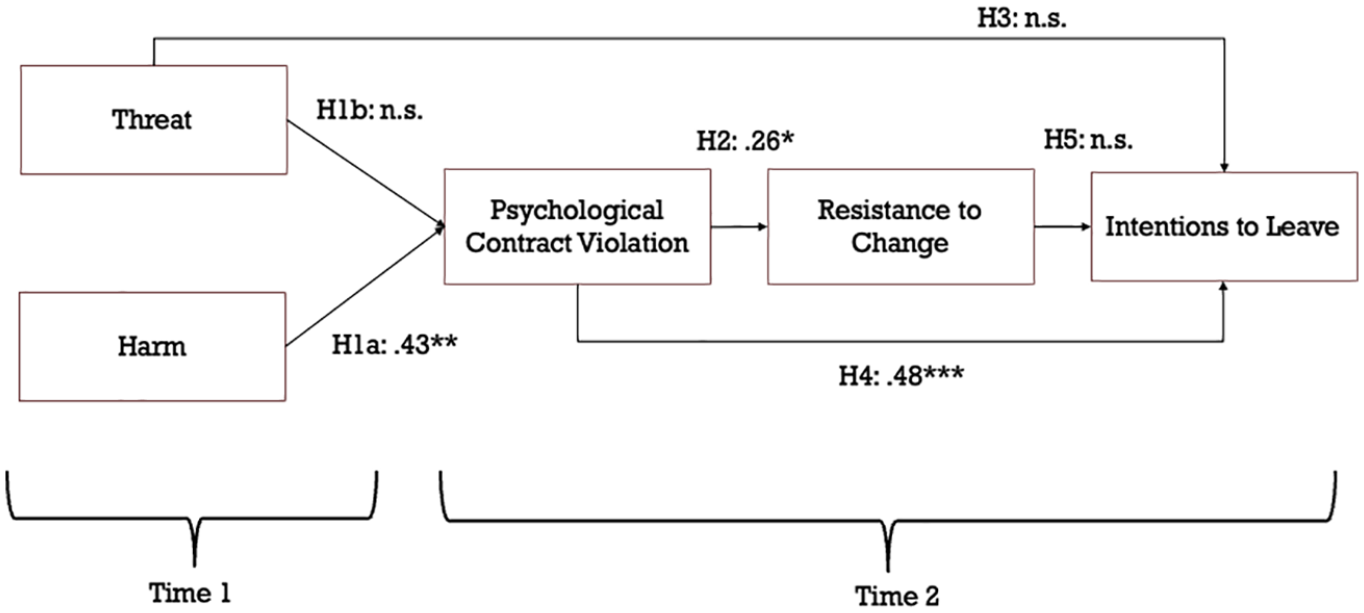
Sem Results (Standardized Coefficients).
Standardized Path Estimates.

Note. N=112. +<.10. CI = confidence interval.
p ≤ .05. **p ≤ .01. ***p ≤ .001.
Discussion
COVID-19 has been characterized as environmental disruption (Kim et al., 2022), which did not allow organizations time for preparation, resulting in a multitude of organizational changes in nonprofit organizations (Kuenzi et al., 2021, 2023). Aside from radical changes such as layoffs or furloughs, many nonprofits have adapted their practices in reaction to a volatile environment caused by the pandemic. This study specifically centers on the employee, since “nonprofit research needs a better understanding of how employees react to those changes, because it is employees who implement changes on a day-to-day operational basis” (Kuenzi et al., 2021, p. 826). Specifically, we investigate to what extent and how negative change appraisals employees had amid the pandemic (October 2020) are related to intentions to leave the organization about a year after the start of the pandemic (April/May 2021) at a point in time when the initial shock of changes spurred on by COVID-19 had settled into a sense of “new normal.” Whereas previous research on negative appraisals in the context of organizational change has established the relationship between appraisals and intentions to leave (Fugate et al., 2012; Rafferty & Restubog, 2017), nonprofit workers have not been specifically studied. This article also proposed resistance to change as an important construct to further understand the mechanism linking psychological contract violation to turnover intentions.
Cognitive appraisals play a central part in the process of evaluating a situation with regard to its impact on a person’s health and well-being (Folkman et al., 1986; Lazarus, 1982). Utilizing negative appraisals consisting of threat and harm appraisals as predictors for psychological contract violations, our findings replicate previous research (Rafferty & Restubog, 2017) and indicate that only harm but not threat appraisals were related to psychological contract violations. Specifically, those employees who experienced harm from COVID-19-related workplace changes reported a violation of their psychological contract to a higher degree. Employees may have been left reeling from these changes, and in light of other effects of the pandemic on their personal lives, these professional harms were simply a load too heavy to bear. This also suggests, however, that nonprofit managers could be mindful of their employees’ reactions to change as there is a possibility to still mitigate negative effects of threat but not so much for harm that already has been done (Fugate et al., 2012). Even though the changes may be necessary, managers can afford their employees transparency, even empathy, which may soften the blow of unavoidable changes (Yue et al., 2023).
Psychological contract violation was positively related to behavioral resistance to change confirming theoretical work positing that emotional episodes may trigger affective processes leading to behavioral response to change events (Oreg et al., 2018; Smollan, 2006). In the case of our sample, employees after cognitively evaluating the change event, displayed an emotional response in the form of psychological contract violation, which then led them to engage in resistance behaviors. This finding suggests that resistance to change is an overlooked factor in past research on psychological contract violation in the context of organizational change. This insight is important for nonprofit practitioners to understand, as many nonprofits operate with thin capacity due to their size or an under-invested infrastructure. Thus, knowing that nonprofit workers may be prone to resistance behaviors may temper how managers approach organizational change, even change that is necessary and warranted. Further, changes that encounter resistance may be taxing for the manager, who must also consider how to sustain themselves through such tumultuous times, and anticipating the resistance may help managers cope with how the change is received from their teams so that they are understanding, rather than encountering the resistance as a betrayal.
Only two of the three hypotheses predicting intentions to leave were significant. Specifically, psychological contract violations were significantly positively related to turnover intentions while threat appraisal and resistance to change were not, contrary to our hypothesizing. While we cannot offer a resolution, there are some potential explanations for why neither threat appraisals nor resistance to change were related to intentions to leave. First, research indicates that nonprofit workers are highly committed to their work and, to some extent, differ from those working in other sectors. Thus, it could be that nonprofit employees are less likely to leave when things get hard, especially as the nature of the pandemic impacted nonprofits across the nation. There is prior evidence that workers who are highly calling-oriented and committed to having an impact on their work are reacting proactively and positively to organizational change despite the tremendous negative impact of the change on their work (Walk & Handy, 2018). It could therefore be that employees pushed through those changes without triggering thoughts of leaving. Further and related to resistance to change, some scholars have argued that change recipients may not feel the need to withdraw from the organization if they are provided with opportunities to voice their opinions, which would indicate a potential channel for their resistance (Coch & French, 1948; Oreg et al., 2018). As we had not measured this on the survey, future research should explore the ability to speak up or be heard as a way to mitigate negative appraisals of organizational change.
Further, whether or not the change is mandatory has been identified as an important contextual factor impacting change recipients’ responses to change (Sverdlik & Oreg, 2015). In the context of the COVID-19 pandemic, a similar mechanism may be at play. Especially early on in the pandemic, it was a shared understanding that changes (e.g., social distancing, modification of work practices) had to be implemented, given the nature and extent of the disruptions. It could therefore be that respondents in this sample perceived the organizational changes they were subject to as unavoidable. Further, instead of behavioral resistance, which fits well into the appraisal theory framework of this study, other resistance dimensions such as affective or cognitive resistance, may capture reactions to imposed change better, which provides another avenue for future exploration.
Finally, a rather contextual factor—the perceived availability of jobs—could have impacted turnover intentions. There is evidence that employees are less likely to act on their intentions, if macro-economic circumstances are not favorable (Jayaweera et al., 2020). Indeed, the Center for Civil Society Studies (2022) reported that only 50% of nonprofit jobs had been recovered by the time of time two data collection. One survey taker’s response to an open-ended question as part of our survey captures this: “I feel worried that I will be stuck in my job for a long time, even though our capacity is reduced, because I won’t be able to find other work” (38 years, female, white, single, no children). Aside from those speculative remarks, we suggest qualitative research to seek a more in-depth insight into how workers reacted to the changes they were subject to and why.
What can nonprofit managers do to help employees in contexts of rapid organizational changes? This depends, of course, on why employees develop thoughts of leaving the organization. Related to psychological contract violation, having open, regular, accurate, and targeted communication about the rationale and implementation of organizational changes may mitigate negative reactions to change (Bernerth, 2004; Morrison & Robinson, 1997). As the situation allows and necessitates, this may come in the form of staff communication or meetings, or even in one-on-ones to tailor outreach to the personnel’s concerns. Further, allowing employees to participate in the decision-making leading up to organizational change, if feasible, has proven another effective strategy to increase employee buy-in to change (Whelan-Berry & Somerville, 2010). Effective communication and employee participation cannot be implemented over night and, ideally, should be in place before organizational changes take place. Regardless of the participatory nature, managers should still practice caretaking of their staff in terms of transparency, sensitivity, and extending flexibility befitting the situation.
While the time-separated data and a good fit of our data to the theoretical framework are strengths of this study, it is not without limitations. In both our study as well as in Rafferty and Restubog’s (2017), data collection between T1 and T2 were several months apart. Although, we supported our hypotheses of no relationship between threat appraisal and psychological contract violation, we wonder if and to what extent the timing of data collection may impact our findings. We reason those cognitive evaluations of threat happen more immediately after a change event occurs, which may not be captured if many months pass before measures of violations are taken. In light of this limitation, we encourage future research to capture threat appraisals very closely after the announcement of a change. Further, we were unable to account for the age of the children in the model. The age of the children, however, impacts how they react to COVID-19, especially during the early lockdowns and parents faced different sets of stressors, depending on the age of their children. In cases where children are impacted by an environmental disruption, we recommend to integrate this measure into future research.
Conclusion
The COVID-19 pandemic has had tremendous impacts on how work in the nonprofit sector is done, which in turn impacted employee expectations about their relationships with their employing organizations. Based on the findings presented here, it is important for organizations to be cognizant of the impact of organizational changes on employees. Once harm is done via organizational change, it seems that violations of the psychological contract are imminent. However, there is a possibility that organizational leaders can implement practices to mitigate or divert threat (Fugate et al., 2012). Given that nonprofits will continue to be constantly asked to change, it is important to develop effective practices to manage organizational change while also being cognizant of the impact of change on employees and their work.
Footnotes
Acknowledgements
The authors also would like to thank Ashabul Alam, Gage Beck, Abby Klippel, and Emily Peterson for their support as research assistants on this project.
Data Availability
Survey data collected for this project can be made available upon request.
Declaration of Conflicting Interests
The author(s) declared no potential conflicts of interest with respect to the research, authorship, and/or publication of this article.
Funding
The author(s) disclosed receipt of the following financial support for the research, authorship, and/or publication of this article: The authors express gratitude for the funding support of the 2020 RGK-ARNOVA President’s Award. Marlene Walk would like to thank the Office of the Vice Chancellor for Research at IUPUI for their generous support.
