




Abstract
Although some evidence suggests that homemakers may engage more in formal volunteering than employed women, the pattern remains inconclusive, and the influence of time and place is understudied. This study investigates: “How does volunteering behavior of women differ when they are homemaking compared to when they are working, and what role does the residential and cultural context play?” Using Swiss Household Panel data (1999–2023), with a sample of 1517 women, we apply fixed-effects regression models. We find that women are equally likely to volunteer when homemaking as when working, but they contribute more hours. This positive effect is weaker for city-center residents, for those born after 1975 (vs. 1960–1975) and nowadays for recent movers. In conclusion, although homemakers volunteer more hours, this varies with residential and cultural context, and their (re)entry into the labor market is unlikely to substantially affect how many individuals engage in the formal voluntary sector.
Keywords
Introduction
Female homemakers—women outside paid employment and who primarily take on domestic or caregiving responsibilities—were once described as the backbone of voluntary workers (Chambré, 1989; Rotolo & John Wilson, 2007). Yet, evidence comparing their formal volunteering in organizations to that of employed women remains limited, as previous research often grouped homemakers with other inactive individuals (Lancee & Radl, 2014; Qvist, 2021; Wiertz & Lim, 2019). In general, individuals are motivated to volunteer for various reasons, such as acting in line with their values (e.g., humanitarianism), fulfilling generative motives or seeking self-enhancement (Clary & Snyder, 1999; Stukas et al., 2016; Villar et al., 2023). However, homemaking may represent a distinct role regarding volunteering (Tomescu-Dubrow et al., 2019). Unpaid tasks like childcare and housework are traditionally part of homemakers’ daily lives (Bergmann, 1981). This may make volunteering, characterized by helpful behavior, complementary (Helms & McKenzie, 2014; Taniguchi, 2012) and therefore closely aligned with activities already inherent to this role. The few studies on homemakers found that they are more likely to volunteer and contribute more hours than employed women (Rotolo & John Wilson, 2007; van Ingen & Dekker, 2011). We aim to deepen our understanding of female homemakers’ volunteering in comparison to working women.
Two competing theoretical perspectives dominate the literature on the link between employment and volunteering (Qvist, 2021). Volunteering refers to unpaid work carried out for a charitable, social, or political purpose. We focus on formal volunteering, which takes place within an organizational setting such as a food bank, school, or church. By contrast, informal volunteering serves similar purposes but occurs within networks of extended family, friends, or neighbors (Taniguchi, 2012). One argues that not having a job frees up time for volunteering (Rotolo & John Wilson, 2007; Wiertz & Lim, 2019). The other suggests that being outside the labor market reduces volunteering, because lacking work ties limit social integration and volunteering opportunities (Brand, 2015; Hustinx et al., 2010). However, volunteering is also shaped by residential and cultural contexts that vary across time and place (Einolf & Chambré, 2011; Liu et al., 2017). These contexts influence volunteering norms and opportunities (Grönlund, 2013) as well as expectations tied to the homemaker role (Biddle, 1986), potentially affecting how inherent volunteering is to that role. Yet such contextual factors are often overlooked. An exception is van Ingen and Dekker (2011), who found differences in homemakers’ volunteering across birth cohorts, such as rising volunteering rates among homemakers from 1975 to 2005. Similar cultural differences may exist across levels of urbanity, such as between city-center and less urban homemakers. Moreover, regardless of where someone lives, recently relocated individuals may be less embedded locally, limiting volunteering opportunities via reduced social capital (Bekkers & Wiepking, 2011; Magre et al., 2016; Putnam, 2000) and potentially reducing differences between homemakers and workers. Consequently, our research question is: “How does volunteering behavior of women differ when they are homemaking compared to when they are working, and what role does the residential and cultural context play?”
We examine this question in the Swiss context, where formal volunteering has a strong tradition, supporting political, social, and caregiving structures (Helmig et al., 2011; Lamprecht et al., 2020). Moreover, in 2023, about 20% of working-age (15–64) women in Switzerland were economically inactive, and over a quarter of them identified as homemakers (Federal Statistical Office, 2024c). Mobilizing this group could ease labor shortages (OECD, 2024), but only if it does not come at the expense of their volunteering. To investigate this, we use Swiss Household Panel (SHP) data (Tillmann et al., 2022) spanning 1999 to 2023. Building on prior research, we apply fixed-effects (FE) regression models for within-person estimation. While some studies on homemakers’ volunteering used longitudinal data (Rotolo & John Wilson, 2007; van Ingen & Dekker, 2011), they did not use within-person methods. Accounting for past volunteering and unobserved traits may matter more than current work status, for example, due to habit formation (Dawson et al., 2019; Qvist, 2021). Moreover, these data allow us to account for factors that can lead women to become homemakers, such as parenthood, health, and religiosity, which may also influence levels of volunteering (Pelkowski & Berger, 2004; Rotolo & John Wilson, 2007; Sherkat, 2000; Taniguchi, 2012; Wilson, 2000). Most research on homemakers’ volunteering focused on older cohorts (Gerstel & Gallagher, 1994; Rotolo & John Wilson, 2007; van Ingen & Dekker, 2011), who grew up while homemaking was still the norm. With Swiss female labor participation at 62.9% 1 in 2024 among those aged 15 and over (Federal Statistical Office, 2025), today’s homemakers may differ from earlier cohorts in their volunteering (Lancee & Radl, 2014).
This paper makes four key contributions. First, rather than comparing workers to the entire non-employed population, we focus specifically on female homemakers—who likely differ from other inactive groups in volunteering (van Ingen & Dekker, 2011) and have recently regained attention through the “tradwife” 2 media trend. Second, we contribute theoretically by situating social role theory and social integration within a contextual perspective (Einolf & Chambré, 2011), moving beyond most earlier studies that treated these factors as fixed and independent of time or place. Third, using within-person comparisons, we are the first to account for past volunteering and unobserved individual traits, allowing a clearer isolation of homemaking’s effect on volunteering. Previous within-person research on employment versus inactivity shows many volunteering differences do not persist longitudinally (Lancee & Radl, 2014). Fourth, we are the first to consider residential moving and urbanity as determinants for the association between homemaking and volunteering.
Background
The role-substitution perspective argues that life-course role changes influence whether individuals take on a volunteer role. Volunteering can replace lost roles, such as paid work (Caro & Bass, 1997; Mutchler et al., 2003) and fulfill unmet needs (Staines, 1980), as seen in the transition to retirement (Tang, 2016). When someone becomes a homemaker, losing the paid work role may create space or need for a new role, like volunteering. Conversely, taking on paid work can compete with formal volunteering (Taniguchi, 2012) due to role overload from multiple demands (Mutchler et al., 2003).
Formal volunteering can replace a lost role, compete with other roles or be an expected part of one (Einolf & Chambré, 2011). From a gender-socialization perspective, homemaking is a socially accepted role for women (Giustozzi, 2023; Kronauer, 2010), and gendered expectations often spill over across domains (Marshall & Taniguchi, 2012). Because homemakers traditionally perform prosocial tasks like childcare and housework (Bergmann, 1981), others may also expect them to engage in prosocial behavior in the volunteering domain, potentially increasing involvement in certain voluntary oragnisations (Sánchez-García et al., 2022; Wiepking et al., 2023). Moreover, homemaking tasks resemble informal helping or volunteering, which includes non-organized assistance to non-household members (Lancee & Radl, 2014; Qvist, 2024). When informal involvement is moderate (Qvist, 2024), it tends to complement rather than substitute formal volunteering (Taniguchi, 2012). Thus, informal volunteering may be inherent to the homemaking role, potentially raising the likelihood of formal volunteering during homemaking compared with working.
Role changes often alter time allocation rather than causing full adoption or abandonment of roles, even though roles compete for limited time and resources (Einolf & Chambré, 2011; Lancee & Radl, 2014). Social roles may therefore affect volunteering hours more than the likelihood of volunteering. This fits the Swiss context, where formal volunteering participation is high—nearly 40% of people aged 15 and older volunteer for an association, organization, or public institution 3 (Lamprecht et al., 2020). Voluntary associations require enough volunteers but also those who invest substantial time (van Ingen & Dekker, 2011). Homemaking entails losing a work role but also paid working hours, which implies more free time, lowering the cost of volunteering and enabling greater involvement (Einolf & Chambré, 2011; Freeman, 1997). Studies show that volunteering hours increase as paid working hours decrease (Kelle et al., 2024; Qvist, 2021), and individuals outside the labor market, such as the unemployed, volunteer more hours than those who are employed (Piatak, 2016).
Being outside paid work often coincides with fewer resources, such as income or education (Becker, 1985), which positively relate to volunteering (Einolf & Chambré, 2011; Wiepking et al., 2023). Homemakers tend to have lower education than working women, but their partners typically earn more (Kitterød & Rønsen, 2013). Shared finances may therefore offset potential resource constraints. However, not being in paid work also means losing latent benefits, such as social integration at work (Jahoda, 1982). Volunteering depends on social integration: individuals with more social ties and social capital (Putnam, 1995) receive more invitations (Bekkers, 2005; Okun et al., 2007), a key predictor of volunteering (Piatak, 2016; Wiepking et al., 2023).
In terms of time availability and social integration, research shows that part-time workers benefit from both more time and workplace ties, leading to higher likelihood and hours of volunteering than full-time workers and the non-employed (Choi, 2003; Einolf, 2011). Although unemployed individuals receive fewer invitations, they often volunteer more than full-time workers, but their likelihood decreases with longer unemployment (Piatak, 2016), possibly due to weakened work-related ties. We question the assumption that homemakers have lower social integration than working women. More free time while homemaking may strengthen other ties (Bogaard et al., 2014) and foster integration through informal settings like neighborhoods and family. Recent research shows women’s joblessness does not reduce social interaction frequency, unlike men’s (Giustozzi, 2023). Overall, we hypothesize that women are equally likely to volunteer when homemaking than when working, but spend more time volunteering while homemaking (H1).
Context
Volunteering depends on the context, which shapes social integration and roles (Einolf & Chambré, 2011). We focus on three contextual factors: residential moves, urbanity, and birth cohorts, which might be particularly relevant for homemakers. First, residential area matters because volunteering often takes place locally (Lamprecht et al., 2020; Omoto & Snyder, 2002). Homemakers, who lack workplace-based ties, may rely even more than other women already do (Lowndes, 2004) on local networks to build the social capital that supports volunteering (Wiepking et al., 2023). Local integration grows with time spent in an area (Keene et al., 2013), making residential moves an important factor. Second, the local context includes prevailing cultural norms that vary across space (Grönlund, 2013), with pronounced rural–urban contrasts—including in Switzerland (Zumbrunn, 2024)—likely shaping both volunteering and gender norms associated with homemaking (Einolf & Chambré, 2011; Fyall & Gazley, 2015; Giustozzi, 2023). Third, cultural norms also vary across time. Birth cohorts shape volunteering and may be interesting in the homemaker case, as gender roles have shifted across birth cohorts as well (van Ingen & Dekker, 2011).
Residential Social Integration
While work-related ties are often emphasized in social integration and volunteering, community ties also matter (Jones, 2006). Many volunteer organizations are embedded in local networks (Omoto & Snyder, 2002), as in Switzerland where most volunteering is locally based (Lamprecht et al., 2020). This underscores the role of residence in volunteering. Since life courses often involve moving (Coulter et al., 2016), each move resets residence length and may disrupt local ties. Longer residence links to stronger integration (Keene et al., 2013). Accordingly, individuals living somewhere under 2 years show lower community engagement, such as association participation, than longer-term resident (Magre et al., 2016). Recent movers may volunteer to integrate but rarely take on time-intensive roles immediately, as volunteering hours increase with social integration (Kim & Jang, 2017). Kelle et al. (2024) proposed that recent movers have weaker local ties and therefore volunteer less hours but found no link between residence length and volunteering hours. Their broader “recent movers” definition (under 3 years) may explain this, unlike the stricter 2-year cut-off used by Magre et al. (2016), who found a relationship.
Residential moves may diminish the positive link between homemaking and volunteering hours, as homemakers rely more on local networks and must first integrate into their new community. When women are working, they can access volunteering opportunities through both workplace connections and community networks. However, while homemaking, they likely depend more on community networks for these opportunities. Therefore, we hypothesize that women spend more time volunteering while homemaking than when working, with this effect being less strong when someone recently moved (H2).
Cultural Differences by Urbanity
Residential moves affect not only social integration but also expose individuals to different cultural values, which can vary across communities and shape norms of appropriate behavior (Grönlund, 2013; Schwartz, 1977). Cultural theory suggests that volunteering motives are influenced both by a person’s own cultural background and by the surrounding cultural environment (Liu et al., 2017; Rotolo & Wilson, 2012). Individuals have various motives to volunteer, including individualistic ones, such as getting job experience or enhancing status (Grönlund, 2013; Piliavin & Charng, 1990). However, altruistic motives, such as community obligation or a desire to help others (Piliavin & Charng, 1990), are essential and always part of someone’s volunteering motives (Burns et al., 2006), especially for contributing many hours (Randle & Dolnicar, 2009). In cities, where residents experience less pressure to suppress individual goals (Yamagishi et al., 2012), people may feel less obligated to their community and display more individualistic behaviors (Santos et al., 2017). Cities are also often more secularized (Henkel, 2014), reducing exposure to strong volunteering norms typically promoted by religious communities (Rotolo & Wilson, 2012).
Although Switzerland is generally considered an individualistic country (Swader, 2019), considerable variation exists (Green et al., 2005). People living in rural or alpine areas tend to be rooted in local communities, while those in urban regions show stronger individualism (Meier-Dallach & Nef, 1987). This difference may explain lower volunteering rates in city centers compared to agglomerations and rural areas (Lamprecht et al., 2020). Consequently, homemakers in city centers, where individualism tends to be higher, might focus more on self-oriented activities (Roberts & Helson, 1997) rather than volunteering. We thus hypothesize that women spend more time volunteering while homemaking than working, and this effect is weaker in urban than less urban areas (H3).
Cultural Differences Between Birth Cohorts
While regional differences persist, long-term trends show increasing individualism within countries over past decades (Santos et al., 2017). Younger cohorts are sometimes considered less civic-minded (Putnam, 2000), with declining volunteering time (Kelle et al., 2022; Qvist et al., 2018). Generational theory suggests these differences are enduring and not just due to aging or life events, implying younger generations may never reach older cohorts’ volunteering levels (Rotolo & Wilson, 2004). These lasting differences arise because people born in the same period often share formative experiences that shape their worldview (Scott, 2000).
Although many societal changes have accompanied rising individualism, we argue that modernization of gender roles (Trappe et al., 2015; van Ingen & Dekker, 2011) and increased female labor market participation are central to the homemaking–volunteering link. Volunteering can be an expected part of a social role (Einolf & Chambré, 2011) and for earlier generations, it may have been inherent to the homemaker role (Chambré, 1989). However, this connection might have weakened. In today’s more individualized society, emphasizing self-focus (Roberts & Helson, 1997), homemakers may use their available time differently, prioritizing leisure or personal development over volunteering. However, research shows that rising self-expression values among younger generations do not imply a more egoistic orientation in which people do less for others, but instead motivate voluntary engagement (Eimhjellen et al., 2018; Welzel, 2010).
Previous findings on how cultural differences between birth cohorts affect the homemaking–volunteering link remain unclear. Kelle et al. (2024) found that the negative relationship between working hours and women’s volunteer hours was stronger in 2019 than in 1999. This might suggest that working women increasingly spend their limited free time on activities other than volunteering, while homemakers might remain more likely to devote time to volunteering. Van Ingen and Dekker (2011) found that volunteering rates among homemakers rose from 1975 to 2005, shifting from parity with employed women to higher rates, though the positive link between homemaking and volunteer hours stayed stable. Both studies used cross-sectional designs, making cohort comparisons difficult. As the homemaker group appears to be ageing (Kröner et al., 2024) one cohort may include younger homemakers while another includes older ones. We hypothesize that women spend more time volunteering while homemaking than working, with this effect being weaker in younger cohorts (H4).
Data and Methods
Data
We used data from the SHP (SHP Group, 2025), a longitudinal, multi-topic survey that annually interviews households and individuals aged 14 and older, primarily by telephone (Tillmann et al., 2022). Based on a random probability sample, the SHP is representative of the Swiss residential population. The initial household response rate in 1999 was 64%. To maintain representativeness, refreshment samples were added in 2004, 2013, and 2020, introducing new households into the panel, with initial household response rates of 65%, 64%, and 60%. Retention rate of households was 94% on average over all samples and all waves, and conditional on household participation, 78% of eligible household members completed the individual questionnaire on average over all samples and waves (Voorpostel et al., 2025). Overall, the response bias in the SHP is mild, and comparable with other large-scale household panels (Lipps, 2007). As in many longitudinal surveys, attrition in the SHP is higher among individuals with lower levels of social integration (Voorpostel, 2010). Consequently, the sample may overrepresent women who are more socially integrated and therefore more likely to volunteer, since social integration is closely linked to volunteering (Ruiz & Ravitch, 2023), potentially affecting estimates of overall volunteering levels. However, women drop out of panel surveys less often than men (Rothenbühler & Voorpostel, 2016). Moreover, compared to men, it is often women’s prosocial values and motivations, rather than social integration factors, such as meeting socially, which drive their voluntary engagement, suggesting that the resulting bias is likely not too large (Einolf & Chambré, 2011; Wiepking et al., 2023).
Sample
The SHP data from 1999 to 2023 included 87,697 person-year observations on working status from 14,083 women aged between 18 and 65, with a mean age of almost 43 and a standard deviation of 13.54. Person-year observations with other statuses (e.g., unemployed) were excluded, as commonly done (Ludwig & Brüderl, 2021). Resulting in 76,362 person-year observations from 12,975 working or homemaking women. For within-person analyses comparing volunteering during homemaking and working, we limited the sample to women with at least one homemaking and one working spell. A homemaking spell was defined when someone not actively working cited “fulfilling domestic tasks or care responsibilities” as one of their three reasons for not working, regardless of whether they had children or a partner. Of the 14,083 women, 2,463 (17.49%) had at least one homemaking spell (20,201 person-year observations). Among these, 1,623 also had a working spell (≥1 hour/week), providing 17,579 person-years for within-person comparison. After removing person-year observations with missing values on relevant variables, the final sample included 1,517 women with 16,792 person-year observations. Urbanity data were only available from 2008 onward because the SHP retrospectively constructed this categorical variable based on people’s place of residence for those years only. Restricting the sample accordingly reduces it to 786 women and 6,755 person-year observations.
Variables
Voluntary work participation was measured by asking: “Do you have honorary or voluntary activities within an association, organization, or institution?” (1 = yes, 0 = no). Voluntary work hours were based on: “How many hours do you usually devote to these activities monthly?” The 160-hour maximum is high but plausible for full-time voluntary work (40 hours/week). A robustness check excluding spells over 32 hours/month (more than 1 day/week) showed consistent results (Model AM1, Table A1, Appendix), indicating findings were not driven by individuals with large volunteering roles. While distinguishing volunteering types would be valuable, the SHP does not include this information because respondents were not asked about it; however, 2023 associational membership data offer some insights into homemakers-workers differences (see Appendix Figure 1).
The main independent variable indicated whether a woman was homemaking or working, as defined in the “Sample” subsection. Homemaking was coded as 1; the reference category included those “actively occupied, 4 ” defined as working for pay at least 1 hr/week. As most women in Switzerland work part-time (Federal Statistical Office, 2024a), working spells were mainly part-time, with few full-time spells. As a robustness check, homemakers were compared with both full- and part-time workers (Model AM2, Table A1, Appendix).
The three moderators, recent residential move, urbanity, and birth cohort, were operationalized as follows: recent residential move was coded as 1 if a person moved since the last interview, and 0 if not. Urbanity was recoded from a three-category variable into a dummy: “centers” as urban (1) and both “agglomeration” and “rural” combined as less urban (0), due to sample size and because city centers best fit our theoretical concept of urbanity. A robustness check confirmed that the main difference in homemaking’s effect on volunteering is between city centers and other areas (Model AM3, Table A1, Appendix). For birth cohort, we used Swiss female labor market participation trends as an indicator of differing socialization experiences regarding the homemaker role. Before 1980, homemaking was more common than working. Between 1980 and 1990, female labor participation sharply rose from about 50% to 60%. In the following decades, participation levels remained relatively stable, only reaching 62.9% up until 2024 (Federal Statistical Office, 2025). Women born before 1960 grew up when homemaking was the norm; those born 1960 to 1975 experienced a transition; later cohorts grew up with the one-and-a-half male breadwinner model 5 established. We distinguished three cohorts: (0) born before 1960, (1) born 1960 to 1975, and (2) born after 1975, using the middle group as reference. Further splitting the youngest cohort was not feasible due to fewer homemakers in recent cohorts. Cohort boundaries were somewhat arbitrary, so we assessed the robustness with different cohort groupings (Models AM4a and AM4b, Table A1, Appendix).
We controlled for time-variant factors that could influence volunteering and transitions between working and homemaking. To capture key family life-course changes (Lancee & Radl, 2014), we included transitions into and out of a cohabiting partnership as a dummy variable: 1 for married or cohabiting, 0 for non-cohabiting or no partnership. Lancee and Radl (2014), show that volunteering declines among married people as social needs are met by their spouse, which likely also applies to cohabiters. We also controlled for children in the household, differentiating: (0) no children, (1) children under 4, (2) school-aged children (4–17), and (3) adult or non-resident children, 6 because children’s ages affect time availability and volunteering opportunities (Rotolo & John Wilson, 2007). Being a homemaker may be associated with higher rates of homeownership due to their typical sociodemographic profiles (Kröner et al., 2024; Kuhn & Grabka, 2018), and homeowners are known to volunteer more than tenants (Rotolo et al., 2010). Therefore, we included a binary indicator for homeownership, coded as 1 for (co)-homeowners and 0 for tenants. Moreover, we controlled for self-rated health, ranging from (1) very well to (5) not well at all, as it impacts employment and likely plays a role in homemaking (Kröner et al., 2025; Pelkowski & Berger, 2004) and volunteering (Wilson, 2000). Finally, we measured religiosity by the frequency of attending religious services (0 = never to 9 = several times per week). Research shows that religiosity positively influences volunteering (Taniguchi, 2012) and often reinforces traditional gender roles (Morgan, 1987), making women more likely to be homemakers (Sherkat, 2000). As this variable was due to the survey design available in only 15 of 24 waves, it was excluded from main analyses but included in a robustness check on the reduced sample. Results remained robust (Model AM5, Table A1, Appendix).
Methods
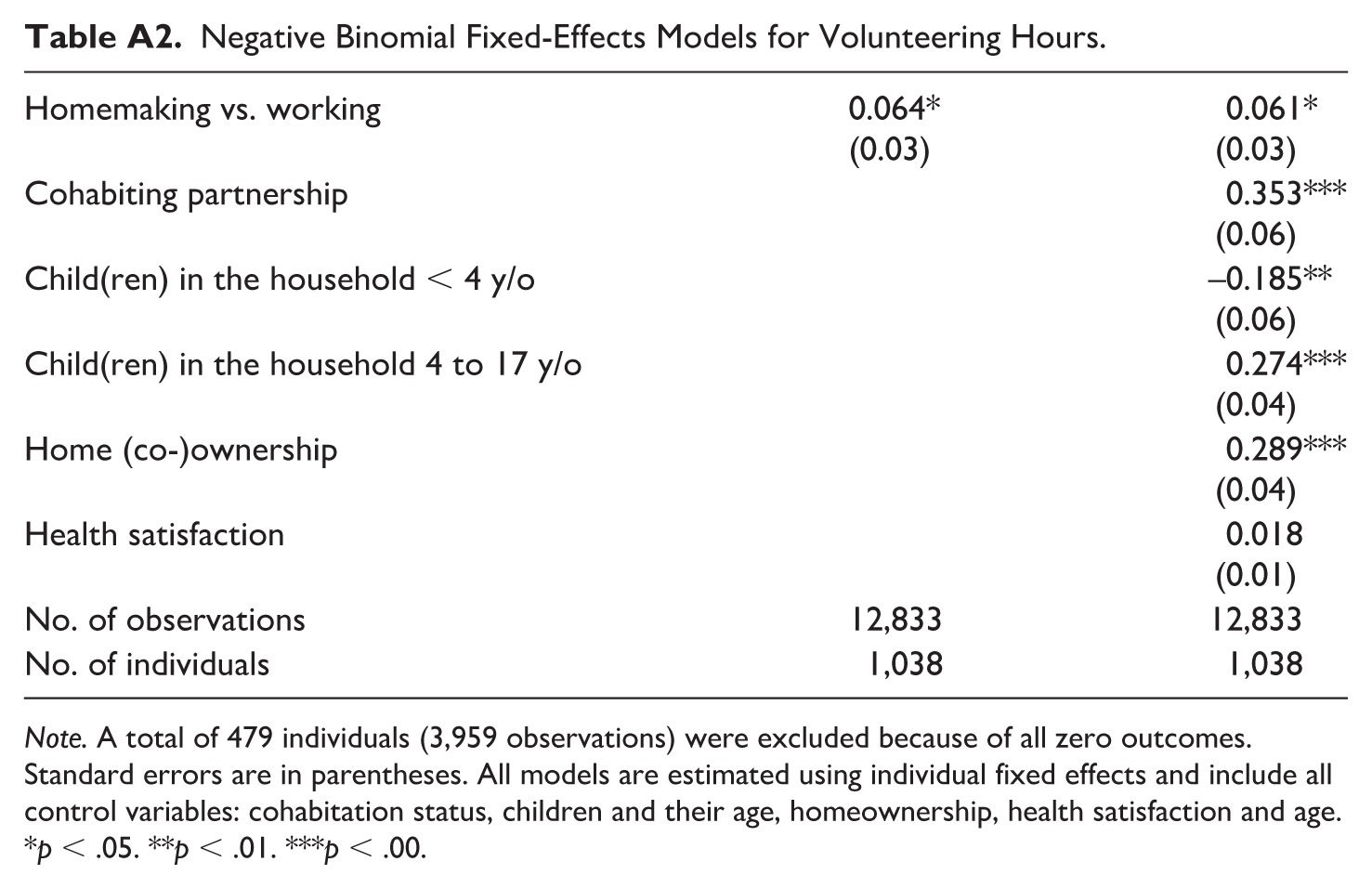
We applied linear FE regression models to analyze how changes between working and homemaking influenced changes in volunteering within individuals over time. Although one dependent variable is binary and logit or probit models are often preferred (Breen et al., 2018), we used a linear model to avoid case exclusion and potential selection bias associated with logit models, which require variation in the dependent variable (Beck, 2020). The same reasoning applies to our choice against a count model for volunteering hours. Count models are preferred when the variance exceeds the mean, as is the case between individuals in volunteering, where most contribute few hours and some contribute many (Beck & Tolnay, 1995; Kelle et al., 2025). However, because volunteering usually builds on prior engagement (Dawson et al., 2019), we expect individuals to adjust their volunteering by moderate amounts rather than shift from no volunteering to very high levels, implying smaller within-person variance. As a robustness check, we estimated a negative binomial model (Table A2, Appendix), which produced the same conclusion.
The FE approach helped to control for unobserved heterogeneity and eliminated confounding effects from time-invariant factors (Halaby, 2004; Kamerāde et al., 2019). By doing so, we accounted for stable individual characteristics, such as personality past experiences, that could confound the relationship between homemaking and volunteering.
Our model estimated

Here,
Although FE models often include year FE, we chose age FE instead. First, this helps us more clearly separate age and cohort effects (Brüderl & Ludwig, 2015) while capturing the non-linear changes in volunteering behavior over the life course (Lee, 2019). Second, homemaking can be considered an age-related life stage (Kröner et al., 2024), making it important to control for age to distinguish whether differences in volunteering are driven by homemaking itself or by the life stage. At the same time, time investments in volunteering have been declining over recent decades (Kelle et al., 2024), and the likelihood of homemaking decreases as female labor force participation rises (Federal Statistical Office, 2024b). Including year FEs in the same model is not advisable with panel data, because age and year both increase in 1-year increments and are therefore likely to be highly correlated. To account for these temporal trends, we conducted a robustness check by replacing age with year FEs. The results remained consistent with our main findings (Model AM6, Table A1, Appendix).
We cannot rule out reverse causality, as volunteering might lead women to exit the labor market and become homemakers (Truskinovsky & Maestas, 2018) or achieve higher occupational status (Wilson & Musick, 2003). Also, the effect of entering homemaking cannot be separated from exiting homemaking and was measured as the net effect of transitions into and out of active employment (Lancee & Radl, 2014). Finally, because the method focuses on within-individual changes over time, we did not apply survey weights designed to adjust for differences between individuals.
Results
Descriptive results in Table 1 show that formal volunteering was reported in 42% of the observations, matching Swiss population averages (Lamprecht et al., 2020). On average, women volunteered 3.39 hours per month, though with considerable variation (SD = 9.16). Almost 30% of spells were homemaking. In 6% of the observations, women had residentially moved since the previous wave. At the within-person level (not displayed), 40.39% had moved at least once. Among those who had moved, 59.12% had moved once, 23.62% twice, 11.89% three times, and the remaining 5.37% had moved up to six times. Moreover, about 52% of the person-year observations were from women living in city centers, indicating that 48% were not. The within-person standard deviation for urban residence was 0.14 (not displayed), suggesting some variation over time in individuals’ urban status, though relatively limited. Regarding generation, the group of those born between 1960 and 1975 was the largest, at 53%, while those born before 1960 accounted for 27%, and those born after 1975 represented 21%. Regarding household composition, almost 90% of the person-year observations were from women in a cohabiting partnership, and 40% had no minor child in the household, 16% a child below the age of four and 44% a minor child above the age of four and 62% are (co-)homeowners. Finally, the average health satisfaction score was nearly 8 of 10, the average age was about 45 years, and, on average, they attended services only for religious celebrations, with a score of slightly above 3 on an 8-point scale.
Descriptive Statistics on Person-Period Level.
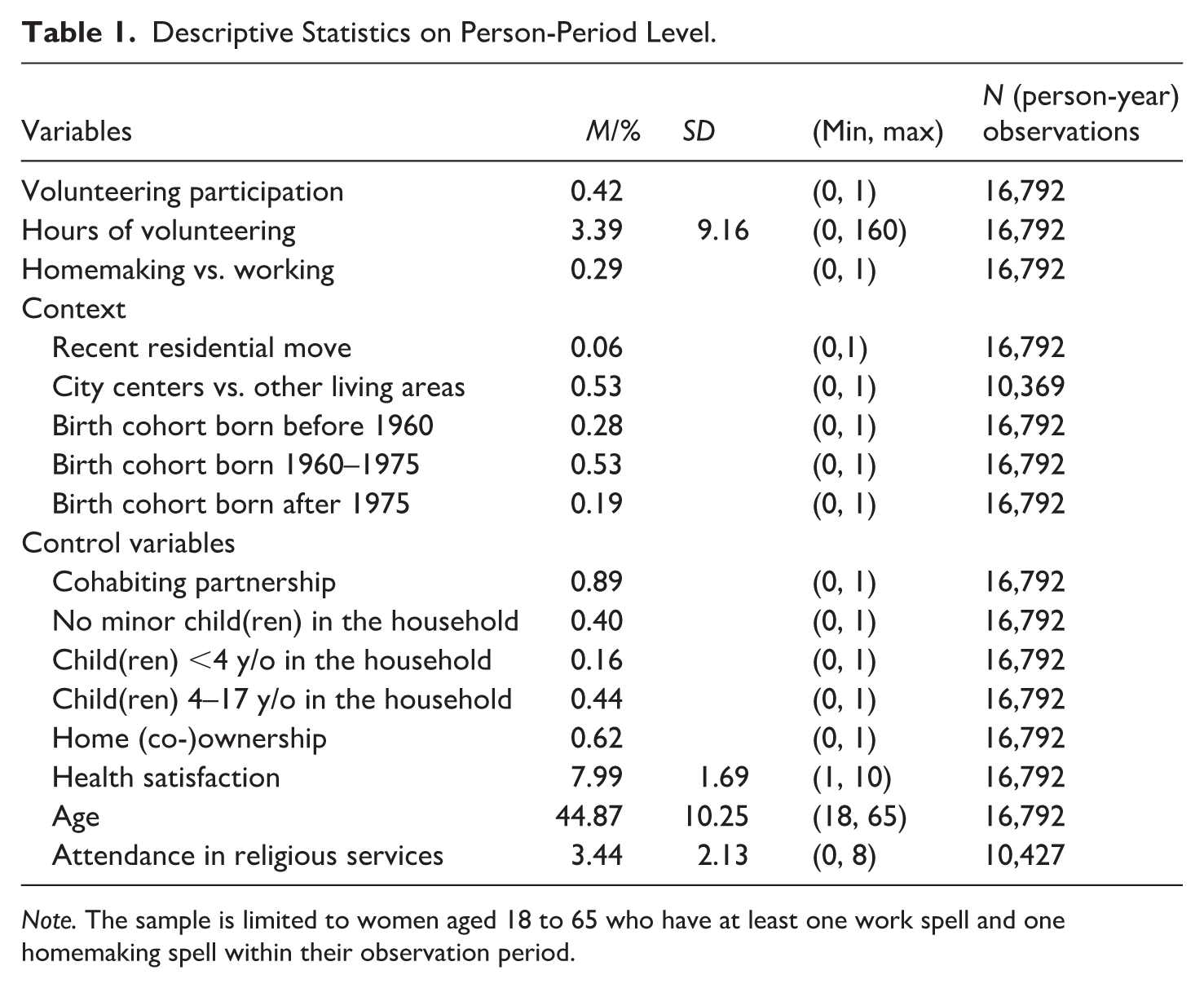
Note. The sample is limited to women aged 18 to 65 who have at least one work spell and one homemaking spell within their observation period.
Homemaker’s Volunteering
The results presented in M1 and M2 (Table 2) indicate that women are just as likely to volunteer while homemaking as when they were working (M1, b = 0.013, p > .05). Figure A1 in the Appendix shows a similar pattern, with about 38% of homemakers and 36% of working women volunteering in 2023. Looking descriptively at associational memberships—which may not directly correspond to volunteering activities—homemakers appear more active in local, parents, women and religious associations, whereas working women seem more engaged in other associations, such as those related to sports and the environment.
Fixed Effects Models for Volunteering Participation and Hours (1999–2023).
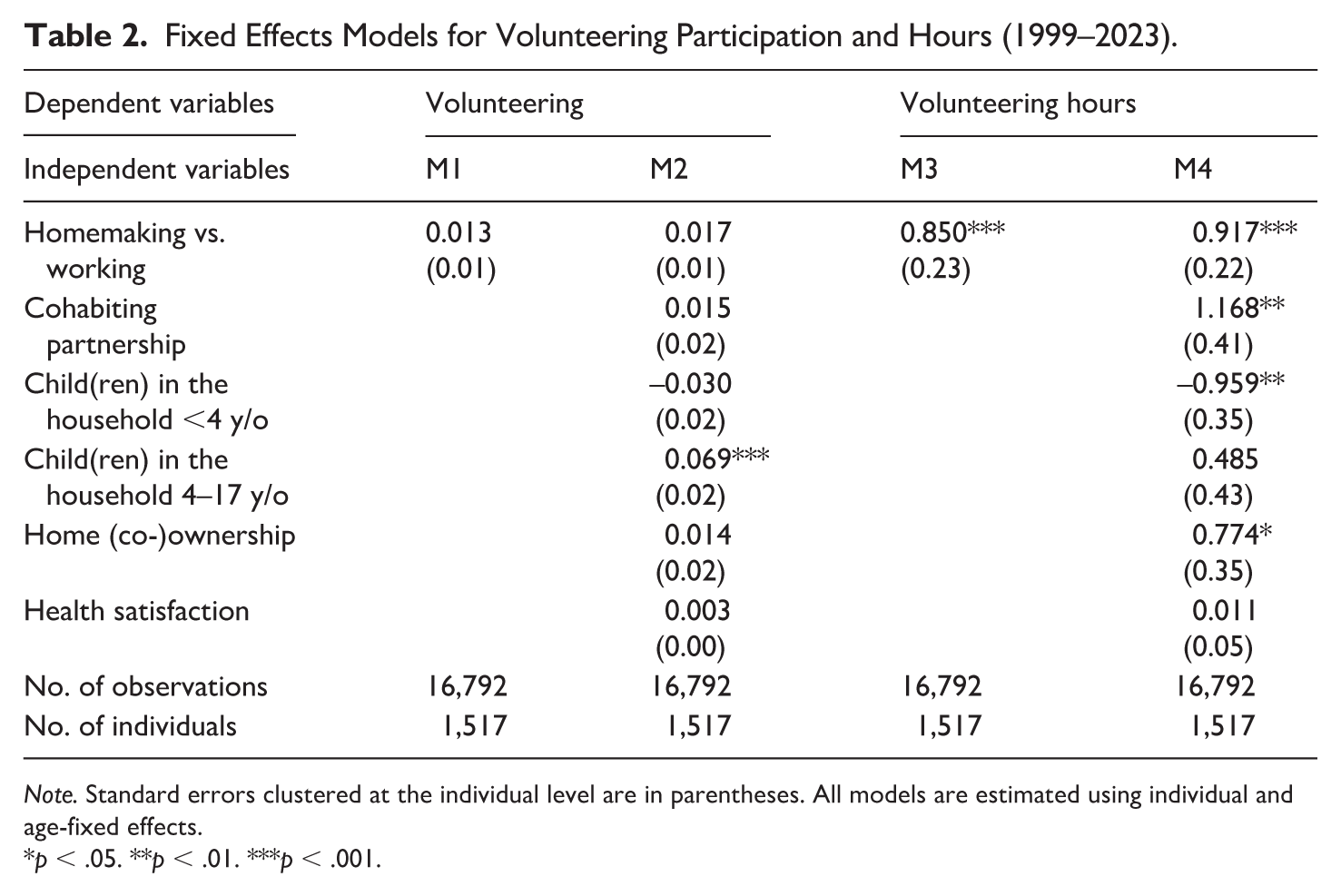
Note. Standard errors clustered at the individual level are in parentheses. All models are estimated using individual and age-fixed effects.
p < .05. **p < .01. ***p < .001.
Homemakers spent more time volunteering (M3, b = 0.850, p < .001), supporting our first hypothesis that homemaking is associated with increased volunteering time. While the absolute coefficient of 0.850, so less than 1 hour, may appear modest, the average number of hours spent volunteering during working observations was 3.08. This implies a 27.6 percentage points increase in time spent volunteering during periods of homemaking compared to working episodes, calculated as: (
Homemaker’s Volunteering Hours Placed in Context
The results in Table 3 suggest that the relationship between homemaking and time spent volunteering does not significantly depend on recent residential moves (M5, b = −0.575, p > .05). However, the squares in Figure 1, representing marginal effects, indicate that the difference in volunteering hours between homemaking and working is significant only for those who have not recently moved. In the full model, the increase in volunteering hours associated with homemaking was significantly less pronounced for recent movers, as indicated by the negative interaction term (M9, b = −1.407, p < .05). The absence of a significant interaction effect in M8 (b = −0.548, p < .05), which excludes urbanity and therefore retains the larger sample, suggests that the significant interaction in the full model (M9) may be driven by sample differences rather than by suppression effects. Consistent with this interpretation, an additional model (Model AM7, Table A1, Appendix) using the smaller 2008 to 2023 sample, shows a significant interaction between urbanity and homemaking (b = −1.492, p < .01), indicating that the full-model interaction effect likely reflects changes in sample composition. We therefore find some support for our second hypothesis that the positive effect of homemaking on volunteering hours is weaker among women who have recently moved, but only in more recent years, specifically after 2008.
Fixed-Effects Models for Volunteering Hours With Interaction Effects.
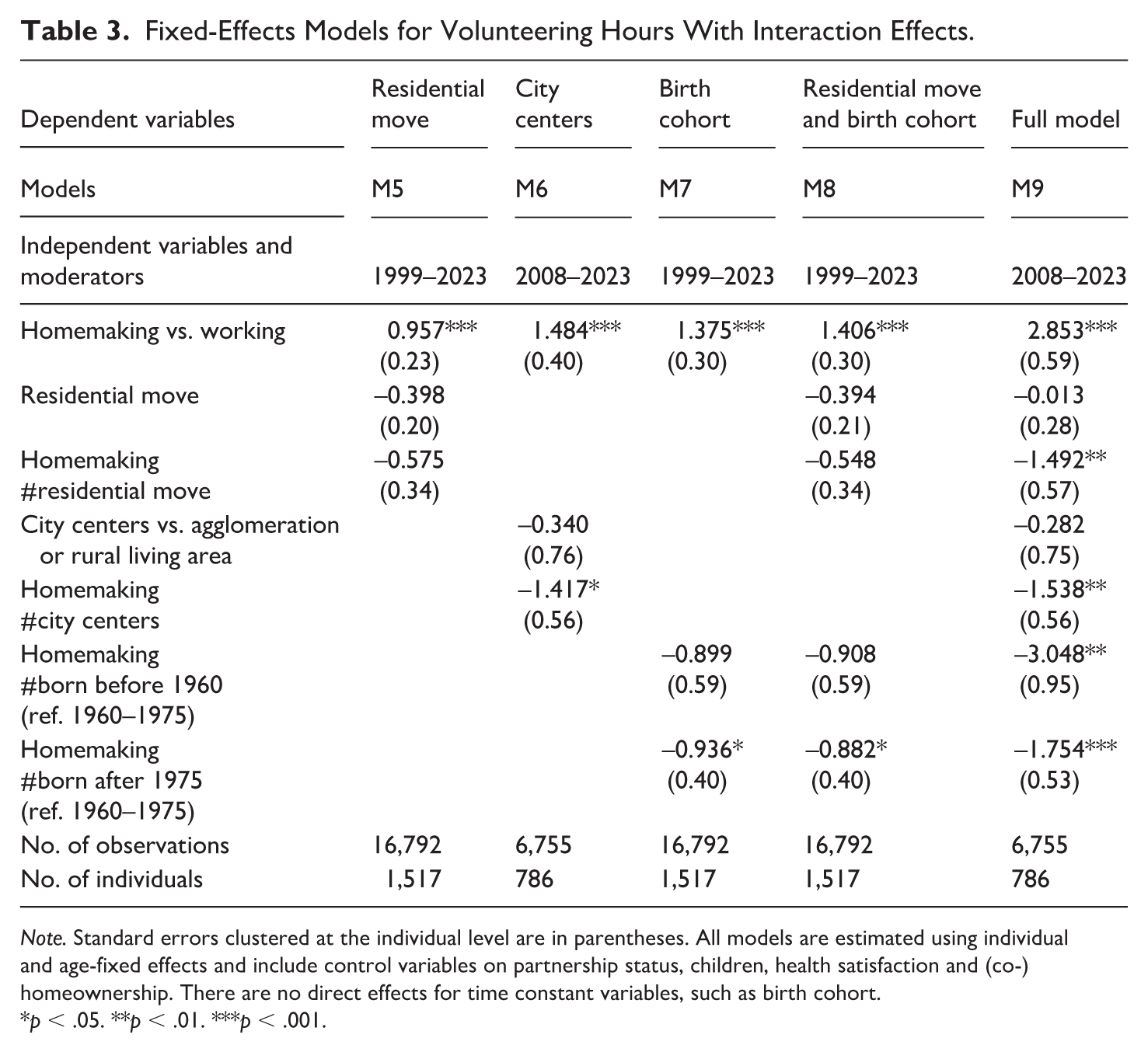
Note. Standard errors clustered at the individual level are in parentheses. All models are estimated using individual and age-fixed effects and include control variables on partnership status, children, health satisfaction and (co-)homeownership. There are no direct effects for time constant variables, such as birth cohort.
p < .05. **p < .01. ***p < .001.
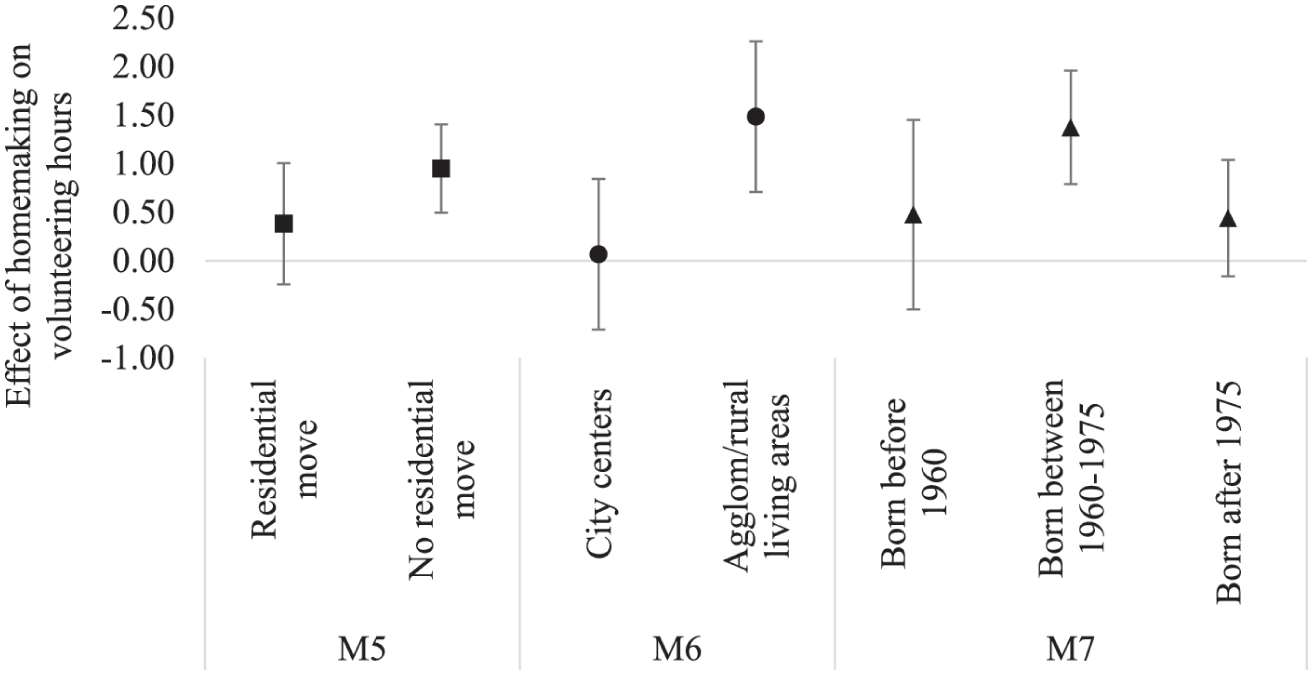
Marginal effects of homemaking on voluntary hours by contextual factors based on Table 3.
Regarding cultural context, there is a significant negative interaction between homemaking and living in city centers versus agglomeration or rural areas (M6, b = −1.417, p < .05), which remains significant in the full model (M9, b = −1.538, p < .05). As noted in the “Methods” section, the two models including urbanity rely on a smaller sample than M5, M7, and M8, thereby limiting comparability across models. As shown by the marginal effects in Figure 1, the positive association between homemaking and volunteering hours is apparent only in non-city center areas, indicated by the circles. This supports our third hypothesis that the positive association between homemaking and volunteering is weaker in urban contexts.
Finally, the positive effect of homemaking on volunteering hours is weaker for individuals born after 1975 compared to those born between 1960 and 1975 (M7, b = −0.936, p < .05). However, there is no significant difference between those born before 1960 and those born between 1960 and 1975 (M7, b = −0.899, p > .05). The triangles in Figure 1 show the marginal effects of homemaking on volunteering, which are significant only among those born between 1960 and 1975. In the full model, the positive relationship between homemaking and volunteering hours is weaker among those born before 1960 compared with the 1960 to 1975 cohort (M9, b = −3.048, p > .05), which is contrary to our expectations. Importantly, this finding does not hold in M8 (b = −0.908, p > .05), where we retained the full sample by excluding urbanity. This suggests that the M9 result is driven by the smaller sample of women born before 1960 who became homemakers after 2008. Models with alternative cohort groupings (Models AM4a and AM4b, Table A1, Appendix) confirm that the positive effect of homemaking on volunteering hours is weaker among the youngest cohorts, and also among those born before 1950. This reinforces that women born roughly around 1960 to the mid-1970s, with no strict cut-off at those years, stand out in their positive homemaking–volunteering link. Overall, we find only partial support for our fourth hypothesis that the positive effect of homemaking on volunteering hours is weaker in younger cohorts.
Discussion
A first key finding is that women while they are homemaking are as likely to volunteer as when they are working. This suggests that role substitution, which is the idea that volunteering compensates for a lost role as often seen in retirees (Bogaard et al., 2014; Mutchler et al., 2003), does, as expected, not apply to homemakers. Women who primarily engage in homemaking tasks might perceive these activities as a meaningful role, which compensates for the absence of a paid work role (Paul et al., 2023). Moreover, if these tasks, which resemble informal helping (Bergmann, 1981), amount to more than 20 hours per week, they may actually negatively affect formal volunteering (Qvist, 2024), potentially offsetting the positive effect of a lost role on volunteering. The absence of the role substitution pattern makes homemakers a distinct group outside of the labor market in terms of volunteering, making it worthwhile to consider them seperately.
Second, we find that women dedicate more time to volunteering when homemaking than while working. Although, in absolute terms, this difference amounts to less than 1 hour per month, the relative difference in time spent volunteering between periods of homemaking and working is substantial with a 27.6 percentage-point difference. This suggests that their volunteering does not suffer from lower social integration due to the absence of workplace ties (Einolf & Chambré, 2011; Pohlan, 2018) and that the absence of paid working hours indeed enables greater involvement (Einolf & Chambré, 2011; Freeman, 1997). Although greater involvement in volunteering is often seen as a potential reemployment strategy (Spera et al., 2015), it should be interpreted with caution. Recent studies indicate that volunteering can also extend time spent outside the labor market due to lock-in effects (Holstein & Qvist, 2025; Lammers & Kok, 2021).
Third, the results indicate that the residential and temporal context matters. The positive effect of homemaking on volunteering hours holds nowadays only for women who have not recently moved and those living outside city centers. This suggests that, without work ties, homemakers likely rely on social capital from local networks for volunteering, and these connections can be disrupted by a residential move. Moreover, homemakers in city centers, despite having the same “free-time” advantage as those in less urban areas, may devote it more to self-focused activities rather than volunteering, reflecting a more individualistic culture. Furthermore, we find a positive relationship between homemaking and volunteering hours primarily among the cohort born roughly around 1960 to the mid-1970s, but not among those born earlier or later. This aligns with generational theory, which emphasizes the role of shared formative experiences in shaping volunteering behavior (Rotolo & Wilson, 2004). It also suggests that declining volunteering hours among homemakers are not occurring gradually, contrary to what might be expected from overall declines in volunteer time (Kelle et al., 2024). Instead, the pattern is consistent with Kelle et al. (2025), who identify cohort-specific trends in voluntary engagement. One possible explanation is that gradual generational shifts in values associated with volunteering may not lead to corresponding changes in volunteering behavior, but may instead reshape motivations for volunteering, which we did not measure (Eimhjellen et al., 2018; Welzel, 2010). Another possible explanation is that changes in gender roles and female labor force participation did not unfold gradually, but in alternating periods of rapid and slower transformation. This implies that the 1960 to 1975 cohort of homemakers came of age during a time of sharply rising female labor market participation (Federal Statistical Office, 2025), which challenged the traditional expectation that women’s work was confined to domestic and childcare duties. Instead, women were increasingly expected to take on paid employment while still performing unpaid household work—the so-called “second shift” (Hochschild & Machung, 2012). Growing up in this environment may have fostered the belief that homemaking alone was insufficient, potentially leading the 1960 to 1975 cohort, compared with the cohort born before 1960 and born after 1975, to a stronger sense of obligation to complement it with volunteering.
In terms of practical implications, homemakers volunteer significantly more time than working women in relative terms, but the actual difference is less than 1 hour per month. This indicates that encouraging homemakers to join the workforce is unlikely to harm the volunteering sector, especially because younger cohorts of homemakers do not differ in their volunteering time from working women. Nevertheless, every hour of volunteer work is valuable to the sector, and employers could help ensure that when someone (re)enters the labor market from homemaking, volunteer hours can be maintained, for example through flexible working hours.
Our study is not without limitations. First, we focus only on formal volunteering, though informal volunteering, such as helping or caregiving may become even more important in the future. As the population continues to age, the number of individuals with chronic illnesses or disabilities who require care is expected to rise (Eifert et al., 2016). Nevertheless, we assume that the comparison between employment statuses is more interesting for formal volunteering than for informal volunteering, because informal volunteering likely depends more on a need for help than on employment status (Mutchler et al., 2003). Second, the FE models do not account for the timing or sequence of transitions between homemaking and working. Future research should examine how transitions between volunteering, homemaking, and employment interact over time, as volunteering may prolong unemployment (Holstein & Qvist, 2025)—raising the question of whether it could similarly extend periods of homemaking. Third, we do not differentiate between types of volunteering. A descriptive overview of associational memberships, such as sports clubs and environmental groups, shows differences in participation frequency between homemakers and workers. This suggests that distinguishing between types of volunteering might be relevant. Some roles can be done outside regular work hours and are less affected by employment status, while others require daytime availability and may decline if a homemaker (re)enters the workforce. Capturing these distinctions would clarify how different types of volunteering would be impacted when homemakers (re)enter the workforce.
Conclusion
We used data from the SHP from 1999 to 2023 (SHP Group, 2025) to investigate how homemakers’ volunteering compares to when they were working, and how these differences vary by context; namely: residential moving, urbanity of the living area and their birth cohort. We find that women are as likely to volunteer while homemaking as they are while working. This suggests the absence of a role substitution pattern, unlike what is often observed among retirees, and indicates that homemakers constitute a distinct group outside the labor market in terms of volunteering. Although the chances of volunteering are the same, they dedicate more time to volunteering when homemaking than while working. The results further show that the positive effect of homemaking on volunteering hours depends on the residential and temporal context, holding mainly for women who have not recently moved, live outside city centers, and belong to the 1960 to 1975 cohort.
Footnotes
Appendix
Negative Binomial Fixed-Effects Models for Volunteering Hours.
| Homemaking vs. working | 0.064*
(0.03) |
0.061*
(0.03) |
| Cohabiting partnership | 0.353***
|
|
| Child(ren) in the household < 4 y/o | –0.185**
|
|
| Child(ren) in the household 4 to 17 y/o | 0.274***
|
|
| Home (co-)ownership | 0.289***
|
|
| Health satisfaction | 0.018 |
|
| No. of observations | 12,833 | 12,833 |
| No. of individuals | 1,038 | 1,038 |
Note. A total of 479 individuals (3,959 observations) were excluded because of all zero outcomes. Standard errors are in parentheses. All models are estimated using individual fixed effects and include all control variables: cohabitation status, children and their age, homeownership, health satisfaction and age.
p < .05. **p < .01. ***p < .00.
Acknowledgements
The authors would like to thank Deni Mazrekaj, Tanja van der Lippe, Anne-Rigt Poortman, and Paula Hoffmann for their feedback throughout this study. Their thanks also go to the members of FORS—the Swiss Centre of Expertise in the Social Sciences in Lausanne—and the Swiss Centre of Expertise in Life-Course Research (LIVES) at the University of Lausanne for their insights. Engaging discussions at the Day of Sociology in Amsterdam (2025) and the Swiss Longitudinal Surveys Conference in Lausanne (2025) further helped to refine this paper. ChatGPT was used for textual rewriting and language improvement.

Funding
The authors disclosed receipt of the following financial support for the research, authorship, and/or publication of this article: This research is part of the National Research Agenda for strengthening economic resilience of women, which is funded by the Dutch research council (NWO) under the project number: NWA.1328.19.003.
Declaration of Conflicting Interests
The authors declared no potential conflicts of interest with respect to the research, authorship, and/or publication of this article.