



Abstract
Acknowledging children as rights-holders has significant implications for research processes. What is distinctive about a children’s rights informed approach to research is a focus not only on safe, inclusive and engaging opportunities for children to express their views but also on deliberate strategies to assist children in the formation of their views. The article reflects on a body of work with children as co-researchers and as participants and demonstrates that building capacity on the substantive research issues enables children to contribute more confidently. It concludes with a conceptualization of this approach integrating relevant international children’s rights standards.
How researchers view children and childhood has direct implications for how they conduct research (Kellett et al., 2004a). Different theoretical perspectives from, for example, developmental psychology, anthropology and sociology result in different choices regarding both the research questions and the appropriate methods for answering them (Fraser and Robinson, 2004). For instance the ‘new sociology of childhood’ emphasizes children’s agency and repositions them as the subjects rather than the objects of research (Greene and Hogan, 2005) and ultimately as research participants (Lloyd-Smith et al., 2000), with an associated move towards child-centred participatory methods. Likewise, the children’s rights paradigm, within which the research discussed in this article is situated, recognizes that children have agency and as such have the ability to engage ‘in the process of the construction of meaning’ in their own lives (Fraser and Robinson, 2004: 76). However when children are viewed as rights-holders they are not just recognized as able to but also as entitled to be engaged in this process, with a concomitant duty on the adults working with them to ensure that their right to express their views and influence their own lives is respected. Human rights discourse defines such relationships as one of entitlement and obligation (Donnelly, 2003; Freeman, 2002). For children, these rights and duties are defined primarily in the United Nations Convention on the Rights of the Child (‘the CRC’) (United Nations, 1989) which provides an internationally endorsed set of standards through which states are required to operationalize children’s rights.
In the context of research, it should be noted that the duty to comply with international children’s rights standards lies with state actors, which arguably includes not only government employees but all those undertaking research which is benefiting from state funding. In any event the state remains under an obligation to ensure that children’s rights are respected in all dealings with children, whether in a private context or not. Notwithstanding this, the significance of the CRC has been recognized by childhood researchers as indicated by the frequent references made to it in texts exploring research with children (see, for example, Christensen and James, 2008; Greene and Hogan, 2005), Most commonly these appear in papers focusing on participatory research methods with children, with the CRC described variously as part of ‘the dominant image of contemporary childhood’ (Kellett et al., 2004a: 34); a ‘backdrop’ to the childhood research base (McKechnie and Hobbs, 2004: 282); part of the justification for listening to children (Langston et al., 2004); or a component of the policy context which has given rise to the increasing engagement of children in research (Jones, 2004).
However, in spite of the awareness of the significance of the CRC, advocates of participatory research with children tend not to articulate their approaches to methods more fully within children’s rights discourse. Those that do most commonly acknowledge the significance of Articles 12 and 13 (see, for example, Winter, 2010). Alderson (2008: 276), on the other hand, draws on a range of key provisions to suggest that a key value of the CRC is that it offers a ‘principled yet flexible means of justifying and extending respectful practices’ in research with children. Ennew and Plateau (2004) combine a number of CRC provisions to argue that children have a ‘right to be properly researched’. This is interpreted to mean ‘children being participants in research; using methods that make it easy for them to express their opinions, views and experiences; being protected from harm that might result from taking part in research conducted by researchers who use quality, scientific methods and analysis’ (Beazly et al., 2009: 370).
When approaches to participatory research with children are not articulated within children’s rights discourse, this does not, of course, mean that they are in breach of children’s rights. The academic literature on participatory methods is replete with efforts to ensure that practices are respectful and attend to a number of key children’s rights issues in critical, reflexive ways. The research community is continually looking for ways to ensure that children’s participation is: truly voluntary and that children are safe (Hill, 2006; Morrow and Richards, 1996); that they are given creative and child-centred ways of expressing themselves (Clark and Moss, 2001; Cook and Hess, 2007; O’Kane, 2008); that their views are listened to carefully and acted upon (Cox and Robinson-Pant, 2008); and that they are given feedback on and engaged in research outcomes (Tisdall et al., 2009). Moreover these efforts are being conducted at all stages of the research process from the inception of research questions (Kellett et al., 2004b), development of research instruments and participation in data collection (Murray, 2006; O’Brien and Moules, 2007) through to analysis (Coad and Evans, 2008) and dissemination of research findings (Fielding, 2004).
This article aims to contribute further to the understanding of the relationship between international children’s rights provisions and research methods through a reflection on what the adoption of an explicit CRC-informed approach to participation might mean for research with children. We suggest that what is distinctive about this approach in the context of participatory methods with children is a focus not only on creating safe, inclusive and engaging opportunities for children to express their views freely but also, somewhat unusually in research methodology, the requirement to develop deliberate strategies to assist children in the formation of their views. The article’s focus is therefore on research which seeks to gain insight into children’s views and opinions on matters affecting them, rather than insight into their lived experiences. The article provides a critical reflection on the strategies we have adopted, both with children as co-researchers and children as research participants, in a body of work which has sought to apply and develop this approach. It concludes with a conceptualization of the approach which integrates CRC provisions into a framework for ensuring that children taking part in research studies are assisted in developing their views.
Children’s rights-based participation
Article 12 of the CRC, uniquely within international law, gives children the right to not only express their views but to have those views taken seriously in all matters affecting them. Our understanding of the implications of this for research processes has been informed by a workable but legally sound means of evaluating the extent to which children’s participation is compliant with Article 12, as understood in the context of other relevant provisions of the CRC and associated jurisprudence (Lundy, 2007). What became apparent in our efforts to work consciously within this conceptual framework was that the most significant way in which an explicit children’s rights-based approach to participation might differ from other participatory approaches to research with children is that it requires that children are assisted in not only expressing their views but also in forming them. While there has been considerable discussion of the process of securing informed positions in the context of children’s consent to research (see Alderson and Morrow, 2011), less attention has been given to placing an onus on researchers to build children’s capacity for engagement with the substantive issues of the research.
Much of the capacity building in participatory research with children concentrates on research methods, with a focus on training children in the techniques of data collection and analysis so that they can conduct research themselves or work as data collectors or peer researchers in child or adult-led teams (Kellett et al., 2004b; O’Brien and Moules, 2007). This is often used in conjunction with creative and participatory research methods (O’Kane, 2008). It is suggested that these techniques are designed to ‘elicit competence’ (Langston et al., 2004: 155), a view which suggests that children’s views are already formed and that what is required solely is the appropriate means of enabling them to be expressed. Capacity building work with children around the substantive issues under investigation in the research project is therefore less common (but see Cox and Robinson-Pant, 2008). This may be due to the widespread assumption that children are experts in their own lives (Clark, 2004) and therefore do not need their capacity built around the substantive research questions. While this may be true in relation to research projects examining issues affecting individual children directly and which aim to investigate their personal experiences, it cannot always be assumed to be so.
Research is conducted on many issues which impact on children’s lives, but to which children may not have given any consideration and therefore, understandably, are unlikely to have a predetermined or informed view. The choices for adult researchers in such instances could be to decide to exclude children from the research on the basis that the issues are beyond their grasp or to proceed without working with children to help them form a view, in which case the opinions expressed could turn out to be superficial. Both approaches could in effect amount to a breach of the child’s rights, given that Article 12 of the CRC requires the decision-maker to first ‘presume that a child has the capacity to form his or her own views’ on matters affecting him or her (UN, 2009: 9) and second, to ensure that children are informed ‘about the matters, options and possible decisions to be taken and their consequences by those who are responsible for hearing the child’ (UN, 2009: 10).
A rights-based approach to participation thus encompasses a requirement to enable children to form a view on all matters affecting them. This article proceeds on the assumption that knowledge is socially constructed, a position which we suggest is integral to a children’s rights-informed approach. Thus, the Committee on the Rights of the Child (‘the Committee’), has stressed that ‘it is not necessary that the child has comprehensive knowledge of all aspects of the matter affecting him or her, but that she has sufficient understanding to be capable of appropriately forming her or his own views on the matter’ (UN, 2009: 9). The implementation of Article 12 should be interpreted and applied in line with children’s other rights including the right to be supported and guided by adults (Article 5) and the right to seek, receive and impart information under Articles 13 and 17 of the CRC, both of which are ‘crucial pre-requisites for the effective exercise of the right to be heard’ (UN, 2009: 19). So, for example, the Committee has emphasized that compliance with Article 12 requires that children are provided not just with an enabling environment but also ‘access to information in formats appropriate to their age and capacities on all issues of concern to them’ (UN, 2009: 20). The information which children receive in line with this rights-based approach may enable them to express and articulate latent views or to form new views through the interaction with the information, adults and peers. This will depend on the child, the issue and the nature of the interaction. In particular, while recognizing that it may be difficult to be impartial in the selection of information, every effort should be made to provide information which is as open and wide-ranging as possible. Notwithstanding this caveat, the right to information is recognized as essential because ‘it is the precondition of the child’s clarified decisions’ (UN, 2009: 10; emphasis added).
Applying the approach
The following section provides a critical reflection on the strategies we have adopted in a number of research studies to build capacity on the substantive issues of the research both for children who worked alongside us as co-researchers in the project as well as the children who were the research participants. The explicit CRC-informed approach to research was first developed in a project ‘E-consultation with Pupils’ (Lundy and McEvoy, 2008; McEvoy and Lundy, 2007) and employed subsequently in two further studies: ‘Ready to Learn’ (Lundy and McEvoy, 2009; Miller et al., 2008) and ‘Attitudes of Children and Parents to Science Assessment’ (Murphy et al., 2010) (see Figure 1). In addition to the active and meaningful engagement of children as research participants, a key feature of each project was the establishment of Children’s Research Advisory Groups (CRAGs) who worked alongside the adult researchers as co-researchers.
In each case ethical approval for the involvement of children, as participants and co-researchers, was sought and approved by the ethics committee of the university in which the researchers are based. The key ethical principles of informed consent and voluntary participation, emphasized in ethical protocols such as the British Educational Research Association, can be closely linked to children’s rights standards (see Alderson and Morrow, 2011) and are therefore consistent with the rights-based approach adopted in these projects.
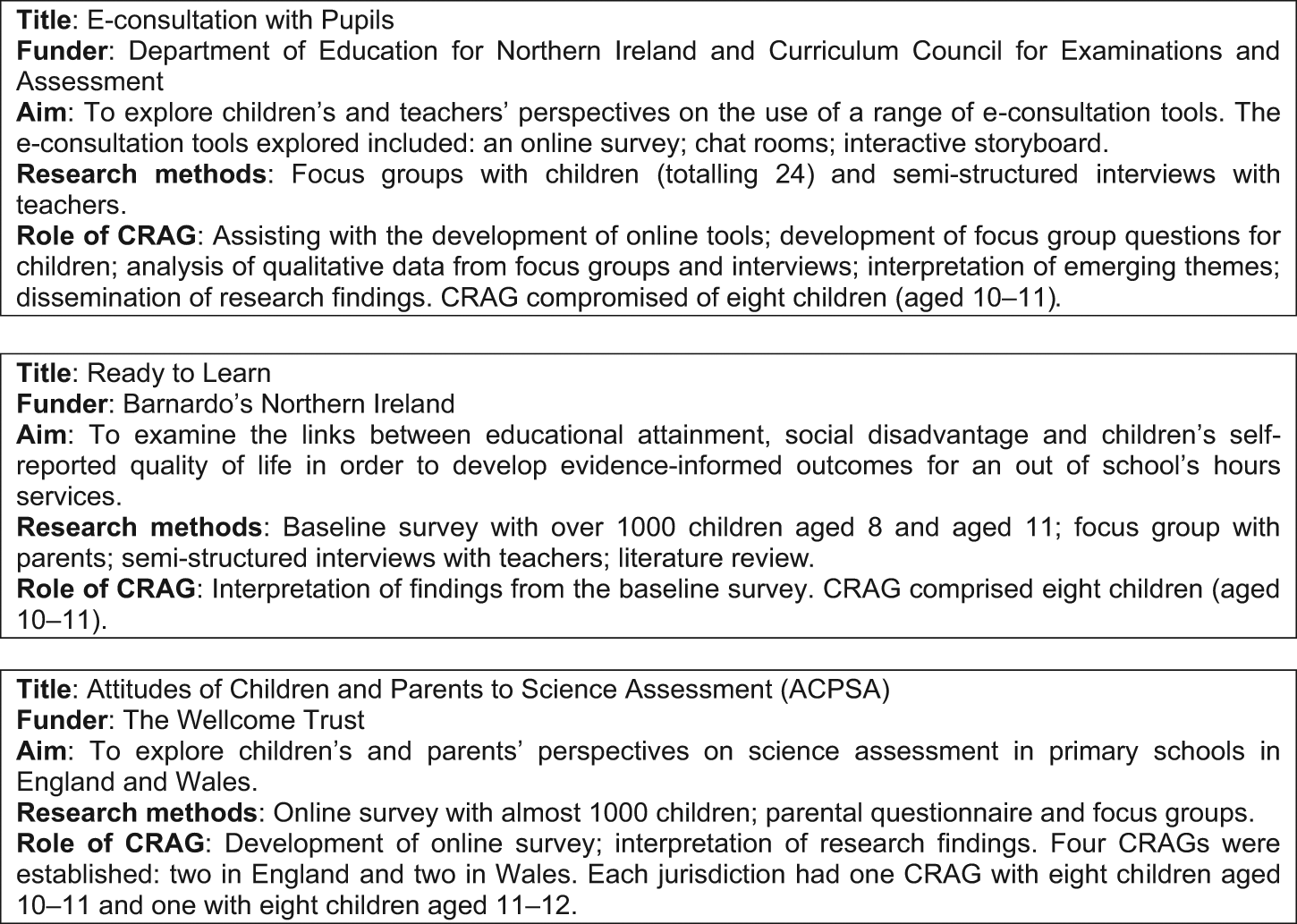
The projects
Children as co-researchers
The children in CRAGs were not research subjects. Rather they were invited to participate on the basis of the expertise they could bring to the research team: contemporary experience as a child in a similar peer group as the research participants. As such the remit of CRAGs is to advise on the research process including how best to engage with other children on the issues; assist with the analysis and interpretation of the findings; provide insight on the main issues under investigation; and to identify potential solutions which might address some of the issues identified by the research. The projects discussed in this article required the CRAGs to reflect on a number of complex issues to which perhaps they had given little previous consideration. Furthermore they were not being asked to speak directly about their experiences but rather, as an expert group, to reflect on the experiences of children in general. The capacity building sessions with the CRAGs aimed to enable the children to reflect on their own experiences and to locate this within the wider knowledge associated with the research questions, in order to assist them in understanding experiences and perspectives beyond their own. Having embraced a range of perspectives the CRAGs could then draw on these in interpreting the findings.
The ‘bespoke’ capacity building strategies developed for each of the projects were informed by the wealth of literature in participatory research with children (see, for example, Christensen and James, 2008; Fraser et al., 2004; Greig et al., 2007; Lewis et al., 2004). For example strategies included arts-based activities (Coates, 2004), individual reflection, paired and small group discussions (see Hennessy and Heary, 2005), sorting and ranking activities (see Kellett and Ding, 2004). Furthermore the strategies were designed to be consistent with children’s rights standards: to be safe, inclusive and engaging; to be flexible and responsive to children’s needs; to be optional (Lundy and McEvoy, 2009). As indicated above these principles resonate strongly with the values underpinning participatory research. By way of illustration, an example of capacity building activities with a CRAG is given in Figure 2. This is followed by a reflection on how the children involved as co-researchers in the project responded to this approach and how this assisted their participation.
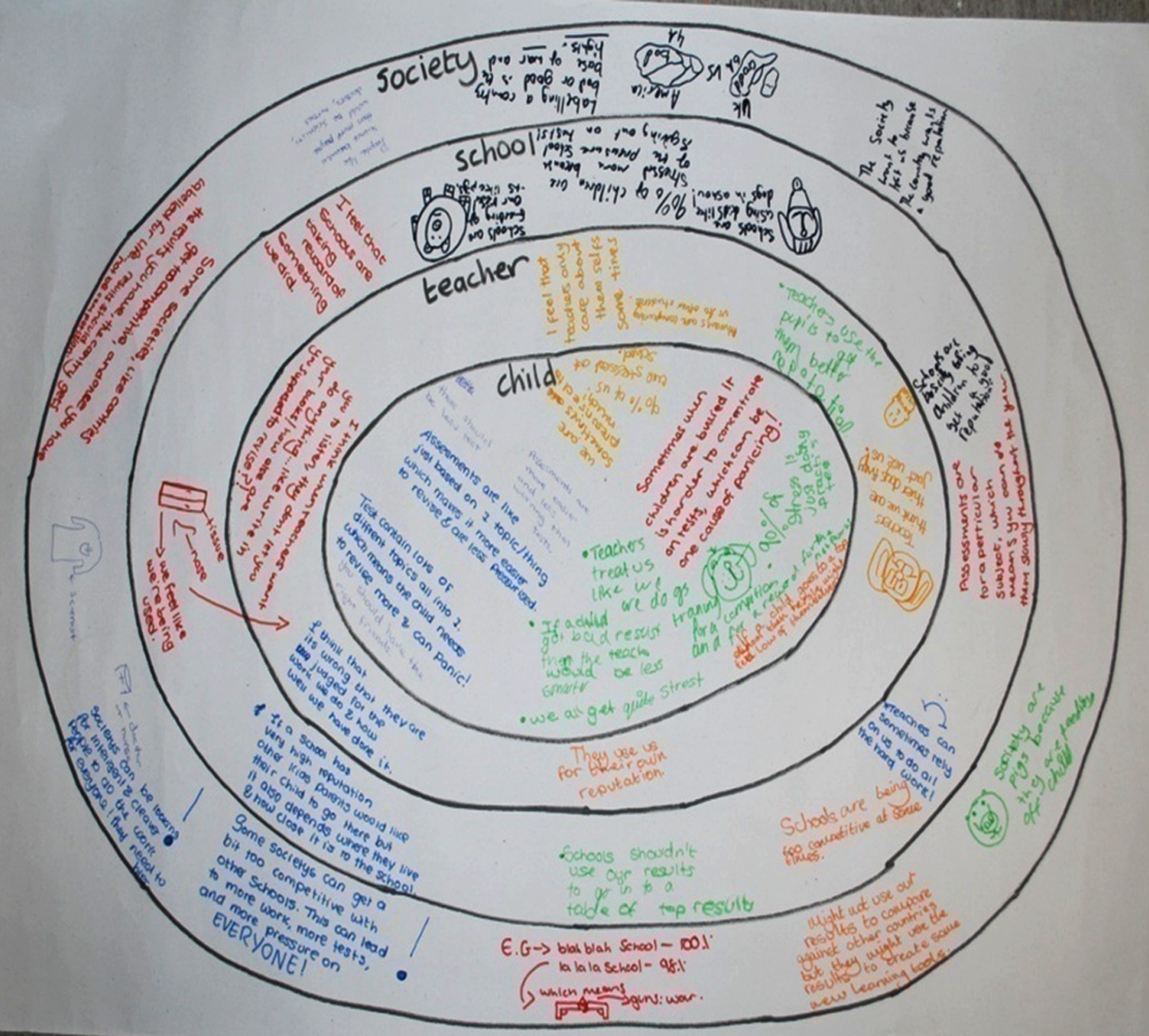
Building capacity on the purpose of assessment
Children’s responses to the approach
It has been noted that children are not routinely asked about their engagement in research projects (Hill, 2006). In the ACPSA project CRAGs were asked to complete an online survey about their experience of engaging in the research process and in particular their views on the role played by the capacity building sessions. Responses to the survey demonstrated that the capacity building activities assisted the children in understanding the issues surrounding the research questions. For example 87 percent of the CRAG children responded that it had helped them understand the issues more fully (8.7 percent did not think it had helped them; 4.3 percent were unsure). When asked if they wished to provide reasons for their answers, typical comments included:
It gave you a chance to think seriously about it. We talked about the issues and it went into detail so I got a better understanding.
This in turn appears to have given the children’s confidence to engage with the research. Most of comments from CRAG children made direct reference to ‘increased confidence’ as a result of the capacity building sessions. The children suggested that this encouraged them to participate more fully, as illustrated by the comment below:
I knew what I was saying so I took part more.
Furthermore, the children indicated that this approach supported them in engaging with other aspects of the research: 65.2 percent stated that the capacity building helped them to participate in subsequent sessions which focused on developing the research instrument, analysing some of the data and interpreting the research findings (4.3 percent did not think it had helped them; 13.1 percent were unsure; and 17.3 percent indicated that they did not understand the question). When asked to provide reasons for their responses, the children explained that it gave them deeper insight into the issues being researched:
It gave a wider perspective of the issue. We have more of an idea of what’s going out because we have talked about it.
This deeper insight became apparent when the CRAGs were asked to analyse the research participant responses to the question on the survey regarding the ‘ideal science assessment’. Each CRAG was provided with a large number of cards containing responses from the participants and asked to cluster these into groups based on any similarities they noticed between the responses. The CRAGs’ ‘clustering’ clearly identified key cross-cutting themes such as ‘fun’, ‘children’s choice’, ‘sharing and helping’ and ‘end of topic rather than end of year’. When the same exercise was carried out with adult stakeholders, they tended to theme the data in relation to specific types of assessment such as standardized tests, investigations, presentations and homework (Murphy et al., 2010). While the adults focused on the mechanics of assessment, the children drew out core attributes of an ideal assessment from the point of view of children.
The additional insight resulting from capacity building also assists CRAGs in the interpretation of data. For example in the ‘Ready to Learn’ project, CRAG children through their capacity building activities had identified and reflected on all of the potential factors (both intrinsic and extrinsic) which may impact on children’s readiness to engage with school. So when the results of the baseline survey (which had focused primarily on issues of self-reported quality of life) indicated that intrinsic factors (such as self-esteem, enjoyment of school and aspirations for the future) were largely unrelated to educational attainment and social disadvantage (Miller et al., 2008), the CRAG children were able to explore with confidence how extrinsic factors such as limited educational opportunities and support for parents linked to structural inequalities, would be more likely to explain lower educational attainment in socially disadvantaged areas (Lundy and McEvoy, 2009). In providing a space for CRAG children to explore the multifaceted aspects of the issue under investigation, they were able to move readily from the adults’ assumed explanation of the problem to their own instinctive take on the issues.
In sum, it is our contention that carefully constructed capacity building activities can engage children as co-researchers with some of the wider existing knowledge associated with the research questions and provide them with a comprehensive framework for exploring the research findings, without imposing a predetermined perspective. In such instances, as illustrated above, children as co-researchers can be enabled to situate and foreground children’s perspectives throughout the research.
Children as participants
When children are participants in research studies they continue to enjoy a right to have assistance in the formation of their views (CRC, Article 12), through access to information (CRC, Article 17) and guidance from adults (CRC, Article 5). To some extent this may appear to go against the grain of traditionally recognized approaches to research where the aim is to ensure data are collected in as non-leading a manner as possible. However a children’s rights-based approach also mandates that this view is formed freely. As with the capacity building work with the CRAGs, our approach to assisting research participants in forming views is carefully constructed therefore to ensure that children participants are not being led to a predetermined response. Rather the central premise of this aspect of the methodology is that with access to a wide range of perspectives, children are more able to self-position on the issues in question. When faced with a request for an opinion on something which they have not previously considered, adults would benefit from access to a diverse range of perspectives before being held to a final position. Nonetheless, the legal reality is that this is only mandated within a children’s rights-based approach which affords this right to children in recognition of their relative lack of experience, power and ability to access information. Our approach has been to present the child participants with a range of views developed with the CRAGs on issues about which they might otherwise not yet have formed a view. These different perspectives are presented as views which other children might have in a language which other children might use: authentic views in an authentic voice. Again, by way of illustration, some examples are given in Figures 3 and 4, followed by a reflection on how the children involved in the projects responded to this approach and how this assisted them as research participants to form views.
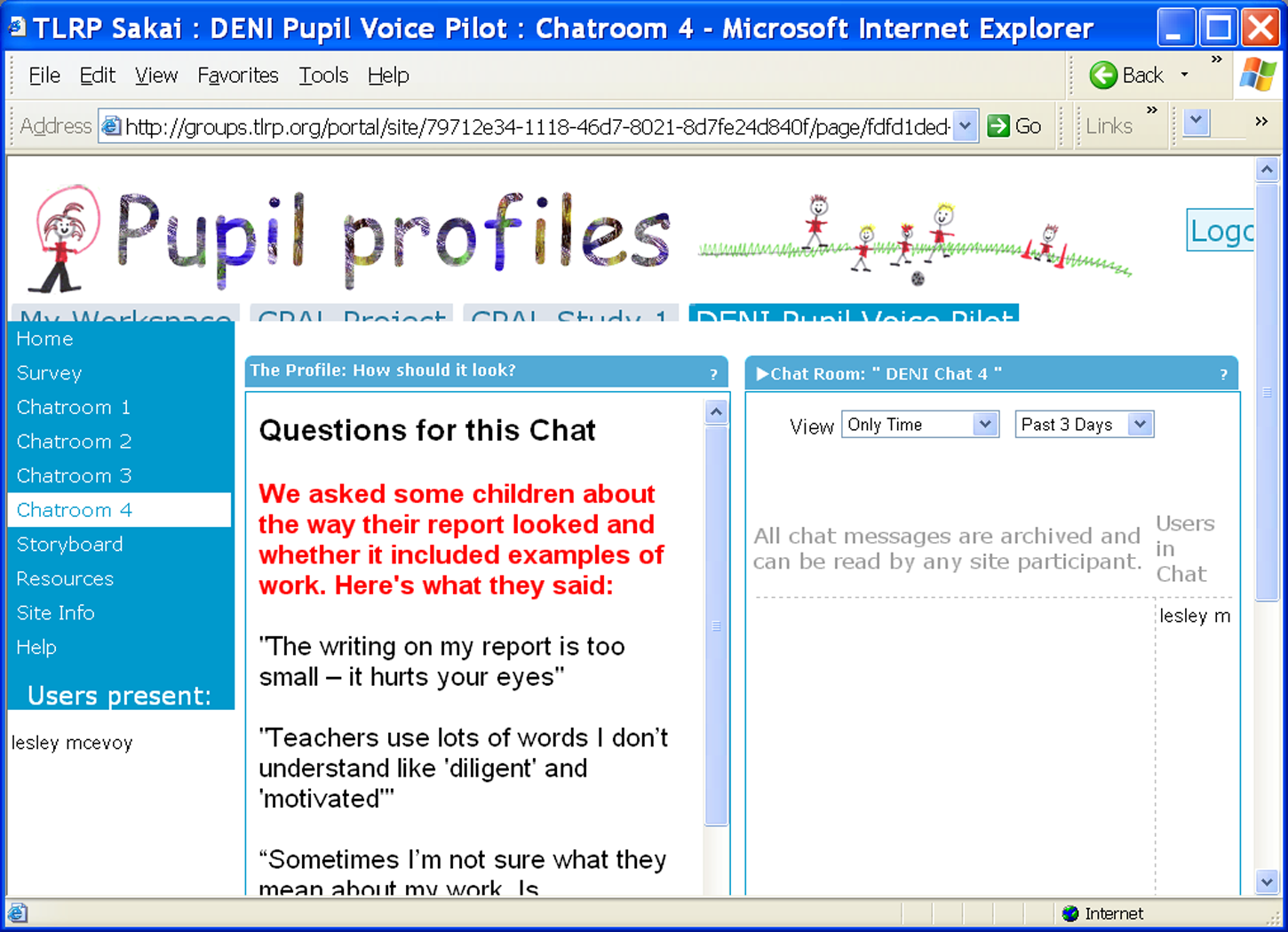
Assisting children to form views using ‘chat’
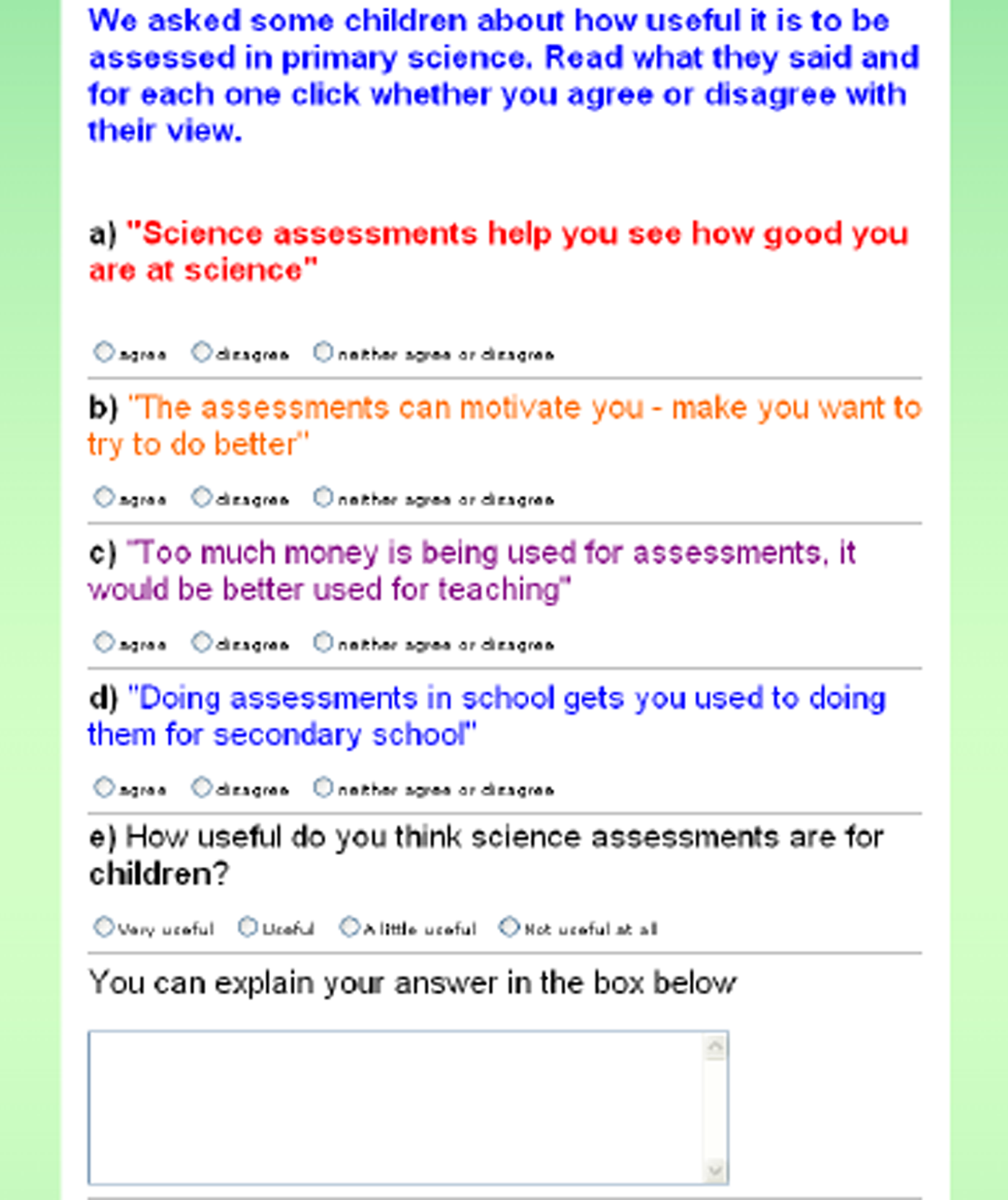
Building capacity on the usefulness of science assessment
Children’s response to the approach
As with the CRAGs, participants indicated that they had benefited from assistance in forming views. For example, in focus groups carried out with children who had participated in the ‘E-consultation’ study, children identified that first, they enjoyed reading other children’s views on the issues and that this assisted them in forming their own view. Typical comments included:
Because if you just had the question there, you wouldn’t really know what to say. If you see what other people say, it gives you an idea.
Similar perspectives emerged in the ACPSA project, where all children who participated in the online survey were asked to comment on the approach adopted through responding to a number of questions at the end of the questionnaire. Again, children welcomed reading other children’s views with 90 percent of participants indicating that they found it either useful or very useful. As one child commented:
It was quite interesting to hear about how other people think about science because you can decide if you have same opinions or not.
Second, a recurring theme emerging from the free response question at the end of the online survey was that assisting children in forming views had increased children’s confidence in responding to the research questions. Typical comments included:
It was giving you confidence to say how you feel about science.
Third, it could be suggested that this confidence enabled the children to provide fuller responses in the survey. When provided with views and perspectives from other children, participant responses in ‘free response’ boxes were noticeably more extensive and detailed. For example a straight word count analysis of the responses indicated that when provided with other children’s perspectives participants wrote an average of 15 words in their responses compared to an average of 6.4 words when other children’s views were not provided. While this is a somewhat crude measure of engagement it does suggest that children are more likely to engage with the questions when provided with material to prompt their own thinking.
Fourth, it was apparent also when the free responses in the ACPSA survey were analysed that the vast majority of participants were not simply repeating the sample perspectives provided. For example, towards the end of the survey children were asked to place themselves in the position of a primary school teacher and to suggest how they would assess science. They were provided with four specific suggestions developed by the CRAGs: the use of end of topic tests; oral responses to teacher questions; inventing and competitions; research projects. Indicative responses from the participants in the survey included the following ideas:
i would assess science by doing a project and getting marks on that and maybe have a small test afterwould. The project could be like a rivision thing but better and funner. [sic] At the end of each topic it would be good if we could choose wether to do a test or a project then their will be less stress because you get a choice. [sic]
This serves to indicate that children were synthesizing, critiquing and personally tailoring the given perspectives in order to articulate their own position on the issues.
Fifth, the approach did not prevent children from expressing alternative views not addressed in the sample perspectives. For example, children suggested that:
I would let the children bring their own experiments into the classroom and explain how to do them. I’d use roleplay. I would ask the class how they would like to do it.
In sum, we would contend that when children as participants in research projects are provided with a wide range of views on the issues from other children they are enabled to not only develop but also to express their own perspective confidently and comprehensively on the issue, without being led to a predetermined, arguably adult, conclusion. As shown it can result in children producing more detailed and reflective responses which should in turn prompt the adults to give more serious attention to children’s perspectives. This increases the salience of children’s views, thereby defying an apathetic, tokenistic or dismissive response on the part of the adults charged with listening and, most importantly, acting (Lundy and McEvoy, 2009). The latter is of course key to the rights-based approach adopted which places core emphasis on children’s perspectives influencing the decisions which are made (Lundy, 2007).
Conclusion
When children are viewed through the children’s rights paradigm, using the CRC as a framework for implementation, there are distinct implications for research methods: it requires that children are not only entitled to have their views given due weight in research studies but that the adults working with them ensure that their participation is compliant with the CRC. We would contend that an approach to research which takes children’s rights as its stance and is informed by the CRC requires that, in appropriate circumstances, children are given information (Articles 13, 17) and adult guidance (Article 5) while their views are in formation, in order to be assisted in determining and expressing what will then be both a formed and informed view (Article 12), as illustrated in Figure 5.
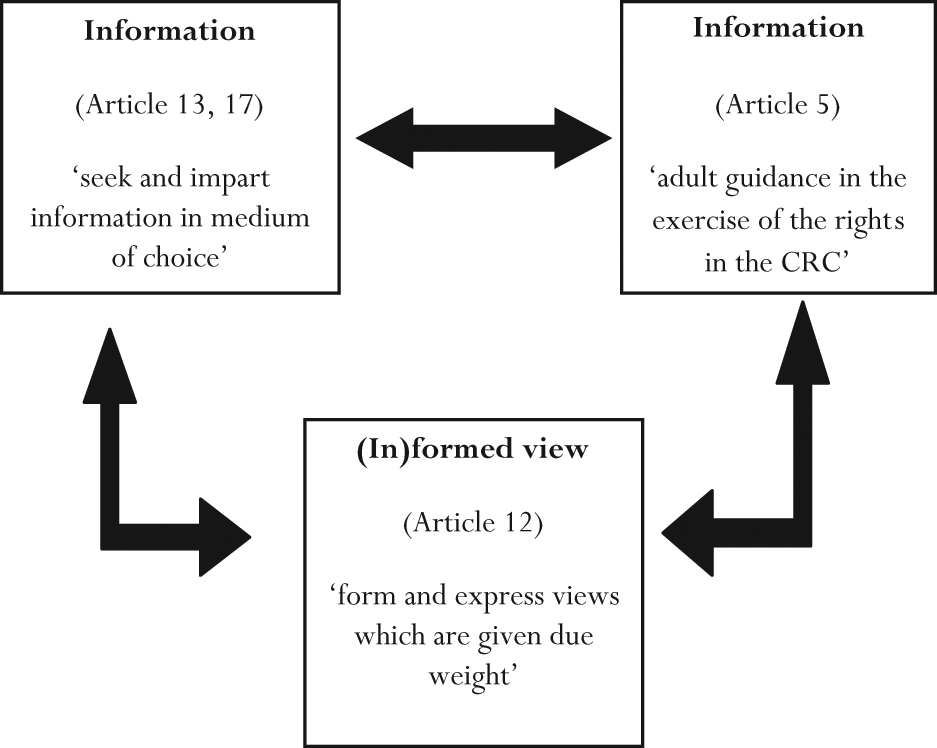
Assisting children to an (in)formed view
While we would suggest that a children’s rights-based approach to research requires that these rights are incorporated into research processes, the CRC however cannot be regarded as providing a ‘blue-print’ which determines the use of specific research tools. The CRC is often phrased in very general terms on the assumption that it will be interpreted teleologically, that is within the broad spirit and intent of the drafters of the Convention itself. Thus it would be anticipated that how these rights are implemented might vary within specific research projects, dependent on not only the research questions but also time, resources, funder requirements, etc., as is the norm with all research studies.
From a children’s rights perspective, a key advantage of this approach is that it does not exclude children from being involved in research projects outside their immediate experience as predetermined by adult gatekeepers. While children are undoubtedly best placed to talk about their own lives and the only people who can represent their views directly, it cannot be assumed that they will always have ‘worked out’ positions on issues of which they have no experience. Nor can it be assumed that they do not have or would not want to develop views on issues outside their immediate experience, which nonetheless impact on them. Assisting children towards an (in)formed view on issues that might otherwise be considered too complex, and therefore outside their competence, ensures that a greater number of children can be included in research covering a wider range of issues. While it is common in research studies for researchers to suggest that certain issues are beyond the scope of children, Article 12 requires that they are consulted on all matters affecting them, in its most broadly defined way (UN, 2009). This is dependent not on their age and maturity; ‘it is dependent only on their ability to form a view, mature or not’ (Lundy, 2007: 935). In light of this the obligation then falls on the researcher to find a way of engaging with all children, enabling them to form views freely.
Moreover a children’s rights-based approach to research offers an alternative lens through which to reflect on the role of the researcher in the adult–child relationship. The perceived imbalance in their respective positions has been addressed by researchers in a variety of ways including the use of participatory methods (Christensen and James, 2008) and/or attempts by adult researchers to minimize adult characteristics and behaviours, for example, by adopting the role of ‘least adult’ (Mandall, 1991), presenting themselves as ‘atypical’ or ‘incompetent’ adults (Corsaro, 2003) or becoming a ‘familiar figure’ for whom the children do not feel the need to behave in special ways (Mayall, 2008). The CRC provides a set of standards, intended to regulate how adults interact with children. Article 12 acknowledges that children may struggle to have their views taken seriously and therefore requires that adults give children’s views ‘due weight’; Articles 13 and 17 recognize that they often do not have access to the information they need to form and express their views; Article 5 recognizes that they will on occasion need support in the exercise of their rights in accordance with their evolving capacities. As such, adults are positioned as potential ‘enablers’ capable of playing a positive role in guiding and assisting children in the formation and expression of their views.
In essence an approach based on children’s rights speaks to one of the ongoing dilemmas of childhood research: the imbalance of power between adults and children. The CRC, as an internationally endorsed recognition of children’s relative vulnerability and lack of power in influencing the decisions that are made for their lives, attends directly to this power differential. It does so through a set of bespoke rights for children, tailored from existing human rights for children and adults alike. So, while all human beings have a right to freedom of expression, the CRC, as discussed throughout, contains a series of articles constructed specifically to ensure effective implementation of this right for children. In this way, assisting children to an (in)formed view is a manifestation of the truism that ‘knowledge is power’. A children’s rights-based approach asks adult researchers to empower children through the provision of information, support and guidance in research processes. The resultant (in)formed positions contribute to the body of knowledge on the relevant issue which can ultimately contribute to furthering the wider realization of children’s rights: the primary goal of children’s rights-based research.
Footnotes
This research received funding from the Wellcome Trust UK, Barnardo’s Northern Ireland, the Council for Curriculum, Examinations and Assessment and the Department of Education, Northern Ireland.