




Abstract
The latest childhood studies present children’s citizenship as a process of engaging in matters related to children themselves in their everyday lives. However, only a few studies have been conducted on what those issues are and what they actually tell about children’s citizenship. This study explores the nature of children’s participation and citizenship by adopting a life world perspective. The aim is to examine what kind of issues children want to participate in and influence. The data are drawn from an online discussion in the Finnish Children’s Parliament. Altogether 61 children participated in the discussion, with 566 postings. The analysis of the children’s online discussion shows that children comment mainly on issues that directly impact their lives, such as school. However, they also want to engage in issues that are global in nature, such as children’s general well-being.
Children’s life world as a perspective on their citizenship
Children’s opportunities to participate in the discussion of issues related to their own lives and their roles as citizens have been discussed increasingly in the fields of research and politics during the past decades. Children have gained attention especially in sociological studies: instead of being seen as entities who merely internalize the existing rules and culture of society, they are nowadays seen as agents who actively contribute to society (Alanen, 1992; Corsaro, 2005; James et al., 1998; Kehily, 2009; Mayall, 2002; Prout and James, 1997; Wells, 2009). In recent years, the viewpoint on children in the research process has changed, with the focus nowadays more often on research with children, rather than on children (Christensen and James, 2008).
The United Nations Convention on the Rights of the Child was introduced in 1989 in the attempt to increase children’s participation in decision-making across the world. The Convention obligates politicians, teachers and other adults to listen to children’s opinions, and it entitles children to special protection and care, adequate provision of resources by society and participation in the decision-making concerning them. In Finland, this obligation is supported by national laws passed to ensure the opportunities for children to participate and have their say. The aim of the Finnish Youth Act, for example, is to improve young people’s active citizenship, by obligating municipalities to provide young people with opportunities to take part in the handling of matters concerning local and regional youth work and youth policy. The Basic Education Act entitles children to participate in student associations and have an opportunity to put forward their opinions about matters relating to the operation of their schools.
Despite these principles, children’s participation can be seen as an aspiration rather than a fact. For example, possibilities to become involved in school-related matters are not as successful as children would hope for (Nordic Study on Child Rights to Participate, 2009–2010). This may also be related to children’s school satisfaction, which is quite low in Finland (Inequalities in Young People’s Health, 2008). Children are often seen as ‘half-citizens’, for being dependent on adults. For example, Lister (2007) argued that children need protection, which makes it problematic to consider children as equal citizens with adults. There has been critical discussion about the Convention as well, which, according to some researchers, is not a solution for improving children’s status as citizens (Invernizzi and Milne, 2005; Milne, 2005). The problem is, according to Milne (2005), that the Convention neither provides children with political rights nor elucidates the duties that accompany the rights. Thus, if citizenship is approached from a traditional viewpoint, which emphasizes the rights and responsibilities of citizens, the criteria of citizenship are not fulfilled by children (Lister, 2007).
It has also been difficult to define children’s participation accurately. According to Skelton and Valentine (2003), children and adults may perceive what constitutes participation differently. In addition, previous studies on participation and citizenship typically have focused on young adults. Thus, participation has often been defined as politically oriented civic engagement, such as initiatives for the government, or alternatively as civic participation, which refers to, for example, social activism or initiatives based on single-issue campaigns (see Banaji and Buckingham, 2010; Loader, 2007). The concepts of participation and citizenship have not been established for children under age 13.
Instead of using the traditional and narrow definition of citizenship, a new, broader, child-centred and everyday-related definition of citizenship has been proposed (Bell, 2005). According to Jans (2004), for example, children can be seen as citizens when citizenship is understood as a playful and ambivalent concept that is related to people’s everyday life. Similarly, Buckingham (2000) emphasized the role of children’s everyday experiences in the definition of citizenship. He criticized the discourse that reproaches children for being apathetic towards politics and argues that the lack of children’s interest in formal politics should be understood as ‘part of the condition of being a child’. Thus, instead of seeing citizenship as participation in formal politics, there is a need for adopting a broader definition of politics that recognizes the potentially political dimensions of children’s everyday experiences.
The aim of this study is to explore what children’s participation and citizenship are. Which issues are important for children in their life world, and which issues do they wish to be engaged in? In this article, we present results of a study which explored the topics and issues that children presented to the Finnish Children’s Parliament. The Parliament is an institution that provides 9- to 13-year-old children with an opportunity to express opinions and influence issues related to children. It is maintained by the Finnish Children’s Parliament Foundation, which is funded by the Ministry of Education and Culture in Finland. By exploring the content of the children’s participation, we highlight the topics and issues that are important for Finnish children as citizens. Thereby, we develop a richer understanding of what citizenship is from Finnish children’s viewpoint.
Life world perspective and children’s citizenship
The life world perspective is used in sociology to describe and analyse the lived world of everyday life. Life world consists of the physical and social worlds experienced by an individual; it is both a personal and intersubjective reality which people modify through their acts and which, on the other hand, modifies their actions (Schutz and Luckmann, 1973). Habermas (1987) also stated that the life world consists of communicative action. One way to analyse children’s life world is to distinguish the private sphere – home, school and family – from the public sphere – public services, organizations and political discourse (Cockburn, 2005; Sinclair, 2004). According to Habermas (1987), private and public spheres are socially integrated spheres of action in the life world that stand against the systems of economy and state (see Baxter, 1987).
Another way to analyse and illustrate children’s life world is to use the ecological model of children’s development (Figure 1). According to Bronfenbrenner (1979), one of the developers of the ecological theory, children’s development can be delineated by four types of nested systems. These systems are (1) microsystem: the child’s immediate surroundings, such as family, home and friends; (2) mesosystem: the interrelations between microsystems, for example home and school; (3) exosystem: the external settings that do not directly influence the child, such as a parent’s place of work or the activities of the local school board; and (4) macrosystem: the larger sociocultural context. Children’s development refers in this model to the effects that the interaction between a child and his/her environments has on the child (Bronfenbrenner, 1979). In the model presented in Figure 1, the private sphere refers to the microsystem whereas the other three systems constitute the public sphere. The borderline between the private and the public is, however, diffuse as the actions that traditionally have been seen as pertinent to the public sphere have now important ramifications for all of people’s seemingly ‘private lives’ (Cockburn, 2005).

Children’s life world based on the ecological model of children’s development.
In this study, the ecological approach to children’s development is used as a framework for describing and analysing the observed issues in an online discussion in the Finnish Children’s Parliament that the children commented on and expressed interest in influencing. Thus, these issues illustrate the life world of children today. Earlier, children’s place in society was merely in the private sphere, meaning within the home and family (James et al., 1998). Nowadays, children’s life is increasingly shaped by outside social forces and children spend more time in institutions such as schools, nurseries and after-school clubs (Cockburn, 2005). This has changed the context of children’s participation. Media have played an essential role in extending children’s participatory field. They have added information about the world and provided children with opportunities to participate in worldwide matters (Kangassalo and Suoranta, 2001). Rheingold (2008) lists blogs, wikis and podcasting as examples of this new kind of participatory media.
The extension of children’s life world has increased expectations of children’s abilities to participate and, thus, children’s position as citizens is now closer to adult citizenship. For example, media and consumption are permanent parts of children’s lives today, even to the extent that childhood is believed to have become shorter or disappeared (Buckingham, 2000; Wilska, 2004). Children not only adopt adult-like ways of behaving and dressing (Suoranta, 2001) but also are very aware of many social themes, such as the environment and peace (Jans, 2004). Howe and Covell (2005) sketched a picture, albeit a fictional one, of child citizens having the right but also the responsibility to participate in the discussion of global problems, such as the environment, poverty and the effects of war.
In society, children’s awareness of global themes is often considered a solid base for future citizenship and only rarely a base for actual citizenship (Jans, 2004). Furthermore, children are often regarded as beings who always need protection and whose place is thus solely in the private sphere. Buckingham and Tingstad (2010) examined these polarized viewpoints in the context of consumption, where children are seen either as powerful agents or passive victims. They argued that in order to develop a more complex account of how children relate to commercial markets, it is necessary to look beyond these opposing positions. The same applies to children’s participation and citizenship: instead of merely talking about children as competent or incompetent citizens, we should actually explore the ‘child-sized’ citizenship. Then, an essential question is what kind of matters children want to participate in and thus, which issues are relevant for children regarding their life in general?
According to the Nordic Study on Child Rights to Participate (2010), children wish to engage in the discussion of matters related to their private sphere, such as the use of their own money, the choice of school, their perspectives on the content of school curricula and lessons, and home-related issues such as the decor of one’s room. In a survey carried out by the Ombudsman for Children in Finland (Tuononen, 2008), it was found that friends, family and home, as well as hobbies and pets, bring joy to children and young people, whereas arguments, bullying and concern about the well-being of loved ones can lead to sadness and worrying. In addition, global issues such as wars and questions related to inequality and the environment were also mentioned as reasons for children and young people’s unhappiness and worry.
Research design
The Finnish Children’s Parliament as an arena for children’s participation
In many countries, children’s councils at schools and municipalities have been seen as good investments for improving not only the local environment but also student development (McGinley and Grieve, 2010; Yamashita and Davies, 2010). Recently, the role and potential of online environments in enhancing children’s participation has been observed as well. This study focuses on the activity of the national Finnish Children’s Parliament, which is an example of an institution that utilizes both the Internet and face-to-face interaction. Child parliaments have been introduced in many countries to ensure children a democratic citizenship (Van Bueren, 2011). The national children’s parliament was established in Finland in 2007. Nowadays, there are also more than 20 municipalities in Finland which have a local children’s parliament.
The Finnish Children’s Parliament is aimed at 9- to 13-year-old children. The purpose of the Parliament is to provide children with opportunities to participate in and influence issues related to their lives. In the Parliament, members can express their opinions on any topic they want. Additionally, authorities and other adults have the right to ask children’s opinions on different issues. Annually, multiple in-person meetings are organized for the Board of the Children’s Parliament and a plenary session for all the representatives is held. There is also a ‘virtual building’ on the Internet, where the children can chat, discuss, respond to surveys submitted by decision-makers and participate in multiple two-week-long online plenary sessions. Only the representatives and the adult tutors have access to the virtual parliament.
In 2010, there were about 400 representatives from all over Finland in the national children’s parliament. The appointed representatives act under the mandates given to them by their municipalities. The way how they become representatives depends on the municipality; the representatives are chosen by a headteacher or another teacher, or in some municipalities, teachers may organize elections at school in order for students to elect the representative. A parliamentary term lasts two years and, after that, new members are selected. The child representatives elect their own board and the committees which meet once in a week to discuss certain topics. In 2010, there were committees on the environment, school, health, free time, friends, animal protection and children’s rights. At the start of each Parliament term, a chairperson and board are elected by the current representatives. All members are free to stand for the elections and they can campaign by discussing and presenting their opinions and views to their peers in the online environment. The children’s activities in the Parliament are supported and guided by the adults employed by the Children’s Parliament Foundation.
Research question and method
The aim of this study is to build a richer understanding of what children’s participation and citizenship are from their own viewpoint by adopting a life world perspective. The focus is on which issues children commented on in the Finnish Children’s Parliament online discussion that comprises the data, which issues children wanted to engage in and thus, what topics are relevant for children in their life worlds. In order to answer these questions, we analysed the children’s online discussion. The discussion forum (Figure 2) was created for the representatives to present their opinions during the spring 2010 elections for the Board of the Finnish Children’s Parliament. The elections were organized to choose the members of the Board, which meets weekly to discuss the current issues and to coordinate activities in the Parliament. Participation by the delegates was voluntary, and the themes of the discussion were not specified in advance. However, the online discussion was framed by a short introduction: ‘Here the candidates can present their opinions about different things and campaign. Other representatives can also ask the candidates questions. It is allowed to start new discussions in this page.’ The children’s discussions were in Finnish and the translations are provided by the researcher.

The online discussion forum in the Finnish Children’s Parliament.
Altogether 61 children took part in the discussions, with 566 postings. The children were 10 to 13 years old and there were 42 girls and 19 boys. Two adults moderated the discussions in the case of seven postings, as there was a need, for example, to remind the children not to share their personal information. The discussion was distributed among 47 different themes defined primarily by the children. Two themes were introduced by an adult in order to create a space for children to ask the candidates questions. Otherwise, the children freely chose the themes and started the discussions independently. The children and their parents were informed of the research project at the beginning of the parliamentary season and consent for the research was received from the Board of the Finnish Children’s Parliament Foundation. None of the parents or children declined to participate in the study. The children’s anonymity was assured by removing their names and user names from the data before the analysis.
In order to analyse the content of the children’s online discussion, we adopted a qualitative content analysis approach. Content analysis is a research method for making replicable and valid references from data to their contexts (Krippendorff, 2004) and it can be used for analysing online discussions as well (Wimmer and Dominick, 2006). At the heart of content analysis is the category system, which can be established in two different ways, namely emergent coding or a priori coding (Wimmer and Dominick, 2006). In our analysis, we selected emergent coding, in which categories are established based on common themes that arise from the data. We first made a list of topics that the children presented in the discussion and, after that, classified the children’s discussions into larger categories. After this phase, we had 47 files classified into 13 subcategories. We continued the classification by selectively combining the subcategories into even larger categories that represent the main themes and the issues that children commented on. In the second phase of our analysis, we focused on the issues that children wanted to engage in or influence. We continued the analysis by classifying the children’s comments into categories based on how children presented their comments.
Results
We first present the results of the initial phase of our analysis, which focused on the issues that the children commented on in the online discussion. In the second subsection, the focus is on the issues that the children wanted to influence.
Issues that children commented on
The children’s discussions were classified into seven main themes. Table 1 illustrates that the most prevalent theme in the discussion was education and the school environment. The second most prevalent theme was respect for and treatment of others and the theme of children’s well-being was third, comprising 14% of the comments. Other themes, such as nature and animals, hobbies and local environment, comprised fewer than 10% of the comments. The category of ‘miscellaneous’, encompassing the children’s questions to the candidates as well as the introductory discussion, represented 10% of all the comments. In addition to the primary themes, Table 1 also contains the subthemes presented in the following paragraphs.
The amount and percentage of children’s comments classified into the main and subthemes.
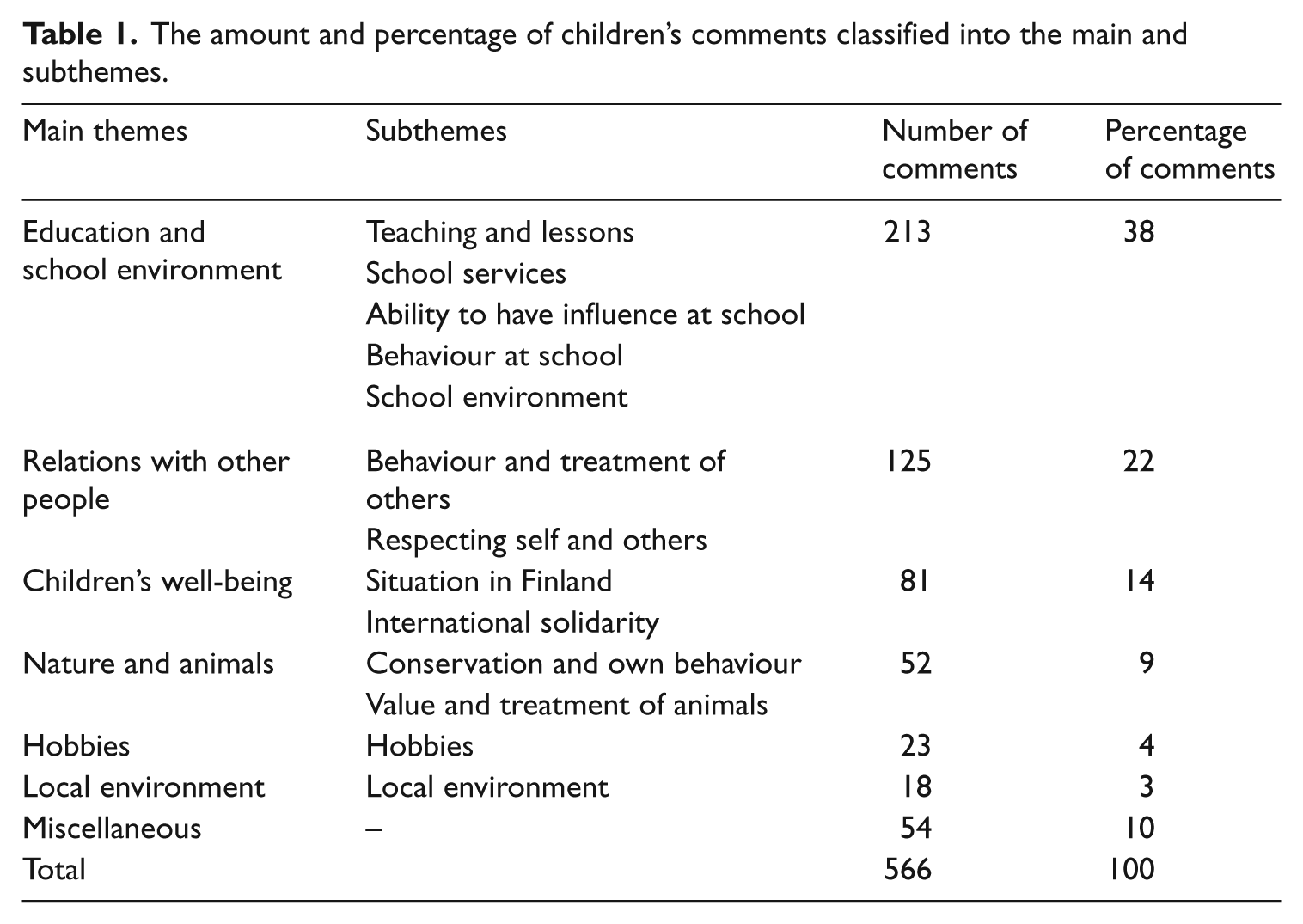
Education and school environment
The children’s comments relating to education and the school environment were divided into five subcategories. These subcategories are:
teaching and lessons (67 comments);
behaviour at school (48);
school services (46);
ability to have influence at school (27);
school environment (25).
First, the children criticized teachers’ habit of announcing in the class the results of or mistakes made in exams. According to the children, the results should be kept private because, at some schools, announcing them has caused bullying and embarrassment. Second, children paid attention to the amount of homework assigned, which varies considerably among schools. Third, some children argued for an increase in physical education in order to help them concentrate on other lessons. On the other hand, some children argued that an increase in physical education would mean a need to reduce the number of lessons in other subjects if the total number of lessons was not increased. Most children did not, however, want to increase the total number of lessons at school.
With respect to behaviour at school, many children saw bullying as a problem that should be addressed as soon as possible, because it may lead to bigger problems, such as shootings. According to the children, there are several good conciliation methods to resolve such issues, such as peer mediation or the KiVa programme, 1 which involves indicated actions to prevent bullying and to tackle cases of bullying coming to attention. Furthermore, many children paid attention to teachers’ behaviour: teachers should be role models for children and not, for instance, smoke or take snuff in the school area. In order to get help and friends at school, children considered the buddy system, in which older students monitor and help younger students, as an important and useful thing for young students.
Children would develop the school services by investing in the better availability of a school nurse. Nowadays, school nurses often serve multiple schools and are not on campus full-time: We don’t have a nurse at the school every day. It’s a bad thing because we need the nurse. I don’t understand why municipalities put money in some unnecessary things. I think that health care should take priority over some entertainment or buildings. (Boy 8, 11 years old)
Second, some children called for equality in school meals. According to these children, there is too big a difference between school meals, in both quality and quantity. Third, children considered it important to have organized after-school activities in every school.
In many children’s opinion, students should be able to participate in the decision-making regarding their school and the school’s investments. However, this is not always possible. Some children also suspected that the money is used for teachers’ benefit. On the other hand, some students felt that they have a possibility to participate in decision-making through student councils. The student councils are organized in many Finnish schools to promote joint action, influence and participation of the pupils in matters relating to them. The student council is usually composed of all students from one school and they elect the members for the board of the student council. The organization of the student councils is decided by the education provider in Finland. According to these children, there should be a student council at every school.
With regard to the school environment, the children emphasized the importance of having small village schools, and most of the children opposed closing them down. The children considered such schools as peaceful and good environments for studying. Most children also criticized the availability of soft drink machines at schools as they think soft drinks are unhealthy.
Relations with other people
Another prevalent discussion point among the children was relations with other people. Based on the children’s discussion, this main theme was divided into two subcategories:
behaviour and treatment of others (67 comments);
respecting self and others (58).
Regarding behaviour and the treatment of others, many children presented their own experiences and discussed the principles of honesty, teasing, discrimination and swearing. As a whole, the children agreed that lying, swearing and all kinds of bullying are always ‘stupid’ and have negative consequences. Many children also had personal experiences about these negative things. Some had been teased and some had had a friend who proved to be a liar: It’s never worthwhile lying, you will be caught anyway. It’s true that even friends go away quite soon if you lie enough. (Girl 10, 12 years old)
Many children also expressed their opinions about respecting themselves and others, particularly allowing people to be themselves. Although the children thought that nobody should be bullied for being different, it does happen. Many children reported that they had been denigrated because they succeed at school. In this respect, children thought friends are important because they help and give support. Furthermore, people should, according to many children, be pleased with themselves because people too often understate their achievements.
Children’s well-being
The third theme in the children’s online discussion was children’s well-being. Based on the discussion, this main theme was divided into two subcategories:
children’s welfare in Finland (46 comments);
international solidarity (35).
First of all, the children discussed problems and depression, and criticized financial savings made at children’s expense. Many children argued that the lack of attention to children by adults and parents’ drinking, for instance, cause problems in children’s family life and at school. In order to solve such problems, many children emphasized the role and help of school personnel: they should be available and close enough to students to assist, if needed. Special attention should, according to some children, be paid to children’s depression. Some children criticized municipalities that save money by cutting funding for services aimed at or beneficial to children’s lives. These children thought that the municipalities spend too much money on unnecessary things when at the same time, for example, school meals are getting worse. In general, however, many children thought that things are very good in Finland.
International solidarity appeared in the children’s discussion as they talked about the need to help poor and hungry children. According to several discussants, poor people can be aided through different charity collections, such as street collections, as well as by participating in different fundraising campaigns and activities. Avoiding unnecessary investments could also, in some children’s opinion, help save money that could be used for the benefit of poor people: I think that we Finnish people should donate to the collections because most of the people can afford to give a couple of euros to Haiti or other countries. (Boy 3, 11 years old)
Nature and animals
The fourth theme in the children’s online discussion was nature and animals. Children’s discussion on this theme was divided into two subcategories:
conservation and one’s own behaviour (39 comments);
the value and treatment of animals (13).
The pollution of the environment as well as climate change aroused concern among children. The condition of the Baltic Sea was of particular concern to the children. On the other hand, most children were generally optimistic about the future state of nature and the climate, and encouraged people to think about their own consumption in everyday life. Several children were concerned about the value and treatment of animals as well. According to these children, animals are important and valuable creatures that should be treated well. Many children were also against fur farming and animal testing.
Hobbies
The fifth theme that children presented in their online discussion was hobbies. Altogether 23 comments were related to this theme. The discussion about hobbies was very personal and unlike in the other discussions, the children did not strive to change anything. Many children introduced their own hobbies and the online environments that they use.
Local environment
The sixth theme in the children’s online discussion was the local environment. Altogether 18 comments were classified under this theme. Some children thought that there should be more dog cages near supermarkets and service stations so that people could safely leave their dogs in the cages while running errands. Some children also wished for more bicycle paths because these would increase road and cycling safety.
Issues that children want to influence
In order to examine the issues that children wanted to influence, their comments were classified into three categories, namely, expressing opinions, 2 expressing deficiency and proposal for action. Children’s well-being and relations with other people were clearly emphasized in those comments that contain expression of opinion, deficiency or a proposal for a decision or action (Table 2). Correspondingly, the number of descriptive comments was the smallest in these themes. The children generally presented numerous descriptive comments on education and school environment (see ‘all comments’ in Table 2).
The percentages of all children’s comments, comments that include expression of opinion, deficiency or proposal for decision/action and comments that are purely descriptive.

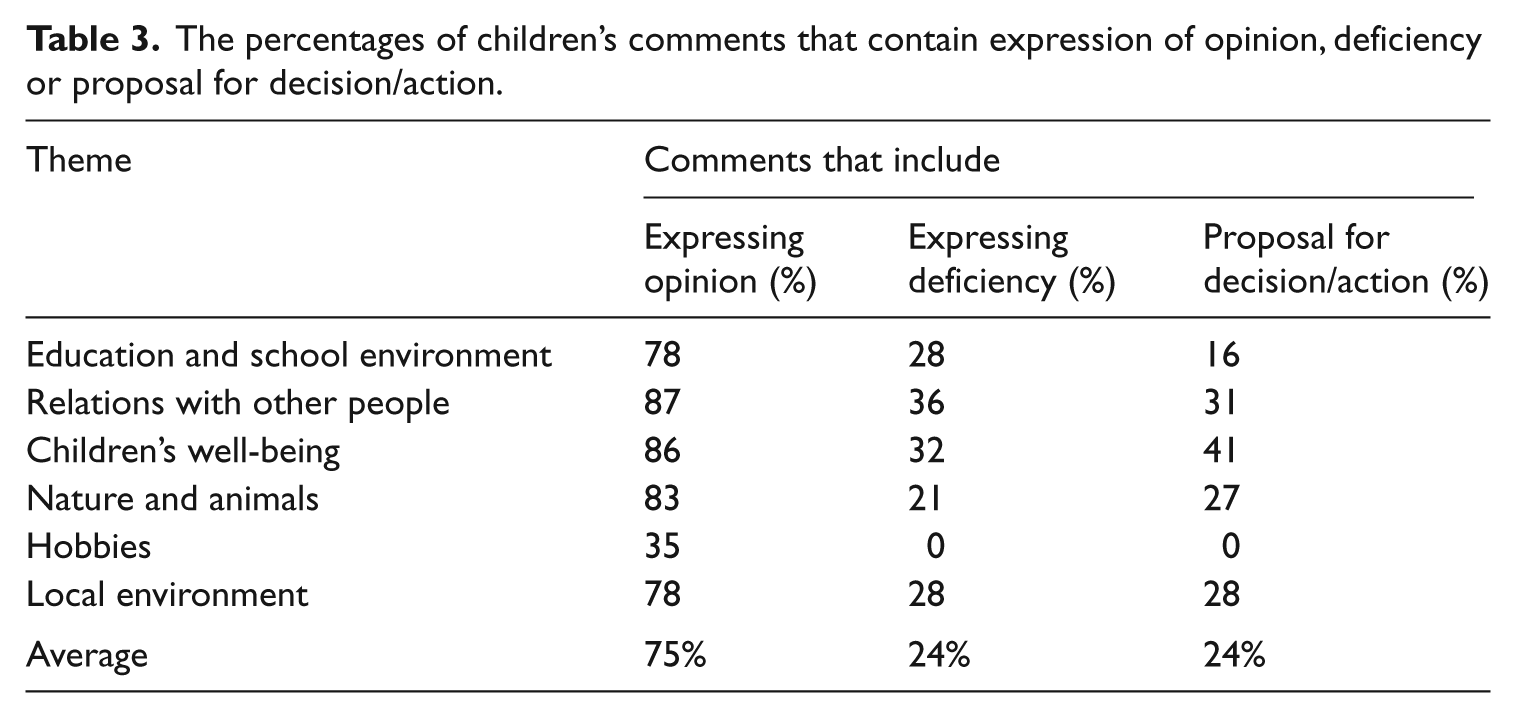
On average, the children expressed an opinion in 75% of their comments (Table 3). Expression of deficiency was found in 24% of the comments, as were proposals for a decision or action. The percentages varied considerably, however, with regard to the theme of the comment. Expression of opinion was detected in 87% of the children’s comments related to relations with other people, whereas only a third of the comments on hobbies contained opinion. Again, the children expressed many deficiencies and proposals for a decision or action in relations with other people and in children’s well-being.
The percentages of children’s comments that contain expression of opinion, deficiency or proposal for decision/action.
The issues that children commented on can be illustrated by the ecological approach framework (Figure 3). The issues that children generally presented comments on are placed within the left part of the diagram, whereas the right side of the diagram represents the issues on which children expressed opinions, deficiencies or proposals for a decision or action, and thus, wanted to influence. As the issues that children generally commented on are considered (the numbers represent the order of prevalence), the emphasis is on micro- and meso-levels. The most prevalent theme, education and school environment, is placed in the micro-level and the second prevalent theme, relations with other people, in the meso-level in this framework. However, as the issues that children want to participate in are considered, the most prevalent theme, children’s well-being, is placed in both the macro- and exo-levels. Again, relations with other people also stand out in the meso-level.
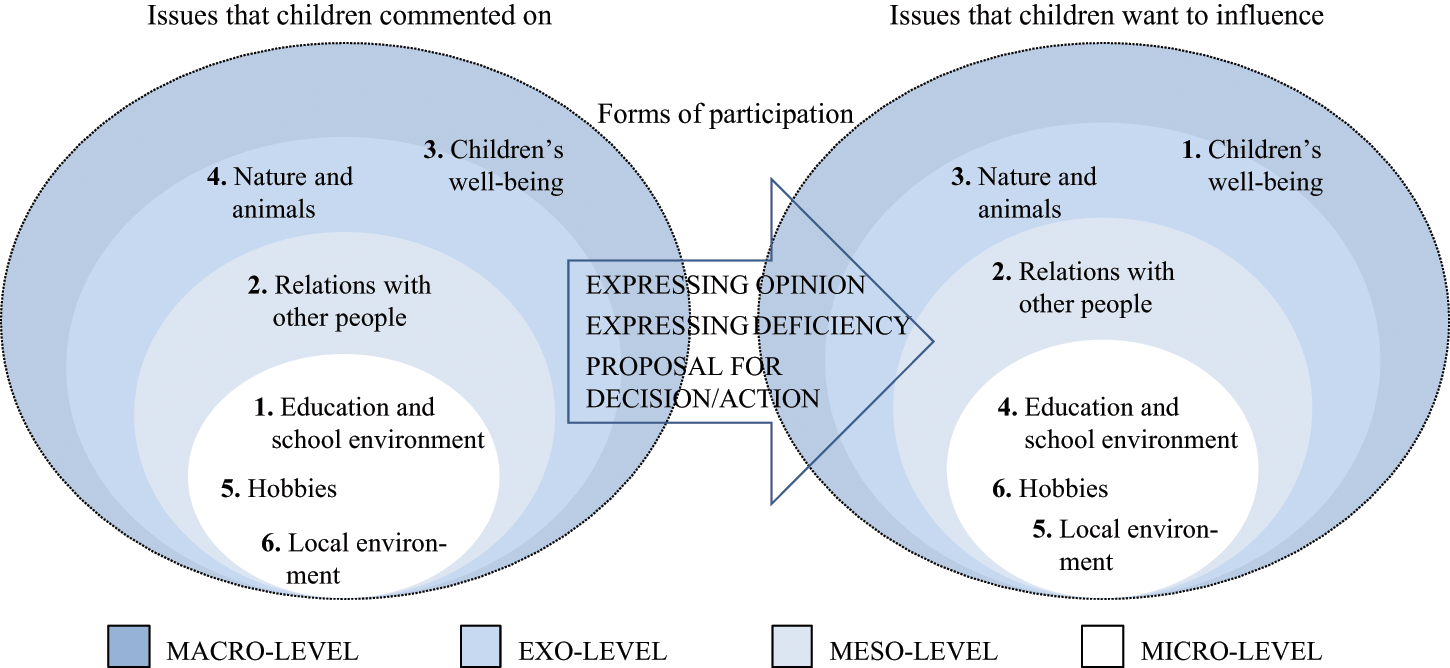
The issues that children commented on, want to participate in and influence placed in the framework of the ecological approach to children’s life world.
The issues that children generally commented on are mainly related to their everyday life context and immediate surroundings. Thus, these issues – school and interaction with others – are important for children in their life world. This is not a new finding; these contexts represent the basic elements of micro- and mesosystems in the ecological approach (Bronfenbrenner, 1979). What is noteworthy, however, is that the children in this study did not mention home or family-related issues, which are essential parts of the microsystem in the ecological approach. One reason for this may lie in children’s reluctance to present their personal experiences in public. On the other hand, children may also be so satisfied with their family life that they do not see a need for sharing their experiences. According to a previous study (Tuononen, 2008), many Finnish children are indeed happy with their family and home.
Concerning the research field of children’s participation and citizenship, it is especially important to notice the difference between the issues that children generally commented on and the issues that they want to participate in, on the one hand, and the forms of participation, on the other. Issues that children want to participate in and influence included, first and foremost, the desire for improving children’s well-being both in Finland and in countries where children suffer from the lack of the basic necessities of life. In relation to the previous studies on children’s participation and citizenship (see Bell, 2005; Buckingham, 2000), the notion of children’s international solidarity is important. As the emphasis has lately been on children’s participation as a process of influence that takes place in their everyday life contexts, the results of this study underscore that children also want to influence themes that are global in nature and only indirectly affect their lives. Furthermore, the results of this study show that children are able not only to express opinions or deficiencies but they also have many proposals for decisions and action. These ways of presenting comments online represent one model for forms of participation which thus far have been only ambiguously defined (see Skelton and Valentine, 2003). The following quotations represent the different forms of participation: We all are different, some people more than others. We all are still equal and nobody should be treated worse than others :) (Girl 5, 11 years old) A new jungle gym was purchased at our school without asking the students. I think that the students should have a possibility to give their opinion on how the money is used or saved at school. (Girl 4, 12 years old) I agree that the climate and environment have to be paid attention to. Our family recycles and tries to buy long-lasting and ecologically packed products. (Boy 16, 10 years old)
Regarding the previous studies on Finnish children’s low satisfaction with school (Inequalities in Young People’s Health, 2008), it is noteworthy that education and the school environment were not emphasized in this study as the issue that children want to participate in and influence. One reason for this may be in the methods of participation. Children may find it easier to engage in the discussion of children’s well-being, for example, rather than on school-related issues. In order to help poor children or to preserve nature, it is easy to donate money in collections or switch off the lights, instead of trying to influence school-related issues by talking to the headteacher, for example. Similarly, hobbies and local environment were not emphasized as matters that children want to discuss or influence. The reason for this may be in the lack of participatory practices. Even though the need for involving children in developing their own environment has been previously noted (Koskinen, 2010; Kyttä, 2003), involving them in developing their own immediate surroundings has not become a part of daily life, for example at schools (Koskinen, 2010).
In this phase of this article, the limitations of our research have to be noted. First, the discussion forum that comprises these data was an arena for children who voluntarily participated in debate. Thus, the discussants represent only a small sample of Finnish children. Moreover, the discussants were members of the Finnish Children’s Parliament, which indicates that they may have been more proactive in participating than their at-home peers. Second, they also knew each other as they had met face-to-face before the discussion. In general, however, the children’s discussion was open by nature and they also discussed sensitive topics, such as bullying and lying.
Conclusion
Children want to share experiences on issues that are related to their immediate environment and everyday life, but they also want to engage in the discussion of issues that are global in nature, such as children’s well-being in poor countries and climate change. Thus, the results of this study support the previous studies on children’s global citizenship. Children can be considered as global citizens and they are sensitive to global themes (Howe and Covell, 2005; Jans, 2004). Children are able to express their opinions, note deficiencies and propose ideas for decisions and action related to their own but also to other people’s lives. Children’s citizenship can thus be seen as an active, participatory practice, representing an expression of human agency (Lister, 2007). It is children’s right but also ‘lived’ in the sense that children’s social and cultural backgrounds and material circumstances affect their lives as citizens (Hall and Williamson, 1999).
In order for children to participate and be citizens, they need support from adults. In spite of their own wishes children cannot participate in decision-making concerning purchases at school, for example, if teachers do not take them seriously (see Devine, 2002; Fielding and Robinson, 2007). According to Buckingham (2000), the challenge for teachers and other adults is to find ways of connecting the ‘micro-politics’ of personal experience with the ‘macro-politics’ of the public sphere. This requires going beyond the formal definitions of politics to provide children and young people with opportunities to engage in political activity, rather than simply observing it (Buckingham, 2000).
Cockburn’s (2005) theory refers to assimilating private and public spheres in the sense that children’s private sphere is seen as political and taken seriously. From adults’ viewpoint, the issues in children’s private sphere, such as the way a teacher announces the results of exams, may seem small. For children, they are not, however, negligible, and the issues that seem to be small may lead to more complex phenomena, such as bullying. Our study suggests that children have a plethora of ideas on how to build arenas for their participation. Children share their life world with adults: it is beneficial for all adults to pay attention to children’s opinions.
Habermas (1987) examined the life world as the shared common understanding that develops through face-to-face contacts. However, as communicative ‘net’ environments and virtual worlds have become a frequent and natural component of many children’s lives today, they could provide adults with the opportunity to co-participate in and to familiarize themselves with children’s life world. In particular, virtual worlds also offer researchers a new and interesting possibility to explore children’s life world and participatory cultures as well as ways of how they could enhance children’s civic participation and citizenship.
Footnotes
Funding
Terhi Tuukkanen’s work was funded by the Finnish Cultural Foundation, grant number 00111086.