




Abstract
Analysis of life narratives of 20 West Bank Palestinians who grew up during First Intifada revealed an experience of having ‘lost childhood’. This experience included various aspects categorized into ‘lost child-friendliness’ and ‘lost childlikeness’. Participants attributed their sense of lost childhood to having grown up in the context of large-scale, unavoidable, inescapable, harsh and instrumental political violence. The author suggests that the Palestinian participants’ understanding that they lost their childhood when still children biologically and legally might best be accounted for within a theoretical framework seeing childhood as subjective in the ontological sense, but objective in the epistemic sense.
The Intifada stole our childhood. The events and hardships killed the child in me, killed my childhood. (Soha)
The words above were said by a young Palestinian woman from the West Bank. This article presents an analysis of her life narrative and those of 19 other Palestinians who grew up during the First Intifada (1987–1993). The First Intifada was a Palestinian uprising against Israeli occupation partly characterized by Palestinian children’s high exposure to political violence and involvement in political protest (B’Tselem, 1999). The narratives in this study were collected with the aim of contributing to knowledge about how Palestinians who grew up during the First Intifada remembered their childhood. However, since participants claimed to have lost their childhood, the study evolved into an analysis of how participants conceptualized and described lost childhood, and portrayed the attributed cause of childhood’s loss: political violence.
A prevalent psychological notion of childhood is that of a natural psychobiological phase, lasting from birth to puberty or age of legal adulthood. Another perspective, common in sociology, treats childhood as a constant structural component in the organization of social life, as all societies always include members treated as children. Research within this perspective focuses on sociocultural and economic aspects of children’s lives in various societies. A third perspective considers childhood a social construction, that is, a concept or practice created through social discourse. According to this perspective, childhood as an innocent, carefree and happy time of life is a normative western social construct rather than a natural fact (see e.g., Berman, 2003; Hart, 2006). For overviews of the three abovementioned perspectives, see Kehily (2009) and James and Prout (2005).
Publications on children and political violence rarely define or discuss the term ‘childhood’ (an exception is Hart, 2006) although it is used in different senses, often even within the same text. Examples are two UN reports on growing up amidst armed conflict. In Impact of Armed Conflict on Children (Machel, 1996), ‘childhood’ refers both to the mere years ‘from birth to early adulthood’ (p. 10) and – more vaguely – to something ‘inviolate’ (p. 90) in children’s lives. In a report by the UNDP (2006), ‘childhood’ refers both to a ‘social category’ (p. 16) and ‘a phase of life in which the individual needs protection, sheltering and guidance’ (p. 12).
‘Children are dropping out of childhood’ (Jain, cited in Machel, 1996: 71). ‘Children who are used as soldiers are robbed of their childhood’ (UNICEF and the Coalition, 2003: 3). Similar claims about children losing childhood are found in several publications on children in violent and impoverished environments, as indicated by high numbers of matches from Google queries (conducted by the author, 8 December 2010) for ‘lost childhood’ in combination – separately – with ‘war’, ‘Holocaust’, ‘violence’, ‘abuse’ and ‘poverty’. In my impression, most publications do not explicitly state the intended connotation of lost childhood, and to my knowledge, no previous study has analyzed the notion of lost childhood. Still, it seems plausible to suggest that phrases referring to lost childhood are usually meant to describe or explain something essential – but undesirable – about children in adverse situations, although the specific nature of that something may differ contextually.
To fully understand what is meant by lost childhood, examination of several empirical, linguistic and philosophical issues is needed: What characterizes attributed causes of lost childhood? Does the lost childhood phrase denote aspects of children’s functioning (e.g., psychological), perceptions of their life situation (e.g., hopeless) and/or environmental characteristics (e.g., violent)? What are the connotations, synonyms and antonyms of that phrase? Do those who use the phrase understand childhood as a factual, observer-independent (i.e., ontologically objective) or as an observer-relative (i.e., ontologically subjective) phenomenon? Are statements about the presence and absence of childhood based on personal, non-verifiable evaluations (i.e., epistemically subjective) or on verifiable assumptions or information (i.e., epistemically objective)? (For explanation of terminology, see Searle, 2006.) Although answers to these questions probably vary according to situational and cultural contexts, they may lead to answering the more general question of whether existing academic perspectives on childhood can satisfactorily account for the notion and experience of lost childhood. This article suggests some tentative answers from within the context of Palestinian children’s exposure to political violence.
Considerable research has examined the effects of children’s exposure to political violence, including studies on Palestinian children (for a review, see Sagi-Schwartz, 2008). As noted by several authors (e.g., Nguyen-Gillham et al., 2008) and also apparent from reviews of research (e.g., Sagi-Schwartz, 2008), previous studies have focused largely on the relation between quantitative aspects of violence exposure and psychiatric disorders (e.g., PTSD). Netland (2001, 2005) claimed that much of that research has failed to adequately describe and categorize types and aspects of exposure to political violence. This has hampered clarification of whether exposure affects children’s psychological needs and attributes in a differential manner (depending on type and features of the exposure situations). In my view, efforts to improve exposure classification need to be based on qualitative data (e.g., exposure narratives).
Recently, researchers have increasingly applied qualitative approaches in research on children in conflict zones, and researchers have also broadened the focus from mental health problems to include other aspects of children’s functioning and life quality. Examples from the West Bank are studies on violence exposure and coping (Ricks, 2006), resilience (Nguyen-Gillham et al., 2008), national identity (Habashi, 2008), and perceptions of the Israeli Separation Wall (Shalhoub-Kevorkian, 2006). Like the abovementioned studies, this article deals with the subjective experience of growing up under Israeli occupation. However, unlike previous research, this study focuses on the notion of lost childhood.
The article is organized according to the following objectives: to describe and categorize aspects of participants’ experience of lost childhood and exposure to political violence, to present a preliminary conceptualization of Palestinian childhood and lost childhood, and to suggest issues for future research.
Method and data presentation
The West Bank lies east of Israel and west of the Jordan River. It was annexed to Jordan in 1949 and occupied by Israel in 1967. The sample consisted of West Bank Palestinians who were children during the First Intifada: 10 women and 10 men (1 Christian, 19 Muslim) from refugee camps (8), villages (3) and cities (9) in the regions of Hebron (9), Jerusalem (6) and Nablus (5). Age ranged between 21 and 24 years (M = 22.2). Nine of the interviewees were employed, whereas the rest were students (6), unemployed (3), or caring for own children at home (2).
Data collection took place in winter 1999. Participants were selected randomly from a quota sample (based on district, community type, gender and violence exposure) of 108 children studied in 1989 (Kanaaneh and Netland, 1992). Some weeks before the data collection, the neighborhoods where the participants lived in 1989 were visited to ask them to participate in the study. Relatives still living in the community informed about the domicile of participants who had moved since 1989. Twenty-one were approached to participate, but one refused (he feared for his personal safety if he told about the political violence that had dominated his life).
Life narratives were collected through semi-structured, individual audio-taped interviews, either at Al-Quds University (13) or in participants’ homes (7). The interviews lasted from 1.5 to 2.5 hours. An interview guide specified key topics and a few questions. The interviews were formed as conversations aimed at covering important events of any kind, good and bad, during participants’ lives. Participants were encouraged to tell, in a chronological order, about events from the preschool and first school years, the Intifada and years after. During the interviews, the participants were asked some open-ended follow-up questions to encourage the narration (e.g., ‘Can you tell me more?’) and questions probing for additional details about the events which participants told about (e.g., ‘What was your age when that happened?’). A translator was present for Arabic–English translation. An Arab anthropologist transcribed the interviews into English.
Data analysis was facilitated by NVivo8, a software program for assisting researchers in organizing and coding qualitative data. The analysis approach was largely influenced by thematic analysis (Braun and Clarke, 2006) and narrative content analysis using empirical categories (Lieblich et al., 1998). Accordingly, categories were developed through a data-driven process instead of using a pre-existing coding frame. The study also shares many of the characteristics of qualitative description (Sandelowski, 2000: 338) which typically aims to capture all elements of events and experiences, their ‘who, what, and where . . . or basic nature and shape’. Although the analysis focused primarily on manifest content (i.e., what was actually said), it also comprised a more latent level (i.e., involving interpretation of what was meant or implied), especially when trying to understand how participants conceptualized lost childhood.
The analysis started with the aim of understanding how participants remembered the First Intifada and reviewed their childhood. As the first rounds of data analysis revealed that a large part of the collected narratives were related to memories of political violence and thoughts about having grown up in a child-unfriendly environment, the analysis focused on these memories and thoughts at the expense of less-mentioned content (e.g., about friendship).
Categories and subcategories were extracted from the narratives and organized under the themes ‘political violence’ and ‘lost childhood’, as shown in Figure 1. The themes, categories and subcategories were identified and refined through a process of reading and rereading the narratives and consulting other data collected from the same participants in 1989, 1999 and 2004–5 (Kanaaneh and Netland, 1992; Kanaaneh et al., 1999).
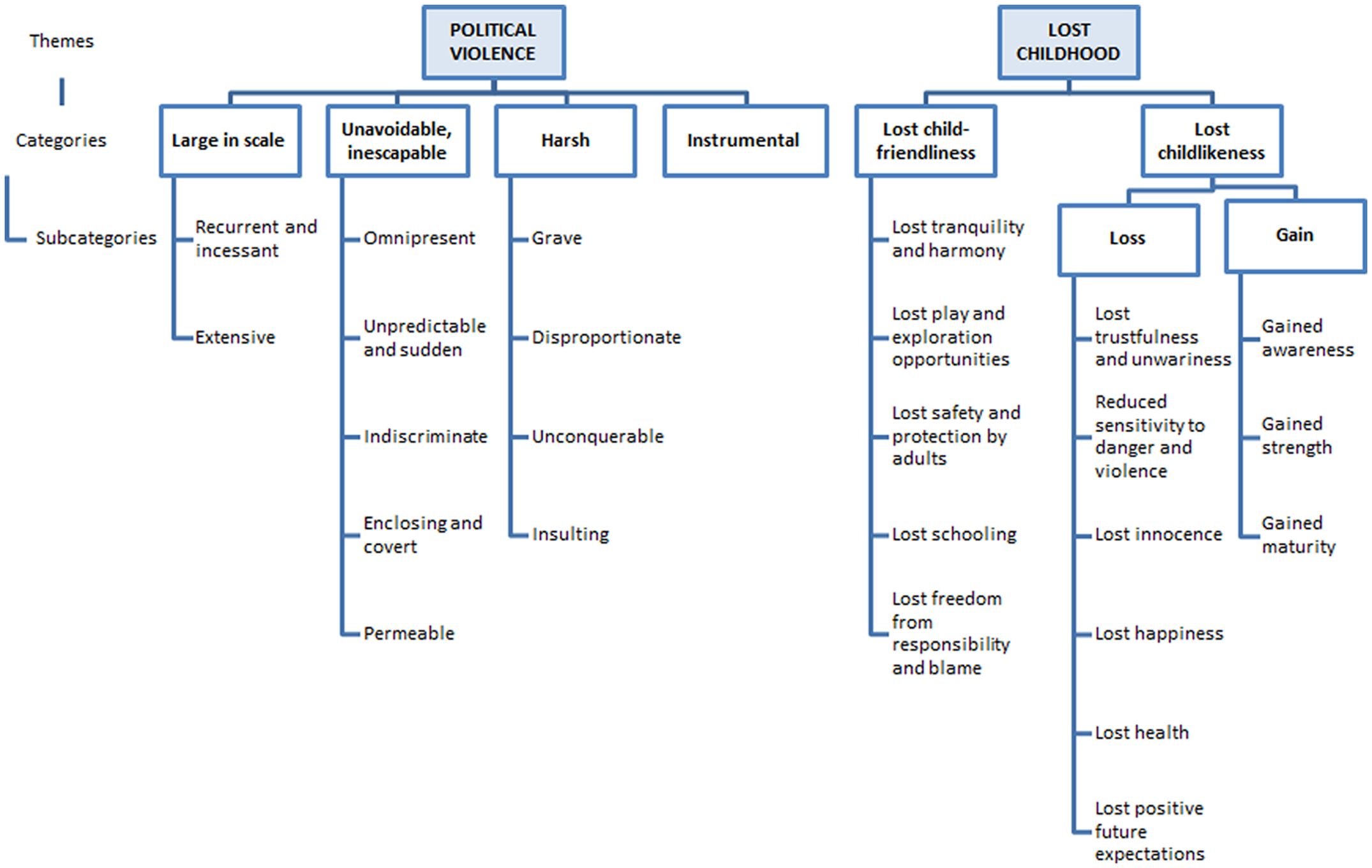
Themes, categories and subcategories extracted from the narratives.
The study is consistent with a middle position between extreme essentialist and relativist views on the relation between narrative and historical reality (e.g., Lieblich et al., 1998). It is based on the view that the research participants would mainly try to tell honestly about their lives. Still, their stories assumingly do not mirror objective outer reality. Stories rather ‘imitate life and present an inner reality to the outside world’ (Lieblich et al., 1998: 7). From a narrative psychological perspective, this is unproblematic since historical truth (i.e., what really happened) is considered less important than whether the narratives and their analysis authentically and accurately represent participants’ subjective experiences, emotions and beliefs (i.e., narrative truth; Spence, 1982). However important, the study should not be expected to uncover the complete narrative truth about how participants remembered their lives as children. One reason is that participants, during the interviews, naturally had to select among countless experiences to be retold and among numerous features of those selected experiences. Many factors were probably involved when participants chose events (and event aspects) to be retold, including evaluations of (a) their psychological, economical and health-related effects, (b) whether they represented something typical for their life and (c) anticipated potential benefits (e.g., emotional relief) and costs (e.g., security risk, painful psychological reactions) of retelling the events. Furthermore, since memory is grounded in the living person, the participants’ psychological (e.g., post-traumatic stress symptoms), social (e.g., political violence) and political (e.g., continued occupation) circumstances at time of data collection assumingly affected their narration about the past events. Although the article intends to represent participants’ voices and therefore quotes extensively from the narratives, analysis of life narratives is unavoidably a selective and interpretive process. Thus, the article represents one of possible ways to understand and represent the narratives.
In the Findings section, short excerpts (identified by pseudonyms) exemplify themes extracted from the narratives. To facilitate readers’ ability to distinguish between genders, female and male pseudonyms end with the letter A and consonants, respectively. Words added for readability are placed in parentheses.
The Findings section begins with an account of how participants portrayed their early years of life, which several participants described as a good or normal childhood. Then various aspects of exposure to political violence as participants described them are presented. Finally, aspects of lost childhood are described (also see Figure 1).
Findings
Childhood and its thief
Some participants portrayed life as difficult right from the start. Randa said, ‘From the time of our birth, we are required to swim against the stream, and only by death can we regain balance with nature.’ Fadel commented, ‘I opened my eyes on life to find it under occupation and full of shooting and beating and violent oppression.’ Several participants, however, described some of their childhood as ‘normal’ or ‘good’, a phase that for some lasted until age five to seven and for others until the start of the First Intifada. According to Elyas, ‘childhood was normal until age five’ with ‘no special bad memories’. Liyana remembered preschool years as ‘a normal childhood with no bad memories. It was a nice life with a lot of freedom of movement and opportunities for outdoor play with friends. I was not afraid of being outside.’ Soha said, ‘Until the age of six . . . I was a normal child, preoccupied with thoughts about having nice clothes and nice dreams of going to school. Of course, I used to see armed soldiers in the camp, but I knew nothing about them. During this period, there was nothing that could endanger my life or disturb my happiness.’ Zeid had ‘a quiet and peaceful childhood with no responsibilities or worries up to age ten. It was also a protected and safe life.’ Jumana said, ‘It was a protected childhood. I think I had a good start in life.’
Some participants apparently used ‘childhood’ synonymously with ‘normal childhood’ and ‘good childhood’. Descriptions of both good and difficult times indicate that participants conceptualized (normal and good) childhood as comprising of two components. The first, which I have named ‘child-friendliness’, is the presence of certain social and physical environmental qualities that participants apparently believed that children need to thrive and grow up healthy: tranquility and harmony, freedom to play and explore, safety and protection by adults, schooling, and freedom from responsibility and blame. The second component, ‘childlikeness’, refers to characteristics of children living ‘normal’ lives: trustfulness, unwariness, innocence, good health, happiness, positive future expectations and naivety.
Political violence brought an end to childhood, according to participants. ‘We grew up much earlier than we should have’, claimed Halaa. Ghina said, ‘I lost my childhood and adolescence to serious political thinking.’ Others described the violent Intifada’s impact with phrases such as ‘stole our childhood’, ‘killed my childhood’, ‘took from me normal childhood’ and ‘I did not have a normal childhood’. Thinking of their lost childhood triggered negative emotions. Halaa said, ‘Remembering the Intifada in general, and the fact that we did not live a normal childhood, . . . produce negative feelings inside me.’ Liyana commented, ‘I am sad for losing part of my childhood.’
‘Sense of lost childhood’ refers, in this article, to the cognitive-emotional experience that – according to analysis of the narratives – was underlying the kind of phrases mentioned above. ‘Notion of lost childhood’ refers to conceptions of what lost childhood is, whereas ‘lost childhood’ refers to the presence in children’s lives of features compatible with notions of lost childhood.
Political violence
As described above, participants claimed that political violence led to loss of childhood. In the analysis, aspects of exposure to the violence were identified and categorized into ‘large in scale’ (subcategories: ‘recurrent and incessant’, ‘extensive’), ‘unavoidable and inescapable’ (subcategories: ‘omnipresent’, ‘unpredictable and sudden’, ‘indiscriminate’, ‘enclosing and covert’, ‘permeable’), ‘harsh’ (subcategories: ‘grave’, ‘disproportionate’, ‘unconquerable’, ‘insulting’) and ‘instrumental’. Each of these aspects of exposure are described below (in the same order as shown in Figure 1).
Large in scale
Participants remembered the political violence during the Intifada as ‘recurrent and incessant’. Elyas said, ‘the Intifada were days of fear, worry and pain, always being in danger’. According to Nadia, ‘the Intifada period was a continuous series of bad and sad events’. Amin said, ‘The Israelis were always there in the streets, and we lurked to school, to avoid the soldiers.’ Dalia said, ‘Almost every day, the army came to school and did something frightening.’ Labeeb commented, ‘Those days we used to go out knowing we might not return home alive.’
Participants also described the violence and its effects as ‘extensive’. Paradoxically, narratives of participants who claimed they had not experienced much violence, most powerfully elucidate the violence’s extensiveness. Bashaar, whose house was partly demolished, said, ‘Five or six of my brothers (from father’s three wives) were in prison at all times and some were expelled from the country. . . . My cousin was killed in Gaza, my brothers continued to be arrested, some friends and neighbors were injured, and so on. But all these were just ordinary things in the Intifada. Nothing really serious happened to my family.’
Unavoidable and inescapable
According to the narratives, it was impossible to completely avoid violence exposure due to the following aspects of the violence:
‘Omnipresent’: According to the narratives, violence was ubiquitous. ‘Danger was everywhere: at school, in the streets and at home’, said Ibrahim. Other participants told stories about violence in graveyards, mosques, military jeeps and prisons.
‘Unpredictable and sudden’: Calm situations often turned into horrific ones within seconds, sometimes without any warning signs that violence might erupt. Halaa remembered the night her home was demolished: ‘Suddenly the soldiers came and forced us out of the house and we had to sleep in the open.’
‘Indiscriminate’: Much of the described violence had the form of collective punishment, including undifferentiated shooting, use of tear gas and long curfews. Violence varied in indiscriminateness, from randomly striking any person in the community to any person belonging to certain social categories or being at particular places at particular times. Apparently, young boys were vulnerable. Amin said, ‘Several times soldiers . . . beat me up severely although I was not participating in demonstrations and did my best to avoid the soldiers.’
‘Enclosing and covert’: Some of the described violence took place in situations where the children found themselves entrapped with very little chance of escape or rescue, either because the they were completely surrounded by soldiers or because violence was hidden to third parties. Dalia, for instance, related, ‘School was a frightening place, because it was a closed place and the soldiers could easily surround it.’
‘Permeable’: Participants apparently remembered violence and its effects as something that permeated into all, or almost all, realms of life, including bodily, psychological, social, economic, educational and personal life levels. Dangers that were hard to detect and shield from, apparently increased the sense that violence and its effects were very permeable, both concretely and psychologically. Some said that contaminated air and water pervaded into the houses, hiding places and bodies. Others told that fear of the soldiers permeated into the most private spheres. Ghina said, ‘I used to write poems expressing my feelings towards the Israelis, but my mother had to burn them because she was afraid they might fall into the soldiers’ hands. This made me feel the occupation even deprived me of expressing my feelings to myself.’
Harsh
The exposure category ‘harsh’ includes the subcategories ‘grave’, ‘disproportionate’, ‘unconquerable’ and ‘insulting’.
‘Grave’: Much of the described violence was mercilessly carried out and had extreme medical and economic consequences. Several participants had lost family members or friends, and had seen killing and corpses. Labeeb witnessed a young man being shot in the head. He died from his wounds: ‘I was about 20 meters from him. When the ambulance came, the soldiers refused to let it take the man to the hospital.’
‘Disproportionate’: In the narratives, there was great disparity between Palestinians’ oppositional acts and soldiers’ reactions. Suker witnessed when ‘a boy (he) shared a desk with at school, was shot in the eye and killed. There was a curfew in the camp that day, and when the boy put his head out of the window to take a look around, a soldier shot him dead.’ Labeeb was severely beaten and kicked ‘because the soldiers wanted to know why I ran away when I saw them. I said (to the soldiers) that everyone in the camp runs away when seeing the soldiers.’
‘Unconquerable’: In most narratives, the opposing parties were armed Israeli soldiers and unarmed, or armed with stones, Palestinian civilians. The soldiers appeared invincible both due to the general unevenness between the parties and due to certain features of the violent situations that gave the soldiers an extra edge over the Palestinians. Several narratives were about violence directed against especially vulnerable people (e.g., babies, young children and injured and disabled people) or in situations when the victims were especially unprepared and defenseless (e.g., during the night, holy days, worship, funerals and vulnerable family or health circumstances). Suker received a severe gunshot wound at age 12. He said, ‘The day after my release from the hospital, soldiers raided our house and wanted to take me with them.’
‘Insulting’: Some narratives described acts apparently aimed at insulting the enemy. Ismael told about Palestinian boys who were ‘shouting obscene words at the soldiers’. Elyas claimed that Israeli soldiers treated Palestinian prisoners’ mothers in an insulting way. Randa felt insulted because a soldier flirted with her while at the same time threatening her and forcing her to stand still in the sun.
Instrumental
It appears that participants conceived violence as ‘instrumental’, motivated by both near (e.g., gaining information about Intifada activities) and longer-term (i.e., victory) goals. Ismael was arrested, beaten and kicked at an early age: ‘The soldiers asked who sent us to shout slogans, which organization (those who allegedly sent us) belonged to and so on. Whenever we said we did not know, the kicking and hitting became worse, and if I shouted “Oh, my hand”, they would beat me on that hand.’ Soha said, ‘They targeted schools in order to produce an ignorant people out of us.’ Halaa said she was less than 10 years old when she concluded that ‘the Israelis’ objective is to break our morale and destroy our personalities’.
Lost childhood
Participants apparently felt that the violence caused loss of childhood. It appears participants conceptualized lost childhood – just like (normal) childhood – as consisting of two components: ‘Lost child-friendliness’ and ‘lost childlikeness’. (It should be noted that ‘lost’ refers to a partial, rather than complete, loss.)
Lost child-friendliness
‘Lost child-friendliness’ refers to having been robbed of essential qualities characterizing adequate environments for children. Lost child-friendliness includes five subcategories (see Figure 1), the first being ‘lost tranquility and harmony’. Participants remembered the Intifada as a period marred by uproar and violence and lacking in tranquility and harmony. This is evident from the above outline of aspects of political violence, and will not be detailed further.
A second aspect of lost child-friendliness is ‘loss of play and exploration opportunities’. Ismael said, ‘We did not have a normal childhood where we could go out on the street to play with friends.’ Liyana mourned ‘the loss of our freedom of movement. We could no longer go out, and I often got sad and afraid.’ When permissible to play outdoors, the children’s games were often colored by the violence. Halaa said, ‘We did not have a normal childhood like other children in the world. Even when playing as children, our games were about clashes between soldiers and demonstrators, with martyrs and wounded people.’
Third, lost child-friendliness includes ‘lost safety and protection by adults’. Soha said, ‘Life became so unpredictable and insecure: we could be killed at any moment.’ The children experienced that neither teachers nor parents could protect them. Halaa said, ‘School did not give us security or protection.’ Zeid was arrested at age 12: ‘My family screamed at the soldier and tried to get me out of the soldier’s hands. . . . This was my first experience with Israeli soldiers, and it filled me with anger, especially because my family wanted to save me but could not.’
‘Lost schooling’ is the fourth subcategory of child-friendliness identified in the analysis. According to Fadel, ‘school . . . was never a safe place, because it was continuously raided by soldiers’. Several participants told about teargas against schools and that schools were periodically closed. Ismael said, ‘the army used to occupy the school […] for several months, turning it into a military camp.’ Bashaar claimed, ‘Every time a child threw a stone, the army closed the school . . . and whenever the school opened again, we took pupils out on strike and started throwing stones.’ Randa said, ‘We, the pupils, used to hold sit-in strikes, where we refused to enter the classes and spent most of the time at school singing nationalistic songs and chanting patriotic poems.’ The violence made it hard to concentrate on schoolwork, according to Layla, ‘I neglected my studies, and my grades went down drastically.’
Finally, lost child-friendliness includes ‘lost freedom from responsibility and blame’. Participants claimed soldiers held children responsible for anti-occupation activities and punished them for such activities and for failure to comply with soldiers’ orders. Suker, for instance, claimed soldiers started shooting at him after he had thrown stones at soldiers while going home from his very first day at school.
Lost childlikeness
According to the analysis, ‘lost childhood’ also includes ‘lost childlikeness’ (in addition to ‘lost child-friendliness’). ‘Lost childlikeness’ refers to having lost, or never developed, some common or normally expected characteristics of children living ‘normal’ lives. Lost childlikeness includes nine subcategories (see Figure 1). These are described below:
‘Lost trustfulness and unwariness’: According to the narratives, participants had been very fearful and watchful, particularly in the beginning of the Intifada. Liyana said, ‘We were afraid of both the soldiers and the masked young men who threw stones at the soldiers.’ Jumana said, ‘We were always on alert, especially because there were so many spies and agents around.’ Randa became extremely afraid of soldiers after her first direct exposure to a politically violent event because it ‘made me realize that my parents . . . could not protect me against armed soldiers’.
‘Reduced sensitivity to danger and violence’: As time passed during the Intifada, participants apparently experienced decreased fear. Nadia remembered that soldiers often forced her father to clean the streets and erase graffiti at night. She said, ‘In the beginning, I used to get scared, but then it became a normal event.’ Ismael claimed, ‘fear disappeared with the passage of time, because such things became a matter of routine’.
‘Lost innocence’ refers both to participants early in life becoming aware of cruelty and destructiveness in others (as seen earlier in this article), and to the fact that they already as children harbored within themselves hatred and injurious – even murderous – intent. Jalaal, whose home was demolished, said he felt ‘anger mixed with hatred, because they destroyed our house and dream for no reason at all. . . . If I had the ability, I would burn them down.’ Soldiers destroyed Layla’s house, uprooted trees and killed livestock: ‘Our house was demolished for no reason, because my brother was innocent; he did nothing. I felt very angry and wished to kill them if I could.’
‘Lost health’: Participants told about loss of both physical (e.g., broken bones and gunshot wounds) and psychological health. Suker, who was severely injured, said: ‘I suffered from strong depression . . . (and) I was obsessed with remembering everything that happened; how the soldier shot me, how I was laying in the hospital, how the soldiers came to the hospital the same day and tried to take me, and so on. And every time I saw an injured person, I recalled the details of my injury.’ Fadel said, ‘(Violence caused) a scar in my heart that will never heal. . . . I would describe myself during that period as an injured child.’
‘Lost happiness’: Feelings of sadness and hopelessness were strong. Randa said, ‘The situation affected our psyche negatively, filling us with fear and taking happiness from us.’ Participants applied phrases like ‘filled with sadness’ and ‘taken by massive sadness’ for describing how they felt when Palestinians were killed. House demolitions caused great sadness as well. Soha, whose home was demolished at age 12, said, ‘It was sadness mixed with fear of the future and of the mercilessness of our enemy, combined with our hopelessness. We were (already) refugees, but had our own house. Now we had become doubly homeless, and I cannot describe to you how tragic this feels.’
‘Lost positive future expectancies’: According to participants, the Intifada also led to diminishing positive future expectancies and daydreams, both regarding political (i.e., end to occupation) and private realms of life (e.g., future motherhood and education). ‘We were swimming in our dreams of unlimited opportunities’, said Soha about the pre-Intifada years. She had waited impatiently to reach fifth grade when English lessons were to start. However, when Soha reached fifth grade, the Intifada started and severely disturbed schooling and the opportunity to learn English: ‘That was when our dreams started to die out!’
‘Gained awareness’: This aspect of lost childlikeness – as well as the subcategories ‘increased strength’ and ‘gained maturity’ described below – may be conceived as the gain of positive qualities. In some participants’ understanding, their awareness of political and social issues gradually increased due to efforts to understand what motivated violence and how to prevent soldiers from reaching their aims. Amin said, ‘I was always wondering and asking myself: “Why is this happening?” ’ The children sought answers in politics. Layla put it this way: ‘I felt I had to develop my political awareness and know the real reasons why the Israelis demolished our house, occupied our country, and made so much trouble for us.’ Randa explained: ‘Oppression and discrimination made me . . . feel the necessity to think and reflect upon the situation of my people . . . and comprehend what was going on around us.’
‘Increased strength’: Elyas, when telling about soldiers having thrown a stack of mattresses on his baby brother, said, ‘I remember myself thinking, “I wish I were older. I wish I had the strength to stop them.” ’ Some participants claimed that the violence had in fact led to increased strength. Halaa said, ‘These events affected my personality both positively and negatively. They did not break me down but rather made me stronger.’ Ismael said, ‘A difficult and stressful life has taught me how to be a fighter in life.’ Elyas, who lost his mother, said: ‘(She) left me five young children to take care of. . . . (This) has made me stronger, because if I break down, it will have an impact on many others.’
‘Gained maturity’: Several participants claimed the Intifada matured them and contributed positive personal qualities. Nadia claimed: ‘You are compelled . . . to mature early.’ Randa said the hardships made her ‘a mature and serious person early in life’. Labeeb said, ‘We lost our education, but gained our dignity and honor.’ Ghina said: ‘The Intifada matured me and gave me awareness of the occupation, the importance of the stone and the role of the masked men. . . . Politics gave me pride, sense of responsibility, self reliance, self confidence and a sense of belonging, and took away normal childhood and adolescence.’
Discussion
Participants apparently felt that they lost their childhood due to the violence of the first Intifada. Analysis of the narratives led to categorizing aspects of exposure to violence during the Intifada into ‘large in scale’ (including ‘recurrent and incessant’ and ‘extensive’), ‘unavoidable and inescapable’ (including ‘omnipresent’, ‘unpredictable and sudden’, ‘indiscriminate’, ‘enclosing and covert’ and ‘permeable’), ‘harsh’ (including ‘grave’, ‘disproportionate’, ‘unconquerable’ and ‘insulting’) and ‘instrumental’. These categories differ from several other exposure categorizations in previous research (for an overview, see Netland, 2002). One explanation is that the categories in this study were derived inductively and rationally on the basis of qualitative interviews in which participants were (relatively) free to describe and explain Intifada events as they remembered them. In contrast, most previous exposure categorizations were derived either rationally or statistically (factor analytically), using data from questionnaires with predefined and limited lists of violent events – an approach fraught with problems (Netland, 2001, 2005).
According to the analysis, participants saw lost childhood as antonymic to (normal) childhood (i.e., as the opposite or absence of childhood). Lost childhood meant two things: ‘lost child-friendliness’ (including loss of: tranquility and harmony, play and exploration opportunities, safety and protection by adults, schooling and freedom from responsibility and blame) and ‘lost childlikeness’ (including loss of: trustfulness and unwariness, sensitivity to danger and violence, innocence, health, happiness and positive future expectations, and gain of: awareness, strength and maturity). Participants felt that, due to lack of environmental child-friendliness, they had lost, or never developed, some common or normally expected characteristics of children’s emotional and behavioral functioning and preoccupations as compared to adults, and instead developed some other qualities usually associated with adults.
The idea that a child (according to biological, legal, or sociocultural definitions) may lose childhood (in this study’s understanding of that phrase) can, in my view, not readily be accounted for within the most widespread theoretical approaches to childhood (see e.g., James and Prout, 2005; Kehily, 2009). It appears difficult to understand how children can be said to lose their childhood within conceptualizations of childhood as, for example, (a) a purely objective phenomenon (i.e., ontologically and epistemically objective, e.g., as the time period from birth to age 17); (b) a purely subjective phenomenon (i.e., ontologically and epistemically subjective, e.g., as something that would ‘exist’ anywhere people believe in childhood as an idea); or as (c) an enduring feature of society’s social structure.
Drawing on my understanding of participants’ narratives, I suggest that lost childhood can be accounted for within a theoretical framework seeing childhood as ontologically subjective, but epistemically objective (see Searle, 2006). Ontologically speaking, childhood is a subjective phenomenon. What is understood as childhood is relative to cultural and historical context. In the Palestinian context, likely influences are Arab and Muslim discourses on childhood, western psychological discourses on children’s needs, and children’s international rights. In this study, the participants’ notion of childhood apparently denoted proper environments for children (i.e., child-friendliness) and normal child behavioral and emotional functioning (i.e., childlikeness), whereas the lost childhood phrase denoted the absence, or opposite, of childhood (i.e., lost child-friendliness and lost childlikeness). Palestinian children of today, however, may differ from this study’s participants with respect to what they regard as childhood and lost childhood.
Epistemically speaking, on the other hand, Palestinian childhood and lost childhood are objective phenomena: childhood is the presence – and lost childhood the absence – in children’s real lives of features compatible with socially shared ideas about what constitutes childhood. I base this, first, on narratives indicating that the lost childhood phrase was no empty cliché in participants’ mouths, but rather a conclusion based on memories of events and characteristics of their real lives. Second, participants apparently believed that childhood actually existed in peaceful parts of the world and had existed on the West Bank before the Intifada. Third, participants’ statements about the presence and absence of aspects of childhood (e.g., claims about lost schooling) were, at least in principle, empirically verifiable.
Although the participants had lived under violent occupation all their lives, several participants related that they had experienced a good or normal childhood during some or all years prior to the Intifada. This indicates that the sense of lost childhood was not due to having lived under violent occupation per se. Rather, the sense of lost childhood seems related to having lived for years in an environment characterized by a violence of such kind and degree that Palestinian caregivers and teachers could not provide children (any longer) with what Palestinians see as minimally adequate environments for children. Phrased differently, the extremely large-scale, harsh, unavoidable and inescapable instrumental violence of the Intifada (i.e., the violence categories in Figure 1) hindered the materialization of Palestinian discourses on proper environments for children (i.e., child-friendliness) and normal child functioning (i.e., childlikeness), and this led participants to claim that they had lost their childhood.
As indicated above, the proposed conceptualization suggests, first, that what is perceived as constituents of childhood (e.g., play) depends on social discourses (i.e., they are ontologically subjective). Second, it suggests that practices (e.g., designing safe and stimulating play areas) associated with those discourses, and the constituents of childhood (e.g., children playing), have a real existence (i.e., they are epistemically objective). However, in my view, social discourses on children and childhood do not construct reality in any simple and deterministic way. The Palestinian notion of lost childhood is not compatible with conceptions of childhood as something existing wherever social discourse encompasses ideas about childhood, or as ‘a technology that fabricates the child in the “mirror” of . . . imaginaries, theories, and ways of reasoning’ (Hultqvist, 2001: 143). Although Palestinians share ideas and images about childhood, participants in this study still claimed the absence of childhood.
Politically violent conflicts – particularly where children are highly exposed to and/or involved in violence – may be interpreted partly as fights over childhood. Antagonist parties may seek to either secure or deprive children of childhood. Consequently, the materialization of cultural ideas and norms about children and their environment may be hindered. Particularly for children belonging to the conflict’s weakest party, a large mismatch may thus arise between socially determined notions of childhood and children’s reality, leading to the conclusion that childhood is lost.
Since this article is the first, to my knowledge, to explore the notion and experience of lost childhood in relation to exposure to political violence, it cannot offer firm answers or deep understanding. However, it may hopefully be seen as a useful empirical and theoretical starting point for efforts to advance thinking about childhood through the study of lost childhood. Pertinent questions for future study are listed, according to research focus, below:
Violence exposure: Is the present study’s categorization of aspects of exposure to political violence relevant to other samples of Palestinians? Are inductively and rationally derived exposure categories based on qualitative data (such as those in the present study) different from, and scientifically superior to, statistically derived categories based on limited event questionnaires (such as those in much previous research)?
Lost childhood in general: Are there equivalents to the lost childhood phrase in many cultures? What are the similarities and differences between ethnic and religious groups in denotations and connotations of lost childhood? What do various groups believe are events and situations that may lead to the sense of lost childhood? Might people who are said to have lost their childhood share some psychological likeness (e.g., sense of unprotectedness) across events and situations (e.g., sexual abuse, violence, poverty, child labor), even when the children’s experiences appear quite different on the surface? What are the eventual effects of describing individual persons or whole generations of children (e.g., in war zones) as deprived of childhood, on both discursive (e.g., talking and thinking of them as scarred children, incomplete persons, or a lost generation) and non-discursive (e.g., treating them in particular ways) levels?
Lost childhood in relation to political violence: Is the present study’s categorization of aspects of lost childhood relevant to other samples of Palestinians and other conflict-ridden people? Are there differential relationships between aspects of political violence (e.g., instrumentality of violence) and aspects of sense of lost childhood (e.g., increased awareness, maturity and strength)?
Hopefully, research into what is understood as the opposite, absence or loss of childhood may stimulate new theorizing about childhood.
Footnotes
Acknowledgements
Many thanks to Magne Raundalen at the Center for Crisis Psychology, Norway and Moslih Kanaaneh at Birzeit University, West Bank, who conducted the interviews, and to Moslih Kanaaneh and Frode Fadnes Jacobsen for commenting on article drafts. Thanks also to Mai Nasrin N Kanaaneh for English language advice. Data were collected as part of a NORDPAS project in cooperation with Al-Quds University.
Funding
The data collection was funded by the Norwegian Ministry of Foreign Affairs.