



Abstract
The Swedish preschool curriculum not only prescribes documentation and quality assessment, it also requires children’s participation in the documentation process, although it offers no directions on how the documenting should be done, which can leave teachers unsure of how to do it. This study differs from research that presents pedagogical documentation as a way of enabling children’s participation in preschool in that it explores children’s participation in producing different forms of documentation in a Swedish preschool – and it finds that such participation is complex. The findings imply that, whether documentation is activity-integrated or retrospective, different forms of participation are possible.
Keywords
Introduction
Increasingly, children have come to be regarded as competent fellow citizens in many countries worldwide (Kjørholt and Lidén, 2004; Wall, 2008). This can relate to ideas about children’s rights and about human rights more generally. Reynaert et al. (2012) argue that it is important to ask what ‘children’s rights’ means in different contexts. This article presents a study of how children’s right to participation is enacted in preschool documentation practice, sometimes seen as a democratic practice, a tool for participatory evaluation (Moss and Dahlberg, 2008). The Swedish preschool curriculum prescribes documentation without giving any guidelines, leaving preschool teachers sometimes unsure of how to document what happens in their classrooms.
The objective of this article is to show the complexity in children’s participation in preschool documentation practices. I have chosen to focus on a specific section of the documentation process: the production of preschool documentation. The article discusses the ways in which children can participate in documentation practices and what can happen when they do.
In the first part of the article I deal with concepts of children’s participation, the competent child and children’s rights. Thereafter, I look at how participation and documentation are depicted in the Swedish preschool curriculum, and I present research on children’s participation and preschool documentation. I then present an empirical study, and finally I discuss the findings.
Background
What is participation?
In order to study participation, defining it is crucial. In Thomas’s words, ‘ “Participation” can refer generally to taking part in an activity, or specifically to taking part in decision-making’ (2007: 199). Enhancing children’s participation is often mentioned as a means for empowering children and giving them greater influence over decisions that affect them (Lund, 2007; Sinclair, 2004; Theobald et al., 2011). However, children’s participation may not always have positive connotations. For example, in some parts of the world, ‘participation’ could also refer to forced participation as child labourers (Lund, 2007). Children’s participation is a concept with different connotations and functions in different cultures and circumstances:
Participation relates to many dimensions and processes. It may be an end and a means, it may be passive or active, inclusive or exclusive, forced or voluntary; it may be an enabling and liberating force and thus empower, or it may be a restrictive force and disempower. (Lund, 2007: 145)
Consequently, the conception of children’s participation as empowering, where children take part in or influence decisions, is just one side of the coin.
According to Sinclair (2004), children’s participation in decision making is multidimensional, relating to the level of participation, the focus of decision making, the nature of the participative activity and who is involved:
In practice the term participation is often used simply to mean being ‘listened to’ or ‘consulted’. In this sense the term takes on a very passive connotation. This is in contrast to active participation, which could be taken to imply some presumption of empowerment of those involved – that children believe, and have reason to believe, that their involvement will make a difference. (Sinclair, 2004: 110–111)
This implies a hierarchical understanding of participation. Roger Hart’s (1992: 9) ‘ladder of participation’ identifies different types of participation, including what Hart identifies as non-participation. Since my interest is in describing rather than evaluating participation, I have not used the ladder in my analysis. As described above, participation can include listening to or consulting children as well as letting them have a real impact on situations that involve them. Although children are currently seen as competent and as having rights, Theobald et al. (2011) have found that studies on children’s participation in early childhood education are rather scarce. They propose further research in order to show how participation is enacted in everyday preschool activities.
The competent child and children’s rights
‘Definitions of children’s rights and debates around them are reliant on two concepts – of “childhood” and of “rights” – and how these two are combined’ (Hill and Tisdall, 1997: 21). Starting with the first concept from this quote, childhood, the ‘new sociology of childhood’ sees children as competent, as social actors and as active agents. It emerged from a reaction against views that underestimate children’s competences and present children as innocent and vulnerable (Corsaro, 2011; Dahlberg et al., 1999; James et al., 1998). It instead presents children as individuals who have value in themselves – not as becoming adults and citizens, but as already being, not adults, but humans and citizens (James et al., 1998). The notions of ‘being’ and ‘becoming’ have been critiqued as referring to the unstableness of contemporary adult life (Tisdall and Punch, 2012). The preference for ‘being’ as a stable final achievement is thus ambiguous considering that the conception of adulthood has been destabilised in the current age of uncertainty (Lee, 2001), which could mean that all humans can be regarded as ‘becoming’ throughout the life course. Drawing from the sociology of childhood, this article takes the position that children are competent in their position as children, but in a process of becoming just like all humans. There are no defined and stable identities either for adults or children.
Proceeding to the second concept, rights, the United Nations Convention on the Rights of the Child (UNCRC) initially grew out of a desire to protect children from the effects of war as well as from the effects of economic and political mistakes made by adults. These efforts expanded as children were acknowledged to have agency and views of their own (Hill and Tisdall, 1997). The UNCRC itself could be seen as constructing children as separate from other humans, implying that human rights differ according to age (Lee, 2001). The UNCRC carries more than one discourse about children having rights to express themselves and influence matters concerning themselves as well as rights to provision and protection. Children are thus seen as both competent and participating individuals and as vulnerable individuals in need of protection and guidance (Hill and Tisdall, 1997).
Despite the emphasis on children’s rights and perceptions of children as participants in the name of the new sociology of childhood, children continue to be marginalised in several areas (Wall, 2008). Wall argues that this has to do with how children’s rights are perceived, stating that children will never be seen as fully social citizens until we transform human rights to encompass both adults and children.
Participation and documentation in the Swedish preschool curriculum
One reason for choosing documentation as a site for studying participation is that preschool documentation is often put forward as a tool for dialogue, discussion and participation in evaluation (Dahlberg et al., 1999; Lenz Taguchi, 2000). It is often claimed that documentation produces visibility, making children seen and heard (Sparrman and Lindgren, 2010).
The Swedish preschool curriculum contains one chapter about children’s influence, underlining the importance of providing ‘the foundation for children to understand what democracy is’ (Skolverket, 2011: 12). The 2010 revised curriculum includes a new chapter about follow-up, evaluation and development, which prescribes documentation and children’s participation in documentation (Skolverket, 2011). However, the curriculum offers no guidelines; preschool teachers are free to make their own interpretations of how to document. A quality audit by the Swedish Schools Inspectorate in 2011 found that preschool teachers were uncertain about how to document (Skolinspektionen, 2011). In 2012 the Swedish National Agency for Education published a report aiming to support teachers in the evaluation and development of preschool practice, and it suggested pedagogical documentation as one way of doing this (Palmer, 2012).
The kind of pedagogical documentation referred to in the report above (Skolinspektionen, 2011) originates in Reggio Emilia preschools (Dahlberg et al., 1999; Lenz Taguchi, 2000; Palmer, 2012). With this type of documentation, teachers and children use photographs, video-recordings and texts for discussion and reflection. Children’s participation is important, and teachers and children are expected to use documentation in their everyday practice (Palmer, 2012).
Any kind of documentation can be employed as a pedagogical tool depending on its objectives and the way it is used (Sheridan and Pramling Samuelsson, 2009). Another kind of documentation often used in preschools is the portfolio. The portfolio concept refers both to the physical portfolio such as a file (digital or not) and to the methodology (Ellmin and Ellmin Cederholm, 2012). The portfolio may function pedagogically, and thus can also be a kind of pedagogical documentation.
The Reggio Emilia–inspired pedagogical documentation and portfolio documentation could be understood as having different theoretical foundations. The quotations below illustrate this:
[Pedagogical documentation] requires, first of all, making practice visible through many forms of documentation: written or recorded notes, the work produced by children, photographs or videos, the possibilities are numerous. Then it requires a collective and democratic process of interpretation, critique and evaluation, involving dialogue and argumentation, listening and reflection, from which understandings are deepened and judgements co-constructed. (Moss and Dahlberg, 2008: 6) A portfolio is a collection of items that celebrates the child. The portfolio includes a variety of artifacts, documentation, and reflections that are developmentally appropriate for young children and includes evidence of understanding and ability. (Seitz and Bartholomew, 2008: 63)
These quotations show similarities as well as differences – similarities in what material the documentation could contain, and differences in, for example, views on children. The Reggio Emilia–inspired approach views children as competent and as active participants, while the portfolio approach suggests a developmental view of children. There are also differences in how the different types of documentation should be used. Reggio Emilia–inspired documentation is supposed to be used collectively and in cooperation with children, while portfolios show evidence of children’s development and learning. These differences could have different implications for children’s participation.
Earlier research
Research has shown that children’s participation, defined as active participation or influence, is sometimes restricted to certain areas. Children were more controlled in teacher-initiated and routine activities, whereas they had greater influence over activities and play they initiated themselves (Ekström, 2006; Sheridan and Pramling Samuelsson, 2001). Giving children a voice and stressing their own responsibility can on the other hand be seen as ways of controlling or governing them (Kjørholt, 2005; Söderlind and Engwall, 2005). Giving children a voice might also be restrictive, limiting articulation to verbal, textual or linguistic modes (Komulainen, 2007).
Teachers’ attitudes have been found to be significant in promoting children’s participation, with closeness to children’s perspective, playfulness and emotional presence being important features (Almgren, 2006; Emilsson, 2008). Structural control, such as having children sit in fixed places or directing children’s attention to specific content, did not seem to have a negative effect on participation in some studies (Emilsson, 2007), whereas it seemed restrictive in others (Kjørholt, 2005).
Research on preschool documentation is scarce. Some researchers have found documentation to be beneficial to both teachers and children in developing everyday practice, and more useful than various other assessment methods, such as observation or standardised testing in preschool as well as primary school (Bjervås, 2011; Lenz Taguchi, 2000). Other researchers argue that documentation can turn children into objects – for adults’ surveillance or for their own introspection – and some question whether documentation is democratic or if it instead helps to keep children in a subordinate position (Sparrman and Lindgren, 2010; Vallberg Roth and Månsson, 2011).
The study
The study was conducted in one preschool in a small Swedish municipality. Swedish preschools, whether municipally run, cooperative or private, often have online websites. The studied preschool was chosen based on information on its website, indicating that the preschool specifically focused on children’s participation in documentation. At the preschool, I observed and video-recorded two groups of children between three and five years old; each group took a different approach to documentation. The groups were chosen because of their explicit focus on children’s participation in documentation. I video-recorded situations where teachers and children were engaged in different kinds of documentation practices. This produced 4 hours and 44 minutes of video-recordings. I chose video-recording because I was interested in what teachers and children were doing rather than in their views on participation in documentation practices. With video-recordings, events can be viewed multiple times, and things like bodily movements, positions and artefacts that at a first glance may be overlooked can be detected and thoroughly analysed. This study was informed by interaction analysis, which goes beyond verbal communication to include other types of interaction. Body language, positions and artefacts were taken into account as well as spoken words (Jordan and Henderson, 1995).
The group I named the Zebra group 1 took what they referred to as a Reggio Emilia–inspired approach to documentation. I call their practice activity-integrated documentation as it is integrated into or directly follows an activity. The group I named the Giraffe group documented using portfolios. I name this practice retrospective documentation because it looks back at recent activities. As previously described, these documentation practices could have different implications for children’s participation.
The documentation in the Zebra group focused more on children’s views on particular themes than on what individual children had been doing. Children were asked how they understood something, and the teachers wrote down their answers. Teachers sometimes photographed the activities, and children drew pictures to show their understanding. Teachers and children could also discuss activities as a part of the documentation practice. Discussions, teachers’ writing and children’s drawing were integrated into the actual activity, and thus this is described as activity-integrated documentation. Drawings and comments were displayed on a wall for teachers and children to view and reflect upon. Photos of activities were also displayed or projected onto the wall, or viewed on the computer.
The documentation in the Giraffe group consisted of binders (portfolios) containing printed photographs of recent activities accompanied by captions, and children’s drawings (sometimes with captions). Teachers photographed the activities, and children were asked to participate in commenting on the photos, focusing on what had occurred during the activities shown, and thus this is described as retrospective documentation. Children were asked about what had happened in the photos, and teachers wrote down their answers. Children were also asked whether teachers could make notes directly on their drawings or if they preferred the notes to be separately attached.
In both groups, documentation consisted of pictures (photos or drawings) and text. The products of the documentation were placed where children could see them in the course of their everyday activities, in binders or on the wall. Both groups also used documentation products for teachers’ reflections, evaluations and planning and for discussions with parents. Accordingly, the two kinds of documentation were similar in some ways, but there were also differences. In this study, the similarities were greater than the differences, which was perhaps unexpected, considering their different theoretical connotations. Nevertheless, this study focuses on the production of documentation, and there may be more differences in the way documentation products were used.
Ethical considerations
I distributed a letter of consent for the parents and teachers to sign. The letter contained information about the aims of the study and how the data would be used. The teachers explained to the children that I would be video-recording them. I asked the children if they would allow me to video-record them and they agreed. Dockett et al. (2009) discuss how to make children active participants in research and how to ensure that children’s assent is taken into account. The word ‘assent’ rather than ‘consent’ is used since consent refers to agreements made between people who are able to enter into legal contracts, which young children are not. Because the children in this study were accustomed to being photographed and video-recorded, they may have been less cautious about agreeing to let me video-record them than they would have been otherwise. Dockett et al. (2009) mention that children will sometimes agree to participate when an authority figure asks them to. Since their teacher had consented to take part in my study and had asked the children to join, they may have been more inclined to agree to participate. I spent a few days at the preschool before video-recording anything, which allowed me to become more familiar with the children first. The children were invited to investigate the camera prior to and during video-recordings if they wished. All children turned to the camera and smiled while I was recording. This reassured me that they really were comfortable being recorded.
Analysis and findings
I video-recorded and transcribed 2 the documentation activities in both groups and then analysed the material. The transcribed dialogue and the video-recordings were used concurrently during the analysis in order to take body language, positions and material objects into account. I used drawings 3 to reproduce body language, positions and artefacts. The drawings should thus be seen as a kind of transcript of how the teachers and children were positioned in relation to each other and to some of the artefacts present.
Although the documentation practices were initiated by teachers, a point of departure in the study was that children were participating in the documentation process. When analysing I focused on how this participation was enacted in different kinds of documentation practices, looking for variations. I identified three different kinds of participation, which are shown in three activities. Questions asked in the analysis were: What actions are involved in (the production, restriction or construction of) participation? Which agents are active in this production/restriction/construction? ‘Actions’ refers to what is said and done by teachers and children, how the situations are organised, and how things like the room, furniture, drawing materials, computers and different types of pictures play a part in the production of children’s participation. Thus actions can be both verbal and non-verbal, and agents can be both human and non-human (Barad, 2003).
From the analysis it appeared that participation in this study seemed to have different connotations: participation as attendance, as involvement and as influence.
Activity 1: Drawing lions – participation as attendance
In the following situation, an example of activity-integrated documentation, a teacher, Chris, and two children, Robin and Sam, were sitting on the floor talking about a project they called ‘Why is the lion growling?’ The purpose was to introduce the project to these children and to listen to and document their thoughts and views by taking notes of what they said. The children were then supposed to document their thoughts by drawing.
Chris leaned forward, talking to the children in a soft voice, presenting a narrative about a basket being left at the preschool (Figure 1). The basket contained a toy lion and a crinkled letter asking the children to find out why the lion was growling. Chris held on to the lion when they were talking and the children occasionally touched it. Eventually the lion was passed to the children and Chris wrote what the children had said on a notepad. Next, the children were invited to document their thoughts and views by drawing. A table with drawing materials had been prepared in advance in an adjacent room. The drawing activity could hence be seen as mandatory. Thus neither the topic nor the documenting method was optional for the children.
Situation 1:
Would you consider drawing a bit what you have told me now?
Mhm.
Would you consider doing that?
Will draw lion.
You can draw whatever you like Robin, but some … either if you draw the food that you think the lion wants to eat or if you want to draw the lion eating … and Sam you could draw … eh, you said that he was angry, right?
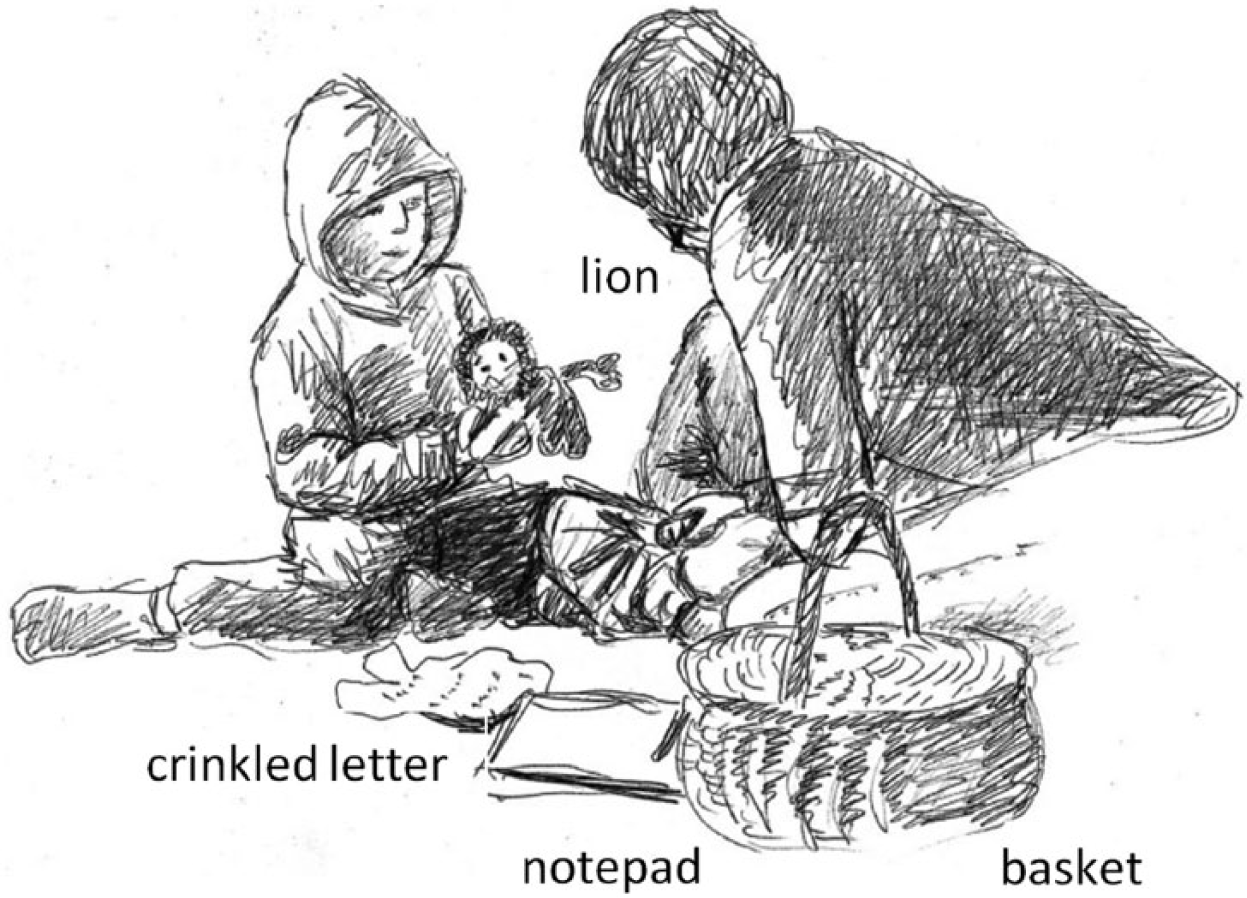
A teacher and two children (one partly hidden) in a conversation.
Chris and the children were sitting next to each other in a small half-circle, with Chris at one end, Robin at the other, and Sam in between them. In these positions Robin and Sam had an equally clear view of the things Chris presented. The physical positions, including the teacher lowering her upper body, could imply that the teacher and children were participating on more equal terms than they would be if one of them were facing the others or sitting farther away, or if the teacher was sitting more upright. This positioning could be understood as a way of encouraging the children to participate in the activity. Chris, however, was the apparent manager of the situation, introducing the project and in possession of some objects: a lion, a basket, a letter and a notepad. The children’s participation was thus framed by the teacher initiating the topic for the activity, by her presentation of the objects, by her spoken narrative and by the written information on the letter. Chris had an agenda of what to do, which was initially unknown to the children. Initiating the activity and possessing the artefacts could be understood as Chris being in the more powerful position. In this activity, the children’s views were important, yet the children had no real influence over the choice of topic nor over how they would document their views on the topic.
Robin stated that he would draw a lion, which Chris met with a contradictive response. After she told Robin that he could draw whatever he wanted, Chris suggested that he could draw the food or the lion eating (in accordance with a suggestion that the lion was growling from hunger). Chris also made a suggestion to Sam about what to draw, forestalling any ideas Sam may have imagined. This could be understood as contradictory in several ways. The discourse of the importance of children’s participation could also affect the situation. Chris could be seen as struggling between wanting to stay with the topic and at the same time wanting to let the children decide.
The product of the documentation (i.e. the drawing) seemed important, since it was supposed to illustrate the children’s thoughts. Drawing a lion could be seen as not really enough for this assignment. The documentation itself could thus be seen as an active agent in the interaction, determining what was possible to do. This made the relations uneven, which affected the children’s participation. The children were controlled by the teacher. The teacher in turn could be seen as controlled by the documentation, or by what the documentation was supposed to consist of.
In this situation, the children’s participation was framed by a number of things: by an agenda that was initially unknown to the children, so they could not participate in deciding on the topic; by the teacher’s possession of the objects, so the children were initially spectators rather than actors; and by the documentation itself, limiting what the children could draw. Although the activity focused on the children’s views and thoughts, and the teacher’s and children’s body positions were on an equal level, implying a high degree of participation, the structure of the activity limited participation. Even though the children were actively drawing, they were participating (or, rather, attending) without having any real influence on either the topic or how the activity was documented.
Activity 2: Making paper houses – participation as involvement
In the second situation, also an example of activity-integrated documentation, the teacher, Chris, had given three children, Alex, Nicky and Charlie, a task: to cooperate in constructing a paper house for the lion. The children sat at a low table while they worked, the teacher took photographs and notes during the activity. Afterwards they all moved to sit on the floor in a corner of the room. They talked about and evaluated the activity, using the teacher’s notes and the children’s paper houses (Figure 2). The children were then supposed to choose a photo to comment on and print. This discussion could thus be seen as the process that took place between the gathering of ‘data’ (documenting) and the production of a finished product (a document); that is, as a part of the documentation practice.

A teacher and three children evaluating an activity.
It took a while for Chris and the children to get organised, Chris was last to sit down. Nicky started to talk while Chris was settling; she stopped him and then asked him to start again:
Situation 2a:
…/ I think Nicky has started a little to tell, or show what he has made; would it be possible for you to consider doing this, Nicky?
mm, here, here is his [unclear] and here is his cabin.
The children were in possession of artefacts (paper houses). Since these artefacts were the focus of the gathering, the children holding them could be seen as holding a key to participation in this situation. The teacher/pupil-like body positions could be understood as placing the teacher in a position of power in relation to the children. The children’s participation might be expected to be somewhat obstructed by this physical arrangement. However, the teacher had clearly declared her own task of documenting the activity in advance. The teacher and children could therefore be seen as performing the evaluation on equal grounds, each knowing their different roles in advance, and their agendas could be presumed to be similar.
Nicky had already started to talk about what he had crafted when Chris stopped him and asked if he would possibly consider talking about this. Chris’s question can be interpreted as a way of clarifying to all of the children what they were supposed to do. Instead of telling the children to talk about the activity, Chris presented it as a question. Since the other children were supposed to talk later, the question could be understood as also directed to them, making sure they were included, telling them that this was what was expected of them. Therefore the question could be interpreted as a means to include all three children in the evaluation.
After the children described their creations, Chris asked them about cooperating, and the children expressed that they had cooperated by passing things to each other. Chris displayed a little reluctance, asking several questions about how they had cooperated and finally summarised the discussion:
Situation 2b:
But you forgot to build something together. But you made very lovely buildings. Charlie made a very lovely … den for, for the lion and Alex has made a lovely house. But you were not really happy that it would not stand up. We will maybe continue with this. And Nicky has made a lovely bed here in the cave …
Tomorrow we can go on with this, Wednesday.
… and a lion.
Yes, tomorrow I am going to a class, but on Thursday … we could carry on.
I don’t want to carry on because I am happy with mine.
You are happy with yours, but I thought that we could try to cooperate even with building eh, and building a hou …, a den for the lion?
Have already done that.
The notion of cooperation was clearly not shared. In Chris’s mind the children were supposed to build a house together, but the children had cooperated by sharing tools and material. Chris seemed determined to reach her goal, suggesting that they could continue another day, while the children felt that they had already completed the task. Thus, the children were involved in the evaluation, but their evaluation seemed to come second to Chris’s. The children had been informed about the purpose of their gathering, they had been asked to contribute to the evaluation and the teacher made sure that all of them were included. However, due to the physical positions (teacher/pupil-like, different body levels) and the teacher emphasising her own evaluation in favour of the children’s, the children’s participation can be understood as involvement without influence.
Activity 3: Guitar making and vampires – participation as influence
In this situation, an example of retrospective documentation, a teacher, Connie, and a child, Kim, were sitting in front of the computer looking at photographs in order to document a recent activity in which the children made ‘guitars’ using pieces of wood. Connie invited Kim to formulate captions for a photograph, but he seemed reluctant. Connie encouraged him by asking questions. Kim started to answer her questions, but stopped and said ‘I don’t know’, shrugged his shoulders, looked away and rubbed his eye, which taken together could be interpreted as expressions of lack of interest. Not answering, or answering ‘I don’t know’, can be understood as a way to avoid further questions (Hutchby, 2002). Connie’s questions became more and more specific, leaving less room for Kim’s descriptions. When Kim looked away, Connie pushed his chair closer to the computer (Figure 3), then paused, giving him an opportunity to answer, but he was still reluctant.
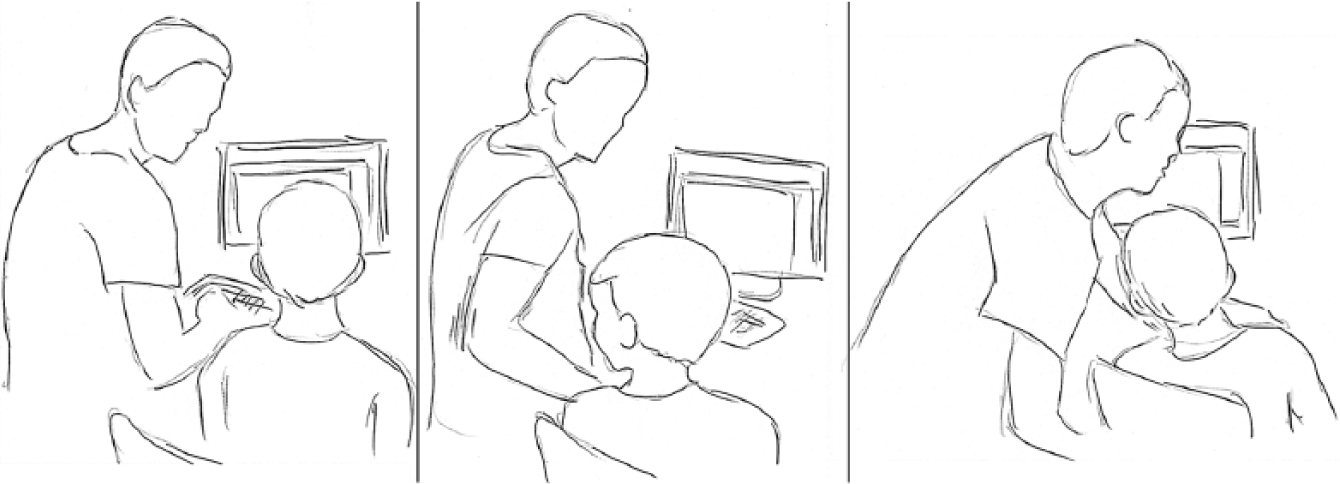
A teacher pushing a child closer to the computer.
Still, Kim remained next to Connie; he did not walk away. Connie pushing Kim’s chair closer to the computer can be seen as her trying to physically involve him when his interest slipped. Cekaite (2010) calls this physical direction shepherding, which in her study was used by parents as a form of control when words were not sufficient. Connie pausing can be seen as a way of making room for Kim to participate. A pause in a conversation can be a good strategy for involving children (Rydjord Tholin and Thorsby Jansen, 2012). Her agenda to document the guitar-making activity, however, did not seem interesting enough to induce Kim to talk.
When Kim did not show any interest in commenting on the guitar-making activity, Connie searched for photographs to interest him (Figure 4).

A teacher and a child at the computer.
Situation 3:
A photograph of Kim in a cardboard box came up on the screen. Kim leaned forward towards the screen and giggled. Connie asked him what it was and he pointed at the screen and answered that he was a vampire. Connie went on browsing the file (containing photos of Kim and other children playing with cardboard boxes), asking Kim about what they were doing. Then the ‘vampire photo’ appeared on the screen again:
I vampire there (points to the screen), I have red eyes.
Yes, you have.
Yes … and a sharp tooth … then I’m a vampire.
What do vampires do then?
Eats, eats … people.
Oh, no … then I don’t want you here … (in a playful tone, lightly touching Kim’s chin)
and …
… if you eat people
and an… and animals.
(Connie continues browsing the photos)
I’m a vampire, driving a car.
Ahaa! Can vampires do that?
Yeah.
Eh, I don’t know …
They can, the-they can tear cars apart.
What do they tear cars apart with then?
They have claws.
Yeah.
Connie browses these photos for a little while and then she turns to browse for other photos. After going through several files containing different photos from activities, Kim wants to return to the vampire photo again. Connie opens the photo and asks if they should do something with it, and Kim agrees. Connie inserts the photograph into a text document and starts to type.
Kim’s actions (leaning forward, pointing, talking about vampires) can be understood as him showing interest in the photo. Connie’s questions can be understood as encouraging Kim to tell her more about vampires. Kim’s interest in the topic seems to have made him more willing to speak. Connie’s recurrent browsing could suggest that the vampire photo was not interesting enough to her, implying that she and Kim had different agendas. Connie encouraged Kim’s interest through questions; her browsing, though, could be interpreted as indicating to Kim that documenting this was not worthwhile.
Kim’s participation finally resulted in a change of focus for the documentation. Connie and Kim can be seen as having different initial agendas, with Connie focusing on documenting a recent activity, but also focusing on Kim’s participation. It is impossible to know what Kim initially focused on, but he did not seem interested in documenting the guitar-making activity. Instead, his interest arose when he saw a photo that he thought resembled a vampire, which resulted in him creating a new story. Focusing on children’s participation in documentation here led to the production of a different kind of documentation than initially intended. Thus the child’s participation can be seen as active participation (see Sinclair, 2004) or influence, causing a different outcome of the documentation than initially intended by the teacher.
Discussion
Some researchers have suggested that a risk with documentation is that it can objectify children, putting them on display (Sparrman and Lindgren, 2010). Could enabling children to participate in documentation practice be one way to reduce this risk? In situation 3, Kim created a new story; instead of focusing on guitar making he created a story about something else. His narrative was thus about the character he seemed to play in the photograph, which resulted in the objective of the documentation shifting from Kim himself to his character, the vampire.
In line with the findings of other researchers, such as Sheridan and Pramling Samuelsson (2001) and Ekström (2006), this study found that children’s participation was restricted to certain areas. For example, children were not invited to participate in deciding on the topic or on the documentation method used in the lion-drawing activity, and neither did they participate in taking the photographs in the guitar-making/vampire activity.
A comparison of the drawings of situations 1 and 2a could at first glance suggest that the physical positions would enable participation more in situation 1 than in situation 2a. However, a closer look at the interactions revealed that it was the other way around. In this case, structure did not seem obstructive, which is in accordance with studies by Söderlind and Engwall (2005) and Kjørholt (2005) and opposed to the findings of Komulainen (2007). Instead, other elements affected children’s participation.
Declaring the purpose of the activity, as the teacher did in Activity 2, could be one way of affecting children’s participation by reducing the difference in agendas seen in Activities 1 and 3.
An element found to enable children’s participation was children’s interest, apparent in situation 3 where Kim’s interest determined what was documented. Rydjord Tholin and Thorsby Jansen (2012) also argue that children’s interest in a topic is important for their participation. In a study by Bjervås (2011), teachers indicated that sometimes children showed no interest in certain kinds of photos while documenting, which was initially the case in the guitar-making activity.
An additional element was the teacher’s flexibility, which was obvious in situations 2 and 3, where Chris maintaining her version of the evaluation can be seen as making the children’s participation more like involvement than influence, while Connie changing her objective promoted Kim’s influence.
Children’s influence in the documentation process was affected by teachers’ ideas of what should be documented and how. Thus the products of the documentation became an objective for the documentation practice. One purpose of documentation was to produce a paper that could be displayed on the wall or put into a binder. If teachers’ intentions about documentation are essential, children have to be controlled, otherwise the products of documentation might become something other than what was intended or perhaps they may not be made at all. This compels teachers to control the children, which is problematic from a participation perspective.
This study set out to explore children’s participation in preschool documentation practices, and the results indicate that documentation is a complex pursuit affected by a number of elements. It presented three examples of how participation can be enacted in preschool documentation practices, from two different approaches to documentation. Using activity-integrated documentation, with children’s views on a topic in focus, did not automatically give children real influence in the documentation process; instead, the children participated in a passive way, to an even greater extent than described by Sinclair (2004), who claims that being listened to and consulted is a passive form of participation. In Activity 1 the children were ‘attending’ rather than fully participating in the documentation activity. They may very well have influenced the documentation process later, evaluating and developing the project; however, this was not the focus of this study. In Activity 2 the children were more involved and were asked to participate in evaluating the activity. In Activity 3, which was a retrospective documentation, that is, an evaluating form of documentation practice, the child was found to have a real influence on the outcome of the documentation process. The portfolio approach, in this case, therefore functioned more in line with the way pedagogical documentation is supposed to, supporting discussion and reflection between teachers and children.
Thus, the study shows that different documentation practices did not match their theoretical connotations, implying different kinds of participation. Instead, the complexity due to questions of what to document, differences in teachers’ and children’s agendas, children’s interest, the degree of teachers’ flexibility and the notion of what documentation is, affected children’s participation in the documentation process. This implies that for enabling children’s participation, how teachers respond to children’s initiatives is more important than which form of documentation is used.
Footnotes
Funding
This work was supported by the Swedish Research Council /Educational Sciences (grant number 729-2010-200).