



Abstract
Understanding how best to nurture children’s respect for, and care of, other living beings is a concern within education and animal welfare science. Relationships with individual animals are often seen as a ‘bridge’ to caring about the broader environment (of people, animals and ecosystems). However, little is known about children’s actual care of the animals they know best. Focus groups explored 7- to 13-year-olds’ caring activities and sense of responsibility to care for family pets, with findings highlighting the strong influence of parental roles and restrictions, the significance of play as a form of care and reluctance to take responsibility.
The empirical research reported in this article was undertaken in the early stages of a multidisciplinary study (that draws on child development/childhood studies, education, health and animal welfare science). The exploratory nature of this research on the ways children say family pets are cared for led to insights that have hitherto not received adequate attention in the field of child–animal interactions.
Understanding children’s care of animals: A relational perspective
Care about individual animals develops ‘naturally’ out of relationships. It involves being open to the other’s needs, truly putting the other’s needs first, and perceiving the other’s response to care. (Myers and Saunders, 2002: 173)
Family pets are a good place to start when considering how best to encourage children’s care of other living beings. Previous research has linked childhood involvement with pets with later animal welfare concerns and ecological sensitivity (Melson and Fogel, 1996; Paul and Podberscek, 2000). Many studies also focus on links between pet ownership and empathy (Daly and Suggs, 2010). It is therefore assumed that the nurturing of pets leads to better care of both human beings (Melson and Fogel, 1996) and the natural world (Myers and Saunders, 2002). Indeed, the view of petkeeping as a means of ‘cultivating the instinct of benevolence’ has a long history (Grier, 2006: 176).
Because pet–human relationships have a ‘close-lived’ nature (Fox, 2006) and early moral development targets close individuals as objects of care, Myers and Saunders (2002) suggest that care of animals originates with childhood pets. Direct interaction, they argue, is the foundation for ‘natural’ care (Noddings, 1984); an indispensable precursor to caring about those with whom we have no personal connection. Natural care is an ‘outgrowth’ of relationships and love: ‘if you care about another – whether human or animal – you are likely to care about what that individual needs and the conditions that affect his or her wellbeing’ (Myers and Saunders, 2002: 154). As far back as 1869, Beecher argued that ‘it is animals’ own displays of affection that awaken corresponding tenderness and care in children’ (Grier, 2006: 177). However, within the social sciences (especially research with children), the reciprocal nature of this relationship has been neglected. Instead, animals are viewed merely as ‘catalysts for human development’ rather than ‘as individuals with whom children relate and for whom they care’ (Tipper, 2011: 149).
What do we know about children’s relationships with, and care of, pets?
Individual child–animal relationships are overlaid by, embedded within, and constructed in relation to the many other social relationships in children’s lives. (Tipper, 2011: 162)
Pets are highly emotionally salient to children. This is particularly evident in research studies of children’s social lives, where researchers have not asked explicitly about animals but about people who are important to them (McNicholas and Collis, 2001; Morrow, 1998; Tatlow-Golden and Guerin, 2010; Tipper, 2011) and things that make them feel good about themselves (Chaplin, 2009; Elsley and McMellon, 2010; Gabhainn and Sixsmith, 2005). Like many adults (see Charles and Davies, 2008; Fox, 2006), children see pets as family members; differentiating ‘animal’ from ‘human’, but not drawing a clear distinction between their animal and human friends or kin (Myers and Saunders, 2002; Tipper, 2011). However, the child–animal relationship has a distinctive character in that it does not involve the same pressures and restraints that exist within child–adult relationships (Tipper, 2011). Perhaps because of this, children readily express deep affection, in contrast to adults’ tendency to avoid revealing ‘too close a relationship’ (Charles and Davies, 2008: para. 5.6) for fear of being viewed as childish or incapable of forming relations with other humans. This suggests that as children grow up, they somehow lose a prior connection with animals through the mechanism of psychological distancing or ‘desensitization’ (Myers and Saunders, 2002).
While we know that preadolescent children benefit from, and enjoy, their relationships with pets, we do not know whether their concern (caring about) translates into action (caring for) and a sense of responsibility (Chawla, 1988). Studies have captured what children anticipate doing rather than what they actually do, although some children do talk about pets with an air of authority and competence (Tipper, 2011). Research with parents has shown that they typically acquire a pet to keep their child company or teach them care for another living being. However, children do not automatically take responsibility even when they asked for the pet (Fifield and Forsyth, 1999). Indeed, once a pet joins the household, it seems difficult for families to define and implement a plan of care (Bryant, 1990). Additionally, there has been little interrogation of what it means to provide ‘care’. Children may be encouraged to adopt an affectionate relationship leading to unrealistic expectations about practical aspects of ‘care’, given the ways animals are introduced in the early years (Johnson, 1996; Paul, 1996). Bryant’s (1990) research found that children did consider some routine pet needs or behaviours bothersome or stressful. However, parental rules and views about the pet were a greater source of frustration. They described ‘getting into trouble’ for not treating pets properly and even feeling mistreated if the parent spent more time with the pet than them. This supports Tipper’s (2011) view that the child–animal relationship is complexly entwined with intergenerational relationships.
On the other hand, Melson (2001) argues, ‘what is remarkable about the theme of nurturing pets [at least in Western cultures] is how seldom children employ this vocabulary of caregiving when they talk about other children, parents, siblings, friends, relatives or teachers’ (p. 51). She contends that pets may provide the only culturally acceptable opportunity for children today (and boys especially) to become caretakers and not just recipients of care (see also Morrow, 2008). However, as Bryant’s research suggests, it is possible that children are not free to care for their pets or take responsibility in the way they want.
What shapes or constrains children’s caring activities?
Pet care is likely to be influenced by cultural expectations which encourage certain kinds of behaviour. (Morrow, 1998: 225)
Children’s knowledge, attitudes, attachment and caring behaviours with respect to animals are inevitably influenced by key role models in their lives, particularly parents and perhaps older siblings. It is important to identify how various sociocultural influences interfere with the development of ‘natural’ care considered crucial by Myers and Saunders (2002). We have already alluded to the influence of age, as well as intergenerational factors in the work of Tipper and Bryant. Their research emphasises the role of family and children’s subordinate position therein and raises questions about children’s agency as far as pets are concerned. Parents may explicitly prevent children (especially the very young) taking an active role in caring for pets, perceiving risk of harm either to child or animal (Melson, 2001). Adult discourses about children and animals are also likely to have a significant, but perhaps less obvious, effect on how children experience their relationships with pets (Tipper, 2011). Furthermore, care among adults has been found to be highly selective, in that affection is only lavished on certain kinds of animal, with care often being withdrawn when animals fall short of owners’ expectations (Fox, 2006).
Children may live in a household where some family members are close to animals and some are not; hence children’s propensity to care may well depend on with whom they identify. In this respect, gender may play a particularly influential role. Girls are expected to be nurturing and this may well be played out in their relationships with pets (Morrow, 1998), whereas boys may be more guarded in their expressions of affection for animals, for fear of being considered ‘feminine’ or ‘childish’ (Tipper, 2011). Similarly, while describing animal care as ‘gender neutral’ (i.e. culturally acceptable for boys), Melson and Fogel (1996) argue that gender differences ‘are restricted to those targets that are linked to gender-role expectations’ (p. 103). Mothers appear to be the main caregivers of family- and child-owned pets (Fifield and Forsyth, 1999). Therefore, girls may use the language of ‘care’ and take more responsibility as part of a broader household/family orientation (Charles and Davies, 2008; Grier, 2006; Melson and Fogel, 1996).
Understanding how to encourage children to care and take responsibility for the welfare of animals depends on first establishing how children currently care for the animals they know and the identification of factors that constrain caring activities. In doing so, this article responds to calls to more closely examine the care/responsibility aspect of pet friendship during childhood (Davis and Juhasz, 1995; Melson and Fogel, 1996).
The present study
The data presented here were generated during a UK Department for Environment, Food and Rural Affairs (Defra)–funded project that explored how a duty of care might be promoted among children. The ultimate aim was to develop an evidence-based intervention to enhance children’s knowledge, attitudes and behaviour with respect to animals. To this end, the preceding part of the project involved extensive literature reviews and three empirical child studies to address some identified gaps. As part of our initial work, we decided to use focus groups as a means of exploring children’s views around issues relating to their care of and responsibility for pets. At the same time, we explored existing knowledge about the welfare needs of common pets and attitudes towards animals more generally (to be reported elsewhere).
The following research questions guided the second half of the focus groups that focused on care and responsibility:
To what extent do children care for family pets, particularly relative to other members of the family?
What kinds of pet care activities are children involved in?
What barriers to caring are identified by children? Are other barriers evident from children’s talk?
To what extent do children allude to gender and age as influential with respect to pet care?
Whom do children hold responsible for family pets and to what extent do they take personal responsibility?
Methods and data analysis
There were several reasons for choosing focus groups for the initial child study: first, to explore children’s attitudes and ‘unfiltered perspectives’ (Charlesworth and Rodwell, 1997), which are more likely revealed within this context than in individual interviews (Barbour and Kitzinger, 1999). That focus groups often resemble ordinary conversations when group members know each other was seen as key to helping identify (1) how ideas are formed around issues of care and responsibility and (2) the influence of family and gender. From a more pragmatic perspective, they were the most expedient route to scoping children’s perceptions with a view to identifying themes to pursue in our later work. While there are limitations to focus groups (particularly as they can be biased towards more vocal children), the researcher facilitating the groups was very experienced with this method and the general approach throughout was informal and conversational. It should be noted that the topic was particularly stimulating and every child contributed openly to the discussions. The challenge was ensuring enough ground was covered, as they were so keen to tell their individual animal stories in great detail.
The planned sample for the study included equal numbers of boys and girls across four age groups, extending into secondary school, acknowledging that different factors are likely to constrain caring activities at different ages. This sample was not achieved as a result of schools’ arrangements and changes of plan on the day. Therefore, the final sample (see Table 1) was skewed towards the females: 53 children (30 girls and 23 boys) aged 7, 9, 11 and 13 years. Four children participated in each same-sex group, with the exception of two groups of girls and one group of boys. They attended one of three schools in Fife, Scotland (two primaries and one secondary) that were closely situated and matched according to their socio-economic status (medium). The semi-rural location of the schools meant that several children lived on farms or owned horses and these animals were included by children in response to questions about pets. Indeed, we use the term ‘family pets’ throughout because children identified ‘pets’ as animals that belonged to the family. Of the 53 children, 42 (79%) were current owners (i.e. one or more animals shared their home or, if parents were separated, one of the parental homes. This also included those who had a horse or lived on a farm). All the pupils were of White and British origin.
The distribution of the sample.
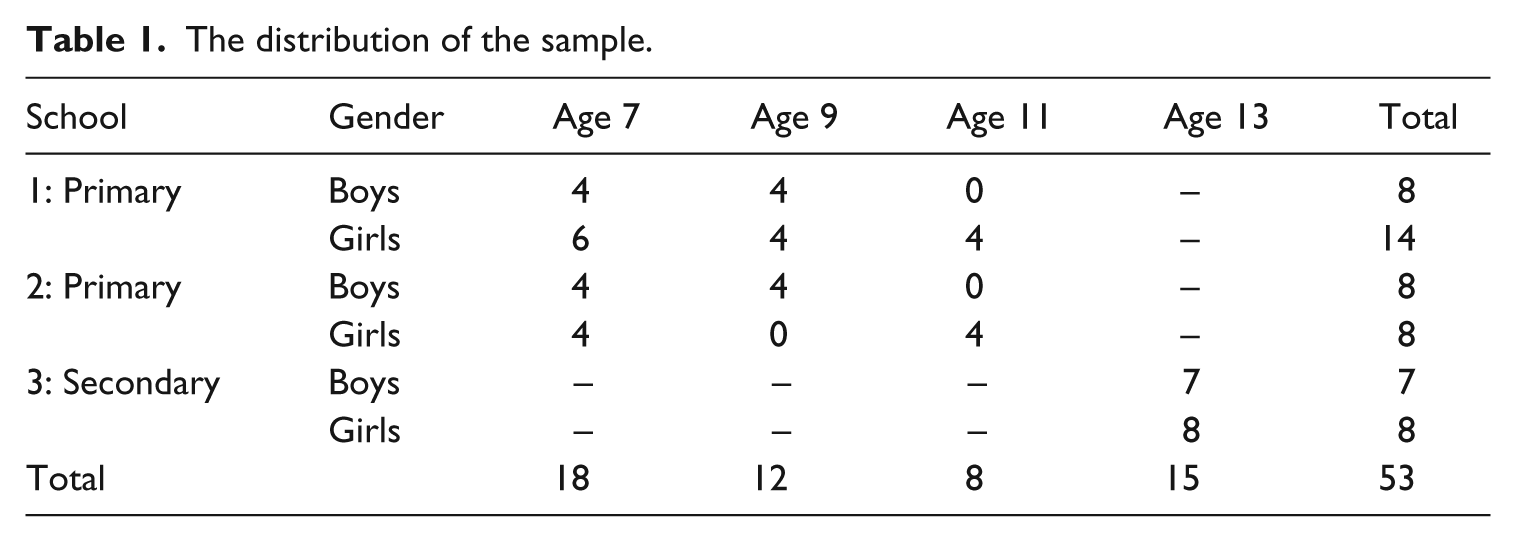
The first half of the groups focused on attitudes and knowledge while the second half, the focus of this article, looked at care and responsibility. Discussion was structured around three questions relating to care: Who looks after the pets in your family? Do you look after them at all and what do you do? Is there anything you would like to do for your pets that you are not able to do at the moment? Two activity sheets were used to explore how children viewed responsibility. They asked children to highlight on a diagram, first, who they thought usually looked after animals in a typical family, and second, who should? We wanted to assess here, with the first sheet, whether gender played a significant role as suggested by the literature. The second was used to investigate attitudes towards responsibility and the degree to which they felt children should take responsibility. We were interested in how children responded to the concept of ‘owner’ and whether they considered themselves owners. As this was the latter half of the discussion and some groups were cut short due to school requirements, only 15 of the 23 boys were explicitly asked about responsibility. Nonetheless, it was discussed spontaneously in the two remaining groups. The groups ranged between 40 and 60 minutes and took place during a normal school period, sometimes running into breaks. They were audiotaped and transcribed in full, and pseudonyms were created for each child.
A general inductive approach (see Thomas, 2003) was taken to analyse the data. Briefly, this involved thorough reading and rereading of transcripts and immersion in the data from each group, making notes on hard copies of common or unusual themes and drawing up summaries. To aid retrieval and organisation of data, codes were assigned using the computer package NVivo. Summarising matrices were drawn up to identify the extent to which issues arising within one group were apparent within others. Individual transcripts were revisited to understand children’s meaning in the context of the broader conversation. During this process, gender and age differences were identified. We were concerned, as the research questions suggest, with whether and how children identified these factors, alongside family, as influential.
Findings
Children’s caring activities relative to other family members
Doing ‘everything’ versus ‘just playing’
When asked what role they played in caring for their pets, many children referred to affection (cuddles, stroking) as well as play, while others, even when they said they did a lot, were extremely vague about specifics. Other tasks mentioned were as follows: filling up food/water, walking the dog (with others), letting the dog out, cleaning out (although usually a disliked and avoided task), brushing, protecting (from other animals or siblings), breaking ice on horses’ water and buying food. There was wide variation in the degree to which children looked after family pets. Some children (mostly younger boys) reported, with some negativity, doing ‘everything’ (due to parental rules or disinterest). Pupils who lived on farms or had horses, it seemed, were required to take responsibility and displayed far more knowledge of the details of looking after their animals:
Who usually looks after pets do you think?
Children, because I always have to feed all of the animals, we have to always clean them out and we have to do it until eight ‘o’ clock (7-year-old boy).
*
I have to do it all the time twenty four hours a day. I need to muck my pony out, then I need to give it fresh straw and hay and then I need to clean its water, then I need to gloss it and then I need to put its indoor rug on. Then I need to go home and do my rabbit.
Do you get any help Callum in caring for your animals?
My mum does her feet but I have to do all the other things (7-year-old boy).
At the other end of the spectrum, there were children who just played with animals. Indeed, play was typically viewed as the child’s role in caring for the family pet:
Because mums sometimes do some things and then dads sometimes do others and then the children might play with them (7-year-old girl).
*
She (mum) cleaned it and I just played with it (13-year-old girl).
Arguably, children were very honest in admitting that they personally did not do much or did not provide consistent care (i.e. ‘always’ look after the pet). Moreover, those who reported often playing with their pets, but only occasionally contributing to other aspects of pet care, spoke with more warmth and love for their pets than children who said they had to do ‘all the jobs’. One obvious inference is that children who ‘get the nice jobs but not the bad jobs’ develop the warmer relationships with those pets. In cases where parents either refuse to help the child or insist the child does everything, the pleasure of pet ownership is diminished.
‘That’s what mums do’: the influence of gender roles
While other family members and neighbours cared for the family pet(s), the majority of discussion centred on parents, with almost twice as many references to mums’ care of pets than dads’. According to the children, dads were involved in buying food, walking dogs, playing and having a more instrumental interest in the animal(s), in line with adult attitudinal research (Kellert, 1980). Some children even made reference to dads purporting not to like the family pet(s) and it was fairly common to be critical of dads’ minimal role in family-related tasks:
My dad’s always so fussy with everything, he’s just got loads on his mind and he just never has time to play or anything, and he’s got work going on and he just doesn’t have time to do anything (7-year-old girl).
Mums, by contrast, were reported as being more involved in everyday activities with pets, especially cleaning out, which was compared with household chores or even (by the boys) childcare. This is perhaps no surprise, given the ‘disproportionate investment’ of women in caregiving duties (Melson, 2001: 54). However, for some boys, their involvement was an unquestionable fact, something mums just do. This was powerfully confirmed later in the focus groups when asked who they thought should look after pets:
I’d probably say the person who it belongs to, because it’s their responsibility and mums because that’s what they normally do.
Do you think that’s what happens quite often, mums do everything?
Yes.
Why is it mums do you think?
Because they look after the kids when they’re small quite a lot of the time.
It’s a bit stereotypical.
It’s just like looking after a really small kid (13-year-old boys).
There were boys who were adamant they would not clean out animals. When this is understood in the context of both the adult literature and the associations outlined above, it suggests that the older boys in this sample were starting to distance themselves from supposedly feminine roles.
‘We’re not allowed’: The significance of parental rules
Children provided reasons why they could or would not do certain things for their animals, although often not in the context of our explicit question. There were numerous references to avoiding tasks deemed ‘disgusting’, particularly cleaning out. Children also described the behaviour of individual animals as an impediment (e.g. dogs not interacting well with other dogs, having a ‘wild’ horse, their perception that the animal does not like them, being fearful of the pet/uncertain about its behaviour). However, more prevalent were issues relating to parental rules (not being allowed to take on particular duties) and (to some extent the opposite) parents refusing to help them look after the pet. Children alluded to age and this appears highly related to the disaggregation of tasks and responsibilities within families.
There was a widely held belief that young children lacked knowledge of how to look after animals properly and needed to be taught or ‘trained’. Often, children explained that they were ‘not allowed’ to do certain things for the animal, so predictably felt adults were responsible for animals. Yet there was recognition among some that they may not have cared for animals properly when they were younger and that small children see animals as toys. Only one girl felt the opposite (see second quotation below), again no surprise given the work parents undertake to ensure children are careful and kept safe:
Children can sometimes be a bit silly with them. Not us children but little children. They try to care for them but they’re not very good at it.
Sometimes they’re lovely.
They try to, but I think more mature people try to care for them but children just try to play with them for the children’s fun, not for the dog’s fun. They think it’s a toy (11-year-old girls).
*
The reason why I ticked children is because although they can be little, they’re not that stupid or silly. I read this in a newspaper or on telly, smaller children actually respond more to animals like dogs, because they just click (11-year-old girl).
Interestingly, the idea that younger children only play with the animal (for the child’s fun) and do not care for them in other ways was often invoked and used as a justification for the argument that ‘little ones’ should not be allowed to care for animals. However, no one (even the 7-year-olds) thought that they personally were incapable. It is possible that these explanations, although often based on their own observations, were also repetitions of parents’ ‘rules, boundaries, proprieties and prohibitions’ that Tipper (2011: 152) views as prominent for children. Naomi (a 13-year-old girl) described how her pet animal had been taken off her, as she played with it but ‘couldn’t be bothered cleaning it out’. This appeared to have led Naomi to believe (very atypically) that even young people should not look after animals. Another group of boys showed how issues of blame for an animal’s downfall might also contribute to children avoiding responsibility:
Just in case mum and dad forget, then it would be the person who it belonged to that would get the blame for not looking after it.
Who would blame them?
Probably the mum and dad. If I say ‘Mum, dad my fish or rabbit or guinea pig is not doing very well’ they might say ‘it’s your fault, you were meant to look after it in the first place’ (9-year-old boy).
Children’s beliefs about responsibility for pets
The final pair of questions asked children to confirm who they felt was usually responsible for pets within families and then consider who should be responsible. The second question was used to ascertain the extent to which children felt they should take personal responsibility. Responses to the two questions are summarised in Figure 1 for girls and Figure 2 for boys. For both questions, children could choose from ‘mum’, ‘dad’, ‘children’, ‘owner’ and ‘other’ and were free to tick more than one option.

Percentage of total nominations for the two questions regarding responsibility (girls).
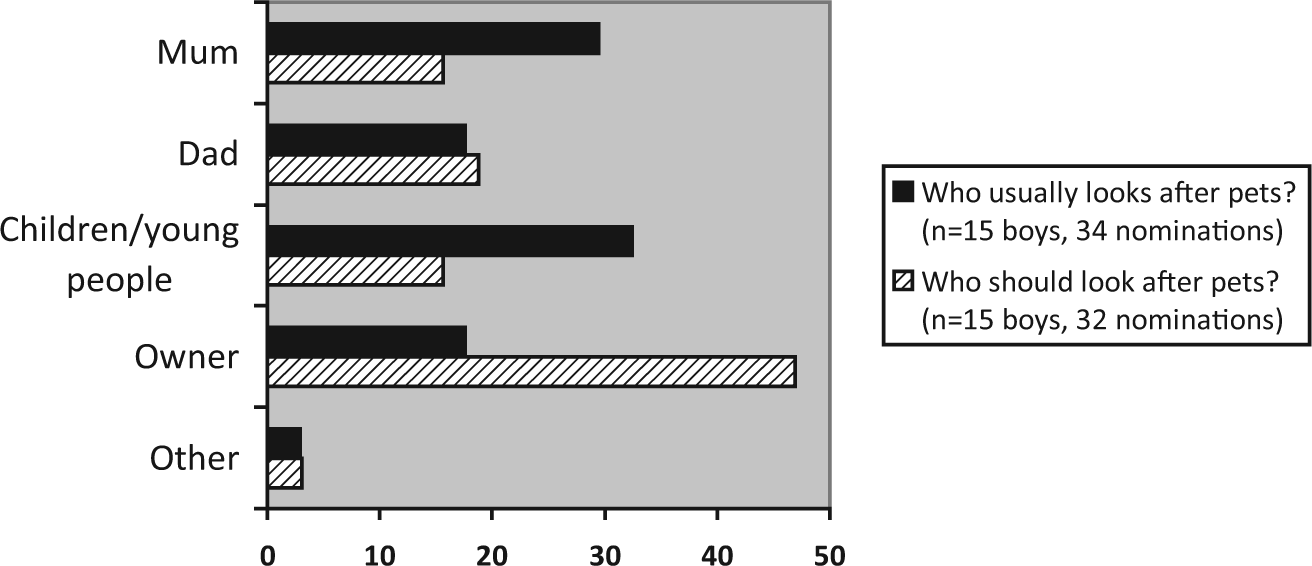
Percentage of total nominations for the two questions regarding responsibility (boys).
Figure 1 shows a relatively even distribution of responses for four of the five choices, with few girls agreeing that pets were usually looked after by some ‘other’ person. However, when looking at differences between the two questions within each option, it becomes evident that girls are far more likely to agree that pets should be looked after by their owners, and not by the children’s parents. Frequently, pets were seen to belong to the child, so by inference, they were construed as the ‘owner’:
Can I just say, if your mum bought it for you I think it should be the child because it’s your responsibility (7-year-old girl).
Importantly though, through discussion, girls very quickly came to the conclusion that responsibility should be shared, with almost unanimous agreement that every family member should help to some degree:
Emily you’ve chosen everybody, which is really interesting.
I’ve chosen everybody because if a pet comes into the family, although the person who it belongs to, you should really share the pet amongst the family who lives in that household with it and they should all take just a little bit of responsibility together.
I kind of agree with that even though I’m not the one that does. If they all play with it they should all help and take care of it (11-year-old girls).
Turning to boys, the distribution of responses to the first question is visibly different to that of the girls (see Figure 2).
Boys were far more likely to report that pets are usually looked after by children and/or mum than by dad. Like girls, they rarely felt that pets were looked after by some ‘other’ person and agreed that it was the owners who should be responsible. Indeed, the boys seemed adamant that responsibility lay with the owner and did not invoke the notion of shared responsibility as strongly as girls.
On the surface, these findings point to a consensus among children that owners should take prime responsibility for pets. However, the question of ownership is problematic. While the majority of girls (and some of the boys) identified the child who asked for the animal as the ‘owner’, it is still difficult to make the distinction called for by Fifield and Forsyth (1999) between ‘family-owned’ and ‘child-owned’ pets. Boys may even differ from girls in their concept of ‘ownership’:
Well they’re sort of the family’s [animal] but I’m the one who wanted it.
It’s my sister’s pet, she brought it home, but she doesn’t do anything for it (13-year-old boys).
In some cases, children are told explicitly by parents that the pet is theirs and they need to take full and sometimes sole responsibility for it, but this is relatively unusual. In most families, boundaries and roles are blurred.
Discussion
This study explored children’s perceptions of their roles and responsibilities with respect to family pets. As children were inordinately keen on the topic of animals, expressing a desire to understand their animals better, they are clearly receptive to learning about animal needs and care. Yet, we have found that pet care within the family is complicated and it is important to disentangle and address issues that prevent children taking an active role. We have highlighted three areas worthy of further investigation: the meaning of ‘play’, the significance of family and the responsibility dilemma.
The meaning of play: Play for the child versus play for the animal
While adults make the distinction between play and care (Melson and Fogel, 1996), children do not. Play, at least for the girls in this sample, was a legitimate form of care, a way of showing love and preventing boredom in the animal. In some ways, this belief may reflect the importance of play to them (Glenn et al., 2013) and how much play is viewed as part of the care they receive from parents (Booth and Jernberg, 2010). Simultaneously, girls criticised those who were younger for ‘just’ playing with the animal, while defending their own (playing) role. It seems older girls are alluding to a different form of play that is, as Sophie explained, for the animal’s fun as well as the child’s. Play, then, is seen by children as important to the animal (an animal need) and perhaps needs to be recognised as such by adults. However, is it sufficient for children to take on this role and not other forms of pet care? This model of care in the family seems to promote positive attitudes and affection, especially among primary school-age children. Giving children more jobs or sole responsibility detracts from the joy of pet ownership and perhaps raises anxieties. Nevertheless, what if, by focusing on more pleasurable aspects of pet care, an unrealistic picture of ownership and responsibility is engendered? Alternatively, if the child’s play with an animal strengthens their relationship in ways that mirror the effects of parent–child play (Ginsburg, 2007), this perhaps leads the way into other forms of care (see Myers and Saunders, 2002).
The significance of family: Roles and restrictions
Children clearly show concern about their pets. However, this does not necessarily translate into action. For this to happen, Chawla (1988: 17) argues that a number of conditions need to be met. Drawing on the work of Mussen and Eisenberg-Berg (1977), she suggests that children need to (1) know norms of reciprocity and responsibility, (2) perceive another’s needs and interpret them accurately, (3) recognise that help is possible, (4) feel competent to do what is needed and (5) estimate that the cost entailed in helping will not be prohibitive. Children in this study clearly knew norms of reciprocity and responsibility; girls in particular felt everyone should contribute to looking after pets in the family, especially if they enjoyed playing with them. However, the findings point to problems with the remaining conditions because parents are preventing children from taking an active role in the way they handle pet care issues.
On the one hand, children expressed frustration when parents did not help them or insisted they have full responsibility (Bryant, 1990, reports similar findings). On the other hand, and more prevalent in children’s talk, was parents not allowing them to care for the animal. It appears that trust is an issue here. While most parents understandably want to safeguard their children and their animals, refusal to let children take responsibility where they want to (with support) ultimately sends the message that they are not competent enough. If this is the case, how can we expect children to develop responsible attitudes and behaviour? This conclusion accords with Morrow’s (2008) discussion of the social context around children caring for siblings. Here, she suggests, there is reluctance on the part of parents to give children credit for the caring work they (are able to) do. Family (adult) disaggregation of tasks and responsibilities therefore appears to have a strong link to children’s behaviour, given the importance in children’s eyes of rules, boundaries, proprieties and prohibitions (Tipper, 2011).
The costs associated with helping may be considered especially prohibitive if they have implications for a child’s gender identity and feelings about self. Tipper (2011) argues that there is much to be explored about how gender and generation overlap in children’s experience of their relationships with animals and our research supports this view with respect to care. Far from being ‘gender neutral’ (Melson, 2001), we found that children are keenly aware of the types of ‘jobs’ undertaken by mums and dads and the differential ways they interact with pets, with some boys strongly asserting that they did not (and would not) clean out pet animals (also reported by Myers and Saunders, 2002). We can only anticipate that this avoidance of tasks associated with ‘mums’ intensifies with the increasing pressure to conform to adult gender stereotypes that accompanies the move into early adolescence (Chawla, 1988). The degree to which this explains a distancing from involvement with animals that appears to occur at this time (see Mathers et al., 2010) is yet to be ascertained. It should be noted that disgust also plays a role in the avoidance of particular pet care activities. Uncertainty about animals’ behaviour is another barrier for children, which would almost certainly be eliminated if children had sufficient knowledge of animal needs and were taught how to identify behavioural cues and act in response (Chawla, 1988).
A note on rurality
It is interesting that children who lived on farms or those who were viewed by parents as the ‘owners’ of the animals felt they were expected to have sole responsibility, while in more typical families, children were often restricted from actively caring for their pet. It suggests that within these different families there are distinct attitudinal patterns governing behaviours towards animals. Within farming families and perhaps very rural settings, it is possible that animals are viewed and treated either more instrumentally or given greater independence. They may not be viewed as ‘babies’ to be protected or ‘possessions’ in the way that many adult pet owners relate to the animals that share their homes (Charles and Davies, 2008; Fox, 2006). This is clearly an important area for future research on how general attitudinal patterns translate into different forms of caring behaviour.
The responsibility dilemma
When deliberately reflecting on the ways humans should care for animals, children (girls in particular) believe everyone should play a role. However, alongside this well thought–through morally ethical stance, they more spontaneously refer to not caring that much for animals in their household. The contradiction between believing everyone should take a role but not contributing yourself (voiced explicitly by Serena – see the section ‘Findings’) highlights further complexities with the care of family pets. The owner is often not defined. Neither are roles and responsibilities, unless there is a clear-cut definition of the owner as the child who wanted the animal. Children may want to take more responsibility, but their feeling of not being allowed or being blamed may culminate, as suggested earlier, in them feeling they are not competent enough to care for pets. As Tipper (2011) argues, ‘children’s reflections on their relationships with animals draw on their understanding of their social world and their position within it’ (p. 161). Understanding how to influence the parental role is therefore imperative if we want children to take more responsibility for the care of animals.
Parental roles aside, it is also possible that children see their pets rather differently from the rest of the animal world, as pets have been described as occupying ‘a liminal position on the boundaries between “human” and “animal”’ (Fox, 2006: 526), valued for their ‘animalness’ but also treated as ‘little humans’. Returning to the issues with which we began this article, several questions are raised by our study. First, is a consequence of having a close relationship with a pet (perhaps developed primarily through play) that children only see them as a friend (and or equal) and not as someone who is dependent on them? The generalisation of care from particular animals (where natural care develops in the context of a close relationship) to the wider animal world requires more of a ‘justice’ orientation (Myers and Saunders, 2002). Here, there is recognition of moral obligation, that we might have do things that we do not necessarily want to. Do we therefore need to explicitly encourage this orientation in tandem with the development of close child–pet relationships? Moreover, how might this be reconciled with the restrictions imposed by parents and the roles and behaviours they model?
Linked to these questions, our findings are strongly suggestive of a role for educators in developing a model of care that specifies the sequence of activities children can be encouraged to engage in to move towards more comprehensive care. Guidance for parents on how to manage the process of allowing children more and more responsibility may be particularly useful. A fine balance needs to be struck between educating children on the full gamut of caring for a pet, while supporting them so they feel responsibility is, and should be, shared and not solely in their hands.
Conclusion
Playing with a pet animal may provide the direct interaction necessary for children to develop a ‘natural’ way of caring for them. However, parents may be inhibiting this process because they restrict children from looking after pets in other ways or they expect too much. In most families, there are blurred boundaries around ownership and roles that add further complications. If natural care of pets is an indispensable precursor to caring about the wider animal world, there is a pressing need to further scrutinise issues raised by this exploratory research. The proposition that play strengthens the relationship between child and animal in a way that leads them to look after pets in other ways is certainly worthy of further study. Whether or not the meaning and significance girls apportion to play and shared responsibility also applies to boys needs to be ascertained. Boys may also differ in the way they conceptualise ‘care’ and ‘ownership’. However, a clear priority is the investigation of the family context (including geographical differences), particularly the ways in which restrictions are imposed and children socialised into gendered roles with respect to pets. As parents appear so influential here, it seems vital to include them in any interventions targeting children.
Footnotes
Acknowledgements
We would like to thank the schools and children for participating in the study.
Funding
This work was supported by the Department for Environment, Food and Rural Affairs (grant number AW1404).