



Abstract
Among the research, practice and socio-legal commentary on the substantial sharing of parenting time after separation, children’s voices about their experiences remain overwhelmingly silent. This article draws on findings of a descriptive phenomenological study which investigated Australian school-aged (8- to 12-year-old) children’s descriptions of two binary phenomena: security and contentment in shared time arrangements, and the absence of security and contentment in shared time parenting. Specifically, this article focuses on exploring parental behaviours and interactions recognised by children as sources of security in shared time lifestyles, through happy and needy times. Central to this is the juxtaposition of the child’s experience of security and shared enjoyment with the present parent, against the absence of security emanating from unresolved longing for the ‘absent’ parent. The article provides an empirically derived formulation of children’s advice to parents about shared time parenting, with relevance for family law related parent education forums.
Keywords
Introduction
Across a range of countries, general population statistics of children’s post-separation care arrangements reflect increasing percentages of children living in ‘shared time’: 1 16%–17% in Australia (Kaspiew et al., 2009; Smyth, 2009), 32% in the American state of Wisconsin (Melli and Brown, 2008) and 30% in Sweden (Carlsund et al., 2012). The latency years (aged 5–11 years) are the most highly represented age group in shared time (26% of children in Australia) (Kaspiew et al., 2009). Over the past two decades, a diverse range of jurisdictions have all considered, and/or implemented to differing degrees, legislative presumptions of shared time parenting. In 2006, Australia (from where this research emanates) introduced the 2006 Family Law Amendment (Shared Parental Responsibility) Act, which requires consideration of shared time parenting when the rebuttable presumption of shared parental responsibility is upheld.
Attitudinal surveys of separated parents (Braver et al., 2011; Fabricius et al., 2010; Kaspiew et al., 2009) confirm increasing community acceptance of shared time as a desirable post-separation living arrangement for children. Some question whether the equation for children is straight-forward (McIntosh and Chisholm, 2008; Pruett and Di Fonzo, 2014), particularly in high conflict separation (Modecki et al., 2014). There is consistency between recent reviews of research evidence about family and parenting qualities associated with well-functioning shared time arrangements (e.g. Fehlberg et al., 2011; McIntosh and Smyth, 2012; Smyth, 2009; Trinder, 2010). These authors largely concur, for example, that parents with demographic and relationship advantages (namely higher education, higher income, higher cooperation, child-orientation and flexibility) are more likely to self-select into shared time, and more likely to establish and maintain arrangements which meet children’s overall needs.
The subjective experience of supportive shared time arrangements for children is yet to be fully understood. Knowledge about children’s perceptions is widely recognised as a major gap in divorce and shared time literature (Birnbaum and Saini, 2013, in 2015; Cashmore et al., 2010; Fabricius and Hall, 2000; Pruett and Di Fonzo, 2014; Smart et al., 2001; Trinder, 2010). In their synthesis of the small body of relevant studies, Birnbaum and Saini (2015) conclude,
[c]hildren’s experiences of shared care parenting post separation were mixed and varied depending on contextual factors related to their relationship with both parents, the quality of these relationships and the flexibility/rigidity of the parenting arrangements.
Within this context, the central questions guiding the current study were as follows: what could descriptive phenomenology add to knowledge about the parental behaviours that create a subjective sense of well-being for the child within shared time arrangements? And what insights might this line of enquiry offer parents and professionals?
The present study
The data reported here are extracted from a larger enquiry into children’s experiences of shared time parenting which involved in-depth semi-structured qualitative interviews with 16 children (aged 8–12 years) from 11 different families, and collection of parental background information via written email questionnaires (findings to be reported elsewhere). The sub-study reported here used a descriptive phenomenological approach to explore children’s lived experience of two phenomena in the context of their shared time living arrangement: (1) security and contentment and (2) the absence of security and contentment. 2 The research focus was explicitly underpinned by Bowlby’s (1973, 1980) secure base construct, which proposes that healthy attachment relationships with parents allow a child to have physical and/or emotional proximity to a guaranteed source of comfort and safety (the secure base) to protect them from fear states, to reduce stress in heightened states of arousal and to enable exploration. This article reports findings related to children’s accounts of security and contentment (and their absence), with a focus on exploring parental behaviours central to fostering heightened security in a shared time arrangement.
Design
The descriptive phenomenological method
The study employed a descriptive phenomenological methodology (Giorgi, 1985, 2009; Giorgi and Giorgi, 2003, 2008). This approach provides a rigorous means for elucidating and describing the psychological essence of a particular phenomenon as it was lived by the subject. The focus is on the subject’s grounded, episodic memory of a particular experience, rather than providing opinions, or a rehearsed account. Husserl (1900/1970) famously described phenomenology as the effort ‘to go back to the things themselves’ (in this case, security and contentment, and their absence, in shared time parenting). The risk of a child giving ‘popular’ or ‘pleasing’ views that he or she thinks the researcher (or their parents) want to hear is removed, drawing instead on the phenomenon of security as it was lived in the ‘everyday’. Phenomenological research is noted for its qualitative rigour, achieved through the systematic application of clearly outlined methodological principles (Langdrige, 2007). Through a lengthy process of narrative analysis, the researcher locates commonalities of experience between individuals who have experienced the phenomena under investigation, across diverse contexts.
Participants
Child subjects were identified via researchers’ networks, and family law dispute resolution and support networks which their parents were attending. In order to achieve maximum variation, a diversity of experiences was sought among the participating children, including court-ordered, mediated and voluntary shared time arrangements, and differing levels of inter-parental cooperation (Polkinghorne, 1989). Inclusion criteria were as follows: (1) child aged between 8 and 12 years old, (2) had lived in shared time parenting (at least 35% of over-night time with each parent) for a continuous period of at least 6 months within the past 12 months, (3) written informed consent from both parents, and (4) willingness by child to participate, and written informed consent from the child. Information from children’s interviews was not shared with parents. Clear contracting occurred around the nature of the interview and the confidentiality of the child’s material, including waivers for safety concerns and follow up services if needed.
Phenomenological analyses depend on rigorous analysis of the narrative accounts of subjects. An adequate level of description is required. Unlike other methods, adequate sample size is achieved once the researchers fail to detect significant thematic variations in further transcripts. Thus, sample sizes of 6–8 subjects are common in this approach. In this study, preliminary analyses revealed close correspondence of themes across all transcripts, including those not selected for detailed analysis. Of the total 16 interview transcripts, 8 were selected for detailed analysis. Two pilot interviews and 4 further interviews from younger children, lacking sufficient depth for analysis, were excluded. Once repetition was detected, the two least rich remaining transcripts were excluded. The mean age of the resulting eight participants was 10 years 8 months, with gender equally distributed. Characteristics are outlined in Table 1 below.
Core subject characteristics.

Pseudonyms have been used.
Based on parental reports; abridged version of the Acrimony Scale (Shaw and Emery, 1987).
Parental self-report scale (McIntosh et al., 2004).
As above.
Due to protracted lack of verbal communication.
Procedures and data analysis
The research questions centred on two phenomena: (1) the conditions contributing to the child’s perceived security and contentment in shared time and (2) those contributing to a perceived absence of security and contentment in shared time. In line with the descriptive phenomenological method (Giorgi and Giorgi, 2008), data are in the form of transcribed narrative accounts. These are concrete descriptions by each child of specific situations in which they described having experienced security and insecurity in shared time. In addition to giving verbal responses to the study questions, children used pictures from the St Luke’s Bear Cards (St Luke’s Innovative Resources, 2010) that depicted variations on security and insecurity. 3 They also made drawings of each experience, utilising a method adapted from a previous descriptive phenomenological study (McIntosh, 1997).
The narrative transcripts were analysed according to the four-step procedure of a descriptive phenomenological methodology developed by Giorgi and Giorgi (2003, 2008) and Giorgi (1985, 2009). These analyses focussed on parental behaviours which foster a heightened sense of security in the child, and inversely insecurity in shared time.
Results
Descriptive phenomenological findings are represented in ‘core constituents’ of the experience under question, for individuals and for the whole group. The group findings are called ‘general structures’. These represent the core of what is common to all subjects’ experiences together with necessary variation between them (Langdrige, 2007). Individual descriptions of the phenomena are also presented to illustrate concrete examples, including direct quotations and drawings.
The child’s experience of parental behaviours that engender felt security in shared time
Core constituents
The following parental behaviours were dominant in children’s descriptions of feeling secure and content in shared time:
Parents co-create a non-threatening inter-personal atmosphere, marked for the child by low levels of conflict, tension and emotional challenge;
The original biological family is able to gather together with ease in this environment, from time to time;
In this environment, the child’s attention is focussed on their parents’ joint capacity to safely share emotional and physical space with each other, in moments of comfortable, benign intimacy, enjoyment and pride;
Parents jointly enable the child to experience lasting moments of enjoyment and simple delight that stay with the child over time.
Children’s individual descriptions
Shane
When reflecting on the experience of felt security, Shane immediately recalls a time when he used his new camera to take a photo of his mother, father and sister. The opportunity for the photo comes through an unexpected change to handover arrangements, occurring in person at his mother’s house. In his mind, Shane savours the opportunity to capture his parents on film together. However, his recognition of the need to seek consent (‘so I asked them if I could … take the photo’) suggests his sensitivity to underlying tension and uncertainty on his parents’ behalf.
Once consent has been granted, Shane takes a photo which is remarkable to him in its representation of both parents, standing side by side, in the same place and time. He explains, ‘I um took a photo of them … of our family … of Mum AND Dad in it’. The photograph represents for Shane tangible evidence of his family as still inclusive of both parents. He continues, ‘And it’s kind of cool ’cause, um, you, like my parents still talk to each other, where other parents don’t have that’.
In his drawing, Shane stands out as separate from the family group comprising his mother, father and sister (Figure 1). The group is enclosed as if in the border of the photograph with which Shane has permanently captured this moment.

Shane’s drawing: feeling secure and content in shared time.
Shane revels in the shared joy, particularly in his parents’ capacity to engage together with their children in spontaneous light-hearted playfulness which erupts as he takes his first photograph:
When I was about to take the photo, Mum played a joke on Dad (laughs) and pushed him out of the photo, and then in the photo, Dad’s like um FALLING out (laughs), and um … everyone’s … Ella’s wondering what’s going on behind her, and Mum’s cracking up laughing, so it’s like we’re a FAMILY … sort of …
Shane’s attention hovers over the scene of his parents ‘having fun, that sort of thing’. In this moment, Shane’s parents provide him with evidence of the cohesion and unity that, in his mind, bind a family meaningfully together. For Shane, security and contentment in shared care is evoked by this reminder of the foundation of his family of origin and his parents’ continued ability to share friendship and delight, and be in the ‘same frame’.
Clare
The situation of felt security described by Clare is of receiving a major award at her school assembly. Rather than focussing on the ceremony on stage, Clare keenly monitors her parents’ proximity to each other in the crowd and their initial lack of interaction. She identifies their physical distance from each other on opposite sides of the room, ‘apart’ with no smiles on their faces looking ‘blank-faced, straight-faced’, emphasising, ‘Like they WOULDN’T talk to each other and stuff’. When Clare’s name is called out to come forward for her prize, she notices her parents approaching each other, and then her father initiating conversation with her mother. She notes how their expressions change to smiles as they both shout out mutual affirmation about her achievement, depicted in her drawing (Figure 2).
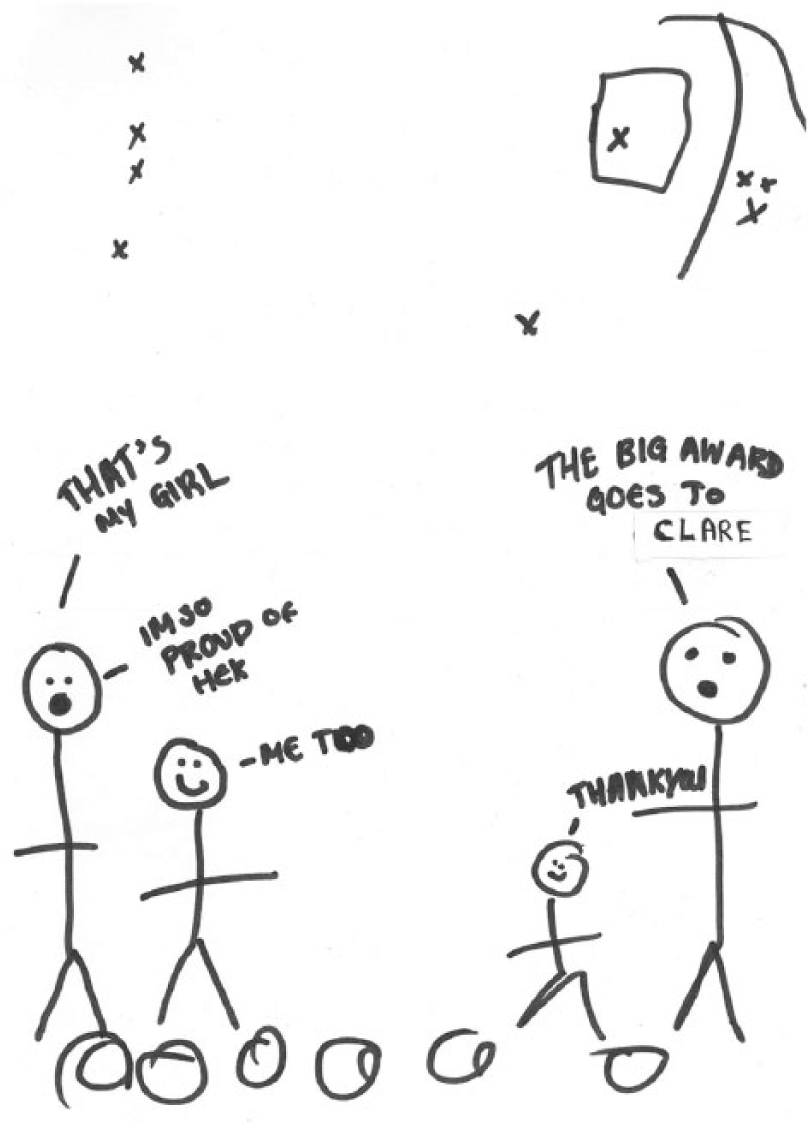
Clare’s drawings: feeling secure and content in shared time.
Rather than soaking up the accolades of her peers around her, Clare focuses her attention on her parents’ interactions with each other. Her parents are the main act, she the riveted audience.
Clare emphasises how her parents’ engagement and communication, and their shared pride over her achievement, result in her positive feelings about this situation:
[A]nd Mum and Dad were both really proud and then they talked to each other and stuff about how proud they were and stuff and that made me feel really good. Well great, and it made me feel like I’m special.
In contrast, she describes how her parents’ non-interaction interferes with their capacity to bestow pride upon her (‘Unlike some other times when it’s a bit … when they won’t talk to each other and it doesn’t feel like they’re proud’). Monitoring of her parents’ interactions appears to be a common occurrence for Clare, as evidenced by frequent references to her parents’ usual lack of interaction. Her parents’ unity continues as they approach her together behind the stage. She describes the laden meanings she attributes to this seemingly simple act:
And they came over TOGETHER so like I didn’t feel like that they didn’t really like each other at all. I felt that they were still nice to each other, and they didn’t want to hurt anyone’s feelings, like they just wanted to be happy alone and when they moved together it just felt really good.
Clare’s reflections (‘Well [it made me feel] great, and it made me feel like I’m special’, ‘Yeah, I just LOVE reliving that really’) highlight the significance of the experience for her. Feeling secure and content in shared time for Clare appears inexplicably woven together with evidence of her parents’ ability to share delight and pride in their daughter, and thus in the moment to be unified. The experience is momentary, but critical to Clare in its ability to disconfirm an experience of a divided life, where pride seems nullified because it is not shared. For Clare, this experience confirms a deep ontological sense of being held in the shared mind of her parents.
Giselle
For Giselle, the phenomenon of security is unexpectedly evoked while observing her parents, from a distance. She describes a handover time in her father’s driveway, upon return from her mother’s house (Figure 3). Giselle watches both parents, as they look at each other. Her focus is on their spontaneous exchanges of smiles and laughter. The observation of her parents sharing a light moment floods Giselle with a sense of relief. It suggests to her the ongoing connectedness of family that transcends the separate physical environments she traverses between her parent’s houses. Giselle describes a hunger for this type of belonging which she feels is ordinarily and prominently absent. The intimate quality of her parents’ interaction as they share a small moment of enjoyment stands out as dissonant to Giselle.
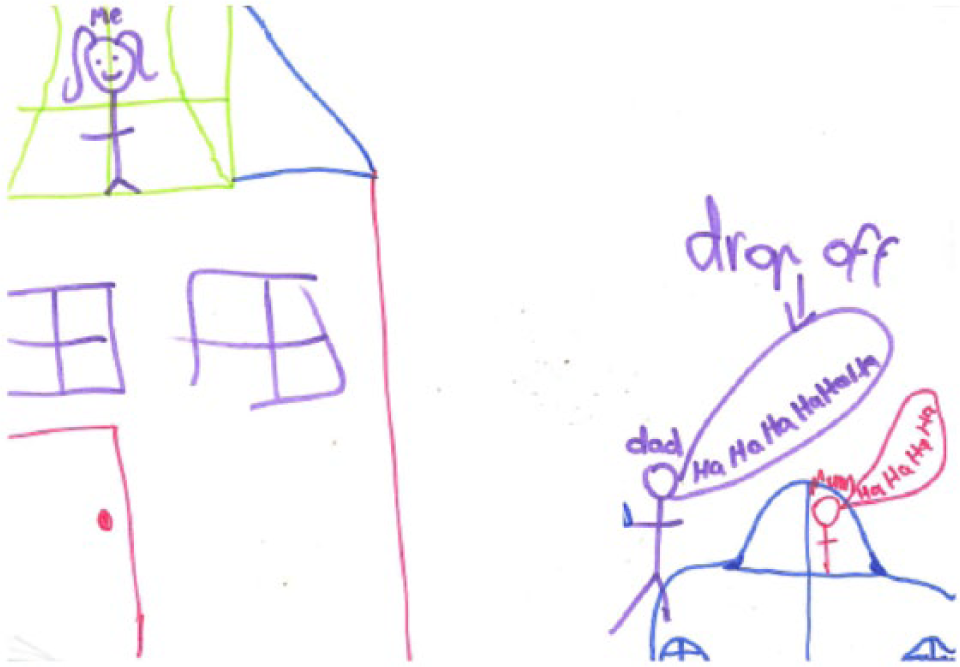
Giselle’s drawing: feeling secure and content in shared time.
She explains,
Um … well … I like this moment because well … because I was happy that they were happy and that they were laughing. And I just like seeing them TOGETHER (emphasis), like for once, like how they’re talking …
Giselle feels exhilarated by the physical proximity of her parents and their ability to share an enjoyable moment. This moment is a preferred way of being for Giselle, in which she is present to a warm feeling of joy.
Implicit in Giselle’s description is an experience of surprise and relief, as she unexpectedly witnesses her parents’ happy encounter. Giselle’s drawing depicts the core of her focus, featuring the intimate details of her parents’ conversation in which her father tells a joke and her mother exclaims ‘Oh Ben, that’s like hilarious’. Her mother’s use of her father’s name implies benign intimacy which Giselle finds profoundly reassuring. In the moment, Giselle’s experience of felt security is grounded in the visual reassurance of her parents’ connectedness. Giselle attempts to keep pleasant feelings alive by reliving them in her mind. But like her parents’ smiles and laughter, Giselle’s sense of security and contentment is temporary. In Giselle’s drawing, her mother remains in the car, poised to depart, highlighting the fleetingness of the encounter. Although Giselle would like to take the togetherness she observed for granted, her lived experience does not enable her to do so. Giselle’s vigilant monitoring of her parents’ interactions belies a search for the shared smile or laughter that serves as her barometer of their togetherness, and with it, her own security:
I don’t really see them, like laughing, together. But like that night, I saw them laughing. And I haven’t seen them ever since. But, I have seen Dad come out and talk to Mum. But I haven’t seen them laughing.
For Giselle, this experience is temporally bound, and somewhat unreal, ‘just like … a dream come true’. Her words, ‘I just like seeing them together, like for once’, highlight the contrasting nature of this experience, relative to the separateness she perceives as the status quo of her current shared living arrangement.
Parental behaviours that compromise felt security when longing for the absent parent
Elsewhere, we have provided a full analysis of the phenomenon of not feeling secure and content in shared time parenting (Sadowski and McIntosh, in press). These findings highlighted a central determining factor which we describe further here, namely how the child’s experience of feeling in need and unsupported, particularly in resolving a longing for their ‘absent’ parent, undermines their security in a shared time life-style. For the children in this study, experiences of not feeling secure and content were ‘game changers’ in their experience of shared time arrangements. Most were clear that the solution to their problem involved gaining access to comfort from a desired parent, who was either physically or emotionally absent. Some could not see a solution to what felt like an overwhelming, amorphous longing. Three examples of individual descriptions are presented.
Core constituents: The child’s experience of longing for the ‘absent’ parent
The following context of parental behaviour was dominant in children’s descriptions of not feeling secure and content in shared time, underpinned by unresolved longing for the absent parent:
From the child’s perspective, their present parent is not fully able to provide sensitive support at a time when the child is distressed and needing thought or care;
The child wishes to be with and comforted by their ‘other’ parent, and is overwhelmed by their absence (and in some cases the denial of access to the ‘other’ parent);
The child’s wish for reassuring contact with either parent (present or absent) remains unfulfilled;
In a state of unresolved heightened arousal and disconnection from both parents, the child feels a sense of vulnerability, merging into acute distress and trauma for some; and,
The experience has a permeating impact on the child’s capacity for security and contentment.
Children’s individual descriptions
Tabitha
In her account of not feeling secure and content, Tabitha’s mind quickly turns to a memory, which stands out as a turning point (‘like when I knew what was actually going on’). Her father’s intrusion into a pleasant good-night phone call from her mother results in a heated argument between her parents. In her interview, Tabitha quickly unravels into an incoherent state, reflecting not only the sense of trauma she felt at the time, but also that reignited upon recollection:
Um like yeah … ’cause I’m not sure … I think they … Oh yeah, when my Mum CALLED me, and I was supposed to, like they said … when it was chosen that I was to CALL them, I had to CALL them and they didn’t CALL me. Um, when um, they … split up and they went to Court or something to decide what it was going to be like, I think Mum and Dad didn’t want them CALLING me …
Words reflecting rigid rules and directives, which Tabitha sees as imposed by the Court and her parents, dominate the muddled narrative. The striking absence of any sense of agency or influence remains prominent throughout the account.
Tabitha describes profound confusion, upon realisation that her father is listening in on the good-night phone call from her mother (‘when Mum said um, “Can you like just let me talk to her by herself” … ’Cause I didn’t know who she was talking to, and then I realized it was Dad because he like had a talk to her’). Suddenly, she is provided with a lasting representation of what happens when rules of communication are violated (Figure 4).
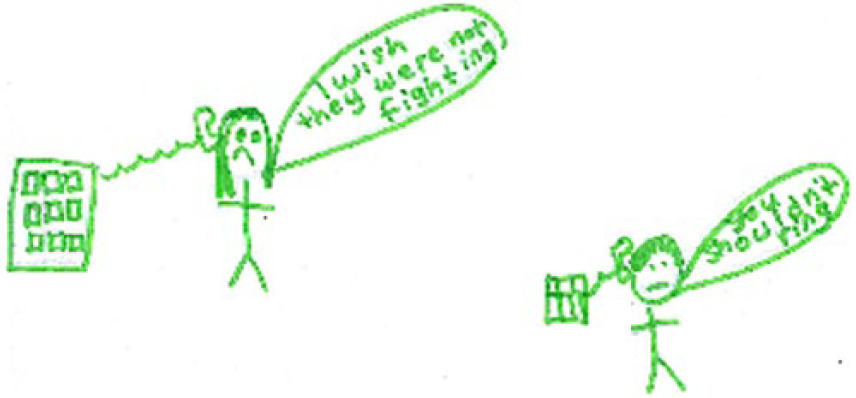
Tabitha’s drawing: not feeling secure and content in shared time.
Tabitha moves from being warmly engaged with her mother to feeling dropped from both parents’ minds, as they forget her presence and enter a bitter argument. Tabitha hears her father’s initial admonishment to her mother (‘You shouldn’t be calling this house ’cause that’s not like what the thing [Court order] said’). She disengages from the phone, explaining ‘I couldn’t really hear them, I just KNEW what they were saying’. After the phone call is terminated, her father responds to her distressed tears by explaining ‘that um, they were … that Mum wasn’t supposed to call, and that he was a bit angry’. Tabitha seemingly does not question the rules, the impermeable boundaries, or her father’s anger. She does not argue, or try to re-gain her mother. Further discussion ends abruptly, and Tabitha’s feelings of distress remain unaddressed.
Tabitha’s account belies her knowledge about how conflict erupts when rules are broken, and her parents’ need for rigidly imposed boundaries. Implicit is the way that Tabitha had to shed her feeling states to cope in this moment. The conflict that emerges on this occasion is toxic for Tabitha. After this event, she describes unquestionably accepting her parents’ lack of verbal communication and the necessity for all family members to follow rigidly imposed rules. While visible conflict ceased around this time, so did any direct verbal communication between her parents, who have not spoken to each other since this incident. Her mother’s partner and a communication diary that Tabitha carries now serve as intermediaries between her parents (‘so um Dad used to go and talk to him which was Mum’s boyfriend, and he’d come back in and tell Mum’).
Lucas
Lucas describes an experience of not feeling secure and content occurring when he was 9 years old, soon after separation (Figure 5). He depicts a time when he longed to see his mother, for no particular reason, and was overcome with the realisation that she was unavailable and inaccessible. He explains,
Um, I was just, it was just like a really strange moment when I just like wanted to be with my Mum, but I knew that I couldn’t. It was just after she left.

Lucas’ drawing: not feeling secure and content in shared time.
He offers a physical demonstration of his feelings at the time, explaining, ‘just like how little kids say, “I want my mummy!”’ He uses a high-pitched voice and bangs his clenched fists on his knees, explaining,
[t]here wasn’t any problems with me or my Dad or anything. It was just a … phase … where I just really wanted to be with her. I got over it eventually.
His father hugs and soothes him, reminding him that he will see his mother in a few days. His father’s statement, ‘Alright, you can call her and just like forget about it. You’ll see her soon’, suggests that consent to call his mother wasn’t taken for granted. Yet in this call, like his father, his mother does not fulfil his desire to see her, commenting, ‘Ah, it’s alright, you can see me soon’.
When asked what stood out for him about this time, Lucas explains,
[n]ot being able to see her when I wanted to see her, just move a little bit into the garden or something. As in just like walk over to the garden and she’s doing something, not like having to go half an hour away by car … just to see her.
Lucas asserts that he has ‘gotten over’ this ‘phase’ of longing. His mother is undeniably no longer in the garden, and over time, he sadly re-aligns his own feelings to fit the new landscape. Where he had clearly identified the accessibility of a needed parent as the core of his felt security, for Lucas, the absence of this accessibility becomes a reality to which he adjusts over time. With this, he urges himself to ‘get over’ feeling like a little kid who ‘wants his mummy’.
Giselle
For Giselle, the experience of not feeling secure or content in shared time is situated within the context of lying alone in bed at the end of the day, flooded by thoughts about her parents:
… I was just thinking about how I don’t spend as much time with Mum as Dad, and how, like some … I should like spend more time with Dad, like Mum, like sometimes I should spend more time with Mum and less with Dad, and then I might like change my mind again. Like more time with Mum. I mean like less time with Mum and more with Dad. Like … that. Yep. Um, yeah, that’s all I can really say.
In the particular situation she describes, Giselle becomes inconsolable about potential harms that might befall her mother in her absence, despite her father’s responsive attempts to comfort her in the face of this overwhelming need to be with her mother, the absent parent. In this instance, her father brings her to her mother’s house. Once reunited with her mother, Giselle is assured, but rapidly refocuses her anxieties on her father, and her need to be with both parents. Her parents try to comfort her, but ultimately tell her she must now sleep in the house of one parent, not both. They return her to her bed in her father’s house, her anguish unresolved.
On her own in bed, feeling unheld or facilitated to cope with this irreconcilable dilemma, Giselle experiences a relentless, somewhat primal longing for her mother and father which rapidly escalates into ideation about their safety in her absence, reflected in her frenzied drawings of harms befalling her parents while she remains helpless to intervene (Figure 6).

Giselle’s drawing: not feeling secure and content in shared time.
Always physically separated from one parent, Giselle describes a perpetual state of grief. It brings a sense of inner disorganisation, intensified by her sense of responsibility for each parent’s well-being:
And then when I’m at Dad’s, like at Dad’s, like I feel the same way about Mum. Because like if I’m in a different place with them. Like if something goes wrong with them, like I’m not there to fix it. Like no one’s there to fix it.
Giselle asserts that what she really wanted at that time was ‘to see my Mum, and to see my … wait … my Dad … to see my Mum and Dad together, probably’. Through her turmoil, she inverts the care-giving relationship, and feels isolated not only from the absent parent, but also from the present parent.
When focussing on her desired resolution of these fears, Giselle moves away from her vivid detailed imaginings. She speaks coherently about how the mere joint physical presence of her parents, and her ability to seek comfort from them both, could alleviate these fears:
Well, no I wouldn’t really feel this (refers to drawings), ’cause if I was laying in bed, I would FEEL it, but then I’d just walk out to the hallway and go, ‘Oh like Mum and Dad are you okay?’ And they’d be like ‘Oh yeah yeah yah’, but if they weren’t okay, I’d just like cuddle them before, if they actually do … and then I’d go back to bed, go to sleep, and if I felt it again I’d just call one of them, I’d just call one of them.
To Giselle, her parents’ togetherness under one roof is the source of both her security and safety, and their own. Without this, she is plunged into disorganising fear. She is not yet able to contain, dampen or indeed switch off her longing, as other subjects had learned to do.
Discussion
This article has focussed on the behaviours of separated parents that engendered felt security and insecurity in their children, about living in substantially or equally shared time arrangements between their parents’ homes. Through a descriptive phenomenological analysis of children’s accounts, we provided concrete examples of how commonly cited parental attributes (such as cooperative, child-oriented and flexible co-parenting) are lived by the child, and how they impact security and contentment. In the children’s descriptions of insecurity, we see the central place of longing for the ‘absent’ parent, and the load this creates for the child’s ability to adjust well to both the parental separation and the shared time parenting arrangement. The power of the children’s voices speaks for itself and points to several possible applications in practice.
This study suggests that the child’s experience is more complex than often played out in the divorce literature, and particularly in debates about the ‘rightness’ or ‘wrongness’ of shared time parenting presumptions and practices. No child in this study mentioned the allotment of time as having any bearing on their felt security. No child implied at any level that there was a ‘better’ or ‘worse’ parent. Instead, the children point to the origins of security within co-parenting availability and responsiveness. Even in longing for the absent parent, no judgment of the present parent was involved, and it was never about feeling unloved. Rather, in these moments of needing but not being able to be with the other parent, the support of their present parent was simply not ‘enough’.
In no account were parents simply interchangeable in their capacity to soothe and comfort the child. Spending equal time with each parent did not resolve the child’s longing for a preferred parent in a moment of need. Indeed, in the extreme case (such as for Giselle), shared time appeared to create two ‘absent’ parents, confining the child to a perpetual state of longing. Many of the children in this study attempted to ‘switch off’ from their distress. While adaptive in the moment, it raises questions about the sequelae of this coping style over time.
Phenomenologies of binary experiences such as security and its absence create light and shade, enhancing our ability to see what, experientially, lies beneath each. These findings suggest a set of parenting attributes which, from the child’s perspective, are core to creating security and contentment in shared time parenting arrangements. These include parental willingness and ability to
Be together from time to time in the same physical space, conflict-free in front of the child;
Share simple enjoyment and pride in their child, on occasions of meaning to the child, such as school functions, sporting events, family gatherings;
Create benign intimacy when together in the child’s presence (such as genuine intent when saying hello, sharing a laugh);
Enable the child to connect with the ‘absent’ parent, especially to reach out to this parent in times of need, without guilt or worry about hurting the other parent’s feelings;
Cultivate the sense of living in a separated but still integrated family (through actions such as joining together for events of significance to the child, and communicating openly to keep apprised of the child’s day-to-day life); and,
Prioritise the needs of the child.
Of course, many aspects of the relationship between parents’ behaviour and children’s sense of security may also apply to other living arrangements. One message from the study is that having shared time does not of itself produce security for the child. It would be useful to explore in future research whether similar or differing findings emerge from a sample of children who live in less equal time splits.
The child’s voice on this topic shifts the focus from ‘time’ as a key determinant of security, to the enactment of the living arrangements by their parents, namely the ways in which each parent remains a sensitive, active, protective presence for the child. The child-generated messages from this study may have applicability to parent education and support programmes, post-separation. For example, this study suggests that many parents (even those who seemingly meet the profile of cooperative, child-oriented and flexible co-parenting) may benefit from specialised support to develop and maintain parenting arrangements (at any time level) which are responsive to their children’s individual and evolving needs. This child-centred phenomenomology may offer new tools to parents for enacting their parenting arrangement in a way that fosters their child’s capacity for security and contentment.
In that light, we conclude with reflections inspired by the children in this study on the advice other children might give to their parents about creating a way to feel ‘securely shared’. The following statement was written for parents by the authors, based on what our subjects told us, and in a style children might use:
When I feel securely shared, I know I don’t have to constantly keep watch over how you will act when you are together (at places like handovers, or my school or sporting events). Knowing that you won’t fight is really important. But that’s not enough. I want to see you act in ways that show me that you can sometimes still laugh and have fun with each other, and share your pride and joy in me. When I see this, I relax and feel good, instead of being worried and watchful whenever you are together. Sometimes when I am at your house, I might be feeling sad, or scared, or upset, and I might start to miss my ‘other’ parent. You and my other parent aren’t the same, and you do things differently. There are times when I just need to reach out to the parent I’m not with, to help me feel okay again. When I feel like this, I want to know that it is alright for me to call, or even see them – even though it is ‘your turn’ with me. It makes it really hard for me when I have to worry about hurting your feelings because I miss the other person, and just need them. I’m still a kid with two parents, and I can’t always get all my needs met by the parent I am with at the time. I will learn to cope with my grief, and I will adjust to you being separate, but there are some needs I can’t just switch off, without creating big problems for myself. When I feel securely shared, I feel like I live in one world, not two. I feel like both my parents are in touch with, and responsive to most things I feel and need. You both make sure that my arrangements and the way you put them into place don’t bury me under emotional burdens. You’re not expecting me to live between two completely unconnected households. You make sure I’m not too weighed down with the practical problems of living in between two houses. You can come together and make sure that my arrangements are predictable, but flexible – both on a day-to-day basis, and as I grow and my needs change over time. Sometimes, my needs might be different from yours. When this happens, I’d be really grateful if you might put aside your own needs, and think honestly about mine, and what could help. There was this guy called Bowlby, who said the job of parents is to be bigger, stronger, wiser and kind. That about sums up what I’m asking for. These are things that you can do to help me to thrive in shared time.
Footnotes
Acknowledgements
The PhD supervision of John McDonald and Angela Murphy, both from the University of Ballarat is gratefully acknowledged by the first author. The authors would like to thank the anonymous reviewers, and the editors, for their feedback.
Funding
This research was supported by a doctoral scholarship from the Ballarat Family Relationship Centre, Ballarat, Victoria, Australia.