




Abstract
Ambiguities and tensions can arise when children are facilitated to act as ‘primary researchers’ concerning whether this is primarily to support their ‘participation’ in knowledge production and, with the knowledge produced, in relevant decision-making processes or whether it is mainly for any educational benefits. This article considers these ambiguities and tensions theoretically and by using evidence from a study where English primary school children were supported to conduct their own research projects. It concludes that, while the boundaries between children’s research as participation and pedagogy can be ambiguous, it should not be promoted for its potential educational benefits alone.
Keywords
Due to the increasing emphasis on children’s agency in the academic disciplines which most concern them and following the introduction of their rights to participation in the 1989 UN Convention on the Rights of the Child, there have been significant attempts to more actively involve children in research rather than treating them merely as a source of data. Often this has involved children taking part at selected stages of projects designed by adults or throughout the entire process by working as co-researchers alongside them. More ambitiously children have been facilitated to act as ‘primary researchers’ who make the key decisions and conduct most of the research process themselves.
In this context, the main rationales for children acting as primary researchers have been concerned about them taking part in knowledge production about contemporary children and childhoods and, based on the knowledge produced, participating better in the decision-making processes that affect them and their lives. However, there has also been a tendency – among those who are less concerned about children’s participation – to see their research as primarily an educational activity and not as worthwhile in its own right (Alderson, 2008). As a result, while some researchers still suggest that children’s involvement in research should be supported for reasons to do with their current participation and not for any future or pedagogical benefits (see Davis, 2009), others are more equivocal and also allude to the educational benefits of them conducting research (e.g. Bucknall, 2012; Kellett, 2005b).
Despite these tensions and ambiguities over what children’s research is for, these issues have rarely been fully discussed either theoretically or empirically. This article attempts to do this by clarifying the relevant issues and, by so doing, to contribute to better informed approaches to supporting children as researchers. Underlying this debate over the purposes of children’s research – whether it is a means of supporting their participation or a pedagogical tool for educational benefits – are contending conceptualisations of them as ‘beings’ or ‘becomings’. However, further tensions arise due to ambiguities or confusions concerning questions such as ‘What is research fundamentally for?’ ‘Can its purposes include the educational benefits to those who conduct it?’ and ‘Can research also be conducted mainly for any educational benefits?’
The first part of this article considers these questions by discussing what it is about children’s research that may be contributing to perceptions of it as primarily an educational activity. It then considers how children conducting research compares to a form of inquiry-based learning as a pedagogical approach and, by examining the suggested educational benefits of the latter, what educational benefits children’s research might also be claimed to achieve. The second part discusses how these various issues emerged when eight primary school children in England were supported to conduct their own research. Finally, based on these theoretical reflections and the case study, it suggests that while children’s research can be facilitated for both participation and educational benefits, it should not be approached as pedagogy alone.
Children as researchers: Conceptual and empirical ambiguities
While children acting as primary researchers have been explored as an innovation in research about children, there have also been some critiques of its underlying theoretical assumptions as well as difficulties in putting it into practice (Kim, 2015; Thomas, 2015; Tisdall, 2012). In particular, Kim (2015) suggests that the way such research is often understood and practised is fraught with the assumptions of the adults who facilitate it and argue for a critical rethinking of such assumptions – including those about children’s epistemological ‘vantage points’ in researching children and whether such research helps fulfil their rights.
In practice, while the approaches to realising the concept vary, especially in terms of the amount of preparatory research training that children receive – for example, from one day’s training (e.g. Fielding, 2001) to courses lasting several weeks (e.g. Kellett, 2011; Kellett et al., 2004) – children rarely act as independent researchers. Instead, they usually require adult support throughout the process, including those instances where they were described as having ‘led’ the research (e.g. Kellett, 2011; Michail and Kellett, 2015). Kellett (2011) differentiates such support between merely ‘facilitating’ children’s research and ‘managing’ it where adults influence or control it. However, keeping the right balance is not always easy and requires adults to continuously reflect on their interactions with the children. On the other hand, as children’s research usually occurs in forms that adults mediate and construct, some suggest that it may inadvertently contribute to children’s socialisation rather than to their emancipation (Coppock, 2011). Children’s role as researchers is also limited as it is adults, not children, who conduct the wider debates on the purposes of their research involvement.
The ambiguous and contentious position of children as researchers is also reflected in debates about the quality of their research and the status and value of the knowledge they produce. These concerns may, in turn, have made the arguments of those who see children’s research primarily as a pedagogical tool for educational benefits seem more convincing. Whether or not this argument is conceptually justifiable is discussed below. But, beforehand, I discuss whether what children do in the name of research can even qualify as being ‘research’.
Is children’s research ‘research’?
Central to debates about children’s research is the issue of their ‘competency’ to conduct it. Some researchers (e.g. Alderson, 2008; Kellett, 2011) argue that age should not be a barrier to children’s research participation and that their social competency – based on their first-hand experiences of children’s issues – should be the key determinant. However, in published research, and other than when they have acted as co-researchers with adults, children younger than 8–9 years do not appear to have acted as primary researchers. Given this, Kim (2015) suggests that social competency alone may be insufficient to act as a primary researcher.
Disagreements about children’s competency lead to questions about the ‘quality’ of the research they produce (see Brownlie et al., 2006). For example, Dyson and Meagher (2001) suggest that if research has certain inherent quality standards that children may find harder to meet due to a lack of the required competencies, the more they are involved in the process, the less likely it will meet those standards. Here, the research they refer to must mean that of a ‘scholarly’ nature which may be comparable to Hammersley’s (2000) concept of a ‘scientific’ inquiry which he defines as that which passes a ‘collective evaluation of its knowledge claims by a research community on the basis both of the body of knowledge that this community currently takes to be valid and of the evidence offered in support of the claims’ (p. 224).
In comparison, and in discussing how to teach children about research and research skills, Kellett (2005b) proposes three key principles of research – be sceptical, be systematic and be ethical – as those that qualify an inquiry to be scholarly. This conceptualisation of research does not define who evaluates it, as the concept of ‘scientific’ inquiry does, nor does it offer any specific criteria by which the investigator can be evaluated as having been ‘sufficiently’ sceptical, systematic and ethical. This may mean that any inquiry where the investigator claims to have followed these three principles would have to be accepted as ‘research’.
Yet, if the central rationale for supporting children to conduct research is the assumption that by doing so, they can better contribute to knowledge production on contemporary children and childhoods, whether their research is accepted as such by a research community may matter. In relation to this, another relevant question seems to be who constitutes this ‘research community’ – should it be the entire academic community, researchers who work under the same research paradigms or some other group? This is because debates about the quality of children’s research may be framed differently by paradigms which vary in what they see as the ideal characteristics of research and on how its value ought to be assessed.
In particular, a significant criterion of ‘inclusive’ research paradigms is whether the people whom the research concerns have taken part in it and/or whether it has benefitted them in some way – for example, by ‘empowering’ them and/or instigating beneficial social change (Brownlie et al. (2006); also see Nind (2014) for a more focused overview of inclusive research). ‘Inclusive’ research also uses diverse approaches to address the unequal or limiting relationships between ‘the researched’ and researchers to produce knowledge that better reflect the former’s views and experiences (although some argue that such research does not necessarily produce ‘better’ research data – see Holland et al. (2010) as an example of participatory research involving children). Children acting as primary researchers on issues that concern them, and where this experience is claimed to empower them or to have benefitted them in some other way, can therefore be seen as a form of ‘inclusive’ research.
Some might even argue that calls for criteria to evaluate the quality of children’s research represent a retreat from earlier attempts to deprivilege the expert position and knowledge claims of adult researchers. For example, Kellett (2005a) suggests that research by children is fundamentally different from adult research about children and one cannot use the same norms or terms of assessment for both. Conversely, Nind and Vinha (2012) suggest that, if it is to have an impact beyond those who promote it, inclusive research as social science still needs to meet some standards in order to be ‘good’. If so, children’s research may also need to meet certain quality standards if it is to be accepted by other researchers and people who use research evidence such as policy makers.
One way of addressing concerns about the quality of children’s research may be to utilise Hammersley’s (2000) distinction between ‘scientific’ and ‘practical’ inquiries. Unlike a ‘scientific’ inquiry, the primary audience of a ‘practical’ inquiry (or ‘practical’ research) are people with an immediate interest in the topic, and the aim is to produce knowledge which can be applied to it. For this reason, although those engaged in practical research may aspire to the quality criteria of a scientific inquiry, they may trade-off some of these to ensure the relevance and timeliness of their findings. Hammersley then suggests that such trade-offs may occur due to the circumstances under which the researchers work or the type of issues under investigation. In differentiating between ‘scientific’ and ‘practical’ research, Hammersley does not extend the discussion to whether knowledge itself can also be ‘scientific’ or ‘practical’, although his earlier distinction implies both types are possible.
While the factors identified by Hammersley for some trading-off of scientific rigour for the usefulness of findings may be relevant to the quality of children’s research, other issues such as their competency to conduct it remain salient. However, if, as a condition of practical research, the reasons for such compromises may be less significant than the relevance and usefulness of its findings, children’s research that produces findings that can inform issues that directly concern them may be accepted as a valid type of practical research. So, while children may be unable to join academic knowledge debates, their findings can be locally acceptable practical knowledge – Thomas’ (2015) ‘situated’ knowledge may be a similar concept – within the particular context where the research was conducted.
Can children conducting research be pedagogy?
The ambiguities or limitations concerning children’s research discussed above may also have contributed to a perception that their research is mainly an educational activity rather than as being worthwhile in its own right. Therefore, in what follows, I discuss whether children’s research could be seen mainly as an educational activity by considering how it compares to a particular pedagogical approach and the educational benefits which are associated with it.
Hammersley (2003) argues that, with regard to both its purposes and outcomes, research can be ‘informative’ but not ‘educative’. While this assertion stresses that the core purpose of research is knowledge production, it appears to disregard some of its additional, if not core or always expected, outcomes. For example, researchers sometimes, as a result of their research experiences, may come to reflect upon themselves as individuals and, if so, their research can become a ‘learning’ experience. Furthermore, research conducted as part of research degree programmes has clear educational purposes for ‘researchers-in-training’ as well as the potential to contribute to knowledge production in their subject area. Also, the benefits suggested for the individuals involved in inclusive research – for example, becoming empowered or, more practically, learning some specific skills – can also be seen as educational outcomes. Even so, if the immediate and main purpose of research is knowledge production, any pedagogical benefits which may arise can be additional outcomes or goals. If this is so, promoting children’s research for mainly pedagogical reasons appears to be problematic.
If it is seen from a pedagogical perspective, children conducting research may be associated with ‘inquiry-based’ learning. In particular, it may be comparable, using Healy and Jenkins’ (2009) conceptual framework, to its ‘authoring (discovery active)’ dimension where students pursue their own open questions and lines of inquiry in interaction with the knowledge base of the subject area (p. 26). While an inquiry pursued in this manner has the potential to produce knowledge that satisfies the criteria for research as a ‘scientific’ inquiry – that is, satisfying the evaluation standards of a research community – this may not happen frequently. Yet, those inquiries which do not qualify as ‘scientific’ still have the potential to be ‘practical’ research that tolerates some compromises in quality for the usefulness of its findings.
The ambiguities over the question of what children’s research is for may also be partly due to the lack of any comprehensive and thorough consideration of what they are expected to gain pedagogically through conducting research. For example, while Davis (2009: 156) defines the ‘pedagogical’ benefits of research as ‘what children can learn from the experience’ because the ‘what’ is not specified, the definition remains vague. If so, when thinking about the possible pedagogical benefits of children’s research, it may be helpful to see what benefits have been suggested for the authoring type of inquiry-based learning. This form of inquiry-based learning overlaps with the dimensions of learner-centred education 1 whose pedagogical benefits have been argued for using three different narratives (Schweisfurth, 2013): first, cognitively, people learn better when they have more control over their learning; second, learner-centred education better prepares people for contemporary and future life where the nature of knowledge and skills required for employment are continually changing; and third, and as influenced by Freire (1972), learner-centred education frees the participants from oppressive forms of control in terms of knowledge that limits their thinking and aspirations and from pedagogical approaches which keep them subjugated to those with power.
The last of these narratives seems comparable to the claim that research participation can emancipate or empower children (e.g. Coppock, 2011; Kellett, 2011). But the difference between learner-centred education and children’s research as a form of inclusive research is whether emancipation or empowerment is its main and immediate purpose (as in pedagogy) or an additional objective to that of knowledge production (as in research). For this reason, linking children’s research directly with inquiry-based learning or learner-centred education seems inappropriate and pursuing it mainly for its pedagogical benefits may obscure what research is fundamentally for. On the other hand, there is not yet strong evidence to support the claimed benefits of learner-centred education (Schweisfurth, 2013: 34), suggesting a need for a more rigorous evaluation of its benefits prior to its wider promotion. If so, expecting similar pedagogical benefits from children’s research may be similarly premature.
Against this background, I now discuss a case study which is useful for exploring the question of whether children conducting research should be seen as participation or pedagogy.
Facilitating children as researchers in a primary school in England
This study was set in a primary school in a largely middle-class area of a city in England. However, even before it had taken place, I had already been debating with a colleague at the research centre with which I am associated – who also decided to become involved – about what children’s research is for. We had two different perspectives: my main interests were about whether and how children’s research could be a meaningful means of their participation – reflecting my sociological research perspectives – while my colleague’s main interest – reflecting her background in educational psychology – was in what children might learn from conducting research, especially in terms of their cognitive development.
When the school’s head teacher invited the centre to support some of his pupils to conduct their own research, we agreed to focus on the process of supporting the children’s research and then to evaluate it separately based on our own research interests. Hence, while my colleague would investigate how the children learned key research concepts, 2 I would explore to what extent their research may be seen as participation in this particular context and the views of those directly involved in the process, including those of the children.
The data collection methods of the study also reflected the mixed interests of the two researchers. First, all the research sessions were video-recorded to help my colleague to explore her research agenda. At the end of the process, I conducted individual semi-structured interviews with the children, the head teacher and a classroom teacher who had directly supported the children’s research projects, concerning their views about the research process and its outcomes. I also kept a research diary throughout the period where I recorded unstructured observational points. These qualitative data were analysed thematically.
It was clear that, even when he invited the centre to the school, the head teacher already had his own views about what children’s research would achieve, and he expressed them clearly in a subsequent interview. In comparison, the children said that they did not have any particular ideas initially as they did not know what it would involve, but towards the end of the process, most of them seemed to have formed some views and these will be discussed later.
Originally, I had hoped to choose the participating children randomly from volunteers. However, given the lengthy process – 22 weekly after-school sessions over a 6-month period – the head teacher suggested choosing those who were more likely to persevere to its completion. This may have resulted in a selection bias similar to that which happens when children-as-researchers projects involve only ‘academically able’ children. Yet, Hart et al. (2004) argue that the notion of ‘academic ability’ is contentious, and practices which label children into different abilities impose limits to the content of learning offered to them, their own attitudes and expectations as well as those of their teachers. Given this, I suggested that we see how those who were not seen as ‘academically able’ and those of different ages fared with their research. Consequently, eight children perceived to be of mixed ability and also of mixed age were chosen by the head teacher and the classroom teacher – two from Year 4 (8–9 years), three from Year 5 (9–10 years) and three from Year 6 (10–11 years).
While conscious of critiques about how children are supported to be researchers in ways that adults construct for them, it seemed that providing some form of research training might help them to make the key decisions for themselves instead of relying entirely on their adult supporters’ knowledge. In this study, however, instead of academics, the classroom teacher provided this training and then supported the children’s research projects based on detailed research training and facilitation manuals that were developed for her. 3 These resources were designed to help the school to continue facilitating children’s research after the centre had left.
When facilitating children’s research, some researchers begin by orienting the children and any adults involved on what their research involvement is for, for example, to help fulfil their rights to participation and/or to empower them. I chose not to do this because such an approach might limit the scope of the children to act as primary researchers by influencing them to work under an adult researcher’s normative perspectives which, as expressed by someone who they might have seen as an ‘expert’ in research, could have come across as what their research ‘should’ be for. However, while this may have helped the children to be open with me about what they thought it was for, as only one half of the research team and as a visitor whose access to the children was mediated through the teachers, I am not certain whether this was how the other adults involved – my colleague and the two teachers – approached the process and especially outside the research sessions where I was present.
Children’s research and local knowledge production
As primary researchers, the children were supported to make all the key research decisions themselves – such as their research topic, the data collection methods and the number and composition of their research participants – in order to respect their agency as the subjects (authors) of knowledge. However, the extent to which this ideal could be realised in practice depended upon the parameters under which they were encouraged to make these decisions and which their adult supporters had set for them, either inadvertently or knowingly.
For example, when the children were choosing their research topics, the head teacher wanted to guide them towards issues that their research would be more likely to have a tangible impact upon. The reason for this became clear during the later interview – he was pursuing pedagogical outcomes that might be achieved if the children had positive research experiences. But, for me, this appeared to limit their role as primary researchers and implied an element of ‘manipulation’ or ‘management’ which might be unethical. Given that he was the main gatekeeper to the children, it was difficult to disregard his views. Yet, mainly from a fear that the project might no longer be about children as primary researchers, I explained that it was their role to make the key research decisions and, as long as it was something they could manage and researching it would produce knowledge ‘worth’ knowing, it might be better to let the children freely identify a topic of their own choice. To my relief, this was accepted perhaps in recognition that my research ‘expertise’ was needed to support the children’s projects.
However, as the head teacher had expected, giving the children control over their choice of topic did not always result in them choosing one that would produce immediately applicable findings. The children’s research topics are shown in Table 1. As the table shows, while six of the children selected a topic which was directly related to their school environment, educational aspirations or current leisure activities, two chose issues with relatively fewer practical implications (i.e. those relating to zoos and the age limit for driving). While these children could have been ‘facilitated’ to think more about the ‘worth’ of the knowledge they would be producing in terms of the wider research audience, the line between ‘facilitating’ and ‘managing’ their research was felt to be thin and one that should not be crossed over.
The children’s research questions.
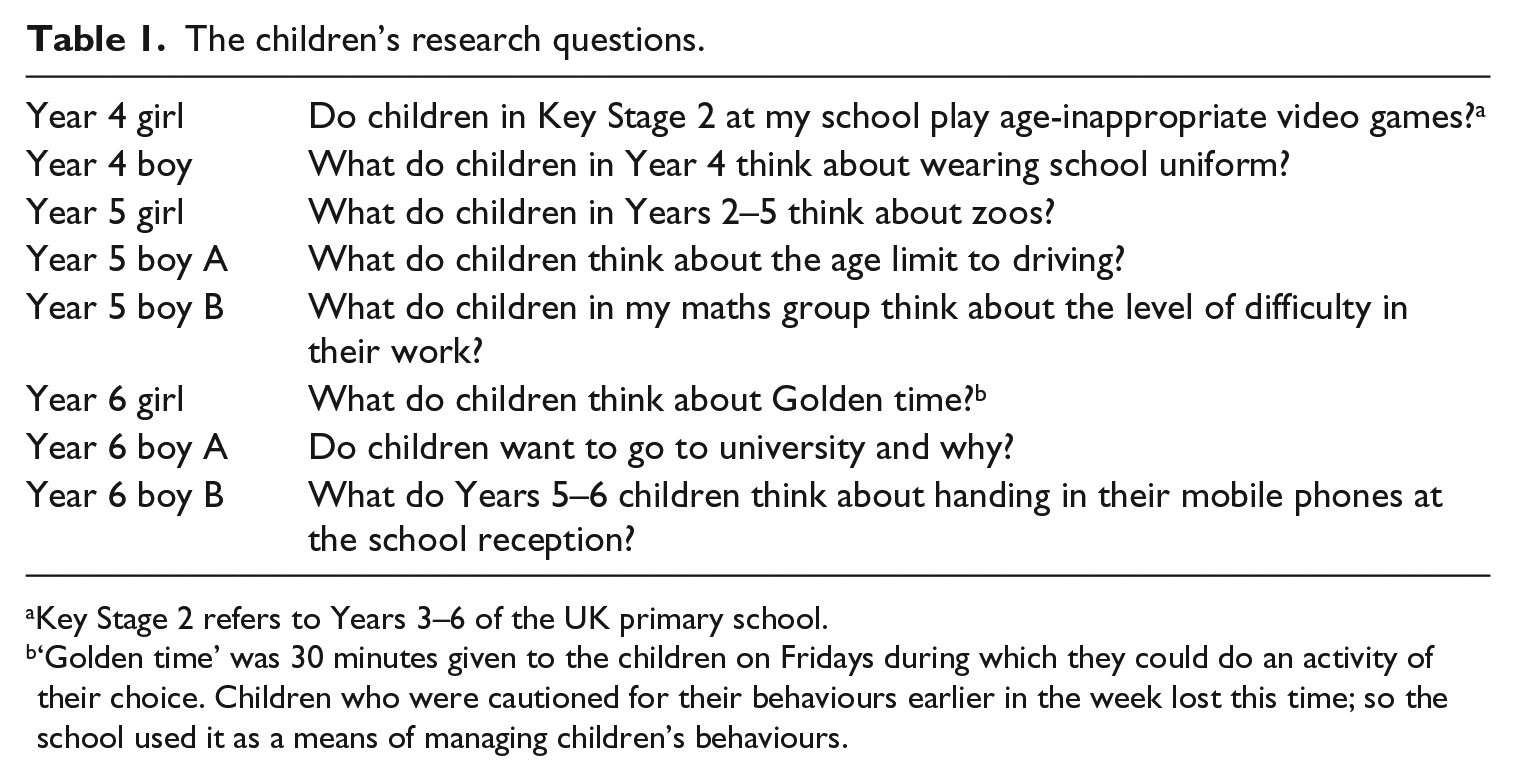
Key Stage 2 refers to Years 3–6 of the UK primary school.
‘Golden time’ was 30 minutes given to the children on Fridays during which they could do an activity of their choice. Children who were cautioned for their behaviours earlier in the week lost this time; so the school used it as a means of managing children’s behaviours.
Allowing the children to make the key research decisions did not always seem to contribute to the quality of their research. For example, while they were introduced to a range of data collection methods during their research training, all of them chose to use questionnaires even when other methods might have been more suitable. The reasons for this were not always possible to identify but, in some cases, it appeared to be mainly for convenience – for example, ‘do not want to transcribe interviews which will take a long time’. The children’s ‘academic ability’ – as classified by the school – seemed to influence the quality of their research, but it (nor their age) did not seem to be the only factor in determining this aspect. Instead, it was also their enthusiasm about their topic and how they utilised their existing skills (e.g. in literacy and numeracy) to deal with the series of tasks posed by their projects that appeared to matter.
When the children presented their projects to their parents and the governors of the school, these adults appeared to show a keen interest and engaged with their findings by seeking clarifications and asking further questions. In particular, when the projects were closely related to the school’s current practices, they discussed how the children’s findings might be used to inform them. As a result, and as an example, the head teacher invited to his next meeting with the school uniform suppliers the child who had investigated this topic – whose findings included that some children found their uniforms ‘itchy’ – and he also held a meeting with the child who had investigated his maths group’s opinions on the difficulty of their work to discuss how these findings might be reflected into future maths group sessions.
But it is important to note that it was the adults who took the initiative to make use of the research findings as none of the children appeared to demonstrate overt agency to explore what they might do with their results. This was despite their research training including the discussion about how research does not end with production of findings and that actively reflecting on how these findings could be useful is also an important part of the process. It was difficult to identify the possible reasons for this passivity although what the children perceived the purpose of their experiences to be may need to form part of any explanation.
Children’s perceptions of the purposes of their experiences
The children’s research training, especially the earlier sessions where they were developing a sense of what they had embarked on, also involved repeated discussions on what research means – producing knowledge – in comparison to simply locating information that others have already made available. However, during the individual interviews, and in response to a question about why they thought children are helped to learn about and conduct research, most of the children said it was for educational and the future benefits while some also mentioned they had learned to be critical and not to take things as they are (see Table 2).
The children’s perceptions of the reasons for conducting research.
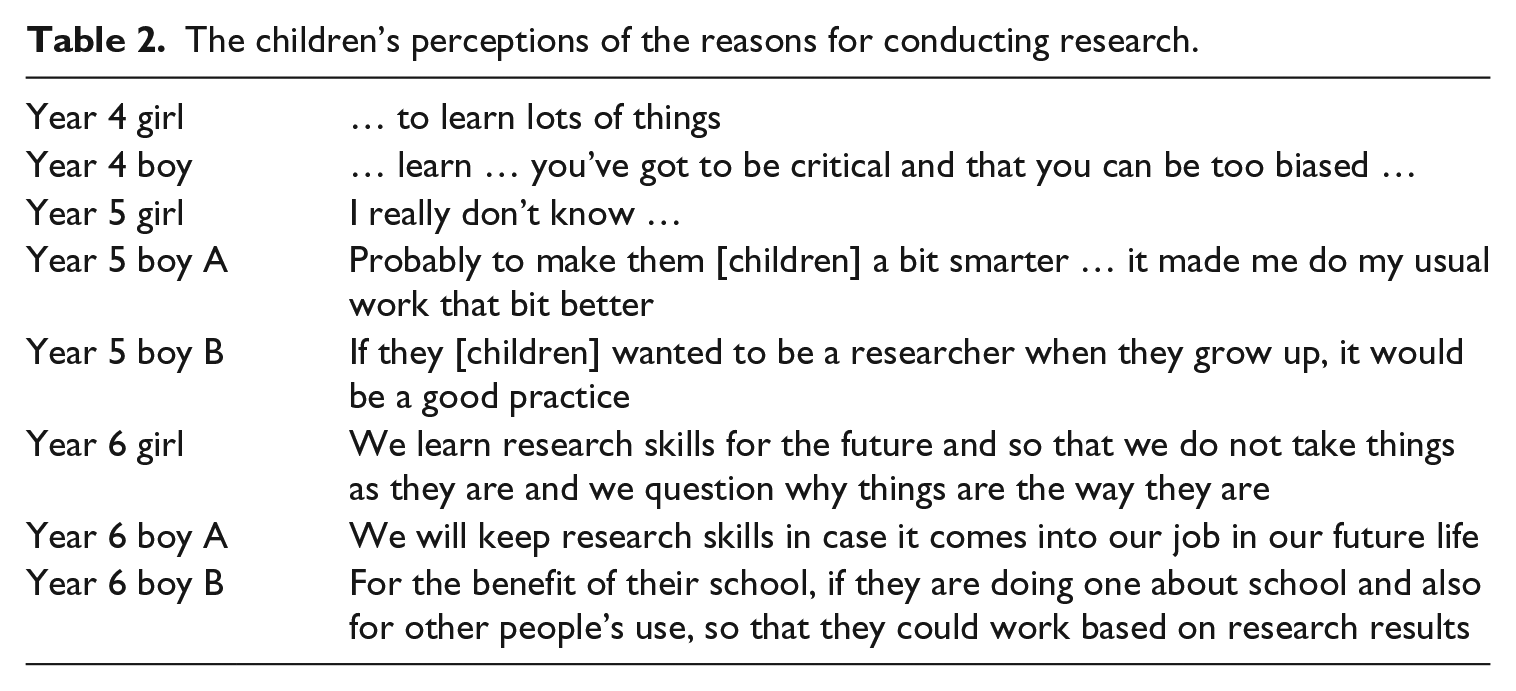
Other than the Year 5 girl who said that she had no idea, the exception to this seemed to be one Year 6 boy who replied that it was to let schools or other people use their findings. Two other children, although they did not say it in response to the same question, appeared to think that it was significant that their research might have some actual impacts. One of them, the Year 4 girl, said sharing her results with adults was one of the best parts of doing research as it might make them think about what they might do (i.e. if their own children played video games). In the case of a Year 5 boy, the head teacher’s decision to reflect his results into the current mathematics teaching seemed to have influenced his perceptions. He mentioned: I realised that it could matter quite a bit, Mr … [Head teacher] said that I speak with him and the leader of maths could actually change … make different parts of maths harder and make certain parts easier.
The same boy, however, still thought that the main purpose of children’s research was to make them smarter and help them to do their school work better.
It is possible that informal interactions with the head teacher outside the research sessions may have influenced the children’s perceptions of what their research was for. But it is also possible that being conscious of the school environment and their expected role within it, the children were inclined to interpret their research as an educational activity. Indeed Hill (2006), although his review did not include examples of children as researchers, suggests children who take part in research are highly sensitive to the context where it occurs. On the other hand, some children’s comments made in studies where their research was organised in non-school contexts suggest they were also conscious of the educational value of their experiences (see, for example, those described in Kellett (2010)), although it is not possible to tell how significantly they thought of such educational value compared to its participation value. The impact of the particular research context on children’s perceptions of what their research is for appears to require further exploration.
The head teacher’s views: Preparing children for the future
In an interview after the process had finished, the classroom teacher who had supported the children throughout the research sessions did not seem to have clarified her thoughts about what children’s research was for. In comparison, the head teacher spoke firmly about why he had taken the initiative to run the project in his school. His approach to children’s research largely reflected the ‘preparation’ narrative for learner-centred education described above: preparing children for contemporary and future lives where the knowledge and skills required for employment continually change. He asserted that research skills were life skills fit for a knowledge-based economy which the children had been given the opportunity to acquire through this project. This view was complemented by a belief in some cognitive benefits from conducting research: that is, applying research skills by actually investigating a topic would cultivate higher-order thinking skills.
However, once during the interview, he also appeared to suggest children’s research might also be a participation tool: If children present us something well thought out … in a structured way, things we didn’t really know about … I think they have to realise we won’t always agree with them but … we have to give due consideration to what it is they are proposing.
But a later comment suggested that he was also thinking about the educational benefits of children learning about the value of participation: I think at that kind of age to learn that you could have an impact … if you put your argument together really well people will sit up and listen!
The head teacher’s comments also implied that, to him, taking children’s views seriously might depend on their ability to rationally address issues to standards that were acceptable to adults. While this may be reminiscent of those who critique children-as-researchers projects as a form of governance aimed at raising rational and self-regulating individuals (Bragg, 2007) or to value ‘adult cultures’ and norms over children’s own (Gallacher and Gallagher, 2008: 505), for those who support such projects, his attitudes may be a reason to support children’s research if it helps them to get their views taken more seriously.
Pedagogical benefits of children’s research
The educational benefits of children’s research that the people involved in this study – including the children and the other researcher – mentioned varied and, as were those articulated by the head teacher, may be compared to the benefits claimed for learner-centred education. However, none appeared explicitly akin to the ‘progressive’ benefits claimed for such an education: that it cultivates minds which think freely from existing power relations. As mentioned above, while some children mentioned they had learned to be critical and not to take things as they are, it was difficult to tell if these included understanding inequalities in social and power relations. While those who argue children’s research as inclusive research emancipates or empowers them are more likely to support the progressive educational benefits, those who approach it more as pedagogy – often within the framework of existing social relations including those between children and adults – may not seek such benefits.
On the other hand, if the pedagogical benefits of children’s research include learning the value of participation – as the head teacher suggested – differentiating its purposes between those relating to participation or pedagogy may be unhelpful. However, even if the boundaries between the two may sometimes be fuzzy, the conceptual distinction still seems necessary. This is not only because, as discussed earlier, there are significant differences between the main purposes of ‘research’ and ‘pedagogy’ but also because allowing conceptual ambiguity, or even the fusion of the two, risks children’s research becoming subsumed under a pedagogical agenda which then can encourage adults to ‘manage’ it to achieve their own pedagogical goals, as was illustrated above when the children were choosing their topics. When this happens, children’s research is likely to cease to be a means of ‘genuine’ participation and to become merely a means of ‘practicing’ it for future.
This also raises some ethical questions that may need further consideration, for example: if telling children ‘explicitly’ to choose a research topic that is likely to have an actual impact does not help them to learn the value of participation, is setting them up to do so without their knowledge being ethical to the children who are supposedly acting as primary researchers? Influencing the children’s research in this way may not only be unethical but, paradoxically, may even inhibit them from learning what participation will ‘realistically’ involve.
Conclusion
While children’s research was introduced to better support their participation in knowledge production and beyond, the limitations in their role as researchers and concerns over the quality of their research can raise questions about such purposes and may lead some to believe it has better value as an educational tool. Even if some children might be able to conduct a ‘scholarly’ inquiry, if this is rare, expecting children’s wider participation in research to produce scholarly knowledge seems an unrealistic objective. However, as in this study, children’s research can produce findings which are useful in the specific contexts where it occurs, qualifying it as ‘practical’ research that produces locally recognisable knowledge – although this may depend on whether the other people concerned (often adults) view it as such especially if the children do not exercise agency in applying their findings.
Nevertheless, it seems difficult to argue that children’s research is only a form of participation. In particular, and although the evidence for its educational benefits is not yet substantial, if children’s own perceptions are to be a significant determinant – especially in light of respecting them as active social agents – then, on balance, and for most of the children in this study, it seems to have been more of a pedagogical activity. However, as it is possible that their perceptions were influenced by the particular setting of the research, it may be necessary to investigate further the extent to which the context of their research determines their reflections or whether it is their wider perception of their status as being in preparation for adulthood that leads them to emphasise the educational value of their activities.
While Thomas (2015) suggests that, depending on the projects, the adults who facilitate children’s research may determine whether it is for participation or educational benefits, its purposes should not be determined arbitrarily. Unlike what Thomas appears to suggest, and as this study has shown, children conducting research can be a site where various contending adult motives are mingled and contested with a consensus between them being difficult to reach. More importantly, there is a need for greater conceptual clarity regarding the issues. As has been argued, if the core purpose of research is knowledge production, promoting children’s research mainly for its educational benefits seems conceptually inappropriate. However, as it is difficult to ignore its educational benefits – although they are mostly ‘perceived’ ones at present – their research may need to be seen as involving both participatory and educational benefits. Yet, as children’s research is vulnerable to being subsumed under the pedagogical intentions of adults, and given the ethical questions that arise when that happens, it seems necessary not to fuse conceptually children’s research as a tool for their participation and pedagogy. If so, tensions arising from balancing these objectives seem inevitable, as are those concerning children’s status as ‘beings’ and ‘becomings’.
Footnotes
Acknowledgements
An earlier version of the article was presented at the International Childhood and Youth Research Network Conference at European University Cyprus on 10–12 June 2015. The author would also like to thank the anonymous reviewers of the journal for their valuable comments on a previous draft of the article.
Declaration of Conflicting Interests
The author(s) declared no potential conflicts of interest with respect to the research, authorship, and/or publication of this article.
Funding
The author(s) disclosed receipt of the following financial support for the research, authorship, and/or publication of this article: The research in this paper was supported by Small Grants funding from the Centre for Research in Education and Educational Technology, The Open University, UK.