



Abstract
This study examines how preschool girls organize situated board games. Examining video data using an ethnomethodological approach, we focus on moral work-in-interaction in instances where the girls negotiate rule violations. It was found that the girls oriented to diverse forms of moral orders, shifting between a competitive/justice-based order and a socio-moral order of reciprocal relations. Argumentative moves of cheating were used as communicative resources both to control moral transgressions and to gain personal advantages. Overall, the analysis shows that preschool girls are active moral agents in the making and breaking of rules and in the negotiation of complex moral orders.
Keywords
Introduction
This study explores the situated activity of preschool girls playing board games, with a focus on how game rules are invoked, accounted for, debated and reconstructed in, and through, game interaction. Using an ethnomethodological approach, we emphasize moral work-in-interaction as an ongoing practical activity (see Bergmann, 1998; Cromdal and Tholander, 2012; Garfinkel, 1967; Theobald and Danby, in press; Tholander, 2002). The approach taken addresses the importance of capturing the situated character of moral work and the different moral orders that are co-constructed as children negotiate and challenge the rules in situated game activities (cf. Evaldsson, 2004; Goodwin, 1995, 1998). Research on children’s games has long attributed separate and different competencies to boys’ versus girls’ games (see Evaldsson, 2009, for an overview). Traditional dichotomies imply that boys’ games are highly competitive and governed by complex rules, while girls engage in games with simple rules and turn-taking structures (Adler and Adler, 1998; Lever, 1978). However, a study of games as situated activities necessitates a shift in focus away from what girls and boys play – which has hitherto been the preoccupation of traditional studies – towards how players actively contribute to the organization of games, thereby generating different versions and experiences through their everyday game participation (cf. Evaldsson, 2004: 333; Goodwin, 2006). Thus, in line with more recent work on gender and language in children’s peer interaction (see Goodwin and Kyratzis, 2015, for an overview), we approach gender and other forms of identity as locally managed practical accomplishments (Garfinkel, 1967). The key focus here is a group of young, preschool girls as they organize their participation in board game interactions in which players engage in extended debates and dispute the rules while also co-constructing a shared moral order in the peer group.
As demonstrated in prior research, while participating in games and play, girls (as well as boys) are constantly probing and exploring what counts as acceptable or not in game participation in the production of social and moral orders (Bateman and Butler, 2014; Evaldsson, 2004; Goodwin, 2006; Sacks, 1995). Even though rules, in one aspect, can be seen as governing play and game activities, they are foremost open to negotiation and are used for different practical purposes in the players’ interactions (Goodwin, 1985; Heritage, 1978; Martin and Evaldsson, 2012). When breaches in social practices occur in an interaction, the taken-for-granted moral order is displayed and accounted for (Danby and Theobald, 2012; Garfinkel, 1967). In this study, we will therefore explore the different forms of moral work accomplished by preschool girls in instances in which rule violations are made a shared topic of concern (cf. Wootton, 1986).
Children’s moral work in games and peer relations
Several studies of children’s game, play and school activities have shown that neither girls nor boys simply follow the official rules of the activity; rather, they make use of rules to renegotiate activities as a way to control others and to bend the rules in their favour and, in so doing, advance their positions (see Cobb-Moore et al., 2009; Evaldsson, 2004; Goodwin, 2006; Tholander, 2007). Martin and Evaldsson (2012: 53) describe the functions of rules, stating that they
provide an interpretative framework for coordinating activities and a resource for negotiations, enforcement, and discussions as well as a resource for children to make sense of ongoing actions so that they can proceed to the next stages in the activity.
Thus, rules can be disobeyed, ignored, debated, disputed or adhered to (Cobb-Moore et al., 2009: 1478). In a study of children’s moral work, Theobald and Danby (in press) found that girls used different interactional resources, such as complaints and accusations, when building alliances (or not) with others, in turn invoking different moral orders in their peer group. The girls oriented to two separate lines of moral conduct: one tied to the pretend frame of playing school and one to the real frame of being friends.
Children’s social competence (Hutchby, 2005) and ability to create their own social orders in rule negotiations (without adult participation) were shown in a study by Cobb-Moore et al. (2009) in which they filmed preschool children’s (boys and girls aged 4 to 6 years) social interactions and activities in a room where the adults had organized the activity. The children created their own rules, drawing from their own social order as well as from categories from the adult world, by invoking institutional rules to control the possession of materials and spaces used in play.
Other researchers have shown that when playing games on the school playground, such as hopscotch, jump rope and foursquare, girls engage in extended arguments and negotiate rules on a turn-by-turn basis (Evaldsson, 2004; Goodwin, 1985, 1995, 2006; Goodwin et al., 2002; Melander, 2012). In particular, Goodwin explored how girls use multimodal resources as they take up claims of positions and negotiate what counts as appropriate game action. For example, oppositional stances and disagreements were found to be immediately displayed and articulated using high-pitched voices. Moves in the game that were seen as problematic or as violating the rules were followed and marked by polarity markers and negatives, such as ‘No!’ and ‘Out!’, and negative person descriptors, such as ‘cheater’, or by using ‘response cries’ (Goodwin et al., 2002). Similar results were shown by Evaldsson (2004) in a study of girls and boys (fourth to sixth graders) playing the game of ‘foursquare’. She found that the girls oriented to different forms of moral orders depending on the participants, thereby shifting away from a ‘morality of rights’ and a ‘morality of responsibility’ to a ‘morality of play’. In sum, previous studies show that girls are involved in complex interactional moral work where they reorganize their social relations when negotiating the rules of a game activity (Evaldsson, 2004; Goodwin, 2006).
Building on prior studies, this study focuses on how preschool girls (aged 5 years) 1 invoke their own local perspectives and moral orders in and through their participation in a situated board game activity as they negotiate the rules of the game.
The following questions are of particular interest:
How do preschool girls handle instances in which there is a perceived transgression of the taken-for-granted moral order of a game?
How do the girls treat the rules of the game, and what forms of interactional and embodied resources do they draw upon as they negotiate the game rules?
How do they organize their participation and what forms of social and moral orders are constituted in the midst of the girls’ game negotiations?
Analysing board games as situated activities
The girls’ participation in board games is approached here as a situated activity. Goffman’s (1961) notion of games as a situated activity emphasizes the interactive actions of separate participants in joint social projects who actively contribute to the organization of play and games (Evaldsson, 2009; Goodwin, 2006). Building on Goodwin’s development of Goffman’s ‘situated activity system’ and his notion of participation, we focus on interactional resources, such as talk and body, along with the material environment, upon which children draw as they organize the game and build alignments with one another and the game actions in progress.
This study also draws on an ethnomethodological approach to explore the moral work that takes place during the talk-in-interaction among preschool girls – in other words, how they negotiate game participation and rules of games in everyday game interactions and, as an element of this, handle rule violations (Garfinkel, 1967; Heritage, 1984; Sacks, 1995). We are therefore closely focusing on how the girls negotiate and manage instances when one of the participants changes her participation or is perceived not to be following the rules when playing the board game. As will be demonstrated, not only is talk seen as important, but non-verbal actions, such as gestures, bodily postures and gaze, are also important when it comes to how the participants build alignments (or not) with each other and choose a course of action during play.
Setting, participants and data collection
The data are drawn from a larger video-ethnographic study focusing on the moral character of children’s everyday peer group interactions in preschool, which is part of the first author’s PhD project. The preschool under investigation was located in a small village just outside of a medium-sized Swedish city. The group of 25 children ranged in age from about 4.5–5.5 years and were guided by three female preschool teachers. The majority of the children lived in what could be described as middle-class, Swedish-speaking homes. The data consist of video-recorded data (35 hours) of children’s naturally occurring peer interactions in everyday routine activities, such as meal times, indoor/outdoor play, circle time and more. Prior to commencing the video recordings, ethnographic fieldwork and participant observation were conducted in order for the researcher to become familiar with the setting, the children and their daily activities (Cobb-Moore et al., 2009). In this particular preschool, a recurrent social activity was engaging in playing different board games in pairs or groups; this was mostly initiated by the children themselves. The selected excerpts draw from video data of such instances of play. The analysis focuses on two separate game episodes in which two pairs of 5-year-old girls play a board game together. These two episodes were chosen because they provided interesting examples of how moral work was accomplished when breaches of social conduct occurred; moreover, the girls drew upon different interactional resources as they held each other accountable for faulty actions.
The episodes under investigation
The first game episode: Playing the memory game
Vera and Nelly (both aged 5) have decided to play the familiar game of memory together and are accompanied by a third girl, Josefin, who is observing the game. At the beginning of the memory game, the cards are placed with the picture side facing down on a table; the aim is for the players to find a pair of corresponding cards. In the game, the girls also have to handle a set of official and explicit game rules, such as taking turns, turning over only two cards in a turn and stopping when they do not succeed in finding the corresponding card. However, there are also some unwritten rules that are implied, such as showing the cards that have been turned over to each other if asked, and that cards in a pair should not be placed too close to one another. These examples of implicit rules can be seen as forming part of a local and shared understanding that was developed during prior engagements (Cobb-Moore et al., 2009: 1478).
The breaking of an implicit rule: Debating the legitimacy of actions
The perceived transgression in the first excerpt, highlighted by Nelly, concerns the implicit rule that the cards in a pair should not be placed too closely to one another.
004 NEL: to one another ((moves her right hand towards the pair)) 005 VER: ((puts a card on top of the other)) 006 NEL: [((moves both her hands towards the cards Vera has put on top of one another)) 007 VER: [jag vet= I know= ((places her right hand on the pair)) 008 =nämen nu =no but now I cards)) 009 NEL: ((rests one hand on the cards near the pair Vera has collected)) 010 VER: okay? 011 ((moves the pair to her collection)) 012 NEL: .hh [hhh. ((gives a ‘tiresome’ look)) 013 JOS: [>heja Ne-lly heja Nelly< [>come on Ne-lly come on Nelly<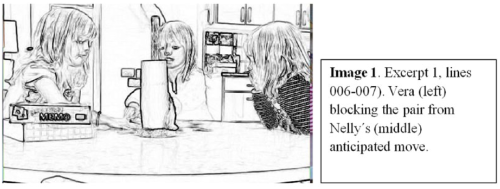
Here, we can see how the girls mobilize a range of multimodal resources in the form of talk, prosody, gestures, bodily actions and artefacts to first highlight a perceived disregard for an implicit rule and then to debate the legitimacy of the move (see Goodwin, 2000; Melander, 2012). In line 004, Nelly refers to the implicit rules of the game: ‘oh you shall not put them that close to one another’. The fact that Nelly then moves her hand in the direction of the pair demonstrates that she tries to change the placement of the cards on the table (see line 006). By referring to the implicit rules of the game, Nelly demonstrates that she sees the earlier move performed by Vera as illegitimate and that she feels that Vera’s pair should not count (Sacks, 1995: 500). Vera notices this and, in a groaning voice, takes a strong epistemic stance when she says, ‘I know’, while at the same time putting her hand on the pair, thus blocking it from Nelly’s anticipated move (line 007, see Image 1). With this, at first Vera seems to agree that there is a rule regarding cards being put too close to one another, but she then immediately displays her disagreement with Nelly’s position by saying, ‘no but now I
Transgressing an institutional rule
In the construction of a peer culture, children draw on and actively transform and subvert the institutional order and/or adult orders and rules that are part of their everyday environments (Corsaro, 2011; Kyratzis, 2004; Martin and Evaldsson, 2012). In the following excerpt, Vera invokes an institutional rule, that is, one that is voiced in preschool and often brought up by adults: ‘You should not leave the game because you don’t think it’s fun’.
038 NEL: =.hhh de är inte ku[l ( ) jag e inte me =.hhh it’s no fu[n ( ) I’m not in ((grabs some cards and drops them on the table)) 039 JOS: [heja Ne:lly [come on Ne:lly 040 jag hejar bara påd[i::g I only support y[o::u 041 VER: [men så [but you can’t back on a card, shakes her head)) 042 NEL: men du (måste) ( ) inte kul but you (must) () not fun 043 VER: jag mig↑ I (0.2) two from me↑ 044 (1.0) 045 VER: HÄR↑ HERE↑ ((holds up two pairs)) 046 NEL: ( ) ((looks at the cards Vera is handing to her)) 047 (3.0) 048 NEL: visst ( ) sure ( ) ((turns over two cards)) 049 ((turns them back)) 050 VER: får du dom av mig (.) här↑ ta ↑dom you may have them from me (.) here↑ take ↑them ((puts the cards in front of Nelly)) 051 NEL: såna hade jag ju I had a couple of those
In response to Vera getting a pair, Nelly threatens to leave the game because she no longer thinks the game is fun, dropping her cards on the table to underscore her discontent (line 038). In an adult-like tone, Vera corrects Nelly, ‘but you can’t
The collision of different moral orders of the game
After counting their pairs to establish that Nelly has three pairs, while Vera has five, Vera argues that Nelly should be able to reach the same number by just playing the game. As will be demonstrated below, Nelly does not accept Vera’s argument and instead announces that she will keep turning over cards until they have a similar number of pairs.
138 NEL: jag får ta tills I can take until ((leans forward to be able to turn over a card)) 139 VER: [VA↑ ] [WHAT↑ ((opens her mouth, looks at Nelly’s hand))] 140 NEL: [jag får två ] [I get two ((turns over a card, turns it back)) ] 141 VER: ((closes mouth, gazes at Nelly’s hand)) 142 NEL: ((places a hand on a card)) 143 JOS: ((returns to the table, holds a small paper note in her hand, which she puts on the table in front of Nelly)) 144 VER: 145 [((holds her mouth open, stares at Nelly’s hand))] 146 NEL: [((rests one hand on a card)) ] 147 ((turns over a card)) 148 VER: DE E [ THAT IS [
When Vera discovers that Nelly keeps turning over the cards, she highlights this as a problematic move when she exclaims ‘WHAT↑’ (line 139), thus showing her sudden surprise. This does not seem to have any effect, however, as Nelly continues with her game actions (line 140). Nelly can thereby be seen as continuing to try to restore her own take on the moral order of the game, where players do not compete and should have equal numbers of pairs. As Goodwin (2007: 66) explains, when an actor does not take a cooperative stance, the joint project collapses and brings affective stances and moral features to the fore. This is revealed in Vera’s escalating opposition, which she demonstrates by using a louder voice, thus again displaying her affective oppositional stance, ‘N↑O::↓’, which is underlined with her headshaking (in line 144). However, from Nelly’s point of view, she could argue that Vera’s refusal to give her pairs could also be seen as unwillingness to cooperate. After this second oppositional outburst from Vera, Nelly rests her hand on a card, which is an action closely followed by Vera (lines 145–146, see Image 2). When Nelly then turns over a card (line 147), Vera accuses Nelly of cheating in a strong voice (line 148). This oppositional move seems to be consequential, as it makes Nelly stop her game actions of turning over the cards.
Shifts of alignment
So far, the role of the bystander, Josefin, who has been watching the girls’ rule negotiations, has shifted from cheering on Nelly to just playfully acting like a ‘game leader’, deciding who has the next turn. After having left for a moment, Josefin returns to the table when Vera is in the middle of questioning Nelly’s game actions, and their alignments towards one another can be seen to shift yet again.
150 VER: HON GÖR SHE IS 151 JOS: ((stands up, looks towards the cards on the table and then at Vera)) 152 JOS: =va =what 153 VER: hon gör fusk she is cheating ((points to the cards)) 154 MAG: [((enters the room)) ] 155 [hon bara ] [she just ((turns her head towards Magnus)) ] 156 VER: °hon (fusk- ) hon tar två° ( ) °she (cheat-) she takes two° ( ) ((turns her head towards Josefin)) 157 NEL: ((looking down, orders her cards on the table)) 158 (3.0) 159 NEL: >din tur< >your turn< 160 VER: ((turns over a card)) 161 JOS: om du gör så igen så kanske jag ka:nske: ka:nske ta ner den här inte se den nu if you do that again then maybe I may:be: may:be take this one down not to see this one now ((holds up a paper note and then places it out of Nelly’s reach))
As Vera, in line 150, shifts the referent term to the third person ‘SHE IS CHEATING’, she also invites Josefin to comment and align with her against Nelly. Josefin looks at the cards that Vera is pointing to and then moves her gaze towards Vera (line 151), thereby attending to what Vera is saying. In her request for more information, Josefin reuses Vera’s words (in line 152), and in so doing, she shifts her alignment away from Nelly and towards Vera’s stance (cf. Maynard, 1985). By this, Vera is gaining support in her accusation of Nelly as a cheater. Moreover, in line 161, Josefin threatens Nelly: ‘if you do that again then maybe I may:be: may:be take this one down not to see this one now’. Thereby, the role of the bystander shifts from showing support to becoming a judge who enforces the rules of the game. Thus, Josefin’s threat makes relevant cheating as morally wrong and shows that it will have negative consequences for Nelly. In this excerpt, we can see how the alignments between Vera and Josefin position them as in control over Nelly and her perceived morally wrong actions. Nevertheless, Nelly will soon argue for her own rights in the game, thereby orienting to a more relationship-oriented moral ordering of the game.
Trying to finish the game despite adhering to different moral orders
As demonstrated, Nelly’s take on fairness in the game is more linked to what we here refer to as a form of socio-moral order based on the maintenance of reciprocal relations between players, who, regardless of how the game proceeds, should have an equal distribution of pairs. However, Vera orients to a more common game-related justice and competitive moral order of winning, meaning that the number of pairs should be distributed according to how one succeeds in the game – finding pairs by taking turns. As will be demonstrated, these different moral orders are not explained or verbally elaborated upon, but are brought up indirectly in the arguments made by the two girls in a yes/no and for/against fashion. At this point, the cards on the table are beginning to run out, and the two girls once again have to deal with their different takes on the moral orders in order to finish the game.
210 VER: ((looks towards Nelly after finishing counting her cards)) 211 NEL: orättvist >°orättvist°< unfair >°unfair°< ((puts her nose up towards Vera)) 212 (2.0) 213 VER: 214 NEL: jo det e visst orättvi:st yea it sure is unfai:r ((in a complaining tone)) 215 VER: det är ↑inte orättvist it is ↑not unfair ((hands three pairs to Nelly, smiles)) 216 NEL: jo det är det visst yea it is for sure ((looking down, sees the cards Vera has given to her)) 217 ((turns to Vera, smiles))
In line 211, Nelly can be seen to upgrade her oppositional stance, pushing her argument about the unfairness of the game regarding Vera having the most pairs, in an attempt to get a reaction from her. After a pause, Vera now finally responds to Nelly but with a disagreement (line 213) that is then recycled by reusing some of the words taken from Nelly’s previous utterance, ‘it sure is unfair’, by adding a negation ‘not’ (line 215) to build an opposition (see Goodwin, 1990). The game ends with the two girls reaching a solution while they simultaneously adopt their own understanding of the moral order of the game. Thus, Vera relinquishes the rules of winning the game and instead gives some of her pairs to Nelly (line 215). Thereby, she also avoids a disagreement with Nelly, which would threaten the institutional order that no one should leave the game. When Vera is handing over her pairs to Nelly, it could be interpreted as relational work, that is, Vera is trying to preserve a shared situation of mutual connection, to stay on good terms with Nelly and thereby maintaining their friendship.
The second game episode: Playing the cock-a-doodle-do game
We will now look further into how the girls deal with players who do not follow the rules of a game. In the second game episode, Nelly 2 and Moa (around 5 years of age) have decided to play a game called ‘the cock-a-doodle-do game’. The game involves remembering where on the table the pieces are located. The pieces depict roosters of different colours, and they are placed with the picture facing down. A player throws a die with the same colours as the different roosters and then tries to pick the right one. Failure to choose the corresponding piece (as in the memory game) makes it the next player’s turn. The game ends properly when all the pieces have been selected and the participants may count who has the most.
Dealing with rule breaking
In the following excerpt, Moa does not seem to get the colour that she wants, so she picks up the die again and starts to rotate it between her fingers while looking at it closely (line 068). The other player, Nelly, immediately identifies this game action as a transgression of the rule on how to handle the die.
068 MOA: ((watches the die closely while rotating it between her fingers)) 069 NEL: Moa: du fuska↑::r Moa: you’re cheati↑::ng ((gazes at Moa)) 070 ((rotates on the chair away from Moa)) 071 MOA: ((rotates the die between her fingers)) 072 (.) 073 > > 074 ((leans over the table)) 075 ((turns over a piece)) 076 ((gazes at Moa)) 077 NEL: Moa du fu:skade: Moa you chea:te:d ((in a complaining tone)) 078 MOA: ((lifts a piece)) (4.0) 079 ye:llow 080 ((hands the die to Nelly)) 081 NEL: [nu får jag (göra) så: hä:r? [now I get to (do) li:ke thi:s? ((looks at the die closely in her cupped hands)) 082 MOA: [((looks away from Nelly, off into the distance))
As shown in line 069, Nelly accuses Moa of cheating, thus orienting to the implicit rule that you should not gain advantages by not following the game rules. Moa continuously ignores her, so Nelly poses a threat: ‘now I get to do li:ke thi:s’ (line 081, see Image 3). In so doing, Nelly invokes a justice-based game order, implying that the players should follow the same rules. Nelly orients to the idea that if one player can cheat, in this case, manipulating the die, then the other may do the same. Hence, she demonstrates that even rule violations can be turned into common rules if they are mutually and/or temporarily agreed upon.
Trying to restore the moral order on how to handle the die
Before the following excerpt begins, Nelly pursues her planned game actions as she holds the die in her hands, looking at it closely, moving it back and forth on the table, but not throwing it. Moa is closely observing Nelly’s actions and is opposing them. As we enter, Nelly tries to restore and redirect the moral order of the game regarding the rules on how to handle the die (lines 089, 090).
089 NEL: ((throws the die)) 090 nu har jag slått- vit? ( ) now I have got- white? ( ) ((puts the die in front of Moa)) 091 MOA: ((looks first at Nelly then at the die)) 092 NEL: ((moves her chair towards Moa’s side of the table where the cards are)) 093 (va jag gör) ( ) (what I do) ( ) 094 ( ) ((leans forward)) 095 ((turns over a piece, looks at it)) 096 NEL: ((starts to move it towards her collection)) 096 MOA: ((leans forward)) 097 >du fuska< >you cheated< 098 (.) 099 NEL: näe no ((smiles, places the piece to her collection)) 100 NEL: (2.0) 101 MOA: ((takes the die)) 102 NEL: det I
Moa and Nelly are here debating and negotiating the rules of the game. As Nelly succeeds in selecting a corresponding piece (line 095), Moa deems the move as ‘illegal’, to use Sacks’ (1995: 475) expression, by accusing Nelly of cheating (line 097). However, as shown, Nelly does not accept the accusation but simply adds the piece to her collection, showing that she does not perceive her actions should be seen as illegally accomplished (see lines 099, 102).
Some moments later, two other girls, Vera and Linnea, join Nelly and Moa, and Vera asks who is winning, which has consequences for the unfolding game. Moa’s earlier perceived transgression, which was highlighted by Nelly, is once again brought up.
Network of alignments
Before this excerpt begins, Nelly has answered Vera regarding who is in the lead – Moa – but states that she has cheated. In this way, Nelly can be seen as retroactively holding Moa accountable for her earlier transgression of the game rules (see Excerpt 6, lines 068, 069), a transgression that Moa did not comment on, or orient to, at the time. The lack of response can also be seen as part of why Nelly is taking up the issue again (Heritage, 1984: 258). At the beginning of the final excerpt, Nelly asks for support from Vera concerning her being behind in the game (line 120). As Nelly has accused Moa of cheating, Vera, and later on Linnea, affiliates with her position in a collective alignment against Moa (lines 122, 125). This is the start of Vera’s ongoing accusations against Moa, which seems to make Moa lose the will to continue.
120 NEL: Vera kan du v:a me i sa:mma la:↓g Vera could you jo:in me on the sa:me te:↓am ((looking at Vera, making a wry face)) 121 (0.2) 122 VER: ja- jag he:ja:r på di::g↓= yea- I su:ppo:rt yo::u↓= 123 NEL: =oka::y 124 (1.0) 125 LIN: jag hejar också på Ne:lly: I also support Ne:lly: 126 ((lines omitted involving two other girls who walked by, showed the girls their earrings, but then left)) 127 MOA: ((orders her pieces)) 128 <å ingen he:ja:ar på mi:g↓> <oh no one su:ppo:rts me:↓> ((in a sad voice)) 129 (1.0) 130 NEL: jo but I support ( ) you 131 VER: men du [fus- ] but you [chea- ] 132 MOA: [din tur ] [your turn ] 133 (.) 134 VER: men du fu [skade ju ] but you che[ated actually] 135 MOA: [ja e inte med] längre [I’m not in ] anymore 136 VER: men du fuska but you cheated 137 MOA: ge mig locket give me the top ((reaches for the cardboard box)) 138 LIN: ni fuska:r::= You’re cheati:ng::= 139 MOA: =jag vann jag får komma hem till Ne:lly: =I won I get to come home to Ne:lly: ((orders the pieces of the game and puts it in the box)) 140 LIN: nä: ni fuska:r: no: you’re cheati:ng: 141 VER: aa: yea:
In the above excerpt, ‘cheating’ can be viewed as an activity that is seen as punishable by the girls (Bateman and Butler, 2014: 236), who, one after the other, align themselves with Nelly’s version of the story depicting Moa as a cheater. Although Nelly does not overtly seek support for her accusation that Moa is a cheater, she nonetheless receives it from Vera, who, in a moralizing manner, repeatedly corrects Moa’s actions (lines 131, 134, 136). When Moa complains that no one supports her (see line 128), Vera justifies this by stating that she has cheated (see line 131), thus, in a way, showing that she deserves to be punished. Vera’s recycled accusations against Moa are made in a moralizing manner through which Vera can be seen as almost exhausting the accused party, trying to get a certain answer. Moa does not challenge the accusation by verbally opposing or denying it (compare with Goodwin, 2006: 118). Instead, as she states that she won, Moa simultaneously refers to her social relationship with Nelly: ‘I won I get to come home to Nelly’ (line 139). This also shows the leakages between the social order in games and children’s ordinary experiences (e.g. Goodwin, 1985); that is, how friendships and alliances from outside the game influence and become part of the social order within the game. The girls’ relationships are further inferred as Nelly, despite being the opponent player, offers her support to Moa (line 130). Interestingly, Linnea then accuses both players, Nelly and Moa, of cheating, thereby strengthening her alliance with Vera, who in turn also affiliates herself with Linnea (lines 140, 141).
Conclusion
In participating in situated game activities, preschool girls are active moral agents in making and breaking the rules and in negotiating moral orders. This can also be seen as part of how the girls at hand socialize each other into shared norms and relations that constitute their local peer cultures (Corsaro, 2011; Goodwin and Kyratzis, 2007; Kyratzis, 2004). This study has focused on instances in which preschool girls playing board games orient to, and deal with, rule violations and investigated how children, in relation to this, negotiate and reflexively orient to different forms of moral orders. As demonstrated by the perceived transgressions in the game interactions, these reactions revealed both how the girls treat the more official rules of the game as they play it and how they negotiate the institutional rules of how to finish the game properly, as well as how they negotiate local moral orders tied to cheating, fairness and reciprocal relations. These intersecting rules and moral orders are invoked, debated and (re)negotiated in the girls’ arguments, negotiations and corrections of one another’s game moves as they try to get the game going. The moral orders co-constructed and negotiated in the girls’ game interactions do not necessarily have to be the same but shift as the game unfolds. In the first episode (the memory game), the two girls oriented to, and negotiated, different takes on the moral orders of the game, which in turn resulted in recurring disagreements and negotiations of the game rules. One girl (Nelly) invoked a more relationship-based moral order or a socio-moral order based on reciprocal relations and equal distributions of pairs. The other girl (Vera) argued for a more traditional game-related moral order in which the goal of playing is to win. The different moral orders to which the girls oriented led to extended negotiations of the rules and accusations of cheating, which in turn mobilized bystanders to take different sides.
In both episodes, the notion of cheating was used as a communicative resource to take control over the perceived transgressions of the moral order and to gain personal advantages. The second episode showed how one girl tried to deal with a norm transgression in the form of cheating. When not getting any response from the other girl, she oriented to the idea that the rules had changed and should therefore be the same for both players, resulting in that form of cheating – here manipulating the die – becoming part of the legal order of the game. Initially, when two other girls joined them, the transgression and accusation of cheating were brought up again and the transgressor was publicly held accountable. As in the first episode, the activity of cheating was mobilized as a resource for debating and defining the game rules and game actions, and it was seen as morally wrong and deserving of punishment.
In sum, this study demonstrates the need to move away from an adult view of games and game rules as simply governing children’s games to instead look at how children, here preschool girls, in their everyday game interactions deal with, and negotiate, moral issues of justice and fairness, as they simultaneously build alliances with each other. Previous studies have emphasized children’s rule negotiations as a means of personal advancement, as they have been shown acting in their own self-interest (see Cobb-Moore et al., 2009; Goodwin, 2006). Here, the girls’ rule negotiations are also relationally oriented, creating a shared situation of mutual connection in order to maintain their friendships (see Evaldsson, 2004). The study further demonstrates the complexity of preschool girls’ situated game activities and reveals that a focus on how preschool girls organize their game participation indicates how young girls, here aged 5, are highly skilled in negotiating rules and handling often multi-layered moral issues. Finally, the findings suggest the need to focus on children’s social competencies, and especially young girls’ competencies, in acting as moral agents and in co-constructing complex forms of moral orders in situ.
Footnotes
Appendix 1
Funding
The author(s) received no financial support for the research, authorship and/or publication of this article.