




Abstract
This article argues that children’s social status and positioning as children needs to be foregrounded in discussions of social citizenship and the re/development of the welfare state against a backdrop of neo-liberal economic and social reform. Set within a theoretical model that highlights the circular and de-centered exercise of power across fields of action, the subject of children’s citizenship, understood as a “citizenship habitus” is explored, taking the exemplar of education and migrant children’s positioning within schools.
The concept of citizenship, and social citizenship in particular, has been the subject of considerable research and debate. Since Marshall’s seminal lecture in 1949, the idea of citizenship as social, interactive, and embedded in dynamics of identity shaping and positioning, has taken hold (see Lister, 2007). While Marshall defined social citizenship in terms of equality of status predicated on the universal provision of services in health, education, housing, and so on, this was firmly embedded in the idea of a uniform Western citizen who behaved and acted in normative ways. In so doing, Roche (1987: 371) suggests that Marshall proposed “an ontology of the citizen” that has itself been subject to considerable criticism in light of its narrow and restrictive categorizations. Roche’s comment is telling, in so far as, it highlights how constructions of citizenship and social citizenship especially are deeply inter-twined with notions of self and identity in social context. In this article, the subject of children’s citizenship is considered in the context of new welfare states and reciprocal dynamics of power, equality, and social justice between adults and children. The role of education, taking the exemplar of Ireland, is especially foregrounded.
Social citizenship and the welfare state
Marshall (1992) coined the term “social citizenship” in the context of a typology comprising three phases. The first phase, following the renaissance, comprised civil rights, embedded in the concept of liberty and freedom of expression and association guaranteed by law. Political rights marked the second phase implemented in the earlier part of the 20th century and was based on rights of suffrage to vote and stand for election. For Marshall (1992), there was a natural evolution—in the mid-20th century—to social rights, completing the circle of full participation in a civilized society, where “every man is a gentleman” (p. 5) through access to economic welfare and security for all. In Britain, this social concept of citizenship emerged in the context of the development of the welfare state, and an expectation that all citizens were entitled to be treated equally in access to health care, free education, social insurance against unemployment and pensions upon retirement. For Marshall (1992), this new form of “democratic-welfare-capitalism” paved the way for the right “to live the life of a civilized being according to the standards prevailing in society.” Education was a key platform preparing an informed citizenry and one that significantly positioned children as “citizens in the making”:
When the state guarantees that all children shall be educated, it has the requirements and the nature of citizenship definitely in mind. It is trying to stimulate the growth of citizens in the making. (Marshall, 1992: 16)
Notwithstanding Marshall’s assertions regarding the future “becomingness” of children as citizens, their induction into citizenship was premised on a firm acceptance of meritocracy and inevitability of social stratification. Within his frame, inequality of outcome was legitimated on the grounds that all had equal chance to succeed and/or fail. The role of the welfare state was to set some boundary to the advantages of inherited privilege. Social citizenship for Marshall was inter-twined with social responsibility to others, predicated on undermining more negative personal characteristics such as idleness that can emerge in situations of poverty. In return then for state support and security, the “good” citizen was enabled to contribute constructively to the advancement and development of a stable economy and society. In this sense, Marshall’s construct of social citizenship was conditional. A rejection of criminality, pauperism, the refusal of employment provided the framework for a particular kind of citizenship bounded by clear moral imperatives of respectability and uniformity. Marshall’s work has been critiqued for his exclusion of certain categories in his definition and understanding of “citizen.” Such critiques focus explicitly on his neglect of differences in experience on the basis of gender as well as ethnicity in his articulation of social citizenship (Delanty, 2000; Revi, 2014), and the conditionality framed primarily in the context of the nation state (Dwyer, 2004).
Marshall’s original connecting of welfare systems with both the construction and experience of citizenship has resonance for today. Boloni and Natali (2012) outline the developmental trajectory of welfare states since the 1950’s. In this context, they refer to “New Welfare States” to reflect the changing orientation of welfare policies from the 1990’s toward increasing employment/labor market participation, in addition to social investment in human capital to enhance economic goals. This involves a transformation in the operation of the welfare state itself, including its distributive mechanisms. This is especially evident in Anglo Saxon models where neo-liberal approaches predominate. The emphasis is on deregulation, markets and a contraction in welfare services. In this article, we are especially focused on this model, given the very specific impact on the construction of a form of market citizenship. Neo-liberal models of state provision emphasize the individual’s relation to provision as consumer within a market driven economy. Here, a demarcation between social and civil rights prevails, with an explicit reduction in the role of the State in mediating the quality and circumstances of people’s lives. This process of individualization (Beck-Gernsheim, 2002) undercuts the more traditional bonds of family, community, and social solidarities typified in earlier accounts of citizenship, to one of individual choice, autonomy, and “freedom” to consume. The advancement of neo-liberal welfare systems in recent years profoundly reshapes the idea of social citizenship, from citizenship as status (relative to others) to citizen as consumer with the capacity to participate in the market, of both services as well as products.
What this suggests is that understandings of social citizenship are subject to change, as are studies of citizenship, which has itself been identified as a contested space (Cockburn, 2013). While Marshall’s original work can be considered within the strand of liberal approaches emphasizing rights and equal status, more recent analysis focuses on the practice and experience of citizenship and how it is framed in social context. This more radical approach emphasizes voice, difference and social justice (e.g. Delanty, 2000; Lister, 2007), and the inclusion of more groups in the definition of “citizen.” It also reflects a turn from a pure “rights” (and duties) approach toward a focus on how citizenship is lived. Such perspectives provide a more nuanced analysis that views citizenship as a process of positioning and identity shaping. Subjective experience, difference, and symbolic power relations (Moosa-Mitha, 2005) are central in this perspective. In part shaped by a politics of recognition (Fraser, 2000), it is this very aspect of inclusion and exclusion in defining the “right” to belong that is central in considering citizenship as it applies to children.
Children’s citizenship and generational studies
A key focus within sociological studies of childhood has been the recognition of children as a distinct group and an analysis of their positioning relative to adults. This inter-generational focus (Qvortrup, 1987) highlights at a macro level the structural positioning of children as a minority group and at a micro level their relatively invisible lived contributions to family and community life. In short, Qvortrup (1987) argued that “children” and “adults” were not some descriptive shorthand but structural elements attached to a particular social status.
Distributional mechanisms are central to the enactment of welfare systems and a key indicator of the priorities and status, hence social citizenship, of different groups. Olk (2009) notes the importance of a generational analysis in this respect, when he points to the lower per capita incomes of children relative to the “economically active” population, at a time when the retired population’s comparative income improved. In all modern societies, the elderly are the main recipients of public income transfer programs, while children, even taking benefits of child allowances and the costs of education into account, are mostly financed privately by their parents (Kohli, 2006). Recent reports on the impact of the global recession on children in poverty reinforce this view with households with children the most to suffer (Cantillon et al., 2017; UNICEF, 2014). However, investment in children is not part of a zero sum calculation where a “good” childhood will mean a poorer elderly population or vice versa. Indeed, the welfare of the elderly primarily depends upon the welfare of current children, both in their present (e.g. as carers in the family, as students in education) as well as in their future as tomorrow’s workers. As Esping-Andersen (2015) shows, inter-generational social mobility is itself enhanced through sustained investment in children in the present.
Given the significance then of children as a social group their absence from definitions of social citizenship (Cockburn, 2013) reflects lacunae in welfare policy development. Esping-Andersen’s analysis demonstrates how the recognition of children, through sustained investment in quality care and education, is inter-connected and highly dependent upon the recognition of women (and gender equality generally). Within neo-liberal/Anglo Saxon welfare models, the trend toward individualization noted earlier, has resulted in a relative retraction in investment and support for children, with consistent patterns of child poverty and lower well-being in these countries (UNICEF, 2007; Wilkinson and Pickett, 2009). The contraction of the welfare state reinforces a more competitive and individualistic approach to children’s welfare, undercutting traditional safety nets of support and inclusion for those most at the margins (Devine and Luttrell, 2013: 241). Explanatory models of poverty and welfare within such contexts, however, are more often framed within a discourse of deficiency in parenting and dysfunctional brain development (Lee, 2014). Such discourses have direct consequences for child protection (Frost, 2011) and wider welfare policies and practice. A subsequent break down in social trust and solidarity leads to greater retrenchment and regulatory/exclusionary practices in relation to those, including children, considered not quite “citizens” (Warming, 2013).
The analysis of generation demonstrates how inter-generational dynamics are related to macro-economic structures and how these filter into distributive mechanisms that directly influence children’s life chances. However, such analysis does not sufficiently account for important elements of inter-generational structures that are more cultural and inter-personal. Families and societies create continuity and change, where children, parents, and possibly grandparents live together and importantly care for each other, undercutting the development of generic generational conflict. The social structures of generations, for Alanen (2009), are produced and reproduced in interactions between adults and children. Generations thus become the site of social reproduction as well as social change, offering both the possibilities of stability and renewal. Children are active contributing agents in this process. As Alanen (2009) notes, attention needs to be paid to the everyday practices of generational (re)structuring. Age, like gender, is “practice based” in interactions, relations, and interdependencies of generations that occur within structured interactions of parents, teachers, care workers, children, and so on. The role of parent or carer can only exist if there are children to care for. While their statuses are symbiotic, the relationship is not symmetrical but based on asymmetrical structural power (Devine, 2002). In addition, for children, “social rights” have been shaped, as have civil and political rights, by cultural and social constructions of their status in different societies. Not only does this highlight the inter-generational dimension to debates about citizenship, but it also raises questions of how and which forms of social citizenship become inscribed into policy making and whose voices predominate in debates about poverty, wealth, redistribution, and recognition within the society at large.
This focus on everyday practices suggests the capacities and competencies of children in “acting” may challenge assumptions around the relative incompetence of children and their contribution to social citizenship processes. As elaborated on later, children already contribute to social citizenship processes (Larkins, 2014). Practice is at the heart of such processes, at both the macro and micro level. As Delanty (2003) notes, citizenship practice, and the form it takes, should be considered as a cultural process. It is a dynamic learning experience that shapes the cognitive (or indeed citizenship) competence of the society through cultural exchange and cognitive transformation of self and other (Delanty, 2003: 603). Applying these ideas to the concept of children’s citizenship signals the need to focus on children’s positioning within this wider learning dynamic and how this is framed both by macro level policies and structures (such as New Welfare State provision) and micro level processes as these are played out in the everyday places and spaces of childhood.
Structuring children’s citizenship—Habitus, power, and positioning
Delanty’s focus on learning at the heart of citizenship formation is especially apt when considering the citizenship practices of children and the potential role of schooling (and education) in this process. Within the field of inter-generational relations, the fact that children are compulsorily required to attend school for a substantive part of their childhood is a significant element in the “generationing” process. Drawing on the work of Foucault (1979) and Giddens (1984), Devine (2002) presents this as a circular process of structuration—schooling as a regulatory system of disciplinary power that shapes children’s time and space in a dialectical interplay between structure and agency. A core element of this regulative order is the production of children’s citizenship identities as “other,” with little voice and participation over what happens to them in school (Devine, 2002: 306).
Bourdieu’s analysis provides a further lens within which to explore these processes through his concepts of habitus, capital, and field. For Bourdieu, habitus is acquired through social interactions that give rise to collective dispositions for social groups. The concept of habitus draws attention to identity in embodied form, “systems of durable, transposable dispositions” (Bourdieu and Passeron, 1977: 72) which integrate past experience and “functions at every moment as a matrix of perceptions, appreciations and actions” (Bourdieu and Passeron, 1977: 83). This is not to say that individuals are determined by the habitus into which they are socialized, but the habitus provides the “logic of practice” (Bourdieu, 1990) that orient individuals to act in particular ways. The concept of habitus is closely linked to that of capital, in that the re/production of the habitus contributes to and depends on the acquisition and generation of capitals. For Bourdieu, capital was defined as economic, social, and cultural, each intersecting with the other in a process of exchange that enhanced or detracted from the individual/groups social positioning and relative status. This concept has since been extended to include symbolic capital (how groups are represented/signified). Subsequent analysis has also highlighted the affective dimension to social and cultural capital and the significance of care, connectedness, and love relations in the experience and reproduction of inequality in the society at large (Lynch et al., 2009; McGovern and Devine, 2016; Skeggs, 2004).
The concept of “field” is the third dimension to Bourdieu’s analysis, signaling the importance of the wider contexts in which interactions and exchanges take place, and the relations of power that govern such interactions. Field is central to how capitals are mobilized and indeed struggled over and each field has its own dynamics of power operating within it. For Bourdieu, as with Foucault, power is conceived as diffuse with both intended and unintended consequences. Unlike Foucault’s docile bodies, however, Bourdieu emphasizes the active and reflexive nature of agent’s “doing” in which they orient themselves, depending on their access to capitals, to the preservation or transformation of the field (Bourdieu and Wacquant, 1992: 109). It is this very agency that lends a dynamic quality to the concept of field (and indeed habitus), which can be construed as a site of struggle and or force, as agents compete with one another for recognition and position.
Education is one core “field” of interaction in children’s lives and these concepts have been used previously to provide an integrated conceptual framing of the generation of children’s habitus through their experiences of school, with particular reference to migrant children (Devine, 2011). Their habitus is placed at the point of intersection between wider social structures and each child’s agentic response, as they engage with a range of practices in schools, in a dialectical cycle of power that is both transformative and reproductive. The crucial issue is the embodiment of power in the habitus as a form of social practice, framing wider dynamics of power, inequality, and social justice in children’s lives in schools.
Taking an inter-generational lens, we can similarly speak of the emergence of a citizenship “habitus” by children that is both product and outcome of wider processes of power, control and social practice in their lives. This is reflected in Figure 1. Children’s citizenship habitus derives from and contributes to the “logics of practice” located in the wider “field” of inter-generational relations, in a circular process of action and re/action across a variety of institutions and wider systems of power and control.
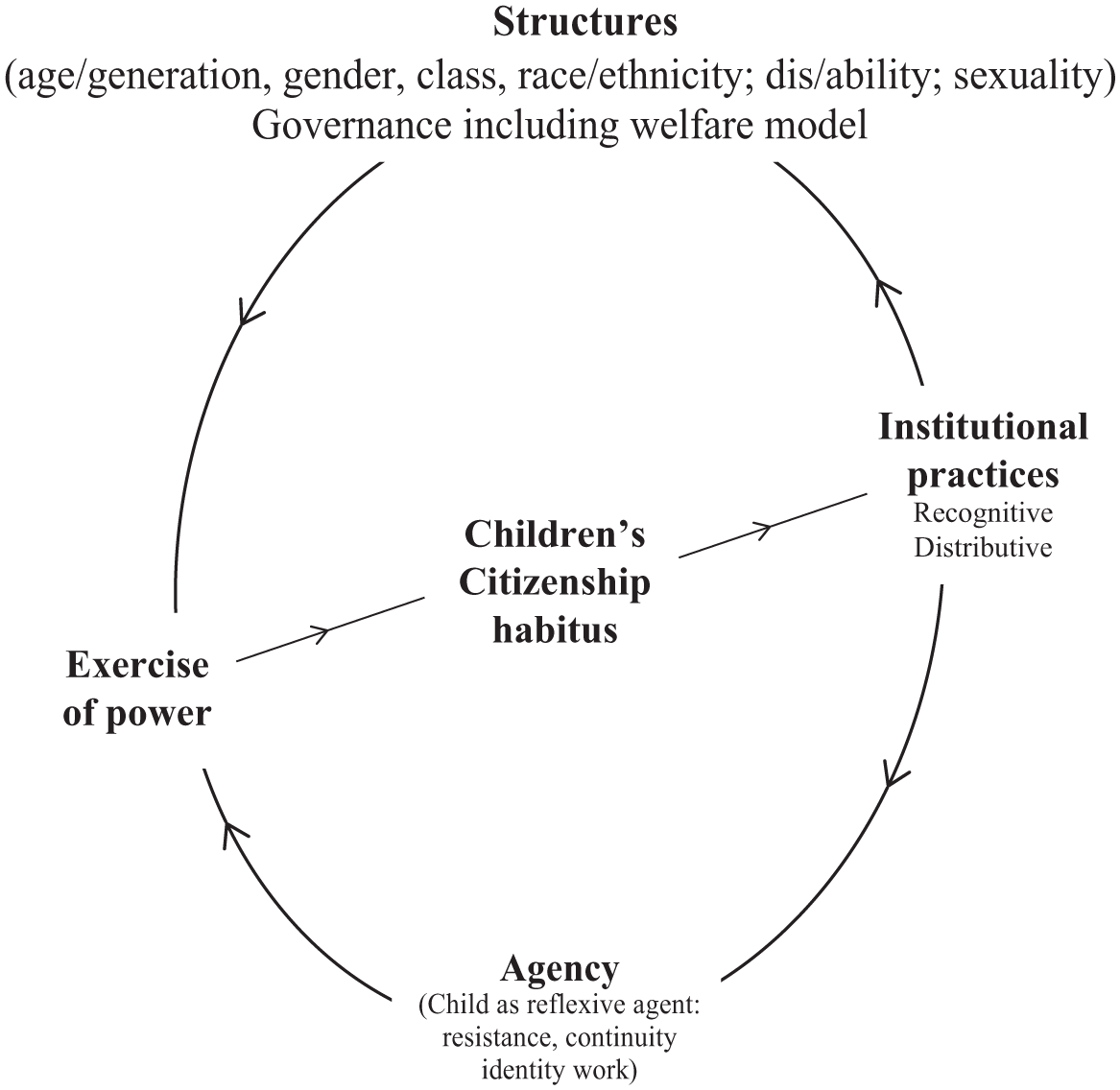
The structuring of children’s citizenship habitus.
This approach enables a deeper analysis of children’s social citizenship and the dialectic at play in terms of their lived citizenship in new welfare regimes. This occurs structurally in terms of constructs, discourses, and policy-level initiatives that frame children’s lives at a macro level (especially through welfare systems), as well as their capacities as reflective active agents and their lived reaction at micro level. It allows us to draw links between everyday practices in children’s lives (in family, school, community, etc.) with broader processes of production and reproduction in the society at large. Combined, Figure 1 highlights the citizenship practicing of children, viewed as the outcome of both structured and agentic processes. These processes are core to social citizenship and understanding how, for example, welfare models underpin children’s citizenship. Their practicing, reflected in the habitus, will be both influenced by and influence the fields of interaction across sites of state institutional intervention (e.g. education social protection, health justice, and political systems) and the access to and distribution of resources (cultural, economic, and social) within each field. The use of such resources gives rise to practices of recognition and distribution in each field—who is valued, what is valued, as well as the differential allocation of time, space, and money that embed these values in everyday practices that children are involved in.
Neo-liberal welfare systems, education, and the structuring of children’s citizenship habitus
This model allows an exploration of the intersection between welfare systems and the generation of children’s citizenship habitus. Taking education as an exemplar, we can trace the dialectical interplay between the “logics of practice” of neo-liberal welfare systems, practices in schools and the possibilities for children’s agency as they mobilize the resources (capitals) at their disposal across home, community, and school. Inter-generational dynamics underpin this generative process. This occurs structurally through the definition and implementation of welfare policy, including the priorities placed on investment (resourcing) by adults in children’s educational services. At a micro level, it occurs through systems of interaction on the ground among children, their parents, and teachers in the everyday lives of schools.
Starting from the top of Figure 1, structure refers to the identity discourses that influence children’s positioning (including age/generation in the very construction of “childhood”), as well as the welfare policy which names children’s position in the economic order. In dominant discourses on social citizenship, and welfare policy in general, children are characterized and structured as dependents in need of protection or as products in need of development. This human capital perspective, which permeates all welfare models, equates investment and welfare provision in childhood with future economic growth and prosperity. As an example of bio-power in practice, the State’s influence over children’s lives increases through interventions in education, including most recently in the expansion of the early years sector (Kjorholt and Qvortrup, 2012). This latter has become especially pronounced in New Welfare States, with social investment in children for future development consistently advocated by major global policy players such as the Organisation for Economic Co-operation and Development (OECD). Tensions arise however between the valuing of children as workers and citizens of the future (as human becomings) and their valuing as human beings, co-contributors to economic and social development in the present. Such constructions of childhood shape children’s productive capacities as both delayed and incremental. Within the context of neo-liberal welfare states, these tensions become even more pronounced, given the construct of citizen, as consumer in a competitive market.
This neo-liberal approach influences education, and children’s lived citizenship, in key ways. First, investment in education becomes predicated on indicators of performance, value for money, and “governing by numbers” (Ball, 2015) that compares schools (and countries) in a league table of performance that demarcates quality and excellence. Globally, the influence of the OECD through Programme for International Student Assessment (PISA) is especially apt in this respect, powerfully shaping policy responses at national level as “competition states” (Ball, 2009) seek to gain competitive advantage in the attraction and retention of high-end multi-national investment. Schools compete for resources, funding is allocated on the basis of progress in “scores” as a discourse of school “failure” is individualized through blaming “failing teachers” and “dysfunctional” parenting (Ball, 2015). Second, school curricula and assessment becomes defined and shaped in line with market needs and a narrowing of learning to core “skills.” The focus is upon economic interests and development rather than wider educational pedagogies based on shared values, community, and the type of society we wish to create. Such developments are reaching into children’s lives from an increasingly early age, as pre-schools and early years settings move through a process of “schoolification” (Moss, 2014). Within such contexts, children are positioned as neo-liberal subjects, defined in terms of their productivity in schools (Devine, 2013a).
Returning to Figure 1, neo-liberal welfare policies, as well as these wider identity discourses, become enacted through the practices of recognition and distribution in social institutions. As an institution influencing both the construction and experience of social citizenship, schools are especially important in this respect given the compulsory attendance required of all children. Considered in terms of inter-generational dynamics, it is adult constructions of what is “good” for children that permeates practices in schools, with little input by children into the “what” and “why” of their learning. Where consultation happens, this tends to be tokenist serving disciplinary norms of school management. More widely, the focus on children’s education as human capital formation ensures that “time” in school is time invested in children’s future becoming. While acknowledging the importance of social investment in education for societal as well as children’s rights and well-being, the conflation of children’s citizenship with their role as future citizen workers has particular implications for the experience of inclusion/exclusion of children in the present.
Inequality persists due to the disparity of resources (capitals) children themselves can draw upon. Within neo-liberal welfare systems, inequalities between children increase (Cantillon et al., 2017) as these dynamics become further embedded. This occurs through the intersectional influence of gendered, classed, ethnic, sexuality, and dis/ability power dynamics operating as cumulative inequalities between different groups of children, compounded through generations. This gives rise to degrees of “development,” “protection,” “valuing,” and ultimately social citizenship that vary across children’s childhoods and the ideal of the “productive citizen child” (Devine, 2013a). While participation in the labor market is one key indicator of the social integration of adults, children’s contribution to labor market dynamics, independent of family members, is relatively under-researched in welfare policy. More evident is research on the impact of childcare responsibilities on usually women’s contributions to the labor market (Flynn, 2017). Furthermore, threats to children’s life chances and future integration into the labor market through, for example, early school leaving becomes a focus of policy intervention only when children are at the point of transition to adulthood, rather than in the earlier and crucial phases of their lived childhoods. These include key transition points through the education system, when the foundations of exclusion and marginalization (the absence of social citizenship) become established.
An “integrated” and “healthy” child makes the all-important transition to the labor market, contributing to the wealth and stability of society, to the benefit of corporate and economic interests as well as to that of society’s older citizens. Those children with more problematic transitions, on the contrary, are positioned as “flawed humans” and become over time distanced from the distributive flows of resources. Deficit discourses predominate, failure is “fixed” (Reay, 2005, McGillicuddy and Devine, 2018) with devastating consequences for these children’s lived as well as future citizenship in society. Such disciplinary practices do not only influence children but also their teachers, who may in turn be positioned and defined in “failing” schools. As Devine and McGillicuddy (2016) show, within neo-liberal societies, teacher habitus risks being framed in narrow instrumental terms. Parents may be likewise positioned as deviant or irresponsible and parenting approaches, as with teaching approaches that value social integration, equality and cooperation, are marginalized (Lowe et al., 2015). This is the embodied element of the exercise of power, as Foucault (1979) notes framing dispositions and “habitus” (Bourdieu, 1998) in a particular way. Within neo-liberal welfare systems, value is attributed conditionally, on success in the education market place where children at the margins are continuously trying to play catch up (Devine, 2013a).
However, the exercise of power is more complex than this. As the model indicates, power does not operate in a linear fashion—it circulates in a dynamic flow between structural and agentic influence. The habitus is construed here as both the outcome and process of change. It both shapes and is in the process of being shaped through institutional practices and across fields of interaction that are both constraining and transforming in effect. Returning to Figure 1, children construct a citizenship habitus–embodied dispositions that influence how they think, act, do, and live citizenship, that is itself embedded in wider (welfare) policy discourses as well as practices of recognition and distribution they experience across multiple fields of interaction. Applied to inter-generational dynamics, we argue that children are human beings with agency and contribute as citizens in the present. This occurs, for example, through inter-generational relations of care and solidarity, through children’s active contribution to social and economic development (through their work in school), through their provision of work for those engaged in the industries of schooling and welfare (Cockburn, 2013), as well as their resistances to and adaptation of governance processes. The absence of structural recognition of children and their contribution to (welfare) society has implications for the enactment of their social citizenship. Changes in the discourse of children’s participation, hence agency, are occurring at a macro level through, for example, greater attention at European and national level to children’s rights (Larkins, 2014; EU Commission 2015), including the field of education (Department of Children and Youth Affairs [DCYA], 2017).
As active agents, children reflect, resist, and position themselves with respect to these experiences, reproducing or transforming wider processes through their micro (and potentially macro) level reactions. Inter-generational contexts and dynamics are crucial here; yet, given the relative invisibility of children in the public sphere, these dynamics are most often downplayed or ignored. This is especially problematic during periods of social and/or economic crisis because it is during such crises that struggle over the transformation or preservation of the “field”/fields intensify. This is most explicitly evident in the redistributive mechanisms implemented during the recent global economic crisis, with children the most negatively affected by the cuts in social transfers (Cantillon et al., 2017). Foregrounding children’s active contribution—both implicit and explicit—is essential not only to ensure adequate recognition of children as a group in the re/distribution of resources through the welfare system but also in relation to their very construction as citizens, valued in the social sphere.
Inter-generational solidarities and children’s citizenship practicing
Inter-generational solidarities, as an expression of lived social citizenship, raises questions about rights, belonging, and the inter-relatedness of adults and children as they live and cope with their everyday lives. In times of economic crisis, the need for such social solidarity significantly increases. At a macro level, solidarity may be simultaneously challenged or indeed resisted and inter-generational competition emerges, as different groups compete for a shrinking share of state resources. Children are structurally dependent on their families’ access to services and resources. This places them in an especially vulnerable position with respect to decisions made over welfare re/structuring. Social analysis of the impact of the recession in Ireland, for example, highlights the inter-generational imbalance in the distribution of welfare cuts and the relative “buffering” of the elderly from the severes cuts (Whelan et al., 2015: 125). This was undoubtedly related to their capacity to mobilize and protest, and their relative power as voters in national elections.
Social life, however, is not only built on the pursuit of economic self-interest but is embedded in the principles of solidarity in human relations (Amin, 2009). This is about more than recognizing the vulnerability of others but also working to facilitate lives that are connected and meaningful (Nussbaum, 2000). Such care and recognition (the pursuit of meaningfulness and value in the holistic sense) is not only provided within the private realm of the family but also by the welfare system (including in education). Research is clear on the negative consequences for both personal and societal well-being when these care and support systems, in the private and public sphere, fail (Lynch et al., 2009). The traditional lack of recognition of caring/love labor (Lynch, 2007) carried out mostly by women is mirrored in the similar lack of recognition of children’s contributions and responsibilities to love and care within their families and wider communities. Children contribute to the operation of the labor market (caring, for example, of younger siblings or elderly grandparents, freeing their parents to participate in the labor force) and there is a need to recognize the impact of changing work/life patterns (24/7 working patterns, defamilialization, etc.) on children’s childhoods. A further question arises as to how neo-liberal “reform” shapes children’s views on solidarity; for instance, their preparedness to show solidarity with others, constructs of who is/who is not deserving of care, rights, or responsibilities. This is central to their citizenship practicing—both now and in the future as their citizenship habitus evolves. Within the education space, these challenges come to the fore.
As one exemplar, the position of migrant children within education has particular resonance in conceptualizing children’s social citizenship. The focus on citizenship of these children most often refers to their legal standing as “citizens” (and often their exclusion from citizen belonging). Considered, however, in terms of citizenship practicing and Delanty’s (2003) emphasis on connectedness and mutual understanding, the focus shifts to their active contributions to the wider society as they bridge often very different cultural worlds at home and school. On one hand, migrant children epitomize the ideal of the flexible, mobile productive citizen, “adding value” to aging societies by boosting the supply of labor and contributing to the talent pool. On the other hand, they present a “risk” and threat to long-term economic and social stability if they do not integrate into the broader social and cultural fabric of the society (Devine, 2013a). These issues are to the fore currently in the “refugee crisis” in Europe. As a group, migrants are often positioned at the fringes of the welfare system, significantly dependent on familial resources and wider kinship networks, to facilitate the process of settlement. Inter-generational solidarities are key here, as migrant children are called upon not only to care for younger children while parents work, often in irregular hours (Luttrell, 2013), but also to become the gateway for the immigrant family to the local community through the friendships they form at school. In so doing, migrant children mobilize social and cultural capital for their families (Devine, 2009), in addition to contributing to the long-term financial sustainability into the next generation through their hard work and effort in school. This social practice of belonging work (McGovern and Devine, 2016) is a labor intensive process, as migrant children sustain cultural and religious identities of the family and actively contribute to dynamics of inter-generational transmission while simultaneously working with the culture of the settlement society. These inter-generational dynamics are circumscribed not only by the resources the family can draw upon but also by their diverse migratory trajectories (including family separation). Both migrant parents and their children also engage in educational solidarity work, that in itself is strongly connected to the resources they can draw on to help them in this process. For migrant children, part of this work includes not only language brokering between home and school (Orellana, 2010) but safeguarding the reputation of the family as “outsiders” in a new community. It also includes resistances and tensions that arise when children frame their identities in ways that differ to that of their parents.
Power is embedded in these inter-generational solidarity practices that have both transformative/generative elements within them as well as reproductive tensions. Considered as citizenship practicing, this occurs within the realm of the immigrant family in terms of practices of love and care, as well as across and between families and the local school and community, as migrant children act, think, and do in order to “get on.” Social citizenship practices are embedded also in the children’s action at school which itself is circumscribed by a range of institutional practices that demarcates recognitive and distributive practices to support migrant children in different ways. With the retraction in support services for migrant children typical in neo-liberal welfare regimes and heightened in times of economic crisis, competition occurs not only between schools in terms of performance but also within schools in terms of the allocation of time, effort, and energy to those “in need.” Understood in terms of the dialectic of structure/agency and power dynamic of Figure 1, dynamics of inclusion/exclusion become more pronounced and differences emphasized between “them” and “us” in a system which privileges individualism and survival of the fittest. That migrant children tend to be located within communities of greatest disadvantage (Darmody et al., 2012; Fisher and Nandi, 2015) the effect is compounded further, as teachers struggle to cope with the range of challenges presented in contexts of poverty and deprivation. Questions arise then not only for the evolving citizenship habitus of migrant children themselves in the negotiation of these experiences but more widely for children in the school system in terms of their experiences of diversity, recognition, and respect for others.
Concluding discussion
We have argued in this article that children’s social status and positioning as children needs to be foregrounded in discussions of social citizenship and the re/development of the welfare state against a backdrop of neo-liberal economic and social reform. Set within a theoretical model that highlights the circular and de-centered exercise of power across fields of action, the subject of children’s citizenship, understood as a “citizenship habitus,” is shown to be both fluid and evolving. As children come into contact with policies, practices, and norms across a range of institutional sites, governed by adults, their understanding of what it is to be a citizen is practiced. Inter-generational dynamics are key here, both in terms of dominant (adult) discourses and understandings over children’s role and status, as well as practically in terms of expectations and norms that govern the control of children’s time and space across the key sites of family, community, and school. Crucially, however, we consider children as social, economic, and political actors, rather than as passive recipients of welfare. We seek to understand them as contributing citizens in the present, building and exercising their citizenship capabilities through inter-generational relations of care and solidarity that are generally invisible in adult-centered frameworks.
The analysis presented has relevance for extending understanding of children’s citizenship beyond ideas of agency and competency, however, to the structural contexts and conditions in which such agency is deployed. While this is mediated generationally, in terms of power and positioning between adults and children, it is also mediated through the structural and intersectional conditions of class, gender, ethnicity, dis/ability, and sexuality that permeate children’s everyday lives. Framing these dynamics in terms of a habitus, and specifically a citizenship habitus, provides a mechanism for exploring the dispositions and “logics” that inform the “doing” and “being” of children across family/home, community, school, and other key agencies and sites of institutional engagement. The model retains the emphasis by Foucault on the circular capillary like flow of the exercise of power in modern disciplinary societies, while moving beyond his concept of “docile bodies” as an outcome of that power dynamic. Rather Bourdieu’s concept of habitus, conceived here at the inflection point in the structure/agency dialectic, facilitates a more nuanced analysis that allows for consideration of both the generative and determining elements of the exercise of power in social practice. This provides a lens through which children’s citizenship practicing across different sites or “fields” of interaction can be explored.
In this article, we provided the example of migrant children in the field of education as a group both in need of welfare services as well as prone to processes of marginalization that views them as a “risk” if they fail to integrate. The key role that migrant children play in their schools, families, and communities through their relations of love, care, and solidarity is downplayed and rendered invisible. This contributes to a feedback loop of isolation and further marginalization that becomes part of a wider dialectic of power and inequality undermining recognition of their capacities in social citizenship at a key period in their lives. Their citizenship practicing can thus simultaneously position them as contributors to processes of both production and reproduction in schools and society. More broadly, children interact in a number of fields where they interrelate with politics, policies, and social rights, shaped by processes that are global, national, local, and familial; a far cry from the universalized model described by Marshall (1992). The analysis can equally be applied to different groups of children (e.g. children in poverty, children in care, disabled children, refugee children, boys and girls, LGBTI+ [lesbian, gay, bisexual, transgender, intersex]) to unpack the impact of welfare policies on their citizenship practicing including how they respond to these in the context of the resources (cultural, economic, social, and symbolic) at their disposal.
Similarly, the model has relevance to wider studies of social citizenship and how structural change, such as, for example, welfare reform, becomes embodied over time in the dispositions and “logics,” processes of identity making and shaping of key actors across institutional contexts, with intended as well as unintended consequences. Rather than viewing these practices through the lens of individual negotiations of rights and responsibilities, the model draws attention to the myriad of social contexts where individuals are located, and how these are inscribed with relations of love and care as well as economy and market exchange. This is crucial not only for the welfare of children but also for adults in both the present and the future. Questions can be asked regarding which reforms give rise to which kind of social citizenship practices? In what contexts? By whom? For whom? Finally, the model has potential to inform a range of disciplinary analysis beyond childhood and citizenship studies and has proven useful in considering, for example, the pedagogical habitus of teachers (Devine and McGillicuddy, 2016), and leadership habitus of school principals with respect to diversity and social justice in education (Devine, 2013b).
Footnotes
Declaration of Conflicting Interests
The author(s) declared no potential conflicts of interest with respect to the research, authorship, and/or publication of this article.
Funding
The author(s) received no financial support for the research, authorship, and/or publication of this article.