



Abstract
Over recent decades, the evolving field of childhood studies has contributed significantly to the theorisation of childhood and to research seeking to understand children’s lives and experiences in different contexts. This article traces some of the key theoretical developments within childhood studies by means of a scoping study of peer-reviewed, scholarly journals and books published between 2010 and 2018. The aim of the review was to explore the theoretical and empirical contributions of childhood studies beyond its early foundational tenets. A number of emerging tensions were identified and these are explored in this article.
Introduction
Childhood studies is a relatively ‘young’ academic field compared to some of the foundation disciplines in the social sciences. The field has grown exponentially over the past 25 years provoking a paradigm shift and new ways of understanding and theorising children and childhood (Prout and James, 1997). For many of us (individually and collectively) endeavouring to progress during this period a more nuanced, reflexive, rights-informed account of childhood cultures, children’s social worlds and the ethics of research involving children, this evolving scholarship was something of a watershed. It opened up, for example, the potential for interdisciplinary research stimulating a ‘child-centred’ scholarship with a strong emphasis on children’s right to be researched (Beazley et al., 2009). It explicitly identified core understandings that had previously been tenuous – like children being worthy of study ‘in their own right’, childhood as socially constructed, children being treated as active agents and participatory methods being better suited to exploring their lived experiences and eliciting their voices (Beazley et al., 2009; Kellett, 2004; Prout and James, 1997; Woodhead, 2008).
Over the years, different disciplines (‘-ologies’) developed different ways of approaching the study of children – using diverse methods and framing research questions through different lenses. These different disciplinary approaches have variously considered childhood as an experience, a biological fact, a social category, an artistic and literary construct, a category for historical and demographic analysis, a category of personhood and a locus for human rights and policy interventions (James and James, 2008; James and Prout, 1997). What childhood studies provided (and continues to do so) is a ‘meeting place of ideas’ (Prout, 2005: 146) across these different disciplinary approaches to privilege the ‘topic’ or ‘problem’ over the ‘discipline’ (James, 2010a: 216). According to Woodhead (2008), features that have contributed to the development of childhood studies include: childhood and the many senses in which childhood is socially constructed and culturally situated, mediated as it is by the different beliefs and traditions of our societies; recognising children’s status and rights as a starting point for research, policy and practice and challenging notions of children as natural, passive, dependent, vulnerable, incompetent and incomplete; and acknowledging that studying childhood is about intergenerational relationships.
On the basis of such understandings, a proliferation of studies emerged over the first decade of this century under the interdisciplinary ‘umbrella’ of childhood studies (James, 2010b), many of which reflected, shaped and consolidated various rationales for children’s participation in research, policy and practice. Such rationales posit different, but arguably complementary, angles on the status, voice and agency of children in relation to their participation. According to Mannion (2007), these rationales include that children have important things to tell us, and listening to and acting on their insights and perspectives provokes better decision-making for children, families and communities (‘enlightenment’; Alderson, 2000; Cashmore, 2003; Morrow, 1999); that children also have a right to have a say and to be heard, as afforded to them under the United Nations Conventions on the Rights of the Child (UNCRC; ‘empowerment’; Lansdown, 2005; Melton, 2005); that children have a ‘place’ and status in society as both current and future citizens (‘citizenship’; see, for example, Kjørholt, 2005; Lister, 2007; Smith and Bjerke, 2009); and that children’s participation is inherently relational and occurs in partnership with adults (‘relationships’; see, for example, Percy-Smith, 2006; Smith and Ballard, 1998). These and many similar contributions furthered understandings of the ways in which the key tenets of childhood studies could advance child-centred scholarship.
Given, though, that the field of childhood studies has matured considerably in relation to its underlying canons and how these have been articulated, utilised and defended, it is timely to reflect on its current status, including aspects that are being problematised and debated. Hence, this scoping review aims to map the theoretical developments in childhood studies from 2010 to 2018. We chose to limit our search to this time period as Morrow’s (2011) comprehensive literature review covers the field’s progress from its inception until 2011. We acknowledge, however, that some important contributions to (and/or critiques of) the field may have been missed if published before 2010 (see, for example, Vanderbeck, 2008; Wall, 2006). We also acknowledge other limitations later in the paper that are largely the consequence of inclusion criteria intended to keep the scope and analysis manageable. The tension in doing so is that key perspectives that potentially provide insight into the epistemic ambiguities and ‘grey zones’ (flagged in the final section of the paper) may be missing.
Methods
The articles included in this analysis were identified through a systematic online database search with the aim of addressing the key review question: How has childhood studies evolved over time? Guided by Arksey and O’Malley’s (2005) scoping framework, we developed a well-defined review question, identified relevant documents, selected studies for inclusion in the analysis phase and analysed and synthesised the information. Such a framework provides a useful approach to a replicable literature search to map current developments in particular areas of scholarship. To identify appropriate articles for inclusion, we followed the Preferred Reporting Items for Systematic Reviews and Meta-Analyses (PRISMA) recommendations (see Figure 1, Moher et al., 2009). Our search protocols included all peer-reviewed, scholarly journals published between January 2010 and August 2018 in English language which mentioned the keyword ‘childhood studies’ in the title or abstract and other relevant keywords in the body of the manuscript including: ‘theory’, ‘child development’, ‘contemporary childhood’, ‘interdisciplinar*’, ‘children’s rights’, ‘ethics’, ‘social construction’, ‘inclusion’, ‘participatory research’ and ‘policy’.

PRISMA selection and inclusion strategy.
An early scoping search on OneSearch (our University library’s preferred tool for searching the entire library catalogues, including online and print holdings) was conducted to identify relevant electronic databases. These included Academic Search Premier, Education Research Complete, ERIC, Humanities International, PsycArticles, PsycINFO, Psychology and Behavioural Sciences Collection contained within EBSCO.
In the first instance, the database search generated 358 records. After eliminating duplicates, 140 studies were initially screened by reading the title, abstract and, in some cases, full text to determine if in scope. The high number of duplicates was due to the way the search was performed including the keyword ‘childhood studies’ in the title or abstract and a combination of the other keywords in the body of the manuscript (see Table 1). In the initial screening phase, a total of 76 studies were excluded on the basis of not being relevant (see Figure 1). Systematic online database searches often capture irrelevant articles that can be eliminated simply by reviewing titles and abstracts (Weiler et al., 2018).
Database search process.

Including Academic Search Premier, Education Research Complete, ERIC, Humanities International, PsycArticles, PsycINFO, Psychology and Behavioural Sciences Collection.
Full-text articles of the remaining 64 articles were then assessed for eligibility and a further 14 studies were excluded because they did not sufficiently connect to childhood studies at a theoretical level. An example is Dillen’s (2012) manuscript on children, resilience and spirituality which does connect to childhood studies and makes reference to the keyword in the abstract but does not sufficiently connect to the theoretical developments in the field to warrant inclusion in the analysis phase of the scoping review. Full-text articles of the remaining 50 studies were analysed using thematic analysis (Creswell, 2014). Emerging themes and other relevant information were compiled in an Excel spreadsheet. Additional studies were sourced by consulting with senior colleagues internationally whose expertise in childhood studies is widely recognised, to identify key articles that may have been missed through the database search.
A number of limitations with the scoping review approach warrant foregrounding here. The major methodological limitation is that the keyword ‘childhood studies’ was limited to the titles and/or abstracts in order to reduce the volume of entries to be analysed. This was connected to time and cost constraints and may have resulted in some studies being missed or excluded from the analysis phase. An example is provided by Anderson and Graham’s (2016) study on student well-being in schools that explicitly draws on the theoretical tenets of ‘childhood studies’ but does not make reference to the keyword in the title or abstract of the manuscript. Likewise, while making a contribution to understandings of agency in childhood, Stoecklin and Fattore’s (2018) study was excluded for the same reason.
A second limitation is the focus only on academic journal articles. We are mindful of a substantial number of books and edited collections now making a significant contribution to scholarship in this field, however, resource constraints precluded the kind of in-depth analysis that was applied to the journal articles. Nevertheless, a number of the centrally relevant books and edited collections (sourced through Trove for the National Library of Australia and Worldcat for international libraries) are flagged in the discussion section below, given their important role in progressing contemporary efforts at theorising and applying childhood studies interests. A further obvious limitation is that it was necessary to limit our search to English-language manuscripts thus possibly perpetuating the critique captured in this review concerning the lack of Majority World perspectives on childhood (Konstantoni, 2012; Mayall, 2012; Punch and Tisdall, 2012; Tisdall, 2012; Tisdall and Punch, 2012).
The evolution of childhood studies
The scoping review has sought to map key developments in the field and address the question ‘how has childhood studies evolved over time?’ The majority of manuscripts were published in the journals Childhood (32%), Children’s Geographies (18%) and Current Sociology (6%). Other articles were published in a number of journals but only figured once (2%) or twice (4%) (see Figure 2). The majority of manuscripts selected were research articles (66%) and editorials (16%) (see Figure 3).

Journal output.
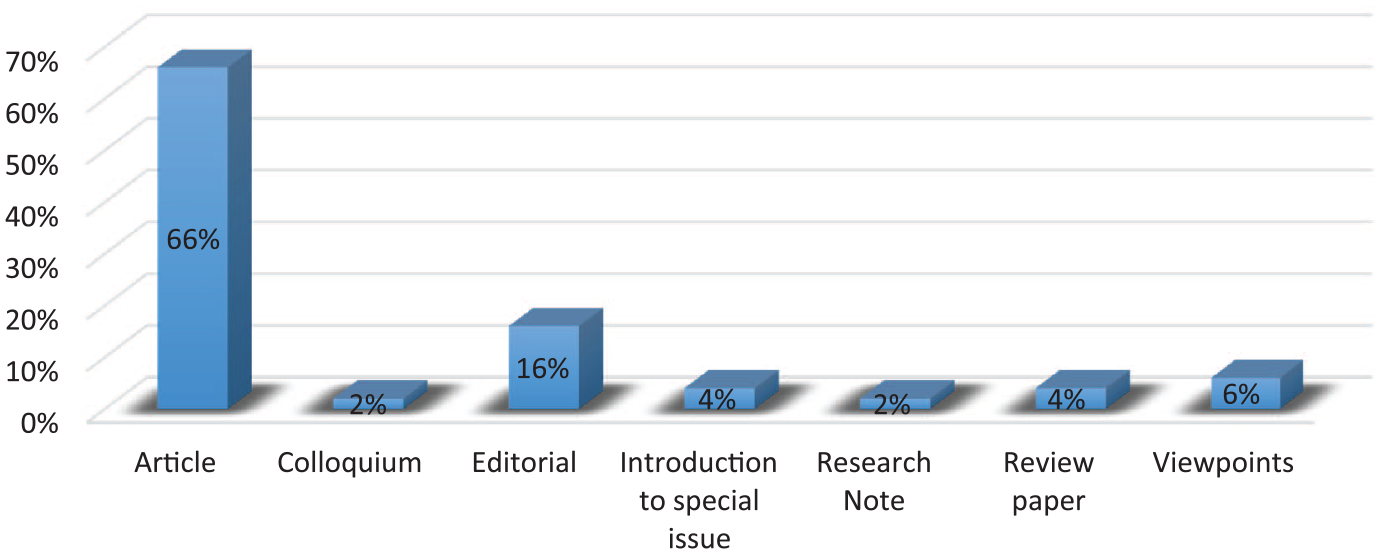
Type of publication.
Results of the analysis point to some emerging tensions and critiques that broadly cluster around three themes: tensions over disciplinary boundaries and the inter/multidisciplinary nature of childhood studies; critiques of some of its key underlying tenets including the social construction of childhood, agency, participation, voice and ethics; and the role childhood studies has played in brokering a new paradigm/view of childhood in other disciplines and sub-disciplines. The manuscripts analysed were sometimes coded to more than one of these themes, as reported in more depth in the following discussion and summarised in Table 2.
Thematic analysis.

The nature of childhood studies
Based on the articles reviewed, some emerging tensions and debates were identified around the very nature of childhood studies. It is not uncommon for relatively ‘young’ areas of scholarship to question and re-define what constitutes the field and how it should evolve. In tourism studies, for example, there has been considerable debate over the inter- versus multidisciplinary nature of the field and the diverse disciplinary claims to the social, cultural, psychological or business dimensions of the phenomenon (Tribe and Liburd, 2016). Likewise, childhood studies is maturing to the point that the strengths and instabilities of its core precepts are explicitly identified, debated and (re)imagined.
The majority of studies reviewed stressed the importance of retaining strong links to sub-disciplines (e.g. sociology of childhood, geography of childhood) and to the respective ‘disciplinary homes’ (Alanen, 2012; Arce, 2015; Bass, 2010). Alanen (2012) calls for an ‘overarching framework for interdisciplinary childhood research’ which builds on solid sub-disciplines and retains strong links to ‘mother disciplines’. Bass (2010) argues that of the three models put forward by Woodhead (2008), the ‘rebranding’ is most often evident in the United States. While researchers commonly collaborate on child-centred research, they often remain firmly positioned in their respective traditional disciplinary homes (Bass, 2010).
At the same time, however, some now argue that over the past 30 years some ‘fissions’ have developed in childhood studies which are causing a return to disciplinary boundaries and potentially jeopardising the interdisciplinary intent of the field (James, 2010a). Punch (2016), for example, argues that childhood studies is a ‘multidisciplinary’ rather than ‘interdisciplinary’ field as each sub-discipline tends not to move beyond its disciplinary boundaries (e.g. each sub-discipline publishes in particular journals and cross-references work within its own sub-discipline rather than drawing on the broader childhood studies literature). This is, according to the author, ‘resulting in one of its key strengths being under-utilised’ (Punch, 2016: 353).
Likewise, James (2010a) argues there is a risk of privileging ‘discipline over topic’ and relegating ‘children’ and ‘childhood’ once again to a subsidiary position ‘within “bigger” disciplinary concerns’. Korbin (2010) further argues that despite the interdisciplinary aspirations of childhood studies, disciplinary boundaries are often ‘tenaciously defended’. These authors renew calls for interdisciplinarity and greater communication between the sub-disciplines of childhood studies (Cook et al., 2018; James, 2010a; Korbin, 2010; Punch, 2016; Punch and Tisdall, 2012). Gagen (2010) reminds us of the opportunities that still exist to push the boundaries of what is now well established in childhood studies through greater experimentation and ‘more dissent from the protocols’, whether it be in a ‘disciplinary, interdisciplinary or extra-disciplinary’ fashion.
Editorials and special issues, in particular, play an important role in mapping current developments. In the recent 25th anniversary special issue of Childhood, cross-disciplinarity and ‘the state of the field’ are approached through a conversation with former editors of the journal (Alanen, 2018; Alanen et al., 2018; Cook et al., 2018). One of the current editors Alanen (2018) argues that ‘disciplines do not occupy clearly bounded, mutually exclusive territories’ and as such can be thought of as ‘conversational communities’ with a tradition of argumentation. Although childhood studies cannot yet claim to have an identity as a discrete discipline, the rise in research centres, study programmes, journals, scientific associations and conferences dedicated to the study of children and childhood is evidence of an ‘animated conversational community’ (Alanen, 2018: 125). The special issue tackles, in particular, some of the challenges and obstacles to cross-disciplinary work in the field. Ní Laoire, Tisdall and Morrow argue that childhood studies risks being too insular as it fails to ‘talk back’ to the broader disciplines and thus does not have ‘the disruptive impact’ that we would hope for in terms of challenging the adult-centrism of so many disciplines and applied fields of research (Alanen et al., 2018; Cook et al., 2018).
In addition, moving beyond (English) language barriers and the so-called ‘friendly’ disciplines is a further related challenge. Tisdall makes the case that going beyond what is available in the English language will provide potential for ‘learning from the respective trajectories and the no-doubt exciting debates’ in other countries (Alanen et al., 2018: 134). Morrow argues childhood studies risks ‘preaching to the converted’ and is missing out on engagement with diverse disciplines such as economics (Cook et al., 2018: 11), to which might be added business, tourism, marketing, and so on.
As well as neglecting to engage with these other more diverse disciplines, Holmberg (2018) suggests the rhetoric and vocabulary used in interdisciplinary discourses risks perpetuating the same ideal standards, rather than translating these into practice and providing guidance for childhood studies researchers in their empirical research. The author argues that ‘it is only in a vague manner that the explanations tell us how to practice research in the ideal advocated way’ (Holmberg, 2018: 169).
Problematising childhood studies
There is little doubt that childhood studies has emerged as a coherent, respected field of scholarship that has provoked new ways of looking at children and childhood. However, key mantras that were fervently promoted in the early days have recently come under scrutiny (Prout, 2011; Tisdall and Punch, 2012). In an effort to legitimise the field of childhood studies in the eyes of other well established disciplines, there have been inconsistencies in the way some aspects are emphasised over others (Hammersley, 2017). Hammersley (2017), for example, argues that in a bid to move away from ‘deficit views’ of childhood and the legacy of development psychology, the biological distinctiveness of childhood is often played down. On other occasions, however, the differences between adults and children are emphasised which according to Hammersley (2017) is the very rationale for the distinct field of ‘childhood studies’.
These more recent tensions and critiques, captured in this scoping study, question some of the key canons associated with the field including: childhood as socially constructed, children as active social agents, participatory methodologies as better suited to explore children and young people’s lives, the importance of privileging children’s voices and a focus on the ethical implications of research with children and young people. These are problematised, in turn, in the following sections.
The social construction of childhood?
The idea that childhood is socially constructed and culturally situated was a cornerstone of the emergent childhood studies paradigm some 25 years ago. Since then there has been a proliferation of studies that assume this position (childhood is socially constructed and children are active social agents); however, some argue that this may have contributed to childhood studies becoming ‘complacent and uncritical on a more theoretical level’ (Tisdall and Punch, 2012: 251).
Hammersley (2017), for example, questions whether the differences between adults and children are really socially constructed: ‘few would deny that young children lack some of the capabilities that most adults have’. He suggests the idea that childhood is socially constructed implies that the category of the ‘universal child’ does not exist and that childhood must be explored in the context of ‘adult practices and forms of social engagement’ (Hammersley, 2017: 117). Questions are raised in relation to the selective use of constructionism in childhood studies arguing that it should be applied across the board to other phenomena such as children’s voices and rights. In this respect, Hammersley (2017) argues that childhood studies is akin to a ‘social movement’ concerned with advocating for children’s rights.
Tisdall (2012) points out that childhood studies was ‘severely critical of what had gone on before’, positioning itself as a ‘counter-paradigm’. As such, the emphasis and promotion of childhood as socially constructed was to the detriment of other conceptualisations of childhood which are also important. Ryan (2012), for example, argues that rather than dichotomise the ‘natural child’ of developmental psychology and the ‘social child’ of socialisation theory we instead need to understand childhood as a ‘biosocial nexus’. In this sense, these authors are positing that the pendulum may have swung a little too far in a bid to legitimise childhood studies as counter-paradigm. Tisdall (2012) thus calls for a ‘continued re-balance in childhood studies’.
Agency – children as social agents?
The literature also features critiques of another central concept in childhood studies – that being agency and the idea that children are social agents, active in the construction and determination of their lives. The scoping review revealed some emerging concerns regarding the conceptual weakness of this key tenet. Valentine (2011) argues that agency is complex and multidimensional and requires greater critical scrutiny. The author reviews the history of the concept of agency including the social models of agency (Giddens structuration theory, Foucault’s governmentality and Judith Butler’s performativity) versus the liberal models, arguing that critical models offer childhood studies a better framework for understanding and progressing agency as a concept which is sensitive to the differences between children and the differences between children and adults (Valentine, 2011).
Authors who have problematised agency point to the often misplaced celebration of it as a ‘personal capacity or attribute’ (Valentine, 2011: 356) neglecting to consider the myriad ways in which children are often constrained or express their agency in problematic ways (Tisdall, 2016). These authors argue that, in its current conceptualisation, agency often ignores ‘the negative, challenging and limiting contexts where such agency is circumscribed or not possible’ (Tisdall, 2012: 185). Agency is usually celebrated when children are doing the right thing but it ‘becomes difficult to recognise, let alone include and consider, when children express agency in ways that go against the moral values and social order’ (e.g. child labour, child soldiers, child prostitution; Tisdall, 2016: 365). Such debates suggest that conceptual weaknesses surrounding how ‘agency’ is understood and explored in childhood studies therefore need to be addressed (Hanson, 2016). According to Tisdall (2016), a ‘relational’ and ‘contextual’ approach to conceptualising agency would help avoid the pitfall of considering it an ‘essential identity, position or characteristic’.
Likewise, Prout (2011) argues that rather than explore children’s agency in its current opposition to structure – dichotomy belonging to a modernist social theory – we should look for new opportunities to understand childhood ‘as a collection of different, sometimes competing and sometimes conflicting, orderings’ existing in a web or network of actors both human (e.g. children and adults) and non-human (e.g. artefacts and technologies). Plows (2012) similarly suggests that ‘alternative and more relational ways of viewing agency’ are a fruitful way to explore intergenerational relations. Here, it is argued that children’s and adult’s agency are, in fact, interdependent both conceptually and practically, and ‘agency is brought into being through interaction’ (Plows, 2012: 288). A focus solely on agency may otherwise risk marginalising children who live in highly constrained contexts or who have trouble expressing their agency (Tisdall, 2012; Tisdall and Punch, 2012; Valentine, 2011). Despite such empirical and theoretical arguments that construct children as social actors, some argue there is little actual change in children’s democratic participation in society (Moran-Ellis and Sünker, 2018).
A further critique gathering substantial momentum in recent years is linked to a perceived over-emphasis on a Minority World view of agency, neglecting to pay attention to the importance of children’s interdependencies within the family in Majority World experiences of childhood (Konstantoni, 2012). In the introduction to a special issue on children and childhood in India, Balagopalan (2011), for example, argues that global discourses on children’s rights and the notion that children are social actors in their own right has had a ‘limited circulation’ and do not function as the ‘primary epistemic concern’ that drives social research on children in India. Childhood is rather conceptualised within broader understandings of colonial racism and the six articles contained in the special issue testify to the variety of disciplinary approaches and the range of children’s experiences reflecting issues connected to caste, religion, class and gender. Balagopalan (2011) thus argues that concerns around ‘privileging children’s agency assume a different tenor and poses for Indian social scientists a set of different theoretical challenges’.
In this way, current conceptualisations of children’s agency may also be ‘antithetical’ to certain cultures and traditions in the Majority World thus perpetuating a certain colonial imperialism within the field (Tisdall and Punch, 2012: 250). According to Tisdall and Punch (2012), there has been a failure to incorporate Majority World’s childhoods into the theory and practice of childhood studies. Mayall (2012) asks what can be learnt from Majority World childhood research including new perspectives on intergenerational relations/interdependencies; different understandings of citizenship and children’s participation in political processes; new kinds of participation experienced through migration; and different conceptualisations about what matters in the lives of children beyond the spheres of school and family life.
By applying a theoretical perspective to child–adult relations, developed in rural Bolivia, to her own ethnographic research on social interactions in a youth club in Scotland, Plows (2012) highlights how a relational approach has the potential to draw parallels and ‘make connections between childhood research in the Majority and Minority World and to understand both the universal and specific features of children’s experiences’.
Participatory methods – the gold standard?
Within childhood studies, participatory methodologies have been identified and promoted as a way of eliciting children’s views and addressing power imbalances between child participants and adult researchers. Participatory approaches to researching ‘with’ and even ‘by’ children rather than ‘on’ children have, however, come under scrutiny.
One of the major concerns highlighted by Hammersley (2017) is that participatory research with children, and particularly child-led research, may threaten the very quality of research. Hammersley (2017) rather strenuously argues that social research is a ‘specialised activity that demands knowledge and skills that a very small proportion of adults – and hardly any children – have, and ones that cannot be acquired quickly’. Hammersley (2017) goes further in questioning whether child-led research, in particular, is defensible. The author challenges both the methodological and political rationale for participatory inquiry, arguing that it is misleading to assume that ‘adults cannot gain any understanding of children’s lives or indeed to assume that children find it any easier to understand one another’ (Hammersley, 2017: 122). According to this author, the political rationale for the superiority of participatory research as a way of extending rights to a marginalised population is also flawed. Given there is little consensus on which categories in society are to be considered oppressed and marginalised, he somewhat provocatively questions whether (as a parallel rationale) paedophiles and racists have a right to control research about them.
In a related vein, Spyrou (2011) argues that we cannot assume that participatory research necessarily overcomes power imbalances between children and adult researchers or that it results in higher quality or more authentic research, as problems connected to representation persist. Similarly, Tisdall (2012) draws attention to some of the issues with involving children as researchers including the risk of considering childhood as a homogeneous group and the problematics of considering children experts in other children’s lives.
Voice – privileging children’s voices?
The literature draws attention to evolving critiques of the notion of ‘voice’, mainly coming from scholars who are concerned about the over-preoccupation with children’s voices and an apparent disconnect with the relational and contextual aspects of the research process (Mayes, 2016; Meloni et al., 2015; Spyrou, 2011; Tisdall, 2012). Spyrou (2011), for example, argues that this has led to a failure to explore the limits of children’s voices. He argues that visual and participatory methods do not necessarily overcome problems associated with representation and there is a need for a reflexive approach which takes into account the situated character of children’s voices, entangled as they are in research contexts.
Mayes (2016) also argues that the concept of an ‘authentic, autonomous speaking voice’ is problematic within childhood research. Mayes (2016) employs a Deleuze–Guattarian approach in positing that ‘voices’ cannot be disentangled from their milieus. Accordingly, it is argued that researchers should shift their approach from ‘trying to capture the voice of the child in isolation, to examining the assemblages of the research encounter’ (Mayes, 2016: 14). Likewise, Meloni et al. (2015) argue that children’s voices do not occur ‘in a vacuum’ but are entangled with family stories, social landscapes and relationships of trust. As such, listening to children’s voices and silences is primarily a ‘relational’ act (Meloni et al., 2015: 108). According to Tisdall (2012), voice is often presented in textual form and risks excluding the ‘emotional and contextual’, particularly in research with disabled children. There is therefore a need for forms of communication that go beyond the written and verbal to include, for example, the visual arts, sound, video and multimedia (Tisdall, 2012).
Ethics
Consideration of the ethical aspects and challenges of conducting research with children and young people appears in the literature as a growing area of interest among childhood studies scholars. Recently, however, concerns have been raised about whether there has been tangible progress in establishing a coherent set of ethical practices that go beyond traditional understandings of ethics and ‘models of intactness’ (Meloni et al., 2015: 118). Meloni et al. (2015), for example, argues that in anthropology there is little consideration of the ethical aspects of researching with children beyond understandings of ‘ethics’ as ‘a mere issue of power differentials’ between adults and children. Likewise, Moran-Ellis (2010) argues that in other disciplines and sub-disciplines where childhood studies is a relatively new field of inquiry, there is little consensus on what ethical frameworks to employ.
Canosa and Graham (2016) go further to argue that often a lack of clear ethical guidelines can actually deter researchers from pursuing research with children in disciplines and sub-disciplines where it is still marginal (e.g. tourism studies). They argue that a coherent ethical framework such as that provided by the Ethical Research Involving Children (ERIC) initiative would provide some direction for these researchers working at the margins of their disciplines (Graham et al., 2013). Similarly, Gray (2014) suggests ethical guidelines developed by the European Early Childhood Education Research Association (EECERA) in 2014 represented a ‘seismic shift in thinking for practitioners operating within the social studies of childhood’. Tisdall argues that one of the challenges in establishing and sustaining cross-disciplinary work in the area of childhood studies is negotiating ethical regulations across countries and disciplines, and having a research protocol that actually ‘facilitates children and young people being involved in shaping it’ (Alanen et al., 2018: 135).
Brokering a new paradigm in other disciplines and sub-disciplines
A further theme emerging from the scoping study was around the role childhood studies has played in brokering a different view of children and childhood within and across other disciplines and sub-disciplines including disability studies, education, family law and children’s legal studies, social work, health and clinical research, history, biblical studies and tourism studies. These studies highlight the possibilities of advancing knowledge about children and childhood in other disciplinary areas by building on the core tenets of childhood studies and by disrupting entrenched assumptions surrounding children’s competence and capability.
Among these studies, Curran and Runswick-Cole (2014), for example, draws on childhood studies to put forward a research agenda which privileges the voices of disabled children, their families and support network, extending beyond the development paradigm prevalent in disability research towards narratives that reinstate children with a disability as children first. Likewise, Tisdall (2012) points to the synergies between childhood studies and disability studies and the possibilities for building a research agenda that draws on scholarship from both fields.
In considering the ways that childhood studies might enhance aspects of educational research, Dumas and Nelson (2016) argue that Black boys are constructed in ways that privilege problem prevention with ‘little imaginative space in Black male research for exploration of creativity or friendships or play’. The authors argue that Black children’s perspectives are among the ‘most invisible, the most under-represented and misrepresented’ in educational research (Dumas and Nelson, 2016: 33). Employing a critical childhoods studies lens would therefore uncover possibilities to view and ‘re-imagine’ Black boys as children ‘with all the agency and freedom envisioned in critical notions of childhood and without the anxiety and sense of limitation brought to bear on Black boys in educational research and everyday discourse on Black males’ (Dumas and Nelson, 2016: 38). According to the authors, this would allow educational research to focus less on deficit-based interpretative frameworks and more on asset-based approaches.
In a similar fashion, Arce (2015) points to the lack of dialogue between law and childhood studies and the absence of a shared ‘critical intellectual agenda’ for children’s legal studies. In addition, this article proposes that children rights research (which the author suggests should come under ‘children’s legal studies’) has become so pervasive as a result of the UNCRC that it currently has no disciplinary home.
Hanson (2014) argues that children’s rights, and associated research in legal contexts, has obvious synergies with childhood studies but suggests these have evolved quite separately with little dialogue and cross-fertilisation. He points out that an emphasis on children’s agency and the idea that children are subjects of rights has had an impact on international legal procedures, with an evident example being the establishment of the third Optional Protocol to the Convention on the Rights of the Child (Hanson, 2015). Under this protocol, children claiming to be victims of a rights violation can submit a communication to the UNCRC directly, in the eventuality that national complaints mechanisms are ineffective or non-existent. However, notwithstanding the evident efforts to view children as active agents and rights-bearer, Hanson (2015) argues that the UNCRC remains for most children ‘little more than abstract concepts’, with communication of rights violation likely to be submitted by adults acting on behalf of children. Likewise, in a Scottish context, Tisdall (2016) argues that, although family law is often child-focused, it is certainly not child inclusive, as it does not afford children the possibility to participate in decision-making.
Taking the concept of children’s rights, and a particular understanding of childhood studies, in a different direction, Cornock and Montgomery (2011) explore the rights of the unborn child and the reluctance of childhood studies to engage with the controversial question of when childhood begins. The authors argue that discussing when childhood actually begins is not only a ‘question of moral philosophy but goes to the heart of the children’s rights agenda about what responsibilities adults have to children and what rights children can claim’ (Cornock and Montgomery, 2011: 4). The article makes a case for further debate and discussion of unborn and neonatal children’s rights, extending current human rights legislation on childhood (UNCRC).
In other fields such as social work, biblical studies, health, history and tourism studies, childhood research that is informed by understandings from childhood studies still appears to be marginal and in need of further cross-disciplinary efforts (Canosa and Graham, 2016; Carpenter, 2015; Cook, 2011; Elkins, 2013; Lees et al., 2017; Mekada, 2011). Mekada (2011), for example, argues that social work has been slow to engage with the childhood studies paradigm and is still very much based on models of childhood originating from psychology (e.g. child development models) which operate within a ‘deficit paradigm’.
In biblical studies, Elkins (2013) explores the synergies that can be developed between childhood studies and feminist approaches since they both tackle similar issues and themes (e.g. agency, rights, responsibility and struggles for justice). Likewise, Swart and Yates (2012) show how the principles of childhood studies have been translated into a ‘hermeneutic of listening’ with regard to children in theological and religious scholarship.
Lees et al. (2017) explore the potential to apply the principles of childhood studies and the UNCRC to engage with children about health and services that affect them. The authors argue that the engagement of children in clinical trials and feasibility studies is scarce. Clinical research historically operates from a positivist/realist paradigm and research protocols are clearly defined by professionals with little scope to actively engage children in more creative and participatory ways. The authors argue that children’s perspectives have often been ‘sidelined in favour of the more factually “accurate” impressions of adults, or at least sought according to tightly defined criteria’ (Lees et al., 2017: 2171). According to Lees et al. (2017), drawing on the principles of childhood studies, and employing more creative ways to engage children in clinical trials, may provide a way forward in qualitative research on children’s health.
Engaging reflexively with childhood studies may also contribute to advancements in the discipline of history and consumer or popular culture, and more specifically the historiography of children’s dress, according to Cook (2011). Often absent or lost to history, the author argues that childhood studies has introduced a ‘new conceptual and epistemological thrust to bring children’s perspectives, voice and experiences into the analysis of history and social life’ (Cook, 2011: 12). Having previously neglected to recognise children as social actors but merely as ‘a clotheshorse for “adult” preoccupations with class, status display and gender’, Cook (2011) argues that historiography and fashion theory may well benefit from being brought into dialogue with the key underlying principles held by childhood studies.
In tourism studies, Canosa and Graham (2016) and Carpenter (2015) argue that the nexus between childhood and tourism is ‘under-explored’. Carpenter (2015) specifically looks at how a childhood studies lens can contribute to a deeper understanding of orphanage tourism. Canosa and Graham (2016) point to the lack of a coherent theoretical framework to guide tourism research involving children which childhood studies is well positioned to offer. Such studies argue that bringing into dialogue these two fields of inquiry will help improve current knowledge around children and young people’s lives in diverse tourism contexts and, as a consequence, contribute to expanding the boundaries of both fields (Canosa and Graham, 2016).
Tisdall and Punch (2012) argue that it is not only childhood studies that contributes to other disciplines and sub-disciplines but the reverse is often the case. Taylor (2011), for example, draws on human geography to bridge the nature-social divide in childhood studies and reconceptualise childhood through the lens of ‘nature’. Likewise, developmental studies have contributed to emerging critiques about childhood studies failing to include Majority World childhoods into its theory and practice (Tisdall and Punch, 2012). In Brazil, for example, children have until recently been viewed mostly as a ‘social problem’ due to high levels of poverty and problems connected to urbanisation. De Castro and Kosminsky (2010) suggest that childhood research has in the past perpetuated this view in Brazil, however, the nexus between the social sciences and education offers a fertile opportunity for a ‘truly transdisciplinary effort centred on the paradigmatic notion of children as agents and contributors to social life’.
Feminism and feminist theories have also contributed to challenging ‘the gender-free and antifeminism paradigm of northern childhood studies’ by exploring the child and childhood from a feminist perspective (Burman and Stacey, 2010). Large-scale empirical studies are often well positioned to expand the boundaries of a discipline or field such as childhood studies and drive theoretical and methodological innovation. Graham et al.’s (2017) study, for example, contributes to developments in childhood studies by utilising some of its core tenets in conjunction with recognition theory to conceptually reframe how student wellbeing is understood and approached in schools.
Progressing the childhood studies agenda in the future
In this article, we have reported on a number of key themes that emerged from a scoping review of relevant literature (from 2010 to 2018) that aimed to examine the contribution of childhood studies in understanding contemporary childhoods and the diverse social worlds of children. The analysis drew attention to several tensions that have emerged in relation to some of the defining tenets of the now ‘not so new’ childhood studies, hoping to help ensure the field does not become ‘complacent and uncritical’ on a theoretical level as some have suggested (Tisdall and Punch, 2012: 251). The analysis has confirmed the view that key ‘mantras’ that were adopted from the earliest work, shaping the field of childhood studies as a distinct interdisciplinary area of inquiry, have now started to be scrutinised (Tisdall and Punch, 2012).
In particular, concerns have arisen around the legitimacy of the notion that childhood is socially constructed (Hammersley, 2017), the theoretical weakness of the concept of ‘agency’ (Konstantoni, 2012; Tisdall, 2012; Valentine, 2011), the claim that participatory methodologies are better suited to explore children and young people’s lives (Hammersley, 2017; Spyrou, 2011), the over-preoccupation with children’s voices (Mayes, 2016; Meloni et al., 2015; Spyrou, 2011) and the lack of effort in consolidating a unified and distinct set of ethical practices across disciplinary boundaries to guide research with children and young people in childhood studies (Canosa and Graham, 2016; Meloni et al., 2015; Moran-Ellis, 2010). Our intention in eliciting from the literature such debates and critiques is to continue to strengthen rather than diminish the role that childhood studies might continue to play in childhood research and scholarship, as well as in the many areas of policy and practice that shape children’s lives.
We are, however, mindful that a considerable number of key text and edited collections have not been included in this review. Time and cost constraints precluded the kind of in-depth analysis that was applied to the journal articles. Nevertheless, a search on Trove (the National Library of Australia) and Worldcat (across a collection of international libraries) revealed 20 documents captured between January 2010 and August 2018 which make a significant contribution to childhood studies (Alderson, 2013, 2016; Curran and Runswick-Cole, 2013; Esser et al., 2016; Faulkner and Zolkos, 2016; Freeman, 2012; Hanson and Nieuwenhuys, 2013; James and James, 2012; Kehily, 2015; McDowall, 2010; Montgomery, 2017; Oswell, 2013; Qvortrup et al., 2011; Runswick-Cole et al., 2018; Smith, 2010; Smith and Greene, 2014; Spyrou, 2018; Spyrou et al., 2018; Wells, 2015, 2018).
In reading the available reviews, prefaces or overviews provided for each of these, it was clear similar themes were reflected to those identified in the scoping analysis reported above. Oswell (2013), for example, in his manuscript ‘The agency of children: From family to global human rights’, contributes to discourses surrounding the complexity of children’s agency as a sociological topic and advocates for the importance of disciplinary knowledge. Smith (2010) tackles the concept of a ‘universal child’ offering a global analysis of the concept of childhood and advocating for the study of childhood to be understood as a work in progress and informed by children’s own perspectives.
More recently, the edited collection by Esser et al. (2016), ‘Reconceptualising agency and childhood: New perspectives in childhood studies’, challenges the Western-centric nature of popular accounts of children’s agency highlighting the need for more culturally diverse perspectives, despite the fact that the authorship and editorial is mostly European (Hartung, 2017). Likewise, Curran and Runswick-Cole (2013) puts forward a research agenda that builds synergies between childhood studies and disability studies. In a similar way, Freeman (2012) highlights the lack of dialogue between law and childhood studies. He argues in his edited collection that it is important for lawyers to have an understanding of the developments in childhood studies research and for childhood researchers to go beyond aspects pertaining to children’s rights which are typically associated with law.
As we move forward with progressing a coherent childhood studies agenda some important considerations have also emerged from the studies reviewed. A key concern is the reproduction of dichotomised oppositions (agency/structure, nature/culture, being/becoming, global/local, childhood/childhoods) that have permeated the field as a consequence of its emergence during a time where modernist sociological discourses were prevalent (Prout, 2011). Prout (2011) argues that in stepping away from modernity and moving the sociology of childhood forward, we need to pay attention to ‘including the excluded middle’. As such, drawing on work by Latour, and Deleuze and Guattari, he proposes to pay greater attention to the ‘interdisciplinarity and hybridity of childhood; being asymmetrical about how childhoods are constructed; attending to the networks, flows and mediations of its production, and the co-construction of generational relations’ (Prout, 2011: 4).
Another key challenge is how to integrate the diversity of interests and agendas that are pursued ‘under the interdisciplinary umbrella of childhood studies’ (James, 2010b: 485). James (2010b) presents an analogy of weaving the different strands of a fabric to produce a unified childhood studies project/agenda. The warp of the fabric is compared to the ‘commonalities of childhood’ whereas the weft to the ‘diversities in childhood’ or the finer strands that create the detailed patterns. Perhaps such patterns of a proposed childhood studies ‘fabric’ would then highlight some of the diversities that other childhood studies scholars are advocating for. These include the need to focus on the politics and practices of intersectionality (Konstantoni and Emejulu, 2017); the need for a global approach to childhood studies including Majority World experiences of childhood (James, 2010b; Konstantoni, 2012; Punch and Tisdall, 2012; Tisdall, 2012; Tisdall and Punch, 2012) and the experiences of children with a disability (Curran and Runswick-Cole, 2013, 2014); the need to include children’s experiences in their global context such as in tourism contexts (Canosa and Graham, 2016; Carpenter, 2015); and the need to move beyond ‘deficit’ views of children in applied fields such as social work (Mekada, 2011) and family law (Arce, 2015; Freeman, 2012; Hanson, 2014; Tisdall, 2016).
In an effort to meaningfully progress a coherent childhood studies agenda into the future, there is a need for a consistent and ‘continued re-balance in childhood studies’ (Tisdall, 2012: 188). This ongoing calibration is both in terms of bridging the gap between policy rhetoric and children’s everyday lived experiences (Meehan, 2016), as well as translating childhood studies’ theoretical principles into practical advice on how to carry out empirical research with children (Holmberg, 2018) and on how to facilitate the actual democratic participation of children in society (Moran-Ellis and Sünker, 2018). Perhaps the greatest challenge facing the field of childhood studies in continuing its important interdisciplinary effort to improve understandings of children and young people’s lives across the globe is overcoming its very epistemic construction shaped and firmly grounded in an Anglophone and Minority World tradition. Although this has been raised by many Northern scholars, including in this scoping review, acknowledging that Majority World perspectives of childhood are still missing is no longer a sufficient response. Capturing more of the conceptual and empirical efforts in these contexts will undoubtedly advance how we understand and engage with childhood studies into the future.
Perhaps one of the most important findings of this scoping review – in addition to the themes that have been reported above – is the silence or lack of theoretical engagement with the field of childhood studies from a substantial proportion of the empirical studies that were not included in this review. This poses interesting theoretical questions. First, many articles (a total of 76) which could have been considered ‘in scope’ were missing from the analysis because the keyword ‘childhood studies’ was not mentioned in the title or abstract. Clearly, this is a limitation of the scoping methodology connected to time and cost constraints; however, it may also raise concerns as to why and how these studies could not inscribe and align their discussion within this paradigm even if they did in fact theoretically perform ‘child studies’ in their analyses.
Second, some articles (a total of 14) that adhered to the field of ‘childhood studies’ (by including such naming in the title or abstract) did not fulfil the theoretical criteria of standing. In these cases, the findings were not sufficiently contextualised within the broader theoretical debates of the field. This may be signalling that social researchers engaging with children and young people in empirical studies are not confident in talking back to the field or perhaps are only doing so within their disciplines and sub-disciplines. Authors, for example, that are more strongly anchored in their ‘mother’ discipline (like sociology, social work, educational science, geography and history) are perhaps excluded from these theoretical debates while their work contributes important insights into processes and structures of childhood, children’s lifeworlds and children’s social action.
Finally, it is important to note the articles that remain on the fringe of childhood studies may perhaps provide insight into the epistemic ambiguities and ‘grey zones’ of the field. Hence, there may be a richness of insight and debate not yet fully realised in terms of the broader interdisciplinary interests and aspirations of childhood studies. This presents an opportunity for those of us engaged in the kind of debates detailed in this scoping review to ‘pay forward’ with considered contributions and critiques that might continue to shape this field in years to come.
Footnotes
Acknowledgements
We would like to thank our international Childhood Studies colleagues who provided expert advice on methodological aspects of this review. Particular thanks also to the anonymous reviewers of the manuscript for their helpful comments and suggestions.
Declaration of conflicting interests
The author(s) declared no potential conflicts of interest with respect to the research, authorship, and/or publication of this article.
Funding
The author(s) disclosed receipt of the following financial support for the research, authorship, and/or publication of this article: This work was supported by the School of Education Research Funding Program 2018, Southern Cross University.
