




Abstract
The safeguards and measures to prevent child trafficking mentioned in the 1993 Hague Convention on Intercountry Adoption have proven insufficient in curbing the so-called irregular adoptions. An analysis of how Spanish central authorities and intermediary agencies managed the flow of adoption dossiers between 2003 and 2013 presents their inability to react swiftly to the imbalance between adoption demand and supply. The 2015 reforms in the Spanish law introduced measures to bring demand in line with real needs. However, imaginaries that portray adopters and children from the Global South as victims of meaningless bureaucracy continue to hold true even today.
Keywords
Introduction
In 2008, the Spanish Ministry of Health and Social Policy organised a conference that brought together representatives of the Spanish central authorities responsible for adoption, and adoption agencies and experts. During the coffee break, I joined a conversation in which news on the falsification of orphan certificates in Ethiopia was being discussed. Someone commented on David Smolin’s work on child laundering (2007), while someone else explained the case of an adoptive family who met their adopted son’s allegedly dead birth mother in a remote town in Ethiopia. Just before walking away from the conversation, the director of one of the Spanish agencies that had processed many adoptions in that country at the time commented, ‘I… I prefer not to know’. Her reaction exemplified the difficulties of the entire system, which is supposed to guarantee the legitimacy of adoptions, to recognise and address the growing number of cases of transnational adoption which showed clear signs of corruption and human rights violations. As this paper shows, this disregard of the red flags and the difficulty in recognising the imbalance between the demand for young, healthy children and the profile of those available for adoption seem to have been particularly vigorous in Spain because of the combination of structural and cultural factors such as (post)colonial understandings that depict differently subjects in the Global North and the Global South.
Concerns around illicit transnational adoptions were a novelty in the first decade of the 20th century (e.g. Carro, 1994; Ngabonziza, 1988). However, at the time, several studies showed how the pressure to find children for adoption had resulted in fraudulent and coercive practices that violated the rights of the children and their families (Bhargava, 2005; Mezmur, 2009; Smolin, 2004, 2007; Terre des Hommes et al., 2010). These works disclosed how the ‘availability’ of children for adoption was produced to fulfil the demand for children from the Global North in a context where ‘demographic anxieties’ (Mishtal, 2014) were at the forefront.
The spectacular growth of transnational adoption from the mid-1990s to the mid-2000s (see Selman, 2009) should be read through the lens of the politics of reproduction (Ginsburg and Rapp, 1991) and reproductive governance (Morgan and Roberts, 2012). In Spain (San Román, 2021), as in many other countries since the 1970s (Budds et al., 2013; Frejka et al., 2010; Romeu Gordo, 2009; Singerman, 2007), natality and fertility rates experienced a notable fall as the participation of women in the labour market and the public sphere increased. The postponement of motherhood (and associated infertility issues) led to a scarcity of children and growing involuntary childlessness. Hence, transnational adoption worked as a convenient means of ‘outsourcing’ reproduction (Marre, 2009), so that some reproductive functions like pregnancy, childbirth and even the early years of childrearing could be carried out in poorer countries, as children circulate in a system of ‘stratified reproduction’ (Colen, 1995; Ginsburg and Rapp, 1995).
Prospective adopters, intermediary organisations, public opinion and even legislation in the Global North interpreted having a child through adoption as a win–win situation for everyone: for the adopters, because their dream to have a child was fulfilled, and for the child because s/he ‘regained’ a family (Cheney, 2014; Howell, 2006; Yngvesson, 2010, among many others). However, most transnationally adopted children did have families who had placed (or were forced to place) them in adoption often because of poverty and/or lack of support for single mothers (Banks, 2004; Shiu, 2001; Smolin, 2021).
Several works have pointed out that the contemporary transnational adoption system is deeply rooted in neocolonialism. Bergquist (2004), for instance, highlighted the idea of economic necessity (related to both birth families and the precarious social services infrastructure in the sending countries) being the most common factor behind relinquishment and described adoption as a neocolonial form of acquiring a country’s or people’s resources. Hübinette (2001) highlighted how the Western culture of adoption revolves around ‘rescue fantasies, colonial desires, and orientalist performances’ (Hübinette, 2001: 150) and how these fantasies conceal the fact that the circulation of children in transnational adoption is a means of ‘colonial trafficking’ (Hübinette, 2006). Some works have also looked at the way the perpetuation of colonial legacies and the way they permeate hegemonic discourses and practices, cut across the way adopted people make sense of their adoption histories and construct their identities (e.g. Cawayu and De Graeve, 2020).
This paper examines how demand was managed in Spain during the years of the adoption boom and the years that followed. After presenting the context and the way the Spanish state organised transnational adoption, it analyses the data on adoption processes initiated by Spanish families and completed adoptions from 2003 to 2012, along with data from an extensive ethnographic field work, to show how the system was unable to read the warning signs and adapt the flow of adoption applications to the real needs and profiles of the ‘supply’. Spain’s case is particularly interesting because a) although it was a relatively late entrant to intercountry adoption as a child-demanding country, the extraordinary development of intercountry adoption made it the second country with the highest number of children adopted transnationally, in 2004 (Selman, 2009); and b) it experienced a particular difficulty in recognising and reacting to evidence of malpractice. The presented results point out that both a highly decentralised system (with 23 competent central authorities) and (post-) colonial cultural understandings contributed to this. Almost a decade later, the discourses that insist on the need to ‘unblock’ international adoption in order to respond to the desire of infertile couples or individuals to build or expand a family continue to persist.
Transnational adoption in Spain: An overview
Until 1975, Spain’s total fertility rate (TFR) was one of the highest in Europe, at 2.8 children per woman, but by 1996, it dropped to 1.16, one of the lowest in the world (Kohler et al., 2002). After Franco’s dictatorship ended in 1975, women’s presence in the job market increased but, up to the time of writing, this was not followed by effective public policies to support family and motherhood (Comas-d’Argemir et al., 2016). The sharp drop in fertility rates could be read as a waning desire for children, but, as Bernardi (2005) pointed out, Spain had and still has one of the highest ‘child gaps’ (the difference between the number of children women would like to have and the number they actually have) in Europe (Beaujouan and Berghammer, 2019). As argued elsewhere (Marre et al., 2018), in this context, transnational adoption seemed to be an effective reproductive strategy for those struggling to become parents after a certain age or due to other causes of infertility. Thus, starting in the 1990s, Spain transitioned from a country where people from other places came to seek an adoptable child to becoming one of the main receiving countries of transnational adoption.
Transnational adoption in Spain (1997–2019) by area of origin.
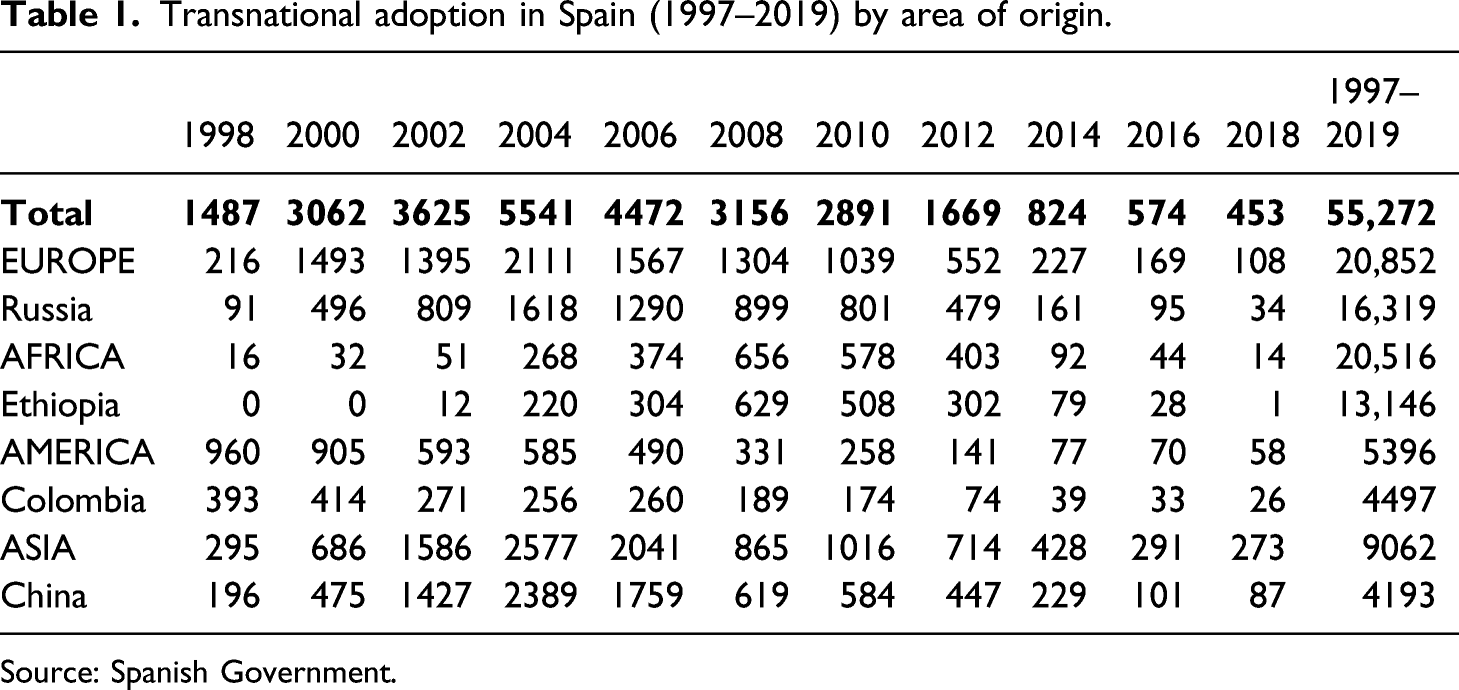
Source: Spanish Government.
According to The Hague Convention on Intercountry Adoption (Hague Conference on Private International Law, 1993), member states have to designate a central adoption authority. Central authorities in the receiving countries are responsible for taking ‘all appropriate measures (…) to facilitate, follow, and expedite proceedings with a view to obtaining the adoption’, which they can do ‘directly or through public authorities or other bodies duly accredited’ (art. 9).
The way Spain has organised the transnational adoption system strongly differs from the approach in other European countries. Spain has a highly decentralised government, resulting in 23 different central authorities. After Law 1/1996, each of them accredited their own adoption agencies. In 1997, 25 adoption agencies had been accredited (Díaz De Tuesta, 1997). By June 2007, there were already 40 agencies (Elena Elosegi, 2014, personal communication). This state of affairs contrasted with that of other European countries, such as France, Norway and Sweden which had only a small number of accredited bodies.
The accredited bodies assisted adopters with the paperwork for their dossiers, sending them to the country of origin and following up and expediting the proceedings. Their fees varied, but they were rarely below €11,000 per adoption, and the average cost was €13,000 per process (Comunidad De Madrid, 2013; Región De Murcia, 2014). These amounts were to be paid in three instalments: 50% when the contract was signed and 25% when the match was accepted or before sending the dossier to the country (Xunta De Galicia, 2013). According to the interviews I conducted with representatives of adopters’ associations and adopters, in most cases, the second payment was required when the file was sent. Thus, 75% of the payment was made before the adoption process began in the country of origin.
Data and methods
Statistics on adoptions by Spanish families were obtained from the Spanish Ministry of Health, Social Services and Equality. This Ministry publishes yearly figures on adoption by country, as well as the number of certificates of suitability granted per country.
The first step in initiating a transnational adoption process is filling out an application so that the parents can be evaluated and deemed ‘suitable’ and therefore obtain a certificate of suitability (according to the official statistics from 2002 to 2011, the rates of denial for this certificate in Spain were extremely low, ranging from 0.5% in 2004 to 2% in 2009). Once this is issued, prospective parents can start the adoption process in the country of their choice. Although there are no data on how many prospective parents holding certificates of suitability decide not to move forward with the process, in my fieldwork I found that the percentage was very low and corresponded to very special circumstances such as the death of a member of the adopting couple while completing the dossier. Benedicto García, the former General Coordinator of the Spanish Federation of Adoptive Families Associations who has been actively involved in this kind of activism since the 1990s, could not recall even one such case, even though during the first 15 years of his activism, the main focus of the associative movement was to help adopters prepare their dossiers. For the purpose of this paper, it is estimated that this may be the case for 1% of the families declared suitable for adoption, so that 99% of the total number of certificates of suitability issued are counted as adoption applications.
The analysis also draws on ethnographic data collected in four three-year projects (2007–2018) funded by the Spanish government. This work included participant observation in associations of (prospective) adoptive parents, attendance at 35 formative events for adoptive families and professionals and the monitoring of five Internet fora on adoption. Over 100 in-depth interviews were conducted with adoptive parents, three interviews were conducted with practitioners working in accredited bodies and numerous informal ‘ethnographic interviews’ (Spradley, 1979) were conducted with directors of accredited bodies and policymakers, particularly in 11 national conferences on adoption that were organised by or in collaboration with the Spanish central authorities where I was invited as a speaker.
The gap between adoption demand and completed adoptions
As seen in Figure 1, between 2003 and 2013, the gap between completed adoptions and initiated dossiers created an ‘unsatisfied demand’ (cumulative difference) of over 23,000 children. Over the years, completed adoptions were significantly below the number of new applications filed. Spanish transnational adoptions and applications from 2003 to 2013 (all countries).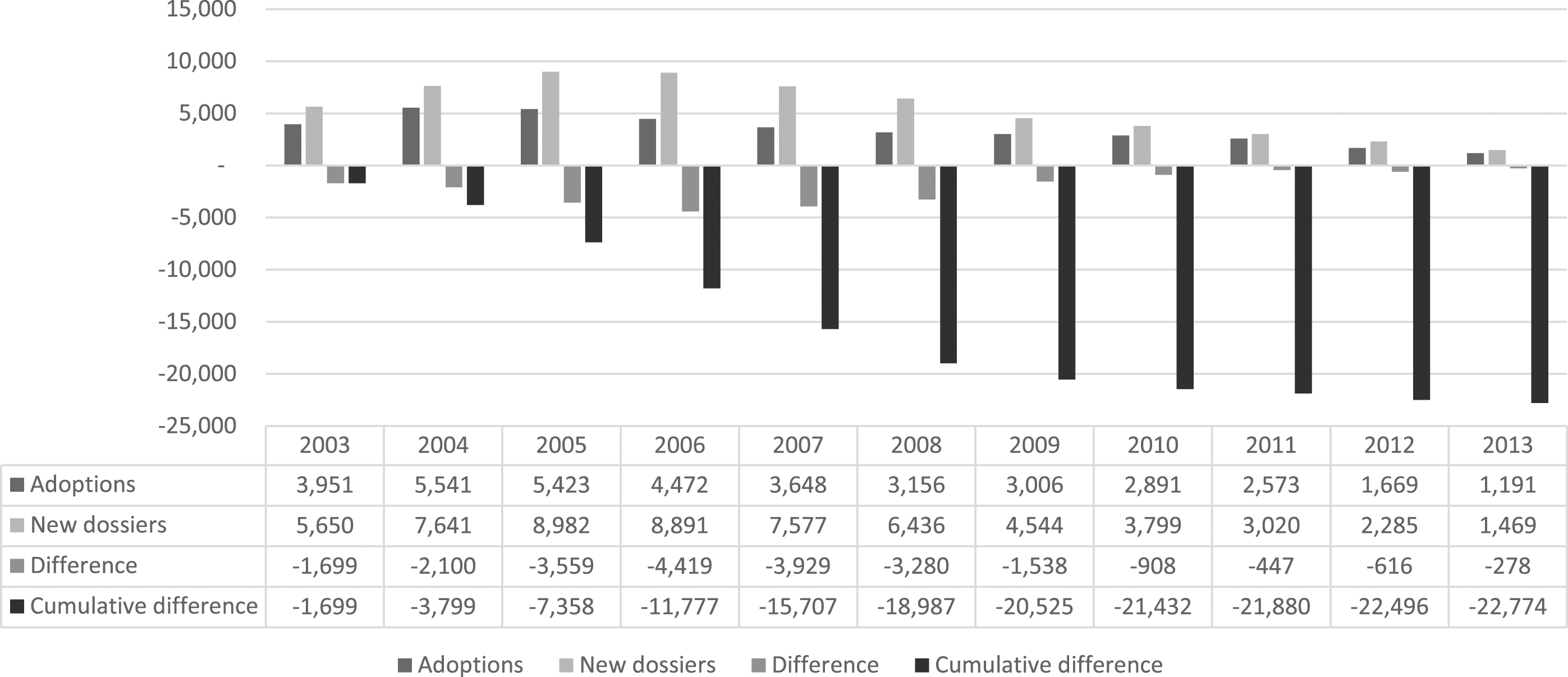
Although starting in 2005 there was a decline in both the annual number of adoptions and the number of applications, the former was far steeper than the latter. By the end of 2013, there were 22,774 files awaiting the allocation of a child, whereas the total number of completed adoptions was 1191. This means that, at that pace, it would have taken nearly 20 years to close or satisfy the pending applications. To gain further insights in this gap, I will look at how the demand for children from China and Ethiopia, two of the most common countries of origin for adopted children in Spain, was managed.
China
Between 2001 and 2006, 40% of all children adopted by Spanish families were born in China. As Figure 2 shows, until 2005, the number of adoptions increased annually, but the number of applications increased at a much faster pace. In 2006, when the number of adoptions from China fell to 1,759, the estimated number of Spanish adoption applications in China was 7457. In 2007, 2523 new applications were processed while only 1059 adoptions were completed, which left over 9000 applications awaiting a match. Spanish transnational adoptions from China and applications from 2003 to 2013.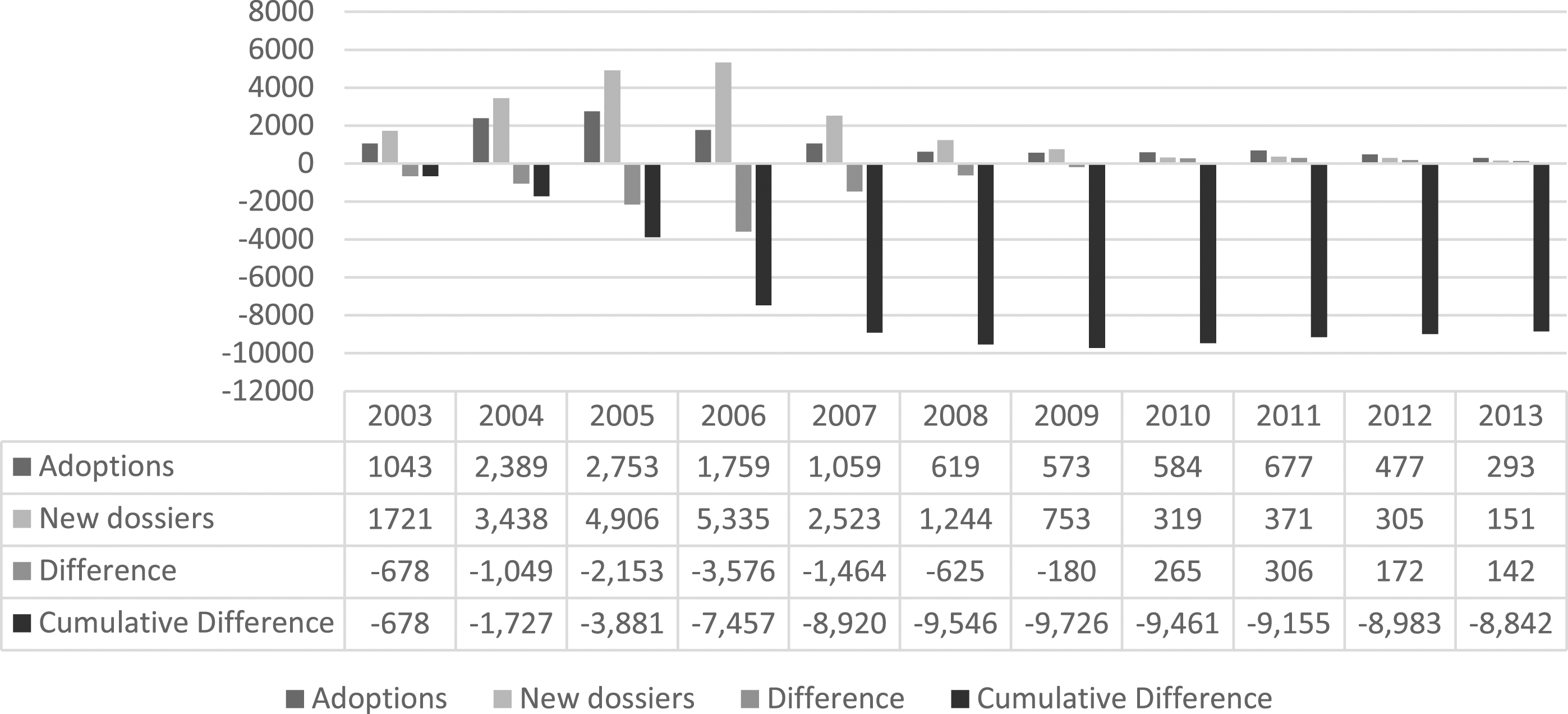
The trend became all the more dramatic in the ensuing years, with waiting times for prospective parents growing longer. Families that received a match from the Chinese government in the beginning of 2005 had filed their application only 6 months prior. Families receiving a match in 2009 had waited for 45 months on average. In the years that followed, the waiting time increased and families travelling to pick up their children in 2014 had waited 7 years or longer.
Most Chinese children adopted in Spain in the first decade of the 21st century were babies or toddlers under 2 years of age. Certificates of suitability issued by Spanish authorities were mostly for healthy children, aged 0–3 years. At the time, as Vich Bertran pointed out, the idea had spread in Spain that girls were not wanted in China and that, for this reason, ‘when they were born, they were drowned in buckets of water, left to starve or abandoned in the street’ (Vich Bertran, 2012: 406).
In the mid-2010s, some international media reports linked international adoption to child trafficking in China (see, e.g. Goodman, 2006; Loyd, 2008). When someone shared a link to this news on a forum for adoptive families, there were very few comments from other prospective parents. None of them challenged the taken-for-granted belief that there were thousands or millions of girls who were healthy and young in China, for whom adoption was the only solution. Many of them pointed to US agencies, their greed, haste and unscrupulousness as the culprits behind the corruption of the system, an argument that would later recur in response to other cases of corruption pertaining to transnational adoption in other countries
1
. The idea that the Chinese adoption system was the ‘most transparent’ and rigorous was and remained for a long time, an unquestioned truth. This alleged transparency was recurrently mentioned in my interviews as one of the main reasons for prospective adoptive parents choosing this country, and in the discourses of the accredited bodies that processed adoption files in this country. The following is a quote from a woman I interviewed in 2009: I do not want to risk it. You hear things from Congo, from Ethiopia... Look, the Chinese system may be slower now, but it is by far the most transparent. I prefer to wait a little longer but be sure that my adoption process is clean and clear.
The myth of the huge number of unwanted Chinese girls who could only be rescued by international adoption did not correspond to the profiles of the children in state care in China. Shang and Cheng (2006, cit. in Wang 2010) pointed out that up to 80.5% of the children in welfare institutes had been abandoned because of disability and/or illness. Starting in 2000, the Chinese government set up the Waiting Child Program to encourage, particularly from 2005 onward, the placement of older and disabled children (for an explanation of the movements in this sense by the Chinese authorities, see Wang, 2016). According to the statistics provided by the Hague Conference on Private International Law, their efforts translated into a sharp rise of the so-called special needs adoptions: from 9% in 2005 to 20%, 30%, 47% and 49% in 2006, 2007, 2008 and 2009, respectively.
Despite the signals sent by Chinese authorities, such adoptions accounted for only 0.2% of the total number of adoptions carried out by Spaniards in China in 2005, and remained below 1.2% in the 3 years that followed. Although it increased up to 9% in 2009, the figure was far below what was seen in the other four main receiving countries that year: 61% of Chinese children adopted by US parents, 40% of those adopted by Canadian parents, 66% of those adopted by parents from the Netherlands and 69% of those who left the country to be adopted by a family in Sweden had ‘special needs’.
The statistics suggest that Spanish-accredited bodies were only partially successful in following Chinese instructions in finding Spanish families that were willing to adopt children with special needs, but kept sending applications for healthy children aged under 3 years, even if everything seemed to point to the fact that the children who could be part of these adoptions had not even been born yet and that the availability of healthy young children was not likely to increase; rather, it was likely to continue declining.
Ethiopia
In 2002, Spain registered the first 12 adoptions from Ethiopia. By 2008, Ethiopia ranked second among the countries of origin for adoption. Once more, the growth in applications far exceeded that in adoptions (see Figure 3). By 2012, there were 302 adoptions in Ethiopia and the peak of accumulated applications: 2279. Although the backlog of files and the recurrent messages from the Spanish Embassy in Addis Ababa questioning the guarantees in the processes, Spain continued sending new applications to Ethiopia until November 2017, when the Spanish central authorities agreed to put an end to all processes that did not have a matching at the time. Spanish adoptions from Ethiopia and applications from 2003 to 2013.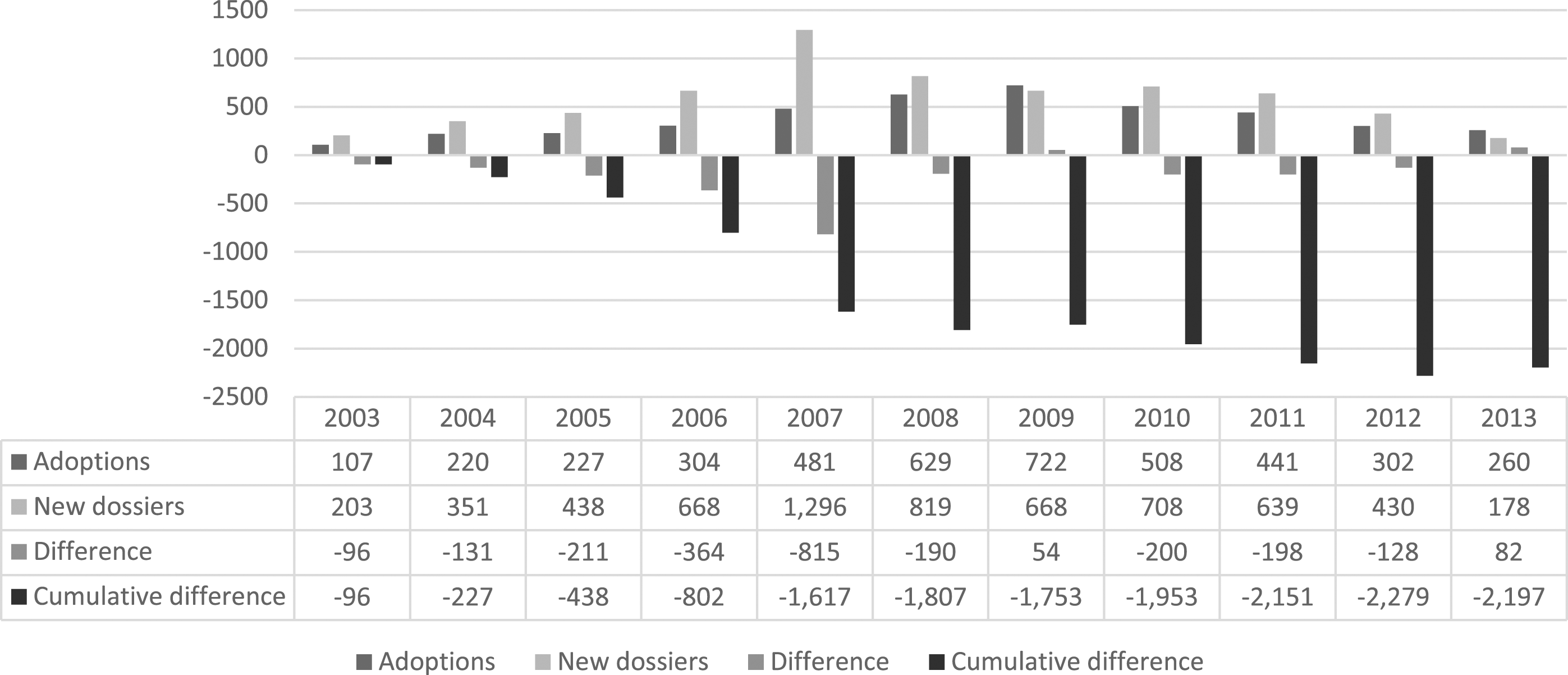
In 2006, the adoptive parents I met during my fieldwork began telling me about the clear signs of corruption and fraud in their adoption processes, including the falsification of adoptability documents and death certificates of birth mothers. When our research group met with the heads of the Catalan central authority on several occasions to report these testimonials, in some cases accompanied by supporting documents, their response was consistently that this was ‘the problem of the country of origin’ and that ‘after all… they are better here’. The reasons given for dismissing the recurrent signs of malpractice and human rights violations revolved around two axes. On the one hand, responsibility was placed entirely on the countries of origin and their inability to control corruption and ensure the best interests of the child. On the other hand, the assumption that any child, under any circumstances, would ‘obviously’ have a better life in a family in the Global North prevailed. Both arguments suggest that the legitimising narratives of irregular adoptions, or at least of the lack of reaction to them, are themselves an ‘exercise of Western power’ (Metcalfe and Woodhams, 2012: 132), which is based on the othering (Bhabha, 1994) and subalternisation of both the subjectivities and ways of life of the Global South and its states.
The lack of reaction from the administration and accredited bodies is in sharp contrast to the response from CORA, the Spanish umbrella organisation comprising 30 Spanish adopters’ associations. In 2009, through a public statement, CORA asked the Spanish authorities to cease adoptions from Ethiopia to Spain. Their petition, which was unsuccessfully and strongly criticised on Internet fora by prospective adoptive parents, included the following statement:
The facts reported by both the international press and a good number of Spanish families are so disturbing that the Spanish administrations cannot wait to act. They should take matters into their own hands to prevent at all costs even a single irregularity that could cause a child to be torn from his or her family. For the associations that form CORA, adoption is a means of providing a family to children who do not have one. It is not a means of satisfying the craving for fatherhood or motherhood of Western citizens who are able to make donations to the third world.
How was it that what was evident to CORA’s activists seemed like irrelevant to prospective parents, accredited bodies and public opinion in general? In the following section, I try to show how the difficulty in recognising that the system of guarantees of transnational adoption was failing is related to both structural factors that hindered parenting projects and the construction of what Posocco (2014) called the ‘acquisitive familialism’ of adoptive parents as rights-bearing figures versus the placement of Global South inhabitants in a position equitable to what Agamben (1998) called ‘bare life’, where both their rights and capacities are blurred.
Re(producing) the socially naked child
In Spain, as in many other countries from the Global North, transnational adoption was built on the socially constructed notion of Howell, namely, the ‘socially naked’ child, which is a child ‘denuded from all kinship; denuded of meaningful relatedness’ (Howell, 2006: 4). A simplistic understanding of the effects of China’s one-child policy and the widespread idea that there were millions of orphans languishing in the orphanages in the Global South fuelled the extraordinary growth of transnational adoption since the late 20th century (San Román, 2013). Recurrent news stories linking adoption to child trafficking, particularly from the mid-2000s, challenged these imaginaries head-on, with the emergence of birth families on the scene. The Spanish media barely gave them any space. The exception emerged when there were identifiable families, pressing the Spanish authorities to mediate difficulties in their processes. One of the most notable among these was in Congo-Brazzaville in 2007, when the adoption processes of several Spanish families were halted as a result of suspicions around their legitimacy that included the appearance of supposedly dead or missing birth families. As discussed at length elsewhere (San Román and Rotabi, 2019), the media framed the topic from the adopters’ perspective, using discourses of rescue and bureaucracy, as they avoided the discussion around birth families and their rights. The following excerpt from a major newspaper is a sample:
Moïse, Guillem, Patrice Anne and Theo arrived yesterday at the airport in El Prat in the arms of their parents, who spent 2 months in the African country doing, they regret, what the Government was unable to do: streamline and close the process. One of them came back with empty arms since the baby’s biological father appeared out of nowhere at the last moment, and as if it was something contagious, three other biological families have appeared in the last few hours. (Conesa and Bernal, 2007; my emphasis).
Other similar cases were covered by the media with discourses that recurrently used words like ‘odyssey’ or ‘nightmare’ to describe the struggle of Spanish families ‘against bureaucracy’ to bring home ‘their children’ (see e.g. Ceberio, 2006; Lorente and Sosa, 2014; Playà, 2008). Words like ‘fraud’ or ‘trafficking’ and the questioning of the system were conspicuous by their absence. Birth families, leave alone their rights, rarely appeared in the stories that emerged. When they did, as in the above quote, their opinions were not reported. Nothing was said about their circumstances and characteristics. In contrast to the profusion of data and accounts of adoptive parents, their figures appear blurred, abstract and dehumanised. It is also striking that the institutions in the countries of origin were, and still are, called ‘orfanatos’ (orphanages), even when it had become clear that in most cases, the children were not orphans. 2 As Smolin (2021) highlighted, in some cultural contexts, these facilities are considered by the local boarding schools for the poor: ‘a way in which poor families under stress ensure that their children will receive an education and food, while intending to maintain parental status and relationship’ (Smolin, 2021: 9). The use of the word ‘orphanages’ serves as a device for erasing birth families and their rights, and reinforces the image of adopted children as being devoid of any family or relational anchorage.
Attempts to match demand with ‘supply’
In contrast to the discourses that blamed the slowdown in the adoption processes on bureaucratic inefficiency and minimised cases of corruption, the associations of adoptive families, through CORA, were the ones who most clearly, and early on, took a stand in favour of the need for a clear change in international adoption programmes. Through public statements, CORA demanded, at different times, the immediate suspension of sending files to countries where clear irregularities were being detected (Vietnam and Nepal in 2008, Ethiopia in 2009), which produced serious tensions in the associative movement. The representative of one of its associations explained so in an interview I conducted with her in 2008, after a communiqué was issued calling for the suspension of adoptions from Vietnam:
We have members who deregister... Just yesterday, a member came and shouted at me that we were immoral and were playing with a lot of people’s family projects. I let her talk and then said, ‘Look, I’d rather you shout at me than come back in a few years, crying because you found out that you adopted a trafficked child’. Unfortunately this is something that is happening more and more, but the regional governments prefer to shelve complaints rather than investigate them.
In 2012, in a public letter addressed to the Spanish government and the country’s 23 central authorities, CORA called for a moratorium on all applications for the adoption of healthy children aged under 4 years and for sending adoption dossiers to those countries where the waiting time to get a match was longer than 4 years, ‘so as not to continue to increase the pressure on them to “obtain” adoptable children’.
It was not until 2015 (when transnational adoptions in Spain were barely 2% of those carried out in 2004) that the reform of the state child protection law included in its text the establishment of sending quotas based on ‘the average number of adoptions in the last 2 years and the number of cases pending placement of a child’, although to date, the mechanism for determining these quotas has not been developed.
The representation of countries from the Global South as inexhaustible reservoirs of healthy, young orphans in the media and in the prospective adoptive parents’ discourses on the Internet seemed to guide what could be seen as a senseless flow of adoption dossiers by accredited bodies, even when some countries of origin sent out clear messages that there were no such number of children available for adoption. The case of the Philippines clearly shows how accredited bodies disregarded the messages regarding mismatch between demand and ‘supply’.
On 1 May 2009, the Inter-Country Adoption Board (ICAB, the Philippine central authority), faced with the accumulation of adoption applications, decreed a moratorium stating that until it processed at least 50% of the pending adoptions, it would not accept new applications for children aged between 0 and 2 years. Given that, in Spain, the majority of certificates of suitability were issued for children between the ages 0–3 years, Spanish-accredited bodies continued sending dossiers to the Philippines. In 2007 alone, applications for the Philippines increased by 550%, from 28 to 182. In the years that followed, the figures increased annually until 2010, when the ICAB recognised the failure of its policy to control the demand for children and established a more restrictive limit on the number of applications accepted. It is hard to believe that the accredited bodies were not aware that they were creating an avalanche of applications that could not be satisfied. The accredited body ACI, which had previously focused on China, was particularly aggressive in its campaign to capture clients despite ICAB’s notice. At the end of 2012, ACI was the European agency with the highest number of applications pending in the Philippines: 316 (the French-accredited body AFA was in second place with 47) (Figure 4). Spanish transnational adoptions from the Philippines and applications from 2004 to 2013.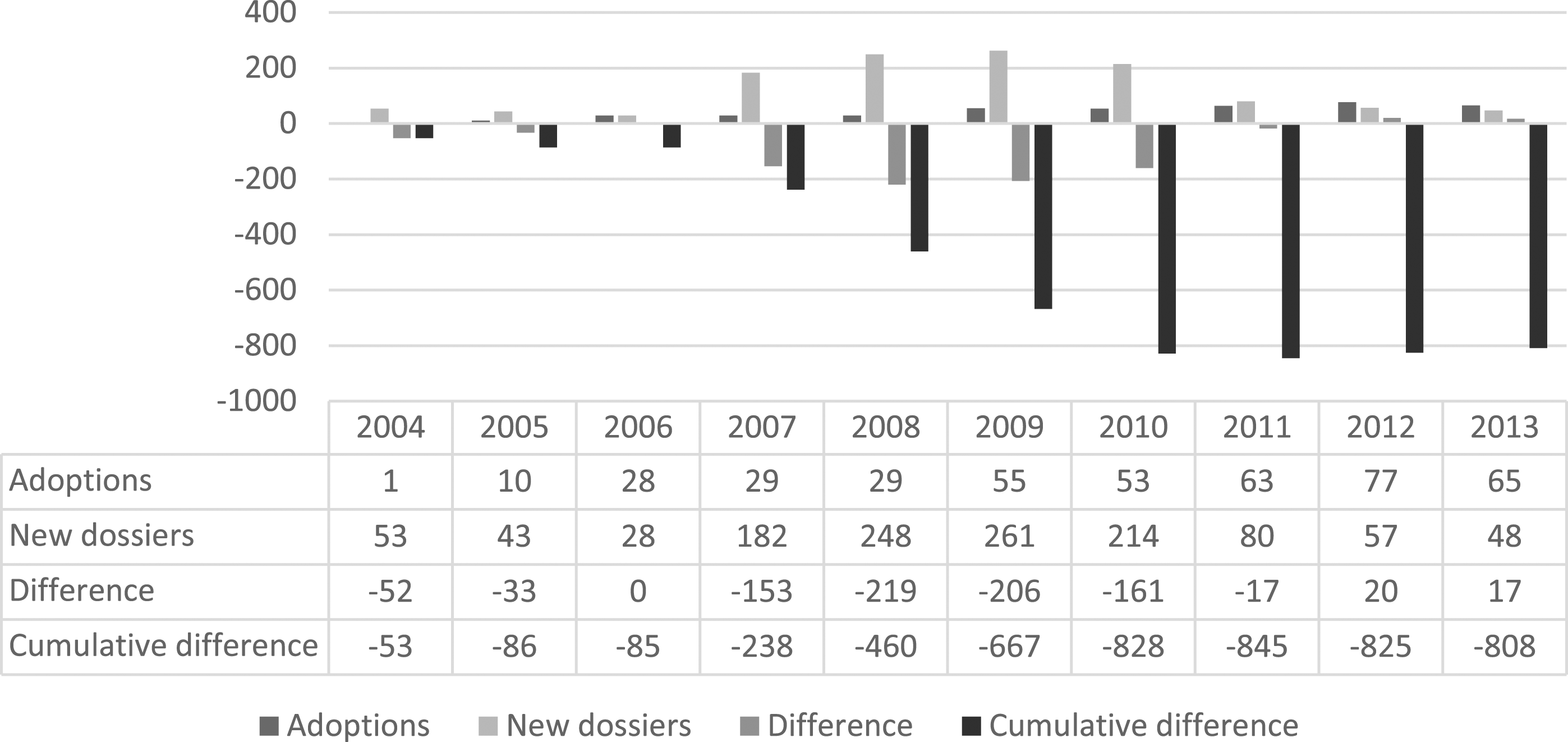
Even after the legal reforms in 2015, the idea that the slowdown in the adoption processes was because of the ineffectiveness of the administration, and bureaucratic obstacles continued to exist in Spain. In 2016, with the support of all opposition parties, the Spanish parliament passed a proposition urging the government to remove ‘the legal and administrative obstacles that specialised entities in the sector and adoptive families encounter in the (adoption) process’. More recently, the contrast between the solidarity of adopting families and the selfish consumerism of those who opt for surrogacy has been recurrent in the intense debate on the latter in the media and social networks. One example of this is a tweet posted by former Socialist MP Elena Valenciaga in 2019: ‘A very simple question: with so many orphaned children (...), why don’t we speed up adoptions and stop objectifying women?’
Biopolitics and (post)colonial entanglements: Acquisitive familialism
According to CORA’s activists, admitting corruption in the system was difficult due to the decentralisation of the system and the determination of accredited bodies to keep sending files to ensure their survival. A more centralised system, where allegations of malpractices were not divided among the 23 central authorities, might have been nimbler in recognising and addressing the red flags. The lack of detail on the breakdown of the budgets that accredited bodies provided to families makes it impossible to deduce the proportion of the budgets of the more than 20,000 adoption files pending matches in 2013 that had been executed. However, the fact that adopters had to pay 75% of the total when the dossier was sent to the country suggests that, regardless of the chances of completion, the possibility of a high income was an important incentive for accredited bodies. As Anzil (2012) pointed out, the intermediation of accredited bodies was described by central authorities as a ‘guarantee against child trafficking networks or mafias’ (Anzil, 2012: 161), but in the face of evidence of malpractice in adoption processes, these same authorities protected them ‘while protecting themselves from liability as accrediting bodies’ (Anzil, 2012: 171).
The delay in action taken by the Spanish adoption system should be examined in light of other related factors. The plummeting global fertility rates since the 20th century were particularly acute in Spain (Kohler et al., 2002). In this context, an analysis in biopolitical terms allows one to understand transnational adoption as a means of ‘producing life’ in a context of scarcity, through the importation of children gestated in other bodies. While until the 20th century, adoption had been a taboo subject in Spain, the rapid development of transnational adoption in Spain since the late 1990s was accompanied by its visibility and social endorsement. Adoptive families came to be considered a modern, desirable and aspirational model, as evidenced by their appearance in advertisements for the most varied products, including biscuits, sanitary towels, cars and washing machines (Zuloaga, 2006).
The difficulty in recognising the failures in the system of guarantees of this form of child circulation and the imbalance between demand and supply must also be analysed in light of post-colonial relations and resulting imaginaries. In the first stage, the development of transnational adoption in Spain was based on the view of countries from the Global South as inexhaustible reservoirs of orphans. When it became evident that many of those who were adopted were not orphans, other imaginaries were activated or reinforced, which enabled the disconnection of children from their relationships, pasts and contexts. Adoptive families are portrayed as heroic individuals and victims of a meaningless bureaucracy that either prolong or complicate their adoption processes. In contrast, birth families and their rights are blurred if not entirely removed from the picture. Their invisibilisation allows adopters’ acquisitive familism to be narrated as an odyssey in which they act as autonomous individuals operating in a faceless system where children are detached of all relatedness so that they can circulate as commodities. At the same time, the explanation of cases of corruption as isolated events or as a result of endemic corruption in the countries of origin ignores the fact that the transnational adoption system itself is embedded in asymmetrical power relations between the Global North and the Global South, in which the receiving countries set the rules of the game. The idea that the system failed because the countries of origin were incapable of controlling the corruption and greed of the mafias that made adoptable children who were not adoptable, also obviates the fact that, as Leifsen (2004) pointed out, transnational adoption has been a lucrative activity in the receiving countries.
Footnotes
Declaration of conflicting interests
The author(s) declared no potential conflicts of interest with respect to the research, authorship, and/or publication of this article.
Funding
The author(s) disclosed receipt of the following financial support for the research, authorship, and/or publication of this article: This work was supported by the Spanish Ministry of Science and Innovation (grant reference MICINNCSO2009-14763-C03-01SOCI), the Ministry of Economy and Competitiveness (grant references CSO2012-39593-C02-01, CSO2015-64551-C3-1-R) and the Ministry of Science and Innovation (PID2020-112692RB-C21/AEI/10.13039/501100011033).
