




Abstract
Civil society seems to be a dead issue in China because its formal aspects of mobilization and institutionalization are so tightly regulated by the party-state. This article looks to activities in and around the Shanghai World Expo (2010) to rethink the meaning of civil society and political action in China. Through an analysis of the Expo’s national, theme, and corporate pavilions, it shows how Beijing is planning a harmonious future for China and the world. Yet alongside this unified future, it examines how Shanghai’s citizen intellectuals – filmmaker Jia Zhangke, artist Cai Guoqiang, and blogger Han Han – are creating alternative futures. This multiple decentralized view of the future is an integral part of building alternative notions of civil society in China. The article thus has two goals: (1) to contrast official constructions of a unified harmonious future with citizen intellectuals’ multilayered views of Shanghai’s past-present-future; and (2) to explore how citizen intellectuals are creating a new civil society that can build alternative futures.
From the skyscrapers of Pudong that tower over the late imperial architecture of the Bund, to the vibrant spaces of commercial and cultural activity on Huaihai Road, Shanghai represents ‘the future’ in China. Even Beijing’s central planners see Shanghai’s knowledge economy as the epitome of not just Chinese modernization, but of global modernization. 1 While most take for granted that China’s future is planned in Beijing, this article examines how Shanghai dreams of – and thus creates – ‘the future’ in alternative ways.
It compares the Shanghai World Expo 2010’s official view of the future with how citizen intellectuals work both inside and outside this official space to craft alternative futures. On the one hand, the Shanghai World Expo’s theme pavilions and corporate pavilions strove to build a harmonious, unified, and cosmopolitan world. Yet in the Expo Culture Center, Jia Zhangke’s film Shanghai Legends (海上传奇) offered a nuanced view of the city’s cosmopolitan past. Outside the Expo, Cai Guoqiang’s ‘Peasant da Vincis’ exhibit celebrated rural ingenuity as a way of criticizing both the Expo theme – ‘Better City, Better Life’ – and China’s urban-focused development strategy. The conclusion examines how Shanghai blogger Han Han negotiates this terrain to build a new civil society in China. In this way, the article looks at how Chinese voices are questioning the ‘China model’ of development, politics, and society. While the party-state tends to plan a centralized future, the article examines how citizen intellectuals are multiplying and decentring what it means to be Chinese in Shanghai.
The article thus has two goals: (1) to contrast official constructions of a unified harmonious future with citizen intellectuals’ multilayered (and often contradictory) views of Shanghai’s past-present-future; and (2) to explore if and how citizen intellectuals are creating a new civil society that can build alternative futures.
Citizen intellectuals
Reflecting on their country’s recent economic success, China’s policymakers and public intellectuals are now asking, ‘What comes next?’. How can China convert its growing economic power into enduring political and cultural influence around the globe? People in China thus are experiencing a heady mix of excitement and uncertainty about the possibilities for the 21st century, which they feel is ‘The Chinese Century’.
To see where China is going in the world, most scholars look to international relations literature and conduct elite interviews with scholars and officials in Beijing. This article takes a different tack to highlight what Chinese people are saying to each other in public space and popular culture. This broad view of Chinese politics enables us to better explore the grand aspirations and deep anxieties of a wide variety of public intellectuals. The goal is to analyse the films, art, and blogs of China’s ‘unofficial futurologists’ to see what they think about what it means to be Chinese in the 21st century.
Since the formal aspects of civil society, especially mobilization and institutionalization, are tightly regulated in China, it is difficult – if not impossible – to organize directly against the party-state. Indeed ‘civil society’ is a problematic term in China because it suggests that people can act in organizations that are separate from and independent of the state. While this makes sense in Taiwan and Hong Kong, in the People’s Republic of China (PRC) it does not: according to the civil administration law, all NGOs have to be sponsored by party-state organizations. Hence, NGOs in China are by definition GONGOs (government-oriented NGOs), or even PONGOs (Party-oriented NGOs). Without reviving the ‘civil society/public sphere debate’ of the early 1990s (best exemplified by a special issue of Modern China edited by Philip C. C. Huang), I think that social movements in late-socialist Eastern Europe (1980s) make a useful comparison. 2
In the 1980s, social movements in Hungary, Poland, and Czechoslovakia certainly were very complex. But Havel’s essay ‘The Power of the Powerless’ (1978), which was widely translated and circulated as a samizdat in Eastern Europe, is rightly taken as not only a manifesto for these new social movements, but also as a sophisticated analysis of power in the late-socialist era. In a nutshell, Havel suggests that being a ‘dissident’ can be counter-productive because it isolates intellectuals as an ‘exclusive group’ from the rest of society. Rather than arguing for an elite movement to lead a grand revolution, Havel suggests that everyone can make their own revolution by ‘living in truth’. Living in truth starts with rejecting the ‘lies’ that the regime produces and distributes to buttress its legitimacy. But it is also positive in the sense of engaging in ‘small-scale work’ to build parallel cultures, parallel markets, and thus a parallel society that exist side-by-side with the official party-state’s culture, economy, and society. Havel argues that when gathered together these various ‘small-scale work’ activities can constitute a parallel polis. Ultimately official structures ‘simply begin to wither away … to be replaced by new structures that have evolved from “below” and are put together in a fundamentally different way’. 3
Beijing takes this possibility, which it calls ‘peaceful evolution’, very seriously. In 2011 it reacted to the Arab Spring uprisings by cracking down on political activists such as the artist Ai Weiwei, who, according to Beijing’s hypernationalist newspaper, the Global Times, had crossed the party-state’s ‘red line’ of what is allowed in Chinese society. 4 The Chinese leadership thus is very wary of civil society movements and ‘colour revolutions’, even as it feels obliged to open up economic and social space in order to promote continued economic growth.
To live and work in this ambiguous social space, China’s citizen intellectuals have developed a few strategies. One is to consciously avoid being pigeon-holed as a ‘dissident’. This is a switch from the 1990s when, as Barmé explains, a tried-and-true strategy for success for many Chinese artists, writers, and filmmakers was to be banned in China. Censorship created a ready market for this ‘packaged dissident’ in Greater China and the West, leading to fame and fortune as a dissident intellectual. 5 But in the 2000s, things changed. More space opened in China to allow formerly dissident artists to become legal – and popular – within the PRC. Although many people criticize filmmaker Jia Zhangke for bending to the censor’s will, I think we should take him seriously when he says that the reason that his films now pass the censors is not because he has changed – rather, China’s propaganda system itself has loosened up. Unlike with dissident directors, Jia’s target audience is the Chinese public because he ‘believes his social critique is strongest not as a protestor on the sidelines but as a legal – and marketable – filmmaker’. 6
To see where new ideas and feelings are bubbling up, this article thus looks away from the iconic ‘dissident versus state’ framework to examine civil society’s informal aspects: specifically, citizens’ ideas and dreams for a better China. Citizen intellectuals are ‘independent voices’ not because they are in opposition to state power, but because they take advantage of China’s new social and economic freedoms to choose when to work with the state, and when to work outside state institutions. Popular resistance thus can emerge in a decentred way, in different social spaces, including the activities of everyday life. 7 Thus instead of looking for alternative organizations (for example, NGOs), this article examines how civil society emerges through the ‘alternative civilities’ 8 of citizens’ many ‘China dreams’.
As Rorty writes, ‘You have to describe the country in terms of what you passionately want it to become, as well as what you know it to be now. You have to be loyal to a dream country rather than to the one to which you wake up every morning. Unless such loyalty exists, the ideal has no chance of becoming actual.’ 9 Although ‘pragmatism’ is one of the code words of the PRC’s reform era, Chinese are incurably idealistic about their ‘dream countries’. Many express their aspirations and anxieties in terms of ‘The China Dream’, which has become a popular mode of ‘small-scale work’. On the one hand, The China Dream (中国梦) is the title of a book by a People’s Liberation Army officer who wants to challenge American military supremacy; on the other, the liberal newspaper Southern Weekend (南方周末) gave out ‘China Dreamer’ awards to citizen intellectuals in summer 2010 at a grand ceremony at Peking University. 10
This article will examine three activities during the Shanghai World Expo 2010 to illustrate how citizen intellectuals are working both inside the system and outside it to broaden the debate about what China should be. Indeed, the ‘small-scale work’ of citizen intellectuals develops a theme broached in this special issue’s ‘Introduction’: the shift from centrally planning the future to multiple decentred imaginings of the future. Hence, it is helpful first to consider how official events such as the Shanghai World Expo are socially engineering 11 China’s future – and the world’s future.
Shanghai World Expo 2010
To introduce China to the world as a major power, Beijing recently choreographed three mega-events: the 2008 Beijing Olympics presented China as a soft superpower, the National Day military parade in 2009 reminded all that China also has hard power, and the Shanghai World Expo in 2010 was ‘the Olympics for Culture, Economy and Technology’. All three were designed to show ‘the Real China’ 12 as a rejuvenated and unified nation that was returning to its rightful place at the centre of world affairs: ‘One World, One Dream’ was the slogan for the Olympics.
Like previous expos, the Shanghai Expo was a dream factory that created various futures. The purpose of World Expositions is both local and global: to showcase the host country’s scientific, technological, and cultural power, but in a global context in cooperation with other nations. In this sense, the tension between nationalist pride and cosmopolitan idealism at the Shanghai World Expo was typical of its predecessors. 13
The centre of nationalist pride was China’s national pavilion; it was striking both because it was huge and because it was elevated over the rest of the world to reign as the ‘Oriental Crown’ (see Figure 1). 14 Through films and exhibits, the pavilion celebrates China’s past, present, and future – especially the achievements of Deng Xiaoping’s reform and opening campaign since 1978. It explains that China has developed so quickly because Chinese people engage in a fruitful dialogue between the old and the young, the past and the future, traditional wisdom and scientific innovation, and the countryside and the city. The result of this conversation, the pavilion tells us, is the all-around development of a harmonious society that values tradition and the family. While the pavilion is full of Confucian aphorisms, China’s dreams of the future clearly point to urban modernity: the World Expo’s slogan, after all, is ‘Better City, Better Life’.
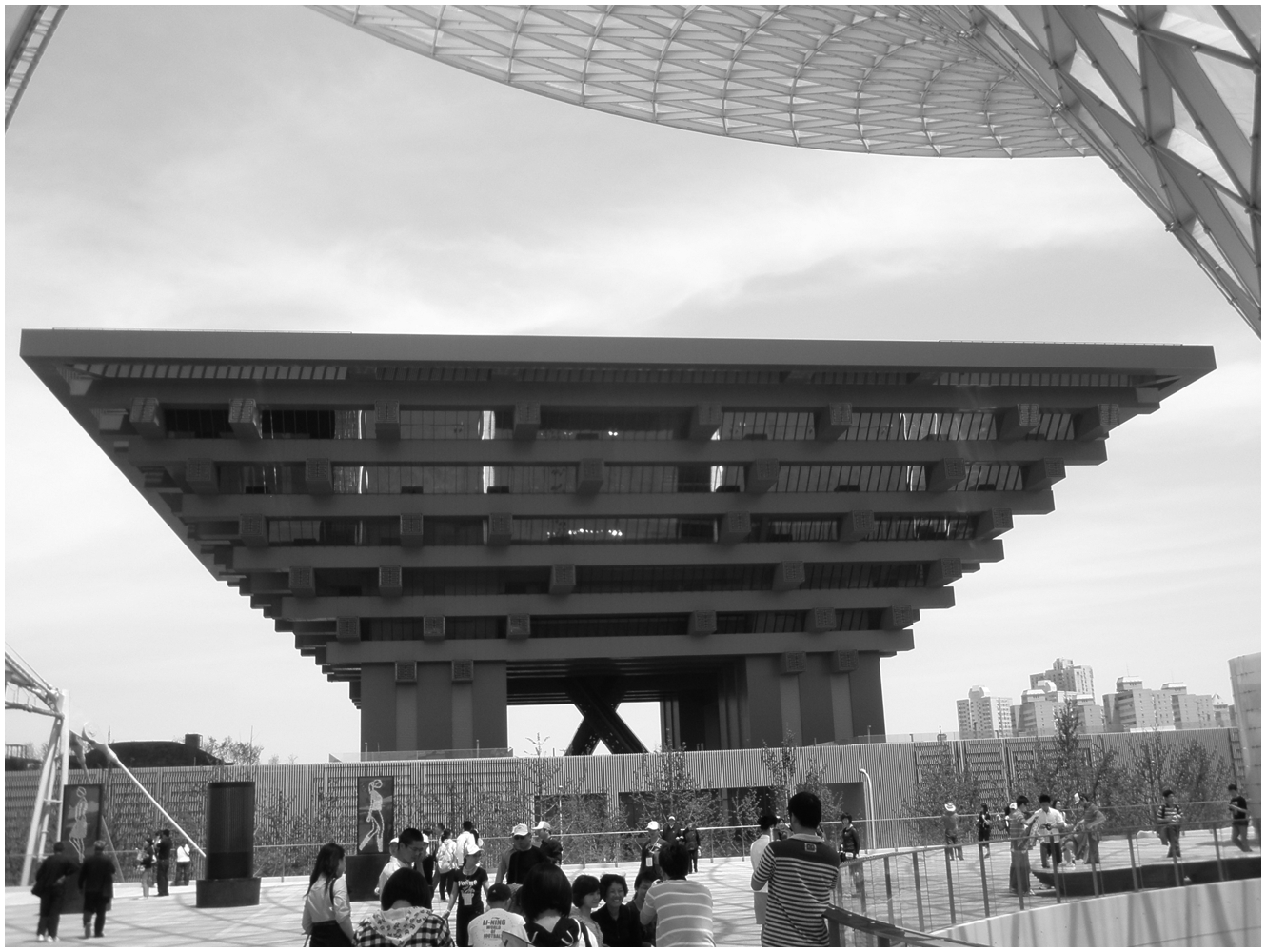
China National Pavilion
The theme and corporate pavilions also explored the topics of balance and harmony. But rather than balancing China’s past and future to build a harmonious society, they look to cosmopolitan themes to build a harmonious world. Intermarriage between Chinese and non-Chinese people in our future globalized world was a recurring scene in theme and corporate pavilions. The ‘Future Cities Pavilion’ that was organized by the Expo committee explores how weddings will work in the future (see Figure 2). A short video shows a wedding that joins a Chinese woman and an American man. Following Chinese custom, the American groom organizes the nuptials; but rather than having to spend months planning the wedding, he does it online on their wedding day. Choosing from a menu of global traditions (Christianity, Buddhism, Islam, etc.), he designs the cosmopolitan wedding of the future that integrates ‘Jewish’ and ‘Chinese’ clothes, rituals, and food. In addition to including family and friends in the lively wedding feast, they are even enabled to invite their favourite historical figures (he picked Attila the Hun). This video thus creates a future where East and West are in harmonious balance, at least at the micro level of family relations. This virtual marriage of the future does raise a different set of questions, though: since the bride was in Beijing and the groom in New York, how was the marriage consummated?

Future Cities Pavilion
One of the corporate pavilions, called ‘We are the world’ (天下一家 tianxia yi jia – one family under heaven), explores family life in such an inter-civilizational marriage, this time between an Italian man and a Chinese woman. Like in the national and theme pavilions, this corporate pavilion (sponsored by the German multinational Siemens) explores ‘the life of an imaginary family in the year 2015’. In this three-generation family, the Chinese man lives in Shanghai and his sister lives with her Italian husband and their child in Milan, while the Chinese parents live in Beijing. The various exhibits highlight how a ‘globally networked and climate-friendly lifestyle’ is the proper middle-class dream. 15 Communicating over 3D videophones, they discuss together how new technologies (provided, of course, by Siemens) make their daily life easier, healthier, and happier. The main message was that the green future will be full of comfort and luxury; for example, as part of the exhibit tour I was invited to drive a virtual version of the eco-sports car, the Ruf Greenster. At the end of this trip to the future, visitors are recruited into the cosmopolitan message of material prosperity: using videos shot at the beginning of the exhibit, animated images of the current audience (including me) are shown on-screen singing the happy song of high-tech global capitalism: ‘We are the world’.
The Expo thus creates and manages cosmopolitanism by combining Chinese wives and Euro-American husbands, suggesting that this is the proper global harmony of East and West. The raciology of this preferred cosmopolitan match became clear with Chinese netizens’ harsh reaction to Lou Jing, a young Shanghainese with a Han Chinese mother and an African-American father, who was a contestant on the Chinese version of the ‘American Idol’ television show. One netizen admitted that the fascination with ‘foreigners is indeed a fad’; they reminded Lou’s mother that ‘you still can’t pick blacks!’. Another claimed that it is ‘common knowledge’ that ‘mixing yellow people and black people together is very gross’. 16
This gendered and raced world harmony defines identities in terms of grand coherent traditions, which are chosen off a menu of cultural stereotypes. This logic certainly follows President Hu Jintao’s vision of a harmonious world where different civilizations co-exist making ‘humanity more harmonious and our world more colourful’. 17
But this East/West cosmopolitanism, which ignores the rest of the world and fosters racialist views, often serves to solidify perceived differences between China and the world. By suggesting that the future reproduces high-tech forms of the past (i.e. Traditions), the theme and corporate pavilions do not allow much space for innovation in identity and culture. As Shanghai blogger Han Han commented about the Expo: ‘When I tell people about my country, and they ask, “What films has your country produced? What literature?”, all I’ll be able to come up with is Confucius. That’s really boring.’ 18
Official messages here are not limited to China’s national and theme pavilions: as a site of transnational capitalism, Siemens was happy to use the Michael Jackson song ‘We are the world’ to reinterpret the classical Chinese idiom ‘tianxia yi jia’ as part of its global marketing strategy. As the CEO of Siemens, Peter Löscher, confidently declared: ‘The entire Expo is our pavilion.’ 19
China’s future and the world’s future thus are a stable harmonious utopia that combines global capitalism and Chinese civilization.
Jia Zhangke: Inside the system
To celebrate Shanghai as a global city, the World Expo management committee commissioned Jia Zhangke to make a film to ‘introduce Shanghai’s architecture, culture, and life and explore the Expo theme, “Better City, Better Life”’. 20 The result was Shanghai Legends, also known in English as ‘I Wish I Knew’. This film was shown at the Expo Culture Center – 10 times a day for 100 days.
To many in the West this came as a surprise: Jia is best known for his underground films that are censored in the PRC. Although starting with The World (世界) (2004) Jia’s films have evaded censorship, it was a big leap for him to work directly for China’s propaganda officials.
21
Indeed, this issue came up while Jia was working on Shanghai Legends: to the disappointment of many Western commentators, Jia decided to follow Beijing’s lead and withdraw his films from the Melbourne International Film Festival (MIFF) in 2009. China urged its directors to boycott the festival to protest the prominent exhibition of The 10 Conditions of Love, a documentary about the Uighur dissident Rebiya Kadeer whom Beijing sees as a terrorist who instigated July 2009’s Xinjiang riots (there is no evidence for this). Jia’s explanation for withdrawing his two films is indicative of citizen intellectual tactics:
We have no interest in meddling with the festival’s freedom of artistic exchange. Withdrawing from Melbourne is, rather, a kind of self-restraint. Xinjiang history is not something I’m well acquainted with, but the recent Urumqi violent incident was only two weeks ago, and I, at a minimum, should take a cautious approach. I don’t want to do anything that would tarnish those who died.
22
Here Jia is consciously asserting that he is not a dissident; he is for artistic freedom, but is wary of being swept up into movements about which he knows little.
Rather than being negative in the sense of protesting against either the Kadeer film or China’s censorship of it, Jia focuses on doing his own ‘small-scale work’ – including preparations for the Expo film Shanghai Legends. In other words, although solidarity is an important value for citizen intellectuals, Jia wants to be able to choose his battles, and thus avoid ‘being dissidented’. Rather than understand this as ‘self-censorship’, I think it is more interesting to consider how Jia was able to work with the state as a citizen intellectual to make a fascinating docudrama that employs multiple voices to showcase Shanghai’s ambiguous experience in the 20th century.
Jia was an odd choice for this official film for another reason; he does not come from Shanghai and is not known for making blockbuster commercial movies (like Zhang Yimou). Jia is from Shanxi Province in the inland north, and is most famous for his artsy ethnographic films about poor people from rural areas. The World is a case in point; it shows how poor migrants from Shanxi deal with the rootless alienation of urban life while working at Beijing’s Epcot Center-like ‘The World’ theme park. 23
But I would argue that Jia was a good choice because he was able to use this intimate aesthetic to see what makes Shanghai tick. While the rest of the Expo presented China as a unified civilization-state that is harmonious and strong, Jia’s Shanghai Legends revels in the messy multiplicity of this ‘glocal’ city. Although the Expo mapped a stable harmonious world in its shiny finished state, Jia’s Shanghai is an overcast polluted city that is engaged in a perpetual process of destruction and construction (see Figure 3).

The Bund in Shanghai Legends
Rather than search for the core values of ‘the Real Shanghai’, Jia highlights how motion and exchange are key to this global city’s success. The film, for example, begins on a ferry crossing Shanghai’s Huangpu River. The camera dwells on the passengers’ faces as they prepare themselves for the hustle and bustle of the city; the tension produced by this combination of stasis and movement defines the film.
Rather than look to iconic buildings in the Expo, Pudong, or the Bund, Jia explores Shanghai’s cityscape through a close examination of people. Han Han (the last person interviewed in Shanghai Legends) agrees: ‘The people are the most badass (牛屄) exhibit the city has to offer. I suggest several Shanghainese should be chosen to be displayed as works of art in the China pavilion.’ 24 The film thus showcases 18 individuals’ intimate connection with Shanghai as patriotic capitalists, gangsters, communist revolutionaries, model workers, popular bloggers, new-era tycoons, and so on. They describe events both momentous and banal, often showing how the grand struggles of war and revolution work themselves out in the human relations of friends and family.
Chen Denqing, for example, describes how the grand politics of the Cultural Revolution shaped local struggles in his family’s neighbourhood. He recalls how his alley was polarized by the struggle of revolutionaries against ‘capitalists’ – meaning his neighbours who had a few luxuries. But Chen’s strongest childhood memories are of the gangs of little kids that took over his neighbourhood. He had to carefully choose his playmates in order to join the correct gang; the Warring States-like battles between alleys amounted to a question of ‘bully, or be bullied’. Chen’s story alludes to ideology, but is mostly concerned with personal relationships and local struggles.
Yang Huaiding, one of China’s new-era tycoons, is interviewed in his office. As a self-made man who took advantage of the socialist market economy’s new opportunities in the late 1980s, he made a killing buying and selling bonds. Curiously, Yang dwells on the logistical problems of his trade: the difficulties of carrying around his large investments when China’s largest bill was the RMB 10 note, and how he had to hire the police to protect him – otherwise he risked being arrested for being a gangster.
Shanghai Legends repeatedly returns to the struggle between the Chinese Communist Party and the Nationalist Party (Kuomintang), which culminated in the 1949 Revolution. As with Chen’s alley politics and Yang’s investment schemes, ideology is rarely discussed; the political struggle is presented as a family squabble that led to a messy divorce that not only split up China, but many families as well. 25
While explaining how his father was assassinated by the Kuomintang, Yang Xiaofo talks about his family’s opulent lifestyle in 1930s Shanghai; he describes in great detail the luxuries of his father’s chauffeured convertible before explaining how the Kuomintang assassins killed his father while he was sitting in the back seat right next to him. Yang’s memories thus are a combination of a specific horror enveloped in general nostalgia.
Ideas and ideology are certainly present. It is clear that Huang Baomei, the national Model Worker who shook hands with Chairman Mao, supports the socialist system. After starring in her biopic Huang Baomei (黃宝美) (dir. Xie Jin, 1958) and attending Vienna’s world youth festival (1959), she concludes ‘I felt very proud to be Chinese, and went back to put in all my efforts to increase production.’ Wei Ran is probably less sanguine about the party-state: he tells the horrible story of how the Cultural Revolution tore his family apart, making his mother commit suicide and ruining his sister’s life. But we are not sure; Wei doesn’t draw larger political conclusions.
Likewise, most of the film’s subjects do not judge: when Du Meiru describes the life of her father, gangster Big-eared Du (Du Yuesheng 杜月笙), she does not mention that he controlled gambling and opium in Shanghai. Rather, she talks about his hard life as an orphan, and the romance of his courtship of her mother. The biggest tragedy is not Du’s support of Chiang Kai-shek’s massacre of left-wing activists in 1927; it is that he did not have enough money for his four wives and their families to buy their way into France after 1949.
Indeed, the fractured and complex family relations presented in Shanghai Legends directly contest the harmonious families of the China national pavilion, the Future City theme pavilion and the Siemens corporate pavilion. In the film, the traditional Chinese family is not seen as a social model, but a social problem: Rebecca Pun explains that the ‘thing I don’t like about old society’ is how men flaunted their success by getting two or three wives. All that changed with 1949, often splitting up these painfully extended families. Indeed, these stories suggest that while family is important, in the end we are all alone as individuals. Jia’s direction stresses each subject as a loner: each person is interviewed sitting alone in an empty office, restaurant, store, home, factory, race course, and so on.
Jia was able to work inside the system because he deals with momentous political events in this disjointedly personal way. It is up to the audience to make sense of these 18 stories, which add up to a nuanced and decentred story of Shanghai itself. Hence it is not surprising that Shanghai Legends revels in the uncertainty and anticipation expressed in the American jazz standard ‘I Wish I Knew’, which is the film’s alternative English title:
I wish I knew, someone like you could love me.I wish I knew you place no one above me.Did I mistake this for real romance.I wish I knew but only you can answer.If you don’t care, why let me hope you could love me.I wish I knew.
The future here is not a shiny finished state, but the product of the past and present that is haunted with anticipation, uncertainty, and loneliness.
Outside the system: Cai Guoqiang
While Jia did ‘small-scale work’ inside the system to produce Shanghai Legends for the World Expo, China’s top global artist Cai Guoqiang worked outside the system to curate the ‘Peasant da Vincis’ exhibit at Shanghai’s new Rockbund Art Museum. This was a departure for Cai. He is famous in China for crafting spectacular pyrotechnic displays for the party-state’s key international events, including the fireworks at the opening ceremony of the Beijing Olympics (2008). However in 2010, as Cai explains, he was an outsider: ‘Although this occasion is concurrent with the World Expo, I am participating purely in a private capacity.’ 26
But Cai took this opportunity to comment on China’s headlong rush for economic development. While the Expo’s theme was ‘Better City, Better Life’, Cai’s theme was ‘Peasants – Making a Better City’. His exhibit thus celebrated the ingenuity of rural people, whose hard work actually builds China’s cities – including the Shanghai Expo site itself. While Jia’s film shifts from rural subjects to urban ones, here Cai does the opposite: his recent art, including pyrotechnic displays, has been very modern, high-tech, and urban. Cai thus sees ‘Peasant da Vincis’ as an opportunity to shift gears and look for the future in low-tech workshops of the countryside. 27
Much like Jia’s collection of 18 portraits, Cai’s exhibit offers a cornucopia of peasant inventions: a flying saucer, planes, helicopters, submarines, robots, and China’s first aircraft carrier (see Figures 4, 5 and 6). (He also collects strange tanks, electric cars, and race cars, but they did not make it into the exhibit.) These rusty industrial innovations are certainly anachronistic; rather than looking to the future, they seem to point to the past. Indeed, most of this ‘small-scale work’ is made out of scrap.

Peasant da Vincis’ inventions (a) Flying saucer (b) Submarine (c) Twilight No. 1 (d) Flying machines and boats
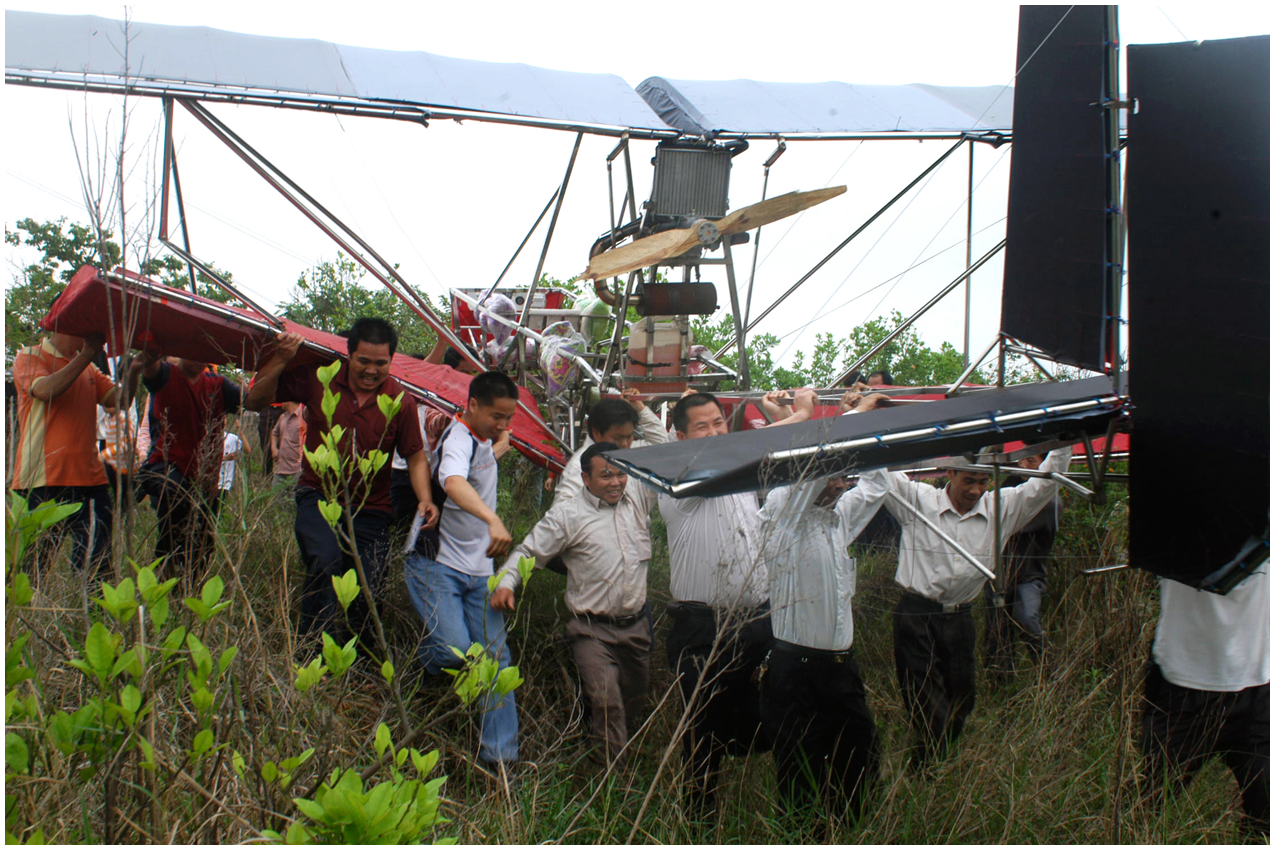
Joyfully salvaging Xiong’s biplane

Tao’s aircraft carrier
However, these inventions are interesting because they present new takes on old themes: an airplane modelled on a pigeon, a helicopter that is a sedan chair with wings, submarines designed to swim like fish, and so on. By offering peculiar creations that do not quite fit in, these inventions offer a new approach to China’s enduring unease about being a ‘copy’ of Western technical and social models, 28 which Cai calls ‘the anxiety present in Chinese society over its state of transition between “made in China” and “created in China”’. 29
The exhibit thus is about more than boys and their toys. It explores the key issues that define China’s intellectual discourse: what is modernity? Is it the same as Westernization? Can it provide spiritual excitement – or just material comfort? And just what is the China model?
Rockbund curator Liu Yingjiu feels that these Peasant da Vincis ‘have dreams, and pursue them however crazy they might seem. It shows how they have bigger dreams than city people who dream of getting a bigger house and a car. City people see the exhibit and are ashamed of their way of living, which is just materialist. The exhibit shows how the peasants are very smart and optimistic.’ 30
‘Peasant da Vincis’ thus suggests that the China model’s standards of economic success do not apply. Alongside the exhibit’s peasant inventions are propaganda-style slogans written in bold characters: ‘What’s important isn’t whether you can fly’ and ‘Never learned how to land’. These inventors often talk about their work in terms of dreams, escape, and freedom. Technically, most of the inventions challenge gravity; these planes, helicopters, and submarines also pursue liberation from the shallow life of working for someone else in industrial society. Cai thus is drawn to these inventions because they are ‘born out of a desire to escape the gravity of one’s circumstances’. 31
Xu Bin, a helicopter inventor from Jiangshan in Zhejiang Province, puts it well: ‘Escaping the gravity of the ground is so difficult, but floating on the wind and spiralling in the air is so liberating.’ Xu tells us that flying is so ‘addictive’ that he often forgets that he’s running out of fuel: luckily his helicopter is able to ‘fall gently to earth’. 32
Wu Shuzai’s goal is to escape the Wuyi mountains that surround his village in Qianshan, Jiangxi. This 69-year-old is alone with nothing to do; his five daughters are all married off, and his wife has passed away. When asked why he makes this sedan-chair helicopter, Wu answered that his real goal is to ‘fly it out of this mountain and see the world’. 33
Pursuing these dreams can have serious consequences: ‘A broken motor from a wrecked plane hangs from the ceiling’ in the museum’s foyer to commemorate the death of another Peasant da Vinci. While testing his fourth plane on 8 April 2007, Tan Chengnian crashed to the ground, dying on the spot. 34
Peasant da Vincis thus are China’s real risk takers. These loners want the freedom to succeed – which includes the freedom to fail. Actually, most of the inventions do not work: the pigeon planes and the flying saucers, for example, have never gotten off the ground. Many of the inventors’ families think they are losers. Until he became famous after Cai ‘discovered’ him, Wu Yulu’s family thought he was a ‘slacker’ for wasting his time building robots. Wu Shuzai’s wife dismantled his sedan-chair helicopter to use it for firewood. Cao Zhengsu’s wife begged Cai not to buy her husband a more powerful engine for his pigeon plane: ‘The old man loves making planes. It’s fine to play around, but if they actually flew, he’d be playing with his life!’ 35
The most successful ‘flight’ of Xiong Tianhua’s biplane was on the backs of a dozen men after it crashed. But as Figure 5 shows, this crash quickly transformed from a tragedy into a celebration of ingenuity and courage: ‘Spectators drawn by the excitement, swarmed over and helped them carry down the plane with its broken propeller.’ 36 Rather than disappointment, the men’s expressions show joy.
Yet Cai’s idealism has a dark side. As his ‘I Want to Believe’ exhibit at the Guggenheim Museum (2008) shows, Cai is fascinated with violence, international terrorism, and the military: the central sculpture is of an IED exploding a car (like in Iraq), and Cai asks his viewers ‘to appreciate some kind of redeeming beauty in terrorist attacks and warfare’. 37
This adds another meaning to the slogan ‘Never learned how to land’, which was also the modus operandi of the 9/11 hijackers.
After seeing a table-top model in Tao Xiangli’s workshop, Cai specially commissioned Tao to build a 20-metre-long aircraft carrier in the museum during the exhibit (see Figure 6). Not surprisingly, Tao came up with a unique design, creating a catamaran carrier by placing the flight deck atop two submarines.
Rockbund curator Liu suggests that this invention exemplifies Cai’s style of critical provocation: a Chinese carrier is a sensitive issue that is not much discussed in China. So Cai commissioned the aircraft carrier so people would have to talk about it – if only as a work of art. Cai thus concludes, ‘At a time when the first Chinese aircraft carrier is anticipated and feared by many, it seems that the peasants have already begun its construction.’ 38 (China’s first aircraft carrier, the re-fitted Soviet-era Varyag, was launched the following year in August 2011.) In this sense, Peking University’s Zhang Yiwu is right when he describes Cai as a ‘dream magician’, whose work ‘makes all Chinese people an important and essential part of the world’s imagination’. 39 The future here is created through the rural ingenuity of lone inventors who reframe the past as a means to escape physical and social gravity.
While the Expo’s more official exhibits strive to build a harmonious world of respect for multiple civilizations, for Jia and Cai cosmopolitanism grows out of messy combinations of odd experiences, which often provide uncertain messages. These parallel technologies are social innovations that develop a parallel society. The appeal to multiple meanings and uncertain endings explains how citizen intellectuals were able to be successful in China, both inside the system and outside it. Their ‘small-scale work’ thus carves out a liminal space to explore the boundaries of what it means to be Chinese in the 21st century.
Conclusion: A new civil society
At the beginning of this article, I argued that we need to think about public space in China in new ways. Rather than being able to clearly label people as either ‘official intellectuals’ or ‘dissidents’ as part of the grand battle between state and society, I suggested that we need to have a more nuanced view of China’s political geometry. The article has argued that a new group of people, whom I call citizen intellectuals, has been active in ways that blur the boundaries of any linear state/society distinction.
As the Shanghai Expo demonstrates, the party-state still seeks to exert centralized control over Chinese identity and China’s future. Yet, as Jia’s and Cai’s ‘small-scale work’ shows, multiplying and decentring China’s dreams is a popular strategy for citizen intellectuals. Since Shanghai Legends lacks both a central message and a clear moral conclusion, it would be hard for the officials to censor it – unless they wanted to scrap the whole project. Cai’s critical method works in an analogous way: ‘Peasants – Making a Better City’ does not directly challenge the Expo’s ‘Better City, Better Life’; rather Cai criticizes the China model by adding another element that twists the meaning of Shanghai’s urban-themed event to include its opposite: multiple views of the future in the countryside.
Certainly, citizen intellectuals are playing with the ‘red line’ of the allowable in China. Rather than working in a civil society built on an open legal system of known rules and punishments, the party-state’s red line is clear only when it is crossed: when artist- activists such as Ai Weiwei are ‘dissidented’ and ‘criminalized’ by the authorities for directly challenging the Communist Party or the leadership. Most analysts focus on the self-censorship encouraged by the party-state’s system of control that heavily penalizes such political critics. However, this article is more concerned with the opposite: the opportunities for social activism that this ‘caged bird’ system creates.
Jia’s and Cai’s appeal to a mix of lonely individuals, as opposed to the Expo’s harmonious collective, has many parallels in the work of Han Han, whose style is exemplified by the title of his short-lived literary magazine, A Chorus of Solos (独唱团), which was published during the Expo. 40 Han is a fascinating figure whose life embodies the tensions faced by many Chinese people today: he grew up in the country but now lives in the city; he dropped out of high school, but as a best-selling novelist he is part of the cultural elite; although a serious writer, China’s literary elite see him as a mediocre dilettante; rather than limit himself to intellectual pursuits, Han decided to follow his dream to become a professional race car driver – where he has been quite successful (see Figure 7). Han thus is seen by many as the voice of the post-1980 generation of one-child policy children who grew up in the economic reform era’s environment of increasing prosperity and freedom. 41
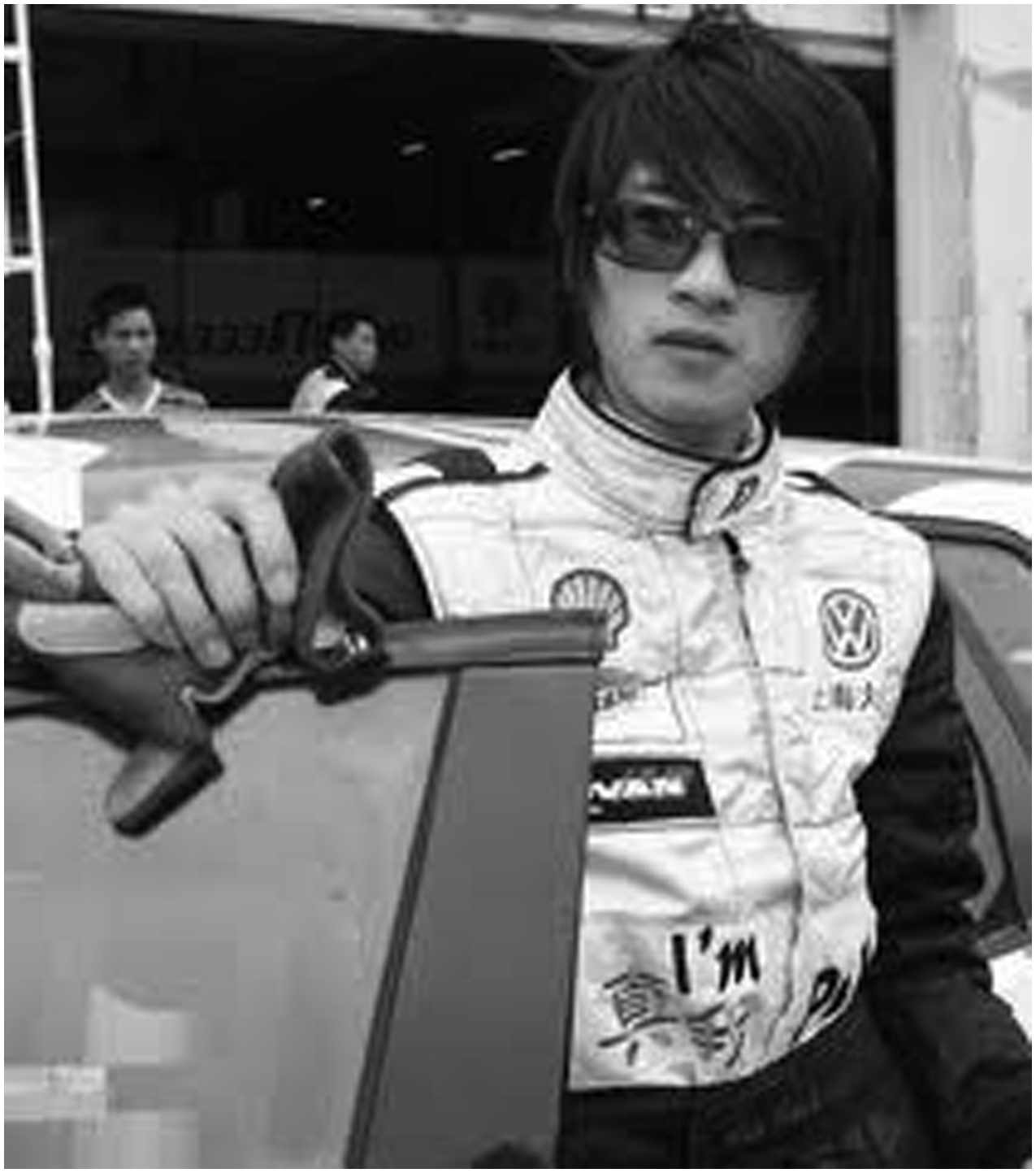
Han Han
This multimedia star is perhaps best known for his ‘TwoCold’ blog, which has received half a billion hits since it began in 2006; it thus is the most popular blog in China – and hence the most popular blog in the world. Using the cultural technology of the blog, Han Han is able to pursue the strategies outlined above to engage in ‘small-scale work’ to build a parallel society in cyberspace. The multiple decentred nature of blogs means that although Han’s posts are occasionally censored – or ‘harmonized’ – most of his other posts still remain. As with Shanghai Legends the party-state could censor his blog as a whole; but since Han is a media darling even with the official media, the cost of pulling his wildly popular blog is still too high.
As a writer, Han is particularly concerned with the shifting rules of censorship in China. 42 Many of his recent blogs have criticized – mocked, really – how official censorship produces absurd results: during the Diaoyu islands controversy with Japan in September 2010, for example, his post was rejected because it used the phrase ‘Diaoyu islands’ (钓鱼台) which was censored as a ‘sensitive word’ (敏感词). Han solved this problem by using the Japanese name, Senkaku, which was strangely acceptable to the web filters even though it is anathema to Chinese nationalists. 43
Although many of Han’s blogs are overtly political, 44 his most effective commentaries are less activist. Rather than play on emotions in a call for grand revolution, many of his posts are rational calculations of the costs of the China model of development. Like a literary accountant, in blog after blog Han talks about life in China by listing the costs of living in Shanghai: the cost of renting and then buying a home, the cost of food, drink, and gasoline, as well as other bread-and-butter issues. 45
Recounting a friend’s personal economic (and social) crisis, Han begins by noting that his pal ‘didn’t really have any big ideals, but he was upbeat about his future’. Han then charts this person’s struggle with the cost of city living: since ‘houses in the suburbs of Shanghai are going for at least RMB 500,000 a pop ($75,000), they would have to work for the next 25 years, go without food and drink, and live between bare walls. Then, if they wanted to actually decorate or furnish the house, they would have to starve for yet another five years.’ 46 Han makes such calculations over and over for different social groups, ranging from migrant workers, to the middle class, to playboys like himself.
Han’s response to the high-speed train crash near Wenzhou (2011), ‘A Nation Derailed’, took this literary accounting to a new level by exploring the cost of human life. Rather than directly criticize the party-state for the substandard construction of one of its signature projects or its arrogant response to the tragedy that killed 40 people and injured at least 192 others, Han’s post satirically explores how officialdom understands the people, rather than the train wreck, as their main problem:
They think: we’re building you all this stuff, why do you mind a few bumps in the road? … The train from Shanghai to Beijing used to take the whole damn day. Now you’re there in five hours — at least when there’s no lightning. Why can’t you be grateful? What’s with all the questions? Every now and then, there’s an accident. The top leaders all show how worried they are. We make someone available to talk to the press. First we say we’ll give the victims 170,000 kuai apiece [US$26,000]. Then we say we’ll give them 500,000 [US$78,000]. We fire a buddy of ours. We do all that, and you still want to nitpick? How could you all be so narrow-minded? You’re not seeing the big picture. Why do you want us to apologize when we haven’t done anything wrong? It’s the price of development, for crying out loud!
47
Han thus hits the party-state where it hurts: its legitimacy is based on providing the benefits of economic growth, including both ‘big projects’ (大事) such as high-speed trains and people’s everyday life as consumers. The leadership thus can hold political reform at bay by warning people that it would endanger social stability. Rather than discuss the macro-economics of China’s GDP growth, Han focuses on the micropolitics of personal finance and personal tragedy. By pointing out the economic and social costs of the China model, which include property bubbles, major accidents, inflation, pollution, official corruption, and forced evictions, Han connects with a wide readership that shares these experiences. He reflects the hopes and anxieties of everyone who is struggling to find a job, get a home, start a family – or just take the train from Shanghai to Beijing. 48
When read together, Han Han’s multiple blogs thus point to the political cost of the party-state’s tight control of power. His mocking praise of local Party cadre Han Feng after the publication of his diary, which documented his laziness, womanizing, and corruption, is a case in point. While some called for Han Feng’s dismissal, Han Han reasons, ‘His diary reveals the life of the thriftiest womanizing official in the country. Other officials give their mistresses houses and cars, but his most expensive gifts are mobile phones and MP4 players. By those standards, he is a pretty decent official.’ Han thus ‘urges netizens to leave this man and his women alone, and let him retain his position. We may wish to punish them, but they are definitely not typical of the true criminals in the Party.’ (Perhaps Han is forgiving of Han Feng because he also cultivates the reputation of being a womanizer.) Or more to the point: ‘If he is dismissed, his successor may be much worse, and may not keep a diary.’ 49
In a similar critical vein, Han criticizes those who protest against Japan because ‘demonstrations against foreigners by people who are not allowed to protest at home are utterly worthless. They are nothing but a group dance.’ 50 Likewise, in ‘I’m only guessing’ Han is pessimistic about China’s future, predicting that government control will continue to grow, eventually shutting down the Internet in 2017. Things get worse in 2020, when he forecasts that ‘the Earth is destroyed’, before noting that ‘the descendants of the Mayans say that a margin of error of plus or minus ten years is normal for such events’. 51
All in all, Han has a singular style that mixes outrage with jokes and formal language with teenage slang, which is as engaging to the post-1980 generation as it is frustrating for people over 30 to fathom. 52 For example, at the start of the Libyan uprising (2011) Han declared that dictators cannot hide behind the legalities of international sovereignty. In a thinly veiled threat to the Chinese leadership he concluded that ‘the slaughterer should be invaded and annihilated’. 53 But actually Han ends the blog with an additional (and rarely translated) sentence that mixes an astronomical event with a reference to a Japanese cartoon popular in the 1980s: ‘Yesterday, the moon was the largest it’s been for 19 years, and regardless of who, regardless of why, in the name of the moon I annihilate him.’ 54
Some critics dismiss Han’s writings as ‘fast food’ that does not measure up as either literature or political activism. 55 Because Han tells jokes and makes pop culture references, they feel that his popularity represents ‘the triumph of the mediocre, and the failure of a nation’. 56 Han certainly deserves his bad-boy reputation; in the early 2000s he took pleasure in lacerating literati critics with his caustic wit, and he is rightly criticized for his often misogynist opinions.
But over the past few years, Han has changed to become more thoughtful and more responsible. Rather than fire off knee-jerk reactions like most of his blogging brethren, many of Han’s posts are sophisticated extended essays that use evidence to carefully analyse topical issues. He thus weighs different perspectives – including the views of the party-state – before employing his acerbic wit to draw strong and clear conclusions. As Han’s ‘A Nation Derailed’ post reasons,
A friend in government said to me: nothing’s ever good enough for you. Forty years ago [during the Cultural Revolution], writers like you would’ve been shot. So you tell me, have things gotten better, or have they gotten worse? I said: no, you’re the ones for whom nothing’s ever good enough. Ninety years ago [at the beginning of the Republic of China], that kind of thinking would have gotten you laughed out of the room. So you tell me: have things gotten better, or have they gotten worse?
While many Chinese netizens – both hypernationalists and liberals – characteristically appeal to conspiracy theories, Han argues that we must search for ‘the truth’, not just ‘a truth that meets our needs’. 57 Han thus is effective because his social commentary is reasonable and moderate – and perhaps moderating of China’s indignant youth (愤青).
While Jia and Cai work both inside and outside the system, Han is interesting because he is neither inside the system nor outside it. Although a loner trying to find his own way to ‘live in truth’, Han is not isolated like a ‘dissident’; rather he is omnipresent on the web, television, magazines, and newspapers. Like Jia and Cai, Han is a free agent who picks his own ‘small-scale work’ projects. They all focus on the micropolitics of people’s everyday experiences at work and with friends and family, showing how they can build alternative cultures and multiple civil societies. Cai’s conclusion thus also applies to Han’s work: ‘Through the creative power of individual peasants standing on their own outside the will and actions of the collective, and through the moving stories of individual lives, we can also see the hope of a people pursuing a just, democratic society.’ 58
Although one would think that Nobel Laureate Liu Xiaobo is carrying on Havel’s ‘small-scale work’ in China by co-writing ‘Charter 08’, I think that Han is the most notable example of a citizen intellectual who works to build civil society through the parallel society of the Internet. By pursuing ‘alternative civilities’ in this way, Han is actualizing a Rorty-style ‘dream country’ for China’s future – and the world’s future.