




Abstract
The creation of the Independent Commission Against Corruption (ICAC) in February 1974 was arguably one of the most important developments in Hong Kong since 1945. Not only did major corruption syndicates disappear from the fabric of public administration in the colony, but the popular acceptance of bribery as a component of social life also faded away. Sir Murray MacLehose, who served as Governor of Hong Kong between 1971 and 1982, was regarded by locals as the maverick behind this miracle. This article argues, however, that the genesis of the ICAC could be better understood as a product of the cumulative efforts of MacLehose and his predecessors. The initiative should also be considered in the political context of the rising tension between London and the local community. In a way, the establishment of the ICAC helped pre-empt London’s intervention in this matter. Also, despite a public appearance of unbridled support for the crusade against corruption, MacLehose’s resolve was severely tested during the early years of the ICAC, and he did contemplate moderating the operation of the Commission, even before the partial amnesty in 1977.
The claim that the tradition of honest government is part of the legacy of British colonial rule 1 is certainly not without its critics. Yet some may regard the colonial government’s success in ridding Hong Kong of the cancer of corruption as evidence for this claim. The creation of the Independent Commission Against Corruption (ICAC) in February 1974 was arguably one of the most important developments in the colony since 1945. 2 In less than a decade, not only did major corruption syndicates disappear from the fabric of public administration in the colony, but the popular acceptance of bribery as a component of social life also faded away. Analysts differ on what lay at the root of this success. Some attribute the triumph to the charismatic leadership of Jack Cater, first Commissioner of the ICAC, while others give more attention to the institutional design that granted the Commission the legal tools and independence that were imperative for its crusade. Some, however, see the universal model of investigation, prevention, and education as instrumental to its success. 3 Central to all these views is the unwavering support for Sir Murray MacLehose, who served as Governor of Hong Kong between 1971 and 1982. It was MacLehose who made the ultimate decision, after decades of deliberation, to set up a commission specifically for anti-corruption work separate from the police, and who continued to maintain the momentum of the campaign with unfailing budgetary support and legislative empowerment.
Notwithstanding the Governor’s contributions, a closer reading of the history of anti-corruption efforts in the colony, including official records, uncovers a more nuanced account of the intricacies and tensions behind the campaign. Based on the recently released documents available in the United Kingdom’s National Archives, this article argues, firstly, that the genesis of the ICAC would be better understood as a product of the cumulative efforts of MacLehose and his predecessors. The idea of removing the anti-corruption work from police jurisdiction was first contemplated by the Robert Black administration in the early 1960s, while it was David Trench who eventually pushed through the legislative change placing the onus of proof on the suspect in a corruption offence, which greatly facilitated the task of prosecution, despite strong resistance from officials in London. Secondly, while MacLehose should be credited for his political acumen in turning the incipient crisis triggered by the escape of Peter Godber into a window for a major institutional breakthrough in the campaign against corruption, the initiative should also be considered in the political context of the rising tension between London and the local community. In a way, the establishment of the ICAC helped pre-empt London’s intervention into the matter, for the British public were showing increasing interest in the state of corruption in the colony because of the Godber scandal, and an external inquiry seemed imminent. Lastly, despite his public appearance of unbridled support for the crusade against corruption, MacLehose’s resolve was severely tested during the early years of the ICAC. When it became evident that the restlessness of the police had reached boiling point, the Governor contemplated moderating the operation of the ICAC, even before the partial amnesty in 1977. The leadership reshuffle of the commission and the reprioritization of prosecution targets in the aftermath of the police mutiny are illustrative of the governor’s concern.
Unsung heroes: Roles of Black and Trench
The colonial administration’s awareness of the problem of corruption in Hong Kong can be dated back to the late 19th century. A passage in the Misdemeanours Punishment Ordinance of 1898 that intended to put an end to ‘the grave irregularities’ that existed in the police force and other government departments is the very first legal response addressing the issue of corruption among public servants. 4 Yet it apparently did little to stem the wave of allegations of corruption and dishonesty amongst officials. In 1907, the then Governor, Mathew Nathan, felt obliged to set up a commission of inquiry to investigate the matter. The findings in its report simply confirmed the public perception, concluding that not only were irregularities widespread but also that corruption and bribery were rampant, particularly in the Sanitary Department, where an extensive nest of corruption existed involving a large number of persons within and outside of the government. 5 Colonial administrators, however, comforted themselves with the belief that corrupt practices were mostly confined to petty officials of Chinese ethnicity. Some asserted that the majority of the local population, who were born and raised in China, was unconcerned about corruption, as bribery, customary fees or gifts for public officials were more or less accepted as standard practices in imperial and republican China. They reasoned that when these Chinese adults migrated to the colony, they brought with them such cultural practices and an indifference to dishonesty among the bureaucracy. Some went even further and justified the prevalence of corruption as a consequence of the alien nature of British rule. That is, corruption enabled the local Chinese to navigate their way through the maze of regulations and ordinances that were embedded in alien values and were seen as incomprehensible.
However, the ultimate defence against the pervasiveness of fraud and sleaze hinged on confidence that senior officials of European origin were immune to corruption. The institutionalization of the cadet system in 1862 provided the colony with a steady stream of well-educated and ambitious young officers recruited from Britain through competitive examinations. The first three were all graduates of public schools and Cambridge University. These cadets came to head government departments, and the most successful even secured the top post of colonial secretary or governor. During its first 80 years, the cadet system produced three governors for Hong Kong and seven governors or high commissioners for the rest of the British Empire.
6
Their impressive quality and success convinced one commentator that these gentlemen-bureaucrats were ‘generally incorruptible’.
7
However, such optimism should be qualified by the fact that cadets were few and far between. In the period from 1862 to 1900, only 22 cadets were appointed. And for European officers in the lower levels of the hierarchy, with less impeccable credentials and more limited career prospects, immunity to the temptation of immediate material gain is more questionable. In fact, the above-mentioned 1907 report also asserted:
This (rampant corruption) was unfortunately by no means confined to the native Assistants, Interpreters, and Subordinate Officials, but there was reason to fear extended throughout the staff of British Inspectors.
8
Evidence of the involvement of expatriates in corruption was also uncovered earlier, when a gambling house was raided by the police in 1898. The receipt books found on the premises revealed that the gambling syndicate had regularly paid protection money not only to a large number of Chinese constables but to European inspectors as well. The subsequent investigation eventually led to the imprisonment of one European inspector. 9
Despite the government’s public denial of the pervasiveness of corruption, and its misguided comfort in the ethnic divide, the colonial government was forced to take sporadic action over the years in response to the unabated scandals involving corruption. Governor Mark Young, for example, announced the appointment of the Chief Justice as a Special Commissioner to look into the issue in 1941. This effort to tackle the problem was unfortunately disrupted by the Japanese occupation of the colony between 1941 and 1945. Yet, once British rule was resumed, the campaign against corruption regained its momentum. The problem of corruption took on more alarming proportions in the post-war period. The population doubled in the 1950s and 1960s due to the massive influx from the mainland, which put severe strain on public management and required an increase in social services provisions. Regulation and intervention provided more opportunities for officials to solicit ‘payment for convenience’. 10 The rise of the triads, a web of secret societies specializing in violence and criminal activities, on the local scene further complicated the picture. 11 The founding of a new communist regime, with its idealism and abhorrence of corruption, may have presented a new frame of moral reference for local Chinese as well. Consequently, a comprehensive law, the Prevention of Corruption Ordinance, that was modelled on the provisions of three English laws, was passed in 1948. 12 While there is disagreement over the effectiveness of this statute in curbing corruption, the ordinance did contain one major innovation that eventually formed the basis of the Prevention of Bribery Ordinance passed in 1970: it allowed a court to use as evidence against a suspect the fact that he or she was in possession of pecuniary resources disproportional to his or her known sources of income, for which he or she could not satisfactorily account. 13
The Anti-Corruption Branch located within the Criminal Investigation Department of the Hong Kong Police was established in 1948 as a result of the enactment of the Prevention of Corruption Ordinance.
14
The colonial government defended its decision to make it a specialized unit of the police force instead of an independent unit on the grounds that the disciplined force was well trained in criminal proceedings and investigation. In England, bribery and corruption cases were investigated in the ordinary way by the Criminal Investigation Department of the police as well. Yet the decision was controversial, as some questioned the credibility of the system
15
since the police force was the object of the largest number of complaints per year regarding corruption in government departments for most years between 1952 and 1973.
16
Elsie Elliot, a lone campaigner against corruption in the 1970s, gave a vivid account of police corruption:
In those days, a senior policeman expected a big bribe to recommend a junior for promotion to a high rank. Police who wanted promotion but did not have the money to pay for it would seek a loan from a triad gang in the district. The more vice there was in the district, the higher the price of promotion would be…. The policeman, having attained the money to pay for his promotion, then had an obligation to the triads to protect them against any legal action.
17
The colonial administration’s growing concern over corruption was further illustrated by the appointment of a Standing Committee on Corruption in 1956. The Committee was chaired by a Principal Crown Counsel nominated by the Attorney General, and the other members were the Establishment Officer and the Director of the Anti-Corruption Branch of the Hong Kong Police Force. Its main duties were to review the incidence of corruption in the public service and to advise the government on measures to reduce corruption. Sir Robert Black, who became the colonial governor in 1958, decided to strengthen this body as he was wary of the danger of corruption and was not entirely satisfied with the current arrangements. He claimed:
[I] hoped that, while we kept the prosecution of corruption within the normal standard machinery for it, as is the case here in Britain, that is, the Police Criminal Investigation Department, we would have more people reporting because they would go to Unofficials and not to men either in uniform or to detectives. But as time passed, we still found that the cases brought to court did not include the big fish. It was very worrying because I could see the speed of economic development increasing. The stakes were growing higher, but UMELCO, the advisory committee and the Police were still hampered by the unwillingness to testify.
18
The Standing Committee on Corruption was renamed the Advisory Committee on Corruption and was strengthened by a powerful line-up of members in 1960. Under the new structure, the Committee was chaired by the Attorney General, and its membership comprised the Establishment Officer, a Deputy Commissioner of police and three unofficial members of the Executive Council. The Committee took its job seriously and met 34 times during 1961. A number of reports were submitted to the Governor and, in its sixth report, the committee made several major recommendations for tackling corruption in the territory. Comprehensive reforms, including changes in the procedure for dealing with disciplinary charges against government servants and in the licensing procedure of various departments, were called for.
19
But public attention focused on two recommendations in particular. First was the proposal that the onus should be ‘on the accused to establish that property not commensurate with his income (as a public servant) is not derived from corruption’.
20
Second were the concerns raised by the Committee over the existing arrangement of leaving the investigation of corruption to the police. In one of its reports in 1961, the Committee asserted:
there was a strong feeling … that the Anti-Corruption Branch should not be a part of the Police Force … The Public are reluctant to complain to the Police, of whom they are afraid.
21
Despite the general awareness of the necessity for action, a reluctance to make drastic changes was also discernible among officials. Claude Burgess, the colonial secretary at the time, voiced his concern:
Basic rights of the individual, the underlying principles of British justice, are not matters which can be impugned, however remorseless the determination to eradicate an evil may be. Corruption of course could be cut right back within a few months if “Gestapo” methods could be used. But they cannot be used, and the basic problem is how to defeat one of the most secret of all evils by methods which are open and manifestly just. As honourable Members are aware the Official Committee produced a particularly striking suggestion which has now been put into effect. Very briefly, this new proposal gives Your Excellence power to inquire into the case of an officer who is clearly living above his known resources and who is unable to explain this in a satisfactory manner. We understood from the Secretary of State that this line of action had never before been tried in any territory for which he was responsible, I can assure honourable Members that it was not finally cleared without much argument and concern.
22
It was the perseverance of Black’s successor, David Trench, who was appointed governor in 1964 that provided the final push for the legal breakthrough in the anti-corruption campaign. Determined to intensify the effort against corruption by equipping the Public Prosecutor with more powers and leverage, official delegations were sent to Singapore and Ceylon to study their anti-corruption laws, and three reports were eventually sent to the Governor in 1968. Trench lost little time, and a proposal for legal changes incorporating many of the suggestions made by Black’s Advisory Committee on Corruption was drafted. However, the legal advisers to the Foreign and Commonwealth Office (FCO) and Home Office were ill at ease with several of Hong Kong’s suggestions for legal changes in tackling corruption. In particular, the shifting of the onus of proof onto the suspect was still deemed too extreme and hardly compatible with the principle of presumed innocence. As Trench recalled:
These (suggestions proposed by Advisory Committee on Corruption) were objected to by the legal advisers to the Foreign and Commonwealth Office who said that they were too extreme, that they were against the principles of natural justice…. When I came, this was the position, that they had not exactly refused, but they had made it clear that they didn’t like these changes and it stayed on [a] fairly official level in the Foreign and Commonwealth Office…. Then I think it must have been in 1970 with this position still pretty deadlocked.
23
Trench, a governor with a reputation for not shying away from an altercation with colleagues in the FCO if he thought such confrontation was warranted, eventually took a bold step to push his case forward. He explained:
In the end, I said: ‘right. It doesn’t look as if you’re going to give me these changes. When I get back to Hong Kong, I shall now write a formal dispatch to the Secretary of State and say that I didn’t consider that I can accept the responsibility for corruption in HK any longer, and that I considered that failure to give us these changes in the law means that, in effect, the Foreign and Commonwealth Office must take the responsibility for corruption in Hong Kong.’ Now that was a very serious step to take because a draft dispatch is something that can’t be ignored and it’s more or less a public document and it would mean that the Minister would have to admit in Parliament, if necessary, that he hadn’t given us these facilities.
24
The audacious move helped to sway opinion in the FCO, and the Prevention of Bribery Bill (1970), which appeared to be a turning point in the colony’s campaign against corruption, was eventually given the green light from London and was passed in the Legislative Council on 16 December 1970, after a decade of deliberation and hesitation. One of the most important implications of the legislation is that, from 14 May 1971 onward, ‘anyone who, being or having been a Crown Servant, maintains a standard of living above that which is commensurate with his present or past official emoluments or is in control of pecuniary resources or property disproportionate to his present or past official emoluments shall, unless he gives a satisfactory explanation to the court as to how he was able to maintain such a standard of living or how such pecuniary resources or property came under his control, be guilty of an offence’. 25 This is ‘a tough measure reflecting a tough attitude’ towards the evil of corruption, as Trench put it. 26 It has proved to be a very powerful weapon in the hands of the prosecution and has been instrumental in the tremendous progress of the campaign against corruption since then.
The new initiative also rekindled the old debate on the issue of separating the anti-corruption work from the police force. Denys Roberts, the attorney general who studied the anti-corruption model of Ceylon in 1968, was particularly enthusiastic about the idea of establishing of a new and independent Anti-Corruption Office (ACO). 27 In his view, such a move would help convey to the general public the government’s determination to tackle the evil of corruption. 28 The Police Commissioner, who was conscious of the growing pressure for change, contended in a counter-proposal that the Hong Kong Police Force should be given some time to prove its mettle with the benefit of the new powers before a final decision on setting up a new anti-corruption agency was made. There appeared to be a general consensus among decision-makers on a three- or four-year period for observation after the new ordinance came into effect. 29 Thus, even before the arrival of MacLehose, there already existed the genuine possibility of a new and separate anti-corruption agency in Hong Kong.
The precipitating crisis of the Godber case
It was, however, the escape of Peter Godber in June 1973 that provided the final push for the establishment of the ICAC. Uncovering the corruption case of Godber was the ultimate wake-up call for the colonial administration. Not only was the myth of the ethnic divide in corruption debunked but also, more significantly, endemic corruption in the colony was confirmed. As the Governor later admitted publicly in the Legislative Council, ‘The suspicion of corruption on a more extensive scale was better grounded than I had personally realized.’
30
Peter Godber was a legend in the police force for his heroic role during the confrontation with local communists in 1967 and appeared to live a modest life despite his rank as a Chief Superintendent. However, the Police Commissioner was alerted to various suspicious transactions in Godber’s bank accounts in April 1973. Further investigation by the ACO
31
determined that Godber had in fact accumulated an amount that far exceeded his total earnings for his service in the police force since 1952. Under the newly amended Prevention of Bribery Ordinance, Godber could be prosecuted if he could not provide an explanation for such disproportionate wealth. However, the ordinance also allowed the suspect the opportunity to prepare an explanation. Despite the limited time before the deadline for making his defence, Godber somehow managed to pass through immigration control at Kai Tak Airport and return to Britain. This set off a political bombshell in the colony, and the credibility of the government’s fight against corruption was seriously questioned. The image of the police force was particularly tarnished. The appeal of a conspiracy theory alleging police collusion in Godber’s escape lingered despite the futile attempts of the subsequent government investigation to clear the police of responsibility or wrongdoing.
32
Inevitably, the pro-communist media seized the opportunity and withheld no punches in their attack on the colonial authority. The Hong Kong Evening News argued:
[o]ne thing proved by the (investigation) report is that many laws in Hong Kong affect only the general public and not the privileged class.
33
Even the non-communist papers were not fully convinced of the administration’s innocence. The Kung Sheung Yat Po (工商日報), for example, declared:
[t]he negligence involved in this incident should not be brushed aside as mere technical errors. People can interpret it as part of a plan to let off Godber.
34
Repercussions of the saga went beyond the confines of the colony. Godber’s dramatic escape to Britain inevitably attracted the interest of British media and politicians in the state of corruption in the colony. Parliamentary questions on corruption in Hong Kong and the possibility of setting up a Royal Commission to investigate the colony’s predicament were raised by Members of Parliament such as Patrick Jenkin and James Johnson. The pressure was sustained by the efforts of other campaigners such as Alan Ellis, who alleged that his discharge from the Hong Kong Police Force in the early 1960s was a result of his refusal to collaborate with other police officers, and Elsie Elliot, who tirelessly voiced her concern over the rampant corruption in the colony to politicians in Britain and Hong Kong. These stories were finally picked up by the national media, including the Sunday Times.
35
British officials deliberated seriously over the propriety of an external inquiry into Hong Kong’s corruption. Officials at the FCO were fully aware of the potential damage posed by a prospective external inquiry to the authority of the Hong Kong government and to the morale of the local police. Also working against the idea was the fact that a Royal Commission on the internal affairs of a dependent territory had not been set up by the United Kingdom for many years. Some saw the merit of an outside inquiry, however. Michael Macoun, the overseas police adviser of the FCO commented:
[t]he appointment of an external UK Commission of Enquiry would indicate HMG’s concern in widespread allegations of corruption in Hong Kong and its determination to endeavour not only to substantiate or disprove these allegations but also to accept its responsibility as the administering authority of what is a Crown colony.
36
Others were more ambivalent but considered the matter from a similar tactical point of view. Richard Crowson pointed out that:
[I]f in the end we are going to appoint a Commission, it would I think be better to do so soon, rather than be seen to do so only when the pressure for one had become irresistible and after we had gone on refusing one.
37
The pressure on London was nevertheless linked with another thorny issue: the extradition of Godber. A complication arose from the difference in criminal codes between Britain and the colony. While it was an offence under the colony’s Prevention of Bribery Ordinance for a civil servant to fail to account for possession of money disproportional to his total official emoluments, ownership of unexplained wealth was not ground for prosecution in Britain. For this reason, the case against Godber did not constitute an extraditable charge under the British Fugitive Offenders Act. Thus, unless the Hong Kong government could come up with evidence of an actual bribe having been taken by Godber, there was no way to bring him back to the colony. The presence of Godber in the United Kingdom was a magnet for pressure and a constant reminder of the maladministration of the colony, so the option of a Royal Commission of Inquiry could appear a second-best response if the deadlock of extradition remained unsolved. 38
The Hong Kong government’s resistance to the idea of an external inquiry was to be expected. Governor MacLehose made his unambiguous objection to the idea during his meeting with Anthony Royle, the minister for foreign and commonwealth affairs, in August 1973. Despite his status as the Queen’s servant, the authority of a colonial governor also hinged on local perceptions of his determination to defend the colony’s interests if necessary. The relationship between London and Hong Kong had, moreover, been far from cordial since the 1960s. Altercations on issues such as devaluation of the pound sterling, the expense of the British garrison, and British entry into the European Common Market had nurtured a feeling in the colony that Hong Kong was misrepresented in London. MacLehose’s speech in the Legislative Council on 17 October 1973 testified to this growing frustration with London:
When we criticize faults here, we do so to an audience well aware of the strengths and achievements that make up the full picture of Hong Kong. But this is not so overseas.
39
Sze-yuen Chung, an unofficial member of the Legislative Council, went further. He argued:
Occasionally, there are cases in which there are conflicting interests between Her Majesty’s Government and the Hong Kong Government. Since Hong Kong is a colony and officials in the Hong Kong Government, with greatest respect, are basically members of the UK civil service and, strictly speaking, are under directives of Whitehall. Despite all their good efforts, the voices of Hong Kong people are seldom heard within the UK Government…. In the recent past, there were some debates on matters concerning Hong Kong in both Houses without any direct participation from Hong Kong, and there were problems and issues about Hong Kong raised in both Houses without someone from Hong Kong to put them into proper perspectives.
40
The remedy, according to Chung, was the creation of life peerages for Hong Kong personalities so that voices from the colony could be heard in the House of Lords. Notwithstanding the growing local frustration with London’s indifference to Hong Kong’s concerns, Governor MacLehose saw the danger that an external inquiry would only consolidate the perception of insubordination by the colonial administration and thus make the latter’s position untenable. The general sentiment was well captured in a comment by the Wah Kiu Yat Po (華僑日報) on 28 July 1973:
The so-called restrictions of the “law” and “customs”, etc. will not convince the people. We ask the Hong Kong Government to show sincerity and determination to get Godber back. If this cannot be done, the public will lose faith in senior European Government servants.
41
Joyce Simmons, an unofficial member of the Legislative Council, echoed such sentiments and said:
This summer our crisis was not caused by the heaviest rain in our history but by strange weakness in our link with Britain. Who can blame the many who firmly refuse to attempt to understand the legal aspects of Godber’s flight and our inability to bring him back?
42
In the face of growing pressure, the Governor pursued his case with firmness and decided to vent his frustration with London’s indifference publicly. Probably irritated by the lack of progress with extradition, the second report of the Investigation Commission led by Sir Alastair Kerr-Blair, which articulated a direct plea for amendment of the British Fugitive Act in the form of an immediate waiver of the double criminality requirement with retrospective effect, was approved for release in September 1973. The logic of such a request is, as the author of the report claimed:
[i]n this dependent territory we live under the rule of law; and Her Majesty the Queen has the power to disallow any new legislation which she may consider not to be for the “peace, order and good government” of the Colony. She did not exercise Her power of disallowance in the case of the Prevention of Bribery Ordinance.
43
The governor exerted more pressure on London by reiterating this position in his Policy Address in the Legislative Council on 17 October 1973. He argued:
[t]he requirement of double criminality is hard to understand in the case of a dependent territory, such as Hong Kong. We feel sure it was not Her Majesty’s Government’s intention in the Fugitive Offenders Act to frustrate in the United Kingdom the intention of laws approved by Her Majesty’s Government in Hong Kong.
44
These moves in effect shifted the burden back to London and in a way helped reduce the pressure on the Hong Kong government. Nevertheless, it is probably unfair to say that the British government was indifferent to the dilemma of the Hong Kong government. In fact, there was serious debate on this matter between officials of the FCO and the Home Office. Although FCO officials did not see the wisdom of amendment with retrospective effect in the case of Godber, they did try hard to make a case for revising the Fugitive Offenders Act so as to avoid future embarrassment. The scheduled visit of the Prime Minister to Hong Kong in January 1974 probably added a sense of urgency to the FCO’s resolution of the issue. 45 Several options were forwarded to the Home Office for consideration: (a) abandoning the application of the double criminality rule to all dependent territories; (b) inclusion of a schedule of dependent territory legislation to be exempted from the application of the double criminality rule; or (c) consideration of whether any special conditions should be attached to service under the Crown by which public servants would be made answerable for their acts in all British territories. 46 The Home Office was, however, not convinced. Its officials were not really sympathetic to the Governor’s position, for they saw his predicament as a result of the failure of his administration to both prevent Godber’s escape and to produce sufficient evidence for an extraditable offence. They also renewed their objection to the philosophy of Hong Kong’s Prevention of Bribery Ordinance, which shifted the onus of proof onto the person being prosecuted. At the heart of their argument was the interest of sovereignty; they believed that bending the double criminality rule might expose the United Kingdom to pressure from other dependent territories and foreign countries. In short, they saw no reason for changing their position on a matter that they had considered thoroughly in 1966. 47
With the return of Godber nowhere in sight, and, even more importantly, mounting pressure for London’s intervention into the domestic affairs of the colony, the Governor needed a new initiative to restore local faith in his determination to fight corruption and, not least, faith in his governorship. Put in this perspective, the creation of the ICAC was an astute move, killing two birds with one stone. A newly created, independent agency in charge of anti-corruption activities was important not only as proof of the government’s determination to uproot the evils of sleaze and corruption, but was also a pre-emptive move against any prospective investigation from outside.
The independence of the new anti-corruption agency was underlined in all official statements regarding the creation of the ICAC. The new entity was formed as an independent statutory body outside the ordinary structure of government, with its estimates, and the appointment of its Commissioner and some other senior officers subject to the approval of the Governor. The selection of staff was carried out by the Commissioner and was not subject to the advice of the Public Service Commission. The main, and highly significant, institutional arrangement, however, was the civilian leadership of the Commission, that is, it was not part of the Hong Kong Police Force. Such separation was crucial in addressing the ‘widespread loss of confidence in the ability of the police to investigate corruption cases with impartiality and zeal’. 48 The colonial government knew only too well that, after Godber’s escape, the general public could only be won over by the immediate success of the new body. Thus, the celebrated independence of the Commission had to be backed up by more weaponry. A long list of recommendations for the amendment of Colonial Regulations and local laws was made. These included extension of the burden of proof to close relations of the accused in a corruption case, the institution of disciplinary proceedings against a public servant irrespective of the contemplation or result of related criminal proceedings, and deployment of the ‘Queen’s pleasure’ provision as a way to remove a public servant suspected of corruption. Despite the reservations of legal experts, the FCO eventually acceded to most of the colony’s demands. 49 As we will see, these measures greatly enhanced the ICAC’s effectiveness in tackling corruption in the territory and were thus instrumental to its success in winning the support of the local community.
Behind this fanfare of independence and allocation of legal powers lay a more subtle but no less important message regarding the ability of the colonial government to clear up its own mess. This was clearly reflected in the Governor’s speech on the staffing of the new Commission:
We have taken very careful advice from the Overseas Police Adviser to the Secretary of State and others on what outside help we should enlist to get the operations unit of the Commission off to a good start, and build it up into the highly expert, effective and dedicated organization that it must be if it is to make headway. In the light of this advice we are appointing immediately Mr John Prendergast to be Director of Operations. His record as a policeman is one of unbroken success in many different situations, and he has the advantage of experience of Hong Kong between 1960 and 1966 as Director of Special Branch. In due course we will be appointing one or two more from United Kingdom police forces, at different levels, with special experience of anti-corruption work. But these are all the importations we have in mind. Basically it is for us in Hong Kong to put our own house in order, and I know very well we have the men and women both inside and outside the police force to do it.
50
The government’s determination to maintain the indigenous character of this effort was illustrated by its willingness to risk losing public confidence in the new anti-corruption agency. A consequence of deliberately limiting recruitment from Britain was a reliance on an alternative source of expertise and experience in corruption investigation: the Hong Kong Police Force. As a result, 53 of the 255 staff serving in the Operations Department of the ICAC in its first year of existence were former police officers. 51 Despite the promise of Commissioner Jack Cater that only former police officers of proven integrity and the right calibre would be recruited, and the commitment to turn the Commission into a civilian organization as soon as possible, FCO officials were not entirely convinced of the wisdom of this staffing strategy. 52 They questioned whether this was ‘the ideal mix to provide enough local expertise without being accused of being too much part of the Hong Kong establishment’ 53 and warned that it may invite ‘accusations that the Hong Kong police had merely moved across to take over the anti-corruption investigation and to keep out outsiders’. 54
Testing time for MacLehose’s commitment: The police mutiny of 1977 and its aftermath
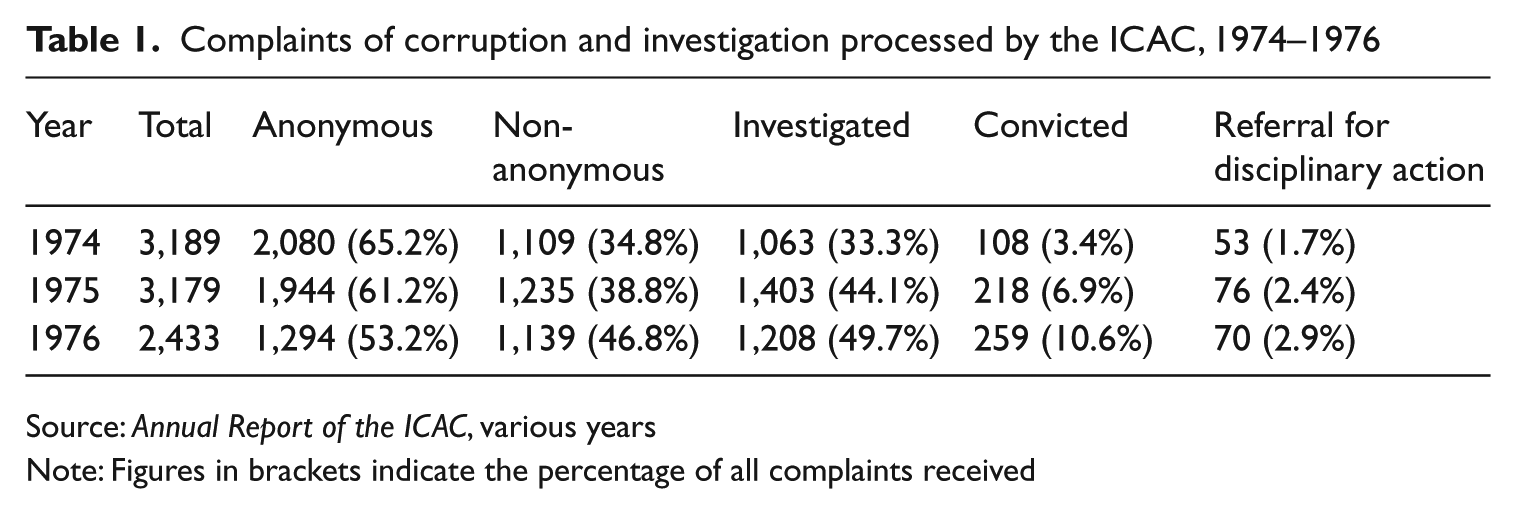
MacLehose’s masterstroke in diffusing local and external political pressure through the creation of the ICAC provided breathing space for the colonial administration in the short term. The move was well received by the local community, but this support was largely attributed to the Commission’s eventual success in bringing Godber back to Hong Kong and his ultimate imprisonment. Jack Cater and his team were fully aware of the challenge ahead and understood that the Commission would have to fight hard to earn people’s respect. Even during the ‘honeymoon period’, the early days were not entirely a smooth ride. Its credibility was not helped by the exposure of instances of its officers taking bribes and accepting private loans without permission. Some cynics seized the opportunity and ridiculed the ICAC as ‘
Complaints of corruption and investigation processed by the ICAC, 1974–1976
Source: Annual Report of the ICAC, various years
Note: Figures in brackets indicate the percentage of all complaints received
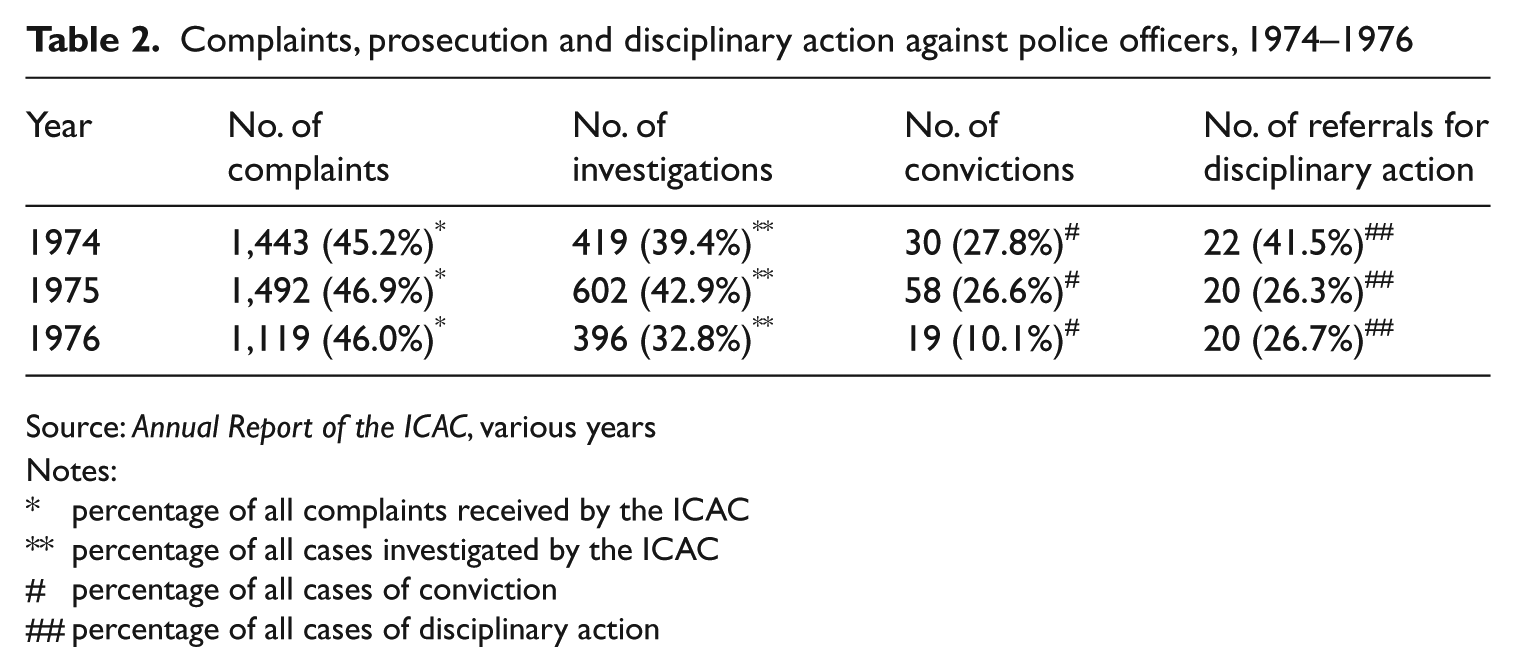
Success, however, came at a price. The tension between the police force and the ICAC had been rising since it was set up in February 1974. As shown in Table 2, the police force had remained the main target of public complaints against corruption in government, constituting almost half of the reports received by the ICAC. Some expressed concern that the Commission appeared to be pursuing a vendetta against the police. Jack Cater tried to defuse the tension by attributing this perception to sensationalism by the local media:
There can be no denying that investigations and prosecutions of members of the Police Force attract far more publicity and attention than any other group. This is a matter which I have discussed on a number of occasions with representatives of the media; many are agreed that the prominence given to Police corruption may seem unfair, but make the point that the media are in the business to “sell newspapers”, and that the headline “Corrupt Cop” is more eye-catching and newsworthy than a headline which reads “Corrupt XYZ Department Employee”.
59
Complaints, prosecution and disciplinary action against police officers, 1974–1976
Source: Annual Report of the ICAC, various years
Notes:
percentage of all complaints received by the ICAC
percentage of all cases investigated by the ICAC
percentage of all cases of conviction
percentage of all cases of disciplinary action
Cater’s conciliatory tone did little to allay the fears of members of the police force. With little sign of abatement in the Commission’s enthusiasm for investigation and prosecution, concern grew over its impact on police morale, and some demanded a general amnesty, with the ICAC restricting its investigations to acts of corruption committed since the formation of the Commission in February 1974. The pressure was substantial enough to finally require the Colonial Secretary, Denys Roberts, to issue an official rebuttal in the Legislative Council in April 1975. Like Cater, Roberts made a deliberate effort to placate the police force:
From time to time, allegations are made that the Police Force is corrupt throughout. I have no doubt that honourable Members will agree with me that this is a gross exaggeration and unfair in the extreme to the thousands of members of the Force who are devoted, loyal and honest men, discharging a difficult, uncomfortable and frequently dangerous task with skill and determination. They are as anxious as we and the public to see a force which is free from corruption and is therefore a better instrument for dealing with crime, which unhappily remains a major social problem, because the force needs not only public support but public respect if it is to be fully effective.
60
However, even if sectors of the police force took some comfort from these diplomatic words, their anxiety was certainly raised by the ICAC’s declaration of war on corruption syndicates. In his annual report in 1976, Cater announced that the Commission would from then on concentrate on destroying corruption syndicates – groups of public servants combining to extort money in exchange for forbearing to carry out the duties imposed on them by their office. According to Cater, although these syndicates could exist in any government department, the police force was the major victim of the proliferation of such evil. Additionally, there appeared to be a substantial connection between these groups among the police and triad societies: ‘they have fed off each other and grown fat together’. 61 Cater claimed that there was at least one syndicate in operation in virtually every police division, and in some divisions there were several, and that the money taken by the syndicates amounted to HK$1 billion a year. 62 The Commissioner envisaged 1976 and 1977 to be crucial years for the Commission and for the community of Hong Kong.
He was right: the year 1977 turned out to be the most trying time for the ICAC, not in its success against corruption syndicates, but rather in surviving the challenge of police mutiny. Despite the rhetoric of the importance of the honesty and integrity of the public service, there was, even while the new crusade against syndicated corruption was in full flow, an undercurrent within the Hong Kong and British governments which questioned the impact and propriety of the operations of the ICAC. Official records reveal that there were growing concerns over the consequences of the ICAC among officials in the colonial administration as well as in the British government. In the report to the FCO on his visit to Hong Kong, the Overseas Police Adviser, Macoun, made a highly disapproving assessment of the performance of the Commission. Based on his consultation with police officers in the colony, Macoun produced some very damaging indictments of the Commission:
The methods and procedures (used by ICAC) are far too inquisitorial and appear to absolve, under the existing Anti-Corruption laws, the ICAC from the need to observe normal legal procedures and to investigate in depth and assemble sufficient evidence before placing any suspect at risk. The result has been considerable inroads into personal freedom and the creation of an almost neurotic sense of apprehension in the community. I would suggest that the time has come for the GOHK to indulge in a degree of self-examination as to whether there should not be some contraction of the apparatus, more clearly defined priority targets, a greater degree of conformity in investigation procedures and the assembly of evidence according to normal legal precepts, and a concerted and determined public relations campaign on the dangers of corruption in the public service. Unless this is done, we can anticipate, in my opinion, a progressive erosion of public confidence in the Police with the consequential impact on public morale and operational efficiency of the Police and the impression that ICAC will become self-perpetuating.
63
According to Macoun, the ICAC operated like an octopus in its surveillance of the community. Macoun was not alone in this opinion, and concern over the exceptional powers given to the ICAC was also raised by legal professionals in the colony. One leading legal authority warned against the danger of ICAC operations bringing ‘inconvenience, distress, irreparable damage and ultimately serious injustice to the innocent’. 64 John Stewart of the Hong Kong Department of the FCO, although not subscribing entirely to Macoun’s disparaging remarks on the ICAC, did share some of the adviser’s concerns. He admitted that there were considerable effects on the morale of the police force and large sectors of the business and commercial community resulting from ICAC operations. He also conceded that some of the Commission’s activities were ‘difficult to reconcile with the principles of democracy and English-style justice’. 65 While there was considerable resistance to the idea of a formal appraisal of the Commission or the appointment of an ombudsman solely covering the operations of the ICAC, discussion of the introduction of some form of review and appeal mechanism against malpractice by the ICAC was certainly gaining ground in the FCO. 66
By 1975, the Governor, too, certainly felt the ICAC’s honeymoon period was over. In a meeting with FCO officials in London, he admitted that the Godber effect had probably weakened and that the Commission’s work could not be expected to be universally welcomed in Hong Kong. He also sensed the uneasiness of the police force, but he was of the view that the police might have to endure another two years of being singled out for inquiry before the ICAC could break the back of the problem. 67 Nevertheless, in a later communication with Macoun, the Governor hinted at a possible reduction in the size of the ICAC and a partial resumption of the investigation of corruption cases by the police by 1977. While the timing of these possible moves and Cater’s grand plan against syndicated corruption suggests that the Governor had confidence in the Commission’s ability to finish the job in two years’ time, it also revealed the pressure faced by the Governor and his contemplation of easing off the pace of the campaign amidst growing resistance from different corners. 68
However, before any concrete response was made to address the anxiety of the police force, the police officers struck. Their anger eventually erupted in mutiny on 28 October 1977. The catalyst for this defiance was a mass arrest in September 1977. More than 50 teams of ICAC officers were sent out to various locations, including the Yau Ma Tei Police Station, the Kowloon Criminal Investigation Department Headquarters and police quarters, in the early morning of 19 September. In these and similar operations on the following day, a total of 87 police officers were arrested. Altogether 228 officers were implicated in a case of syndicated corruption and placed under investigation. The first sign of trouble following the arrests was a petition to the Police Commissioner by about 100 police officers, many of whom were under interdiction for corruption offences. They complained about the procedural unfairness of the ICAC investigation and demanded better representation in the form of a rank-and-file association. Senior Assistant Commissioner Schouten tried in vain to defuse the tension and a mass meeting of about 3,000 police officers was held on 27 October. At this meeting, the organizers announced a march to police headquarters on the following day. About 2,000 off-duty police officers responded. The Commissioner and Deputy Commissioner received representatives of the group, who presented them with another petition that they claimed was signed by 11,000 of the 17,400 members of the force. The Commissioner expressed his sympathy and the crowd dispersed in an orderly fashion soon afterwards. A small group of about 40 officers, however, decided to vent their anger with the ICAC directly, and marched to the Commission’s headquarters in Central. When the group tried to force their way into the offices of the ICAC, the scene became ugly. Windows were smashed and a scuffle broke out, with a few ICAC officers suffering minor injuries.
This confrontation was simply the beginning of the crisis, an escalation of the tension was on the horizon. Despite the condemnation of violence by various police associations, support for the dissidents’ demand widened. On 3 November, about 400 inspectors of the Local Inspectors Association expressed their support for the demands of their rank-and-file colleagues. In addition to the original demand for the creation of a rank-and-file association, an amnesty was requested. Another meeting of about 300 officers from different divisions was held on 4 November, at which the mood had become increasingly militant and at which the option of a police strike was discussed.
69
The deep resentment of the ICAC by those within the police force was evident, and prompt and drastic action from the government was imperative. The necessity of a swift and powerful response was confirmed when the Governor summoned the most senior police officers to an emergency meeting of the Security Committee on 5 November. The Governor recalled:
[Y]ou can imagine the distress and shock with which one after another the senior officers confessed that they could not rely on their men to carry out orders, if I gave them, to intervene against the ring-leaders. When I asked them whether they would be able to carry out such orders given military support, again each one miserably answered he could not. On hearing this analysis, and realizing how rapidly the situation was evolving, and how consistently under-reported it has so far been, my appreciation was that we could be on the very edge of a breakdown in law and order. It would only need a rumour that the Police were off the streets for the night for looting to start. Indeed it would be all too easy for the Police ring-leaders to tip off triads to start something so that they could put pressure on the Government.
70
When asked what could be done to bring the situation under control, the senior police officers unanimously proposed an amnesty, and Jack Cater concurred. The rest of the discussion then focused on how to preserve the authority and dignity of the government and the ICAC given such a monumental concession. It was vitally important that, when announcing the amnesty, the government should not appear to be backing down. Thus, it was decided that, firstly, the amnesty would not be subject to further negotiation. Secondly, the ringleaders of the mutiny, many of whom were currently under investigation by the ICAC, should not be let off by the concession. The decision to make 1 January 1977 the cut-off date, with the exception of those who had already been interviewed by the ICAC, probably implied that most of the organizers of the various petitions would not be exempted. Lastly, the government also proposed to amend the Police Ordinance to give the Police Commissioner the power of summary dismissal of disobedient officers. 71
The rapid unfolding of events deprived the Governor of the chance for full consultation with all the concerned parties. Members of the Executive Council, with the exception of Yuet-keung Kan, were not consulted, and even the FCO was not given sufficient time to deliberate on the decision of a partial amnesty. FCO officials were only informed on 5 November when the decision had already been made, and they were not entirely happy with the situation. Some went on to criticize the Governor and the Police Commissioner’s poor judgment on the state of police morale, and their persistent denial of the concern over the impact of the ICAC’s work on police morale raised by the FCO months before the mutiny. 72 Yet the FCO officials reasoned that the Secretary of State should show his full support for the Governor’s decision lest any appearance of ‘less than complete confidence in the governor … make the situation between police and the public in Hong Kong worse than it is’. 73 In any case, the partial amnesty did succeed in defusing the crisis. Despite the resistance of some who persisted in demanding a full amnesty, the move achieved its objective of isolating the ringleaders from the majority of the police force. The general public also showed their support for the government, seeing this step as a way out of the existing predicament, between the danger of a breakdown in law and order and the importance of the anti-corruption campaign.
The immediate damage to the morale and credibility of the ICAC was obvious. The Operations Department had to abruptly terminate 83 investigations related to offences committed prior to 1 January 1977. 74 Jimmy McGregor, who had served in and witnessed the rampant corruption in the Department of Commerce and Industry until the mid-1970s, regarded such a ‘retreat’ as a missed opportunity to tackle corruption head on. 75 The Governor also withdrew his resistance to London’s demand for the creation of an ombudsman for ICAC, and conceded the introduction of a mechanism to investigate complaints against the Commission in the form of a committee under the chairmanship of Yuet-keung Kan. The ICAC was subject to further scrutiny by a team of special police advisers, headed by Jim Crane, sent from Britain in January 1978. Although the team’s primary objective was to advise on the Hong Kong Police Force’s organization and communications, they were also ‘invited’ to review the ICAC’s procedures for investigations and its relationship with the police. It is hard to deny the cumulative negative impact of all these developments on the public perception of the credibility of the Commission. The drop in the number of complaints received in 1978 was a testament to the damage. The ICAC received only 1,234 complaints in that year, the lowest number since the founding of the commission in 1974, and a drop of 28 per cent compared with the previous year. 76
The colonial government had not withdrawn its support for the anti-corruption campaign spearheaded by the Commission following the crisis. The Commission persevered and succeeded in attacking syndicated corruption, as shown by the prosecution of the Yau Ma Tei Fruit Market drug syndicate in 1978. By 1980, the Commission had developed into a force of 1,099,
77
a rapid expansion from the 369 personnel in 1974. However, since 1977, improving the relationship between the Commission and the police force and enhancing police morale appeared to be the main concerns of the government. Joint seminars, co-training, exchange of intelligence and information, and joint operations with the police were developed on the recommendation of Jim Crane’s team. The appointment of John Luddington, the former chair of the Public Service Commission, as successor to Jack Cater was illustrative of the Governor’s priorities as well. Jack Cater had personified the commitment of the campaign against corruption. In a way, his promotion to the post of Chief Secretary in July 1978 was untimely, since ‘there was a good deal of public concern about the possibility that the commission was likely to be wound up’.
78
Yet instead of appointing a strong character in response to this concern, the Governor saw this as an opportunity for moderation. He expressed the view:
Now that the Commission has been built to the full strength and has had considerable success in reducing corruption to acceptable levels, the new Commissioner needs to be someone who is not so much a crusader or innovator as someone whose appointment will indicate the importance the government attaches to the Commission’s work and who will have the personality and experience to lead the Commission and keep it on the rails. And hopefully, without conceding anything, he should be able to create a better working relationship with the police.
79
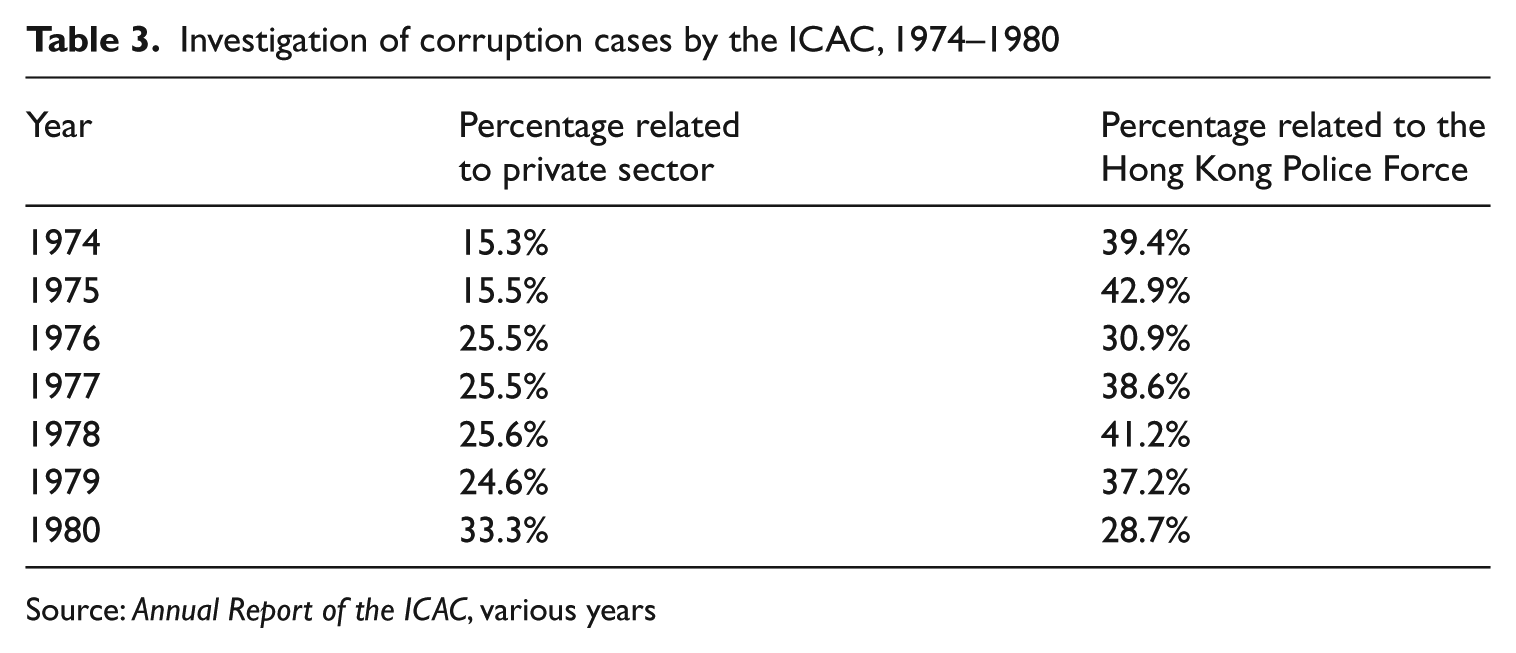
The preoccupation with improving the Commission’s relationship with the police force coincided with a shift in the focus of ICAC’s investigation work. Although police-related complaints still constituted the largest share of investigations in the public sector, the Commission’s focus on the police force appeared to have eased off by the late 1970s (Table 3). This was probably a result of the success of previous efforts in eradicating syndicated corruption and the impact of the partial amnesty in 1977. The Commission had also begun to pay increasing attention to corruption in the private sector during the same period, and had achieved considerable success. Offenders involved in corruption related to the Hong Kong Telephone Company and the China Motor Bus Company cases were eventually bought to justice, heralding a new frontier in the anti-corruption campaign. By 1980, the number of cases under ICAC investigation relating to the private sector exceeded the total relating to the police force, as shown in Table 3. There is no evidence that the police were deliberately let off, although the diversification in investigations certainly helped improve the relationship between the ICAC and the police force.
Investigation of corruption cases by the ICAC, 1974–1980
Source: Annual Report of the ICAC, various years
Conclusion
Murray MacLehose has been seen by many as a zealous reformer, 80 if not the most reform-minded governor in the history of colonial rule in Hong Kong. The long list of social reforms implemented under his governorship may be one of the most powerful justifications for the claim of the benevolence of British colonialism. 81 Lethbridge was of the opinion that MacLehose’s efforts against corruption were a part of the Governor’s grand moralizing project and should be related to his initiatives in the ‘Fight Crime’ and ‘Keep Hong Kong Clean’ campaigns, and to reforms in district administration that were designed to instil a new sense of civic responsibility and community among the locals. 82 Notwithstanding his vision for reforms and passion for social justice, the Governor may never have envisaged himself as a crusader against corruption. This, at least, is not confirmed by the documentary evidence available. In his maiden policy address delivered in the Legislative Council on 18 October 1972 – a document that was regarded by many as a landmark document depicting chains of social reforms on a seismic scale – MacLehose did not say a single word on the prevalence of corruption in the colony. Nor is there any comment on the topic in the document entitled Guidelines for the Governor Designate, Hong Kong that was, in effect, an understanding between MacLehose and the FCO on the list of priorities that the former would focus on during his tenure. 83 Corruption in Hong Kong, as he later admitted publicly, was far more endemic than he had imagined. Rather than a saviour with a self-assigned mission to eradicate fraud and sleaze from the bureaucracy, MacLehose was more like an accidental hero. Like most public administrators, colonial governors did not just make but also inherited policy. The institutional set-up for the anti-corruption campaign was already in place before MacLehose reported for duty in 1972. The statutory power of shifting the onus of proof onto the suspect – means that proved instrumental in bringing many culprits, including Peter Godber, to justice – was secured by David Trench, and the institutional removal of the anti-corruption function from the police also appeared imminent before MacLehose took up office. Some may argue that the creation of the ICAC in 1974 was inevitable, given the logic of path dependency in institutional development, together with the unbridled corruption following the rapid expansion of public services by a colonial government with no formal mechanism of public accountability. Yet one should not push the argument of historic inevitability too far. Historic twists may be primarily shaped or even determined by systemic and structural conditions, but the actual timing of such changes is still subject to the decision and courage of the ‘agent’ concerned. The apartheid regime in South Africa may have continued beyond 1990 without Frederik Willem de Klerk’s determination to collaborate with Nelson Mandela. Similarly, the rule of white terror in Taiwan may have lasted longer without Chiang Ching-kuo’s decision to terminate the rule of martial law in 1987. MacLehose did play a key role in sanctioning the creation of ICAC, even if he did not foresee his involvement in this specific historic juncture of colonial rule.
MacLehose’s decision is not merely a testament to his moral courage, but more a measure of his political acumen in the face of a political crisis. He demonstrated his extraordinary political skills in tackling the double crisis triggered by Godber’s escape in June 1973: by creating the long-discussed independent anti-corruption body, he managed to both pre-empt a possible external inquiry by London and put a halt to the downward spiralling of public confidence in the colonial government’s commitment to fighting corruption. In this single stroke, the Governor managed to keep the damage of the crisis on the authority of his administration to a minimum. The people of Hong Kong should also be grateful for his unwavering budgetary support for the ICAC in subsequent years, enabling the Commission to become a resourceful and effective anti-corruption task force. Ironically, MacLehose’s commitment to the cause was most severely tested when the Commission thrived with increasing success. The Commission’s triumph in cleansing the police force of widespread dishonesty came at the price of mounting political pressure from all corners for moderation of its conduct. The Governor won some battles in rejecting the idea of a special ombudsman with exclusive focus on the activities of the ICAC, and succeeded in denying the request for a general amnesty. Yet the police mutiny of October 1977 appeared to have shaken his resolve. Regardless of the facade of dignity and firmness in the announcement of a partial amnesty, this was the darkest hour in the history of the ICAC. Fortunately, the ICAC persevered and survived, and its eventual success in integrating the principles of integrity and honesty into the conduct of the public service and into the social fabric of the colony added a crucial chapter to the story of Hong Kong.