



Abstract
Authoritarian regimes, such as the Chinese Communist Party (CCP), seek to bolster legitimacy by facilitating communications between citizens and government officials. This article investigates the operation of online consultation, a process through which citizens offer feedback on draft laws and regulations. The article specifically examines the importance of demographic characteristics and subjective motivations in the expression of citizen sentiments in response to a proposed revision to China’s health system. By bringing together analysis of the content of citizen sentiment with a survey of participants, the article illuminates the determinants of the tone and substance of citizen feedback in health system reform. The primary finding is that participants who were internally efficacious and democratically oriented were, relative to respondents not possessing such traits, positive in tone and highly substantive in the submission of their comments concerning health system reform. This finding indicates that the health system reform commenting process offered citizens the opportunity to gain exposure to democratic principles and the process of articulating interests. More broadly, the analysis suggests the promise of online consultation in promoting citizen satisfaction with public policies, the legitimacy of the CCP, and, ultimately, stability in the Chinese political system.
Keywords
Contemporary authoritarian regimes, such as the Chinese Communist Party (CCP), routinely establish institutions designed to facilitate communications between citizens and government officials. 1 Such communications are essential for non-democratic states seeking to bolster legitimacy in environments characterized by restrictions in political expression and, by extension, in the circulation of reliable information about public opinion. 2 Increasingly, the search for legitimacy has led authoritarians to the Internet, to digital spaces where many of the central political contestations of the 21st century are articulated and adjudicated. 3
The Chinese Internet is not a monolithic entity, but rather a collection of disparate digital spaces, each with its own design features and user characteristics. 4 As a result, the association between government–citizen interactions, on the one hand, and stability and change in the Chinese political system, on the other hand, most likely varies significantly across institutional contexts. Irrespective of context, the tone and substance of sentiments expressed by citizens are likely to be central in determining the extent to which online interactions with government officials ultimately enhance or threaten the regime’s legitimacy.
This article contributes to the process of building a context-specific body of empirical knowledge about political expression and contestation in Chinese digital spaces. The article examines the operation of online consultation, a process through which government officials provide citizens with opportunities to offer feedback on draft laws and regulations. Online consultation is an important institutional feature of the Chinese Internet, as it constitutes one of the central mechanisms through which government organizations solicit and receive public input on proposed courses of action. 5
This article focuses specifically on citizen feedback that is submitted during the course of online consultation, addressing the following research questions: what are the determinants of the sentiments that citizens express in online consultation and what is the respective importance of demographic characteristics and subjective motivations in determining the tone and substance of citizen feedback?
Although little is known about citizen feedback in online consultation, 6 research on other forms of institutionalized political expression has devoted significant attention to the association between demographic characteristics and substantive motivations, on the one hand, and the nature of public participation, on the other hand. Demographic characteristics, such as age, income, and education, provide insight into the segments of society that engage government officials through instruments such as petitioning and voting in local elections. 7 Subjective motivations, which include support for democratic principles and political reform initiatives, indicate the extent to which participatory instruments are associated with dispositions that potentially enhance or threaten the legitimacy of the CCP. 8 By grounding the analysis in existing understandings and uncertainties regarding demographic characteristics and subjective motivations, this article situates the study of citizen feedback in online consultation within the framework of political participation and stability and change in the Chinese political system more broadly.
This article examines the determinants of citizen sentiments in the context of a particular application of online consultation, a revision to China’s health system proposed in 2008 by the National Development and Reform Commission (NDRC, 中华人民共和国国家发展和改革委员会). 9 Health system reform is one of the most important policy initiatives that the Chinese government has pursued in recent years, as it seeks to improve its governance in an area where citizen dissatisfaction has skyrocketed in the post-reform period. 10 In addition, health system reform was one of the NDRC’s initial applications of online consultation as a means of soliciting citizen feedback. 11 The article therefore establishes a benchmark against which future experiences with and analyses of online consultation can be juxtaposed. Finally, health system reform is perhaps unique in that there is systematic information regarding both the content of the feedback that was submitted and the characteristics of the citizens who offered comments on the NDRC proposal. 12 Together these data sources make it possible to address such issues as the respective importance of demographic characteristics and subjective motivations in determining the tone and substance of citizen feedback in health system reform.
In analysing the expression of citizen sentiment in online consultation, this article advances understanding of political contestation in Chinese digital spaces, particularly in the context of institutions established by government officials to bolster the legitimacy and sustainability of the CCP. Such understanding complements ongoing research on citizen expression in digital spaces, such as blogs, microblogs, and discussion forums, which are not directly created and operated by government organizations. 13 Ultimately, the article, by generating insight into political expression in a specific institutional context, contributes to the study of the ongoing evolution of communications between Chinese citizens and government officials and, more broadly, the resilience of CCP authoritarianism. 14
Research on political participation in China
Rather than stifling political participation in its totality, the Chinese government, as with contemporary authoritarian regimes throughout the world, establishes opportunities for and imposes constraints upon the expression of citizen sentiments. Participatory opportunities include instruments such as petitioning and voting in local elections. 15 Research on such forms of political expression has focused extensively on the respective importance of demographic characteristics and subjective motivations as determinants of citizen participation. 16 This research has generated insights and provoked uncertainties that are of great utility in informing expectations, analysis, and interpretations of the tone and substance of citizen feedback in online consultation.
One of the most publicized political reforms of the post-reform period has been the expansion of local elections. 17 Research on the operation of elections is grounded in the underlying notion that patterns in citizen voting have profound implications for stability and change in the Chinese political system. From one vantage point, elections offer citizens opportunities to articulate interests and impose a measure of accountability upon government officials. 18 Viewed differently, elections are exercises in which citizens demonstrate compliance with actions that have already been ratified through internal CCP decision-making channels. 19
The case for elections as meaningful democratic moments is derived from research demonstrating the centrality of particular demographic characteristics and subjective motivations as determinants of citizen voting. In competitive elections throughout the world, characteristics such as gender and education, and motivations such as interest in politics, affect the propensity of citizens to cast ballots. 20 Research on Chinese elections demonstrates that, at least under certain choice conditions, substantially similar arrays of factors differentiate voters from citizens who abstain from participation. 21 For example, in semi-competitive elections, well-educated male citizens who discuss politics and national affairs with others are more likely to vote than citizens not possessing such demographic characteristics and subjective motivations. 22
The contrary case for elections as instruments for inducing compliant citizen behaviour is derived from research that highlights the importance of an alternative suite of demographic characteristics and subjective motivations. 23 In this research, age is positively associated with voting, while education is negatively associated with participation in elections. To the extent that older, less educated citizens are relatively likely to be supportive of the political establishment, such patterns are consistent with the notion that elections are exercises in ratifying authoritarian courses of action. When it comes to subjective motivations, citizens with weak internal efficacy and democratic orientations are more likely to cast ballots than citizens who are confident in their capacity to influence public affairs and who support the expansion of local elections. 24 These results suggest that efficacious, democratically oriented citizens are dissuaded from participation, at least in certain choice environments, by constraints placed by government officials on the scope and conduct of elections. 25
Similar variation in findings characterizes research on forms of political participation other than voting in elections. Much of this research examines citizen-initiated contacts with government officials, through such instruments as petitioning, letter writing, and attending meetings. 26 Many, though certainly not all, analyses demonstrate that well-educated, wealthy male citizens are more likely than citizens not possessing such demographic characteristics to contact government officials. 27 Research also suggests that civic competence is a crucial determinant of non-electoral participation, 28 much in the same manner as in democratic countries throughout the world. 29
Such associations between demographic characteristics and subjective motivations, on the one hand, and political participation, on the other hand, have thus far not generated much attention in the specific context of citizen feedback on the Chinese Internet. The little evidence that has been generated indicates that citizens with awareness of the political possibilities of digital spaces have typically been online for relatively long periods of time and are well established in Chinese society. 30 Such citizens, for example, are often highly educated males who are employed in well-regarded professions. 31
Taken together, existing studies demonstrate the utility of demographic characteristics and subjective motivations as conceptual frameworks for analysing political behaviour. Given, however, that the results of previous analyses vary substantially across institutional contexts, little guidance is provided regarding the development of specific expectations for the operation of online consultation. Nevertheless, particular patterns of demographic characteristics and subjective motivations have been interpreted with respect to the distinction between participation as instrumental articulation, on the one hand, or compliant behaviour, on the other hand. These interpretations offer a pathway for linking the tone and substance of citizen feedback in online consultation with broader concerns regarding stability and change in the Chinese political system.
The operation of online consultation
Online consultation is a relatively new development in Chinese policymaking that has been made possible in part by the extraordinarily rapid growth over the past decade in the proportion of the population with access to the Internet. 32 Despite its recent vintage, online consultation is a highly salient instrument of political participation. In 2008, the State Council announced that it will ‘make use of the Internet as a standard method of inviting public opinion on draft laws and regulations’. 33 In the years ahead, the State Council plans to establish a nationwide system for facilitating online consultation on the part of all central agencies and at all levels of government. 34
Due in part to the opacity of the Chinese policymaking process, little is known about the operation of online consultation. In 2011, for example, the National People’s Congress (NPC) utilized the Internet to solicit citizen feedback on proposed revisions to the nation’s criminal procedure law. 35 The NPC did not make public the tens of thousands of submissions that were received, 36 thereby making it difficult to assess systematically the identity of participants, the content of citizen feedback, and the influence of comments on the law that was adopted the following year.
During the health system reform consultation, in contrast, the NDRC made available via the Internet comments that were submitted in response to the proposed policy. 37 The proposal, which was circulated in October 2008, established the broad outlines of a reformed health system. The proposal laid out the objectives that the system would be expected to meet, such as providing both urban and rural residents with universal access to basic services, ensuring the safety and availability of pharmaceutical products, providing physicians with adequate compensation, and combatting waste, fraud, and abuse in the system. 38
Concurrent with the announcement of the reform proposal, the NDRC opened a one-month feedback period, during which nearly 30,000 comments were submitted. The NDRC also offered participants the opportunity to submit an email address along with substantive feedback. This request resulted in the provision of more than 6,000 email addresses. 39 The public, online disclosure of these email addresses makes possible the gathering of information not only regarding the content of specific comments, but also the demographic characteristics and subjective motivations of the participants who submitted these comments. By bringing together analysis of the content of comments with an email survey of participant attributes, attitudes, and behaviours, this article utilizes a combination of original data sources to examine the determinants of the tone and substance of citizen feedback in health system reform.
Analysing health system reform
An effort was made to collect information about the demographic characteristics and subjective motivations of all 6,402 participants who publicly provided their email addresses. The author, in collaboration with the Research Center for Contemporary China at Peking University, developed a survey instrument consisting of 23 questions regarding various attributes, attitudes, and behaviours of health system reform participants. The Center implemented the survey by sending the questionnaire as an attachment to all available email addresses, accompanied by a message explaining the purposes of the research and ensuring the anonymity of respondents. Valid responses to this survey instrument were provided by 541 participants, who constitute the sample that is analysed regarding the determinants of the tone and substance of citizen feedback in health system reform. 40 Given that the sample was constructed in a non-probabilistic manner, the results of the analysis may not be readily applicable to health system reform participants and comments in general. 41
Dependent variables
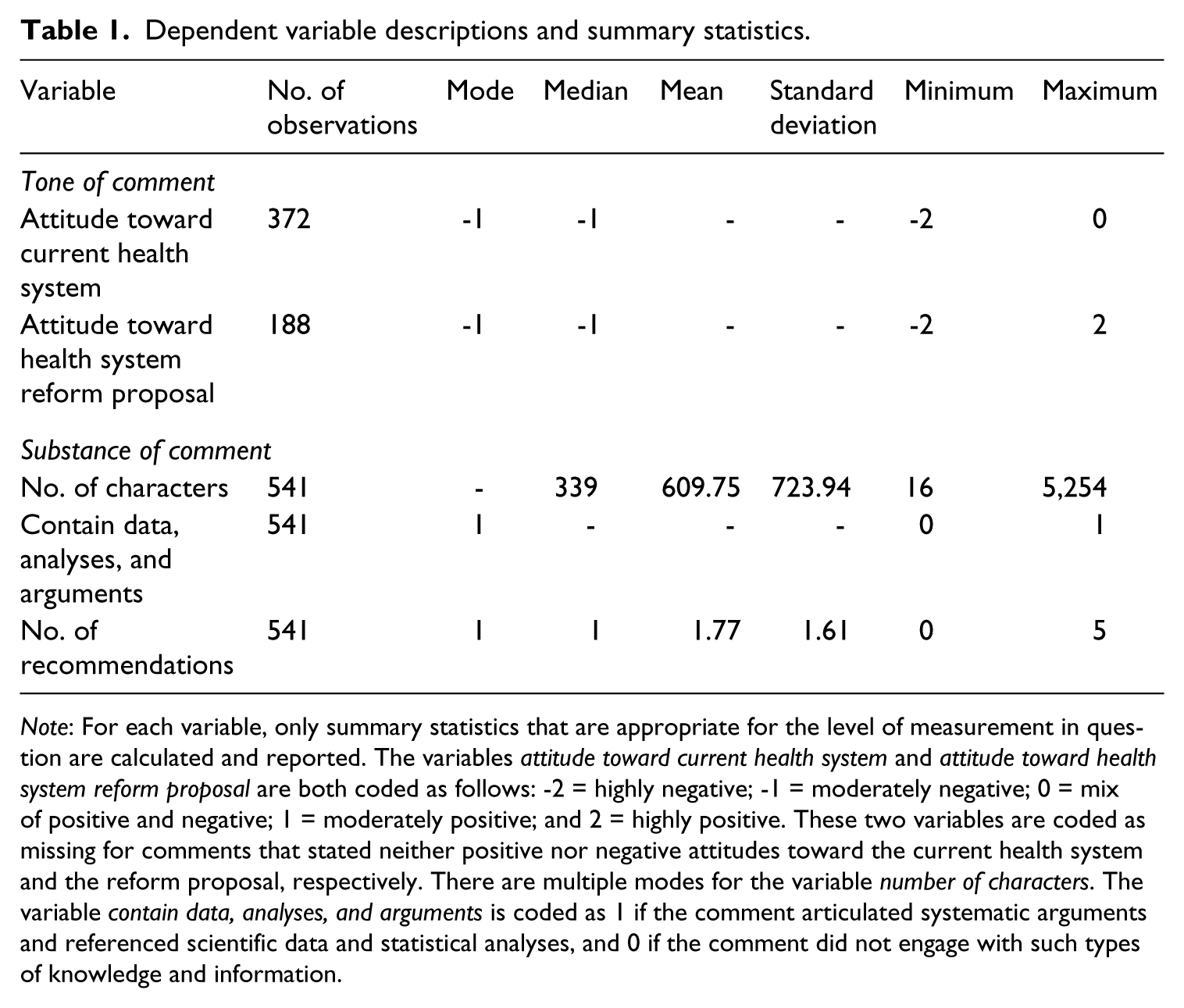
The dependent variables in the analysis consist of measures of the tone and substance of health system reform comments. These measures were operationalized through an analysis of the content of the 541 comments that were submitted by participants who subsequently responded to the survey instrument. 42 Table 1 provides descriptions and summary statistics for the five indicators of comment content that serve as dependent variables.
Dependent variable descriptions and summary statistics.
Note: For each variable, only summary statistics that are appropriate for the level of measurement in question are calculated and reported. The variables attitude toward current health system and attitude toward health system reform proposal are both coded as follows: -2 = highly negative; -1 = moderately negative; 0 = mix of positive and negative; 1 = moderately positive; and 2 = highly positive. These two variables are coded as missing for comments that stated neither positive nor negative attitudes toward the current health system and the reform proposal, respectively. There are multiple modes for the variable number of characters. The variable contain data, analyses, and arguments is coded as 1 if the comment articulated systematic arguments and referenced scientific data and statistical analyses, and 0 if the comment did not engage with such types of knowledge and information.
With respect to tone, comments were differentiated according to the extent to which they express positive or negative attitudes toward both the current health system and the health system reform proposal. These two dependent variables were coded according to an ordinal scale, ranging from highly positive to highly negative sentiments. For both variables, expressions of negative sentiments were more common than expressions of positive sentiments. In fact, not a single comment was coded as expressing even a moderately positive attitude toward the current health system.
Comments were differentiated in three ways regarding their substantive content. One such dependent variable is the length of the comment, measured by the number of characters contained in the submission. Comments varied in length from 16 to 5,254 characters, with the typical comment consisting of several hundred characters. Comment length is an imprecise measure of substance, given that brief comments may communicate substantively salient information and, conversely, comments comprised of hundreds or thousands of characters may contain arguments and evidence of little relevance to government officials. Nevertheless, the number of characters serves as an indicator of the extent to which comments do more than quickly register facts and opinions. 43
A second measure of substantive content considers the nature of the arguments and evidence presented in comments. Were comments grounded in knowledge derived from such sources as research and professional experiences? This dependent variable is dichotomous, distinguishing comments that articulated systematic arguments and referenced scientific data and statistical analyses on the one hand, from comments that did not engage with such types of knowledge and information on the other hand. With regard to the former, 302 comments satisfied this criterion, including the following comment, of which the text below is an excerpt.
I work at a hospital in a rural area. The New Rural Cooperative Medical System was implemented in 2008, but it does not work to the benefit of peasants. Originally, RMB 1,300 was enough to cover the cost of an appendectomy. Now, however, the operation costs RMB 3,000–4,000 and patients must pay RMB 1,300–1,500 out of pocket. Instead of benefiting from this measure, the economic burden of peasants has increased.
44
Finally, substantive content is measured by the number of recommendations communicated in the comment. Recommendations are specific changes to the health system and reform proposal suggested by participants. Recommendations, in other words, are more than statements that convey information to government officials. The number of recommendations contained in comments ranged from zero to five, with more than three-fourths of comments including at least one such suggestion. The following comment excerpt is an example of a recommendation: Restrictions on private hospitals should be eliminated, thereby allowing private hospitals to compete on an equal footing with public hospitals.
45
Explanatory variables
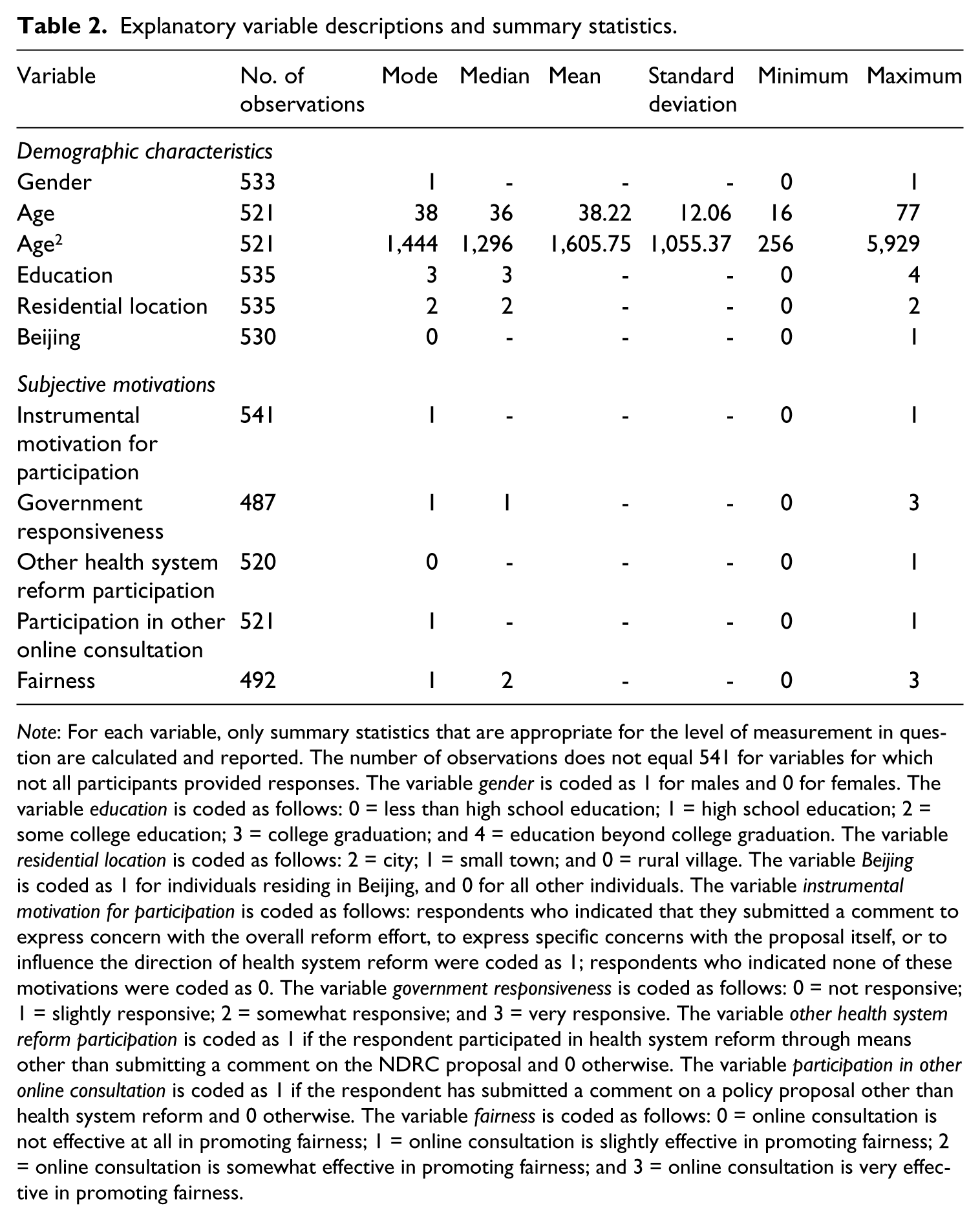
The explanatory variables, for which descriptions and summary statistics are provided in Table 2, are derived from responses to the survey instrument. Respondents were asked to provide information about demographic characteristics and subjective motivations that have framed debates and structured analyses regarding the causes and consequences of Chinese political participation. 46
Explanatory variable descriptions and summary statistics.
Note: For each variable, only summary statistics that are appropriate for the level of measurement in question are calculated and reported. The number of observations does not equal 541 for variables for which not all participants provided responses. The variable gender is coded as 1 for males and 0 for females. The variable education is coded as follows: 0 = less than high school education; 1 = high school education; 2 = some college education; 3 = college graduation; and 4 = education beyond college graduation. The variable residential location is coded as follows: 2 = city; 1 = small town; and 0 = rural village. The variable Beijing is coded as 1 for individuals residing in Beijing, and 0 for all other individuals. The variable instrumental motivation for participation is coded as follows: respondents who indicated that they submitted a comment to express concern with the overall reform effort, to express specific concerns with the proposal itself, or to influence the direction of health system reform were coded as 1; respondents who indicated none of these motivations were coded as 0. The variable government responsiveness is coded as follows: 0 = not responsive; 1 = slightly responsive; 2 = somewhat responsive; and 3 = very responsive. The variable other health system reform participation is coded as 1 if the respondent participated in health system reform through means other than submitting a comment on the NDRC proposal and 0 otherwise. The variable participation in other online consultation is coded as 1 if the respondent has submitted a comment on a policy proposal other than health system reform and 0 otherwise. The variable fairness is coded as follows: 0 = online consultation is not effective at all in promoting fairness; 1 = online consultation is slightly effective in promoting fairness; 2 = online consultation is somewhat effective in promoting fairness; and 3 = online consultation is very effective in promoting fairness.
One such demographic characteristic is gender. Much previous research has generated null results regarding gender differences in the propensity of Chinese citizens to vote in local elections and initiate contacts with government officials. 47 Research that has uncovered gender differences has demonstrated that males are more likely than females to engage in political participation. 48 Consistent with such results, more than 80 per cent of the health system reform comments under examination were submitted by males.
Previous research has demonstrated that age is associated with participation in the Chinese political system. 49 This association is typically conceived of as curvilinear, with petitioning and voting in local elections rising in propensity through middle age and then declining afterward. As a means of assessing such curvilinearity in the context of the tone and substance of health system reform comments, the analysis includes as explanatory variables both the age of the respondent and the square of this quantity. The typical participant was above 38 years of age, older than the majority of Chinese Internet users. 50
The nature of the association between education and political participation is, on the basis of previous research, highly uncertain. Some research has uncovered a positive association, with participation more prevalent at higher levels of education. 51 Other research, in contrast, has revealed a negative association, 52 while still other research supports the conclusion of no association at all. 53 The analysis includes as an explanatory variable an indicator of the respondent’s highest level of educational attainment. This variable is measured on an ordinal scale, ranging from lower than a high school education to education beyond the completion of undergraduate studies. Collectively, participants were well educated, with nearly 90 per cent consisting of university graduates.
Given that previous research suggests that political participation varies across geographic locations, 54 the analysis includes a pair of explanatory variables denoting the respondent’s current place of residence. One variable classifies respondents as living in cities, small towns, or rural villages. The other variable differentiates Beijing residents from respondents living in other locations. 55 Nearly three-fourths of participants lived in cities, with 77 respondents specifically residing in Beijing.
This survey provides a number of instruments for assessing the subjective motivations of participants in health system reform. Respondents were asked to indicate their motivations for submitting comments on the reform proposal. Respondents were given an array of options and were instructed to select as many reasons as possible which were applicable to their participation. 56 Several of these options offer insight into the internal efficacy of respondents, that is, the confidence of respondents in their ability to understand and influence politics. 57 The analysis includes a dichotomous explanatory variable indicating whether respondents selected any of three options regarding their motivations for participation – to express concern with the overall reform effort; to express specific concerns with the proposal itself; and to influence the direction of health system reform. Nearly 80 per cent of the participants indicated that one or more of these instrumental motivations described their submission of health system reform comments.
As another means of measuring internal efficacy, respondents were asked about their expectations regarding the government’s responsiveness to health system reform comments. This variable is operationalized as an ordinal scale, ranging from very responsive to not responsive at all. Nearly three-fourths of participants expressed the expectation that the government would be either slightly responsive or not responsive at all to the comments that were submitted.
One indication of the internal efficacy and democratic orientation of respondents is political participation beyond the submission of comments on health system reform. Was comment submission a one-time, perhaps idiosyncratic event or do respondents manifest internal efficacy and democratic orientation through participation in politics and policymaking on a regular, ongoing basis? The analysis includes a pair of dichotomous indicators that measure other forms and venues of participation. One variable differentiates between respondents who have participated in health system reform in ways other than submitting comments on the NDRC proposal and respondents who indicated no such additional participation. The other variable asks respondents whether they have submitted comments on draft laws and regulations in online consultations other than health system reform. A total of 142 respondents and 316 respondents, respectively, indicated engaging government officials via these alternative forms and venues of participation.
The survey instrument assesses respondent attitudes toward the democratic possibilities of online consultation. Respondents were asked about the extent to which they viewed online consultation as a means of increasing fairness in the policymaking process. This variable is operationalized as an ordinal scale, in which the efficacy of online consultation is rated from very effective to not effective at all. Respondents were nearly equally divided in their assessments of online consultation as slightly effective, somewhat effective, or very effective in promoting fairness in government decision-making.
Multivariate regression results
The analysis is oriented toward determining the extent to which the measures of demographic characteristics and subjective motivations are associated with the tone and substance of health system reform comments. As illustrated by the descriptive statistics, participants collectively occupied well-established places in Chinese society and aspired through regular, ongoing public involvement to exert influence over policymaking processes. 58 Among such participants, did differences in circumstances and orientations affect the nature of submitted comments?
The associations between the dependent variables and explanatory variables are assessed through a series of five multivariate regression equations, the results of which are reported in Table 3. 59 For each equation, the estimator is chosen on the basis of the nature of the dependent variable. Ordinary least squares is used for the number of characters variable, which is a continuous measure. Logistic regression is utilized for the dichotomous indicator of comments that articulated systematic arguments and referenced scientific data and statistical analyses. Ordered probit is employed for the attitude toward current health system and attitude toward health system reform proposal variables, both of which are ordinal scales. Finally, Poisson regression is used for the variable counting the number of recommendations. 60
Determinants of the tone and substance of health system reform comments.

Note: Each column in the table reports the results of a regression equation. The numbers in the cells are parameter estimates, with standard errors in parentheses. *** = statistically significant at p < .01; ** = statistically significant at p < .05; and * = statistically significant at p < .10. All hypothesis tests are two-tailed. The number of observations varies across equations as a result of differences in the prevalence of missing data among the variables.
In general, the multivariate regression results demonstrate that subjective motivations were more salient than demographic characteristics as determinants of the tone and substance of health system reform comments. Among this well-established, publicly involved set of respondents, it was not specific differences in personal circumstances that were most important in explaining the nature of submitted comments. Rather it was internal efficacy and democratic orientation that separated respondents from one another in the content of their participation.
Results for subjective motivations
The comments of respondents who have participated in health system reform in ways other than offering feedback on the proposal were more positive in tone and more substantive in content than comments submitted by respondents who have not participated in health system reform through such alternative channels. This finding is derived from the fact that the other health system reform participation variable is positive in sign and statistically significant in four of the five regression equations.
To assess the substantive significance of the association between other health system reform participation and the tone of comments submitted on the proposal, Monte Carlo simulations were conducted. 61 The predicted probability of submitting a comment of a particular tone was estimated both for respondents who have and have not participated in health system reform through alternative channels. In these simulations, as in all simulations reported in this article, the remaining explanatory variables were held constant at either their mean, for continuous variables, or mode, for categorical variables. 62 According to the simulation for the second column of Table 3, the probability of submitting a highly negative comment on the proposal was 28 per cent for respondents who have not utilized other venues to participate in health system reform. This probability diminishes to 17 per cent for respondents who have participated in health system reform through alternative channels. In addition, the probability of submitting a highly positive comment was more than twice as large for respondents who have participated in health system reform via multiple venues than for respondents for whom submitting a comment on the proposal was their only form of involvement.
The magnitude of the association between other health system reform participation and the substance of comments was substantial as well. As demonstrated by the parameter estimate for the other health system reform participation variable in the third column of Table 3, respondents who utilized other venues of participation submitted comments that were on average 215 characters longer than respondents who did not participate outside of the commenting process. According to the simulation for the fourth column, the probability of submitting a comment that articulated systematic arguments and referenced scientific data and statistical analyses was 52 per cent for respondents who have not utilized other venues to participate in health system reform. This probability rose to 69 per cent for respondents who have participated in health system reform through alternative channels.
The instrumental motivation for participation variable is positive in sign and statistically significant in three of the regression equations. Respondents who indicated that they participated in order to express concern with the overall reform effort, to express specific concerns with the proposal itself, or to influence the direction of health system reform were more positive and more substantive in their comments than respondents who did not indicate one of these instrumental motivations. As demonstrated by the parameter estimate for the instrumental motivation for participation variable in the third column of Table 3, respondents with instrumental motivations submitted comments that were on average 204 characters longer than respondents without such motivations.
The association between instrumental motivations for participation and the substance of health system reform comments is also exhibited in the extent to which submissions articulated systematic arguments and referenced scientific data and statistical analyses. According to the simulation for the fourth column of Table 3, the predicted probability of submitting such a comment was 55 per cent for respondents who did not express an instrumental motivation for participation. This probability rose to 70 per cent among respondents who indicated one or more instrumental motivations for offering feedback on the health system reform proposal.
The magnitude of the association between instrumental motivations for participation and the tone of health system reform comments was substantial as well. According to the simulation for the first column of Table 3, the predicted probability of submitting a comment that was highly negative toward the current health system was three times smaller for respondents who expressed an instrumental motivation than for respondents who did not participate for one of these reasons.
Other indicators of the association between subjective motivations and the tone and substance of health system reform comments come from the fairness and government responsiveness variables. As demonstrated by the parameter estimate in the second column of Table 3, the fairness variable is associated with the submission of comments that express positive attitudes toward the health system reform proposal. According to the parameter estimate in the fifth column, the government responsiveness variable is associated with the submission of comments that make numerous substantive recommendations. Each of the variables, it is important to note, is statistically significant in only one of the regression equations.
Results for demographic characteristics
The evidence for the importance of demographic characteristics in determining the tone and substance of health system reform comments is neither strong nor consistent. None of the explanatory variables measuring demographic characteristics are statistically significant in more than two of the regression equations.
To the extent that there are significant associations, the most clear-cut concern gender and the nature of comments. As demonstrated by the parameter estimates in the second and third columns of Table 3, comments from female respondents were more substantive and more positive in tone than comments submitted by males.
There is limited evidence that the association between age and the substance of comments is curvilinear, with the number of recommendations contained in submissions at first rising with age and then declining afterward. Such curvilinearity is demonstrated in the fifth column of Table 3, as the statistically significant parameter estimate for the age variable is positive in sign and the statistically significant parameter estimate for the age2 variable is negative in sign.
As demonstrated by the parameter estimate for the residential location variable in the first column of Table 3, respondents living in cities submitted comments that expressed more positive attitudes toward the current health system than respondents from rural villages. By contrast, the parameter estimate for the education variable indicates that respondents with high levels of education were less positively predisposed toward the current health system than respondents with low levels of educational attainment.
Summary and implications
Taken together, the results regarding the association between subjective motivations and the tone and substance of health system reform comments are broadly consistent with the notion of online consultation as a form of instrumental articulation. 63 The determinants of the content of health system reform comments, in other words, do not indicate that online consultation operated as an instrument for inducing compliant citizen behaviour within the overarching presence of authoritarian constraints. 64 This interpretation derives from the fact that respondents who were internally efficacious and democratically oriented were, relative to respondents not possessing such traits, positive in tone and highly substantive in the submission of health system reform comments.
Digital spaces and the Chinese political system
The nature and implications of communications between citizens and government officials in authoritarian regimes constitute a significant concern in contemporary comparative politics. 65 Of particular interest is the capacity of information and communication technologies to facilitate democratization, on the one hand, or bolster authoritarian resilience, on the other hand. 66 This article has addressed such issues of political expression and contestation in the globally salient context of the Chinese Internet.
Given the complex, multifaceted nature of digital spaces, this article has not endeavoured to offer an overarching appraisal of the possibilities of the Internet with respect to stability and change in the Chinese political system. Rather, the analysis has focused on online consultation, an instrument through which government officials regularly provide citizens with opportunities to offer feedback on draft laws and regulations. 67 Specifically, the analysis has examined the tone and substance of comments submitted in response to a proposal, circulated in 2008 by the NDRC, to reform the nation’s health system. Health system reform is one of the most pressing domestic issues in contemporary China, 68 and the NDRC proposal constituted one of the initial applications of online consultation as a means of soliciting citizen feedback. 69
The primary finding of this article, derived from a survey of participants and analysis of the content of comments, is that participants who were internally efficacious and democratically oriented were, relative to respondents not possessing such traits, positive in tone and highly substantive in the submission of health system reform comments. Following the convention of previous research on demographic characteristics, subjective motivations, and Chinese political participation, this finding has been interpreted as evidence that health system reform offered citizens the opportunity to gain exposure to democratic principles and the process of articulating interests, 70 as opposed to inducing compliant behaviour defined by the overarching presence of authoritarian constraints. 71
This interpretation does not necessarily signal the potential of the Internet as an instrument for enhancing consultation and participation in Chinese politics as a general matter. Rather, the analysis has specifically identified the determinants of variations in the tone and substance of online feedback in government policymaking among a well-established, publicly involved set of Chinese Internet users. Although the proportion of the population with access to the Internet has grown at an extraordinarily rapid rate over the past decade, 72 nearly 60 per cent of Chinese citizens cannot be counted as Internet users. 73 Furthermore, even among citizens with access to the Internet, awareness and utilization of e-government remains rather limited. 74 As a result, online consultation is likely to remain, at least in the immediate future, an instrument for communications between government decision-makers and a limited set of socially advantaged, politically sophisticated Chinese citizens.
Despite such limitations, online consultation is emblematic of a significant evolution in communication practices among government officials and Chinese citizens who have fared well under the economic reforms of the past several decades. Such citizens are well educated, work in professional and technical occupations, and reside in world-class urban environments. Political reforms, even modest innovations such as online consultation, carry the potential of facilitating partnerships between government and select citizens on issues of great importance to their everyday lives. Such partnerships, in turn, represent pathways for promoting citizen satisfaction with public policies, the legitimacy of the CCP, and, ultimately, stability in the Chinese political system.
The analysis from which such interpretations and implications are derived consists of a case study of a single manifestation of online consultation. A logical next step is to scrutinize experiences with online consultation beyond health system reform. It is through such investigation that general knowledge will be generated about citizen feedback and other elements of the operation of online consultation. As this research is implemented, the analysis presented here is well positioned to serve as a demonstration for the collection of data and the drawing of inferences about expression and contestation in Chinese digital spaces.
An additional concern for future research is the comparison of participants in online consultation with citizens who have not submitted comments in response to draft laws and regulations. The analysis presented in the article focuses specifically on the importance of differences in demographic characteristics and subjective motivations among citizens who participated in health system reform. Expanding the comparative focus to include non-participants will broaden the inferences that can naturally be drawn regarding online consultation and stability and change in the Chinese political system.
Although the Internet is not a monolithic entity, 75 overarching narratives of censorship and revolution are often ascribed to Chinese digital spaces. 76 Neither of these narratives holds much explanatory power in the context of online consultation, which operates as an incremental innovation in facilitating communications between citizens and government officials. Institutional context, in other words, is a crucial dimension in conceptualizing and analysing expression and contestation in Chinese digital spaces. Ultimately, the continual building of a context-specific body of knowledge about the Chinese Internet holds exceptional promise for adjudicating the possibilities of CCP authoritarianism in the years ahead.