



Abstract
Consumerism is a central feature of urbanism in China and has been actively promoted as a sign of urbanity in the official rhetoric and mass media. This urban ideology is exemplified by the ubiquitous presence of street advertisements that often occupy prominent urban public spaces. After all, turning every citizen of China into a consumer has become a widely accepted Chinese dream and one that is employed to mobilize a population otherwise divided by the ever-widening gap between the rich and poor. Advertisements have assumed a commanding role and are utilized by both official entities and private corporations to promote all kinds of urban consumption, ranging from concrete commodities such as high-end homes, beautiful neighbourhoods, and luxurious goods to intangible symbols such as lifestyle, ideology, and cosmopolitan identity. All these have fallen under the scrutiny of the Shanghainese artist Ni Weihua, whose photography documents billboards advertising official ideologies and real-estate projects in Shanghai and other cities. This study brings into context Ni’s artistic practice and examines specific ways in which his photographic series Keywords (关键词) and Landscape Wall (风景墙) engage with formal advertisements in the street both as an urban reality and as a site for deconstruction.
Since the beginning of 2013, red ‘dreams’ have quietly emerged in cities across China (Figure 1). Written in calligraphic style in bright red, the Chinese character for dream, 梦, constitutes the core of a new slogan: ‘Chinese dream, my dream’ (中国梦我的梦). Variations include ‘China fulfils its dream and all families prosper’ (中国圆梦家家有福) and ‘Beautiful Chinese dream’ (美丽中国梦) (Figure 2). In various forms such as print on billboards and electronic screens, the red dream appears in every corner of urban public space: streets, shopping malls, buses and subways, and so on. This is related to the ideological campaign initiated by the new state administration led by President Xi Jinping and Premier Li Keqiang, both of whom officially assumed their post in 2013. In several official speeches, Xi defined the Chinese dream as national rejuvenation and prosperity, and emphasized that the Chinese dream is every Chinese citizen’s dream and that only if Chinese individuals accept the common national goals designed by the government can they realize their own dreams. 1 China’s centralized political and propaganda systems have ensured the immediate proliferation of the Chinese dream. In both the official rhetoric and physical manifestations, calls to fulfil the Chinese dream have gained currency over ‘harmony’ (和谐), which was used in slogans such as ‘Build a harmonious society’ (构建和谐社会) and ‘Harmonious demolition’ (和谐拆迁), propagated by the previous administration headed by President Hu Jintao and Premier Wen Jiabao (Figure 3).

Left: ‘Chinese dream, my dream’ printed on the fences put up for the subway construction at the centre of a main street in Xi’an. Right: ‘China fulfils its dream and all families prosper’ printed on the wall of a sidewalk in Beijing. Photos taken by the author in 2013.

Ni Weihua, Chinese Dream – Jinan Huanggang Road, 26 June 2013. Courtesy of the artist.

Ni Weihua, Keywords – Harmony: Shanghai Jiasong Road, 18 September 2008. Courtesy of the artist.
The Shanghainese artist Ni Weihua (born 1962) has coined the term ‘language event’ (语言事件) to denote the replacement of an old public slogan with a new one when a new state administration comes into power. 2 For more than a decade, the subject matter of Ni’s concept-oriented documentary photography has been the way political slogans are advertised like commercial products in public spaces in Shanghai and other cities. He has documented street advertisements proclaiming ‘Development is the most important principle’ (发展是硬道理), a phrase which originated from the late leader Deng Xiaoping, the mastermind of China’s reform and opening up, in his series titled Keywords – Development (关键词 – 发展) (Figure 4). In Ni’s view, the emergence of this phrase in prominent public spaces is an example of the language event that chronicles China’s dramatic transformation from a political society driven by revolutionary ideals to a materialist one that values economic development as the only principle. 3 What can be more revealing for a society that adopts consumerism as its primary ideology than the ubiquitous presence of political slogans advertised like commercial brands? What interests Ni more is the potential impact of these slogans on spaces and people. He calls such slogans ‘advertising words’ and points out that through repeating, spreading and infiltrating, advertising words have become an indispensible part of the scenery in people’s daily life. 4

Ni Weihua, Keywords – Development: Shanghai Zhongshan Road East No. 1, 15 December 1998. Courtesy of the artist.
This indispensible scenery which Ni refers to is omnipresent in the urban spaces of major cities, shaping the consciousness and subconsciousness of urbanites. A reader of Henri Lefebvre and many other Western Marxist thinkers, Ni adopts Lefebvre’s conception of social space as a complex product of concrete human practices, and he is keenly aware of the power struggles taking place in urban space and of visual representations that condition the thoughts and actions of people who live in that space. 5 According to Ni, the two major actors in Chinese social spaces are political ideology and commercial forces; the collusion of the two constitutes the most powerful form of control over Chinese citizens in contemporary times. 6 As he sees it, this control is most evident in urban public spaces where official ideologies manifest their power through ubiquitous billboards, a phenomenon that prompted him to take up documentary photography.
The practice of displaying messages in public space is hardly new in China. The country has a long tradition of promulgating official messages through big characters in public space and this, as Geremie Barmé argues, has itself become a feature of artistic creation, deconstruction and contestation in modern China. 7 Since the 1980s, a number of avant-garde artists have made written words the subject matter of their art, for example the notorious big-character posters from the Maoist era. 8 Ni’s interest in examining the infiltration of official words into contemporary urban space is also shared by other artists. For example, Zhang Dali, in response to the official slogans then prevalent in Beijing as the city prepared for the 2008 Olympics, began creating his painting series Slogan (标语) in 2007. 9 Employing the style of pointillists, Zhang painted sentences from slogans that he photographed from streets in different tones so as to form human faces of anonymous individuals. These emotionless faces simultaneously emerge from and are pulled back into the endless Chinese characters, suggesting the infiltrating violence of state propaganda in society. Ni, however, examined the hegemony of state propaganda from a different angle when he began his work Keywords – Development in 1998. He was intrigued by the style employed in publicizing official ideologies, which has become increasingly sophisticated – from the coarse production of handwriting in the past to digital printing and use of electronic screens. The government has adopted the advertising strategies of the commercial world and is making use of popular technologies, materials, and styles in its efforts to occupy urban space.
Here we are dealing with another Chinese dream that has played a central role in the recent development of China, with urbanization transforming China into a consumer society. Consumerism in turn has played an important role in the rise of Chinese urbanism and has been actively promoted as a sign of urbanity in the official rhetoric and mass media. Turning every Chinese citizen into a consumer, regardless of his or her original social background or class status, has become a widely accepted Chinese dream. Consequently, advertisements have assumed a commanding role, indistinguishably employed by both official entities and private corporations, in promoting all kinds of urban consumption, ranging from concrete commodities such as high-end homes, beautiful neighbourhoods, and luxurious goods, to intangible symbols such as lifestyle, ideology, and the cosmopolitan identity of a city. This article analyses Ni’s major documentary photography series Keywords – Development, Keywords – Harmony (关键词 – 和谐), and Landscape Wall (风景墙) and illustrates how Ni turns urban billboards into the content of his artistic contemplation, simultaneously deconstructing the national consumerist dream.
From development to harmony
Ni’s Keywords – Development and Keywords – Harmony series deal with the advertisement of political ideologies via billboards in urban public space over a span of more than 16 years. It is worth noting that Ni is not a professional artist in the common sense of the word because, unlike most contemporary Chinese artists, making art is not his only career. He has been a fulltime employee of Shanghai Baosteel Engineering & Technology Group Co. Ltd since 1983, and he engages in art during his spare time, mostly on weekends. Against conventional wisdom, he believes that having a stable job in another field gives him the freedom to keep a critical distance from the ebb and flow of the contemporary art world and, more importantly, an opportunity to engage with the real world from a different perspective. 10 His past artworks range from expressive paintings in the 1980s that dealt with the psychological state of modern individuals to installation and performance art in the early 1990s that investigated new social phenomena arising from China’s economic transformation. 11 Some of these early works were included in the Second Modern Chinese Art Research Documents Exhibition in 1992, one of the few landmark exhibitions organized in China for contemporary art in the 1990s. 12 He was the only artist from Shanghai to be included in the once underground but now famous Black Cover Book (黑皮书), released in 1994, which introduced the works of leading Chinese avant-garde artists of the time. 13 Starting in 1997 he turned his attention exclusively to the city, Shanghai in particular, as the site for sociological research and was part of a collaborative conceptual project called Linear City (线性城市), in which he and the Shanghainese architect Wang Jiahao explored the relationships between individuals and the city they inhabited. Explaining why he began focusing on the city as the site of his artistic engagement, he states that ‘the city, as the site of higher civilization, is the congregation zone of various discourses and therefore the central location of conflict between the individual and the collective’. 14 Certainly, Shanghai, one of the most rapidly growing cities in China since the 1990s, has produced numerous acute social conflicts that have caught his attention.
Ni’s Keywords – Development series features the slogan ‘Development is the most important principle’ in various urban settings. In a piece titled Keywords – Development: Shanghai Zhongshan Road East No. 1 (Figure 4), the billboard in the photo is located at the side of a public square. It is treated as a scenic spot for people to take photos. A group of older adults have arranged themselves in three rows in front of the ‘development billboard’, behind which is the most famous street in Shanghai – the Zhongshan Road East of Shanghai Bund. Their group photo is centred on the billboard, which is a very telling illustration of the effect of official ideologies on the mindset of the general public in China. Under the logic of developmentalism, China has witnessed extraordinary economic growth and urban transformation. Shanghai owes much of its current international status to the central government’s preferential policies, which has allowed the city to prioritize economic development above all else since 1991 and to transform itself in the short period of a decade to become a metropolis of global significance in the domains of finance, trade, and commerce. 15
In Keywords - Development: Shanghai Nanjing East Road East, Ni captures the presence of the development slogan at a busy intersection where both the surrounding street and buildings are under renovation (Figure 5). Written in red on a white surface and accompanied by a telephone number, the slogan adorns the top of a yet-to-be-completed building bordering two streets as if it is the name of the building or a commercial advertisement. Pedestrian and other traffic move in different directions, with no apparent attention to the slogan so high above them. During Ni’s research, he discovered that in many cases, the slogan ‘Development is the most important principle’ was put on empty advertisement boards waiting to be sold. 16 Apparently the political correctness of the message has made the slogan a popular alternative before corporations purchased the advertising slots and replaced them with their own specific commercial advertisements. Some scholars have argued that since China’s reform, commercial advertisements appearing in newspapers have often appropriated official ideologies for the promotion of their products. 17 It seems that the strategy also works on outdoor billboards, as shown in this photograph. According to Ni, the symbolic power of this slogan lies in it being used as ‘an explanatory tag embedded among soaring metropolitan skyscrapers’, which themselves are the most typical evidence of the speed of economic development in China. 18 As he puts it, ‘with development as the main theme, all conflicting economic, political, social and cultural problems already seem to be solved because all social groups and every individual are “developing”, regardless of their pace of development and disparity in wealth’. 19

Ni Weihua, Keywords – Development: Shanghai Nanjing Road East, 8 January 2000. Courtesy of the artist.
Ni is being satirical here. China’s headlong plunge into economic development has caused acute social problems, but these are overshadowed by the mandate of development and considered a necessary sacrifice for China’s transformation into a modernized urban nation. 20 In Keywords – Development: Shanghai Baoyang Road (Figure 6), Deng Xiaoping is portrayed on the right of a large billboard. The aging leader is shown waving his right hand as if in approval of the success brought about by his reform policies. Behind him to his right is a magnificent waterfront view of a city with brand new skyscrapers standing in grandeur against the blue sky. At the top, written in big, red characters, is the development slogan and below the slogan is Deng’s signature. Obviously, by re-enacting Deng’s push for economic reform, it evokes the economic miracle and rapid development which China has experienced so far. According to Ni, the slogan has been highly publicized since the late 1990s in big cities such as Shenzhen, Guangzhou, and Shanghai, which benefited the most from Deng’s reform and opening up policies. Portraying Deng and echoing his words might stem from the need to justify the radical urban transformation and its controversial consequences. In Figure 6, the billboard is located at a major intersection where a couple of locals are cycling past. Bicycles as a means of transport do not correspond to the image of a world-class urban nation that China aspires to be, and the discrepancy between the vision and reality forms an interesting contrast.
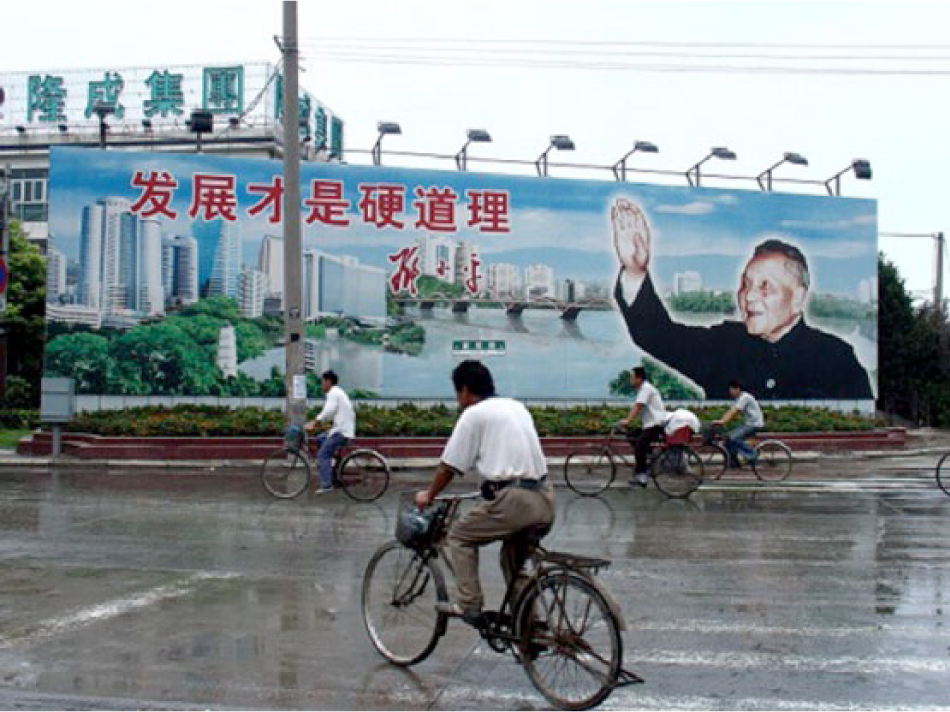
Ni Weihua, Keywords – Development: Shanghai Baoyang Road, 19 September 2004. Courtesy of the artist.
The billboard is a reminder of the dominant mode of Chinese development since the 1990s, which is largely driven by pro-GDP growth policies. As Ni puts it, GDP brings growth to China’s cities and gives them an appearance of prosperity. Magnificent buildings and structures, symbolizing the ‘administrative feats’ of officials, are rapidly erected in cities across China – boasting the great achievement of ‘Chinese-style development’. 21 GDP has been used as the primary criterion for measuring achievement and for determining the promotion of Chinese government officials, while urban expansion has been used to increase GDP. 22 Since Chinese officials are appointed cadres who are assessed for promotion on the basis of political loyalty and economic achievement, they naturally gravitate towards massive construction projects such as city squares, flyovers, or development zones, which are visible proof of their achievement. 23 Under such a political system, a considerable number of negative effects of urban development, such as the displacement of residents, the misuse of public resources, and the destruction of cultural and historical heritage, are often overlooked since these issues do not carry much weight in the assessment criteria for promoting officials. 24 Such issues are consequently ignored in the official media.
Ni maintains that under the bombardment of the mainstream discourse on development, the majority of Chinese people have generally overlooked the impact of ideology – made into ‘public speech’ through billboards – on their lives. They have also ignored the widening social and economic gap and the irreversible damage on the living environment caused by overdevelopment. 25 The official ideology has certainly achieved its intended purpose. With Ni’s documentary photography, however, we are shown very clearly how dominant public speech shapes the awareness of urbanites who read slogans and unconsciously or willingly internalize the messages they see everywhere. According to scholars such as Roland Barthes and Gunther Kress, who studied the impact of advertisements and pictorial representation in popular culture, a visual image is itself speech, and accordingly a billboard can be seen as a ‘demand picture’, calling on the viewer to act. 26 In China’s context, billboards as demand pictures often function to urge the public to accept a government decision or policy and its consequences. From a semiotic perspective, experts studying advertisements propose that every advertising image is making a kind of ‘visual argumentation’, calling for a belief change and followed by action. 27 The visual argumentation depicted by the billboard in Figure 6 is particularly relevant in areas deemed to be of low urban status which are still dominated by low-rise buildings, since it proclaims urban construction and skyscrapers as the very means of China’s progress. Such billboards thus serve as an ideological preparation and justification for the impending redevelopment.
As an artist who is also interested in the semantics of texts and images, Ni aims to reveal a crucial process of visual mobilization at a time when direct political control is no longer popular. Recording faithfully what was there at a specific time and location, his preference of documentary photography over staged photography (the latter has been employed by many conceptual photographers in China) purposely minimizes personal touch and interpretation. In most cases, his choice of where to photograph was itself guided by chance. His job requires him to travel around Shanghai frequently and to other cities occasionally. Always carrying a camera, he would stop where possible and take a photo whenever he spotted a billboard with the development slogan. If he was unable to photograph it, he would make a mental note and find an opportunity to go back to snap some shots. His decision on whether a slogan would be worth photographing was rather simple: the characters had to be big enough so he could see them clearly. For the Keywords – Development series, Ni took more than 100 photos of street views that contained a billboard with the development slogan. In a sense, what Ni does is a kind of sociological survey of a typical visual phenomenon in locations that are part of his daily routine as an ordinary urban resident, and the camera is what he uses to collect the visual data. The task of analysis is left to the viewer. This approach is also a result of his personal understanding of photography as a popular medium and his preference for fostering dialogue with his audience on an equal level. Discussing why he abandoned art photography, which usually involves manipulating lighting and setting to achieve desirable visual effects, Ni explains:
My main preoccupation is to observe like an ordinary citizen rather than taking the approach of professional photographers. With this ‘equal viewing point’, we can connect to the visual impression the general public will experience when viewing a photo, since they usually overlook visual details such as light and shade to read the content of the photo directly…. I have been aware of this from the very beginning. In order to produce a documentary of scenes involving human activities, I pay more attention to the naturalness of the scenes and try to ensure that they are not spoiled by ‘the subjectivity of the documenting’.
28
The desire to be understood by the general public rather than art-world insiders also explains Ni’s decision to abandon installation and performance, two new mediums that were largely adopted by Chinese avant-garde artists in the 1990s, and to focus on photography as the main medium for his artistic practice. 29 Furthermore, individual pieces in this series can be described as simple and plain in terms of style since they do not show much evidence of a carefully planned angle, sophisticated composition, or special lighting. Neither was there any aesthetic modification or compositional readjustment after the photos were taken. One may argue that Ni is more interested in presenting the content than he is about the medium itself or the pursuit of a personal style. He forsakes all these aspects to achieve ‘the naturalness of the scenes’. These images are just like the kind of snapshots anybody can take as long as he/she can hold a camera steady, focus on the slogan, and press the shutter button.
Around 2006, during Ni’s visual survey of Chinese cities, he began noticing the disappearance of the development slogan and the emergence of ‘Build a harmonious society’ and its variations that contained the keyword ‘harmony’. The new political mandate was initiated by the new government administration under the leadership of Hu Jintao which attempted to address severe social and environmental problems arising from more than two decades of pro-economic development. 30 China’s economic growth is admired throughout the world; however, the repercussions of the widening social gap and rapidly degenerating ecosystems cannot be ignored. In order to stabilize a society torn by conflicts and problems, the new generation of political leaders began touting a new official rhetoric and policy concept expressed in the slogan ‘Build a harmonious society’. While still focusing on the goal of rapid economic growth, the Chinese government began promoting a more balanced policy, arguing that ‘scientific development and social harmony are integral’. 31 It is clear that the ideological campaign for a harmonious society was a correct assessment of the grim state that China was in, and it reflected the central government’s efforts to solve the country’s problems, at least at the level of policy concept. With the nationwide campaign for harmony, Chinese cities were ‘harmonized’, with the word appearing in all kinds of forms taking over public spaces in a short span of time.
Ni begins his new documentary series Keywords – Harmony with the observation that Shanghai has been quick to embrace the new political rhetoric emphasizing harmony. Since 2006, he has taken more than 2000 photos of street scenes where slogans espousing harmony were displayed, most of them from different locations in Shanghai and a few from other cities. Keywords – Harmony: Shanghai Jiasong Road (Figure 3) is dominated by a large billboard above another that is already faded, displaying the message ‘Build a harmonious society’. Printed in red and with a white background, the big Chinese characters and the English translation stand out against a background featuring a new apartment complex. This billboard is actually part of a wall-like fence separating pedestrians from the construction site on the other side, presumably where the advertised new residential complex is being built. On the street are passers-by on bicycles and motorcycles, and on foot. Harmony slogans at construction sites became a common visual phenomenon in Chinese cities in the late 2000s, especially since these sites tended to be associated with violence. In the first place, Chinese urban expansion involves the large-scale demolition of old communities and often the forced eviction of residents who are inadequately compensated. Moreover, construction sites are also locations where most migrant workers end up working and being exploited. The slogan in Keywords – Harmony: Hangzhou Jiefang Road (Figure 7) indeed addresses the issue directly by advocating ‘harmonious demolition’. This time the slogan in golden yellow is attached to a red banner hanging over a run-down wall. Over the wall through a thin slice against the picture frame we see a densely built environment, where dilapidated single-storey houses, multi-storey houses, and apartment buildings jostle against each other. They appear to be so tightly overlapping that there seems to be no open space between individual buildings. The slogan on the wall indicates that this area is designated for demolition by the city authorities.

Ni Weihua, Keywords – Harmony: Hangzhou Jiefang Road, 14 September 2008. Courtesy of the artist.
The slogan ‘Harmonious demolition’ thus serves as a textual reassurance, as a remedy for the impending violence that often accompanies demolition in China. The irony which Ni’s photograph quietly presents is that the new ideological campaign does not seem to address the source of the problem; it simply adopts a new rhetoric without slowing down the mandate of development or redressing the severe socio-economic disparity. In Shanghai, in particular, in the run-up to the World Expo 2010, the city was turned into a massive construction site and there were many such slogans plastered on billboards to cover up the chaotic construction scenes and, one might add, social conflicts arising from enforced demolition and displacement. 32 In her study of Beijing’s construction boom for the 2008 Olympics, Anne-Marie Broudehoux argues that construction projects built for the Olympics helped concentrate economic and political power in the hands of government leaders and private investors, exacerbating profound inequalities and social conflicts since ordinary residents were forced to pay the costs in the form of dislocation, inflation, and tax increases. 33 The same can be said about Shanghai’s preparation for the World Expo. Indeed, many pieces in Ni’s Keywords – Harmony series were taken near World Expo venues that were under construction after the forced eviction of residents. 34 It became only too evident that, rather than creating a fairer and more harmonious society, the rhetoric of harmony has often been used to justify the increasingly tight media and Internet controls in China. It is no coincidence that the word harmony has entered into unofficial language, largely circulated via cell phone text messages and Internet blogs, in which people appropriate the noun and use it ironically as a verb by talking about somebody or an online post ‘being harmonized’, meaning that something is being forced upon somebody for politically sensitive reasons or the post is being deleted because of its unacceptable content. 35
China continues to employ urbanization as its main development strategy and the activities of demolition and construction continue to play a prominent part in the everyday living environment of urbanites. People pass by without paying any special attention to slogans in the same manner depicted in Ni’s street photographs. Harmonious demolition as a slogan has inserted itself as an accepted reality and an inseparable component of urban space. However, once captured by Ni’s camera, this reality becomes a visual text that allows us to examine the manifestation of political power and the constructed nature of space. Overall, Ni’s Keywords series documents a distinctively Chinese way of promulgating official discourses and exercising ideological control in public space. Through various settings that always involve the presence of a billboard advocating an official mandate in an ordinary urban setting that matches or mismatches the advertised message, Ni’s Keywords documentary project reveals how words are used as a tool in public space to shape Chinese urbanites’ understanding of the sociopolitical and economic processes. It also depicts the changes in the political rhetoric of different administrations in China and urges viewers to reflect upon the underlying rationality and absurdity. In a sense, one may argue that Ni has been documenting the official Chinese dreams long before the word dream appeared as a new political slogan. More importantly, he observes an interesting tension between the static but purposeful presence of advertising words in the background and the accidental appearance of people and vehicles in the foreground. The words have become a background that is both real and symbolic against which actual urban routines take place. This tension inspired him to start a new conceptual work, Landscape Wall, another multiple-year documentary project that he began in 2008, exploring the disharmonies between a static advertising image and real-life passers-by.
The real and virtual disharmony
In Landscape Wall – Shanghai Dalian Road (Figure 8), the viewer is presented with a photograph consisting of two elements: a group of people and a city. In the foreground, four construction workers, identifiable by the construction hats three of them are wearing, are walking by. They all have their heads turned towards the viewer as if being alerted by something, probably the artist who is taking the photo. Behind them is a magnificent bird’s-eye view of a city, characterized by many bland new skyscrapers and straight avenues extending all the way to the horizon. With some iconic structures looming against the horizon in the distance such as the Oriental Pearl Tower and the huge ferris wheel of the leisure park, we know the city is Shanghai. The position of the construction workers in the foreground makes them stand out, dwarfing the city – a situation that is quite the opposite of reality. As emphasized by Maurizio Marinelli in this special issue, China’s revolutionary urban transformation has produced sleek and glittering cities alongside numerous excluded and dispossessed people. 36 Among them, migrant workers constitute a major disenfranchised social group. Every year millions of rural migrants flood into cities, but their presence is often rendered invisible even though it is their labour that makes the rise of Chinese metropolises possible. Ni’s photo seems to highlight the contribution of these people, a fact that has been ignored for too long in the Chinese mainstream media and is not even being appreciated by the construction workers themselves. The lack of assurance and pride on the faces of these characters makes it clear that they do not feel any sense of ownership of the city they helped to build; certainly not in a society where they enjoy few rights in the city and are systematically stigmatized as inferior outsiders, not to mention that their legal presence is often challenged by the city authorities, and they are forced to disappear from public sight when important political events take place. 37
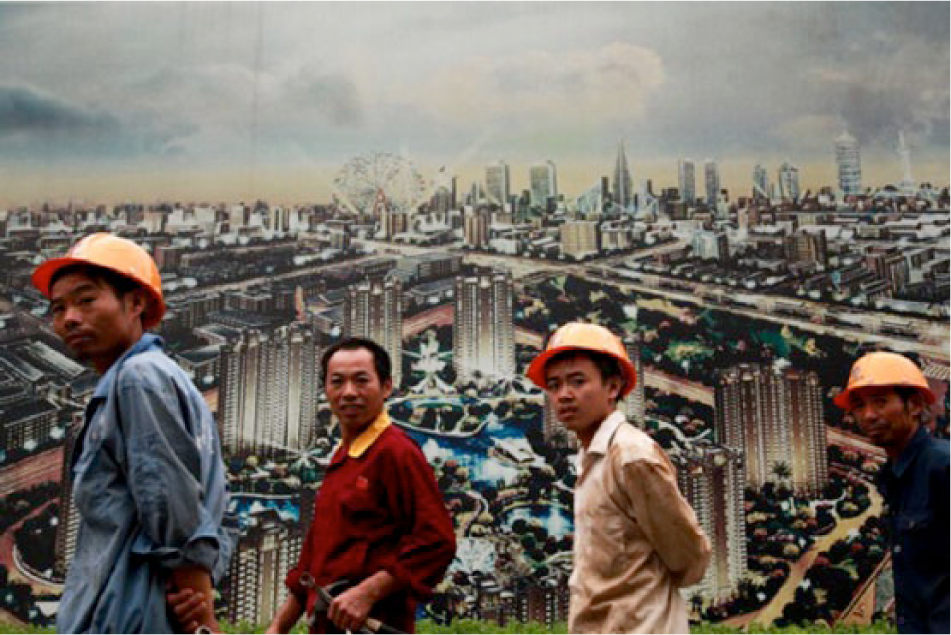
Ni Weihua, Landscape Wall – Shanghai Dalian Road, 10:30–11:00, 9 September 2009. Courtesy of the artist.
As a conceptual artist, Ni’s intention goes deeper than simply revealing the exclusion and marginalization of this group of people who have been ignored. The city in the background is not real; it is a picture. Actually it is a billboard advertising the vision of a city that Shanghai sees itself developing into. The construction workers, on the contrary, are real persons who happened to walk by the billboard in real place and time, as indicated by the full title of the piece. Many photographs in this series could easily cause a cognitive misperception because viewers may think that both the foreground and the background are real. The confusion is not unintentional as Ni, in this series under the umbrella title Landscape Wall, continues his interest in juxtaposing two different worlds, the actual one unfolding in front of his eyes and the virtual one represented by real-estate advertisements. In his Keywords series, Ni was taking snapshots and making his audience aware of the context in which the billboard was located. In this series, the context disappears and virtual reality expands and even becomes the very site where Ni observes and conceptualizes the unfolding of consumerism in urban China. The artist sets up his equipment facing a chosen billboard and takes photos of pedestrians passing by between his camera and the billboard. He has shot close to 5000 photos from different locations, and among them he has produced a succession of images that bring together seemingly irrelevant elements and create interesting and sometimes acerbic contrasts between the background and the characters in the foreground.
Landscape Wall – Shanghai Hengfeng Road (Figure 9) captures a man carrying a huge package emerging from the left of a billboard advertising a gleaming waterfront featuring high-rise hotel buildings and yachts against a crisp blue sky and washed by azure blue water. The man is totally burdened by the weight of the contents in the plastic bag made of cheap, light, and durable tarpaulin with its distinct red and blue stripes, a material commonly associated with migrant workers in China. Here manual labour and leisure and consumption are juxtaposed. Migrant workers might have helped build the magnificent waterfront of Shanghai, but there certainly is no place for them after the job is done. If we look closely, we will find an interesting detail. At the centre of this large and well-composed panorama, just where white clouds are forming, there appears to be a remnant of a small advertisement, apparently placed by a different party than the one that established this large billboard. By pure coincidence, the colour of the small advertisement matches the colour of the bag that the man is carrying. The small advertisement is missing a piece, but we can still read most of it. The advertisement seeks casual labour for inns, KTVs, and other entertainment industries, for which workers are paid on a daily basis. This kind of cheap and instant advertisement for low-end and sometimes illegal professions or services is widespread in Chinese cities, often posted on the walls of ordinary residential complexes, the tops of formal billboards, electronic posts, street overpasses, curbs and floors, and other public spaces. Such advertisements target mainly migrant workers and low-class urban dwellers, perhaps the man in the photo. Their abundant presence, as suggested by Elizabeth Parke, calls attention to the ‘public secret’ of exclusion and discrimination in Chinese cities. 38

Ni Weihua, Landscape Wall – Shanghai Hengfeng Road, 15:00–15:30, 18 April 2009. Courtesy of the artist.
Often hard to remove, the small advertisement has been seen as a stigma, blemishing a city’s efforts to maintain a clean and well-ordered urban image. In this case, the advertisement is posted right on top of the officially sanctioned advertisement. The presence of this coarse small advertisement is in obvious contrast to the formal and refined advertising language adopted by mainstream institutions. Here the ‘tiered logic of consumption’ in Chinese cities, as discussed by the literary critic Jing Wang, offers a useful analytical framework. 39 Advertisements in urban space can also be understood in tiered logic, as they are usually designed for different potential audiences and appear in urban spaces of varying grades. A billboard promoting leisure and consumption, as represented by hotels and yachts in the depiction of a grand city, belongs to the first-tiered advertisement that targets newly affluent individuals who can actively participate in urban tourism, entertainment, and consumer culture, through which they construct and express their urban subjectivity. On the other hand, for those people who worry about how to make ends meet on a daily basis, the low-tiered small advertisement that spells out clearly how much they can earn per day is a very practical and relevant piece of information. A sense of discordance and irony occurs when the advertisement and the people that belong to entirely different tiers of consumption are juxtaposed together, as in Ni’s image here. Discussing how migrants construct their identity and social belonging in Chinese cities where discrimination against migrants is a firmly institutionalized national practice, the anthropologist Li Zhang brings up the concept of ‘consumer citizenship’. 40 She suggests that, through purchasing luxurious commodities, affluent migrants are allowed to claim a certain level of legitimacy in a social setting that generally denies urban citizenship to migrants living in cities. 41 The promise of consumer citizenship, unfortunately, does not seem to work for the majority of migrant workers who usually do not have the wealth to consume high-end consumer goods. They become the doomed group in a society that, as the sinologist Robin Visser rightly asserts, is restructuring into a class system based on wealth. 42
Another piece from the series Landscape Wall – Shanghai Dahua Road (Figure 10), which Ni completed in 2009, features a beautiful street adorned by well-groomed trees and lawns. Two new, three-storeyed, European-style mansions stand on the side of the street. In white, pink and blue, the colour scheme of the mansions echoes the sky over them, enhancing the visual effect of a dream house. Four young men are shown walking towards the street, seemingly heading to these mansions, while on a much smaller scale we see a couple approaching the entrance of one mansion. The couple are walking confidently and their style of dressing matches well with the house that they are entering. The four men who have their back towards us, however, seem to be quite out of place. We soon realize that there are indeed two worlds. The high-end living environment is a virtual world depicted on a large billboard, accompanied by some text on the top right-hand side: a 1000-square-metre private home near the waterfront. The four ordinary men, on the other hand, are from the real world and, judging by their dress and gesture, they are probably manual labourers or construction workers. In reality, they have no means to achieve such high-end homes. Their lack of means instantly makes them inferior compared with those who can afford such houses. Manual labourers were privileged in the Maoist era when the productivity of labour was essential to nation-building. However, the official ideology has shifted and the logic of consumer society now dominates; ‘those who can afford to consume are represented as ideologically superior and more active participants in the socialist construction’. 43 They are by nature more modern in comparison with their counterparts since modernization is now defined as ‘the consumption of the latest consumer goods, rather than as production and contribution to the good [of] society’. 44

Ni Weihua, Landscape Wall – Shanghai Dahua Road, 12:30–13:00, 23 May 2009. Courtesy of the artist.
Focusing on real-estate billboards, Ni’s Landscape Wall probes into the issue of housing, a highly controversial topic in urban China where major social problems arising from China’s rapid economic transformation such as social injustice, inequality, and corruption are playing out. These problems were the theme of a popular Chinese TV drama titled Dwelling Narrowness (蜗居, literally translated as snail house), also released in 2009, which astringently portrayed the struggle and sacrifice that a young married couple had to endure in order to buy an affordable home in a metropolis modelled upon Shanghai. 45 The TV drama resonated very well among young urbanites and generated widespread public discussions. 46 In China nowadays young urbanites are expected to purchase an apartment of their own when they get married or soon after that, a practice resulting from the privatization of the housing system after the government had abolished welfare housing and made commercial mortgages available. The raised expectation of private homeownership, however, cannot be fulfilled easily since it has become increasingly difficult to buy an affordable home in major Chinese cities where the housing price is forever on the rise. It has been observed that municipal governments across China have relied heavily on the rising value of local property to generate revenue and to improve the city’s image, and this is an approach widely adopted by government officials for personal career advancement. 47 In addition, the geographer You-tien Hsing argues that the lack of affordable homes is also attributed to affluent urban residents who are simultaneously consumers and investors in the housing market. 48 All these factors have contributed to a property development boom and real-estate speculation, in which homes have gone from an item primarily appreciated for its use value to a pure commodity, sold and resold by many for its exchange value.
As mentioned earlier, Ni does not stage a setting for his Landscape Wall. He searches for an appropriate location and waits for the perfect moment to take his photo. This makes Ni’s conceptual photography interesting and intense. He treats a specific site and the advertisement there as an existing urban reality, but right upon this reality he deconstructs the consumerism-oriented mode of development that is promoted nationwide in the mainstream media. He freezes scenarios in which high-tiered advertisements encounter the potential audience of lower-tiered advertisements, resulting in awkwardness and disharmony. His work reveals that advertisements have dominated much urban public space and have actually formed a new type of urban space themselves, often serving to distinguish and stratify the population. Landscape Wall – Shanghai Langao Road (Figure 11) is a vivid portrayal of spaces of differences. The image opens into a big billboard portraying a well-equipped and well-lit kitchen of a well-to-do urbanite. Through the large window we see mid-sections and roofs of some skyscrapers outside, indicating that the apartment is located on an upper floor of a skyscraper, a desirable location for urban dwellers. An elegant housewife whose dress matches the fresh and clean lines of the kitchen stands relaxed and about to drink from a cup she is holding. This carefully constructed space of prosperity and modernity, however, is abruptly intruded upon by an ordinarily dressed young girl who happens to pass by the billboard, holding a baby in her arms. This person, identified by the artist and some critics alike as a nanny, a job carried out mostly by rural migrants, appears dishevelled and tired. 49 Her posture and her dark-coloured clothes are an obvious contrast to the elegant well-groomed woman in a light grey outfit – so too her numbed facial expression compared with the sweet and contented smile of the latter. They belong to two totally different worlds that are simultaneously produced by China’s market-driven urban transformation.
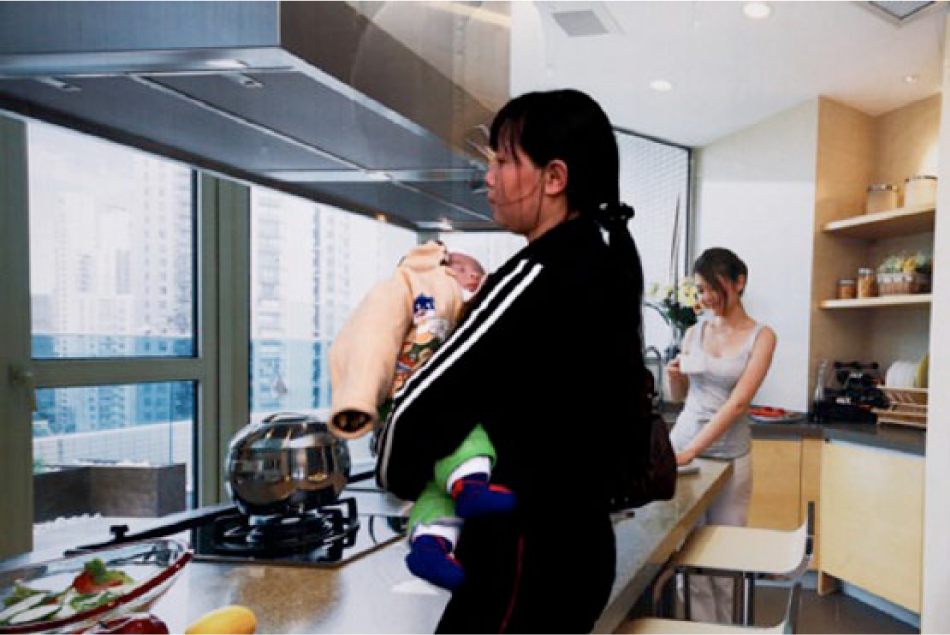
Ni Weihua, Landscape Wall – Shanghai Langao Road, 16:00–16:30, 26 November 2009. Courtesy of the artist.
Ni’s Landscape Wall – Qingyang Temple, Chengdu, Sichuan (Figure 12) also presents such a pointed contrast. A middle-aged Chinese woman in black walks along a street, carrying a huge black trash bag over her shoulder, probably full of objects for recycling which she picked up from the street. Behind her is what looks like a shopping mall and arcade adorned by fashionable images. Hanging over the rooftop of the sleek building is a huge billboard featuring an attractive Western woman reclining on her side and showing off a stylish handbag. Her sexy outfit and seductive pose are probably intended to entice viewers to look not just at the handbag but also at her. This invitation, of course, is not for everybody. The Chinese woman looks away from the stylish urban arcade and from the woman on the billboard, as if to acknowledge a reality that the spaces of leisure and consumption behind her, either real or virtual, only mean exclusion for people like her. The message of social disharmony is hard to miss when one looks at this photo. Attracted by this obvious message, a cognitive misunderstanding may arise, and we might treat whatever is behind the Chinese woman as real. Here, the artist’s wit wins again. In reality, the only real space is where the Chinese woman walks, and everything behind her is just a gigantic flat billboard. Or perhaps the artist intends to pose a question here: does it matter anymore whether one confuses the real with the virtual? The striking social difference is certainly a reality; so too is global culture, signified by the billboard, firmly entrenched in Chinese society.
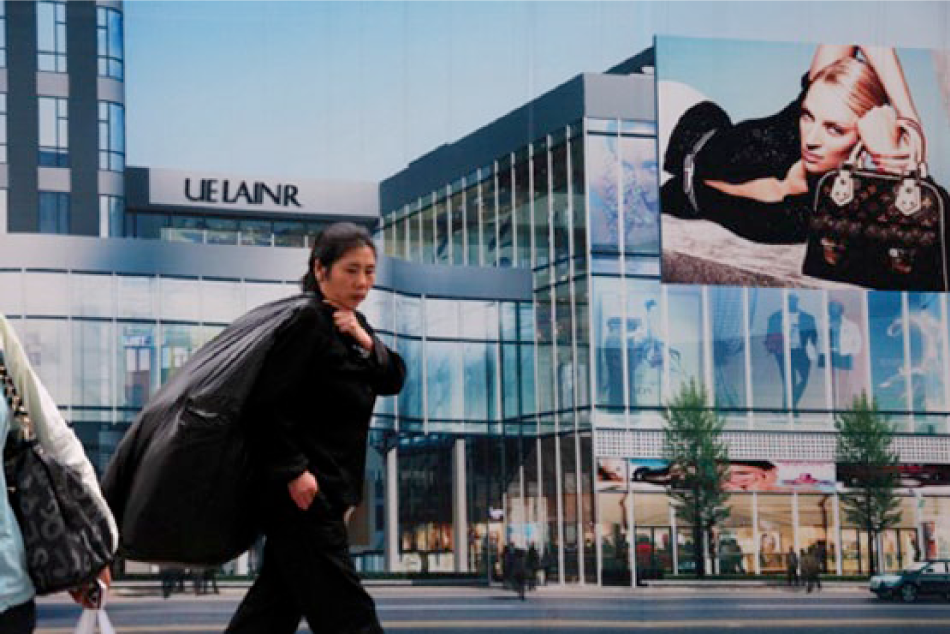
Ni Weihua, Landscape Wall – Qingyang Temple, Chengdu, Sichuan, 11:15–11:25, 24 October 2011. Courtesy of the artist.
The title of the series Landscape Wall (provided in English by the artist himself) comprises two words, landscape and wall, and together they are a close translation of its Chinese title 风景墙. Landscape, a term that usually evokes land and, by extension, nature – including natural creations such as mountains, rivers, forests, and so on – here refers to visual representations associated with the city, such as skyscrapers, apartment buildings, villas, modern kitchens and model interior settings which are printed and displayed on billboards advocating a mainstream urban lifestyle. The substitution of manmade urban structures for natural creations as the very content of Ni’s landscape reflects the changing relationship between human beings and nature in China as a result of the country’s rapid modernization and urbanization. Traditional Chinese philosophy, which views man as a part of nature and, as such, the conduct of human activities in accordance with natural cycles, 50 has been replaced by an outlook that treats nature as the objectified other whose existence is to serve human needs.
In practice, urbanization has become a policy priority of China’s modernization effort and has contributed significantly to the spectacular growth of China’s economy since the beginning of the 21st century. 51 Cities across China are engaged in a competition to expand their urban territory by converting neighbouring rural counties into urban districts and bringing large areas of rural land under the municipal government’s direct jurisdiction. 52 Shanghai, for example, has annexed several of its neighbouring rural counties into municipal districts since 1992 and greatly expanded the available land for urban development, resulting in a construction boom as commercialized high-rise apartment complexes, shopping malls, highways, and other urban structures were built to demonstrate the power and wealth of the growing city. Along the way, numerous billboards have been erected to promote the city and major real-estate projects. They are the most eye-catching ‘scenic sights’ or spectacles that have caught Ni’s attention. 53 Thus the missing land in Ni’s Landscape Wall can be read as a sign of the approaching dominance of urbanization and the omnipresence of urban advertisements. 54 In China’s endeavour to become an urban nation, the social and cultural significance of land (or soil) that was cherished during its long history when it was a predominantly agricultural nation has been lost. Land, like many other natural resources, has been drawn into the process of commercialization and its use value is now overshadowed by its exchange value. 55 Land, like houses, has become a commodity and is brought into the urban marketplace as China undergoes a metamorphosis from an agricultural society into an urban one. 56
The second word of the title, wall, refers to the location of real-estate advertising. Such advertising images often adorn construction fences facing the street to shield the actual construction or renovation activities behind the fences. By offering urban residents visual representations of gleaming cities, high-end shopping malls, dream homes, charming interiors, and luxurious commodities, they appear to justify sacrifices such as dislocation, pollution, inconvenience and government spending. They block the view and ensure that chaos remains on the other side, and that the city looks clean and orderly. Simultaneously these images of prosperity, development, and urbanity also detract attention from manual workers labouring strenuously behind the barriers provided by advertising billboards and construction fences which cordon construction sites across China. With the popularity of these attractive advertising walls, a dark and uncomfortable reality of Chinese urbanization is silently removed from public sight. The actual labour of migrant workers has become invisible, just like their precarious existence in the city.
It is probably this perceptive conception of the problematic social reality, combined with a seemingly unsophisticated but thoughtful approach, which makes Ni’s Landscape Wall a well-received artistic endeavour. His Keywords series have been exhibited in major cities such as Beijing, Shanghai, Hong Kong, and Berlin, but it was Landscape Wall that brought him renewed critical attention from contemporary art and cultural circles. Quite a number of critics have published reviews or interviews with the artist on his work and his approach to photography in general, and many pieces from this series have been included in major exhibitions and featured in Chinese and overseas art publications and newspapers. 57 As pointed out by several art critics, the most prominent feature of Ni’s Landscape Wall series is the obvious disharmony between the background imagery and the characters in the foreground. 58 Furthermore, he orchestrates an interesting twist, reversing the position between what is promoted and what is neglected. By so doing, Ni tells a dark joke, making visible what has been rendered invisible. Construction workers, nannies, trash hunters, street cleaners, and ordinary city dwellers are brought to the forefront, while the grand vision and cosmopolitan lifestyle, which cities and real-estate corporations have tried to sell to the new rich and which are central to the political rhetoric and official media, are pushed to the background.
Conclusion
Advertisements in Ni Weihua’s Keywords series promulgate national ideologies that aim to mobilize all Chinese individuals, call upon their civic awareness as citizens, and inform and educate them about the latest political mandates. Billboards in Landscape Wall promote localized visions and specific commercial products in order to arouse and feed consumers’ desires – that is, the desires of those who can afford what is on offer. While containing different messages and goals, they present an interesting collusion advocating urbanity and modernity. Becoming a modernized socialist country continues to be critical in the political rhetoric of the Chinese state, but what marks modern individuals now lies in their ability to acquire monetary power to consume. 59 Therefore we can indeed label Chinese consumer culture as a ‘politicized consumer culture’, the cultivation of which has been imperative for the state in its efforts to legitimize and strengthen its control in the new millennium. 60 If there were still some fractures between the state ideology and nascent consumer culture in the 1990s, 61 they have now disappeared completely. Since the beginning of the 2000s, consumerism has become deeply rooted in China’s urbanization and modernization. To consume now fulfils dual goals: to be both modern and urban.
With the camera, Ni explores the city and assesses its promises and failures through billboards displaying words and images and imposing on urban spaces. Each of Ni’s newer series is built upon the previous one, and together they constitute successive investigations of a prevailing Chinese urban reality. Through his work, we are introduced to major political directives in China and, more importantly, we are exposed to a paradox: the mass infiltration of advertising into urban public space that targets every citizen as a consumer and the distinctive virtual spaces of consumption being advertised that underline the stratification of Chinese society and the inability of many to consume. With the domination of the new slogan of the Chinese dream across China in ever-refined and more grandiose visual forms, Ni began a new photographic series titled Chinese Dream in 2013 (Figures 2 and 13). It remains to be seen whether the dream is for all Chinese, as proclaimed.
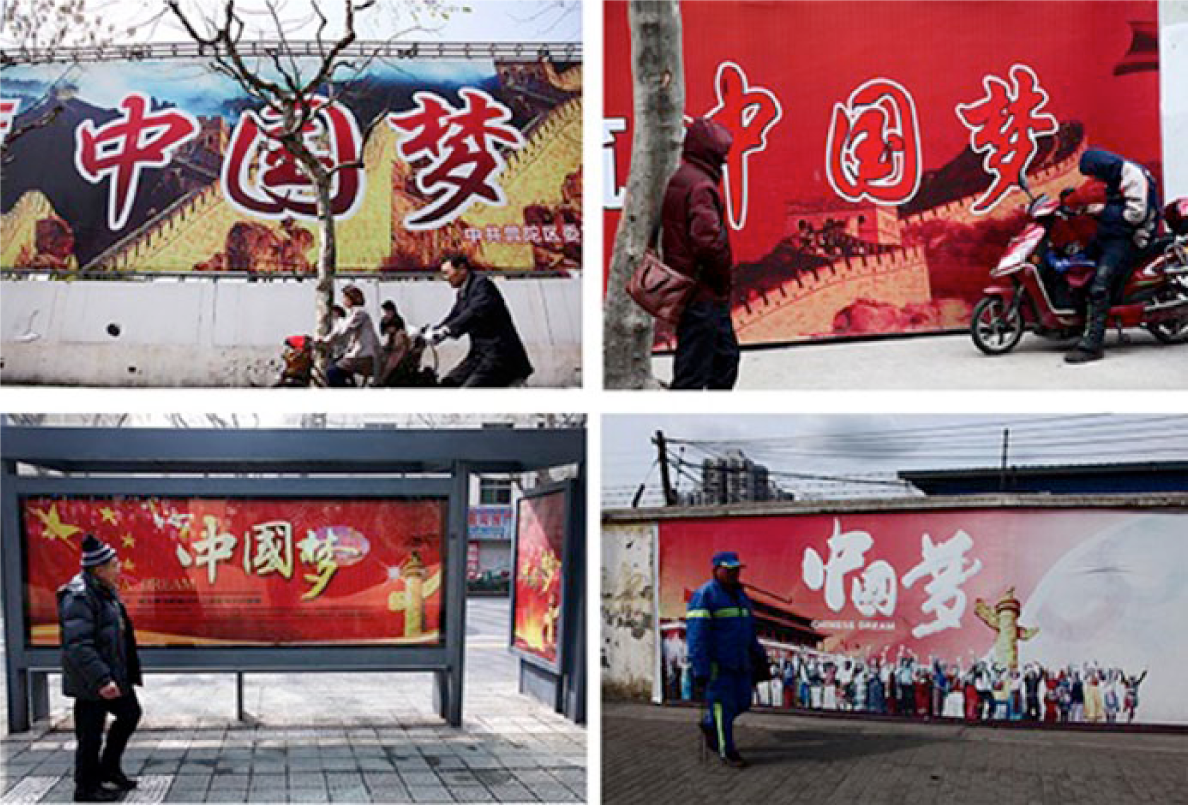
Selected pieces from Ni Weihua’s Chinese Dream series which he began in 2013. All these were taken in Shanghai in early 2014. Courtesy of the artist.