




Abstract
Since the mid-1990s, growing urbanization has led to the rise of new forms, needs and sites for visual self-expression in urban public space in mainland China. Drawing on periods of intensive fieldwork in Beijing, Shanghai, Shenzhen and Hong Kong since 2006, this article suggests a new approach for examining the spatial politics of urban art images in China based on the concept of ‘site responsiveness’. Inspired by discussions on site-specific and site-oriented art and street art, this article aims to clarify the importance of both aesthetic analysis and comparative contextualization of urban art images in relation to (1) the reciprocal relationship between the urban art images and the site, and (2) international developments in the discourses on ‘graffiti’ and ‘street art’. This dual approach provides a starting point for a comprehensive sociospatial interpretation of the visual phenomenon in China while challenging the unproblematized use of the concept of graffiti in existing studies and offering two umbrella concepts – urban art images and creator of urban art images – to facilitate more nuanced research. By examining actions of visual self-expression at the grass-roots level, this article brings attention to an often neglected but crucial perspective to discussions of the city as a living organism and to the interrelations between art and urbanization.
Keywords
Urban public space in mainland China is subject to scrutiny. What has been created and/or allowed to exist in terms of visual self-expression is continuously contested. As Jacob Dreyer has aptly expressed, ‘In contemporary China, the most forceful language that the government can speak is the language of controlling the urban space itself.’ 1 As is well known, censorship and, even more importantly, self-censorship, applies to published information, including interviews and material on urban art images. Information on unauthorized forms of urban art is particularly self-censored when circulated in the media or online. Truly critical visual self-expressions with sociopolitical messages are rarely shared openly on social media or even through closed platforms among peers. Although studies based on secondary sources can provide thought-provoking interpretations, their results remain limited. 2
The importance of physical site to the meaning and value of both ‘graffiti’ and ‘street art’ is repeatedly acknowledged in studies on the spatial politics of these visual phenomena, especially in Euro-American cities. However, because of the specific sociopolitical and cultural circumstances in China, the forms of visual self-expression in urban public space have developed their own characteristics, so theoretical approaches or concepts derived from Euro-American contexts are not always applicable. For example, the construction of ghettos and broader issues of racial segregation are significant factors in spatial analysis of graffiti in New York City, 3 but they are not applicable in Chinese settings. Nonetheless, questions about how the use of space is negotiated are relevant to all forms of urban art images in China, including the exclusion of marginal populations such as migrant workers, as discussed by Elizabeth Parke in this special issue. 4
The voices of the people involved in these visual self-expressions must be heard, and the scenes must be examined using ethnographic data collection methods, including on-site observations, to expose and contextualize the complexities of urban art images (including various forms of contemporary graffiti and street art) in China. Only by exploring the physical urban environment and combining aesthetic, temporal and spatial analysis will we begin to understand the visibility, tolerance and ontological issues which derive from the complex interrelations of urban art images with site, place and space.
Each particular urban art image, even if it is only a simple tag, is created in its specific physical site for a reason. While creating site-specific art in urban public space is one way for contemporary Chinese artists to explore the characteristics of a particular site or of urban space in general, 5 engagement with the site and space is both the premise and defining factor for creators of urban art images. To explore in detail the complex layers of the physical and conceptual importance of site, place, space and the meaning of the context of each city to urban art images, a more nuanced approach than the site specificity suggested by Miwon Kwon is needed. 6 Peter Bengtsen maintains that although street art can be seen as site-specific in Kwon’s phenomenological sense, Kwon’s interpretations actually focus on site-oriented art that consciously explores the site’s role. In street art, ‘site specificity is not dependent on such conscious deliberations’ 7 but rather the interrelations between site and art are far more complex. At the same time, however, institutional/ideological site specificity is also significant for establishing the authenticity of street art. 8 While distinguishing street art from ‘mere graffiti and artistic graffiti’, Nicholas Alden Riggle even suggests that ‘An art work is street art if, and only if, its material use of the street is internal to its meaning’. 9 Bengtsen, however, argues that Riggle’s interpretation is problematic. One of the crucial questions, Bengtsen points out, is how to define when ‘the use of the street is indeed essential to the meaning of a specific artwork’. 10 The interrelation of street art and site varies depending on the use of pictorial space, the medium, and the placement of the work. 11 If we broaden this approach to include contemporary graffiti, the question becomes even more problematic: when would site not be essential, even for the meaning and value of a tag?
While I agree with Bengtsen’s insights, based on my findings in China I argue that the physical and contextual features that resonate with urban art images are even more versatile than previously suggested. In order to emphasize the complex interactions between site (as a multilevel tangible and intangible context), image(s) and creator(s), and the continuous impact of this interaction on the meaning of the urban art images, I suggest using the concept of ‘site responsiveness’. This is especially helpful for examining the multilayered visual dialogue which occurs in response to an existing image or images. The details of visual composition, such as languages, colours and materials used, cultural and artistic references, as well as the nationality and ethnicity of the creator, must also be considered if we wish to examine in detail how images relate to sites.
Besides the features related to the creator and the urban art image itself, the various physical and contextual levels of site, place and space also have a significant impact on an in-depth interpretation. Local features of the city in question, such as urban planning policies, physical infrastructure, tangible and intangible cultural heritage, the contemporary art scene, social norms, laws and regulations and their implementation, both hinder and facilitate the progress of urban art images in each city. While following the developments of this complex visual phenomenon, I have come to understand that the scenes of urban art images differ from one city to another even in mainland China, not to mention Hong Kong and Macao. Significant differences are also evident between neighbourhoods in a city. To fully understand how urban public space is negotiated, the multilevelled interdependence between a city and specificity of urban art images (such as aesthetics, contents and agencies) must be acknowledged. This acknowledgement is a prerequisite to any broader sociopolitical contextualization at the national level. My findings clearly resonate with and broaden Anna Wacławek’s insight that ‘Street art responds to the environment of a city inasmuch as it partakes in the creation of visual culture’. 12
Drawing on the importance of site responsiveness and on the need to respect local perceptions of discourses on graffiti (涂鸦) and street art (街头艺术), this article aims to address the gaps in current research. The primary data is obtained from fieldwork since 2006, mainly in Beijing, Shanghai, Shenzhen and Hong Kong. Ethnographic data collection methods include extensive photographic documentation, participatory observations in urban public space, numerous events and exhibitions, formal and informal interviews, and ongoing personal communication with countless insiders such as creators, contemporary artists, art gallerists, and documentary filmmakers. Secondary materials include surveys on information published in social media, and local and international academic and popular publications on graffiti and/or street art in China.
It is beyond the scope of this article to provide a comprehensive sociopolitical analysis of all the multilayered and interrelated features of urban art images in the whole of China. A detailed history of hundreds of creators and crews in dozens of cities would be worth a monograph, and I have provided a brief introduction to the key historical developments in Beijing, Shanghai and Hong Kong elsewhere. 13 This article, however, will focus on questions of site responsiveness by combining both conceptual and aesthetic analyses of current examples of Chinese urban art images. To demonstrate the conceptual complexity of the urban art images in China, I first provide a comparative analysis of local definitions and evaluation criteria in relation to the current discussion in Euro-American studies. Next, I briefly introduce the main characteristics which are relevant for understanding the current situation in China and which form the basis for site responsiveness. Finally, I illustrate the different levels of site responsiveness through selected case studies.
Beyond undefined graffiti
The growing scholarly discourse on urban planning policies, sociospatial restructuring, spatial variations and their interconnectedness with creativity in mainland Chinese cities has not yet addressed grass-roots creativity in detail. 14 Existing studies on urban image construction in Beijing and on Chinese contemporary art occasionally discuss graffiti, but with no clear definition and focusing on Zhang Dali (born 1963), an internationally recognized contemporary artist, and his series Dialogue (对话) (1995–2005). 15 A contextualized and comparative analysis of the broader visual phenomenon both in China and abroad is still lacking. Two recent studies have sought to examine Zhang Dali’s work in relation to graffiti in China, but with limited results. 16 Previous studies discussing graffiti in China have failed to acknowledge the international discourses on various forms of graffiti and street art. Lu Pan, for instance, aims to provide a new paradigm based on three case studies and relying on information from secondary sources. Without questioning the definitions or understanding of the key concepts used by the Chinese media and insiders, she groups all the forms under the undefined concept of graffiti. Although she provides a brief summary of the historical context, she does not address any distinction in intention, form, agency and reception. 17
Especially in the Euro-American cities, methods of visual self-expression in urban public space have diversified tremendously since the 1990s, when new forms, gradually labelled as street art, emerged. Consequently, the concept of graffiti is contested today. The importance of aesthetics for the analysis of even the most basic definitions and interpretations has been repeatedly shown. 18 Jeff Ferrell, in his study focusing on Denver, explained that graffiti writing, as a form of aesthetic sabotage, is an interruption of the ‘planned’ urban space and lived experience of mass culture. 19 Although many of the current forms do not fall under either graffiti writing or sabotage, the importance of style and aesthetics has not decreased. On the contrary, in international studies, evaluations of and distinctions between graffiti and street art are based on stylistic forms and aesthetics.
Scholars studying graffiti and/or street art acknowledge that these two concepts cannot be clearly defined and neither can cover all forms. 20 Graffiti has been used to refer to anything and everything scribbled, written, drawn, smudged or incised on any surface, but this kind of undefined application of the term does not help scholarly research into the complexities of the visual phenomena and their mediation from one cultural context to another. Concepts such as ‘ancient’, ‘traditional’, ‘gang’, ‘subway’ and ‘train’ graffiti can help refine the discussion to some extent, 21 but they often fail to address the new forms constantly developing in street art. Alternative terms for the new forms and their subcategories include: post-graffiti art, neo-graffiti, urban painting, abstract graffiti, urban knitting and so forth. 22
These conceptual frameworks must be acknowledged in studies of various forms of visual self-expression in China, but not at the expense of locality. With regard to modernity in Asian art, John Clark argues that transferring art discourses from one cultural area to another is a highly restricted and complex receptive process. It is controlled by the needs of the receiving culture, and its adaptation depends on varying modalities of transfer and on the types of culture mediating the transfer. 23 Such partial adaptation of international, especially Euro-American, conventions of graffiti and street art is to some extent visible in visual self-expressions in China. The current forms and intentions of Chinese creators of urban art images today are not necessarily the same as their predecessors in the Euro-American scene. Moreover, the understanding of the new forms differs. In the Chinese language, there are also different concepts for indigenous and traditional forms of writing and/or painting in public. How terms are used locally and how they are constantly changing reveal the inherent interaction of visual self-expressions with their sociopolitical and cultural context. Traditional concepts are laden with cultural meanings and values that also have an impact on the development and reception of new forms. Instead of imposing ready-made Euro-American concepts onto the phenomena developing in China, it is far more interesting to examine the local concepts used. A comparative analysis of Euro-American studies and conventions can aid our understanding of the processes of negotiation between indigenous and transcultural features and values.
The strictest old-school definition of graffiti denotes the form mainly developed in New York in the 1970s and 1980s: illegal writing of alphabetic letters with spray paint or marker pens, primarily on subways and trains. 24 According to this strict definition, there is very little graffiti in China today. For instance, stone engravings, big-character posters, peasant painting, street calligraphy made with water on the ground in public space, and demolition signs written by government officials are not illegal private actions. The cultural values related to these indigenous forms differ greatly and none of them is regarded as graffiti or graffiti art (涂鸦艺术) in Chinese discourses. The colloquial word for graffiti in Chinese is 涂鸦 (tuya), meaning poor handwriting, to scrawl, and it is also used to describe young children’s doodling. At the other end of the spectrum, the traditional stone engravings represent a valued category of calligraphy. Far from being considered deplorable or illegal, stone engravings represent an indigenous and privileged form of writing, often an indication of power with political undertones. The technique was originally commission-based and was not a private action: the text was first written with brush and ink by the nobility and then incised into natural rocks or steles by artisans carefully following the brushstrokes of the original text.
Another interesting juxtaposition can be made between two different forms of writing in public today. The first is the illegal and despised form of advertising services such as false certificates, 25 considered to be ‘redolent of graffiti tagging’, 26 while the second is street calligraphy, an appreciated form of writing on the streets with water and brush. Because it is illegal to write on permanent surfaces, 27 advertising services, written or stencilled on any surface, are repeatedly painted over. At the same time, street calligraphy, is a form of self-expression, a pastime especially of elderly men, and its appeal lies in the ephemeral nature of such works: the first characters might evaporate before the calligrapher gets to the last brushstrokes (Figure 1). The difference is remarkable not only in intentions, aims, and materials, but also in terms of aesthetics: style is a key feature in street calligraphy, but it is completely absent from the hastily written advertisements. To group all these forms under the concept of graffiti is to overlook and misinterpret essential characteristics which have a clear impact on the reception of these forms.
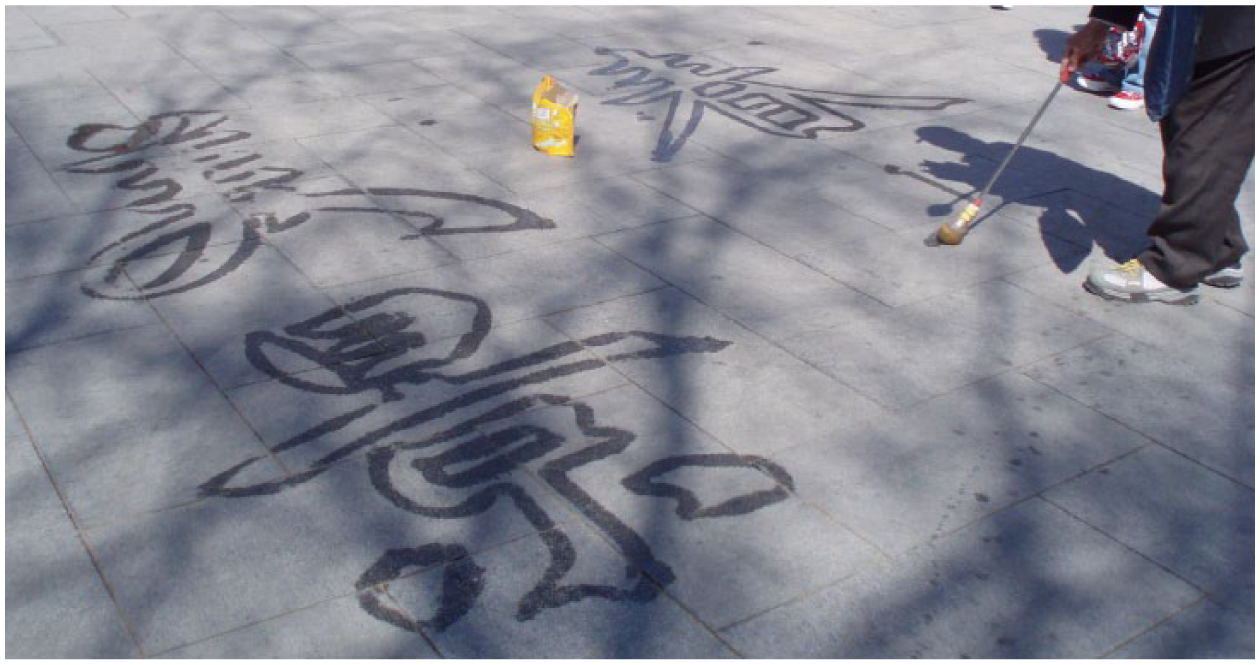
Street calligraphy in Beihai, Beijing, April 2007. Photograph taken by the author.
Graffiti, street art or visual propaganda?
The use of a simple concept of graffiti is no less problematic when applied only to new, contemporary forms in China deriving from the phenomenon which emerged in the United States and has diversified significantly since the 1990s, especially in the United States and Europe. Even if we follow the strict definition only partially, as a private illegal action in public space with an emphasis on technique (spray-paint) and content (writing with personalized style), none of the three cases discussed by Lu Pan – Huangjueping’s ‘Graffiti Street’ in Chongqing, Zhang Dali’s Dialogue series, and images at Shanghai Jiaotong University commenting on the high-speed train accident 28 – can be called graffiti. Although the last two examples were illegal, they were not based on writing.
The more experienced local graffiti writers and graffiti artists do not usually appreciate authorized beautification projects, such as Huangjueping, initiated or supported by the city officials, because such projects (1) are often created only by art students who lack previous experience of creating unauthorized forms in public space; (2) have nothing to do with the local graffiti writers and/or graffiti artists; (3) require prior approval of the sketches; and (4) are usually made for keeping up the appearances (面子上的工程) of the city officials. 29 Consequently, according to the most conventional local graffiti writers and graffiti artists in China, such projects should not be called graffiti at all, even though the local media labels these projects ‘graffiti art’. 30 The lack of these insights in Lu Pan’s conceptualization of Huangjueping’s Graffiti Street as state-sponsored graffiti, and a mere imitation of the carnival-ness of graffiti described by Mikhail Bahktin, 31 is one reason why her interpretation is incomplete. In addition, she fails to provide aesthetic analysis of the works and a consideration of whether they resonate with the site (for example, the physical structures of the buildings), city or nation.
Similar cases of officially authorized beautification projects have emerged around the country. One of the latest examples, ‘My Dream, Beijing Dream, China Dream’, an officially commissioned project similar to Huangjueping on the outskirts of Beijing, was announced by the media as the ‘world’s largest graffiti wall’ 32 although its images are painted on bridge piers rather than a wall and had ‘nothing really to do with the [graffiti] writers here in Beijing’. 33 A more appropriate label would be authorized or commissioned street art, or even mural project, because of the content (pictures, mainly landscapes, flowers and cute figures), style and technique (brush and paint aiming at realism). Because the project was commissioned to beautify the urban public space and to promote the official campaign of ‘Dreams’, it is clearly not an interruption of the ‘planned’ urban space.
In fact, the walls commissioned by city officials or even the police serve as new tools of visual propaganda in urban public space and their intentions and motives are no different from those of posters and billboards. 34 The most illustrative case is the cultural wall of the Beijing Olympics (北京欧云文化墙) near Beijing’s 798 art district (Figures 2 and 3), which was still untouched in June 2009. Reflecting Anne-Marie Broudehoux’s observations about spectacles, festivals and rituals in Beijing, this wall and others like it around Beijing also served as ‘national representation by reviving national pride and unity’, and like other urban spectacles were employed ‘to aestheticize local politics’. 35 The commissioned walls aestheticized and popularized politics with officially approved slogans (e.g. One world, one dream) and displayed a visual celebration of Chinese athletes. They aimed to improve the image of the city and, in the case of Beijing, the whole nation as more modern and open-minded. 36 This political beautification using a visual form more acceptable to younger generations was a new tactic for manipulating public opinion, but it has also been suggested that the walls in Beijing were commissioned to compensate for the loss of advertising billboards which had already been paid for by Adidas, which had to be removed. 37 If this claim is true, then these walls are an example of the interconnected power of government and global companies to manage urban public space by employing creators of urban art images.

Cultural wall of the Beijing Olympics (北京欧云文化墙), in the vicinity of 798 art district, Beijing. Created in Summer 2008 and photographed in June 2009. Photograph taken by the author.
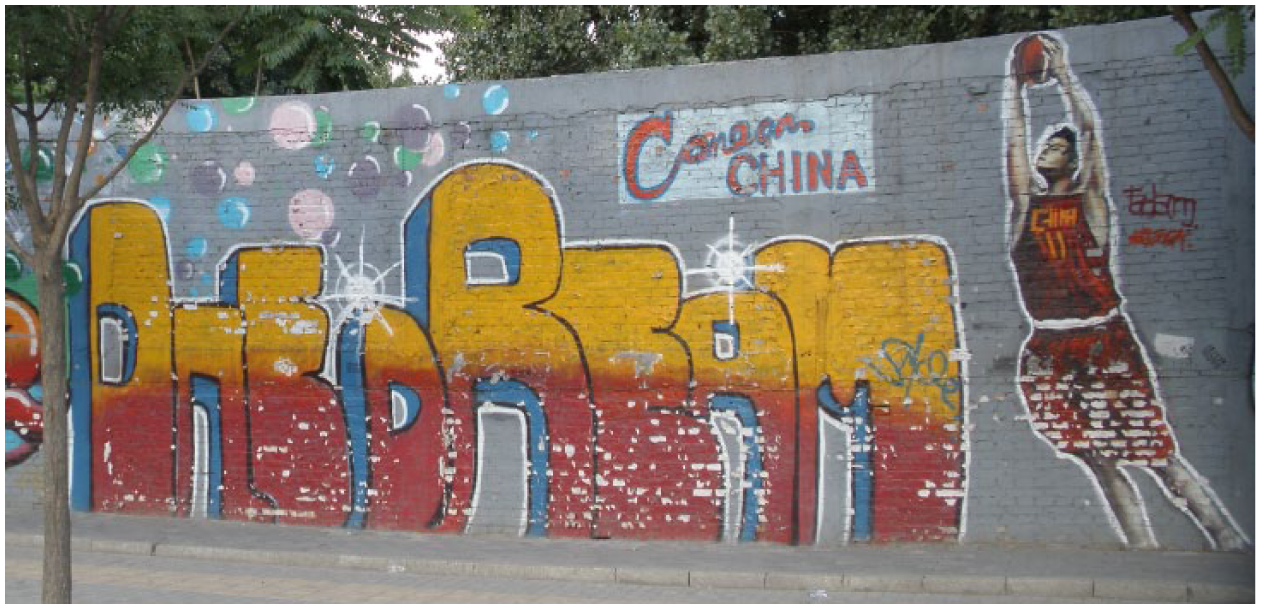
The images on the cultural wall of the Beijing Olympics (北京欧云文化墙) were still intact in June 2009. Photograph taken by the author.
As these examples suggest, and interviews with countless people involved in varied forms of visual self-expressions in urban public space in mainland China, Macao and Hong Kong confirm, notions of graffiti and street art vary greatly from one person to another. Especially in the early years, people interested in contemporary graffiti in mainland China were not always familiar with Euro-American conventions. Even today some consider graffiti as a form of street art in China, while for others street art focuses on artistic activities on the street (such as music and performances) and excludes graffiti. Because of the partial adaptation of the Euro-American phenomena and the lack of experience in writing with alphabets, the clear majority of images created on the streets of Beijing and Shanghai at the beginning of the 21st century focused on pictures, not on writing. 38 In addition, regardless of the content or form, anything created on the streets was commonly called graffiti and graffiti art.
For some, the concepts of graffiti and street art are still quite interchangeable, while a few prefer not to use them and suggest that their work be seen as spray-painting, stencil art, stencil graffiti, sticker art, mural painting, urban art, and so on. However, in recent years, many local creators have started following the conventions of their Euro-American peers more closely. Li Qiuqiu, from the legendary Beijing Penzi (BJPZ) crew, started spray painting on the streets in 1996. Last year in an interview he declared that what he created should actually be called street art rather than graffiti because he did not focus on writing but on pictures. This would also apply to the majority of the crew’s work. Although Li is respected in China as a graffiti writer/artist, he would be more comfortable with the term street artist. 39
The more traditional old-school graffiti writers in China insist that tagging and writing (with alphabets and/or Chinese characters) are the main components of graffiti, especially of street graffiti (街头涂鸦). Other forms, such as wheat-pastes and stencils, are increasingly considered street art while the understanding of graffiti art remains vague: for some it must be based on writing, while for others it can focus on pictures. Graffiti art usually denotes more complex, larger pieces than tags and throw-ups. It may also be authorized, while street graffiti is generally not.
To make a basic although not entirely unproblematic distinction, ‘contemporary graffiti’ could be used for the new, international form of graffiti which emerged in East Asia in the late 1980s and in mainland China in the mid-1990s. 40 I use contemporary graffiti in line with how the local and international creators active in mainland China use the terms graffiti, graffiti art, or street graffiti: I do not define the content or form of contemporary graffiti but follow the local understandings. However, this concept is by itself inadequate for a comprehensive approach.
Urban art images and creators of urban art images
As I suggested earlier, a broader umbrella concept is required to facilitate research into the shifting concepts of graffiti, graffiti art, street graffiti and street art and to include forms that do not correspond to any of these concepts (e.g. illegal advertisements). Urban art images and creators of urban art images as broader concepts could include the great variety of local insights and identities without being limited in the form, content, style, language or visual elements of the works. 41 My aim is not to add further confusion, but rather to reveal the complexities of the phenomena through local voices: when writing about individual creators or a specific group with similar views, I will use the concepts they themselves propose.
It is all the more necessary to respect local insights because the emerging self-identities of creators in China cannot be confined to categories such as graffiti writers (写字人 or 喷子), graffiti artists (涂鸦艺术家), or street artists (街头艺术家). Many creators change their style and form or engage with several different styles and forms at the same time, making their self-identity more challenging to define. To try to fit all creators into these categories would be inaccurate and would seriously insult some creators. 42 The broader concept of a creator of urban art images could include a range of identities, such as art students who participate only once in an official project. Zhang Dali is a well-known example of how none of the abovementioned categories capture the full reality. 43 Zhang started to spray-paint his profile in Beijing in 1995, after his return from Bologna. Although Zhang is often regarded as the pioneer of contemporary graffiti in mainland China, and has been repeatedly labelled a graffitist, graffiti writer or graffiti artist, he has never considered himself as any of these. Zhang prefers to be defined as an artist adhering to extreme realism (极端现代主义). 44 In an interview, Zhang said that contemporary graffiti was primarily conceptual art and just one form among many to express his ideas and anger. Zhang has been significant in promoting this visual form of self-expression in Beijing, but his impact on creators has been limited because he has not been part of any crew nor has he actively engaged with other creators in mainland China. 45 One could even ask how representative of Chinese contemporary graffiti Zhang is.
Urban art is another problematic concept and is used for various purposes in international discourses. In recent Euro-American discussions, the term urban art has been increasingly applied to art based on graffiti/street art styles but presented and sold by museums and galleries; it is often unpopular among the Euro-American artists themselves. 46 This does not yet apply to mainland China, where art markets for contemporary graffiti and street art remain undeveloped despite the efforts of both local and international galleries. However, Robin Visser, in her study on post-socialist urban literature, film and art, uses the undefined concept of urban art for Chinese contemporary arts that address issues of urbanization, some of which are created in urban space. 47
In contrast to others, I define urban art images as creative action that leaves a visible imprint, however short-lived, on urban public space. The concept of image distinguishes the focus of this research from other forms often regarded as urban art, such as performance art, acrobatics, and street music. Following James Elkins’s suggestion of an image as a trichotomy of writing, notation and picture, I regard as urban art images any image that includes numbers and writing (in any language), pictures or three-dimensional objects and materials or any combination of these. They can be authorized or unauthorized, resulting from private or collective actions, commissioned or voluntarily made. To focus only on illegal spray-painted examples would give an incomplete picture because most creators are engaged in both legal and illegal activities, although illegal activities are generally more highly appreciated. 48 In addition, the notion of illegal urban art images is a complicated issue both in mainland China and Hong Kong: some sites and forms are semi-legal or even legal. 49 An example of this complexity is the attempt to solve, at least partially, the problem of illegal touristic graffiti damaging the Great Wall, for which a designated area was set up in Mutianyu, Huairou county, where visitors could leave their mark. 50
The prerequisites for site-responsive urban art images in mainland China
As Anna Wacławek rightly explains, ‘Urban artworks together with their material support and surrounding landscape compose a specific context.’ She further argues that any analysis must examine how the work interacts with its environment, including ‘the media, architectural forms and signage that envelop it’ along with ‘local history and contemporary issues’. 51 Although the intertextuality of the content with volatile, multilevelled contexts is central to the site responsiveness of urban art images in China as elsewhere, the first level of site responsiveness to examine must be the preconditions of what can be created, where, when and by whom. There is a complex interdependence between the selection of the physical site and both the content and form of the urban art image. This is a relevant starting point for understanding how urban art images inter-relate with urban public space in mainland Chinese cities. The four main variables – form, content, behaviour and choice of site – have an impact on the level of legality or illegality of urban art images. 52 The time and date of creation also affect the level of tolerance. Especially in mainland China and in Beijing, surveillance of urban public space is intensified around important political occasions.
Contemporary graffiti, along with street art, has its own characteristics in mainland China. First, contemporary graffiti in China is primarily a form of escapism for children from the middle classes or wealthier families and the clear majority of creators are art students. Stealing paint cans is not part of the culture as it was in the United States and in Europe, and not everyone can afford to buy paint. Every so often contemporary graffiti becomes a fad in China, but for many it remains a passing hobby – not a form of vandalism or sabotage – and creators lose interest after a few months. 53 Because few have the dedication to master spray painting, the scene can even appear boring. 54
Following on from this, the scenes of urban art images (including any forms of contemporary graffiti or street art) in mainland Chinese cities have remained small and, to some extent, undeveloped, although some creators are technically very skilful. The emergence of the phenomenon in Hong Kong can be traced to the 1980s, and in mainland China to Beijing in the mid-1990s. 55 Inspired by developments in Hong Kong, crews were established in the southern cities, for example Guangzhou, at the beginning of the 21st century, but it was not until around 2006–8 that more creators became active around the country. At the time of writing, there were only around 250–350 active creators in mainland China.
Third, contemporary graffiti was advocated as an art form from the very beginning of the phenomenon. 56 This was not so much because graffiti was associated with derelict and degenerated sites, as it is in Euro-American contexts, but more because of the disparaging connotations of the Chinese concept of graffiti. The media and people involved with contemporary graffiti in China deliberately used the term graffiti art to induce a more positive response. This may also have led to the understanding in mainland China of graffiti involving mainly pictures rather than writing. Euro-American graffiti writers occasionally suggest that the conventions of graffiti were misunderstood and/or mistranslated when they were mediated to China. One possible mistranslation is the Chinese understanding of ‘piece’, which was originally an abbreviation for masterpiece and denoted a large-scale, multicoloured and skilfully spray-painted name of a writer or a crew? In mainland China, ‘pic’ is a common abbreviation of piece, but it is easily confused with picture. This ambiguous abbreviation might have facilitated the understanding of ‘graffiti piece’ as a large picture rather than writing.
While urban public space is managed mainly by the government and global companies, 57 there are vast areas of wall space in large cities that provide potential sites for urban art images. Legislation bans writing and drawing in urban public space, but the official attitude has in general been fairly lenient, and punishments have usually been limited to fines or cleaning up. As a result, the fourth characteristic is that creating urban art images is mainly considered mischief and not a form of vandalism, as in Euro-American cities. The tolerance and relatively low production costs in Chinese cities also enable creators to experiment with unusual forms, such as sizeable stickers, as shown by BRIM, from the legendary New York TATS crew (Figure 4). He put up his new, extra-large vinyl stickers in conjunction with the Meeting of Styles 58 event in Shenzhen in 2014, during the day and without any consequences.
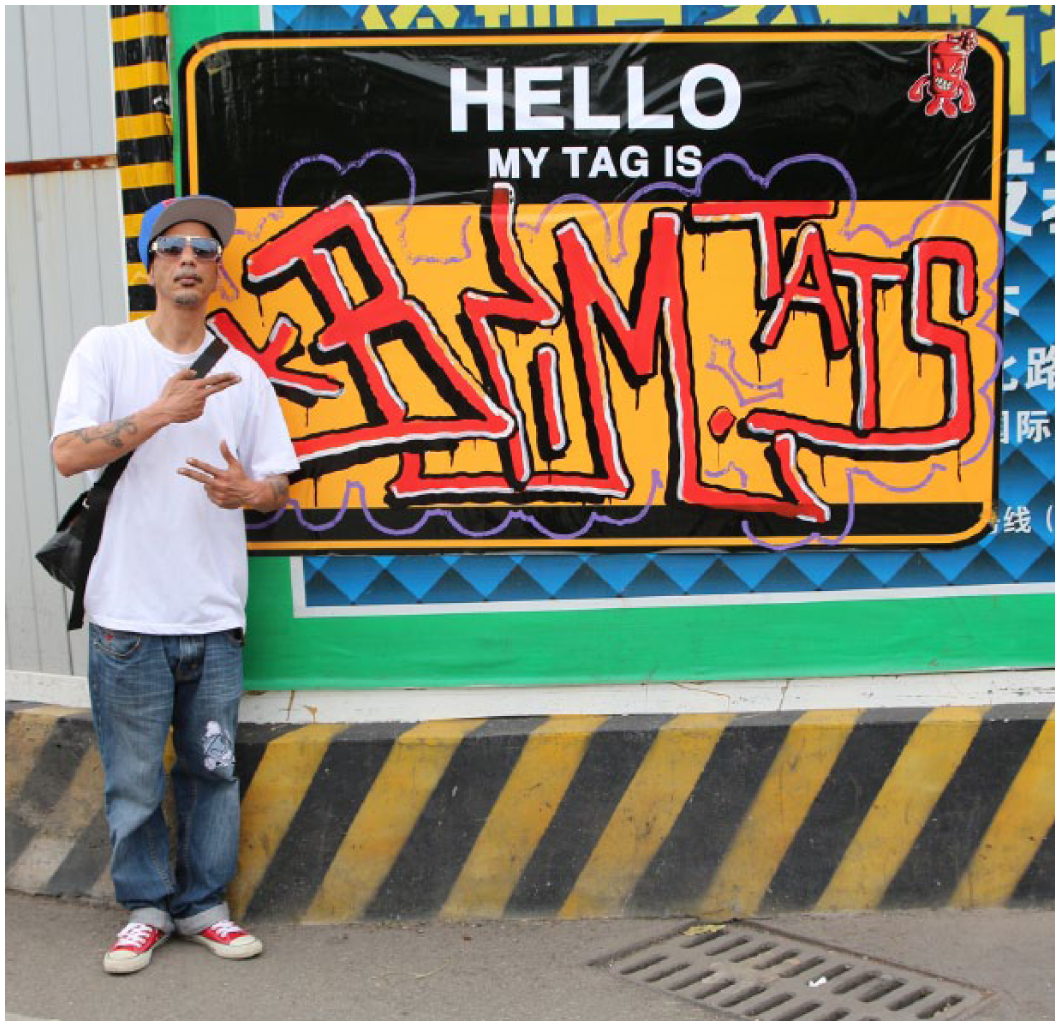
BRIM from TATS crew, extra-large vinyl sticker in conjunction with the Meeting of Styles (MOS) event in Shenzhen, April 2014. Photograph taken by the author.
Because of this relational tolerance, the act itself is not always considered subversive, but depends mostly on the site and content. In Euro-American cities, creating any kind of unauthorized urban art image in urban public space can be considered illegal and, as a consequence, a political action. 59 In China, however, there are numerous sites where spray painting is tolerated, even in the daytime. Walls of this kind can be regarded as semi-legal sites, because no official authorization is granted but no consequences result from painting. 60 The oldest of these is the Honghu West Road along the Huangpu River in Shenzhen (Figure 5). Since around 2002–3 it has been a popular base for painting, and it is one of the most important sites in the history of contemporary graffiti in China. Since 2006–7, a significant wall for the Shanghai scene is Moganshan Road, close to the contemporary art district. The most recent popular wall is Jingmi Road in Beijing. On these walls even large and complex pieces, requiring hours to finish, can be created without fear of being caught. In other words, site responsiveness influences form, style and meaning. Semi-legal sites enable creators who are interested in street graffiti as an art rather than as a form of vandalism to hone their skills in a setting where creating graffiti is not necessarily a subversive act.

Honghu West Road, one of the oldest semi-legal sites, along the Huangpu River in Shenzhen, April 2014. Photograph taken by the author.
The relationship between site responsiveness and subversion is further complicated by the fact that targeting trains or other government property is not allowed, nor is the expression of politically critical views. On the one hand, the courage required to ‘hit’ a difficult site, such as a train, police car or politically significant building, raises the bar for other creators. On the other hand, this kind of subversive action carries the risk of being caught and fined, and may also lead to more intense surveillance and, in the case of foreigners, to deportation. To avoid causing trouble for the scenes, many local and foreign creators avoid sensitive sites, such as government buildings and trains. Perceptions, ambitions, and intentions obviously vary among the few hundred creators. Norms and tolerance also vary between different cities and over time, but city officials generally have a tolerant attitude toward urban art images as long as they are neither too visible, too viral nor too offensive. 61
Creators are mindful of the content as well. In mainland China, the majority of unauthorized urban art images – especially those easily visible to the general public – are apolitical, because directly targeting sensitive issues or the establishment would bring about a swift official response and could cause severe problems. Political graffiti art can also be created to support the establishment, however. TinG from Shanghai and Moon from Quanzhou, Fujian, created an unauthorized, bilingual piece One China Forever (壹個中國), at Moganshan Road in Shanghai in 2008. The piece was the creators’ personal response to discussions among foreigners that parts of China should gain autonomy (Figure 6). 62

TinG and Moon, One China Forever (壹個中國), Moganshanlu, Shanghai, June 2008. Photograph taken by the author.
Politically critical messages can be expressed, but usually through abstractions and intricate visual references, or at less visible and accessible sites, such as abandoned buildings. An illuminating but rare example of subversive images is this stencil by an unknown creator on an abandoned building in Guangzhou (Figure 7). It plays with the convention of illegal advertisements of services by offering a swordsman for hire to kill corrupt officials (杀贪官), and is made more subversive by listing an existing phone number, the number for reporting injustices to the Central Commission for Discipline Inspection. The figure appears to be inspired by either the mythological demon queller Zhong Kui or the noble bandits from the classical Chinese novel Water Margin (水浒传), or perhaps both. This stencil, its subversive content and the site where it was posted further show how site responsiveness is manifested in an interconnectedness between site, content and form.
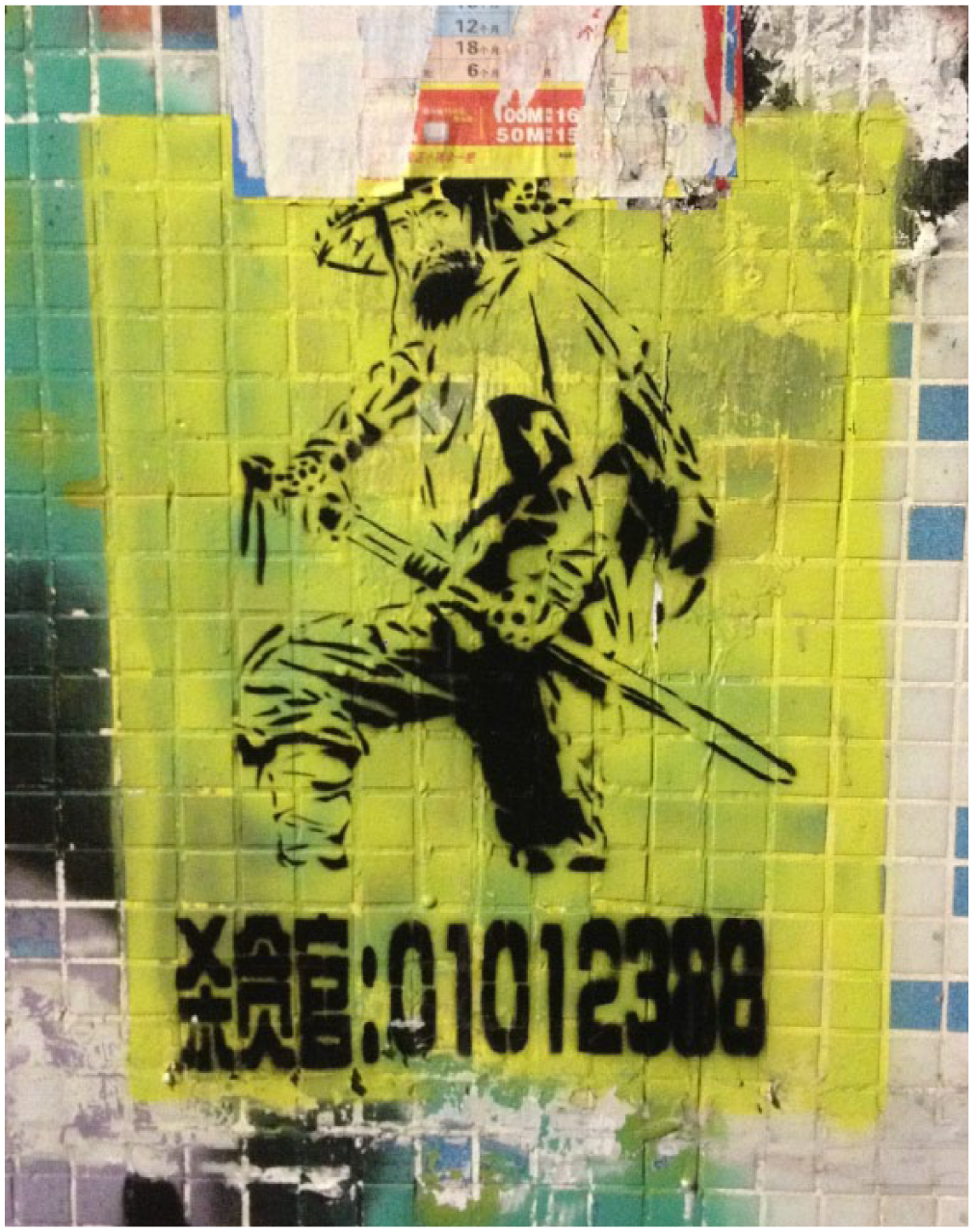
Kill Corrupted Officials (杀贪官), Guangzhou, Spring 2014, stencil. Courtesy of a local graffiti writer.
Site responsiveness as visual dialogue
Another step in the analysis of site responsiveness is to examine how the pictorial space of the image resonates with its physical surroundings. As Bengtsen states in relation to street art, ‘their respective site specificity is also conditioned by the way in which their non-material pictorial spaces interrelate with the surroundings’. For instance, an image of a human figure, cut in outline, connects with urban public space in a different way from a rectangular poster of a human figure that maintains its independent pictorial space. 63 This kind of interconnectedness between an image and its site can be seen when we compare a wheat-paste of a human figure from the 798 art district in Beijing (Figure 8) with the anti-corruption stencil of a Chinese hero (Figure 7). But these two examples also reveal the complexity of site responsiveness and that it cannot be reduced to the pictorial space alone: the local hero in the anti-corruption stencil evidently refers to Chinese sociopolitical issues and cultural traditions, whereas the image of the young girl wearing a Roman-like helmet does not seem to have any clear reference to China.

Human figure, 798 art district, Beijing, April 2014, wheat-paste. Photograph taken by the author.
However, urban art images that incorporate the physical structures of a site into their composition relate with the physical site even further. Zhang Dali’s Dialogue series is the earliest example of how site responsiveness gradually developed. Zhang had started creating a profile of a bald man, based on his own self-image, in Bologna, and continued on returning to Beijing in 1995. Gradually the profile transformed into an abstract empty man without identity. In 1998, he began making holes – in the shape of the profile – into walls, through which a variety of Beijing landmarks were visible. The site responsiveness of the image is extended to include the juxtaposition of the empty profile in a partly demolished wall with, for example, the watchtower of the Forbidden City. In addition to the profile, Zhang used two other symbols for his protest and to express his understanding of and relationship with the city: AK-47 and 18K. According to Zhang, they reflected the changes and issues of Chinese society at the time: money, violence and the residents’ growing indifference. 64 Interaction with the local audience remained limited, however, because the average citizen did not understand or know how to interpret Zhang’s work. 65 Still, if we accept Zhang’s own perception that the series, both on site and in the reproductions displayed in galleries and museums, was a conceptual artistic experiment and if we extend the notion of audience to the international art community, the media and scholars, the dialogue has not failed. On the contrary, this series has drawn attention to numerous issues arising from the relationship between Zhang, the city and art. Not only did the series provoke diverse responses in Beijing – including copycats – it has also inspired scholars from various fields. 66 The Dialogue series continued until 2005, when Zhang decided to concentrate on other forms of contemporary art. In December 2006, however, Zhang felt obliged to spray-paint the profile once more in the Qianmen area, which was undergoing drastic transformation because of the approaching Olympic games. 67 A couple of his profiles were still visible in the 798 art district in May 2007 (Figure 9).
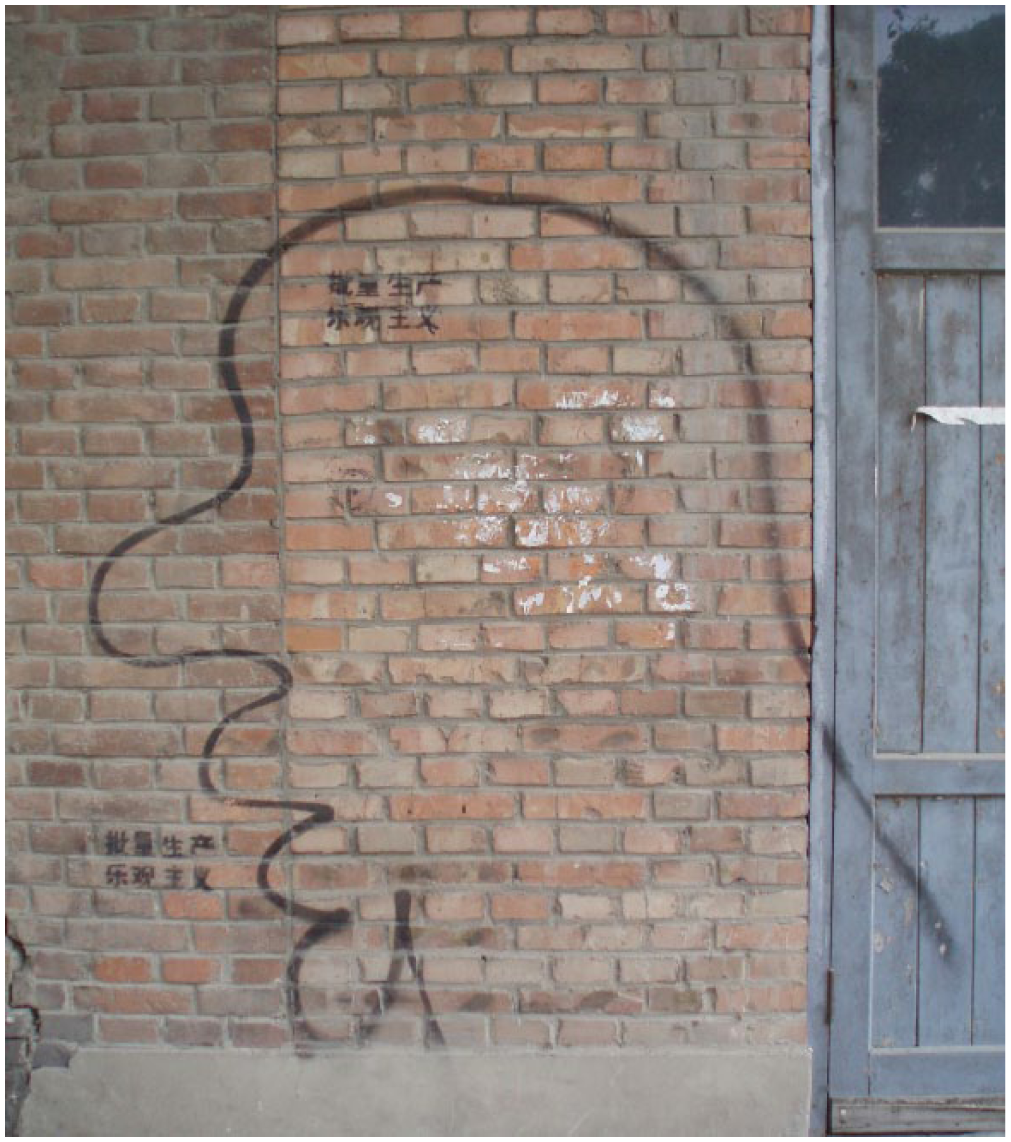
Zhang Dali, Dialogue (对话), 798 art district, Beijing, May 2007. Photograph taken by the author.
While urban art images can be responsive to the physical site and location, they can also be created in response to existing images on the site. According to international conventions for both contemporary graffiti and street art, covering up any existing image, even a tag, is considered offensive, or at least disrespectful towards its creator. Despite these conventions, urban art images are created beside or over each other, resulting in a multilayered visual dialogue.
One case of visual dialogue launched by overpainting occurred at the Shanghai Jiaotong University campus, with an image commemorating the high-speed train incident on 23 July 2011. 68 The original design, criticizing China for aiming to be the leading country in the world (世界第一) at the expense of the people (人民, written in a pool of blood), was made by an anonymous Chinese illustrator. The first urban art image painted at Shanghai Jiaotong University was a modified version of the original design. It depicted a crushed train in the form of an extended skull with a fierce grin and blood-red eyes. The underbelly of the train was also blood red. The signature (apparently ‘Christian2x’) and the date ‘7.26.11’ seemed to indicate a non-Chinese creator, but the local creators believe it was painted by a Chinese person whose identity remains unknown. The next day the image was painted over, launching a site-responsive visual dialogue: the latest documented phase of the dialogue included a text, ‘reading and understanding China in here’ (在这里读懂中国), with an arrow pointing to the overpainting covering the image. On the overpainted area, a new image was created: the blue logo of the train, a magnifying glass that doubled the size of the logo and transferred it onto white bony fingers, and a brush and a dustpan. In the second image, we can see criticism of the concealment of this sensitive issue: a clear response to what was happening on the physical wall. An interesting site-responsive visual dialogue on the physical wall, initiated by the first image, developed into heated discussions on social media. 69 While online debates show how the use of public space is developing in virtual realities, discussions online often include people unconnected with the scenes of urban art images which can result in incomplete information posted or even misinterpretations.
Contextual site responsiveness
The anti-corruption stencil (Figure 7) also sheds light on site responsiveness in terms of the contextual relationships of urban art images. As Miwon Kwon argues, not only physical locations, but also various cultural, theoretical, institutional, societal, political and historical debates, issues and events can function as sites and be reflected in the content of the artwork. 70 All these different levels of contextual site responsiveness are represented in Chinese urban art images.
The multilevelled intertextuality of urban art images in China today is a key issue of site responsiveness, and can only be deciphered through detailed aesthetic analysis of the images. References to various national sociocultural issues, traditions and arts, and both local and international visual and popular culture, further enrich the scene. Site responsiveness can also playfully combine both national and foreign discourses, as the stencil from the Central Academy of Fine Arts in Beijing in May 2009 shows: four international leaders, Hu Jintao, Barack Obama, Vladimir Putin and Gordon Brown, are depicted as if in the Mount Rushmore National Memorial in the United States (Figure 10).
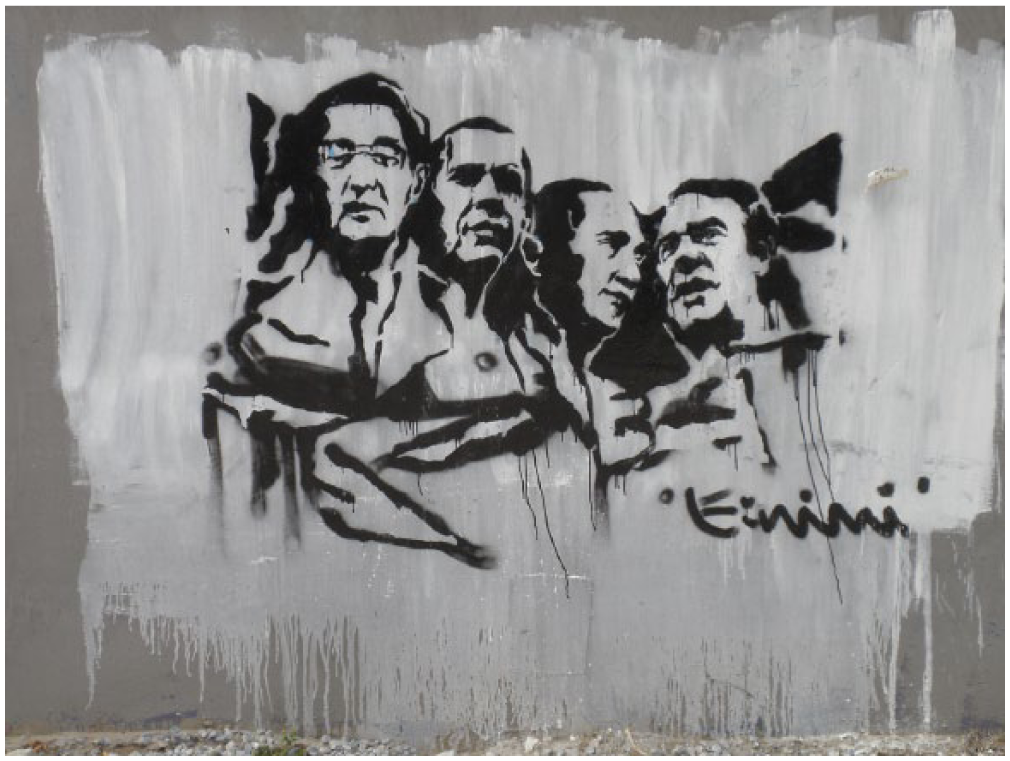
Four international leaders, Central Academy of Fine Art, Beijing, May 2009, stencil. Photograph taken by the author.
Which urban art images are created and what is allowed to exist in urban public space can further our understanding of spatial politics and censorship in mainland Chinese cities. For example, in 2012 when inflation and, especially, the increased price of pork affected Beijingers, the local ABS crew created an elaborate piece entitled Inflation (通货膨胀) at Jingmi Road in the suburbs of Beijing (Figure 11). A greedy-looking but already sliced pig was pictured on a background of shining jewels, cash, gambling chips and dice, and flanked by two green, almost rotten pigs. Although there was no direct visual reference to China, the contextual site responsiveness is clear because of the timing of the piece’s appearance. At the other end of the spectrum are urban art images that leave no room for interpretation. One of the issues that has gained prominence in urban art images, by both local and international creators, is pollution. The piece Beijing Is Polluted (北京有毒), made by ABS crew in 2013 near the 798 art district in Beijing (Figure 12), was perhaps too straightforward and too accessible. Consequently, it was soon overpainted while Inflation still existed in spring 2015. 71 These two examples from the same crew also illustrate how the style was a response to the site: Inflation, created in the peace and quiet of Jingmi Road, is far more detailed than the other, which was sprayed on temporary walls surrounding a construction site. The surface and material of the wall itself also had an effect, because details are far more difficult to spray-paint onto corrugated metal.
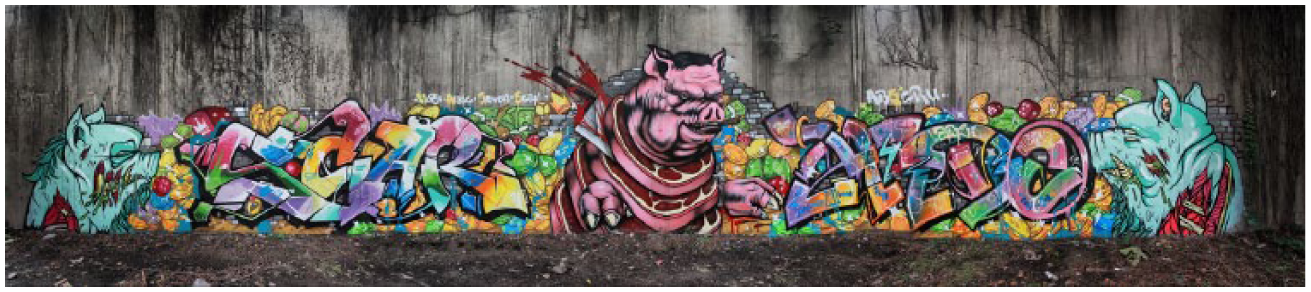
ABS crew, Inflation (通货膨胀), Jingmi Road, Beijing, summer 2012. Courtesy of ABS crew.

ABS crew, Beijing Is Polluted (北京有毒), construction site close to 798 art district, Beijing, 2013. Courtesy of ABS crew.
Besides the sociopolitical context, cultural site responsiveness in urban art images can reveal which features and discourses of visual and popular culture the creators consider worth addressing. A personal style is still the key evaluation criterion for any form of contemporary graffiti and street art. Local creators in China repeatedly emphasize the importance of developing indigenous and original styles. Cultural references are expressed mainly through content, style, composition, imagery from Chinese visual culture, colour and especially, language. Kwanyin Clan and Beijing Penzi crew from Beijing and French Dezio from Shanghai are especially known for intricate visual references to Chinese culture throughout their oeuvre.
The use of ‘Chineseness’, and especially language, is a double-edged sword valued by local and even many international creators. Expression of local culture is increasingly important to locals, but reception among international creators is mixed. Some international old-school writers regard graffiti writing as a ‘Western game’ which requires creators to use alphabets. Many are more tolerant, however, and believe that the future of graffiti writing in China is in Chinese characters. At the practical level, the challenge of using Chinese characters lies in legibility and comprehension. For example, the message in a piece by Touchy, a local graffiti writer from Shenzhen, might be difficult to decipher even for a person literate in Chinese. It critiques the use of conceptual deception by the growing advertising industry. Genuine Hong Kong Style Circumcision (正宗港式包皮整形) alludes to a local hospital that advertises its circumcision procedure as more professional by labelling it ‘Hong Kong style’ (Figure 13). Touchy sees similar misleading advertisements all around China. He believes contemporary graffiti can wake people up to what is happening in society and make them more aware and critical towards the aesthetics of both urban public space and advertising. 72
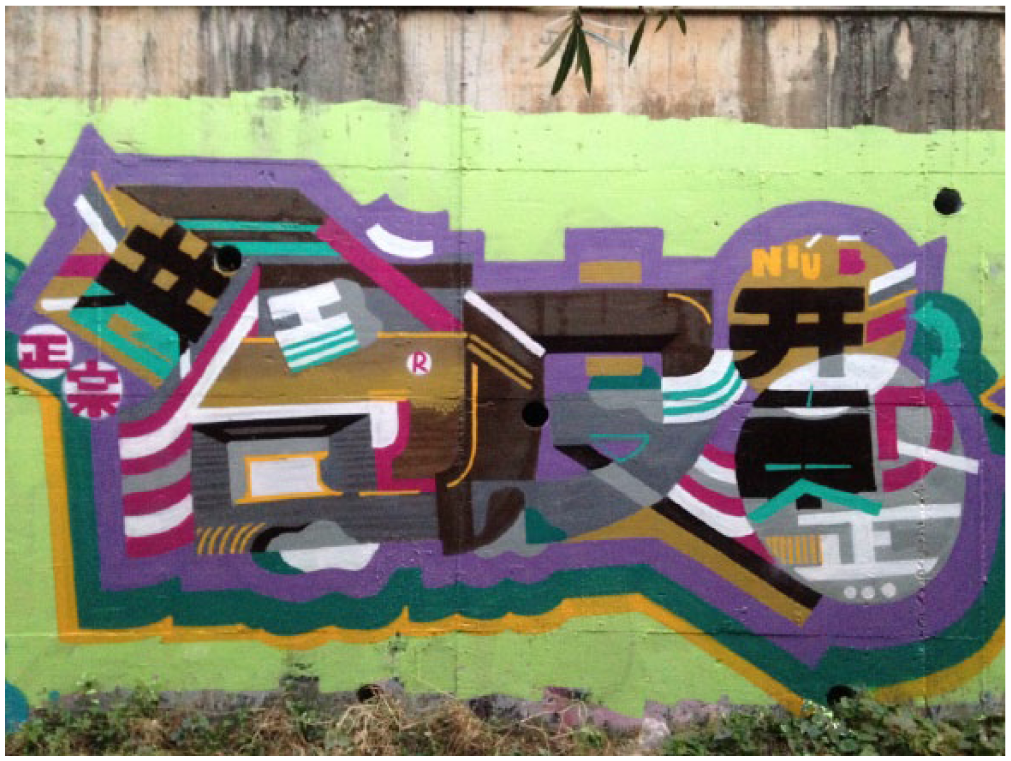
Touchy, Genuine Hong Kong Style Circumcision (正宗港式包皮整形), Shenzhen, November 2013. Courtesy of Touchy.
Site responsiveness as a method to reshape the city
Site responsiveness of urban art images is based on reciprocity between the city and the images. As Wacławek states, street art also shapes visual culture. 73 Urban art images in China support Henri Lefebvre’s observation that space is produced in an ongoing interaction with social relations and in representations of this interaction. Urban art images, especially when unauthorized, negotiate both the spatial practices and representations of space in a city. 74 We can also adapt Lefebvre’s theoretical framework of the production of space to the urban art scene itself. The creators of urban art images need, and are continuously creating, a space for themselves and their activities in the built urban environment, through complex negotiation processes. Detailed analysis of the site responsiveness of urban art images furthers our understanding of these negotiation processes because site responsiveness is a key element in the transformation of abstract urban public space into a more meaningful place for urban art images.
In addition to interconnection between an urban art image and a specific site, there is also interaction with the city, the community, and other creators of urban art images. For example, ZATO, a foreign graffiti writer living in Beijing, uses human figures to ‘populate the city’ and Chinese writing to communicate with local audiences. He also enjoys the recognition and inspiring other creators. For him, contemporary graffiti is a way to be more conscious about the city. 75 Another foreign graffiti writer, SBAM, emphasizes the importance of knowing the city and the atmosphere and the significance of a site, especially for illegal contemporary graffiti. 76 Creators, and those who follow the scenes, experience a heightened awareness of their living environment. In China, as elsewhere, creators emphasize their belonging to a community of creators and usually describe the city as a playground and/or battleground, though some also express a sense of being part of the city which is a living organism.
When creators move from one country to another, engaging in their passion can provide a sense of stability in the face of change. For SBAM, creating graffiti makes him feel at home wherever he is; being a graffiti writer is the basis for his self-identity. Locals express similar experiences of the importance of contemporary graffiti to their identity. For TinG from Shanghai, a female street art player, creating contemporary graffiti and/or street art is a kind of psychological backbone. TinG did not think when she started that she would be involved for a long time, but contemporary graffiti gave her the motivation to strive in other areas of life and art too. 77
The long-term sites, existing for years without overpainting or demolition, are important for enhancing interconnectedness and for the development of a scene. They often tempt international creators to leave their mark as well. Such sites are the physical representations of the space of urban art images and make the city more appealing to people interested in creativity in urban public space. Such ‘walls of fame’ are also places of identity construction and belonging. They resemble what Lucy Lippard has defined as the local: a physical place based on the interconnection of culture, history, ideology, and nature, experienced and understood from the inside. The local is the result of a space where culture is lived. The sense of identity is primarily bound to places and the histories they embody, and this interconnection can be addressed by art. 78 Similar interconnection between place, memory, identity and creating come up repeatedly in discussions with creators, which are filled with personal memories linked to particular sites and concerns about possible loss of sites. For many local creators, especially younger ones with less experience and commitment, creating urban art images is a way to amuse themselves. In spite of this casual attitude, the sense of place offered by urban art images is ‘the geographical component of the psychological need to belong somewhere, one antidote to a prevailing alienation’ in postmodern society. 79 In using urban public space to create unauthorized urban art images, creators in China do more than simply challenge the power relations and visual narrative of the city. They gradually reshape the space into meaningful places they can identify with.
Conclusions
How scenes of urban art images develop, which styles and forms gain support, depends on a process of mediation between local, national, regional and global trends. In mainland China, the spatial and visual practices of urban art images – including choice of site, form, content, details, languages, composition and colours – reveal a multilevelled site responsiveness. The cases discussed in this article shed light on the main features of the complex reciprocal relationship between urban art images and their sites. First, the selection of the site itself has an impact on the content and form of the image created. Second, the content and pictorial space of the image affects its relationship with its surroundings. Content is especially important when analysing the visual dialogues that occur between images at the same physical site. Third, site responsiveness can include reference to sociopolitical and/or cultural discourses at local, national and international levels. Acknowledging indigenous cultural features is becoming ever more important in China, and examining in detail how these notions oscillate between transcultural and transnational features is worth a study on its own. Fourth, site responsiveness involves a reciprocal relationship between the scenes of urban art images and the city: creators not only actively negotiate the sociospatial policies and representations of the city, but they also develop a space of urban art images in China.
Understanding the processes and manifestations of site responsiveness is an essential starting point for a more nuanced comprehension of urban art images and their role in mainland China. As the selected examples show, aesthetic analysis of Chinese urban art images can reveal how they relate to both material and immaterial elements of the scenes of urban art images, the city and the nation.