




Abstract
This article traces the institutional development of environmental regulation in urban China, using data from three rounds of surveys of enforcement officials in the Guangzhou Environmental Protection Bureau in 2000, 2006 and 2013. We found that the changes to institutional contexts of regulatory control appear mainly in the fluctuating degree of support from various non-state actors, but not from government entities and regulated industries. While we detected visible organizational changes in local environmental enforcement bureaus, there was also organizational stability. First, the quality of enforcement officials has improved, as reflected by a higher level of education, first from 2000–2006 and then from 2006–2013. Second, the perceived value of enforcement officials in environmental protection was considerably enhanced in the period 2000–2006, and then remained stable from 2006 to 2013. Third, enforcement obstacles in terms of administrative ambiguity remained virtually unchanged from 2000 to 2013, while enforcement power deficit, resource scarcity and procedural ambiguity became more severe. Overall, the general perception of enforcement effectiveness at both the unit and organizational levels has remained the same over the past 13 years, whereas individual-level enforcement was perceived to have become more effective (with significant changes mainly taking place from 2006 to 2013). On the basis of these empirical results, we found that the institutional conditions for stricter enforcement in Guangzhou were visibly improved from 2000 to 2006, but only modestly improved between 2006 and 2013.
Keywords
China’s increasingly visible and rapidly expanding ecological footprint as a result of the phenomenal economic development of the last four decades has provoked worldwide criticism of its persistently ineffective regulatory control of industrial pollution. 1 Starting with its adoption of a national development strategy which snowballed pollution in the 1980s, moving towards sustainable development in the 1990s, transitioning to a green idea of quality economic growth in the first decade of the 21st century, and moving towards a low carbon economy in the latest development, China has ideologically effected a step-by-step green transformation of its polluting trajectory of economic progress by subscribing to a more advanced green concept of development as it refines its development strategy periodically through the growing incorporation of ecologically friendly components. 2 A succession of green milestones have clearly indicated the regime’s growing determination to mitigate the ecological impact of its past aggressive industrialization and urbanization efforts. These efforts include the 1994 promulgation of ‘China Agenda 21 – White Paper on China’s Population, Environment and Development in the 21st Century’, the 2004 launch of the triple initiatives – ‘cleaner production’, ‘circular economy’ and ‘saving energy, reducing emissions’ – and the upgrading of the State Environmental Protection Administration (国家环境保护总局) to a full Ministry of Environmental Protection (中华人民共和国环境保护部) in 2008. 3
How far has this trend in national development helped bring about a more favourable institutional setting for effective enforcement of pollution control regulations in urban China? Is it just a myth that the pro-growth sentiment has remained dominant in the politics of enforcement, particularly at local levels, frustrating any attempt at green economic transformation? There is no shortage of evidence to show that the problem of ‘law enforcement is difficult’ (执法难) has persisted in locations where limited efforts have been made to temper institutional constraints that hinder stricter enforcement, such as the lower bureaucratic status of local environmental protection bureaus, their limited enforcement capacity due to limited resources, the existence of guanxi networks, and the lack of public participation. 4 Or has the inspiration for green development effectively passed from the central to the local and thus activated a nationwide green evolution? Studies increasingly report that local environmental protection bureaus have been able to improve control of industrial pollution with the aid of greater policy support and growing social demand for clear water and blue skies. 5
To address the empirical puzzle outlined above, this article examines changes in environmental regulation enforcement in urban China by tracing institutional development in Guangzhou. As the third largest urban economy in China for decades, Guangzhou has been a leader on the polluting path of economic development, imbued with a strong pro-growth orientation inside and outside the government. 6 By examining three surveys of enforcement officials in the Guangzhou Environmental Protection Bureau, administered in 2000, 2006 and 2013, this article focuses on the relative impact and importance of three factors on the enforcement of environmental regulations over time: environmental orientation, internal institutional strength, and external political support. It concludes with an assessment of whether the institutional changes between 2000 and 2013 have provided more favourable conditions for stricter regulatory enforcement in an urban context of increasing public attention on urban ecological well-being. 7
Changes to environmental regulation in China
Research into environmental regulation in China has sought an explanation for the limited effectiveness of regulatory control of industrial pollution and the persistence of ‘enforcement gaps’ between legislative intent and enforcement outcomes. An emerging focus in such research has been the trend to detect major changes in regulatory enforcement of pollution control regulations in China’s highly complex and rapidly evolving contextual setting. 8 The core question in this research effort concerns improvements in institutional environments for more effective pollution control and closing the enforcement gap. 9 Recent studies have commonly observed that the environmental quality administrative leadership responsibility system has caused local leaders to take pollution control more seriously. 10 Because of this political development, local environmental protection bureaus have received a stronger policy mandate and more resources for tightening up enforcement. 11 At the same time, pressure from the public calling for stricter pollution control has grown, as shown by the rapid increase in popular complaints and the proliferation of civic environmental non-governmental organizations. 12 As a result, regulatory enforcement has been increasingly stringent with more frequent inspections conducted, higher fines imposed, and more polluting enterprises closed. 13 In a study of regulatory enforcement in Guangzhou between 2000 and 2006, Xueyong Zhan, Carlos Lo and Shui-Yan Tang found that environmental officials in the Guangzhou Environmental Protection Bureau tended to rely on a more formalistic and coercive approach to regulatory enforcement than the predominantly educational and cooperative approach of the past, because the institutional environment had made it difficult for them to secure compliance from polluting enterprises. 14 Their study established a theoretical link between contextual changes and regulatory enforcement and it captured the dynamics of environmental regulation over time.
Under the theme of change in regulatory control, the classic problem encapsulated by the question, ‘Why is perfect implementation unattainable?’, should be re-conceptualized from an absolute (or static) state to one that is relative to time, that is, ‘Why is perfect implementation unattainable over time?’ This longitudinal perspective requires the assessment of whether changes in institutional conditions are conducive to improving regulatory enforcement. Accordingly, the principles for such an assessment 15 should be revised to determine whether there has been an improvement in the regulatory process as follows: 16
Constraints imposed by circumstances external to the environmental enforcement agencies should be reduced. Political leaders and other leading government officials are likely to harmonize environmental protection and economic interests when the two are in conflict, leading to the reduction of political pressure that frustrates enforcement efforts. This is particularly the case in developing countries, where the pro-growth sentiment gradually subsides as a nation progresses and makes economic advancements.
The priorities of the actors involved should increasingly converge. Government authorities should progressively share the policy priority of environmental protection over time. In this way, environmental agencies and enforcement officials can rally more bureaucratic support for stringent enforcement.
Objectives should be increasingly understood and agreed upon. Environmental officials should develop a clear understanding of the environmental regulations they are to enforce, including the legislative intent, the contents of legal prescriptions, and the modes of regulation. It is important that they increasingly agree on the objectives of environmental regulation and approve strict enforcement.
Sufficient resources should gradually be made available. Environmental agencies and their officials must by degrees be given the right level of resource support in order to build the organizational capacity necessary for sound regulatory control. Such resources should embrace financial, human, and technological requirements.
More consideration should be given to enforcement issues at the time of legislation. In order to make environmental regulations more enforceable, increasing effort should be made to identify the most likely enforcement difficulties (e.g. administrative capacity, technological feasibility, and conflicting interests) and to deal with them during law making. Such a move should strengthen the cause and effect of enforcement and compliance and block poorly formulated (and hence non-enforceable) environmental regulations.
Regulations should be consistently enforced. In the regulatory process, environmental agencies must increasingly enforce pollution control regulations in a uniform manner to prevent inconsistencies and unfairness. All regulated parties must increasingly be treated equally to convey a stronger sense of legal justice. Such improvement in uniform enforcement should reduce false expectations, minimize complaints, and eventually promote compliance.
There should be improved effective communication and coordination. Environmental agencies and their officials should communicate and coordinate enforcement actions more effectively with other bureaucratic agencies involved in environmental regulation. Keeping these government authorities more informed and getting them more involved in the exercise of power will promote inter-agency collaboration and remove bureaucratic resistance.
Reporting on compliance should be more reliable. Environmental agencies should have greater administrative capacity to ensure that more reliable reports on compliance can be prepared and be available to interested parties. The problems are fundamental, because an improved reliable and accurate reporting system on compliance is essential for enabling environmental regulators to prevent regulated parties from cheating and to organize an effective enforcement plan and actions.
Potentially compromising ‘dependency relationships’ should be avoided. Environmental agencies and their officials should increasingly be able to take full charge of regulatory enforcement, decreasing their reliance on the support and collaboration of other government authorities. The single enforcement agency approach is the most desirable. Even in the case of a multiagency approach, the environmental agency should play a leading role with minimal dependency on the others in performing its enforcement duties.
Enforcement officials should have greater authority to demand and obtain compliance of all the regulated parties. This exercise of enforcement power should eventually be independent and unconditional, subject to no extra-legal constraints.
Environmental regulation is an ongoing process, so the aspect of change should also inform studies on the regulatory process. Enforcement is related to changes in three general sets of institutional factors at three levels of analysis. At the individual level, the personal environmental values and motivations of enforcement officials themselves may improve over time to strengthen their determination for stricter enforcement. 17 At the level of the bureau, various constraints – which may limit the organizational capacity of environmental protection bureaus to carry out enforcement – may become less severe; 18 at the societal level, an increase in external support or a reduction in opposition to pollution control will facilitate enforcement. 19
In this vein, the following sections will examine the evolving conditions of regulatory enforcement in Guangzhou by considering changes in external political support and internal organizational capacity as described by local environmental protection bureau enforcement officials. We will also examine changes in the officers’ attitudes and beliefs in relation to the environment, that is, changes in their environmental orientation.
Methodology and background
The data for this study come from surveys conducted among environmental officials in the Guangzhou Environmental Protection Bureau. This bureau is responsible for enforcing environmental regulations in Guangzhou, the capital city of Guangdong Province, located in the Pearl River Delta region.
Guangzhou municipality, with an area of 7434.6 km2 and a population of over 7.5 million, is a suitable setting for this study of changes in regulatory enforcement. Economically, it has remained among the fastest-developing local economies in China, with a GDP that has seen a phenomenal increase from around RMB 5 billion in the early 1980s to more than RMB 206 billion in 1999, to RMB 623 billion in 2006, and to RMB 1542 billion in 2013. Environmentally, Guangzhou has experienced serious degradation of its air, water, and other environmental resources in the last three decades resulting from its rapid economic growth. Politically, senior municipal leaders have increasingly incorporated environmental protection as a major component of the city’s development strategy, and they are driven by a strong desire to give the city a green image as a garden-like city. 20 Socially, Guangzhou citizens have become more critical and less tolerant of industrial pollution. Popular protests against polluting projects have become more frequent and contentious. All these institutional developments have placed ever greater pressure on the Guangzhou Environmental Protection Bureau to tighten regulatory control over polluting enterprises. To strengthen the empirical basis of this study, we supplemented the survey findings with analyses of recent interviews with leading officials of the bureau in charge of enforcement.
Compared with other Chinese cities, Guangzhou’s environmental performance record is rather inconsistent. Although the city ranked among the top 10 between 1988 and 1994, as measured by the annual environmental protection assessment exercise conducted by the State Environmental Protection Administration, it has failed to achieve a top 10 ranking since 1995. In fact, its ranking slipped to a low of 29th in the 1998 re-assessment, although its record has improved in the past few years. Guangzhou achieved green model-city status in 2007, 21 and in 2008 was honoured with the titles National Health City (国家卫生城市) and National Forest City (国家森林城市). After hosting the Green Asian Games in 2010, the municipal government’s ambition was to transform Guangzhou into a garden-like city by 2015, so that its ‘overall eco-system environment will reach first-class standard in the nation, the first step to a garden-like city’. 22
As shown in Table 1, the concentration of respirable suspended particulates, 23 sulphur dioxide, and nitrogen dioxide, in Guangzhou’s air met the mandatory standard, but there was no clear sign of ongoing reduction in pollutants from 2000 to 2006. However, an improvement appeared from 2006 to 2013 with significant reduction in sulphur dioxide. Perhaps most noteworthy is the rapid decrease in the frequency of acid rain, down to 23.7% from a consistently high level before 2006, indicating greater effectiveness in the elimination of concentrated pollutants in the air. Following the measurement change mandated by the 11th National Five-Year Plan (2006–2010) in 2006, the percentage of drinking water sources meeting water quality standards improved steadily from 67.86% in 2006 to 100% in 2013, after a period of deterioration from 98.3% in 2000. The sewage treatment rates in 2006 and 2013 also rose from 71.64% in 2006 to 90.89% in 2013. However, the volume of industrial and residential waste water discharged remained high as late as 2013 (213.91 million tons industrial, and 1351.79 million tons residential), demonstrating an enforcement gap in water regulation. Noise control has been highly inadequate, with the degree of compliance with acoustic environment requirements, particularly the night-time standard, remaining consistently low. In sum, the data presented in Table 1 and discussed here (based on figures from the Guangzhou Statistical Yearbook for 2001, 2007, and 2014) 24 show that Guangzhou’s environmental record has started to pick up, with more visible improvement since 2006. However, the overall picture is still mixed, and the city has yet to achieve a global improvement trend in all major dimensions of its environmental conditions.
Environmental standards and quality in Guangzhou municipality, 2000, 2006, and 2013.

Source: Guangzhoushi Tongjiju (Bureau of Statistics of Guangzhou), Guangzhou tongji nianjian (2001–2014) (Guangzhou statistical yearbook (2001–2014)).
Notes: #Grade II Standard, applicable in urban residential and commercial areas; *The dramatic reduction in the percentage of drinking water that meets water quality standards is partly due to the change in measurement in the new policy announced in the 11th Five-Year Plan (2006–2010).
Data collection
The survey was administered in the years 2000, 2006, and 2013, each time with the endorsement and support of the Guangzhou Environmental Protection Bureau, which greatly facilitated survey administration and enhanced response rates. 25 Prior to each round of data collection, a briefing session was held with representatives at each field office. These representatives, in turn, helped distribute the questionnaires to officials within their units, collected completed questionnaires, and returned them. Altogether, 202 usable responses were received from a total of 250 distributed in 2000, 154 of 220 were received in 2006, and 207 of 280 in 2013, yielding response rates of 81%, 70%, and 74% respectively. Because of the low turnover in enforcement officials (about 5% per year), the samples are reasonably comparable. Indeed, because more than 70% of the respondents worked more than six years in environmental protection bureaus, a large number of the respondents were working for their respective bureau during both the 2000 and 2006 data collection periods. In 2013, around 37% of the respondents had more than eight years of job tenure.
Findings and analysis
Our three surveys examine changes in the responses and perceptions of enforcement officials in the period 2000–2013. ANOVA (analysis of variance) was conducted to compare mean values of the key variables in the three rounds of the survey. Post-hoc comparison using Bonferroni criteria was also employed.
Changes in orientation of environment officials
This study used the new environmental paradigm (NEP) scale, a widely applied and well-recognized scale, 26 for measuring the environmental orientation of environmental officials and the public. 27 Some studies have found a strong association between NEP scores and respondents’ environmental behaviour. 28 The NEP scale included 12 items when first developed by Riley Dunlap and Kent Van Liere; 29 these were divided equally into four dimensions: limits to growth, anti-anthropocentrism, fragility of nature, and looming eco-crisis. It was later revised to a 15-item version to include a fifth dimension: rejection of exemptionalism. The two versions have seven items in common. The original version was used in our 2000 survey, while the revised version was used for the 2006 and 2013 surveys; all were in the form of a five-point Likert scale. For the purpose of comparative analysis of the three surveys, only the seven items in common in the original four dimensions will be included. Detailed findings are shown in Table 2. Overall, the ANOVA results indicate that there have been significant changes in the two periods within 13 years (F = 4.599; with 2 degrees of freedom; p < 0.01). A post-hoc comparison of these means suggests that there was a significant increase in the NEP scores among enforcement officials from 2000 to 2006 (p < 0.05), and that this remained stable from 2006 to 2013.
Comparison of means in responses to new environmental paradigm items, 2000, 2006, and 2013.

significant < .05; **significant < .01; ***significant < .001
The two reverse items related to anti-anthropocentrism were recoded before analysis.
Findings are considered for individual NEP items in each of the four aspects. Significant changes in the past 13 years were seen in two dimensions of NEP: anti-anthropocentrism and fragility of nature.
Limits to growth. This was encapsulated in two statements: ‘We are approaching the limit for the number of people the earth can support’, and ‘The earth is like a spaceship with only limited room and resources’. Although no significant changes are detected in the first item, officials’ perception of the second item records a significant increase from 2000 to 2006 (p < 0.01) while dropping to a similar level to that in 2000 from 2006 to 2013 (p < 0.05). With regard to respondents’ perceptions in the three surveys within this 13-year period, there is a pronounced increase in the percentage of environmental officials agreeing with the statement that the earth is like a spacecraft, from 80.9% in the 2006 survey to 89.3% in 2013, slightly higher than 89.1% in the 2000 survey, suggesting a revival of the awareness of earth’s limited capacity for coping with unbridled consumption.
Anti-anthropocentrism. This is expressed by two statements: ‘Humans have the right to modify the natural environment to suit their needs’, and ‘Humans were meant to rule over the rest of nature’. We recoded the variables before conducting ANOVA. There were significant changes over time between 2000 and 2013 (F = 6.448; with 2 degrees of freedom; p < 0.01). A post-hoc comparison of these means indicates that there was a significant increase from 2000 to 2006 (p < 0.01), and that this remained stable from 2006 to 2013. In particular, the percentage of environmental officials who agreed that humans were meant to dominate nature first declined sharply from 31.7% in the 2000 survey to 12.2% in 2006, and then remained at 12.1% in the 2013 survey, suggesting that a strong sentiment of anti-anthropocentrism was already entrenched among them.
Fragility of nature. This consists of two statements: ‘When humans interfere with nature it often produces disastrous consequences’, and ‘The balance of nature is very delicate and easily upset’. There were significant over-time changes between 2000 and 2013 (F = 4.564; with 2 degrees of freedom; p < 0.05). A post-hoc comparison of these means indicates that there was a significant increase from 2000 to 2006 (p < 0.01), and that this remained stable from 2006 to 2013. Specifically, officials agreeing with the first statement increased especially between 2000 and 2006 (p < 0.001). Although the over-time changes in the second statement were insignificant, we noticed that the increase in the percentage of environmental officials who agreed with the second statement was quite pronounced, rising from 71.8% in the 2006 survey to 80.7% in 2013, indicating their increasing worry over the adverse impact of pollution on the natural environment.
Looming eco-crisis. A single statement was used to examine this aspect: ‘Humans are severely abusing the environment’. The results suggest that the differences over time are not significant (F = 2.41, p = 0.09). However, the percentage of environmental officials who agreed with this statement increased steadily, from 81.2% to 83.4% to 88.9%, indicating that their sense of environmental crisis has been growing stronger and stronger.
The overall NEP scores (the mean values of all items) of the environmental officials in the three surveys are 3.73, 3.89, and 3.85. In addition to a significant increase from 2000 to 2006, they remain at a relatively high level, which indicates a tendency toward pro-environment values among the respondents in this period. Most importantly, these figures provide solid evidence to demonstrate the reversal of the low pro-environmental sentiment among the officials of the Guangzhou Environmental Protection Bureau in the early 1990s. 30 Finally, the trend toward younger ages and higher education levels among respondents in individual surveys helps to account for all the positive changes in the environmental orientation of enforcement officials. With regard to the age of the respondents, the mean values were 37.36, 37.52, and 34.74 in the three waves of the survey. The ANOVA results indicate that there have been significant changes in the past 13 years (F = 6.25, p < 0.01) and that enforcement officials in the 2013 survey were younger than those in 2000 (p < 0.05) and 2006 (p < 0.05). As for education level, in 2000 about 52% of the surveyed enforcement officials had university education or higher; this number increased to 60% in 2006 and 81% in 2013.
Changes in institutional strengths
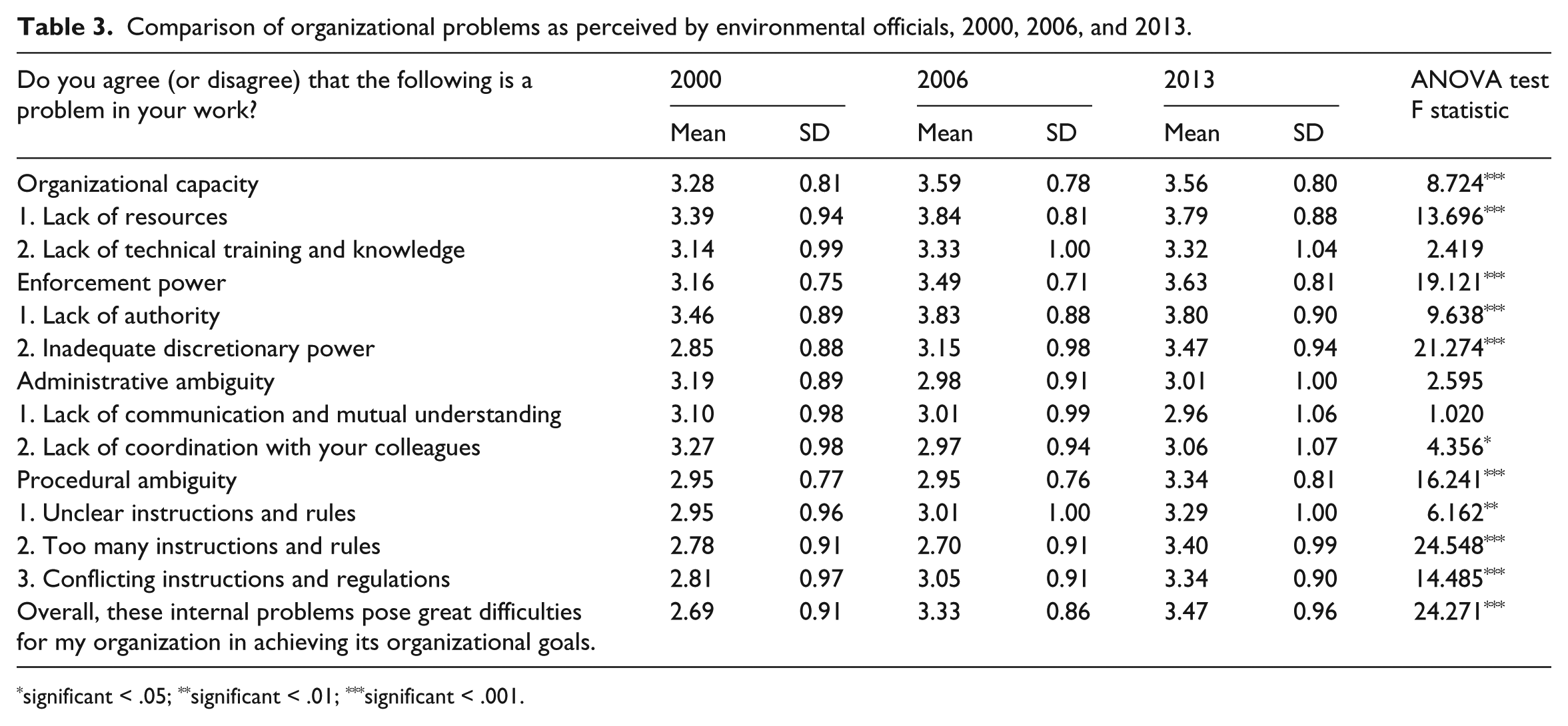
Enforcement agencies should build their institutional strengths to support their enforcement officials in the long-term task of controlling industrial pollution. To examine how institutional strength affects regulatory enforcement, the respondents in each survey were asked to rate the institutional deficits of their respective local environmental protection bureaus in four dimensions: organizational capacity, enforcement power, administrative ambiguity, and procedural ambiguity. The findings are summarized in Table 3.
Comparison of organizational problems as perceived by environmental officials, 2000, 2006, and 2013.
significant < .05; **significant < .01; ***significant < .001.
Organizational capacity
Two items were employed to capture respondents’ perception of organizational capability: lack of resources, and lack of technical training and knowledge. Overall, we found significant changes over time in the past 13 years (F = 8.724; with 2 degrees of freedom; p < 0.001). From 2000 to 2006, enforcement officials’ perception of insufficient organizational capability increased significantly, meaning that environmental protection bureaus had become less capable during this period. From 2006 to 2013, in comparison, there was a marginal improvement (p < 0.1). This overall change stems mainly from a significant increase in the perception of a lack of resources (p < 0.001) from 2000 to 2006, which then remained stable between 2006 and 2013. However, there was no significant change in the perception concerning lack of technical training and knowledge throughout the survey period. The percentage of respondents agreeing with the first item rose, from 53.4% in 2000 to 74.5% and then 77.3%, and this strongly indicates that resource deficit has continued to be a major source of local environmental protection bureaus’ capacity constraints.
Enforcement power
Two items were used to gauge the enforcement power of enforcement officials: inadequate administrative authority, and inadequate discretionary power. Over the past 13 years, enforcement officials increasingly agreed that inadequate administrative authority and discretionary power were major institutional problems in their local environmental protection bureau, as evidenced by significant changes over time for both factors (F = 9.638, p < 0.001 and F = 21.274, p < 0.001, respectively). A post-hoc comparison suggests that there was a significant increase in officials’ perception of inadequate administrative authority from the years between 2000 and 2006 (p < 0.001), and this remained more or less the same from 2006 to 2013. Interestingly, officials’ agreement that lack of discretionary power was a major organizational problem increased significantly in both periods (p < 0.01 and p < 0.01 respectively). On closer examination, it is clear that the perception of inadequate discretionary authority increased sharply among enforcement officials, from 26.8% in the 2000 survey to 37% and 56%, respectively, in the latter two surveys. This trend may indicate greater uniformity in the enforcement of pollution control regulations, but at the same time, this may restrict enforcement officials’ discretion for tougher enforcement. It appears that the newly revised Environmental Protection Law of the People’s Republic of China (中华人民共和国环境保护法) that became effective in 2015 has finally addressed the environmental officials’ ceaseless complaints about inadequate enforcement power because this law grants them greater enforcement and sanctioning power. But it remains to be seen whether enforcement officials will exercise their increased enforcement power and whether they will remain institutionally constrained in reality.
Administrative ambiguity
We used two items to measure enforcement officials’ perception of administrative ambiguity: lack of communication and mutual understanding, and lack of coordination with colleagues. Overall, we found insignificant changes over the past 13 years (F = 2.595; with 2 degrees of freedom; p = 0.076). More specifically, officials’ perception of the first item did not change during the study period, while the perception of a lack of coordination among departments in their organization recorded a significant decrease between 2000 and 2006 (p < 0.05), and then remained stable between 2006 and 2013. In other words, inter-departmental coordination improved in the first seven years without any decline thereafter. Communication and mutual understanding were consistently perceived as improving, given the steady decrease in the percentage of enforcement officials who agreed with the first item in the three surveys, from 52% to 38.8% and then to 38.7%. However, coordination re-emerged as an issue, as 45.9% of the respondents in 2013 agreed with the second item, significantly more than the 38.8% in the 2006 survey.
Procedural ambiguity
Three items were used to measure enforcement officials’ perception of procedural ambiguity: unclear instructions and rules, too many instructions and rules, and conflicting instructions and regulations. Overall, our findings reveal that procedural ambiguity emerged as a new obstacle in the past 13 years (a significant increase in the mean value; F = 16.241; with 2 degrees of freedom; p < 0.001). From 2000 to 2006, perceptions about all three items remained unchanged. Considerable negative changes are, however, evident during the period 2006–2013 (p < 0.001). Enforcement officials’ perceptions of all three indicators point to the growing problem of procedural ambiguity (p < 0.05, p < 0.001, p < 0.01, respectively). This trend is quite alarming, because more than 50% of respondents in the 2013 survey agreed with these three statements, compared with less than 35% in 2006 and less than 25% in 2000.
Changes in institutional strengths in this period, based on the ranking patterns of the nine organizational problems, indicate that inadequate administrative authority is an embedded constraint of enforcement power. It was ranked as an organizational problem in all three surveys. Lack of resources, a continual problem constraining organizational capacity, was ranked almost as high. Conflicting instructions and regulations, ranked fourth in the 2006 and 2013 surveys, appear to be increasingly disturbing to enforcement officials. Finally, the item concerning excessive instructions and rules is a growing concern, ranking third in the most recent survey.
Changes in external political support
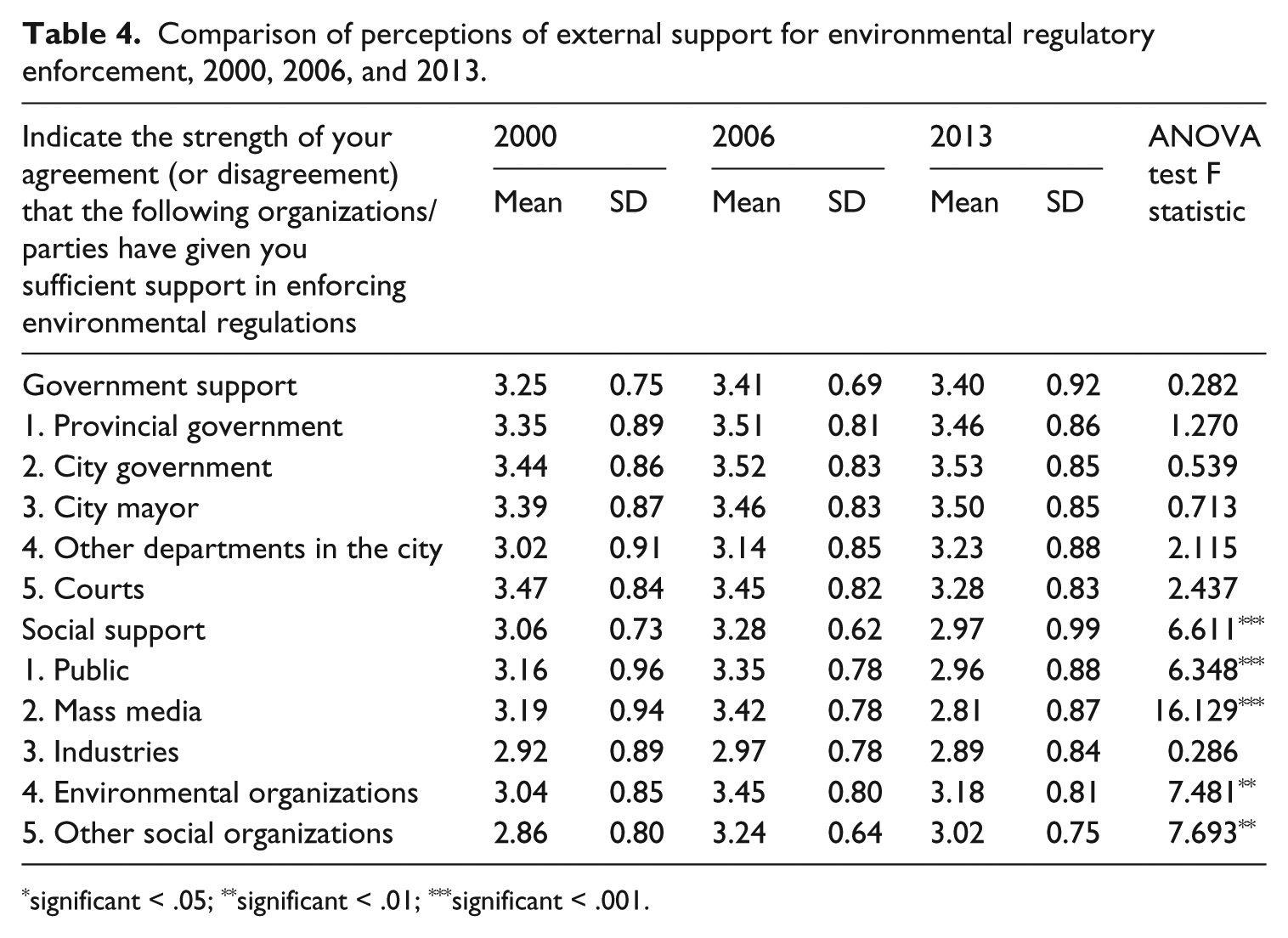
Enforcement officials’ perception of external support for their regulatory enforcement is based on two aspects: governmental support and societal support. The major findings with regard to the changes in external support are reported in Table 4.
Comparison of perceptions of external support for environmental regulatory enforcement, 2000, 2006, and 2013.
significant < .05; **significant < .01; ***significant < .001.
Governmental support
Five questions were used to measure the extent to which respondents felt supported by various local and regional authorities: provincial government, city government, city mayor, other government departments in the city, and the courts. Our findings reveal that changes over time in local government support for enforcing environmental regulations were not significant (F = 0.282; with 2 degrees of freedom; p = 0.754). In addition, changes across the selected five government entities were also insignificant. This suggests that the respondents tended to perceive the level of support from all these government authorities as being consistently similar.
A more dynamic picture can be observed from the ranking patterns. First, the municipal government has consistently been the major source of political support from the perspective of enforcement officials: the means have continuously improved, with top rankings and percentage of endorsement consistently higher than 50% in all three surveys. Second, the respondents consistently ranked support from other government departments the lowest, indicating the persistence of difficulties in conducting joint agency efforts in environmental regulatory enforcement. This trend is quite worrying, as there was a drop in the percentage of endorsement from 34.5% to 33.5% between 2006 and 2013. Third, there were negative changes in the perception of support from the courts, probably owing to the fact that the judicial courts, in handling the increasing number of administrative lawsuits filed by sanctioned enterprises against environmental protection bureaus’ sanctioning orders, may not always rule in their favour. Perhaps the most interesting finding is the locus of the city mayor’s support: while perceived mayoral support was ranked behind the city and provincial governments, there was a significant positive change between the 2000 and the 2013 surveys, as the percentage of endorsement jumped from 44.1% to 55.2%. This seems to suggest the growing institutionalization of environmental governance in the city, and less dependence on the individual city mayor’s policy preferences.
Societal support
Another five items were used to measure societal support, namely, the public, mass media, industries, environmental organizations and other social groups. Unlike the relatively stable support received from government entities, we found significant variations over time in societal support for enforcing environmental regulations in the past 13 years (F = 6.611; with 2 degrees of freedom; p < 0.001). Societal support increased from 2000 to 2006 (p < 0.05). Nevertheless, this support dropped significantly between 2006 and 2013 (p < 0.01). Considerable changes were detected in all societal sectors, except industrial entities. On the one hand, support from both the public and the mass media remained stable between 2000 and 2006 (as evidenced by insignificant increases), but underwent significant decreases from 2006 to 2013 (p < 0.01 and p < 0.001, respectively). However, it should be noted that mass media support as perceived in 2013 is still significantly higher than it was in 2000 (p < 0.01). Change over time in support from social environmental organizations and other social entities shows a similar trend: there was significantly more support from both sectors in 2006 than in 2000 (p < 0.001). This support dropped from 2006 to 2013 (p < 0.05 and p < 0.1, respectively).
Where changes in societal support are concerned, there is a lack of any consistent ranking patterns across these three surveys. Such trends appear to go against the conventional wisdom of rising societal support for regulatory control of industrial pollution as society advances economically, socially and politically. In particular, the downward trend of perceived societal support from the 2006 to the 2013 surveys is a source of concern. However, the picture is not completely gloomy. One important positive change was detected: the perceived support from all five social sectors (public, mass media, industries, environmental organizations, and other social organizations) increased significantly, as reflected in the percentage of positive ratings from the respondents in the 2013 survey compared with those in 2000. Specifically, perceived support for regulatory enforcement from industry improved over time, as the percentage of endorsement increased from 25.3% and 25.4% in the 2000 and 2006 surveys to 36.5% in the 2013 survey. In addition, it was encouraging to see that environmental organizations were consecutively ranked top of the list for societal support in the last two surveys, indicating enforcement officials’ growing receptiveness toward their active role in pollution control.
Changes in institutional constraints
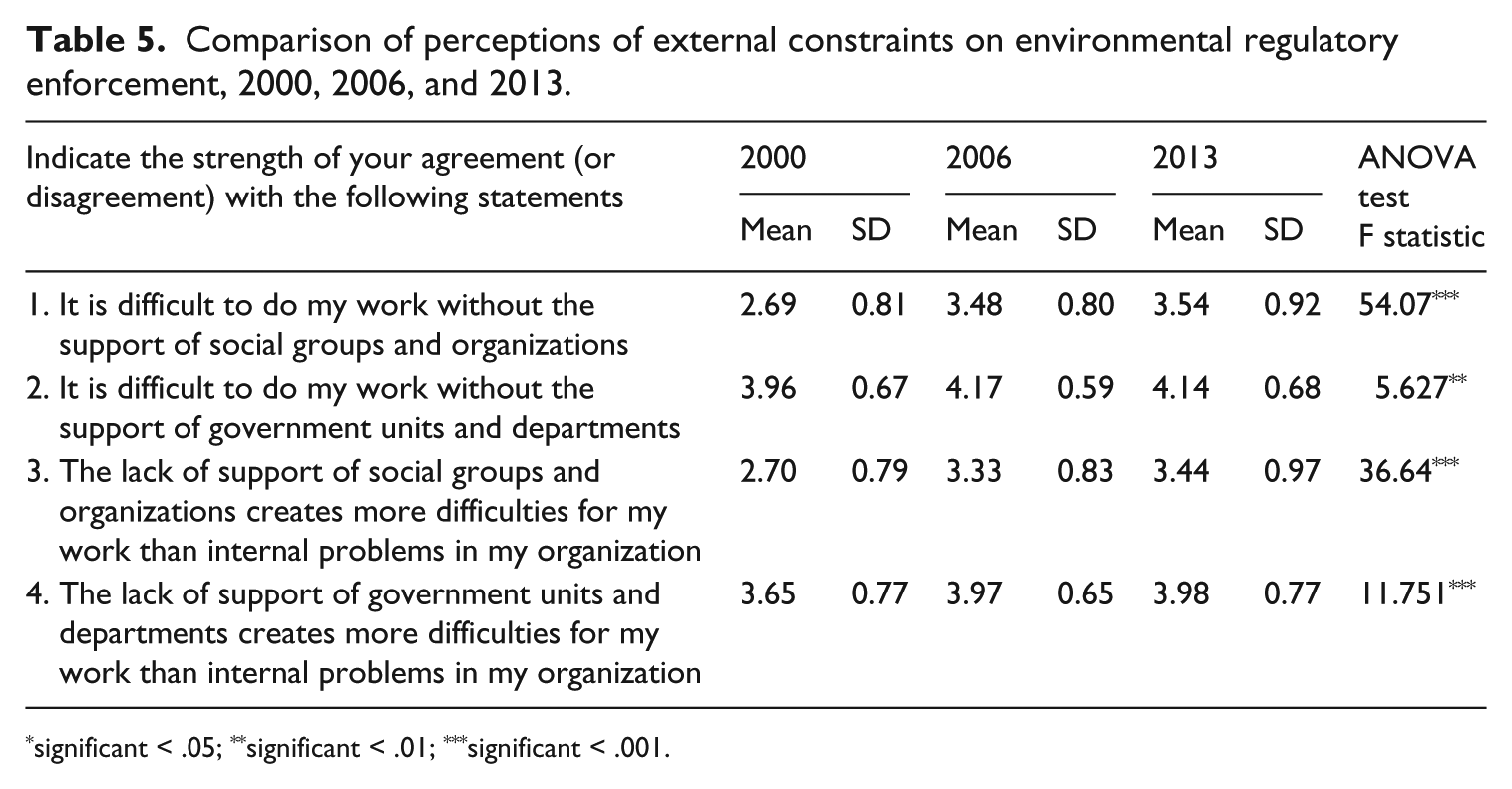
Table 5 summarizes our findings concerning changes in institutional strengths and external support for regulatory enforcement. These findings indicate significant over-time changes in the perceived importance of both societal support (F = 54.07; with 2 degrees of freedom; p < 0.001) and government support (F = 5.627; with 2 degrees of freedom; p < 0.01). Interestingly, both changes took place from 2000 to 2006 (p < 0.001 and p < 0.05, respectively), while enforcement officials’ perceptions remained relatively stable between 2006 and 2013. More specifically, in the 2000 survey, on average, respondents disagreed that a lack of social support makes enforcement difficult (mean value = 2.69), while average agreement was detected in both the 2006 and 2013 surveys (mean value = 3.48 and 3.54, respectively). These changes strongly suggest that in the past 13 years, enforcement officials have increasingly considered that the lack of both social and government support creates more difficulties for enforcement work than internal problems in their bureau (F = 36.64, p < 0.001; F = 11.751, p < 0.001). Both changes took place during the first half of the period (p < 0.001), while enforcement officials’ perceptions remained stable from 2006–2013.
Comparison of perceptions of external constraints on environmental regulatory enforcement, 2000, 2006, and 2013.
significant < .05; **significant < .01; ***significant < .001.
Government support for environmental regulatory enforcement remains an overwhelmingly important factor, because the percentage of respondents who agreed with the statement that ‘it is difficult to do my work without the support of government units and departments’ stayed consistently high, at 88.5% (2000) and above (91.1% in the 2006 survey and 89.8% in the 2013 survey). At the same time, the percentage of respondents who felt that the lack of support of government units and department created more difficulties for their work than internal problems in their organization increased steadily from 74.7% in the 2000 survey to 80.3% in 2006 and 83.1% in 2013. Quite unexpectedly, organizational strengths appear to be of less importance in the findings, as only 20.8%, 39.4% and 50.2% of the enforcement officials agreed that ‘internal organizational problems cause major difficulties in the enforcement of environmental regulations’ in the three surveys, respectively. Even societal support was seen as more important than organizational strength for effective enforcement: 31.9% (2000), 44.9% (2006) and 52.8% (2013) of respondents agreed with the statement, ‘the lack of support of social groups and organizations creates more difficulties for my work than internal problems in my organization’. This pattern of perception concerning difficulties in environmental regulatory enforcement was basically shared among enforcement officials across the three periods.
Changes in the effectiveness of regulatory enforcement
To what extent have the changing conditions of environmental regulation in Guangzhou presented thus far (i.e. in terms of the changes in environmental officials’ pro-environmental orientation, organizational capacity, and external political support) affected the effectiveness of environmental regulatory enforcement in this period? Given the difficulties of developing any objective measures of enforcement effectiveness, we used self-reporting. Accordingly, the respondents in individual surveys were asked whether they agreed or disagreed, on a five-point Likert scale, with the following three statements denoting the perceived effectiveness at the three different levels of the individual, unit, and bureau: Overall, I am effectively enforcing environmental laws and regulations. Overall, my unit is effectively enforcing environmental regulations. Overall, the environmental protection bureau is effectively enforcing environmental regulations.
This three-item scale demonstrated a marginal level of internal consistency with a Cronbach’s alpha of 0.823, 0.74, and 0.82 in each of the three surveys, providing an adequate basis for analysing their relative differences.
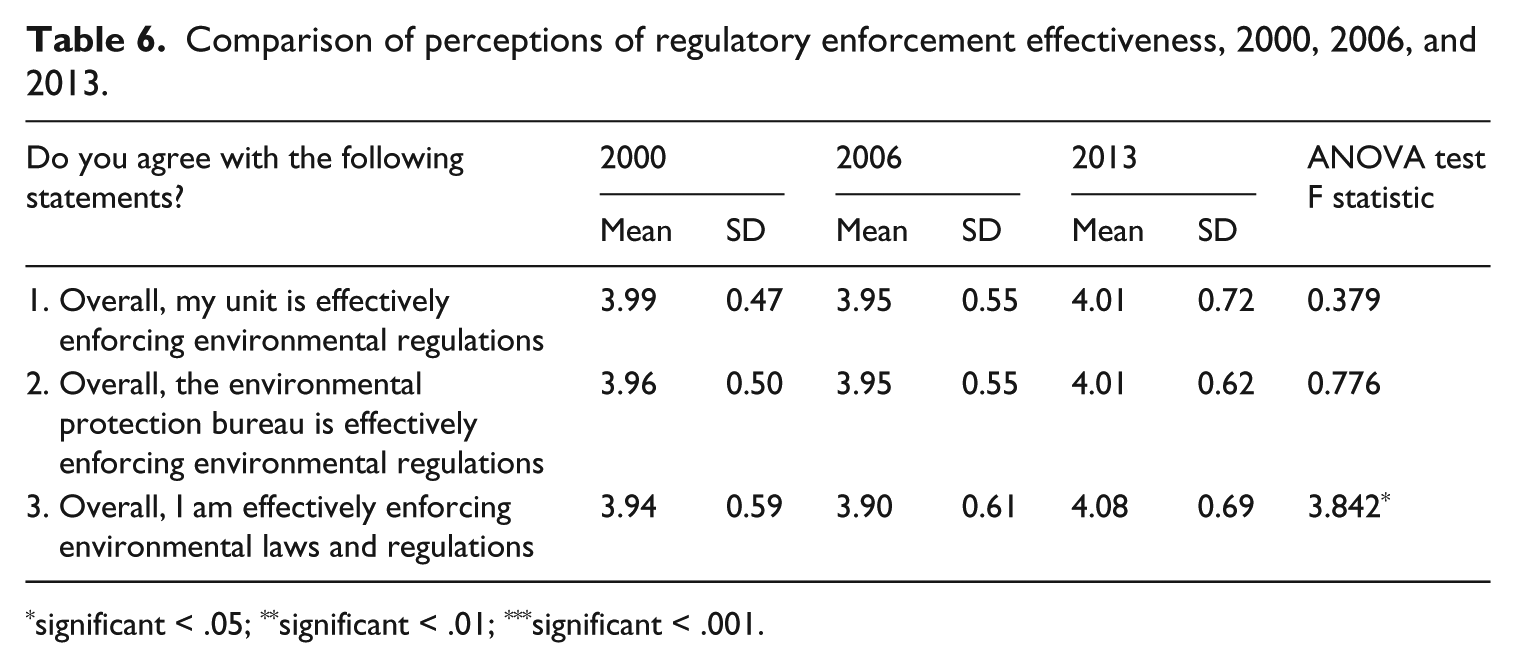
The results suggest that the over-time changes of unit-level and bureau-level effectiveness are not significant (F = 0.379 and F = 0.776, respectively; with 2 degrees of freedom), whereas individual enforcement effectiveness improved considerably over the past 13 years (F = 3.842; with 2 degrees of freedom; p < 0.05). These changes took place mainly from 2006 to 2013 (p < 0.05), with a mean value increase from 3.90 (less than agree) to 4.08 (more than agree).
The major findings regarding enforcement officials’ perceptions of enforcement effectiveness are summarized in Table 6. The trend of regulatory enforcement presented is quite positive, as the means for each effectiveness item in the 2013 survey were all above 4.0, higher than in the other two surveys (although the variations are not statistically significant). Taking a closer look at the three samples in different survey periods, the majority of respondents agreed (or strongly agreed) that regulatory enforcement was effective at the level of the bureau (81.7% in 2000; 84.7% in 2006; and 86.5% in 2013), unit (82.7% in 2000; 84.7% in 2006; and 86.5% in 2013) and individual (82.7% in 2000; 84.8% in 2006; and 85.0% in 2013). In particular, the increase in the percentage of respondents who strongly agreed is very visible across all three categories: bureau (7.4% in 2000; 11.5% in 2006; and 17.4% in 2013), unit (7.9% in 2000; 9.6% in 2006; and 19.8% in 2013) and individual (9.6% in 2006; and 25.1% in 2013). The fact that respondents in the 2013 surveys were among the youngest and the best educated, with the highest technical competence, may explain their high confidence in their personal enforcement capacity.
Comparison of perceptions of regulatory enforcement effectiveness, 2000, 2006, and 2013.
significant < .05; **significant < .01; ***significant < .001.
While the trend of perceived effectiveness is consistent with the gradual alleviation of the polluting environment in Guangzhou, it is notable that there is a gap between the perceived effectiveness at the level of the bureau and unit on the one hand and the individual on the other. A possible explanation is that enforcement officials may perceive that they have steadily improved enforcement effectiveness over time, but the effect may be limited for all kinds of reasons, most notably that the scale of environmental problems has intensified in a way far exceeding the growth of enforcement capacity. In addition, the perceptual evaluation of organizational enforcement effectiveness may have been based on a more ambitious benchmark over time. This ‘moving target effect’ on the perception of enforcement effectiveness could be quite strong among environmental officials in the context of Guangzhou’s fast-growing economy, where local citizens’ expectations of environmental quality have kept rising as material conditions improve.
Discussion and conclusion
Regulatory control of industrial pollution in urban China has consistently been a top priority, because of the presence of tens of thousands of polluting enterprises over decades of economic transformation through rapid industrialization of suburban surroundings. While a great majority of polluting enterprises in urban districts have been either relocated to designated industrial areas, closed down, or technologically upgraded to address increasing sustainability concerns, the fast pace of industrial and urban expansion has offset much of this pollution reduction effort. Concurrent with this greening development is the growing demand for more effective control of industrial pollution from an increasingly affluent public that expect improvements and solutions which ensure the eco-quality of urban life. 31 Added to this is the green awakening of political leaders from central to municipal level, who have come to acknowledge the limits of a polluting path of economic development and have endeavoured to make a transition to a low carbon economy. 32 The eco-friendly urban city concept has received wide attention and greater acceptance, effecting a change in the institutional environment in favour of tighter and more stringent regulatory control of industrial pollution.
In light of these changes, how far have institutional environments been improved for more effective enforcement of environmental regulation in urban China? How far have enforcement officials in urban environmental protection bureaus been able to effectively enforce pollution control regulations? Our time-series surveys of Guangzhou Environmental Protection Bureau’s enforcement officials provide us with solid empirical bases for answering these questions, particularly in terms of Guangzhou’s development trajectory.
There are two major sets of findings in this study. The first relates to factors that facilitate more effective regulatory enforcement. First, enforcement officials in Guangzhou Environmental Protection Bureau reported their pro-environmental values in all three surveys, with a rising trend from 2000 to 2013. This is an encouraging sign, because officials’ pro-growth orientation in the past was found to be one of the major reasons for lax enforcement. Their rising environmental orientation has probably increased the legitimacy of regulatory policies, provided stronger motivation for their enforcement actions, and fuelled greater demand for more positive enforcement outcomes.
In addition, the enforcement officials’ perception of the degree of support received from the municipal government, city mayor and other bureaucratic authorities for performing their enforcement duties has steadily increased over time. This suggests that the municipal government is less obsessed with economic growth than previously; between 2000 and 2006 the municipal government set two ‘eco-missions’ of becoming a green model city by 2007 and hosting a green Asian Games in 2010. It therefore acted more aggressively in pollution control to accomplish these two tasks.
The implementation of the widely publicized environmental quality administrative leadership responsibility system since 2000 to enhance accountability may account for the positive development of stronger local government support for pollution control in Guangzhou. Under this environmental leadership responsibility system, the entire municipal government bureaucracy from the level of city down to local bureau is responsible for improving the quality of the ecological environment in their respective jurisdictions. All government authorities must incorporate specific environmental objectives and measurable pollution control targets into their annual plans in the form of contractual obligations. Leading officials are then evaluated annually by a higher level of government, which has the authority to appoint, reappoint or remove the officials according to a set of pre-determined performance indicators and targets. Although this responsibility system has been implemented to varying degrees in different jurisdictions, environmental quality has already gone beyond mere formality and is increasingly taken more seriously in the evaluation of a local leader’s performance and career prospects.
Thus governments at lower levels and individual authorities face increasingly greater pressure from their superiors to intensify their efforts to combat industrial pollution. For example, under tremendous pressure from the municipal government and after more than 10 years of strong local resistance, the Guangzhou Environmental Protection Bureau finally closed down dozens of jeans factories in one of Guangzhou’s county villages, which were notorious for flagrant water pollution offences. A sharp contrast is provided by the county government of Panyu, one of the most resourceful counties in Guangzhou, which has continually committed additional resources to support its environmental protection bureau in pollution control.
Finally, only the respondents in the 2006 survey perceived a relatively high level of support from society in the performance of their enforcement duties. All sources of societal support increased significantly from 2000 to 2006, and then declined quite visibly from 2006 to 2013. The biggest fluctuation is seen in perceived support from the general public and the mass media, which have been increasingly conscious of the adverse impact of industrial pollution, evidenced by the rising trend of public complaints and the increasingly aggressive media reporting of pollution incidents. Both have been potentially important allies for environmental agencies in their long-term battle to counter bureaucratic pressure against stringent enforcement. How can this be explained? We were told by leading officials of Guangzhou Environmental Protection Bureau’s enforcement teams in recent interviews that handling popular complaints was time-consuming and, worst of all, much of their enforcement effort had been distracted from controlling major pollution sources to checking minor pollution cases, such as excessive noise from nearby restaurants’ air conditioners. Similarly, handling media inquiries was proving non-rewarding, and the media’s out-of-context reports very often undermined staff morale and created trouble for them. In short, it is possible that enforcement officials will see the public and mass media changing their position, from supportive forces to obstacles. Perhaps the industrial sector is the greatest disappointment: their lukewarm support for enforcement action has been quite clear in this 13-year period, highlighted by their passivity in greening their polluting operations. The picture is not all that bleak because of the steady support from environmental and social organizations since the sharp increase from 2000 to 2006. Although the effect of social forces in supporting enforcement remains uncertain, it is encouraging to see the gradual emergence of green non-governmental organizations and their growing participation in Guangzhou’s environmental protection community in the last few years.
The second set of findings relates to enforcement obstacles. The growth of the institutional strengths of the Guangzhou Environmental Protection Bureau in this 13-year period appears to be slow: organizational capacity continues to be severely constrained by a lack of resources; enforcement power has not been appropriately strengthened, marked by inadequate administrative authority over polluting enterprises; procedural ambiguity has gradually emerged as a major organizational problem in that enforcement officials have increasingly felt that the instructions and rules were excessive, confusing, and even conflicting; and administrative ambiguity has shown no explicit signs of improvement in terms of better internal communication and coordination. The lack of adequate resources is a general and chronic problem in China’s environmental administrative system. In particular, there is a widely perceived shortage of manpower in the face of the ongoing expansion of the industrial sector and the growing complexity of enforcement duties. Guangzhou Environmental Protection Bureau is no exception, and it continually makes requests for additional staff to strengthen the capacity of its enforcement teams. It is worth noting that the impact of strict implementation of the policy ‘two separate lines for revenues and expenses’ (收支两条线) on the bureau’s financial budget was negligible in this period because of the government’s strong financial commitment to the green transformation of the city.
Although the traditionally strong economic orientation of the Guangzhou government and local-level authorities has been considerably tempered by the urgent need to control pollution, the Guangzhou Environmental Protection Bureau and its local counterparts have remained in a relatively weaker position in the bureaucratic setting, with little hope for any immediate determination at the municipal level to rectify this imbalance of power. This general perception of inferior bureaucratic rank has persisted for years, manifested in the frequent complaints of interviewed enforcement officials over the rejection of their request for uniforms to carry out enforcement duties, and the lack of authority to close down polluting factories or to stop their production operations. Therefore, it should not be a surprise that respondents in each of the three surveys indicated the difficulty of obtaining active support and cooperation from other bureaucratic authorities to conduct stringent enforcement. An example repeatedly cited by the enforcement officials during interviews is the passivity and reluctance of public security bureaus at different levels to work closely with their local environmental protection bureaus’ enforcement schedule for controlling roadside vehicular emissions. As for the regulatory enforcement, enforcement officials persistently perceive their limited authority in discharging regulatory control over polluting enterprises. In particular, the feeling that they do not have adequate discretionary power to handle the growing complexity of pollution control has become stronger as enterprises have increasingly used tricks and exploited legal loopholes to block and frustrate their enforcement actions. These perceptions of inadequate authority were probably stronger in the past, when a great majority of polluting enterprises were either sponsored by or directly owned by local government authorities. A more recent development is that enterprises very frequently bring their violation cases to court in order to buy time to keep their production going and at the same time to delay sanctions. We were told that this lack of cooperation has been gradually reversed in the last few years as individual bureau chiefs are instructed to set pollution control targets for their organizations in the form of contractual arrangements under the environmental quality responsibility system and, at the same time, the number of state-owned enterprises with strong bargaining power has been greatly reduced because of a new emphasis in policy to separate government from enterprises. Nevertheless, inadequate legal instruments could curb the long-term effectiveness of various administrative measures to enhance the efficacy of environmental regulatory agencies.
Finally, although enforcement officials’ knowledge and technical competence have improved over time, building a competent enforcement team continues to be a challenge in Guangzhou’s county environmental protection bureaus. Deficient local budgets, living conditions, and inferior career prospects have consistently put county environmental protection bureaus at a disadvantage compared with their urban counterparts. Attracting well-qualified candidates to staff county bureaus is another challenge. The general practice is to recruit from urban environmental protection bureaus. For example, the current deputy chief of Zengcheng District Environmental Protection Bureau was formerly a mid-ranking employee in Guangzhou Research Institute of Environmental Protection Science, a research arm of Guangzhou Environmental Protection Bureau. Due to the proliferation and intensification of tasks entailed in pollution control and problems associated with understaffing, it is not easy to provide regular on-the-job training to upgrade the competence of existing enforcement officials.
These two sets of findings provide a strong empirical basis for determining how far the institutional conditions in Guangzhou City have changed to facilitate more effective enforcement of pollution control regulation over time from 2000 to 2013. The assessments, summarized in Table 7, show that the preconditions for stricter enforcement were visibly improved from 2000 to 2006, but only moderately between 2006 and 2013.
An assessment of the changes in the preconditions for effective regulatory enforcement in Guangzhou, 2000, 2006, and 2013.
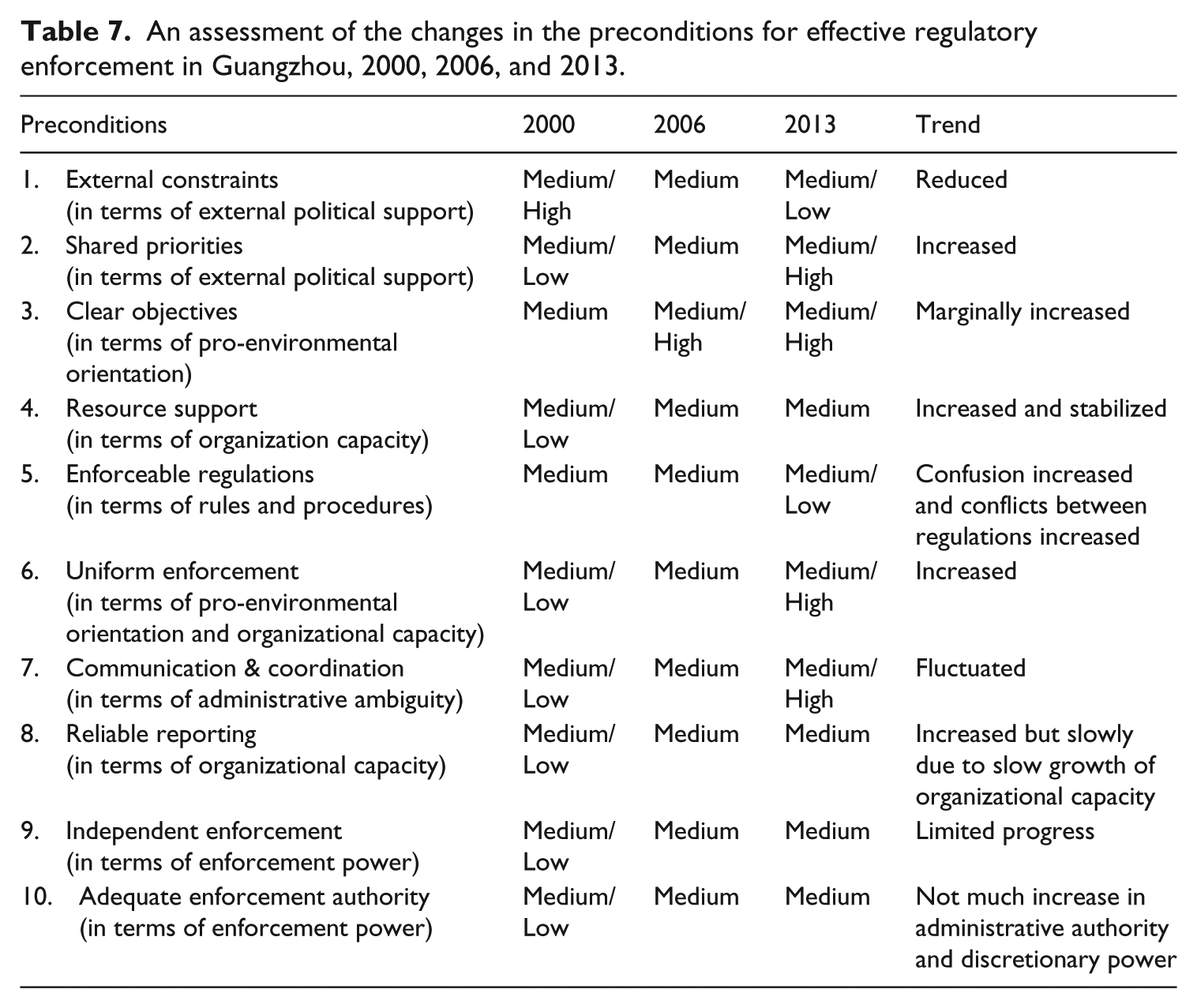
The pattern presented here indicates a notable improvement in the institutional environment for the regulatory control of industrial pollution by 2013, in contrast with the situation in 2000 when the institutional environment was more constrained. Here, the pre-conditions of enforceable regulations, independent enforcement, and adequate enforcement authority appear to have contributed towards some improvement. The most pressing issue is resource support, which has not increased in proportion to the growing complexity and magnitude of the enforcement task. In terms of procedural ambiguity, this has caused communication and coordination to emerge as an area of concern. After notable increases in external political support, shared priorities, clear objectives, and uniform enforcement, environmental officials assessed the effectiveness of their enforcement actions quite positively in the 2013 survey. The high rating given to effective enforcement may suggest that major obstacles to more vigorous regulatory enforcement have gradually been removed. On the whole, we may conclude that the contextual setting for the regulatory control of industrial pollution in Guangzhou has changed from one marked by constraints and lack of cooperation to one that is more receptive and supportive.