




Abstract
This article discusses state-led heritagization processes in Beichuan and Wenchuan Counties, two Qiang ethnic minority areas severely affected by the 2008 Wenchuan earthquake (China). Certain destroyed landscapes were preserved and turned into earthquake relic sites. In particular, the former Beichuan County seat was entirely heritagized for memorial, economic, and patriotic education purposes, causing an emotional conflict with locals still affected by loss and trauma. At the same time, Qiang cultural practices were hastily registered as national and international intangible cultural heritage, while reconstructed Qiang villages were transformed into heritage tourism destinations. These initiatives tend to reshape Qiang culture elements into fetishized commodities. Allocating massive funds to historically marginalized regions, these post-disaster heritagization programmes aimed at boosting economic recovery, as well as demonstrating state power, national unity and solidarity. Implemented using a top–down method, they appear insensitive to the affected population’s trauma and the sociohistorical context from which the newly heritagized elements originate. The disaster and Qiang culture heritage tourism not only failed to bring about sustainable economic development to the earthquake-stricken areas, but also ignored to a large extent the initial goal of ‘post-disaster cultural recovery’ and the virtues of cultural heritage in recovery processes.
Keywords
While the Chinese government has a long history of dealing with disasters, rescue and recovery plans have not always involved cultural heritage. Following the country’s entry into the ‘Heritage Regime’, 1 official response to disaster increasingly includes cultural heritage. The 8.0 magnitude 2008 Wenchuan earthquake prompted unprecedented ‘urgent’ and ‘special’ ‘cultural recovery’ measures, 2 which scholars proposed to the state a few weeks after the disaster devastated Northwestern Sichuan. With a heavy casualty count of close to 70,000 and a direct economic loss of over RMB 843 billion, the earthquake was ‘the most destructive one with the widest affecting scope and most serious disaster-induced losses ever since the founding of the People’s Republic in 1949’. 3 The safeguard and preservation of cultural heritage became a major part of the state-led cultural recovery. Such projects included reconstructing the heavily affected ethnic minority Qiang’s (羌) tangible heritage (e.g. museums, watchtowers, and villages) and intangible cultural heritage (epics, skills, and folk arts), as well as making earthquake ruins into heritage sites (e.g. Yingxiu Middle school, Luobo Village and Beichuan City). Included in the state’s emergency plan and funded by massive public and private donations, cultural recovery measures were presented as important mechanisms for economic, cultural and social recovery as well as redevelopment. They would facilitate the economic recovery mainly through tourism, and the state-asserted ‘culturally sensitive recovery’ by ‘rebuilding’ the affected population’s traditional knowledge and practices. In addition, the preservation of ruins sites was thought to facilitate mourning, commemoration and to promote risk education.
Almost 10 years after the launch of this heritage preservation programme, this article explores the implications and effectiveness of these goals. Enforced in all affected counties, the promotion of Qiang intangible cultural heritage and the making of disaster ruins as heritage sites are closely intertwined processes, both in implemented projects and in local people’s experiences. We present two case studies: the Beichuan County seat preserved ruins site and Qiang villages in Longxi Township (Wenchuan County).
Data were mainly collected through ethnographic fieldwork in which we joined local families in their daily lives, which allowed participant observation and informal discussions (in Mandarin and Sichuan dialects exclusively). We met informants through personal networks and serendipitously in local public spaces. We also conducted interviews with local officials, heritage scholars and Qiang cultural specialists, and carried out archival research on official documents, media reports and tourist blogs. While the methodology of the two cases is similar, their context is not. The fieldwork in Wenchuan was part of a five-year-long study focusing on the state-claimed cultural recovery in the ethnic minority Qiang villages. Data analysed in this article include more than 100 interviews (structured and informal), two surveys and multiple ritual performance recordings collected between 2013 and 2014. The Beichuan case is based on one month of fieldwork in September 2015 as part of a 12-year-long study on cultural heritage protection plans and cultural policy measures in the context of territorial upheavals in the Sichuanese area. The repeated occurrence of the destroyed city in conversations with people encountered in the field (approximately 50 people, with additional in-depth discussions held with six families) allowed for an overview of the local significance of the preserved Beichuan city.
This study centres on the following question: is heritagization the most suitable initiative for the sociocultural recovery of a population impacted by a disaster? The heritagization we refer to is not the ideal of safeguarding endangered cultural elements, but the process commonly implemented worldwide. Synthesizing academic discussions on the topic, Ahmed Skounti recalls its characteristics: a complex normative and institutional process through which cultural and natural elements in time receive the status of heritage, elements worthy of being preserved, enhanced and transmitted. 4 Heritagization is known to be a construction process inducing both a devaluation, through selection and delimitation, as well as a revaluation involving changes and redefinition, reflecting the needs of the present rather than past configurations. 5 Heritagization is tangled in a web of socio-economic and ideological issues, and is, especially in China, characterized by heavy state control and a lack of citizen involvement. 6 As Stevan Harrell has stated, ‘Contemporary China is not the land of popular initiative. Almost everything in China happens from the top down. . . . Cultural heritage projects are no exception … leaders have little actual faith in the people’s ability to know what they need to be served.’ 7 These characteristics of heritagization, identified by scholars and during our fieldwork, triggered doubts about its pertinence in disaster contexts. Our research question is less about heritagization itself than its alleged purpose in recovery plans. In the wake of the Wenchuan earthquake, academics brought the attention of policymakers and popular media to cultural heritage’s crucial role in rebuilding social, symbolic, and cultural structures. Yet, fieldwork in Beichuan and Wenchuan reveals the disappointing outcome of post-disaster heritage programmes, which, although well funded, led to perverse side effects. We discuss four critical issues.
First, to what extent does heritagization help affected areas rebuild a sustainable economic structure? In post-disaster contexts, economic recovery is decisive; means of living need to be restored. Reconstruction projects based on tourism are not uncommon. Not only is local culture seized as a resource, but the disaster itself may be considered valuable capital. After Hurricane Katrina on the US Gulf Coast, tourist trips to New Orleans were promoted as a citizen’s duty of solidarity. 8 However, as Julie Hernandez indicates, post-disaster tourism is not without controversy. Dark tourism, as it is called, raises ethical concerns about respecting the deceased and the survivors. 9 Verifying policies and processes identified in other post-disaster contexts, our study further explores the issue by analysing effects at the micro-local level in the medium term. After the Wenchuan earthquake, newly heritagized disaster ruins and Qiang cultural practices were combined to foster new tourist destinations, selling an authentic, sensitive and emotional experience relying on a commodification of both the living and the dead. Their economic sustainability being seriously challenged, these initiatives sparked criticism among the local people. More importantly, as the economic goal took precedence, psychological and cultural recovery, which the heritagization projects were supposed to facilitate, was largely neglected.
The first section of the article more specifically focuses on yet another issue: how does disaster ruins heritagization help or, in this case, disrupt the healing process? Preserved sites of tragedy (related to war, terrorist attacks, slavery and genocide) and the acts of memorialization associated with them have long been recognized as both pedagogical and therapeutic. In post-disaster contexts, they may encourage coping mechanisms 10 and reconstruction initiatives, 11 as well as serve as vehicles for personal mourning and death-pacifying rituals. 12 They provide spaces to publicly acknowledge victims and their suffering, as well as identify perpetrators and risks, so survivors can overcome adversity, and society can learn from the past. However, our research identifies certain conditions in which adverse effects are observable in the medium term. The Beichuan case presents another far less appealing outcome of heritagizing the earthquake ruins and memorial sites. The complicated relationship locals have with preserved ruins highlights the importance of carefully planning such initiatives in contexts of disaster with mass fatalities.
The second section of the article focuses on a third issue: the implications and fallout of making Qiang intangible cultural heritage as part of the culturally sensitive recovery. According to anthropologists and heritage professionals, cultural heritage plays an important role in satisfying the local people’s sociopsychological and cultural needs and helps them recover their sense of community and equilibrium after disturbing events. A growing number of scholars regard heritage as an agent of solidarity, ensuring social cohesion. For Joseph King and Gamini Wijesuriya, communities may experience further vulnerability when post-disaster recovery plans ignore heritage and cultural continuity. 13 After the 2011 Japan multi-disaster event, several Japanese researchers explored how folk performing arts helped people positively overcome the tragedy and restore communities. 14 While this effort is highly worthwhile, initiatives related to cultural heritage in disaster contexts may turn out to misunderstand or ignore the very principles of cultural and sociopsychological recovery. In the aftermath of the Wenchuan earthquake, the commodification of Qiang cultural heritage overwhelmed cultural recovery. Our research in Longxi explores paradoxes within and adverse reactions to projects more focused on reinventing local traditions to entertain visitors than on helping affected communities to reconstruct their sociocultural realm.
Finally, ideological and political issues are found in both case studies. These issues are known to be deeply embedded in state-, private- and association-led heritage protection initiatives. Heritagization projects in post-disaster areas can become platforms for protests. 15 However, when criticism and anger towards governing bodies, which failed to adequately prepare for or manage the crisis, are high, cultural heritage can be exploited to promote an official agenda, to direct the emotional aftermath towards solidarity and national pride. 16 Unsurprisingly, in China, where heritage laws already stipulate a galvanization of patriotism, post-Wenchuan earthquake heritage projects served to promote social stability, state power and national unity under the protective wing of the party. Heritage projects were included in the state’s spectacular outpouring of resources. This expenditure served mainly to neutralize rising criticism of and protest against how slipshod development projects (such as building dams in a seismic area) and corruption of state officials (reflected in the shoddy school buildings causing the deaths of many children) worsened the heavy damages of the earthquake. 17 The swift disaster relief and heritage rescue work also helped to renew trust in the government and bolster national pride at a time when China was to host its first ever Olympic Games, and in the troubled context created by a series of disturbances such as a heavy snowstorm in January and social unrest in Tibet in March. 18
The challenging dilemma of heritagizing a fatal earthquake’s ruins
On 12 May 2008, the Wenchuan earthquake lasted merely 80 seconds, but it had a devastating impact in Northwest Sichuan. In its aftermath, the primary goal was to rebuild. Yet, parts of ‘the landscapes marked by the earthquake’ were considered resources to be exploited. Enthusiastic scholars proposed related plans, 19 later supported by high officials and implemented by local governments. In Wenchuan, Beichuan and Qingchuan counties, several sites of destruction were kept intact, secured and equipped for tourists and official mourning. This section examines the case of ‘Beichuan earthquake relics site’, classified as Sichuan Province’s ‘ancient relic site’ in 2013. According to Qiao, our informant, after the city was declared uninhabitable and targeted for relocation, the local heritage bureau launched an application for the recognition of the wrecked city as a heritage site, inspired by the Port of Kobe Earthquake Memorial Park (Japanese national heritage). Since there was no category for disaster heritage, after inaugurating the site in 2009, they applied for the one related to ‘historical areas’. Officially, the state-funded project cost close to RMB 100 million.
Even though the Beichuan County seat was relatively distant from the earthquake epicentre, the town was severely damaged by rockslides, landslides and mudslides from surrounding mountains. Beichuan’s devastation hit the headlines, reported as shocking the world and causing grief in the whole nation. Wen Jiabao himself went to the scene to declare the entire city relocation a priority. The Beichuan earthquake site, with an area of 1.2 square kilometres, is advertised as the biggest catastrophe relic, the most severely destroyed and the best preserved in the world. After detailing the tourist experience and ideological framing of the site, we discuss the victims’ place in the preserved ruins and their impact on the survivors.
A time-encapsulated disaster in a ruined and romanticized city
Upon arrival, following the visitor trail, people first meander through the remains of the city’s oldest area which is now covered with vegetation. Tourists’ post-visit feedback on blogs often describe the place using romantic and dramatic language, 20 describing their experience in terms of ‘astonishment’, ‘overwhelming emotion’, ‘penetrating pain and incomparable sadness’ facing such ‘tragic violence’. The trail is strategically designed to pass by buildings in various states of destruction (Figure 1).

Tourists in Beichuan City earthquake relics site, Sichuan, China.
In the city’s modern area, half-collapsed high structures are secured using steel frames and beams. The buildings which catch one’s eye and camera lenses are the ones most heavily destroyed. The site’s claimed intention is to ‘engrave the memory of disaster and not forget the past’. But above all, going there in person offers a unique opportunity to ‘experience the earthquake’. For Song Yurong and Qing Qianlong, this is one of the main attractions for tourists visiting earthquake relics. 21 The fixed stage of the collapse provokes tingling sensations of amazement, danger even. It gives a surrealist impression of paper buildings ready to crumble. Reminders of this risk are displayed along the pathway, safety notices prohibiting visitors from approaching structures, climbing walls or crossing the guardrail. Witnessing the destruction in this way allows visitors to immerse themselves in a mild version of the event, giving a desired, or perhaps unwanted, thrill.
The Beichuan earthquake site is designed as a place to feel, not to read. It is equipped with very few explanation boards and maps. Visitors discover the disaster with their own senses. Post-visit feedback, especially from younger visitors, reveal this sense of understanding ‘at last’ the ‘terror’ and ‘desperation’ it caused. Song and Qing encourage local governments to exploit this thrill extensively, even to go as far as organizing meetings between survivors and tourists, to satisfy the latter with an enhanced experience. 22 In 2016, the Beichuan government opened the Earthquake Science Experience Centre below the ruins of Beichuan High School (where many students died). For a fee, two 4D dynamic cinemas offer visitors the experience of disasters and earthquakes depicted in animated cartoons and Hollywood movies.
Wenchuan earthquake relics sites were valued for their potential to become competitive world-famous destinations in the new global hotspot disaster tourism, an industry believed to help devastated areas regain sustainable economic development. In the years following the earthquake, local businesses flourished thanks to the flocking tourists, but currently few tourists come outside of peak seasons. In recent years, many shops and restaurants in the area closed because of a lack of customers. Moreover, entry into the Beichuan earthquake site is free since local people complained about the entrance fee of RMB 30, leaving the national government to cover all maintenance costs.
Promoting the disaster’s official narrative
The Beichuan earthquake site is built on the basis of providing patriotic education. Panels along the path encourage visitors to ‘work energetically for the country’s prosperity and glory’. The dozen identified ‘scenic ruins’ are mainly official buildings in front of which boards show their pre-earthquake state and indicate the death toll, the extent of the collapsed area and the type of losses (e.g. materials and archives). A short text follows, glorifying local officials’ and Chinese Communist Party (CCP) cadres’ quick and efficient reaction in maintaining public order, rescuing and evacuating people, salvaging precious materials, and rapidly resuming their responsibilities, all while ‘being heavily pressured and affected by grief themselves’.
This eulogy echoes exhibitions in the official Wenchuan earthquake museums erected in Beichuan and Anren (Sichuan), as well as exhibitions about other upheavals, such as the Three Gorges Dam Migration. In both cases, we find sections dedicated to CCP members and civil servants, including pictures of them carrying people on their back, attesting to their involvement. This is classic communist and Confucian promotion of virtuous authority figures, sacrificing themselves for the common people and the greater good. As stated previously, ‘Such [museum] displays attempt to rectify the public’s negative opinion of the authorities’ actions at the time of the earthquake and the building of the Dam by verifying the positive role of the state, Party cadres and government officials.’ 23 The official discourse might be accepted to some extent by outside visitors but, much like people in the Three Gorges Area, 24 local witnesses of the earthquake we met during fieldwork or those featured in independent documentaries 25 narrate their personal experiences of the people’s own rescue work, and of the local governments’ flaws or officials’ lack of accountability.
Victims’ presence and complicated worship in the heritage site
Although actively featured on boards, civil servants and CCP cadres are not the main protagonists of the Beichuan relics site. The dead are. Their presence is ubiquitous. Signs mention that about 20,000 people died there, but locals claim that many more lives were lost. Disputes over the death toll are typical between authorities and victim families in a disaster context, due to the difficulty in identifying casualties. 26 On the visitor trail’s yarn lines, equally spaced red pieces of cloth (typical Chinese offerings to spirits) are constant visual reminders of the deceased. The path is scattered with signs urging visitors to behave properly and respect the peaceful atmosphere. This emphasis echoes the heated discussions Chinese scholars had about opening earthquake sites. Favouring such endeavours to support economic reconstruction, historian Ge Jianxiong claimed that disaster tourism was not negative in itself, but ‘the theme must be solemn, dignified and respectful’, citing the Auschwitz concentration camp as a famous model. 27
Visitors to the Beichuan earthquake site are given the opportunity to honour the deceased at the Public Cemetery of Victims. It is a large elevated platform of green grass, enclosed by stones, trees and a wall displaying: ‘Let us commemorate with sincerity the compatriots who perished in the enormous earthquake of May 12th’ (see Figure 2).

Public cemetery for earthquake victims, Beichuan City earthquake relics site.
Officials, paying formal and well-publicized visits to the site, stop there to offer yellow chrysanthemums. Tourists’ post-visit feedback often mentioned the desire to pay respect to the victims with a moment of silence in this spot. This place appears to be much like a memorial, though it is not declared as one. The name ‘public cemetery’ might even be a little confusing for visitors, Chinese and Westerners alike, as there is no sign of either tombstones or victim names. Some tourists find the overall lack of clear identification of civilian and child victims at the site unacceptable. Their criticisms relate to a wider controversy over the concealment of the numbers of victims and their identities. The term ‘cemetery’ refers to the bodies buried in the mass grave under the platform. However, Beichuan people know only too well what this place is, locally referred to as ‘the pit’. During our fieldwork, they often talked about the victims’ bodies. In the earthquake’s chaotic aftermath, family members were not allowed to retrieve or identify the bodies. Deeply affected, locals recall how the victims were piled up there: ‘one layer of corpses, one layer of lime’.
For Ge Jianxiong, the Beichuan relics site should help the grieving process and contribute to the ‘spiritual’ aspect of the post-disaster recovery. 28 Beichuan people we met generally avoid the mass grave and do not go there for the private funeral practice known as ‘cleaning the tombs’. In line with tradition, many families have a proper ritual at a tomb erected in a favourable spot, burying clothes of the departed one, a practice known as 衣冠墓 (literally: clothes and hat tomb). If they know where their relatives died, they may perform the ritual at the site. Visitors may spot traces of such offerings next to a hill or a building, but the staff clear them up quickly.
Authorities understand the locals’ need to worship the dead and have established about half a dozen cement worship facilities near a few collapsed buildings. They are located along the visitor trail, making it possible for tourist groups to photograph families paying their respect. During fieldwork, Tang (a 26-year-old mechanic) brought the first author along for a journey to the city, to perform the mourning ritual with his son at the facility facing the collapsed building which buried his father. Out of curiosity or empathy, and perhaps with the hope of hearing a vivid tale to enhance her visit, a female tourist came forward and interrupted them, and asked whether his family perished there and whether he was present at the time of the earthquake. Tang did not mind being photographed from the back, but was clearly disturbed by the questions, coldly answering ‘Yes’ without even looking at her. It is clear that the local people are psychologically still affected by the disaster and their losses. Fieldwork showed that after their families were decimated, many survivors felt desperation for months, even years. Some of them are not yet able to voice their experience, overcome with guilt, long-term loss of appetite, deep depression and suicidal feelings. The presence of tourists in the destroyed city during funeral rituals put mourning families in an awkward situation, as they deal with private and sensitive matters.
The debatable efficiency of heritagizing disaster relics abhorred by survivors
Xia Xuelan was involved in the early controversy around the site. He claimed that such a tourist attraction was not appropriate and should be opened only after at least eight to 10 years, so that people had the time to forget and heal: ‘If we build now, it is like they are suffering another trauma.’ 29 Be that as it may, almost 10 years have already passed and the pain is still raw. During fieldwork, a local teenage girl pointed out that ‘the city is rebuilt, we are finally settled and life takes up its course again, and yet people haven’t found peace and serenity’. Locals frequently spoke to each other and to the researchers about how uncomfortable they were with the heritagized site. Tang had only been twice to pay respect to his father, driving straight to the worship facility. He mentioned the flourishing vegetation and how it made the site less unbearable, but he still experienced the visit as a struggle. Although mourning appeased them, the journey to the destroyed city was still an ordeal for many locals. An often-heard and repeated remark was: ‘This is the place I am the most unwilling to go to.’
The locals’ rejection is partially due to the occurrence of so many tragic deaths, which are considered a bad omen, creating a potentially dangerous site. Even tourists sometimes express a fear of disturbing the spirits. The locals’ aversion is also related to the wrecked appearance of their former homes filled with memories; bad ones, like the disaster, but also good ones, nostalgic memories of their loved ones, childhood, and cherished native town. Deng was in Chengdu in his first year at university when he lost both his parents in the earthquake. For him, the city has ‘changed beyond recognition’. Like many others, he often dreams about the former city, and still considers it his ‘natural harbour’. Wishing to keep his memory intact, Deng does not ever want to go back to the destroyed city. After the mourning visit, Tang stated that only the next generation (such as his son, mostly impressed by the place’s appearance) will be free from the burden of memory such a visit induces. In the meantime, the disaster is made omnipresent for the survivors, possibly even slowing down their grieving process. In addition, Beichuan people can hardly avoid the wrecked town as the only road connecting the villages in the valley to the new county seat runs through it. Visiting relatives, wedding processions, patients and newborns are forced to cross a city marked by death.
Li, a 45-year-old saleswoman, told us that the sight of the old city landscape was difficult to bear and it made her sad. She said, ‘Many people died there. I remember all too well the corpses covering the streets.’ She was annoyed when it opened for tourism. ‘This is not right, Beichuan’s whole population lost relatives there, it breaks their heart’, she complained. In Ai Xiaoming’s independent documentary, parents who lost their children also accused authorities of disrespect and turning them into tourism products. 30 Some web users expressed their concerns about this ethical dilemma, describing the tourist sites as being ‘disrespectful of the dead’, and accusing tourists of ‘running wild to rob tombs’. Some wondered if the remains of children would ever be excavated, ‘while the site was opening with great pomp and selling tickets for entertainment purposes’. Others defend the Beichuan project, arguing that it has an important role in commemorating victims and transmitting the event’s memory to younger generations to teach them about the harshness of nature and the possibility of overcoming difficulties with hard work.
For some scholars 31 and Qiao (who participated in the site application process, while avoiding the place where his wife died), earthquake relics must be exploited despite the heartache, for the sake of local economic development and employment opportunities. The Beichuan earthquake site initially served as a means of attracting tourists. They spent time and money in the new county seat, which was banking on the heritagization of Qiang culture. The media used Qiang people in forefront displays to depict the earthquake victims. However, Beichuan county’s economic recovery based on disaster heritagization does not seem to have encouraged sustainable economic and sociopsychological recovery. Can the same be said about the measures regarding Qiang cultural heritage?
Mixed outcome of preserving Qiang intangible cultural heritage in post-earthquake reconstructed villages
The Qiang are one of the 55 officially recognized ethnic minorities in China. Originally referring to a dozen ethnic groups in Western China who experienced frequent migration and intermingled with the Han, Tibetans and other groups, the ancient Qiang were one of the oldest ethnic groups recorded in the oracle bone scripts (produced over 3000 years ago). The population of contemporary, officially recognized Qiang is around 300,000 32 and they primarily reside in the mountainous regions of Northwestern Sichuan where the earthquake hit. The Qiang were severely affected. It is reported that about 10 per cent of the entire Qiang population was lost to the earthquake. Hundreds of Qiang villages and settlements were destroyed completely. Many Qiang cultural specialists, including bearers of rare knowledge and skills, ritual specialists and local historians, were killed. The Qiang’s material culture was also deeply affected. Relics of stone tombs and watchtowers, listed as Chinese national cultural heritage, were destroyed. Safeguarding and preserving the Qiang tangible and intangible cultural heritage were prioritized in the state’s reconstruction plan from the very beginning. Only 10 days after the disaster, Wen Jiabao proclaimed that the Qiang culture and civilization must be protected. 33 Among the principles listed in the ‘State Overall Planning for Post-Wenchuan Earthquake Restoration and Reconstruction’ released in 2008 and in ‘Guidelines for Developing Cultural Affairs of Ethnic Minorities’ drafted in 2009 were the preservation of local culture and the timely rescue of affected ethnic cultures. A noticeable result of this state-led culturally sensitive reconstruction was the prompt inclusion of several Qiang cultural practices in the Chinese and UNESCO Representative List of Intangible Cultural Heritage.
The next section discusses the emergency policies related to the preservation of Qiang intangible cultural heritage, implemented swiftly after the earthquake, revealing its complex relationship with recovery, economy, and state power. Research on the state-orchestrated celebration of the newly heritagized Qiang New Year Festival in Longxi Township shows paradoxes in safeguarding intangible cultural heritage: the social role and cultural significance of practices are transformed while the Qiang’s identity and lives are reshaped by heritage tourism.
Politics of the emergency preservation of Qiang culture
Quickly after the earthquake, the Qiang’s tragic situation was brought to the attention of the nation, while a number of state representatives and scholars simultaneously spun an emotional narrative around Qiang culture’s need for immediate rescue. However, Qiang practices and systems of beliefs were slowly disappearing long before this event, endangered by massive urbanization, rural exodus, and modernization, not to mention their long-lasting assimilation into the Han culture. Post-earthquake Qiang heritage initiatives were not without political implications. The Qiang’s quick and culturally sensitive recovery was considered an effective and affective showcase for the government to demonstrate its leadership in disaster relief and reconstruction. It also provided an opportunity to stage a spectacular show of benevolence towards affected populations who were portrayed as helpless in this narrative. In China, ethnic minorities are usually presented through a social evolutionist perspective. They are seen as backward, to be civilized, in need of guidance, and, more recently, as the ‘good savage’. 34 For the CCP’s propaganda to promote a well-managed disaster context, minorities are presented as being more ‘vulnerable’ and ‘better image’ victims than their Han counterparts.
As disaster ruins, reconstructed Qiang villages were oftentimes seen as platforms to allow people to ‘relive’ the ‘great spirit of the post-disaster relief’. The state and media magnified this idea of a ‘feeling of strong social cohesion’ and ‘an impregnable, strong unity of will in the whole nation’ after the earthquake, an idea periodically revived when visitors expressed their sympathies to survivors, who, in turn, transmitted their ‘gratitude’. 35 The ‘grateful culture’ campaign paired with Qiang cultural heritagization aimed, in this particular time of crisis, at strengthening the nationalist narrative of the multi-ethnic country. 36 Yet, the Qiang negotiate their ‘grateful’ status in an unbalanced power relationship.
In the heritage era, many ethnic minorities’ cultural practices, long regarded in China as primitive and superstitious, are registered as intangible cultural heritage. In most cases they are advertised as entertaining celebrations and educational snapshots of China’s great and diverse history, as well as displays of the state’s power and generosity. Nominating cultural elements for heritage status is a process of knowledge production and identity transformation, in which related practices are reshaped and reinterpreted before being upheld as heritage in need of safeguarding. The urgent rescue, preservation, and heritagization of the Qiang culture was top–down, state- and scholar-led. Soon after the Wenchuan earthquake, five Qiang practices were added to the national intangible cultural heritage list. Then, in 2009, the Qiang New Year was inscribed as UNESCO Intangible Cultural Heritage in Need of Urgent Safeguarding. Most of these elements did not follow the usual application procedure, requiring each element to be approved at the lowest hierarchical level for several years first before upgrading to the next level, and so on until reaching national intangible cultural heritage status. Thanks to the ‘urgent and special’ context, the application for Qiang intangible cultural heritage was rushed through the steps. Besides official recognition, this status allowed the appointment of Qiang practitioners (musicians, dancers, speakers, ritual specialists) as official ‘intangible cultural heritage transmitters’. They received subsidies and material support to promote and teach their skills. The heritagization of Qiang construction skills, embroidery skills and New Year Festival played an important role in the emergence of Qiang heritage tourism, officially endorsed as a positive development strategy. Most of the Qiang villages that were rebuilt as ‘traditional’ villages, supposedly with the goal of preserving Qiang lifestyles and cultural practices, were turned into tourist destinations. The fieldwork analysis raised issues with the outcome of the heritagization measures, which were intended to facilitate skill and knowledge transmission among the Qiang communities after the disaster.
Paradoxical effects of the urgent heritagization in a local Qiang village
An emblematic example of how the state reshapes Qiang practices through the heritagization programme is the so-called ‘Qiang New Year Festival’, advertised as the centrepiece of Qiang culture. This festival was inspired by an old village-level ritual in the region, which was held in mid-autumn (but non-annual) and overseen by Qiang ritual specialists, shibi (释比). It was dedicated to celebrating the harvest and worshipping gods for their blessings and power. The ritual was forbidden during the Cultural Revolution until 1987, when the previously variable event was arbitrarily set on the first day of October on the Chinese lunar calendar and stamped as Qiang New Year Festival. Like many ethnic ritual ceremonies in China, it was made to fit the Han-oriented orthodox model of New Year festivals. Officials, in collaboration with intellectual elites and official media, spearheaded these projects to uphold minority-specific events as showcases of the Qiang’s good lives and ethnic features under the leadership of the state. Listed as a Sichuan provincial intangible cultural heritage in 2006, this state-created festival was immediately named national intangible cultural heritage after the Wenchuan earthquake. In 2009, the UNESCO world committee added it to the List of Intangible Cultural Heritage in Need of Urgent Safeguarding, and extended its condolences to the Qiang people and local authorities for the devastating loss they suffered.
Since 2008, local governments have organized annual celebrations of the Qiang New Year, which have become major tourist events in rebuilt Qiang villages. In 2013, Longxi’s Dongmen Village was one of the main celebration sites. A Qiang majority township about 100 kilometres north of the earthquake’s epicentre in Wenchuan, Longxi is a textbook example of post-earthquake Qiang village reconstruction. Rebuilt with state aid as the ‘Qiang People’s Valley’, Longxi was designated a ‘National AAAA tourist destination’ in 2011. Dongmen became the township’s star village because of its beautiful scenery and proximity to the national highway. More than 20 out of the 100 or so reconstructed homes were redecorated and transformed by villagers into qiangjiale (羌家乐), home hostels and restaurants to host mostly urban, middle-class tourists. The second author stayed in a qiangjiale throughout the fieldwork. In Dongmen, reconstructed houses and two watchtowers demonstrate the newly heritagized Qiang construction skills. Ironically, despite the fact that Qiang construction skills were recognized as endangered intangible cultural heritage and well known for their anti-seismic features, such traditional practices were not used. Nor were transmitters of such construction skills invited to participate in the reconstruction. Buildings were rebuilt with concrete and by heavy machines, and decorated with imitation stone and wood pieces on the outside walls to look historic and traditional. Randolph Langenbach argues in his study of another post-earthquake context that doing so is considered to be much cheaper, and most of all faster. 37
The Qiang New Year celebration, turned into a hodgepodge of Qiang culture to attract novelty- and leisure-seeking visitors, reveals other paradoxes in the culturally sensitive recovery programme. One paradox concerns the preservation of the Qiang traditional dress style and language. For instance, during the 2013 Qiang New Year Festival celebration, middle-aged women, hired by the township government, welcomed guests and tourists, singing and dancing at the township gate in colourful long gowns presented as typical Qiang ethnic clothing, thus staging a stereotypical image of China’s minorities (Figure 3).
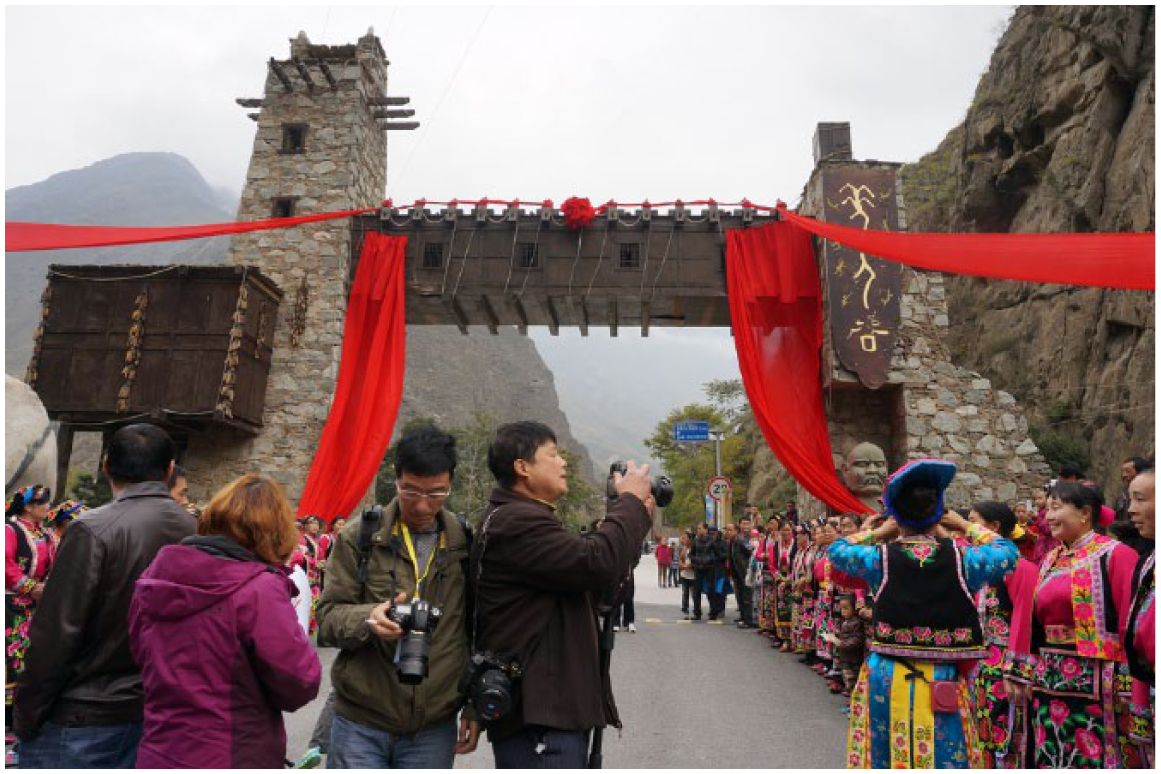
Qiang New Year Festival in Dongmen village, Qiang women singing.
One of the women jokingly told us that she was representing the ‘face of the Qiang’. The Qiang dress according to each specific village’s tradition, but these women wore homogeneous ‘Qiang style’ clothes, recently elaborated especially for tourists who considered them prettier. They also sang newly composed songs in Mandarin despite using the Sichuanese or local Qiang dialect in daily life. Other than a few hours in local schools, heritagization initiatives after the earthquake seem to have forgotten the preservation, not to mention the revival, of the Qiang language, which is little valued by many villagers. They often say that ‘there is no need to learn the Qiang language’ since ‘so few people use it now’.
The ‘safeguarding’ of shibi practices also reveals a whole set of problems. After the earthquake, shibi were recognized as crucial players in the Qiang New Year and the Qiang Sheep-Skin Drum Dance (national intangible cultural heritage). During the 2013 New Year celebration in Dongmen, shibi and dancers from another village were hired by the township government to perform Qiang rituals in Dongmen. In front of tourists and cameras, they performed a worship ritual for the newly erected pagoda, which included sacrificing a rooster and burning incense. They undertook two other exorcism rituals, ‘licking the burned ploughshare’ with the tongue, and ‘steel needle piercing’, in which a shibi pierced a thin steel needle through the lower part of a dancer’s chin (Figure 4).
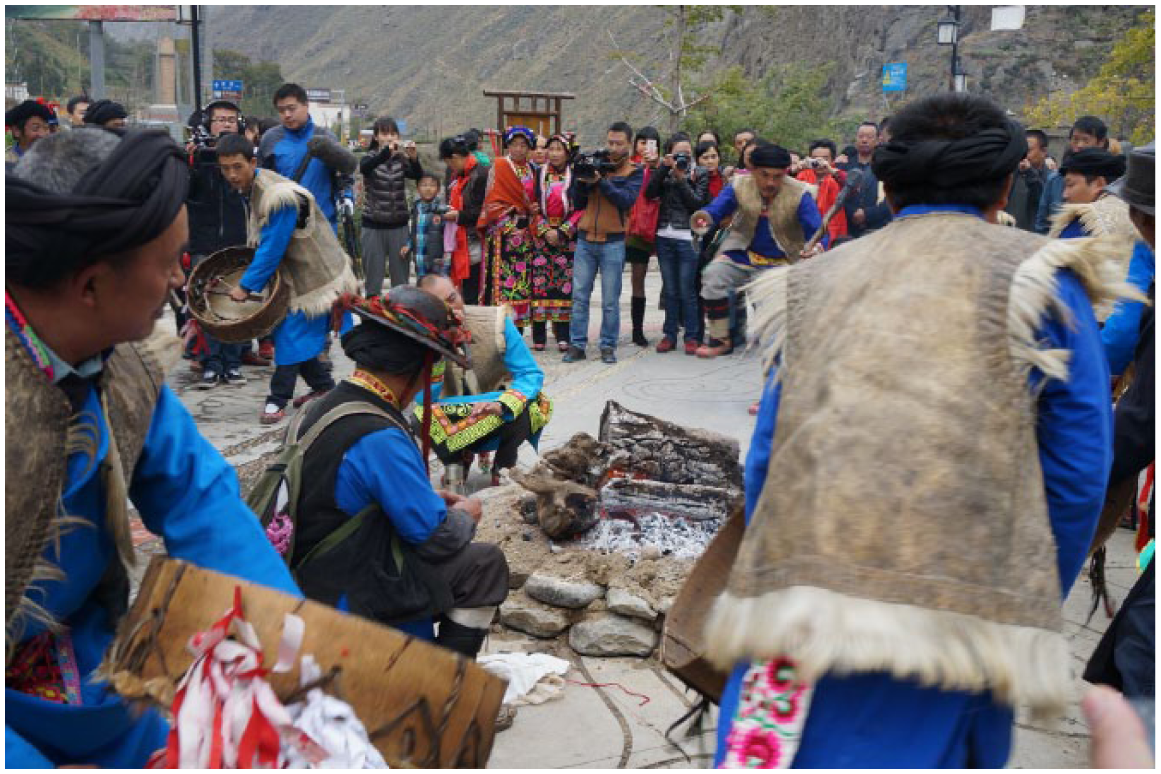
Qiang New Year Festival in Dongmen Village, shibi performing rituals.
The shows, seen as exotic and exciting because of the physical danger, were the most appealing to visitors. One of the performing shibi said, ‘Tourists come here for such performances, something they have never seen in their lives.’ As one visitor said to us, ‘It is good that I can see all of Qiang culture at once. Isn’t it what the festival is for?’ The shibi rituals, originally for worshiping and exorcism purposes, have however been taken out of their initial context. Their socially embedded significance was jeopardized by both the heritagization process and market commodification. Many villagers condemned the shibi and dancers for performing fake and meaningless rituals during the celebration to fool the visitors, while undermining the solemnity of the practice. For example, the Sheep-Skin Drum Dance in Longxi was reserved for funerals when shibi danced to send the souls to the other world. A puzzled villager asked, ‘How can we let the Sheep-Skin Drum Dance group welcome tourists in this case?’ Aware of this issue, some shibi deliberately changed elements in the chanting and dance steps to protect them from blaspheming the gods or spirits. Other minority ritual specialists made similar choices when engaging in state-led heritage protection programmes in China. 38
Frequently invited to perform on various occasions, shibi and dancers have reached new customers and businesses in addition to their previous ritual specialties. For instance, villagers increasingly hire shibi to perform blessings on new cars and minivans, or previously unauthorized house building and worshipping rituals such as ‘placing the family door’ (安家门) and ‘placing the family shrine’ (安家神). Recognition of intangible cultural heritage creates space for cultural flexibility and innovation, inducing ‘organic’ cultural changes, 39 but Qiang practitioners are not free to do so. The recognition gives the shibi the economic and social incentives to perform commissioned rituals, but not to preserve cultural practices organically. For instance, since the earthquake, no shibi from Longxi’s E’er Village, where most of the shibi in Wenchuan originate, has supervised a New Year Festival celebration in their home village. The brand-new Shibi Culture Transmitting Centre has been deserted since its inauguration. Like many other intangible cultural heritage transmitters, shibi became too busy performing for official and tourist ceremonies to fulfil their obligations to transmit their knowledge and skills in their own villages.
Practices and lives reshaped after the urgent intangible cultural heritage preservation
The post-Wenchuan Qiang cultural heritagization, and the Qiang New Year Festival in particular, have extensively impacted the villagers’ economic and social lives. This campaign has led to a shift in perceptions and practices of Qiang culture, especially regarding the shibi, whose practices endure despite institutional normative framing. The intangible cultural heritage recognition facilitates the production of fetishized commodities catering to visitors’ imaginations, while villagers have developed mixed feelings towards the heritage business. Attracting much national and international interest and funding, the newly created New Year Festival does not seem to be genuinely celebrated by villagers or shibi. The researcher’s host confessed, ‘I am not celebrating the Qiang New Year Festival, but doing tourism. It is a performance which lets the visitors celebrate whatever Qiang New Year is in their mind.’
The celebration is now presented as a uniting event and gesture. On this occasion, throughout Dongmen village, large billboards praising the ‘reconstruction miracle’ under the leadership of the CCP and ‘grateful education’ posters are strategically placed, with themes such as ‘having a grateful heart’ and ‘becoming a grateful person’. However, the short-term, top–down state aid was far from effective in providing sustainable development for the Qiang. Many Dongmen villagers repeatedly told tourists that they rebuilt their houses and operated the hostels with mostly personal savings and loans rather than state aid. As our host often said, ‘I did most of the work on my own. I should be allowed to not be grateful.’ Many villagers also suspected that a number of corrupt local cadres embezzled the funds intended for their home reconstruction and village tourism development. Their doubts and contempt were frequently discredited. The Qiang are presented as a state-saved minority, forever indebted to the state, while their agency and control over their future are challenged by this asymmetrical gifting relationship.
In the well-advertised Dongmen village, heritage tourism brought instant financial profit. According to the qiangjiale host, the two-day celebration in 2013 made up one-third of his annual tourism revenue. The majority of the villagers benefited from the event, managing fully booked home hostels and tea-houses, feeding tourists with traditional Qiang dishes, as well as selling embroidery pieces and souvenirs. However, with much of their land expropriated to build tourist facilities in addition to the earthquake destruction, villagers have lost their stable income from farming and have fallen victim to the unpredictable tourism business in the long run. This restructuring, together with the transformation of people’s lifestyle and social network, challenges the population’s sustainable living. It also hinders the preservation of cultural heritage as the farming lifestyle, the basis of local cultural practices and belief systems, disappears.
Ambivalent assessment of heritagization measures
By giving a glimpse of selected micro-local contexts, this article offers an overview of the state-led post-Wenchuan earthquake heritagization campaign’s impact on the affected area almost 10 years after the disaster. Few post-disaster policies, in China and abroad, have taken cultural recovery into account and still fewer are as extensive or intensive. Yet, this campaign relied on institution-led reinvention and was conditioned by specific economic, ideological, and political contexts. Due to the lack of risk assessment, as well as the emphasis on state image and historically rooted principles of top–down authoritative actions, the Chinese campaign has failed to reach its goals. Our research reflects on the effectiveness of cultural heritage preservation in economic, psychosocial and cultural recovery.
The heritagization of Qiang culture and earthquake landscape has brought about an economic recovery and development that is hardly sustainable. Only a few years later, the booming heritage tourism in the earthquake-stricken areas is already beginning to dwindle. The lack of comprehensive regional planning is to blame for the proliferation of redundant offers, resulting in a dilution of visitor numbers. In addition, as people’s memory of the earthquake began to fade, the number of visitors has declined rapidly. Crisis preparedness projects should explore the lifespan of such disaster-based tourism planning.
Furthermore, the heritage protection programmes failed to consider the long-term psychosocial needs of a grieving population shaken by broken social, territorial and symbolic references. Affected by the disaster themselves, local authorities tackled the enormous challenge by following already widely applied practices related to heritage. The state put extreme pressure on them, sending significant funds while demanding rapid results, in order to showcase nationally and worldwide the government’s benevolent actions towards the affected populations, minorities no less. The recovery programme presented the state not only as the force rescuing people, rebuilding settlements and appeasing trauma, but also saving a whole culture. Reconstructed sites became platforms to allow fellow Chinese and foreigners a glimpse of the disaster experience and be reassured with pictures of grateful victims who were well taken care of, happily singing and dancing. The programme led to the commodification of the disaster, victims and survivors alike, for tourism purposes, as well as to galvanize visitor and local patriotism.
This research raises ethical issues related to heritagizing difficult events. Such issues are hardly taken seriously by this recovery campaign, and dismissed by much of the literature, which tends to emphasize the positive roles of memorialization in overcoming grief and tragedy. In this state-led programme, the affected population’s social trauma was disregarded, as if patriotism, a combative spirit and positive thinking were all that was necessary for recovery. Despite efforts in good faith, such as memorial ceremonies and worship facilities around preserved sites, the focus on attracting tourists and promoting official narratives prevented sincere consideration of the survivors’ needs. Instead, they caused pain with constant vivid reminders of the event, and hindered grief by not recognizing the victims’ identity or officials’ flaws. These cases lead us to question the conditions of such projects. Should the crucial need to ‘not forget the past’ override the survivors’ right to forget or remember on their terms? Should post-fatal-disaster heritage projects not consider consequences relative to the time of implementation (grieving period) and the site’s location (the view of ruins for survivors)? In order to provide educational and cathartic benefits, should disaster ruins not be equipped with related information, and allow survivors to worship privately?
Finally, this research points out how problematic it is to ‘recover’ a culture through heritagization initiatives, which rely heavily on authoritative reshaping and interpretation of practices. Although the state-led and UNESCO programmes recognized the Qiang’s valuable heritage by giving them new status and identity, they overlooked the significance of cultural practices, as well as the history of accumulated knowledge and skills, reducing them to fetishized tourism commodities and showcases of state power. The essentialization of the Qiang people and their practices, as well as the commodification of death and destruction, prevented a dynamic and context-based understanding of the affected regional cultures. This situation has prevented organic cultural changes that might have eased the survivors’ recovery. However, the affected population’s agency should not be underestimated. As expected, and despite authoritarian control of the cultural realm, they manage to express their viewpoints (the discomfort induced by heritagization, the survivors’ role and officials’ abuses) and demands (Beichuan site free entrance). We also see highly motivated men and women participating in music and dance associations, as well as a few transmitters able to finally earn a decent living by practising skills and crafts they love. The celebration of the Qiang New Year Festival stimulates, to some extent, collaboration, solidarity, and fun among the local people when preparing for the tourists’ arrival. Some find creative ways to engage with the heritagization programme. As daily actors of preserving (and organically changing) their cultural knowledge and practices, local people should be respected and given the opportunity and flexibility to shape post-disaster sociocultural recovery projects appropriate for them.