




Abstract
While there is an emerging body of literature that examines labour resistance within industrial cities in China, there is, however, little research on ethnic minority labour migrants, in particular their interaction with the local state in migrant-receiving cities. This study fills this research gap by focusing on ethnic Yi labour migrants in the Pearl River Delta area. Based on seven and a half months of fieldwork, this article illustrates the ways in which local governments cope with Yi labour disputes on the one hand, and the strategies that Yi migrants developed – emphasizing their minority status while negotiating their labour rights – on the other. The article finds that a strategy to maintain stability by applying patronage selectively to certain ethnic groups cultivates ethnic elites as middlemen to appease workers’ collective disputes in the short term. However, the state’s failure to fully recognize cultural differences of ethnic minorities and to protect their labour rights results in more resistance and marginalization of ethnic minority labourers in the long term. In this way, the Chinese government’s current policy may jeopardize the wider aim of maintaining social order.
Keywords
During the past three decades, China has been witnessing its largest internal rural–urban migration ever. This migration has not only spurred institutional, cultural, and social changes, but has also reshaped relations between state and society in the areas receiving migrants. Among these migrant workers are large numbers of ethnic minorities from China’s autonomous regions. Abundant research has been conducted on labour migration in China; however, the minorities who form the bulk of this migrant population and the new forms of ethnic politics that their migration has engendered remain largely absent from the literature. 1 This article fills this research gap by focusing on workers of the Yi (彝) ethnic minority who migrated from the Liangshan Yi Autonomous Region in Sichuan Province to the Pearl River Delta in South China. 2
The Liangshan Yi Autonomous Region and the Yi are disadvantaged in large part due to the poor economic situation in Liangshan. Since the 1990s, continued poverty in the region combined with the lure of modernity have pushed this rural population of peasants to migrate elsewhere in search of better livelihoods. 3 The Pearl River Delta, one of the largest manufacturing areas in China, has been the premier destination of Yi migrant workers since their initial outmigration. Despite recent transformations towards a knowledge-based and technology-driven economy in China, low-end factories, requiring many flexible and low-wage workers, are still prominent in the Pearl River Delta. Approximately 15,000 Yi migrants – often lacking proficiency in Mandarin and literacy skills and contending with cultural barriers – fulfil these factories’ labour requirements, with their employment arranged either through dispatch agencies or individual co-ethnic brokers. 4 The work that these agencies and brokers present them is often poorly paid and lacking valid contracts and legal protection. Exposed to yet another set of disadvantages through their precarious work conditions, Yi migrant workers have engaged in acts of visible, organized collective resistance. Instances of this range from street fights to strikes and petitions, and the Yi are generally referred to by the local government as troublemakers. Needless to say, these acts of collective resistance have made local governments increasingly nervous about the presence of Yi migrants in their cities.
This article investigates interactions between the local state in one non-autonomous region (the Pearl River Delta) and Yi migrant workers. It explores some of the many strategies that local governments use to manage ethnic minorities in cities and, conversely, the strategies which Yi migrant workers and brokers have developed to deal with local state policies that so often disadvantage them. I raise the following interrelated questions: what strategies does the local Chinese government in the Pearl River Delta area use to manage Yi migrants in cities while complying with the broader overriding policy of stability maintenance?; and how do Yi migrant workers and brokers respond to local government management?
The empirical data is divided into two sections. In the first section, I demonstrate how the local government, under pressure from the central state to maintain social stability (维稳), employs multiple strategies, including preferential policies for ethnic minorities and patron-clientelism, to keep Yi labour migrants in check. The second section explores the complex dynamics of the collective resistance strategies carried out by Yi migrant workers. I shall illustrate how, in some cases, Yi migrants, and Yi brokers in particular, utilize their officially recognized ethnic status to leverage their bargaining position during labour disputes. Moreover, I shall show how Yi customary law and cultural logic, adopted by Yi brokers, are used as an instrument for resolving disputes in cities. Present ethnic policies may manage to stabilize Yi collective disputes in the short term, but these policies do Yi migrants in non-autonomous regions a disservice in the long term.
Background
China is an authoritarian state that is ‘coercive and repressive, and places enormous political constraints on any organized movement in society’. 5 In the context of such constraints, one of the greatest social problems China has had to cope with in recent decades has been organized labour resistance. Ever since the Tiananmen Square student movement in 1989, the Chinese government has invested considerable resources in attempts to dissipate, accommodate, or crush the collective actions of workers. 6 Since the Chinese Communist Party General Secretary Xi Jinping came to power in 2013, the primary tool for coping with labour disputes across China has been a set of policies designed to maintain social stability. 7 These policies, which act as formulas to control workers and quell labour activism through coercion and violence, fit into broader strategies of maintaining social stability.
Does this mean that the Chinese government’s system of stability maintenance is purely confrontational? While many studies have highlighted the inflexibility of local governments in their confrontations with labour migrants, recent scholarship has also uncovered various non-confrontational strategies undertaken by local governments. For instance, Ching Kwan Lee and Yonghong Zhang’s empirical research demonstrates that local governments actually deploy stability maintenance strategies such as protest bargaining, bureaucratic absorption and patron-clientelism. These have emerged as three micro-foundations of authoritarian domination. Among these three, the strategy of ‘buying stability’ (literally ‘paying cash for peace’) has become the most prevalent means of pacifying aggrieved citizens involved in disputes concerning labour, land, and property. 8 Indeed, it seems to be an effective tool in quelling popular unrest and depoliticizing state–society confrontations at the grass-roots level. However, the strength and generalizability of these micro-foundations require further exploration.
There are, of course, other important dimensions to examine in order to understand interactions between state power and migrant labour in China, and one such dimension is the legal framework. When the state first passed labour laws in the 1990s, migrant workers were quick to use them as weapons to protect their rights during protests and strikes. 9 Now, nearly 30 years on, recent studies have unearthed a very different pattern. Changes in the law have made the legal channels available to migrant workers more labyrinthine. Often short on both time and legal expertise, they are finding it difficult to navigate these channels to solve their disputes. Moreover, because local governments prioritize local economic development, they often lean towards the interests of capitalists/manufacturers when a dispute does occur. 10 This preference undercuts the position of workers and undermines their capacity to organize and act collectively. 11 Without a doubt, these political and structural constraints to workers’ agency also discourage Yi workers who might be contemplating a legal route to dispute resolution.
Significant scholarly literature has also examined the agency of Chinese migrant workers by focusing on the causes, formation, and organization of workers’ strikes and other forms of labour disputes. Organized labour resistance is the method preferred by migrant workers, especially second-generation workers, seeking redress for capitalist exploitation in factories. Pun Ngai and other contemporary Marxist labour scholars see this as an indication of the formation of a working class and the growth of a working-class consciousness; numerous incidents of labour resistance over the last 20 years have demonstrated the organizational power of the working class. 12 Departing from these studies emphasizing working-class formation, an emerging branch of scholarship concentrates on the many precarious workers in China, highlighting the divisions within the Chinese working class and the difficulties of organizing collectively among precarious workers. 13 While critical of the overemphasis on the class dimension, the latter strand of scholarship tends to underestimate the organizational power of precariously employed workers in China. Thus, this article demonstrates the ways in which precarious Yi workers forge solidarity and participate in collective resistance. Navigating the precarity in which Yi workers find themselves, they demonstrate their agency through their ethnicity rather than working-class solidarity.
Within the context outlined above, I investigate how local government representatives and Yi migrants negotiated with each other at a time when ethnic policy outside autonomous regions was not yet properly institutionalized. In its analytical framework – unlike previous studies, focusing on either structural oppression and state policies or the agency of migrant workers – this article suggests examining the state–labour relationship by using an interactive approach. Just as state policies shape the mobilization of migrant labour, the collective actions of migrant workers compel the state to readjust its strategies accordingly. I show that the constellation of different actors involved works to produce a complicated relationship between the authorities and resisters. Political and structural constraints – the stability maintenance system and the ineffectiveness of the legal framework – do form an obstacle for Yi workers; yet, these constraints also provide workers with opportunities to organize collectively and take alternative courses of action. Ethnic minority status and customary laws also emerge as special factors that assist Yi migrants in collective organization.
Methodology
My research, conducted in 2013 and 2014, involved seven and a half months of ethnographic fieldwork in the Pearl River Delta in South China. I chose the Pearl River Delta, particularly Dongguan, as my main research site because it is one of the largest manufacturing areas in China. Containing the largest number of manufacturers producing electronic appliances, shoes, cell phone components, and other industrial goods, Dongguan has become a principal city for a variety of migrants. This city has not only remained the premier destination of Yi migrant workers since their initial outmigration, but it is also the city in which the Yi co-ethnic brokerage system was first initiated, before it became a common practice among Yi labour migrants in other parts of China.
To analyse the interaction between Yi labour migrants and the local governments in the Pearl River Delta, my interviewees included Yi workers, Yi brokers, and non-Yi government officials in a few townships in Dongguan and Shenzhen. I conducted participant observation by working with 38 Yi workers, most of them between 15 and 25 years old and employed for two to five months in an electronics factory. Living and working with workers in a factory gave me the unique opportunity to conduct interviews about how Yi migrant workers and brokers dealt with labour disputes. After becoming acquainted with a few Yi brokers, I was given permission to observe some labour and medical disputes as well.
In addition, I conducted in-depth interviews with government staff about ethnic policy, labour law implications, and their attitudes towards mass incidents involving the Yi. I investigated the government bureaus, including the Ethnic and Religious Affairs Bureau, the Labour and Human Resources Bureau, the Petition Office, the Comprehensive Management and Social Stability Maintenance Office, and the Social Affairs Bureau in two townships. These local bureaus provided me with documents about Yi mass incidents that had occurred in the townships; written from the perspective of Han Chinese officials, these documents helped me understand government attitudes towards these mass incidents. To verify the documented mass incidents involving the Yi, I also spoke to Yi brokers.
Seeking a new path for ethnic policy in cities
The stability maintenance system
In contemporary China, the ability to handle significant mass incidents has become a crucial, if not the only, index for measuring the performance of local government leaders. Local governments are required to respond vigorously to mass incidents, and those who fail to handle incidents that occur on their watch may find their leaders dismissed. Under such pressure, local government leaders usually prioritize stability maintenance over other tasks and innovate new strategies to handle these problems. 14 For example, in 2011, the Comprehensive Management and Social Stability Maintenance Office was established in Guangdong Province. As a collaborative bureau and an inter-departmental agency, it coordinates all the bureaus in the monitoring of mass incidents. The Central Political and Legal Affairs Commission itself, the Judicial Bureau, the arbitration courts, and the police work together to restore calm after mass incidents. 15 Under tremendous pressure to maintain stability, the various government agencies collaborate with each other and are naturally quick on the scene to mediate and intervene. This innovative strategy in Guangdong has been termed grand mediation (大调解) and has been widely adopted across China. 16
At present, the policy framework on ethnic minority issues in China is territorially based, which means that preferential policies grounded on ethnicity are mainly implemented in ethnic autonomous regions. 17 With an ever-increasing number of migrants going to work in cities, ethnic minorities that engage in labour resistance have been receiving increasing attention from the local governments of Han dominant regions. This sensitivity towards ethnic minorities is related, in particular, to the 2009 Han–Uyghur conflict at the Xuri (Early Light) factory in Shaoguan City, Guangdong Province, a conflict that became a spark for ethnic violence in Xinjiang that same year. Since then, preventing ethnic conflicts in cities has been overwhelmingly highlighted on the agendas of local governments. Certain ethnic minority groups, including the Uyghur, Tibetans, Hui, and Yi, are seen to be particularly sensitive and likely to produce conflicts.
In light of these conditions, the management of ethnic minority affairs in the Pearl River Delta area is not a matter confined to the Ethnic and Religious Affairs Bureau; it also falls under the aegis of the stability maintenance system which is mandated to cope with any mass incidents. The local government in Dongguan City uses multiple soft strategies to manage ethnic minority migrant workers, including informal policies that give preferential treatment to ethnic minorities and cultivate patronage relationships with Yi elites. Nevertheless, local government sometimes resorts to rigid repression to prevent ‘ethnic mass incidents’ which have become a source of anxiety for the Chinese government.
Preference for ethnic minorities
While exploring new strategies to manage ethnic minorities, local governments are required to adhere to the overarching guidelines of the central government. Xie, an official from the Ethnic and Religious Affairs Bureau, explained his views on how ethnic minority migrants should be managed and the preferential policies applied to them: Actually, we do treat ethnic minorities with kid gloves, taking exceptional measures and depending on specific circumstances, but we do not go out of our way to do it. For instance, the police will usually drive Han peddlers off the streets, but none of them dares to try to remove the Uyghur peddlers, even though the skewers of meat they sell are unhygienic. The Muslim mosque is another case in point. The Hui mosque can usually count on support (from the government), but the Christian church, mostly attended by Han, encounters some restrictions. Because they are ethnic minorities, as local government [officials], we do our best to try to smooth the path for them, just as long as we do not neglect the main principles.
18
Highly aware of the overarching purpose of stability maintenance, local government officials, like Xie, reluctantly show some ethnic minority migrants more tolerance than they do with non-ethnic minority workers. Despite acts of tolerance, many government officials seem to harbour negative stereotypes of migrant groups. Another official in Shenzhen, Wang, confirmed this while commenting on Yi collective disputes in cities: Our principle is that all migrant workers are equal, but we pay more attention to some ethnic minorities, such as the Uyghur, Tibetan and Yi. This means that we should be more concerned and tread more cautiously with some ethnic minorities, and must be more patient with them than with other non-minority groups. Why? Because the local government’s performance on handling ethnic minority issues is assessed by their superiors, the local government dares not make mistakes in ethnic minority issues…. You never know what kind of dubious habits and religion they might have, and you never know if what you do might offend them and provoke collective resistance on their part. For us, as government staff, nobody wants to upset national solidarity and lose their jobs. I don’t, nor does the head of the government … If Han Chinese workers had done the same thing as these Yi have done, many of them would already be in jail.
19
According to the general social norms of Chinese society, the dominant Han people are perceived to be culturally superior, while some ethnic minority groups, such as the Yi, are considered backward and it is felt that they should simply learn from the Han Chinese. Influenced by this social norm, government officials often complained about what they saw as the backwardness of these migrant workers. Wu, a government official, gave his opinion: After migrating to Han cities, the ethnic minorities are the ones who should adapt to the Han Chinese urban way of life…. I believe that the reason these ethnic minorities migrate to cities is because they want to make money and begin a new life here, and not because they want to preserve their own culture and lifestyle. If they really want to preserve their own ways instead of acculturating to urban life, they should return to their own autonomous region.
20
Government officials often find themselves in a contradictory position: on the one hand, they personally stigmatize Yi migrants; on the other hand, they are legally bound to recognize the status of ethnic minorities and show informal preference in some cases. This dilemma constantly pushes and pulls at the positions they choose to adopt when dealing with collective disputes involving the Yi.
Patronage: Absorb and buy off
In addition to preferential policies, another key soft strategy that local governments use to manage Yi migrants is to establish alliances with the Yi elites. The Ethnic and Religious Affairs Bureau is the major political apparatus managing Yi migrants at the local level. It is subordinate to the upper layer of the Ethnic Affairs Commission at the provincial and national level. As part of the government, they are all under the supervision of the National United Front Work Department of the Chinese Communist Party (CCP). In 2010, a director of the National United Front Work Department of the CCP went to Dongguan to observe how ethnic policy was implemented on the ground. He urged the local Ethnic and Religious Affairs Bureau to pay attention to the conditions of Yi migrant workers in the Pearl River Delta. Following this breakthrough, since 2011, the Ethnic and Religious Affairs Bureau in Dongguan has been establishing relationships with the Yi. Four Yi brokers were nominated Yi delegates and have been regularly invited to conferences, meetings, and symposiums organized by the bureau. The bureau has acknowledged the Yi delegates as ‘individuals advancing ethnic unity and progress’. The local newspaper reports on their model deeds and, in these reports, the Yi delegates are portrayed as ‘pioneer migrants who help their fellow migrants to get rich’ and ‘golden mediators in solving labour disputes’. 21
Besides the honour and glory, being an ethnic delegate brings Yi labour brokers substantial benefits, the most important of which is the public school entrance quota arranged by the Ethnic and Religious Affairs Bureau. The educational opportunities for migrant workers’ children in Chinese cities are severely limited by their hukou status. If they want to send their children to public schools, non-hukou migrants either have to pay a sponsorship fee, or leave their children back in their hometowns to be educated. Since 2011, however, the children of Yi delegates have been granted a few quota-guaranteed places in public schools through the intervention of the Ethnic and Religious Affairs Bureau, and these places can be distributed among other Yi brokers’ or the delegates’ relatives.
Another benefit of being Yi delegates is that they often receive gifts directly from the Ethnic and Religious Affairs Bureau on special occasions such as Yi New Year and Mid-Autumn Festival. Moreover, establishing a good relationship with the government has allowed Yi entrepreneurs to run their businesses without too many impediments. Sha, the owner of a Yi labour agency, proudly told me that because of his close contacts with the officials of the Ethnic and Religious Affairs Bureau, at a time when most other brokers could not find factories, he had been introduced to some large ones.
The local government has reason enough to carry out this strategy of alliance with ethnic minority elites because it complies with the institutional arrangement of the central government. The United Front Department manages and coordinates ethnic affairs by building ties with ethnic elites, coopting them into political positions and nominating ethnic minority delegates as delegates to the local People’s Political Consultative Conference or People’s Congress. At the local level, the Ethnic and Religious Affairs Bureau regularly organizes meetings with a few Yi elites. Considered more knowledgeable about and better suited to deal with Yi culture than Han government officials, some big brokers are invited into this circle and expected to keep tabs on what the officials perceive as troublemaking activities among the Yi migrants.
The fragile alliance between the government and Yi delegates
Strategies similar to those outlined above are found in a study by Ching Kwan Lee and Yonghong Zhang, who described how government officials bargained with a small number of workers’ representatives to prevent labour conflict from escalating and to discourage them from resorting to legal action such as suing bosses and/or local governments. Lee and Zhang found that this strategy functioned to prevent labour unrest in some cases. 22 Nevertheless, the alliance between the local government and the Yi delegates is more fragile than it may appear. Officials are willing to make friends with Yi elites in a less institutional way, in the hope that these brokers can exert a positive influence on their ethnic group, but Yi brokers have never been officially appointed to any seat on the Political Demographic Committee and the Political Congress. This sort of appointment depends on their status as migrants and the type of business they run. The official requirement is that the majority of Political Demographic Committee and the Political Congress appointed members have to be local citizens, but none of these Yi brokers are actually qualified to hold a local hukou. Moreover, as the businesses the brokers run are not legal according to the terms and conditions laid down in the Labour Contract Law, it would be difficult for government officials to justify nominating them for any formal positions. This stumbling block prevents Yi brokers from participating in local politics and making constructive suggestions.
The account of one of my interviewees, Laoliu, is illustrative. As a Yi delegate in Dongguan, Laoliu made a proposal to the Ethnic and Religious Affairs Bureau of the Dongguan government, and suggested that the government produce a bilingual CD on common legal knowledge to educate illiterate Yi workers about the importance of obeying the law. However, to his disappointment, his suggestions were hardly taken into consideration by the officials of the Ethnic and Religion Affairs Bureau. They explained that they were unable to give the go-ahead for such a project without instructions from the upper-level government and without the cooperation of the Liangshan government. Despite their superficially privileged positions, delegates like Laoliu feel that they are hardly included in policymaking.
These kinds of alliance are only made more tenuous by the fact that the local state is rarely fully committed. Officials can readjust their strategy according to the needs of governance and will sometimes withdraw from an alliance when they find the patronage of the Yi elites ineffectual in preventing collective disputes. The following incident confirms the fragility of the alliance between the local government and major Yi brokers. My female informant, Haiying, called me late one night. She said anxiously, ‘You have to come and see! It is terrible! Last night around 55 Yi were detained and most of them are bosses [brokers]. This has never happened before!’ I realized the importance of this event. During the earlier four months of fieldwork, they knew that I was carrying out research on Yi disputes and that I seized any opportunity to interview brokers and workers. If this had not been an extraordinary event, they would not have taken the trouble to contact me.
The next day I visited the scene in Sun City, a place far from the town centre, popular as an entertainment area where migrant workers liked to unwind after work. Although there had been altercations and people in this street were detained the night before, everything was back to normal. It was quiet and peaceful, as if nothing had happened. The Internet bars, saunas, foot spas, skating rinks, DVD rental stores, pedicure parlours, and so on were operating as usual. Street fighting occurred so often in this area that the people who worked or lived there accepted it as normal. Without expressing any astonishment, the DVD store owner directed me to the bar called Beer City: ‘Oh, you are asking about that fight with the Yi? The people in that bar know everything.’ A waiter in Beer City greeted me. He recalled the previous night’s fight: Why did it happen? It was caused by just one cigarette. Probably someone wanted to scrounge a cigarette from someone else, but the other person said something offensive. In just 10 minutes a fight broke out and some people were hurt. The next day, five or six Yi guys came to our bosses to ask for fees for medical treatment, saying that their people had been beaten up and were hospitalized. We do not have anything against their people. Why should we pay their medical fees?… These Yi people are powerful in this area … Correct. The boss of Beer City is by no means a push-over. He has strong guanxi with the government. The second evening their people gathered here – some sat at the tables and drank alcohol, while others parked their cars nearby. In the meantime, policemen, including the riot police, gathered here as well.… It was 11 p.m. When the police arrived, they gave these Yi guys some time to vacate the place, but they did not leave within the given time. This was what happened: when a guy smashed a beer bottle, intending to throw it [at the crowd], policemen immediately rounded them up and took them away in handcuffs. I heard that these people have done this many times. The policemen were just waiting for the chance!
23
During the 48 hours that these 55 brokers were held in the detention centre, many other Yi brokers were gripped by panic and anger, in part because a big incident like this had never happened here before; since Yi workers began migrating to the Pearl River Delta in the 1990s, only some small brokers have been detained for extortion. However, this time Anyo, the Yi delegate appointed by the Ethnic and Religious Affairs Bureau, was among those detained. Although Anyo regularly participated in the activities organized by the bureau, when his Yi friends were in trouble he automatically took their side. Anyo’s detention stirred up discontent and anger among the group of small Yi brokers and stoked their anxiety about the actions of the local government. While waiting outside the government building, one Yi man came up to me, raising his voice, and said, ‘All alliances are based on self-interest. They want us [brokers] to work for them to keep Yi workers under control. But everything they do is spurred by self-interest!’ ‘They kill the chickens to frighten the monkey.’ 24 He meant that some troublemakers were punished as a warning to others.
In sum, preference for ethnic minorities, patronage, and the stability maintenance system are recurring and interrelated themes in government policies. They form an alternative dispute-resolving mechanism, alongside the legal framework, to deal with mass incidents involving Yi workers. In this way, local governments try to buy off big brokers to act as political intermediaries and keep an eye on Yi migrant workers. Nevertheless, Yi brokers do not always function optimally to bridge the gap between the local government and Yi communities. As I shall show in the next section, faced with the reality of having to respond to state manipulation, Yi workers and brokers have developed their own strategies to organize themselves collectively.
Yi migrants’ response strategies
As mentioned earlier, the legal framework implemented over the past 20 years has indeed improved workers’ rights, but protracted legal procedures have driven workers to search for other ways of settling labour disputes. Many workers perceived the stability maintenance system as a channel for them to address the local government directly and quickly. Previous successful experiences among labour migrants have made some believe that whether the government takes the disputes seriously depends not only on the issue itself, but also on whether people can organize supporters into a collective public presence. Chatting with a Han migrant who has witnessed various collective actions in a labour agency recruiting temporary workers, I was told the following: You know what? The government bullies the weak and fears the strong. The more troublemakers, the greater the government’s fears. If you come as an individual, it will never work because nobody will pay much attention. Only when significant numbers of people gather will the government take any matter seriously. If someone has reliable relatives or people from the same region who can help collectively, he/she is very likely to receive payment. Otherwise, authorities suggest that he/she follows the legal channel! It might also work, but will cost much more time, at least a few months. That’s usually too long for workers to wait.
25
The following popular saying circulating among migrant workers sums up the realities of dispute resolution: ‘Big dispute, big solution; small dispute, small solution; no dispute, no solution’. It means that if more people turn up in public, the greater the apprehension of the local government. In this way, making collective disputes public is an effective way of resolving disputes for workers of both the Han majority and the Yi.
The status of ethnic minority: A bargaining chip
Under these circumstances, Yi migrant workers, like their Han counterparts, seek a resolution to disputes by organizing collective bargaining. Liu, a Yi broker, explained to me how he claimed wage arrears on behalf of a young Yi man: I did not know the young man [who was injured] personally. He was brought to me by one of my relatives. They knew I have experience in bargaining; therefore, his boss summoned me here. The injured man’s family did not want to follow the legal channels because they did not want to wait for the injury assessment by the labour authorities…. You know it wastes too much time. Very few people choose to go down that road. We sat inside the office of the village committee. It was just like an official negotiation hosted by the members of the village committee. Interestingly, before the village head intervened, the sub-contractor was quite harsh. He said he would not pay our Yi people that much. You know what? I immediately took my phone and recorded it! Nowadays, when engaged in negotiations, it is important to have a record of the negotiations. Once you have a record, you can either use it in the legal channels as evidence or put it online! These factory bosses fear it! That is enough … There is a basic amount that the Labour Bureau officials calculate according to the Labour Contract Law. I usually ask for a bit extra on top of the amount calculated by the Labour Bureau officials. Why? Because we are ethnic minorities and we have our own laws and customs. Ethnic minorities are treated differently according to the national policies. People here all know that. They do take this into consideration and pay more!
26
As has been demonstrated in other studies of labour resistance focusing on Han Chinese workers, the legal framework – the Labour Contract Law in this case – is a tool which migrant workers can use in their bargaining. Additionally, based on their previous experience with the local government, Yi brokers are aware of another bargaining chip: their officially recognized ethnic minority status. In this case, Liu was aware that the minority status of those he represented allowed him to ask for more than the amount calculated by the Labour Bureau officials in their negotiations with factories. Although these extra benefits for ethnic minority workers do not appear in any written policies, under pressure to prevent ethnic minority mass incidents at all costs, the Labour Bureau often transfers the responsibility of ensuring social stability to factories. Needless to say, factories employing temporary Yi workers do not adhere to the provision on equal pay for equal work stipulated in the Labour Contract Law and, consequently, they must heed the government officials’ instructions.
Broker Liu was regarded as a law-abiding citizen among Yi brokers. During bargaining, he only asked for extra compensation and did not try to make money or instigate mass incidents. In many other cases, Yi migrants have demanded compensation by organizing collective actions, including strikes, public protests, street fights, and traffic blockades. The following case, a medical dispute involving a group of Yi migrants, exemplifies how Yi workers and brokers referred to Yi customary law to solve their dispute.
Customary law
In 2013, I visited Aga, whose injury was aggravated because of medical negligence by a hospital. I accompanied her to the Stability Maintenance Bureau and the Government Medical Office, and witnessed the entire negotiation process. Aga was accompanied by a group of 16 Yi male brokers and workers. She knew none of them personally, except for a broker who happened to be her uncle from the same village. These Yi men assembled at the gate of the local government building.
Gathering a group of workers to stand outside a government building is one way of drawing the attention of the local government. It was not long before the officials inside noticed the group. A few minutes later, a staff member of the medical bureau came out of the building, shouting at the group rather insolently: You guys do not have to turn up with so many people! What does this look like? Why not select two or three delegates and come to our office this afternoon? That’s the way to solve a problem! Simply making trouble by assembling a large number of people defeats your purpose!
The Yi group was directed to go back and write a statement describing the whole history of the medical treatment that Aga received, and the officials promised to summon the other side – the manager of the hospital – to sit down with them and find a solution.
Two eloquent brokers who had already mediated several cases like this were assigned to bargain on Aga’s behalf. Before entering the government building, Aga was instructed to tell the government officials that the group of Yi men were her relatives – brothers and uncles – who had journeyed all the way from her hometown. Knowing that she had had difficulties in the hospital, they had come to demand justice for her. The Yi brokers allowed me to escort Aga and attend the meeting held in the office of the Medical Bureau. Initially, the two Han Chinese hospital staff were more dominant in the bargaining process. They had the advantage of speaking fluent Mandarin and being better acquainted with the intricacies of labour law than the Yi workers. The Yi group was aware that taking the legal channel would cost them more time, and they could not produce sufficient evidence to win the lawsuit. During the bargaining, the two Yi delegates just repeated the same argument: We are an ethnic minority. We do not know the legal channels. All we know is that our niece was injured in your hospital. Your hospital should take responsibility … Take a legal channel? We won’t do that. We are migrant workers. We can’t afford to wait so long … Legal channels will drag on for a few months, and the young girl will probably die. Who will take responsibility if this should happen!
27
The Yi delegates intentionally emphasized the number of Yi workers assembled outside the building. ‘The girl’s relatives are terribly worried about her. Look outside! Dozens of our relatives have come from our hometown. They will not leave without receiving compensation!’ This caused a certain anxiety in the government officials. I noticed that the officials of the Medical Bureau had provided the two sides with a place to bargain, and they tried to retain a neutral position, and not get involved in the debate. This fruitless bargaining lasted for an hour. Outside the government building, the other brokers waited and drafted a petition containing a list of items for which they demanded compensation (see Table 1).
Compensation drafted by Yi brokers.
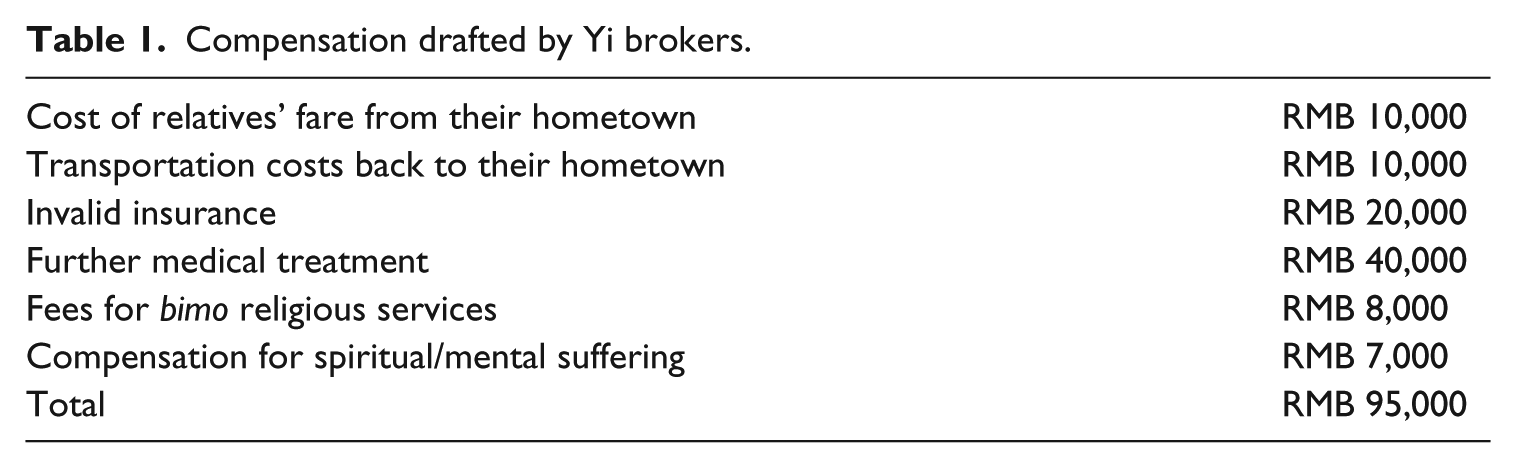
The items they claimed – including the fees for carrying out religious observances, compensation for psychological pain and physical suffering, and transportation costs incurred by Aga’s relatives – reflected interesting features of Yi collective bargaining, very much connected to Yi customary law. As is the case in many other rural villages in China, people rarely, if ever, solve disputes by turning to the modern legal system. In traditional Yi society, disputes between people from different clans are resolved through the mediation of their traditional arbitrators, ndeggu (judicial mediator) or suyy (headman). The compensation that the defendant is awarded not only reflects the degree of harm caused to the injured party, but also the degree of respect for the arbitrators and the honour and dignity of the whole clan. In this case, asking for compensation to carry out rituals and compensation for pain and suffering underlines the value behind the material object (money). Likewise, the fees for practising Yi rituals and the compensation for pain and suffering are an integral part of Yi customary law. 28
However, the Yi migrants involved did not simply apply Yi customary law during this case of collective bargaining. The amount of compensation they asked for, RMB 95,000, is enormous and the items listed were not quite in line with Yi customary law. To find out more about the basis for claiming particular items, I pointed to the column showing the total amount and queried Wang, the broker who drafted the petition. He said: We just jot something like that down first. It does not have to represent the actual amount … The compensation depends on the results of what they bargain for inside. Let them [the other two] bargain and see how much we can gain. Only when you write a big number do you have room to bargain.
29
Wang told me that setting a high bargaining price is like setting a benchmark for the two sides. They did not expect to get the exact amount of compensation stated, but they expected to gain more room for bargaining.
On that day, the negotiations in the Medical Bureau lasted until late afternoon, but proved absolutely futile. When evening fell, I followed the group of Yi brokers and the two hospital managers as they moved to the local police station, where they continued negotiating and squabbling until midnight. About 10 more Yi men gathered in the police station after hearing this news from their peers. Confronted with a large group of Yi males, the arrogance and confidence of the hospital staff gradually dissipated. Empowered by their numerical dominance, the group of Yi men, albeit with little legal knowledge and less eloquence compared to the two hospital staff, gained the upper hand. The quarrel between the two parties eventually ran out of steam. By 2 a.m., with another dozen Yi men arriving at the police station to support their peers, the advantage was on the side of the Yi workers. Finally, bargaining ended with the hospital paying RMB 60,000 as compensation.
Notably, perceiving the government’s special treatment of ethnic minorities, Yi labour brokers play active, decisive roles in organizing collective actions and collective bargaining. Although the brokers claim to function as mediators, such as ndeggu or suyy, they often prioritize their own financial benefits above the interests of workers. An unwritten rule among brokers is that every time they help to resolve a dispute successfully, they will earn a certain percentage as mediation fee. The more compensation they can wheedle, the more money the mediators will receive. However, this only benefits the Yi brokers, not the Yi workers. In the above case, Aga received RMB 4000 for further treatment and the remainder was eventually shared among the men who participated in the collective action, in line with the Yi custom of sharing. 30 Aga’s face radiated with relief and happiness afterwards. As she put it, ‘Without the help of my uncle [the broker] and other bosses, I would have had no access to any solution if I was bullied.’ 31 For her, getting protection from her community when she was in trouble meant much more than getting full compensation.
In sum, Yi migrants demonstrated their own agency in response to the political constraints and structural disadvantages they faced. Though Yi workers are not represented by trade unions, their co-ethnic brokerage system helps them cope with the unexpected problems that they frequently encounter in informal, precarious employment such as wage arrears, industrial accidents, injury, and sickness. However, collective actions in cities involving Yi migrant workers have earned them the stigma of troublemakers and have drawn unwelcome attention from local governments. Furthermore, some Yi brokers mobilize Yi workers in collective resistance and abuse their ethnic minority status simply for profit, and even Yi migrant workers’ persistent emphasis on their customary law is like a double-edged sword in this context. Consequently, Yi workers in cities are caught in a bind in their co-ethnic brokerage system, victimized from all sides even as they demonstrate agency.
Conclusion
By examining how local governments interact with Yi migrants in the Pearl River Delta area, this article has shed light on the tensions between local governments and ethnic minorities in China. Looking at how the state handles popular unrest in China, scholars such as Ching Kwan Lee and Yonghong Zhang demonstrated the multiple soft strategies that Chinese local governments have adopted to maintain social stability. While mindful of the overarching purpose of maintaining stability, many local governments have been reluctant to show more tolerance towards ethnic minority migrants in comparison to other non-ethnic minority workers. Nevertheless, rather than depoliticizing the confrontation, this article found that the stability maintenance system and the ineffectiveness of the legal framework provided workers with opportunities to organize collectively as an alternative course of action.
While much of the research on labour migration in China has focused on Han Chinese migrants and largely ignored ethnic minorities, this study has added an ethnic dimension to the scholarship on Chinese labour migrants, with Yi migrant workers diverging significantly from their majority Han Chinese counterparts. In their repertoire of responses, Yi migrants not only resorted to the legal framework to bargain their position, as would most Han Chinese workers, but they also showed considerable resourcefulness in drawing on their officially recognized minority status and from their customary law. While trade unions have not been successful in their efforts to organize Yi workers to bargain collectively, ethnic characteristics have instead served as a useful mobilizing force among these migrants. Although their strategies have helped them, their ethnicity remains an obstacle and they are unable to transcend ethnic boundaries and forge a sense of solidarity with other members of the working class.
One limitation of focusing on one ethnic group in a particular region is the issue of representativeness. Because the 55 ethnic minority groups in China vary enormously in culture, religion, and material well-being, this study does not make claims about the generalizability of its findings to other ethnic groups. However, in the course of my research, I have discovered that similar strategies have been used in Dongguan City to manage other ethnic groups, in particular the Tibetans, Uyghur, and Hui. Much like the Yi, the Chinese government considers these minority groups mostly likely to provoke ethnic unrest. However, my research during visits to other cities such as Qingdao, where a large number of ethnic Koreans have settled, found that the local government there does not apply the same policies and strategies. In order to obtain a general picture of the relationship between the local state and ethnic minorities in China, more research into the situation of different ethnic groups in different regions must be conducted.
Finally, it is worth emphasizing that rather than being empowered by current ethnic policies and stability maintenance strategies in China, as the case might appear at first glance, Yi migrant workers are also victims. For one thing, their participation in collective actions has earned Yi workers in cities the stigma of being troublemakers and factories are not willing to employ them if other workers are available. For another, the preferential policies and material benefits that local governments informally provide are restricted to a small number of elites – the major Yi brokers – and these elites are used to prevent social conflict rather than to advise on policy. The great majority of Yi migrant workers are still carrying out informal, precarious work, which their co-ethnic brokers have introduced to them. The result is that they constantly experience unexpected problems such as wage arrears, injuries from industrial accidents, suicidal tendencies and the like. If policies in China continue to be designed to prevent labour instability rather than to improve the social well-being of migrant workers and to change their structural disadvantages, Yi workers will be further marginalized and hence provoked into further labour resistance.