



Abstract
The relocation of peasants to high-rise buildings is the latest strategy deployed to feed the insatiable hunger for land in China. To free up more land for construction, Chinese peasants are encouraged to abandon their traditional homes and move into newly built high-rise modern apartments. A central feature of this distinctive form of rural urbanization is the transferability of land development rights across the rural–urban divide. Like most policy initiatives in Chinese economic reforms, variations and improvisation in implementation are found across local administrations. Such local disparities carry major implications for rural governance. This article compares and evaluates the experience of local governments in Chongqing and Nantong. Local governments in these two localities face both opportunities and constraints in integrated urban–rural development, a situation which has contributed to contrasting relocation patterns, and consequently variations in intergovernmental relationships at local levels. Enjoying the privilege of experimenting with the ‘land bill’ (地票) system, local governments in Chongqing have more leeway to stake their claims and are thus in a better position to maintain their authority. In the Nantong case, however, the more hands-on approach of the prefecture deprives lower administrative levels of flexibility to pursue their interests. This contrast in the policy process leads to different patterns of collaboration between levels of government at the grass roots in the two localities, which may also have a long-term impact on the exercise of authority at the community level.
It is clear from the voluminous literature on rural protests and the suffering of peasants in land disputes 1 that rural land administration in China entails compromising between the conflicting claims of peasants, the central government, and local governments. As the final arbitrator of the demands and needs of different stakeholders, the central government has been walking a tightrope between policy innovations and concessions during the past three decades.
Peasants’ constitutional rights to land provide them with a means of subsistence and shelter. Peasants surrender their land, if the price is right. The prevalence of the term ‘descendants of the demolished house’ (拆二代) attests to the general enthusiasm among young peasants towards the prospective requisition of their parents’ land in return for compensation. 2 New construction projects also imply jobs, revenues, and GDP growth. Rural administrations are highly motivated to entertain these initiatives because their finances have been severely hit by the tax reform of 1994 and the subsequent abolition of the agricultural tax. 3 The national government is fully aware of the financial and developmental needs of its local governments. As Meg Rithmire pointed out, the fiscal centralization in 1994 occurred ‘on the heels of the first major experience with land commodification, and simultaneously with the designation of municipal governments as representatives of the state in land management’. 4 In short, these policy changes allow subnational governments to lease land and to pocket most of the returns. Such accommodating gestures, however, have reinforced the dependence on land-related revenues and precipitated the scramble for land at the grass-roots level. The unchecked escalation of land grabbing and the proliferation of violent conflicts triggered by land requisition across rural China have, however, unnerved the central government. This is a huge embarrassment for the party leadership since social harmony is a cherished cornerstone of its enlightened rule.
A more pressing strategic consideration related to land conflict is the issue of grain security. The steady decline in farmland over the last three decades is disconcerting to the regime. As a response to this challenge, the central government has drawn a red line of 1.8 billion mu as the minimal amount of land to be reserved for farming. 5 In 1998, the amended Land Administration Law introduced a more innovative means of control over land use through a quota system for construction land (建设用地指标) which stipulated an amount of land to be made available for development at every subnational level of government. Once the ceiling was reached, no new construction projects would be allowed. Unfortunately, in most provinces the amount provided by the quota failed to satisfy the huge demand for land. Eventually, a solution was found in the notion of ‘integrated development of urban and rural sectors’ (城乡统筹). Central to this new approach is the exchange of developmental rights across the rural–urban boundary. Thus, the creation of savings in the use of construction land in a rural area would allow a project occupying a similar area of land in an urban area to go ahead. 6 This ‘linking up’ principle (增减挂钩) is excellent news for local governments that have already used up their construction land quota because it provides an alternative for acquiring land for new non-agricultural projects. By 2008, 633 test points for such exchanges had been set up across the country, accounting for a land quota of about 230,000 mu. 7
Despite the authoritarian and centralized rule of the communist regime, regional variations and local experimentation are evident. Sebastian Heilmann attributes such institutional plasticity to the guerrilla-like policy style of the revolutionary period. 8 Yuen Yuen Ang’s more articulated account of ‘directed improvisation’ highlights the role of the central government in defining the space and incentive for local variations. 9 Regardless of the validity of the different explanations for such adaptive governance, there is a general consensus over the enthusiasm and success of local government in inserting its agenda and interests into the policy process. 10 The issue of rural land administration is no exception. Local leaders have proactively navigated the parameters defined by the national authority, and they try to explore and utilize every opportunity to pursue local interests. As this article shows, differences in the parameters for policy implementation imply contrasting scopes for local communities to pursue and defend their interests, engender distinct forms of alliances between the levels of local bureaucracy, and confer varying degrees of power to cadres when they exercise their authority at the grass-roots level.
This article reveals the intricacies and implications of the rural urbanization process in post-Mao China. Unlike the ‘conventional’ process of urbanization that sees a massive influx of the rural population to the cities and the consequent expansion of urban boundaries, China’s strategy of rural urbanization is the government’s attempt to regulate the intensity of rural–urban migration while responding to the urban proclivity for rural resources, particularly land. 11 In short, benefits and entitlements previously enjoyed only by the urban population are given to rural residents without their being admitted into the core urban area. One of the earlier approaches in this direction was the ‘small town’ strategy, 12 and the land quota system evaluated here is the latest initiative. This article aims to ascertain the impact of these variations on local governments in their implementation of the land quota system. It argues that the differences between Nantong in Jiangsu and Chongqing offer contrasting paths to rural urbanization. Whereas a standard procedure linked to quota was implemented in the former, the latter has adopted the more aggressive approach of a land bill system. Such divergent approaches not only affect the fiscal situation of the two local administrations, but also have a major impact on their autonomy and authority at the rural grass-roots level. In the implementation of the new policy in Nantong, there is a more proactive presence of prefectural authority at grass-roots level, whereas the difference in incentive and opportunity inherent in the distinctive arrangement in Chongqing allows more room for administrations at the county level and below to pursue their agenda. The following analysis is based on fieldwork conducted in the rural areas of Nantong and Chongqing in 2014. The data include 38 interviews with peasants and local officials and the findings of a survey of 600 peasant respondents in these two locations.
Urban–rural integrated development in action
Central to the idea of urban–rural integrated development is the creation of savings in usage of construction land. How then to create these savings? The residential plot of rural households is a convenient target. According to the national laws on land management, land in rural areas designated for residential purposes is classified as construction land. Therefore, if the local government can persuade peasants to abandon their houses and then convert the land back into farmland, it will achieve a reduction in usage of the construction land quota. The key to success is the relocation of the peasants affected by this process to high-rise buildings. By taking a vertical approach to the provision of rural residences, a decrease in the consumption of construction land is made possible. The portion of the construction land quota made available can then be used to justify new construction projects elsewhere in the urban area. This is the standard practice of linking usage to quota which is supposed to be implemented in all localities designated for experimenting with this new policy.
The policy’s origin can be traced back to the notion of ‘balancing use of farmland and compensation’ (占补平衡). That is, when one unit of farmland is converted to non-agricultural purposes, the resultant loss must be compensated by the provision of a new piece of farmland of the same size and quality elsewhere. This innovative policy idea, with the prime concern of protecting farmland, first appeared in the Land Administration Law in 1998 which introduced the principle of ‘reclaiming the same area of land as is used’ (占多少, 垦多少). 13 However, the requirements of development quickly diverted attention to the need to increase space for urban construction. In the National Planning for Land Development and Rehabilitation issued by the Ministry of Land and Resources in 2003, possible ways to increase the area of land for construction were listed, including the idea of ‘surrendering homestead and restoring farmland’ (退宅还田). 14 These policy ideas paved the way for linking usage to quota.
There is, however, another dimension of the integrated urban–rural development strategy. The rationale behind this approach is not just to facilitate development in the urban area. It is also the hope that ‘capital to the countryside’ (资本下乡) will follow, meaning that the newly available farmland created by linking usage to quota would attract investors in agribusiness to move into the rural sector. According to this vision, agribusiness entrepreneurs would bring capital and technology as well as innovation to the local community. This should result in more jobs, large-scale production and, most importantly, higher productivity in China’s agricultural industry. A similar stimulus to the local economy is expected from all new development projects made possible by the release of construction land quota under this process.
Nantong
Nantong was one of 14 designated coastal cities opened to foreign investment in the 1980s. Located in Jiangsu Province, the government of Nantong: Prefecture oversees eight county-level administrations, 75 townships, and a population of 7.6 million (based on local hukou). 15 The first batch of provinces chosen for experiments with the quota exchange scheme in 2005 included Jiangsu. In 2008, Jiangsu received a construction land quota with a specific ceiling of 1155 hectares for exchanges across the rural and urban boundary. 16 Thus, if the province could create parallel savings in construction land usage in the rural area, new projects consuming the same amount of land in the urban area would be allowed.
How does the system actually work? It usually starts with a proposal for a construction project in a specific locality. It could be the initiative of an investor who wants to build a new shopping centre or hotel, or the result of an investment recruitment drive by a local government offering land resources in return for outside capital. Yet, the commitment of investment funds alone is not enough. The formal procedure requires a joint proposal by the prospective quota user and supplier. The former is the local administration seeking to start a new construction project in its area, whereas the latter refers to the rural administration able to create savings in construction land usage: in other words, a county-level administration that will host the new investment project must team up with and obtain the consent of a township or village administration that is willing to collaborate. The application will then be considered by the relevant prefectural land administration. Once the proposal is approved, a permit for ‘circulation quota’ (挂钩周转指标) will be issued and the process can commence. The relocation of the peasants affected (including the demolition of their former residences and construction of new housing units) and the conversion of residential land into arable farmland must be completed within three years. Failure to meet the deadline may incur a financial penalty or result in invalidation of the circulation quota permit. Once the prefectural land administration has verified the saving in the construction land quota, construction work for the new investment project can commence.
The exchange, however, is subject to several restrictions. Firstly, the transaction can only involve an exchange of developmental rights within the county boundary. Secondly, the quota is not transferrable to a third party because the exchange must be linked directly to a specific urban project. Together with the three-year limit on completion, these restrictions create a downward pressure on the value of the quota. These measures confirm the regulatory authority’s effective control over land usage and guarantee its veto in respect of any violation against excessive expansion of construction in the country. Yet, they also deprive local government of the opportunity to build up a land reserve and limit its freedom to maximize fiscal gains through well-timed land grants in accordance with the market situation. Although the additional opening for urban expansion is very much cherished, local government has to be realistic about the contribution of prospective land deals to prefectural finances.
In the face of all these constraints, the Jiangsu government came up with an innovative idea to fully utilize the policy opportunity. The 10,000-Hectare Fertile Farmland Project (万顷良田, hereafter Farmland Project) is Nantong’s response to these restrictions. The idea is to increase the scale of agricultural production by recruiting agribusiness investors to the prefecture. Thus, once the peasants are relocated and the conversion of rural residential land to farmland is completed, an agribusiness that requires more than 100 mu of farmland for its operation will be given priority when it applies for a land lease. The idea was formulated by Xia Ming, Director of the Department of Land and Resources of Jiangsu Province, who believes that such projects are crucial for enhancing agricultural productivity in China. He opines:
From a purely economic perspective, farmland is badly utilized if the production scale is confined to the level of 3 to 5 mu per household; government subsidy is necessary in these circumstances. If the scale is increased to 30 to 50 mu level, general efficiency can be maintained and the cost and benefits of production can be balanced as well. Just imagine if the scale is further expanded to 300 to 500 mu; the farmland resource would surely be fully utilized, and make a huge contribution to the national economy.
17
However, the benefits of scaling up agricultural production go beyond boosting productivity. What really matters is that it is consistent with the national policy of upgrading agriculture. The national government has been ill at ease with the prevalence of household farming in the aftermath of de-collectivization in the post-Mao years. While the motivational effect may have contributed to a general increase in productivity in the early years of reform, the small scale of household-based production has not been conducive to investment in agriculture. The trend in abandoning farming has further exacerbated anxiety about the general state of China’s agriculture. Such apprehension probably accounts for the flexibility shown towards local experiments on the circulation and exchange of land leases across rural China in the hope that they may help to increase the scale of agricultural operations. ‘Diverse forms of operation of appropriate scale’ (多种形式适度规模经营) is encouraged, meaning individual households should not be the dominant players in agricultural production. Instead, ‘dragon-head’ enterprises, agribusiness, and various forms of cooperatives operating with advanced technology and substantial investment should play a major role. According to the State Council, these players should constitute 40 per cent of agricultural operators by 2020. 18 In short, scaling up farming is regarded as the key to China’s agricultural modernization and grain security. The mega project strategy of the Jiangsu government may not only appease the national government politically, but, more importantly, would also greatly enhance the likelihood of securing financial support from the central government.
One of the forerunners in the province that embraced this initiative is Nantong. Central to the success of this strategy is the clustering of farmland. Clustering is an imperative because scattered plots make the use of machinery or the introduction of capital-intensive technology more challenging and costly. Nantong has a massive relocation plan in mind. By 2016, it had created 200,000 mu of connected farmland and had relocated 51,100 rural families. Generous offers were made to the affected farmers to persuade them to surrender their rural residences. 19 The package included two components. First, a ‘house-for-house’ compensation, calculated on the basis of RMB 1600 per square metre for the farmer’s original house, compared with a price of RMB 1420 per square metre for the new apartment that the farmer is entitled to buy. Thus, the relocated household is guaranteed a new home ‘for free’. Second, there is the ‘exchanging farmland for social insurance’ (土地换社保) arrangement. That is, those who possess a hukou in the affected community are entitled to a monthly stipend that varies according to age. 20 As discussed later in this article, many peasants choose to abandon farming altogether and turn themselves into waged labour for jobs in the neighbourhood or to continue their lives as migrant workers in the cities.
The exchange of construction land quota has greatly facilitated the development of Nantong. The savings in rural construction land usage engendered in the relocation process have enabled the steady expansion of the Nantong High and New Technology Development Zone in Tongzhou District. Nantong has become home to 15 major industrial enterprises with a total investment of RMB 7 billion, 21 while the Farmland Project has succeeded in attracting major agribusiness firms to rural Nantong. Between 2012 and 2015, inducements resulted in 62 major enterprises starting their operations in the prefecture with a total output value of RMB 13 billion. 22 In 2015 alone, the central government supported 30 local agricultural projects. The amount of subsidy received amounted to 10 per cent of the national government’s total support for all prefectures in Jiangsu that year. Hai’an County in Nantong was an outstanding exemplar, ranking top in the province in the scramble for state subsidies between 2012 and 2014 and securing more than RMB 200 million from the central government. 23
Chongqing
The practice in Chongqing is a variant of the quota exchange policy. Chongqing is one of China’s four directly administered municipalities with a territory comparable to the size of Jiangsu Province. Its total population is estimated to be about 30.7 million, of which 19.7 million are urban hukou holders and 11 million rural hukou holders. 24 In 2007, Chongqing was designated a national experimental zone for the policy of integrated urban–rural development. Chongqing is thus in a good position to explore policy flexibility in its own interests. The national government’s concern for speedy recovery in the aftermath of the disastrous 2008 Sichuan earthquake also provided the prefecture with extra leverage in bargaining for preferential treatment. The end result was the introduction of the land bill (地票) system in 2008.
Chongqing practises the standard linking-up procedure, similar to that in Nantong and other cities in China, in which peasants are relocated from their rural houses, the residential plots are converted into farmland, and savings in construction land use are created. However, the process for investors to acquire land in urban Chongqing is more complicated. In Chongqing, the quota created is first repackaged as a land bill. Anyone who wants to acquire a land lease in the urban area must first buy a land bill through open bidding in the exchange centre. An auction is publicly announced, together with details of the area stipulated in the land bill and the minimum bidding price. The bidding can be terminated if the minimum price is not met. After securing a land bill, an investor can then negotiate a land lease in a preferred location with the municipal government. The cost of purchasing a land bill can be deducted from the land lease fee and other administrative charges once the deal is concluded. 25
Compared with investors outside the region who are also keen to make investments in urban areas, investors in Chongqing enjoy greater flexibility in two ways. First, they can postpone deciding on the location of the project, whereas under the standard linking-up scheme an investor must declare his/her preferred site before the rural land is freed under the conversion process. Even after the purchase of a land bill, the Chongqing investor can still decide on the best timing for utilizing the entitlement to lease land. In order to minimize the financial risk to prospective land bill holders, banks in Chongqing also accept land bills as collateral for loans. Thus, although a secondary market has yet to emerge, the credit policy of local banks has, in effect, converted land bills into a financial asset. This extra liquidity undoubtedly helps attract more interest from prospective investors. By the end of 2011, a total credit of RMB 410 million was provided by banks in Chongqing in 16 loan transactions involving land bills for a total area of 3100 mu. 26
Second, the need for mediation by the government in concluding a land deal is reduced to a minimum under the land bill practice. For investors in Chongqing, there is no need for them to engage with the village community where the quota is generated. Land bill transactions are purely a matter of supply and demand. How the local government creates savings in land usage and the identity of those who are relocated are irrelevant to the land bill buyers. Unlike the Nantong arrangement, their final investments do not tie in with the supply of a specific land quota. All the manoeuvrings required to make the construction projects possible – that is, bidding for a land bill and negotiations for securing the perfect location for investment – are concluded entirely in urban Chongqing.
Comparing the standard quota linking-up scheme practised in Nantong and other testing areas in the country, the land bill system offers a number of advantages to Chongqing. Firstly, there is no ceiling imposed on the amount of the quota for circulation. The only constraint is whether it can create a sufficient amount of savings through relocation. Secondly, the exchange under the land bill system is not directly linked to a designated project. Investors can even stockpile land bills for future use and build up their own ‘land reserve’. The most important difference lies in the spatial boundary for circulation. The quota embedded in the land bill system can be used for sustaining any project within the perimeters of Chongqing. In other words, its operation is not confined to the county boundary as it is under the standard linking-up arrangement. This enviable privilege has immense implications for the market value of land bills. The construction land quota created in Chongqing generates greater financial returns than elsewhere, including Nantong. The average price for one mu of land recorded in the first land bill auction in 2008 was about RMB 90,000. 27 In 2017, the average price rose beyond the level of RMB 180,000. 28 Policy stipulates that 85 per cent of the net proceedings of land bill sales should go to the relocated households, while the rest is destined for village collectives.
Given the high price attached to land use in the prime location of urban Chongqing, the municipal government is well placed to claim a major share of the revenues from land leases and other related charges generated by these land deals. It is, therefore, hardly a surprise that the Chongqing government has been very aggressive in enticing peasants to surrender their farmhouses in recent years. In 2010, it announced that residential space in the urban area would be increased by 40 million square metres by 2020. 29 As in Nantong, the Chongqing government is prepared to supplement the package with an urban hukou, and has planned for 10 million peasants to be given this status by 2020. 30 For those peasants with a substantial amount of compensation and who are prepared to start a small business in the city, there is further encouragement from the municipal government’s micro-enterprise subsidy scheme. Under this scheme, a private investment of RMB 100,000 will qualify for a subsidy of RMB 50,000 from the government, as well as a loan of RMB 150,000. 31
Contrasting spatial order
To anyone who has visited the relocated communities in Nantong and Chongqing, there is a discernible difference between the size of the communities of peasant apartments. The apartment buildings in Chongqing where we conducted our research are mostly low-rise, four- or five-storey buildings. In most cases, there are two units on each floor. A typical community comprises not more than 10 blocks with a total population of several hundred residents. For example, in Bishan District, three newly created communities contained around 500 resettled rural households. 32 Similarly, 26 locations in Kai County housed 2000 families. 33 The more ambitious projects in Nantong dwarf the scale of relocation housing in Chongqing, which represents a different strategy in building new communities. In these so-called ‘happy communities’ (幸福社区), buildings are mostly taller, and it is common to find blocks with 10 floors or more. A community is generally composed of a dozen blocks with an average population of several thousand people. For example, by May 2014, in Hai’an Town in Hai’an High-tech Zone, 60,000 peasants were relocated into 35 newly created communities. 34 Here, size appears to be a major concern in enhancing the scale of agricultural production. Each project ideally aims to relocate at least 3000 to 5000 peasants, which would create a land construction quota of 700 to 800 mu. 35
In terms of spatial reconfiguration, Chongqing and Nantong differ from one another not only in the size of the resettled community. Another distinct contrast is the organization of farming activities in these two jurisdictions. In short, peasants in Nantong are more inclined to abandon farming, whereas Chongqing peasants appear to be more interested in maintaining some involvement in agricultural activities. Our survey findings in these two locations (Table 1) confirm this. While respondents in Chongqing have kept on average about one-third of their original land holding and continue to maintain a certain level of involvement in farming activities, their counterparts in Nantong have effectively abandoned agricultural production.
Change in agricultural involvement before and after relocation.
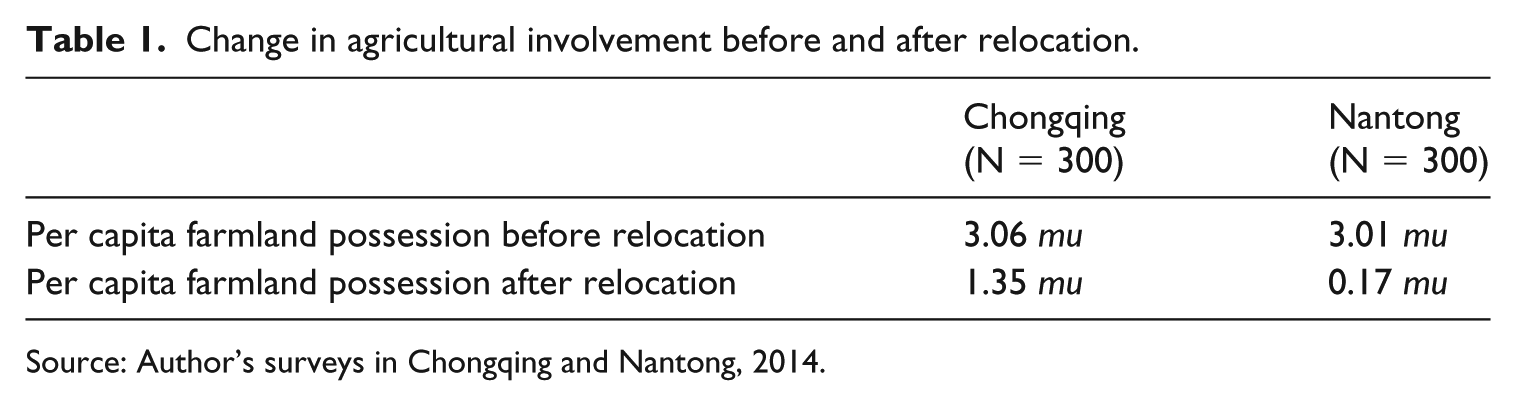
Source: Author’s surveys in Chongqing and Nantong, 2014.
A general reduction in agricultural production is more or less to be expected. Relocation has created many logistical problems for peasants who want to continue their involvement in agriculture. Firstly, unlike the spatial order of the past, where most households had plots adjacent to their houses or within a stone’s throw, the physical distance between farmland and residence has increased. With regular public transport services few and far between in rural areas, a daily commute of around 10 km can be taxing. In addition, the separation of farmland from residence raises the issue of storage of farming equipment. Again, this was not a problem before relocation when a farmer could simply take the tools home at the end of each working day or simply leave the equipment in the fields since the farms were mostly adjacent to their houses. This is not an option when the farm plot is no longer located within sight of one’s residence.
In Nantong, the Farmland Project places extra pressure on peasants to abandon farming. The project entails the concentration of farmland, requiring the transfer of farms to agribusiness firms or professional planters who are eager operate on a larger scale of production. For example, in Nantong, the relocation of 2100 households from six villages created a new Renhe Community in Gangzha District. In order to acquire the land from the peasants, the Gangzha administration set up a wholly owned company, Metropolis Modern Agriculture Company. The relocated peasants were persuaded to transfer their land leases to this company at an annual fee of RMB 1000 per mu. The contract operates until 2028, the year when existing land leases for all peasants in the country expire. Local cadres are of the opinion that this implies that the peasants have permanently abandoned their rights to the land. From this new community and other similar operations in nearby areas, by 2014, the company had obtained 36,000 mu of farmland from rural households. It then leased out the land to agribusiness operators and professional planters who needed farm plots of a substantial size. 36
Chongqing’s relocation projects also show a similar pattern of land concentration, although the scale is evidently more modest. For instance, Company X, set up by individuals who are apparently closely related to village and township officials, has been very active in acquiring land contracts from relocated households in the Ba’nan District in Chongqing. The company claims to specialize in growing flowers and has acquired several hundred mu of land at an annual fee of RMB 900 per mu from the peasants who moved to newly built apartments nearby. The company, however, has a different business agenda in mind, as an administrator explained:
On your way to our site, you can easily find flowers planted along the road. This is in fact all our farming activities at the moment. There is nothing going on behind the slope where visitors passing by in a car cannot see. You can say the flowers on the roadside are for the officials at the higher level. As we have to appear to comply with the activities stated in our business licence: flower growing. In the long run, we have plans to use this land for other business operations like rural tourism and even a nursing home for affluent pensioners from the cities.
37
In most cases, investors are keen to use the space freed up by the relocation process to start non-farming activities. Company Y, for instance, is prepared to build several low-rise hostels for tourists from the urban area who want to have a taste of rural life. The management personnel of these well-connected companies appear to be fully acquainted with the work style of high-level officials. ‘Their attention to the situation at the grass-roots level would wane after a year or two. By that time, probably no one really cares what kind of business we are actually running’, an investor confided. 38 Such strategic calculation explains why much of the farmland held by local businesses lies idle. It is common to find temporary office buildings sitting on a large piece of land with little sign of activity or, in extreme cases, just a big billboard displaying the company name and slogans such as ‘scientific methods are crucial for agricultural promotion’ (科技兴农). Interestingly, peasants interpret such inactivity as a justification for their continued use of the land, even though they have already contracted out the farmland to, and have been compensated by, these same businesses. ‘They just feel it is not right to leave land idle and believe that they are entitled to farm these plots if we are not using these resources for the time being’, said a manager from a local business. 39
In rural Chongqing, the policy to share some of the construction land quotas created by the relocation projects with lower-level administrations encourages the emergence of non-farming business. The Chongqing government allows a county-level administration that achieves its target to keep 30 per cent of the newly created construction land quota. The county-level administration would then negotiate with lower administrations as to how these rewards might be split. These concessions open up an opportunity for governments at the county level and below to attract capital and investment to their jurisdictions. This sharing agreement between prefectural and lower-level administrations is clearly essential to the success of the implementation of the land bill system and helps explain the general enthusiasm among grass-roots officials who actively encourage the local population to enter into the relocation arrangement. 40
The contrast between Chongqing and Nantong reflects the divergence in policy parameters and developmental strategies of the two jurisdictions. As analysed earlier in the article, the various policy restrictions (e.g. transfer only within the county) very much circumscribed the scope for Nantong to secure returns from the quota system. Thus, in order to maximize gains from the new policy, Nantong has resorted to a strategy of scaling up agricultural production to entice further financial support from the higher levels of government. Consequently, the Nantong prefectural government has maintained a hands-on approach in recruiting investors and agribusiness, and has been very proactive in deciding how land should be utilized. Relocation has been swift and comprehensive, and the prefectural government’s involvement has left little room for village or township administrations to pursue a local agenda. The Chongqing government, on the other hand, appears to be more relaxed in implementing the new policy. Its primary concern is simple: the creation of land bills. Macro control of the supply of land bills and negotiations with prospective investors for land leases in the urban area are the Chongqing government’s priorities. How the farmland created will be utilized and where savings in construction land usage are generated are not its primary concerns. The opportunity offered by the land bill system to cash in on new construction projects in prime areas of urban Chongqing has added hugely to its finances, allowing the Chongqing government to be more accommodating towards local interests at the grass-roots level. Thus, it is willing to share some of the land quota with the lower levels of administration to generate local enthusiasm for removing peasants from their land. And the cases of distorting land use mentioned earlier are testaments to the Chongqing government’s indifference to and toleration of policy deviations at the lowest levels.
Implications for local governance
The discernible differences in spatial order between Chongqing and Nantong have significant implications for local governance of the two jurisdictions.
Firstly, there is a growing sense of vulnerability among residents in the relocated communities. Common to both the Chongqing and Nantong experience is the extensive loss of farmland suffered by the majority of those who agreed to move into peasant apartments. The surrender of land holdings implies a new pattern of capital accumulation in China compared with the early years of reform. Giovanni Arrighi has labelled the latter a process of ‘accumulation without dispossession’ when migrant workers contributed to the development of capitalism by accepting low wages in the market periphery; they survived at the subsistence level by drawing resources from their land back home. 41 In recent years, when the dominant approach to urban development became land grabs, this was no longer the case. Julia Chuang has coined the expression ‘urbanization through dispossession’ to describe the process by which peasants have lost land, the most important buffer against the tension inherent in the fluctuations and uncertainty of market dynamics, and thus have become more vulnerable. 42 The relocation projects described earlier have exacerbated this trend. Not unexpectedly, the impact in Nantong has become more evident because of the more comprehensive uprooting in the relocation process.
Two features are particularly outstanding: the growing dependence on wage income and the decline in food self-sufficiency. The surrender of farmland denotes a change in income structure as agriculture and other forms of land-related income are no longer significant for local households. Wages and returns from business activities are now the dominant sources of household income. According to our survey data, these two sources contributed more than half the household income in both localities, while land-related income has dropped to a level of insignificance. Local households in Chongqing still obtain 10.1 per cent of their income from farming or land leasing, whereas, in Nantong, these earnings constitute only 1.8 per cent of household income. As a result of a decline in farming activity, the cost of living has risen. In the majority of cases, relocated households have to buy most of their staple food from the market, and the most serious complaint regarding the new life in a peasant apartment is the level of expenditure on food. In short, market dynamics dictates their economic well-being. The availability of jobs and the supply and price of food as well as wage levels are now key factors determining the economic conditions of these households. In the new communities, full exposure to the defining characteristics of market mechanisms such as unpredictability and cyclic fluctuation have contributed to unease and general anxiety over their economic future.
In a rural community, village cadres are expected to provide the first line of support for local households. A similar sense of dependence is extended to the local administration after relocation. This sense of vulnerability exerts pressure on cadres at the grass roots. The life of local administrators is further compounded by the compactness of residences in the new communities. ‘In the past, it is your own business if you throw rubbish out of your house, but it is now a nuisance to your neighbour living next door and mostly guarantees a quarrel and eventually our intervention’, complains a local cadre. 43 Residents have rising expectations about living in a modern apartment in a high-rise building, which local administrators find increasingly difficult to meet. In the past, village cadres were rarely concerned with matters such as Internet services, gas supply, or repair works in toilets and kitchens as these were considered the private concerns of individual households. In the new setting, where a centralized system in each building supplies these utilities, most residents expect the local administrators to sort out related problems when they arise. The pressure on local cadres is further aggravated by proximity to their clients. ‘In a rural setting, it was not difficult to hide from your fellow villagers if you didn’t want to entertain them. However, we are now living in the same block or our apartments are just within a one- or two-minute walk of each other. The job has become a 7 [days a week]-24 [hours a day] routine’, 44 a local administrator protests. As a result, extra help is needed. In Chongqing, where the new communities mostly comprise several hundred residents, it usually entails the recruitment of a few full-time staff: a cleaner to take care of public hygiene and rubbish collection and a labourer for general repair work. In most cases, they are locals living in the same community. However, the giant complexes found in Nantong require a completely different arrangement. There it is common to find estate management companies operating in the new communities. In a typical community, 20 to 30 staff dressed in smart uniforms are trusted with the various mundane tasks of property management. These staff, however, are mostly outsiders. For residents living in these communities, the first point of contact is no longer local officials but hired helpers who are mostly strangers. Unfamiliar people are now the intermediate link with local cadres whom the residents had always regarded as the face of the Chinese state.
The ‘distance’ between local authority and residents is further increased by the distinctive pattern of community building in Nantong. Because large-scale acquisition of farmland is central to the success of the Farmland Project, the rate of implementation of the relocation process in Nantong is seen to be more intensive than in Chongqing. In Nantong, the best way to minimize land usage is to concentrate thousands of residents in a complex of blocks of 10 floors or more and such an approach can save space for the provision of a community hall, a park, or other common areas. However, the approach implies that the new community will comprise the former residents of numerous villages. As Table 2 shows, multi-village relocation is more common in Nantong than in Chongqing.
Pattern of relocation in Nantong and Chongqing.

Source: Author’s surveys in Chongqing and Nantong, 2014.
It is argued that local authority at the rural grass roots is dependent upon the bonding between village cadres and peasants. The former are seen not only as officials but also as family and friends. Thus, their authority is not merely based on the exercise of state power bestowed by higher authority: it is a product of the trust and respect generated by common experience, lineage connections, and shared morality. As Fei Xiaotong pointed out half a century ago, rural society is a community of familiar faces (熟人社会). 45 This is very much the foundation of state authority in rural China. The merger between villages in the new community, therefore, posits a challenge to this cornerstone of local authority. Peasants from the same village are relocated to different residential blocks based on the time when they consented to relocation, affordability, or simply administrative convenience. They may not be against the idea of making new friends, but they are more inclined to stay within their original social network and, more importantly, most tend to ask the cadres from their original village for help if they encounter any trouble. The problem is that not all former cadres belong to the local authority in the new setting. As most relocation involves hukou transfers, it is common practice to set up residents’ committees in the newly created community. Notwithstanding the tendency of residents to rely on the original village authority, there is a genuine attempt to absorb the former village cadres into residents’ committees. However, it is not always successful. Disincentives to serve on the committees owing to the additional demands on cadres described above, the limits on the size of local establishments imposed by the government at the higher level, and the decision by many former cadres to explore better career prospects elsewhere now that they are relieved of their farming obligations all serve to hinder the success of the co-optation effort. Without the involvement of these cadres, who are trusted by the different elements of the new community, the attempt to consolidate authority in the new setting can be a difficult task, and the larger the size of the relocated community, the bigger the challenge in building authority anew. 46
Conclusion
The concept of integrated urban–rural development is evidently gathering momentum in China’s policy community. For party leaders, this approach has revealed a compromise between national concerns over grain security and macro-control and trepidation at the local level over development needs and finances. The relocation projects which relocate peasants to modern high-rise apartments and which bestow on them urban hukou are also consistent with the party’s objective of rewarding peasants (回馈农民), something that has been enshrined as an overarching goal in the notion of the New Socialist Village. Although in the long term relocated peasants may have to pay the price of completely surrendering their land holdings, all the parties concerned appear to be content with the new arrangements for the time being.
Liberal scholars in China have offered intellectual support for the new approach. They argue that the further incorporation of rural society into the market system is a benevolent movement pushing Chinese peasants into a trajectory towards modernity. Endorsement of peasants surrendering land rights can be found among leading economic advisors, such as Lin Yifu, who see the formation of a national unified market for land as an indispensable step in transforming ‘traditional small peasants’ (传统小农) into productive and efficient entrepreneurs. 47 There are certainly dissenting voices, but this resistance appears feeble in the face of the political alliance between the revenue-hungry local governments and the peasants who cherish the opportunity to cash in their land rights. Together, these forces have contributed to a momentum of historic proportions pushing relocation projects forward.
China’s reform trajectory is characterized by its pragmatism, and local variations are the rule rather than the exception. As the preceding analysis shows, there are at least two different approaches to implementing the policy of integrated development, and each entails different constraints, consequences, and opportunities. The experience of Nantong and Chongqing has had a significant impact on the cohesion of their local communities and, more importantly, has posited challenges to local governance. The sustainability of the newly established arrangements depends very much on successfully fostering a common identity in the relocated communities and in co-opting former cadres from the rural administration into its power structure. The challenges, however, appear to be more severe in Nantong than in Chongqing. Under the former’s approach of comprehensively uprooting peasants from agriculture and clustering farmland, the relocation process is manifestly more massive in scale, swifter in pace, and more brutal in implementation compared with the Chongqing experience, where the process appears to be more relaxed. The room for manoeuvre and negotiation accorded to village administrations is more limited in Nantong since the prefectural government monitors progress more actively and more closely. On the other hand, in Chongqing, following relocation, there is more scope for bottom–up initiatives in development. Money matters in Chongqing, and it is the difference in financial returns under the two approaches that accounts for the contrast in implementation of the integrated development policy at the grass roots. The jury is still out on which practice is preferred by the party leadership. The Bo Xilai factor may be a liability in Chongqing’s case since the land bill system was an integral part of his ‘Chongqing model’. A sense of uncertainty over the prospects of this system was evident among local cadres during our fieldwork in 2014, but, after the conclusion of Bo’s trial, it may no longer be relevant. Meanwhile, the land bill system has gradually spread to other major cities such as Chengdu and Guangzhou.
Regardless of the party leaders’ final choice, it is certain that the Chinese government will be pressured to find the means to accommodate the hunger for land in the coming years. The trade war with the United States and the slowdown in growth of the national economy have rendered policy measures that may inhibit economic momentum at the local level highly undesirable. Pragmatism and flexibility are now evident even in key policy areas, such as credit control and local finance, which were heavily regulated in the past. For the Chinese leaders, the experience in Chongqing and Nantong has revealed a solution, albeit probably a short term one, of how the balance between the desire for local economic development and national regulatory intentions can be maintained.