




Abstract
China’s cadre evaluation system – the personnel management system used to assess the performance of government officials in the party-state – is considered an important tool for upper-level governments to supervise and regulate lower-level agents. This system is one of the key factors contributing to the Chinese Communist Party’s (CCP) authoritarian resilience. Deficiencies of this system are exemplified by the ‘blind pursuit of GDP’, selective implementation, gaming, collusion, and data fabrication. The CCP has been reforming this system to strengthen its monitoring and political control over local government cadres, especially at the county level, and it is a crucial component in the step-by-step hierarchical power structure. While current literature focuses largely on the assessment content of such reform, this article pays specific attention to the changes in the cascading evaluation structure of province to prefecture to county. The article identifies a new dynamic of ‘over-cascading’ whereby provincial governments bypass prefectural governments and directly evaluate county officials, resulting in the co-existence of prefecture-county and province-county evaluations. This article also explores the functioning mechanism of this dual structure and argues that this structural change in the cadre evaluation system is breaking the traditional hierarchical governance structure and enhancing authoritarian resilience of the CCP because it provides a new route for over-cascading governance between provincial and county governments. This research contributes to the conceptualization of the over-cascading governing structure of the CCP and fills gaps in the literature on structural changes in China’s cadre evaluation system.
Keywords
Since the 1990s when China carried out institutional reform, the Chinese Communist Party (CCP) has consolidated its legitimacy with a series of socio-economic achievements, and refuted the negative comments and predictions of Western observers by bolstering the then ‘collapsing system’. 1 Increasing state capacity has prompted China studies researchers to figure out ‘how authoritarian rule works’. 2 In recent years, an increasing amount of literature has used the term ‘resilient authoritarianism’ 3 to explain China’s party-state regime and to examine the political and institutional reasons for its resilience. 4 Cadre management is an important contributing factor to the CCP’s governance resilience and to maintaining China’s authoritarian regime. 5 The CCP’s control over cadre elites is realized through a series of rules including the nomenklatura system, 6 promotion and reward, 7 rotation and transfer communication/exchange, 8 cadre reserve, 9 accountability system, 10 and above all cadre evaluation 11 on which cadres’ promotion and reward are based. This article examines China’s cadre evaluation system and how it contributes to the party’s authoritarian resilience.
China’s cadre evaluation system originated in the late 1970s when the CCP tried to replace the former vague and subjective evaluation system – based primarily on political loyalty – with a specific and measurable performance assessment. 12 Currently, the cadre evaluation system is viewed as the ‘big stick used by upper-level authorities to ensure implementation compliance from local leaders’. 13 It is carried out in a centralized top–down manner even though there is no official document or regulation to guide such practice. On the one hand, this evaluation has positive disciplinary effects on policy implementation. 14 It is a ‘channel for specialised political communication, steering cadres’ behaviour and promoting an incentive system’. 15 Through cadre evaluation, effective governance has been fostered, contributing to the leading role of economic growth. It is accepted that the cadre evaluation system strengthens state capacity to monitor, control, and secure the compliance of local agents. 16
On the other hand, scholars highlight many defects of this system. Excessive weight was placed on GDP-related targets 17 leading to the ‘blind pursuit of GDP’ on a local scale. Further, the system has resulted in gaming (no matter how pernicious or benign) and collusion 18 leading to poor regulatory enforcement in local governments 19 who failed in serving the public. 20 Such defects of cadre evaluation undermine the long-term productivity of government agencies. Thomas Heberer and Anja Senz 21 classified the targets in cadre evaluation into one-item veto and hard and soft targets. Such classification allows superiors to pass on their political priorities to the lower-level governments, and also leads to selective policy implementation on a local scale. Usually, only the one-item veto and hard targets are fully enforced, while many social and environmental tasks identified as soft targets are overlooked. To sum up, it is a system with outstanding advantages and obvious disadvantages.
Scholars have observed that the CCP has refined the cadre evaluation system. 22 Since 2006 the CCP has addressed the issue of local cadres’ morals, called for public policy assessment, and refined the targets system to reduce the emphasis on GDP indicators. 23 A recent article has noted the ‘diminishing hard/soft targets dichotomy, the much more constrained power of priority targets with veto power, and the comprehensive quantification of evaluation targets’. 24 Initially there was heavy emphasis on economic targets such as GDP growth, but this has given way to targets/items that focus on social development and sustainability 25 as well as environmental concerns. 26 The studies have improved our understanding of the CCP’s cadre management and its contribution to resilient authoritarianism. However, little study has been done on the evaluation hierarchy. Previous studies mainly analysed the dynamic between the upper-level governments and the lower-level governments 27 or the evaluation between two adjacent levels. 28 These studies assumed that there was only level-by-level evaluation: central to province, province to prefecture, prefecture to county and county to town. Thomas Heberer and René Trappel observed that the provinces improved the evaluation processes by more direct evaluations. 29 Graeme Smith also pointed out that the prefecture is increasingly bypassed because provincial governments dealt directly with counties. 30 However, they did not examine this structural change in detail, nor did they analyse the impact of such change. This article aims to fill these gaps.
This article focuses on structural changes in cadre evaluation. The concept of cascading has been used to explain how the central government controls and motivates local agents, for example in the target-based responsibility system. 31 Here we adopt the concept of cascading to characterize the traditional hierarchical level-by-level evaluation structure (not only central to local, but upper-level government monitoring and control of lower-level governments), which is conceptualized as a cascading structure in this article. The article also identifies the over-cascading structure introduced by provincial governments where the county is directly assessed by its provincial government, bypassing the prefecture-level government. It should be noted that the over-cascading system is still by nature a top–down cascading system but it differs in that it emphasizes the evaluation structure of ‘two levels down’, which diverges from the traditional strict hierarchical structure. Such divergence is new, and it is rarely discussed in the existing literature. This article further argues that the two structures form a complementary architecture, which enhances provincial supervision and control and contributes to resilient authoritarianism (first brought up by Andrew Nathan in 2003 to explain why China’s authoritarian regime has remained stable). Four aspects of institutionalization are thought to reinforce authoritarian resilience: political succession, meritocratic promotion, bureaucratic differentiation, and mass participation and appeal. We concur with Nathan that institutionalization contributes to the resilience of China’s authoritarianism and that the constant tweaking and tinkering of the system make it robust and resilient.
In this study, cadre evaluation system reform is used as a case of institutional change to show the CCP’s adaptability. We contend that this reform contributes to the resilience of the Chinese political system and raises the issue of ‘tinkering’ for the first time. Cadre evaluation is one of the normalized procedures within the party’s mobilizational structure. Disagreement over authoritarian resilience concerns whether resilience originates from institutionalization or centralized leadership, 32 with Joseph Fewsmith pointing out that the ‘stability of the system is not institutionalization but the consolidation of power at the top of the system’. We acknowledge this and further argue that it is the institutionalization of cadre evaluation at subnational levels that contributes to authoritarian resilience. While Fewsmith’s and Nathan’s recent revisiting of authoritarian resilience mainly focuses on central political succession, this article examines the local dynamics that are at play within cadre evaluation.
This research aims to identify current structural changes within the cadre evaluation system and to further explore the implications of the system for the CCP’s resilient authoritarianism. Empirical investigations are based on a Hubei provincial case study of county-level economic development evaluation where both evaluating structures exist. The nature of this study is largely deductive; specific expectations of hypotheses are developed based on the general theory of cadre evaluation and resilient authoritarianism, before being tested against a case study. The rationales for choosing Hubei Province as a case study are twofold. Firstly, Hubei was one of the first provinces to pioneer reformation of county development assessment. As an early adopter, it therefore has one of the more comprehensive and time-tested processes, which also provides more insight into the latest developments in this area. Because the majority of 28 provinces and autonomous regions in China have adopted a similar model voluntarily, 33 Hubei presents a useful case study to reflect on the general trends that may arise in the rest of the country. Secondly, China’s provincial government evaluation of its prefecture and country government officials is a politically sensitive topic. Without secure access to informants willing to speak truthfully, it would be impossible to conduct such research. This sensitivity may contribute to the lack of literature on this topic. We selected Hubei Province as a case study due to our secure access to informants. With one of the researchers having worked as a member of the Hubei provincial government’s think tank on cadre evaluation reform since 2015, such a connection ensures our access to data through both formal and informal information sources.
We adopted documentary analysis of internal government documents, and semi-structured interviews with officials from the Hubei provincial government and its Bureau of Statistics who have participated in cadre evaluations. County-level cadres, including the county chief and deputy county chief who were both evaluated, as well as prefecture-level government officials from the Xiangyang municipal government were also interviewed in this research. Altogether 20 government officials were interviewed between 2015 and 2017. Subsequent sections of this article are structured as follows. First, we present a review and analysis of the traditional level-by-level evaluation with reasons for the formation of a cascading structure and analysis of its advantages and disadvantages. The section thereafter traces the establishment of the over-cascading structure, followed by an analysis of the province’s strategy of using both cascading and over-cascading systems. The article concludes with theoretical contributions and a future research agenda.
Problems of a cascading structure
In China, before 1978, cadre evaluation was top–down and qualitatively based on political loyalty. In 1978, the CCP shifted its focus from chaotic political struggle to revitalizing the economy, and the party needed capable cadres to implement its ambitious reform and opening-up policies. An effective system to monitor policy implementation was called for. Therefore, the Central Organization Department which oversaw the party’s cadre management introduced the cadre evaluation system, a system which continues to evolve. Though the system has always been top–down, the assessment criteria have transformed from vague political commentary to measurable, economic performance-centred achievement. The Department only provides guiding principles and allows local governments considerable space for policy innovation. 34
Figure 1 summarizes the evolution of the top–down cadre evaluation system characterized by a cascading mechanism. In 1979, the Central Organization Department issued the Opinions on the Implementation of the Cadre Evaluation System, which introduced a four-dimensional evaluation, marking the beginning of cadre evaluation. In 1983, the CCP convened a national organization working conference to prioritize performance over the other three dimensions. In the same year, local implementation in Li County, Hunan Province, was the first to apply the one-item veto. If a local government failed to meet the designated target in one specific area, its performance in all other areas will be affected, which would be detrimental to the evaluation of the performance of top officials. 35 Following this, the one-item veto was promoted nationwide and became one of the distinguishing characteristics of China’s cadre evaluation. In 1988, the Central Organization Department issued the Measures for Evaluating Annual Work of Party and Government Cadre at County (City/District) Level, which institutionalized the annual evaluation and consolidated the importance of ‘completion of social, economic and cultural targets’ and created the ‘target-based responsibility’ feature of the system. In the early 1990s, the indicator ‘GDP growth’ was added to the evaluation list of targets, and GDP quickly became a core feature in the evaluation. Defects of the cadre evaluation system begin to emerge by the end of the 1990s whereby the distorted incentive structure led to the blind pursuit of GDP by local cadres, and local governments were engaged in unrealistic projects to boost their image rather than in substantial work. Environmental degradation, social inequality, and serious corruption in this period were threatening the legitimacy of the CCP. In 2002, the Central Organization Department updated the four-dimensional evaluation framework to five dimensions by introducing integrity (廉), 36 which aimed to address corruption. In 2006, the political discourse of ‘Scientific Outlook on Development’ was brought up by the party, and both the party and the state began to reflect on the previous unsustainable development mode reforms. The Department also initiated pilot programmes to reform the cadre evaluation system according to the new outlook. Some major changes were announced in the Comprehensive Evaluation Methods of Local Party and Government Leading Bodies and Cadres issued by the Central Organization Department in 2009. Firstly, the comprehensive evaluation system was proposed as a means to adjust the unilateral evaluation of a high-priority target, namely the target-based responsibility system. Secondly, it de-emphasized the interregional comparison of peer cadres and emphasized the chronological evaluation of a cadre during her/his tenure. Thirdly, it replaced GDP growth indicators with sustainable development indicators and introduced health care and environmental indicators. In 2011, the State Council issued the Strategy of Major Function-Oriented Zone 37 in support of sustainable development. To further promote the 2009 reform as well as the zoning strategy, the Central Organization Department issued eight principles to improve the comprehensive evaluation system in 2013: emphasizing scientific development orientation, reducing GDP orientation, initiating regional assessment according to the 2011 zoning strategy, optimizing the indicator system, evaluating government debt, improving the comprehensive analysis of evaluation results, enhancing accountability, and trimming the evaluation list of one-item veto targets.

Evolution of the cadre evaluation system in China.
The cascading structure of cadre management was institutionalized in 1984 38 when the CCP began decentralization and adjusted its governance. Before 1984, superior governments governed two adjacent levels of inferior governments. 39 After 1984, upper-level governments only evaluated the immediate lower level of government. 40 Under the new rule, the upper-level party and state is only responsible for the management of party and state in the immediate lower level for financial, administrative, and cadre management. Thus, an administrative hierarchy of central-to-province, province-to-prefecture, prefecture-to-county, county-to-township was formed, laying down the cascading structure of the cadre evaluation system. As of 2017, there are 34 prefecture-level governments governing 2851 county-level governments. 41 In addition to the hierarchical government structure, there are two other reasons for the cascading cadre evaluation. One is that upper-level policies are implemented by the immediate lower-level government, and the other is that information disclosure from the lower-level government to the upper level is often limited to the direct superior, making it practically feasible for upper-level government to assess information from the immediate lower-level government. The issue of information cost is the primary reason for the dominance of the cascading structure. Taking Hubei as an example, the Hubei provincial government is in Wuhan City and directly governs 13 prefectures and 4 counties. However, these 13 prefectures govern 99 counties. Before the rapid development of transportation infrastructure and government informatization, the Hubei provincial government incurred high costs to collect and process county information directly. 42
To carry out the central social and economic development policies, annual targets from the central government are interpreted by provincial-level governments and broken down into more specific targets. Then provincial targets are interpreted and further broken down by prefecture-level governments, with county- and township-level governments following the same pattern of interpretation and specification. This process of target implementation follows a cascading structure, with the information on target enforcement reported back up the chain. As government performance is the basis for the legitimacy of the CCP, the major function of cadre evaluation is to improve government performance. Therefore, the cascading cadre evaluation originated from the system of cascading governance in China. The cost of collecting information within the bureaucracy is another important factor. Cadre evaluation first started in the 1980s, when the statistical department in China was still underdeveloped and accessibility to evaluation data was limited. Therefore, putting prefecture-level governments in charge of county evaluation reduced the administrative burden of the province and the risk of information asymmetry. 43 The cascading structure was practical then, and it is still dependent on the institutional arrangement.
Now after 40 years of development, cadre evaluation in China has become highly institutionalized, whereby the party’s organization department at each level oversees the evaluation. This structure prevails alongside the same cascading structure of governmentality. Evaluation serves the purpose of policy target implementation, and the content of evaluation focuses on the enforcement of policy and the performance of government. Cascading evaluation is simple and clear, allowing the province to concentrate its efforts on prefectural assessment. 44 With cadre evaluation and other management tools, the provincial government gains a deeper understanding of the resources and cadre capabilities of each prefecture-level division under its administration. Cadre evaluation is multi-functional; superior governments are not only merely assessing the performance of lower-level governments, but also analysing the causes of differences in performance among localities and shaping achievable targets for the next evaluation year. 45 With numerous evaluation indicators to meet, the workload of the superior government is heavy. Therefore, the cascading evaluation structure seems more practical and allows the prefectural government to gain deeper insight into its county governments. 46
Four major problems of the cascading structure were also identified in this research. Firstly, information asymmetry. There is only one information channel through which the province can obtain county information from the prefectural government. Such self-reporting mechanism 47 creates space for data falsification 48 and prefecture–county collusion. 49 In 2005, Hubei identified two data falsification incidents. One was that the Huangmei County Bureau of Statistics falsely reported an industrial output value of RMB 420 million. The second was that Maiwang Town in Hanchuan City reported a false self-employment income of more than RMB 900 million. These incidents have added to the province’s concern about establishing alternative information channels. Secondly, with the improvement of social governance capabilities, the province is keen to gain more county information. For Chinese politicians, information means power. In the cascading system, information on the county is provided to provincial government, and this is filtered by the prefectural government, limiting the information width. Thirdly, in the cascading model, scores for the individual county will be aggregated into scores for the prefecture, and in the process, information on regional disparity is lost. This gives the prefectural government a distorted incentive to devote more resources to the well-developed regions, thereby increasing regional inequality. Remote counties are often overlooked and sacrificed for the development of municipal districts, 50 though they are at the same administrative level under the prefectural government. 51 Fourthly, in the process of target cascading, both provincial- and prefecture-level governments will add additional targets to reduce their own enforcement list. These additional targets might even be personal, reflecting the leading cadres’ governing philosophy. When there is inconsistency in provincial and prefectural targets, which is true in many cases, these two levels of government will compete for influence in their dealings with county-level government. 52 As a result, for county governments, the targets which they are obliged to achieve may not reflect the objectives of the provincial government.
Beyond one-step down: Over-cascading
In contrast to the cascading structure, an over-cascading evaluation that goes beyond the traditional one-step-down hierarchical mode has emerged in recent years. The formation of an over-cascading evaluation structure has been a gradual process, starting from county economic evaluation that appeared around 2005. County economic evaluation, where provincial government directly assesses the economic development of the region, originated from the governance of the local economy, which is a major task for the subnational-level government. The reason for the provincial government’s specific interest in the county is due to the urban–rural disparity discussed in the previous section.
County-level governments have always played a strategic role in Chinese politics. No matter how administrative divisions change, the county border remains relatively stable. 53 Since the reform and opening-up, the development of urban districts in China has been rapid, while the development of rural counties has relatively lagged behind. Counties occupy 90 per cent of land in China, accommodate 70 per cent of the total population, but account for only 55 per cent of the total GDP. 54 Therefore, in 2002, the CCP proposed to develop county economy, and provincial governments responded enthusiastically to the party’s economic growth policies. In order to implement the county economic development policy, Hubei took measures such as expanding the power of counties and building industrial parks. By expanding the financial and approval power of county-level government, Hubei has given its greater autonomy, which has laid the foundation for economic development and social governance. 55 The Hubei provincial government also encouraged counties to build industrial parks through financial funding and preferential land policy. From 2003 to 2006, the number of county-level development zones more than doubled. 56
In order to monitor county economic development and the implementation of economic policies, Hubei provincial government began county economic evaluation in 2005. However, this assessment does not follow the traditional province-prefecture-county cascading structure. Instead, the province started to directly evaluate county governments based on economic performance rather than cadre evaluation. The outcomes are commendable. The total county-level GDP of Hubei increased from less than RMB 350 billion in 2004 to RMB 2 trillion in 2018. In 2008, Hubei’s county economy, which has been lagging in growth rate in previous years, exceeded the provincial average for the first time. 57 With the new evaluation system playing an important role in county economic development, some county-level governments have expedited the institutionalization of the over-cascading evaluation. More resources have been devoted to the analysis of evaluation results. In the annual work meeting, county economic development and assessment have become a top priority. 58 It is noted that such a mechanism primarily targets the performance evaluation of functional agencies in the government rather than that of leading officials.
The reform in county economic assessment has led to the emergence of unanticipated improvements. In this study, we identify two improvements based on the Hubei case. First, the reform boosted the statistical capability of provincial governments. To cope with county economic assessment, the Hubei Provincial Bureau of Statistics expanded the range of county development statistics. In 2008, around 270 items were monitored, while in 2015, the number exceeded 400. 59 Departments, including environmental protection, agriculture, water conservancy, forestry and the like, followed the same trend and established direct statistics sharing between agencies at a provincial and county level. This resulted in the provincial functioning department directly assessing its county-level counterpart. These efforts have greatly increased information and data for provincial government. Second, over-cascading assessment has gradually evolved into provincial evaluation of county cadres. Because indicators for economic assessment are top concerns of county-level cadres, indicators are taken seriously by both provincial and county cadres. Hubei holds an annual working conference on county economy, in which the assessment of the former year is announced, the well-performing counties are commended, and the next year’s plan finalized. From 2005 to 2008, this meeting was chaired by the deputy governor in charge of the economy, and subsequently by the secretary of the provincial party committee, with the governor co-presiding, thus reflecting the importance of such a meeting in Chinese bureaucracy. The participants of the annual conference are no longer deputy county chiefs in charge of the economy but secretaries of the county party committee and county chiefs. 60 For counties being rewarded, whether they are rewarded by the secretary of the provincial party committee or deputy governor makes a great difference in terms of political significance and this influences the prospects of their promotion. The over-cascading evaluation of the county economy, which was initially intended as a departmental evaluation, has thus gradually evolved into direct provincial evaluation of county cadres.
The final formalization of Hubei’s over-cascading structure in cadre evaluation occurred around 2014. In 2013, the Central Organization Department requested provinces to further promote the reform of the cadre evaluation system, especially to avoid the blind pursuit of GDP targets. This consolidated the change towards over-cascading. In response to the Central Organization Department’s reform requirements, Hubei carried out a substantial reform of the county economic assessment. The original economic indicators were condensed and many social and environmental indicators were added, making it a comprehensive evaluation system with sustainability indicators. With the increase in the scope of economic assessment, this over-cascading evaluation shifted from departmental assessment to the comprehensive evaluation system. Compared with the previous county economic assessment, this newly introduced system does not increase the number of indicators by much but replaces the previous single indicators with many composite indicators, which greatly increases the information load. For example, Hubei replaced the past social insurance participation rate and employment rate with a social security comprehensive index and employment comprehensive index. These indices are aggregated by more indicators and are more scientific and comprehensive than a single indicator because the associated accounting procedures are more standardized. Many other provinces have followed suit, and there is evidence that at least 18 provinces have adopted a similar model voluntarily. The target of the Central Organization Department reform is the cadre assessment system. The over-cascading reform is in effect a formal recognition that county economic assessment is no longer at the departmental level, but an integral part of cadre evaluation. Therefore, we contend that cadre evaluation at province, prefecture, and county levels has changed from a single cascading structure to a dual structure of cascading and over-cascading.
The emergence of the over-cascading structure has enabled Hubei Province to obtain comprehensive information on regional development including details on economic and social development of many cities and counties, information that was lost in the previous cascading structure due to aggregation. As we discussed at the end of the section on cascading structure, prefectural governments will selectively report on positive aspects of their performance and cast a veil over disparity between urban areas and rural counties. Before over-cascading, economic departments only reported annual provincial economic information to the provincial party committee, which includes total GDP, GDP growth rate, tax revenue, and fiscal expenditure of 13 prefecture-level cities and 4 provincial-run counties 61 in Hubei. Now, the Commission of Economy and Information Technology must produce an additional detailed county economic development report, usually completed by a team consisting of government officials and consultants from universities or other research institutes. With information obtained from both cascading and over-cascading evaluation, it is difficult for prefectures to get away with unbalanced development in their region because the provincial government is now aware of county-level development. The province is still attempting to enhance surveillance capabilities on prefecture- and county-level governments through broader political efforts to transform a single information channel into multiple channels. In recent years, the central and provincial governments have been trying to establish more channels of supervision, including the utilization of the media, Internet, new information and communications technology, remote sensing, and so on. Through both political and technical means, information symmetry has been strengthened, leaving local cadres with less room to commit fraud.
County cadres have embraced the over-cascading evaluation as well due to two major forms of rewards from this new structure. One is the direct financial award from the provincial government for good performance. For example, in 2003, the top 10 counties in Hubei received an average of RMB 150,000 as financial reward. In 2010, rewards for well-performing counties exceeded RMB 8 million. Counties with individual indicators ranking among the top three in the province received a reward of RMB 500,000. 62 The other form of reward is better promotion prospects for county cadres. For cadres, promotion is far more important than financial rewards. Under the cascading system, performance-based promotion of county-level cadres depends on prefectural cadres unless there are factional factors. The emergence of over-cascading has made the performance of county-level cadres directly seen by provincial cadres, which increases the former’s promotion opportunities. H, a mountainous county in E city of Hubei with a population of only 300,000, is a relatively underdeveloped economy. Usually, it is difficult for cadres in such a county to get promoted. According to convention, prefectural cadres will assign promising candidates to counties with good economic conditions to help them accumulate political achievements and get promoted. However, after 2013, when over-cascading evaluation directed its focus from economic to sustainable development, more ecological and poverty alleviation indicators 63 were added to the evaluation list of the party secretary of H county. H county is in a key ecological function area. Leading cadres in H county therefore decided to put more resources to address this new issue. Under the over-cascading system, the ranking of H county improved from 22/31 to 15/31, making it the county with the most progress. In 2017, the party secretary of H county was promoted to vice chairman of the Municipal People’s Congress of E city. This is a position at the level of deputy bureau director (厅局级副职) in a prefecture-level city, which is half a grade higher than the previous position. At the same time, the party secretary of Z county in E city was also promoted to the same level, while Z county is the very county with the best initial economic conditions. 64 The over-cascading system places cadres from poor counties at the same starting line as cadres from rich counties. According to the cadres in H county, H is the most unrecognized county among the counties of E city. The promotion of its former party secretary will bring more resources to H county, and credit should be given to the new evaluation system.
Hubei Province saw an improvement in its oversight and control capabilities through the over-cascading structure and intentionally applied it in the enforcement of other policies. In 2013, the CCP proposed the plan for targeted poverty alleviation and promised to eliminate poverty by 2020. However, in 2014 and 2015 the central government found the enforcement of this plan to be unsatisfactory. Party secretaries in four provinces were called by the central government to answer for the poor implementation. This placed great political pressure on provincial party secretaries in other central and western provinces, including Hubei. To promote targeted poverty alleviation, Hubei Province separated 37 poverty-stricken counties from other counties in the over-cascading assessment, formulated specific evaluations for them, and directly supervised their implementation of poverty alleviation and county-level sustainable development policies. Hubei achieved good results in the provincial government’s direct assessment of counties. The province ranked second in the 2016 national targeted poverty alleviation assessment. Hubei Province attributed its success to strict evaluation and accountability for the effectiveness of poverty alleviation in 37 counties. 65 The empirical case in Hubei shows that the over-cascading structure enhances the implementation of provincial policy to a certain extent, contributing to the resilience of authority.
Complementary or competitive?
The reform of the cadre evaluation system has provided provincial governments with two routes to monitor and control county-level governments through cascading and over-cascading. How does this dual structure function? What is the relationship between these two co-existing tools? To further the investigation, we compared these two structures in relation to five aspects (Table 1).
Attributes of the cascading and over-cascading structures.
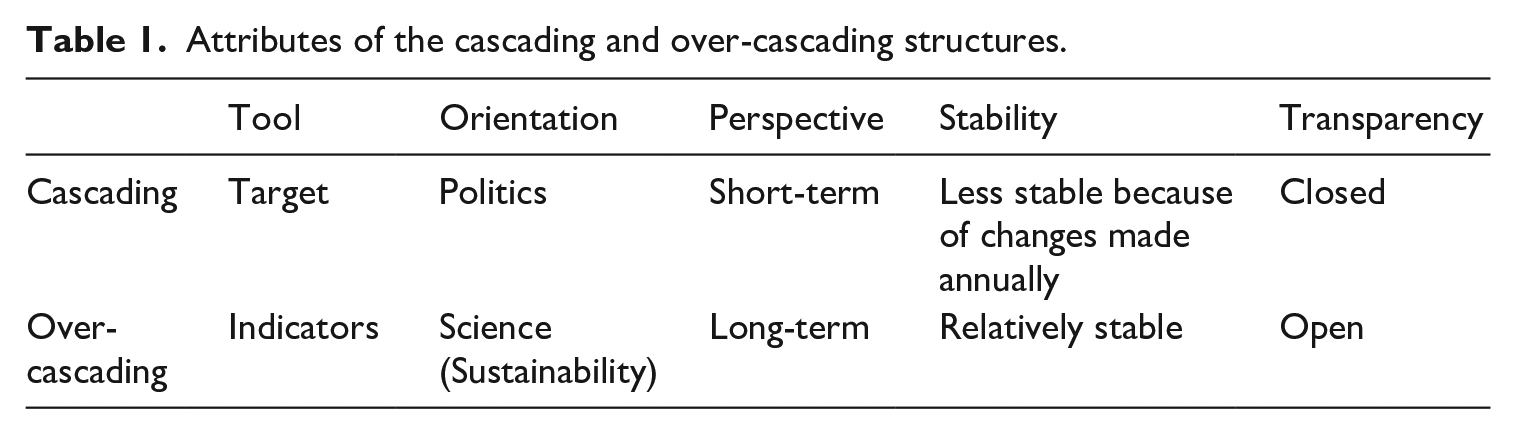
In terms of a tool for evaluation, the traditional cascading evaluation system is usually conceptualized as a target responsibility system. John Burns and Zhiren Zhou 66 observed the shift from target to indicator in China’s cadre evaluation. Though the word indicator is also used in academic discourse as a synonym for target, both words convey different meanings in cadre evaluation. Both terms are set by upper-level government, and target mainly acts as a guide to action, sometimes with mandated quotas based on upper-level governments’ projections. The word indicator is about lower-level government performance according to indicator benchmarks that take the heterogeneity of locality into account. While Burns and Zhou did not make an explicit distinction between target and indicator in their research, we make this distinction in view of the mandatory nature of target: targets are mandatory goals that local governments must implement, whereas indicators are more flexible in their assessment of success and improvement.
The distinctions inherent in both evaluation tools further highlight differences in the orientation of the evaluation. Cascading is politically oriented, with a lot of the wording used stemming from the latest CCP political discourse. For instance, in 2016, in the four-dimensional evaluation framework of Jingzhou under the cascading structure, all the dimensions, including ‘all-round well-off society’, ‘comprehensively deepening reforms’, ‘comprehensively strengthening party discipline’, and ‘policy responsiveness’ corresponded to the central government’s political discourse. However in 2018, this framework became a five-dimensional framework in response to the CCP’s new political discourse ‘five-in-one’. The over-cascading evaluation framework is dominated by the discourse on sustainability. The over-cascading evaluation in Hubei has adopted a seven-dimensional framework 67 since 2014 which is still in place. Here we can see that cascading evaluation is political in nature and that it emphasizes the implementation of party policies; whilst over-cascading emphasizes sustainable development and provincial control of prefectural and county governments reflects both political and sustainability demands.
This difference in orientation leads to a distinction in perspective and stability. Given the fact that political discourse in China is constantly changing, cascading – which is politically oriented – has experienced less stability and more changes annually in areas such as politics, economy, society, and the environment. Therefore, cascading has a shorter-term perspective whilst over-cascading is long-term and more stable. From 2006 to 2013, the over-cascading evaluation of the county economy in Hubei remained at 28 indicators. In 2014, when the comprehensive evaluation system was first adopted, more social and ecological indicators were added, but the indicator system remained stable at 35–38 items with fixed weighting for each indicator and minor revisions.
The fifth distinction is in the transparency of evaluation. Although the Central Organization Department requested an increase in the openness and transparency of cadre evaluation, it was basically impossible for the public to obtain the assessment results. The indicator system of over-cascading in Hubei commenced in 2009 and the annual results analysis report has been published from 2011 onwards, with a specific index available online to the public from 2014 – this demonstrates a high degree of openness in the over-cascading system. 68
The differences between the cascading and over-cascading structures motivate provinces to use over-cascading to make up for deficiencies of the cascading system. For most provinces, the promotion of county-level cadres is determined by the prefectural government based on the results of the cascading evaluation system. A county’s priority is still based on completing the tasks assigned by the superior prefectural government and meeting its assessment goals. 69 Provincial documents do not clearly stipulate how prefectural governments should use the over-cascading assessment results, but only mention that the provincial government would reward outstanding counties in the over-cascading evaluation. The county that performs well in this evaluation will promote county economic development as its most important political achievement. Counties evaluated as mediocre will avoid mentioning the result, 70 and they obviously prefer the cascading method of cadre control. Over-cascading assists provincial governments to communicate with county governments and convey long-term sustainability signals. Thus, provinces seek a balance between politics (cascading structure) and sustainable development (over-cascading structure).
How are the prefectural governments that have been bypassed taking on over-cascading? We identified a conflict of interest between provincial and prefectural governments in the dual structure. In the over-cascading evaluation of Hubei’s performance in poverty alleviation, GDP is no longer listed in the evaluation. However, Jingzhou City still allocates targets, including total GDP, GDP growth rate, and number of investment projects, to the remote poverty-stricken county 71 of Jiangling. For Jiangling, though its quota of total GDP is the lowest among the nine counties with similar economic conditions, the quota for GDP growth rate is the second highest. 72 There is no evidence showing that the province is aware that Jingzhou’s own targets go against the province’s requirements. These details demonstrate that provincial and prefectural evaluation are not completely consistent. In short, in Hubei Province’s vision of evaluation, cascading is the mainstay and is supplemented by over-cascading. These two systems are thus complementary despite minor conflicts.
The two structures are more complementary than competitive, with the target-based responsibility system being the major evaluation mechanism and the comprehensive (over-cascading) evaluation system supplementing the original (cascading) structure. Complementarity is also the original intention behind the innovations of the over-cascading system. The target-based responsibility system has strong mobilization and execution capabilities, which the CCP values the most. This system does however have its shortcomings: because it is politically goal-oriented, it tends to ignore other goals in the pursuit of political gains. The targets between different levels of governments are also significantly different. In the push for the achievements of the prefectural government to be recognized by the province, the prefecture may sacrifice long-term development. Therefore, the province uses the target-based responsibility system for prefectural governments to manage county political tasks and economic growth, whilst supplementing it with the comprehensive evaluation system to manage the long-term social development of counties.
Conflicts between these two systems also exist, though these are implicit since the CCP will not allow outright conflicts in its administrative system. One conflict that may arise is the competition for limited administrative resources. With limited administrative resources at the county level, the targets in the target-based responsibility system have resulted in large amounts of administrative resources being channelled into the promotion or dismissal of county cadres. Therefore, the remaining resources for the comprehensive evaluation system indicators are very limited. The second conflict is over the mandatory GDP target/indicator which the central government intends to remove. Various provinces have been reforming the GDP target, while the strategy Hubei took was to remove GDP in the comprehensive evaluation system and keep the GDP target in the target-based responsibility system in order not to weaken the pressure on local GDP growth. There are other conflicts on smaller scales, but due to limited space in this article, we are unable to discuss in greater depth the conflicting relationship between the two systems. This constitutes fertile ground for future research.
Conclusion
This article conceptualized both cascading and over-cascading structures in China’s current cadre evaluation system and provided details on both structures to shed light on the complementary and competitive nature of the relationship between the two. With a cascading structure, although there is a lack of county characteristics in the evaluation, such an evaluation structure is resilient and workable. Due to limited state capacity, provincial governments do not have enough resources to supervise each and every county, and the current hierarchical structure is there for a reason. With regard to over-cascading, we are the first to identify this new evaluation structure and have provided substantial empirical evidence on this new structure. We also argue that this new structure offers checks and balances between provincial and prefectural governments. It is the improvements made by various institutions, for example, reform of cadre evaluation in our case, that make China’s authoritarianism resilient. The cadre evaluation system in China is a relatively well-established institution, and it is also a mobilization system whereby the new over-cascading structure has expanded the provincial government’s mobilization scope. Since the CCP is a revolutionary party that relies on mobilization and hierarchy, 73 we argue that the current form of cadre evaluation serves to mobilize subnational governments at various levels without destabilizing the fundamental hierarchy. Both Fewsmith’s and Nathan’s discussions and other research on authoritarian resilience are largely focused on elite politics at the very top, whereas in this study, perspectives were given at a county level, the stability of which directly influences the CCP regime. Despite the large literature on authoritarian resilience examining institutional building at local levels, 74 there is little discussion on the over-cascading system and its role in understanding the resilience of China’s regime. This is where our study makes a contribution to the literature.
It is acknowledged that the resilient authoritarianism of the CCP also stems from other complex factors. This article explains that the cadre evaluation system plays a major part in this resilience. In order to understand the authority of such evaluation, the dynamic evolution of this system should not be neglected, especially structural changes in cadre evaluation. In recent years, the CCP has carried out a series of reforms to improve cadre evaluation, which have not only changed the indicators, methods, and procedures of assessment, but also gradually changed the structure of evaluation. In addition to the well-established cascading structure, an over-cascading structure was introduced based on county-level economic assessment. Drawing on evidence from document analysis and in-depth interviews, this article conceptualized the emergent over-cascading structure and investigated how it enhanced a province’s ability to monitor and control county-level governments. Though the empirical analysis is based on the case of Hubei, evidence from our investigations also shows that most provinces, including Hunan, Shandong, Guangxi, and Yunnan, are adopting a similar structural change.
Although the over-cascading assessment was initially used by provincial economic departments to assess the economic sector at the county level, it has greatly enhanced the statistical abilities of provinces and, more importantly, the over-cascading evaluation has been transformed into a cadre assessment tool for provincial governments to evaluate county officials. The emergence of the over-cascading structure has enabled the province to obtain detailed information on county and prefectural development and enhanced the province’s ability to supervise both county and prefectural governments. The increasing economic and political rewards based on over-cascading assessment results have improved the incentives for county-level cadres and therefore strengthened the province-to-county control. Because provincial governments saw that the over-cascading structure improved their oversight and control capabilities, they have applied it to the promotion of other policies. Currently, provincial governments are still using cascading as the main evaluation approach, supplementing it with over-cascading. In general, the cascading and over-cascading dual assessment structures can co-exist with the emerging over-cascading structure contributing to the CCP’s resilient authoritarianism.
Factors responsible for the resilience of the CCP’s authority are complicated. Although many scholars have made remarkable progress in this field of study in the past 30 years, more political and institutional factors have yet to be identified. New factors, such as the non-leadership cadre system recently proposed by Hon S. Chan and Jie Gao 75 as well as other new perspectives, should be identified so as to better understand this area. There are also other descriptions of China’s authoritarianism, for example adaptive authority, which indicates the constant reforming in the system to adapt to new contingencies. These reforms are sometimes focused on content, and sometimes on structure. These changes are impacting the evolution of China’s governance.