



Abstract
This article looks at the dialectics of race, space and death in the structuring of black urban life and in the making of the African Diaspora. It argues the African diaspora should be understood not only within the perspectives of the historical trauma of racial terror but also through the spatial agency developed by people of African descent as a way to reconstitute the self and forge a political community. Based on fieldwork with black youth in a shantytown in the city of São Paulo, the article aims to investigate the political subjectivities created through the state’s (morbid) interpellation of black youth in the global city. In order to answer this question, it pays attention to the spatial praxis developed by the direct victims of state violence to reclaim their right to a city divided along racial lines. Finally, it suggests that the global and local articulations of race and racism also convey a transnational explosive black political identity of which black youth spatially grounded strategies of resistance are just one example.
On 13 April 2012, Paulo Sérgio Ferreira, a young black man, climbed a pole and burned the Brazilian flag in the Three Powers Square in Brasília, the capital of Brazil. Sergio was arrested by the police and portrayed in the national news as mentally ill, although he insisted otherwise, explaining that his gesture had a clear message: esta é uma pátria assassina de negros (‘this is a nation that kills its black population’). A few days after Sergio’s protest, I wrote an open letter 1 arguing we should indeed burn the Brazilian flag given the anthropophagic nature of the nation. I argued that, if within the Brazilian economy of violence blacks are devoured as criminals, deemed as dirty and sexually perverse, then why should we invest energy in claiming membership of a nation historically conceived as an anti-black project? Simply put, black position within the Brazilian racialized regime of citizenship points to the ontological impossibility of fully participating in the nation as a racially democratic ‘imagined community’. It only allows black membership through a pathologized regime of power that reduces black bodies to the status of exotic’ objects.
This article is part of ongoing research regarding black social suffering and black subjectivity in a country still deemed a racial democracy, but yet continues to be marked by an endless economy of violence and racial terror. National statistics on homicidal violence, unemployment and lack of access to higher education reveal some of the enduring patterns of black social vulnerability in Brazil despite the fact the country is steadily emerging as a major global player. The Global Report on Equality at Work, 2011, reveals that blacks comprise 50.5 percent of the total unemployed population and at least 45 percent of black youth are unemployed or in low paying jobs. In 2010, blacks accounted for 5 percent of executives and 13 percent of managers of the 500 largest companies in Brazil. Black women hold only 0.5 percent of management positions, 2 and overall, they earn on average 70 percent of white men’s and half of black men’s incomes. As for the formal education sector, blacks represent 70 percent of the fourteen million illiterate Brazilians. 3 The Map of Violence, 2011, also reveals key aspects of this racially anthropophagic scenario: Brazil is sixth in the current worldwide ranking of homicides among young people, with blacks being 127.6 percent more likely to be killed than whites the same age. Moreover, in some Brazilian states, such as in the states of Paraiba (1971.2 percent), Alagoas (1304.0 percent) and Bahia (798.5 percent), the pattern of victimization of young black men is nearly 2000 percent in relation to young whites (Waiselfisz, 2011).
São Paulo’s pattern of juvenile victimization illustrates this economy of racial violence. Although homicide rates in the state dropped 67 percent from 2002 to 2010, black victimization continues to be higher than any other social group. In 2010 the homicide rate was twice as high (48 percent) as that of whites (18.3 percent) (Waiselfisz, 2011: 67). Also, it is striking that although the metropolitan districts of the state registered a major reduction in homicide rates, they remain the areas most targeted by police lethal practices. In the city of São Paulo, for instance, the police were responsible for one out of five violent deaths in 2011, representing 23 percent of homicides. 4 Proportionally, the homicides committed by the police have increased, while those associated with drug trafficking and street violence have diminished. 5
A special report on police killings released by a human rights organization in 2009 unveiled a ‘methodology of death’ that encompassed extortion, torture, and the targeted assassination of mainly black young men who resided in hyper-impoverished areas associated with drug trafficking. 6 A 2009 Human Rights Watch special report reveals 11,000 people were killed in the last six years by São Paulo and Rio de Janeiro state police forces under the legal justification of ‘acts of resistance’. Between 2003 and 2008, São Paulo Police killed more people (2,176 deaths) than all of South Africa’s infamous police force (1,623 deaths) and the number of deaths caused by the police remained unchanged through the years. 7 As I have argued elsewhere, patterns of homicidal violence, mass incarceration, unemployment and police lethality constitutes a spatial strategy of racial domination in which the state appears as a murderous agent even when it is not explicitly implicated in such deadly practices (Amparo Alves, 2011).
Considering blackness as a political category constituted through the dialectics between life and death, this paper offers an analysis of the identities forged within the context of black disposability in urban Brazil. It seeks to unveil how blackness comes into being around a particular group of individuals interpellated by the Brazilian racial state in São Paulo’s favelas. While I am conscious about the implications of making broad generalizations, and am aware of the fragmented and diverse ways blackness is lived, my work with black youth in the hyper-periphery of São Paulo highlights the dialectics of blackness as an identity forged under/through macabre interpellations. I seek to evince how violence and social suffering provide the material resources from which black youth forge an alternative identity in a racially segregated neoliberal city.
This article is organized as follows. First, I consider the relation between racial injustice in São Paulo’s periphery with worldwide schemas of racial domination by probing the relation between a black youth spatial praxis 8 in São Paulo and an alternative approach to the African Diaspora theory. Second, in arguing that the African Diaspora is a dialectic between deadly interpellation and self-making, I explore ethnographic material from group focus interviews with black young men and women in Jardim Angela, an (infamous) São Paulo shantytown. I seek to understand the underground politics of resistance organized around specific notions of blackness in a context where race is hardly articulated as a political category, yet painfully lived through mundane encounters with the police. I ask the following question: how is black subjecthood forged and lived by black youth favela residents within the context of everyday state violence in the anti-black global city? I draw on Henry Lefebvre (1991) and Katherine McKittrick (2006) to provide provisional thoughts on the notion of blackness as spatial praxis, what I conceive in the urban Brazilian context as black spatialities. By reclaiming a spatially situated black political identity, my main concern is primarily to redress a fatalist notion of blackness that while helping to unveil the brutality of anti-black violence, has also denied the agency of the (socially) dead.
Dialectics of the African Diaspora
This article elaborates the African Diaspora as an analytical category and as a political community constituted through the dialectics of race, space and death. I draw upon the literature on black genocide to suggest a ‘supra-national geography of death’ (Vargas, 2010) and geography of resistance forged by people living under a racial regime of terror (Gilroy, 1993). Yet, instead of looking into the worldwide structure of racism from above, I focus my attention on the glocality 9 of race. In other words, I look at how race is dialectically articulated and lived, in its mundane form, by people as they confront globally structured racial injustice. The spatialized effects of global white supremacy can be easily located within different territories where black life is in a permanent state of siege, whether in Brazil, the United States or elsewhere. In Brazil and the US, statistics illustrate the deadly consequences of these economies of violence. They have evinced a historical pattern of black vulnerability to death energized by state technologies of confinement such as racial segregation, police violence and mass incarceration (Davis, 2003; Gilmore, 2007; James, 1996; Nascimento, 1989; Russell-Brown, 1998; Silva, 1998; Vargas, 2010). 10 However, at least in the Brazilian academic landscape, very little attention has been paid to the dialectics between such worldwide systems of domination, local technologies of social control and a painfully articulated black urban identity.
Conceiving the African Diaspora as mutually constituted through death, space and resistance is to account for its macabre, yet, promising outcome: the anti-black project that constitute the nation state also provide the context in which a transnational black politics may emerge (see Vargas, 2010). If the nation state is imagined—in Benedict Anderson’s (1983) framework—as a (white) horizontal comradeship, the black placeless location offers political and theoretical resources to challenge narratives of national boundaries and reterritorialize blackness as a supra-national political community.
It is both theoretically and politically relevant to reclaim black urban life and to account for a transnational black subjectivity produced in such macabre spatialities, since if blacks are always and already marked as socially dead (Sexton, 2011; Wilderson, 2003), blackness is not/cannot be circumscribed to and defined as death. 11 As a political project, the African Diaspora only makes sense if it complicates narratives of black suffering and national belonging, and thereby, provides analytical lenses to understand what connects the national to the global reality of race and resistance. In that vein, Paul Gilroy (1991) and Sharon Patricia Holland (2000) interrogate Benedict Anderson’s analysis of national identity through a critique of the articulation between race and ‘national culture’. National culture, Gilroy has highlighted, is the domain in which anti-black discourses are articulated through homogeneous accounts of a horizontal community. In the British case, Christianity and whiteness appear as the core resources to suture a national identity that conceals black subjects. Likewise, Holland has questioned Benedict Anderson’s premises by analysing how his metaphor of the Unknown Soldier’s death precludes any consideration for those ontologically situated outside the national project. As she points out, ‘what if some subjects never achieve, in the eyes of others, the status of the “living”?’ (2000: 15). The homogenous narrative of the nation cannot account for the black subject, she suggests, because her/his precarious position is what makes the nation possible: ‘We literally speak from the dead’ (2000: 21).
This black impossibility within the nation—or the national comradeship made possible through black annihilation—begs for an understanding of the African Diaspora as a community forged through the dialectics between living and dying, geographies of death and geographies of resistance, the globality and the locality of race. As Joy James (2010: 214) has reminded us, black death is also generative as it can be the house of a black utopia where black political life can be reclaimed ‘from meaningless death and despair’. She points to a radical approach that redefines the nature of the black community itself and redefines black subjecthood from the space of death: ‘one does not negotiate with the state’s use of terror, violent and premature death (actual physical death or disappearance through incarceration). One opposes it and in that opposition finds meaning in black suffering’ (2010: 214).
Drawing on these insights, let me offer then a conceptualization of the African Diaspora that takes its macabre geographies and the spatial politics of resistance it entails as black alternative spatialities. By black spatialities, I am also referring to the geographies of death generated by the state—such as the prison, the favela, the cemetery, the (necro)polis—which have profoundly shaped black urban lives. This entails at least two considerations: first, I evince a different way to engage in a black critique of what has been called the nation state, proposing a critique that, instead of relying on reified accounts of ‘it’ (the state), focuses on the spatial outcomes it produces in both local and supra-national context. Second, in taking the African Diaspora as a ‘spatial praxis’, I want to complicate a Marxist analysis of space (Lefebvre, 1991; Soja, 1980) and consider the ‘socio-spatial dialectics’ of black identity and black suffering by looking into both the ‘permanent state of siege and the permanent state of rebellion’ (Vargas, 2010: 34) entailed in this political community. This approach is helpful since in order to understand the nature of resistance today, it is imperative to consider the entanglement of space, race and gender in producing mundane global hierarchies of power people confront in their everyday lives.
As I will illustrate, the testimonies of my interlocutors suggest a profound racial/spatial consciousness as an important dimension of their strategies to position themselves as blacks within the global city. In the same vein, and in line with Jacqueline Brown’s insightful discussion on black spatial agency, I suggest that space and place are ‘diasporic resources’ (Brown, 2005: 42) urban black Brazilians have creatively manipulated to constitute their identities as pretos, 12 favelados and so on. If the prison and the favela have been ‘sites’ of spatial confinements, blackness has to be thought of as an alternative spatiality to state-produced black captivities. This is also what Katherine McKittrick (2006: xiv) has suggested in her call for a consideration of space in our critiques of racism because ‘black matters are spatial matters . . . and also [because] space itself is produced through social relations of power . . . [b]lack subjects are not indifferent to practices and landscapes; rather, they are connected to them due to crude racial-sexual hierarchies and due to their (often unacknowledged) status as geographic beings who have a stake in the production of space’. McKittrick juxtaposes two distinct spatialities: a geography of domination that she situates in the slave trade and in the racial/sexual displacement of the black body, and a geography of resistance that she locates in black women’s praxis. In the context of displacement and racial trauma, black women have developed an ‘oppositional geography’ to reimagine and remake themselves: if the ship was a vehicle of dispossession and terror, it also gave birth to new black geographies (2006: p. xi).
The usefulness of this dialectic perspective on black geographies is that it enables us to go beyond static notions of spaces and blackness—geographical and political spaces—and accounts for the (spatial) social agency of black pepole in remaking themselves (see Hamilton, 1995; Gordon, 1998, 2006; Patterson and Kelley, 2000). Within that context, I argue that blackness should be understood as a category that is neither stuck in time, nor in space; blackness is dialectically lived through bodily and spatial praxis as multiple geographies of dislocation are constitutive elements of black experience. In other words, black consciousness is also a ‘spatial consciousness’ (Soja, 1980) as ‘black matters are spatial matters’ (McKittrick, 2006: p. xiv).
Understanding blackness as a spatial praxis allows us to recognize the everyday dimensions of the African Diaspora as we account for historical displacement, everyday struggle for territory, and the political identity forged in local contexts. A severe qualification is needed here: by looking into the ‘localness of race’, I also join Jacqueline Brown’s critique of the relativist approach on race and place in recent literature. I do not want to suggest that race is a fluid/contextual category that should be understood just in relation to the local context (Maggie and Rezende, 2002; Sansone, 2003). As the body of literature on global racial formations (Omi and Winant, 1994; Winant, 2002) has suggested, the worldwide effects of global white supremacy in producing global racial injustices demystify such a relativist approach that argues for racial fluidities. I am more interested, instead, in seeing how race and space are inscribed on an ‘axis of power’ (Brown, 2005: 9) that is globally and locally produced and lived, the ‘instabilities that surround both blackness and localness’ notwithstanding (2005: 33).
The locality of race and violence in a São Paulo shantytown
Tagged by UNESCO as one of the most violent neighbourhoods in the world (Covey, n.d.), Jardim Angela is hyper-poor and a predominantly black neighbourhood. According to the official census, the district has 245,000 inhabitants: 47.2 percent are white, 51.4 percent are black, and 1.4 percent are classified as ‘other’. While the black population in the city of São Paulo has been approximately 28 percent, their over-representation in poor districts such as Jardim Angela is still overlooked in the literature on urban studies, leaving unarticulated how race and class are lived in the city (for a critique see Carril, 2006; Oliveira, 2008; Rolnik, 1989). While it may be true that favelas are not racially homogeneous enclaves, blacks are the overwhelming majority of favela residents and they are spatially interpellated as a racial group. In reality, most of the poor ‘whites’ in the census could easily be identified as brown northeastern immigrants who are whitened in the Brazilian ideology of racial democracy, in everyday discourses about race, and in official government data by census takers (Piza and Rosemberg, 1999). Yet, the apparent racial heterogeneity of Jardim Angela hides a spatially grounded racial injustice expressed in state-produced vulnerabilities that foster and enable premature death among its black youth. And as a predominantly black territory, social indices such as youth homicide, unemployment, teenage pregnancy, as well as residents’ level of education, housing conditions and average household income, renders Jardim Angela a prime example within São Paulo’s ‘geography of death’ (Vargas and Amparo Alves, 2009).
Dropout rates in the local school system are three times higher than in predominantly white districts of the city where the average is 3 percent. 13 The public schools look like prison installations with high walls and robust gates. The wall of a secondary public school is graffiti-ed with the following inscription: Polícia, sai do pé! (Police get out!) Rotating checkpoints and police patrol vehicles in the streets remind us that this is a military-occupied territory, even though there is a state effort to present the police as a friendly force (uma polícia amiga). 14 The district houses the 100th Delegacia de Polícia (police station) and the Police Company Quarter. Along with the 47th DP and 92th DP, the three police stations are known by residents as the ‘Bermuda Triangle’ or the ‘Triangle of Death’, an allusion to the ‘disappearance’ of people, a practice related to police-linked death squads.
In Jardim Angela, deaths among young males are significantly high. Between 1996 and 2000 the district registered an annual homicide rate of 116 homicides per 100,000, while the city of Sao Paulo’s homicide rate oscillated from 55.6 to 66.9/100,000 population in the same period. The numbers were even worse when categorized by age and gender: males between 15 and 25 years of age accounted for a homicide rate of more than 200 killings per 100,000 population. 15 Although in the last couple of years the government has celebrated a reduction in Sao Paulo’s homicide rates, in poor districts like Jardim Angela, violent deaths among youth aged 15 to 24 remain high. In 2010 the district registered a rate of 57.64 deaths per 100,000 inhabitants, higher than the capital city’s average (34.41) and three times higher than that recorded in Morumbi, one of the wealthier areas, in which the homicide rate among young people of the same age is approximately 19.96 deaths per 100,000 inhabitants. 16
Spatial distribution by race in the ten most and least vulnerable districts of the city of São Paulo.
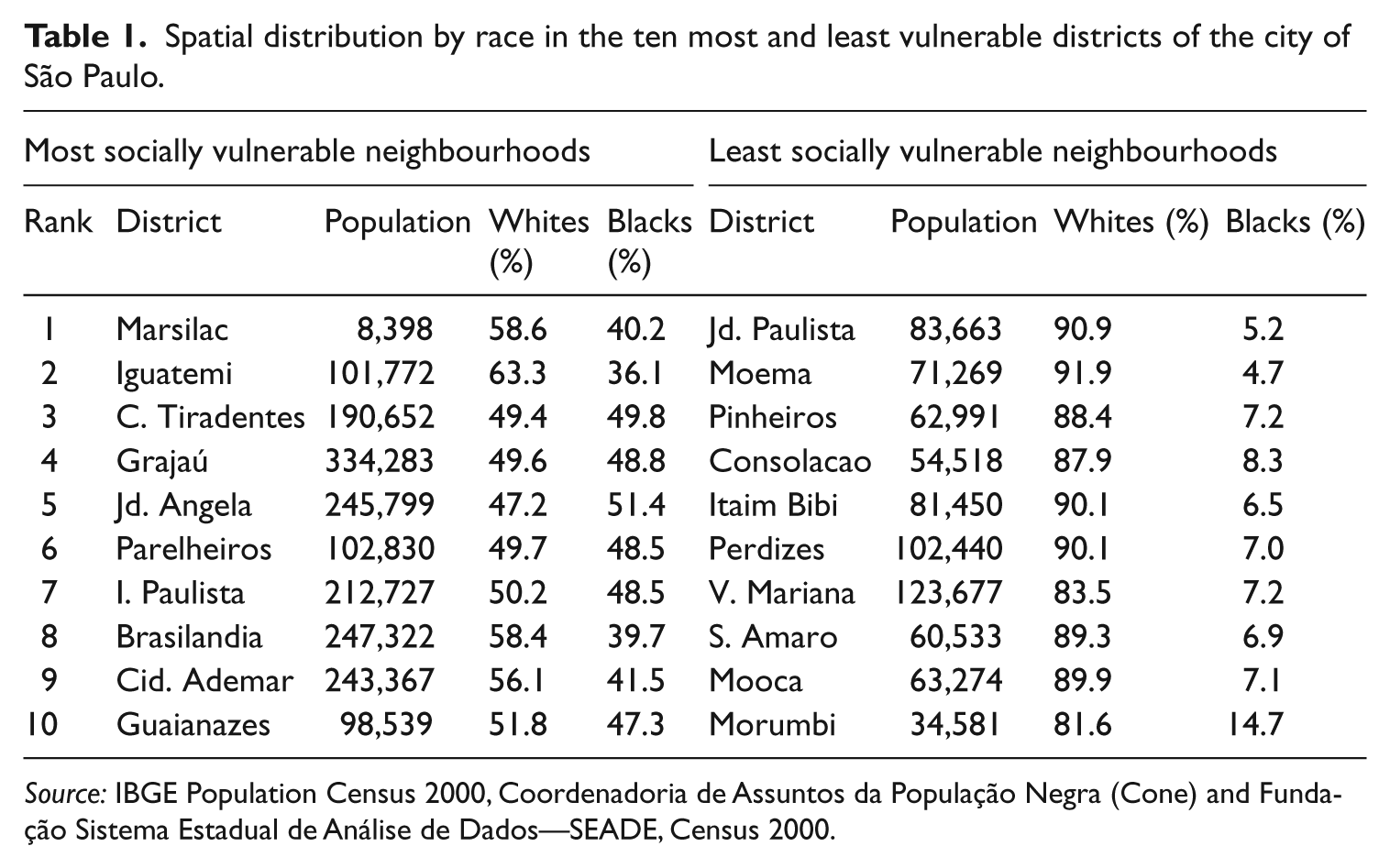
Source: IBGE Population Census 2000, Coordenadoria de Assuntos da População Negra (Cone) and Fundação Sistema Estadual de Análise de Dados—SEADE, Census 2000.
Which (social) geographies are produced through economic, symbolic and physical violence in a city divided along racial lines? If race does not exist in Brazil, what renders blacks the main victims of state violence even in supposedly racially diverse urban spaces like the favelas? What accounts for the disproportional premature deaths of young black males? While this article does not intend to address all these questions, they inform my understanding that police killings and other racial injustices are technologies of racial domination in a ‘raceless’ society (see also Silva, 2001; Smith, 2008). They are also important procedures through which the Brazilian racial state reasserts its power in a deeply destabilized economic/social order produced by the state itself. Thus, as a racially produced space, the favela should be seen as a text to understand the racial state sovereignty in its murderous exercise of killing and/or letting die. 17
Although state violence is not limited to the police force, police killing is a practice that organizes and produces the city, giving coherence to its racial arrangement. It produces the meanings of peace and order and establishes the boundaries between law as protection and law as punishment, the legal city itself and the illegal troubled geographies of the favelas. As Steve Martinot and Jared Sexton (2003) have argued in the US context, police killing not only provides the narrative of “endangered civil society”, but the very essence of civil society as the white community comes into being through its practices. White supremacy and police killing are ‘a twin structure, a regime of violence that operates in two registers, terror and the the seduction into the fraudulent ethics of social order; a double economy of terror, structured by a ritual of incessant performance’ (2003: 172). In fact, white middle class projection of fear towards black bodies and predominately black territories in urban Brazil justifies a politics of terror that contains, kills and allows blacks to be killed in the favela. We have to take into consideration, then, how racially oriented meanings of specific localities came to signify crime and disorder and how the favela is produced and reproduced in the spatialized and gendered ‘narrative’ of black criminals.
In a classroom and in the bar: discussing urban violence, racism, and hope
I spent the summer of 2007 doing preliminary fieldwork for a dissertation project with black youth in Jardim Angela. Most of my weekends would be spent hanging out with black young men in its countless bars and as a volunteer teacher in a grassroots project for black youth in a local public school. In the bars and in the classroom I explored the possibilities of understanding the black urban experience and black subjectivity in a place overwhelmed by police violence, poverty and deemed as hopeless. Here I draw primarily from focus group interviews, personal interactions and participant observation with Jardim Angela youth participants at Educafro (Educação e Cidadania de Afrodescendentes e Carentes), a community-based grassroots organization I was part of.
Educafro’s main agenda is to prepare poor black youth for the highly selective entrance exams required for admission into public universities in Brazil. The organization does more than that, however: it is also an umbrella for different demands of black youth in hyper-impoverished neighbourhoods of the city. At Educafro, the youth are encouraged to critically assess and intervene in the social reality in which they live through classes and workshops that provide venues for young black women and men to actively engage in conversations pertaining to their gender and racial identities, as well as link their experiences to larger structures of oppression in the city. Although I initially planned to conduct focus group interviews exclusively with black males, I explored the space of classroom as a ‘site’ in which to engage in an open conversation with all the students at Educafro in Jardim Angela (this included 53 brown/black young women and men).
I was assigned to teach Afro-Brazilian history as part of my volunteer work in the organization and this turned into an opportunity to establish further relationships with local youth beyond the classroom. As part of the class activities, I designed a 45-minute discussion on media-related issues, such as controlling images, police violence and personal life experiences as favela residents. Instead of guiding the discussion, my main interventions consisted of mediating the debate or elaborating on someone’s comments I judged as underexplored by their classmates. The conversation began with a discussion about media coverage of recent waves of violence in the area. The topic was brought to my attention before class by a young black man who updated me on a police raid carried out in the favela the night before, resulting in the arrest of two young black men said to be involved with PCC, a criminal organization in the underground economy of drugs. The students vehemently rejected the media portrayal of Jardim Angela as a violent neighbourhood, although some of them recognized that violence was part of their daily experiences as favela residents:
The favela is violent, but not as violent as the media want us to believe it is. The favela is as violent as any other. The media’s coverage is very problematic because violence is only seen by ‘them’ when there is a death. Then, if there is a death in any place close to Jardim Angela, they just say that it happened at Jardim Angela. They [the Media] are lazy. Is the bairro violent?, I say yes. When we do not suffer violence from the bandits, we suffer from the police. I’m OK with that [violence in Jardim Angela]. Ever since I was born, my bairro has had this reputation and it has not changed. Living here is not calm, but I’m used to it. What sells in the media is blood. If there is blood, there is profit. That is all. Not only the press, but society [itself] see the bairro as excluded [sic] . . . it’s like there were borders that delineate where poor and violent people should live.
The residents’ anger towards the media’s biased portrayal of their part of the city is a result of a pattern of journalistic discourse that has portrayed it as a problem for the city. They contended that media created a fictional narrative that justified police raids that led to more marginalization and discrimination against favela residents. Overall, the newspapers’ discussion on criminality is reduced to a moral rhetoric that avoids the structural roots of the violence at Jardim Angela and equates its residents with criminals. Headlines generally depicted the bairro as a territory of fear and an outlawed land. Its residents were stigmatized as either passive or dangerous. 18 Consider, for instance, the following headline from the newspaper Diário do Comercio: ‘Jardim bate Cali em homicidios’ (Jardim Angela beats Cali in Homicides). Here, the verb ‘beat’ and the mention of the Colombian city are used to explain the causes of violence and to ask for harsh measures against the favelados. The race between the favela and Cali also suggests that Jardim Angela is a place out of control and under the domain of drug dealers, along the lines of Cali’s international media and Hollywood portrayals—another instance in which certain racialized spaces are constructed as troubled geographies.
The production of news media on crime in Jardim Angela can be easily situated within the moral economy that produces black criminality and evokes military intervention to safeguard the middle and upper classes from ‘black criminals’ in urban Brazil. In the news, the geography of the favela and the cartography of the black body are symbiotically articulated to produce narratives of crime and order; ‘the society’ is seen as endangered by the favela, and the favela in its turn is a foreign land, a territory needing to be ‘pacified’ through military intervention. 19
In opposition to the media narratives, the students in the classroom felt discriminated against and identified both the journalists and the police as two sources of constant violence against them. While the journalists produced discourses that legitimized police incursions in the favela, the police appear as a cruel force that humiliates, beats and kills. Fear, distrust, frustration and anger appeared in the students’ voices as the immediate response against a police said to be one of the most well trained in the human rights ideology in Brazil:
I can’t count how many times I was stopped by the police here in Jardim Angela. One friend of mine had his guitar stolen by a white person. He called the police, and guess what. The police ended up arresting him! What disturbs me is when a black male police officer calls us monkeys, opens our backpack, [and searches through] the food we are tak[ing] to our jobs. It is not the white, the black police officer himself [that does this]. What is that? The police and nothing is the same. We are our own police. I have more fear of the police than of the bandits. The police is present in the bairro, but only to humiliate [the] poor, making one think twice before getting into trouble. I think the police should be more present here, I think.
On one hand, the police are seen as a brutal force that performs violence against the poor, black, favela residents. On the other, some students considered their presence important, not because they saw the police as an institution they could trust, rather because they identified state violence not only through police brutality, but also by state negligence in protecting Jardim Angela residents. The state is then understood through the outcomes produced by its absence as social protection and by its overwhelming presence as military force. Yet, such mistrust highlights also a fundamental paradox of the police force in Jardim Angela: while the state has invested in neighbourhood surveillance programmes and community policing strategies—with a police heavily trained within the human rights framework—the ‘shoot to kill’ policy remains an enduring institutionalized practice and the police image continues to be associated with an ‘old’ police practice, despite the government’s fictional narratives of peace and order.
All of the students in the classroom had personal stories about their encounters with the police. A black male remembered his friend who was killed by the police in an alleged confrontation. Another one recalled the moment when he was coming home from work late at night and was harassed in a police checkpoint. Those that didn’t have a personal encounter with the police had one story about a relative or friend who had fallen into the hands of the state.The explosive relationship between black youth and the police came to my attention at several moments when I was interacting with black young men in the streets of the bairro. They taught me the strategies they use to face day-to-day police violence and keep themselves alive. Any black person in the favela knows the rituals they have to undertake when confronted by a police blitz in the middle of the night and black young men have taken these strategies very seriously. The ritual involves slow hand movements, a cooperative behavior, confidence in answering questions, sometimes showing submission and not speaking unless they are spoken to. Fernando’s and Julio’s narrative, as we hung out in one of countless bars in Jardim Angela, illustrates both their familiarity with police brutality and the strategies to stay alive:
I used to work at night. When I was coming down the hills the Força Tática [Special Unity] suddenly appeared around the corner and shone light on my face. I froze off. They shouted at me, ‘vagabond stop and put your hands on the wall’. I thought, now I am fucked. So I went straight to the gate [of the house nearby] and put my hands under the doorbell, like I was standing at the walls. They came to me with this stick and I was basically pissing myself. Then they started searching me and I had the doorbell under my hands, pressing the doorbell (campanhia). Each time they poked my body, and I pushed the doorbell harder so someone inside the house would know that I was being beaten. They saw my ID, asked for my work-phone and released me after lots of questioning. [There were] no excuses or apologies. I was feeling like trash. Now tell me, what can you do in the middle of the night, four guys with the gun in your face?
We can‘t do much. Just pray, man. I wanna see who doesn’t get afraid and that will say this and that . . . You can’t even look at their faces. Go ahead and look [at their faces] and see if you don’t receive a slap across the face. That stuff is crazy (O bagulho e’ louco).
Very crazy. If you snooze (moscar) they smash your face, your mother’s, whoever is with you. I wanna see them do that with the playboys in the jardins [the elite neighbourhoods]. On this side of the city, from the bridge to ‘here’ things are crazy. Just see how the police are equipped here and there. Here is a 38 [referring to the police guns], there are automatic pistols [again referring to police guns]. Who are they protecting? In the Jardins, if you walk around the block twice you are stopped (enquadrado). Two laps you take and the bastard doorman calls the police.
In Moema [a rich white neighbourhood] they say ‘Please, sir, hands on your head.’ Here, [the police say] ‘hands on your head ladrao [thief]’ or I’ll burst you. Once a policeman told my brother: I prefer working in Jardim Angela. You can beat-up the niggas (la posso quebrar os neguinhos). And they beat us up . . . oh yes.
Fernando and Julio were totally aware of the bodily ‘racial episteme’ (Fanon, 1967) through which the police organizes its practices in the neighbourhood. Even though the language of race barely appeared in their dialogues, their wncounters with the police are deeply racialized. The strategies developed to cope with police violence, however, did not protect them as the police had a well-defined ideal-type of the urban criminal. I wrote in my field notes the following fragments from their reaction to the police’s selective profile of black men:
Ah, the person’s appearance. Just the look says it all. The police will stop you if you are wearing a cap, baggy pants, if you are black and poor. They see the way you move, your clothes, if you have tattoos. When the police are passing by and you are scared, that alerts the police. If you put your hand on your back like in the prison and call the police ‘sir’ then you are guilty as charged (tem culpa no cartorio). They don’t even need to check your record (puxar a ficha). When I pass by the police I look straight. If they ask for my ID I look into their eyes. At that moment you need to think fast. If you see the police and turn your head down, hummm. Huge mistake. For example, three of us are here, right? So they are passing by [pointing the street] and when you see the police you try to divert the eye, they stop with the movement of [our] bodies . . . See when a policeman stops someone. Do you have any doubt who the police will stop first? Then you don’t understand anything about real life. It is black . . .
These fragments show not only their consciousness of the place their bodies occupy in the city’s economy of violence, but it also suggests some strategies used by black youth to cope with the overarching presence of the police in their lives. They have strategized ways to deal with these encounters by developing a repertoire of practices such as showing compliance by calling the police officer ‘sir’, avoiding eye contact, pushing the doorbell at someone else’s gate while being searched, always having their work ID in their pocket and behaving ‘naturally’ when being questioned. Yet, complying and negotiating with the police did not mean, in my interlocutors’ case, submission or false consciousness. As James Scott (1990) has questioned elsewhere, what is the language of resistance when the ‘powerless’ face the brutality of power? Within the context outlined, black youth’s strategies to cope with police violence may offer, then, a critique of power that does not necessarily follow the conventional script of resistance. Their dismissal of the state call to participate in neighbourhood surveillance and community police strategies, for instance, illustrates a way to ‘speak back to power’ (Scott, 1990: 83) in the context of state violence. Although the state has spent a lot of time and money trying to clean up the police’s image, these young men have remained reluctant to believe the motto policia amiga because, as their personal encounters with the cops suggest, nothing has changed. Like many favela residents, they have completely dismissed the ‘new’ police because its images and practices continue to be associated with the ‘old police’, precisely the one the new strategies on policing community were desperately trying to overcome. Although the police have presented themselves as a ‘friendly’ institution, the lack of trust in the justice system, and in the police in particular, points to crises of state legitimacy among the poor urban youth.
In that regard, while the police were seen as abusive forces, the local branch of Primeiro Comando da Capital (PCC), a criminal organization in São Paulo that disputes the territorial control of the favela, was perceived as the provider of justice and collective well-being. When I asked what explained the drop in homicides in the bairro, one interviewee’s response was particularly telling: ‘It was the PCC that ended with criminality here’. When I asked how, he continued, ‘With the PCC, if a person steals a water jug he goes to the debate. Now if you call the police, he is gonna be killed.’ While I do not take such manichaeist readings of social reality at face value (a dualism between an evil police and good drug dealers who distribute justice), such narratives help us to understand the responses produced by black youth as the encounter the racial state. Trapped in the favela kilometers away from downtown, and excluded from the ‘right to the city’, the youth at Jardim Angela only knew the state though its punitive brunch, the police. The criminal organization appears in that context as the alternative system that distributes justice and social network based on what they consider a ‘fair’ game.
20
If there was no way to negotiate with the police, the PCC at least opened the possibility for one to defend him/herself and pay back for the wrongdoing with a less lethal sentence. Again, Fernando explained to me:
Who goes to the police? Do you go to the police when something happens to you? I don’t go. Once I went and that was a bad idea. Sometimes when you ask, even a simple question, he [the police officer] wants take everything away from you. If you ask, they want to make a report, and also treat you as ‘marginal’ [criminal]. It is because of this that I dropped the theft complaint . . . if you go to the police station as a victim you probably will leave as a ‘marginal’ [criminal]. Sometimes one does not talk because when you go to the police station to explain, you end up suffering by having to explain things that you don’t know. Instead I went to the brothers [PCC] to solve the issue.
Living under the constant shadow of death, what expectation do Jardim Angela’s youth have about their social position in a city not made for them? While some youth responses suggested a radical critique of capitalist values, others revealed a wish to equally participate in the global city. Contrary to a stereotyped perspective on black youth as lazy, hopeless and lacking self-entitlement, the participants in the classroom expressed not only a desire to get a college degree, to have family or to get a good job, but also to help others ‘succeed’. Their dreaming, however, did not prevent them from setting forth a strong critique of the structural barriers that prevented them from participating in the regime of citizenship and they were aware of the social conditions in which most of them would ‘fail’, regardless of their attempts:
I want a college degree, but I’m not sure I will get it. See, this idea of success is relative. I myself have worked hard to get into the university. I’ve tried three times to get into USP [University of Sao Paulo] but my score was low. I feel the system works against us and some of us will never make it anyway. Dream one has, but to have dreams in the favela is very relative. If you ask me about my dream, of course I want to get a college degree, and to get married. But if you ask a guy over there [in the selling drug point], he will say that he wants to be the dono da boca [the drug dealer].
The youth referred to the territorial limits of jardim Angela as ‘Da ponte pra cá’ (this side of the bridge), in opposition to its neighbouring well-off districts across Pinheiro’s River. Antonio, one of the community organizers and activists at Educafro, explained to me the meaning of the metaphor extensively used by the youth to refer to their geographic location in relation to the city. He explained that ‘da ponte para cá’ represented not only the territorial division between two neighbourhoods; it represented the social boundary that divided the haves from the have-nots, a similar metaphor to the proverbial ‘other side of the tracks’ in the US. My reading of their uses of the metaphor: Jardim Angela’s youth spatial consciousness reveals a deep understanding of how class- and race-based oppression are spatialized, as well as how space itself is produced through particular understandings of race and class.
I came to a better understanding of the spatial metaphor in the classroom when students complained about Jardim Angela residents being unable to circulate around the city due to the high cost of bus fares. They also expressed frustration about being denied a job when disclosing their zip code in the application process, what they sarcastically labeled as zip code racism (racismo postal). The inscription of dangerousness on spaces like Jardim Angela was not only the result of white fictional narratives on crime and order; it also had material consequences for black youth from the outskirts of the city who were dubbed public enemies. The ‘white paranoia’ was translated into racial injustice expressed in day-to-day discriminations that prevent black youth from accessing the job market: in 2008 alone, while the unemployment rate among whites in the São Paulo metropolitan area was 9 percent, among blacks in general it was 16 percent. Even worse, in that same year, the unemployment rate among black youth was as high as 43.7 percent.
21
As a ‘racial formation’ (Omi and Winant, 1994) because it reflects the city’s ideological frontier between purity and dirtiness, order and crime, privilege and dispossession; it also reveals the racial manoeuvre through which the global city perpetuates global injustices along race and gender lines even when such categories are not primarily deployed as makers of difference. Here are two revealing responses from two young black women, one saleswoman in a shopping center and another currently unemployed:
In my job, when I say that I’m from Jardim Angela the people get scared. The idea that I’m ‘favelada’ just comes to their mind . . . uneducated and violent. I know it is discrimination, so sometimes I prefer just to stay quiet, hiding the name of the neighbourhood. I lie when I’m asked where I live. When looking for a job I never say that I live here because they will never call me for an interview. If you wanna a better job, better not say you are from Jardim Angela.
For black women, the strategic denial of the place of origin represented an attempt to move away from the racial imaginary that defined their social position. It goes without saying that black women’s access to the job market continues to be defined through the relation of racial patriarchal domination that Brazilian history conveys (Bairros, 1991; Caldwell, 2007; Carneiro, 1999; Santos, 2008). In that sense Jardim Angela’s black young women’s anxiety reflects the history of racial/gender subordination inscribed in São Paulo’s social landscape. In 2008, black women, aged 25–39, comprised 52.9 percent of the domestic workers in the metropolitan region of São Paulo, with a monthly income as low as 250 USD. 22
The narratives given are only a very limited piece of the complex dynamics of race, class and space in shaping the lives of Jardim Angela residents. However, they point to some of the mechanisms by which structural racial injustice endures through the media, the state and the production of the global city itself. In other words, they show how mundane events from police harassment, to the price of the bus fare, to discrimination in the job market structure black urban life. Furthermore, the narratives offer possibilities to examine the spatial dialectics of race, gender, class, and structural violence in the production of blackness. An additional component I identified in my interlocutors dialogues was a black political identity forged through territorial identification.
In fact, some students expressed a will to move out of the favela to a ‘better’ neighbourhood, aiming to escape from the stigma of being a Jardim Angela resident. There was no advantage in reclaiming belonging to a place marked by dispossession and seen as ‘dangerous territory’. Other students, however, engaged in discursive practices of reclaiming the favela as home and refusing its pathologic narratives:
If I could, I would move away from here! If you compare this school with the ones in Moema, there it [public education] seems like private schools. Even doctors do not want to come to work in the clinics here. Why? The Emergency room here closes at seven [in the evening]! The postal code says a lot at the time of getting a job. It’s for that [reason] I’ve been unemployed until now. You just need to look at the difference between here and Santo Amaro. From that point on (Da ponte pra cá) it’s a whole other reality. I am 100 percent Zona Sul [southside], but I will tell you the truth, if I could move out today I would not think twice. Who would like to live like that? Nobody, right?
The last assertion was made by Fabio, a 22-year-old active participant in Educafro Although being proud of being from Zona Sul, his response pushes us to not naively accept traditional narratives of resistance that take the favela and its inhabitants as exotic subjects. His assertion was quickly justified as he revealed the hard time he had trying to find a job:
I think that it is because of this [perception] that I’ve been unemployed for a while. When you say: I am from the zona sul, even worse, if you say, I am from Jardim Angela or from Capao Redondo, people quickly step back. You just need to look at the differences between here and Santo Amaro. From that point on, (Da ponte pra cá) it’s a whole other reality.
Fabio’s consciousness of his position in the socio-racial-spatial configuration of the city provides a space to explore what Loic Wacquant, in the US context has coined as the ‘two faces of the ghetto’. The ghetto, according to the author’s formulation, is a space of subordination to the power of the dominant group and a machine of political and cultural identity (Wacquant, 2008: 88). Although Wacquant himself has been hesitant to see the Brazilian favelas as a racial enclave (Wacquant, 2004)—and in that sense, some literature on black urban life in Brazil has been hesitant in establishing parallels between the model of segregation in São Paulo and the (American) ghetto (Caldeira, 2000; Carril, 2006: 93; Valladares, 2005)—my interlocutors’ experiences help us to understand both the ‘Brazilian apartheid’ (Vargas, 2005), and the ways favela residents have reinvented their everyday life and reclaimed their spatial identity as a political tool to vindicate their place in the anti-black city. It is in this context that blackness rises as a spatial praxis, one that enables a critique of state violence that takes into consideration how racial injustice is spatially grounded and globally articulated.
Blackness and territorial identity
In his Black Corona, Steven Gregory argues for the need of an ethnographic approach that would ‘dismantle the trope of the black ghetto’ (1999: 12). The author draws attention to narratives of urban pathologies that reinforce stereotypes of black communities as disorganized, crime zones and hyper-impoverished territories. Gregory challenges such approaches by demonstrating how Black Coronians organized themselves around race and class solidarities: a) since they were interpellated as black, in order to address the specificity of their urban experience they had to create an autonomous space to struggle against racial injustice; b) contrary to hegemonic narratives in which they are depicted as disorganized, apolitical and helpless victims, he shows that blacks are political subjects; what incapacitates them to act as such is the ‘multiple and crosscutting hierarchies of power’ (252); c) in order to understand the nature of black urban politics, one needs to look into the space of everyday practices, that is, how black activism came into being within the socially constructed and socially constrained world of black identity (251).
In this last section, along the lines of Gregory’s political purpose, I focus on the spatial agency that emerges from the anti-black polis. I explore the strategies developed by black youth in Jardim Angela to cope with the regime of racial domination that structures their lives. By doing so, I do not aim to provide a definitive answer to the complexity of black urban resistance in Brazil. As I have argued elsewhere, as much as it is important to challenge hegemonic constructions of black urban pathology, it is also essential to explore practices outside formal political activism, such as the underground economy of drugs and other practices traditionally labelled as apolitical and criminal. While not all black youth at Jardim Angela are engaged in criminal activities, some members of that community are, and I contend that their practices of burgling the houses of the elite, selling drugs on street corners or refusing to comply with the community police reflect practices that James Scott (1990: 148) defines as the ‘infrapolitics of subordinated groups’. Likewise, I suggest that these questions can only be addressed if we consider how the brutality of power constrains/limits people’s responses as they confront its manifestations in their everyday lives. 23 Yet, for the purpose of the argument outlined so far, and seeking to provide a response to a racial common sense that deems blackness and black spatialities as pathological others, I have focused on the political activism of black youth who, albeit being socially and spatially excluded from the city, are engaged in collective strategies of resistance within a territory deemed violent, disorganized and apolitical. The racialized territorial identity generated in these practices is what the reader should have in mind in this last section:
Among the political initiatives developed by Jardim Angela’s residents to fight against violence, one example of the thriving political mobilization in the community was the creation in 1996 of the Forum em Defesa da Vida (Forum in Defense of Life), 24 a collective of social movements that meets monthly to discuss the community’s needs and demand public policies that address the pressing problems of Jardim Angela. While the district continues to be plagued by the worst social indexes in the city, and remains a leader in violent deaths among youth, in the last couple of years the homicide rates there dropped by 54 percent, from 223 to 88 cases. 25 Although there are controversial explanations for this achievement—some people credit the criminal organization PCC’s alternative juridical order, while others attribute it to the community police strategies—the residents have creatively resignified their reality through political mobilization and strategic solidarity among different social movements to face violence.
Although it is beyond the scope of this paper to provide an analysis of the limits and possibilities of radical politics in the context of Jardim Angela, it is worth highlighting the strategies used by its residents in facing state-sponsored multi-faceted violence (unemployment, lack of education, residential segregation, police brutality, precarious health service, precarious public transportation, environmental degradation and so on). First of all, they sometimes comply/negotiate with some of the very technologies of governance the state imposes in the neighbourhood. The Forum, for instance, became an official space where state authorities were invited to ‘explain’ the lack of resources or justify their negligence towards the residents’ demands. Some residents actively participate in formal arenas while others radically refuse to do it because they understand such spaces as being too close to the state. Those refusing to participate in the formal arenas are ordinary citizens who do not find themselves represented in the Forum’s agenda, or those individuals engaged in ‘criminal’ activities, to whom the dialogue with the state represents a threat. Second, it is important to highlight that the political claims of Jardim Angela’s residents are not always structured in racial terms. Yet the hesitation of some of the community-based organizations to embrace ‘race’ as political category does not imply that their struggle has nothing to do with race. Their claims may sometimes privilege one dimension, usually class, as a driving force for creating a broad coalition. Many of the claims are seemingly detached from the notion of racial identity, since the mobilization occur in apparently neutral spheres such as the claims for a new hospital, the denouncement of police abuse and the strategies to overcome poverty. Yet, these ‘neutral agendas’ are precisely the ones that bring to the surface the devaluation of black urban life and specific needs, as blacks bear the brunt of police killing and social vulnerability to premature death in the district.
It was in such context that Educafro (Educação e Cidadania de Afrodescendentes e Carente) emerged, as a grassroots initiative aiming to mobilize marginalized youth in the struggle for affirmative action policies in the job market as well as in Brazil’s public universities. Since its creation in 1992, the grassroots movement has struggled along two fronts: officially it has pressured the Brazilian government to pass a law to create affirmative action through quotas in public universities, government agencies and commercial businesses for blacks and indigenous peoples. Second, it has contested everyday racism and police brutality against youth in São Paulo’s favelas by creating educational training programmes that seek to improve the chances of poor young women and men being approved in the highly selective admission exam to the overwhelmingly white public universities. 26
In Jardim Angela, Educafro has organized a social network aiming to reduce black youth vulnerability to violence. I myself have worked in its local branch at Jardim Angela as a teacher in an educational programme called ‘aulas de cidadania’ (citizenship classes), aiming to raise political consciousness about Afro-Brazilian history, constitutional rights and legal procedures to deal with police abuse. 27 Based on Paulo Freire’s pedagogy, Educafro’s practices privilege political consciousness and racial solidarity as important tools to empower blacks and other marginalized groups. Yet, although its approach on social justice stresses broad alliances, blackness featured in its methodologies as the organizing principle. Volunteer teachers in regular disciplines offered by the project are encouraged to incorporate discussions on white privilege and racism in their classroom, and interrogate their own identity as they join the project. In the same vein, community organizers, rappers and former students became teachers of black political history by bringing everyday pressing issues to the classroom. Students who have been admitted to public universities or who have been granted fellowships by Educafro would become coordinators and usually open a new Educafro center, thus multiplying opportunities for new students. Solidarity at Educafro was used as tool to broaden political mobilizations and redress rampant social exclusion. The street becomes an important classroom, as the Freirian critical pedagogy encourages not only traditional academic disciplines of mathematics, physics or literature, but also black history, citizenship, reading media critically and so on. The classroom is the place where protests are planned, legal claims are strategized and alliances with other social movements are made. Co-responsibility for the destiny of others is encouraged by stressing the roots of solidarity in maroon communities like the Quilombo dos Palmares. In fact, inscribed at the NGO’s main office in São Paulo’s downtown one reads: ‘Educafro is a quilombo’. Alliance with other movements such as the Landless Peasants Movement, Santo Dias Center for Human Rights, Pastoral Carceraria and the Students National Union, among others, suggests strategic coalitions forged under specific conditions and geared towards specific goals.
Social movements like Educafro are also more than just a group of people making claims for better life conditions. Educafro and other grassroots organizations at Jardim Angela envision not only a better world, but a different world. Albeit, its limited framework in terms of radical transformations (and notwithstanding its internal gender hierarchies), Educafro framed its practices in terms of a politics of urgency (uma política da urgência) that recognized the precariousness of its intervention in the official sphere of politics. Concomitantly, its discourses and praxis of social transformation incorporated art, poetry, spirituality and politics as ways to transcend the immediacy of black urban life and reclaim blackness as a politics of transcendence (Vargas, 2006). Moreover, social movements like Educafro could be characterized by what Robin Kelley conceives as an ‘incubator of new knowledge’ (2002: 8) for embodying transformative potential that, although not free from power dynamics that severely limit its potential, points to a black political life and a black utopia despite common sense narratives that deny black agency. As the songs which they chant at protests boldly claims, ‘A new day will come, a new sky, a new earth, a new sea. It will be in this day that the oppressed will sing liberty in a single voice’ (irá chegar um novo dia, um novo ceu, uma nova terra e um novo mar. E neste dia os oprimidos em uma só voz a liberdade irão cantar). Within this context, Africa and Afro-Brazilian radical traditions are reclaimed as political resources to inform the politics of urgency around black vulnerability to poverty and premature death. It is in that sense that blackness features in Educafro’s organizing as a spatial praxis that both denounces everyday violence in the favela and mobilizes those victims towards a collective identity to redress their condition of oppression in the city.
Nothing illustrates this self-making process better than the activities in ‘our’ classroom: black youth gathered as black political subjects as they discussed their social and geographic segregation, tried to redress the media’s pathologized narratives of their bodies and invested in their self-esteem by reclaiming their African roots. The process of preparing demonstrations and protests for affirmative action policies or against police brutality provided the opportunity to reflect on Brazilian history. Individuals discovered themselves as they unveiled the brutality of racism and how the group was interpellated in such schemas of power. In the same vein, blackness was defined as personal responsibility in the sense that each individual was invited to make a moral commitment to the collective well-being.
At Educafro I met several individuals who, despite their own exclusion from the city, invested most of their lives in organizing others against racial injustices. Suely, a 27-year-old black woman, and Vinicius, a 23-year-old black man, were two of those individuals who embraced a politics of collective responsibility. Suely holds a bachelor’s degree in business administration from one of the best private universities in the city of São Paulo. Although highly qualified, she finds herself unemployed and in debt with the university. Even though she received a 50 percent scholarship for her tuition, her salary as a sales clerk is not enough to pay the remaining tuition debt. Suely does not feel that her skin colour or residence in Jardim Angela played a significant role in the difficulties she faced entering the job market or in getting a college education, but she acknowledges that youth at Jardim Angela are discriminated against based on their skin colour and decided to join efforts to redress what she considers an ‘injustice’. She spends her Saturdays volunteering as an English teacher in Educafro’s classroom. When I asked her why she continues investing her energy in the community, when she has already acquired her degree, and no longer lives in the ‘hood’, she replied:
Today, I do not live here. I have moved to another neighbourhood. But I come every Saturday because here is my space, here is my place. Here I was born, here I lived, and it is here that I want to help. Our project here is very important, you know. The youth of Jardim Angela’s self-esteem is under the foot sole (na sola do pé). Not for everybody, of course, but for the majority, yes, for sure. Because of that we created this project here.
Vinicius also spends his weekends at Educafro’s classroom as a volunteer biology teacher while a college senior. Vinicius ’discovered’ his blackness when confronted with racist jokes in public schol as a teenager. The teacher and his classmates used to ‘remind’ him of his place in the classroom and in society at large.
I’m Black. I discovered that I am Black with the piadinhas de mau gosto [distasteful jokes] at school. I always studied in public schools. The first time I noticed prejudice against me was in the 7th grade [elementary school] when the professor told me that I should study hard like a white [person].
Suely and Vinicius’s life trajectories resemble the experiences of most of the students with whom I interacted as a volunteer teacher. Suely recalls her experience as favelada and living under a permanent crossfire between the police and drug dealers: ‘I had to move away from here because we could not sleep at night with the police terrorizing everyone that they saw in the streets. It was like a nightmare.’ Vinicius recalled the first time he had an ‘encounter’ with the police at the age of 16: ‘I was stopped by the police even though I was in front of my house, can you believe it? I was running from inside my house and when I went out there were many police officers were surrounding the house. They thought I was a thief, I guess.’ I asked Vinicius what advantages one would gain in recognizing himself/herself as a black person. If blacks were subjected to all sort of discrimination, why would one of his students identify him/herself as black?
I like to be Black, but there is some disadvantage, between quotation marks, you know? . . . because you note the difference. I have entered in some places in which people look at me in a different way. There is a preconceived idea that you do not study, do not work . . . I see that as a real disadvantage. When I was looking for a job, I felt that.
Suely and Vinicius’s narratives help us to perceive them not only as victims, but also as agents of social transformation. Moreover, they can also help us understand the complex processes by which race is hidden, negotiated and lived in a global city. Ultimately, the poor young women and men like Suely and Vinicius who came to Educafro aiming to get a fellowship in a private university assigns meanings to their experience by using their political identity as a tool towards social justice in a city in which they are placeless. Educafro’s uses of the very legal grammar of the state, demanding affirmative action policies, may indicate that blackness should be understood not only in terms of what we deem a radical response to the state, but also taking in to consideration the daily challenges lived by black people as they struggle to exist in the anti-black city. Educafro’s educational training of black and poor youth, as well as other forms of politics carried out by individuals in the underground economy of drugs, express the creative effort to survive and to reinvent forms of sociability where the state’s technologies of terror produce death.
The glocality of race
Current contributions on identity politics have suggested that identities are created through a dynamic and fluid process. Stuart Hall sees identity as a ‘process of becoming, rather than being’ as it is ‘never unified and, . . . increasingly fragmented and fractured’ (Hall, 1996: 4). Elaborating on Althusser’s concept of interpellation, he offers a critique of the ways people articulate difference and elaborate alternative narratives of themselves; as he notes, individuals are always ‘struggling with, resisting, negotiating, and accommodating the normative or regulative rules with which they confront and regulate themselves’ (1996: 14). While such an approach has helped to de-essentialize reified notions of identity, despite the consequences for those interpellated as a racialized group and resisting as such, it also leaves unarticulated the strategic claiming deployed by those racially interpellated. As outlined, black youth interpellated as such by state technologies of domination ‘come into being’ as a group not because they wanted, but because they suffered racial injustice as a group and were unable to resist it just as individuals.
The fact that Paul Gilroy’s (1993) relativist approach on racial identity has become a canonical text in Brazilian social science reveals the extraordinary difficulty of Brazilian academia in dealing with the everyday reality of race in the largest black nation outside of the African continent (see Fry, 1982; Maggie and Rezende, 2002; Sansone, 2003). While such texts identify an African heritage in ‘cultural texts’ such as carnival, samba, feijoada, the candomblé and so on, they have de-politicized the meanings of blackness as an identity forged within the historic zone of trauma and pain. While carnival, samba and feijoada are featured as exotic components of an African tradition, the strategies of resistance forged by the victims of global racial injustice are undermined, as if there is a black culture without a black political subject, or ‘blackness without ethnicity’ (see Sansone 2003). Here are some missing links in the hegemonic literature on racial relations in Brazil: a) they take the social constructiveness of race to such an extent that such approach denies the power of race in structuring people’s everyday lives, as if race was just a discursive apparatus, or a cloth one could choose to wear whenever at will; b) in such literature there is a transnational movement of black culture but there is no transnational black political subject. 28 Under the white gaze, from geographically displaced objects of colonialism, blacks now become ungeographic, pre-political and exotic subjects.
Katherine McKittrick has challenged this notion of a placeless blackness with a compelling argument of blackness as historically and geographically situated political subjects. She guides us to shift away from the traditional narratives of black people as ‘ungeographic subjects’ by reclaiming the spatial strategies blacks have developed to ‘struggle with discourses that erase and despatialize their sense of space’ (2006: pp. ix–xv). In the context of urban Brazil, this black ‘ungeographic subject’ becomes the paradigmatic figure of the scholarship on race and racism because such a theoretical/political project serves the purpose of denying black spatial agency. Paradoxically, the favela also appears in the sociology of race in Brazil as the paradigmatic space for both denying the existence of race, since poor whites are increasingly sharing the same territory, and identifying the ‘authentic’ Afro-Brazilian culture in its ‘exotic’ cultural expressivities.
An alternative understanding of race should move beyond superficial and naïve refusals of its biological trap and consider how global hierarchies of power along racial lines find their way into spatially grounded exercises of power and resistance. To me, more theoretically compelling and politically relevant is to understand race through the lens of a ‘realist theory of identity’ (Mohanty, 1993), that albeit recognizing the precariousness of identity politics, takes seriously the ‘objective social location’ where identities become ‘real’ (Mohanty, 1993: 55). It is within this framework that my interlocutors at Jardim Angela find themselves articulating a political identity in order to come to terms with the system of oppression that makes them placeless in the global city. It is also in that sense that the African Diaspora appears as a political community dialectically produced through local and global racial formations, and resulting in ‘the creative efforts of people living through such systems to formulate and re-evaluate their own sense of self’ (Gordon and Anderson, 2000: 289). What does the black youth in Jardim Angela/São Paulo have in common with black young women and men struggling to survive in south central Los Angeles, in a poor neighbourhood in Cape Town, or on the outskirts of Bogotá? They share a common condition of racial disposability that the neoliberal city conveys. Borderless subjects, black bodies are naked from the realm of citizenship and are continuously interpellated through global technologies of domination that devalue their lives. Yet, they are not helpless victims of racial capitalism. They are also political subjects made not only out of the deadly material conditions that structure their everyday lives, but also engaged in strategies of resistance that point to an (always in process) transnational political community. Is it not this dialectics of displacement and localness, racial injustice and resistance - as well as its glocalarticulation - that defines the African Diaspora as a historically produced, and always inprocess, political project? If we accept that black consciousness is also a spatial consciousness that articulates the local and global reality of race, it may be the case that a black supranational community should be defined not through the circularity of black bodies across national frontiers, but as bodies becoming borderless through the lived reality of everyday racial injustices and resistance.
Footnotes
Acknowledgements
Most of the research for this article was funded by the international Fellowship Program (IFP)/ Ford Foundation and The TIAA-CREF Ruth Simms Hamilton Fellowship, in 2007. Additional funding was provided by SSRC Dissertation Development Fellowship Program in summer 2009. This article stems from the insights produced by black activists in São Paulo and the individuals I came to know in the course of this research. I thank Elvia Mendoza, Monique Ribeiro, Noman Beig, Elizabeth Bolton and the anonymous reviewers for the critical suggestions on earlier drafts.