



Abstract
The 1890s were a period of tremendous social and political upheaval. The intimate nature of boom-bust economies and the end of the Indian wars influenced US–Mexico borderlands social life, forming the basis of this article. A 23 March 1893 murder-suicide attempt by ex-Congressman Hiram Stevens against his wife Petra Santa Cruz in the Arizona territory sets the stage for how larger socioeconomic shifts in racialized capitalist production influenced historical memory. In particular, analyzing Petra Santa Cruz Stevens’ life history in the context of capitalism provides a window for a reassessment of borderlands history as it is currently practiced, the ways in which material objects account for the affective and social labor of producing legible subjects, the ways in which sexual and racial modalities informed property relations of capital, and finally, a feminist critique of social history and national formation by shifting our attention to how borderlands negotiations of violence and history were, and continue to be, central to US history. I argue that the murder-suicide reordered systems of meaning, serving as a microeconomic index of racial capital and nation-state formation.
When her husband tried to kill her before taking his own life on 24 March 1893, in Tucson, Arizona territory, Petra Santa Cruz Stevens, aged 50 years at that time, was saved from death by a peineta made of metal. A symbol of propriety and Spanishness, this link to Tucson’s colonial past deflected the bullet so that it did not penetrate her skull in its entirety. The peineta has a convex body and prongs that hold up the lace mantilla (lace scarf covering the head and shoulders but not the face) and hair. Often a symbol of mourning, modesty, and traditional Spanish-Catholic practices, they are ceremonial and worn during weddings, processions, and dances. Popularized by Queen Isabella II of Spain (1833–1868), the use of the mantilla and peineta by Petra Santa Cruz Stevens signified upper-class status and a claim to Spanishness and not Indigeneity.
But scholars know very little of Petra Santa Cruz Stevens in the historical record beyond her husband’s murder-suicide attempt, and even that event is rarely discussed in regional histories. 1 In contrast, her sister Atanacia Santa Cruz de Hughes was so important to the Tucson community that her testimonios about the transformation from Mexican to US territory or her account of the Camp Grant massacre serve as primary source material for the pueblo between 1850 and 1910. Atanacia Santa Cruz de Hughes was married to Sam Hughes, founder of Tucson’s first public school, an organizer of the Camp Grant Indian massacre where 130 Aravaipa Apaches were slaughtered at the Arizona military fort in 1871 and bore 15 children in her lifetime. In a biography of Hiram Stevens, University of Arizona historian Frank Lockwood states that Stevens “married the beautiful older sister of Atanacia Santa Cruz and with the marriage later of Hughes to Atanacia, the two [Sam Hughes and Stevens] became brothers-in-law” and never actually mentions Petra by name (Lockwood, n.d.). She is merely Atanacia’s sister or the wife of Hiram Stevens.
Atanacia Santa Cruz de Hughes became “the” Mexican pioneer mother in Tucson borderlands history and lore, and Petra Santa Cruz Stevens was not because of social, economic, and sexual politics. Petra Santa Cruz Stevens never had any biological children (she adopted a little girl, Eliza Stevens, and a boy named Tomas Stevens later in life). Even though Petra performed a different kind of classed domesticity through adopting children, she was not viewed as a public mother in the same way that her sister was. This article relies on archived fragments of Petra Santa Cruz Stevens’ life story by reading against the grain of her erasure. I argue that the social and economic conditions of the period became a way by which Petra negotiated her childlessness and the botched murder-suicide, producing a micronarrative of queer shame and intimate investments in social and racial forms of capital. Petra Santa Cruz Stevens’ own past, when read through the family’s economic history, explains why race, skin color, language, and caste systems for those for the organizers of the Camp Grant Massacre of 1871 shifted so drastically with the financial panic of 1893. They went from economic and social prosperity—the result of the Indian wars—into a state of economic and social ruin just 22 years later. Petra Santa Cruz Stevens’ will, obituaries, coverage of the botched double suicide attempt, photographs, local testimonios, and family histories, including that of her adopted daughter Eliza R. Stevens, are a microeconomic index of racial capital and nation-state formation. Collectively, the evidence demonstrates the tensions between the disparate history society wanted to produce in the name of propriety and the actual material lived realities of gendered and racialized elite Tucsonense Mexican and Indigenous women. The unsuccessful murder-suicide attempt by Hiram Stevens set into motion, what would later become Doña Petra’s life of historical invisibility, a symptom and outcome of larger socioeconomic shifts. Normative racialized capitalist production was interrupted with the murder-suicide and manifested in Petra’s shame and withdrawal from society. That retreat is reflected in the limited archival traces of her life. The sum total of my analysis stages a series of interventions, including a reassessment of borderlands history as it is currently practiced, the ways in which material objects account for the affective and social labor of producing legible subjects, the ways in which sexual and racial modalities informed property relations of capital, and finally, a feminist critique of social history and national formation by shifting our attention to how borderlands negotiations of violence and history were, and continue to be, central to US history.
Social histories of domesticity and economic instabilities
Tucson’s rise to prominence as a capitalist center of reproduction can be traced back to the eighteenth-century Spanish Presidio and the building of the San Xavier Mission shortly thereafter. Both projects of Spanish empire and Indigenous prostelization ultimately linked Central Nuevo España to Coahuila y Tejas, Arizona and California, and Baja y Alta. After the Gadsden Purchase of 1853, the area was slow to grow, but maintained a steady population because it was an outpost on the way to California, a place where people sought provisions and refuge from neighboring, and oftentimes hostile, Indian tribes (Apache groups in particular). In the transition from Mexican to American territory, a new flood of mostly Anglo settlers entered the region, seeking their fortunes in what they believed to be a vastly misused territory held hostage by Indians. Tucson reached the height of its economic prominence in the late nineteenth century (the 1870s), where a growing merchant class of Anglos, Mexican, and Indigenous peoples produced the very provisions that these Indian fighters and the US military used in their daily battles to make the region and its settlers safe for capitalism (Guidotti-Hernández, 2011; Jacoby, 2009). At this time, locals were agitating in Washington for President Grant to send more troops to stamp out Indian retaliation. They forced changes in Indian lifeways to make way for the railroad. Local newspapers expressed a sense of hope for a bright economic future that would be Indian free and exceedingly profitable once the Indians were removed. Local men controlled the overland freighting companies that ran in and out of Tucson, the hotels, dry goods stores, and held army contracts for these items between 1850 and 1885. 2
In the 1881 Tucson City Directory, almost all of the settler elites were listed with the occupation of “capitalist.” They did not, however, anticipate the railroad would displace their businesses and the kind of commercial and human traffic that the city was used to. Nor did they realize how their economic prosperity was intimately tied to war with Indians. With the speed of rail travel and the monopoly the Southern Pacific had in the transfer of goods between Arizona, California, and Mexico, and the loss of military contracts with the de-escalation of the Indian wars in 1890, the economy came to a screeching halt. These once enterprising and wealthy men were “just about able to live and that is all,” stated Arizona Mining Index article “The Dead Broke Rich Men of Arizona” (3 July 1886). Esteban Ochoa, who had a peacock living in his parlor to display his wealth to diplomats who visited the pueblo, was “a victim of the railroad which caused his firm as well as many others, to go by the board” (3 July 1886). In sum, none of the settlers anticipated the non-human agent forces of capitalist development to so rapidly transform their way of life as it did for the Indigenous peoples. They failed to assimilate into regimes of new-phase capitalism.
Militarized capitalist and economic shifts in Tucson Arizona territory modify the focus of scholars away from the East Coast formations of racialized capital and domesticity into the frontier with reason. Scholars such as Nayan Shah (2012), Deena González (1999), David Montejano (1987) Laura Ann Stoler (2006), Nancy Cott (2000), and Walter Johnson (2001) have shown that racialized forms of capital are regionally embedded and affected national economic transformation. Shah’s Stranger Intimacy demonstrates the destabilizing nature of racialized capital outside marriage and normative partnerships. Tracking the meaning and variance of erotics and relations among migrants in the Pacific Northwest and California in the late nineteenth and early twentieth century, Shah’s (2012) analysis of legal archives shows how racialized capitalist reproduction was predicated on heteronormative, state-sanctioned forms of kinship, labor agreements, property arrangements, and sexual liaisons (p. 11). Furthermore, the varied and unstable geographies that mostly male racialized migrants traversed dislodge the idea that national formation only took place in the East. Rather, the sexualized policies of regulation in the territories and newest states embodied larger national fears of “male strangers and the threat they posed to the public good—in particular, the worry that coarse, amoral ‘roving men’ unattached to wives and children were a sexualized menace to working class men, women and children” (Shah, 2012: 28). But in the case of Tucson and its territorial liminality, White male migrants were seen as a civilizing force and readily incorporated into the local economy and Tucsonense Mexican families, unlike the South Asian and Asian men who migrated into the Pacific Northwest and California. Such White men were necessary to the Americanization of the territory, economically, reproductively, and socially after the Gadsden Purchase.
Similarly, Johnson’s (2001) Soul by Soul argues that families reproduced themselves through slave buying in New Orleans, which was a part of renegotiating the terms of domestic patriarchy by both White men and White women (p. 100). As White men and women used their slaves to reproduce their own families and patriarchy more broadly, their localized practices of purchasing slaves for family members and for themselves ultimately were purchases of social distinction, patriarchal benevolence and generosity, and a way to transform the self into a legible subject (Johnson, 2001: 93–94). Johnson (1999) rightfully argues that these practices bought a fantasy of humane treatment, White supremacy, and reciprocal benefit as a management strategy (p. 87). As these fantasies of racialized capital became desirable and necessary to White patriarchal reproduction in the South through the objectified slave body, we see how individuals literally used the market in acts of self-making. As we will see in the following pages, Anglo settler colonialists like Hiram Stevens also purchased things like elections, property, Indian criadas, and cattle to make themselves capitalist subjects of the state. This held true in the ways in which his marriage to Petra Santa Cruz also purchased her some of these White entitlements through racialized capital as well.
Purchasing entitlement and legibility in marriage comes into clearer focus with Cott’s (2000) Public Vows. The institution of marriage historically produced a system of gender, which relies on and derives distinctions grouped under the name of race (Cott, 2000: 3–4). Social class in addition to racializing and gendering structures were essential to capitalism and ushered couples into economic prominence in Arizona’s war-based economy. Ultimately, social reproduction, literal reproduction, and property relations are central to material histories of the US–Mexico borderlands and to larger narratives of capitalism. Furthermore, my goal is to address one of the blind spots that seem to remain in borderlands history, a consistent analysis of the intersection of race, class, gender, and sexuality as part and parcel of the transnational history of the region. More often than not, recent scholarship replicates a masculinist narrative of nation and economic exchange. John Nieto-Phillips (2011) has identified this trend as endemic to the ways in which “history pivoted not only on a succession of state-centered polities but also on the turning points anchored in vast stretches of America where the visions of empires and nations often floundered and the future was far from certain” (p. 340). The Hiram Stevens–Petra Santa Cruz Stevens’ attempted murder-suicide ruptures borderlands history as masculinist and the dominant narrative racialized capital consolidation on the eastern seaboard. If examined as a historiographic point of departure in a different geography of empire, the attempted murder-suicide was a direct result of this fragile economic moment and registers how profound economic and social losses yielded violent deaths and capitalist reordering of society.
The “Great Granddaughter of a Spanish Pioneer” 3
Petra Santa Cruz, the great granddaughter of Hillario Santa Cruz who served in the Spanish military Tucson presidio, had known consistent economic hardships. Hillario, according to family oral history, helped paint the walls of the mission San Xavier in 1797 (Stratton, 2010: 9). When he finally had the opportunity to buy land, he could not pay for it, and the Pacheco family filed suit in 1824. The family was barely able to hold on to a portion of this property. Her grandparents were Petra Alcantar (Pima Indian) and Juan Santa Cruz (Spanish). Her parents, Juan María Santa Cruz and Manuela Bojorquez both died when she was 12 years old, apparently from a cholera epidemic (Lockwood, 1943). Their Aunt Guadalupe raised both Petra and Atanacia on the land retained from the Pacheco lawsuit. In 1858, their Aunt Guadalupe leased the house to William Buckley of the Butterfield Stage Company as a hotel, and it then became known as the Buckley house (H.S. Stevens papers, n.d., “The Mexican Period”: 2).
Guadalupe was a widow and she also did the laundry of single men in Tucson (such as Sam Hughes and Hiram Stevens), showing that the family was landed but cash poor. They had to labor to support themselves by taking in piecework, gendered forms of manual labor for subsistence. The ascent of the Santa Cruz women out of poverty begins when Petra met her husband Hiram Stevens 4 at the age of 13 years (Stratton, 2010: 69). Stevens immediately started courting Petra, but her Aunt Guadalupe did not like him because “he [wasn’t] even Catholic” (H.S. Stevens Papers, n.d., “The Mexican Period”: 2). After 3 years, Stevens found a priest to baptize him so that he could marry Petra. In roughly 1859, at the age of 16, Petra married Hiram Stevens, who was 11 years her senior.
Marriages like the Stevens–Santa Cruz union were common during this time period. While there were no anti-miscegenation laws on the books in Arizona in the 1850s, like in Virginia where those laws held until the 1960s (Botham, 2009), there was a way in which such Mexican–Anglo unions signaled a crossing of different religious and cultural tenants (Catholicism and Protestantism, or Mexican, Indian, and Anglo racial formations). In California, Anglo men often married into Californio families in the pre-Treaty of Guadalupe Hidalgo period to have access to the large Spanish land grants and build alliances to protect their economic interests (Chavez, 2006; Haas, 1998). Often, it was the economic interests that intersected with the intimacy of family in these cases. But in the 1850s, what integrated American newcomers into the Tucsonense Mexican society was not access to capital through intermarriage—many of the Mexican women married by Anglo newcomers had partial holdings of original family land grants—but domestication of these men to regional customs (Jacoby, 2009: 74). The 1880 census demonstrates that the majority of women of marriageable age in Tucson were Mexican, making unions like the Santa Cruz Stevens one somewhat necessary (Culin-Roberts, 1982; Sheridan, 1986). Tucsonense Mexican women aided Anglo ascendancy in territorial Arizona through intermarriage. They actively configured the racial image of the pueblo’s Spanish-speaking population by emphasizing their Spanish heritage at the same time that they married Anglo men and became part of the newly emerging White hegemony. These were normative marriages, but after the arrival of the railroad (1887), tolerance of interracial Anglo-Mexican unions decreased with the influx of White women.
While ideas about race and interracial marriage were flexible for the Mexican daughters of those who settled in the Tucson Presidio because they claimed Spanish ancestry, the question of skin color was always tenuous (Image 1). Dark skin color and brownness signified Indigeneity and were anxiety-causing in a fragile social hierarchy of race. 5 The Apache wars that spanned from the 1850s—immediately after the Gadsden Purchase annexed the Mesilla strip to the United States—to the 1890s, when Geronimo’s men surrendered, signaling the end of an era of border warfare, which colored race relations in Southern Arizona, so much so that being a Mexican mistaken for an Indian had many consequences. The only way to achieve such a distinction racially, socially, and nationally was to participate in the policing of racial boundaries. Women claimed the rights of citizenship by defending small-scale private property, and thus racial capital embodied in Spanishness, “the petit bourgeois basis for the reproduction of capitalist relations” according to Saldaña-Portillo (2003: 127).
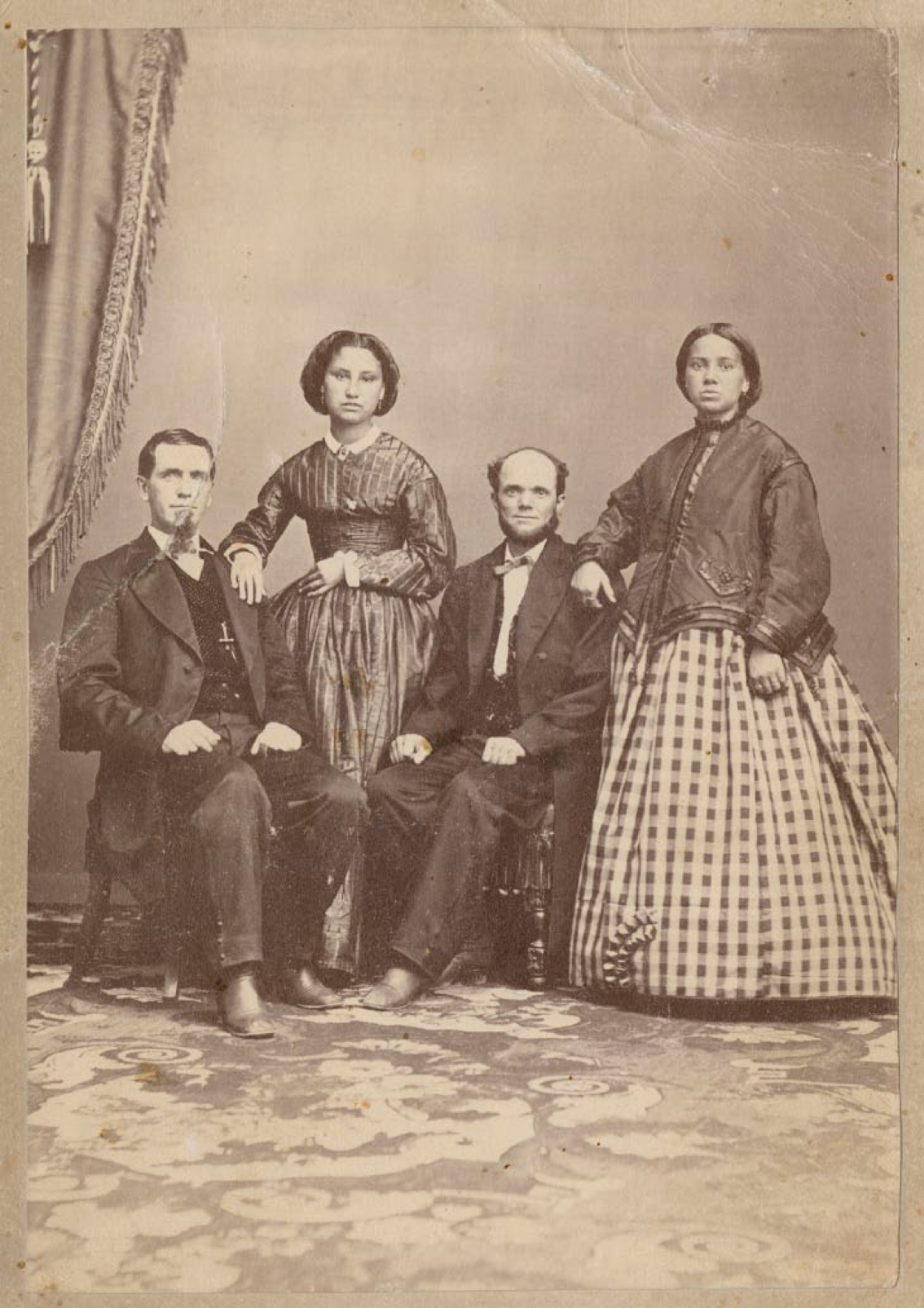
Hughes and Stevens families.
A testimonio by Doña Jesús Moreno de Soza shows how Tucsonense Mexican women policed these racial boundaries and their own claims to Spanishness and subjecthood. The 1932 testimonio demonstrates that Petra Santa Cruz, much like her sister Atanacia, who proudly admitted to helping make the bullets that massacred Apache women and children at the Camp Grant Indian reserve on 30 April 1871 (Guidotti-Hernández, 2011; Kitt, 1926), had an opinion about Apache Indians that was less than favorable. Moreno de Soza (1939–1940) stated the following about a local Mexican fandango dance:
It was customary in those days to have a dancing platform to celebrate ‘La Fiesta de San Agustin at Levin’s Park … Once it happened that an Apache squaw called Luisa was dancing when Petrita Santa Cruz (later Mrs. Hiram Stevens) came along, and looking at the Apache squaw said, “That is enough, get out, we want to dance.” The Apache squaw replied, “I am a person, too.” (p. 5)
A peer of Petra Santa Cruz, born in 1855, Moreno de Soza’s account most likely occurred in the early 1870s, at the height of conflicts with the Aravaipa and Pinal Apache tribes.
Petra Santa Cruz’s expulsion of Luisa from a public space of pleasure and leisure policed the racial boundaries of the community. Claiming the power of racial differentiation over a public forum shows how one was permitted to participate if found to have the proper racial and class credentials. Upper-class Tucsonense Mexicana gendered and sexual spaces were imagined without Indians. Public dances were a space to find a suitable mate for Tucsonense Mexican women. They became the site from which social and eventual sexual reproduction was enacted if a woman did in fact find her husband at such a dance. While Moreno de Soza never indicates that Luisa/Mrs Handy may have been dancing with a White man, Petra’s cultivated hatred for the Apaches and Stevens’ philandering ways (he held partial ownership of a brothel prior to being elected to Congress) could have influenced the expulsion. Casting out the Apache woman meant controlling the fitness of socially and, by extension, sexually reproductive unions, making it impossible for full-blooded Indigenous women to marry into middle-class cum White proper society. Fear of miscegenation and the loss of cultural capital for proper Tucsonense Mexicana subjects was a real threat if an Apache woman were permitted into the same social circle. It would mean that they were equals. These women were fully ensconced agents of empire and racial capital. Luisa’s instance on being called a person in light of the expulsion show that active shaming of racialized others was the mechanism for elite brown women to participate in nation building and create legible subject positions.
Furthermore, Petra’s devaluation of Luisa as a non-citizen-subject demonstrates how native-born Tucsonense Mexican women did not see themselves as kin to “savage” Indians—Santa Cruz Stevens was part Pima Indian and Spanish. Pimera Alta tribes had historically allied with settler colonials, earning them the designation as semi-civilized because they farmed. In contrast, Apache groups were viewed as most barbarous for their system of warfare and nomadic migrations. Given Petra Santa Cruz’s position as a descendent of the civilized elements in Arizona, her actions to police social space went unquestioned. Rather, Doña Moreno de Soza’s silent observation reinforced such racial practice as acceptable for gendered subjects. But Moreno de Soza’s testimony conveys uneasiness with Petra’s actions because she remembered that Mrs Handy contested dismissal and emphatically insisted on subjecthood by stating “I am a person too.” This exclamation “too” imagines the Indigenous self as a racial, gender, and class equal, entitled to participate in the market. Nonetheless, Luisa is the Apache squaw, and Petra is named both by her maiden name and the diminutive form of her name (Petrita). Thus, intimacy between Doña Petra and Doña Jesús brokers an unspoken set of social codes of access that made such policing among gendered racialized subjects permissible and, in some ways, expected.
As the testimonio continues, Luisa talks back to other brown women as agents of empire by saying that she is not only a subject, but also a subject made through marriage. She is “Mrs George Handy.” As the wife of Dr Handy’ Apache male “son,” one of Tucson’s only medical doctors and the city’s designated physician at the time, there was a narrow legal window by which to claim juridically legible subject position (Moreno de Soza, 1939–1940: 5). 6 Marriage to an Apache Manzo or hijo legitimo further civilized her tenuous place in society and should have afforded Luisa some kind of cultural capital and social legibility because Mr George Handy was a detribalized Indian. But Moreno de Soza’s insistence on not hailing Luisa as a person, but as a squaw, only made the racial and social exclusion more profound. This derogatory slur subordinates the intended target and attempts to silence Luisa with the gendered racial epithet that marks her as sexually available, non-White, inferior, and nullifies the cultural value of marriage.
Moreno de Soza (1939–1940) further recalled that when her “own” criada
would stop to see them [Mr. and Mrs. George Handy] and ask why they never want to see her, the squaw would reply “because when you see me you always call me ‘Hallo Comadre,’ why don’t you call me Mrs. Handy” stated Luisa. (p. 5)
Luisa continuously marked herself as a civilized subject and understood that when people insisted she was a “squaw” or “comadre,” that familiarity made her a Mexicanized Indigenous peer. “Squaw” indicated the wrong kind of social and economic intimacy. She too protected her position as Mrs Handy, fully buying into colonial and capitalist structures of power. Refusing to be seen with to Moreno de Soza’s criada, unless she was acknowledged as a legible, married, civilized subject, Luisa attempted to harness the power of Whiteness and social capital in the market by insisting she be hailed as Mrs Handy.
Ironically, the only exceptions that were made in integrating Apaches into the local community was as servants or criadas—captives baptized and raised by Mexican families to show them the ways of civilization (Brooks, 2001; Guidotti-Hernández, 2011; Jacoby, 2009). In fact, Moreno de Soza (1939–1940) remembered that her family “kept an Apache squaw in the house who was Esquimensin’s [sic] aunt,” the domesticated kinswoman of the Aravaipa Apache Chief against which the Camp Grant Massacre was militated (p. 3). Moreno de Soza’s intimacy with Aravaipa Apache domestic servers exposes complex race and class relations. One’s affective ties were tempered by reproductive and emotional intimacy, on the one hand, and protecting racial boundaries, on the other. That Moreno de Soza refers to both women (Mrs Handy and Hashkebanziziin’s Aunt) as squaws suggest that sex/race/gender systems were differential. In fact, the language itself exerts violence through the speech act. Thus, Moreno de Soza’s unease, Petra’s violent expulsion of Luisa, and the fact that both of them refer to her as a squaw without hesitation shows that Tucsonense Mexican women like Santa Cruz Stevens (and even Soza Moreno) knew racial systems to be fragile. Their marriages to Anglo-American and gentrified Spanish-Mexican men further reinforced their power to claim public rights in opposition to those of full-blooded Indigenous descent. Furthermore, Moreno de Soza’s repetition of the story almost 50 years later reminds us that even if women were publicly (at the dance) and privately (using the word squaw in the testimonio) complicit with behaviors that policed racial and class boundaries, they registered a range of emotions like discomfort and what appears to be outright rage. This glimpse of Petra Santa Cruz Stevens’ life as a young woman, policing her own claims to Spanishness and Whiteness ultimately demonstrates how racial and economic privileges were generated simultaneously. Moreno de Soza’s testimonio, in its representation of discomfort, portrays Petra and Luisa’s interests as capitalist and colonial ones. The expulsion ultimately stabilized racial and social categories and expressed anxiety about Tucsonense Mexican women’s position in the market.
Picturing race
While the testimonio expresses sexual and social anxieties codified in racial formations, state and family studio portraits of the Santa Cruz Stevens family by Washington, DC, photographers and the Beauman Studio (known for photographing the who’s who of territorial Arizona) convey a similar visual message. These photos mark a domesticated life. Petra and her sister are well dressed in silks and taffeta, and large quantities of them, no small expense in territorial Arizona, where it took several days by wagon for such fabrics to travel up from Mexico City or from the eastern United States (Image 1). Both women engage the camera with humility, but their skin color was vastly different from their husbands—both Petra and Atanacia are considerably browner than their mates, even though census takers in the territory often labeled Spanish surnamed people Caucasian (Sheridan, 1986: 5). 7 Such photos were a way for this emergent class of merchants to document their rise into affluence, representing their visibility in society as economic actors. As Nicole Hudgins (2010) has argued, nineteenth-century portraiture was a means of building a visual sense of one’s own past (p. 560) including women’s ability to exert their subjectivity by capturing it on film. Furthermore, she argues that “standard[s] of neatness and, if possible, elegance, optimized the photographer’s results” (Hudgins, 2010: 560). Conventions about quality coupled with propriety mask any kind of inconsistencies outside of the captured shot and yet cement the difference of these women from their husbands.
Portraits such as the ones taken when Stevens was serving in the US Congress (Image 2), symbolically represent the national family (Campt, 2012: 33; Edwards, 2012: 36).They were a means of fomenting the idea of a strong nation. Congressional photos also convey requisite family values and opulent class status as leaders of the nation. Petra’s gaze is to the left of the camera, performing modesty—that was how the wife of a Congressman was supposed to act. Yet her chandelier earrings, excessive rings (two on one hand and two on the other), and the excessive layers of fabric on her dress indicate that she was on trend for fashion that characterized the Victorian era, coupled with Stevens’ ring and pocket watch, all present signs of wealth. Reproducing Victorian excess communicated economic and social normativity for the ruling class. Petra’s adopted daughter Eliza reminisced that her father “loved to dress her up and buy jewelry for her. She was a success at the capital. She was pretty but could not speak a word of English” (Wilder, 1937a: 19). Thus, the moral character of the familial unit, without children, shows a kind of consistency in the representation of class status and economic power. It also pictures a Tucsonense Mexican woman operating within congressional circles with her Anglo-American husband. And, as Eliza Stevens’ interview attests, Petra operated like a beautifully adorned accessory to her husband in Washington, DC, because she did not speak English. Her lack of acumen with English represents the position of women as those to be seen and not heard, infantilizing them. Her English also created cultural and social isolation from the Washington, DC elite mainstream who were not Catholics nor Spanish speakers. Eliza, instead of critiquing a patriarchal view of women as appendages to history and their husbands, only reproduces the mechanizations of patriarchy and power in Petra’s life story. Furthermore, Petra was much lighter in skin color than her sister and perhaps she could have passed for White until she spoke. This petit bourgeois representation of family conceals racial difference by putting the focus on the wealth and idea of family as a solitary unit displayed in the government-sanctioned Victorian image (Image 2). It also indirectly evokes the history of US imperialism as a form of nation building, which facilitated such interracial unions, their visibility, their acceptability from the 1850s to 1880s, and the reproduction of racialized capitalism at the fringes of empire.
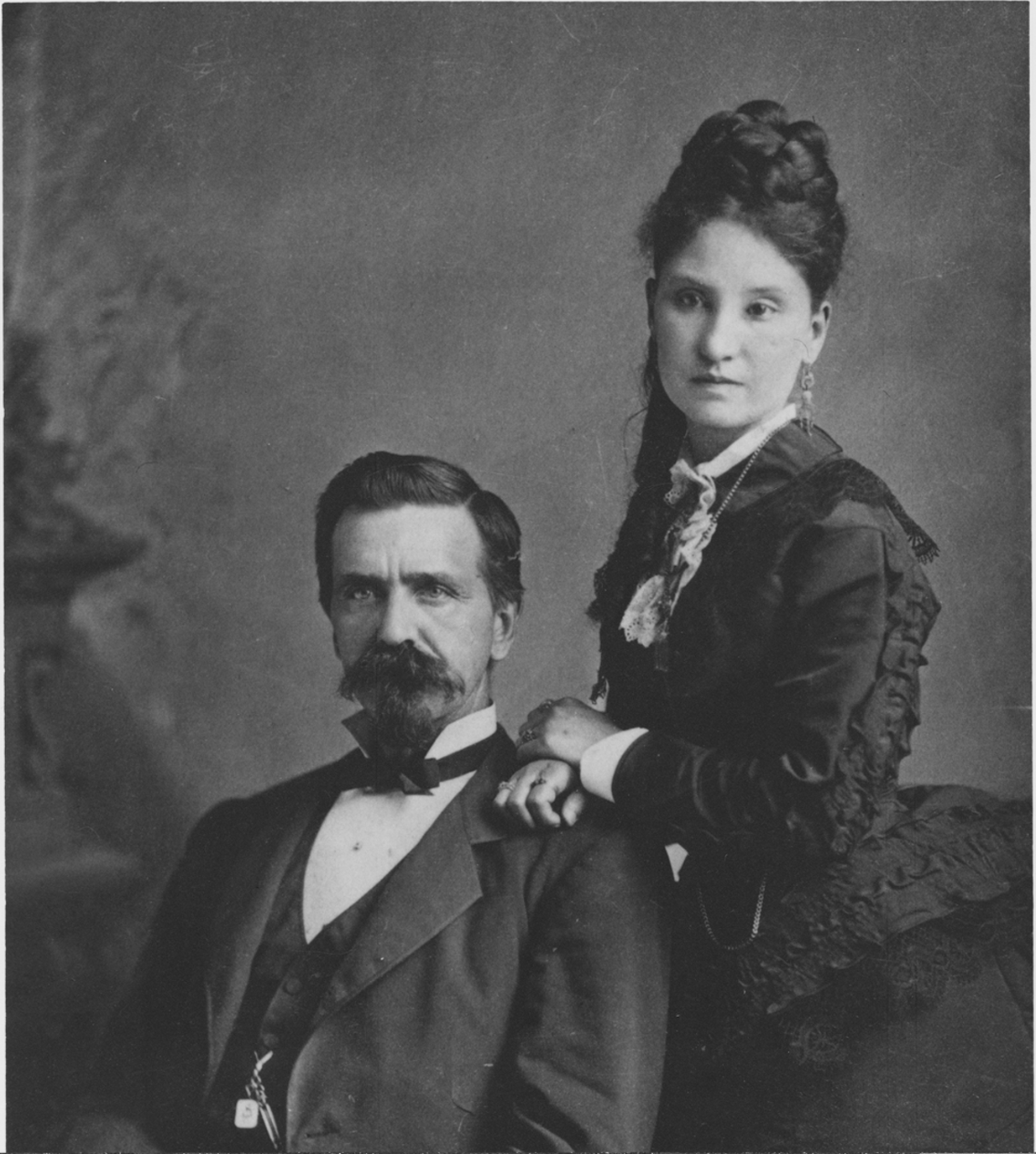
Petra and Hiram S. Stevens.
But these photographs of domestic opulence and official bliss also engage in acts of concealment. As Hudgins (2010) further argues, the norms of nineteenth-century family life were determined by struggle and stresses for both sexes, such as competition, childhood illness, and death (p. 562). The three haunting absences in these two photographs are Petra’s dislike for the East (although perhaps registered in her longing expression—what is she longing for?), the sexual pressures of producing children, and the affair and subsequent illegitimate child Stevens had with an Anglo woman while he served in Washington, DC, from 1874 to 1878. First, her adopted daughter Eliza’s 1937 interview explains how Stevens took his young bride back to Vermont to meet his family: “She hated the snow and everything else about it, but Hiram’s mother had been very sweet and kind to her” (Wilder, 1937a: 18). Eliza also noted that Petra soon grew tired of the social life in Washington, DC, and returned home to see her family, most likely out of cultural and linguistic isolation, or perhaps because she was simply not as successful as Eliza indicated (Wilder, 1937a: 18). Thus, despite the benefits and social privileges of becoming overly legible to the US nation-state as the wife of a Congressman, Petra’s close-knit ties to her Tucson family and linguistic limits outweighed those to her husband and her obligation to be the good wife. The cultural climate, and economic shock of this White Anglo-Saxon Protestant (WASP), English-speaking world of national level politics did not quite jibe for her.
Second, these photos conceal Stevens’ affair with Clara L. Knight and the daughter she bore on 22 June 1880, named Clara Jane Knight Stevens. 8 Stevens did not publicly admit that he was the father of the child but did give her his name, deed property to her, and opened a bank account in her name (Stratton, 2010: 71). Coupled with a child from an affair, these marital trespasses had a number of compounding traumatic and shameful effects on Petra. She had already had a difficult time adjusting to the culture of Washington, DC, and returned to Tucson during the second half of his second term (H.S. Stevens Papers, “The Mexican Period,” n.d.: 2). For a Tucsonense Mexican Catholic woman, public infidelity was one of the biggest insults against the sacrament of marriage, and the fact that it was with a woman who came from the same dominant cultural group as her husband could not have made it any easier. The birth of this child magnified Petra’s difference linguistically, racially, culturally, and sexually. The affair also marks Stevens’ investment in his own sexual life and alienation from his culturally and racially different wife. But the other thing that the birth of Clara Jane Knight Stevens confirms is that it was Petra who was infertile.
In the context of the shame and responsibility of Catholic conceptions of womanhood generated from Marianismo (the self-sacrificing mother figure modeled after the Virgin Mary), we see that Petra could not biologically fulfill this motherly duty. This further excluded her from the biologically based national ideas of republican motherhood because it was Stevens’ mistress who produced the heir to the family legacy, creating deep social anxiety about Petra’s role as a wife. As family historian C.J. Stratton (2010) states,
as Sam and Atanacia, her brother Philimino [sic] and her Bojorquez families had numerous children and grandchildren over the years. Petra’s heart was stabbed very deeply. [Petra] always wanted to be a mother and to be loved and cared for by the father of her children. (p. 72)
This wounding and loss, in psychoanalytic terms, put the past and the present in tension, to force one to relive despair with every evocation of the illegitimate child. Family historian Stratton does not name infertility directly or Stevens’ philandering as the causes of Petra’s wounding. Instead, inference about the illegitimate child suggests that her sister’s very successful reproduction stabbed Petra very deeply, in addition to Stevens’ infidelity. To say all of this publicly in a family history would shame the great pioneer family.
But Petra did get the chance to be a mother. When her cousin Victoria Bojorquez died in childbirth, she adopted the child Eliza Ruelas de Bojorquez (b. 15 March 1882) and raised her as her own (Stratton, 2010: 72). However, Petra’s great niece Ruth Corbett Cross suggests that Eliza was “Hiram’s daughter by a love match” and that “it was always Hiram’s idea to adopt [Eliza and Tomas]” (Lyons, 1980: 3). Cross’ quip represents competing familial narratives of Hiram’s sexual practices and resentment toward Eliza. The claim that Petra was either duped or forced to adopt Eliza against her will seems false when viewing the family portraits of Eliza, which tell another bourgeois Mexican Tucsonense story. But instead of concealing the narrative of Stevens’ infidelity and Petra’s infertility, they somewhat re-write it by taking attention away from the divided interracial couple and putting the emphasis on the beloved child. Even if Eliza were a love child conceived with Petra’s cousin Victoria, who resided in their household briefly in the early 1870s as a youngster, the child was nonetheless a perfect example of capitalist citizenship and national consolidation through family. In a series of photographs, Eliza’s baby pictures and toddlerdom depict a lovely little girl who was well fed and well cared for, replicating a number of the paradigms of social class that Karen Sanchez-Eppler (2005) has investigated (Images 3 and 4). Children ordered the haloes of the middle-class family in nineteenth-century American culture, creating social reform and commercial exchange with feeling (Sanchez-Eppler, 2005: 151). Such photographs indicate childhood as leisure, where Eliza Stevens emerged as a subject free of difficulties and responsibilities of everyday life, a complete contrast with Petra’s motherless childhood of poverty and washing the laundry of others (Stratton, 2010: 152). While the earlier pictures of the Stevens family concealed domestic discord, the photos of Eliza, as do those of Petra, show the emergence of bourgeois Mexican subjects in territorial Arizona, still possessing the trappings of brown skin (Images 3 and 4) yet transcending and creating White racial hierarchies through social class and wealth.
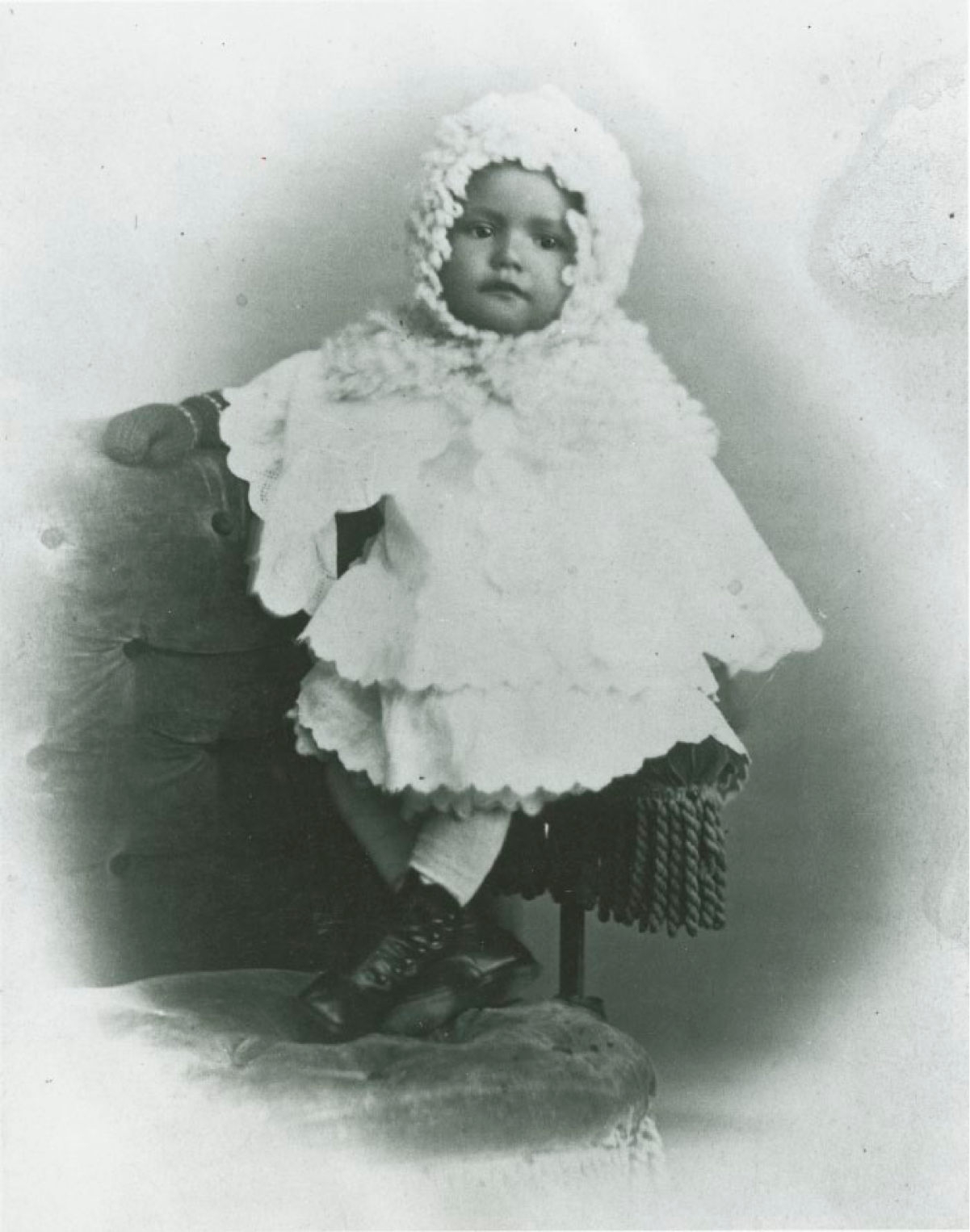
Eliza Stevens as a baby.

Eliza Stevens as a child.
Public losses and private dramas
While the Stevens family photos simultaneously mask and expose domestic discord around sexuality, reproduction, and gender, the murder-suicide attempt was a symptom of the catastrophic economic shifts in Southern Arizona with the financial panic of 1893. Yet, at the height of the Apache wars, businessmen like Hiram Stevens and his brother-in-law, Samuel Hughes, held exclusive contracts with the US army as suppliers of beef, grains, and other materials to Camp Crittenden and Camp Lowell. In addition, Stevens speculated in real estate, cattle, and mining, co-owning a share in the Hughes, Stevens, and Company Store in Tucson. 9 In 1874, he was counted as one of the richest men in the territory with assets totaling approximately $180,000 USD (Farish, 1915: 197). He served as Tucson City Treasurer, Pima County Assessor, and County Supervisor at various times; was elected to the state legislature in the period 1868–1871; and was delegate to the US Congress in the period 1874–1876. Apparently, Stevens used $25,000USD of his own money to finance the congressional race campaign of 1867. By outspending his opponent issuing loans to gamblers for votes, Stevens won the election and unseated the incumbent (Farish, 1915: 197). Following Johnson’s (2001) research on how the purchase of slaves in New Orleans during the mid-nineteenth century fomented familial White supremacy and subjectivities, I argue that this act of purchasing an election was a similar kind of logic to “buy [one’s] way into full participation into the political economy of [racial capital] and white masculinity” (p. 88). In order for racial regimes of capital to shift from a Spanish-Mexican schematic of survival to that of Anglo-American race based capitalism, Stevens had to figure his independence, benevolence, and capitalist accumulation through a public and grand gesture of buying not slave chattel but, an election with gambling and speculation (Johnson, 2001: 89). Speculation made visible the economic capacity to take risks in the political market, making Stevens into a White patriarch, fit to control not just the political arena, but also the larger economy of Southern Arizona.
With such speculation paying off, the Stevens house was built in 1866 and through the purchase of the Duffield home in 1874 the two were joined into a large house with a long corridor connecting them. The house boasted an aviary, orchard, carriage house, and stables. Stevens had most of his money tied up in property, including his rather large home. In a series of indentures from 1884, before the market crashed, Stevens deeded property to his illegitimate daughter Clara Jane Stevens and Petra Santa Cruz Stevens. Following an earlier precedent about property transfer, Stevens paid the minimum protocol of $1.00USD for each property transfer (Stevens, 1884b: 1). But what is striking about the indentures is not the fact that property was being deeded to his wife and illegitimate daughter, but the way that Stevens registered affect through property transfer itself. In the indenture to his daughter C.J. Smith of Washington, DC, dated 9 August 1884, he gave
the sum of one dollar and the love and affection which said H.S. Stevens bears towards said C.J. Stevens … lots one (1) two (2) three (3) four (4) in block one hundred and ninety (190) according to the official map of the city of Tucson. (Stevens, 1884: 2)
On the same day, Stevens indentured lots number (9) and (12) from block number 83, lot numbers (3), (4), (5), and (6) on block 183, lot number (14) on block 229, to Petra Stevens “for consideration in the sum of (sic) with love and affection which the said HS Stevens bears towards the said Petra S. Stevens.” (Stevens, 1884: 2).
10
Such gestures of love and atonement seem morally at odds with each other. Filing the deed for the illegitimate daughter in the Pima county court was a legal acknowledgement of paternity and the deeding of the majority of the property to the wife who remained married to her unfaithful husband both show the entanglements of Stevens’ affective ties.
These emotional bonds, embodied in the deeding of property, map how the psychic, social, property domains overlap. Love and capitalist exchange are entwined, when Stevens crossed out the word sum and replaced it with love. The exchange provided reprieve from his own shame-humiliation drive (Frank, 2006: 13). Stevens also relied on the language of paternalism. He performed these acts for his wife and his illegitimate daughter, emphasizing the needs of these dependent women and not his own, buying a fantasy of reciprocal love through property transfers (Johnson, 2001: 86–87). Stevens did not transfer property to his adopted daughter Eliza on the same day, but did leave her a dowry. This signals that the affective relationship and legal obligation codified in property was distinct. Eliza was legitimate as an adopted child and could inherit directly; Clara Jan Stevens was illegitimate and could not. Taken together, acts of love are “co-assembled with a perception of failure, inferiority, or negative evaluation,” remedying the multiple levels of domestic discord caused both with the illegitimate daughter (Frank, 2006: 13). The property essentially makes Clara Jane Knight Stevens legible to the state as both his daughter and property owner. At the same time, the property transfers to Petra temporarily repaired the fractured marriage because of his infidelity.
Property transferences literally mark Stevens’ sexual, familial, and personal spaces as comingled in these legal and economic records. Historian Shirley Thompson (2009) has argued that the nineteenth-century Creole New Orleans real estate mogul Lacroix
presented himself as an architect of his social world rather than simply an actor within it … La Croix the mere owner of property became Lacroix the proprietor, an exemplar of the social status attributed to ownership and the cultural values conveyed to it. (p. 113)
While Lacroix was a free man of color and Stevens was a White man, we can see that both men actively used property to construct their social worlds. In Stevens’ case, the status he held was then conferred to the women in his life through the indemnities of property. Furthermore, Petra Stevens and Clara Jane Stevens become proper subjects, recognizable to the state through their property ownership. These deeds produced legitimate accumulation of property and status (Thompson, 2009: 114), making both women social equals within the inheritance structure of the Stevens family. And in Petra’s case as a Tucsonense Mexicana woman, the legitimate accumulation of wealth demonstrates how women of color could amass authority and posterity in a shifting economic and social world (Thompson, 2009: 115). Yet, the fact that both sets of deeds were written and filed on the same day in 1884 suggests that, in Stevens’ mind, his illegitimate daughter Clara and marriage to Petra were connected in familial, emotive, and capitalist reproductive bonds. Here, the two most important women cannot be imagined without each other, most clearly codified in the transfer of property in a moment of Stevens’ peak wealth. Stevens imagining of the two women’s equal status continued into his will where all of the remaining Tucson lots willed to Petra and “all property in the east is left to his daughter in Washington” (Arizona Daily Star, 1893a). In these transactions, property builds racial capital and a multi-ethnic nation simultaneously. Such racial capitalist practices ensured the reproduction of US empire at the fringes of the nation.
A new era for the Stevens family: “He shoots his wife before the deed” 11
The crashing prices of real estate and the larger market in the late 1880s and early 1890s were a reflection of the poorly financed and speculative modernity brought to the region by the arrival of the railroad. No longer was there a need for overland freighting companies like Tully and Ochoa nor were there abundant monopolizing government contracts for Fish, Stevens and Company, providing troops provisions to fuel the US army’s war against Indigenous people. In addition, overgrazing, prolonged drought, and an economic recession took men and women like Petra and Hiram Stevens from being the richest in the territory to what they might have considered dire poverty. The arrival of the railroad and the end of the Indian wars, in theory, should have stimulated the local economy because it opened up space for goods to pass through the Arizona territory unfettered. Arizona’s once booming economy was no longer controlled by local merchants, but by the Union Pacific Railroad and Southern Pacific of Mexico, which were responsible for inexpensive and rapid transport of goods within and across national boundaries. These families were not prepared for this new phase of capitalism, nor the failure of the economic speculation that had made them rich in decades prior.
Stevens’ investment as the sole owner of the Gas Light Company, founded in the 1880s, provides another example of speculation gone wrong. His company had an exclusive contract for supplying gas to the city of Tucson to power its streetlights. The city decided to switch to electric power in early 1893, rendering his stock worthless at the time of his death (Lyons, 1981: 14). In a matter of months, Stevens had to liquidate his holdings, including the Cosmopolitan Hotel, “known to be the finest hotel in the Territory” 12 for $2800USD, less than half of what it was worth, on 11 March 1893. He then sent $400USD from this sale to his 12-year-old daughter Clara Jane Knight Stevens in Washington, DC, and deposited the remainder of the money in her account (Allen, 2005). Finally, two days after the Gas and Light Company was rendered worthless, Hughes, Stevens and Company was in deep debt, shut its doors, and was seized by its creditors (Lyons, 1981: 14). 13 Distraught by these sudden economic changes, the former Congressman and Indian fighter did something that many found unthinkable. On a fateful night of 24 March 1893, Stevens shot his wife and then turned the gun on himself. The first bullet hit Petra’s Spanish peineta, the second went through the fleshy part of her hand. He later used a second gun and shot himself in the head (Farish, 1915: 184). Petra underwent an emergency operation to dislodge what many assumed was a bullet from her skull and family histories reveal that it was her peineta that prevented the bullet from fully penetrating the skull (Farish, 1915: 184).
Front-page headlines of the Arizona Daily Star and Tucson Daily Citizen starting on 23 March 1893 announced the violent psychic break between that self-invention and capital losses. At 3:00 p.m. on the previous day, Stevens had returned from a Board of Supervisors meeting because he felt ill. Petra, who was also suffering from a headache, told him he was the more ill of the two and that he should lay down and rest (Arizona Daily Star, 1893a, 1893c). Stevens, “in a kindly manner, passed his hand over her forehead, and the next she knew there was a report of a pistol and she felt a burning sensation on her head” (Arizona Daily Star, 1893a). He had come to her with two guns in hand: a revolver with a long barrel and a small six-shooter. She screamed “For God’s sake! What are you doing?,” where she then grabbed for the 44 caliber bulldog in Stevens’ hand and it went off again, this time the ball passing through her hand (Arizona Daily Star, 1893a). He then hastily fired a forty-five caliber Colt that was a favorite gun from his time in the army and turned it on himself (Arizona Daily Star, 1893a). Upon firing a second shot at himself, the ball entered through the forehead above the right eye, and exited out of the top of his skull, “tearing a ghastly hole in it” (Arizona Daily Star, 1893a).
H.S. Stevens was dead by his own hand and “he did it while his mind was temporarily unbalanced from intense pain. His actions of late not those of Stevens as his old friends know him.—A Lamentable affair—Mrs. Stevens’s Condition serious” declared one local press outlet (Arizona Daily Star, 1893a). Hiram Stevens had been treated for bowel trouble, and this became so severe that it “went to his brain, rendering him delirious, so that he was unaccountable for his actions” (Arizona Daily Star, 1893a). But there is something quite curious about the connection between his bowel trouble and the delirium of the brain. Stevens’ psychic trauma of losing his fortune in the fallen economy and the news about his illegitimate daughter correlates the psychic break and the bowel trouble with the financial panic of 1893.
Stevens psychic break and ill health was a product of untreated medical conditions that manifested in this final act. And if the stress from market anxiety caused his ill health, we see the actual physical consequences of bad market futures manifesting in the body. Furthermore, his niece, Mrs Mary Sheenan recalled that Stevens’ home office was “turned into his bedroom later in his life when he was ill a great deal of the time” (Lyons, 1981: 5). As Stevens deteriorated, on the day before his death, he was described as being “despondent” upon his return to town because large numbers of his cattle had been found dead along the road to Nogales. Some accounts say that he shot the cattle that were not already dead. These conditions suggest that the death by suicide was spurred by Stevens’ economic and social surroundings, which he took out on his wife (The Tucson Citizen, 1893). Stevens had hastily changed his will a few months before the incident. To many, myself included, this seems like a premeditated move to commit suicide and murder Petra. His bankrupt estate was as settled as it possibly could be. But the press reported, “it [as] not generally believed that there was any premeditation to the tragedy” (Arizona Daily Star, 1893a). Stevens’ class status, wealth, and Anglo pioneer heritage exempted his actions from being characterized as criminal or planned. Instead, friends of his same social class mobilized to save him from public shaming. To further this point, once Stevens had died, a coroner’s jury held an inquest reaching the verdict that he had taken his own life because of temporary insanity (Lyons, 1981: 15).
Juridically circling the wagons to protect a distinguished pioneer from being publicly humiliated for his rash behavior, the press expressed shock as subtle subterfuge. When the funerary announcement went out, it was addressed to “All Pioneers,” asking that they meet at pioneer hall at 2:30 p.m. for the funeral of “our late brother pioneer, Hiram S. Stevens” (Levin, 1893). Deploying ideology like that of the Freemasons, where civic interaction was at the core of fraternal interaction, the Pioneers Society operated more concretely through the logic of settler colonialism of the American west. 14 Formed to self-commemorate Arizona’s settler legacy through the preservation of territorial history, the society used public historical memory in constructing the pioneer as Anglo and Tucsonense civilizers of the harsh desert that surrounded the Tucson basin. The collective fraternal claim to Stevens as a brother overlooks the violence of his suicide and Petra’s near murder by putting the emphasis on the temporariness of his insanity. Despite Church rules about suicide as sin, he was buried in the Catholic Holy Hope Cemetery, showing that he was exempt and exceptional in death (Arizona Daily Citizen, 23 March 1893). The funerary notice follows convention about gendered notions of suicide, making Stevens’ violence seem part of man’s “more arduous struggle for existence,” a kind of rugged frontier masculinity (Bailey, 1998: 9). When Stevens could no longer enforce his power through the privilege of his Whiteness and wealth, his world fell apart (Bederman, 1995: 5).
The local press and community used illness as a rational means of accounting for Stevens’s psychic break with reality. But if we read Stevens’ pain and loss for what they were, we see that the community, even in his death, could not afford him the possibility of being a publicly demasculinized White patriarch at the hands of a non-human actor, the market. The psychic break and loss mark the decline of a White racialized patriarchy. With abrupt economic catastrophe and an inability to anticipate the market, Stevens was a “failed frontier’s man.” The self-inflicted violence and violence against his wife Petra reconcile collapsed property relations. It reordered the family structure, the economic structure, and ultimately, completely should have removed them both from these systems in death. The melancholia that preceded the murder-suicide registered what was to come, but very few people knew how to interpret the emotive non-normativity of Hiram Stevens’ losses nor his emotive dissonance, including Doña Petra, which is registered in her shock and surprise in the newspaper accounts. The queer work of shame (non-normative nature of the death and their marriage) protects illegible histories, in Hiram’s suicide, his attempt to take Petra into death with him, and in how she reproduced this shame on a daily basis after he died.
In all of the public historical commemoration of Stevens (his house is a state-recognized historical site), there is rather profound silence about this botched murder-suicide and the family’s fall from economic grace. 15 Even in the catalog record for the Stevens family papers with the Arizona Historical Society, no mention is made of the suicide. The silence suggests that the Tucson community and Stevens–Hughes–Santa Cruz families actively organized the history of their lives outside of the drama of violence that occurred in the Stevens–Santa Cruz household in March of 1893. The taboo about suicide by an upstanding Catholic pioneer citizen did not fit the parameters for the ways in which Tucsonans narrate their history, and Doña Petra had to reckon with that legacy daily. There was no space for Stevens to be sad, angry, lost, or traumatized by these market changes, or that the market literally bore a relationship to his emotional state. A concrete rupture in the history of racialized capital, the murder-suicide mirrored the interruption of normative White capitalist reproduction in the market. All of the irrationally bound accounts of this event—for that was what the Tucson public called the shooting—are explained away with the discourse of illness, instead of accounting for the relationship between the market, race, masculinity, and economies of emotion.
This only in part explains why Petra was the primary target of his suicidal violence. One could argue that he wished to save her from the shame of his fall from economic grace. But what about their children, if he killed her, who would raise them and further, what kind of shame would they have lived with? Another argument could be made for the notion that he had failed her and desired to not fail her anymore. Stevens already had the affair that produced an illegitimate child. There is also speculation that he made Petra infertile. 16 We could also suggest that he blamed her for his failures as much as himself and wanted to wound her for these reasons. Nonetheless, a few days after the violent shooting took place, Petra Santa Cruz Stevens’ account emerged in the press. Because she was the recipient of her husband’s homicidal violence, the press refers to her as in “a more connected and rational frame of mind,” than the day before when she experienced the physical and emotional trauma of the shooting (Arizona Daily Star, 1893a).
While nothing more is said of Petra’s recovery, Stevens’ funeral was said to be “one of the largest in the history of Tucson” and that “on the way to the grave there were many moist eyes caused by thoughts of him who was taking his last ride on earth” (Arizona Daily Star, 1893a). The tension between Stevens as a pioneer pillar of society and “a man not in his right mind” explain why nothing is said of Petra (Arizona Daily Star, 1893c). Her social position, much like his suicide, was precarious and differential. Stevens and his suicide were invisible, as was his grieving brown wife. In order to preserve the image of the outstanding pioneer citizen, forgetting of the Spanish-Mexican wife has to occur. By reading what is left unsaid, “the mysterious matter” circumvents the possibility for gossip (Arizona Daily Star, 1893c). Even years later in the 1950s, University of Arizona historian Frank Lockwood (1943) said the following of Stevens:
He was by nature quiet, deep and somewhat reserved. He was, nevertheless, popular, for he was a typical pioneer, doing things in a big, breezy, western way, and sharing both the usual foibles and good qualities of his fellows. He was a man of nerve, a crack shot. (pp. 2–14)
This glorious revisionist history obviates Stevens’ own pain and loss, the attempted murder of his wife, and his failure to reproduce racialized capitalist structures. The “man of nerve” obscures not only the violence of the murder-suicide and Stevens’ own pain, but it puts Petra’s gendered, racialized, and differential history into the shadows of quotidian realities of boom-bust frontier economies. It also occurred in a shifting economic moment where the most powerful families lost their wealth, making Doña Petra Santa Cruz Stevens’ position in the market more tenuous without her White husband because Mexicans were increasingly pushed out of elite circles with Anglo emigration.
This multi-layered shaming experience for Petra was channeled into managing what was left of the estate, her children, and involvement with the Catholic Church and religious life. In fact, decreased economic status of elite Tucsonense Mexicans permitted and in some ways mandated the incorporation of shame, as a faithful reproduction of cultural and economic practice into Petra’s daily life. The social status and credibility that Petra Santa Cruz Stevens lost through the botched murder-suicide enacted a kind of wounding beyond the body. Her amplified and more open dedication to the Catholic Church compensated for her losses. Furthermore, economic and emotional losses were remedied by the fact that she moved into the north end of her spacious house, demolishing it and remodeling it (Wilder, 1937a: 4). By reordering the space, the record verifies that she was not in complete and dire poverty. Rather, it shows Petra’s attentiveness to her economic means and position in the market to make money with her property. She later began taking in boarders in the extra rooms of the house, just as her Aunt Guadalupe had done before (Wilder, 1937a: 5). Furthermore, Petra had converted the pantry area into a religious shrine and sitting room which most likely contained the large picture of our Lady of the Immaculate that she willed to her friend Carmelita Romero (Lyons, 1977b; Stevens, 1909). Petra used the remainder of her life to serve God as an example of domesticity, humility, purity, and faithfulness as a mother and disciple of her faith.
But there is another reading to be rendered via her of the installation of the home altar following Stevens’ suicide: everyone knew that he was a cardboard Catholic, only converting to marry his wife. Understanding Stevens’ position on Catholicism, it is most likely that he did not want an altar with crucifixes suspending mutilated bodies, relics, and milagros, or shrines in his house. When US army generals entered the house during the Indian wars, how could one explain away such display of Papism in a moment when Mexican and territorial elites were being questioned for their loyalty to the nation over that of their loyalty to the Pope? In fact, post-Civil War anxieties about Papism and Mexicanization (instability and dictatorship-proneness) have been well documented by historians and literary scholars, noting that the xenophobia was directed at ethnic Mexicans, Catholics, and those who were foreign. 17 Escaping government scrutiny pre-shrine, dignitaries may have seen Petra’s Catholicism and by extension that of Stevens’ as antithetical of the emerging post-Civil War nation-state. Thus, after Hiram’s death, Petra was able to do what she had most likely wanted all along: build a home shrine as a way to reproduce shame, be a custodian of her own life story, and develop an intimate religious practice on a daily basis outside of national demands to reject Papism. Chandan Reddy (2013) has argued, in instances such as this one with the home altar construction after the suicide, shame protects an illegible queer history. This ambiguous, non-normative practice bound to sexuality and gender used religion to justify being anti-social and reproducing structural melancholia as a way of life. The freedom to have that altar in her home was an assertion of self at the same time that it was a means of shielding that self from scrutiny, be it that of heads of state or community members. That shrine and altar privately cultivated memory and situates Doña Petra Santa Cruz Stevens within alternate, gendered historical narratives of self-making in the region and nation.
Recovery from trauma(s)
While Petra Santa Cruz Stevens does not appear again as a public figure until her death in 1919, she still practiced the sexualized and gendered modalities of property relations on a daily basis (Shah, 2012). Petra created an alternative public community centered in motherhood and religion, capitalist practices in their own right. Her will and several ledgers, including that of Eliza Stevens’ trust fund, show how Petra’s life became dedicated to her adopted daughter, her grandchildren, picking up the pieces from Eliza’s failed marriage, and the quiet management of the finances—the very basis of capitalist relations of exchange. For example, Eliza Stevens represented the typical child of the Tucsonense Mexicano elite. Thomas Sheridan (1986) has argued that such families “saw themselves as the heirs to a Catholic, European intellectual tradition, one that had been implanted in Latin America long before the Anglos ever reached the new world” (p. 47). After Hiram’s suicide, Doña Stevens took the education of her daughter very seriously, enrolling Eliza in the Sisters of St Joseph school (founded in 1870) and later the University of Arizona. 18 These alliances with the Church in making young girls into proper Catholic women suggest that Tucsonense Mexicans like Petra Stevens wanted to produce Europeanized bourgeois subjects who had a more civilized heritage that preceded the arrival and conquest of Anglos in the region. All of Eliza’s education went into creating the perfect bride and the perfect society marriage. Before he died, Stevens gifted his ranch in the Sierrita Mountains, including the several herds of cattle, mules, and horses, to his daughter Eliza. This, along with a lump sum of money, was raised for Eliza’s dowry in the marriage to Carlos J. Velasco Jr on 21 January 1903, which was arranged by Petra (Lyons, 1980). The match was a good one: the daughter of a former Congressman and one of Tucson’s elite Mexicana pioneers was to marry the son of the publisher of El Fronterizo, one of Tucson’s longest running Spanish Language newspapers that operated from 1878 until 1914. Eliza married into the family that started a paper dedicated to the “interest[s] of Mexicans in both countries, expressing their opinions and directing their initiative along the path of moral improvement and material progress” (El Fronterizo, 1878; Sheridan, 1986: 104). Velasco was heavily involved in the repatriation of Mexicans during the Porfiriato and considered himself Mexican and a temporary resident of the United States. He was a transnational citizen, power broker, defender of the rights of exiled Mexican nationals, and businessman of the Arizona–Sonora border (Sheridan, 1986: 104). His paper was described as having “a large circulation in Arizona and Sonora, and is every way in a prosperous condition” in the Tucson City Directory for 1881 (Sheridan, 1986: 39). Hence, the match with the son of a Mexican intellectual in Tucson did three things. First, it redeemed Eliza because of her father’s suicide. The marriage reinforced the highly gendered and cultured nature of her education and rearing by her Catholic Mexican mother reinforcing her market value. Second, the marriage provided class consolidation and even upward mobility for Eliza in light of the fact that the Stevens estate had dwindled. 19 Third, it provided a means for the Velasco family to make long-term ties to the region and access to elite old Tucsonense Mexicano and Anglo social capital. Their wedding’s extravagance and the fact that Carlos and Eliza honeymooned in Mexico City with their mothers, Mrs Stevens and Mrs Velasco accompanying them, melded social prestige and new money (Wilder, 1937b: 1). That young Tucsonense Mexicans and their mothers traveled to Mexico City in 1903, the height of Porfirian opulence and the grand modernity of Mexico, marks them with the privileges of access to disposable capital. On the one hand, Eliza and Carlos were reared in the United States. On the other hand, both spoke Spanish. They were nonetheless US subjects, and brought those privileges to Mexico, perhaps even in an imperial fashion given their class privilege (Ruiz, 2013). They most likely visited Tepayac, the site where the Virgin of Guadalupe appeared to Juan Diego in 1529, reinforcing not only their religious devotion but also the fact that these Tucsonense Mexicans had the privilege to move freely and easily across Mexico after the expenditure of an extravagant wedding.
However, Eliza quickly discovered that her husband Carlos had a gambling addiction. Eliza’s cousin, Julie Corbett Bell stated that “Hiram was dead then, and his estate (most of which had been left evidently to Eliza) went through hers and her husband’s hands—the ranch and everything” (Wilder, 1937b: 2). The Corbett family particularly resented how Eliza and her husband “had four or five children quickly and in a short time all was gone, they drifted into slovenly habits, and Charlie shed all responsibility and left home” so that his creditors were knocking down Eliza’s door (Wilder, 1936–1937: 1; Wilder, 1937b). Trespassing against her rearing as a bourgeois Mexicana subject, not only was the loss of family capital by Eliza offensive, but so too was her excessive reproduction and her husband’s errant expenditures to fuel his addiction. This not only dishonored the family name, but he refused to claim his children. By 1914, Eliza was drinking heavily and she and her four children moved in with her mother. Doña Stevens arranged the match with Carlos Velasco. If understood within Catholic gendered frameworks of women’s responsibility, Petra Stevens may have felt guilty and responsible for her daughter’s abandoned fate. The burden, according to Petra’s niece,
[a]ll of this seemed to be as much a grief to Petra as one would imagine it would be. Twice that Mrs. Bell knows of she made promises to the Virgin and made the 150 mile long trip to Magdalena which was necessary in connection with it to pray to the Virgin there. (Wilder, 1936–1937: 1–2)
Particular devotion to the church in Magdalena was linked to the fact that when Tucson traded hands between Mexico and the United States in 1856, all of the altar pieces, paintings, and statues of the saints from the original San Agustin Cathedral were taken by a wagon across the border to the main cathedral at Magdalena del Kino (Santa Cruz de Hughes, 1929). Petra’s devotion to Our Lady of the Immaculate, including the painting that hung in her house, follows the dogma that Jesus’ mother Mary was also conceived without any stain or mortal sin and that she herself remained sinless during her life. Petra’s prayers could not save Eliza: accounts state that she and her illegitimate daughter Natalia lived in dire and slovenly poverty prior to her death in 1961. This also explains why Petra willed her prized painting of Our Lady of the Immaculate to Carmelita Romero and not Eliza. Its meaning would have been lost on her adopted daughter.
Whether by coercion or consent, she appointed her niece Elizabeth Knox Corbett the Executrix of her will, not her daughter Eliza. Thus, Petra’s will literally documents affective material legacies as crucial parts of her life. For example, Eliza was originally willed a Kranich and Batch upright piano, two pillow shams, one homemade quilt, and one Spanish silk shawl (Stevens, 1909: 2). The silk shawl and quilt were later struck from the inheritance and given to Petra’s friend Sarah Sanchez. Again, sentimental value and custodianship were the basis for bequeathing, perhaps explaining this change of heart in the emotional economy of inheritance. Keeping with this idea of order and emotional economies, neither Eliza, nor her five children were willed any money, implying that Eliza would squander liquid assets like she did with her dowry, or that her husband should have provided for her. Instead, along with Petra’s sister Atanacia, brother Filimino, her daughter Eliza, her son Tomas, nephew Lazero Borquez, and niece Mrs J. Knox Corbett went the “rest and remainder of my property for every nature whatsoever” (Stevens, 1909: 2). Ranking value by naming objects one by one or the “remainder of my property” in discrete categories to be divided put the Executrix in a difficult position. Corbett had to convey to the abovementioned family members that they did indeed deserve equal parts of the remainder of the estate. Legal duty and family duty are here structured and ordered through the will, both for the author and Executrix (González, 1999: 93).
In addition, Petra’s last will and testament bequeathed $50.00USD to the Sisters of Saint Mary who founded the city’s first hospital; $50.00USD to the Sisters of St Joseph Orphanage, $126.50USD to the Parish Priest at Saint Augustine’s Cathedral, $50.00USD to Sociedad de San de Vicente de Paul, the Right Rev. Bishop Granjon of the Catholic Diocese of Tucson $100USD, and an additional $100USD for general usage at San Agustin Church (Stevens, 1909: 2). The $476.50USD willed to Tucson Catholic institutions and the priest were Petra’s way of paying a debt to these important networks and religious support systems. She also wanted her own legacy to be tied to long-standing Catholic–Spanish traditions, so much so that the first line of her will states “In the Name of God Amen” (Stevens, 1909: 2). Doña Petra Santa Cruz Stevens, in life and death, showed a complete devotion to her religious practices and Spanish-Catholic heritage as a racialized woman who performed economic damage control in the family’s fall from social grace up until her death. Clearly, she had developed a network and kinship ties with the Sisters of Saint Joseph as with the Parish Priest of San Agustin Cathedral. These affective bonds were rewarded in death to rectify or temper the shame of downward social mobility. Catholic institutions were remunerated with liquid capital, unlike her adopted daughter or other family members.
Returning to objects with emotional value, Petra willed a breast pin containing the picture of her late husband Hiram Stevens, and two silk shawls to Julie Corbett Bell. In the same clause, she willed to Hiram Corbett, the son of Mrs J. Knox Corbett, the watch and shirt studs of her late husband Mr Hiram Stevens (Stevens, 1909). Given the anguish of the murder-suicide attempt, and the shame it brought to Petra Stevens, why would she hold onto the personal effects of her husband? Perhaps it was part of the ways in which injury structured her life. In fact, scholars have shown that shame and failure formed the basis of normative nineteenth-century social interactions “effectively challenging the homogenous narratives of national formation” (Gabiola, 2012: 32). Whiteness and domesticity also became a means of asserting Mexican rights of belonging in within the borders of the US nation. Anything outside of this normalizing rhetoric was shameful (McMahon, 2007: 33). Thus, the uneven and traumatic nature of affect and memory coalesce in Petra’s will. Her own death, as narrated through the will, is linked to the unhappy death of her husband and the dissipation of White privilege. But Petra Santa Cruz Stevens was also invested in cultivating this history of violence. She lived with it intimately, and passed it on to her family. Her love for Hiram did not dissipate even though he cheated, shot, and almost killed her, or produced an illegitimate child. Perhaps she too, in her melancholia, identified with the pain and loss her husband met at life’s end. Silent wounding and suffering are legally registered in the willing of these personal effects to her niece and the grandnephew named after her dead husband. Jennifer Travis (1998) has argued that “the properties of emotion and the ownership of injury accrue value,” especially in relation to wounding (p. 838). It is both the property (the objects willed by Petra) and the injuries enacted by Hiram Stevens that make the objects and memories valuable. Furthermore, in their value, such objects convey emotion and the lost story of suicide.
In a 1937 interview Judith Wilder (1977b) noted, “At the time I talked to Eliza, I did not know Hiram had committed suicide. Mrs. Roberts had never mentioned it, Eliza certainly hadn’t and strangely enough, we hadn’t picked it up anywhere” (p. 5). The silence surrounding the suicide references the unspeakable quality of the violence. The failure to mention the suicide does not highlight Doña Stevens’ near brush with death or the tremendous losses she experienced. This emotional pain, as Travis (1998) would call it, “becomes not only a currency for exchange and compensation but, most importantly, a category of cognition, one that significantly (and surprisingly) demands a new and previously unsuspected kind of protection” (p. 839). But, based on the will, and Eliza’s abovementioned unwillingness to report the murder-suicide, she perhaps was unreliable. It appears Petra did not trust Eliza in 1909 when the will was filed 16 years after Hiram’s death. Eliza too may have needed to avoid speaking of the murder-suicide because of the anguish it caused, or it could have been a strategy to reinforce rumors that Executrix of the estate Julie Corbett Bell intentionally cut her out of the will. If Eliza’s interpretation were true, affective value would only register in the willing of objects and liquid assets. Yet from 1904 to 1914, Eliza and her children had lived with Petra and the will stood as it was until her death in 1919—the value of the objects, money, and whom they went to remained constant long after Hiram’s suicide. Prior to her death, Petra discontinued support of Eliza’s family. When coupled with Carlos Velasco’s squandering of Eliza’s dowry 15 years earlier, we witness a savvy financial manager who saw thrift and morality as posterity and legacy. 20 Posterity and legacy carry through the will, probate documents, and testimonios—they expose what Petra’s obituaries later conceal, making illegible history quite logical in terms of the affective value ascribed to objects and money in inheritance.
Even though the will and probate documents were made public, the audience for such documents was small. This was a way for a community to see and know whom you were by what you owned and what you bequeathed to others. Petra’s will accounts for a whole life through material objects. It is a modality of property exchange, a historical document that conveys affective histories. Furthermore, Petra’s passing on of property show how the pain and loss of the botched murder-suicide and Petra’s lack of emotional distance from the event made the value of such objects even greater. Willing the property of a man who almost killed you to another family member confirms that family legacy and memory are crucial in the private exchange of the objects themselves and, in the community’s public access to the documents. This compensates for the compounded losses in the relics she clearly cherished within the private space of her home religious shrine. The will also records the legacy of a woman who thought enough of herself in life to make sure that her history was codified legally, through the passing on of objects, in her death. If the will is a marker of subjectivity in the juridical realm, then it also historically documents the curious legacy of racial capital. Petra, as a woman of means and fallen social status, manipulated a system and environment of capitalist exchange, even in death. With this will, Doña Petra gets the last word, writing herself into the juridical history of borderlands economies of exchange, one silk pillow sham, one donation to a cathedral, and one painting of Our Lady of the Immaculate at a time.
Conclusion
Petra Santa Cruz Stevens’ 29 July 1919 obituary best unifies the complexities of wounding, shame, loss, and the affective registers of gendered, sexualized, and racialized capital and property relations, which form the basis of my argument. She had gone to Los Angeles at the age of 68, 18 years after the shooting, to live under her niece’s care, despite the fact that her sister Atanacia, her brother Filimino, daughter Eliza, and numerous extended family members lived in Tucson. At 73 years of age in 1919, Petra’s death prompted her final return to Tucson for services at San Agustin’s Catholic Cathedral and burial at Holy Hope cemetery. The Tucson Citizen (1919) remarked that the “[d]eceased was born and reared in this vicinity. For many years, she watched [sic] the present city grow from a small one street village … She had many friends and acquaintances in this city and Pima County.” There is no sentimental nostalgia for Petra as a beloved Tucsonense or carrier of history and culture. Instead, the obituary tracks her life span and the transformation of space, not laying claim to a prestige of social class position as a Tucsonense Mexican woman or wife of a former Congressman. Furthermore, obituaries are often racializing, classing documents as Lois Brown (2003) has argued. Obituaries often laid claim to collective American identities for people of color (Brown, 2003). But the way this obituary is written suggests that Petra Santa Cruz Stevens had never been married, never adopted two children, never helped raise her five grandchildren, or never had intensive familial ties in the national or local context.
The obituary further suggests, by omission, that she was not a devout Catholic, willing the majority of her tiny estate to Catholic institutions and individuals, nor that she lived a holy life and died a holy death. This is not a narrative of becoming a subject through death, but rather the unmaking of a subject in death. Her Spanish-Mexican heritage is barely legible through the reference to her brother’s last name (Santa Cruz) and her own name meaning rock in Spanish. Coupled with the unspoken nature of the multiple tragedies of her life, the obituary downplays obligation to family. It represents mediated acts to mask the complex life and history that Petra Santa Cruz Stevens carried with her. Selective details of Petra Santa Cruz Stevens’ history achieve the closest possible thing to “an idealized account of a citizen’s life,” as Janice Hume (2000: 13) has argued. Deliberate withholding of information about the deceased, most likely by her sister Atanacia Santa Cruz Hughes or the Executrix of the estate, Elizabeth Knox Corbett, disconnected Petra Santa Cruz Stevens from the narrative history of social, economic, gender, sexual, and racial transformations within borderlands histories. I would venture to say, that the unspoken nature of her dramatic life was excluded from nationalized histories of racialized capital and US national formation of the nineteenth and early twentieth centuries because it damaged the family name. The willful community claim to Petra necessitated public silence in protecting both Hiram Stevens’ founding father image and her own privacy. Stevens, his suicide, Eliza her daughter, and the family’s complicated history are not mentioned in order for Petra to become an ideal citizen in death. The obituary represents how Doña Petra Santa Cruz Stevens’ family actively cultivated its own idealized version of the way they wanted the public to remember her.
Thus, if we return to the peineta that preserved Petra Santa Cruz Stevens’ life on 23 March 1893 when her husband tried to kill her, yes, it did in fact save her from an untimely biological death. However, that peineta prolonged a life of pain, violence, infertility, infidelity, dispossession, and domestic discord. It facilitated the reproduction of shame via objects of worship, while family photographs and obituaries concealed discord. Clearly, Petra Santa Cruz Stevens reproduced her own melancholia after Stevens’ suicide, amplifying the central role of her Catholicism, something that could not have happened prior to his death. At the same time, Hiram Stevens’ own sense of loss and disorientation from White patriarchal normative codes of affect and belonging do not account for the murder-suicide. Instead, material objects did the affective and social labor of producing illegible subjects. The new-phase economy that governed Tucson in the 1890s made both of them illegible.
While the murder-suicide spurred by economic catastrophe made an entire familial system of power collapse, it still maintained White supremacy. And yet, their daughter Eliza’s role as a failed Tucsonense Mexican bourgeois subject further disrupts the racialized capitalist logics and foundational fictions the family cultivated. As a result, Petra found comfort in pain, shame, and loss as evinced by her religious practices and bequeathing. In the context of borderlands history, the case study demonstrates how social death was powerful in economic terms. So much so, in fact, that women like Petra Santa Cruz Stevens’ are effaced subjects in the larger historical record. Complex histories such as this one damage larger White supremacist narrative histories like those that underpin the founding story of Tucson Arizona, proper womanhood, or upper-class propriety. The family clearly had intimate investments in maintaining a scandal-free narrative of Hiram, Petra, and Eliza Stevens in the public sphere. And this is why we as scholars know nothing of Petra Santa Cruz Stevens’ life history—the archive gives us little to work with. Ultimately, we cannot forget that all of this mass social, political, and personal upheaval were wrought by the processes of colonization in the American Southwest, a broadening and deepening of racialized capitalism, and property exchange that did not affect White patriarchs or Tucsonense Mexicana women equally. 21
Footnotes
Funding
The project received partial funding from, “The Gender, Migration, and Citizenship Project.” Secretary of Economic Development and Education, Spanish Government (FFI2011-24120).