



Abstract
Literary biopics tell stories of how to become an author or an authoress. Literary history as told by biographical pictures since the beginning of the 20th century depends on specific social and aesthetical contexts. The literary genius, who is in special militaristic narratives the head of an intellectual gang, rises in German history even before World War I and again in the mid-war era. This chapter discusses the later fascist version of Friedrich Schiller’s life in Herbert Maisch’s Triumph eines Genies (1940), which deals with the psychosocial dynamics of gang building and with biopics appearing after World War II, which develop various deviant author figures with obvious problems in their life and work, including homosocial desire, mental illness and addiction. In these movies, male homosocial bonding places the women writer as ‘the other’ outside the literary gang.
Reinventing a heroic character in literary history often means rethinking the unique man’s differentiation from common people. Especially in the first half of the 20th century, literary biopics told stories about (more or less) intellectual gangs with one of a kind among them. It is the gang itself who identifies the ‘genius’ – similar to modern societies which supposedly single out the artist as an exceptional personality. Sometimes the members of gangs struggle and fight over the process of determining who deserves acknowledgement in terms of poetics, politics and ethics, and sometimes they have to constitute themselves as a homogeneous group which defends its core values against the oppressive society. Gangs are high-grade dynamic societies within society, crossing of the frontier between the illusion of (socio-economic) homogeneity on the one side and heterogeneous rivalry on the other side. The resulting ambivalence concerns both the relationship of the gang members with each other and at the same time the gangs’ relationship with society. The social and aesthetic capacity of gangs produces a kind of ‘symbolic double-sidedness and heterogonically, however, racial and ethnic segregation and hatred are exacerbated by the gang themselves’ (Johnson, 2004: xxv). Second only to literary film adaptation, the literary biopic is a crucial genre through which film takes part in the construction of literary history. At the same time, the literary biopic proves to be a tremendously accessible genre, as it communicates social and ethical values by both educational and entertaining means. Biographical narrations benefit from people’s interest in each other as well as in exceptional characters. In his essay The Biography as an Art Forum for the New Bourgeoisie, Siegfried Kracauer (1995) made it very clear that the biographical genre enables bourgeois escapism. The lack of self-confidence and intrinsic values in times of economical and moral crisis tends to intensify the readers’ focus on historic role models (Kracauer, 1995: 101–106). Without any doubt, such movies have been competed successfully with printed books to be the top-tier medium for biographical story telling since the interwar period.
Against the media- and social-historical backdrop of the early 20th century, it proves instructive to observe how the biopic changes from its distinct focus on the individual towards a popular narration of an intra-social collective. As biographic medium, it offers alternatives to sociopolitical problems as well as appealing concepts of leadership. Biopics on specific authors are especially revealing as they conceptualize what writers can achieve within and for society. Thus, they represent a particularly metareflexive genre. Narrating intellectual gangs and their leaders forays deep into these possible worlds and encourages the audiences to think and explore the opportunities the films make them aware of. Gangs function as allegorical constructs which, standing in for the audience and the national collective at the same time, accumulate ideological discourses, pervading the gang (intradiegetically) and contemporary audience, that is, society (extradiegetically).
In order to analyse this more thoroughly, I will first look at the beginnings of the biopic in early American cinema. The first films on Marc Twain and E.A. Poe show the author in the quotidian context of his family or as lone fighter against society and its rigid boundaries. Only the specifically German adaptation of the genre establishes the filmic poet as an exceptional character within a special gang context. Films on Theodor Körner, a highly stylized national hero, and later on Friedrich Schiller scrutinize the unique qualities of the heroic poet. These films cast the intellectual gang as a rebellious band of free spirits. In fascism this tendency reached a climax, which becomes particularly tangible in Friedrich Schiller – Triumph eines Genies. After the end of National Socialism, a new pattern emerged: the author is portrayed as a conflicted individual, often stricken with illness and struggling with social deficits. The final part of this article seeks to demonstrate how the female author is fully excluded from the homosocial bonding mechanism of the above-mentioned gangs. This becomes especially visible in view of a central metaphor for creativity in modernity: the game of billiards.
Twain and Poe in 1909
Since the studio era of the classic narrative movie in Hollywood of the 1930s, the biopic has been a safe bet, on which film producers can rely (Custen, 1992). After a crisis in the 1970s and 1980s, the biopic returned with a vengeance – and not only in Anglo-American movies. In Germany, it has also been a consistently popular sub-genre of the period movie since the 1990s, reliably meeting increasingly rising demand. The biopic plays an important role for literary history in view of canonization it propels and the judgements it casts through the narrative. In this way, the biopic not only actively co-writes popular literary history but also makes an important contribution to cultural memory, as it helps to integrate works and authors into the literary-historical canon by conveying accessible ideas of literary creativity while simultaneously rejecting the commercial and consumption-oriented demands of the cinema and literature scene. Scholars are well aware that every successful movie – especially a comedy like Shakespeare in Love with a worldwide US$300 million gross at the box office – receives more attention than any printed written work or literary history chapter could possibly get. Again and again, the biopic brings particular authors and works into focus. Biopics purport to tell us how certain literary works came into being and how we should imagine their authors (Buchanan, 2013). Just like Michel Foucault (1977), the movies ask What is an Author? and promptly show us what he or she had to overcome in life to make a name on the literary scene and what social, political and aesthetic conditions facilitated his or her literary creativity. At the same time, the biopic proposes an outmoded concept of hermeneutics because it encourages the audience to understand a certain literary text in a specific way, meaning that in most cases the literary text is seen as a biographic document. In this sense, biopics still prove a stronghold for positivist interpretation (Nieberle, 2008).
When Thomas Alpha Edison visited the famous Marc Twain in his house in Redding, CT, he provided one of the first cinematic homestories (1909). 1 The documentary style that shows the luminous figure, with his auratic hairstyle, surrounded by family is undermined by the fact that the author is portrayed outside his work context, walking across his estate and having tea. This movie tells us nothing about his literary work. In the same year, the biographic short film Edgar Allen Poe, directed by D.W. Griffith, appeared. 2 The occasion was Poe’s birthday; such anniversaries later came to dominate the genre. The production’s need for haste is said to have caused the obvious clerical error in the title which misspells the name of the eponymous author. In contrast to the documentary footage about Mark Twain, Griffith’s film is an elaborate piece that works with parallel montages, different shot sizes and exposure tricks and comes up with the plot pattern opposing career to love, and domestic affinity to public recognition, which would later become conventional. The tragic conflict of an artist who risks the life of his wife for the pursuit of artistic recognition has been told again and again – as we know – across all media. Significantly, Poe has no friends and no social bonds, but rather devotes himself entirely to his terminally ill wife. The crucial difference between Edison’s and Griffith’s stories is obviously the lack of public acknowledgement; however, the film on Twain does not tell us anything about his public and social importance as an author. On the contrary, the figure of Poe is characterized as a struggling genius finding himself without any allies in his melodramatic fight for aesthetic innovation. Neither of them joins a social group or an antisocial group; they belong exclusively to their family contexts.
‘Rebels will inspire rebels’ 3
The fine line that separates acceptable youth culture and non-acceptable gang membership may also be drawn between social and antisocial culture (Kinnear, 2009). This differentiation became important for the genre of the literary biopic only a few years later and after the transformation of the biopic genre into the German national discourse. German biopic production started in 1912, to commemorate 1812, the first year of the Napoleonic Wars of Liberation, with a long movie on Theodor Körner, who was considered one of the German romantic heroes of 19th century nation building.
In addition to his knack for pathos-laden poems on his ‘Fatherland’, Körner was a successful author of dramas and novels. He died fighting in 1813 at the age of 22. His father, a good friend of Friedrich Schiller’s, edited a collection of his poems posthumously with the title Leyer und Schwerdt. The young poet joined a soon to be notorious Prussian free corps (called the ‘Lützowsche Freikorps’) together with Joseph von Eichendorff, Friedrich Friesen, Friedrich Ludwig Jahn and, remarkably, two famous cross-dressing soldiers, Eleonore Prohaska and Anna Lühring. The French called the ‘Lützower Jäger’ ‘bandits noir’ and refused their prisoners the standard military treatment by ignoring their prisoner-of-war (POW) status. Although one could not go as far as to claim that these soldiers had joined a ‘gang’, their adolescent engagement for ideas of rebellion and national freedom remind us of antisocial structures which are connected to critical or even illegal activities against an occupying and oppressive power. This desperate cry for universal liberation, only vaguely defined, is part and parcel of heroic narratives (Müller-Funk, 2002: 231–247). To be part of this struggle for freedom and to find one’s individual (male) identity in this German free corps meant at the same time strengthening German national and cultural identity. Biopics on the national poet Theodor Körner from 1912 onwards established a heroic biographical narration which combined the following narrative topoi: male homosocial bonding, hierarchical codings of submissive behaviour and the vague promise of freedom for the next generation. However, these mythical elements are also constitutive for the invention of gang culture.
Theodor Körner’s mythical story is characterized by a significant difference between military leadership and poetic empowerment. In the three German Körner movies (Porten/Dammann 1912, Oswald 1927, Boese 1932), the young poet has to share his ethical and affective leadership with the powerful commander of the free corps, Baron Lützow. The author is a subordinate even in his writings, as his poetry is supposed to serve strategic purposes: the anti-napoleonic rebel Körner is meant to inspire his comrades and to infect them with his patriotic discourse. This hierarchical code is interspersed with paternal gestures, when Lützow and Körner appear to have a father-and-son relationship. The fathers’ generation willingly sacrifices their sons on the altar of national identity, and the sons have no hesitation in giving their lives for this political aim. The idea of a militarily organized gang culture is curiously intertwined with references to the Old Testament alluding to the sacrifice of Isaac. This mythical knot of archaic and modern narratives was to be severed by the invention of Schiller as a screen hero. As Schiller was a rebel against all odds, a staunch opponent of military and paternal structures, he needed all the help he could get, and in the movies I will analyse in the following, it was a gang that provided this specific support.
Schiller and friends: An early ‘Dead Poets Society’
In 1923, Schiller’s biography was adapted for German cinemas: 4 ‘Friedrich Schiller – Eine Dichterjugend’, directed by Curt Goetz, presented the author as a human genius and a loyal friend of his comrades in the ‘Hohe Karlsschule’ in Stuttgart. His father sent the son to this military institute in 1773 where he studied medicine and stayed until 1782. Duke Carl Eugen of Wurttemberg founded his institute to raise the young male elite of his country with stern discipline. Because of Duke’s ban on his pupils’ travel activities, the young writer Schiller escaped and moved to Mannheim where the national theatre staged his first drama Die Räuber (The Robbers). His getaway was dramatically described by his friend, the composer Andreas Streicher; this report was used as one of the basic sources for the biopic scripts later on (Streicher, 1912). The early Schiller biopic draws a hardly plausible heroic character. Actually, devoted to his mother – quite a mummy’s boy – this student dreams of a career as an author and not as an antisocial rebel. His leadership is not defined by violence and power; rather, he is committed to the ideal of loyal friendship and aesthetic-affine principles. In this specific narration as well as in the later version, the young Schiller is in love with ‘Laura’, a character taken from one of his early love poems who lacks any autobiographical authenticity. Indeed, one could read the Schiller by Curt Goetz as an alternative to the aggressive and heroic Körner of the interwar period, as portrayed in the movies I referred to above.
Biographical stories situated in schools – the homosocial bonding of the gang and the fight for intellectual freedom – established a master narrative, seminal for later movies such as the highly successful Dead Poets Society (Peter Weir, USA, 1989), where a group of adolescent boys grows increasingly passionate about the literature. It is exactly the small world of military and educational drill that pushes them towards the possible worlds of the literature. Through their imagination, and by reading and talking about their reading experiences, they enter this alternative world. They interact in spaces remote from their daily routine, so to speak, underneath the real world, for instance, when the unconventional teacher Keating and his pupils withdraw to a cave next to their college grounds or when Schiller and his friends come together in the detention room which is symbolically situated in the cellar under their dormitory. They meet regularly, as often as they can, to recite poems and dramatical texts. Of course, Schiller begins to read his own texts to his gang audience. They read, as one intertitle explicitly says (00:24:20), 5 canonical thinkers and writers, too, namely, Milton and Rousseau. In so doing, Schiller and his friends create a society within a society. It is all about defending their creative and aesthetic talents and, moreover, the specific ethical values connected to them. Loyalty, one of the core values of their community, is constantly reiterated and demonstrated. Even draconian penalties cannot bring them to betray each other or to give in to the Duke and his military apparatus. Schiller prefers to spend a couple of weeks in jail, rather than turn in a friend. Although morally justified, the group members do not comply with the rules: they read forbidden poetry, they meet in secret rooms on school grounds, they drink and play and, ultimately, they begin to think about political and philosophical issues. Their ethical commitment grows as they begin to notice every aspect of social injustice and unfairness in their environment. To bring this aspect home to the audience, the movie features the son of the critical thinker and intellectual opponent of the Duke, Friedrich Daniel Schubart, who was eventually sent to prison for years. In the movie, Schubart’s son and Schiller are devastated by conditions under which Schubart has to live in the military fortress Hohenasperg. These scenes leave us with the impression that enlightened humanity is unattainable in feudal Wurttemberg under Duke’s despotic rule.
The first biopic on Schiller contains an explicit metatheatrical episode, too. When Carl August of Sachsen-Weimar-Eisenach and his friend Johann Wolfgang Goethe came to Stuttgart in order to visit the prestigious Hohe Karlsschule, Schiller and his gang are excited about the important guests. They plan to perform Goethe’s Clavigo for the author himself and the royal household (this indeed happened on 11 February 1780). However, they deviate from the tragic genre and present a farcical adaptation of the play with highly comical elements owing to an involuntarily hilarious and queer performance, which pleases Goethe and Carl August, whereas the Duke, who feels disgraced by his students, is not amused at all. These experiences weld the gang together. When Schiller’s drama The Robbers is finally accepted by the famous national theatre in Mannheim, the gang duly celebrates their admired comrade Fritz. At this time, Schiller decided to escape from Stuttgart together with his friend Streicher. As a result, and because of Duke’s strict rules, they were to be excluded from the group for good. Schiller’s ensuing long struggle as an author is well known to the audience. He had to overcome many problems and illnesses during his whole life, before dying in Weimar in 1805. Today, Schiller has canonical status and is seen, often along with Goethe, as one of the most important writers of German classicism and idealism. Nevertheless, the cinematic focus always lies on Schiller’s rebellion against the Duke and the authoritarian system of the Hohe Karlsschule.
The youth of famous poets is a staple of popular literary-historical biographies; other authors such as Goethe, Heine, Byron, Barrett Browning and Shelley were portrayed in a highly stylized way with an emphasis on their amorous and historically relevant escapades in their early days as authors. Of particular interest were authors who died young or as martyrs for their art, such as Percy Bysshe Shelley, Keats, Büchner et al. In German literary history as depicted in cinema, there is also a focus on Storm and Stress and Romanticism, as these movements highlighted the incompatibility of life and art to a great extent (Nieberle, 2014). Schiller as a Storm and Stress hero illustrates this, as he exemplifies this particular tension (Figure 1).
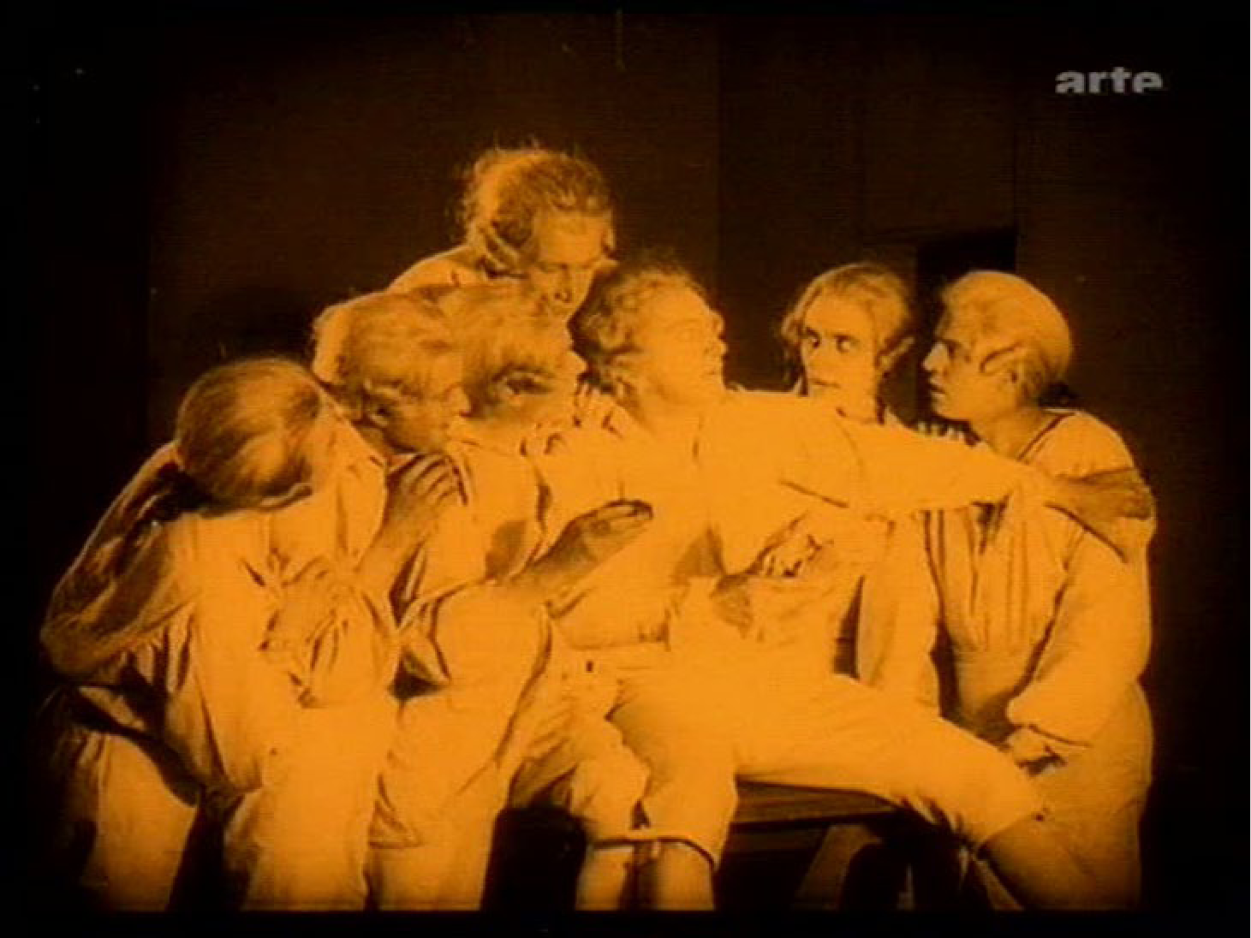
Friedrich Schiller: Eine Dichterjugend (Germany 1922/1923): Reading at night in the detention room.
The Nazi Schiller and his gang: Can a genius be more radical?
Opposed to this loyal, compassionate and ultimately queer Schiller figure in Goetz’s movie is the fascist Schiller in Friedrich Schiller: Der Triumph eines Genies, directed by Herbert Maisch in 1939/1940. Originally, the movie was supposed to be promoted under the title Rebellen, but the Reichsfilmkammer pushed through the new title which clearly alludes to Leni Riefenstahl’s Triumph des Willens (Triumph of the Will), the notorious cinematic account of the NSDAP ‘Reichsparteitag’ in Nuremberg (1934).
After the end of the Nazi era, the director Herbert Maisch retrospectively interpreted his version of Schiller’s biographical episode in Stuttgart as a critique of fascist structures in education and the military. Despite unconvincing self-interpretation, this movie still belongs to a series of genius and hero films: on Robert Koch, Friedemann Bach, Mozart, Andreas Schlüter, Bismarck, Neuberin, Lessing, and last but not least, on Friedrich II. These biopics were made on the order of propaganda minister Goebbels and produced during World War II from 1939 to 1944, mostly in the Berlin UFA Studios. This second Schiller film radicalizes a national heroic character. The idea of re-inventing German national history, to provide a strong national identity during World War II, was prevalent here, whereas economic, aesthetic or historiographic objectives seemed to matter little. Stories about the Nazi movement were told as stories about sons who rebel against their parents’ generation, thus Sabine Hake describes the Nazi cinema as ‘the oedipal self-representation of the Nazis as a movement of the sons’ (Hake, 2002: 83). The rebellion of a single man and his friends – as shown in the first Schiller movie – was transformed into the rebellion of a filial collective: ‘Nazi cinematic history “re-writes” individual desire as collective desire; its ready-made closure anticipates closure yet to come, which is already written as victory (whether in a military or cultural war)’ (Schulte-Sasse, 1996: 28–29). 6 In the fascist movie, Schiller’s gang comes to the fore, and together they fight for a new society. His charismatic leadership enforces a regime far more tyrannical than the old feudal order.
However, this author’s strong willpower is not an invention of Nazi propaganda; rather, it was an already long-established topos in 19th century Schiller biographies. Alexander Gleichen-Rußwurm (1913), Schiller’s great-grandson and his last descendant, opens his biography with the following: ‘Der Dichter stellte sich von früher Jugend an immer die schwierigsten Aufgaben und setzte volle männliche Kraft an ihre Lösung. Sein festes Wollen hat aus ihm den Menschen geformt, den wir bewundern’ (p. 1). 7 The admiration for Schiller is based on his specific humanity; this is what the biography and the biopics both argue. However, in the Nazi version, this kind of humanity, along with creativity – causing the author’s great sense of justice and loyalty for his comrades – can only be realized in a world of order and strict rules. Schiller does not rebel ‘against authority’ but ‘for authority’ (Segeberg, 2001: 524), in the sense that he and his gang are determined to establish a moral order which cannot be guaranteed by Duke’s morally compromised authority: not only does the Duke criticize the Prussian king and his government, as he vehemently rejects the latter’s disciplined lifestyle and his enlightened governance, both borne by his self-conception as the first servant of the state; he also sells his mercenary soldiers out of greed, and, worst of all, he does not care about the idea of a strong German nation. It is the gang which provides the cohesive environment, in which the new leader is accepted without any reservation; emulating familiar military patterns, they show respect and subordination by saluting every time Schiller meets them in the inn (01:13:37). This Schiller is the virtual leader of a new society, a leader who is desperately needed in times of eroding legitimacy of an arbitrary government.
As early as in 1928, Max Kommerell suggested in his essay Der Dichter als Führer in der deutschen Klassik that the poet of the idealism has to be seen as a ‘natural’ born leader (Albert, 1994: 7–9); this longing for a strong, intellectual leader is a frequent topos in the interwar-period.
8
In a dramaturgically essential sequence and at a dramatic climax of ‘Friedrich Schiller: Triumph eines Genies’ – quite similar to the reading scene in the previous biopic ‘Schiller: Eine Dichterjugend’– the protagonist once more recites a passage from his drama in the cellar under the dormitory for his gang. The movie employs iconographically the Christian motif of the shepherd and his flock (‘The lord is my shepherd’, Psalm 23). Just like a priest Schiller, a luminous figure, addresses his friends in the darkness of the cellar-vault, as they look up to him, almost devout and moved by his speech. The Christian foundation of the new leadership also refers to the dialogue of Pastor Moser/Franz Moor in Schiller’s drama Die Räuber (Act V). Within the above-mentioned cadrage, the Christian imagery furthers this effect: MOSER. Then, for the first time, will the sword of eternity pass through your soul; – and then, for the first time, too late, the thought of God will wake up a terrible monitor, whose name is Judge. Mark this, Moor; a thousand lives hang upon your beck; and of those thousand every nine hundred and ninety-nine have been rendered miserable by you. […] Now do you really think that the Almighty will suffer a worm like you to play the tyrant in His world and to reverse all his ordinances? Do you think the nine hundred and ninety-nine were created only to be destroyed, only to serve as puppets in your diabolical game? Think it not! He will call you to account for every minute of which you have robbed them, every joy that you have poisoned, every perfection that you have intercepted. Then, if you can answer Him – then, Moor, I will admit that you have won. (V.I., translation by ‘H.G.B.’)
Schiller in the biopic lambastes Duke’s tyranny with this citation, and at the same time, he expresses his claim to leadership and demands the loyalty of the gang. The world underneath the Hohe Karlsschule, where the so-called ‘betrayals’ and ‘rat pack’ meet, is a chthonic world, and yet it is a man’s world; a large part of society, especially women and the male aristocracy, seems to exist only in the ‘wrong’ world above. At this point, the proximity of the biographic narrative and the drama becomes obvious: the intellectual gang rebels against the fathers, just as the gang in Die Räuber does while simultaneously longing for authority and relatable values (Figure 2).
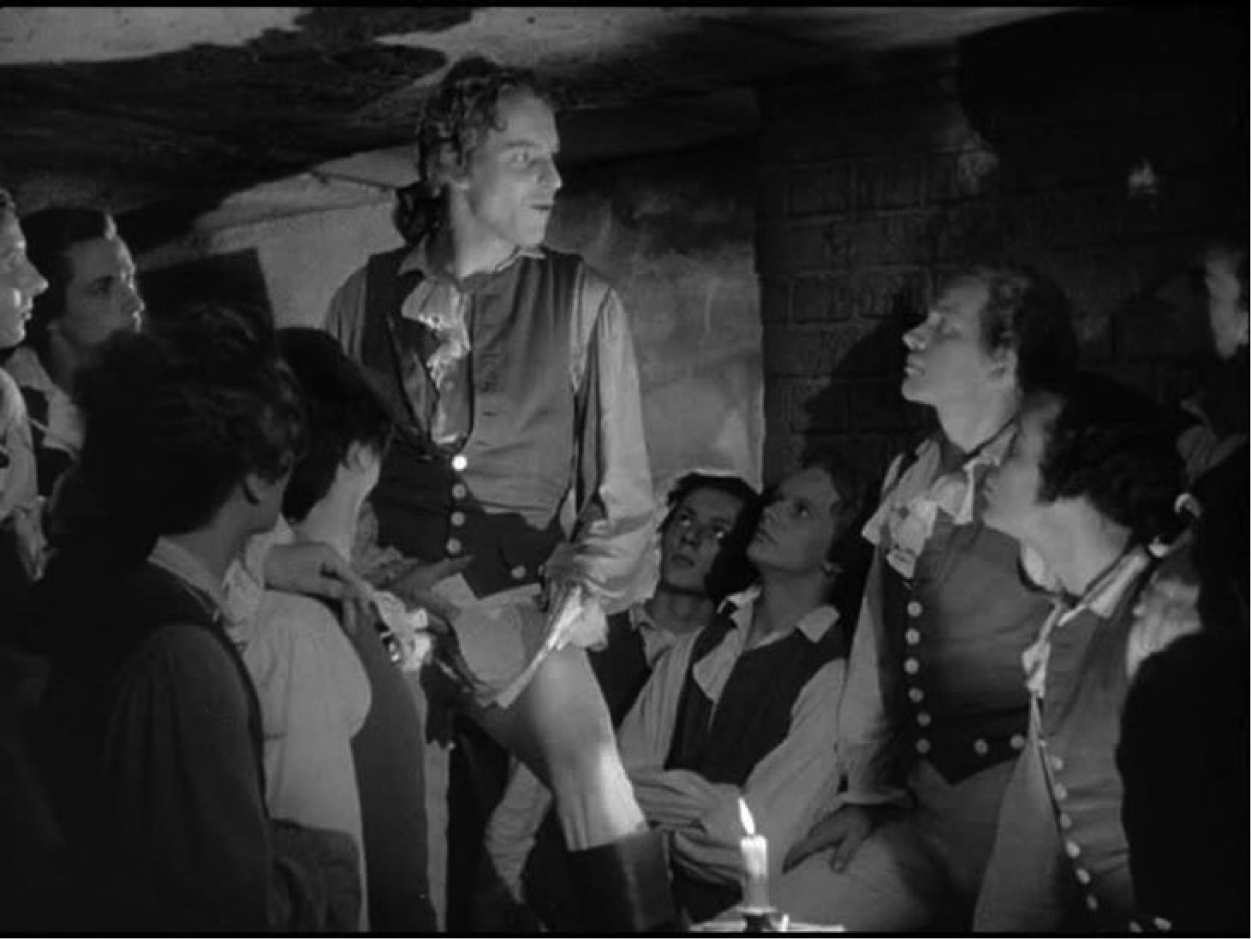
Schiller: Der Triumph eines Genies (Germany 1940): Reading from ‘The Robbers’ (V.1).
In quest for the genre
Both 20th century biopics – by Goetz in 1922 and by Maisch in 1939 9 – focus on the historical figure as member of an intellectual gang in the context of their military education. This aspect is in keeping with many German national narratives about the Napoleonic wars and the foundation of the ‘Reich’ in 1871 and highlights the important role of young soldiers as embodiments of worthwhile values, national identity and the moral formation of society. In addition, there is another genre which is seminal for the two films on Schiller. Both adaptations draw in some respects on the genre of the German student or campus novel which had been particularly successful since the beginning of the century. Heinrich Mann’s novel Professor Unrat oder das Ende eines Tyrannen (Professor Garbage or The end of a Tyrant, 1905) and its film adaptation Der blaue Engel with the young Marlene Dietrich (Blue Angel, Josef von Sternberg, D 1930) is just one of the most famous examples. Male adolescence is a common theme of the literature around 1900, particularly in prose and biographies. Biopics as a multi-layered and hybrid genre traditionally draw on the narratological codes of narrative genres in order to render the life-story narratable in filmic adaptations. Trial scenes which lend themselves to this form of dramatization often feature in biopics. Custen highlights the following: ‘Trials and other scenes of public judgment have the commanding function of laying bare the narrative device, of telling the audience what the film is really about’ (Custen, 1992: 136).
There are two aspects pertinent to the reading scene described above. First, when Schiller recites passages of Die Räuber, he speaks to his gang at the Karlsschule. The scene meta-dramatically refers to the cinematic audience. Both the audience and Schiller’s gang follow Schiller’s reading on-screen. Of course, we find this meta-dramatical function in the Mannheim performances of ‘The Räuber’, too. Both of the movies have long sequences with interesting stage on screen-scenes. Therefore, the cinema audience is invited to identify either with the gang listening to Schiller’s spoken words in the cellar or with the theatre audience in Mannheim listening to the performers and their recitation of Schiller’s written words. Goetz’s early movie has an additional scene, which connects this meta-dramatical aspect to a metatheatrical dimension, namely, the Clavigo performance for the royal household and the poet laureate Goethe. Maisch’s film, on the other hand, does not allude to theatrical codes which negotiate the relationship between the unique author and his audience, but rather toys with one of the dominant media discourses of National Socialism. The so-called ‘Volksempfänger’ was a seminal tool in terms of propaganda, since the cheap device which basically everybody could afford enabled households to listen live to Führer’s voice. Maisch’s film now stages a form of media competition between radio and cinema by dint of an allusive chase: while Schiller and his gang are celebrating his first drama Die Räuber, the submissive military and the Duke eavesdrop on the performance through an aperture in the ceiling. (After all, the French term ‘lumière’ means an opening or aperture as well as referring to the early famous filmmakers, the Brothers Lumière.) Although the persecutors – the Duke and his subordinates – cannot see Schiller and his gang, which is fully engrossed in its activities, the cinematic style of narration, camera, sound and montage help to provide a glimpse of what is going on underneath the ceiling. To put it clearly, the representatives of the oppressive system can hear almost everything that the gang is listening to, but they cannot see anything. ‘Entdeckt und verschwunden? Was soll das heißen?’, asks one of the captains (‘Detected and disappeared at once? What does this mean?’). It is possible to listen to news about culture and society on the radio set, but only the multi-track medium of cinema is capable of communicating exciting news and ideas to an audience which is watching, listening and reading all at once.
From these observations on meta-medial implications, we can conclude that the hybrid genre of the biopic – well known as a ‘troublesome genre’ (Brown and Vidal, 2013: 1) which routinely merges various others – uses the story of intellectual gangs for its own purposes. We have seen that the early German literary biopic dealt mainly with the military and educational milieu. It featured historical rebels who were closely connected with the institutions, the government and the social hierarchy in place. These rebels, like Körner or Schiller, fought on the screen against powerful forces and dominant structures, reaching from national depression to social injustice. Only the fascist version of the story developed a gang of students who were longing for authority. Gangs as homosocial groups are only at first sight clear social formations; their conceptualization of order, conventions and norms is however more complex than the antisocial labelling indicates. Consequently, they are often used as a metaphor of intricate social dynamics. In the literary biopic, the gang also works as a meta-media metaphor for the audience and, in doing so, the gang demonstrates an appropriate reaction to the genius on display, while the audience is made complicit with the gang on screen. 10
Coda: A rare female gang member
As mentioned above, the portrayal of poets among their gangs in biopics is limited to men and thus focused on homosocial bonding mechanisms. Authorship is staged as a male; women only come into play as love interests or machinators. However, in the Anglo-American biopic production, these homosocial patterns fade more quickly than in Germany.
As early as 1934, a romance about the writing couple Elizabeth Barrett Browning and Robert Browning came out (‘The Barretts of Wimpole Street’, dir. Sidney Franklin). Its dominant social context is the family. In the second half of the 20th century, the dominant heroic narrative (as in the case of Poe, Körner and Schiller) was replaced by a psychologizing approach that discussed the psychosocial difficulties of an artist’s life. Now addictions and mental diseases, and the homosexuality or polygamy of the artist were addressed. This alternative to the heroic narrative surely helped promote biopics on female authors. One has to bear in mind of course that out of 50 international film productions (up to the present), 27 feature a female author as protagonist; however, in almost half of these, the female writer is part of a couple or a supporting character. Up to the present day, an impressive corpus of movies has emerged, representing female authors and telling the stories of their specific stages of life. The large, striking gap of the 1960s may refer to the end of the Hollywood studio system and the reformulation of narrative and aesthetic criteria in European and US-American movies. It was only with the re-establishment of the classic narrative cinema and possibly literary interests of the auteur movie (e.g. with Francois Truffaut’s ‘L’Histoire d’Adele H.’, 1975) that the biopic becomes again an important genre that is especially recently experiencing a strong upward trend. Since 1999 about more than 20 movies on woman writers have been created, including others on Virginia Woolf, Iris Murdoch, Sylvia Plath or George Sand. George Sand is perhaps the most portrayed authoress in the biopic, that is, in terms of film music, surely influenced by the historical connection to Frédéric Chopin’s romantic piano music. However, already between 1987 and 1991, there had been a first high point for the woman writer biopic, for example, with movies on Janet Frame, Juana Inés de la Cruz or with three films (Russel 1986, Suárez 1987, Passer 1988) about Mary Shelley and the ominous summer of 1816 on Lake Geneva. She is the only female writer who is characterized in the social context of a male gang.
When Lord Byron and friends met by chance at Lake Geneva in the summer of 1816, they moved to a mansion called Villa Diodati. The meeting of this group of rebels and writers – Byron, John Polidori, Percy Bysshe Shelley and Mary Wollstonecraft Godwin (later Shelley) in Switzerland – is a popular episode in English literary history (Beaton, 2013: 37–50) and became the object of this series of Byron biopics. As mentioned above, these biopics routinely draw on various genres and their characteristics, in this case especially paying homage to gothic movies (Nieberle, 2004).
One of the main difficulties in biopics lies in finding a plausible metaphor for literary creativity, since reading and writing as contemplative techniques require a specific visual and auditive code for their filmic staging. One of these metaphors which help convey creativity and authorial power is the game of billiards (Nieberle, 2008). With billiards, you can no longer assume a narrative subject that organizes the narrations intentionally: the shot of the cue gets the billiard balls rolling. It’s all about getting the balls on their correct trajectory without any further control. The cue acts as an initiation signal, as a key word and activation, and as an initial impulse which initiates the subsequent automatic processes. The cue on the stage or film set sets the spectacle in motion; thereafter, it cannot be influenced until the next cue. This concept of impulse that may unfold in strategically intended and yet unpredictable ways is not only used as a narratological metaphor but has already been ingeniously realized in one the most important biopics since the 1980s: in Milos Forman’s Amadeus (USA 1984). The game of billiards serves as a metaphor for artistic creativity and authorship and it renders the gradual generation of thoughts at the writing process comprehensible. The author begins with the first impulses; subsequently, everything else happens automatically. Famously, Mozart displayed a passionate interest in billiards, as numerous sources claim. Contemporary biographies have transformed this into a biographeme. In Milos Forman’s filmic staging, the game of billiards and the act of writing are one synergetic act. Both activities only require small impulses that produce intentional and surprising effects automatically. In the biographies on Mozart, this is supported by the legend that the composer was always preoccupied with his work, putting it on paper on all occasions. The artist becomes an autopoietic system.
The game of carambole that is mainly cultivated by the French and British nobility also symbolizes, socio-historically, the male artist’s emancipation from aristocratic patrons of the arts. The bourgeois artist adopts both values and commodities of the nobility. It is therefore not surprising that this metaphor of creativity is also used in literary biopics. Lord Byron and his visitors in Diodati mansion on Lake Geneva find a billiard table and also want to use it. In his version of that episode, Ken Russell staged in Gothic (GB 1986), Mary Shelley accuses her host Lord Byron of extreme narcissism. After that, he plays billiards alone with himself and avoids the ordinary arrangement of two players at the table. In Gothic, nobody ever finds the time to play a regular game of billiards with two players. Billiards has also replaced the activity of writing in the film.
In Rowing with the Wind (Suárez 1987), the game of billiards serves as a central metaphor for rivalry between the male authors and dominates the first half of the movie. Lord Byron and Percy Bysshe Shelley competently master the challenges of the (writing) game, while alcohol and the half-hearted will to commit suicide get the better of John Polidori. He almost commits suicide – right on the billiard table, but ultimately, he manages the game in every condition he is. But what about the only female author? Mary Shelley tries to imitate the men, at least at night when she finds herself alone, but she does not know the rules. She strikes the red ball, instead of the white one, and promptly gives up after only one single failed attempt with the cue. Apparently she cannot master the cueing technique. She never will be part of the gang.
The gang in literary-historical biopics is a male, homosocially organized group that – in its homogeneity – positions itself against an equally homogeneous counter world. Rebellion but also bonhomie are crucial ingredients of the German National tradition and find their expression in military imagery. Social-critical and aesthetic impulses of innovation dependent on strategically useful cues as in a game of billiards eventually lose the military implications; however, these gangs nevertheless remain homosocially cohesive and exclusively male.
Footnotes
Funding
The author(s) received no financial support for the research, authorship and/or publication of this article.