



Abstract
This article analyses two post–civil war Lebanese films, Ghassan Salhab’s Terra Incognita and Khalil Joreige and Joana Hadjithomas’ A Perfect Day, to examine how the conditions and valences of a particular sociocultural moment register affectively and mobilize the investments that inform memory making in the Lebanese context. In particular, I study these works as embodiments of an emerging structure of feeling specific to post–civil war Beirut, in which the haunting remnants of an unresolved violent past intersect with the neoliberal imperatives to propel Lebanon into a global market. In this sense, I build upon an exclusive concern with ‘pastness’, which often dominates discussions about post-conflict and post-colonial societies, in order to consider how an unfinished traumatic past intersects with more contemporary oppressions and the affective dimension of these intersections. Through a series of visual motifs and audio techniques, Terra Incognita and A Perfect Day track the ways that forces from the past encounter a wholesale embrace of neoliberalism and commercialism to create a kind of affective impasse that plays out either in depressed apathy or in excessive indulgence.
Ghassan Salhab’s Terra Incognita (2002) and Khalil Joreige and Joana Hadjithomas’ A Perfect Day (2006) belong to a larger body of Lebanese cultural production that emerged in the late 1990s and early 2000s as part of a movement to insert the Lebanese civil war back into public discourse and therefore counteract the climate of amnesia and reluctance that had dominated the early years of the postwar era. In many ways, when the Lebanese civil war ended in 1991, after 16 years of bloodshed, it was like it never happened. In addition to the national amnesia that governed public discourse and reflected the public’s unwillingness and inability to confront the fresh wounds of the past, an amnesty law was passed that pardoned all political crimes committed during the war and therefore allowed perpetrators of violence to re-inhabit governmental positions. The ‘post–civil war’ era is distinguished, instead, by a commitment to reconstruction as a way of leaving behind the scars of the past and ‘moving forward’, to propel the country forth into the global market. I place the term ‘post–civil war’ in quotes here because the notion of ‘post’ may not take into account the continuation of political violence under the Syrian military occupation that lasted for 30 years and the Israeli occupation of South Lebanon that ended in 2000. While I use the term ‘post–civil war’ to designate the official end of the civil conflict, throughout the article I complicate the idea of a post-conflict nation by revealing the ways in which this period continued to witness political violence. 1
The films that I analyse in this article emerge from and within this context as a kind of negotiation of the various tensions characterizing life in the post–civil war state, which refuses to acknowledge its recent past while falling victim to the dehumanizing modes of neoliberalism. I am interested in tracing the affective dimension of these tensions that the films mediate through various visual motifs. Through such analysis, I hope to elucidate the realities of what some may call collective trauma, as a shared experience of violence and its aftermath. More precisely, I aim to think about the specific shapes that such scars take and the ways they figure into the aesthetic realm. Here, I am advancing a study of the affective afterlife of trauma that brings the violences of the past into conversation with the injustices of the present. My move here resonates with Michael F. O’Reily’s (2007) concern that an overreliance on frameworks of hauntology in post-colonial or post-conflict societies, in which there is an exclusive focus on the effects of colonial history, can potentially overlook contemporary forms of neoliberal and transnational violences that characterize the present. My question, in this sense, is not about how a traumatic past figures into present representations; rather, I am interested in situating the afterlife of this past within a rich ‘post’-traumatic context that is infused with its own particular injustices. Here, then, the idea of ‘post’-trauma/conflict is thrown into doubt as I reveal the ways crisis continues to unfold within the confines of the quotidian in the aftermath of the civil war. As Veena Das (2013) has argued, in many Middle Eastern countries, ‘there is no clear boundary between war and peace’ (p. 798). Terra Incognita and A Perfect Day offer insight into the ways such boundaries are blurred and the affective consequences of such existence.
Joreige and Hadjithomas’ A Perfect Day is set in postwar Lebanon in the early 2000s and follows the experiences of Malek, who suffers from narcolepsy, and his mother, who struggles with the disappearance of her husband during the war more than 15 years ago. The film revolves partially around the disappearance of Malek’s father, Riad – one of around 17,000 people reported missing during the war. Riad’s disappearance reigns over the lives of his wife and son in very different ways as his ghostly presence sits uneasily at the centre of the film’s plot. This film, however, is not about evoking a lost past; rather, it is concerned with mediating the affect of a present distorted and warped by the unresolved nature of its violent history and that is thrust into grotesque trends of hyper-commercialism and consumerism.
Salhab’s Terra Incognita follows the ‘moods, feelings and experiences’ (Khatib, 2008: 163) of a group of thirty-somethings living in Beirut sometime after the civil war. The film is narratively incoherent, often jumping from scene to scene with no apparent logical sequence. In terms of on-screen action, not much happens, but through various ambient gestures, the piece signals towards a turbulent context in which the spatial and temporal frame of the film takes place. There is no clear phantom, ghost or spectres at the centre of Salhab’s piece, yet it is still possible to consider this film within the realm of hauntology and spectrality, precisely because of the ways that Salhab conjures up objects and figures associated with the civil war. As I will discuss later on this article, moreover, Terra Incognita is preoccupied with ruins, and this preoccupation is reminiscent of the relationship between archaeology and theories of the uncanny in which ‘a previously repressed emotional affect’ (Vidler, 1992: 55) recurs. In many ways, Beirut is the ghost at the centre of the film, the ghost that now exists somewhere between life and death, between the horrors of past destruction and the gruesome attempts of resurrection/reconstruction.
Unlike many films that emerged in Lebanon in the late 1990s and early 2000s, the films that I study in this article do not attempt to provide a narrative about the experience of living during the civil war. Neither of the films reference the civil war directly, except in very minor and coded moments. Instead, the films ask what it means to exist in a postwar condition as they explore the affective realities of living in a society that has supposedly moved on from war but is still deeply scarred by it and still experiences its residual violences. In order to analyse how Salhab, Joreige and Hadjithomas use the filmic medium to carry out these explorations, I evoke theories of haunting and spectrality that help me understand how the unfinished nature of the civil war continues to play an active role in the present. More than this, however, I unpack the ways that the films’ mobilization of spectrality unfolds within a postwar mood that is enmeshed in its own violences, larger global conflicts and neoliberal tendencies. In this sense, rather than exclusively using a framework of trauma theory and its logic of exceptionalism to understand the past’s reverberations in the present, I frame my discussion through the lens of affect theory to elucidate the ways in which the ‘social or social-cultural [is] always affective’ (Berberich et al., 2013: 314). Affect is a productive concept for theorizing the realities of postwar Lebanon because it ‘registers the conditions of life that move across persons and worlds’ (Berlant, 2011: 16). In these terms, then, affect is fundamental to the mediation of any historical moment.
I have chosen these two works because of the way that each film seems more concerned with mediating a particular sense or structure of feeling as opposed to telling a story or constructing a narrative. The war is presented as a latent force brewing beneath the surface of a society unable to heal. The prioritization of affective mediation is significant to the aims of this article in which I explore how the spectres of past trauma bears heavily on the present and encounters the dynamics of modernity. My contention is that through particular aesthetic strategies, these films throw the idea of ‘post’ war into doubt as they explore how the war takes on new forms in the troubled present. According to these films, then, the logics that perpetuated violence during the civil war still exist in the present, however, with altered manifestations. Rather than just being concerned with evoking the notion of haunting, these films provide a critical perspective on the emotional state of the nation in a ‘postwar’ present. Both films evoke the temporality of a perpetual present and more precisely of a mood of being stuck between ‘the guilt of a dark past … and the anguish of an uncertain future in a politically unstable region’ (Hadgithomas and Joreige, 2011).
In order to carry out my analysis about the ways these films mediate a particular structure of feeling, I rely on theories of affect that discuss methodologies for locating and conceptualizing affect in cultural works. In particular, I outline the schism between some theorists whose study of affect in film and art tends to rely on spectator engagement and embodiment, and those who criticize these inclinations. My own argument emerges from this debate as I distance myself from spectator-based analyses and instead locate the affective dynamics of the films I study in visual and audio motifs that index certain structures of feeling as well as issues of haunting and spectrality. I then discuss the reconstruction efforts that took place under the management of late Prime Minister Rafic Hariri’s company Solidere – French acronym for ‘Society for the Development and Reconstruction of Downtown Beirut’ – in order to provide a better sense of the context within which these films unfold and to which they respond. In this section, I outline some of the major critical responses to Hariri’s endeavours in order to reveal the sense of urgency that triggered cultural activists to produce work about the civil war. Much of this criticism stemmed from Solidere’s ‘blatant attempts to rewrite the urban history of Beirut’ (Hayek, 2015: 24) and for its economically driven policies that marginalized large swathes of the population. Finally, I analyse Terra Incognita and A Perfect Day in order to demonstrate the extent to which they provide a nuanced critique of postwar reality by mediating haunting as a pervasive structure of feeling in postwar Beirut and for evoking a sense of disempowerment, which stems from unjust modes of governance that are primarily invested in accumulating wealth for the ruling elite
Mediating affect
In her monograph entitled Empathic Vision: Affect, Trauma, and Contemporary Art, Jill Bennett (2005) discusses works that have often been overlooked as so-called ‘trauma works’ because they are not directly or explicitly about trauma. As she notes about the art works she studies, ‘The trauma … was not evinced in the narrative component or in the ostensible meaning, but in a certain affective dynamic internal to the work’ (p. 1). According to Bennett, the kinds of art work that she is concerned with contribute to an understanding of trauma ‘in [their] endeavour to find a communicable language of sensation and affect’ as opposed to reflecting ‘predefined’ symptoms and conditions of trauma (p. 2). In the same spirit, Nadia Yaqub (2014) discusses Palestinian films that do not necessarily provide an explicit narrative about the trauma experienced by occupation; instead, the films she considers avoid direct representations of violence and operate through refractive techniques, ‘which redirect viewers’ perspectives of events, people, places, and conditions’ (p. 154). In this way, Yaqub argues, the filmmakers avoid ‘the discourse of claims-making that viewers have widely come to expect in the Palestinian context’ (p. 155) and instead evince an ‘affective understanding’ (p. 155) of traumatic circumstances. Following Bennett, Yaqub argues that such techniques do not seek to ‘produce secondary trauma within the spectator’, as they create an experience of ethical empathy that affirms the distinction between viewer and victim.
I start with Bennett and Yaqub here because, as I have mentioned, both the films that I am concerned with in this article do not reference the civil war directly. Instead, each film evokes Lebanon’s traumatic past as a force that weighs heavily on the present. The kinds of work that I am interested in for the purposes of this article resonate with the artworks and films that Bennett and Yaqub look at respectively. However, while both Bennett and Yaqub provide a productive departure point for my purposes, their theoretical investments do not fully help me articulate the issues I am concerned with, particularly because of their Deleuzian-inspired understandings of affect that are preoccupied with the spectator. Bennett, for instance, relies on Deleuze’s idea of the encountered sign ‘to describe the sign that is felt rather than recognized or perceived through cognition’ (p. 7). For Bennett and other Deleuzian-inspired affect theorists, affective forces are asignifying or always separate from meaning as they come prior to ‘intentions, meanings, reasons, and beliefs’ (Leys, 2011: 436). Bennett’s preoccupations, for example, lie in understanding the ‘instantaneous, affective response, triggered by an image’ (p. 11) and the ways in which these responses eventually provoke critical inquiry. Yaqub’s theorization of refraction echoes this idea because she argues that rather than provide a trauma narrative about occupation, the films she studies produce a feeling that helps viewers achieve an affective understanding of the characters’ experiences.
While both Bennett and Yaqub make compelling arguments about the affective impact of the works they analyse, they do ultimately treat these works mostly as vehicles for spectator response. This kind of analysis, I find, while useful, can often elide something crucial about the internal dynamics of the works themselves and their relationship to cultural contexts. Here, I have Ruth Leys (2011) in mind who critiques the ‘affective turn’ and its non-signifying, precognitive and non-representational tendencies. In particular, Leys is sceptical of theorists like Bennett who rely on spectator response as a stand-in for interpretation and as a mode of analysis that, she argues, de-politicizes reading. She observes, An entire aesthetic is involved here, one that emphasizes the reader’s or viewer’s experience of a text or image to the extent that that experience might be said to stand in for the text or image in question. An opposing position would insist that although a work of art might make us feel happy or sad or envious or ashamed, what matters is the meaning of the work itself, which is to say the structure of intentional relationships built into it by the artist. The fact that a novel or painting makes me feel or think a certain way may be a significant aspect of my response to the work, but, simply as my response, it has no standing as an interpretation of it. But cultural theorists who have turned to affect convert questions about the meaning of works of art into ones concerning their affective effect or influence on the reader or viewer. (p. 451, Note 31)
Leys’ concern here is that by privileging corporeal-affective responses to images or texts, we are eliding the ways in which the internal dynamics of these works produce meaning in and of themselves. This ontological turn that she is so sceptical of assumes a disconnect between affect and ideology, ideas, and meaning and so, in her terms, has very depoliticizing consequences in its prioritization of response over content. I share some of Leys’ scepticism for affect theorists that place too much emphasis on corporal responses to cultural products, particularly because I think such readings potentially overlook many of the culturally inflected nuances that structure the texts or images in question. I would not, however, go as far as Leys does in dismissing the significance of these theorizations completely because I do see value in considering how cultural artefacts circulate in specific sociopolitical contexts and how certain publics receive them. In particular, for example, I find Yaqub’s assertion that the films she studies provide an affective understanding of occupation, which differs from the ideologically explicit, claims-making approach that characterizes most Palestinian cultural production convincing. Her reliance on spectators’ affective involvement is useful in the Palestinian context where cultural producers attempt, through their creative works, to create agency ‘while representing all the forces that seek to destroy that agency’ (p. 157).
Eugenie Brinkema (2014) is another scholar who is dubious about theorizations of cultural output that rely too heavily on affective responses. Her critique of film theory, specifically, targets the obsession with spectator bodily response. Brinkema’s insistence on the significance of formal reading in cinema resonates with general assessments of the affective turn, like Leys’, which criticizes the asignifying and precognitive theorizations of affect. She writes that ‘because form and affect have been taken as antonyms in the post-1970s battle over the discipline of film studies, this book will insist from the outset that we have not yet asked enough of form’ (p. 41; original emphasis). She reveals that even in instances ‘when form and affect have been considered together’, there is always an insistence on ‘how form affects spectator’ (p. 44). In turn, she argues, the study of affects in the history of film theory has turned into ‘little more than the study of effects’ (p. 44). Her main preoccupation with formal matters in cinema, however, does not mean that she dismisses affect’s relationship to the subject or the body completely. As she acknowledges, ‘it hitherto has been underdetermined what the body can do to form and even what form can do to a body’ (p. 41). Nevertheless, in her own work, she is uninterested in the body as she attempts to recuperate a formalist reading of cinema that pays close attention to the structures and details that pan out visually on a screen. She is invested, then, in revealing how affects are bound up in specific cinematic forms.
Through my methodology, I am concerned, to some extent, with reconciling those film theories that take into account the affective response of the spectator without abandoning the ways in which affect is registered formally and aesthetically. While I am not primarily concerned with thinking through the ways the films affect spectators, I do acknowledge that film is a medium that ‘works with all the senses’ (Rutherford, 2013: 93), so I maintain that when analysing the ways in which affect works in films, we are always, to some extent, considering how films draw in (or isolate) viewers.
Returning to Bennett and Yaqub, their theorizations affirm to some extent what I am observing in the films under scrutiny in this article, particularly in terms of how each film does not represent the civil war explicitly and how there is instead a certain affective dynamic or mediation occurring. Similar to the works that Bennett and Yaqub study, the films in this article register a sense of crisis that occurs within the confines of the quotidian. The quotidian in Salhab’s and Hadjithomas and Joreige’s films is loaded with the unresolved tensions of past trauma. Unlike Bennett and Yaqub, however, I am not just thinking about how these films evoke a particular affective response in the spectator or how they help us make ‘sense of the war on an affective level’ (Westmoreland, 2013: 717). Instead, I locate the affective dynamics of the films in issues of haunting and spectrality that unfold within a series of visual motifs that index a particular postwar structure of feeling. More specifically, while I am interested in thinking through how the films provide an affective understanding of Beirut, I also argue that this sensory/affective representation reveals or mediates a structure of feeling that requires us to go beyond a spectator/embodiment-based analysis. I explore the various aesthetic strategies of these films, then, to diagnose haunting as a pervasive structure of feeling characterizing postwar Beirut and to think through the other layers of affective existence that operate in this ‘post-conflict’ society. Here, I take my cue from Avery Gordon (2008) who, in offering a ‘cultural hypothesis’ about haunting as a shared structure of feeling, defines the phrase as ‘a shared possession, a specific type of sociality’ (p. 201). Gordon cites Terry Eagleton who explains that a structure of feeling refers to those ‘elusive, impalpable forms of social consciousness which are at once as evanescent as “feelings” suggests, but nevertheless displays a significant configuration captured in the term “structure”’ (p. 198). In order to gain a better sense of the particular structure of feeling characterizing postwar Beirut, I will discuss some of the major developments unfolding during this time.
Solidere and a culture of amnesia
As mentioned earlier in this article, after the Lebanese civil war ended in 1991, there was a general reluctance to speak of the war in its immediate aftermath, and there seemed to be a consensus that it was best to leave behind the troubles of the past in order to move forward. This attitude was coupled with a climate of suppression that the continued Syrian military presence in Lebanon created. Late Prime Minister Hariri’s private-sector company Solidere, which was tasked with the reconstruction of downtown Beirut in the 1990s, best encapsulates the mindset of looking to the future as opposed to the past. 2 Much of Solidere’s rhetoric invoked nostalgic sentiments about a prewar Lebanon. The company aimed to recreate Beirut’s image as the ‘Paris of the Middle East’ and so it marketed itself as a restorer of Beirut’s great legacy. The Solidere project, however, drew much criticism from intellectuals, architects, artists and others who felt that the company’s interest in preserving Beirut’s heritage was merely a marketing scheme focused purely on image. In this sense, critics argued that Solidere’s corporate agenda effaced significant traces of Beirut’s heritage. Saree Makdisi (1997) posits in his well-circulated and oft-cited article, ‘Laying Claim to Beirut: Urban Narrative and Spatial Identity in the Age of Solidere’, that ‘[I]t is worth asking why this project relentlessly clings to the language of the re-rather than admitting that it is not about the resurrection, redemption, recuperation, reinvention, remembrance of that past but rather its invention from scratch’ (p. 682; original emphasis). For Makdisi and others who share his abhorrence for Solidere, Hariri’s mission rendered Beirut’s city centre a clean slate or tabula rasa on which to implement a corporatized version of Lebanese identity that alienates large swaths of the Lebanese population, intensifies class schisms and sanitizes Lebanese history.
While Solidere presented itself as recuperating Lebanon’s historical identity, the company is in fact responsible for more destruction and demolition of buildings than the war itself (Makdisi, 1997: 674). Many of these buildings, as Elise Salem (2003) points out, could have been salvaged. Still, Solidere clung to its proclaimed identity as a reviver of Beirut’s historical associations and ‘a keeper of national heritage’ (Nagel, 2001: 227). The company’s slogan remained, after all, ‘Beirut: An Ancient City for the Future’. This slogan eventually became established in response to critics who accused Solidere of ‘wilful amnesia’ (Haugbolle, 2010: 85). In turn, Solidere capitalized on the ancient Phoenician and Roman ruins located in Beirut’s downtown as evidence for its commitment to Lebanon’s historical identity. As critics like Makdisi (1997), Miriam Cooke (2002), Aseel Sawalha (2010) and Caroline Nagel (2001) convincingly argue, however, Solidere’s preservation of architectural heritage is less about igniting a process of historicization or remembrance, and instead about ‘creating a “name brand” for Beirut – a place identity that is easily marketable to tourists and investors and that adds value to downtown real estate’ (Nagel, 2001: 224). This appeal to history, then, is nothing more than a marketing strategy inspired solely by a concern with ‘appearance and façade’ (Makdisi, 1997: 686). Even more troubling about this commitment to historical appearances is that it effaces Beirut’s local history. As Cooke (2002) poignantly writes, Solidere revives the regional past (Phoenician and Greek) to erase the local past (the war) and to launch this new Beirut into a global future … The traces will soon be gone. It will no longer matter who was responsible for the war nor why it was fought. (p. 422)
Ultimately, the most resounding condemnation towards Solidere is that it embodied the colonization of public interests by privatized, neoliberal ones. Makdisi (1997) reveals how Solidere came into being without any regard for the public, most notably for those whose property the company was expropriating (p. 672). Makdisi estimates that ‘there were as many as 250,000 property-rights claimants in the central district’ (p. 670, Note 10). Many of these property claims were largely disputed due to archaic inheritance laws; however, the fact remains that the properties were all expropriated without any consideration for the claimants.
Early demolitions, moreover, carried out by Solidere were in fact unauthorized by any governmental or public authority. Even more strikingly, since the company and its investors would not be taxed for the first 10 years of operation, the government denied itself any potential tax revenues
3
and was to reimburse Solidere for all infrastructure costs incurred (Makdisi, 1997: 676). Hence, in the age of Solidere, it very soon became apparent that with the ascendancy of what many have called ‘Harirism’ came a ‘dramatic intensification of the presence of market forces’ (Makdisi, 1997: 694) in the Lebanese political and economic scene, as well as the ‘astonishing self-enrichment for the members of [Hariri’s] government and their wide circle of business associates’ (p. 694). Najib Hourani (2010) argues that this neoliberal order that characterizes postwar politics is in fact not a new phenomenon, but an extension of the politics that dominated during the civil war. He argues that the ‘militia economy’ that operated during the civil war was never outside of larger processes of financial globalization, [instead] it was integrated into a global realm consisting not of financial corporations operating according to a universal capitalist rationality, but rather one of similarly constituted networks of capitalists, companies and other institutions working within and alongside a variety of states in pursuit of politico-economic power. (p. 290)
I agree with Hourani that the same capitalist logics that characterized the postwar period were in fact an extension of the militia system that dominated the civil war and benefited those who perpetrated the violence, but what is unique about the postwar phase, perhaps, is the monopoly of power and capital by one businessman turned politician. Hariri’s policies as prime minister were largely ‘wedded to his private business empire’ (Salem, 2003: 180) as he not only oversaw and benefited from the construction of Beirut’s downtown but also managed dissent by changing media regulations in his favour (Makdisi, 1997; Salem, 2003) and bringing school curricula under much tighter government control.
I should note here that these regulations occurred in the spirit of or under the auspices of suppressing the potential for sectarian conflict. For instance, the appeal of preserving Lebanon’s architectural heritage was that it created a ‘Phoenician Levantine identity … that supersedes narrow sectarian affiliations’ (Nagel, 2001: 226). In fact, many during this period regarded Hariri as a ‘formidable persona’ (Haugbolle, 2010: 91) coming to Lebanon’s rescue. Samir Khalaf and Philip S. Khoury’s (1993) anthology, Recovering Beirut: Urban Design and Post-War Beirut, is one example where we can find such attitudes. In their preface to this anthology, which includes entries by a number of architects and urban designers who would go on to blithely attack Hariri and his Solidere project and whose visions for the reconstruction of Beirut were largely incompatible with Solidere’s, Khalaf and Khoury surprisingly record, As we write, the news of appointment of Rafik al-Hariri as Prime Minister reconfirms this hope that Lebanon may have finally taken the road to recovery … [He] has evolved over the past decade into a folk hero of sorts … Partly because of his Cinderella-like success story … and his selfless benevolence on behalf of his country, he commands now, particularly among the beleaguered masses, an aura of unmatched respect and hope. (p. xiii)
It is indeed curious, despite the appeal that Hariri might have held, that these two academics would so uncritically characterize Hariri’s actions as ‘selfless benevolence’. This is especially surprising considering the plethora of harsh critiques that Solidere would come under from cultural producers, activists, intellectuals and citizens who felt left out of Hariri’s corporate vision for Beirut.
The question that I am interested in here is, ‘How this reality figures into the films under study in this article and what are the affective dimensions of these conditions?’ A Perfect Day and Terra Incognita do not overtly tackle reconstruction; instead, it is figured as an active backdrop or dominant force framing each of their narratives. Most significantly, as my analysis will shortly reveal, the structures of the films summon the mood of a disempowered public sphere by gesturing towards these larger political developments that frame the lives of the characters, but from which they are somewhat removed. Just like Solidere privileged corporate interests and became established without any regard for the general public, the films represent the average civilian in postwar Lebanon as a spectator to the developments occurring around them. The civilians wander around the constantly changing city, yet they are rarely represented as agents in the changes taking place. Through an evocation of spectrality in a nuanced representation of the postwar present, the films embody the various tones of affective existence in post–civil war Beirut. The films, however, refrain from clear-cut narratives and causalities because, as I will reveal, the dynamics of spectrality are rarely so straightforward.
The affective landscapes of A Perfect Day and Terra Incognita
In the following section, I explore how the films make a critical intervention into the postwar present by revealing a darker layer of Beirut’s affective reality, one that is inhabited by the unexorcised ghosts and phantoms of its recent past. Hauntology as a theoretical framework is a productive place to begin thinking about the state of postwar Lebanon because, as Colin Davis (2005) acknowledges, it is part of an endeavour to keep raising the stakes of literary study, to make it a place where we can interrogate our relation to the dead, examine the elusive identities of the living, and explore the boundaries between the thought and the unthought. (p. 379)
As a critical and psychoanalytic discipline, hauntology has two main sources: the first and most often cited source is Jacques Derrida’s Spectres de Marx (1993) and the second, ‘chronologically prior yet less acknowledged’ (Davis, 2005: 373) source is the work of Nicholas Abraham and Maria Torok. In Derrida’s renowned text, he explores how the spirit of Marx and our inherited legacy of Marxism haunt us in the wake of post-communism. Derrida (2006), in this sense, provides a formal structure of hauntology or spectrality as he asks, ‘What is the mode of presence of a specter?’ (p. 46). For Derrida, a spectre is always a revenant in that it ‘begins by coming back’ (p. 11; original emphasis). The spectrality effect, in Derrida’s terms, accounts for slippages between the past and the present and between absence and presence. There is always, moreover, a certain kind of opacity when dealing with spectres in the Derridean sense. The readability of an inherited legacy – what Derrida calls the spectres of Marx – is always elusive and secretive and always requires multiple interpretations. These characteristics informs us of the aesthetics of haunting.
In Abraham and Torok’s (1994) account of hauntology, they deal with the figure of the phantom, which represents the transgenerational effects of undisclosed traumas on its descendants. Abraham and Torok’s version of psychoanalysis offers an alternative to Freudian theories that rely heavily on instinctual forces in explaining the symptoms of trauma. For Freud, trauma operates according to a temporal logic of delay or ‘deferred action’ (Nachträglichkeit) in which trauma is made up of the dialectical relationship between two events or experiences that are not in themselves traumatic: the first event, sexual in nature, that came too early in a child’s life for it to be understood and the second event that triggered a memory of the first event that only then was given traumatic meaning. The first childhood experience establishes the ‘libidinal “substructure”’ (Ball, 2009: 153) upon which future ‘neurotic’ experiences are based. In Abraham and Torok’s formulation of the phantom, however, traumatic symptoms are not necessarily related to instinctual life. Instead, ‘the diverse manifestations of the phantom, which we call haunting’ (Torok, 1994: 181; original emphasis), result from inheriting the ‘secret psychic substance of … ancestors’ lives’ (Rand, 1994: 166). The main difference that Davis (2005) identifies between Abraham and Torok’s phantom and Derrida’s spectre is that the spectre does not belong to the order of knowledge. As discussed above, Derrida maintains that, to some degree, the spectre always lies beyond interpretation and resolution. In contrast, for Abraham and Torok, ‘the phantom’s secret can and should be revealed’ (Davis, 2005: 377)
For my own purposes and departing from Davis who favours a Derridean approach to hauntology, I am not so much interested in choosing a side, so to speak, mainly because I find Abraham and Torok’s theories useful for conceptualizing the effects of a silenced traumatic past on those who inherit it. Following Meera Atkinson (2013), then, I believe that the ‘usefulness in teasing out the distinction [between Derrida and Abraham and Torok] perhaps lies less in establishing a conflict between them and more in collapsing the two approaches into a complimentary amalgamation …’ (p. 268). Derrida’s theory on spectrality provides a productive framework for conceptualizing the ways in which we interact and live with the ghosts of the legacies we inherit, while the specificity of Abraham and Torok’s phantom allows us to think about how a silenced past makes its way into and disrupts the psyche of those who follow it.
The fact that each film, under study in this article, does not provide a narrative about the civil war is fundamental to their haunting aesthetic. Gordon (2008) argues, for example, that the ethical imperative of haunting ‘is not a return to the past but a reckoning with its repression in the present’ (p. 183). Through an evocation of spectrality in the present, then, the films reveal how the logic of the civil war perpetuated into the contemporary moment and how the present’s impetus to reconstruct and forget reflects the ‘incomplete forms of containment and repression’ (Gordon, 2008: xvi) through which the spectre of the past interferes. Like Kamran Rastegar (2015) observes, with the cessation of the cycle of violence and hostilities … a specter rose over Lebanese cultural life – a specter representing in some measure the war itself, but also the absence of a process of accountability, as well as an accounting of the history of the war. (p. 158; my emphasis)
It is the repressive forces of the present, then, that account for the force of the spectre in Lebanese postwar society.
It is significant here to go beyond an analysis of how the films under study evoke haunting through oblique representations of the undead. This recurrence of the undead in the Lebanese art scene has been theorized either as evidence for the absence of a mourning process (Westmoreland, 2010, 2013) or as a trope that signifies the unjust end of the war (Rastegar, 2015). I do not refute these claims, but I argue that an exclusive focus on the undead potentially obstructs an understanding of the ways in which this haunting confronts other affective dimensions of the postwar present. In his analysis of A Perfect Day, for instance, Rastegar focuses exclusively on Claudia’s encounter with the ghost of her missing husband as well as the ways in which his absence has prevented her and Malek from joining the realm of the living. His analysis is illuminating for thinking about how the spectre of missing persons in Lebanon painfully reveals the unfinished nature of the civil war; however, it also elides the other affective dynamics at play throughout the film. The films, I argue, call upon us to think about how these evocations of spectrality or these hauntings contend with present-day realities and how they are in fact connected. Here, I am reminded again of Michael F. O’Reily (2007) who warns that an exclusive focus on haunting ‘as a mode of recovery of colonial history’ in post-colonial theory can ‘obsess memory and divert the critical gesture from contemporary issues requiring intervention and immediate attention’ (p. 4). Keeping this caveat in mind, then, I wish to consider how the evocation of spectrality in the films is embedded within a larger affective and sociopolitical context.
In order to analyse this encounter, it is first necessary to consider how the spectre of the civil war is represented in the postwar mood that Terra Incognita and A Perfect Day evoke. Each of these films attempts to articulate the ways in which haunting, as a kind of ‘experiential modality’ (Gordon, 2008: xvi), makes itself known in a postwar present riddled with its own violences. When we speak of haunting here, we are speaking of the undead, the ghosts or spectres that interfere with the configurations of the present. In this sense, as María del Pilar Blanco and Esther Pereen (2013) remind us, ‘studies of ghosts and haunting can do more than obsessively recall a fixed past … they may [also] reveal the insufficiency of the present moment’ (p. 16). Through an evocation of spectrality, then, the films provide a critique of the postwar present.
As I already mentioned, A Perfect Day revolves around the disappearance of Malek’s father, Riad – one of around 17,000 people reported missing during the war. Riad’s absence is the only way that the civil war is evoked throughout the film. In one scene, for instance, Malek lays out old newspapers that advertise his father’s death. The camera lingers on the image of Riad at the corner of the page before it slowly travels across the newspapers, layered on top of one another, to reveal headlines and images from the civil war. As the camera travels upwards, exposing darkened photos of destruction and wrapped up corpses, and glimpses of sombre headlines, the non-diegetic sounds become more intense, glum and eerie. The camera finally pauses once again on the image of Riad, with the words ‘Missing’ typed above his photo. This scene situates Riad’s death in the mayhem of the civil war. Amid the changing images of chaos and destruction and the layers of newspapers that represent the tragic persistence of time, Riad’s picture remains statically situated in the corner of the page, shrouded in mystery, as his absence continues to plague the lives of his wife and son.
This film, ultimately, is not about the past; rather, it is concerned with mediating the affect of a present distorted and warped by the unresolved nature of its violent history. For while ‘death exists in the past’, as Gordon (2008) reminds us, ‘disappearance [exists] in the present’ (p. 113). The film, then, uncovers the ways in which absences and their uncertainties are constantly negotiated in the present. Gordon argues that it is precisely these uncertainties that render disappearance an exemplary instance of haunting. Disappearance, she contends, undoes those borders between knowing and not knowing (p. 113).
Riad’s disappearance reigns over the lives of his wife and son in very different ways as his ghostly presence sits uneasily at the centre of the film’s narratively incoherent plot. One of the central conflicts in the film revolves around the decision to declare him legally dead. Claudia is uneasy with this undertaking as she is unable to foreclose the possibility that her husband might return. Unable to mourn her husband, Claudia is stuck melancholically in the present as she exercises a persistent attachment to her loss. Ruth Kluger (2001) suggests that ‘Where there is no grave, we are condemned to go on mourning …’ (p. 80). The lack of grave in Kluger’s sense resonates with Claudia’s inability to reach closure regarding her husband’s absence, for as Kluger notes, ‘the grave is not necessarily a place in a cemetery, but simply clear knowledge about the death of someone you’ve known’ (p. 80). Claudia is still haunted by her missing husband; she still sees him, feels him and has been denied the possibility of mourning him, and so the lack of a grave, both literal and figurative, makes it necessary for her to be stuck melancholically in the present, unable to move forward in the way that the political elite deem necessary. She wears his shirt and stares in the mirror pulling her hair back desperately trying to glimpse an image of her lost husband; she sits in vacant rooms looking around apprehensively and reaching out to empty chairs trying and failing to touch what seems to be there but cannot be found; she wanders around the house and down to the street pausing at each car horn and looking around searchingly in anticipation of what never arrives. In these instances, in the loaded absences and vacancies of Claudia’s life, she oscillates between the boundaries of certainty and doubt.
Unlike his mother, Malek wants to believe in the certainty of his father’s death, insisting that they should declare him legally dead. Despite this expressed certainty, however, Malek is plagued by narcoleptic fits that reveal a troubled psyche. Constantly retreating into the realm of the unconscious, Malek is unable to fully exist in the present. His slips into narcolepsy, then, also reflect the ways in which ‘haunting alters the experience of being in time and how we separate the past, the present, and the future’ (Gordon, 2008: xvi). In one scene, for instance, this dynamic is played out aesthetically. When Claudia and Malek drive back from the lawyer’s office, Claudia accuses her son of not feeling his father the way that she does. As she is speaking, seemingly to herself, the camera shifts to Malek who rests his head against the back of his seat and falls asleep. With Claudia’s last words, the screen goes blank and silent for a few seconds before the sound of beeping horns and Claudia’s voice calling out her son’s name abruptly awaken Malek. The transition from Claudia’s speech to the black screen and back to the noisy streets of Beirut effectively interconnect the past and present together in a striking and insinuating manner. In Jacques Derrida’s (2006) terms, spectrality designates slippages between absence and presence or the past and the present. One cannot so easily ‘differentiate between the specter of the past and the specter of the future’ (p. 48) because, as Derrida argues, the ‘spectrality effect’ consists precisely in undoing the opposition ‘between actual, effective presence and its other’ (p. 48). The spectrality effect, then, accounts for the various ways that the past intrudes on the present and gestures towards the future because it throws doubt on ‘the reassuring order of presents’ (p. 48). As Claudia is speaking, viewers are drawn in to the private experience of a woman haunted by the disappearance of her husband. The effects of a traumatic past are evoked directly in this instance as the outside city, and the representation of the present that the directors vividly take viewers through throughout the film is relegated to the background. With a jolt, however, both Malek and the audience are transported from the lull of the black screen, which represents Malek’s narcoleptic slip, back into the chaotic noises and suffocating traffic that inundate the streets of Beirut. In this sense, a kind of slippage between the past and the present is enacted as the past emerges in the schism between Claudia and Malek and then is once again superficially masked by the indulgences and excesses of the present.
Unlike A Perfect Day, Terra Incognita does not have a clear phantom at the centre of the plot. Rather, the film evokes haunting by unnervingly conjuring up images and figures associated with the civil war into the present-day postwar context that it represents. The film is a grim piece, paradoxically named, for while the title evokes an unexplored region or territory, it is in fact concerned with revealing the various inhabited and neglected layers of Beirut. Terra Incognita follows the experiences of a group of thirty-somethings who struggle with the various issues plaguing the country in the wake of the civil war. Its main character, Soraya, is a tour guide who leads curious Westerners through the country’s ancient civilizational structures that have been discovered partly because of Solidere’s reconstruction efforts. As she leads tourists through the country’s newly uncovered history, Lebanon’s most recent history – the civil war – is strikingly absent from her presentations (as one character, Tarek, observes on one of the tours that he intrudes upon). Tarek, who has just returned from abroad in the film, cannot decide whether to stay or leave, an issue that plagues other characters, like Soraya, as well. Nadim is a Solidere architect who struggles with his profession as he spends most of his time going over maps of the city seemingly searching for a version of the city that he can identify with. Leila is a depressed existentialist who constantly questions her existence. Finally, there is the character of the radio-announcer who Salhab films either reporting the daily news that forms the background of many scenes throughout the film or going about mundane daily activities. Like A Perfect Day, the film never references the war; however, the spectre of this conflict reigns over the lives of the characters in significant ways.
In the film’s opening sequence, we hear Soraya speaking in French about the ancient Roman temples located somewhere in the Bekaa valley outside of Beirut. As she explains, credits roll on the screen against a background of Salhab’s ID card outlining basic information about him, including, most notably, his religious sect: Muslim Shiite. Soraya is subsequently filmed with a group of French United Nations (UN) peacekeepers navigating the undulating landscape of the Bekaa and discussing the financing of these temples, 4 before the camera shifts once again to an image of Salhab’s ID card, this time with his photo in the frame and the film’s title sprawled across the screen: terra incognita. The insertion of Salhab’s ID card into the opening sequence is a significant framing device considering the importance or rather, infamy, this object held during the heydays of the civil war, when slaughterings based on sectarian identity were rampant at checkpoints located across the country. The ID card, then, that lingers between the opening frames of the film is a daunting echo from the past as it unnervingly enacts the notorious exchange of identification, but this time between the director and the viewer. It should be noted here that the ID card, and his sectarian identity specifically, represents a kind of essential system of identification on a diasporic and local level. Salhab’s upfrontness about his sect also functions as a way of referencing the ways in which Lebanese people recognize themselves and others. One of the first questions a Lebanese person often asks the other, after all, when they first meet is ‘where are you from’, as a way of discerning sectarian identity based on geographic belonging.
This technique, of inserting figures and images associated with the civil war into the filmic landscape, is a method that Salhab uses throughout the film and it is how he mobilizes a formal dimension of haunting or spectrality that is crucial to his mediation of a postwar structure of feeling. Most strikingly, for instance, is the repeated presence of army or militia figures that constantly enter the frame of the film. We can interpret the constant and mysterious appearance of these soldiers as representations of the endurance of Syrian hegemony over Lebanon. The persistent military presence in the film corresponds to the postwar climate when Syrian checkpoints were prevalent across the country. Another way to think about these figures is through the lens of spectrality. These army men in the film are often unacknowledged by the characters, functioning simultaneously as the ‘undead … whose amnesty has not provided them with redemption’ (Westmoreland, 2010: 200), or they are briefly recognized as they intrude, often unexpectedly, upon the dialogue or development of the film to signify perhaps how the perpetuation of unjust power interferes with wholesome progression. In one particularly evocative scene, the ghostliness of these armed men is educed quite clearly. After driving to the bar to go meet his friends, Nadim walks past a marching line of army men carrying rifles across their chests (Figure 1). The armed men are blurry compared to Nadim, as they often are when represented in the film as unacknowledged background figures. Nadim walks besides them as though they were not there, until finally pausing to glance back. The sequence slows down, dwelling on a shot of Nadim’s back, as he stands there frozen with an eerie high-pitched noise stirring in the background. The camera then shoots back to him in his car, as he was before when he was driving to meet his friends. That moment, therefore, with him and the armed figures is fleeting, and its position within the temporal narrative is unclear. The scene disrupts the progression of Nadim’s drive to meet his friends, functioning almost as a memory or a hallucination. These figures in uniform are crucial to the dark layer of Beirut’s history that Salhab represents, precisely because of the uncertainty surrounding their existence. As they march through darkened streets, they evoke a sense of unease, representing the unfinished nature that a lack of amnesty imposes on the psyche of the country. 5
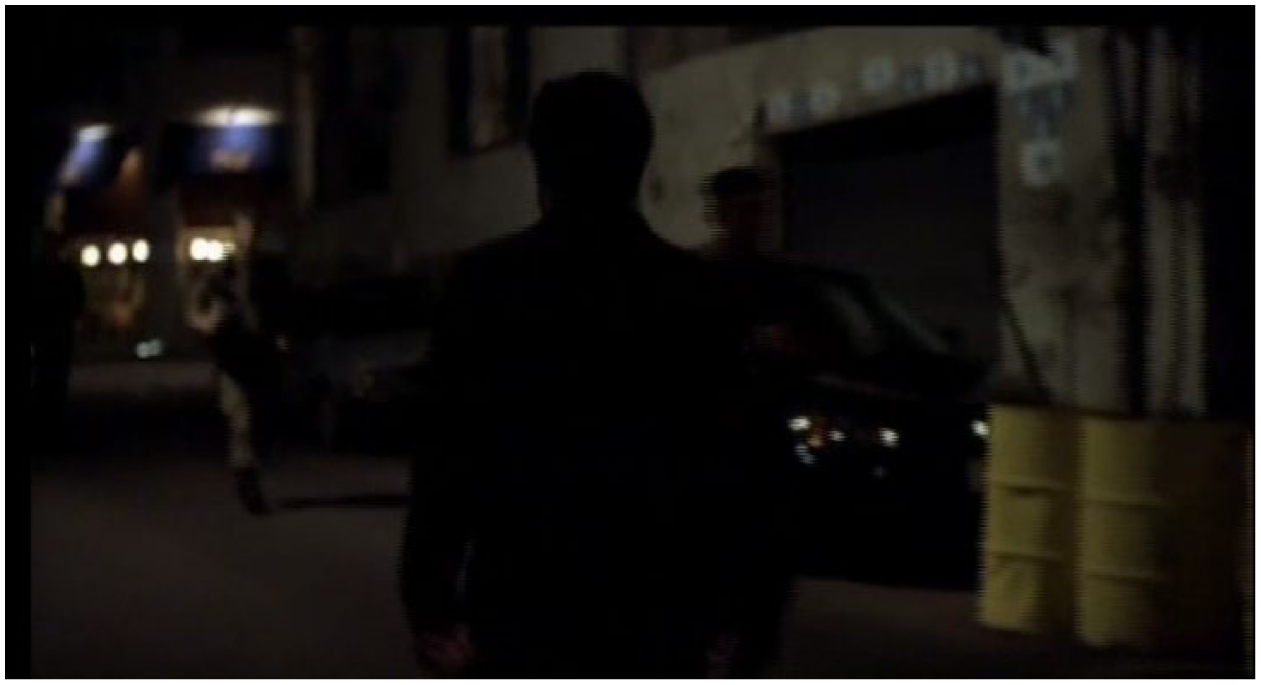
Terra Incognita: Mysterious armed figures walk past Nadim in the night.
In addition to these spectral evocations, the films also represent phantomhood as a more generalized condition characterizing the characters and the city itself. With the massive reconstruction projects enveloping Beirut, the films portray the city as being grotesquely revived from the dead, as Soraya’s conversation with the tour’s bus driver reveals. He tells her, ‘If Beirut wasn’t destroyed, we wouldn’t have discovered any of [these ruins]’. ‘Seven times it was destroyed’, she replies, referring to Beirut. He continues, ‘seven times we died and came back to life’. ‘Not us’, she retorts, ‘it’. Beirut, then, is the phantom city that plays an active role throughout both films. Other critics argue that in addition to the phantom city, the civil war created a phantom citizenship (De Cauter, 2011), rendering the citizens of Lebanon ‘ghosts among ghosts’ (Wright, 2002: 15). Whether it is Malek whose narcolepsy prevents him from joining the realm of the living or Leila who wanders around aimlessly ruminating about the fleetingness of her existence, these characters are demoted to the role of inverse or false phantoms, to use Lieven De Cauter’s (2011) term. He writes that ‘Just as real phantoms have only their appearance and no matter, false phantoms have only their body, their naked life … because they have lost their citizenship, their belonging, their civic human appurtenance, their form of life’ (p. 428). There is, then, a certain hollowness to the lives of these characters, a gap created by the suppression of a traumatic legacy. As Nicholas Abraham (1994) reminds us, ‘what haunts are not the dead, but the gaps left in us by the secrets of others (p. 171).
Haunting, ultimately, as a prevailing sense in these films, is tied to what Hadgithomas and Joreige (2002) identify as the latency of the civil war in the postwar era. They write that latency connotes what is often felt in Beirut, in face of the dominant amnesia prevailing since the end of the war, in face of this strange paralysis that pervades the city, in face of this violent desire to place things between parentheses – to censure oneself. (p. 40)
The idea of parenthesizing the past, as though it were not essential to the fabric of Lebanese society, is something that preoccupies Joreige and Hadjithomas throughout their work. The nature of latency for them is troubling because, as a force, it cannot be clearly identified. The memory of the civil war is instead ‘strangled’ by desperate attempts to push the country forward into the global economy. As a result of this stifling reality, Lebanon is thrust into a form of paralysis, a ‘stuck-ness’ that we find resonating throughout the aesthetic of their work. 6 Interestingly, Salhab also comments on this sense of entrapment in the postwar present. He describes postwar Beirut as being ‘imprisoned in the present’. ‘It is frozen in time’, he tells Lina Khatib (2008) in a personal interview (p. 163).
These filmmakers, then, establish this quality of ‘stuck-ness’ as fundamental to the affective dimension of the encounter between spectrality and the impulses of modernity. This temporal quality comes across in the visual aesthetics of the films I analyse here. The idea of ‘stuck-ness’, or of Beirut being frozen in time, unwilling to remember and unable to look towards a future, is central to an imagination of the affective landscapes that characterize postwar Beirut and is a recurrent theme in discussions about the state of Lebanon in the wake of the civil war. Saree Makdisi (2006), for instance, observes how it is nearly impossible to find a postcard ‘showing Beirut in its current state’ (p. 202). Instead, most postcards depict Beirut in its prewar glory, evoking the sense that the city has been ‘frozen in time’ (p. 202). According to Makdisi, these postcards function as ‘prosthetic devices … that do not so much rekindle collective memories … as take their place’ (p. 203). In these terms, the present becomes frozen in time and imagination of the past functions merely as ‘a present to answer our own present’ (p. 205). The temporal notion of ‘stuck-ness’ that I evoke here attempts to capture this affective impasse that results when an unwillingness to engage the past confronts the adamant capitalist desire to propel the country forward into the global market.
In A Perfect Day, the camera shots are frequently clustered by the visual noise of Beirut, with the frame often crowded by intruding figures, buildings or honking cars. Some of the predominant shots are filmed in traffic, where the characters are literally stuck, unable to move forward because of an absence of effective road regulations. The entire course of the film takes place in the course of one day, further evoking this idea of being confined to a present that is frozen in time. Similarly, Terra Incognita removes viewers from the comfort of linear narrative, dispersing seemingly unrelated scenes together, creating a stagnant temporality. The camera shots often include characters staring blankly into the screen or moving about their days in a slow-paced motion. The film reveals the way that this stuck-ness is a dominant characteristic of the postwar present and is linked to the stifling of the past that the films evoke through their preoccupation with the undead and the development projects enveloping the city.
Reconstruction, then, is one way in which Joreige and Hadgithomas, and Salhab reveal the forward-looking initiatives of the country. Reconstruction is frequently figured as an intrusive force in both films: not only forming much of the background against which events in the city unfold but also actively intervening in scenes, often dominating the visual and audible frame. In one of the first shots of A Perfect Day, the camera shifts between different frames of the Beiruti landscape. The images expose clusters of buildings crowded together against a disappearing green landscape as well as emerging high rises looming tall next to towering cranes (Figure 2). As the camera moves between these various images, the non-diegetic background sounds of drilling, hammering and clanking are heard, providing continuity against the cuts.
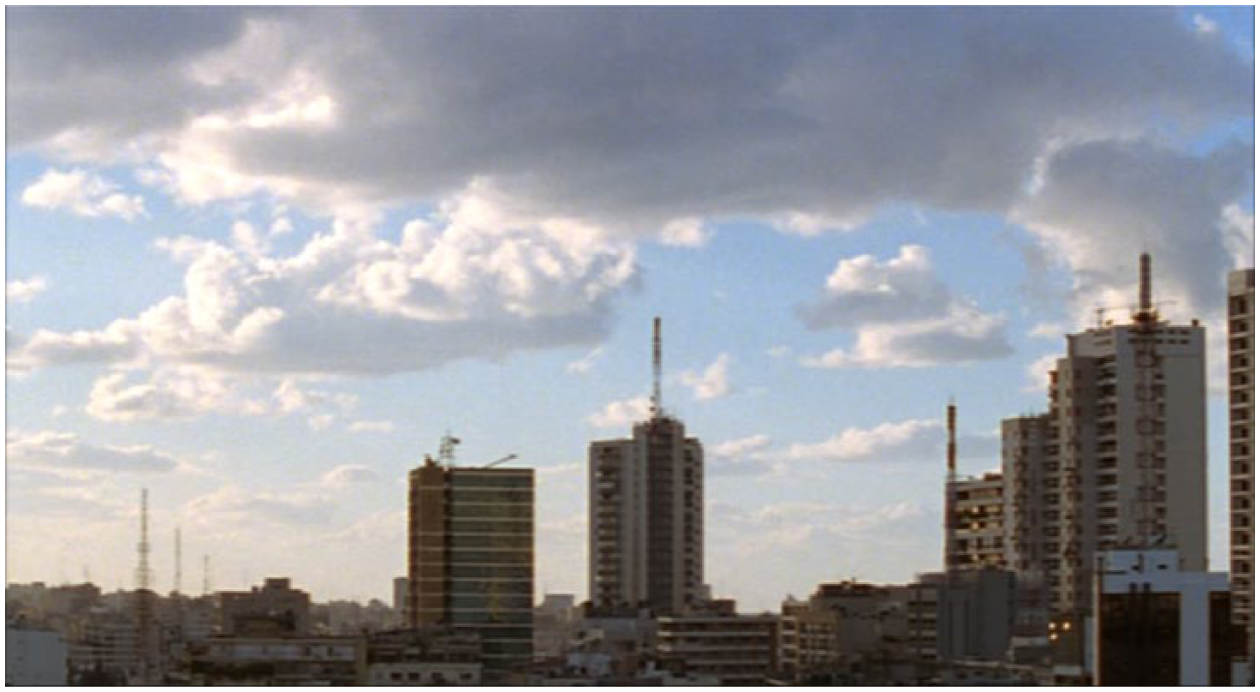
A Perfect Day: Shot of Beirut buildings and cranes.
Reconstruction, therefore, dominates the sensory frame of Beirut that these directors represent. Malek, an engineer, is then filmed surveying a construction site and discussing the details of the site with one of the foremen, but their conversation is eventually muffled by the resounding noises of construction. Salhab uses a similar technique in Terra Incognita, which also portrays reconstruction as an intrusive and domineering force in Beirut (Figure 3). As Soraya and Leila stroll down the street, the sounds of reconstruction are clamorous. Leila then notices that Nadim’s name appears as one of the architects of a new building. The camera shifts to a low-angle shot of the building – a towering and bland structure that takes up most of the frame. Soraya and Leila stare up at the building before Soraya angrily marches across the street and demands to borrow a stranger’s phone to call Nadim. The camera remains distant, situating Soraya within a larger frame of passer-bys and reconstruction. ‘Listen to me well’, she barks at Nadim through the phone, ‘I’m standing in front of one these fucked up buildings that are being newly built. Your name is on it. They posted it for you on a nice, fancy sign …’ As she continues to pace and rant at Nadim, her voice is eventually completely drowned out by the deafening sound of drilling. Here, once again, reconstruction is figured as a hostile force, imposing on the lives of these characters.
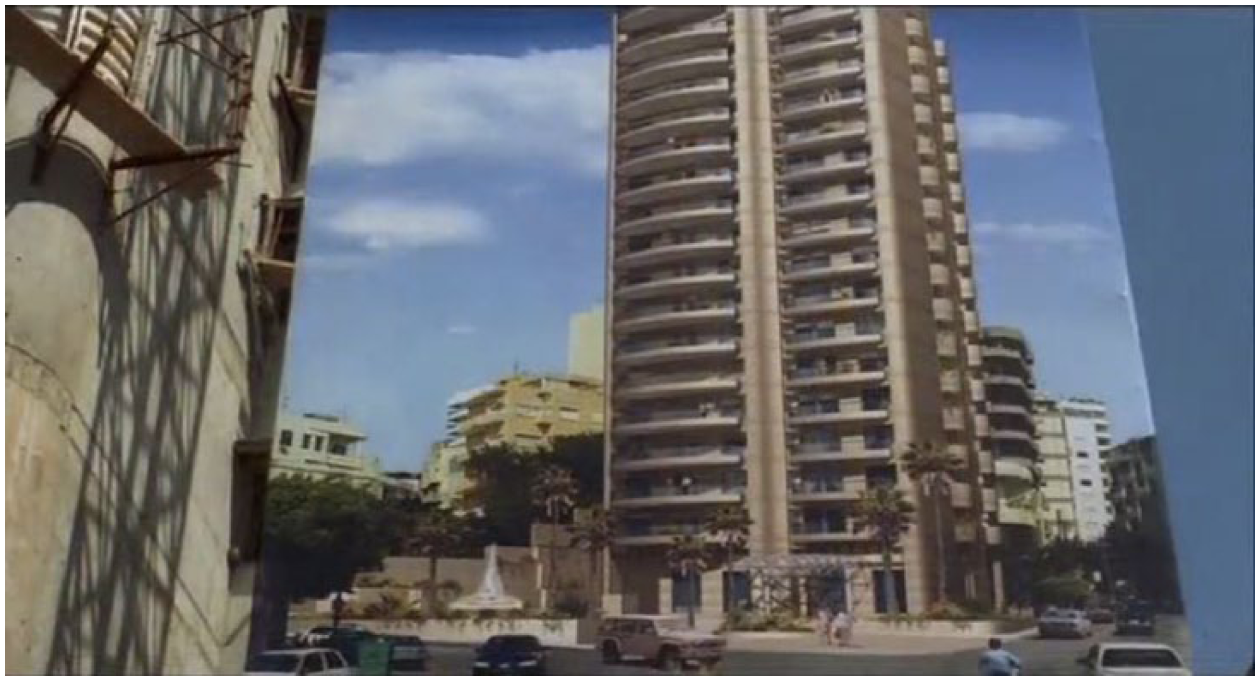
Terra Incognita: Advertisement of new building next to its construction site.
The kind of impasse that characterizes the postwar structure of feeling each of the films depicts, ultimately contributes to a mood of disempowerment that the persistence of corrupt power and the endurance of a politically volatile climate create. In both Terra Incognita and A Perfect Day, the characters are represented as spectators to the developments taking place around them. Through various ambient gestures, the films situate their plots in a turbulent context that seems strangely removed from the lives of the characters. In Terra Incognita, the radio-announcer best exemplifies this removal as he recites the daily news that forms the background of many of the film’s scenes. The news often relays the ongoing conflict between Israel and Lebanon or issues like immigration that both gesture towards a context still grappling with unresolved tensions. Through the radio, the film challenges the idea that Lebanon has fully moved on from the conflicts of its recent past. Salhab films the announcer going about his daily routine, jogging along the corniche, 7 buying fruit and having dinner alone. In this sense, the disembodied voice of the news becomes embodied in this mysterious, lonesome character. He is the only character that is not connected to the rest of the group, signifying the ways in which the tumultuous news that he personifies is detached from the lives of the other characters. Similarly, in A Perfect Day, the radio is employed as a vehicle through which the directors gesture towards an external and turbulent context. The radio is always on in Malek’s car as the news switches from announcements about people demonstrating against the country’s unfair economic policies to a football championship that Lebanon is on the brink of winning. The radio, then, which is rarely acknowledged in both films, is a sensory tool that the directors use to reveal the ways in which crisis is registered within the confines of the quotidian. As characters go about their daily lives, the radio mediates a sense of unrest, invoking how the burden of present violence and the spectre of future conflict hang over the country and the ways in which the characters affectively negotiate this uncertainty. In Terra Incognita, moreover, this spectre is further evoked through the representation of sonic booms that Israel implemented as a form of psychological warfare across Lebanon. The sound from the sonic booms is reminiscent of a bomb going off, so it is a triggering reminder of the civil war, poignantly representing and embodying the ways in which sounds of the past operate in the present. It is also an audible reminder of the Israeli occupation that still looms on in the South of Lebanon. Characters are often un-phased by these sounds, either briefly looking up at the sky or ignoring the noise completely. A fruit vendor responds to one boom humorously, saying, ‘At least they didn’t forget about us’, referring to the Israeli aircrafts. The characters, then, are unmoved and numbed as these events become a nuisance instead of a source of concern in the rare moments when they are acknowledged. The two times, for instance, that characters acknowledge the radio news in Terra Incognita, they bemoan how they are sick of the constant outbursts of violence that erupt around the country. The characters, then, are spectators to the larger events around them, unable to affect any change, and so they plummet into indulgent and excessive behaviour. By representing the characters as spectators, the films do not imply a kind of innocence that other representations of the civil war do. 8 Instead, the kind of apathy with which the characters live their lives reveal the ways in which ties to their context have been severed or strained by the various forces at play in the postwar era. The films, then, do not romanticize Lebanese citizenship as they reveal how the characters become complicit in the indulgent and often escapist trends characterizing the country.
The characters are not represented as active agents in the country in which they exist. Instead, the films use these characters as vehicles through which to take viewers through the damaged city and all of its affective connotations. As Malek drives aimlessly throughout the city, point-of-view camera shots are crowded with views of honking cars and life size posters of pop stars advertising Pepsi cans. He makes his way through packed nightclubs swarming with youth smoking excessively 9 and swaying to the sounds of pop songs and techno beats. In Terra Incognita, as characters roam the city, the intertwining sounds of Muslim calls to prayers and church choirs resonate in a paradoxical reverberation as the camera glides across a gritty Beirut landscape. The sensory spectrum is mobilized here to throw the idea of ‘postwar’ into doubt. This doubt is achieved not by explicitly relaying the conflict but by evoking the various tensions and contradictions making up the heart of the city. The unresolved nature of past and present conflicts exists on the periphery of the film, pressing up against the unfolding of the mundane and the everyday. In the final sequence of Terra Incognita, a bitter ex-lover physically attacks Soraya. This attack, however, does not occur within the camera’s frame and only becomes obvious in the final shot of the film, as Soraya strides past one of the ever unfolding reconstruction sites, her face bruised and swollen from the blows she endured. The actual scene of violence occurs on the periphery of the camera frame, echoing the ways that past and present violence are suppressed and unacknowledged in post–civil war Beirut. Soraya’s wounds, however, render the presence of violence undeniable as they are significantly juxtaposed against the forward pull of reconstruction.
The forward pull of the political elite to modernize Lebanon without catering to the wounds of an ugly past plays out in these films through other striking juxtapositions that the directors construct. In both these films, moreover, the country is ridden with images representing a forthcoming Lebanon and by commercial advertisements that gesture towards a sense of futurity. 10 But alongside these desperate and superficial attempts to imagine a modernized future, a reality of decay musters within the city. A Perfect Day, for instance, inserts lingering images of decay and neglect in order to play out the affective reality of living in a nation that has not yet recovered – that is still marked by festering scars and unhealed wounds. As Malek walks past concrete walls plastered with cheap posters of pop stars, he crosses an entrance of an abandoned building with a sign warning no entry as the structure is on the brink of collapse (Figure 4). Reconstruction plagues the city and new luxury buildings emerge, either towering over old ones or, as this shot reveals, leaving them to tumble in decay.
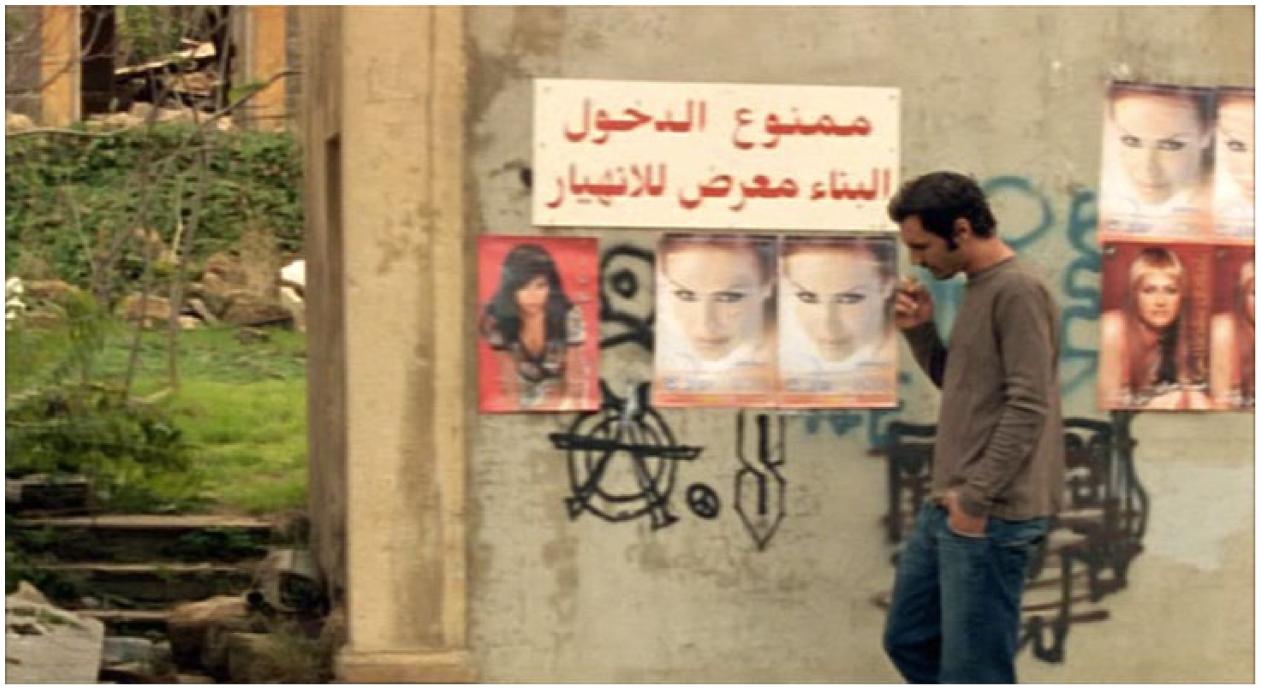
A Perfect Day: ‘No entry allowed, building on brink of collapse’.
In the new Beirut, old wounds are not catered to; they are abandoned and left to rot while a shallow and glossy layer forms in a desperate attempt to mask the hideousness. In the lawyer’s waiting room, Claudia flips through pages of Mondanite magazine, covered with pictures of made-up socialites, beauty pageants and elite societal events – images of fleeting significance that she quickly tires of and that Khatib (2008) argues mirror the fakeness of Lebanon after the war (p. 75). A pacing Malek then turns his attention to a vase on the counter – an image on which the camera lingers: dead, wilted sunflowers, flowers that gesture towards the sense of neglect and deterioration that characterizes the psychic state of the nation. This juxtaposition that the directors visually map out – between the superficial glossiness sprawled out across the pages of Mondanite magazine and the abandoned decayed flowers – works to intervene in the indulgent present in which the film unfolds. Similarly, in Terra Incognita, as the camera transitions smoothly from a church choir group rehearsing to Soraya waking up in her bedroom to the sound of a sonic boom, she looks up at the peeling paint on her ceiling – flaking paint due to the moisture created by bad pipes. The camera pauses on this image of neglect and encroaching deterioration, the sounds of the city gently playing in the background. These images of degeneration are scattered throughout both films, visually evoking a sort of waning affective state that corresponds to the aesthetic of stuck-ness that the directors represent.
In postwar Beirut, then, forces from the past resonate with present violence and encounter a wholesale embrace of neoliberalism and commercialism to create a kind of affective impasse that plays out either in depressed apathy or in excessive indulgence. Gordon (2008) reminds us that the case of the ghost is ‘often a case of inarticulate experiences, of symptoms and screen memories, of spiraling affects, of more than one story at a time, of the traffic in domains of experience that are anything but transparent and referential’ (p. 25). Her description of ghostly matters here resonates with the affective quality that comes across in Terra Incognita and A Perfect Day as they each attempt to capture the various flows and circulations that characterize postwar Beirut, without reducing it to a flattened out representation. The films present a nuanced critique of how larger frameworks of power work to disempower Lebanese citizens, without exonerating or victimizing their characters. As the films reveal, Lebanon’s past is one force coming up against the impulses and violences of traumatized modernity.
Footnotes
Funding
The author(s) disclosed receipt of the following financial support for the research, authorship, and/or publication of this article: Research for this publication was made possible through the support of a grant from the Social Sciences and Humanities Research Council of Canada.