




Abstract
This article will analyse the relations between anarchism and artistic practices. The relationship between anarchy and art has been well documented ever since political anarchism was first defined and includes Gustave Courbet’s painting Proudhon and his daughters from 1865, Victor Hugo’s letters about demolishing La Bastille, the Second Spanish Republic, and the Mexican Revolutionary Anarchist press and engraving workshops. All these paths and possibilities, including a belligerent use of art and the social permissiveness intrinsic to it, are used by many artists to highlight political or social issues from an anarchist perspective. The actions of anarchist artists have gone beyond the production of pieces of art: plastic mechanisms of disobedience provide alternatives by which to improve life. The limit between artistic fiction and everyday life has been deleted by creative and radical works which transgress legal norms and generate disobedient practices which offer clandestine citizenships as an alternative. This is the spirit of anarchist art.
It’s easy to me to say and I mean it Sincerely I have no money I have no name I have nothing to put on the line but myself Thomas Bellinck
Caveat: One of the first considerations in the anarchist political framework is the use of simple and understandable language to favour communication with the bulk of the population. Please do not confuse my straightforward writing with a lack of truthfulness, or rigour, in research. This research work relates, and lists, a series of activities considered illegal; the author denies his participation in these events. The use of the majestic plural in this article is an academic rule of writing. It should not be considered as a declaration or personal confession of the author’s participation in any event described here. 1
Clarification of concepts
First, we must focus our efforts on approaching the basic concepts to be discussed; we will present a definition of art, which seems fundamental and highly relevant to us, and which will help us understand what we both consider and do not consider art. This will form the standard by which we can differentiate ourselves from the art market. The market has been responsible for the lack of aesthetic criteria in studies of the arts and which, consequently, has created a void within institutions dedicated to artistic work: it currently denies the academy the possibility of defining its activity. (Lugo, 2020: 75).
To begin the proposal, we need to define art as an abstract and conscious language capable of reproducing things, building forms, and expressing experiences. The product of this reproduction, construction, or expression should delight, excite, shock and thereby transform an individual’s reality. (Lugo, 2020: 95). It is a tool of human communication which transmits emotions through emotional or perceptive means. To do this, we must understand that this type of relationship refers to a mechanism of consciousness and understanding, mainly based on the characteristics of the art worker and the being we consider the observer. Thus, it possesses the virtue of being able to communicate with the spectators’ senses. The relationships between the being that produces and that which witnesses intermingle, and relationships and emotional reactions transform. These transformations are perceptible and lead the being to a transformation of their reality, psyche, and ultimately a transformation of the individual in action. It is precisely the ability for art to reconstruct reality that allows us to help the individual perceive possibilities beyond what he was taught or what he initially perceived. (Anarchist Federation, 1996).
Defining art would bring catastrophic consequences to the free market as it would stipulate conceptual limits which would be transferred to mercantile and trade contexts, and the market would cease to be the entity which defines the principles of art, and whose principle is that art is solely that which always confers economic benefit. This is not simply because “anarchists reject the cruder forms of economic determinism, but also because anarchists want to extend the social struggle into all those areas of life in which capital is dominant.” (Anarchist Federation, 1996). By not limiting the market, neoliberalism generates an expansion of the wholesale market: defining is delimiting, and that is counterproductive for the art business. Leaving a business without limits allows the market to present anything from which it can obtain a profit as art and is the cornerstone of the free market. Disassociating ourselves from neoliberalism leads us to contradict that position and define what is and what is not art.
We must establish the artistic work’s importance is determined by the impact it can generate through the transformation of the community in which the work takes place. However, we cannot rule out the possibility that works can impact a greater number of communities if the pieces are made by human beings who, in turn, share the same emotional characteristics with others and their communities. Consequently, artistic practices can be related to other similar communities or individuals. This is a natural tendency not only with art but with many forms of perceptible knowledge because, as human beings, we share sensory tools for understanding the world and relating to our environment: perfect tools for the development of creativity, which is simply another form of critical thinking. For this reason, art is one of the many cultural forms in which it is possible to identify a distinctly anarchist approach. How people see society, and how we express ideas and generate new modes of expression are essential to the development of critical opposition. (Anarchist Federation, 1996).
The workers' perspective of art, and how it should respond directly to the interests of the working class, is marked in several proposals made by different authors. Among then, we find two fundamental thematic discussions: on the one hand, the precise idea of using art as a tool for denouncing the crimes and atrocities of the capitalist system “Narrate for us in vivid style or in fervent pictures the titanic struggle of the masses against their oppressors: inflame young hearts with the beautiful breath of Revolution.” (Kropotkin, 1885: 226). However, on the other hand we have those who promote a utopian view of what anarchism will achieve when it triumphs as a political system. It is a clear perspective in which it is assumed that the desire, hope and vision of the future must form part of the creative work, providing a glimpse into new worlds in which we can develop original forms of coexistence and in which “... no one can consider himself a true artist, as long as he does not paint what he believes, what he loves, what he hopes for and what he hates.” (Proudhon, 1884: 88).
Art developed from the worker’s perspective of forms of production and aesthetic enjoyment is different from those of the bourgeois. We are far removed from the romantic ideals of avant-garde artists who established a universality of aesthetic enjoyment of art. According to Theo Van Doesburg, “art is an intellectual function of man with the purpose of delivering him from the chaos of life.” (Van Doesburg, 1923: 1). This philosophy was embraced by artists such as Hans Harp, Tristan Tzara, Schwitters and Christof Spengmann. These beliefs are visibly altered by scientific, sociological and technological developments, leaving intellectual gaps preventing different social classes from approaching the arts in the same way. Neoliberalism and its desire for accumulation has led the market to link the aesthetic spectrums of different social classes in their approach to, and contemplation of, art, mixing them in art fairs, museums, auctions, and biennials around the world - and it does not look like that is going to change anytime soon. History has shown that there is no such thing as universal art. Neoliberalism would leave Theo Van Doesburg stunned to see how capitalism has appropriated creations of the proletariat and turned them into merchandise. Pop Culture, that framework of popular creation, has been transformed by capital to be resold to its creators.
Indeed, the relationship between proletarian art, or grassroots art and use, value and exchange value are directly focused on the understanding that enjoyment and aesthetic experiences should not be exclusive to a group of people, but must be accessible to all social classes, and primarily to the majority social class. It is fallacy to think that we do not depend on cultural training to have aesthetic experiences with art. As human beings we require basic training to be able to relate to an abstract language such as art in the same way we learn to communicate in a concrete language.
For the working class, the relationship to aesthetic enjoyment must be commonly related to the utility of aesthetic objects because they cannot afford to purchase art whose only function is contemplation. For the proletariat, “original”, “contemplative” and “unique” art by recognized artists and forming an “economic asset” is unattainable. However, this does not mean that the working class does not seek aesthetic enjoyment. For this, there are the different objects that history has tended to classify as handcrafts. These are not art objects impeded by ideas such as “intentionality” and the specific conceptualizations used to differentiate between art and craft. Despite this, an intermediate link can be found in the “design” of beautiful and practical objects by the Bauhaus. Their objects took something that capitalism had decided to be totally unattainable for the working class and made it a relationship with aesthetic experiences an everyday occurrence. It was a step towards deconstructing that idea that art was just one more element for, and controlled by, the elite.
These differences crumble as soon as institutions accredit or endorse them. Cases in point are the Zona MACO in Mexico and Frieze Masters in London, and other art fairs which have crafts, design and art stands. Museums such as the Victoria and Albert in London and other design museums around the world regularly present artefacts from everyday life and from different periods as pieces with artistic qualities and values. This undeniably opens debate about the differences between craftsmanship, design and the definition of art.
In this sense, the anarchist posture of the artistic function is what encourages the participation and immersion of the artistic and aesthetic experience in the depths and fundamentals of everyday life. How this happens, and approaches the individual takes are down to them: it could be through a book that influenced childhood, a film that marked adolescence, or a painting that took them to other museums. This is the fundamental characteristic of anarchist art: the permanence of the piece in the individual’s subconscious leads him to modify his path.
Human aesthetic enjoyment and anarchist vision is linked to daily life through a basic initial moment. We understand that to get out of the situation in which we find ourselves, artistic proposals must belong to their time and space. It has always been said that anarchism cannot resolve complex doubts about issues within an anarchist system, since this requires an anarchist system to manage responses to problems and provide solutions. Anarchism is a philosophical-political-economic system that proposes human emancipation without hierarchical relationships.
Art which exists within the capitalist system is a product which defines social class, generates mechanisms of division, and requires elitism to position it as a symbolic product of a privileged social class. The market opens the belief that art is as an exchangeable good whose value is dependent on symbolic capital, allowing the transformation of symbolic capital into economic capital. (Lugo, 2021). This has opened the doors to speculation, which is why the artists recognized in the market are those who, before being artists, had the capital necessary to take and act upon risk, in the same way as any other investment within the capitalist system. Currently, Universalists' claim of “contemporary art has come to be associated with the global art market and the big auction houses. In recent decades hundreds and thousands of pages have been written about contemporary art, describing it as a manifestation and celebration of neoliberal globalization.” (Groys, 2019: 132) but for anarchism this is irrelevant. Anarchism does not seek to transform the system; it does not require art fairs to stop selling bourgeois works of art at exorbitant prices. We are not interested in the economic collapse of auction houses, and we do not care about the fluctuations and collapse of NFT’s. Anarchists are not interested in building an anti-culture, nor continuing directly alongside the counterculture: what we seek is the-other-culture, a culture formed by people from below and from the left-wing, a culture that detaches itself from white-culture, colonialism and their institutions of knowledge. The current structure is one in which we support the weight of those above, but following their absurd criteria of how to organize those who support and maintain the said structure. Thus, we decided that it was no longer worth supporting this structure said and created another one, a horizontal one, without those from above and only with those from below (Galeano, 2010: 8–9). By doing this we are distancing ourselves from them and learning to survive in our isolation. However, autonomy is not easy, and nobody ever said it was. That is why there is an art that allows us to move from one point to another, an art of transition.
Actions against globalization that were generated at the end of the last century included two very important protests: the first, in April 1999, was the strike at the National Autonomous University of Mexico against the imposition of the education privatization plans by Ernesto Zedillo’s neoliberal government who wanted to remove free public education and privatize it. This led to the longest student strike in the history of Mexico, which ended 9 months later after the imprisonment of more than 1000 students. Despite this, the strike was successful and the UNAM remains autonomous. However, the actions that had the largest global impact were the protests in Seattle in 1999. The streets were filled with protests against the World Trade Organization. “Propaganda by deed” ensured that anarchism’s radical position, and its action mechanisms: organic, horizontal and decentralized, were known worldwide. The Black Block was supported by the sending of SMS messages, the communication system of its time. It made clear that collective and anarchist organization was an efficient mechanism of protest. This led to a multitude of protests and activities with various names within the spectrum of political action, including the global expansion of Black Block, and influenced artistic actions and practices. Indeed, it is not the first time that art has been influenced by anarchist thought. Situationism has intervened to introduce anarchist thought in artistic and cultural activities throughout history. There has always been a relationship with art, and this is due to the intrinsic links that exist between anarchist political philosophy and artistic practices: the search for freedom through practice. (Lugo, 2020: 255). This relationship is most evident in artistic practices termed “artivisms.”
We have highlighted the capacity of neoliberalism to appropriate all rebellious and critical discourse: it is a hydra that seizes the criticism that fights it and employs it as a fictitious banner of “progress” and “openness to all” which has left direct action and creative political in a vacuum. The impact that an action has is immediately absorbed by capitalism in order to destroy all alternative political forces. Let us not forget that capital and its function reaffirm the idea that everything is fine, while art and culture workers are handcuffed, exploited and dedicated to making the rich richer. “The artist was labelled a politically committed server giving relief to the consciences of left-wing citizens. The tyranny of democratic opinion has succeeded in making its citizens believe that to have an opinion is enough to express an idea, and that the opinion, as performance, has the value of social transformation: the politically committed artist is a media reflection not of the impotence of the citizens but rather of their desire for impotence.” (Non-Fides, 2009: 3). It is key to understand that the force of political action can be dismantled by the concept of art, art, and its individualistic proposal which is what reviles and appropriates collective work.
However, anarchism proposes the existence of a transitional art, which is an art that differs from contemporary art as it does not seek to be an economic asset but also refuses to let that happen to it. “In terms of capital, the mission of the artist is to enrich it and, while he is at it, to make himself richer, taking on the role of consumer and reinjecting his wealth.” (Fides, 2009: 2). Thus, anarchism art is a tool for the transformation of consciousness: a radical mechanism for enacting and proposing new forms of political-economic action. If artistic practices are offered within the capitalist economic system, then it would be necessary to establish a hierarchy in the forms of access to those possibilities of transforming political-economic actions. As a result, it is an excluding mechanism. Access to anarchist art must seek the widest possible range. “In an anarchist society, one would learn a variety of skills and participate in a variety of useful activities, concentrating on whatever is most interesting.” (Scrivener, 1979: 14). A fundamental characteristic of art is to demonstrate one’s social needs in relation to the balanced development of both the individual and the community, Ursula LeGuin (1979) writes in her novel The Dispossessed, about the problems that an anarcho-syndicalist society would encounter when encountering the forefront of an individual’s creative faculties. For this reason, we argue that the anarchist artistic process is constantly changing, constantly questioning and whose main motor is rebellious doubt, a doubt that causes us not to give up, but to always doubt.
What we propose is a process of transition within art; understanding contemporary art as typical of neoliberalism, and an activity that reflects a time, a space, and a mentality focused on the commercial exchange of a “creative” product which can be marketed using exorbitant numbers. Ultimately, we believe that art, its activities and concepts, will evolve into a situation that we cannot predict as the context in which it will be created is non-existent today. It would be absurd to try to think of a possibility because our mind is contextualized by the conflicts of our own time and space. We are talking about the inability to predict an artistic production that is not hierarchical and is based on commercialization and the search for economic profit. Alexander Bogdanov who, despite being expelled from the Communist Party well before 1917, was briefly given free rein to share his vision of art communism: Proletkult (Dubrovsky, 2019: 40), said it meant creating a society in which we everyone is an artist. This leaves us in the present, a moment which we call transition, with an art seeking to reach utopia but which cannot completely detach itself from the capitalist system, economically or contextually, as neoliberal systems seek to absorb everything that is located on their periphery.
In this sense, artistic creation in transition is involved in everyday life and supported by it. It can resolve or generate conflicts and, therefore, improve quality of life. From this perspective, the role of the anarchist artist is to improve life. This can lead us to understand the implementation of creativity and the concept of art as a tool for criticism, modification and/or alteration of life at local, personal, global or universal levels. When we understand that art is a universal and abstract language, the message can be understood from different local perspectives, including from the universalization proposed by the avant-garde and Kant. It seems fundamental to us to understand that the universal quality of its proposals lay in the possibility, and not the obligation, of participation in the aesthetic experience.
We understand that contemporary art has glimpsed what we anarchists propose: art is not only a tool for transforming personal mentality, but it is also a tool for transforming immediate reality. Hence the political reactions that contemporary artists have had in their pieces. However, neoliberalism does not take long to absorb these practices, depriving them of legitimacy, and transforming symbolic force into monetary force, that is, the rebelliousness of some contemporary artists becomes an excellent currency for the market. I would like to exemplify this with a political action taken in the winter of 2009 on Belgium streets, a new wave of non-European migrants occupied university gyms, churches and even underground parking lots demanding the implementation of the long-overdue agreement which had been promised to them. After months of ineffective demonstrations a mass hunger strike began, well known that when a person is too weak to be removed from the country, the government give them access to a medical card that is valid for 3 months, so some organizations decided to take part of this demonstrations, artists and students made their part in a shipping container that was installed in front of the Operahouse in Brussels, the container changed along the day, in the afternoons served as platform, podium or monument, and in the evenings it changed to a radio station and concert spot. This Platform was selected to be honoured at the 2009 edition of the Theaterfestival Vlaanderen. (DeCauter et al., 2011: 47). Led the organizers to present a harsh and highly critical “anti-thank you” letter for the nomination, “Shit, I’ve accidently made art, this has never happened to me before” can be read in that letter. (Bellick, 2011: 49). The responsibility of artists who do not have a political background is the basis of the conflict and the main source of capital to obtain profits, showing an effective way to deactivate any radical proposal within the art market.
For other artists, their relationship with the art market constitutes a survival mechanism, that is, the denial of the secondary and tertiary art market itself limits their income within the primary market. (Lugo, 2021). That initiative leads the artist to a fantastic variety of possibilities. On the one hand, production is freed from the demands of the secondary and tertiary art market but, on the other, its financial situation is usually precarious. Despite this, the artist’s work focuses on community activity and/or pedagogy of or from the arts.
We also find a series of activities related not only to pedagogy, but also to civil resistance and the fight for civil rights, equality, or fraternal freedom. This is a fundamental aspect of the creative process in anarchist art. “Art remains inseparable from a romantic notion of freedom, but the pursuit of the individual version of romantic freedom seems to lead inexorably to validating the logic of finance capital.” (Dubrovsky, 2019: 26). Individualism is a key concept for Neoliberalism as its economic relation with others is through exploitation between human beings. The alternative capital provides to creative minds is collaboration. Emphasizing the importance of the individual is something that the world is full of, however, the possibilities of moving away from individual-capitalism and towards the collective are radical parts of anarchist artistic action.
One of the examples is a phenomenon that emerged in London between 2014 and 2019. It was the combination of organic collectives, which contributed to the productive and equal integration of different non-European Union emigrants within the United Kingdom. The phenomenon was focussed on several anarchist artists as they contributed to the creation of documentation that allowed immigrants to access the benefits of being a first-class citizen, that is, citizens who enjoyed the benefits that a job provides: social security contributions, access to health care, a legal minimum wage, access to banking services, and access to social housing to name but a few.
It is important to understand that an emigrant without legal documentation in the United Kingdom is, as in any other country in the world, a person who has no rights. This causes a structural problem creating precarious citizenship. People who have emigrated can only work in unequal industries, or within the informal or illegal market. This increases inequality and lack of opportunities as well as the marginalization of new inhabitants. It also promotes a culture of exile and forever denies social mobility to the newcomer in their new environment and guarantees the existence of precarious labour for various industries, from services to construction.
Clandestine citizenships
We believe that migration is not the only global problem. The mechanisms by which nations refuse to accept the natural migratory flow are part of a new wave of nationalist discourses by right-wing political parties which has created, at least in Western countries, large campaigns appealing to fear. “The main presupposition of the ideology of such political parties is an effect of what can be characterized as the territorialization of identity politics (...) every cultural identity must have its territory in which it can and should, undisturbed by influence from other cultural identities” (Groyls, 2019: 134). It is important to establish that all the actions that we will discuss took place during the free flow of workers from the European Union to the United Kingdom, essentially in the pre-Brexit era. This leaves us with clarity at a time when British right politicians are fighting to regain control of their country.
Previously, a European citizen had to go through a simple process to obtain the documentation to be able to work legally in the United Kingdom. The migrant presented himself at the Employment Office with his passport and proof of residence, and with this he could receive a National Insurance Number. The letter that includes the NIN is sent to a given address and serves as proof of address. In this way, the applicant has access to multiple opportunities from registering for a job search, registering for health services, forming part of the electoral roll, contracting services for his home in his name to, most importantly, being able to open a bank account: all necessities for starting a legal job.
Some groups realized that the best way to resolve this issue of discrimination was to provide emigrants with opportunities to obtain the rights of any citizen as their economic contribution to society would be the same. However, the benefits that the migrant obtains are often diminished by the lack of documentation.
Figure 1 A group was created that promoted and scattered identity documents, designed, created and printed so that the appearance of emigrants corresponded with the origin of the document. This meant emigrants would have access to all services available to citizens. Several tests of the process were carried out, in which European emigrants participated, and excellent results were obtained so the documents were made. The first batches of documents were successful. Being organic collectives working in different regions of the UK, there is no certainty about the number of documents created, and there has been no attempt to find out. Forged passport created by anarchist groups in the UK. 2015 Ink on paper. 125 x 88 mm.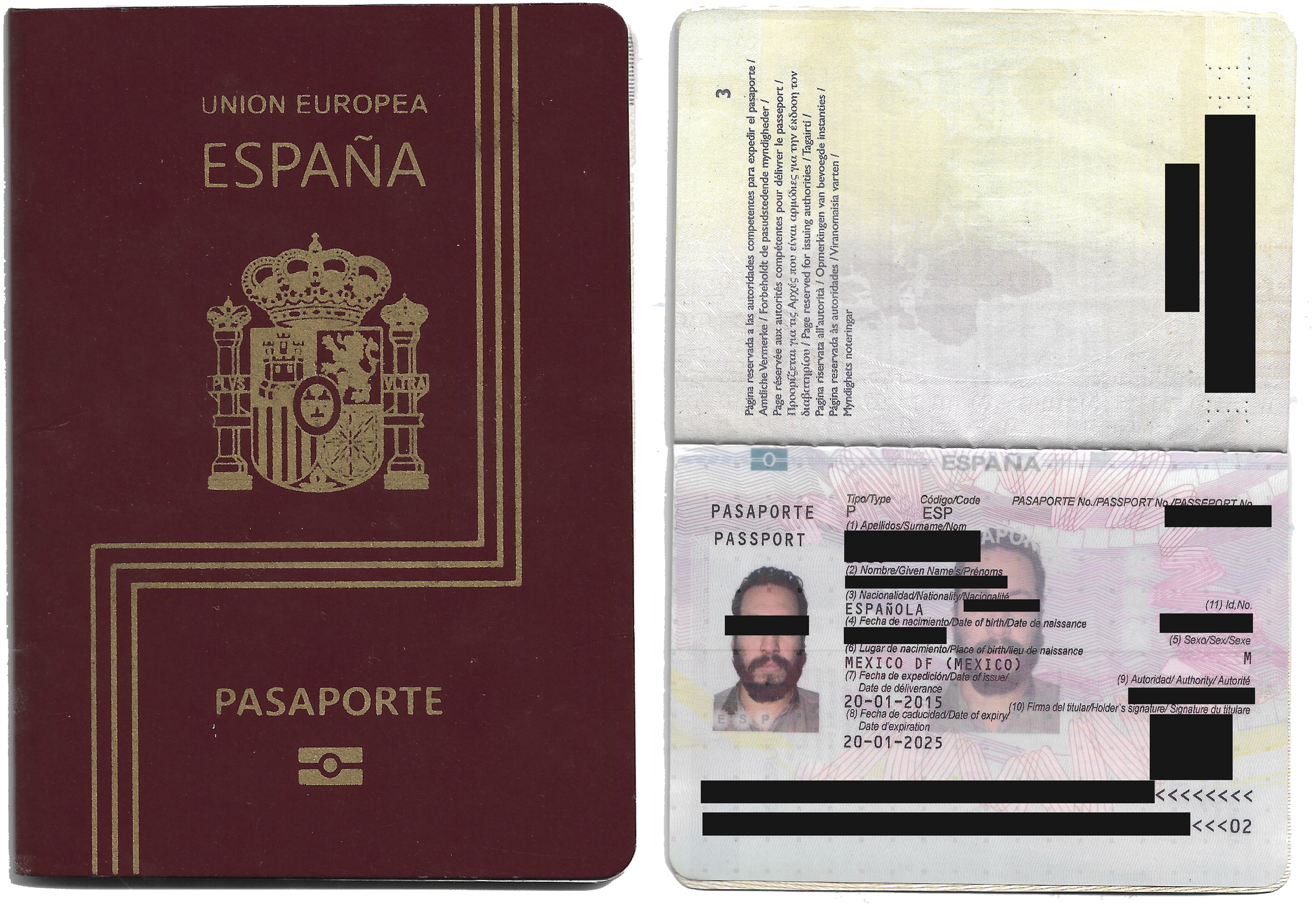
We must not make the mistake of analysing these actions from a capitalist point of view, whose political system implies the citizen is a passive mechanism of participation. Anarchist actions and postures plan radical activity and direct participation in politics and provide the ability, necessity and right of the individual to disobey unjust laws or governments. “The right of rebellion is sacred because its exercise is essential to break the obstacles that oppose the right to live (...) Rebellion is life; submission is death. Are there rebels in a town? Life is assured and art, science and industry are also assured; from Prometheus to Kropotkin, rebels have made humanity advance” (Flores-Magón, 1970: 5). From the perspective of hierarchical elimination, any regulation that a government establishes and is executed as a form of marginalization, segregation or classification of people without rights, requires the necessary disobedience of said regulation. But beyond that, for anarchists, the mere existence of a government is something to which authority is denied. The way the state asserts its “authority” is through coercion. The use of force, such as the creation of detention centres for foreigners, is without a doubt a clear example of why we deny the existence of regulations that marginalise.
Figure 2 The campaign that this collective initiated developed organically, which led to organizing mechanisms guaranteeing members’ invisibility, and cells that were created and dissolved so as to avoid contact between each other in the future. This is very important as there is an undetermined number of migrants who may or may not be part of the legal mechanisms established by the United Kingdom so that Europeans can remain in the United Kingdom as part of the Brexit agreements. In other words, some people have moved from illegal status to legal status in order to stay the UK permanently. National Insurance Number, obtained thanks to one of the created passports. 2015.
As you can imagine, it is not possible within this research and practice work to be able to define the number of people involved but what we are certain of is that the process began with artists of different nationalities, who offered their IDs to generate those that would serve as the basis for printing the new documents, intended for the immersion of emigrants within British society.
Figure 3 The possibility of being prosecuted by the British justice system led the participants to absolute silence and secrecy, and for this reason, the question will resonate: did this really happen? Let me leave that doubt in your head forever, because that is not what is important. What is key is that there are action mechanisms that some anarchist artists have found which not only create a quality-of-life improvement in those who approach the aesthetic experience provided by these works. Here I want to mention some other works that we can consider transitional art, in which the artist does not stop “helping”, and said help becomes part of the symbolic capital in his name which transforms into economic capital. The artist Nuria Güell, (Güell, 2015) in her “humanitarian aid” project from 2008 to 2015, marries a Cuban, who writes her a “love letter”. After publishing it on paper cards, the artist offers to grant Spanish nationality, via marriage, whoever writes the most beautiful love letter. Although the artist complies with the agreement and runs the risk of going to gaol, it is still an issue that increases the artists’ visibility. Despite this, these practices are a dangerous tool for the art market. Of course, we understand that neoliberalism could try absorbing much more radical proposals, and, personally, I think it will. However, just like the “Clandestine Citizenship” proposal that we share here, it seems to be difficult for it to be presented under a veil of contemporary art. We know that it is not the same to display the cultural appropriation of a European artist in an art gallery in New York, as it is to share an anonymous work which openly violates the law and results in an indefinite number of emigrants being able to settle legally in the United Kingdom with the unwitting support of a chaotic Brexit. Format D740 to get a driving license by driver and vehicle licensing agency. January 2015.
We highly doubt that the art market will incorporate a piece like this, but we do believe that it is dangerous for the system (and the high capacity of neoliberalism) to adapt and take advantage of the criticism that undoubtedly makes the publication of said project complex. Many doubts arise about the publication of this project: to what degree will the participants be affected? Will the British justice system be able to “pass by” this project? Will this project be persecuted or investigated with the same intensity as that persecuting Julian Assange? Despite these doubts, we believe that the social permissiveness granted to the artist is the key shield in keeping participants safe and secure, and it is even more important that we do not know the personal details of the project and its members. No one could provide the names of the participants.
As Karl Marx pointed out, the system will create its own mechanisms for its destruction, so if the project ends up in an exhibition hall, we hope that it will serve to emphasize the precariousness in which these artists live. It will also allow us to research some of the hundreds of questions that remain: What can be sold in this context? Will it be possible to obtain a document printed by the collective? Will it simply pass into the hands of Scotland Yard, or better yet, will the system refuse to investigate the matter and bury it in oblivion? Regardless of what happens to the actions of this group undertook, the influence exerted on the participants and collaborators will be permanent, going beyond museums, galleries, art fairs and the market. The anarchist pieces that have been created do not seek the legitimacy of the art market or system. They are, as most anarchists suggest, a way of “moving house” to another way of acting and working. Part of this attitude led us to think, repeatedly, about publishing this article: how much do we want the academy to find out about what we do? Do we anarchists need the academy? Well, on this occasion we were invited to share the experience through this article. Our goal is to seek other eyes and ears for what matters to us; this is “propaganda by deed”. Obviously, it is not an economic interest, as we are not paid for this work. But that’s not the issue, not this time.
A further benefit of “Clandestine Citizenship” is that, to a certain extent, the citizen is a ghost that appears when he needs to form part of a society that denies him and, on the other hand, he also disappears when he needs to do so. This is an excellent security measure in a society that refuses to accept some people’s existence and yet requires their labour. The clandestine citizen understands his position as a participant in contemporary British society and assumes a role within it, notwithstanding that this role could easily disappear in the same way it appeared. There are also very particular characteristics in which the roles, as fictitious as they are, allow them a selective participation in social affairs. There are multiple cases that we were able to witness, each so different from the others that it would be impossible to mention them all, not only because of the amount of information but also because of the importance of secrecy regarding this work.
Are “Clandestine Citizenships” a work of art? Beyond having to exemplify the matter, or justifying said project against positions that will attack our activity for being morally questionable, we have to say, clearly, that for us it is a piece key to revolutionary creative action. Many others that have generated alternative mechanisms of participation in the market, a system designed for the permanence of the working class in its hierarchical position at the base, the design of creative tools for daily use that allow the individual but being able to work in a dignified and equitable way with their peers is a clear and powerful alternative that we must help spread.
Conclusion
Can we say that Clandestine Citizenships is a work of art? From our perspective, it covers the characteristics that both anarchist art and transitional art should include.
The definition we give is that art is a human activity, an abstract and conscious language capable of reproducing things, building forms, or expressing an experience if the product of this reproduction, construction, or expression can delight, move, shock and this transform the reality of the individual. (Lugo, 2011, 78). We can assure that this project complies with this, and we present a project that seems radical, eliminating, and articulating itself against the law, in a direct confrontation which has obtained a fantastic result: the incorporation of emigrants into a society, allowing them to enjoy rights and have access to what any other citizen has.
The doubts about the existence of said event are clear. Can anarchists who violate the law be trusted? What certainty is there that everything narrated here happened? Let me say that being an anarchist and not believing in the need for the law, nor in the coercive institutions of the state, does not mean that we believe that prisons and police brutality are imaginary. We understand that for them our actions are criminal, but not for us. Our actions are mechanisms that amend and reduce inequality.
Footnotes
Declaration of conflicting interests
The author(s) declared no potential conflicts of interest with respect to the research, authorship, and/or publication of this article.
Funding
The author(s) received no financial support for the research, authorship, and/or publication of this article.