




Abstract

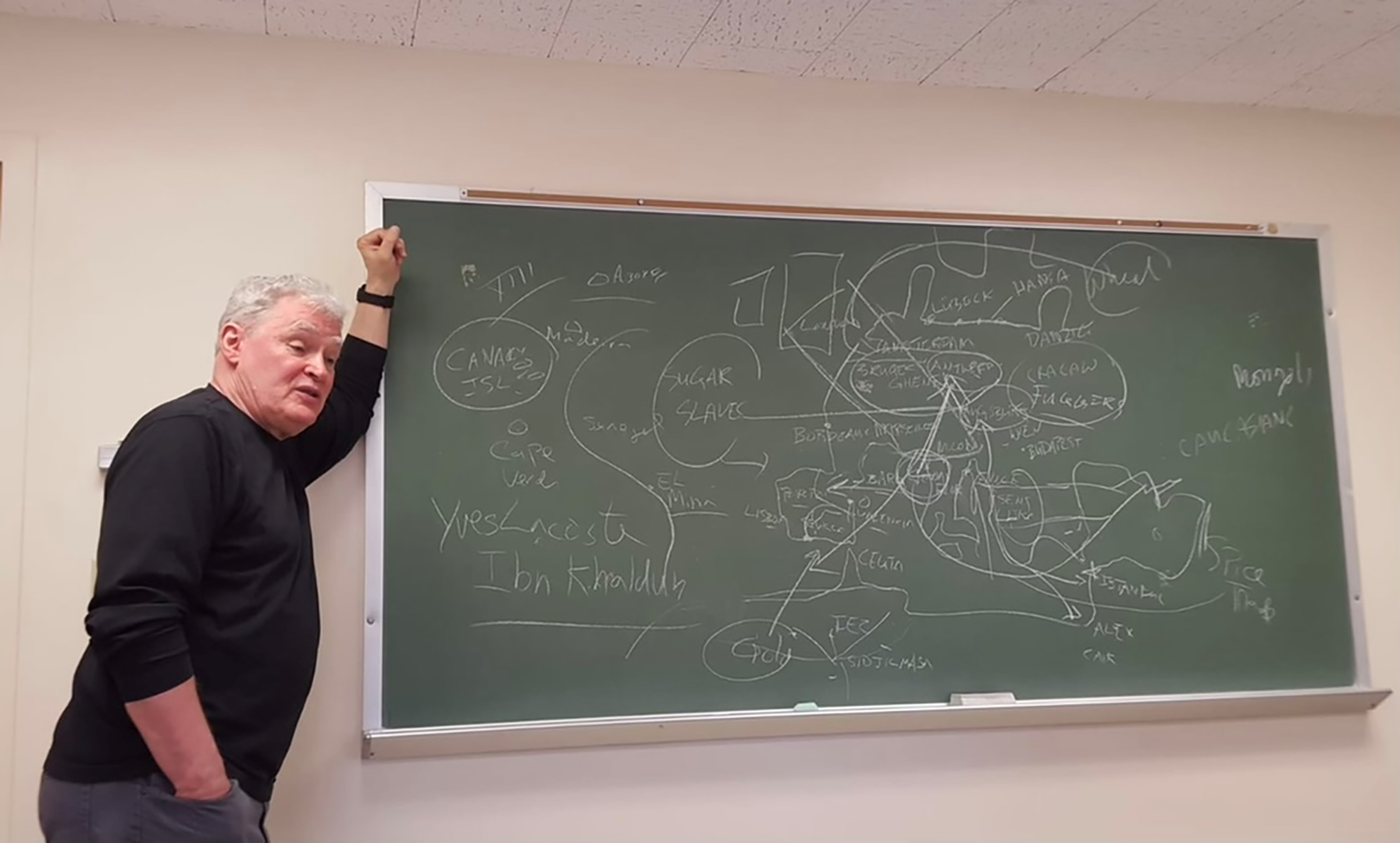
Dale Tomich in class at Binghamton University (photo by Andrea Toth)
Introduction
These four interviews were conducted through Skype between December 2023 and February 2024. Sadly, Dale passed away in August. The interviews cover Dale’s personal history from his family background in West Milwaukee and upbringing in Wauwatosa, a Milwaukee suburb, to his undergrad and graduate years at the University of Wisconsin and then teaching at Binghamton University.
Dale’s trajectory connects with the history of a U.S. industrial heartland with a mighty, broadly skilled working class and massive factories that was part of his early life, whether as a family reality, or something to escape from, or an all-pervasive presence in racially and ethnically stratified Milwaukee.
It’s also a history of university radicalism at one of its intellectual heartlands of the 1960s, the University of Wisconsin at Madison, where Dale developed a singular outlook that avoided conventional left-wing or black power politics while connecting them, and always asked: but what about labor at the point of production? who is doing the work and how? and what are they producing?
Finally, Dale’s is a history of intellectual/political relationships that straddled an epoch: Hans Gertz, Harvey Goldberg, E.P. Thompson, C.L.R. James, Joan Scott, Georges Haupt, Terry Hopkins, Immanuel Wallerstein, Catherine Coquery-Vidrovitch, Walter Rodney and Sidney Mintz, to mention the most salient figures. All of whom Dale portrays while describing how each impacted his thought; a heterodox tradition where Dale saw himself half-jokingly as “the last man standing.”
At Binghamton and in his later career, as the interviews reflect, Dale’s questions remained largely the same – a favorite metaphor is “successive approximations” --- but his answers remained open-ended, moving continually between analysis and interpretation. Dale’s longtime interests in surrealism and jazz are always in play, a radical constructive uncertainty.
Dale’s inquiries into slavery and capital evolved and grew in scope to include what would be his second intellectual and political homeland, Brazil, and the “Second Slavery.” It is, as Dale would have it, a personal history that could not but also be a theoretical journey. And through that personal journey, Dale was always Dale: a football-player-sized guy with a gentle manner, open to all argument and critique, respectful of adversaries as persons… but unsparing toward sloppy theorizing and academic opportunism, quick with irony, deeply skeptical of an always too-trendy academia industry, his eye on Brazil where he is regarded as a leading social historian. As the interviews reflect, Dale also had a good eye for observing people, places, and himself.
Part I: Binghamton Sociology and the Braudel Center 1
Juan: One of the most interesting general lines of discussion that we’ve touched on was your sense of what happened to the social sciences in the past 50 years, how that has been manifest in many ways, and what was lost in the process.
Dale: Ok, we can talk about it, and I think that may be important. A lot was lost, but from a certain point. It’s important to talk about, because I'm the last survivor of the original group and there are people who write about it now, but they write about it from the outside. But having said that, I was kind of inside and outside, I think of Dosse’s book on the Annales school. 2 He’s got these concentric circles. I always had a certain tension, and I never was on the inside, completely.
Juan: That’s the ideal position to be in.
Dale: Yeah, but partly because there was a certain notion of collectivity I didn't really buy into. That first issue of Review [the Braudel Center journal], or one of the early issues of Review had a collective research agenda for the perspective. And I am down as a co-author, as Phil McMichael may be, I don't remember off the top of my head. But being part of a collaborative group, meant that Terry Hopkins or Immanuel Wallerstein would say to me go get the bibliography on this. I was never part of the formulation of the problem. I was always doing the shovel work for the definition of the problem I was always critical of. But also, I was thinking about this the other day. I never understood academia very well and I never understood that I was supposed to be a squire. These things were sort of eating up all my time and I wanted and needed to write my book.
Juan: Go on…
Dale: Within two or three days of getting to Binghamton Phil McMichael and I really connected, and we had a whole critique of what was wrong with the way that world systems –how the conception was formulated and that led us you know over the years to our different work, his food studies and my slavery studies and the idea of different kinds of –what Phil called “incorporating comparisons”-- or my small islands would never have come out of the Wallerstein program. 3 It was always the macro problem where the macro dominated. So, it was a non-issue for them, and a lot of what I did and what Phil did was working our way out of it or through it to get to where we wanted to go. I think in some ways we both thought it was important, but neither of us was brought in. Other people in that group were happy disciples. But it wasn’t the case with Phil or me. It was always that kind of tension. I mean, like I taught with Wallerstein for, I don't know, five or seven years in the world-system seminar and it was a weird relationship. I mean I was the only person besides him that could teach it for a long, long time…. I taught it with him, but he never let me talk.
Juan: In the 301 course? (Editor’s note: Sociology 301 was the introductory, core world systems seminar at Binghamton)
Dale: We got divided up. I was supposed to do the world systems, 301 course, with Immanuel, and Bob Bach was supposed to do Methods with Terry. I mean, you know, I always respected Immanuel, but it was weird. A lot of it was just Immanuel, you know. It’s not a negative judgment, it was just who he was. You couldn’t hang out with him or shoot the breeze. He counted on me to do a lot of stuff, because he knew it would get done in the way he wanted. But I had no personal interaction with him, or even professional. I mean, it was never clear to me that he respected what I was doing at all. But then he never said it, put it that way. But then you know at key times he really went to bat for me. So, it’s something that always left me personally uncertain. I just didn’t know where I stood, with him. I never wanted to be anybody’s disciple on anything. I never wanted students who worked with me to be disciples of me. So, it was just an odd thing. I mean, I learned a lot with Sociology 301. Also, I'm slightly, –or a lot, I don’t know, I’ve never been diagnosed – a dyslexic. I mean I read slowly and stuff. I just had to read tons of stuff that was away from what I was trying to work on, so it was just a burden. Now, I wish I had more facility and had mastered some of that stuff better, and in a different way. So I don’t know, my trajectory which isn’t what you’re exactly asking about was, I think Phil at a certain point said the hell with it and went off his own way, whereas I always thought, you know, that the way to deal with it was to do a critique in a Marxist sense and not reject it, but to work through it and come out somewhere else, which is what I always tried to do.
Juan: I think that your work gained from being close to world-systems, and Wallerstein.
Dale: I think so too.
Juan: The ambitiousness of the project, of Wallerstein’s project was stimulating. I went in the opposite direction, too, into the Loiza region and the micro and all that.
Dale: Well, we got lucky.
Juan: I think it had a lot to do with the general ambiance at Binghamton and the Annales. I developed my own take on the Annales which really wasn’t read a whole lot in Binghamton after all, and I found it useful to have that kind of perspective, being both concrete, complex and historical.
Dale: Yeah, now I’m reading the three volumes of Braudel’s Civilization and Capitalism 4 just for the structure of the argument. It’s simple, and I’m seeing stuff I never saw before.
Juan: Yeah, Binghamton is interesting to talk about. And you’re the last man standing.
Dale: Yeah–pretty much. When they hired Wallerstein, he got one hire– a junior hire – and that was me. You know I think it was the best job. It was certainly the best job for me. My advisor, Harvey Goldberg, said I had gotten the only job in American academia that I could possibly survive in. I didn't take it seriously at the time, but now I do.
Juan: I think that was the case for me also in terms of grad school. I think I did much better in Binghamton than I would have done somewhere else.
Dale: I mean, I felt in a certain way constrained by the structure, but it was a totally open and creative place. And there were no limits, you could really do what you wanted. I mean there was my intellectual critique of the world-systems concept, but there's also the thing that they were doing everything at once, and you know, and some of it–a lot of it was sloppy. I mean they had to do it. And, I mean, the metaphor I can use is that at a certain point, say, the first year I tried to make reasoned critiques of things Wallerstein would say, and he wasn’t interested. And then after a time I said well, it doesn’t really matter what you know. The thing is that’s he’s smashing down walls all over the place and opening tremendous new spaces to be creative and it’s stupid to say he didn’t get through this or didn’t do that. Just take advantage of the space he’s created because it’s fantastic once you see what he’s doing. That was my attitude towards him, you know, once I kind of adjusted.
Juan: Looking back, you had to be kind of in a hurry because the 80s were coming along. I mean a lot of this stuff really had to be done in the 70s and very early 80s, the biggest advances, the biggest opening up of stuff.
Dale: But that’s the reason I wanted to go back to kind of reiterate that’s why I never gave up on the perspective. Because between Wallerstein and Terry I saw how important it was, and through Terry how it was possible to do it differently. I kind of think that if you go back to Terry’s essay on Parsons in the Polanyi collection, there was really a vision for an alternative social history, an alternative social science that was historical, and that Immanuel broke through. But if Terry had written the book he would have liked to have written, it would have been a real alternative to what everybody does. And even, you know, since the death of Henry Kissinger, 5 I’m astounded how much modernization theory is still around and still informs politics. I mean it really would have consolidated a paradigm that most people wouldn’t have liked but it really would have done something more than it did if it had a more solid intellectual ground–a theoretical and methodological ground. That was in the works, but Terry died. It never happened.
Juan: That’s a good topic to follow up on, maybe you can, after you go back to some of the texts. What would that look like?
Dale: Well, I think if you follow my work. I think my work looks like that. Somewhere, something I just wrote when I got to Binghamton.
Juan: No, but I mean in Terry’s language, what would that have looked like?
Dale: What I do is take Immanuel’s’ problem or conception and rework it through in my own work on slavery through Terry’s method. If you read all the stuff that I’ve written, Terry’s method impregnates everything. It’s always there. And I was lucky. It’s probably how I got the job in Binghamton, I don’t know. But Terry was close and mentored by Harvey Goldberg, who was my guy. By the time I got there, I was doing European social history, or European-Caribbean labor history, whatever you want to call it. I got space there when I was in Wisconsin where I was totally free thanks to Goldberg. When I came to Binghamton, Terry put me under his wing right away and I spent lots of nights at his house on weekends, and he’d just go over things with me and talk about stuff.
Juan: That was a polar opposite to Immanuel?
Dale: Yeah, completely.
Juan: You hung out with Terry a lot.
Dale: I never put it that way, but that’s right. Terry was my one friend in Binghamton, he was my big brother. And, you know, there was this whole cult of Terry amongst the graduate students, you know, but I was outside of that. I was the one who spent hours and hours with him. He really taught me. I didn’t know what method was when I got there. He just guided me through talking about problems with me, working on my own work with me. How it fits together, how things have architecture if you knew it his way. You know, he really supported me intellectually and personally and he was a great friend, and I miss him enormously.
Juan: I think I got into Binghamton because of him. He was director of graduate studies, and I don’t think Immanuel looked at applications too closely. As soon as I got to Binghamton, he summoned me to his office. He knew my history professor at Penn, who came from Columbia.
Dale: Terry had an idea of what kinds of graduate students we ought to have and how it ought to form a community fully for all kinds of reasons.
Juan: I think we should spend time at some point about how to read Terry and how to grab what you know, what you think is important. There is work of his that maybe because of the way Terry wrote or because of our narrowmindedness or whatever we don’t get when we read him. I must go back to that Review article.
Dale: It was those little talks that we had at the Braudel Center, that’s really the extent of Terry’s written work plus the Polanyi thing. I carefully reread Terry’s critique of Parsons there and then it all made sense to me. I mean in the last few years I could see the big picture. You can read the method of those essays in terms of technique but there's really a conception of history in there and relation of theory to history and how you do things like measure things.
Juan: Because Terry was not explicitly historical in his argument, like let’s look at this historical situation.
Dale: But the method behind it was getting more and more historical because I think he was moving more and more. Not abandoning Polanyi but moving more and more toward Marx’s method and toward Sartre in interesting ways.
Juan: Because he liked methodology and theory, that was his formation, he was very much a sociologist in that sense from that period.
Dale: But he broke away from that. The interesting thing is that the two are the first Columbia PhDs to be hired at Columbia and Terry was the prized student of Lazarsfeld. And from what I can tell because I’ve gone through all the correspondence, he seemed much closer to Polanyi than Immanuel was. But then the two of them hook up and they break with modernization theory. Columbia and Harvard were the two pivots, anchors, of modernization theory and they broke with it. And then they broke with modernization by going to Africa and supporting national liberation and anticolonialism and then they broke with it by supporting the students at Columbia; and then they have, you know, a total critique of modernization theory and the world-systems concept. And Terry is like totally reworking the method of social science. So, they broke with the establishment in every way you could break with it. And I think people don’t realize the degree of that break. But we just have these fragments of Terry’s methods writing.
Juan: So, if you’re not tired there’s another topic we’re going to touch on briefly.
Dale: OK, let’s do that now then take a break.
Juan: As you frame things, labor and not race is your central theme.. And that’s a major kind of axis for understanding your work.
Dale: Yeah.
Juan: So there’s an implicit critique of 90% of what is written these days.
Dale: Oh, it’s probably...
Juan: Or much more than that.
Dale: It’s interesting, because that’s where CLR (C.L.R James) really influenced me. How should I put that: It wasn’t just the Caribbean, I mean I had read Black Jacobins and then I had spent this crazy week with CLR when I was a senior. I’d already been interested in the self-activity of working people, let me call it that. And I think that also let me hook up with Sid (Sidney Mintz) in the way that I did. Someone was going to do a thing on CLR 15 years ago, and I was going to write something, and I started to do it and they dropped the project. So how I was going to start it is… You know, when I was a student, all the studies about slavery were about race and then I read CLR, and I wanted to write about this, and it seemed to me no one was writing about slaves as working people and that’s what I wanted to do and that’s what the Martinique book came to be about. Now the irony is we're back to everything’s about race and there is no labor, except maybe as an epiphenomenon of race. The other thing I got out of my multicultural meetings of the ultra-left around the world was I don’t like to talk about class. So, the whole race-class thing seems to me kind of rigid and artificial. It seemed to me much more productive to talk about labor and to talk about different forms of labor. If I think about Thompson, there’s capital and labor, and in their historical circumstances labor can form itself to be a class and act as the class. But not always. It’s not the same class. You know this silly idea of mine. I think the Chartists could have won and we could have had a different socialism starting in the 1830s. They lost and then along came Lenin and then, there are many kinds of possibilities in the manifestation of labor as class, taking different forms. And in the same way I have always been against using ideas like slave mode of production. I always try to be explicit that slavery was a form of labor and it differed in different places. The struggle over provision grounds could have been in Martinique or Jamaica or you know the old colonies of the Caribbean, but not so much in the new areas, the “second slavery” colonies. I mean it is configured differently and that you must start with the world and differentiate and not start with your national thing and build up, but then you need a concept like labor as the unifying thread. The unifying thread is labor and slave labor and then you can think about race, I think. But to start with race or to make it a separate variable doesn’t make sense to me.
I’m quite aware that the enslaved people were nonwhites and suffered some kind of domination because of that. But for me it’s much more important to try to uncover the thread of labor. Because then I think what you could see if you followed it and did other kinds of studies than what I do, and then seeing the constant making and remaking of race as labor. That’s what I always liked in that essay by Hal Baron on the demand for black labor. 6 In a very straightforward and simple way he just was very compelling about race relations not as people’s physical characteristics. The social construction of group relations is constantly being remade in epochal ways– race was constructed in different ways under slavery and Reconstruction and the urban environment. And the last few years I’ve been delighted to see people rediscover Reconstruction (in the U.S.) and not equate race and slavery as this kind of inner binomial that always holds. You know, Reconstruction for us was probably more important than slavery in terms of what these relations in the US look like today. There are two op-ed writers for the New York Times, Charles M. Blow and Jamelle Bouie, 7 they’re the only good ones, with maybe Michelle Goldberg thrown in, she’s good. Blow and Bouie are both black guys. Blow recently wrote a book encouraging Black people to move back to the South. 8 He had a debate last week or beginning of this week with Joy Reid. What I want to say is, then you can see that the kind of poles of Reconstruction and, you know, urban racism are the two poles of the same thing and that in fact we’re still going back and forth between them. I mean, there’s been some interesting work that's totally ahistorical. A couple years ago a Harvard political scientist did things on voting patterns and slavery showing where slavery was strong you get different voting patterns. All that stuff if you looked at it through a historical lens could become powerful. But it doesn’t leave the realm of, you know, political science. That’s it. I always wanted to stick to labor.
Juan: Now you say that you don't like class too much either, that’s kind of surprising.
Dale: I don’t like it to start with class.
Juan: As a concept, it’s kind of confining. Any concept like that is confining.
Dale: It scrambles analysis and it’s always for me highly historical and not permanent like “the” working class. I mean we’ve gone through probably 5–6 different working classes in my lifetime. It’s constantly being remade.
Juan: Now it’s Amazon, the scriptwriters, the UAW (Union of Auto Workers) in the South.
Dale: Yeah. I mean one of the sad things for me, to go back to the Binghamton theme, is just after I got here. I don’t remember years of things anymore… I came in 76 or 78. There was an article in the Times about making this steelworkers museum in East Chicago or Gary. They interviewed one of the people doing it. This woman said, “It’s important that people remember we used to be steel workers.” 9 And I’m going like my God, 5 years ago this was the most powerful working-class configuration in the country, you know, and it’s just gone. Then when I used to go home, to my parents’ house in Wisconsin from Binghamton I had to drive through Gary. In the first years even like Christmas Eve my car would be covered with soot of sorts, because the steel mills were all going full blast, working all the time and the mills were churning, and then I would go back 3–5 years later and it was empty, maybe one or two mills were still there. It was completely, completely, gone. One of the biggest industrial complexes in the world was gone.
Juan: That’s Trump land now.
Dale: I grew up maybe a mile from what was the biggest single site factory in the world.
Juan: Which was that?
Dale: Allis Chalmers. 10 My grandfather worked there, and it was, almost 2 miles long and 3/4 of a mile wide–three enormous, long sheds with overhead cranes in the empty spaces between. Now it’s a shopping mall. And shopping malls as we know them are not going to go the distance.
Juan: Wonderfully dynamic capitalism that people keep trying to freeze.
Dale: But as a preface to what I’m sure we’ll talk about later; I’m convinced that the sort of dialectic of capital and labor is deeper than ever. It just doesn’t look the same. Capital is totally socialized, the commodity has colonized the whole world, and kinds of collective subjectivities are broken up and reformulated in different ways. I mean the entry of cultural studies never looked at that, they just looked at the superficial phenomena and decided that with the fall of the Soviet Union because the old mechanical understandings were gone that all these things were gone. I don’t think that’s true. I think the struggle with capital and labor is as bitter as ever even though most of labor may be marginalized. So that’s where the chapters of Capital on the reserve labor are so important. Even people surviving by some marginal activities are reproducing reserve labor just by staying alive. So, I think that frames where we are on the other side of the “cultural turn.” We have literally 50 years of Kondratieff wave that just looked at culture superficially, the surface phenomena, without ever relating it to deeper structural shifts.
Juan: For me it was the flight controllers strike in 1981, that really felt like a turning point and the way that Reagan thumped it down. 11
Dale: Or the 1984 coal miners’ strike in England. Did you ever see Pride the English movie, it’s a great movie because it’s about the coal miners’ strike where a gay group in London tries to support a miners’ community. 12 It’s a beautiful movie. If you think about it, there are these two kinds of collective subjectivities that apparently couldn’t get along at all or go together at all you know, and that’s kind of what we’re talking about. And I think you know what's relevant now and why you know I’m anxious about. After 50 years of ignoring this, people are coming back to it they see we can’t go forward in this crisis without understanding it differently and I think now it’s obvious that capital’s always been global, but we don’t have the tools to study it. And people are doing like weird analyses––they’re going back to dependency theory. This is the generation that doesn’t know and doesn’t have the tools, and it’s literally been fifty years. So, that’s why I think what we’re doing and how we connect stuff is important. We can’t do it alone, probably won’t do it all that well, but we need to do it. But it’s coming back now to this kind of obvious capitalist crisis. I thought that was one of the interesting things about Trump is the liberal ideology. The US is not freedom and equality. It’s genocide, displacement, and enslavement–the founding principles. Even this Israel business–the ideological pressure to enforce a certain understanding of history and categories as you know is through the roof, because it’s so fragile it's obvious.
Juan: So Native Americans are reclaiming sacred land for themselves.
Dale: One of the cool things I saw was when I drove home. Laura (Tomich’s daughter) and I went to Wisconsin, and we're driving. There’s a reservation in Western New York with a big casino. It’s the railroad town that was built on land leased from the Indians for 100 years and the lease expired, and they’re scared because they're going to be expelled. Laura and I drove through there. It’s just before you get to Lake Erie and there’s a big banner across the road, “We stand with Standing Rock.” So, I think these indigenous movements are fantastic. In a way, it just opens up all kinds of things.
Juan: They’re being shaken, their land is being taken over, they’re being fracked. That's a third pole, line of discussion.
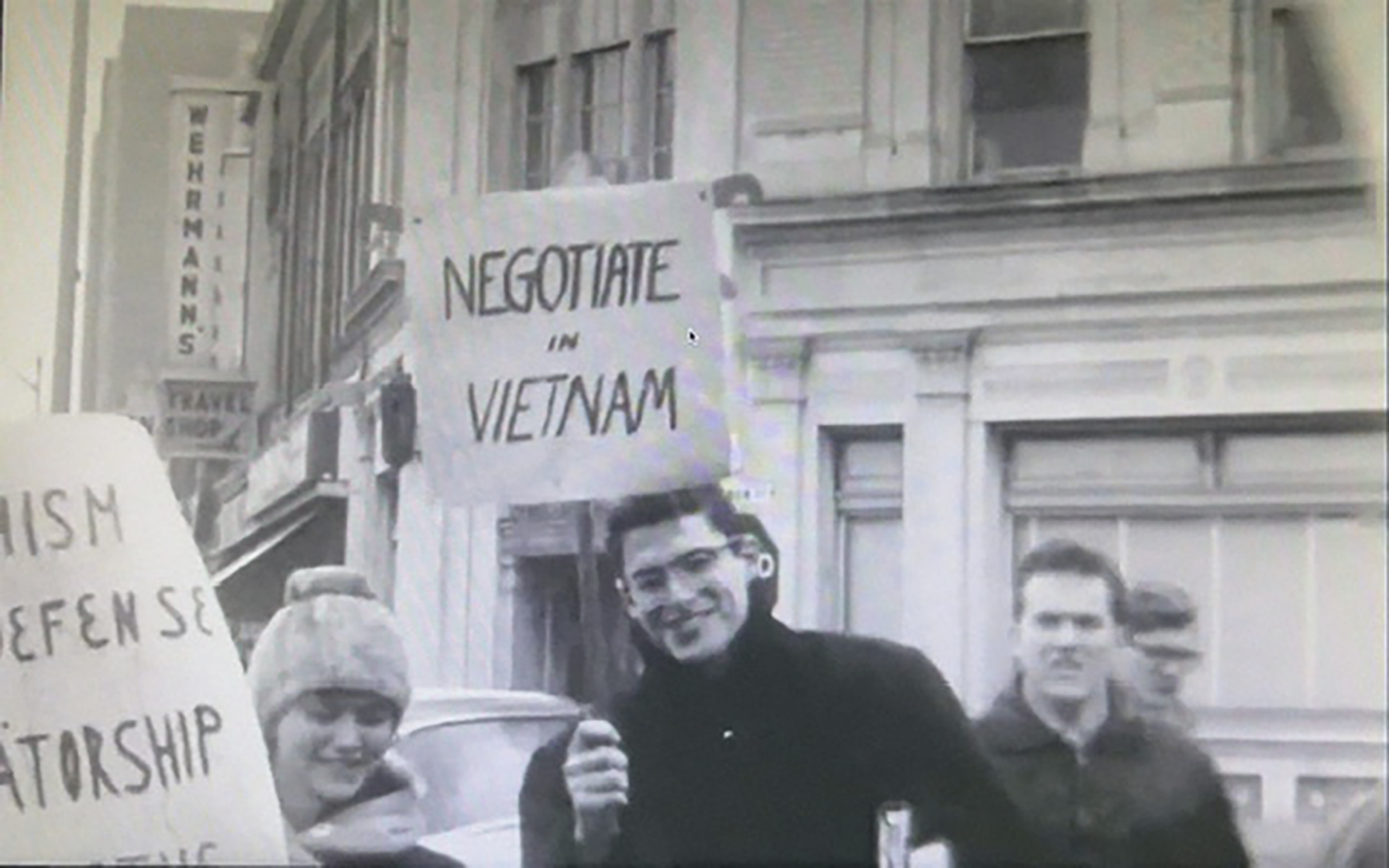
Dale Tomich as a student in Wisconsin demonstrating during the Vietnam War circa 1966 (From the movie The War at Home, 1979).
Part II: Heartland
Juan: Can we talk about your background, how you saw your family background, how it influenced your outlook, what you saw in terms of social class. You did bring up Allis Chalmers, and your grandfather.
Dale: Well, I didn’t see anything, I only figured it out in my mid 20s.
Juan: But you saw, like big industrial towns…
Dale: It was a big industrial town, I could see factories all around me, but I had nothing to do with them. My family had ceased to work in them. except my grandfather on my mother’s side.
Juan: What did he do?
Dale: He was …what did they call that… Oh it’s very technical… when you make the sand molds to pour and to make specialized metal parts. So, he was a metal worker but very skilled. There’s a name for it, sand molded casting… he made casts, he made the molds for castings. They had to have this industrial sand and you had to make it to high precision because they would pour the metal in, the molten metal in, and it would come out, if you made the sand right. So, a master mold maker. The sand receives the hot metal, you have to make the sand in the shape of what you want, like the casing for an airplane engine. It could be quite complicated and demanded highly skilled workers.
Juan: Well-paid?
Dale: Not really; for that, he had a working-class house… in a nice suburb, spent his whole life working there and then the company got sold two weeks before he retired. They all went to the Philippines and took not only his retirement but his last two weeks of pay.
Juan: What?
Dale: He was in the vanguard of the runaway companies; he died on Social Security.
Juan: He didn’t get any retirement pay?
Dale: Nothing. They took it. They sold it, and the new company took everything and went to the Philippines. And he was deaf in one ear from the noise because he started working in the foundry when he was very young. And because of that he couldn’t go into the army in World War One and he was always pissed off about that. He was basically a very right-wing kind of guy–Archie Bunker–a disciplinarian. He was the working class we like to pretend doesn’t exist.
Juan: Did you grow up in a very green suburb with you know lawns and trees and all that.
Dale: Yeah, middle class suburb… Like I think I told you, like a mile away was the suburb that my parents grew up in (West Milwaukee) which was an industrial suburb which had an upper working-class part and then a lower middle-class part that were quite nice, I mean that you know were good to us and they had lawns and stuff too. 13
Juan: What was the name of the town?
Dale: I grew up in a place called Wauwatosa which is a real shit place and it's really right wing. 14
Juan: Wauwatosa?
Dale: Wauwatosa. An indigenous people’s First Nations name. I lived in a little part that had Milwaukee across the street and West Allis like three blocks away. And I was on the margins of this place, living in a big mansion with my family.
Juan: You told me one time about that mansion, it belonged to the governor once?
Dale: It belonged to the governor of Wisconsin. 15 “Ludington” is all over the place. There’s Ludington in Michigan, Massachusetts, and Montana. Our direct Ludington was a big lumber baron, so he built it. It was called a model farmhouse, but it was three times the size of a normal farmhouse and made with exquisite parquet wood, all over everything, so it’s quite something. They died out. It was a white elephant on the market and my dad, and his brother bought it, and both families plus my grandmother grew up there.
Juan: Well, I had never gotten the name of Wauwatosa from you. This is really a first. (Laughs) You never talk about Wauwatosa, you only talk about Wisconsin and going back to Wisconsin.
Dale: Yeah, yeah (Laughs) Well, Wauwatosa I’ve never been back to, I don’t think. I went back when my grandmother died, and my uncle sold the house and I’ve not been back since. It’s partially also that when you go away, your immediate family takes up all your time, so I very seldom if ever saw friends from before college.
Juan: Did you hear languages other than English when you were a child?
Dale: Always. But I wasn’t allowed to speak to them.
Juan: You weren’t allowed? How was that?
Dale: Well, my father was Croatian, my mother was German and Norwegian. My mother thought that the Croatians were barbarians, and it was an uncivilized thing. And my father was from an unskilled immigrant working class family. On the other hand, my grandfather – my mother’ father – was from an older generation. His people came over in the 1870s, 1880s from someplace in Germany. They got a farm near Door County, Wisconsin, and then he left and came to Milwaukee and got a job in a foundry. He was German, and he married my grandmother who was Norwegian OK. So, my mother’s side of the family was – I think of it now as skilled workers, Germans, Germanic, and Protestant. My father’s family–his parents were both immigrants from Croatia. He grew up in Milwaukee, went to public school and didn't speak English till he was twelve. No one in his elementary school spoke English but the teacher.
Juan: Wow, they all spoke Croatian?
Dale: Croatian or Italian. He grew up with Serbian, Croatian, and Italian kids. They were supposed to be learning English, but no one spoke it, and no one spoke it at home. The only place, the only person they heard English from was the teacher. They had English class, but nobody spoke it, and it wasn’t their first language. So, Luiza was visiting my aunt in Argentina who’s my grandmother’s sister, and they called my father, and each one said the other one couldn't speak Croatian anymore. I don’t know what that’s about, you know. (Laughs)
Both of my parents grew up in West Allis, which is where Allis Chalmers is. Allis Chalmers is right next to Wauwatosa. Allis Chalmers is a working-class place, for the most part; it has the middle-class stuff, lower management, I would suppose. Wauwatosa was a hoity toity and I think a little bit on the decline, upper middle class, a place at least of high pretensions.
Juan: Did you pick up any words in Croatian?
Dale: No. I’m a generation later, and we moved to the middle-class suburb. So, they’re coming from the working class into the postwar upper class, or middle class. They wanted us to go to college, they wanted us to assimilate into middle class prosperity, the post-World War II American Dream, and my mother who thought the Croatians were all Slavs, all barbarians, and really didn’t want to learn Croatian. Everyone in the house I grew up in spoke Croatian except my mom who spoke nothing, and my aunt who spoke Polish. But if you speak Polish, you can understand Croatian and vice versa. So, the only one who was out of it was my mom. I was immersed in Croatian at home but not at school and I wasn’t allowed to learn it. It was a very German-English suburb, and with some other people like me whose families had moved from West Allis to Wauwatosa. Some were quite prosperous, like lawyers and stuff, and others were just you know kind of small businessmen like my dad, and we all went to this pretentious public high school [Wauwatosa East High School]. My cousins went to Catholic school.
Juan: You were lucky.
Dale: Totally, totally. It was a very good public school, it was excellent. I was looking today to find something out, and it’s still like one of the top public high schools in the state. They had good teachers; I must give them credit. 16
Juan: So West Allis connects with Allis Chalmers?
Dale: That’s where West Allis comes from, from Allis Chalmers.
Juan: Wow, the name of the company is the name of the town… The world headquarters of Allis Chalmers.
Dale: I think that company went out of business, it’s a mall now. In its heyday it was the biggest factory in the United States in terms of space.
Juan: They made all kinds of agricultural tractors.
Dale: They made tractors and the like, but they also made huge electrical generators and big machinery. When I first went to Brazil, I was driving with some friends from Campinas to São Paulo and this big truck, I mean– these generators they would build would take up a whole flat car. It was huge, and I saw like a double tractor trailer pulling out in front of us and one of those things. Oh man that’s what I grew up with–and I looked, and it was Allis Fiat. So, they weren’t making them at all anymore unless they were making at least that part in Brazil.
Juan: [Reading] from an online article: “Allis Chalmers sold out its interest in different partnerships and finally dissolved in 1999. Yet even today engines built by Allis Chalmers continue to power factories and power plants all over the world. Collectors prize vintage Allis Chalmers orange tractors.” 17
Dale: There would be whole trains of those things running by the house all the time–freight cars with orange tractors.
Juan: So, it was kind of an iconic industrial complex.
Dale: At a certain point, every farmer in Wisconsin got a British Leyland tractor because Allis Chalmers went down the tubes. The story of hegemony, as Immanuel Wallerstein would tell us.
Juan: At one point, the industrial heartland. 18
Dale: Yeah. That was the big heavy industry. Most of the manufactures in Milwaukee were very specialized machine-tool stuff, very high-skilled so it didn’t have a mass working class except a few places like Allis Chalmers. Well, to give you the gross sociological background of Milwaukee, there were very few blacks even when I was going to high school. They were concentrated on the North Side. They’ve been there a long time, it’s an all-black community. 19
Juan: But how far were you from Milwaukee?
Dale: It was across the street.
Juan: Oh, my you should have started there. (Laughs) So Wauwatosa is a suburb of Milwaukee.
Dale: I lived across the street was Milwaukee, three blocks down was West Allis but I lived in Wauwatosa, which was a very middle-class place, and I went to Wauwatosa East High, a very good middle-class school that was the paradigm for the TV show Happy Days. It’s based on my high school. Richie, Fonz, and the guys. 20
Juan: That’s important.
Dale: But the major division in Milwaukee was Germans and Slavs. The Germans had all the good jobs, like my maternal grandfather, and the Slavs had all the mass production jobs on the South side. 21 But then I’m Croatian and the real mass of Slavic populations is Polish, the whole South side of Milwaukee when I was growing up was Polish. So, all my aunts and uncles by marriage are Polish, but I’m not Polish. I came out of this whole middle class… out of this whole working class. The culture I grew up in the home was working class, but I didn’t grow up in a working-class place. The aspirations my parents had and that the school enabled were not working-class ones. Which is in part the idiosyncrasy of my family, of my dad. As you were saying, most of my family on his side is horribly Catholic, but his dad was a kind of anarcho-communist and an atheist. He died when my dad was young. My grandmother, who was an overly religious peasant got him a church funeral even though he probably didn’t want it. And my dad was really close, he was the oldest son and old enough to be close to his dad––in the talks with him, and understandings. My dad really didn’t have much use for organized religion, and he was, from my point of view, by the end, a little too obsessed with it. He wouldn’t let us go to church.
Juan: Really?
Dale: Yeah, the compromise was when we were old enough to think for ourselves, my brother and I, we could go to church, but not before. And while we were waiting for the age of enlightenment, we would read Bertrand Russell with my dad on Sundays. So, religion didn’t really have a big chance.
Juan: Your mother, she was Protestant.
Dale: Well, she was a Lutheran in principle. But she was one of those non-practicing Protestants, she was technically there but she never went. And then when there came a time when we had to go to church, we went to the Methodist Church. Because there was a guy down the road whose kids I went to school with and they were Methodists and they would take us, and the father went to school with my parents in high school. So, we went there, and I was confirmed a Methodist. The first year I was very enthusiastic because it was so different. By the second year I just thought it was all hypocritical and I hated it. I got confirmed and I got to go to the church and that was even worse, and I would come home and critique the sermon every Sunday and my mom said if I didn’t want to go– I didn't have to go. That was it. And the last time I remember apart from being a tourist in Europe or in Puerto Rico was my grandmother’s funeral and my second cousin’s marriage and that was it, I haven’t been since.
Juan: Your grandfather was an anarchist?
Dale: An anarcho-communist.
Juan: So, your father absorbed a lot of that?
Dale: Well, he was twelve, he talked to his dad about religion. And he remembers his dad had a group of friends who were Germans, Serbians and Italians, and my grandfather spoke all the languages and he could cook all the different foods and they would come over on Sundays. My dad remembered my grandpa would cook a big meal and they would read Marx and Bakunin together.
Juan: So, tell me about your grandfather.
Dale: Oh, this is arcane personal stuff.
Juan: It seems he was very resilient, adaptable.
Dale: My grandfather worked at a lot of places. Yeah, he had a farm, he worked at a place called Harnischfeger, then at semi-skilled labor. 22 Then at Allis Chalmers he worked one of those big overhead cranes. He had been a sailor too, so maybe he picked up some mechanical skills. That's how he left Croatia, around 1904, I think. He died in the flu epidemic in the 20s. They invented penicillin like six months later. He went around the world a couple times, he spoke all these languages because he was from the coast, and he was a sailor.
Juan: Did you ever go back to his town?
Dale: My brother, Jim, has been back twice. We know where it is, there’s nothing there, it’s just a rocky beach.
Juan: Ok, what I really want to know, is: did you watch Happy Days? (Laughs)
Dale: All the time yeah. (Laughs)
Juan: I’m seeing that it was set in the 1950s, just your time.
Dale: Yeah, well, a little earlier. But I had friends like Fonzi and I was probably Richie, I don’t know.
Juan: (Reading from an online article) … “in the 1950s and early 1960s” ... “idealized vision of life”… Well, I'm going to have to watch that for my research. (Laughs)
Dale: My mom worked at the Happy Days’ drive-in when she was in high school.
Juan: Wow! So, was anybody from that series from the town, from the area?
Dale: They don't call it that. But they've got “W's” on their leather jackets.
Juan: Really? So, this is Wauwatosa?! (Laughs) This is like the congressman from Florida, Matt Gaetz, who’s being investigated by the Ethics Committee.
Dale: Matt Gaetz?
Juan: Yeah, his house where he grew up was where they filmed The Truman Show. 23
Dale: Well, he could have easily gone to my high school. (Laughs)
Juan: You are fortunate to have a TV series on your childhood… (Laughs) There were no Marxists in Happy Days?
Dale: There were none in Wauwatosa either. (Laughs)
Juan: So, you used to brag about all these German exiles from 1848 going to Milwaukee.
Dale: I think one or two did. I don't know, the Union general Carl Schurz … Milwaukee had a kind of municipal socialist tradition. 24 And there were some Forty-Eighters, but I don’t know that much about it. We didn’t go much to the German side very much, the food was bad, and just always much less lively than the Slavic side. The Slavic side was a little crazy too…
Juan: So, you ate a lot of Slavic food?
Dale: I never wanted to eat it, when I started cooking it, I started eating it but when I was a kid, except for the roast pig and stuff, that was good– I always called them food substitutes (Laughs) I hated cabbage, man, you know. Retrospectively it’s all they had.
Juan: So, you lived more like on the South side of Milwaukee.
Dale: No, I lived on the West side.
Juan: And the black community was where?
Dale: In the North Side. I had no contact with it at all, it was far away and not very big. I mean my big thing was to go to the museum. One of the good things about having this socialist tradition in Milwaukee is they had great parks and swimming pools and museums and libraries. So, from a young age, elementary school still, I would take the bus and streetcar for about an hour to go downtown to the museum and then to the Milwaukee Public Library, which was quite enormous, spend my Saturday there.
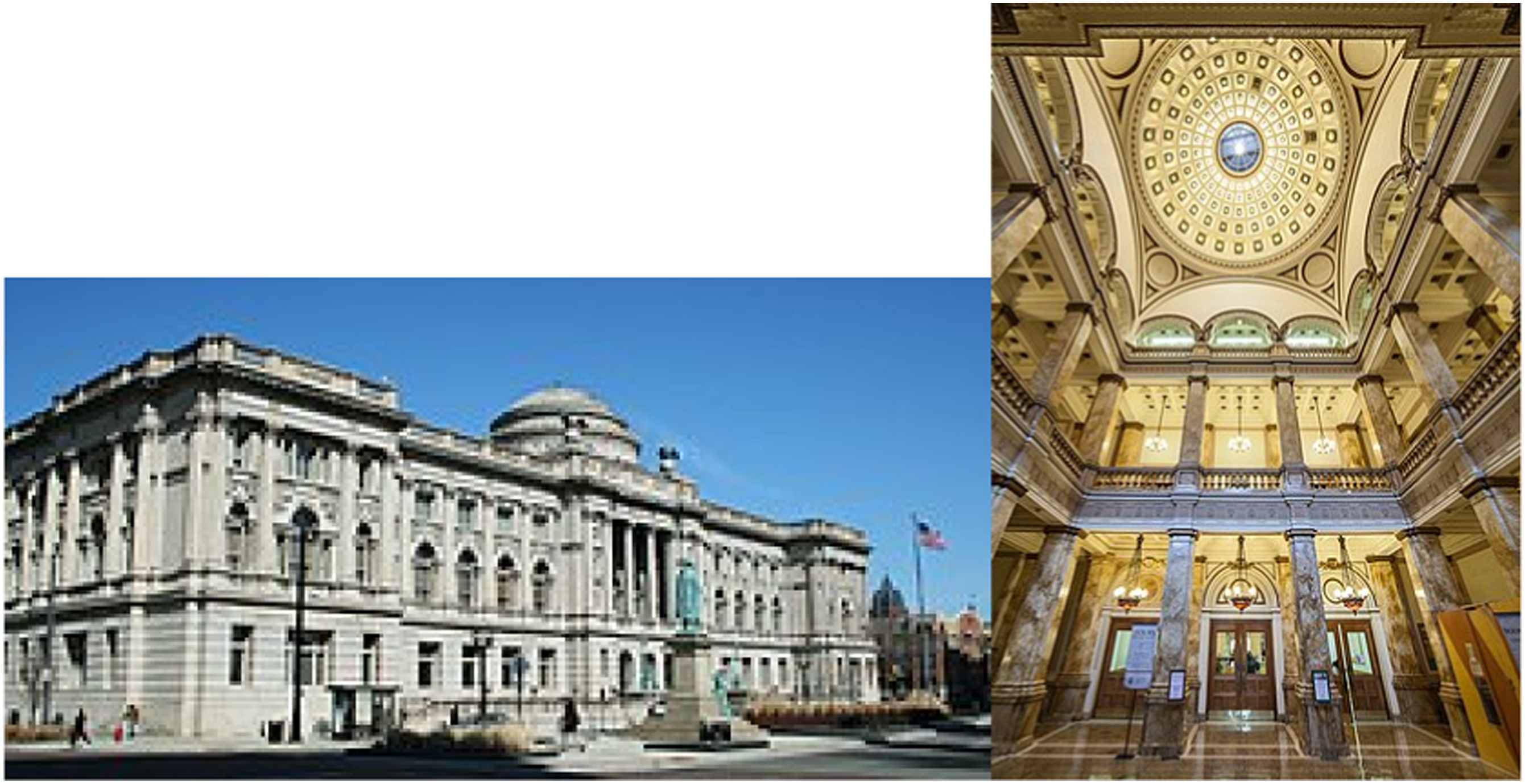
The Milwaukee Central Library, which Dale often visited since elementary school. Library interior photo: Copyright: ©2012 Kenneth C. Zirkel.
The streetcar would go over a big viaduct over the breweries, maybe way up in the air 150 feet looking down at the river it was kind of exciting, unless it was windy and then it was scary. 25 That was my exciting life.
Juan: Well, so it was safe to be around in public transportation.
Dale: Oh yeah.
Juan: Great to have that kind of freedom when you’re a kid.
Dale: No, my only conflict was with the Catholic kids who would pick on you and you’d have to fight.
Juan: Then you were, what was it, a track star, football star.
Dale: I don’t know, I played high school football, and it was kind of a waste, I only realized it much later. I liked track and I wish I had only done track, I always liked to run. Now if you ask me, my high school track coach was my best teacher. The track coach was wonderful, I liked track from a young age, even before I got to junior high school and he’d been like many times national champion, big star at Madison Square Garden, had been on the Olympic team… and basically had nothing to prove anytime. Other coaches were always working out their own ego problems with us I thought, he had this big book before we started on what you get out of participating, you know, and how to set goals for yourself, how to work interacting with other people. That those were the things you wanted to get from being on the track team or doing sports. I always wanted to be a runner but then I went through this growth spurt, and I just was out of sync with my body. But I used to run all the time, all the time, even through the winter run like 5 miles a night, with weight strapped to my ankles. And then one time you know I was on the junior varsity team, and I ran the 400 meters and I beat the varsity time by two seconds.
Juan: Then in your second year of college you turned more toward books.
Dale: But that was the thing, I didn’t. All I knew was I was supposed to do good in school, but I didn’t really understand much of anything that was going on at school. I would do what they told me and do it well, but I didn’t have any clue. Nothing caught me. In that [freshman] year I hurt my leg in the spring. I had a hard time walking, frankly, and that’s when I met Harvey. You know, Sid said to me, when you teach undergraduates, it’s about making them want to learn, it’s not about anything else. And Harvey Goldberg did that for me you know.
Juan: Making them want to learn, that’s good.
Dale: Harvey made me want to learn and he showed me the way to do it which is probably the first time anyone had showed me the way to do anything if I think about it. So that was it, that was the turning point. So, the sports had a lot to do with it. When I was in high school, I wanted to go to the West Coast because it was an escape from Milwaukee, which I found really confining. Then my parents said uh-huh. I applied to UCLA and Washington, and they said, no you're going to Wisconsin. And I went there was a big track meet at the Wisconsin Fieldhouse for high schools from Wisconsin and Northern Illinois. It went on all day, and we went up there and I was in the hurdle relays, but I had three hours before the race, and I went walking around the campus. I walked in the hill in front of the Ag school, on the hill with Lake Mendota and I said wow, I could go here, this is cool. Wisconsin always had the best track in the Midwest which is what I thought I was going to do anyhow. So, I said yeah, let’s go to Wisconsin, that would be great. Now I probably couldn't have gotten in because I applied so late. But those were different times. I worked out my track session. So now you know all my inner secrets, I don’t know who else wants to know them.
Juan: I think when we get the right context with Happy Days, it all makes sense. (Laughs)
Dale: Happy Days imitator.
Juan: So, listen, since we go to Harvey Goldberg.
Dale: The thing is, you know, I wasn’t really happy. I mean, it wasn’t a fun place to grow up. It was alienating.
Juan: It was a very industrial kind of area.
Dale: Wauwatosa was anything but… you could see it all around you like hostile–barbaric, like the Gaza Strip, these other beings worked in factories, and then I had the embarrassment of being related to them. Which what were known as good Wauwatosa people weren’t, I don’t think.
Juan: Harvey Goldberg, Wisconsin, it’s a good place to recess.
Dale: This is kind of deep background, but I think it gives you a much better sense of why Harvey Goldberg was such an eye opener for me.
Juan: He got you fresh, you were very curious, reading a lot already.
Dale: So, let’s finish this story then hang it up. My first year I did the Business School because my high school guidance counselor said do business, no kidding. That’s what I did, I went to Business School. He could have said become an astronaut; it was all the same to me. So, I did the Business School and the introductory course. I should say I always liked to read. We would read three books a week: one was about something new, one was a kind of history/biography book, and one was about something practical. I would read everything on the library on airplanes, then I would read everything in the Public Library on boats; then I would read everything in the Public Library on World War II. It was a bit like my dad, he read madly but he didn’t know how to put it together because he had gone to college playing football. And it killed him because he was unhappy in that middle class suburb, he didn’t fit in at all. And the great thing about my dad he said he never wanted to work for anybody, and he never wanted anybody to work for him.
Juan: Wow, the second part is usually people don’t care for the second part. That’s important also.
Dale: Man, if you think about it, that’s hard to do and he did it. And he took care of us all, I never wanted for anything. You know, it was a great accomplishment.
Juan: What was his business?
Dale: He started off working for the VA after World War II, he hated that. He did recreation and rehabilitation for Veterans’ Hospital. He was good at it, he invented blind bowling.
Juan: Blind bowling?
Dale: You can pull a wire up so that a person can find the way to the lane.
Juan: Wow, that’s imaginative.
Dale: Built a golf course. No, he was good. My dad was a wonderful man, in every way you can think about it.
Juan: So, they built bowling alleys like that?
Dale: Yeah, it’s a big deal now. Then he started a roller rink with a friend of his in a big tent, and that blew down. And there was a company that in Chicago made prefabricated steel buildings. He wouldn’t work for them, but he bought the buildings from them then he resold to farmers or some manufacturers. And the terrible thing, was he was a straight-shooting guy, and farmers and small businessmen really liked him, because he shot straight. But he only worked when he had to. It drove my mom crazy because her dad punched the clock like Archie Bunker; he gave the check to my grandma. My dad was always around the house, he was always playing with us, always doing stuff with us. And then when he had to work, in a few weeks he made more money than my grandfather made in 6 months or a year. Then he wouldn’t work again unless he had to, or unless they asked him for a building. But he wouldn’t go out pushing it. So, you know, he did it, and that was just fantastic.
Juan: He was a builder?
Dale: Sometimes and they were simple to put up. He and I would put them up, just bolt these panels together. They were quite brilliant buildings. The patent was stolen by some company in Belgium and now you’ll see them protecting fighter jets in the Middle East. They could span like 150 feet, indestructible.
Juan: Did this come out of the bowling?
Dale: No, he quit the bowling, that was with the Veterans Administration. Then he met the guy who designed these buildings and he started to sell them. It was a brilliant building, windproof, fireproof, hurricane proof. There are places where the building stopped huge fires and kept half a town from burning down and glowing cherry red; and you could keep using it. They’re still around but they’re made in Belgium and the military uses them for front-line jet hangars.
Juan: That’s interesting. What did they call them?
Dale: Well in his time they were called wonder buildings. I don’t know what the Belgians call them. When I went to Martinique, I found them there and they were called the “Maisons des Merveilles,” but I don’t know. But you see them at US bases or with F-16s covered with sand or something. We buy them from the Belgians.
Juan: So, he worked when he wanted to, and he was good at it. Well that was interesting, work for nobody and have nobody work for you. (Laughs)
Dale: They did it, they did it. I was going to tell some story Wisconsin. there and I forgot– it was on Wisconsin.
Juan: I think we did well. I discovered Wauwatosa.
Dale: Harley-Davidson is from Wauwatosa. How’s that?
Juan: Damn, you left the best part for the end.
Dale: I would run from my house around the Parkway and then down to the Harley-Davidson plant and back.
Juan: So, you had, pardon the pedantry but you had American industrial culture in its golden age just built into everyday life.
Dale: Yes, but I was looking from the outside in.
Juan: Well, you lived it anyway, it was all over. It’s what sustained the place. Almost a classless society. (Laughs)
Dale: Almost. Except the Germans hated the Poles and both hated the blacks.
Juan: Or like Sid said of Santa Isabel, “Everybody worked!”
Dale: Yes, people had jobs.
Juan: At least everybody you know. Everybody had at least a decent or well-paying job, or high-skilled jobs. Very different from the Midwest of today. And then Milwaukee becomes a battleground for the elections.
Dale: And a civil rights battleground too for a while, pitting different sections of the working class against one other. Look up Harvey Goldberg on YouTube, all his lectures, or many of his lectures are there. You can hear the real experience. 26
Part III: Wisconsin History
Juan: We were talking about Wauwatosa. I’m pronouncing it right?
Dale: Yeah.
Juan: The big “W” on the leather jackets in Happy Days. But they never mentioned Wauwatosa.
Dale: No, it’s like Middletown. TV is like Sociology; they never say the real place.
Juan: They don’t mention it, but they used the “W” on their sweatshirts.
Dale: They have everything, from the drive-in to the high school, it’s all right there. You know it’s Wauwatosa.
Juan: Like Middletown. 27
Dale: Yeah, like Middletown. You have to, you can’t really name the community. You know what happened to Bensman and Vidich who did Small Town in Mass Society, 28 they did it in Candor right up between here and Ithaca and everybody in Candor hated them, because they exposed all the shit in the town.
Juan: Well, that happens. That’s generally the case if the book is any good. So, it’s a TV version of Middletown Sociology.
Dale: Something like that.
Juan: It’s kind of a new thing in American television. But I was interested in a comment you made recently about the New Left, and how you felt about lefty people in Wisconsin. So, we were about to begin to talk about your college years.
Dale: I don’t particularly like lefty people, or lefty activist types. Some I do, but I certainly don’t feel great bonds of solidarity with everyone. I just had this very complicated thing of basically growing up middle class. I grew up in this very conservative and very right-wing place where people were mostly German and English, with a mixture of others. All white, of course, but a few Slavs and Italians among others.
Juan: Croatian?
Dale: There was maybe one or two others, that was it, it wasn't a big thing. In Milwaukee the big non-German population was Polish.
Juan: But your father’s background was Croatian, no?
Dale: Who were Slavs.
Juan: But Catholic, no?
Dale: Yes, and the Serbs are Orthodox. There’s not much difference except that, and the language. Serbs use Cyrillic, Croatians use Latin alphabet. You can talk back and forth. They’re transposable languages, they’re not even different languages.
My mother was German and Norwegian, and she was Lutheran. On my father’s side my grandmother was Catholic, but my father was at best agnostic, and most likely an atheist, but anyhow virulently anti-clerical.
Juan: And Milwaukee, as you said, was mostly German and then the biggest minority after that was Polish.
Dale: The South side of Milwaukee, when I grew up, was all Polish. It was then the biggest Polish population I think outside of Warsaw, it was huge. There’s also a big one in Chicago but I think for a while Milwaukee was bigger.
Juan: Were you surrounded by Polish food, that kind of thing?
Dale: My aunts and uncles on both sides of my family were Polish, the ones by marriage. But my mother’s family. Well, here’s the deal. My mother’s family was German and Norwegian, Protestant, and her father was a skilled metal worker as I told you, very skilled. My father’s family was Croatian and Catholic, but a big part of them were anticlerical or atheists. And my grandfather, who I didn’t know, was an anarcho-communist. That influenced my dad in some sense, but he died too young for my dad to absorb any of that in an ideological sense. But there was always anticlericalism, and the road to anti-authoritarianism, freethinking. And I was in this John Birch nuthouse of a highly conformist middle-class suburb.
Juan: But Democrat?
Dale: Not where I lived. My parents were, but nobody else was. Even in my family, my grandfather the metal worker hated unions. Nobody after the war– nobody, well I don’t know what you would call working class. My aunt and her husband had a tavern but I mean the whole thing was to escape the factories. The great thing was my Croatian grandma scrubbed floors and saved enough so that all her kids had a start, or she bought them a house, got them started, out of just being tremendously frugal. I had a modest but comfortable middle-class life growing up, I wanted for nothing. But, I guess, thinking after our conversation most everyone in the extended family had a job and worked for a living. What professional people did was a mystery, great pressure on me to get an education; but nobody really knew exactly what that was, I mean where that went. My dad went to college on a football scholarship, and he got a degree, but the football really controlled what he could study. So, he never could study what he wanted, never felt he learned anything.
Juan: So where did he go to school?
Dale: A great story. He had a scholarship to play football at Notre Dame along with his buddy, and some guy came and said why don’t you come to play football in Idaho, and he talked about mountains and horses and that all sounded great, so they took off to Idaho which at that time played in the Pacific Coast conference with like USC, Stanford, Washington and Oregon. So that’s where he played football until World War II came. But I think it wasn’t the education that he wanted or needed. He read voraciously; I think I told you. He’s the one that told me to read Malcolm X. It made a lot of sense to him, because growing up and thinking immigrant neighborhood you could see the parallels. But he never had the tools to put it together, and then he just was completely socially, politically, culturally, morally alienated from this kind of middle-class conservative environment of where we lived. He had no friends from his neighborhood when he was a kid, or somebody he played sports with, but he was repulsed by the whole thing. He was glad we were there, because we went to good schools, but beyond that it wasn't a big deal. Not a place I go back to for my high school reunions, let’s put it that way.
Juan: Yeah, well, that happens to me too.
Dale: But even people who I kind of stick with would wind up insulting me, without knowing that it's possible.
Juan: So going to Wisconsin was a big deal.
Dale: Huge. What I wanted to do is to go to the West Coast with my father's Idaho fantasy and just get the hell out of Milwaukee because it was, as I said, it’s the world's biggest small town. I applied to Washington and UCLA, and my parents said I wasn't going there, I was going to go to Wisconsin. And there was a big track high-school track meet at the university. And we went up to be in the meet and I had like hours before my event. We were just walking around the campus, there’s a place called Observatory Hill, where there’s an observatory and a bluff overlooking Lake Mendota, and all the old buildings. And Wisconsin also had a really good track team which was my sport. It was so cool, I said I could go here. So that’s how I came to Wisconsin.
Juan: Going back to your initial comment, then, were you attracted to the left at Wisconsin?
Dale: Well, I met Harvey [Goldberg] I mean it’s all very confusing because I got there in ‘64 and you know Berkeley was happening, and civil rights was happening, and they were all you know left and right. There’s a lot of activism from all points of view, including a whole smorgasbord of leftist ones.
Juan: Everything was still kind of new.
Dale: Totally new, totally new. College itself was new. I started off in Business because that’s what my high school guidance counselor.
Juan: But I mean also the politics.
Dale: I didn’t know what you’re supposed to do there, I was meant to study something. So I started off in Business and that really sucked, I didn't like it. The Intro course was Probability and Finance, and the first part was Probability. I had lots of math in high school and probability was easy, so I got an A; and then the second part was all about amortization and I didn’t know what it was about, and the people in the class all seemed kind of creepy to me. I would go to my TA for help, and she was this Jewish grad student in math from Brooklyn and she said (Whispers) “You don’t want to be here, get the hell out of here, this is not for you.” On her advice, I dropped out of the Business School, and I was looking around. So, I started to take philosophy and history and that was it. Two things happened when I dropped out, first, I took Logic, Formal Logic, and I really wasn’t doing all that well and this guy Lenny Wax was the TA, a graduate student teaching the course. And I just decided, I’m either going to get this shit or I’m not, and if I’m not I should get the hell out of here because I don’t know what I’m doing. So, they had these study carrels that were like little cages, and I locked myself in a carrel for three days and learned Formal Logic, and I came out and I aced the course. So, I stayed.
Then a few weeks, maybe a month or so after that I met Harvey, and he said come take this thing. And History the way he taught it made me understand things and I got really you know passionate about it. There’s a lot of Harvey’s lectures on YouTube that are great. There's one on private property, the transition to capitalism. The course went on for fucking ten years and there’s only a sliver of that on what’s on there. But you listen to them, because they’re good. I told [Massimiliano] Tomba what you’re doing now, Harvey Goldberg was doing in the Sixties with different tools. But he was trying for the same thing because it was supposed to be a course on France before the Revolution, and he started with the Essenes in 2000 BC and it was all about private property the state, social thought, and social movements.
Juan: The course was on France before the Revolution?
Dale: Then he just said forget about that, I mean, he was crazy, because that was like 1965 in the Fall, it must have been. The course went on sequentially until I finished graduate school.
Juan: What?!
Dale: Yeah, when I took it, there were maybe 150 students in the lecture, a hundred, and that was the core of a kind of intellectual campus Left. I didn’t know that, and I was the youngest person because he said, you come, this is for you, and he took me under his wing right away. But that’s how I got to have a kind of radical perspective on History and the importance of History, and History as a way of understanding.
Juan: Was it your sense that there was a kind of a generation just before you that was finishing at Wisconsin?
Dale: Yeah, that was the generation of Studies on the Left. And by the time I got to graduate school. The way graduate school worked at Wisconsin, was that you had to be admitted to the department, and you had to be admitted to a research seminar. So, I got admitted to his Social History seminar and the older students were the tutors or resource for the younger students. To this day I still have that relationship with Joan Scott. 29 I mean we started when I was in Graduate School, she's always been kind of a mentor and you know friend and guide; but it started in Graduate School.
Juan: And the Studies on the Left people, was that based in Wisconsin?
Dale: Yeah, that was based in Madison.
Juan: And SDS?
Dale: That was in Madison too but there are two different… well they overlap but they’re not the same, I would draw a distinction between the older generation. I'm in the middle, I mean the last of the people. The way I describe myself is, I came not with any great consciousness but with liberal assumptions of how society should work. Then there was civil rights, there was Vietnam, there was Berkeley, there was bureaucratization of the education that I had wanted. And I could feel something wasn’t right, and that’s what got me into the left student movement. But I always had Harvey and this other thing that’s kind of the intellectual component which the others didn’t. So, my experience and my generation– I mean, the generations go in years here, not in lifetimes. My generation was figuring out what was happening and why the liberal values and ideas we had didn’t work. By the time my brother got there, it was in the middle of Vietnam, and you were either on one side or the other. His generation four years later missed the whole intellectual trying to figure things out, and they were activists.
Juan: Yeah, that was my generation, your brother’s, pretty much. He started college in what year?
Dale: ‘68? He went in ‘68.
Juan: I started in ’69, in business school too. I went to business school for a year and dropped out for History. I didn't find a mentor like you did in in college, really, but I did have some good professors in European history especially.
Dale: But the thing that was great about Goldberg's course, looking back, my introduction to History was that it wound up being world history from the point of view of property, the state, social movements, and social thought.
Juan: But the course was different every semester?
Dale: Yes, he started in 2000 BC, when I was the TA, it was comparative contemporary societies, the Iranian revolution, Algeria, and colonialism.
Juan: How many students did he have by then?
Dale: Well, that's the funny part. They brought him to Wisconsin and William Appleman Williams together to kick-start teaching in the History Department. And they were both highly successful, so when I started there were 125 or so students in a lecture hall, if that; and then by the next semester it doubled. And by the time I finished, there were over 2000 students in the class.
Juan: What? How was that possible?
Dale: It took the biggest room in the campus; they filled it to standing room. Harvey was supposed to teach for an hour, he’d teach for two hours, and it ended with a standing ovation. I mean this was the event of Madison in the Sixties, and you had to go to Harvey Goldberg’s lectures.
Juan: How did he grade?
Dale: TA’s. Harvey didn’t grade himself. He was really kind of master teacher in his style of teaching, and he dedicated himself to it. But it was amazing, practically he wound up carrying the whole department. They all hated him in his politics and being gay and all the shit, but he was carrying a department of sixty faculty because most of them didn’t have the FTE’s [Full-Time Equivalents] that he had. He jacked up the enrollment in History way up. In one course carrying 2000 students per semester, that’s a lot of faculty getting a free ride.
Juan: Sid didn’t have 2000 at Yale, Wisconsin was bigger; but he had 500 at some point. But he never got to teach graduate courses in Yale, they wouldn’t let him because he was Jewish, as he told me. And they also knew that he was the one who brought in the big numbers of students, many of whom became donors later, made up for the lack of enrollment in the rest of the faculty. But Goldberg also taught graduate courses, he didn’t have a problem with that?
Dale: Yes, he taught the one lecture and the graduate course.
Juan: I’m interested in the generations, and where you placed yourself, because Wisconsin I think was one of those places where that kind of periodization, perhaps, was fairly clear-cut and intellectually important. It had very intense groupings– generations. Some people in the beginning were strictly into civil rights, and not at all into antiwar or into socialist politics or anything but civil rights, and that was the thing in the late 50s, and then it evolved into things like Studies on the Left. The Port Huron Statement was 1962, and Wisconsin figured importantly in all that.
Dale: That’s the SDS chapter. The older group which was a faculty-student group was around Studies on the Left which was before my time; but a lot of the people were still there. Hans Gerth had something to do with it, and I studied with him a lot of Sociology. And (William Appleman) Williams (who was one of the founders of Studies on the Left). I never took a course with Williams, because he was gone when I had to take that course.
Juan: Faculty was involved in Studies on the Left?
Dale: Yeah. There was a kind of left collective.
Juan: And Radical America?
Dale: That came later. Paul Buhle came in the late 60s and he either brought it or started it, I don’t know, then at a certain point I became the co-editor which was to say his assistant. That didn’t work as he was too hard to work with, we both were.
Juan: Goldberg, you mentioned he was gay. Was he open about it?
Dale: No, he couldn’t be, he was in his 50s.
Juan: But people knew.
Dale: That wasn’t the attraction to me or even how I thought about him. He was just this powerful figure. Harvey and William Appleman Williams shared an office, and they were good friends. Goldberg was interested in French socialism and the history of socialism. The only real book he wrote was a biography of Jean Jaurès, which is wonderful but it’s the kind of historiography nobody does anymore. 30 I think Paris was his escape from Madison, where he could be himself, like many black jazz musicians and intellectuals.
Juan: Goldberg spoke French fluently?
Dale: Oh yes, very fluently. He was a member of the French Socialist Party, I think.
Juan: So, this was quite a background for you also in terms of Braudel and French historiography.
Dale: But for me at the time, Braudel was always the bad guy, no movement, conservative… so forth.
Juan: You took his class when you were a sophomore?
Dale: I took it every year until I graduated. Or rather, I took it the first two years and then he came to me and said there’s a new program you must go. And that was an exchange program with the University of Warwick. Harvey said there’s a guy called EP Thompson and you must study with him. And he wrote a very long letter of recommendation for me to be accepted into this program. It was very nice because I just had to pay my fees at Wisconsin and the airfare, and I could go to Warwick; and the English students did the same thing, and they came to Wisconsin for a semester. So, I went on that premise. That was really the first time I’d been on an airplane, first time out of the country, first time to the East Coast to get on the airplane at Kennedy. I went to Paris first, but I didn't speak French and it was a fucking disaster. I took the train to England, spent some days in London and then I went to Warwick, got off the bus with my suitcase just to find out that the university was in Coventry. I had to get back on the bus, then when I got there, first, the dormitories weren't built. And then they had all these courses like English culture or these things where a different professor would lecture you every week, some kind of shit courses and I protested I said no, I came here to study with EP Thompson and the program wasn’t set up that way at all. But they accommodated me. I got into a tutorial with Thompson, and I just had to take some of the shit courses, which I don’t remember. But that was it, that was the knockout, it was overwhelmingly good, and I was just absorbing all this, and then seeing the English left and because there were no dormitories I wound up living with Anna Davin and her husband Luke, who was also in the tutorial with me. Luke’s father was Thomas Hodgkin. 31 So I was just in the middle of all this, you know, every day. There were people from South Africa, expelled from South Africa, and it was wild.
Juan: EP Thompson had just published the Making of the English Working Class in 1964 and this was 1966, no?
Dale: Yes.
Juan: Wow.
Dale: And he taught a course on industrialization.
Juan: Was the impact of the book being felt already? You read it right away?
Dale: It was a big book, I read some chapters of it, I didn’t read the whole book. And I wrote a paper on Chartism or something. The other thing that happened with Thompson was, first, there’s this crazy middle class American kid out of Happy Days who was interested in labor history, which was extremely odd in 1965, and social history and the history of socialism, and I was a Methodist (the central religious doctrine in the England of The Making of the English Working Class) the two years I was in religion; and my great uncle had been a Partisan in Yugoslavia and Thompson, he breaks down crying talking about the Partisans. They were really everything to him, so I was just this weird combination of things, and he was very open. I had a relationship with him through many years and we would correspond, and he would advise me on things, and he wrote letters of recommendation for me.
Juan: Were you the only American in the tutorial?
Dale: I think two other people got in the class. Eleven of us went, but most of us were quite happy with the English culture stuff, but I was the one who rattled the cage in saying I need Thompson, and then once that opened some other people jumped on board. But what got me going with him were these kinds of accidents of my biography.
Juan: So, this was like your third year of college, or fourth?
Dale: It must have been the beginning of my junior year, so, 1966.
Juan: And your relationship with Gerth?
Dale: That was when I came back. After I went to Warwick, I decided that I had taken all these languages, but I didn’t know grammar. I didn’t remember what it was in English, and I took four years of German in high school, but for me it was like learning by ear. I didn’t understand the structure of language. I took two years of Spanish to fulfill my language requirements, but I didn’t understand Spanish grammar at all.
Juan: Bad combination, Spanish and German. (Laughs) You can go crazy.
Dale: Then, I went to Warwick and decided when I came back, I really wanted to learn French and it’s when I studied French that I learned what grammar was, then everything started to make sense to me. I didn’t know, you would do the exercises putting the pronoun in the right place, but I didn’t know what the pronoun was, really, I just did the exercise and I got through all the courses. I have a good ear for languages so I can pick them up to speak quickly, but I didn’t know what I was doing maniacally about any language, even English. Remember that my father didn’t even speak English until he was 12. He went to elementary school with Italians, and the only person who spoke English was the teacher. He didn’t speak Croatian or Italian, so it was a kind of weird experience.
Juan: Was he fluent in Italian?
Dale: My dad? No. He could cook some things, but I don’t think he spoke anything. I imagine there was a lot of pidgin going on, I don't know.
Juan: So, back to Hans Gerth. You’ve told me about Hans Gerth, tell me again.
Dale: He was this great guy. He’s just like this towering intellectual. He knew everything, literally. He was kind of ostracized by his colleagues as a strange dude. But he had been an assistant to Karl Mannheim in Germany before the war and he’d been a journalist. He said he was picked up by the Gestapo twice and he decided if there was a third time, there wasn’t going to be a fourth. So, he got out, and came here. He got the job at Wisconsin because he knew a lot about the Nazis. He just was frankly amazing; he knew Max Weber backwards and forwards. His English was always shaky, so (C. Wright) Mills put his stuff in good English. But if you read Gerth’s translations of Weber, they’re much better than the Parsons stuff out there.
Juan: How I knew about Gerth was that anthology (co-edited with Mills, From Max Weber) that I had in my last year of college, in a grad course in Sociology I took, that was one of the textbooks. 32
Dale: That was probably his best known. I don't think he wrote a whole lot. (Gerth died in 1978) He may have edited some other things, but he didn’t write a lot. But he knew everything. I mean you go in the office, there were first editions of Hegel, and you know he could talk about Hegel and Kant and go back to Calvin, and he just knew all this shit. The only course of I didn’t take of him, that I regret, was the Sociology of Cinema, which was supposed to be a knockout. The student union always had first-run art films and there were about six film societies on campus. We would not infrequently go to the movies in the evening together. I remember one night we did Kurosawa’s The Lower Depths (1957), The Blue Angel [Sternberg, 1930] and maybe Potemkin (Eisenstein, 1925), all of this sequentially. And he would talk about the framing of the shadows, and he was a classical pianist, he knew (Arnold) Schoenberg. For me, he’s the last great Central European intellectual. Maybe there’s another one, but he’s that. He was a kind of master of everything and totally alienated from his environment.
Juan: But he got along with Mills, who was not easy to get along?
Dale: At the end, no. He was quite critical of Mills. Thought Mills wasted his talents. 33
Juan: Were there other intellectuals close to Gerth?
Dale: None. Harvey was his friend. I think he could appreciate Gerth, though Gerth didn’t particularly appreciate him, I don’t think. Gerth was just a different plane. It's hard to explain.
Juan: What courses did Gerth teach?
Dale: Sociology of knowledge. He had the film course too– I don’t know, I took them all, I don’t remember what they were. Here’s the story with Gerth: he always had these different courses, I started taking him in my senior year and then when I came back to graduate school I took his seminars. But we had this half-assed project of translating Lukács into English, and I was going to do the English translation, for Radical America. We were going to have this Radical America book series. That never happened. But I would go pick him up at his house in the morning and basically spend the day with him and I would take all his classes during the day. And there weren't all these classes, it just was a continuous monologue. You ‘d start talking in the morning, he talked to me at lunch and then the after-lunch class was the continuation of the lunch conversation. It was always brilliant, and was always bringing in stuff you never thought about and making connections, but it just kept going, and I think it got to the point where I started to know what he was going to say before he said it and then OK I better get out of here, it’s just getting too incestuous. But he was fantastic, he just wasn’t like anybody else.
Juan: You had unique experiences, and this was still only college.
Dale: Totally.
Juan: So, grad school was a no-brainer, you wanted to stay in Wisconsin, and you wanted to do History.
Dale: I couldn't think of anywhere else to go, so I stayed there. When I was an undergrad I took some courses with Maurice Zeitlin, but then he left for UCLA, and I think I wouldn't have stayed with him. I tried to do stuff with Curtin on Africa but that didn’t work out for me. Later when I was out, Curtin was quite friendly to me, but he was kind of just too conservative. Everything I thought was important he didn’t, and vice versa, so it didn’t work as a student.
Juan: Who else?
Dale: Jim O’Connor came as a visitor to teach Capital after I got back from France and doing my research and I sat in, and we became close friends. He had a brilliant interpretation of Capital that I typed out on shitty paper and when I get some time, I’m going to scan it. Hopefully it’ll come out and I’ll send it to you. He and I were really close. But he was emotionally fragile. At first, we had a really equal relationship then as he got more pressure in California and tried to do the capitalist state and then the environmental history journal Capitalism Nature Socialism (1988). First, he wanted me to sort of help him fight off the enemies, and then to be kind of a disciple, in the sense of I had to be doing what he was doing, and that just didn't cut it. He was in Santa Cruz until he retired and passed away there in 2017.
Juan: In Binghamton in the 1970s, The Fiscal Crisis of the State was really something.
Dale: They even read that in the straight courses. It was like the book. Jim’s book on Cuba is the best book on the socialist Cuban economy still. He was a brilliant guy; he's got really good theoretical stuff. He just was doing all these things, but he was just emotionally… certain things he couldn’t hold together for himself. A disk disintegrated and he had all this back pain, and he couldn’t sit in a chair, and he couldn’t sleep. This really debilitated him at the end. Then there is someone I shouldn’t have forgotten at all. Georges Haupt.
Juan: That’s right. When did he come in?
Dale: In graduate school, I think.
Juan: Ok…We were still in your college years.
Dale: He might have come in at the end of college. What happened was, like I said, that Goldberg was carrying the department in terms of the budget. When I was a student, it was the second-rated History department in the country. It was good, and it was big, at 60 or 80 faculty. There were three areas: American history, European history and Comparative Tropical History. 34
Juan: Comparative Tropical History?
Dale: Asia, Africa, and Latin America. Skidmore was there. Curtin and Vansina did Africa, and then a couple Chinese and Indochinese historians, Indian historians, Turkish historians.
Juan: So, it was stronger than Sociology?
Dale: Sociology was up there too, but it was up there for shit American sociology and Europe was an outcast, so I wasn't much moved by that.
Juan: So, you were never too interested in the sociology offerings?
Dale: Never American sociology. I was totally into Gerth and Gerth’s version of European sociology. I remember one of my lefty colleagues’ brother taught Political Science and wrote some article that started “Politically powerless people are people without political power.” It was that kind of functionalist shit. And that was really one of the capitals, it was a highly ranked department.
Juan: Erik Olin Wright was there?
Dale: That was much later. There were some token radicals. Stephen Bunker wound up in Sociology there and his wife Jane Collins, but she left for Rural Sociology because it was so awful.
Juan: They had good Rural Sociology, no?
Dale: Yes, that was very good. And there was this Land Tenure Center, which did very good things. But they had nothing to do with Sociology. It’s a big place, 40,000 students, so there's lots of stuff. But Gerth, both intellectually and as conception of what Sociology and theory were, was just outside the box of the rest of the department. And I was totally into that.
Juan: Was he historical in his thinking?
Dale: Yes.
Juan: Did that come across in his writings?
Dale: It came across in his teaching, for sure. He had all these classical references, he could talk about ancient Rome, China, and he was just a polymath, I don’t know what else to say. But he understood, you know, that Sociology is founded in history.
Juan: In your undergraduate years, you were in class or had some kind of working relationship with Harvey Goldberg, Thompson, Gerth, Paul Buhle, O’Connor and Georges Haupt.
Dale: And CLR James.
Juan: Not bad for college, not bad. (Laughs) Pretty ready for graduate school.
Dale: Yes. In my senior year, what happened with Haupt was that Goldberg had never gotten raises and he was carrying the department, and he finally cut a deal, and the deal was that he would teach every other year and go to France the alternative year and they paid his salary and his ticket to France. It turned out eventually that Haupt would come to replace him. I think Haupt came in my senior year. Haupt was into the history of socialism, let’s call it. He only wrote a couple of books, but he was really an organizer. He would go everywhere and start people doing social and labor history and get people to start small journals. He was really an amazing guy, but he wasn't into academic publishing; he was an organizer.
Juan: He spoke English?
Dale: Probably… maybe he spoke Esperanto. (Laughs) We would have to help him in with words in class. But a totally sweet guy. He’s got a book of essays that maybe Hobsbawm edited that really has some nice questions, and asks why the history of the working class is anti-Stalinist. When I went to France, he was there, and I would see him. Haupt was in the first group of adjuncts in Binghamton. 35
Juan: He was quite a connection to Binghamton, then. I never met him.
Dale: He died after a year or two later; he had a heart attack in the airport in Rome. In Paris I would cook for him, he’d come to my house, and I would bake a ham. He was Jewish and he loved me baking hams. He'd been in Auschwitz, and he went through a lot of shit, and I think it caught up with him in the heart attack.
Juan: He knew all the Annales people?
Dale: Braudel got him the job in the Ecole Pratique d’Hautes Etudes. He was kind of the boy wonder of the Romanian Communist Party at 14. He was Transylvanian. He addressed thousands of workers as a fourteen-year-old and then he wound up in a concentration camp. Later, he got his PhD in Moscow and came back and was the head of the Romanian historians’ association, which had much more weight in Communist Romania than does some American AHA or ASA. And then he was supposed to surveil his colleagues and found that offensive and he went to a conference in Paris and defected and helped fund them a position in the university in Russian studies.
Juan: Did you go from college directly to grad school?
Dale: I taught elementary school in an inner-city school and then full-time after college. It was a one of those master’s with the teaching practicum, so I had a full-time job and was supposed to be going to school at night to get a masters in education. I have a bunch of credits somewhere but didn’t do that. It got to be too much for a variety of reasons, the worst being the last school with all Black kids from inner city Milwaukee. I just got to the point where I thought school was creating the problem. As long as I was in the school, there was nothing I could do, and I was just reproducing the problem and I just said I can’t take it anymore. So, I went to graduate school.
Juan: Did you have any more thoughts on college?
Dale: Well, on the initial question [on his relations with the UW campus left]. So, I had this crazy background but had no consciousness of anything. And then when I got to Madison and by the second year....
Juan: There were a bunch of activist groups in Madison, no?
Dale: Wisconsin was one of the hotbeds of the student movement, Wisconsin, Berkeley were the two. We always thought Columbia were a bunch of wimps, because we’d been doing this for three or four years before they did their thing, and they did it so half-assedly. No, in Wisconsin it was a very sophisticated thing. But I soon saw that there were all kinds of people who would be happy to take drastic action in the street and go to jail, and then get kicked out of school and I realized, well, their parents are lawyers and doctors, if they get kicked out of school it’s not that big a deal because they’ll get into another one. That’s not the case with me, (a) if I get kicked out my parents worked their whole lives to get me here, and (b) now that I’m here it’s the best thing that ever happened to me for the reasons we just talked about. I’m not getting kicked out of school for some half-assed shit these clowns make up. So that that’s when I started to see, I might have grown up middle-class, but I wasn’t middle-class like they were, and then I started to see the complexities in my own background you know, the reification that daily life had hidden from me.
Juan: Who were the biggest activist groups? SDS was never big, as such?
Dale: It was, but they had no structure. If you showed up for a meeting then you’re an SDS for that day, I was an SDS for a day. I wasn’t in it. The draft resistance was a big one, had a name in Wisconsin, and they were the original users of that snake flag that the right-wingers have now taken from us. Wisconsin Draft Resistance Union (WDRU). The teaching assistants’ union, the History students were a huge radical undergraduate group, the activists going in demonstrations. The antiwar movement was big in the community of Madison, there was SDS, there were all kinds of student movement. I can’t even remember them all. Various newspapers, like Leviathan, 36 great newspaper, started there. And then all the countercultural stuff, I mean it was just huge. Then the Trotskyites and the Communists and all that crap. 37
Juan: There must be books or films on Wisconsin in those years.
Dale: The War at Home film, I’m in it three times. 38 It opens with me, really. It opens with one of the first marches against the war. There had been things going on in Madison before I got focused. One of the first big marches up State Street to the state capitol that was against the war, I’m right in front of the camera, and of all the people marching I’m the only person smiling. A guy called Evan Stark, was the assistant to the mayor of New Haven, has a great piece on Terry. He was a Gerth student, and he was a real firebrand. He was kicked out of school as a graduate student, and he was out for a long time. Terry invited him to Binghamton to finish his PhD. He did a great dissertation about how the New Haven hospital handled abused women and reproduced the abuse. 39 But in the Terry book he said, when I first came to Binghamton I was really scared, I’d been out of academia for so long I didn’t know what was going to happen. I was walking around campus, and I saw that Dale Tomich was a professor. My bodyguard, and he’s the kindest person I’ve ever known, and I knew everything was going to be OK. I was Evan’s bodyguard, because the right was always trying to beat him up and I was the big guy. When he saw me, he felt relieved since I’d been his bodyguard before so I would get him through.
Juan: You struck fear in the hearts of the right. (Both laugh)
Dale: I was also ready to take on the Weathermen. They tried to come and take over a meeting in Madison and I was there guarding the stage so they wouldn’t do that.
Juan: The right and the left. Then Chicago came in ‘68 and Wisconsin must have been really hit by it.
Dale: I didn’t go, I think all my friends did. When I was watching [the convention on] TV, sitting next to George McGovern, was his daughter who sat next to me in Gerth’s class. (Laughs) Oh look at that, she’s McGovern’s daughter. Around that time, some guys tried to drop a bomb on an ammunitions factory, and they blew up the Math Research Center. 40 Also, there was a big demonstration with fighting late into the night and that time I lived a couple of miles from campus with my buddy Fig who was a scientist. We were walking back and there was the Madison power station, nobody there. We said, you know we could blow this up right now and wouldn’t make a damn bit of difference, all this shit is stupid. No, I don’t like demonstrations. There’s another story that has nothing to do with me except that I saw it. There was a bunch of the hard-core people, there was a big demonstration to march, not from the campus but from the South Side to the Capitol, 41 where there was an IBM building, and the hard-core people were going to smash the windows and trash the IBM building except they were all these crazy hippies who ran up and attacked the police, and created such mayhem that they couldn't get to the IBM, which I thought was like just typical stupidity. I mean I have deep ambivalence about the 60s. It really formed me but there was a lot of just plain stupidity, if it reached anarchism it would have been something. So much of what happened was just stupid shit, with no political content. That's why I don’t like demonstrations, because whatever you're protesting about, as soon as you get on the street it becomes a drama, and everything becomes about the protest and the issue has little to do with what’s going on. The cops hitting us, tear gassing us, and we’re gonna do this, let’s throw rocks, and then it becomes its own little story.
Juan: What’s the documentary you said that you were in?
Dale: The War at Home, I’m in there three times but I’m so old that I don’t recognize myself. It won an Academy Award for a documentary film. It is on Prime Video, The War at Home, on Amazon.
Juan: Any random thoughts, other people from that time?
Dale: I wrote my senior thesis with Bob [David] Starobin who was a radical historian and wrote a book on industrial slavery [Industrial Slavery in the Old South, 1970]. Had this old CP family. A lot of people I went to school with were all red diaper babies. He didn't get tenure, and when he didn’t get tenure he got a job Binghamton, he was really into the Black Panthers, I had a really close relationship with him. His father had been an editor of the Daily Worker. He had serious personal troubles and lived up by Apalachin, but he was teaching here. His personal situation only worsened, and he committed suicide. 42 I had lots of people who really supported me once I got here. I mean, the people here. And then Sid was the big one.
Sidney Mintz and Dale Tomich in Brazil, circa 2009 (Photo by José Piqueras)
Part IV: Networks
Juan: So, was being a bodyguard a one-time thing, or did you do that several times?
Dale: Several times. I mean, I wasn’t like a professional, but when they needed it, I was the guy they called, and I think maybe 2 or 3 times.
Juan: Oh, you were not with any group, so you could be called by anyone. You did freelance bodyguarding. (Laughs)
Dale: Yeah, I was, I was drafted. You get to beat up frat boys. (Laughs) I never struck a blow, I guess my presence was so intimidating.
Juan: So, you were. I’ve been listening to the Harvey Goldberg audios online. How cool. And yeah, some of the tapes I’ve listened are better quality. Some are very easy to understand, others were harder.
Dale: Well, he didn’t want to record them at all, so they’re all kind of bootlegged.
Juan: The best one I’ve heard is on the German Communist Party. And what happened during the Russian Revolution, all the complexities, the ins and outs of their relationship with the Russian Revolution.
Dale: If he had known they were recording, it probably would have been my job to smash the recorders.
Juan: Goldberg gets very intense in the recordings. It’s the kind of history I like a lot because he builds in biography, very smoothly, interesting narrative.
Dale: He tries to put it in a form that undergrads can follow and will be interested. The death of Rosa Luxembourg, that took about a week. Six hours, hour by hour, minute by minute. 43
Juan: I also liked his lecture on the origins of capitalism. But he’s at his best when he’s talking about persons, biography, making some very funny comments along the way for example about Luther's sexuality.
Dale: It’s kind of everything. Kind of building a counterculture to the whole thing. For the students, I mean his anecdotes all add up to a way of thinking about people in the world.
Juan: Really brings in the energy of the moment.
Dale: He started as a French historian. He did his B.A. at Wisconsin in Comparative Literature, then his M.A. at Columbia in art history with Meyer Schapiro and his History Ph.D. in Wisconsin. 44 But it’s really performance art, and after the class he was just exhausted. 45
Juan: How did you get into Martinique and sugar?
Dale: Harvey was my advisor. Big fights. What happened? Harvey was writing a book on the origins of the French Communist Party, and he was interested in the different labor unions and World War One and what their position was for or against the war. The only big book he ever wrote was a biography of Jean Jaurès, 46 which is pretty good, but we don’t write like that anymore. And he wanted everybody to take a union and study its politics vis-a-vis the coming of World War one and what they did when the war broke out. And I didn’t want to do that and then I wanted to do something on Lukács. He thought that was horrible. We had a fight about that. And I don’t remember what. If he would, he might not even have been there when Lukács surfaced, because he was gone for a semester. But he was against that, and we had many contentious discussions. And then it turned out rather well. That was the point where I told you I just wanted to escape American history. And the compromise was that he was interested in colonialism in small islands. The initial compromise was that in 1903 there was a huge strike wave in sugar mills in Martinique.
I had started with Thompson and the big excitement around social and working-class history. But with Harvey, who was my advisor, it was all getting boring with either strikes or unions and I didn’t want to do that. So, I rebelled. I know Lukács was an alternative and he shot that down. We had a couple of weeks of intense debates about what I was going to do. And it came out that it would be colonialism in small islands. I had done my senior thesis on slavery with Bob Starobin on household slaves, reading their memoirs, and so I had something about slavery, And I always saw slavery in the Caribbean as a way of breaking out, that slavery branched out of the United States to a wider space, whatever that was. I just wanted to escape a historiography where the normative US was the center point or the focal point. And I had read both Capitalism and Slavery and Black Jacobins as an undergraduate, and I think that must have been around the time that I met James. He’s right in there. Many people had read Black Jacobins, but James was still an obscure figure. I read Black Jacobins as an undergraduate. But then when I was doing Radical America, before all this happened, we did the special CLR James issue. 47 So I spent like 4 or 5 days with James. This was cool.
I also translated some texts of both André Breton and Aimé Césaire for Franklin Rosemont and the Surrealists. 48 I told you the story, didn’t I? When I was in Havana walking at the Plaza de Armas there’s the big book fair and I find Rosemont’s Selected works of André Breton, by Pluto Press, which is a Trotskyist publisher. And I thought, how weird this is in Havana. I picked it up and I had two essays of Breton translated. (Both laugh) So I knew something about Césaire from that. And I was arguing with Harvey, and along came this interest in small islands. Through some negotiation we settled on Martinique. And then he had the good idea that I should write my master’s thesis on Aimé Césaire to get to know something about the Caribbean. Aimé Césaire was not widely known outside of, you know, French, surrealist, French Caribbean poetry, literature. A narrow circle and he wasn’t even prominent. People thought he was very good, but it was like James; it wasn’t a time when these people had prominence. Now they’re prominent although no one really understands what the hell they were talking about. But back then, the issue on C.L.R. was a big breakthrough that we published all this stuff that most people had never heard of.
Juan: Well, I was a subscriber to Radical America and that’s how I think I first heard of CLR James.
Dale: Anyhow, Harvey said I could write my M.A thesis on Aimé Césaire, which I thought was cool. We never met in the History Department. We always met at his house or in a restaurant or café. But for some reason, we wound up in his office when we came to this decision, and I walked. You ever been to Madison? You walk out of the History Department with the State Historical Society and the library and the student union and the lake, and there’s State Street. And right in the first block of State Street is Paul’s Used Books, which was the Mecca for all nerds. And I was walking up past the window of Paul’s bookstore. And there was a hardcover copy of Caribbean Transformations for the astronomically high price of $12. But I ran in and bought it because I had read (Sidney) Mintz and I thought it was fantastic. I got what I’m going to do– I got Mintz, and I was off, you know; between C.L.R. and Césaire and Sid, I began to learn about the Caribbean. And I didn’t know anything about poetry, but in my thesis, I did this analysis of the Cahier du retour au pays natal and a kind of intellectual biography of Césaire from what I could find. It’s kind of funny, for someone who knew nothing about poetry, because now several people have told me it’s a very good essay. Years later I revised it, and it was published in Review. 49 That was cool. And then during the course of things, I found various texts by black surrealists, some of which I translated and some of which I didn’t, but I gave them all to Rosemont. And there’s a book he did with Robin Kelley on black surrealists. 50 If you look at that one, too, there are four of the texts in the small book and things that I recovered from very obscure places. So that’s my contribution to the arts. But it was a good way to learn about the Caribbean and to try to understand the politics of the 30s, 40s and 50s and what assimilation meant and why Césaire didn't want independence. And I read Fanon to understand Cesaire, I read all the books by Fanon. I found them interesting, but they were less central to me. Black skin, White masks probably influenced me the most. I read The Wretched of the Earth, but I was reading a lot of stuff about colonialism, so it just kind of got mixed up in that. I was happy to have, my kit bag being James and Césaire but I wound up working mostly in the problematic of Williams. When I went to do my thesis, I wanted to do a kind of Thompsonesque social history of slaves, but I couldn’t find any documentation. I wrote about plantations, and here I am. But that’s how I got into it. It was good. Harvey also wanted me to write on Vietnam as an alternative, but I didn’t want to do that because it was like the anti-war movement and stuff, I just wanted to stay away from that. So, Harvey was not into social and economic history, which at the time was probably not all that interesting, the way it was being done then. But he wrote the book on Jaurès which from the point of view of political biography, goes beyond the canon, shall we say. But it preceded the social history of revolution. And then that came, and that influenced teaching a lot. But he never wrote much more after that. His thing was, really, giving that course. He had a project, but he never finished it, and then he was very active in the anti-Vietnam stuff.
Juan: And did you stay in touch with him after you left Wisconsin?
Dale: He didn’t live much longer. 51
Juan: Or during dissertation. Was he involved?
Dale: He was great, yeah. He was tremendous. It was a hard dissertation because the archive was really fragmented. And I mean, if you saw the dissertation, it’s quite different than the book. When I did this, there was Gabriel Debien, and very few people working on this stuff. There weren’t many books. There were two or three Martinican scholars, one of whom I met, who seemed kind of not happy I was working on the field. And that was it. I mean, there weren't big bibliographies. There weren’t books I could read. Even the archives in Paris were fragmentary. I was piecing together sentences and paragraphs, but you couldn’t find a file on sugar plantations. If you were lucky, you could find a government report on something, but it was bad. And then after I was in Binghamton, I went to Martinique, to the archives in Fort de France. And the archives from my period were just destroyed. I opened a box and the papers crumbled to dust in front of me. They were better prepared, but there wasn’t much, it was very scattered. I think now there are more people and they’ve dug out some stuff. But I didn’t know where to look. It was all just a big bunch of files, and the archivists weren’t particularly helpful. And I was changing, I went with the idea of doing social history, and I saw within a couple of weeks that I couldn’t do that. And then it became a kind of economic history of plantation slavery or political economic history. You know, so I was really inventing empirically, but I was just really on my own trying to figure it out. Which wasn’t bad. And the other thing I have to say, is: I don’t even know, was I in French history? in labor history? in social history? in comparative world history? It was never clear, and it kept changing. There was comparative tropical history in Wisconsin, where people like Lovejoy had some institutional standing, but which I didn’t find particularly stimulating. But I didn’t have any of that. I had Césaire, Eric Williams, C.L.R. And I just did that, trooped off to try to make sense of things. So, you know, it was kind of good in a way, but it was very difficult. And writing the book was difficult because I was continually developing the method and rewriting over my previous work. I didn’t publish my thesis; I totally transformed the subject matter. By then, Sid helped a whole lot once I met him in terms of how to think about all the proto peasant stuff and what to do with the stuff I had about garden plots, which I didn’t exactly know what to do before.
Juan: How do you compare your dissertation to Slavery in the Circuit of Sugar?
Dale: There’s a lot of political stuff about emancipation that I don’t even know how good it is. I haven’t looked at it since I wrote it, but it was all new stuff then. I was just trying to put the pieces together as best I could, but I had this core of the plantation and production that came pretty much from C.L.R. The modernity of the plantation was the epigraph of the dissertation, too. I had this idea from everyone I read that I wasn’t in the mode of production thing, this is something modern and new and slavery was modern and capitalist, and how did that work. And I was much more caught up in the history of Martinique. You know, the other thing is, there’s such an empiricist bias in history and History departments and what I had to do to have a defensible dissertation. I couldn’t go very far. Everything was about empirically demonstrating something based on documents. That's really what I was looking to do to get the dissertation. And, you know, it’s a good dissertation. Like I said, I haven’t read it since I wrote it, but, you know, it passed, and people were pleased. But I always had a lot of fights with everyone and no one outside a small circle loved me very much. And it was very solid.
But then in the defense, it was very funny. Well, you and I would find it funny. We had the dissertation, which was like 250–300 pages (it had several chapters that aren't in the book at all, I just cut them). Some background–– I had done the Radical America issue on black labor with the League of Revolutionary Black Workers 52 while I was writing on Césaire and doing all this shit. And the way it worked out was John Higginson and Eric Perkins would come up from Chicago and we worked on the issue. 53 I couldn’t really relate to Eric very well, he was kind of a wild guy, but brilliant. I’ve often thought that if Eric had lived and he was the public intellectual instead of Cornel West, we’d be in a lot better shape because Eric was fucking politically brilliant. 54 But anyhow, I would hang out with them. And would write to them a lot, and we would discuss all this stuff. Eric studied with Herbert Gutman at CUNY. 55 And let me also tell you, since we’re doing this, go to YouTube and listen to everything by General Baker.
Juan: Who is General Baker?
Dale: General Baker was the organizer of the League of Revolutionary Black Workers in Detroit, the black auto workers movement. His father’s name was “General,” and he was named after him. General Baker was the smartest guy in the Sixties. He understood everything, he had an analysis of capital and race way beyond everything from the point of view of black workers in mass production industries. He’s amazing. And some of the You Tube clips are like the whole history of the League. And then some other people from the league, you know, occasionally. Watch the videos, they go from two minutes to an hour and a half. He’s really brilliant. I still go back to try to think about things through him. All this was happening. So, to go back to the day of my defense, among the things I wrote to the other guys doing the “Black labor” issue – this actually, I think, was quite important – I’d written a ten-page critique of Genovese that just ripped him apart. Part of it came up in the first paper I presented at the Braudel Center, in a meeting of the Labor working group. And they had given the critique to Harvey. At the defense, instead of starting with the thesis, Harvey read my 10 pages and started to discuss them. Because there was something that at the time broke through the whole left-wing historiography and how to think about slavery. And only after about twenty minutes on that did he go to my dissertation.
Juan: Goldberg spent twenty minutes at your defense reading your informal paper and discussing it!
Dale: On the critique of Genovese. But it was informed by all these things that were happening to me and how, you know, Genovese just had it all wrong. Which I think is actually a very important document for the course I took. I mean, it all began with a critique of Genovese.
Juan: You still have it?
Dale: Probably, but you must have the thing from the Braudel Center that I did. There were those handouts from the Braudel Center that were stapled together. Remember those? Mine had a yellow cover and it was on class in the world economy. It was a response to the first paper of the working group by Wallerstein. I must have the original in TypeScript somewhere because we didn’t have computers then. That paper started the critical approach to thinking about history. I was always trying to do it, but that brought it into focus. And basically, when I got here.
Juan: Harvey loved it?
Dale: Yeah! He took it seriously. I think that I probably got the job in Binghamton because Harvey and Terry were very close. He might have sent it to Terry even, I don’t know. And when I got to Binghamton, Terry was always like my uncle. He always took care of me. I mean, outside of everybody else, I always would spend hours and hours with him. Harvey and Terry knew each other in New York after Terry got thrown out of Oberlin.
Terry got thrown out of Oberlin, and so did Harvey.
Juan: They got thrown out of Oberlin? Nobody gets thrown out of Oberlin. (Laughs)
Dale: Well, if you watch The War at Home 56 the big Quaker peace activist is Joanne Elder. Terry got thrown out of Oberlin because he stole her bicycle. That’s how small the world is. And Harvey, he got thrown out because Oberlin has this big monument to the Christian martyrs of the Boxer Rebellion. And on some anniversary of the Chinese revolution, Harvey, who had a big following at Oberlin, gave a big talk on Chinese resistance to colonialism, the Boxer Rebellion and the May 5th movement, and then the Chinese Revolution. And he got thrown out. Harvey wound up in New York City doing I don’t know what. And he hooked up with Terry and he tutored Terry like 2 years.
Juan: He was older than Terry?
Dale: Oh, yeah, older than Terry [Harvey was born in 1922, Terry in 1928] But once I got to Binghamton Harvey would tell me that he always knew I was a great teacher, because I could teach Terry Hopkins something.
Juan: So, all these things are weaving around you, all these connections are happening. When did you meet Sid?
Dale: When I came to Binghamton.
Juan: Not before that?
Dale: No. I loved Sid. I read Sid before I started working on the Caribbean, and then when I started to work on it, I read everything by him because I thought it just made everything so clear.
Juan: Did you get in touch with him during that time?
Dale: It must have been after I got to Binghamton, because I came here right after I defended. Then the whole thing here was me trying to figure out what the world system was, and I reorganized. The dissertation is kind of a linear political economic history of Martinique with a big emphasis on the plantation. And eventually, you know, it took me three or four drafts, rewriting the dissertation took me years. I had read some dependency theory to write the dissertation. I never liked Gunder Frank, but Samir Amin came to mind, and I got to Binghamton and saw that from the methodological point of view, the world-systems perspective was so much better than dependency. And then I was trying to figure out how to rewrite the dissertation, doing that with the idea of writing about one small island from the point of view of world capitalism. But making it a social history of that island, because I was still very deep into social history, which I still am, I just never get the chance to do it. I was really working on that, and it took a long time to figure out how to organize that. Just mechanically, you’re writing over yourself all the time. It’s hard. So, I was working that out and I think at some point I sent it to Sid, and I believe he wrote me back a very nice letter. And then within one or two semesters, he came to Binghamton.
Juan: Do you have Sid’s letter?
Dale: I must have it. I mean, the stuff that’s pre-computer is all in these file cabinets and that’s Mondo Misterioso. Some of it’s even in plastic tubs in the basement. Letters from James and Thompson in there. So, I think Terry and Harvey knew each other well. And I came to Binghamton with this. I was in European labor history, knew a lot of that history, and I wrote on the Caribbean. Plus, I had letters from Harvey, E.P. Thompson, and Georges Haupt, who, it turns out, Wallerstein was trying to hire as an adjunct. So, I came with the right dossier.
So anyhow, Sid came for a talk, and I got to spend a lot of time with him. He was always kind to me. And took an interest in me. That's when I met him. And after we met then he wrote a lot, talked a lot. I can't give you a chronology, but several times I went to Baltimore and stayed with him for a weekend or stuff like that. Like he invited me down when Richard Price had all the Saramaka Maroons at Johns Hopkins. Introduced me to Rolph [Michel-Rolph Trouillot]. A nice thing in that film that Olivia made, 57 was that she asked him about his students and said, well, Dale was never my student, but he is my student. So, I knew him well by the late seventies. And I think that he had a similar relation to you, I think. But I think that made the connection. I would send him stuff I was writing. We went to some conferences; he would always yell at me for being a shitty speaker and not writing enough. Up to the end. I think he was quite surprised when we all went to Brazil (in 2009) because until he went there, I don’t think he was aware what a life I carved out in Brazil instead of the US. And I think he didn’t expect that. He was always on my case. But he supported me always wrote letters for me.
Juan: The Brazil trip was very energizing. I wasn’t even teaching much at the time. I was working in administration in the university. And it really gave me a boost for several years.
Dale: Defining our own space.
Juan: Being with Sid and you and the Brazil bunch was a really eye- opening. Anyway, we’re racing ahead. You were defending, and right after defending, you got your dream job. But you had to go to speak at Binghamton. (Laughs) There’s a story there
Dale: Oh, yeah, I was terrible, I didn’t know how to make a speech. And I had my whole dissertation. I was trying to sum it up and I thought it was awful, but I think everybody I mean, if anyone had a concise speech, it wasn’t any good and everybody else was more awful than I was. But I had this stuff going for me before I even got there. I think the anti Braudelians (in the Sociology Department) didn’t want me. They just drew this line. My job searching was just one colossal failure after another. If not being shot down for being a leftist or all kinds of crazy, like, I was going to throw bombs at people or some shit. I never understood it and frankly, tried as hard as I did my whole life, I've never understood the academy and how to work in it, period. And when I got the job, Harvey said, you’re really lucky, you got the only job in American academia you could possibly survive in. I didn't know what he was talking about, but when I retired, I remember that I thought he was totally fucking right. And it was hard enough there with all the conflicts, as you know. But it was also beautiful there.
Juan: Did you like Binghamton when you got there? I didn’t.
Dale: I didn’t know, I didn’t know anything. I didn’t know how lucky I was getting this job. I mean, it took me a couple of years to probably many years to figure it out. I mean, I’m coming from Madison man and wind up in fucking Binghamton, I got to get out of here. This is the state university, but Madison was the state university; and this is the fucking state university? I didn't really appreciate how shitty every place else is. (Laughs)
Juan: New York never really had a state university. There was a conspiracy against having a state university in New York. (Laughs)
Dale: Anyhow, in general I couldn’t figure out who the people were in academia and what they were doing, in a job interview in San Francisco, I never got to say anything because they all argued with each other. I guess that meant I probably had the job. They were all trying to impress me by out-macho-ing one another. it was all weird. The one thing I didn’t want to do was the one thing that didn’t happen. I didn’t want to stay in Binghamton forever, but I couldn’t get out. When I applied for jobs, I don’t think I ever fit into anything. I was often the second or third candidate. In the 1990s, I was invited by a colleague at the University of Wisconsin to apply for a job there, would have been my dream job. But someone came out of retirement and talked for 2 hours to argue that under no circumstances should I be offered the job, even though everyone told me I killed it and I apparently outperformed everybody. I’m glad I didn't get it.
Juan: Maybe it was not so much a dream job.
Dale: I thought Wisconsin was for me because I loved it. You know my family lived there and I said wow this would be so fantastic. It hurt not to get it, but I came back here, and I got the Getty grant, and my life just took a whole other turn. Then we were both going to get jobs at Kansas University and that fell through for budgetary reasons. Didn’t go. And I was sad about that because I wound up liking Lawrence. But then, I got a $300,000 grant, and it was wonderful. Those years were fantastic, they were the best career years, nothing compares with it. And we got to have all those sessions and to travel across the Americas and meet all these people and do all this stuff.
So. Back to my impression of coming to Binghamton. Everyone was very excited. Met Phil (McMichael). Within 2 days, and within four days we had this whole critique of world systems. But I didn’t know what it was. When I got the job, I went to the UW library. Immanuel had just written volume one and I knew who Petras was because I knew [Maurice] Zeitlin, I’d done undergraduate work with Zeitlin, and we got along very well. I knew they had done stuff. I looked up Terry and all his stuff was on small groups, so I was like, befuddled. I started to read Wallerstein, but I was reading it probably as a historian, and didn’t really grasp the total structure completely. And yet there’s enough of it from juxtaposing to a kind of Marxist account, and again, the critique of Genovese which ended up in a market versus production dichotomy, or dualism I guess we should say. Phil and I began talking about that, and that really took off very quickly. We became fast friends, and we were developing critiques constantly. And he was writing his dissertation with Petras and Terry. And the students were great. Phil was terrific. My first job was to reorganize the undergraduate curriculum.
Juan: So, you reorganized the undergraduate Sociology curriculum?
Dale: I learned things doing it, but that meant I was the focal point of the fighting in the department. Because there was social change in the US and social change in the world, I was supposed to organize things about social change in the world with such luminaries who were dragging their heels the whole way. I think I organized a good curriculum, but it just was exhausting. I'm three months out of graduate school and I was trying to sequence courses.
Juan: Was there some tension in the department?
Dale: Big time.
Juan: It was an existing Sociology department on which the university superimposes a new department. There must have been very, very few cases like that in American academia.
Dale: No, and the existing department wanted, for the most part, to do American Sociology rather than World-Systems. But the idea was than I taught with Wallerstein. And then, like, a year or two later, Bob Bach came, and he taught the Methodology course with, Terry, so I was Wallerstein’s apprentice, go-to, whatever, I don’t know. A role I didn’t fill too well either. So that was the thing. But, you know, the big thing was keeping the undergrads with programs in line. And then it was worse because they (Wallerstein and Hopkins) came in with the Columbia model that there should be small undergraduate classes that read primary sources and were taught by full faculty, full professors, which meant we got to the point where the professors were all teaching like introduction to Sociology, and the graduate students were teaching the advanced courses, which is fucking ridiculous.
Juan: Was there anything written about the department?
Dale: I don’t think so. I hope not, I mean, it was such a mess.
Juan: It was quite an experiment. The way that it was formed, in terms of administration, university administration, it was trying to work magic.
Dale: The thing is, it had to be something; and our part was never really Sociology.
Juan: But then there was no other way of doing it.
Dale: That’s right. Because you couldn’t create a new department somewhere in the university, there wouldn’t be the backing for it. You had to deal with an existing department. So, since Sociology isn’t about anything anyhow, why not? I think, that was my interpretation. But no, our part was innovative, but the other part couldn’t carry its weight, I mean the study committees and the mentoring and all this stuff.
Juan: Yeah, that’s a lot. As a student in the Sociology Department, I had little idea and there was a lot happening.
Dale: Students never know. I always tell Luiza, 58 don’t think that smart graduate students have any political idea at all about what’s going on, and don’t count on them to do something intelligent even if you tell them, because they’re just in a different world.
Juan: Listen, it’s late, let me let you go. We’ll pick up later with Binghamton.
Dale: I think this won’t be the introduction to the dossier, it’ll be my biography, your memoir. (Laughs)
[TO BE CONTINUED ELSEWHERE]