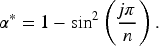
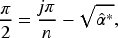
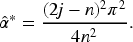
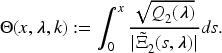
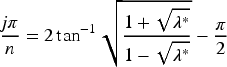
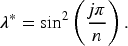
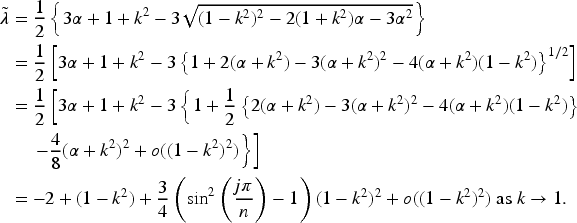
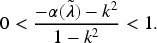
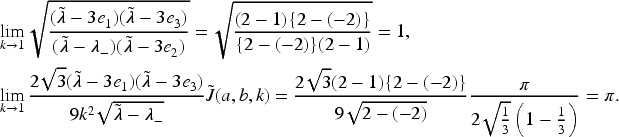
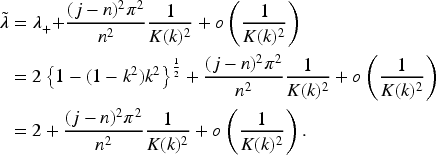
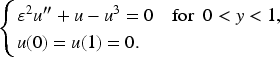
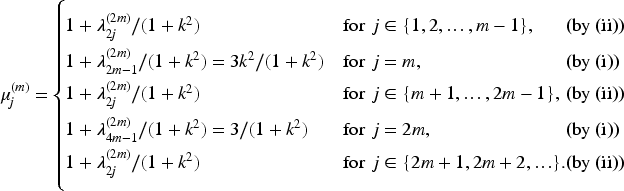
Let , and . We are concerned with the eigenvalues of the Lamé equation of the form
where is a constant, denotes Jacobi’s elliptic function and denotes the complete elliptic integral of the first kind. Using integral representations of two independent solutions, we obtain exact expressions of all eigenvalues and establish asymptotic formulas for all eigenvalues as . It is known that the Lamé equation appears as a linearized eigenvalue problem of important semilinear elliptic equations including the Allen–Cahn equation, a scalar field equation and the sine-Poisson equation. We also establish asymptotic formulas for the eigenvalues of the linearization of various boundary value problems of semilinear elliptic equations.
Let and be positive integers and let . We are concerned with the Lamé equation of the form
where is a constant, denotes Jacobi’s elliptic function, denotes the complete elliptic integral of the first kind and the domain is a circle
In this paper we frequently use the complete elliptic integral of the first kind , the Jacobi elliptic functions , and and the Weierstrass elliptic function . Definitions and basic properties of elliptic functions and elliptic integrals are summarized in Section 7 of the present paper. Hereafter, , and stand for , and , respectively.
The Lamé equation appears in various contexts of mathematical sciences. One of the main concerns for the Lamé equation is spectra of the corresponding operator
The eigenvalue problem (1.1) is classical. However, detailed descriptions of the eigenvalues of (1.1) seem to be unknown, because various integral formulas related to complete elliptic integrals given in Subsection 7.4 are needed and they were found recently. The first aim of the present paper is to obtain asymptotic formulas for all eigenvalues of on as in the case . When , the following expression of (1.1) is useful:
where is a new spectral parameter for (1.2). The first main result is the following:
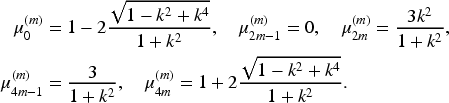
Let . Let , , be the eigenvalues of (1.2). Then the following hold:
(i) The first eigenpair is given by
and is simple. If is even, then the following two pairs are eigenpairs:
and the two eigenvalues and are simple.
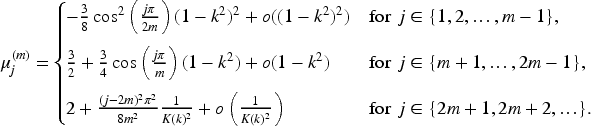
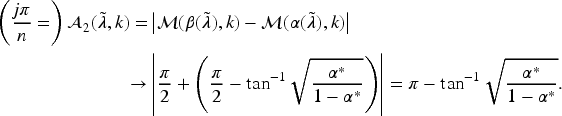
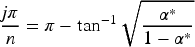
(ii) The other eigenvalues have multiplicity . Moreover, as ,
Although the three eigenvalues , and given in Theorem 1.1 (i) and associated eigenfunctions, which are called the Lamé functions, are well known, we include them to cover all the eigenvalues.
(i) If is odd, then is simple and the other eigenvalues have multiplicity , i.e.,. Note that neither nor is an eigenvalue. If is even, then , and are simple and the other eigenvalues have multiplicity .
(iii) As , the first eigenvalues are on the first spectral band of (1.3) and they converge to . The other eigenvalues are on the second spectral band of (1.3) and they converge to .
In this case we do not change the spectral parameter . The second main result is the following:
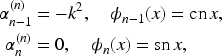
Let . Let , , be the eigenvalues of (1.4). Then the following hold:
(i) The following three pairs are eigenpairs:
and three eigenvalues , and are simple. If is even, then the following two pairs are also eigenpairs:
and two eigenvalues and are simple.
(ii) The other eigenvalues have multiplicity . Moreover, as ,
Although the five eigenvalues given in Theorem 1.3 (i) and corresponding eigenfunctions are well known, we include them to cover all the eigenvalues.
(i) If is odd, then , and are simple and the other eigenvalues have a multiplicity . Note that neither nor is an eigenvalue. If is even, then , , , and are simple and other eigenvalues have a multiplicity .
(iii) It follows from Theorem 1.3 that the first eigenvalues are on the first spectral band of (1.5) and they converge to (). The second eigenvalues are on the second spectral band and they converge to . The other eigenvalues are on the third spectral band and they converge to .
The second aim of the present paper is applications of Theorems 1.1 and 1.3 to singularly perturbed nonlinear elliptic problems. It was found in Liang et al. (1992) that the Lamé equation appears as linearized eigenvalue problems of important semilinear elliptic equations, namely
the Allen–Cahn equation , (),
the scalar field equation , (),
the sine-Poisson equation , ().
However, only special eigenvalues, which are given by Theorems 1.1 (i) and 1.3 (i), were studied in Liang et al. (1992).
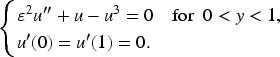
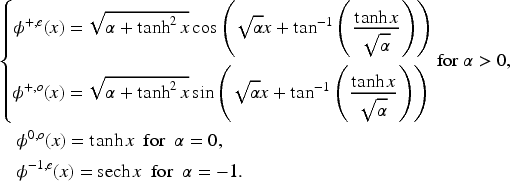
Let us explain some details of our results here. For example, we consider the Allen–Cahn equation on with periodic boundary condition:
where is an unknown function. All nontrivial solutions of (1.6) can be written as
for and . We consider the case . The linearized eigenvalue problem becomes
where is an unknown function. Let and . Then, (1.8) is equivalent to
Note that because . Let . Then, (1.9) is equivalent to (1.4) with . Therefore, each eigenvalue , , of (1.9) is given by
Now, we can obtain asymptotic formulas of the eigenvalues of (1.8), using Theorem 1.3 and (1.10).
Let . Let denote the eigenvalues of (1.8). Then the following hold:
(i) The eigenvalues , , , and are simple and they are given by
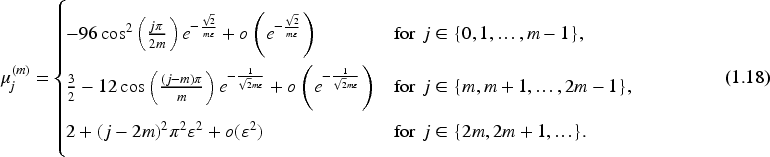
(ii) The other eigenvalues have multiplicity . Moreover, as ,
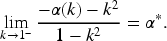
We consider the limit . Since is increasing in and , by (1.7) we see that is equivalent to . Hence, (1.8) is the so-called singular limit eigenvalue problem. A singular limit of a solution as appears in many branches of mathematical sciences, and the asymptotic formula of the eigenvalue as has attracted a great attention. For example, the asymptotic formula of the eigenvalue as plays a crucial role in a limit of energy of various models in quantum physics (Funakubo et al., 1990; Liang et al., 1992; Manton & Samols, 1988; Smondyrev et al., 1995), in very slow dynamics in coarsening phenomena of the Allen–Cahn (real Ginzburg–Landau) equation (Carr & Pego, 1989; Eckmann & Rougemont, 1998) and in a metastability of spiky stationary patterns of the shadow Gierer–Meinhardt system in morphogenesis (de Groen & Karadzhov, 2002; Iron & Ward, 2000). By Lemma 7.1 we have
Using (1.7), (1.11) and Lemma 7.1, we obtain the following: As ,
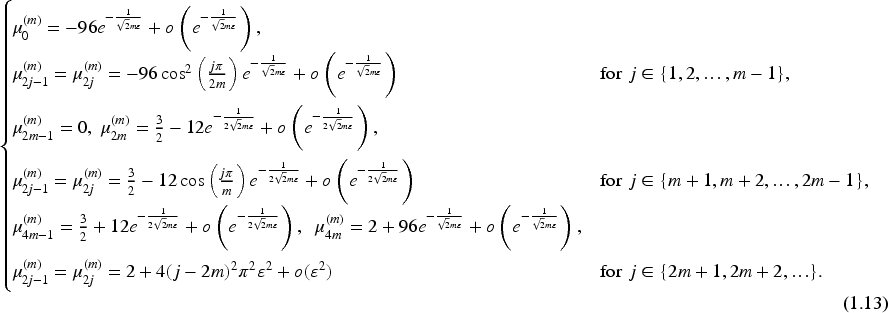
By (1.12) and Corollary 1.5 we can obtain the following asymptotic formulas: As ,
In summary the eigenvalue relation (1.10) is crucial to obtain (1.13).
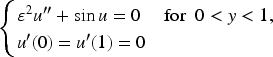
We show that the eigenvalues for both Dirichlet and Neumann problems can be expressed by using eigenvalues for periodic problems. For example, we consider the Neumann problem
All nontrivial solutions can be expressed as
for and . The first three eigenvalues , , for -mode solutions were obtained in Wakasa (2006). We will see in (2) of Subsection 6.1 that the three eigenvalues correspond to , and in Theorem 1.3 (i). In Wakasa and Yotsutani (2015) exact expressions of the other eigenvalues were obtained and asymptotic formulas were established. Now, we show that the same asymptotic formula as in Wakasa and Yotsutani (2015) can be obtained by Theorem 1.3. Let denote the eigenvalues of the associated eigenvalue problem
In Subsection 6.1 we prove the following eigenvalue relation
Using (1.16) and Theorem 1.3, we obtain the following:
Let denote the eigenvalues of (1.15). Then, every eigenvalue is simple and the following hold:
(i) Three eigenvalues , and are given by
(ii) The other eigenvalues satisfy the following: As ,
Note that neither nor is used in the Neumann problem. By (1.11), (1.14) and Lemma 7.1 we obtain the following: As ,
By (1.17) and Corollary 1.6 we obtain the following asymptotic formulas: As ,
for and . Now, we show that various asymptotic formulas in Wakasa and Yotsutani (2008) can be obtained by Theorem 1.1. Let denote the eigenvalues of the linearized problem
Then this linearized problem can be transformed into
where and . Note that because . In a similar argument to the Allen–Cahn equation with Neumann boundary condition we obtain
By (1.21) and Theorem 1.1 we obtain the following:
Let denote the eigenvalues of (1.20). Then, every eigenvalue is simple and the following hold:
(i) Two eigenvalues and are given by
(ii) The other eigenvalues satisfy the following: As ,
These formulas are the same as Wakasa and Yotsutani (2008, Theorems 2.1 and 2.3). By (1.19) and Lemma 7.1 we obtain the following: As ,
By (1.22) and Corollary 1.7 we obtain the following asymptotic formulas: As ,
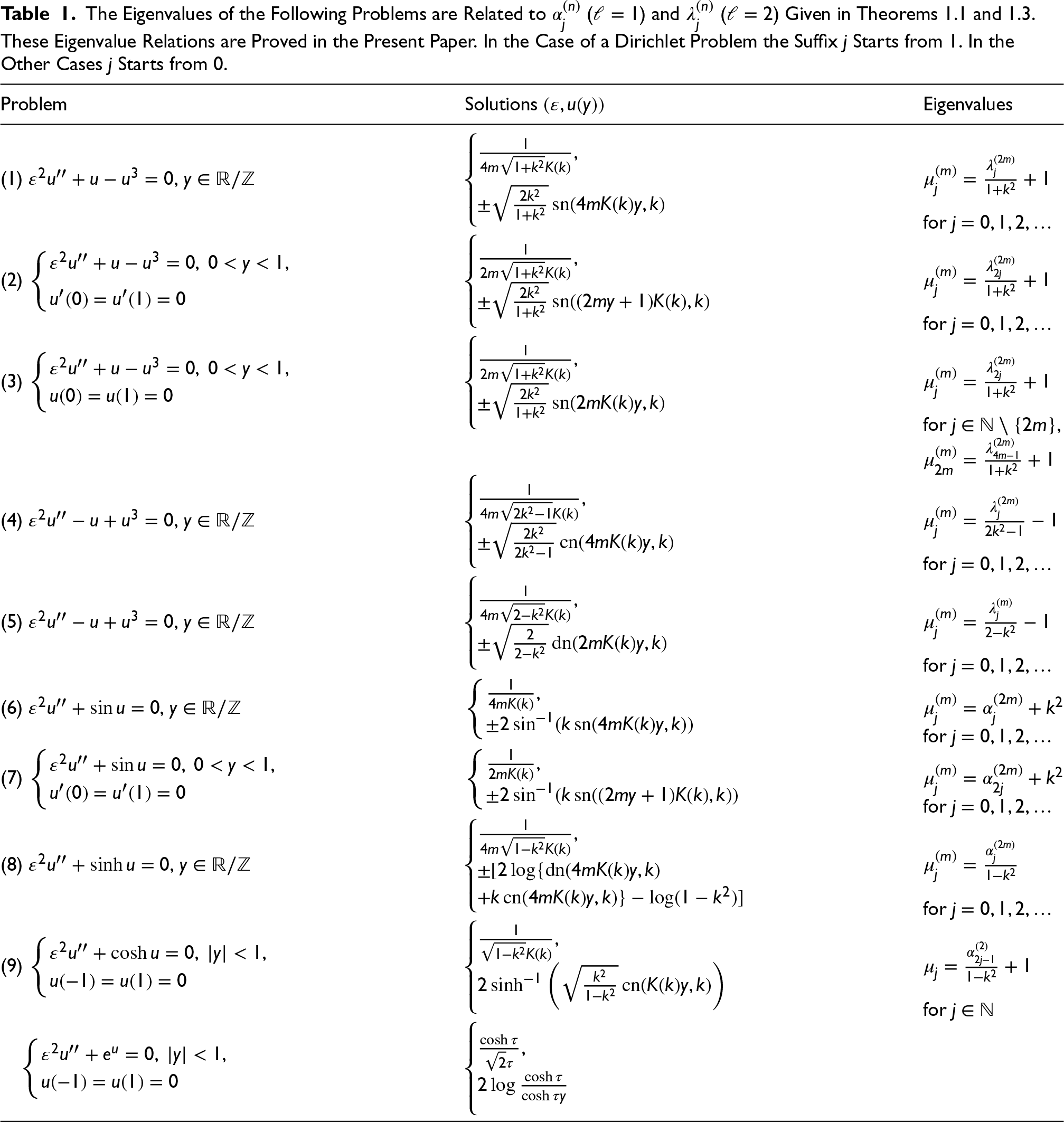
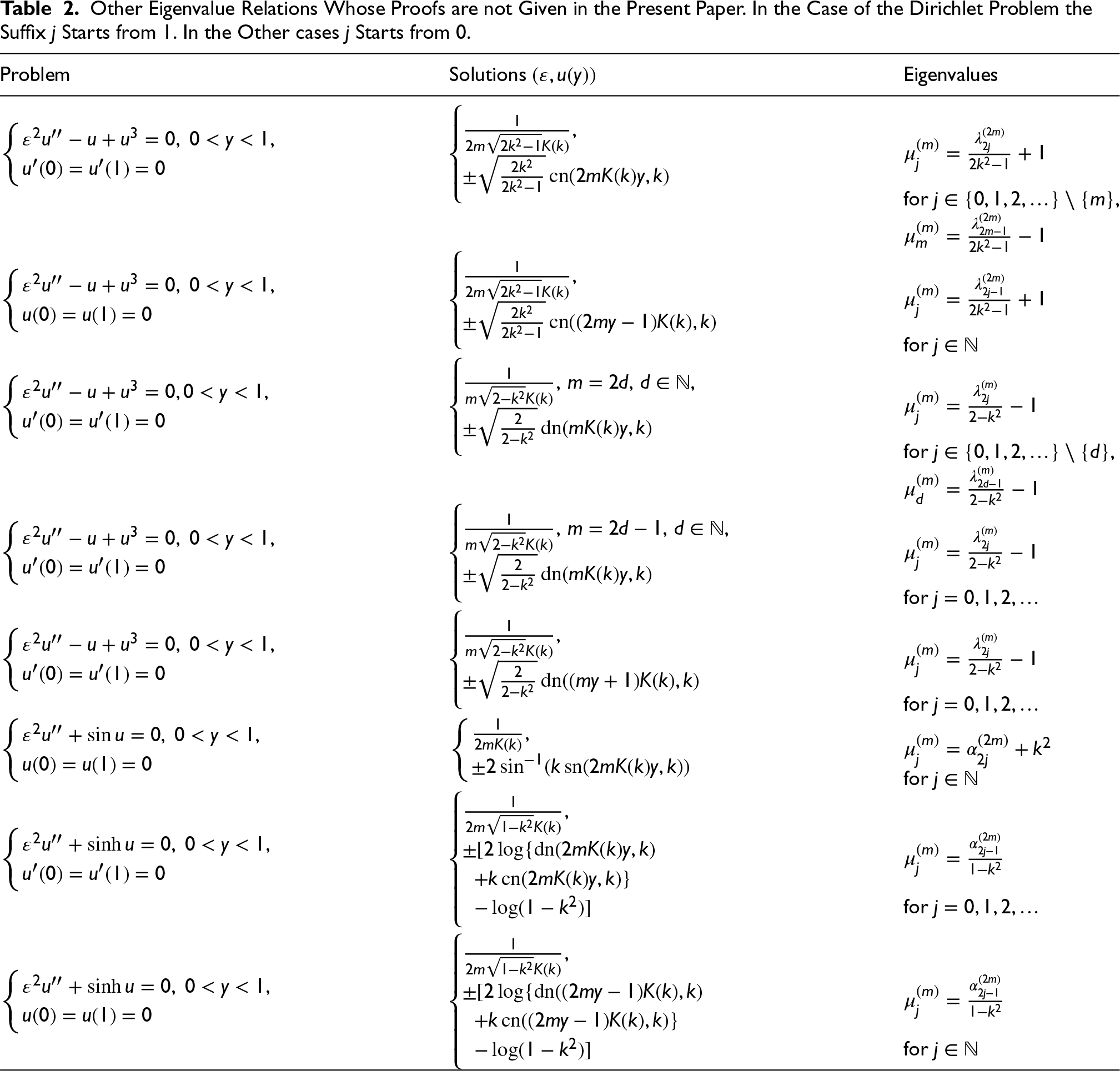
As seen in derivations of (1.13), (1.18) and (1.23), Theorems 1.1 and 1.3 with eigenvalue relations lead to asymptotic formulas for all eigenvalues as . The third main result is eigenvalue relations given in Tables 1 and 2. Eigenvalue relations in Table 1 are proved in Section 6, but proofs of those of Table 2 are omitted. Explicit forms of asymptotic formulas as are omitted, since it can be calculated in the same way.
The Eigenvalues of the Following Problems are Related to () and () Given in Theorems 1.1 and 1.3. These Eigenvalue Relations are Proved in the Present Paper. In the Case of a Dirichlet Problem the Suffix Starts from . In the Other Cases Starts from .
Problem
Solutions
Eigenvalues
(1) ,
for
(2)
for
(3)
for ,
(4) ,
for
(5) ,
for
(6) ,
for
(7)
for
(8) ,
for
(9)
for
Other Eigenvalue Relations Whose Proofs are not Given in the Present Paper. In the Case of the Dirichlet Problem the Suffix Starts from . In the Other cases Starts from .
Problem
Solutions
Eigenvalues
for ,
for
for ,
for
for
for
for
for
The two equations () and () became model cases. After (Wakasa & Yotsutani, 2008, 2015), the scalar field equation with was studied in Miyamoto et al. (2023). The scalar field equation has two families of solutions which can be expressed as - and -functions which are in (4) and (5) in Table 1. In Miyamoto et al. (2023) it was found that solutions of the -function of the Neumann problem corresponded to the case and the asymptotic formula was established. In this article, we study the cases of a - and -function of the periodic boundary value problem. In Aizawa et al. (2023) the cases of with Dirichlet and Neumann problems were studied. In this paper we study the case with periodic boundary condition. The Dirichlet problem of is also studied.
We study the Dirichlet problem of which was already considered in Miyamoto and Wakasa (2019). Although the eigenvalue relation does not exist, this problem can be seen as the limit case of (1.2) in a certain sense. Lastly, we mention the case in Subsection 6.5. The equation (1.1) with appears in the linearization problem of . Therefore, a counterpart of Theorem 1.1 (and 1.3) is required. However, the case is difficult, and it may be a future work. Eigenvalue relations about eight more problems are shown in Table 2. Their proofs are omitted.
Let us explain technical details. An integral representation of two independent solutions of the ODE in (1.1) is known (Proposition 2.13), and it is written explicitly when . This representation is often written in terms of Weierstrass’s function. In this paper we write the integral representation in terms of Jacobi’s elliptic function, using a relation between a -function and -function (Proposition 2.8). Combining the integral representation and a theory of Hill’s operator, we show a multiplicity of each eigenvalue of (1.1). In Wakasa and Yotsutani (2008, 2015) various limit formulas related to complete elliptic integrals were developed. Using those limit formulas, we prove Theorems 1.1 and 1.3.
This paper consists of seven sections. In Section 2 we recall a theory of Hill’s equation. We also collect useful properties of the Lamé equation. In particular, integral representations of two independent solutions are given. In Section 3 we prove a simplicity of the eigenvalues given in Theorems 1.1 (i) and 1.3 (i). In Sections 4 and 5 we prove Theorems 1.1 (ii) and 1.3 (ii), respectively. In Section 6 we prove the eigenvalue relations in Table 1. We also study the Dirichlet problem in details. Section 7 is an appendix. We recall definitions and basic properties of complete elliptic integrals , and and Jacobi’s elliptic functions , and . We also recall basic facts of Weierstrass’s elliptic function . We collect various limit formulas for complete elliptic integrals.
Fundamental Results
Hill’s Equation
We recall a theory of Hill’s operator. Details can be found in Magnus and Winkler (1966, Part I in pp.3–48). Let be a smooth -periodic function and let . We consider the problem
There exists a sequence such that
If , , then all nontrivial solutions are unbounded. We call the interval of instability. On the other hand, if , , then all solutions are bounded. We call the interval of stability. If for , then there exists a periodic solution with period or which is bounded. In this case a boundedness of a solution independent of the periodic one is as follows: If , then all solutions for are bounded, and hence two adjacent intervals of stability and can combine to a single one . In the other case is a boundary point of an interval of stability and also an interval of instability. Then a solution independent of a periodic one is unbounded. Thus, we obtain the following proposition.
There exists a subsequence of , which may be a finite subsequence, such that and the following (i)–(iii) hold:
(i) The intervals of stability is . If the subsequence is finite, then the last interval is .
(ii) The intervals of instability is .
(iii) If , , then a periodic (and bounded) solution exists and all solutions independent of the periodic one are unbounded.
In Magnus and Winkler (1966) the interval of the instability is defined as the complement of the intervals of stability in . In this paper we adopt a different definition of the interval of instability, which is based on Proposition 2.1.
The Lamé Equation on
Let be a positive integer. Let , , be a complex-valued function. We consider the Lamé equation of the form
where
and denotes Weierstrass’s elliptic function. A definition and basic properties of are summarized in Subsection 7.3.
We recall known results about (2.1). Propositions in this subsection are valid for more general equations. However, we restrict ourselves to the Lamé equation. Let be the product of a pair of solutions of (2.1). Then satisfies
where and are polynomials in , they do not have common divisors and the polynomial is monic. Moreover, the degree of is and the degree of is not more than .
Let
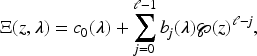
Then the RHS is independent of and it is a monic polynomial in of degree . We can construct a solution of (2.1), using and .
The cases in Example 2.4 correspond to , , in Takemura (2005, Section 6), respectively. These formulas also can be found in Takemura (2006, Example 1 in p.107) and Takemura (2007).
We rewrite the function as follows:
Then, and are polynomials in , and it follows from Proposition 2.2 that the degree of is and the degree of is not more than .
Takemura (2004, 2005) Let be the eigenvalue satisfying . Then there exist such that , and we have
for any , where and is the Weierstrass zeta function.
(i) The case . The value satisfies and . The polynomials and are calculated as
(ii) The case . The values satisfy and . We have
(iii) The case . The value satisfies and . We have
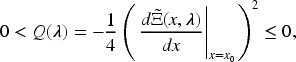
Set . Then, the degree of is . If and are positive numbers, then every coefficient of is real-valued and the polynomial has distinct real roots (see Takemura, 2003, Proposition 3.3). Write
(ii) The polynomial has distinct real roots which satisfies for .
If , then and the integrant is real-valued. Hence the integral in the left-hand side of (2.7) is real-valued for each . By combining with (2.6), we obtain (i).
If the polynomial does not have zero on the interval for some , then the sign of the value is constant. Thus the integral in the left-hand side of (2.7) is non-zero, which contradicts to (i). Hence, the polynomial has a zero on the interval for any . Since the degree of the is , we obtain the proposition.
The Lamé Equation on
The function is a complex-valued function. However, it is known that if and , then is a real-valued smooth function on . Therefore, we define
Then, is related to Jacobi’s elliptic function as follows:
Let . Then,
Therefore, for , ,
See Lawden (1989, Eq.(6.9.11) in p.163) for (2.8). This relation is crucial in this paper. Let . Then, the problem (2.1) for becomes
When , can be chosen as a real-valued function. In that case is also a real number. Hereafter, we define for . Since , by (2.3) we can easily check that the same as (2.3) satisfies
Let and be a basis of analytic solutions to the differential equation
about . Since the function is analytic in the domain , the functions and are continued analytically on the domain . It follows from the periodicity that the functions and also satisfy the differential equation (2.11). Since and are a basis of solutions, there exist such that
Then the values and do not depend on the choice of the basis and , and it is shown that . Set
If or , then any nonzero solutions are not bounded. If , then all solutions are bounded. If and , then all solutions are bounded. It follows from (2.5) that
Even or odd periodic solutions of (2.1) with period or are called the Lamé function.
(ii) If , then all nontrivial solutions of (2.9) are unbounded.
(iii) If , then (2.9) has a periodic (and bounded) solution, which is the Lamé function, and all solutions independent of this solution are unbounded.
Proposition 2.9 seems to be known for experts. However, the authors could not find a proof in literature. Therefore, we show a proof.
(i) If and , then or there exists such that . In the case , we set . It follows from (2.5) that
Since the integrant is pure-imaginary for , we have . Hence, all solutions are bounded.
(ii) If and , then or there exists such that . In the case , we set . Assume that It follows from (2.5) that
Since the integrant is real and non-zero for , we have or . If or , then
the integrant is real and non-zero, and we have or . Therefore, any nonzero solutions are not bounded.
(iii) If , then the corresponding Lamé function is a solution. Since the degree of is and has different roots, each root is simple, and hence is a boundary point of and . Because of (i) and (ii), is a boundary point of the intervals of stability and also the intervals of instability. By Proposition 2.1 we see that all solutions independent of the Lamé function are unbounded.
If is an eigenfunction of (1.1), then can be regarded as a bounded periodic smooth function on , and hence is a bounded eigenfunction of (2.9). Thus, we obtain the following:
In the case of a Dirichlet (resp. Neumann) problem
an eigenfunction can be extended as a bounded periodic smooth function on by using odd reflection (resp. even reflection). Therefore, Proposition 2.10 holds for both Dirichlet and Neumann problems.
We study the case . In this case (2.9) has a periodic solution with period or called the Lamé function. The Lamé function can be expressed as a polynomial of , and . The following are examples of the Lamé function:
(i) The case ,
(ii) The case ,
Here,
The above examples can be found in Arscott (1964, p. 205).
It follows from Proposition 2.12 that if , then does not vanish or change sign. By Proposition 2.3 we can obtain two real-valued solutions defined for all .
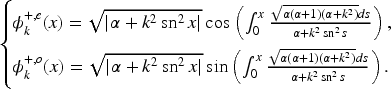
Let be such that . The following and are two independent solutions of (2.9) which are real-valued:
When we consider (1.1), the phase function is important in checking the periodic boundary condition. In Sections 4 and 5 we study the phase function in detail.
(i) If is an eigenvalue and , then is a simple eigenvalue and an eigenfunction is the Lamé function.
(ii) The other eigenvalues satisfy and have multiplicity . Moreover, and defined in Proposition 2.13 are two independent eigenfunctions.
(i) Because of Proposition 2.9, all solutions independent of the Lamé function are unbounded on . Hence, the corresponding eigenfunction should be the Lamé function and the multiplicity of is .
(ii) All eigenvalues other than (i) satisfy , because of Proposition 2.10. It follows from Proposition 2.13 that and are two independent eigenfunctions which have to be -periodic, and hence the multiplicity is at least . Since the equation of (1.1) is an ODE of the second order, the multiplicity is at most . Thus, the multiplicity is .
Simple Eigenvalues
In order to prove the simplicity of special eigenvalues we consider the following problem on :
Proof of Theorem 1.1 (i).
By Example 2.11 we see that the following three pairs of satisfy (3.1):
It is obvious that is a positive function in . Thus, is the first eigenvalue and hence the eigenvalue is simple.
We consider the case where is even. Then, it is well known that the two pairs and satisfy (1.2). Hence, they are eigenpairs. We see in the proof of Theorem 1.1 (ii) in Section 4 that (1.2) has eigenvalues on . Note that if is even. Thus, is the -th eigenvalue, and hence . Since and have the same zero number on and , it follows from a Sturm–Liouville theory that is the eigenvalue next to . Thus, . It immediately follows from Proposition 2.14 that and are simple eigenvalues.
We consider the case where is odd. This case is not mentioned in Theorem 1.1. The functions and are -periodic and is not divisible by . They are not solutions of (1.2). Therefore, neither nor is an eigenvalue. The proof is complete.
We consider the following problem on :
Proof of Theorem 1.3 (i).
By Example 2.11 (ii) we see that five pairs of satisfy (3.2). We easily check that is positive for . Thus, is the first eigenvalue, i.e.,.
We consider the case where is even. Using the same argument as in the proof of Theorem 1.1 (i), we can check that is the -th eigenvalue and is the -th eigenvalue, i.e., and . Note that neither nor is an eigenvalue for odd , since both and are -periodic functions and is not divisible by .
Next we show that and . By proofs of Theorem 1.3 (ii) below we see that (1.4) has eigenvalue on whenever is odd or even. Thus, is the -th eigenvalue, i.e.,. We can easily check that and have the same zero number on . Thus, is the eigenvalue next to . i.e.,. It follows from Proposition 2.14 that all eigenvalues associated with the Lamé functions are simple. The proof is complete.
Proof of Theorem 1.1
We consider the case . In this case it is convenient to study the following form:
We find eigenvalues on . Proposition 2.12 guarantees that does not vanish for . It follows from Proposition 2.13 that the following and are two independent solutions of (3.1)
where
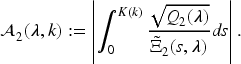
We define
and
Since the integrand of is -periodic, we see that . Therefore, and are solutions of (4.1) if and only if
In this case is an eigenvalue of (4.1) and the multiplicity is . In this section we study to solve (4.3).
For each fixed , the function is continuous for .
Lemma 4.1 is obvious. The proof is omitted.
The following hold:
(i).
(ii).
(iii).
(iv).
The assertions (i), (ii), (iii), and (iv) follow from Lemma 7.2(i), (ii), (iii), and (iv), respectively.
For each fixed , the function is increasing for .
Let be fixed. Let and for simplicity. The function satisfies
Since satisfies a Sturm–Liouville equation, we see that if increases, then by Prüfer transformation oscillates more rapidly. Hence, rotates in the clockwise direction around the origin as increases. Then, is an increasing function on each connected component of . On the other hand, is defined on . Because of Lemma 4.2 (ii) and (iii),
This indicates that is an increasing function on the whole set of .
Proof of Theorem 1.1 (ii).
Let . Because of Lemmas 4.1–4.3, the continuous function is increasing in , and . Therefore, (4.3) has a unique solution for each . Each solution gives arise an eigenvalue with multiplicity , and an associated eigenfunction has zeros in . Hence this eigenvalue is .
First, we consider the case for . Let for simplicity. Then,
Lemmas 4.2 and 4.3 indicate that a solution of (4.4) is unique and . Hence,
Letting , we have a convergent subsequence of which is still denoted by . Then,
By Lemma 7.4 we have
Solving with respect to , we have
Note that the limit is unique. By the limit in (4.5) we have
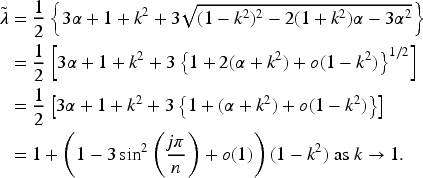
Second, we consider the case for . Because of Lemmas 4.2 and 4.3, the continuous function is increasing in , and . Therefore, (4.3) has a unique solution for each . By the same argument as in (ii) we see that the solution gives arise an eigenvalue with multiplicity which is denoted by .
Let for simplicity. Then,
Therefore, . We define
Then, . Letting , we have a convergent subsequence of which is still denoted by . Then,
The set consists of all the eigenvalues, since we have examined all in proofs of Theorem 1.1 (i) and (ii). Every eigenvalue in Theorem 1.1 (ii) has multiplicity , since and are solutions of (4.1). The proof is complete.
Proof of Theorem 1.3
We consider the case , i.e.,
which is equivalent to (1.1) with . Let us consider the problem (3.2). Let
Since , by Example 2.11 (ii) we have
Then, is equivalent to
We find eigenvalues on . Proposition 2.12 guarantees that does not vanish for . It follows from Proposition 2.13 that the following and are two independent solutions of (3.2):
where
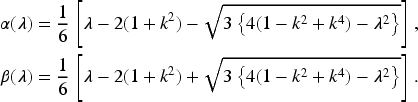
We define
It follows from the same argument as in the case that and are solutions of (5.1) if and only if
Let . In a similar way to the proof of Lemma 4.3 we can prove that is increasing in each connected component of . By Lemma 5.2 we see the following:
for , and . Thus, is an increasing function on the whole set of .
Proof of Theorem 1.3.
(i) We can obtain candidates in a similar way to the proof of Theorem 1.1 (i). We can check that five (resp. three) pairs are eigenpairs for even (resp. odd), using Example 2.11 (ii). We omit details.
(ii) Let us consider the first case. Let be fixed. Let . We consider the equation
Lemmas 5.1 and 5.2 indicate that a solution of (5.3) is unique and . Since
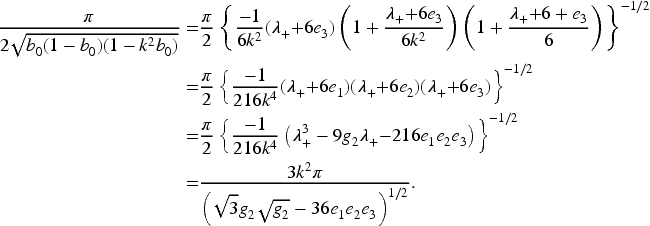
Note that the larger root is in . By (5.7) we have
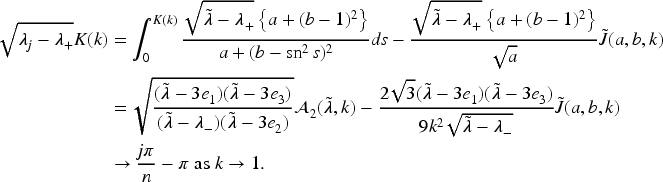
Next, we consider the second case. Let be fixed. Let for simplicity. We consider (5.3). Lemmas 5.1 and 5.2 indicate that a solution of (5.3) is unique and . By elementary argument we see that . Therefore,
Letting , we have a convergent subsequence of which is denoted by . Then,
By Lemma 7.4 we have
On the other hand, by elementary argument we see that , for and has a unique maximum point in which satisfies . Hence,
In particular, as . Using Lemma 7.1, we have
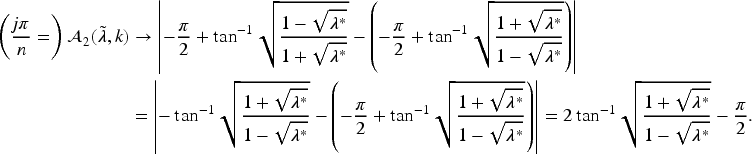
Let be defined by (7.5). By Lemma 7.3 and (5.10) we have
The set consist of all the eigenvalues, since we have examined all in proofs of Theorem 1.3 (i) and (ii). Every eigenvalue in Theorem 1.3 (ii) has multiplicity , since and are solutions of (5.1). The proof is complete.
Applications
In this section let denote an unknown function of nonlinear problems, and let denote an eigenvalue for a linearization around an -mode solution . Moreover, in the case of a periodic or Neumann boundary condition starts from , i.e., the first eigenvalue is . However in the case of a Dirichlet boundary condition starts from , i.e., the first eigenvalue is .
Allen–Cahn Equation
(1) We consider the nonlinear problem with periodic boundary condition:
All nontrivial solutions can be expressed as
for , and . We consider the solutions with . The linearized eigenvalue problem becomes
Since , an eigenvalue for is equal to that for , and hence denotes the eigenvalue for both and . Then, the linearization problem around is
Let and . Then,
The problem (6.1) is equivalent to (1.4) with . Thus, for , and hence
(2) We consider the Dirichlet problem
Then, all nontrivial solutions can be expressed as
for and . The linearization problem around is
Let and . Then,
By odd reflection we extend to defined on . Then, satisfies
We choose all eigenfunctions of (1.4) with that satisfy (6.2). Since is even, in Theorem 1.3 (i) only and satisfy (6.2). In Theorem 1.3 (ii) every eigenvalue has multiplicity , i.e., for . An eigenfunction associated with , , satisfies (6.2). Thus, we obtain
It is equivalent to the following:
(3) We consider the Neumann problem
All nontrivial solutions can be expressed by
for and . The linearization problem around is
Let and . Then,
By even reflection we extend to defined on . Then, satisfies
We choose all eigenfunctions of (1.4) with that satisfies (6.4). Since is even, in Theorem 1.3 (i) only , and satisfy (6.4). In Theorem 1.3 (ii) every eigenvalue has multiplicity . An eigenfunction
associated with , , satisfies (6.4), where . Since , we obtain
Scalar Field Equation
(4) In this subsection we consider only periodic boundary value problem
Dirichlet and Neumann problems can be treated in the same way as in Subsection 6.1. All sign-changing solutions of (6.5) can be expressed by
for , and . We consider the case . Using the same method as the problem (6.3), we obtain
Comparing this problem with (1.4), we obtain the following relation:
(5) The problem (6.5) has the following positive and negative solutions:
for , and . See Miyamoto et al. (2023) for details. We also consider the case . Then, we have
In this case the following relation holds:
sine-Poisson Equation and Other Equations
(6) We consider the sine-Poisson equation
This problem has nontrivial solutions
for , and . See Wakasa and Yotsutani (2008) for details. We consider the case . Let . Then the linearized eigenvalue problem can be transformed into
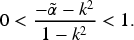
Thus, an eigenvalue can be related to the eigenvalue of (1.2) with . Specifically, we have
(7) Details of this case are omitted. The eigenvalue relation is given by (1.21).
(8) We consider the sinh-Poisson equation
All solutions can be expressed by
Details can be found in Aizawa et al. (2023). We consider the case . Let . Then the linearized eigenvalue problem can be transformed into
Therefore,
(9) We consider the Dirichlet problem
All solutions can be expressed as
for . Let . The linearization problem becomes
By odd reflection we extend to defined on . Then satisfies
Since is -periodic, we set . In Theorem 1.1 (i) only satisfies (6.6). Every eigenfunction in Theorem 1.1 (ii) has multiplicity , i.e., for . An eigenfunction associated with , , satisfies (6.6), where . Since , we obtain
1D Gel’fand Problem
We consider the Dirichlet problem
Then, all solutions can be written as follows:
for . Let . The linearization problem can be transformed into the following:
where is an unknown function. We consider the following ODE
where is an unknown function. The equation (6.8) has the Pöschl–Teller potential with for which all eigenvalues of on can be obtained explicitly, i.e., the eigenvalues are . It is known that the spectral set of (6.8) is , where is a continuous spectrum. Bounded solutions of the ODE in (6.8) are given by
Therefore, putting and finding all solutions satisfying , we obtain all eigenvalues . Details can be found in Miyamoto and Wakasa (2019).
Now, let us study a relation between (6.8) and (4.1) on . It is known that
Therefore, roughly speaking, (4.1) converges to (6.8) as . We show that a solution of (4.1) converges to that of (6.8) as . When , two independent solutions of (4.1) are given by (4.2), i.e.,
By the dominated convergence theorem we see that, as ,
because of the integral formula
When , we see that, as ,
When , we see that, as ,
When , we see that, as ,
In summary, (6.8) can be seen as the limit case of (4.1) as . However, the domain in (6.7) is not the limit of the domain in (4.1), and hence the eigenvalue relation does not exist.
for , and . We consider the case . Let . Then the linearization problem can be transformed into
Since , the asymptotic formula for (1.1) with is required. Two independent solutions of the ODE in (1.1) are given by Proposition 2.13 with Example 2.4 (iii). However, an analysis of the phase function , , is difficult, since is a cubic polynomial and the root formula is complicated. The case is left open.
Appendix: Complete Elliptic Integrals and Elliptic Functions
Complete Elliptic Integral
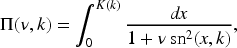
Let and . The complete elliptic integrals of the first, second and third kind are defined by
respectively. Then, is a monotone increasing function in ,
Let . Jacobi’s elliptic function is an odd, periodic and analytic function with the period as a function for the real domain, and the inverse of is defined locally by
for . The function is a solution of
The function is an even and -periodic function defined locally by
for . Then, . Moreover, is a solution of
The function is an even and -periodic positive function defined by
Then, . Moreover, is a solution of
Using the transformation in (7.1), we obtain the following expression of :
where we used and for .
Weierstrass’s Elliptic Function
Let . In this paper we use Weierstrass’s elliptic function only of the following form:
for , where
The function has singularities at and it is a doubly periodic in the sense
Let . We define
Then, it is known that
and hence and . See Lawden (1989, Eq. (6.9.10) in p.163) for (7.2). Let
The following relation holds:
These relations are used in the proof of Example 2.4. A reader can consult (Lawden, 1989, Chapter 6) for details of .
A Variant of the Complete Elliptic Integral of the Third Kind
Let . We use the following variant of the complete elliptic integral of the third kind
for . Let . Then, and have the following relation:
for .
The function has the following limits at the end points of .
Lemma 7.3–7.6 are used to calculate the limit of eigenvalues. Those proofs can be found in Wakasa and Yotsutani (2015).
Let
Then,
Suppose that is a continuous function on with for . Assume that there exists such that
Then,
Suppose that and . Then for each ,
Suppose that , , and . Let
Then,
Footnotes
Acknowledgments
YM was supported by JSPS KAKENHI Grant Number 24K00530. KT was supported by JSPS KAKENHI Grant Number 22K03368. TW was supported by JSPS KAKENHI Grant Number 24K06814.
ORCID iDs
Yasuhito Miyamoto
Kouichi Takemura
Tohru Wakasa
Funding
The authors received no financial support for the research, authorship and/or publication of this article.
Declaration of Conflicting Interests
The authors declared no potential conflicts of interest with respect to the research, authorship, and/or publication of this article.
Data Availability
Data sharing is not applicable to this article as no new data were created or analyzed in this study.
References
1.
AizawaS.MiyamotoY.WakasaT. (2023). Asymptotic formulas of the eigenvalues for the linearization of a one-dimensional sinh-poisson equation. Journal of Elliptic and Parabolic Equations, 9, 1043–1070.
2.
ArscottF. (1964). Periodic differential equations: An introduction to mathieu, lamé, and allied functions. International series of monographs in pure and applied mathematics (vol. 66). The Macmillan Company x+284 pp.
3.
ByrdP.FriedmanM. (1971). Handbook of elliptic integrals for engineers and scientists, Die grundlehren Der Mathematischen Wissenschaften (2nd ed., Vol. 67). Springer-Verlag.
4.
CarrJ.PegoR. (1989). Metastable patterns in solutions of . Communications on Pure and Applied Mathematics, 42, 523–576.
5.
de GroenP.KaradzhovG. (2002). Metastability in the shadow system for Gierer–Meinhardt’s equations. Electronic Journal of Differential Equations, 2002, 22.
6.
EckmannJ.RougemontJ. (1998). Coarsening by ginzburg-landau dynamics. Communications in Mathematical Physics, 199, 441–470.
7.
FunakuboK.OtsukiS.ToyodaF. (1990). Sphalerons of nonlinear sigma model on a circle. Progress of Theoretical Physics, 83, 118–133.
8.
IronD.WardM. (2000). A metastable spike solution for a nonlocal reaction-diffusion model. SIAM Journal on Applied Mathematics, 60, 778–802.
9.
LawdenD. (1989). Elliptic functions and applications. Applied mathematical sciences (Vol. 80). Springer-Verlag. xiv+334 pp. ISBN: 0-387-96965-9.
10.
LiangJ.Müller-KirstenH.TchrakianD. (1992). Solitons, bounces and sphalerons on a circle. Physics Letters B, 282, 105–110.
11.
MagnusW.WinklerS. (1966). Hill’s Equation, Interscience Tracts in Pure and Applied Mathematics, No. 20. Interscience Publishers John Wiley & Sons. viii+127 pp.
12.
MantonN.SamolsT. (1988). Sphalerons on a circle. Physics Letters B, 207, 179–184.
13.
MiyamotoY.TakemuraH.WakasaT. (2023). Asymptotic formulas of the eigenvalues for the linearization of the scalar field equation. Proceedings of the Royal Society of Edinburgh Section A: Mathematics, 155, 307–344.
14.
MiyamotoY.WakasaT. (2019). Exact eigenvalues and eigenfunctions for a one-dimensional Gel’fand problem. Journal of Mathematical Physics, 60, 021506.
15.
SmondyrevM.VansantP.PeetersF.DevreeseJ. (1995). Nonlinear Schrödinger equation on a circle. Physical Review B, 52, 231–237.
16.
TakemuraK. (2003). The Heun equation and the Calogero–Moser–Sutherland system. I. The bethe ansatz method. Communications in Mathematical Physics, 235, 467–494.
17.
TakemuraK. (2004). The Heun equation and the Calogero–Moser–Sutherland system. III. The finite gap property and the monodromy. Journal of Nonlinear Mathematical Physics, 11, 21–46.
18.
TakemuraK. (2005). The Heun equation and the Calogero–Moser–Sutherland system. IV. The Hermite–Krichever ansatz. Communications in Mathematical Physics, 258, 367–403.
19.
TakemuraK. (2006). On eigenvalues of Lamé operator. Sūrikaisekikenkyūsho Kōkyūroku, 1480, 104–116.
20.
TakemuraK. (2007). Towards finite-gap integration of the inozemtsev model. Symmetry, Integrability and Geometry: Methods and Applications, 3, 038.
21.
WakasaT. (2006). Exact eigenvalues and eigenfunctions associated with linearization for Chafee–Infante problem. Funkcialaj Ekvacioj, 49, 321–336.
22.
WakasaT.YotsutaniS. (2008). Representation formulas for some 1-dimensional linearized eigenvalue problems. Communications on Pure and Applied Mathematics, 7, 745–763.
23.
WakasaT.YotsutaniS. (2015). Limiting classification on linearized eigenvalue problems for 1-dimensional Allen–Cahn equation I-asymptotic formulas of eigenvalues. Journal of Differential Equations, 258, 3960–4006.
24.
WhittakerE.WatsonG. (1927). A course of modern analysis. An introduction to the general theory of infinite processes and of analytic functions; With an account of the principal transcendental functions. Reprint of the fourth edition, Cambridge mathematical library. Cambridge University Press.