We investigate the long-time dynamics of a non-autonomous stochastic Benjamin–Bona–Mahony equation on a high-dimensional unbounded channel domain , driven by an operator-type Laplace-multiplier noise. We construct a non-autonomous random dynamical system on and prove the existence of a compact pullback random attractor, which is cocycle-invariant and pullback attracts every tempered random set in . The lack of compactness of Sobolev embeddings on unbounded domains is overcome by combining spectral decomposition on bounded truncations with uniform tail estimates outside large bounded sets.
This paper studies the long-time dynamics of the following non-autonomous stochastic Benjamin–Bona–Mahony (BBM) equation defined on an unbounded channel domain () with smooth boundary:
where , , and is a time-dependent forcing. The nonlinear flux satisfies
When , (1.1) reduces to the deterministic BBM equation, introduced in Benjamin et al. (1972) as a nonlinear dispersive model to describe the physical phenomenon of long waves in shallow water. Well-posedness and long-time dynamics (including global attractors) for BBM-type equations have been studied in many works; see, for example, Astaburuaga et al. (1998), Avrin and Goldstein (1985), Celebi et al. (1999), Chueshov et al. (2004), Stanislavova et al. (2005). For stochastic BBM equations, Wang (2009) obtained a random attractor for the BBM equation with additive noise (in particular, the case ). BBM equations driven by nonlinear colored noise on unbounded domains have also been studied via multivalued random dynamics and robustness analysis; see Chen et al. (2023, 2024).
In this paper, we consider the operator-type (Laplace-multiplier) noise , rather than the usual multiplicative noise (cf. Caraballo et al., 2001). This choice is naturally adapted to the BBM structure . From a modeling viewpoint, the operator-type perturbation may be interpreted as acting on the same spatial operator as the dispersive component involving . From an analytical viewpoint, it allows an exponential change of variables (see (3.1)–(3.3)) that rewrites (1.1) as a pathwise random PDE without an explicit -differential. This reformulation is convenient for establishing pathwise energy estimates and for constructing the associated non-autonomous random dynamical system (NRDS) in the sense of Wang (2012). Random attractors for three-dimensional stochastic BBM equations driven by Laplace-multiplier noise were obtained in Li and Wang (2018), and asymptotically autonomous behavior of the corresponding random attractors was further studied in Wang and Li (2020).
Compared with existing works on BBM-type equations on unbounded domains, the present paper treats a BBM equation on high-dimensional unbounded channel domains and allows for non-autonomous forcing in (1.1). In particular, unlike the three-dimensional setting in Wang and Li (2020), we consider a general spatial dimension and work in an unbounded channel geometry. Our objective is to show that the NRDS generated by (1.1) admits a unique measurable compact pullback random attractor in . A central step is to verify pullback asymptotic compactness in , which is technically challenging on unbounded domains due to the non-compactness of Sobolev embeddings and the weak dissipativity inherent in the BBM structure.
For deterministic equations on unbounded domains, compactness has often been recovered by either the energy equation approach or the tail-estimates approach. The energy equation method was developed by Ball (1997, 2004) and has been applied in many contexts; see, for example, Chen et al. (2023, 2024), Wang, Li et al. (2025). The tail-estimates method was introduced in Wang (1999) for deterministic PDEs and has been used, for instance, in Wang, Chen et al. (2025), Wang, Guo et al. (2024), Wang, Li et al. (2025), Wang and Li (2020). In the present work, we employ a tail-estimates argument and combine it with a spectral decomposition on bounded truncations of to obtain the required compactness properties for the weakly dissipative stochastic BBM equation (1.1), and hence to establish the existence of a compact pullback random attractor on the unbounded channel domain.
The paper is organized as follows. In Section 2 we recall basic notions and known results on pullback random attractors for NRDSs. In Section 3 we prove existence and uniqueness of solutions to (1.1) and the cocycle property. In Section 4 we derive uniform a priori estimates. In the last section we establish pullback asymptotic compactness and then prove the existence and uniqueness of the pullback random attractor for (1.1).
Preliminaries
In this section, we recall some basic concepts related to random attractors for NRDSs. The reader is referred to Wang (2012) for more details. Let be a complete separable metric space with metric . Let denote the Borel -algebras of . Assume is a metric dynamical system where is a probability space and is a measure-preserving group of translations on . Let be a collection of some families of nonempty subsets of parametrized by and .
Let be a -measurable mapping. We say is a parametric dynamical system if
;
;
(preserves measure), that is, , ,
A mapping is called a continuous cocycle on if for all , and t, ,
is -measurable;
is the identity on ;
(cocycle property);
is continuous.
If there exists such that for every , and ,
then we say is a periodic cocycle with period T, that is, for fixed , is periodic with initial time.
We call is a -pullback absorbing set for if for every fixed , and , there exists such that
We say is -pullback asymptotically compact in if for every and , the sequence has a convergent subsequence in if , with .
Let . Then is called a -pullback attractor for if
is measurable and is compact in ;
is invariant: and ,
, and ,
If there exists such that
then we say is T-periodic.
Let be an inclusion-closed collection of some families of nonempty subsets of X, and is a continuous cocycle on X. If is -pullback asymptotically compact and has a closed measurable -pullback absorbing set , then has a unique -pullback attractor . If and K are T-periodic, then so is .
In the sequel, we adopt the following notations. Let and denote the norm and inner product in , respectively. For a given Banach space , the norm is denoted by . Additionally, we use to denote the norm in . The constant represents a generic positive constant, which may change from line to line or even within the same line. Given , we define the norm and the norm in as .
Throughout this paper, we will frequently use the Poincaré inequality:
where is a constant. We will also use the well-known Gagliardo–Nirenberg inequality (see Friedman, 1969):
provided that
where , , and . Note that if is a nonnegative integer, then the inequality holds for .
Existence and Uniqueness of the Solution
In this section, we study the existence and uniqueness of the solution to problem (1.1). To handle the Laplace-multiplier noise, we introduce an exponential change of variables:
where is the pathwise-continuous solution of the stochastic equation and such that
In this case, the noise term is expressed as:
Substituting this expression into Equation (1.1), we obtain the following equation for :
with initial conditions given by:
A solution to the problem (3.3) will be considered in the following sense.
Given , and , a function is called a solution of problem (3.3) if , for every , , and for every and ,
If is a solution of Equation (3.3) in the sense of Definition 3.1, then satisfies the energy equation:
for almost all . Indeed, by (3.4) we have, for almost all ,
for all . Since , by (3.6) with we get, for almost all ,
Since , for every , we see that both and belong to . Consequently, by Temam (2024, Lemma 1.2, p.260) we find that for almost all ,
where is the outer unit normal vector. Then, by the Poincaré inequality: , the energy inequality (3.9) follows immediately.
Based on the above estimate, the similar argument as given in Stanislavova et al. (2005) shows the well-posedness of solutions to Equation (3.3).
For each , the problem (3.3) has a unique solution with such that is continuous in with respect to .
By Theorem 3.4, we define a mapping by
where is the solution of Equation (3.3). One can verify that is a continuous non-autonomous dynamical system on .
From now on, we denote by , the collection of all tempered families of bounded nonempty subsets of ; that is, for every , and ,
where .
In this article, we assume that the function satisfies the following conditions:
Uniform Estimates of the Solution
In this section, we derive uniform estimates for the solutions of the BBM equation, which are crucial for establishing the existence of pullback attractors.
We derive -uniform estimates of solutions to Equation (3.3) in .
For each and , there exists a such that for all the solution of problem (3.3) satisfies
where is given by
Moreover, for all , and ,
In addition, we find that there exists such that for all , by (4.3) we have
We have rewritten the energy inequality Equation (3.9) for . The result is
Applying the Gronwall inequality to (4.5) with respect to , we obtain (4.3) immediately. Letting in (4.3) yields
Since with , it follows from (3.2) and (3.11) that there exists a such that for all ,
This completes the proof.
For every and , the NRDS has a closed -pullback absorbing set , defined by
Next, we derive the uniform estimates on the tails of the solution, which are essential for proving the -pullback asymptotic compactness of in .
For every , , , and , there exist and such that for all and ,
Take a smooth function such that for all and
Then for all , where is a positive constant independent of .
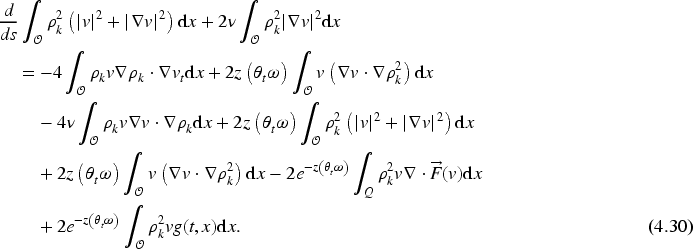
Let for . Since is a smooth function and is a solution to (3.3) in the sense of Definition (3.1), we know that . Then by (3.6) with we get for almost all ,
Since and for every ,we infer that and belong to . By Temam (2024, Lemma 1.2, p.260) we find that for almost all ,
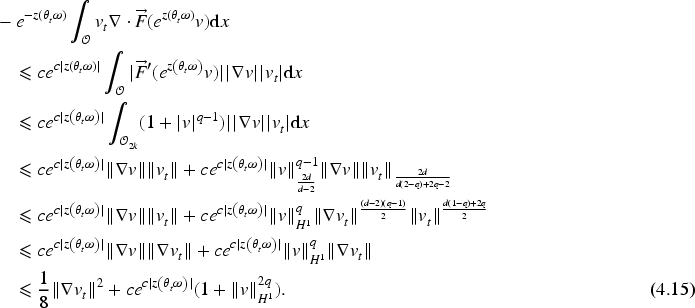
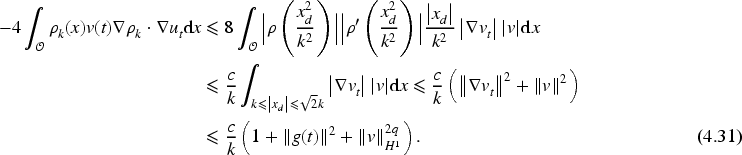
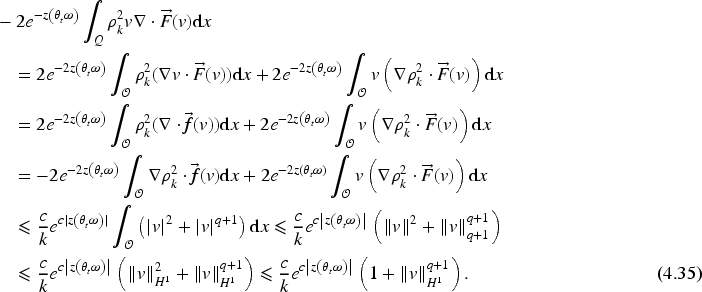
Substituting all above estimates into (4.30) and recalling , we have
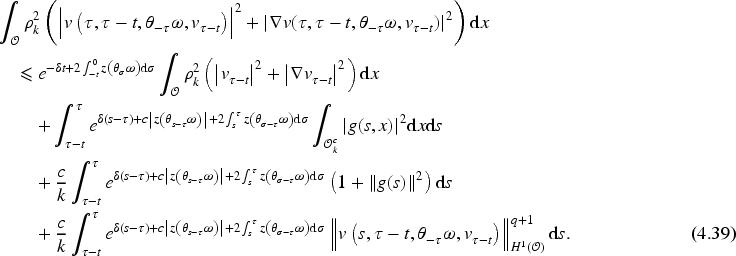
Applying the Gronwall inequality to (4.38) over and replacing by , we get
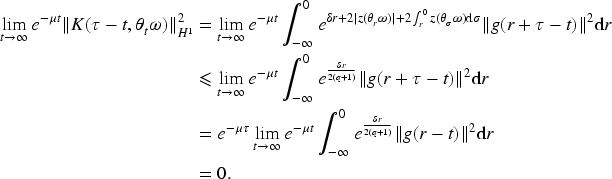
Next, we estimate all the terms on the right-hand side of (4.39). For the first term, we get from the fact with that as ,
By (3.2), we have the following estimate for the second term on the right-hand side of (4.39)
as . For the third term on the right-hand side of (4.39), we get
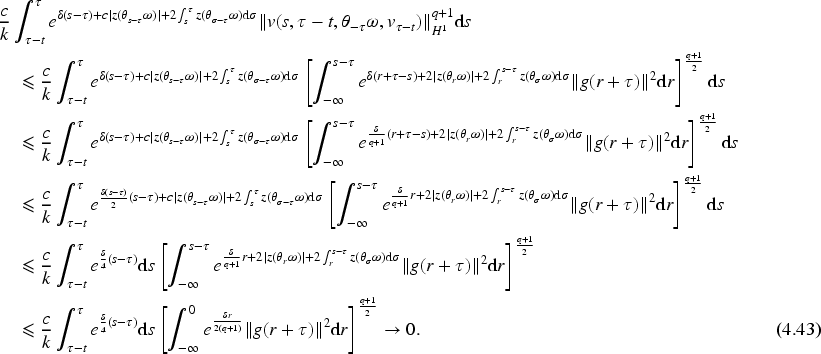
as . For the last term on the right-hand side of (4.39), we get from (4.4) in Lemma 4.1 and (3.12) that there exists such for as ,
By (4.39)–(4.43) we know that for given , there exist and such that for all and ,
which combined with the property of the function implies that
This completes the proof of Lemma 4.4.
Uniform Estimates on Spectral Projections of Solutions in Bounded Domains
In order to prove the asymptotic compactness of the solution operators, we also need to establish the uniform estimates of the solutions of (3.3) in bounded domains. Let , where is the function given in (4.20). Fix and let for . Then and
Note that
Multiplying equation (3.3) by and applying the relations of (4.45), we get
Consider the eigenvalue problem:
Then, the eigenvalue problem (4.47) has a family of eigenfunctions with corresponding eigenvalues such that is an orthonormal basis of and
Given , let and be the projection operator.
We have the following uniform estimates in .
For every , , , , and , there exist and , such that and , we have
where and .
Denote by . Applying to Equation (4.46) and then taking the inner product of the resulting equation with in , we obtain that
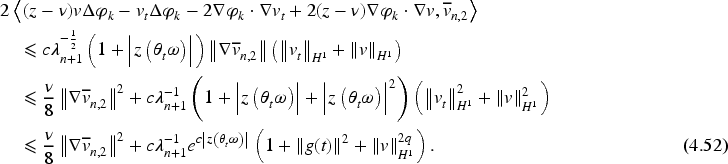
Now, we estimate all the terms on the right-hand side of (4.49). For the first term, by (4.14) and we get
For the second term, we get from the Young’s inequality that
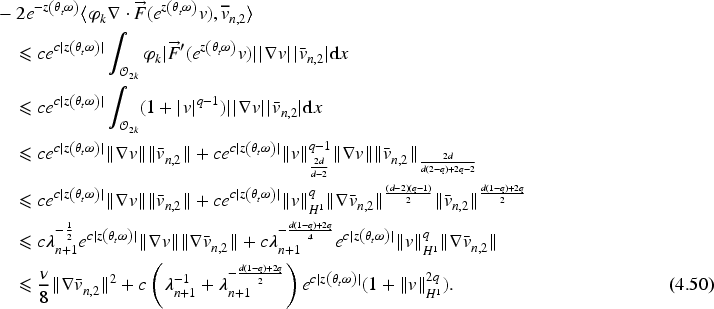
Similarly, by Lemma 4.3 and , we find that the last term on the right-hand side of (4.49) satisfies
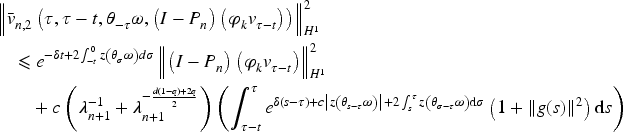
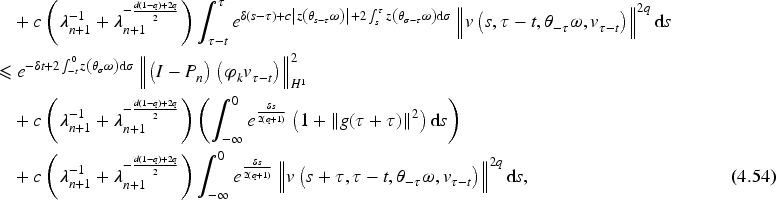
where . Hence, the Gronwall lemma over (4.53) and integrating over with , we get that
where the last term is obtained by the argument of (4.43).
By with we find that as ,
Note that as . Then exist and , such that and , we have
Existence and Uniqueness of Pullpack Random Attractors
Based on the results established in the previous subsections, we now prove the -pullback asymptotic compactness of solutions to (3.3) in .
For , , and the sequence of solutions of Equation (3.3) has a convergent subsequence in .
Let be an arbitrary number. By Lemma 4.4, there are and such that for all ,
By Lemma 4.5 with , there exists such that for all ,
where with . In addition, by Lemma 4.1 we know that there exists such that for all ,
where . By (4.44) and (5.3) we find that for all ,
Note that (5.4) shows that the sequence is bounded in the finite dimensional space , and thus it is precompact in . This fact combined with (5.2) means that is precompact in . By the definition of we know that in , and hence is precompact in , which together with (5.1) shows that is precompact in , so it’s easy to know that is also precompact.
The NRDS associated with the Equation (3.3) has a unique -pullback random attractor in . So we know for the NRDS associated with the problem (1.1) has a unique -pullback random attractor in . If, in addition, there exists such that in for , then the attractor is also -periodic, that is, for all and .
Note that is -pullback asymptotically compact in by Lemma 5.1, has a closed -pullback absorbing set by Lemma 4.2. As a result, the existence, uniqueness, and periodicity of the -pullback random attractor of in follow from Proposition 2.6 immediately.
All authors reviewed the final version of the manuscript.
Funding
The authors received the following financial support for the research, authorship, and/or publication of this article: This work was supported by the National Natural Science Foundation of China (12301299, 12426606, 12161019), the Guiyang City Science and Technology Plan Project ([2024]2-17), the Natural Science Research Project of Guizhou Provincial Department of Education (QJJ[2024]322,QJJ[2023]011), the Young Elite Scientist Sponsorship Program (GASTYESS202403), the Guizhou Provincial Basic Research Program (Natural Science) (QKHJC-MS[2025]279, QKHJC-ZK [2022]YB318).
Declaration of Conflicting Interests
The authors declared no potential conflicts of interest with respect to the research, authorship, and/or publication of this article.
Data Availability
No data was used for the research described in the article.
References
1.
AstaburuagaM. A.BisogninE.BisogninV.FernandezC. (1998). Global attractors and finite dimensionality for a class of dissipative equations of BBM’s type. Electron Journal of Differential Equations, 25, 1–14.
2.
AvrinJ.GoldsteinJ. A. (1985). Global existence for the Benjamin-Bona-Mahony equation in arbitrary dimensions. Nonlinear Analysis, 9, 861–865.
3.
BabinA. V.VishikM. I. (1992). Attractors of evolution equations. North-Holland, Amsterdam.
4.
BallJ. M. (1997). Continuity properties and global attractors of generalized semiflows and the Navier-Stokes equations. Journal of Nonlinear Science, 7, 475–502.
5.
BallJ. M. (2004). Global attractors for damped semilinear wave equations. Discrete and Continuous Dynamical Systems, 10, 31–52.
6.
BenjaminT. B.BonaJ. L.MahonyJ. J. (1972). Model equations for long waves in nonlinear dispersive systems. Philosophical Transactions of the Royal Society of London. Series A. Mathematical and Physical Sciences, 272, 47–78.
7.
CaraballoT.LangaJ. A.MelnikV. S.ValeroJ. (2003). Pullback attractors for nonautonomous and stochastic multivalued dynamical systems. Set-Valued and Variational Analysis, 11, 153–201.
8.
CaraballoT.LangaJ. A.ValeroJ. (2001). Global attractors for multivalued random dynamical systems generated by random differential inclusions with multiplicative noise. Journal of Mathematical Analysis and Applications, 260, 602–622.
9.
CelebiA. O.KalantarovV. K.PolatM. (1999). Attractors for the generalized Benjamin-Bona-Mahony equation. Journal of Differential Equations, 157, 439–451.
10.
ChenP.WangB.WangR.ZhangX. (2023). Multivalued random dynamics of Benjamin-Bona-Mahony equations driven by nonlinear colored noise on unbounded domains. Mathematische Annalen, 386, 343–373.
11.
ChenP.WangR.ZhangX. (2024). Asymptotically autonomous robustness of random attractors for 3D BBM equations driven by nonlinear colored noise. SIAM Journal on Mathematical Analysis, 56, 254–274.
12.
ChueshovI.PolatM.SiegmundS. (2004). Gevrey regularity of global attractor for generalized Benjamin-Bona-Mahony equation. Mathematical Physics Analysis And Geometry, 11, 226–242.
13.
CrauelH.FlandoliF. (1994). Attractors for random dynamical systems. Probability Theory and Related Fields, 100, 365–393.
14.
FlandoliF.SchmalfußB. (1996). Random attractors for the 3D stochastic Navier-Stokes equation with multiplicative noise. Stochastics and Stochastics Reports, 59, 21–45.
15.
FriedmanA. (1969). Partial differential equations. Holt, Reinhart and Winston.
16.
HaleJ. K. (1988). Asymptotic behavior of dissipative systems. American Mathematical Society, Providence, Rhode Island.
17.
HaoJ.CaraballoT. (2025). Solvability and convergence results for the temperature and concentration field in incompressible Navier-Stokes equations with boundary conditions. Journal of Differential Equations, 450, 113735.
18.
KinraK.MohanM. T. (2022). Weak pullback mean random attractors for the stochastic convective Brinkman-Forchheimer equations and locally monotone stochastic partial differential equations. Infinite Dimensional Analysis. Quantum Probability and Related Topics, 25, 2250005.
19.
KinraK.MohanM. T. (2024). Random attractors and invariant measures for stochastic convective Brinkman-Forchheimer equations on 2D and 3D unbounded domains. Discrete and Continuous Dynamical Systems-B, 29, 377–425.
20.
LiY.WangR. (2018). Random attractors for 3D Benjamin-Bona-Mahony equations derived by a Laplace-multiplier noise. Stochastics and Dynamics, 18, 1850–004.
21.
RobinsonJ. C. (2001). Infinite-dimensional dynamical systems. Cambridge University Press.
22.
StanislavovaM.StefanovA.WangB. (2005). Asymptotic smoothing and attractors for the generalized Benjamin-Bona-Mahony equation on . Journal of Differential Equations, 219, 451–483.
23.
TemamR. (2024). Navier-Stokes Equations: Theory and numerical analysis. American Mathematical Society.
24.
WangB. (1999). Attractors for reaction-diffusion equations in unbounded domains. Physica D: Nonlinear Phenomena, 128, 41–52.
25.
WangB. (2009). Random attractors for for the stochastic Benjamin-Bona-Mahony equation on unbounded domains. Journal of Differential Equations, 246, 2506–2537.
26.
WangB. (2012). Sufficient and necessary criteria for existence of pullback attractors for non-compact random dynamical systems. Journal of Differential Equations, 253, 1544–1583.
27.
WangR.CaraballoT.NguyenH. T. (2024). Mean attractors and invariant measures of locally monotone and generally coercive SPDEs driven by superlinear noise. Journal of Differential Equations, 381, 209–259.
28.
WangR.CaraballoT.TuanN. H. (2023). Asymptotic stability of evolution systems of probability measures for nonautonomous stochastic systems: Theoretical results and applications. Proceedings of the American Mathematical Society, 151, 2449–2458.
29.
WangR.ChenP.WangB. (2025). Asymptotic behavior of weakly dissipative fractional wave equations driven by superlinear colored noise on . The Journal of Geometric Analysis, 35, 1–51.
30.
WangR.GuoB.LiuW.NguyenD. T. (2024). Fractal dimension of random invariant sets and regular random attractors for stochastic hydrodynamical equations. Mathematische Annalen, 389, 671–718.
31.
WangR.KinraK.MohanM. T. (2023). Asymptotically autonomous robustness in probability of random attractors for stochastic Navier-Stokes equations on unbounded poincaré domains. SIAM Journal on Mathematical Analysis, 55, 2644–2676.
32.
WangR.LiY. (2020). Asymptotic autonomy of random attractors for BBM equations with Laplace-multiplier noise. Journal of Applied Analysis and Computation, 10, 1199–1222.
33.
WangR.LiD.GuoB. (2025). Pullback asymptotic compactness and asymptotically autonomous robustness of non-autonomous Klein-Gordon-Schrödinger system on unbounded domains. International Mathematics Research Notices, 12, rnaf171.
34.
ZhaoC.CaraballoT. (2019). Asymptotic regularity of trajectory attractor and trajectory statistical solution for the 3D globally modified Navier-Stokes equations. Journal of Differential Equations, 266, 7205–7229.
35.
ZhaoC.LiY.CaraballoT. (2020). Trajectory statistical solutions and Liouville type equations for evolution equations: Abstract results and applications. Journal of Differential Equations, 269, 467–494.