




Abstract
This study sought to explore the neural and affective responses to exercise- and sedentary-related imagery among Latin Americans and Non-Hispanic Whites with overweight and obesity, aiming to understand the influence of cultural background on exercise behaviors. Using electroencephalography, the research investigates differences in directional brain connectivity patterns and emotional reactions between the two groups. Participants were shown images depicting exercise and sedentary behaviors, with affective responses recorded via the Self-Assessment Manikin and neural connectivity assessed using Granger Causality Analysis. Results indicate significant differences in brain connectivity between groups and conditions. Non-Hispanic Whites showed stronger connectivity within frontal-parietal networks during exercise imagery, while Latin Americans displayed more distributed connectivity during sedentary imagery, suggesting different neural engagement strategies. Affective data revealed that participants reported higher valence for exercise-related images, with Latin Americans exhibiting higher perceived activation for sedentary images. Qualitative analysis of semi-structured interviews identified key themes, including family support, motivation to exercise, and time constraints. Both groups emphasized the importance of social influences on physical activity; however, Latin Americans expressed more ambivalence toward exercise. Network analysis of interview data further highlighted the complex interplay between these psychosocial factors. This study provides novel insights into how cultural differences shape both neural and emotional responses to exercise, informing the development of culturally tailored interventions to promote physical activity in populations with higher obesity prevalence.
Introduction
Overweight and obesity have emerged as global health crises, affecting millions and significantly contributing to the rise of life-threatening conditions such as heart disease, diabetes, and certain types of cancers (Blüher, 2019). This growing epidemic is fueled by a complex web of factors, including genetic predispositions, urbanization, socioeconomic disparities, and shifts in dietary patterns and physical activity levels. Sedentary lifestyles, the overconsumption of highly processed foods, and limited access to healthy options further exacerbate the problem, especially in lower-income and minority populations (Koliaki et al., 2023). As the prevalence of obesity skyrockets, the strain on healthcare systems intensifies, highlighting the urgent need for comprehensive, multifaceted interventions. Understanding the intricate causes of obesity, from individual behaviors to broader societal influences, has become a central focus for healthcare providers and researchers, driving efforts to develop targeted strategies that not only treat obesity but also prevent it from taking root (Temple, 2022).
A key factor contributing to overweight and obesity is the lack of regular physical activity (Wiklund, 2016). Sedentary lifestyles have become increasingly prevalent in both developed and developing nations and play a significant role in this trend (Myers et al., 2017). The shift toward more screen-based entertainment, desk-bound jobs, and reliance on motorized transport has drastically reduced daily physical movement (Cassidy et al., 2017). Research consistently shows a strong inverse relationship between physical activity and elevated body mass index, with individuals who engage in regular exercise being far less likely to suffer from obesity-related conditions (Brittain et al., 2024; Cleven et al., 2020; Gray et al., 2018). Regular physical activity not only helps to burn calories but also plays a crucial role in regulating metabolic function, improving cardiovascular health, and enhancing overall well-being (Warburton et al., 2006). Despite these known benefits, many populations, particularly in urban environments, struggle to incorporate sufficient exercise into their routines, further compounding the obesity crisis (Guthold et al., 2018). This underscores the need for public health interventions that promote physical activity as a key component of obesity prevention and management.
Perceptions of exercise and sedentary behavior can significantly shape individuals’ willingness and ability to engage in physical activity, directly influencing their capacity to adopt healthier behaviors (Bourke et al., 2024). Many people, especially those struggling with being overweight or obese, often perceive exercise as intimidating, time-consuming, or even unattainable due to physical limitations or lack of motivation. In contrast, sedentary activities, such as watching television or browsing the internet, are viewed as more convenient and less demanding (Koh et al., 2022). These perceptions can create psychological barriers that discourage regular physical activity, making it more difficult to break free from the cycle of inactivity (Cheval & Boisgontier, 2021). Furthermore, cultural attitudes and societal norms about body image and fitness can either motivate or deter individuals from pursuing a more active lifestyle (Merino et al., 2024). Misconceptions about the effectiveness of exercise, combined with the allure of sedentary comfort, often result in resistance to behavior change. Addressing these perceptions is crucial in designing interventions that not only educate individuals on the benefits of physical activity but also reshape attitudes toward exercise, making it more accessible and appealing as a sustainable lifestyle choice (Salvatierra-Calderón et al., 2024).
Sociocultural background plays a pivotal role in shaping perceptions of exercise, physical activity, and sedentary behavior, influencing both individual behaviors and the broader prevalence of overweight and obesity (Rio & Saligan, 2023). Cultural norms, values, and traditions can shape what is considered acceptable or desirable regarding body image, fitness, and health (Merino et al., 2024). In some cultures, physical activity may not be prioritized, or even seen as necessary, especially in communities where larger body sizes are associated with prosperity, strength, or beauty. Conversely, other cultures may emphasize a slim or athletic physique, thereby encouraging more active lifestyles (Abdoli et al., 2024; Guo et al., 2023). Socioeconomic status also influences access to opportunities for exercise; individuals in lower-income communities often have limited access to safe recreational spaces or affordable fitness programs, leading to higher rates of inactivity (Bantham et al., 2021). Additionally, societal expectations regarding gender roles can affect physical activity levels, with women in some cultures facing more constraints in their ability to engage in exercise due to household duties or social stigma (Hallal et al., 2012). These sociocultural factors can create a complex environment that shapes how individuals perceive and engage in physical activity, often leading to higher obesity rates among certain populations (Alemán et al., 2023; Rio & Saligan, 2023).
The present study was motivated by the need to deepen our understanding of the factors that may contribute to disparities in overweight and obesity among Latin American populations in the U.S. when compared to Non-Hispanic Whites (Alemán et al., 2023; Hales et al., 2018). In U.S. health surveillance, Hispanic/Latino origin is defined as an ethnicity and includes individuals of Mexican, Puerto Rican, Cuban, Central or South American, Dominican, or other Latin American/Spanish origin, regardless of race (Office of Management and Budget, 1997). Accordingly, in the present study, Latin American refers to participants who self-identified as Latino, whereas non-Hispanic White refers to participants who self-identify as White (i.e., having origins in any of the original peoples of Europe, the Middle East, or North Africa) and do not identify as Latino (e.g., Echeverría et al., 2019; Hales et al., 2018). Research suggests that while the benefits of physical activity are widely acknowledged across groups, cultural attitudes and priorities can influence how exercise is valued and integrated into daily life (Merino et al., 2024). For example, family obligations, work schedules, and economic factors can make regular physical activity less accessible for some Latin American individuals (Bantham et al., 2021). Additionally, perceptions of exercise may be shaped by cultural norms that emphasize immediate responsibilities over long-term health goals, potentially contributing to lower engagement in structured physical activity (Larsen et al., 2013). In contrast, Non-Hispanic Whites may have greater access to recreational facilities and more opportunities to prioritize individual health. However, it is important to note that these differences are not uniform across all Hispanic communities and may be influenced by factors such as acculturation, socioeconomic status, and personal health beliefs (Echeverría et al., 2019). Clarifying these nuanced differences is essential to developing culturally sensitive interventions to reduce obesity and promote healthier lifestyles across diverse populations.
Qualitative evidence further suggests that exercise-related perceptions and perceived barriers may differ by Latino vs. non-Hispanic White groups, although patterns appear to be context-specific rather than uniform across settings: for example, focus groups with pregnant Latina (e.g., Puerto Rican/Dominican) and non-Latina White women identified both shared barriers/facilitators (e.g., fatigue, safety concerns, and social support) and culturally patterned themes related to the meaning and feasibility of exercise (Marquez et al., 2009). Complementing these between-group comparisons, Latino-focused research consistently highlights perceived constraints that shape both exercise and sedentary behavior, including time scarcity, competing family and work demands, childcare responsibilities, fatigue, and neighborhood safety or limited access to recreational resources. This literature also notes that “physical activity” may be conceptualized broadly (e.g., occupational or household activity vs structured exercise) and that culturally tailored, family- and community-centered strategies may be particularly acceptable and feasible (Bautista et al., 2011; Larsen et al., 2013; Martinez et al., 2009; Mier et al., 2007).
Psychological correlates relevant to sedentary behavior have also been documented in large Hispanic/Latino cohorts. In the HCHS/SOL Sociocultural Ancillary Study, Vásquez et al. (2016) examined whether chronic and lifetime traumatic stress exposures were associated with daily sedentary time assessed both objectively and via self-report. In adjusted models, greater stress exposure, particularly multiple chronic stressors and/or multiple lifetime traumatic stressors, was associated with higher objectively measured sedentary minutes per day, with no evidence of effect modification by age or sex. These findings support the view that perceptions and engagement in physical (in)activity are embedded in broader sociocultural and psychosocial contexts; however, the mechanisms through which exercise- and sedentary-related cues are processed in real time, and whether this processing differs across cultural groups, remain insufficiently characterized. Notably, empirical work examining the neural correlates of exercise- and sedentary-related cue processing in Hispanic/Latino populations, and especially direct comparisons with non-Hispanic White adults, appears limited. Consequently, it remains unclear whether culturally patterned perceptions of physical (in)activity are reflected in differences in real-time neural processing of exercise versus sedentary cues. In the present study, we examined directional electroencephalography (EEG) connectivity patterns across large-scale brain networks implicated in motivation, cognitive control, salience detection, self-referential processing, and action preparation (e.g., frontoparietal, default mode, salience, sensorimotor, and limbic systems), which have been theoretically linked to affective and motivational responses to exercise-related stimuli (Bigliassi & Filho, 2022; Schimmelpfennig et al., 2023; Pan et al., 2018).
The literature on physical activity- and exercise-related perceptions has relied predominantly on self-report measures, which may be limited in their ability to index real-time neural processing of exercise- and sedentary-related cues. Accordingly, the present study integrates neurophysiological and subjective approaches by examining directional brain connectivity while participants view images depicting exercise and sedentary behaviors. EEG provides time-sensitive indices of neural dynamics during stimulus processing, allowing investigation of how distributed brain regions communicate during the perception of exercise- and sedentary-related cues. In this sense, network-level dynamics are indirectly assessed by quantifying directional connectivity between electrode sites, providing an objective complement to subjective reports (Bigliassi & Filho, 2022). To further broaden interpretability, we combine EEG indices with self-reported affective responses and qualitative analyses of participants’ perceptions, aiming to characterize exercise- and sedentary-related processing at multiple levels of analysis.
By exploring how this population views exercise and sedentary behavior, we aimed to investigate the neural and affective responses to exercise and sedentary stimuli in Latin Americans and Non-Hispanic Whites with overweight and obesity. The primary focus was on examining differences in brain connectivity patterns and affective states across these groups. First, we hypothesized that directional connectivity patterns would differ between exercise and sedentary stimuli. We expected to observe distinct patterns of connectivity across brain networks, including the frontoparietal network and the default mode network, when participants viewed images depicting exercise versus sedentary behaviors. These networks are implicated in functions related to motivation, attention, and self-referential processing, which may be differentially engaged by exercise and sedentary stimuli (Bigliassi & Filho, 2022). It is also important to emphasize that the exact (in)activity of these neural networks is not directly assessed using EEG; instead, it is inferred from the degree of directional connectivity between electrode sites. Second, the study explored the association between affective states and brain connectivity patterns during the observation of exercise and sedentary images. While the exact nature of this correlation is not fully predictable, we anticipated that variations in affective responses would be reflected in changes in connectivity between specific networks (Schimmelpfennig et al., 2023). For instance, higher arousal during exercise images may be linked to increased connectivity within the salience and sensorimotor networks. The salience network is crucial for detecting and integrating emotionally relevant stimuli, while the sensorimotor network prepares the body for potential action (Bigliassi & Filho, 2022). This relationship may indicate how emotionally engaging exercise imagery can prime the brain for physical activity.
Third, this research examined whether there are any differences in connectivity patterns in response to exercise and sedentary stimuli between Latin Americans and Non-Hispanic Whites. Given cultural differences in perceptions of exercise, the two groups may exhibit distinct patterns of connectivity within networks such as the frontoparietal network, involved in goal-directed behavior, and the limbic network, associated with emotional processing (Pan et al., 2018). However, this hypothesis is exploratory, as the specific influence of cultural factors on these neural dynamics in the context of overweight and obesity remains unclear. Fourth, we aimed to explore the response times in reporting affective states following the observation of exercise and sedentary images. Response times may vary not only between exercise and sedentary stimuli but also between the two groups. Such variation may reflect differences in the activation of the executive control network, which regulates attention and processes conflicting information (Xuan et al., 2016). Longer response times could indicate greater cognitive and emotional conflict related to physical activity, as the brain works to reconcile different motivational and emotional signals. Finally, we explored the influence of cultural perceptions on brain connectivity patterns, with an emphasis on understanding how participants’ cultural backgrounds may shape their neural responses to exercise and sedentary imagery. We hypothesized that cultural differences could modulate connectivity between key networks involved in motivation and cognitive control, such as the frontoparietal and limbic networks (Han & Humphreys, 2016; Park & Huang, 2010). Specifically, we anticipated that these cultural influences may affect the integration of external goals with internal motivational states within the frontoparietal network, while also modulating the emotional processing functions of the limbic network. To further investigate these dynamics, we incorporated a qualitative analysis component that explores participants’ subjective perceptions and attitudes toward physical activity and sedentary behavior. This approach was intended to provide insights into how cultural attitudes are linked to variations in brain connectivity patterns. However, given the complexity and multiplicity of cultural influences on neural processes, this hypothesis remains exploratory, and we acknowledge the challenges in capturing the full spectrum of these influences.
Method
Participants
A total of twenty participants (n = 11 Latin Americans and n = 9 Non-Hispanic Whites) with a Body Mass Index (BMI) of 25 kg/m2 or higher were recruited to complete the study. Participants ranged in age from 19 to 33 years and were classified as either sedentary or physically inactive based on their self-reported physical activity levels assessed using the International Physical Activity Questionnaire – Short Version (Craig et al., 2003). No significant differences were observed between groups in terms of sex distribution (Latin Americans: 6 males and 5 females; Non-Hispanic Whites: 4 males and 5 females; χ2 = .202, p = .653). In addition, no significant differences were detected in participants’ demographic variables across groups (see Table 1). Recruitment was conducted through targeted advertisements in local community centers and universities, on social media platforms, and through flyers distributed in areas frequented by the specified ethnic groups. Participants were excluded if they were unable to comprehend the study protocol, had major vision-related conditions that would prevent them from viewing images on a monitor, or had epilepsy or any other neurological conditions that could compromise the fidelity of the EEG data. Further exclusion criteria included current participation in a structured exercise program and the use of medications that might influence neurological activity, thereby minimizing potential confounding variables. Each participant provided informed consent prior to their involvement in the study and received a $30 Amazon E-gift card as compensation for their time and participation. The study protocol was approved by the Institutional Review Board, ensuring adherence to ethical standards for the protection of human subjects.
Characteristics of Participants.
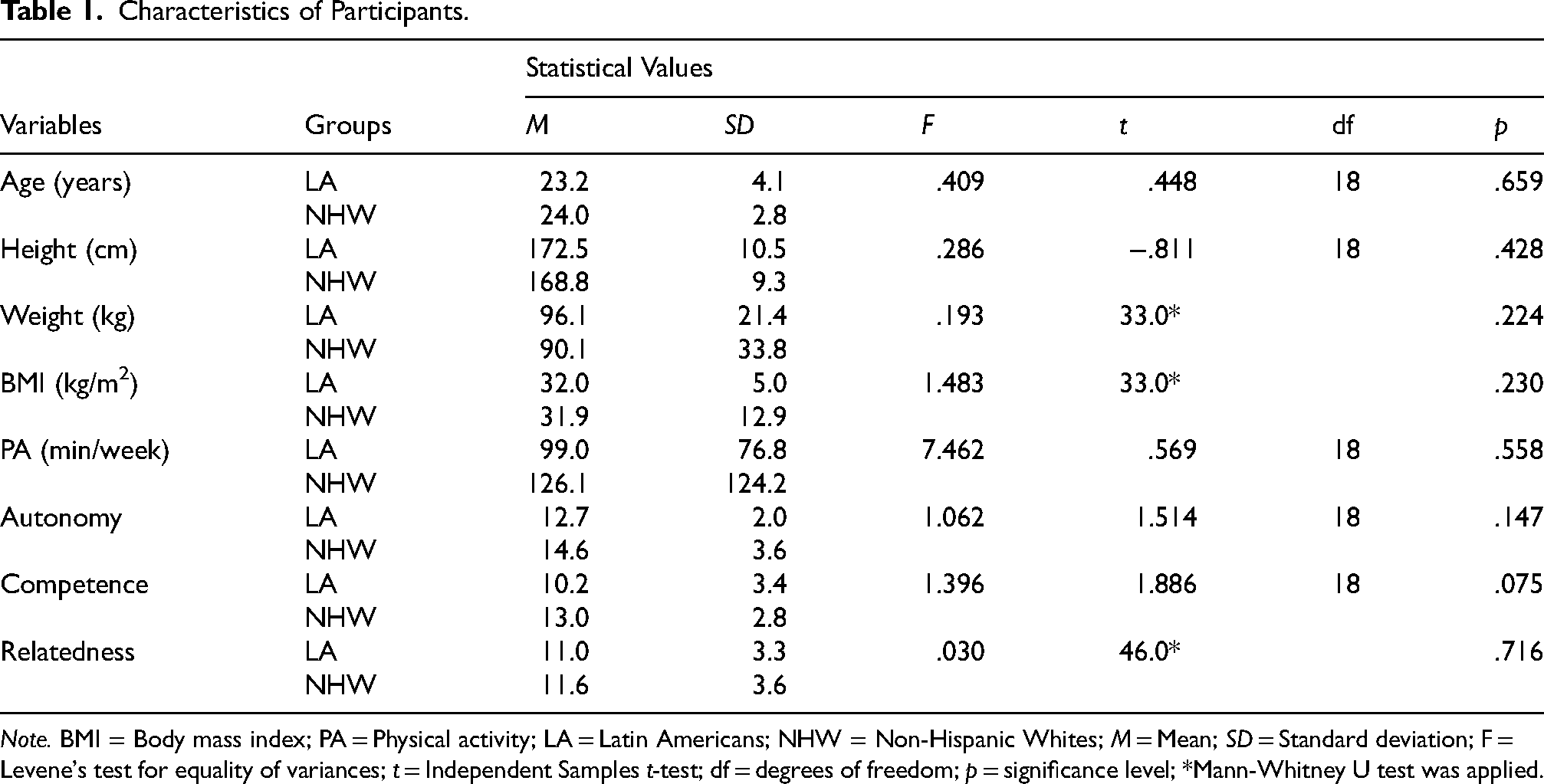
Note. BMI = Body mass index; PA = Physical activity; LA = Latin Americans; NHW = Non-Hispanic Whites; M = Mean; SD = Standard deviation; F = Levene's test for equality of variances; t = Independent Samples t-test; df = degrees of freedom; p = significance level; *Mann-Whitney U test was applied.
Procedures
Upon arrival, participants were seated comfortably in a designated area and provided with the consent form, which they were asked to read at their own pace. Researchers were available to answer any questions throughout the session. Following consent, participants completed a series of questionnaires, including socio-demographic and anthropometric assessments, as well as the Basic Psychological Needs in Exercise Scale to evaluate their perceptions of physical activity (Vlachopoulos & Michailidou, 2006). To facilitate familiarity with the experimental task and ensure consistent, automatic responses, participants underwent a familiarization procedure. This entailed presenting them with five positive and five negative images designed to acclimate them to the affective reporting process. The positive and negative images were carefully selected to represent a range of emotionally evocative stimuli, thereby helping participants understand the nature of the subsequent tasks and minimizing potential variability in responses due to unfamiliarity with the assessment protocol (see Supplementary Material 1).
Subsequently, participants underwent EEG data collection. A noninvasive EEG cap (SmartingMobi) with 24 electrodes was placed on each participant's head, and conductive gel (Electro-Gel) was applied to enhance electrical conductance between the scalp and electrodes. The EEG cap was configured according to the 10–20 International System. Participants were instructed to remain seated and relaxed during the EEG recording to minimize movement artifacts. Participants were then presented with a series of images on a computer monitor using E-Prime software (3.0.3.80). The image set included exercise-related pictures (e.g., a person running) and sedentariness-related images (e.g., a person watching TV). Images were selected to depict common, ecologically valid representations of exercise and sedentary behavior that would be readily interpretable by adults with overweight/obesity. To ensure clear categorization of stimuli, three independent members of the research team reviewed a pool of candidate images and rated each image for whether it unambiguously depicted the intended condition (exercise vs sedentary) and was appropriate for the study population. Only images with full agreement were retained; any disagreements were resolved through discussion and consensus. Normative valence and arousal ratings were not available for this stimulus set; accordingly, the study was designed to test whether exercise- and sedentary-related cues elicit differential affective and neural responses rather than to balance conditions based on standardized affective norms. The two sets of images were randomly assigned using computer-generated randomization, with some participants starting with exercise-related images and others starting with sedentary-related images. Each image served as a visual stimulus (see Supplementary Material 2), displayed for 5 s, followed immediately by the Self-Assessment Manikin (SAM), with each scale remaining on the screen for 5 s. This was followed by 1.5 s of feedback, confirming that the participant's response was recorded. The total interval between stimuli was 18 s. Participants were asked to report their affective states using the SAM, a psychological instrument designed to measure affective responses to sensory stimuli (Bradley & Lang, 1994). The SAM was used to capture two dimensions of affect, valence (pleasure) and arousal (psychological activation), and was selected because it provides a rapid, language-minimal assessment of these affective responses. From the SAM, we extracted scores for affective responses and recorded the response time for each assessment to analyze the immediacy and consistency of participants’ emotional reactions to the exercise-related and sedentariness-related images. After viewing all images, the EEG cap was removed, and participants were provided with a towel to clean their heads. A semi-structured interview followed, during which participants discussed their perceptions of exercise and their emotional reactions to the images presented.
EEG Data Collection and Analysis
The EEG signals were digitized at a sampling rate of 500 Hz and amplified by 1,000 to ensure precise measurement of brain activity. To maintain data integrity, impedance levels were kept below 10 kΩ for all electrodes, minimizing electrical noise and ensuring reliable signal acquisition. During data collection, an online bandpass filter ranging from 0.1 to 1000 Hz was applied to capture a broad spectrum of neural activity, while a notch filter at 60 Hz was used to effectively reduce the influence of electrical power-line artifacts. The M1 and M2 electrode sites served as digital references for the electrical signals, providing a stable baseline for accurate measurements. Data preprocessing began with importing EEG signals into Brainstorm. Initial quality checks involved the identification and exclusion of bad electrodes and segments contaminated by electrical interference (Antonio & Bigliassi, 2025). Additionally, the EEG data underwent DC-offset correction to eliminate voltage imbalances, thereby preventing distortions in the recorded signals. Trials containing at least one electrode with an amplitude exceeding 200 μV were discarded to eliminate potential artifacts from muscle movements or external electrical sources. Vertical eye movements were detected and removed using independent component analysis and signal-space projection, effectively isolating and eliminating artifacts from eye blinks and movements (Antonio & Bigliassi, 2025). The cleaned EEG data were then subjected to an offline bandpass filter between 0.5 and 30 Hz. Sixty EEG trials were extracted and segmented into epochs ranging from −200 ms to 2 s relative to each image stimulus presentation. The pre-stimulus period (−200 ms to 0 ms) served as a baseline to account for any ongoing neural activity, ensuring that the post-stimulus measurements accurately reflect the brain's response to the visual stimuli. During the 2-s post-stimulus phase, we focused on cognitive processes such as emotional evaluation, attentional engagement, and memory encoding. This timeframe allows for the capture of immediate affective reactions and the subsequent neural mechanisms involved in processing the emotional content of the images.
Granger Causality Analysis was conducted in the time domain to evaluate the directional interactions between all EEG electrode sites. Granger Causality is a statistical method that determines whether past values of one time series can predict future values of another, thereby inferring a directional influence or information flow between electrodes. This approach was selected due to its robustness in assessing effective connectivity, which refers to the influence that one neural system exerts over another, providing a deeper understanding of the dynamic interactions within the brain during cognitive and emotional processing. Granger Causality offers several advantages for analyzing EEG data in this study. Unlike traditional connectivity measures that capture only the strength of synchronization or correlation between signals, Granger Causality provides insights into the directionality of interactions, allowing researchers to discern not only whether, but also how information flows between brain regions. This is particularly valuable for elucidating the temporal dynamics of neural networks engaged when participants are exposed to exercise-related versus sedentariness-related images. By understanding the directional flow of information, we can infer which brain regions may be driving or responding to the processing of these stimuli, thereby uncovering the underlying neural mechanisms that differentiate responses based on cultural or ethnic backgrounds.
To perform the Granger Causality Analysis, vector autoregressive models were fitted to the EEG time series data for each epoch corresponding to image stimuli. To select the appropriate autoregressive model order for our Granger Causality Analysis of EEG signals sampled at 500 Hz, we evaluated model orders from 1 to 50 using both the Akaike Information Criterion and the Bayesian Information Criterion. These criteria help in identifying the model order that provides the best balance between model complexity and explanatory power without overfitting the data. To ensure numerical stability, the noise covariance matrix was regularized by adding a small value to its diagonal before computing its determinant. Our analysis revealed that both the Akaike Information Criterion and Bayesian Information Criterion consistently favored a model order of 1, indicating that a first-order autoregressive model provided the optimal balance for capturing the relevant dynamics in the EEG data. This selection aligns with the need to incorporate sufficient temporal information while avoiding overfitting, thereby enhancing the reliability of our connectivity estimates.
Semi-Structured Interview and Qualitative Analysis
Following the EEG data collection and affective assessments, participants engaged in a semi-structured interview designed to explore their perceptions of exercise and sedentary behavior. Upon initiating the interview, the researcher introduced herself, explained the purpose of the interview, and obtained verbal consent before proceeding with a series of predetermined open-ended questions (see Supplementary Material 3). These questions were strategically selected to explore various dimensions of participants’ relationships with physical activity and sedentary behavior, including emotional responses, personal habits, self-perception, motivations, barriers, and social influences.
The semi-structured interview format allowed flexibility for deeper exploration of participants’ experiences while maintaining consistency across interviews. This approach facilitated the collection of detailed qualitative data, complementing the quantitative EEG and affective response measurements. By allowing participants to express their thoughts and feelings in their own words, the interviews helped uncover underlying motivations, beliefs, and attitudes towards exercise and sedentary lifestyles that may not be fully captured through standardized questionnaires. All interviews were audio-recorded with participants’ consent, and the recordings were subsequently transcribed verbatim. Transcriptions were reviewed for accuracy by the research team, and identifying information was anonymized to maintain participant confidentiality. Python scripts were used for data preprocessing and preliminary analyses to support the integration of qualitative and quantitative findings.
The transcribed interview data underwent thematic analysis, following the six-phase framework proposed by Braun and Clarke (2006): 1) Familiarization with the Data: Researchers immersed themselves in the transcripts by reading and re-reading the data to gain a comprehensive understanding, 2) Generating Initial Codes: Systematic coding was performed using both inductive and deductive approaches, assigning initial codes to significant features of the data, 3) Searching for Themes: Codes were organized into broader patterns, identifying potential main categories, 4) Reviewing Main Categories: Themes were refined and validated against the data to ensure accurate representation of underlying meanings, 5) Defining and Naming Main Categories: Each theme was clearly defined and named, and 6) Producing the Report: The final themes were integrated into a coherent narrative supported by illustrative quotes from participants. To enhance the reliability and validity of the qualitative analysis, multiple researchers independently coded a subset of transcripts to ensure consistency, with discrepancies resolved through consensus. Additionally, findings from the interviews were cross validated with the quantitative EEG and affective response data, providing a comprehensive understanding of participants’ experiences. A subset of participants was also engaged in member checking to verify the accuracy and resonance of the interpretations.
Data Collection, Transcription, and Preprocessing
The audio responses were transcribed using Google Speech Recognition through the `speech recognition` Python library. This library provides easy integration with Google's speech-to-text API, allowing efficient transcription of spoken language into text with high accuracy. To match participant responses with corresponding questions, a pre-trained BERT model (`deepset/bert-base-cased-squad2`), accessed through Hugging Face's `transformers` library, was used. BERT (Bidirectional Encoder Representations from Transformers) is a state-of-the-art natural language processing model that captures the context of words in relation to others in a sentence. This model was particularly useful for handling incomplete or noisy audio inputs, ensuring accurate mapping between questions and responses. Once transcriptions were obtained, they were preprocessed using the Natural Language Toolkit (`nltk`). These preprocessing steps were critical for ensuring that the subsequent analyses, such as sentiment analysis and classification, were performed on clean, standardized data.
Thematic Category Selection and Response Classification
The thematic categories used to classify participant responses were derived from a combination of a literature review, expert consultation, and participants’ data. While the literature and experts helped in identifying broad, well-established themes such as family support, motivation, and time constraints, new themes also emerged directly from the participants’ responses. This approach allowed the analysis to remain flexible and sensitive to participants’ unique perspectives and experiences. A final set of thematic categories was established, reflecting both the common barriers, motivations, and experiences associated with exercise and novel insights from the participant data. The categories included: 1) Family Support, 2) Negative Feelings Toward Exercise, 3) (de)Motivation to Exercise, 4) Time Constraints, 5) Health Benefits, 6) Mental Well-being, 7) Social Influence/Support, 8) Physical Barriers, 9) Transportation Issues, and 10) Other. Each participant's response was classified into one or more categories based on keyword matching. Specific keywords for each category were identified, and responses were categorized according to their relevance to those keywords. When a response matched multiple categories, it was assigned to the most relevant one by evaluating keyword frequency and context.
Network Analysis of Thematic Categories
To further understand the relationships among the thematic categories identified from participant responses, directed network graphs were constructed using `networkx`, a Python library for creating, manipulating, and studying complex networks. Each thematic category was represented as a node, and directed edges between nodes reflected co-occurrence and directional influence. The edge weights quantified the strength of these relationships based on how frequently participants mentioned two categories together. For example, if many participants mentioned “Family Support” alongside “Motivation to Exercise,” a directed edge would be drawn between these categories, and its weight would reflect the frequency of co-occurrence. These edges did not emerge from the software itself but were manually defined based on how frequently participants mentioned two categories together. The edge weights represented the strength of these relationships, with higher values indicating more frequent co-occurrences. Additionally, the direction of influence between nodes was determined through qualitative analysis of the data, in which researchers identified which categories exerted influence on others. The positioning of the nodes in the visualizations was handled by layout algorithms in `networkx`, such as `spring_layout()`, which aimed to minimize overlap and create a clear, interpretable graph. These networks visualized how different factors influencing exercise behavior were interconnected, providing deeper insights into the psychosocial dynamics at play.
To quantify the emotional tone of participant responses, sentiment analysis was conducted using the Valence Aware Dictionary and Sentiment Reasoner (VADER) tool from the `nltk` library. VADER is specifically designed to analyze social text and conversational language, making it ideal for the relatively informal, narrative responses of participants. VADER provides a compound sentiment score that reflects the overall emotional tone of a text, along with individual scores for negative, neutral, and positive sentiment. One of the strengths of VADER is its ability to account for context-dependent sentiment shifts, such as negation (e.g., “not good”) and intensity modifiers (e.g., “very good”). This made it particularly useful for capturing the nuanced emotional expressions in participant responses. These sentiment scores were then linked to the thematic network analysis to influence edge weights between nodes and provide a more comprehensive view of both the content and emotional tone of the responses.
Statistical Analysis
Data analysis commenced with screening for univariate outliers using standardized z-scores (|z| > 3.29; Tabachnick & Fidell, 2007). Subsequently, distributional assumptions were evaluated (Shapiro–Wilk), and when parametric assumptions were not adequately met, appropriate corrective steps (e.g., Box–Cox or natural log transformations) were applied as needed (Rasch & Guiard, 2004). These preprocessing steps were essential to ensure the integrity and reliability of the data, thereby facilitating accurate and valid statistical inferences. To evaluate the effects of different image types (exercise-related vs. sedentary-related) on both psychological and neural responses across the two distinct groups (Latin Americans and Non-Hispanic Whites), a mixed-design Analysis of Variance (ANOVA) was employed. This statistical approach incorporated image type as a within-subjects factor and ethnic background as a between-subjects factor, enabling the examination of both within-group and between-group effects as well as their interaction. To pinpoint specific condition differences, Bonferroni-adjusted pairwise comparisons were conducted to control for Type I error rates across multiple comparisons. The assumption of sphericity, a critical prerequisite for the validity of repeated-measures ANOVA, was evaluated using Mauchly's test. When the sphericity assumption was violated, Greenhouse-Geisser corrections were applied to adjust the degrees of freedom, thereby maintaining the robustness of the statistical results. To assess demographic differences between groups, either an independent samples t-test or the Mann-Whitney U test (for non-normally distributed data) was used. Statistical significance was set at p < .05 for the psychological responses.
Given the modest sample size and the exploratory nature of the study aims, we conducted a sensitivity analysis to estimate the minimum effect size with 80% power (α = .05) for the primary 2 × 2 mixed-design tests. For effects with df1 = 1 and df2 = 18 (consistent with the group, condition, and group × condition tests), the minimum detectable effect corresponded to Cohen's f = 0.66 (ηp2 = 0.31), indicating sensitivity primarily to large effects. For outcomes with reduced degrees of freedom (e.g., df2 = 14), the minimum detectable effect increased to f = 0.75 (ηp2 = 0.36). Accordingly, small-to-moderate interaction effects should be interpreted cautiously, whereas large effects are expected to be detectable with the present sample.
Connectivity strengths between pairs of electrodes were computed for each participant and condition, yielding a comprehensive connectivity matrix. Significant connections were identified using a threshold of p < .001 to control multiple comparisons and reduce the likelihood of Type I errors. Network analysis was performed to identify the main neural networks involved in processing the different image types. Centrality measures, such as degree centrality and betweenness centrality, were calculated to determine the importance of each node (electrode) within the network. Visualization of neural networks was achieved through interactive 3D network graphs that displayed the significant connections and their directionality between electrode sites. Edge colors and styles represented different effect types (Condition, Group, and Interaction), and legends were included to make the figures self-explanatory. These visualizations highlighted which group or condition had higher connectivity, providing insights into the neural mechanisms underlying the observed effects.
Several libraries in the Python ecosystem were used to process and analyze the data, providing a comprehensive, flexible environment for advanced analysis. The NumPy library provided efficient handling of large numerical datasets, enabling quick and precise array operations essential for data transformation and the preprocessing of EEG connectivity data. NumPy was also instrumental in implementing statistical operations, such as normalizing the connectivity strength data. The Pandas library, known for its robust data manipulation capabilities, was used to organize and structure the EEG connectivity data. For example, Pandas was critical in reshaping the EEG connectivity matrices into long format, which was necessary for statistical comparisons of connectivity strength across groups and conditions. For brain connectivity analysis, NetworkX was used. This powerful library enabled the construction and analysis of neural networks by representing EEG electrodes as nodes and the significant connections between them as edges. NetworkX facilitated the calculation of centrality measures, such as degree centrality and betweenness centrality, which were used to quantify the importance of each electrode within the neural network. These measures provided insights into which brain regions were most active or most influential for each ANOVA contrast. Additionally, NetworkX allowed for the construction of directed graphs to represent the directional flow of neural information between brain regions, as determined by Granger Causality Analyses. Visualization of these neural networks was performed using Plotly, a versatile graphing library that supports interactive 3D plots. Plotly's interactive features enabled the visualization of EEG connectivity networks in 3D, with connections between electrodes color-coded to reflect the significance of the findings. Comprehensive statistical analyses were conducted using MATLAB (R2024a), Jamovi (2.3.28), and Python (3.10.10).
Results
Initial Data Screening and Diagnostic Tests
The biological signals from two participants were removed from the dataset due to artifacts that compromised data fidelity. In addition, four univariates outliers were identified for affective valence, as well as two univariates’ outliers were identified for affective valence and perceived activation response time. Based on box plons, all outliers were removed from the dataset. The majority of the dependent variables presented a normal Gaussian curve, but some variables exhibited a non-normal distribution. In such cases, considering the shape of the curve, the best approach was used to normalize the distribution (i.e., Box-Cox and natural Log transformation). Additionally, some variables violated the assumption of sphericity, requiring the Greenhouse-Geisser correction to adjust the degrees of freedom. Finally, one audio file was corrupted and therefore could not be used in the qualitative analysis.
Core Affect
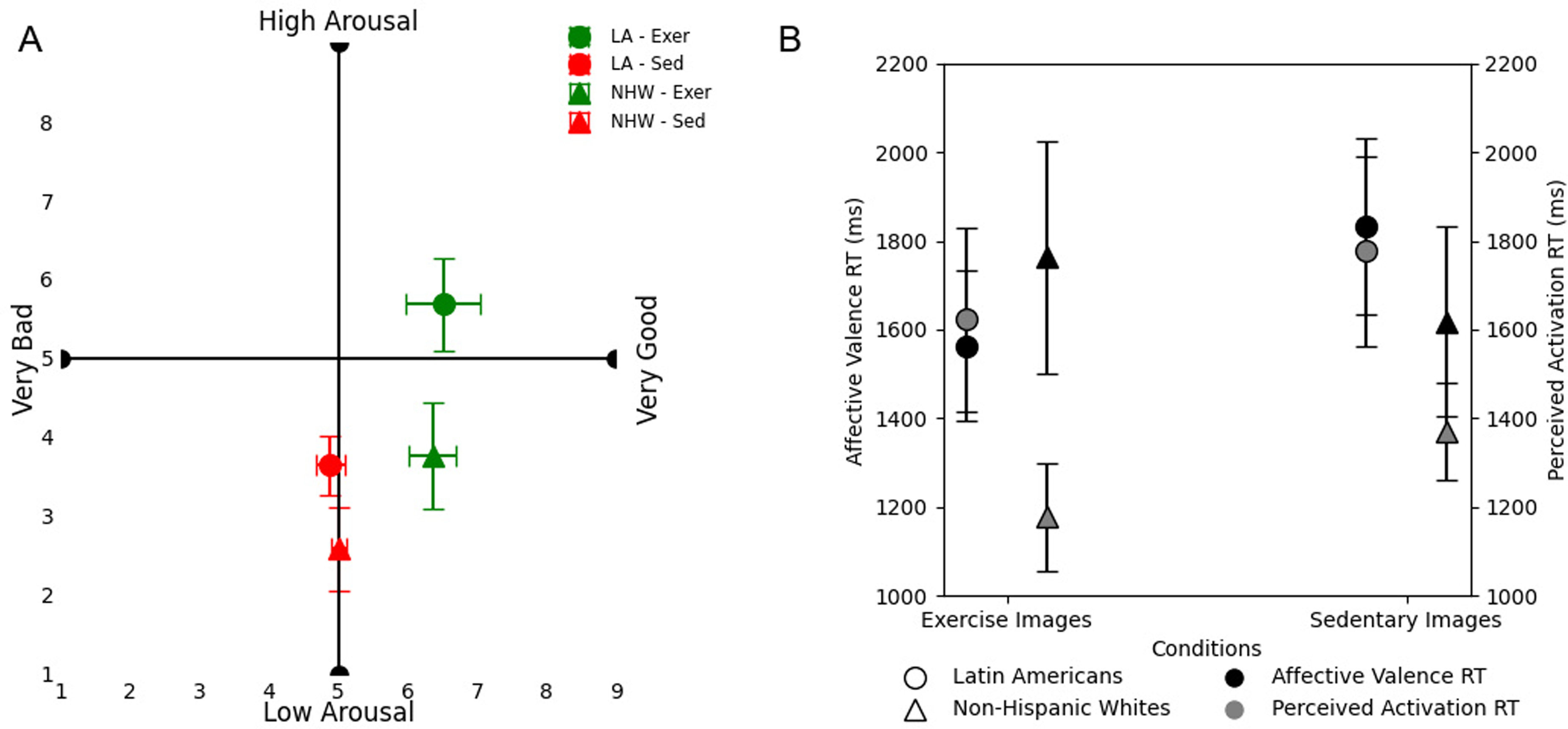
A: Two-dimensional affective space defined by valence and arousal ratings. B: Response time (RT; ms) compared across Latin Americans and Non-Hispanic Whites for affective valence and perceived activation.
Response Time
Directional Connectivity
The Granger Causality analysis provided key insights into the directional interactions between brain areas during the presentation of exercise-related and sedentary-related imagery in both Latin American and Non-Hispanic White participants (see Figure 2). Significant group, condition, and interaction effects were observed; further analysis used Bonferroni-adjusted pairwise comparisons to control for multiple testing (see Figure 3). Additionally, measures of degree centrality and betweenness centrality were calculated to emphasize the most influential brain regions and connections (for a 3D visualization, see Supplementary Material 4).
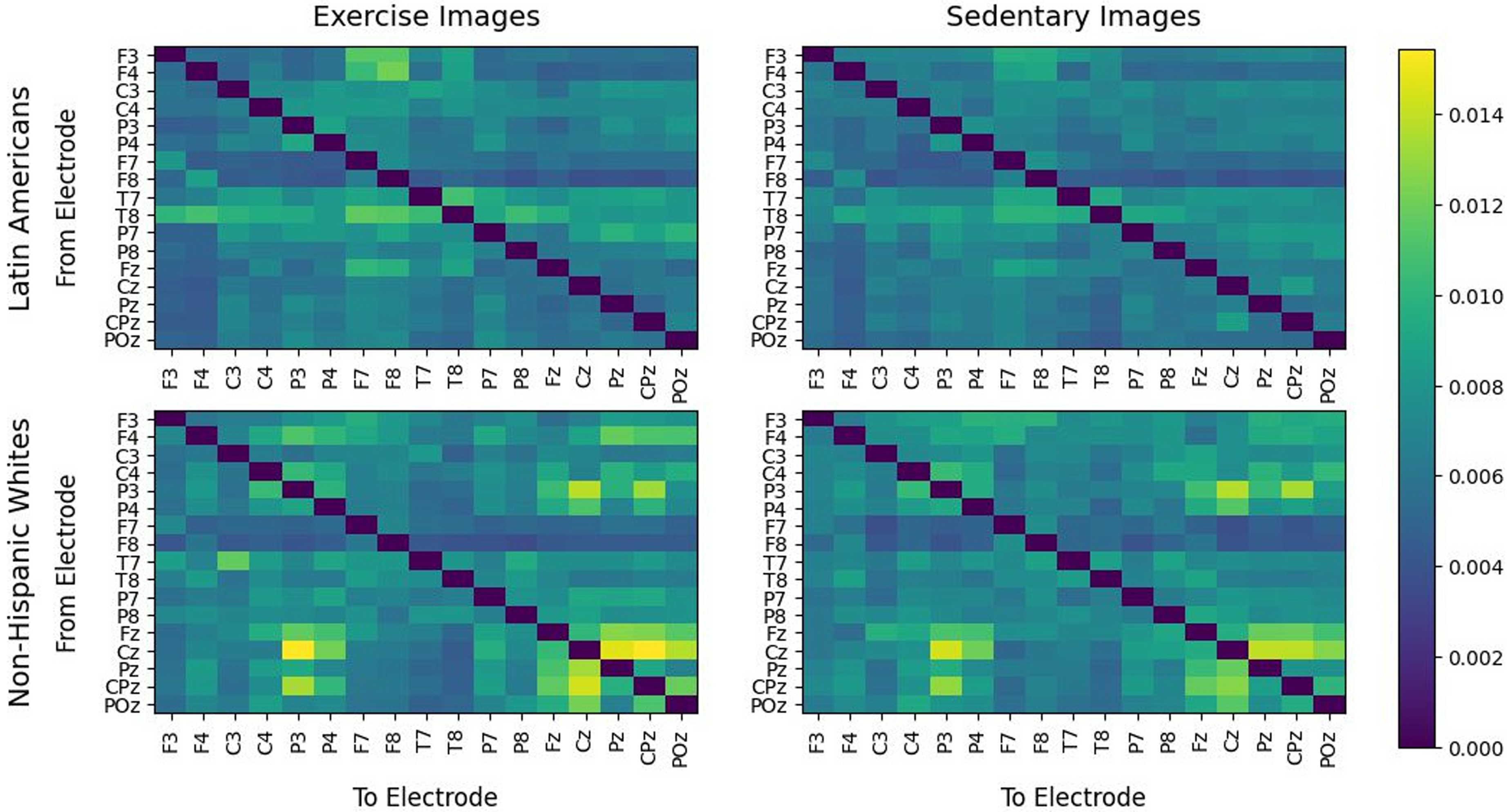
Granger causality matrix across conditions between Latin Americans and Non-Hispanic Whites.
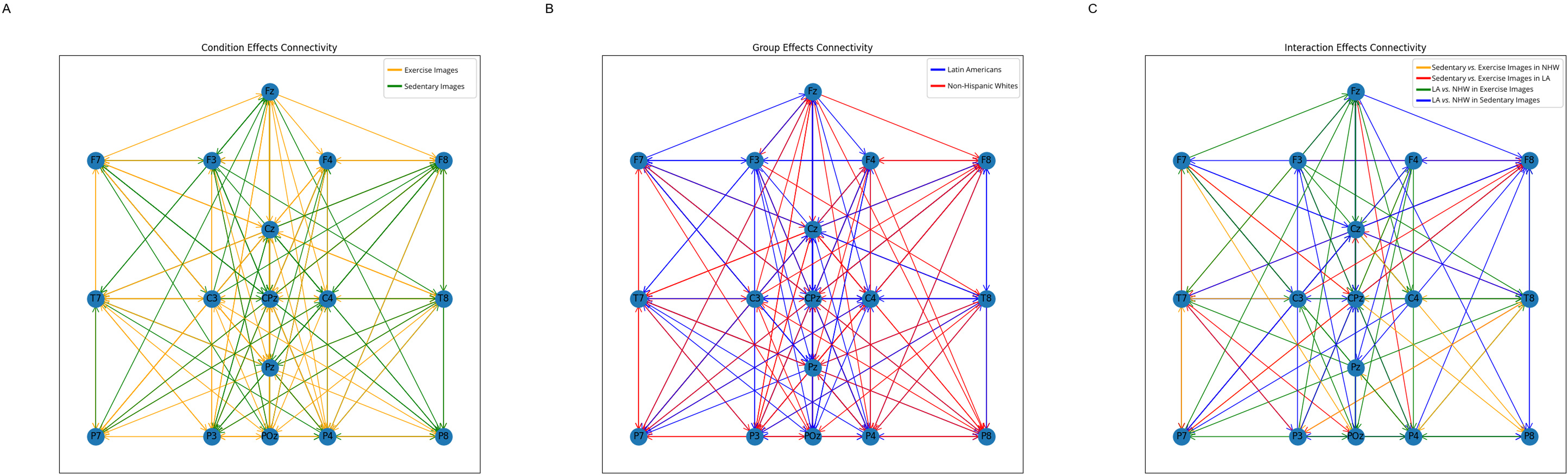
Connectivity patterns in mixed-ANOVA contrast analysis across conditions between Latin Americans and Non-Hispanic Whites
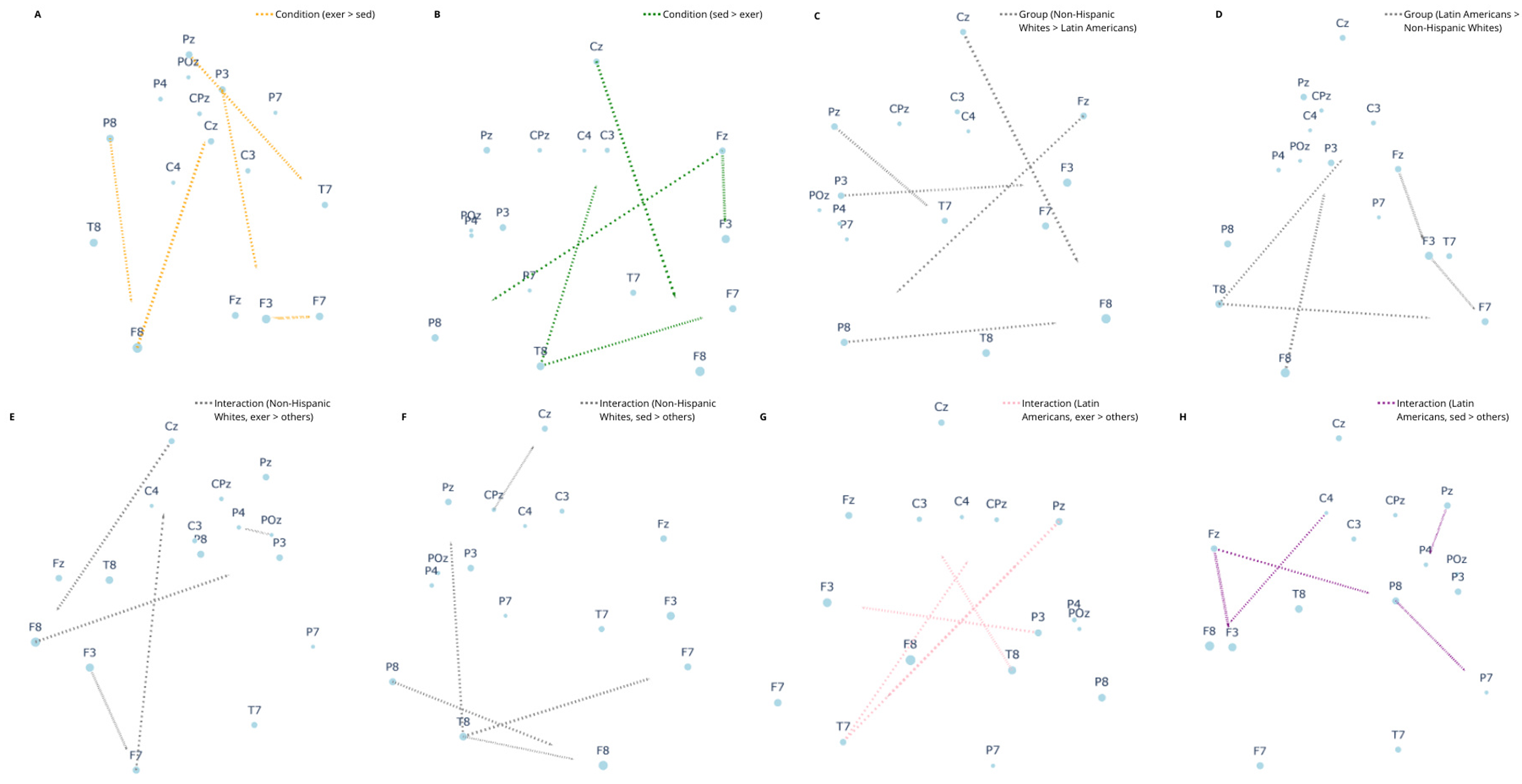
Main Neural Networks across conditions, groups, and interaction.
For Latin American participants, exercise imagery was characterized by greater connectivity from Pz to T7, T7 to Pz, T7 to CPz, T8 to C3, and P3 to F3, indicating a preference for engaging temporal and parietal networks during dynamic stimuli (see Figure 4G). During sedentary imagery, these participants displayed stronger connectivity from Pz to P4, P8 to P7, Fz to P8, Fz to F3, and C4 to F8, suggesting increased involvement of posterior and frontal regions (see Figure 4H). Interaction effects revealed that Non-Hispanic White participants relied more on frontal-parietal networks during exercise imagery, while Latin American participants demonstrated stronger posterior connectivity during sedentary imagery. The higher betweenness centrality observed in temporal regions for Latin American participants, particularly during sedentary imagery, indicates that these regions served as key relay points for processing static visual information, whereas Non-Hispanic White participants relied more on frontal-parietal integration, especially during exercise-related tasks.
Qualitative Analysis
Main Categories and Supporting Quotes
The qualitative categorization of participants’ responses provided deeper insights into how specific themes related to exercise emerged within both groups (see Table 2). Several major categories were identified, including Family Support, Motivation to Exercise, Negative Feelings Toward Exercise, Time Constraints, and Social Influence. These categories were further supported by quotes that provided illustrative examples of participants’ attitudes and experiences. In the Non-Hispanic White group, participants frequently highlighted the significance of familial and social support in motivating their exercise behavior. One participant noted, “My close friends and family love exercising,” indicating that positive reinforcement from social circles plays a crucial role in encouraging regular physical activity. However, time constraints emerged as a significant barrier, as many participants cited their busy schedules as a challenge to maintaining an active lifestyle. One participant shared, “I get overwhelmed with school,” underscoring the difficulty of balancing academic or work-related responsibilities with time for exercise. Additionally, exercise was often described as a means of stress relief, with one individual mentioning, “I feel better, it's a good distress,” reflecting the mental health benefits that physical activity can provide.
A Sample of Supporting Quotes for Each Main Category and Group.
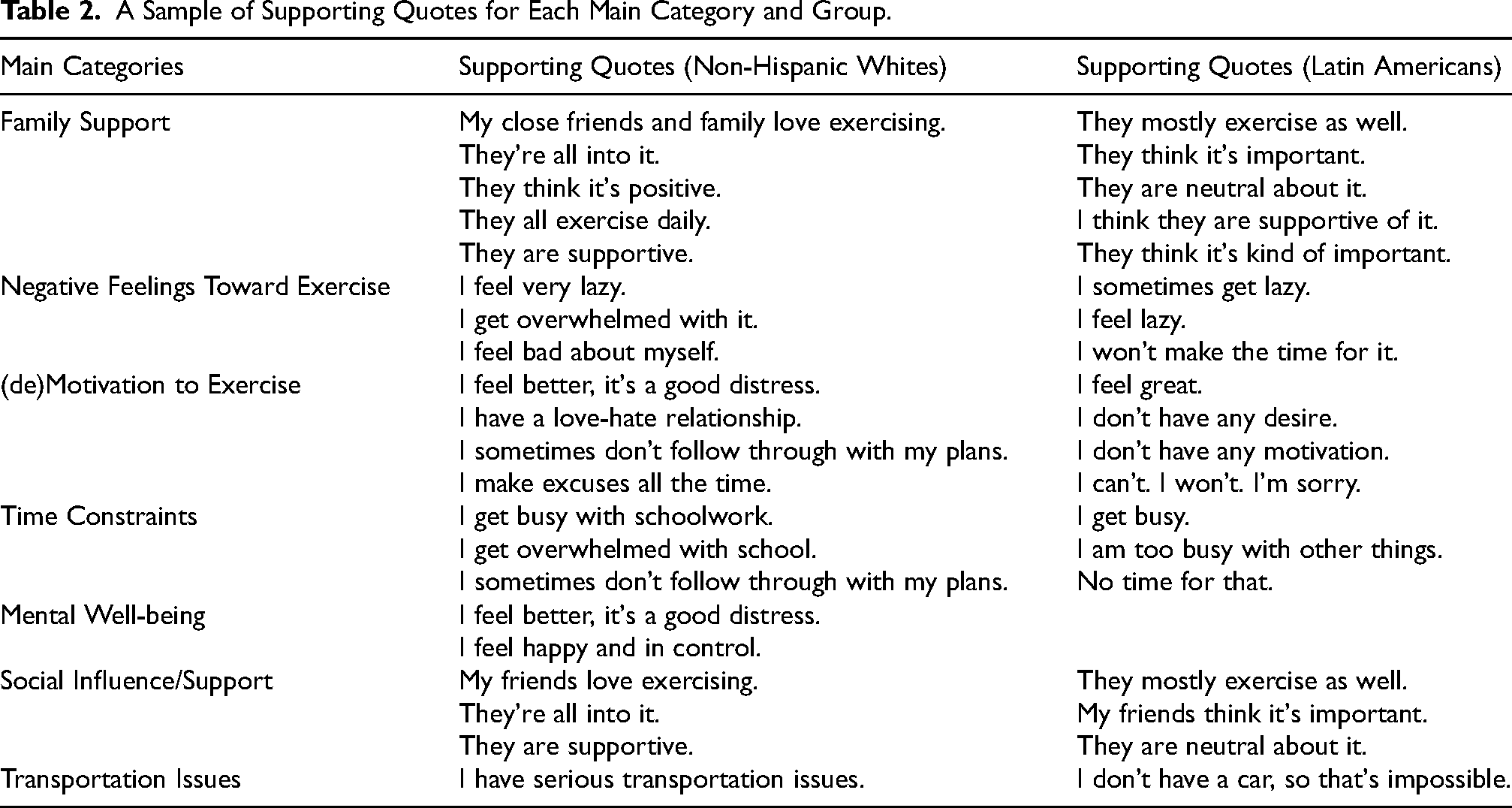
Similarly, in the Latin American group, family support was also a common theme, with participants emphasizing the influence of family in shaping their exercise habits. One participant remarked, “They think it's important,” illustrating how positive family attitudes toward exercise can foster healthier behaviors. However, unlike the Non-Hispanic White group, the Latin American participants expressed more ambivalence toward exercise, with many describing feelings of laziness or a lack of motivation. For instance, one participant admitted, “I feel lazy,” while another shared, “I sometimes get lazy,” highlighting a recurring theme of negative emotions toward physical activity. Time management challenges also echoed those in the Non-Hispanic White group, as participants identified busy schedules as a major obstacle to exercise, with one stating, “I get busy,” illustrating the common struggle to incorporate physical activity into daily routines.
Network Analysis
The bidirectional network graphs for the Non-Hispanic White and Latin American groups provide a deeper understanding of the mutual influences between key categories related to exercise behavior. The network graph for the Non-Hispanic White group reveals a complex web of bidirectional influences, particularly around Family Support, Social Influence, and Motivation to Exercise (see Figure 5A). Family Support is shown to be highly influential, directly affecting Motivation to Exercise with a strong edge weight of 49.35 and being influenced by it in return. This suggests a mutual reinforcement where support from family and social circles encourages exercise, and engaging in physical activity strengthens these bonds. Similarly, Negative Feelings Toward Exercise significantly influence both Social Influence and Mental Well-Being, indicating that peer and societal expectations play a crucial role in shaping both positive and negative attitudes toward exercise. Negative Feelings Toward Exercise also appear to be influenced by Family Support (or lack thereof; weight 53.93). Interestingly, the graph shows that Transportation Issues play a relatively minor role in this group's exercise behavior, with weaker edge weights (10.58) compared to the stronger influences of family and social support. The bidirectional nature of these connections emphasizes the dynamic and interconnected factors that either promote or hinder physical activity in this population.
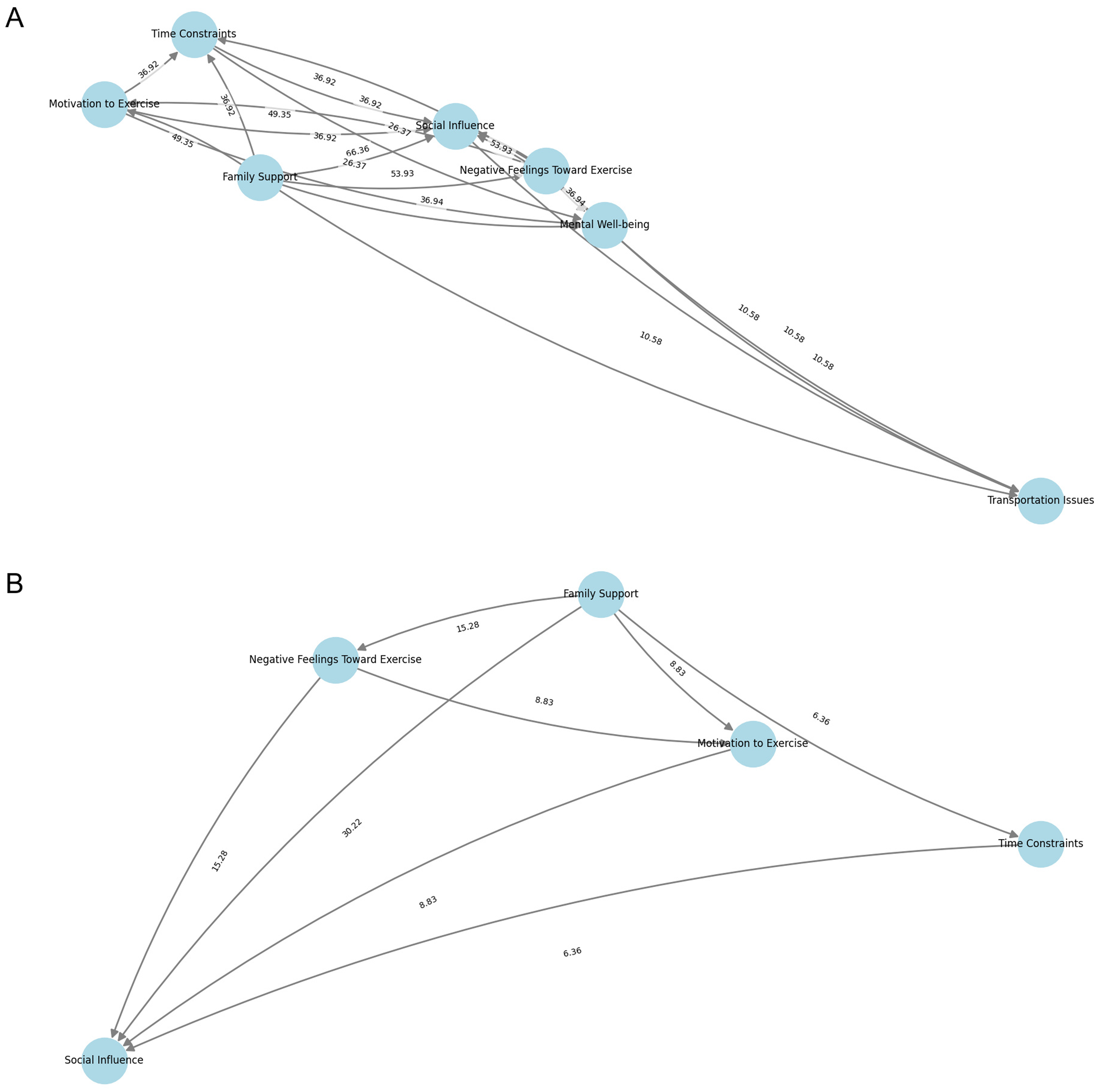
2D network graph with bidirectional influence: qualitative analysis.
The network graph for the Latin American group displays a somewhat simpler structure (see Figure 5B), with fewer strong connections compared to the Non-Hispanic White group. However, the role of Family Support is again prominent, significantly affecting both Social Influences (weight 30.22) and Negative Feelings Toward Exercise (weight 15.28). This underscores the importance of community and peer engagement in shaping exercise behaviors and emotional attitudes toward physical activity within this group. Family Support also appears to influence Motivation to Exercise (weight 8.83), but the influence is weaker compared to the Non-Hispanic White group. This suggests that, while family encouragement remains relevant, other factors, such as Social Influence, may have a stronger impact on exercise behavior in this group. Additionally, Time Constraints exert a moderate influence on Social Influence (weight 6.36). Interestingly, Negative Feelings Toward Exercise also play a significant role, affecting Motivation to Exercise (weight 8.83) and indicating that emotional ambivalence may be a notable barrier in this population. Overall, these bidirectional network graphs highlight the dynamic interactions between motivational factors, emotional barriers, and practical challenges that influence exercise behavior. While both groups demonstrate the importance of social and family support, the differences in edge weights and connection patterns suggest varying levels of influence across these factors for the Non-Hispanic White and Latin American groups.
Discussion
The present study sought to investigate the neural and affective responses to exercise- and sedentary-related imagery among Latin Americans and Non-Hispanic Whites with overweight and obesity. Given the modest sample size, the quantitative results are considered preliminary and are used to identify candidate patterns of cue processing warranting replication. The qualitative component was included to contextualize these patterns by characterizing participants’ perceived barriers, meanings, and appraisals of exercise and sedentary behavior. Specifically, the findings suggest differences in brain connectivity patterns and emotional reactions between the two groups, providing preliminary insights into how cultural context may relate to the processing of exercise- and sedentary-cues. One of the most notable findings of this study is the distinct brain connectivity patterns between Latin Americans and Non-Hispanic Whites when exposed to exercise- and sedentary-related imagery. Bidirectional connectivity analysis indicated group- and condition-dependent differences in directional connectivity patterns. For example, Non-Hispanic White participants exhibited stronger connectivity in frontoparietal networks during the viewing of exercise imagery, whereas Latin Americans showed a more distributed and lateralized pattern of connectivity, particularly during sedentary imagery. These between-group differences should be interpreted cautiously; however, they are consistent with the possibility that exercise cues engage relatively greater top-down control and goal-relevant processing in non-Hispanic White participants (Han et al., 2023), whereas sedentary cues may recruit broader associative or socioemotional processing in Latin American participants (Buckley et al., 2014). These findings align with previous research suggesting that cultural norms and values can significantly influence perceptions of exercise (Rio & Saligan, 2023). In many Western cultures, where thinness and physical fitness are often associated with success and attractiveness, individuals may be more motivated to engage in exercise due to societal pressures (Abdoli et al., 2024; Guo et al., 2023). This could explain the stronger activation of the frontoparietal network among Non-Hispanic Whites, as these regions are generally associated with goal-directed behaviors (Spreng et al., 2010). Conversely, Latin American cultures may prioritize other factors and view the importance of exercise differently, which could explain the broader engagement of neural networks and the more distributed patterns of brain communication (Larsen et al., 2013). We emphasize that these interpretations are hypothesis-generating rather than definitive mechanistic conclusions.
In addition to differences in brain connectivity, the study found that Latin Americans reported higher perceived activation when viewing sedentary-related imagery than Non-Hispanic Whites. This heightened activation could reflect a stronger emotional or psychological reaction to sedentary behaviors, potentially tied to cultural or social norms that prioritize relaxation or family-oriented activities over individual exercise (John et al., 2022). The higher perceived activation could also indicate that Latin Americans experience more emotional conflict when confronted with the idea of physical inactivity, which could serve as a barrier to exercise (Feil et al., 2022). Interestingly, while both groups rated exercise-related imagery more positively in terms of affective valence, the ambivalence toward physical activity expressed by many Latin American participants in the qualitative interviews suggests a deeper emotional resistance to regular exercise (Cheval & Boisgontier, 2021). This could be driven by a myriad of factors, including negative past experiences, a lack of perceived self-efficacy, or cultural norms that do not emphasize physical fitness as strongly as in other cultures (Anderson & Durstine, 2019; Larsen et al., 2015). These emotional barriers, combined with practical challenges such as time constraints and limited access to safe recreational spaces, likely contribute to lower engagement in physical activity among certain Latin American populations (Payán et al., 2019). In this sense, qualitative findings are used to generate contextual hypotheses (e.g., ambivalence, perceived barriers, culturally shaped meanings of activity) that can be tested directly in adequately powered quantitative designs.
The findings of this study have important implications for designing culturally sensitive interventions to promote physical activity among populations with overweight and obesity (Koh et al., 2022). The neural and affective data suggest that different cultural groups may respond differently to physical activity stimuli, and interventions should be tailored accordingly. For instance, while Non-Hispanic Whites may benefit from goal-setting strategies that tap into their frontoparietal networks and motivate action, Latin Americans may require more holistic approaches that address both emotional ambivalence and practical barriers to exercise (Bourke et al., 2024). Public health interventions targeting Latin American populations should consider the cultural emphasis on family and social connectedness (Payán et al., 2019). Programs that incorporate family involvement or community-based activities may be more effective in promoting sustained engagement in physical activity (John et al., 2022). Additionally, addressing emotional barriers to exercise through strategies such as motivational interviewing, self-efficacy building, and culturally appropriate messaging could help reduce resistance to adopting more active lifestyles (Bantham et al., 2021).
Putative Neural Mechanisms
The use of Granger Causality Analysis in this study provided a more nuanced understanding of the neural mechanisms underlying the processing of exercise- and sedentary-related imagery. Importantly, both groups, Latin Americans and Non-Hispanic Whites, were considered physically inactive, and no significant differences were observed in terms of BMI. This uniformity in physical inactivity and BMI helps isolate the cultural factors and neural mechanisms that might influence how these groups perceive exercise and sedentary behaviors. At the same time, participants ranged in age from 19 to 33 years, and age-related variability in young adulthood may influence how exercise- and sedentary-related cues are appraised. Differences in role demands (e.g., academic versus full-time employment), autonomy, and evolving health motivations during this period could modulate the engagement of executive control and salience-related circuitry during cue processing. While we did not test age moderation given the modest sample size, this factor may contribute to individual differences in both affective responses and the organization of directional connectivity patterns, warranting targeted examination in larger samples.
The findings suggest that the salience and frontoparietal networks may play a critical role in mediating the motivational aspects of exercise, particularly in Non-Hispanic Whites (Bigliassi & Filho, 2022). These neural networks, which are implicated in attention, self-referential processing, and goal-directed behavior, are essential for sustaining motivation during physical activity (Buckley et al., 2014). The stronger connectivity observed in these networks during the viewing of exercise imagery could reflect a more intrinsic motivation to engage in physical activity among Non-Hispanic Whites (Di Domenico & Ryan, 2017). This may be explained by the fact that these networks support the integration of personal goals with physical actions, thus fostering a more positive association with exercise (Schimmelpfennig et al., 2023). Conversely, the more distributed brain connectivity observed in Latin Americans, particularly during sedentary imagery, may suggest a greater focus on comfort, relaxation, and social experiences. The involvement of temporal regions, associated with memory, emotion, and social processing, indicates that sedentary behaviors, such as relaxing with family or participating in leisure activities, may be viewed more positively in this group (Collins et al., 2023). These associations could contribute to emotional barriers to physical activity, as exercise might be perceived as more demanding, solitary, or even conflicting with culturally valued social and family-oriented time (Payán et al., 2019). Although our electrode-level connectivity findings are consistent with engagement of circuits commonly linked to cognitive control and salience processing, network-level inferences remain indirect; therefore, the mechanistic account presented here is putative and intended to motivate targeted replication.
It is also essential to consider the directionality of the neural connections observed in this study. Granger Causality Analysis not only identifies which regions are functionally connected but also the direction in which information flows between them (Seth et al., 2015). This directional information provides deeper insights into the underlying neural dynamics of exercise- and sedentary-related imagery processing. For example, in Non-Hispanic Whites, the observed directional connectivity from frontal to parietal regions during exercise imagery suggests a top-down influence, where higher-order cognitive processes (e.g., goal setting and decision-making) drive attention and physical action planning (Marek & Dosenbach, 2018). This pattern aligns with the idea that exercise may be perceived as a goal-directed activity that requires conscious effort and motivation (Cheval & Boisgontier, 2021). In contrast, the more distributed, bidirectional connectivity observed in Latin Americans during sedentary imagery indicates a more balanced flow of information between regions, particularly those involved in social and emotional processing (Palomero-Gallagher & Amunts, 2022). This pattern may suggest that sedentary behaviors are perceived more intuitively, without the need for higher cognitive regulation (Cheval & Boisgontier, 2021). The direction of connections between temporal and parietal regions, for example, highlights how social and emotional associations may dominate over goal-directed behavior, potentially explaining the reduced motivation to engage in physical activity in this group (Palomero-Gallagher & Amunts, 2022).
Strengths and Weaknesses
While this study provides valuable insights into the neural and emotional responses to exercise- and sedentary-related imagery among Latin Americans and Non-Hispanic Whites, several limitations must be acknowledged. One of the primary limitations is the relatively small sample size, which may restrict the generalizability of the findings. While the sample size was sufficient for preliminary exploration, statistical power was likely limited for detecting small-to-moderate effects, particularly group × condition interactions, making it difficult to detect more subtle differences or group interaction (Yano et al., 2019). Consistent with this concern, our sensitivity analysis indicated that, with the present design and sample size, the study was primarily sensitive to large effects, and null or small effects should therefore be interpreted cautiously. Furthermore, the inclusion of participants with both overweight and obesity introduces an additional limitation, as these conditions represent distinct physiological and psychological states (Blüher, 2019; Mehrabi et al., 2021). Ideally, the sample would have either focused on a single condition or split participants into separate groups for more accurate comparisons. However, due to the insufficient sample size, such a division was not possible, which may have influenced the consistency of our findings. Recruiting participants who met the stringent inclusion criteria, such as BMI, physical inactivity, and ethnic background, posed significant challenges. The combination of these criteria, along with the need to balance recruitment across ethnic groups, limited the availability of suitable participants and underscored the practical difficulties of assembling a larger, more diverse sample.
Another limitation concerns the method used to measure perceptions of exercise and sedentary behaviors. The study relied on imagery-based stimuli and self-reported affective responses, which may not accurately reflect real-world experiences (Marini et al., 2019). While viewing exercise- or sedentary-related images can elicit emotional and cognitive responses, this approach lacks ecological validity as it does not replicate actual physical activity or sedentary behavior in real-life contexts. Perceptions of exercise and sedentary behavior are likely influenced by numerous factors in a real-world setting, such as physical fatigue, environmental influences, and social interaction, which were not captured in the controlled experimental environment (Koh et al., 2022). The reliance on self-reported measures of affect also presents limitations. Moreover, normative valence and arousal ratings were unavailable for the selected images; therefore, we cannot confirm that the stimulus sets were matched on standardized affective norms. In addition, self-reports are inherently prone to biases, such as social desirability and inaccurate recall, which can skew participants’ emotional responses to stimuli (Prince et al., 2008). Additionally, the emotional responses elicited by static images may not fully capture the dynamic and multifaceted nature of emotional states experienced during actual physical activity or sedentary periods.
Granger Causality Analysis, while a valuable tool for assessing the directionality of neural interactions, also comes with limitations. This method assumes linear relationships between time series data and may not fully capture the complex, non-linear dynamics of brain activity during emotional and cognitive processing (Rabinovich & Muezzinoglu, 2010). Additionally, Granger Causality infers directional influence rather than true causality, which limits the ability to draw definitive conclusions about the neural mechanisms driving exercise or sedentary behavior perceptions (Seth et al., 2015). In addition, the semi-structured interview process, while useful for gathering qualitative insights into participants’ perceptions of exercise and sedentary behavior, also presents limitations. Interviews are subject to interviewer bias, and the depth of responses can vary between participants, potentially leading to inconsistent data (Cairns-Lee et al., 2022). Additionally, because the interviews were conducted after the neural and affective assessments, participants’ responses may have been influenced by their immediate experience with the study's tasks.
Another key limitation is the diversity within the ethnic groups studied. Both Latin Americans and Non-Hispanic Whites encompass a wide range of cultures, subcultures, and socioeconomic backgrounds (Bantham et al., 2021). Latin Americans, for example, represent individuals from various countries with distinct cultural traditions, languages, and attitudes toward exercise (Larsen et al., 2015). Similarly, the Non-Hispanic White population in the U.S. is not culturally homogeneous, and regional, socioeconomic, and lifestyle differences could have influenced the participants’ perceptions and neural responses (Read et al., 2021). This cultural diversity within each group may have introduced variability in the data that was not fully captured or controlled for. Future studies should aim to disaggregate these broad categories to explore cultural differences in greater depth, possibly by including larger, more culturally specific samples that allow for comparisons within as well as between ethnic groups.
Despite the abovementioned limitations, this study contributes important preliminary insights into the neural and emotional processes underlying cultural differences in perceptions of exercise and sedentary behavior. Future research should aim to address these limitations by recruiting larger, more diverse samples, employing more advanced connectivity analysis techniques, and using a broader range of objective and qualitative measures to provide a more comprehensive understanding of these complex processes. Moreover, exploring the influence of acculturation, socioeconomic factors, and regional differences within cultural groups will be essential for developing culturally tailored interventions to promote physical activity and reduce obesity in diverse populations.
Conclusions
In conclusion, the present study highlights the importance of considering cultural differences in the neural and emotional responses to exercise and sedentary behaviors. The distinct patterns of brain connectivity and affective responses observed between Latin Americans and Non-Hispanic Whites emphasize the role of cultural context in shaping perceptions of physical activity. Specifically, Non-Hispanic Whites showed stronger frontoparietal connectivity during exercise-related imagery, suggesting a more goal-directed and motivation-driven response, while Latin Americans exhibited more distributed and temporal region engagement during sedentary imagery, reflecting a focus on social and emotional aspects of relaxation. These group differences in both exercise and sedentary conditions underscore the need for culturally tailored interventions that account for the unique cognitive and emotional barriers each group faces in relation to physical activity. By understanding these neural and emotional barriers, we can develop more effective strategies to promote healthier behaviors and address the growing obesity epidemic, ultimately improving public health outcomes across diverse populations.
Supplemental Material
sj-docx-1-rnn-10.1177_09226028261436633 - Supplemental material for Perceptions of Exercise in Latin Americans and Non-Hispanic Whites with Overweight and Obesity
Supplemental material, sj-docx-1-rnn-10.1177_09226028261436633 for Perceptions of Exercise in Latin Americans and Non-Hispanic Whites with Overweight and Obesity by Marcelo Bigliassi, Dayanne S. Antonio, Ekaterina Oparina and Jason R. Kostrna in Restorative Neurology and Neuroscience
Supplemental Material
sj-docx-2-rnn-10.1177_09226028261436633 - Supplemental material for Perceptions of Exercise in Latin Americans and Non-Hispanic Whites with Overweight and Obesity
Supplemental material, sj-docx-2-rnn-10.1177_09226028261436633 for Perceptions of Exercise in Latin Americans and Non-Hispanic Whites with Overweight and Obesity by Marcelo Bigliassi, Dayanne S. Antonio, Ekaterina Oparina and Jason R. Kostrna in Restorative Neurology and Neuroscience
Supplemental Material
sj-docx-3-rnn-10.1177_09226028261436633 - Supplemental material for Perceptions of Exercise in Latin Americans and Non-Hispanic Whites with Overweight and Obesity
Supplemental material, sj-docx-3-rnn-10.1177_09226028261436633 for Perceptions of Exercise in Latin Americans and Non-Hispanic Whites with Overweight and Obesity by Marcelo Bigliassi, Dayanne S. Antonio, Ekaterina Oparina and Jason R. Kostrna in Restorative Neurology and Neuroscience
Supplemental Material
sj-html-4-rnn-10.1177_09226028261436633 - Supplemental material for Perceptions of Exercise in Latin Americans and Non-Hispanic Whites with Overweight and Obesity
Supplemental material, sj-html-4-rnn-10.1177_09226028261436633 for Perceptions of Exercise in Latin Americans and Non-Hispanic Whites with Overweight and Obesity by Marcelo Bigliassi, Dayanne S. Antonio, Ekaterina Oparina and Jason R. Kostrna in Restorative Neurology and Neuroscience
Footnotes
Acknowledgements
We would like to thank Courtney Afram-Gyening and Anamaria Astudillo Garcia for their invaluable assistance with participant recruitment and data collection.

Ethical Considerations
This study was approved by the Florida International University Institutional Review Board (110966) on 11/12/2021.
Consent to Participate
All participants provided written informed consent to participate in this study.
Consent for Publication
No participant identifying information is shared in this publication. All participants were notified that their data may be used in future publications during the informed consent process.
Author Contributions
All authors contributed to the study. Material preparation, data collection, and analysis were performed by Dr. Marcelo Bigliassi, Dayanne Antonio, and Ekaterina Oparina. The first draft of the manuscript was written by Dr. Marcelo Bigliassi and all authors commented on previous versions of the manuscript. All authors read and approved the final manuscript.
Funding
This research was supported, in part, by a seed grant from the College of Arts, Sciences & Education (Department of Teaching and Learning) at Florida International University.
Declaration of Conflicting Interests
The authors declared no potential conflicts of interest with respect to the research, authorship, and/or publication of this article.
Data Availability
The data associated with the findings of this study are available from the corresponding author upon reasonable request.
Supplemental Material
Supplemental material for this article is available online.
References
Supplementary Material
Please find the following supplemental material available below.
For Open Access articles published under a Creative Commons License, all supplemental material carries the same license as the article it is associated with.
For non-Open Access articles published, all supplemental material carries a non-exclusive license, and permission requests for re-use of supplemental material or any part of supplemental material shall be sent directly to the copyright owner as specified in the copyright notice associated with the article.
